
Design Behaviour and Interface Consistency in Generative No-Code Tools: A Systematic Literature Review

Abstract
1. Introduction
- It synthesizes reported evidence on layout, styling, usability, and accessibility into a structured synthesis of generative design behaviour;
- It shows that variability and inconsistency arise from learned design priors rather than isolated technical errors; and
- It identifies reproducibility, transparency, and controllability as necessary properties for reliable human–AI interface development.
2. Background
2.1. The Rise of Low-Code/No-Code Development
2.2. Defining Low-Code and No-Code
2.3. The Convergence with Generative AI in UI Design
2.3.1. Multimodal Large Language Models (MLLMs)
2.3.2. Structured Approaches for Managing UI Complexity
2.4. Challenges in Generative AI and No-Code UI Automation
3. Related Work
3.1. Systematic Literature Reviews and Surveys on Low-Code/No-Code Platforms
3.2. Empirical Studies Evaluating AI-Generated User Interface Designs
3.3. Systems for UI Authoring and Structured Representations
3.4. Accessibility- and Usability-Focused Evaluations of AI-Generated Interfaces
3.5. Motivation for Further Systematic Review
4. Methods
4.1. Research Questions
- MRQ: How do generative AI-based no-code tools make user interface (UI) design and aesthetic decisions when generating applications from natural-language prompts?
- RQ1: What underlying design principles, layout structures, or color strategies can be observed in the generated interfaces?
- RQ2: How do generative design tools (e.g., Bolt, Lovable, Replit) vary in the user interfaces they generate when given the same prompt, both across different tools and across repeated generations within the same tool?
- RQ3: To what extent do the generated interfaces adhere to established usability and accessibility guidelines (e.g., WCAG and Nielsen’s heuristics)?
- RQ4: What limitations, biases, or inconsistencies exist in the current generative UI design systems?
4.2. Review Protocol and Planning
4.3. Search Strategy
4.4. Inclusion and Exclusion Criteria
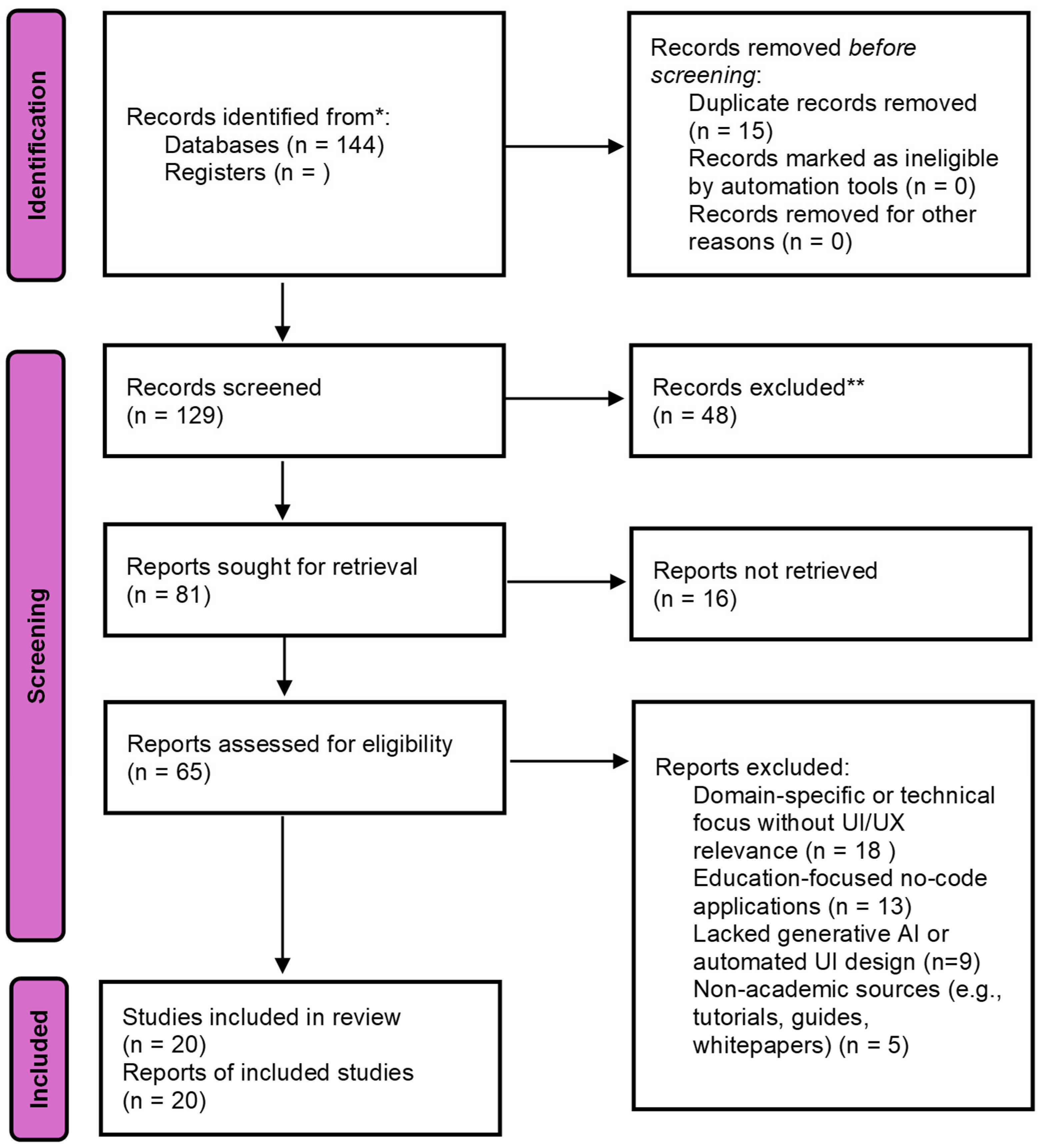
4.5. Study Selection Process
4.6. Data Extraction and Categorization
4.7. Quality Assessment Criteria
4.8. Synthesis and Analysis Approach
5. Findings
5.1. RQ1—Design Principles, Layout Structures, Color Strategies
5.1.1. Design Principles and Usability Heuristics
5.1.2. Layout Structures and Hierarchical Organization
5.1.3. Color and Styling Decisions
5.2. RQ2—Cross-Tool and Within-Tool Variability
5.3. RQ3—Usability and Accessibility Compliance
5.3.1. Usability
5.3.2. Accessibility
5.4. RQ4—Limitations, Biases, Inconsistencies
5.4.1. Functional and Structural Limitations
5.4.2. Non-Determinism and Consistency
5.4.3. Platform Constraints
5.4.4. Bias and Ethical Concerns
6. Discussion
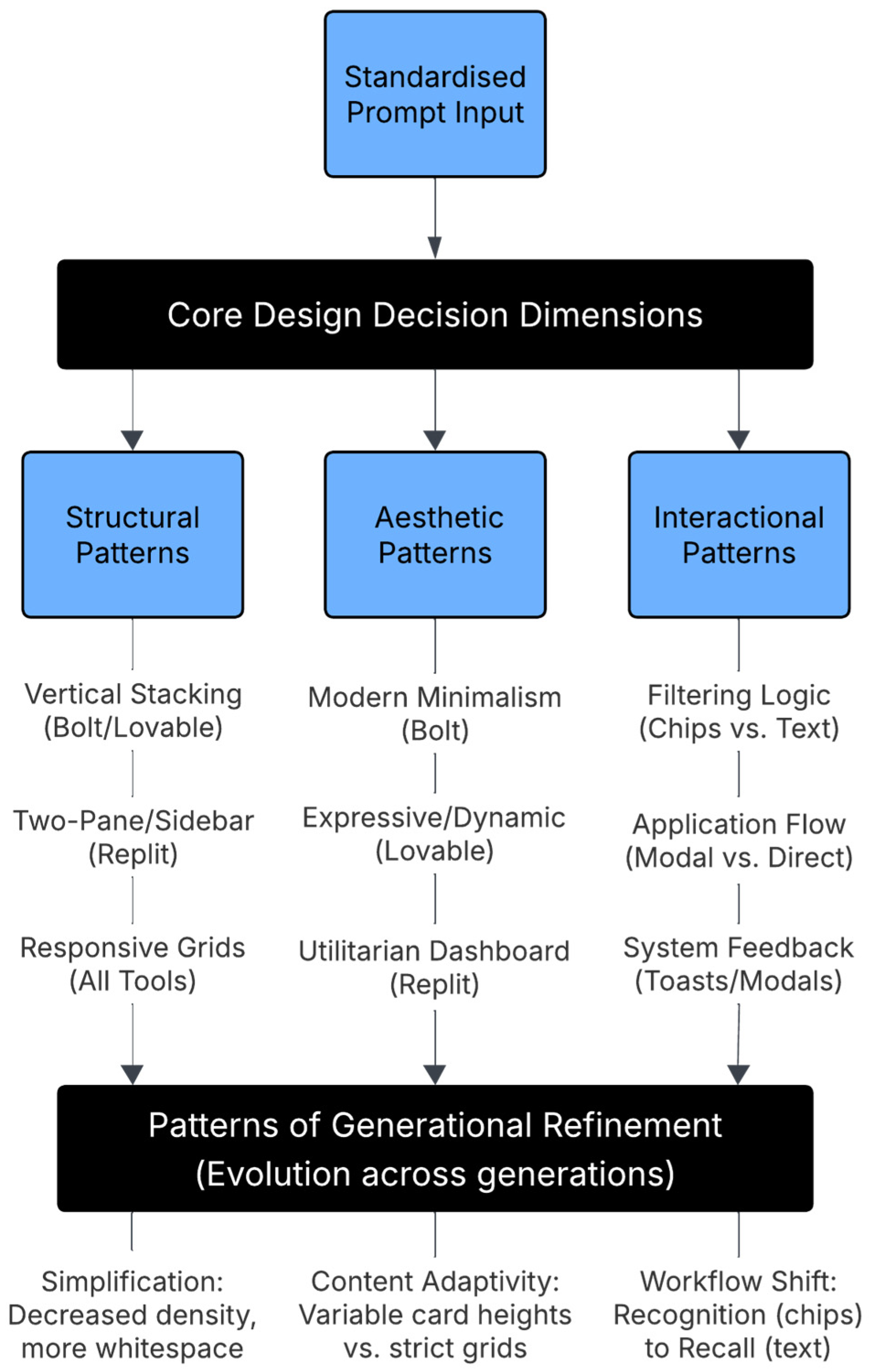
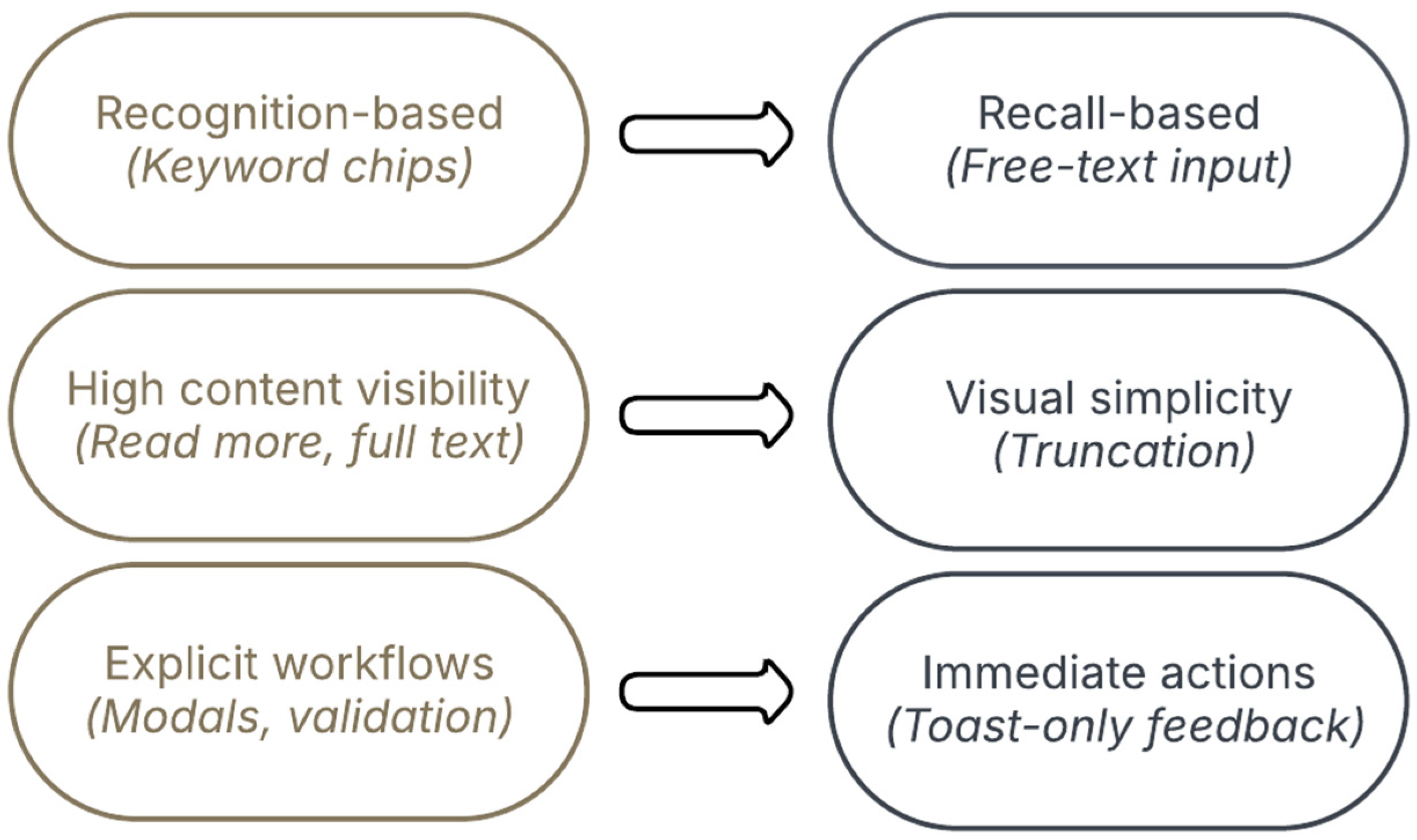
6.1. Design Decision Patterns in Generative No-Code Tools
6.2. Variability and Reproducibility
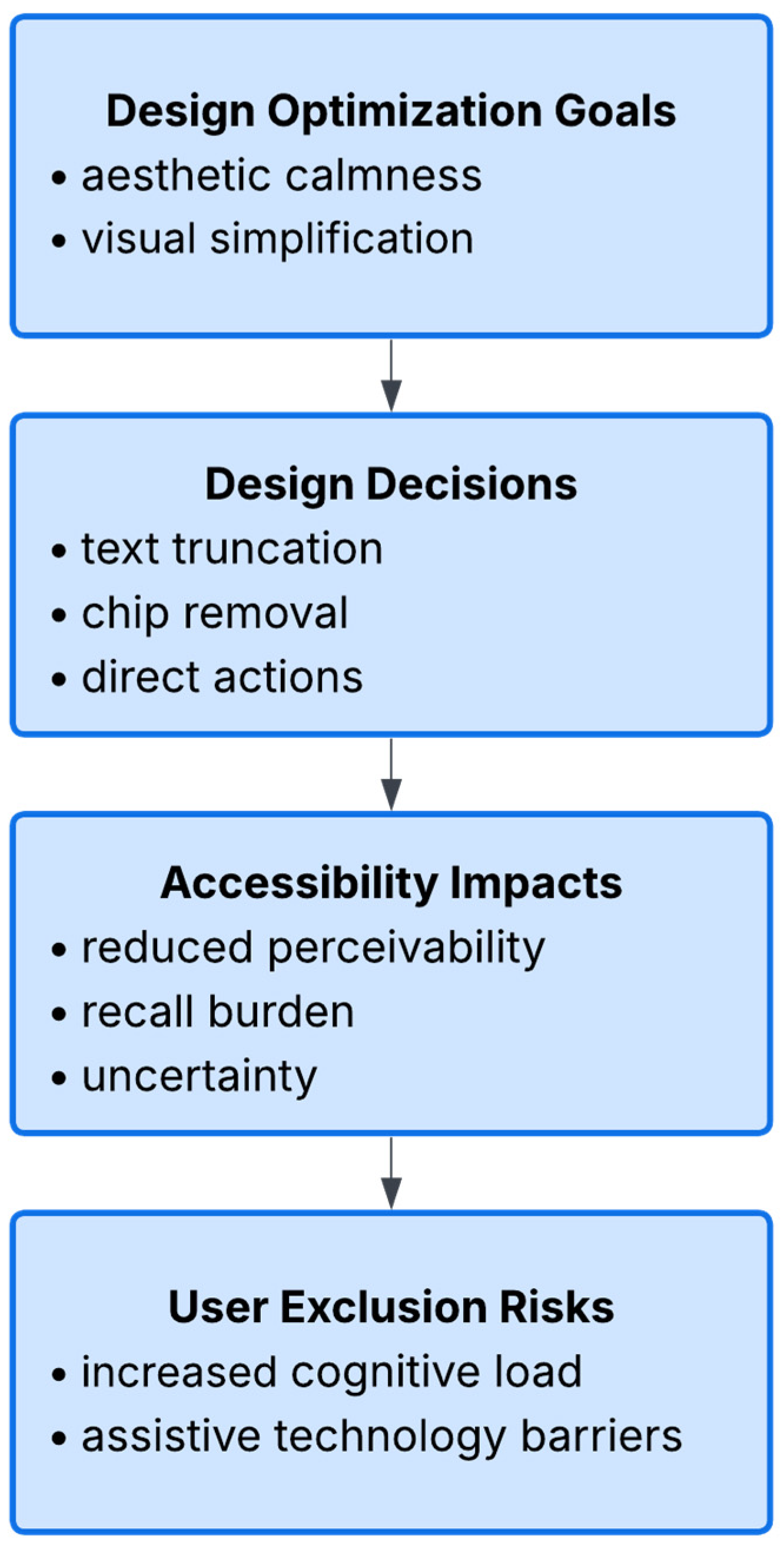
6.3. Usability and Accessibility as Emergent Properties
6.4. Implications for Human-AI Collaboration
6.5. Implications for Human-Computer Interaction Research
- how users form mental models of generative behavior
- how interfaces communicate degrees of confidence or stability
- how users constrain exploration without over-specifying solutions
- how iterative refinement affects trust and perceived control
6.6. Implications for Software Engineering Research
- managing prompt and model configurations as versioned development inputs
- defining acceptable ranges of variation rather than exact outputs
- validating stability across multiple generations
- detecting undesirable drift during iterative refinement
6.7. Implications for Future Tool Design
- Transparency: communicating the constraints, assumptions, and preserved properties guiding each generation
- Controllability: enabling users to lock structural decisions, bound stylistic variation, and maintain consistency across iterations
- Reproducibility: allowing regeneration of equivalent interfaces across sessions, collaborators, and deployment stages
7. Threats to Validity
7.1. Study Identification and Selection Validity
7.2. Data Extraction and Interpretation Validity
7.3. Generalizability and Temporal Validity
8. Conclusions
Author Contributions
Funding
Data Availability Statement
Conflicts of Interest
References
- Paliwal, G.; Donvir, A.; Gujar, P.; Panyam, S. Low-code/no-code meets GenAI: A new era in product development. In Proceedings of the IEEE 8th Ecuador Technical Chapters Meeting (ETCM), Cuenca, Ecuador; IEEE: New York, NY, USA, 2024. [Google Scholar]
- Liu, Y.; Yang, B.; Lee, M.; Martens, J.-B. Low-code conversation-based hybrid UI design: A case study and reflection. In Proceedings of the Chinese CHI 2023 (CHCHI 2023), Denpasar, Bali, Indonesia, 13–16 November 2023; Association for Computing Machinery: New York, NY, USA, 2024. [Google Scholar]
- Liu, D.; He, J.; Guo, S.; Chen, Y.; Qiao, L. What’s wrong with low-code development platforms? An empirical study of low-code development platform bugs. IEEE Trans. Reliab. 2024, 73, 695–708. [Google Scholar] [CrossRef]
- Velásquez, A.P.; Pérez-Salazar, C.; Hernández-González, L.A.; Sánchez-García, Á.J. Systematic literature review of low-code and its future trends. In Proceedings of the 12th International Conference on Software Engineering Research and Innovation (CONISOFT), Puerto Escondido, Mexico; IEEE: New York, NY, USA, 2024. [Google Scholar]
- Gui, Y.; Li, Z.; Zhang, Z.; Wan, Y.; Chen, D.; Zhang, H.; Su, Y.; Chen, B.; Zhou, X.; Jiang, W.; et al. UICopilot: Automating UI synthesis via hierarchical code generation from webpage designs. In Proceedings of the ACM Web Conference (WWW), Sydney, Australia; Association for Computing Machinery: New York, NY, USA, 2025. [Google Scholar]
- Vaithilingam, P.; Glassman, E.; Inala, J.; Wang, C. DynaVis: Dynamically synthesized UI widgets for visualization editing. In Proceedings of the 2024 CHI Conference on Human Factors in Computing Systems (CHI ’24), Honolulu, HI, USA; Association for Computing Machinery: New York, NY, USA, 2024. [Google Scholar]
- Zhang, Y.; Liu, J.; Zhang, T.; Chen, X.; Guo, W.; Chen, X. MultiML: A machine learning model construction tool based on multidimensional views. In Proceedings of the IEEE First International Conference on Data Intelligence and Innovative Application (DIIA); IEEE: New York, NY, USA, 2024; pp. 1–7. [Google Scholar]
- Leung, A.; Cheng, R.; Wu, J.; Nichols, J.; Barik, T. SQUIRE: Interactive UI authoring via slot query intermediate representations. In Proceedings of the 38th Annual ACM Symposium on User Interface Software and Technology; CSCW1; Association for Computing Machinery: New York, NY, USA, 2025; Volume 9, p. 167. [Google Scholar] [CrossRef]
- Chen, Z.; Wang, C.; Sun, W.; Yang, G.; Liu, X.; Zhang, J.; Liu, Y. Promptware engineering: Software engineering for LLM prompt development. arXiv 2025, arXiv:2503.02400. [Google Scholar] [CrossRef]
- Sumit, S.A. The Future of No-Code Web Development: Evaluating the Potential and Limitations of Webflow. Bachelor’s Thesis, Haaga-Helia University of Applied Sciences, Helsinki, Finland, 2025. [Google Scholar]
- Zhang, L. Evaluating the Merits of the Low-Code/No-Code Paradigm from the Perspective of ISO 25010 Quality Requirements. Bachelor’s Thesis, Lappeenranta–Lahti University of Technology (LUT), Lappeenranta, Finland, 2024. [Google Scholar]
- Abahussain, O.; Al-Ammary, J. Low-code/no-code platforms: Impact and concerns. In Proceedings of the International Conference on IT Innovation and Knowledge Discovery (ITIKD), Manama, Bahrain; IEEE: New York, NY, USA, 2025. [Google Scholar]
- De Silva, D.; Shangavie, R.; Ranathunga, R. Role of quality assurance in low-code/no-code projects. In Proceedings of the International Conference on Information and Knowledge Integration (ICOIN); IEEE: New York, NY, USA, 2024; pp. 789–794. [Google Scholar] [CrossRef]
- Huang, T.; Yu, C.; Shi, W.; Peng, Z.; Yang, D.; Sun, W.; Shi, Y. Prompt2Task: Automating UI tasks on smartphones from textual prompts. ACM Trans. Comput.-Hum. Interact. 2025, 32, 1–45. [Google Scholar] [CrossRef]
- Zhou, T.; Zhao, Y.; Hou, X.; Sun, X.; Chen, K.; Wang, H. DeclarUI: Bridging design and development with automated declarative UI code generation. Proc. ACM Softw. Eng. 2025, 2, 219–241. [Google Scholar] [CrossRef]
- Wu, F.; Gao, C.; Li, S.; Wen, X.; Liao, Q. MLLM-based UI2Code automation guided by UI layout information. arXiv 2025, arXiv:2506.10376. [Google Scholar] [CrossRef]
- Wan, Y.; Wang, C.; Dong, Y.; Wang, W.; Li, S.; Huo, Y.; Lyu, M. Divide-and-conquer: Generating UI code from screenshots. Proc. ACM Softw. Eng. 2025, 2, 2099–2122. [Google Scholar] [CrossRef]
- Cheng, Y.; Chen, J.; Huang, Q.; Xing, Z.; Xu, X.; Lu, Q. Prompt Sapper: A LLM-empowered production tool for building AI chains. ACM Trans. Softw. Eng. Methodol. 2023, 33, 1–24. [Google Scholar] [CrossRef]
- Duan, P.; Cheng, C.-Y.; Li, G.; Hartmann, B.; Li, Y. UICrit: Enhancing automated design evaluation with a UI critique dataset. In Proceedings of the CHI Conference on Human Factors in Computing Systems (CHI); Association for Computing Machinery: New York, NY, USA, 2024. [Google Scholar]
- Lu, Y.; Leung, A.; Swearngin, A.; Nichols, J.; Barik, T. Misty: UI prototyping through interactive conceptual blending. arXiv 2024, arXiv:2409.13900. [Google Scholar]
- Naqvi, B.; Kedziora, D.; Zhang, L.; Oyedeji, S. Quality of low-code/no-code development platforms through the lens of ISO 25010:2023. Computer 2025, 58, 30–40. [Google Scholar] [CrossRef]
- Cui, J. The Impact of Low-Code and No-Code Programming on Software Product Delivery Quality and Development Efficiency; SSRN: Rochester, NY, USA, 2024. [Google Scholar] [CrossRef]
- Khalajzadeh, H.; Grundy, J. Accessibility of low-code approaches: A systematic literature review. Inf. Softw. Technol. 2024, 177, 107570. [Google Scholar] [CrossRef]
- Somer, P. Algorithmic accountability of low-code/no-code artificial intelligence: A literature review. In Proceedings of the Thirty-First Americas Conference on Information Systems (AMCIS), Montréal, QC, Canada, 14–16 August 2025. [Google Scholar]
- El Kamouchi, H.; Kissi, M.; El Beggar, O. Low-code/no-code development: A systematic literature review. In Proceedings of the International Conference on Innovative Trends in Information Technology (SITA); IEEE: New York, NY, USA, 2023; pp. 1–8. [Google Scholar] [CrossRef]
- Gao, D.; Fagerholm, F. Measuring end-user developers’ episodic experience of a low-code development platform. e-Inform. Softw. Eng. J. 2024, 18, 240105. [Google Scholar]
- Roy, N.; Horielko, O.; Omojokun, O. Benchmarking of generative AI tools in software engineering education: Formative insights for curriculum integration. In Proceedings of the ACM Conference on International Computing Education Research (ICER 2025), Charlottesville, VA, USA, 3–6 August 2025; Association for Computing Machinery: New York, NY, USA, 2025; Volume 2. [Google Scholar] [CrossRef]
- Lively, J.; Hutson, J.; Melick, E. Integrating AI-generative tools in web design education: Enhancing student aesthetic and creative copy capabilities using image- and text-based AI generators. DS J. Artif. Intell. Robot. 2023, 1, 23–33. [Google Scholar] [CrossRef]
- Xu, H.; Yu, X.-Y. From PowerPoint UI sketches to web-based applications: Pattern-driven code generation for GIS dashboard development using knowledge-augmented LLMs, context-aware visual prompting, and the React framework. arXiv 2025, arXiv:2502.08756. [Google Scholar]
- Dibia, V.; Chen, J.; Bansal, G.; Syed, S.; Fourney, A.; Zhu, E.; Wang, C.; Amershi, S. AutoGen Studio: A no-code developer tool for building and debugging multi-agent systems. arXiv 2024, arXiv:2408.15247. [Google Scholar]
- Liu, Y.-F.; Luthfi, M.I.; Hwang, W.-Y. Enhancing usability and learner engagement: A heuristic evaluation of the AI-enhanced video drama maker app. In Proceedings of the Joint International Conference on Computer Science, Software Engineering and Applications (JCSSE); IEEE: New York, NY, USA, 2024; pp. 337–342. [Google Scholar]
- Guriță, A.-E.; Vatavu, R.-D. Good accessibility, handcuffed creativity: AI-generated UIs between accessibility guidelines and practitioners’ expectations. In Proceedings of the ACM Designing Interactive Systems Conference (DIS ’25), New York, NY, USA; Association for Computing Machinery: New York, NY, USA, 2025; pp. 1197–1209. [Google Scholar] [CrossRef]
- Guriță, A.-E. Understanding and improving accessibility in AI-generated interfaces through interactive prompt engineering methods. In Proceedings of the ACM International Conference on Human Factors in Computing Systems (CHI); Association for Computing Machinery: New York, NY, USA, 2025; pp. 101–104. [Google Scholar] [CrossRef]
- Iman, J.; Felisha, A.; Kimeison, M.; Hermawan, E.; Rumagit, R.; Pranoto, H. Refining UI/UX with minimalist design and AI: Towards sustainable and efficient digital experiences. Procedia Comput. Sci. 2025, 269, 669–680. [Google Scholar] [CrossRef]
- Kamnerddee, C.; Putjorn, P.; Intarasirisawat, J. AI-driven design thinking: A comparative study of human-created and AI-generated UI prototypes for mobile applications. In Proceedings of the International Conference on Intelligent Computing and Technologies (InCIT); IEEE: New York, NY, USA, 2024; pp. 237–242. [Google Scholar] [CrossRef]
- Shahab, M.A. The Impact of Generative AI on UI Design for Mobile Applications in Terms of Efficiency Using the SPACE Framework. Master’s Thesis, Tampere University, Tampere, Finland, 2024. [Google Scholar]
- Abu Doush, I.; Kassem, R. Evaluating AI-generated web code for accessibility compliance: A metric-driven approach. In Proceedings of the ACM International Conference on Web Engineering; Association for Computing Machinery: New York, NY, USA, 2025; pp. 338–344. [Google Scholar] [CrossRef]
- Monteiro, M.; Branco, B.; Silvestre, S.; Avelino, G.; Valente, M. NoCodeGPT: A no-code interface for building web apps with language models. Softw. Pract. Exp. 2025, 55, 1408–1424. [Google Scholar] [CrossRef]
- Fischer, M.; Lanquillon, C. Evaluation of generative AI-assisted software design and engineering: A user-centered approach. In International Conference on Human-Computer Interaction; Lecture Notes in Computer Science; Springer: Cham, Switzerland, 2024; Volume 14734, pp. 31–47. [Google Scholar] [CrossRef]
- Guthardt, T.; Kosiol, J.; Hohlfeld, O. Low-code vs. the developer: An empirical study on the developer experience and efficiency of a no-code platform. In Proceedings of the ACM International Conference on Software Engineering; Association for Computing Machinery: New York, NY, USA, 2024; pp. 856–865. [Google Scholar] [CrossRef]
- Liu, S.; La, H.; Willms, A.; Rhodes, R. A “no-code” app design platform for mobile health research: Development and usability study. J. Med. Internet Res. 2022, 24, e38737. [Google Scholar] [CrossRef]
- Pinho, D.; Aguiar, A.; Amaral, V. What about the usability in low-code platforms? A systematic literature review. J. Comput. Lang. 2023, 74, 101185. [Google Scholar] [CrossRef]
- Rokis, K.; Kirikova, M. Exploring low-code development: A comprehensive literature review. Complex Syst. Inform. Model. Q. 2023, 36, 68–86. [Google Scholar] [CrossRef]
- Ajimati, M.; Carroll, N.; Maher, M. Adoption of low-code and no-code development: A systematic literature review and future research agenda. J. Syst. Softw. 2024, 222, 112300. [Google Scholar] [CrossRef]
- Sufi, F. Algorithms in low-code/no-code for research applications: A practical review. Algorithms 2023, 16, 108. [Google Scholar] [CrossRef]
- Upadhyaya, N. Low-Code/No-Code Platforms and Their Impact on Traditional Software Development: A Literature Review; SSRN: Rochester, NY, USA, 2023. [Google Scholar] [CrossRef]
- Kitchenham, B.; Charters, S. Guidelines for Performing Systematic Literature Reviews in Software Engineering; Technical Report; Keele University: Staffordshire, UK, 2007. [Google Scholar]
- Moher, D.; Liberati, A.; Tetzlaff, J.; Altman, D.G.; PRISMA Group. Preferred reporting items for systematic reviews and meta-analyses: The PRISMA statement. PLoS Med. 2009, 6, e1000097. [Google Scholar] [CrossRef]
- Feng, S.; Jiang, M.; Zhou, T.; Zhen, Y.; Chen, C. Auto-Icon+: An automated end-to-end code generation tool for icon designs in UI development. arXiv 2022, arXiv:2204.08676. [Google Scholar] [CrossRef]
- Lee, J.; Oh, G.; Ahn, J.; Qiu, X. ReDemon UI: Reactive synthesis by demonstration for web UI. arXiv 2025, arXiv:2507.10099. [Google Scholar] [CrossRef]
- Owen, E.; Ajeigbe, K. Generative AI for Enhanced User Interface (UI) Design. Unpublished Work. 2023. Available online: https://www.researchgate.net/publication/390311896_Generative_AI_for_Enhanced_User_Interface_UI_Design (accessed on 6 April 2026).
- Binzer, B.; Elshan, E.; Fuerstenau, D.; Winkler, T. Establishing a low-code/no-code-enabled citizen development strategy. MIS Q. Exec. 2024, 23, 253–273. [Google Scholar] [CrossRef]



| Feature | Low-Code (LC) Platforms | No-Code (NC) Platforms |
|---|---|---|
| Primary goal | Accelerate development with minimal manual coding [11]. | Eliminate the need for traditional coding altogether [11]. |
| Target user | IT professionals, developers, or “citizen developers” with some coding knowledge [12]. | Business users or “citizen developers” who have minimal or zero programming background [10]. |
| Customization | Allows a high degree of custom sation and flexibility, often enabling users to write some custom scripts/code [13]. | Relies heavily on pre-designed components, templates, and ready-made functions [13]. |
| Technical Approach | Acts as a middle ground, speeding up development with minimal coding [11]. | Utilizes visual programming entirely through a graphical interface and drag-and-drop functions [11]. |
| Study | Year | Methodology and Focus | Key Findings and Limitations |
|---|---|---|---|
| Zhou T. [15] | 2025 | Design-to-code pipeline using computer vision and multimodal LLMs to generate UI code from mockups and screenshots. | Structural accuracy; lacks user-centered evaluation. |
| Wan Y. [17] | 2025 | Divide-and-conquer UI generation pipeline using multimodal LLMs to decompose screenshots and generate HTML/CSS. | Focus on fidelity; limited usability and accessibility analysis. |
| Leung A. [8] | 2025 | Interactive UI-authoring system combining LLM generation with structured intermediate representations for guided prototyping. | Focuses on prototyping workflows and refinement; limited evaluation of UI design quality and user experience. |
| Liu D. [3] | 2024 | Empirical analysis of bugs in low-code platforms, focusing on UI-related defects and interaction logic. | Identifies design-stage defects in UI graphics and interactions; limited assessment of overall UI design quality and user-centered aspects. |
| Duan P. [19] | 2024 | Introduces UICrit dataset with expert UI critiques and applies visually guided few-shot prompting for design feedback generation. | Improves LLM-based design critique quality; focuses on issue-level feedback with limited coverage of holistic UI evaluation and reproducibility. |
| Gui Y. [5] | 2025 | UICopilot system using hierarchical UI-to-code generation with separated structural prediction and HTML/CSS synthesis. | Improves layout accuracy and visual similarity; limited evaluation of user-centered design qualities and restricted to static web interfaces. |
| Khalajza H. [23] | 2025 | Systematic literature review of accessibility in low-code development environments. | Synthesizes accessibility strategies and research gaps; does not address AI-generated UI artifacts or interface design quality. |
| Somer P. [24] | 2025 | Structured literature review on algorithmic accountability in low-code/no-code AI platforms. | Identifies governance risks and mitigation strategies; does not address user-facing UI design or generative interface behavior. |
| Kamouch H. E. [25] | 2023 | PRISMA-guided systematic literature review of low-code/no-code platforms and their technologies, applications, and challenges. | Provides a high-level overview of LCNC ecosystems; lacks empirical evaluation of UI design quality and generative behavior. |
| Gao D. [26] | 2024 | Introduces EDEQ-LCDP questionnaire to measure episodic developer experience in low-code platforms. | Focuses on subjective developer experience in limited task settings; does not assess UI design quality or generative behavior. |
| Roy et al. [27] | 2025 | Benchmark study of generative AI tools across software engineering tasks. | Highlights workflow trade-offs and educational implications; limited evaluation of detailed UI design and generative variability. |
| Lively et al. [28] | 2023 | Study on the impact of text- and image-based generative AI tools on creativity and UX design education. | Highlights effects on creativity and ideation; limited evaluation of UI design quality and generative system behavior. |
| Xu H. [29] | 2025 | Knowledge-augmented framework using visual prompting and retrieval-augmented generation to convert UI wireframes into React applications. | Improves code structure and scalability; focuses on code quality with limited evaluation of UI design and cross-tool generative behavior. |
| Dibia V. [30] | 2024 | Introduces AUTOGEN STUDIO, a no-code environment using structured representations for LLM-based multi-agent workflows. | Improves controllability, transparency, and reproducibility; not focused on UI generation or user-centered interface design. |
| Liu Y. F. [31] | 2024 | Evaluates an AI-enhanced mobile learning application using expert-based usability heuristics. | Identifies strengths in visual design and feedback; limited to a single application and does not assess generative UI systems. |
| Gurita A. E. [32] | 2025 | Evaluates accessibility of AI-generated user interfaces across 90 samples and analyzes the impact of prompting strategies. | Focuses on accessibility outcomes; limited coverage of broader UI design qualities and restricted to static outputs from a small set of tools. |
| Gurita A. E. [33] | 2025 | Evaluates 200 AI-generated user interfaces across five tools using WCAG criteria and prompt engineering analysis. | Emphasizes accessibility compliance and visual consistency; limited assessment of broader UI quality and reproducibility. |
| Iman J. A. [34] | 2025 | Comparative study of AI-generated and human-designed minimalist UI refinements. | Shows AI-refined designs can outperform humans in usability and efficiency under constrained settings; limited to minimalist scenarios with no broader evaluation of design variability. |
| Kamnerddee C. [35] | 2024 | Compares AI-generated and human-designed mobile UI prototypes using usability testing and interviews; proposes AID-UX framework. | Highlights human–AI collaboration in UI design; limited to prototype-level evaluation without analysis of reproducibility or cross-tool variability. |
| Shahab M. A. [36] | 2024 | Survey-based study using the SPACE framework to assess the perceived impact of generative AI on mobile UI design workflows. | Highlights perceived efficiency and workflow impact; relies on self-reported data with no objective evaluation of UI artifacts. |
| Doush I. A. [37] | 2024 | Evaluates AI-generated web code from ChatGPT and Copilot using metric-based measures of accessibility, correctness, and compatibility. | Focuses on code-level quality and compliance; limited evaluation of UI design and cross-generation variability. |
| Monteiro M. [38] | 2025 | Introduces NoCodeGPT, a task-oriented no-code interface using GPT models to guide structured application development. | Improves task completion for non-experts; limited to small-scale studies with no evaluation of broader UI design quality. |
| Fischer M. [39] | 2024 | Mixed-method study combining literature review and user evaluation (18 students) to assess generative AI support across development phases. | Highlights usability and workflow integration; limited by small sample size and lacks evaluation of UI design quality. |
| Paliwal G. [1] | 2024 | Conceptual review of the convergence between low-code/no-code platforms and generative AI, including a small case study. | Highlights potential for rapid development and automation; lacks systematic evaluation and relies on a limited illustrative case. |
| Guthardt T. [40] | 2024 | Empirical comparison of programmers and citizen developers using a prototype no-code builder. | Finds comparable performance and usability between groups; limited by simplified tasks and lacks evaluation of UI design quality. |
| Liu S. [41] | 2022 | Design and usability evaluation of Pathverse, a no-code platform for mHealth application development. | Focuses on platform usability and development; limited by small sample size and lacks evaluation of UI design quality. |
| Pinho D. [42] | 2023 | Systematic literature review of 38 studies on usability in low-code platforms. | Identifies common usability challenges and platform features; focuses on platform-level usability with limited relevance to generated UI design. |
| Velásquez A. P. [4] | 2024 | Systematic literature review of 15 studies on low-code development features, benefits, and challenges. | Identifies common platform trends and limitations; focuses on general LCNC aspects with no evaluation of UI design quality. |
| Rokis K. [43] | 2023 | Comprehensive literature review of low-code development covering concepts, lifecycles, and adoption patterns. | Synthesizes platform characteristics and adoption trends; limited relevance to UI design and interface-level analysis. |
| Ajimati M. O. [44] | 2025 | Multi-phase systematic literature review of 40 studies on low-code/no-code adoption. | Identifies key adoption factors and organizational impacts; focuses on high-level adoption with no evaluation of UI or artifact-level quality. |
| Sufi F. [45] | 2023 | Practical review of 47 studies on low-code/no-code usage patterns and applications (e.g., AI/ML, NLP, visualization). | Highlights data-centric workflows and capabilities; limited relevance to UI design and generative interface evaluation. |
| Zhang L. [11] | 2024 | Evaluates low-code/no-code platforms using the ISO 25,010 software quality model. | Identifies strengths in usability and development efficiency; focuses on general software quality with limited evaluation of UI design and generative behavior. |
| Cui J. [22] | 2024 | Qualitative review of academic and industry sources on the impact of low-code/no-code platforms on development efficiency and delivery. | Highlights faster prototyping and reduced coding effort; focuses on productivity outcomes with limited evaluation of UI design quality. |
| Abahussain O. [12] | 2025 | Review of benefits, risks, and hybrid approaches in low-code/no-code platforms. | Highlights development advantages and organizational challenges; focuses on technical and organizational aspects with no evaluation of UI/UX design. |
| Upadhyaya N. [46] | 2025 | Review of the impact of low-code/no-code platforms on traditional software development processes. | Highlights benefits such as faster delivery and citizen development; focuses on organizational and lifecycle impacts with no evaluation of UI design or empirical validation. |
| Database | Search Strings Used | Total Retrieved | Records After Initial Screening |
|---|---|---|---|
| IEEE Xplore | No-code/low-code AND generative AI/LLM AND UI design | 54 | 44 |
| ACM Digital Library | No-code/low-code AND user experience/UI design | 60 | 27 |
| Google Scholar | No-code UI design AND evaluation/prompt-based tools | 30 | 18 |
| Criterion | Relevance |
|---|---|
| QA1 | Relevance to generative no-code or low-code UI design |
| QA2 | Clarity of research objectives and contribution |
| QA3 | Appropriateness of the methodological approach |
| QA4 | Transparency of UI evaluation or analysis procedures |
| QA5 | Clarity and validity of reported findings |
| UI Quality Dimension | Number of Studies (n = 20) |
|---|---|
| Layout & Structure | 10 |
| Aesthetics & Visual Design | 5 |
| Usability & Learnability | 5 |
| Accessibility | 4 |
| Consistency & Variability | 7 |
| Research Question | Number of Studies | Studies (Author [ref]) |
|---|---|---|
| RQ1 | 11 | Gui Y. [5], Vaithilingam P. [6], Leung A. [8], Zhou T. [15], Wu F. [16], Wan Y. [17], Lu Y. [20], Kamnerddee C. [35], Feng S. [49], Lee J. [50] |
| RQ2 | 9 | Gui Y. [5], Duan P. [19], Huang T. [14], Zhou T. [15], Wu F. [16], Kamnerddee C. [35], Monteiro M. [38], Lee J. [50], Owen E. [51] |
| RQ3 | 6 | Duan P. [19], Gurita A. [32], Shahab M. A. [36], Doush I. A. [37], Fischer M. [39] |
| RQ4 | 10 | Gui Y. [5], Duan P. [19], Wu F. [16], Wan Y. [17], Kamnerddee C. [35], Shahab M. A. [36], Fischer M. [39], Feng S. [49], Lee J. [50], Owen E. [51] |
| Aspect | Common Approaches | Representative Studies |
|---|---|---|
| Layout representation | DOM tree, UI layout tree | Gui Y. [5], Zhou T. [15], Wu F. [16] |
| Design principles | Gestalt grouping, usability heuristics | Duan P. [19], Wu F. [16] |
| Color handling | Color similarity, contrast checks | Duan P. [19], Wan Y. [17], Feng S. [49] |
| Variability Type | Source of Variability | Evidence Reported in Literature | Representative Studies |
|---|---|---|---|
| Cross-tool variability | Differences in underlying LLM/MLLM architectures | Different prioritization of visual fidelity vs. interaction logic when generating UIs from identical prompts | Gui Y. [5], Zhou T. [15] |
| Framework and domain knowledge gaps | Reduced generation quality when models lack familiarity with specific UI frameworks | Zhou T. [15] | |
| Ambiguity of natural-language prompts | Divergent interpretations of layout, color, and component hierarchy | Leung A. [8], Chen Z. [9] | |
| Intra-tool variability | Probabilistic inference mechanisms | Same prompt produces structurally different layouts across executions | Gui Y. [5], Chen Z. [9] |
| Non-deterministic runtime behavior | Inconsistent compilation success and flaky outputs across runs | Chen Z. [9], Zhou T. [15] | |
| Limited cross-page coherence | Failure to maintain consistent navigation logic across multi-page interfaces | Zhou T. [15] |
| Dimension | Commonly Supported Aspects | Reported Limitations | Representative Studies |
|---|---|---|---|
| Usability | Learnability, visual clarity, template-based layouts | Weak error handling, limited interaction feedback | Vaithilingam P. [6], Huang T. [14], Naqvi B. [21] |
| Visual design | Consistent typography, spacing, and hierarchy | Pixel-level inaccuracies requiring manual refinement | Zhou T. [15], Wan Y. [17] |
| Accessibility | Basic contrast and readable text | Missing semantic labels, incomplete keyboard navigation | Sumit S. A. [10], Feng S. [49] |
| Interaction logic | Static layout generation | Incomplete navigation and cross-page coherence | Zhou T. [15] |
| Code usability | Structured output in advanced systems | Manual effort required for maintainability | Zhou T. [15], Wan Y. [17] |
| Limitation Category | Description | Representative Studies |
|---|---|---|
| Functional & Structural Errors | Missing UI elements, layout distortion, incomplete interaction logic | Zhou T. [15], Wu F. [16], Wan Y. [17] |
| Non-Determinism & Inconsistency | Variability across runs and tools; lack of reproducibility | Leung A. [8], Chen Z. [9] |
| Platform Constraints | Limited customization, scalability, and maintainability in LC/NC platforms | Velasquez A. P. [4], Cui J. [22], Naqvi B. [21] |
| Accessibility Limitations | Incomplete WCAG compliance; manual correction required | Zhang L. [11], Lu Y. [20], Feng S. [49] |
| Bias & Ethical Concerns | Dataset bias, design homogenization, accountability gaps | Sumit S. A. [10], Lu Y. [20] |
Disclaimer/Publisher’s Note: The statements, opinions and data contained in all publications are solely those of the individual author(s) and contributor(s) and not of MDPI and/or the editor(s). MDPI and/or the editor(s) disclaim responsibility for any injury to people or property resulting from any ideas, methods, instructions or products referred to in the content. |
© 2026 by the authors. Licensee MDPI, Basel, Switzerland. This article is an open access article distributed under the terms and conditions of the Creative Commons Attribution (CC BY) license.
Share and Cite
Irmak, G.; Mahmoud, Q.H. Design Behaviour and Interface Consistency in Generative No-Code Tools: A Systematic Literature Review. Computers 2026, 15, 238. https://doi.org/10.3390/computers15040238
Irmak G, Mahmoud QH. Design Behaviour and Interface Consistency in Generative No-Code Tools: A Systematic Literature Review. Computers. 2026; 15(4):238. https://doi.org/10.3390/computers15040238
Chicago/Turabian StyleIrmak, Gizem, and Qusay H. Mahmoud. 2026. "Design Behaviour and Interface Consistency in Generative No-Code Tools: A Systematic Literature Review" Computers 15, no. 4: 238. https://doi.org/10.3390/computers15040238
APA StyleIrmak, G., & Mahmoud, Q. H. (2026). Design Behaviour and Interface Consistency in Generative No-Code Tools: A Systematic Literature Review. Computers, 15(4), 238. https://doi.org/10.3390/computers15040238