Article

Preparation for Inclusive and Technology-Enhanced Pedagogy: A Cluster Analysis of Secondary Special Education Teachers


by
Evaggelos Foykas
1,
Eleftheria Beazidou
1,
Natassa Raikou
1,* and
Nikolaos C. Zygouris
2
1
Special Education Department, University of Thessaly, 38221 Volos, Greece
2
Department of Computer Science and Telecommunications, University of Thessaly, 35100 Lamia, Greece
*
Author to whom correspondence should be addressed.
Computers 2026, 15(1), 42; https://doi.org/10.3390/computers15010042
Submission received: 7 December 2025 / Revised: 5 January 2026 / Accepted: 7 January 2026 / Published: 9 January 2026
(This article belongs to the Special Issue STEAM Literacy and Computational Thinking in the Digital Era)

Abstract

This study examines the profiles of secondary special education teachers regarding their readiness for inclusive teaching, with technology-enhanced practices operationalized through participation in STEAM-related professional development. A total of 323 teachers from vocational high schools and integration classes participated. Four indicators of professional preparation were assessed: years of teaching experience, formal STEAM training, exposure to students with special educational needs (SEN), and perceived success in inclusive teaching, operationalized as self-reported competence in adaptive instruction, classroom management, positive attitudes toward inclusion, and collaborative engagement. Cluster analysis revealed three distinct teacher profiles: less experienced teachers with moderate perceived success and limited exposure to students with SEN; well-prepared teachers with high levels across all indicators; and highly experienced teachers with lower STEAM training and perceived success. These findings underscore the need for targeted professional development that integrates inclusive and technology-enhanced pedagogy through STEAM and is tailored to teachers’ experience levels. By integrating inclusive readiness, STEAM-related preparation, and technology-enhanced pedagogy within a person-centered profiling approach, this study offers actionable teacher profiles to inform differentiated professional development in secondary special education.

1. Introduction

Modern education systems are shifting towards pedagogical approaches that promote the inclusion of students with special educational needs (SEN) and utilize technology, particularly in secondary education [1]. The increasing integration of digital tools and, more broadly, STEAM (Science, Technology, Engineering, Arts, and Mathematics)/STEM (Science, Technology, Engineering, and Mathematics)-oriented learning environments has further highlighted the need for teachers to demonstrate not only pedagogical competence, but also a readiness to respond effectively to student diversity through innovative and technology-supported teaching practices [2,3,4]. Emerging research suggests that inclusive readiness is influenced by a combination of professional knowledge, attitudes toward inclusion, and self-efficacy beliefs, which together shape teachers’ willingness and ability to implement inclusive strategies in classroom practice [5,6]. Within technology-enhanced environments, these attributes are increasingly required to converge with educational technology to enable adaptive instruction, foster engagement and support learners’ participation [7,8].
Although previous studies have addressed individual aspects of teachers’ readiness—such as inclusion-related beliefs, technology use, or STEAM pedagogy—these areas are often examined separately, limiting understanding of how they interact in practice [2,9,10]. More specifically, evidence on whether professional preparation that promotes digital and STEAM-based teaching aligns with teachers’ attitudes toward inclusion, perceived success in inclusive practice and exposure to students with SEN remains scarce [11]. This gap is particularly relevant in secondary special education, where heterogeneity in teaching roles and technological engagement may lead to substantially different teachers’ readiness profiles [12,13]. Addressing this limitation, the present study adopts a person-centred approach to explore how fundamental dimensions of teacher readiness co-occur and differentiate teacher profiles within technology-enhanced and inclusion-oriented pedagogical contexts. More specifically, this person-centered approach complements variable-centered research by revealing heterogeneous configurations of readiness that can inform differentiated professional development rather than one-size-fits-all recommendations.
In this study, secondary special education teachers from vocational high schools and integration classes (N = 323) completed a self-report questionnaire that combined selected items from three established instruments—the Attitudes toward Inclusion Scale (AIS) [14], the Intention to Teach in Inclusive Classrooms Scale (ITICS) [14], and the Teachers’ Efficacy for Inclusive Practices (TEIP) scale [15]—in order to capture complementary dimensions of teacher readiness. An exploratory factor analysis (EFA) conducted on the collected data supported a four-factor structure comprising: (1) Teaching Adaptation and Collaborative Practices, (2) Classroom Management and Behavioral Skills, (3) Positive Attitudes toward Inclusion and Diversity, and (4) Willingness to Cooperate and Comply. These empirically derived factors were then used as clustering variables in a subsequent cluster analysis to identify distinct teacher readiness profiles. To contextualize and interpret the resulting profiles, four external indicators of professional preparation—teaching experience, participation in STEAM-related training, perceived success in inclusive teaching and exposure to students with SEN—were also examined.
Therefore, the aim of this study is to classify secondary special education teachers into meaningful profiles based on core dimensions of their readiness for inclusive teaching and to examine how these profiles relate to professional preparation indicators—namely teaching experience, participation in STEAM-related training, perceived success in inclusive teaching and exposure to students with SEN. In this study, teachers’ inclusive readiness is understood as their current capacity to enact inclusive, technology-enhanced pedagogy, as reflected in their attitudes, self-efficacy beliefs and perceived success in inclusive teaching. By contrast, we use the term preparation to refer to prior professional learning opportunities and experiences—such as years of teaching experience, STEAM-related training and exposure to students with SEN—that are expected to shape this readiness [16]. The study was guided by the following research questions (RQ):
RQ1. How can secondary special education teachers be grouped into distinct profiles based on key dimensions of readiness for inclusive and STEAM-oriented (technology-enhanced) teaching using cluster analysis?
RQ2. How do these profiles differ in terms of teaching experience, participation in STEAM-related training, perceived success in inclusive teaching, and exposure to students with SEN?

2. Theoretical Framework

2.1. Conceptualizing Inclusive Readiness

Based on previous work on teachers’ competencies and self-efficacy in the field of inclusion, inclusive readiness can be conceptualized as a multidimensional construct that encompasses: (a) knowledge and skills for adapting teaching, managing diverse classrooms, and collaborating with colleagues and families; (b) attitudes and beliefs about inclusion and diversity; and (c) motivation and self-confidence, reflected in teachers’ perceptions of their ability to manage challenges and achieve success in inclusive teaching [17]. Rather than a fixed trait, inclusive readiness is understood here as a dynamic configuration of cognitive, affective, and motivational components, in line with research on teacher readiness and competence showing that such profiles of knowledge, skills, beliefs, and motivation can be strengthened through targeted preparation and professional development [18].
Within this perspective, teachers’ readiness is not determined solely by what they know or believe in principle, but also by the extent to which they feel capable of translating these resources into concrete actions in diverse classrooms, in line with research showing that teachers’ self-efficacy—i.e., their perceived capability to implement inclusive practices—plays a central role in whether inclusive approaches are enacted in everyday teaching [6,19]. Knowledge and skills without positive attitudes may lead to formal compliance with inclusion policies without genuine engagement, whereas favorable beliefs without adequate competence or self-efficacy may result in good intentions that are difficult to sustain in practice, a pattern that is consistent with meta-analytic evidence on teachers’ cognitive appraisals, emotions and self-efficacy in relation to inclusive education [20]. Thus, inclusive readiness—as defined in the present study—involves the interplay between teachers’ professional competences, their beliefs and emotions regarding diversity, and their sense of efficacy for acting on these beliefs in real classroom situations.
Beyond these cognitive, affective and motivational dimensions, inclusive readiness is also shaped by teachers’ longer-term professional trajectories and the concrete contexts in which they work [21]. Research on teacher development and inclusive education suggests that years of teaching experience can offer opportunities to refine classroom management, experiment with adaptive instruction and build collaborative relationships [22]. However, its contribution to inclusive readiness appears to depend on the kinds of school contexts and professional learning opportunities that accompany it [23,24]. Similarly, direct exposure to students with SEN—particularly when supported through collegial collaboration and access to appropriate resources—has been associated with more nuanced understandings of learner diversity and stronger beliefs about the feasibility of inclusive practice, whereas limited or challenging contact may reinforce doubts about inclusion [25,26].

2.2. Inclusive Readiness in Technology-Enhanced and STEAM-Oriented Contexts

STEM education is commonly defined as an interdisciplinary approach to teaching and learning in which science, technology, engineering and mathematics are integrated through problem-based or project-based activities that connect academic content to real-world contexts [27]. STEAM extends this framework by explicitly incorporating the arts—including visual and performing arts, design, and other forms of creative expression—thereby fostering creativity, multiple modes of representation and diverse ways of engaging with disciplinary concepts [28].
Current literature on inclusive digital education highlights that teachers need to develop inclusive competences and self-efficacy specifically within technology-enhanced classroom environments, where digital tools and educational technologies are embedded in everyday teaching practice to support the participation of students with diverse needs [7,29,30]. In such contexts, teachers are expected not only to possess subject knowledge and classroom management skills but also to design learning experiences that utilize technological resources and, where relevant, integrated STEM/STEAM activities to support the participation of learners with diverse needs.
In such environments, it is reasonable to assume that operating effectively requires a combination of pedagogical competence, digital and STEAM-related skills, and a strong sense of self-efficacy for implementing innovative teaching strategies while maintaining an inclusive focus. When teachers have both the tools and the confidence to use technology and STEAM approaches in flexible ways, they are more likely to design learning environments that anticipate learner variability from the outset and provide multiple means of engagement, representation and expression, in line with Universal Design for Learning principles [31,32].
From this perspective, technology-enhanced and STEAM-oriented settings do not represent separate domains of practice; rather, they function as applied contexts in which inclusive readiness is exercised and can be strengthened. From this perspective, the competences for inclusive education described by Vantieghem et al. [33] can be seen as foundational for creating high-quality classrooms for diverse learners. This perspective can be extended to technology-enhanced and STEAM-oriented learning environments, where inclusive competences may also involve the capacity to select and use digital tools purposefully, design interdisciplinary STEAM tasks, and differentiate instruction so that students with and without SEN can participate meaningfully [34,35].

2.3. Interconnection Between STEM/STEAM, Teacher Self-Efficacy and Inclusion

Recent research on online professional development for teaching science through the arts has found that participation in such STEAM-focused programs is accompanied by significant increases in teachers’ self-efficacy to implement STEAM instruction [36]. Evidence from a year-long STEAM teacher training program shows that professional learning experiences which allow teachers to experience STEAM pedagogies as learners, collaborate in school-based teams to design and implement integrated lessons, and reflect on challenges and successes can support teachers’ confidence and ability to implement student-centred STEAM practices [37]. Research on differentiated instruction shows that teachers with higher levels of self-efficacy are more likely to differentiate their instruction—for example, by varying content, processes, products and the learning environment—and to make more consistent use of such strategies when working to meet the needs of diverse learners in inclusive classrooms [38]. When STEAM activities integrate visual and performing arts into computing in ways that open up multiple entry points and forms of expression, they can serve as a promising strategy for making computer science learning more inclusive, especially for students who are underrepresented in computer science courses and careers [39].
In this sense, STEAM can function not only as a vehicle for innovation but also as a context in which design-based, inclusive approaches may become part of regular classroom practice, supporting participation by learners of diverse abilities [40]. Taken together, meta-analytic evidence that STEM-focused professional development has a positive effect on in-service teachers’ self-efficacy [41] and research evidence documenting science teachers’ self-efficacy for teaching students with SEN alongside their reported practices in inclusive classrooms [42] offer a plausible theoretical background for viewing STEAM-related preparation as a way to strengthen teachers’ self-efficacy, which in turn may support their readiness to enact inclusive teaching.
A small but growing number of studies have investigated this relationship. A recent meta-analysis of experimental studies in STEM teacher education by Zhou et al. [41] showed that professional development programs have a strong positive effect on in-service teachers’ self-efficacy, with an overall effect size of g = 0.64. Similarly, Liu et al. [43], in a meta-analysis of professional development in STEM education, reported that STEM-related professional development has a statistically significant positive effect on in-service teachers’ self-efficacy beliefs. In addition, Thoma et al. [32] reported that STEAM teaching designed within a Universal Design for Learning (UDL) framework—providing multiple means of engagement, representation and expression—supported teachers in planning more proactively for diverse learners and highlighted the potential of such approaches to foster more inclusive learning environments.
Furthermore, a one-year study by Gardner et al. [44] involving middle and secondary teachers in non-STEM-focused schools in the United States found that a targeted STEM professional development program led to statistically significant increases on three T-STEM self-efficacy subscales and was accompanied by qualitative evidence of productive changes in teachers’ classroom practices toward more integrated STEM instruction. Research syntheses on inclusive education by Havik [45] indicate that teachers with higher levels of self-efficacy tend to adapt instruction more actively to students’ needs and to use responsive, differentiated teaching strategies that support the participation of diverse learners in mainstream classrooms.
Overall, the literature supports that secondary special education teachers’ inclusive readiness encompasses skills, attitudes, and self-efficacy, which are shaped by prior experience, professional training, and exposure to students with SEN. Technology-enhanced and STEAM-oriented environments provide applied contexts for this readiness, enabling differentiated and participatory teaching. Based on this theoretical foundation, the present study examines teachers’ readiness profiles (RQ1) and their relationships with indicators of professional preparation (RQ2), offering evidence for the enhancement of inclusive practices in innovative learning environments. Based on this framework, we used exploratory factor analysis (EFA) to derive empirically grounded readiness dimensions from the combined item set. These EFA-derived dimensions were then used as inputs to the cluster analysis to identify distinct teacher readiness profiles.

3. Methodology

3.1. Research Design

The study employed a quantitative, non-experimental design, with the aim of identifying distinct profiles of secondary special education teachers based on their preparation for inclusive and technology-enhanced pedagogy, with an emphasis on STEAM-related practices. Rather than testing predictive relationships between variables, the study adopted an exploratory, person-centered analytic approach, focusing on uncovering latent dimensions of perceived readiness and grouping teachers according to shared characteristics.

3.2. Participants

A total of 323 secondary special education teachers participated in the research. The majority were female and aged between 31 and 40 years, with varying levels of teaching experience. Most respondents reported moderate perceived success in inclusive instruction and had prior exposure to students with SEN. A high proportion had attended at least one professional development seminar related to inclusive or technology-enhanced teaching. Participation was voluntary, no incentives were provided, and all responses were anonymous. Ethical approval was granted by the University of Thessaly Ethics Committee.

3.3. Measures

Teachers’ attitudes, intentions, and self-efficacy for inclusive education were assessed using three validated instruments. The Attitude Scale toward Inclusion (AIS; [14]) comprises 10 items that capture two dimensions—teachers’ cognitive beliefs about the value and feasibility of inclusion and their affective–behavioral tendencies toward implementing inclusive practices. The Intention to Teach in Inclusive Classrooms Scale (ITICS) [14] includes 7 items across two dimensions reflecting teachers’ intention to adapt instruction and provide appropriate support within inclusive settings. Teachers’ perceived self-efficacy was measured using the Teachers’ Efficacy for Inclusive Practices (TEIP) scale [15], an 18-item instrument comprising three subscales—efficacy in inclusive instruction, collaboration, and behavior management. In all instruments, the items are rated on an ordinal Likert-type scale; higher scores reflect more positive attitudes, stronger intentions, or greater perceived efficacy, respectively. The AIS, ITICS and TEIP scales were selected because, in combination, they capture complementary components of readiness for inclusion: attitudes toward inclusion, intentions to teach inclusively, and self-efficacy for implementing inclusive practices [6,19]. This operationalization aligns directly with the study’s research questions and supports the person-centred profiling approach adopted in the cluster analysis. All three scales have consistently demonstrated strong internal consistency, stable factor structures, and robust cross-cultural validity across diverse educational contexts. The instruments were translated and culturally adapted into Greek following forward translation, expert judgment, and pilot testing procedures to ensure conceptual and linguistic equivalence.
In addition to the standardized instruments, participants were asked to provide demographic and professional background information. This included the type of school in which they taught, their years of teaching experience, participation in STEAM-related training programs, and exposure to students with special educational needs (SEN).

3.4. Data Analysis

Statistical analyses were performed using IBM SPSS v29. All items from the AIS, ITICS, and TEIP scales were first standardized (z-scored) to account for differences in response formats (6- and 7-point Likert scales). Pearson correlations among scale components were then examined to confirm their conceptual interrelatedness, supporting their inclusion in a unified exploratory factor model. The suitability of the data for factor analysis was verified (KMO = 0.91; Bartlett’s test, p < 0.001). An exploratory factor analysis (EFA) was conducted using principal axis factoring, and in the final solution, maximum likelihood extraction with direct oblimin rotation was applied. Factors were retained based on both the scree plot and Horn’s parallel analysis [46,47]. Internal consistency was satisfactory for all factors, as indicated by Cronbach’s α and McDonald’s ω [48]. Furthermore, “Perceived Success in Inclusive Teaching” was not derived from the EFA and was not included among the clustering variables. It was assessed separately as a single global self-rating item and treated as an external indicator used only to characterize and interpret the clusters (RQ2). This analytic strategy, including the use of external indicators to interpret teacher readiness profiles, follows and extends our previous work using the same dataset and questionnaire [49].
In the second stage of analysis, cluster analysis was employed to identify distinct teacher profiles based on the four EFA-derived readiness dimensions (Teaching Adaptation and Collaborative Practices, Classroom Management and Behavioral Skills, Positive Attitudes toward Inclusion and Diversity, and Willingness to Cooperate and Comply). First, a hierarchical clustering procedure (Ward’s method, squared Euclidean distance) was conducted to determine the optimal number of clusters, followed by K-means clustering to refine the solution, in line with established recommendations for combining hierarchical and partitioning methods in a person-centred analytic approach [50,51]. To facilitate substantive interpretation of the clusters, four variables were conceptualized as external indicators of professional preparation: teaching experience, reflecting the duration of classroom practice; participation in STEAM-related training, as an index of formal professional development; perceived success in inclusive teaching; and exposure to students with SEN, capturing practical experience in diverse classrooms. Differences between clusters on these indicators were examined using descriptive statistics and one-way ANOVA [52,53]. When omnibus tests were significant, post hoc pairwise comparisons were conducted using the Tukey–Kramer procedure [54,55] to identify between-cluster differences on each external indicator (see Appendix A, Table A1, Table A2, Table A3 and Table A4).

4. Results

4.1. Exploratory Factor Analysis (EFA)

As a preliminary step, Pearson correlation coefficients were calculated among the AIS, ITICS, and TEIP subscales. Correlations ranged from small to strong (r = 0.23–0.79), and the vast majority were statistically significant (p < 0.001), indicating that the three sets of constructs were positively interrelated. To investigate the latent structure underlying teachers’ attitudes and self-efficacy in inclusive teaching, an exploratory factor analysis (EFA) was conducted on the combined item pool. Maximum likelihood extraction with direct oblimin rotation was employed, allowing the resulting factors to correlate. Indicators of sampling adequacy were excellent, with a Kaiser–Meyer–Olkin value of 0.91 and a significant Bartlett’s test of sphericity (χ2 = 4079.71, p < 0.001), confirming that the correlation matrix was suitable for factor analysis. Items displaying low primary loadings (<0.30) or substantial cross-loadings were removed to enhance interpretability.
The final EFA yielded a four-factor structure capturing distinct facets of teachers’ readiness for inclusive education:
(A)
Teaching Adaptation and Collaborative Practices
(B)
Classroom Management and Behavioral Skills
(C)
Positive Attitudes toward Inclusion and Diversity
(D)
Willingness to Cooperate and Comply
Factor loadings for the retained items ranged from 0.47 to 0.81, supporting a clear and well-defined factorial pattern. Internal consistency was satisfactory across all dimensions, with Cronbach’s α values between 0.74 and 0.91 and McDonald’s ω between 0.76 and 0.91, indicating reliable measurement of the four factors.
The factor scores derived from this solution were subsequently used as the core variables for the person-centered analyses, serving as the basis for identifying and comparing teacher profiles in terms of their professional preparation and perceived readiness for inclusive practice. Accordingly, higher scores on the external indicator “Perceived Success in Inclusive Teaching” can be interpreted as reflecting a stronger sense of being able to implement these adaptive, well-managed, collaborative, and inclusion-oriented practices in everyday classroom contexts.

4.2. Teacher Profiles: Cluster Analysis

Between-cluster differences on the four EFA-derived factor scores are described using means (SD) and standardized mean differences (Hedges’ g), without inferential testing on these scores. In contrast, differences between clusters on the four external indicators of professional preparation were examined using one-way ANOVA. Next, we compared the groups based on variables related to teachers’ professional preparation (experience, participation in STEAM training, perceived success, and exposure to students with SEN). These indicators were not used to derive the clusters and served as external variables for interpretation. The final cluster memberships were obtained using K-means clustering.
Before implementing K-means clustering, we conducted a hierarchical cluster analysis (Ward’s method, squared Euclidean distance) on the four standardized EFA factor scores to explore plausible numbers of clusters. Inspection of the dendrogram suggested a higher-level two-cluster structure; however, the agglomeration schedule primarily supported retaining three clusters as a better balance between parsimony and differentiation. Although a two-cluster solution was also visible at a higher fusion level, k = 3 was preferred due to its superior interpretability and theoretical coherence. This solution was subsequently refined using K-means clustering (k = 3) for the final allocation of cases; the dendrogram is presented for descriptive purposes and was not used as a decision rule for determining the number of clusters. The resulting K-means solution produced three groups (N = 109, N = 90, and N = 124), which are described below.
As summarized in Table 1, the profiles differ clearly across the four external indicators of professional preparation—years of service, participation in STEAM training, perceived success in inclusive teaching, and exposure to SEN—supporting their interpretability. Among these indicators, participation in STEAM training shows by far the largest between-cluster effect size (η2 = 0.73), indicating that STEAM-related professional development is the strongest discriminator between teacher profiles. Notably, clusters with higher levels of STEAM training also report higher perceived success in inclusive teaching, suggesting that STEAM-focused professional development is closely linked to teachers’ sense of success in inclusive practice.
Given the significant omnibus tests, Tukey–Kramer post hoc comparisons (Appendix A, Table A1, Table A2, Table A3 and Table A4) showed that all pairwise differences were significant (p < 0.001). For experience, Cluster 3 scored higher than Cluster 2 and Cluster 1 (Cluster 3 > Cluster 2 > Cluster 1). For STEAM training, perceived success, and exposure to students with SEN, Cluster 2 scored higher than Cluster 1 and Cluster 3, and Cluster 1 scored higher than Cluster 3 (Cluster 2 > Cluster 1 > Cluster 3).
Following the confirmation of the three-cluster structure, the profiles of secondary special education teachers are presented below, along with a comparison of the average scores in each cluster:
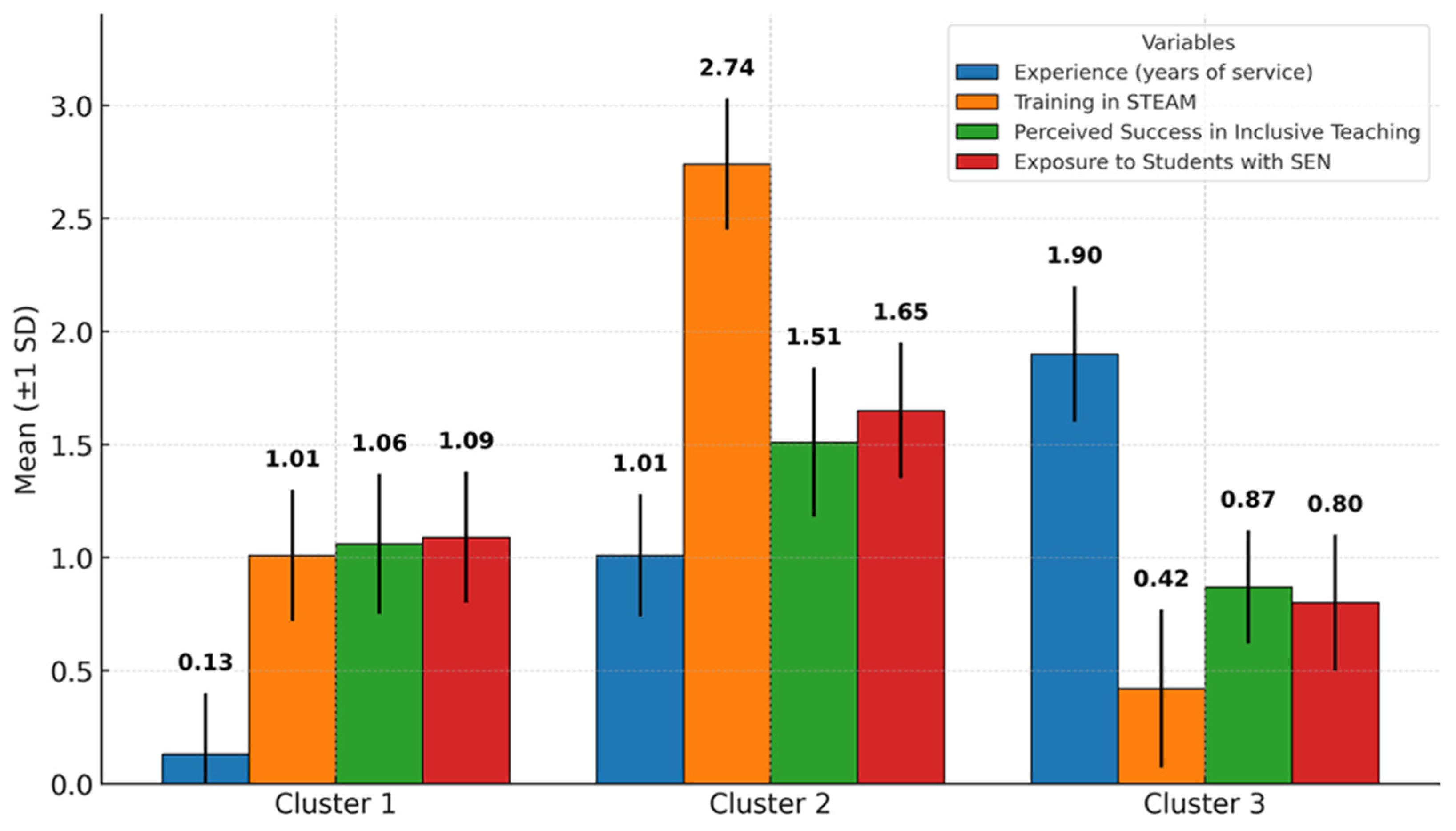
  • Cluster 1—Moderately Trained, Less Experienced Teachers—(N = 109) includes teachers with the lowest mean scores in experience (M = 0.13, SD = 0.27) and relatively limited exposure to students with SEN (M = 1.09, SD = 0.29), while they show moderate levels of training in STEAM (M = 1.01, SD = 0.29) and perceived success in inclusive teaching (M = 1.06, SD = 0.31). This profile suggests that, despite their limited classroom experience and only modest exposure to SEN students, participation in some STEAM-related professional development is associated with moderate, rather than low, levels of perceived success in implementing inclusive practices.
  • Cluster 2—Highly Prepared and Confident Teachers—(N = 90) shows consistently high values across all variables: experience (M = 1.01, SD = 0.27), training in STEAM (M = 2.74, SD = 0.29), perceived success in inclusive teaching (M = 1.51, SD = 0.33), and exposure to students with SEN (M = 1.65, SD = 0.30). The combination of extensive STEAM-related professional development, substantial classroom experience, and the highest reported success in inclusive instruction underscores the role of STEAM-focused training in strengthening teachers’ confidence to implement inclusive, technology-enhanced pedagogical practices.
  • Cluster 3—Experienced but Undertrained in STEAM—(N = 124) shows the highest level of experience (M = 1.90, SD = 0.30), but the lowest scores in training in STEAM (M = 0.42, SD = 0.35) and exposure to students with SEN (M = 0.80, SD = 0.30), as well as comparatively lower perceived success in inclusive teaching (M = 0.87, SD = 0.25). Although teachers in Cluster 3 have the most extensive teaching experience, their more limited engagement in STEAM-related professional development and lower exposure to SEN students are accompanied by reduced confidence in their inclusive teaching, indicating that experience alone does not guarantee a strong sense of efficacy in technology-enhanced inclusive practices.
The analysis showed clear variation among teachers, suggesting that they do not form a single homogeneous group. Figure 1 presents the mean values of preparation variables (external indicators) across the three groups, visually highlighting their differentiation. Cluster 2 shows consistently higher values across all variables, Cluster 1 records low experience and moderate exposure to SEN compared with Cluster 2, while Cluster 3 displays the highest experience but the lowest scores in training in STEAM and exposure to SEN.
Overall, exploratory factor analysis (EFA) and cluster analysis provided a robust depiction of secondary special education teachers’ readiness for inclusive teaching in STEAM-oriented, technology-enhanced contexts. The EFA yielded a clear four-factor structure representing distinct dimensions of readiness, while cluster analysis identified three profiles of teachers differing across key professional preparation indicators: STEAM-related training, teaching experience, perceived success, and exposure to students with SEN. Cross-validation indicated high classification accuracy, supporting the stability of the identified profiles.

5. Discussion

The present study extends knowledge on inclusive education by demonstrating that teachers’ readiness within STEAM-oriented, technology-enhanced environments is inherently multidimensional. Consistent with prior research, attitudes, self-efficacy, and contextual experiences jointly shape inclusive practices [5,6,14]. The four-factor structure emerging from the EFA—Teaching Adaptation and Collaborative Practices, Classroom Management and Behavioral Skills, Positive Attitudes toward Inclusion and Diversity, and Willingness to Cooperate and Comply—highlights that readiness is not a unitary construct but the product of integrated knowledge, skills, and attitudes. These dimensions provide a theoretically coherent framework for understanding how secondary special education teachers conceptualize and enact inclusion across contemporary educational contexts [12,19].
Cluster analysis revealed three distinct teacher profiles, directly addressing RQ1. The high-readiness cluster, characterized by extensive STEAM training, meaningful exposure to students with SEN, and strong perceived success, demonstrates that mastery experiences and structured professional learning foster inclusive self-efficacy [55]. The experienced but underprepared cluster shows moderate readiness despite teaching experience, highlighting that experience alone is insufficient without targeted training and exposure [12]. The low-readiness cluster, with limited experience and minimal training, illustrates the interdependence of attitudes, knowledge, and perceived competence; inadequate proximal processes in supportive environments result in underdeveloped readiness [19]. Collectively, these profiles answer RQ2 by revealing systematic differences in teaching experience, STEAM-related training, perceived success, and exposure to students with SEN.
The present findings highlight the prominent role of STEAM-related professional development in shaping teacher profiles and enhancing perceived success in inclusive teaching. Teachers with more extensive STEAM training reported higher self-perceived effectiveness in adaptive instruction, classroom management, and collaborative practices, indicating a strong link between STEAM-focused professional development and inclusive mindsets. This aligns with evidence showing that interdisciplinary, technology-rich learning environments foster problem-solving, collaboration, multimodal expression, and differentiated instruction—core components of inclusive education frameworks [12]. STEAM-trained educators also demonstrated greater competence and willingness to scaffold participation, integrate assistive technologies, and engage in collaborative design models, thereby enhancing collective efficacy and attitudinal openness [36]. Complementing these findings, recent studies illustrate the broader potential of STEAM-focused professional learning: Wade et al. [56] show that STEAM pedagogy implemented through Universal Design for Learning (UDL) facilitates participation of students with diverse needs, promoting equity and inclusion; the SciArt professional development program reports increased teacher self-efficacy in designing and delivering inclusive, inquiry-based STEAM activities [57]; and a meta-analysis of STEM/STEAM teaching abilities indicates positive associations between STEAM education and the development of adaptive, flexible pedagogical skills critical for inclusive classrooms [58]. Collectively, these studies reinforce the notion that targeted STEAM training enhances both pedagogical competencies and inclusive mindsets, offering a lever to improve classroom practices and inform teacher education programs and policy initiatives aimed at fostering equitable and adaptive learning environments.
Beyond documenting associations between training and perceived success, this study contributes a profile-based conceptualization of inclusive readiness in technology-enhanced, STEAM-oriented contexts. By combining empirically derived readiness dimensions (via EFA) with a person-centered clustering approach, we show that readiness is expressed through distinct configurations rather than a single continuum. This integrative perspective helps explain why teachers with similar experience may differ in their readiness and supports more targeted, cluster-sensitive professional development. The observed profile differences may also reflect contextual factors such as unequal access to STEAM-oriented professional learning, differences in school infrastructure and support, or local inclusion cultures that enable (or constrain) technology-enhanced inclusive practice. In addition, the cross-sectional, self-report design limits causal interpretation and may be influenced by social desirability or common-method bias. These considerations are further reflected in the Limitations Section and should be taken into account when interpreting the findings across settings.

6. Practical Implications

The differentiated teacher profiles identified in this study offer clear practical implications for professional development. One-size-fits-all approaches may be insufficient to foster inclusive readiness; instead, cluster-sensitive strategies are recommended. Experienced but underprepared teachers could benefit from structured, practice-based interventions, whereas those with positive attitudes but limited hands-on experience may gain from mentoring, co-teaching, or collaborative design opportunities. Policy frameworks should integrate inclusive pedagogy with digital and interdisciplinary competencies, aligning with EU strategies on digital transformation and educational inclusion.

7. Limitations and Future Directions

Despite these insights, several limitations should be acknowledged. The cross-sectional design and reliance on self-reported data constrain causal inferences and generalizability beyond Greek secondary special education contexts. Longitudinal and intervention studies are needed to examine the development of inclusive readiness over time and the impact of STEAM-oriented professional development. Moreover, mixed-method approaches—including classroom observations and reflective interviews—could provide richer insights into how inclusive, technology-enhanced practices are enacted, informing more nuanced teacher training and policy initiatives.

8. Conclusions

This study shows that inclusive readiness in technology-enhanced, STEAM-oriented contexts is a multidimensional construct reflected in interrelated dimensions of adaptive/collaborative practices, classroom management skills, inclusion-related attitudes, and willingness to cooperate and comply. Methodologically, by combining EFA-derived readiness dimensions with a person-centered cluster analysis, the study identifies three distinct teacher profiles, demonstrating meaningful heterogeneity that may be obscured by variable-centered approaches. Overall, the findings highlight STEAM-related professional development as a key lever associated with higher perceived success in inclusive teaching and support the need for differentiated, profile-sensitive professional learning pathways in secondary special education.

Author Contributions

Conceptualization, E.B., E.F., N.R. and N.C.Z.; methodology, E.B., E.F. and N.C.Z.; software, E.F.; validation, E.F.; formal analysis, E.F.; investigation, E.F.; resources, E.F.; data curation, E.F.; writing—original draft preparation, E.F. and E.B.; writing—review and editing, E.F., E.B., N.R. and N.C.Z.; visualization, E.F.; supervision, E.B.; project administration, E.B., N.R. and N.C.Z. All authors have read and agreed to the published version of the manuscript.

Funding

The research is conducted in the operating framework of the University of Thessaly Innovation, Technology Transfer Unit and Entrepreneurship Center “One Planet Thessaly”, under the “University of Thessaly Grants for Scientific Publication Support” action and is funded by the Special Account of Research Grants of the University of Thessaly.

Data Availability Statement

The datasets presented in this article are not readily available because the data are part of an ongoing study. Requests to access the datasets should be directed to vgsfoukas@gmail.com.

Conflicts of Interest

The authors declare no conflicts of interest.

Appendix A

Table A1. Post hoc pairwise comparisons between clusters on teaching experience (years of service).
ComparisonMean Diff (I–J)SEp95% CI
1–2−0.880.028<0.001[−0.97, −0.79]
1–3−1.770.026<0.001[−1.86, −1.68]
2–3−0.890.028<0.001[−0.98, −0.80]
Note. Values are Tukey–Kramer adjusted pairwise comparisons between clusters following significant omnibus one-way ANOVA. Mean difference = (Cluster I–Cluster J); negative values indicate Cluster I < Cluster J. CI = confidence interval.
Table A2. Post hoc pairwise comparisons between clusters on participation in STEAM-related training.
ComparisonMean Diff (I–J)SEp95% CI
1–2−1.730.032<0.001[−1.84, −1.62]
1–30.590.029<0.001[0.49, 0.69]
2–32.320.031<0.001[2.22, 2.42]
Note. Values are Tukey–Kramer adjusted pairwise comparisons between clusters following significant omnibus one-way ANOVA. Mean difference = (Cluster I–Cluster J); negative values indicate Cluster I < Cluster J. CI = confidence interval.
Table A3. Post hoc pairwise comparisons between clusters on perceived success in inclusive teaching.
ComparisonMean Diff (I–J)SEp95% CI
1–2−0.450.030<0.001[−0.55, −0.35]
1–30.190.027<0.001[0.10, 0.28]
2–30.640.029<0.001[0.54, 0.74]
Note. Values are Tukey–Kramer adjusted pairwise comparisons between clusters following significant omnibus one-way ANOVA. Mean difference = (Cluster I–Cluster J); negative values indicate Cluster I < Cluster J. CI = confidence interval.
Table A4. Post hoc pairwise comparisons between clusters on exposure to students with special educational needs (SEN).
ComparisonMean Diff (I–J)SEp95% CI
1–2−0.560.030<0.001[−0.66, −0.46]
1–30.290.028<0.001[0.20, 0.38]
2–30.850.029<0.001[0.75, 0.95]
Note. Values are Tukey–Kramer adjusted pairwise comparisons between clusters following significant omnibus one-way ANOVA. Mean difference = (Cluster I–Cluster J); negative values indicate Cluster I < Cluster J. CI = confidence interval.

References

  1. UNESCO. Global Education Monitoring Report 2023: Technology in Education—A Tool on Whose Terms? UNESCO: Paris, France, 2023. [Google Scholar] [CrossRef]
  2. Amanova, A.K.; Butabayeva, L.A.; Abayeva, G.A.; Umirbekova, A.N.; Abildina, S.K.; Makhmetova, A.A. A systematic review of the implementation of STEAM education in schools. Eurasia J. Math. Sci. Technol. Educ. 2025, 21, em2568. [Google Scholar] [CrossRef]
  3. Mintz, J.; Connolly, C.; O’Brien, E.; Daniela, L.; Ceallaigh, T.J.Ó. Inclusive digital education: Contexts, practices and perspectives. Comput. Sch. 2024, 41, 115–119. [Google Scholar] [CrossRef]
  4. Samaniego López, M.V.; Orrego Riofrío, M.C.; Barriga-Fray, S.F.; Paz Viteri, B.S. Technologies in inclusive education: Solution or challenge? A systematic review. Educ. Sci. 2025, 15, 715. [Google Scholar] [CrossRef]
  5. Avramidis, E.; Toulia, A.; Tsihouridis, C.; Strogilos, V. Teachers’ attitudes towards inclusion and their self-efficacy for inclusive practices as predictors of willingness to implement peer tutoring. J. Res. Spec. Educ. Needs 2019, 19, 49–59. [Google Scholar] [CrossRef]
  6. Yada, A.; Leskinen, M.; Savolainen, H.; Schwab, S. Meta-analysis of the relationship between teachers’ self-efficacy and attitudes toward inclusive education. Teach. Teach. Educ. 2022, 109, 103521. [Google Scholar] [CrossRef]
  7. Navas-Bonilla, C.d.R.; Guerra-Arango, J.A.; Oviedo-Guado, D.A.; Murillo-Noriega, D.E. Inclusive education through technology: A systematic review of types, tools and characteristics. Front. Educ. 2025, 10, 1527851. [Google Scholar] [CrossRef]
  8. Ranzato, E.; Holloway, C.; Bandukd, M. Use of educational technology in inclusive primary schools: A systematic review. JMIR Res. Protoc. 2025, 14, e65045. [Google Scholar] [CrossRef]
  9. Charitaki, G.; Kourti, I.; Gregory, J.L.; Ozturk, M.; Ismail, Z.; Alevriadou, A.; Soulis, S.-G.; Sakici, S.; Demirel, C. Teachers’ attitudes towards inclusive education: A cross-national exploration. Trends Psychol. 2024, 32, 1120–1147. [Google Scholar] [CrossRef]
  10. Msafiri, M.M.; Kangwa, D.; Cai, L. A systematic literature review of ICT integration in secondary education: What works, what does not, and what next? Discov. Educ. 2023, 2, 44. [Google Scholar] [CrossRef]
  11. Mehddi, F.; Kazi, A.S.; Butt, A.I. From Theory to Practice: How STEAM Professional Development Shapes Teacher Beliefs and Perceptions About Design Thinking Activities. Sage Open 2025, 2025, 1–15. [Google Scholar] [CrossRef]
  12. Florian, L.; Black-Hawkins, K. Exploring inclusive pedagogy. Br. Educ. Res. J. 2011, 37, 813–828. [Google Scholar] [CrossRef]
  13. Howard, S.K.; Tondeur, J.; Siddiq, F.; Scherer, R. Ready, set, go! Profiling teachers’ readiness for online teaching in secondary education. Technol. Pedagog. Educ. 2020, 30, 141–158. [Google Scholar] [CrossRef]
  14. Sharma, U.; Jacobs, D.K. Predicting in-service educators’ intentions to teach in inclusive classrooms in India and Australia. Teach. Teach. Educ. 2016, 55, 13–23. [Google Scholar] [CrossRef]
  15. Sharma, U.; Loreman, T.; Forlin, C. Measuring teacher efficacy to implement inclusive practices. J. Res. Spec. Educ. Needs 2012, 12, 12–21. [Google Scholar] [CrossRef]
  16. Hassanein, E.E.A.; Alshaboul, Y.M.; Ibrahim, S. The impact of teacher preparation on preservice teachers’ attitudes toward inclusive education in Qatar. Heliyon 2021, 7, 07925. [Google Scholar] [CrossRef]
  17. del Barrio, L.; Casanova, O.; Vernia, A.M. Music Teacher Competences Oriented Toward Inclusive Education: An Analysis of Proposals in the Initial Pre-Service Teacher Training Phase. Sage Open 2024, 14, 1–19. [Google Scholar] [CrossRef]
  18. Mohamed, Z.; Valcke, M.; De Wever, B. Are they ready to teach? Student teachers’ readiness for the job with reference to teacher competence frameworks. J. Educ. Teach. 2016, 43, 151–170. [Google Scholar] [CrossRef]
  19. Savolainen, H.; Malinen, O.-P.; Schwab, S. Teacher efficacy predicts teachers’ attitudes towards inclusion: A longitudinal cross-lagged analysis. Int. J. Incl. Educ. 2022, 26, 958–972. [Google Scholar] [CrossRef]
  20. Dignath, C.; Rimm-Kaufman, S.; van Ewijk, R.; Kunter, M. Teachers’ beliefs about inclusive education and insights on what contributes to those beliefs: A meta-analytical study. Educ. Psychol. Rev. 2022, 34, 2609–2660. [Google Scholar] [CrossRef]
  21. Nissim, M.; Shamma, F. Supporting teacher professionalism for inclusive education: Integrating cognitive, emotional, and contextual dimensions. Educ. Sci. 2025, 15, 1317. [Google Scholar] [CrossRef]
  22. Özokcu, O. Investigating the relationship between teachers’ self-efficacy beliefs and efficacy for inclusion. Eur. J. Spec. Educ. Res. 2017, 2, 234–252. [Google Scholar] [CrossRef]
  23. Florian, L. Preparing teachers to work in inclusive classrooms. J. Teach. Educ. 2012, 63, 275–285. [Google Scholar] [CrossRef]
  24. Villegas, A.M.; Ciotoli, F.; Lucas, T. A framework for preparing teachers for classrooms that are inclusive of all students. In Teacher Education for the Changing Demographics of Schooling; Villegas, A.M., Sleeter, K.E., Lucas, T., Eds.; Springer: Cham, Switzerland, 2017; pp. 133–148. [Google Scholar]
  25. Kunz, A.; Luder, R.; Kassis, W. Beliefs and attitudes toward inclusion of student teachers and their contact with people with disabilities. Front. Educ. 2021, 6, 650236. [Google Scholar] [CrossRef]
  26. Ní Bhroin, Ó.; King, F. Teacher education for inclusive education: A framework for developing collaboration for inclusion of students with support plans. Eur. J. Teach. Educ. 2019, 43, 38–63. [Google Scholar] [CrossRef]
  27. National Science Teaching Association. STEM Education Teaching and Learning [Position Statement]. 2020. Available online: https://www.nsta.org/nstas-official-positions/stem-education-teaching-and-learning (accessed on 25 December 2025).
  28. Perignat, E.; Katz-Buonincontro, J. STEAM in practice and research: An integrative literature review. Think. Ski. Creat. 2019, 31, 31–43. [Google Scholar] [CrossRef]
  29. European Agency for Special Needs and Inclusive Education. Inclusive Digital Education; EU: Odense, Denmark, 2022; Available online: https://www.european-agency.org/resources/publications/inclusive-digital-education?utm (accessed on 25 December 2025).
  30. Polat, E.; Cepdibi Sıbıç, S.; Cirit-Işıklıgil, N.C.; Hopcan, S.; Baştuğ, Y.E. Educational technology in inclusive classrooms: Assessing teacher awareness and needs. J. Educ. Technol. Online Learn. 2024, 7, 115–131. [Google Scholar] [CrossRef]
  31. Almeqdad, Q.I.; Alodat, A.M.; Alquraan, M.F.; Mohaidat, M.A.; Al-Makhzoomy, A.K. The effectiveness of universal design for learning: A systematic review of the literature and meta-analysis. Cogent Educ. 2023, 10, 2218191. [Google Scholar] [CrossRef]
  32. Τhoma, R.; Farassopoulos, N.; Lousta, C. Teaching STEAM through universal design for learning in early years of primary education: Plugged-in and unplugged activities with emphasis on connectivism learning theory. Teach. Teach. Educ. 2023, 132, 104210. [Google Scholar] [CrossRef]
  33. Vantieghem, W.; Roose, I.; Goosen, K.; Schelfhout, W.; Van Avermaet, P. Education for all in action: Measuring teachers’ competences for inclusive education. PLoS ONE 2023, 18, e0291033. [Google Scholar] [CrossRef] [PubMed]
  34. Redecker, C.; Punie, Y. European Framework for the Digital Competence of Educators: DigCompEdu; Publications Office of the European Union: Luxembourg, 2017.
  35. Sakellaropoulou, G.; Spyropoulou, N.; Kameas, A. Towards a holistic competence framework for inclusive STEAM educators. In Proceedings of the 15th International Conference on Education and New Learning Technologies, Palma, Spain, 3–5 July 2023; pp. 5710–5717. [Google Scholar] [CrossRef]
  36. Wong, J.T.; Bui, N.N.; Fields, D.T.; Hughes, B.S. A Learning Experience Design Approach to Online Professional Development for Teaching Science through the Arts: Evaluation of Teacher Content Knowledge, Self-Efficacy and STEAM Perceptions. J. Sci. Teach. Educ. 2023, 34, 593–623. [Google Scholar] [CrossRef]
  37. Boice, K.L.; Jackson, J.R.; Alemdar, M.; Rao, A.E.; Grossman, S.; Usselman, M. Supporting teachers on their STEAM journey: A collaborative STEAM teacher training program. Educ. Sci. 2021, 11, 105. [Google Scholar] [CrossRef]
  38. Moosa, V.; Shareefa, M. Implementation of differentiated instruction: Conjoint effect of teachers’ sense of efficacy, perception and knowledge. Anatol. J. Educ. 2019, 4, 23–38. [Google Scholar] [CrossRef]
  39. Weisberg, L.; Barrett, J.; Israel, M.; Miller, D. A review of arts integration in K-12 CS education: Gathering STEAM for inclusive learning. Comput. Sci. Educ. 2024, 35, 123–152. [Google Scholar] [CrossRef]
  40. Morrin, A.M.; Liston, M. Engaging Children with Authentic STEAM Learning Experiences Through Design-Based Approaches. Connect. Sci. Learn. 2020, 2, 12318723. [Google Scholar] [CrossRef]
  41. Zhou, X.; Shu, L.; Xu, Z.; Padrón, Y. The effect of professional development on in-service STEM teachers’ self-efficacy: A meta-analysis of experimental studies. Int. J. STEM Educ. 2023, 10, 37. [Google Scholar] [CrossRef]
  42. Teo, T.W. A survey of science teachers’ perceptions and practices in inclusive science classrooms. Asia-Pac. Sci. Educ. 2021, 6, 388–426. [Google Scholar] [CrossRef]
  43. Liu, J.; Wang, K.; Pan, Z. The effectiveness of professional development in the self-efficacy of in-service teachers in STEM education: A meta-analysis. Behav. Sci. 2025, 15, 1364. [Google Scholar] [CrossRef]
  44. Gardner, K.; Glassmeyer, D.; Worthy, R. Impacts of STEM professional development on teachers’ knowledge, self-efficacy, and practice. Front. Educ. 2019, 4, 26. [Google Scholar] [CrossRef]
  45. Havik, R. Teacher Self-Efficacy and the Implementation of Inclusive Practices: A Systematic Review. Master’s Thesis, University of Groningen, Groningen, The Netherlands, 2025. [Google Scholar]
  46. Fabrigar, L.R.; Wegener, D.T.; MacCallum, R.C.; Strahan, E.J. Evaluating the use of exploratory factor analysis in psychological research. Psychol. Methods 1999, 4, 272–299. [Google Scholar] [CrossRef]
  47. Hayton, J.C.; Allen, D.G.; Scarpello, V. Factor retention decisions in exploratory factor analysis: A tutorial on parallel analysis. Organ. Res. Methods 2004, 7, 191–205. [Google Scholar] [CrossRef]
  48. Dunn, T.J.; Baguley, T.; Brunsden, V. From alpha to omega: A practical solution to the pervasive problem of internal consistency estimation. Br. J. Psychol. 2014, 105, 399–412. [Google Scholar] [CrossRef] [PubMed]
  49. Foykas, E.; Raikou, N.; Beazidou, E.; Karalis, T. Transformative potential in special education: How perceived success, training, exposure, and experience contribute to teacher readiness for inclusive practice. Educ. Sci. 2025, 15, 1476. [Google Scholar] [CrossRef]
  50. Aldenderfer, M.S.; Blashfield, R.K. Cluster Analysis; Sage University Paper Series on Quantitative Applications in the Social Sciences No. 07-044; Sage Publications: Newbury Park, CA, USA, 1984. [Google Scholar]
  51. Everitt, B.S.; Landau, S.; Leese, M.; Stahl, D. Cluster Analysis, 5th ed.; Wiley: West Sussex, UK, 2011. [Google Scholar]
  52. Ketchen, D.J., Jr.; Shook, C.L. The application of cluster analysis in strategic management research: An analysis and critique. Strateg. Manag. J. 1996, 17, 441–458. [Google Scholar] [CrossRef]
  53. Milligan, G.W.; Cooper, M.C. Methodology review: Clustering methods. Appl. Psychol. Meas. 1987, 11, 329–354. [Google Scholar] [CrossRef]
  54. Kim, H.-Y. Statistical notes for clinical researchers: Post-hoc multiple comparisons. Restor. Dent. Endod. 2015, 40, 172–176. [Google Scholar] [CrossRef]
  55. Kramer, C.Y. Extension of multiple range tests to group means with unequal numbers of replications. Biometrics 1956, 12, 307–310. [Google Scholar] [CrossRef]
  56. Bandura, A. Self-Efficacy: The Exercise of Control; W. H. Freeman: New York, NY, USA, 1997. [Google Scholar]
  57. Wade, C.B.; Koc, M.; Searcy, A.; Coogle, C.; Walter, H. STEAM Activities in the Inclusive Classroom: Intentional Planning and Practice. Educ. Sci. 2023, 13, 1161. [Google Scholar] [CrossRef]
  58. Sofianidis, A.; Petridou, E.; Stylianou, E.; Tsaliki, C.; Malletzidou, L.; Sarmento, C.; Charalambous, C.; Fotiadou, S.; Makridou, T.; Pires, I.; et al. Bridging STEAM and Cultural Heritage Through Inclusive Inquiry: The SciArt Professional Development Program. Educ. Sci. 2025, 15, 1551. [Google Scholar] [CrossRef]
Figure 1. Mean scores of the four preparation variables across teacher profiles (error bars: ±1 SD). Note. Descriptive characterization only; these external indicators were not used to derive clusters.
Computers 15 00042 g001
Table 1. Descriptive statistics and ANOVA results for each preparation variable and cluster.
Cluster 1 Cluster 2 Cluster 3
Preparation VariableMSDMSDMSDF(2, 320)η2
Teaching Experience (years of service)0.130.271.010.271.900.30196.900.55
Training in STEAM1.010.292.740.290.420.35444.430.73
Perceived Success in Inclusive Teaching1.060.311.510.330.870.2532.960.17
Exposure to Students with SEN1.090.291.650.300.800.3061.600.28
Note. M = mean; SD = standard deviation; F = one-way ANOVA test; η2 = partial eta squared (effect size). All omnibus ANOVAs were statistically significant (p < 0.001), indicating significant differences between teacher clusters across all variables. Effect sizes range from moderate to large, suggesting meaningful distinctions in professional experience, training, perceived success, and exposure to SEN students.
Disclaimer/Publisher’s Note: The statements, opinions and data contained in all publications are solely those of the individual author(s) and contributor(s) and not of MDPI and/or the editor(s). MDPI and/or the editor(s) disclaim responsibility for any injury to people or property resulting from any ideas, methods, instructions or products referred to in the content.