1. Introduction
The contemporary financial services landscape has experienced a profound transformation through the adoption of advanced computational paradigms, with virtualization technology emerging as a cornerstone of digital infrastructure modernization. Financial institutions have been forced to radically rethink their information technology architectures due to the convergence of economic pressures, regulatory requirements, and technological innovation. They have moved away from traditional physical infrastructure models and toward sophisticated virtualized environments that promise improved service delivery capabilities, cost optimization, and operational efficiency. Multiple virtual instances can run concurrently on shared physical infrastructure thanks to the fundamental idea of virtualization, which represents a paradigm shift from dedicated hardware allocation to resource abstraction. Virtualization has progressed from a specialized technical idea to a fundamental technology that helps businesses lower power usage, consolidate servers, improve testing and development capabilities, enable dynamic load balancing, and strengthen disaster recovery procedures while maintaining high availability for vital applications [
1,
2]. Financial institutions, which have historically operated under strict availability requirements and compliance frameworks, have found this technological evolution to be especially relevant.
In recent years, a mix of pressures has pushed financial institutions to embrace virtualization at an unusually rapid pace. The most powerful of these pressures’ dates to the last big financial crisis, when many firms were left short on staff and hardware, forcing their IT teams to search for creative, money-saving workarounds [
3,
4]. Working under those resource limitations, executives began to demand solutions that could bring added value from what they already owned while keeping new spendings restrained. Virtualization technology stepped in as an obvious solution, promising to bring added value into aging systems by layering modern technology on top of them [
3].
Additionally, cloud computing paradigms have fundamentally altered the operational landscape for financial applications by representing a fundamental transformation in information technology that emphasizes movement toward intensive, large-scale specialization, where virtualization serves as the key enabling technology [
5,
6]. The integration of virtualization with cloud computing has introduced both significant convenience and efficiency benefits alongside substantial challenges in data security and privacy protection domains [
7,
8,
9]. Financial institutions must navigate the complex balance between operational benefits and risk management considerations, particularly concerning multi-tenant environments where different users’ virtual resources may be bound to identical physical resources, potentially creating data access vulnerabilities. The evolution of virtualization technology has progressed beyond traditional server consolidation models and nowadays it is considered as the key underlying technology for infrastructure transformation initiatives. Research indicates that traditional organizations are increasingly adopting cloud computing environments that integrate most required resources through remote cloud service providers, offering rapid installation, deployment, and maintenance capabilities [
10,
11]. This shift toward cloud-based resource provisioning has enabled financial institutions to achieve more efficient resource utilization and optimal service delivery through advanced techniques, such as sophisticated scheduling mechanisms, and dynamic load balancing strategies [
12,
13].
Furthermore, the financial sector’s unique operational requirements have driven specific applications of edge computing, particularly in risk management and real-time decision-making contexts. Specifically, recent research has identified critical applications regarding financial contagion risk, where rapid transmission of financial data between institutions requires localized decision-making capabilities, filtering at network edges, and dynamic resource allocation to mitigate systemic risks and improve stability [
14,
15,
16,
17]. These applications demonstrate the strategic importance of edge computing combined with virtualization technology in maintaining financial system resilience and operational continuity.
The implementation of virtualization technology in financial environments requires careful consideration of performance, security, and compliance requirements. While virtualization and cloud computing technologies have achieved significant success in general-purpose computing applications through server consolidation, operational cost reduction, flexible systems configuration, and elastic resource provisioning, they are still facing considerable challenges in supporting emerging real-time applications such as online financial services that demand real-time performance in open, shared, and virtualized computing environments [
18,
19,
20]. These challenges highlight the need for specialized implementation approaches in financial contexts.
Single-board computer implementations represent an innovative approach to edge computing virtualization in financial applications. Contemporary research has demonstrated the feasibility of adopting virtualization technology on single-board computers for implementing reliable and cost-efficient edge-computing environments, with experimental implementations showing successful workload migration from traditional infrastructure to single-board computer-based edge infrastructure in financial organization contexts [
21,
22]. These implementations offer significant advantages including low power consumption, reduced operational costs, minimal heat generation, and high processing capabilities suitable for distributed financial applications.
The business impact of virtualization adoption in financial institutions extends beyond technical improvements to encompass comprehensive organizational transformation. Case study research conducted within European financial organizations has demonstrated measurable impacts of virtualization technologies in replacing legacy infrastructures, with comprehensive five-year financial evaluations showing positive projections for expenditure reduction, return on investment optimization, and improved profitability metrics [
3,
23,
24]. These empirical results offer verifiable proof of virtualization’s capacity to produce long-term economic value in financial services settings.
Given the sensitive nature of financial data and the need for regulatory compliance, the security issues surrounding virtualization technology in financial applications demand particular attention. Centrally managed application delivery systems that give employees instant mobile access to business-critical apps, desktops, and data while preserving native-like user experiences across all geographical locations are essential for financial institutions deploying virtualization solutions to guarantee corporate compliance with changing security regulations. The trajectory of virtualization technologies in the financial services industry points to further development in the context of increasingly complex hybrid models that integrate cloud and edge computing implementations. According to current adoption patterns, businesses are using cloud services more and more to expand their capabilities and offer their stakeholders richer environments. Virtualization is a key component of services and facilities that combine multiple independent virtual computing components into a single hardware platform that includes processing, networking, storage, and memory resources [
25,
26].
This paper aims to explore the present as well as the future of virtualization-based technologies in the financial services sector, following the evolution from conventional cloud computing deployments to specialized edge computing applications. The analysis covers both theoretical foundations and practical implementations, providing insights into the transformative nature of these technologies for financial institutions that aim to optimize their operational efficiency, maintain their competitive advantage in the increasingly growing digital services market, and improve their service delivery capabilities. By analyzing relevant recent works and by interpreting data from relevant case studies, this study aims to advance knowledge regarding how the unique opportunities and challenges presented in financial services might be successfully addressed by adopting modern technologies such as virtualization, cloud computing and edge computing.
2. Research Methodology and Materials
This review thoroughly examined the concepts of virtualization technology, cloud computing applications and edge computing in the context of financial services by utilizing methodology based on the contents of relative publications. The study used a systematic, analytical framework in three stages that were intended to give both scope and depth in analyzing the empirical data, theoretical underpinnings, and real-world applications of these technologies in the sector of financial services. To locate recent data in financial technology applications, a literature inquiry was carried out covering the period from 2016 to 2025 across several electronic databases, including Scopus, Web of Science, IEEE Xplore, ACM Digital Library, and ScienceDirect. Three main concept clusters were used to organize the free-text keywords and controlled vocabulary terms used in the search strategy:
Publications relevant to cloud computing: “edge computing” OR “virtualization” OR “cloud computing” OR “containerization” OR “hypervisor” OR “software-defined” OR “distributed computing”;
Publications relevant to financial services: “financial services” OR “banking” OR “fintech” OR “financial technology” OR “wealth management” OR “investment” OR “financial risk” OR “financial intermediation”;
Publications relevant to applications: “risk management” OR “security” OR “blockchain” OR “machine learning” OR “operational efficiency” OR “digital transformation”.
The inclusion criteria were: (a), articles from peer-reviewed scientific journals and conference proceedings; (b), studies examining applications of virtualization, edge computing, or cloud computing specifically in the financial services environment; (c), research dealing with theoretical frameworks, empirical implementations, or performance evaluations of these technologies in banking, investment, or financial risk management; (d), studies published between 2015 and 2025 to ensure contemporary relevance, and (e), studies published in English. On the other hand, the exclusion criteria were: (1), non-scholarly publications including trade magazines, blog posts, and commercial white papers; (2), Studies focusing exclusively on general IT applications without specific financial services context; (3), publications addressing only basic cloud computing concepts without advanced virtualization or edge computing considerations; (4), publications limited to purely theoretical discussions without empirical validation or practical implementation insights.
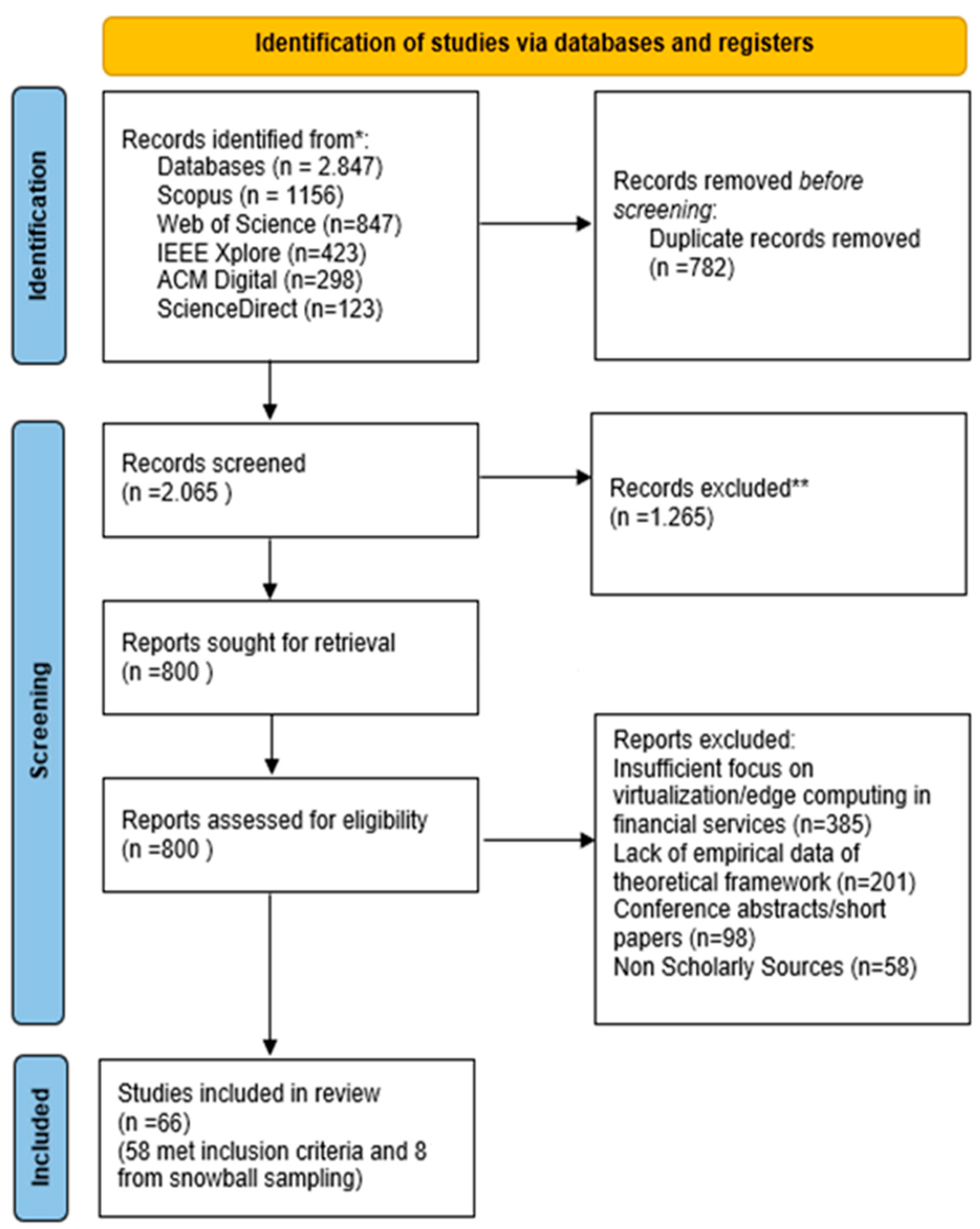
The initial comprehensive database search yielded 2847 records across all selected databases, distributed as follows: Scopus (n = 1156), Web of Science (n = 847), IEEE Xplore (n = 423), ACM Digital Library (n = 298), and ScienceDirect (n = 123). Following automated duplicate removal using Mendeley reference management software, 782 duplicate records were identified and removed, leaving 2065 unique records for initial screening. Title and abstract screening was conducted independently by three (3) reviewers, with inter-rater reliability achieving Cohen’s kappa = 0.84, indicating substantial agreement. Application of inclusion and exclusion criteria at the abstract level resulted in the exclusion of 1265 records. The reasons for exclusion included studies not related to financial services (n = 645), research with general IT focus without virtualization technology, cloud or edge computing specificity (n = 489), non-English publications (n = 73), and non-scholarly sources (n = 58). This screening process left 800 records for full-text assessment. Full-text screening was conducted on the remaining 800 articles. During this review phase, 742 articles were excluded due to insufficient focus on virtualization, cloud or edge computing in financial services context (n = 385), lack of empirical data or theoretical framework (n = 201), conference abstracts or short papers without substantial content (n = 98), and outdated methodologies or technologies (n = 58).
Following a full-text assessment and a quality evaluation, snowball sampling was conducted by systematically examining reference lists of the 58 selected articles and conducting forward citation searches through Google Scholar and Web of Science. This supplementary search strategy identified an additional 8 relevant articles that met all inclusion criteria, bringing the final sample to 66 articles selected for comprehensive data extraction and analysis. The complete selection process thus progressed from 2847 initial records through 2065 unique records, 800 records after abstract screening, 58 records after full-text screening, to a final corpus of 66 articles that were included in the final version of this systematic review. This review was performed in accordance to the PRISMA (Preferred Reporting Items for Systematic Reviews and Meta-Analyses) guidelines, as summarized in
Figure 1:
In accordance with the principles of PRISMA, a structured assessment of risk of bias was performed for each eligible study. Each reviewer independently reviewed the titles and abstracts, conducted full-text reviews, and coded for risk of bias. Differences were resolved by consensus. The majority of studies in this review demonstrated a low risk for bias in measurement of outcomes, extraction of data, and transparency of reporting (particularly studies using machine learning benchmark tasks and well-documented datasets). In contrast, some studies had unclear or high-risk factors associated with three specific areas of (i) reporting of training/validation splits; (ii) the process of hyperparameter tuning; and (iii) how the authors handled missing data and/or imbalanced datasets.
A small percentage of papers had little to no information related to how participants were selected for inclusion, representativeness of the dataset, and reproducible performance claims, which limited interpretability of the performance claims. The corpus of literature for this review demonstrated an overall moderate level of risk of bias despite evidence of a few methodological flaws, and the impacts of identified threats to validity were mitigated by quantitative synthesis strategies and narrative contextualization. Thus, we considered the level of confidence associated with the aggregate results of this review to be acceptable.
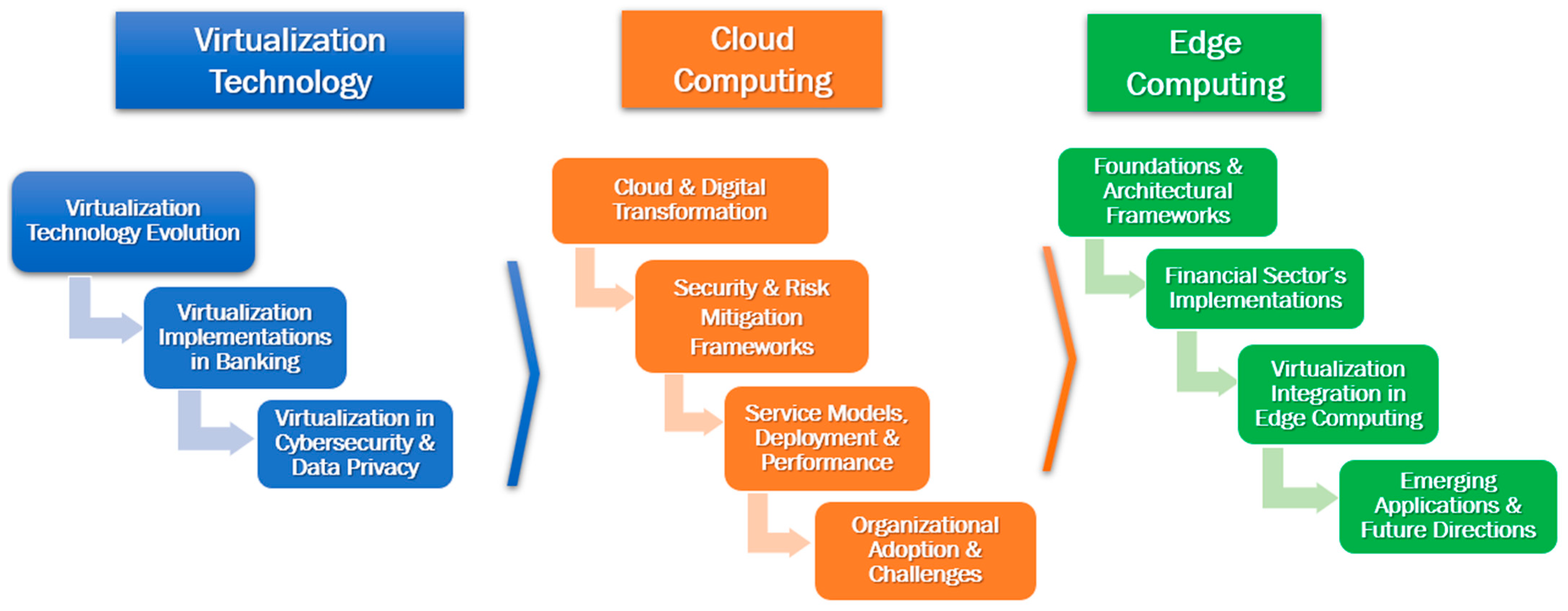
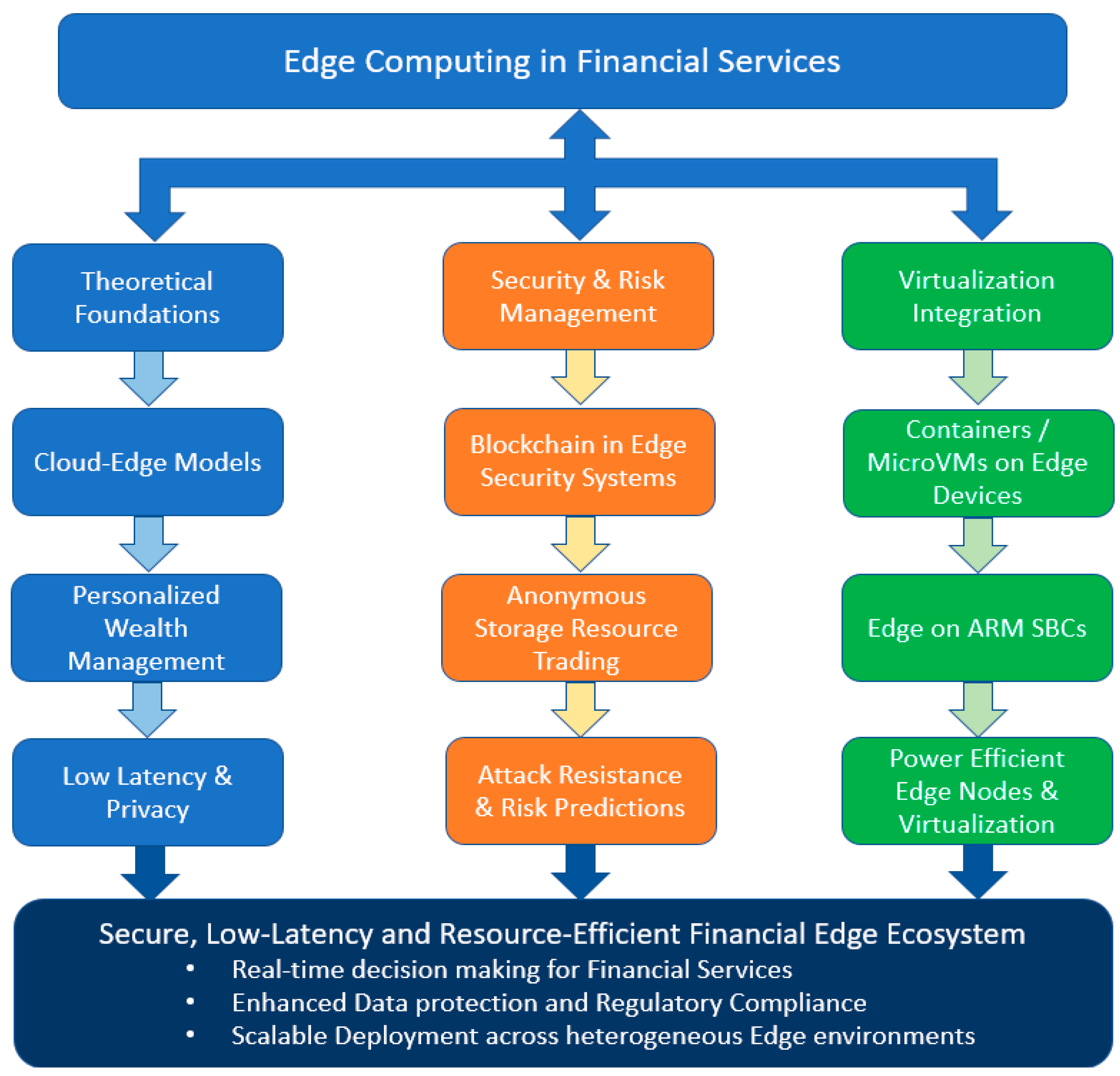
The categorization of the results from the analysis as presented in this review paper, are organized in sections beginning with Virtualization (
Section 3), since it is the key-enabling technology and basis for cloud computing. Cloud Computing is then addressed (
Section 4), followed by Edge Computing (
Section 5), since the related implementations are directly focused on mitigating known cloud computing limitations. The results categorization along with their structure is summarized in
Figure 2:
3. Virtualization Technology in Financial Services
This section provides a systematic analysis of the extant literature addressing the integration of virtualization technology in traditional financial intermediation functions, the operational efficiency implications of digitalization processes, the evolutionary trajectory from conventional hypervisor-based systems toward containerization and software-defined infrastructures, along with its importance in cybersecurity, especially for enhancing access control and data isolation for risk mitigation across banking distributed systems.
3.1. Virtualization Technology Evolution
Virtualization technology has been developed and evolved at such a level that nowadays it is considered as the key underlying technology for the majority of modern computing infrastructures. Specifically, the recent research highlights the virtualization technology’s role in improving efficiency, scalability and sustainability for both on-premises and cloud environments. In the same context, the evolution of virtualization frameworks for blockchain-oriented systems indicates the adoption of new virtualization-based concepts for secure and enterprise level architectures.
Lambropoulos et al.’s (2023), analytical review of ARM64 architecture’s impact on modern computing, focusing on its integration with virtualization technology, cloud computing maturity, and environmental sustainability considerations. The research examines ARM64 RISC-based design principles that prioritize energy efficiency and reduced power consumption compared to traditional x86 architecture, positioning it as a transformative force in digital infrastructure. They analyzed ARM64’s versatility through various System-on-Chip implementations, including Qualcomm Snapdragon for mobile devices, Apple’s M1/M2 processors for MacBooks and iPads, NVIDIA Tegra for gaming and automotive applications, and Ampere Altra for datacenter operations. The review demonstrates that virtualization technology on ARM64 is rapidly maturing, with experimental support from major hypervisors like VMware ESXi, Microsoft Hyper-V, and established containerization platforms including Docker and Kubernetes. In cloud computing, major providers including AWS (Graviton processors), Microsoft Azure, and Google Cloud Platform have begun offering ARM64-based instances, capitalizing on energy efficiency and cost-effectiveness. The study emphasizes ARM64’s alignment with Environmental, Social, and Governance (ESG) criteria, highlighting its potential to reduce carbon footprints through lower energy consumption in datacenters and edge computing deployments. On the other hand, the authors identified significant adoption challenges including software compatibility issues with legacy x86 applications, infrastructure integration complexities, security vulnerabilities, training requirements for IT personnel, and substantial initial investment costs. The study concludes that while ARM64 represents a promising sustainable computing alternative, successful adoption depends on continued hardware and software standardization efforts [
27].
The study by Tara et al. (2019) on the evolution of the blockchain virtual machine demonstrates enterprise-focused virtualization architectures as a disruptive approach to blockchain adoption as it relates to incorporating advanced virtual machine implementations that satisfy requirements for flexibility, security, formal verification and cross-domain business logic that are important for enterprise blockchain application. The study further shows how the introduction of the Ethereum Virtual Machine in 2014 made decentralized computing possible, allowing new types of public proof that could only be executed in decentralized ecosystems; the study characterized 6 generations of architecture evolution and variations from embedded platform-dependent VMs to platform-agnostic pluggable modular architectures with an execution container designed to support dynamic, generic, smart contract specifications, while ensuring deterministic execution using verification logic. The authors used empirical investigation methods, involving four months of evaluating code and position architecture through reverse-engineering open-source repositories and white papers. This study outlines what enterprises need in order to develop blockchain applications, which includes meaningful compliance with ISO/TC 307 standardization; access to a formal verification framework; access to a stable non-Turing complete language that provides adequate levels of security; access to a shard abstraction; the ability to be multi-VM platform integrated; access to privacy controls for off-chain contracts; and upgrades for smart contracts. The results of this research demonstrate transformative advantages that include eliminating programming language barriers through interoperability services, performance enhancement through sharing between shards via network shar-ding and cross-shard smart contract execution along with enhanced abstraction tier enabling RPC compliant language integration thus establishing this evolutionary framework to be an essential infra-structure for trusted machine-to-machine protocols with seamless multi-virtualized environment interaction in the enterprise blockchain ecosystem [
28].
3.2. Virtualization Implementations in Banking
Virtualization technology has become essential for modern banking infrastructures by enabling a high level of agility, reliability and efficiency across most financial operations. In the banking industry, virtualization enables features such as data integration and performance management, while at the same time drastically enhances overall performance by optimizing resource utilization and scalability. Additionally, the ability to develop and implement highly available infrastructures ensures constant service delivery for critical banking services.
Gangarapu’s (2025) study about Enterprise Performance Management (EPM) systems establishes data virtualization as a game-changer to fundamentally redefine operational efficiency in investment banking with the innovative use of “virtual data layers” that overcome the boundaries of Extract, Transform, Load (ETL) methodologies. This particular research revealed how virtualization technology enables a new way of throughput to obtain accessible real-time data without physical data consolidation, providing an operational lift including a 35% improvement in system performance, a 24% reduction in infrastructure costs, and a substantial lift in predictive analytics creation accuracy from the industry norm of 71% to 89%. This empirical assessment shows that 67% of international banks are struggling significantly to modernize, with the architecture of traditional EPM rating as much as a 27% loss in operational efficiency as a byproduct of data silos and disjointed systems taking 8–12 h to complete total processing cycles. Financial Institutions operating in virtualized environments also exhibited a 68% faster transaction processing time (with a reduced response time from 15 min to 4.8 min), a 56% reduction in compliance reporting preparation time, an increase of 41% in real-time risk assessment capabilities, and provided global financial service institutions with an architectural framework that provided a 56% increase in the success rate of digital transformation initiatives, while increasing threat detection capabilities by 64% and the prevention of cyberattacks to 92% [
29].
Lambropoulos et al.’s (2021) thorough empirical investigation of virtualization technology implementation within a European financial institution offers crucial insights into the strategic modernization of legacy IT infrastructures. The study tackles urgent issues facing financial institutions in post-crisis environments, where limited resources demand technologically advanced solutions for infrastructure optimization while upholding operational continuity and regulatory compliance requirements. With its three-phase analytical approach that includes a thorough infrastructure inventory assessment, virtualization integration planning, and a thorough financial effect evaluation, the methodological framework used exhibits remarkable rigor. The study’s empirical basis is based on a thorough analysis of an operational financial institution that oversees 85 servers in various domains, including Microsoft Exchange infrastructure that manages 1450 mailboxes, Active Directory services that support 1600 users, and various database systems that aggregate vital financial data. Sophisticated data collection techniques using VMware Capacity Planner analytics spanning four-month monitoring periods are incorporated into the research methodology. Hourly performance indicators that capture CPU utilization, memory allocation, and disk I/O operations ensure statistical validity. A remarkable 84% consolidation ratio, which allows 77 physical servers to be consolidated onto 12 virtualization hosts while maintaining improved availability, performance scalability, and operational flexibility characteristics, is revealed by this methodologically sound approach, which makes it possible to precisely quantify the potential for infrastructure consolidation. Additionally, a financial analysis revealing initial negative ROI in year one (−€264,721) followed by strong positive returns (31% in year two, 147% in year four, 142% in year five) with cumulative savings exceeding €1.9 million by year five, provides concrete evidence of the long-term financial benefits of virtualization implementation. The break-even point occurring before year three demonstrates the dynamics of infrastructure investment recovery in financial services contexts [
3].
Neng’s (2017) thorough investigation of virtualized high-availability banking systems introduces a disruptive paradigm for financial technology infrastructure by advancing the idea of “service-oriented high availability”, which fundamentally rethinks system design that focuses on continuous service delivery to the users over targeting the specific devices common in mobile internet and FinTech. This research demonstrates that virtualization technology resolves significant gaps in existing high-availability research by simultaneously addressing the ambiguity around device-business relationships and strong data consistency requirements, producing significant operational improvements of 99.99% system availability instead of 99.96%, with automatic failure recovery via innovative dual-active cluster implementations and emergency response communications protocol. The experimental validation of the research used VMware vSphere HA and PowerVM, Neng to establish significant performance metrics including recovery times of 83 s post-application layer failures, 384 s after database layer failures, while sustaining transaction processing rates of 362 transactions/second with fewer than two transaction failures during high-criticality system changes. The practical findings demonstrate transformative virtualization benefits, including an increased risk based on using distributed resource pools converged with risk mitigation capabilities from backup storage data that could automatically restart the current state of the virtual machine, and new hybrid high availability modes that combined traditional hot stand by components with modern virtualization platforms, creating a necessary infrastructure for organizations like banks, which have an ability to meet continuous 24/7 financial services to their clients during the digital transformation era [
30].
3.3. Virtualization in Cybersecurity and Data Privacy
Virtualization technology is becoming increasingly relevant in cybersecurity mostly for strengthening data protection in cloud-based systems. Recent research highlights the employment of virtualization for enhancing access control and data isolation so to mitigate security risks in distributed systems. Such approaches are further strengthening the secure handling of sensitive data, especially in financial services where data confidentiality and integrity is of outmost importance. Specifically, the intersection of virtualization technology and big data analytics technologies in cloud implementations provide highly adaptable, resilient and compliant security frameworks towards the journey of digital transformation in financial services.
According to Michael et al. (2025), innovative research establishes hybrid algorithmic virtualization frameworks as a transformative paradigm for cloud computing data security, introducing sophisticated fraud detection methodologies that fundamentally reconceptualize threat identification in cloud environments through the integration of Deep Neural Networks, Logistic Regression, and advanced machine learning techniques within virtualized infrastructure systems. This pioneering work addresses fundamental limitations in existing fraud detection methodologies that rely predominantly on circumstantial evidence and whistleblower accusations, resulting in substantial numbers of unreported and unpunished fraud cases, establishing a comprehensive hybrid model (HM = X
2 + PSO + k-NN) combining Chi-Square analysis, Particle Swarm Optimization techniques, and K-Nearest Neighbor algorithms to enhance detection accuracy and system performance. Through rigorous experimental validation using Hypertext Pre-processor programming language implementation and Structured System Analysis and Design Methodology (SSADM), the research demonstrates remarkable performance improvements with the new virtualized system achieving 1.07% accuracy compared to existing systems’ 0.48% accuracy, representing a 123% improvement in fraud detection capabilities while processing 100 tested records compared to traditional systems’ 45-record capacity. The empirical validation reveals transformative benefits including enhanced scalability through Virtual Machine Monitor (VMM) separation of computing environments from physical infrastructure, cost-effective energy-efficient operations through hardware independence, and sophisticated text classification preprocessing capabilities that enable real-time fraud detection across diverse electronic transaction platforms [
31].
Gholami and Laure (2025) conducted an extensive study of the security and privacy frameworks for cloud computing and found that multi-layered security architectures in virtualization represent a paradigm shift in protecting sensitive data that redefine data protection approaches for the orchestration, resource control, resources, and management of cloud services layers while also confronting commonly identified challenges of multi-tenancy, loss of control, and trust in cloud environments. Their research included rigorous methodology and demonstrated how the new cloud computing ecosystems that have emerged from leading information technology (IT) vendors (Amazon Web Services, Microsoft, Google, etc.) in the last decade, have completely changed the way organizations provision computing by virtualizing—moving the amount of physical servers in enterprise datacenters owned by organizations from thousands to hundreds—while at the same time complicating the security vulnerabilities inherent to virtual infrastructure with technological and organizational requirements to prevent expensive breakdowns in data protection in light of evolving regulatory requirements governing personal health data with regulations such as the EU Data Protection Directive (DPD) and the US Health Insurance Portability and Accountability Act (HIPAA). Their research involved a detailed analysis of layering virtualization technologies from Type I hypervisors (Xen) that run directly on hardware and Type II hypervisors (KVM) that operate with hosted operating systems, and a planned emergence path with next-generation technologies (Linux Containers (LXC) using chroot, namespaces, cgroups, and Docker), and demonstrated measurable improvements in performance through increased efficiency, portability, and provisioning compared to previously tested standard approaches. The empirical validation of the study demonstrates transformative advantages including privacy-preserving solutions for sensitive data through homomorphic encryption that allows computation over encrypted data without decryption keys, anonymization frameworks for medical and genomics datasets, as well as new privacy outsourcing frameworks that can allow secure operations on untrusted servers; thus establishing this whole security framework and infrastructure as a fundamental asset for organizations dealing with sensitive information while staying compliant with regulations and in a world of changing digital transformation, where data privacy has become a fundamental human right requiring complex technical and legal protections [
32].
The study by Alruwaili and Hendaoui (2025) provides valuable guidance on hybrid blockchain architecture as a transformative model for banking data privacy. It presents the concept of heterogeneous public–private blockchain systems (HPPB) and thus a revolutionary model for financial transaction security. By significantly enhancing the prevailing hybrid blockchain model through network virtualization, the study achieved high privacy protection and heightened security levels, while reducing computational overhead. This study also provides superior evidence of network virtualization to address significant weaknesses in conventional implementations of blockchain technology, in which public blockchains achieve high levels of security but sacrifice user privacy with discoverable addresses of nodes and private blockchains achieve better privacy protection but are limited in security with conventional database architecture. Alruwaili and Hendaoui’s evidence of vastly improved operation via Software-Defined Networking (SDN) and Network Function Virtualization (NFV) demonstrates beneficial distributed computational processing through virtual agents. Using Python programming along with SHA256 encryption and pandas data interpretation on two datasets of 1,000,000 bank transactions, the researchers supplied convincing evidence-based insights of enhanced performance metrics that account for legal transaction validation and immediate detection of fraudulent modifications with recovery; processing improved at a speed of cooperative computation via virtual agents compared to conventional processing via independent blockchains. This study’s validation, offers revolutionary advantages such as centralized controller synchronization that guarantees blockchain accuracy and integrity matches between physical private and virtual public implementations; the ability for dynamic fault recovery through cloud-based backup mechanisms; and advanced distributed computation techniques that allow virtual agents to cooperate as collaborative groups making it possible to massively minimize processing time to accomplish large-scale banking operations with millions of branches generating transactions every minute rendering this hybrid architecture critical infrastructure for secure privacy preserving financial systems in the era of digital transformation [
33].
3.4. Summary of Virtualization Research in Financial Services
Following the preceding detailed analysis, this subsection consolidates the key insights regarding the role of virtualization in contemporary financial systems.
Table 1 summarizes the reviewed studies, illustrating the progression and evolution of virtualization technology from conventional hypervisor-based infrastructures toward data-centric, software-defined and blockchain-enabled virtualization models tailored to banking environments. Across the literature, virtualization consistently emerges as a critical enabler of operational efficiency, high availability, and scalable digital transformation within financial institutions.
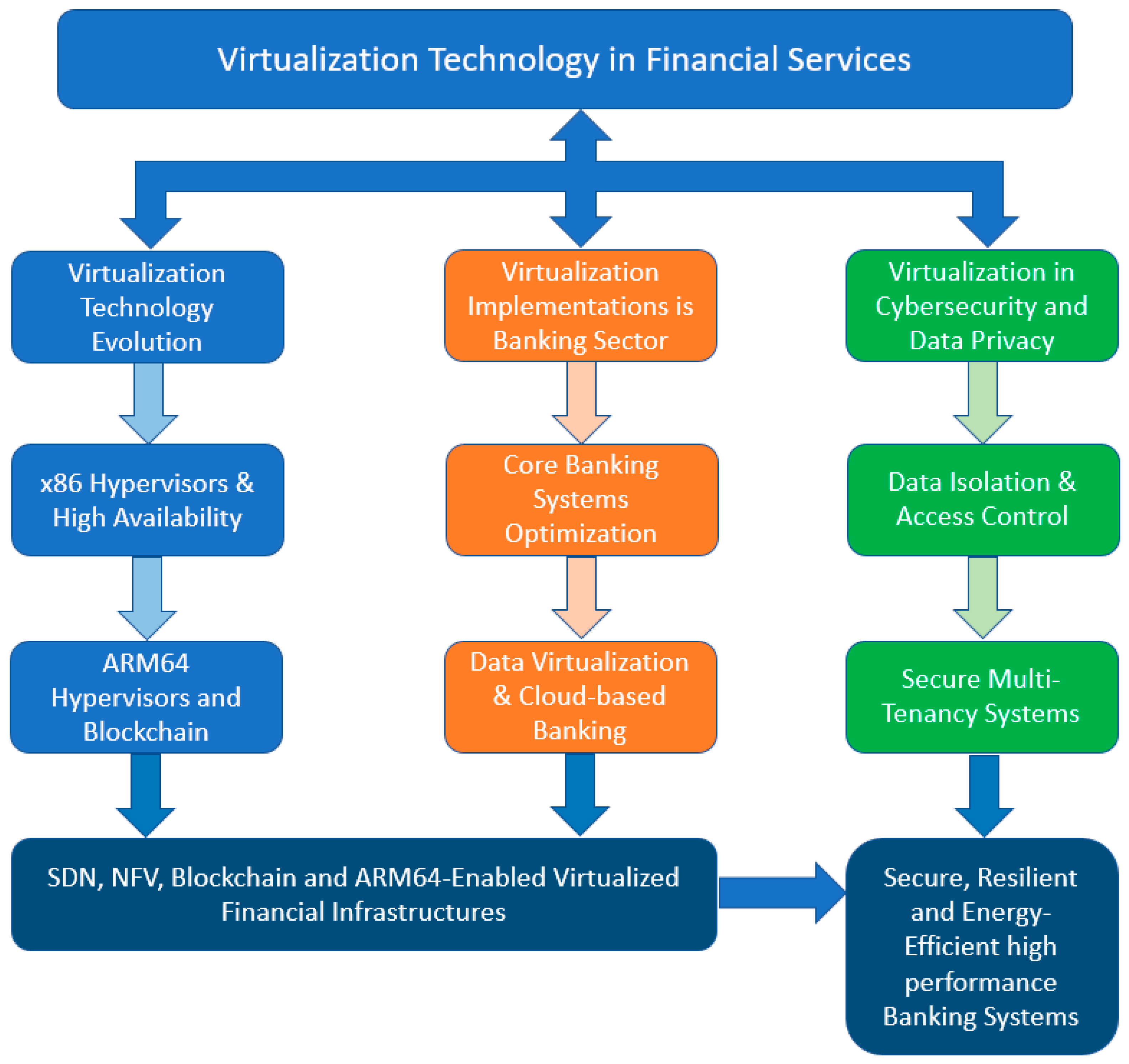
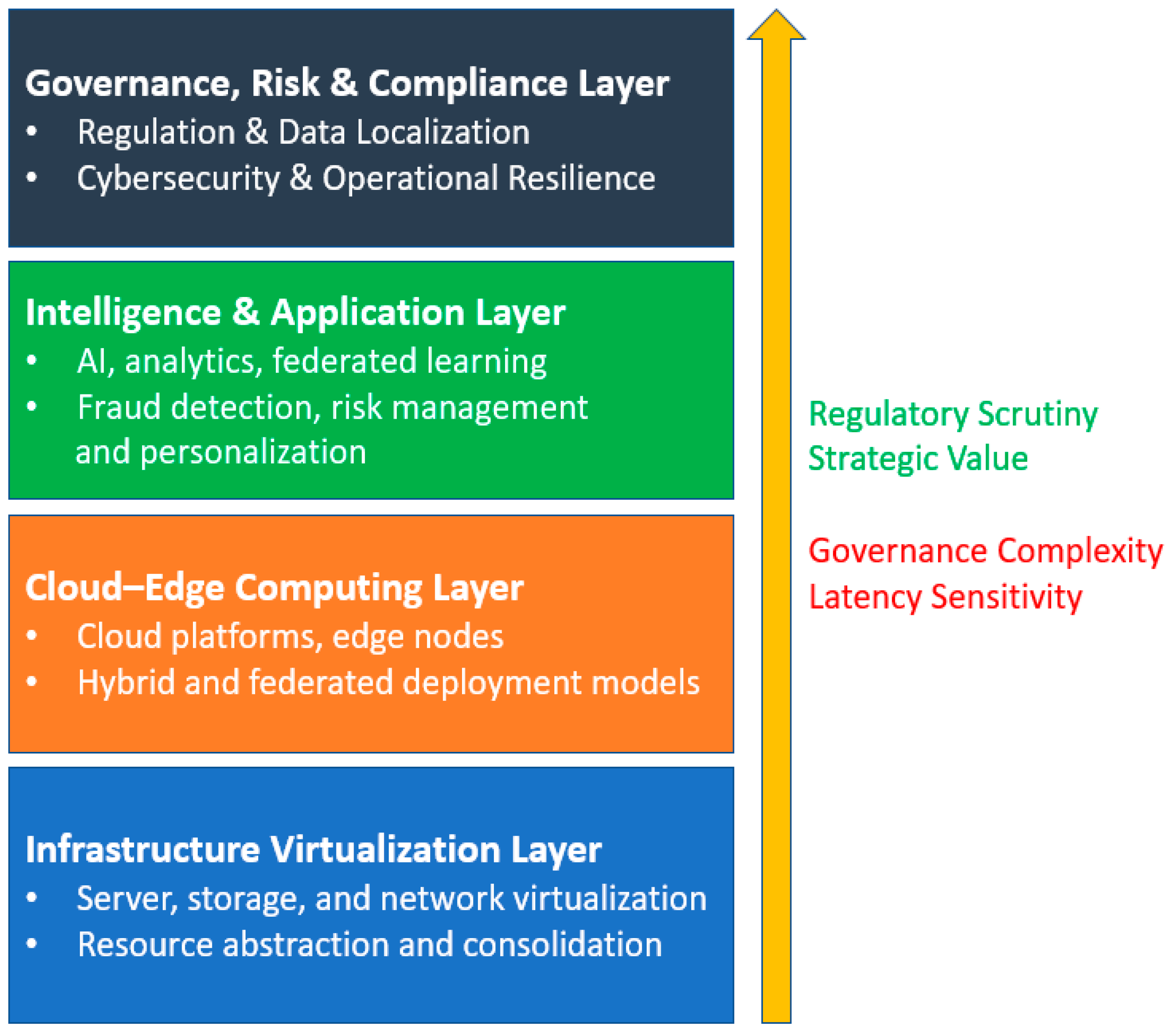
In parallel,
Figure 3 provides a conceptual synthesis of virtualization’s architectural role in distributed banking systems, emphasizing its function in enforcing workload isolation, access control, and secure data segmentation. Collectively, the table and schematic highlight virtualization not merely as an infrastructural optimization mechanism, but as a foundational component for cybersecurity and risk mitigation in increasingly distributed, cloud-enabled financial ecosystems.
4. Cloud Computing in Financial Services
The transformation of financial services through cloud computing represents a fundamental reconceptualization of traditional banking and financial operations, necessitating a comprehensive examination of the theoretical foundations, empirical evidence, and practical implications of this technological advancement. This chapter of the review provides an analysis of the literature concerning cloud computing adoption in financial services, examining the multifaceted dimensions of this technological transformation through the lens of organizational theory, economic efficiency, risk management, and regulatory compliance considerations. The financial services sector’s migration toward cloud-based infrastructures embodies a complex interplay between technological innovation and institutional adaptation, while traditional banking models are being reconstituted through digitalization processes that fundamentally reshape value creation mechanisms, operational models, and competitive dynamics [
34]. This transformation necessitates rigorous scholarly examination to clarify the theoretical underpinnings and practical implications of cloud computing adoption within the highly regulated and risk-sensitive financial services ecosystem.
4.1. Cloud Computing and Digital Transformation
Cloud computing has become the main technological ingredient of digital transformation, leading towards innovation, scalability and efficiency across all industry sectors. Cloud computing integration in financial services enables new capabilities such as precise data management, real-time analysis and flexible strategic decision making. Specifically, cloud infrastructures provide adaptability to legal and regulatory requirements, support digital business models and increase overall organizational stability.
The conceptual framework developed by Irwin et al. (2017), establishes the theoretical foundation for understanding cloud computing resources through financial market principles, introducing the novel paradigm of “financial cloud computing” that applies sophisticated economic and financial theories to optimize resource allocation and risk management in cloud environments. This pioneering work demonstrates how cloud resources, characterized by their dynamic nature and temporal constraints, differ fundamentally from traditional commodities, necessitating the adaptation of Modern Portfolio Theory (MPT) and other financial instruments to achieve optimal cost–risk–performance balancing. The concept of “derivative servers” created through algorithmic trading policies represents a significant theoretical advancement, achieving demonstrable improvements in cost efficiency (2× lower costs) and risk reduction (2× lower revocation rates) compared to single-server deployments. This theoretical framework establishes the foundation for understanding cloud computing not merely as a technological infrastructure but as a sophisticated financial instrument requiring economic analysis and portfolio management principles [
35].
Chen & Metawa’s (2020) comprehensive analysis of enterprise financial management information systems within big data environments provides crucial insights into the transformative potential of cloud computing for financial operations. Specifically, this research demonstrates how cloud-based financial shared services can fundamentally alter organizational efficiency and profitability through the implementation of “business-driven value” management concepts that prioritize automated workflow processes over traditional hierarchical approval mechanisms. The empirical validation provided through their longitudinal case study reveals remarkable operational improvements, including an 84.7% reduction in average accounting staff per subsidiary (from 23 to 3.5 personnel) while simultaneously achieving nearly 300% growth in operating revenue (from 23 billion to 68.55 billion yuan) over a nine-year implementation period. These findings substantiate the theoretical proposition that cloud computing enables fundamental restructuring of financial operations through enhanced resource utilization (achieving 80% efficiency compared to traditional 15% benchmarks) and automated process optimization [
36].
Wu and Cheng (2024) provided a comprehensive empirical analysis utilizing Chinese commercial banking data from 2010–2022, which provides robust evidence of the positive relationship between digital transformation and financial institution performance, demonstrating average returns on assets of 14.2% among digitally transformed institutions with significant variation indicating diverse implementation outcomes across different organizational contexts. The research establishes that digital transformation significantly enhances banking competitiveness through multiple mechanisms, enabling institutions to leverage technological capabilities for improved service delivery, operational efficiency, and customer experience enhancement. The finding that 43% of sample cities had implemented supportive digitalization policies demonstrates the critical role of regional policy frameworks in amplifying the positive relationship between digital transformation and institutional performance [
37]. The contradiction of U-shaped relationship theories previously proposed in the literature represents a significant theoretical contribution, with Wu and Cheng’s findings supporting a consistently positive linear relationship between digitalization and financial performance, thereby challenging existing theoretical models and providing empirical evidence for sustained benefits of digital transformation initiatives.
Shanti et al.’s (2023) innovative application of Panel Autoregressive Distributed Lag (ARDL) methodology to Indonesian digital business model banks reveals a sophisticated relationship between digital transformation investments and long-term financial performance, providing crucial insights into the dynamics of digital transformation outcomes in the banking industry context. The discovery that digital transformation initially deteriorates profitability through substantial IT infrastructure costs, technical talent expenses, and promotional expenditures, but subsequently enhances profitability through improved efficiency and competitive advantages, represents a significant theoretical advancement in understanding digital transformation dynamics. The error correction term coefficient of −0.914, indicating that 91.41% of disequilibrium movements are corrected within one month, demonstrates relatively rapid adjustment mechanisms despite requiring sustained investment periods for achieving targeted profitability outcomes [
38]. The three-dimensional transformation impact framework encompassing value creation models (VCM), value proposition models (VPM), and customer interaction models (CIM) provides a basic theoretical structure for understanding how digital transformation affects organizational performance through systematic integration of relevant IT resources including hardware, applications, databases, and data analytics capabilities.
Kanchepu’s (2023) examination of cloud computing as a key facilitator of digital transformation in banking demonstrates a major shift in operational paradigms away from reliance on legacy systems and toward solutions based on cloud-computing that are nimble, scalable, and economical. Through implementation of tactics such as centralized data storage, automated routine task execution, and optimized resource utilization, the research shows how cloud computing enables the streamlining of these operations. This practice lowers operational costs and allows human capital to be reallocated toward higher-value activities like customer engagement and the development of innovative programs. By using cloud-based analytics and AI-powered tools to produce deeper insights into customer behavioral patterns, predict the anticipation of customer needs, and deliver customized recommendations in real-time configurations, the authors also highlight how cloud computing can improve customer experience through personalized services and Interaction capabilities across all channels. In increasingly saturated financial services industries, this technological capability that promotes client loyalty enhancement and brand reputation strengthening constitutes crucial competitive differentiator [
39]. Cloud computing’s dual ability to improve security through advanced encryption, intrusion detection systems, and regulatory compliance automation is demonstrated by the cybersecurity and regulatory compliance dimensions. At the same time, cloud computing introduces new risk vectors that require complex management techniques. Although financial institutions must negotiate complicated regulatory environments that include data residency requirements, jurisdictional compliance obligations, and prudential supervision frameworks, cloud providers’ significant investments in cutting-edge security measures show institutional confidence in cloud-based security paradigms.
Fathima and Santhiyakumari’s (2021) taxonomical investigation traces the evolutionary trajectory of cloud computing technologies from foundational distributed computing paradigms toward contemporary cloud virtualization architectures, employing CloudSim simulation frameworks to demonstrate practical implementation of virtualized data center environments with empirical validation of theoretical constructs through computational modeling methodologies. The theoretical foundation establishes cloud computing as an emergent paradigm representing evolutionary confluence of distributed systems, grid computing, cluster computing, and virtualization technologies, tracing historical progression from early mainframe virtualization implementations exemplified by IBM’s S/370 architecture circa 1972 through contemporary hypervisor-based virtualization frameworks enabling sophisticated resource abstraction and workload consolidation across heterogeneous hardware platforms. This genealogical analysis illuminates technological lineage underlying modern cloud service delivery models [
40].
4.2. Security and Risk Mitigation Frameworks
Precise security and risk mitigation frameworks are crucial for establishing trust, flexibility and resilience in cloud-hosted financial systems and services. Recent research is focused on the creation of risk management models for compliance, data and operational risks associated with virtualization technology employment and migration of services to cloud in the banking industry. The creation of these frameworks aims to assist in identifying and classifying new vulnerabilities, further enhance security policies and improve proactive threat management against known and newly emerging cyber threats, while achieving regulatory compliance.
The framework developed by Elzamly et al. (2016) addresses the critical challenge of high failure rates in cloud computing projects within banking organizations through a five-stage conceptual model specifically designed for the unique security, regulatory, and operational requirements of financial institutions. This framework establishes the theoretical foundation for understanding the complex intersection of cloud computing capabilities and banking industry requirements through systematic risk identification, assessment, and mitigation strategies. The proposed framework encompasses cloud mobility and banking applications, cloud service models (including the specialized Banking Process as a Service—BPaaS), cloud deployment models, risk management protocols, and advanced security models addressing third-party governance, application security, data transmission protection, and regulatory compliance mechanisms. The emphasis on private and hybrid cloud models reflects the banking sector’s requirement for enhanced security controls and regulatory compliance capabilities while maintaining operational efficiency [
41]. The integration of supply chain finance considerations within this framework demonstrates the complexity of modern financial operations, where traditional banking services intersect with multi-party transactional networks requiring sophisticated risk assessment and management protocols that extend beyond conventional banking risk categories.
On the other hand, Vinoth et al.’s (2022) analysis of security threats in banking and e-commerce cloud implementations provides critical insights into the fundamental paradox of cloud computing adoption, where technological benefits including scalability, elasticity, and cost optimization should be balanced against significant security vulnerabilities that pose substantial risks to financial institutions. Semantic gaps that make it difficult to interpret meaningful data, analysis flaws that expose sensitive information during cloud processing operations, multi-tenancy risks resulting from shared infrastructure among independent customers, and issues where financial institutions lose direct control over their data management procedures are the most important of the security challenges identified by this research. These challenges are particularly threatening in banking environments where regulatory compliance requirements mandate specific data handling, storage, and processing protocols [
42]. The identification of trust mechanism dependencies represents a crucial theoretical contribution, highlighting how the “black-box” nature of cloud services creates uncertainty regarding data handling procedures, storage locations, and deletion protocols, thereby complicating regulatory compliance and risk management processes essential for financial institutions operating under strict regulatory oversight.
4.3. Service Models, Deployment Strategies and Performance Metrics
Cloud computing service models and deployment strategies are essential towards the digital transformation journey and overall modernization of financial and banking institutions. Specifically, by successfully adopting them, banking organizations can achieve the implementation of high-performing scalable infrastructures with seamless services integration across diversified financial applications. Recent research indicates that virtualization technology in conjunction with service-oriented architectures leads to optimized resource allocation, improved user experience and optimized data-driven decision making. Additionally, cloud-based deployments are increasingly evaluated by performance metrics focused on reliability, sustainability and efficiency, ensuring the alignment of strategic and long-term financial planning with technological investments.
Rana et al.’s (2023) examination of cloud computing utilization in banking provides detailed analysis of service models and deployment strategies, revealing the fundamental transformation occurring in banking where traditional IT systems characterized by operational inefficiencies, security vulnerabilities, and limited scalability are being replaced by advanced cloud computing architectures offering continuous network access and dynamic resource provisioning capabilities. The research demonstrates how Infrastructure as a Service (IaaS) provides fundamental computing resources while enabling user control over operating systems and applications. Platform as a Service (PaaS) offers development environments without requiring underlying infrastructure management, and Software as a Service (SaaS) delivers complete applications with minimal customer infrastructure responsibility. The analysis reveals Amazon Web Services achieving 78% adoption among financial institutions, Microsoft Azure 76% adoption, and Google Cloud Platform securing 43% market share, indicating diverse strategic approaches to cloud service provider selection [
43]. The strategic recommendation for hybrid cloud adoption reflects the complex balance required between sensitive data protection through private cloud components and leveraging public cloud scalability and cost-effectiveness for non-critical workloads, demonstrating the complexity of architectural decisions required for successful cloud implementation in banking environments.
Wang and Chang’s (2016) innovative cross-service cloud architecture represents a significant advancement in understanding how financial institutions can integrate multiple cloud-based NoSQL datastores to reduce enterprise computing costs while addressing the limitations of traditional cloud storage services for complex data operations. Their proposed framework leverages Service-Oriented Architecture (SOA) principles to combine heterogeneous cloud services including MongoDB, Google Cloud Datastore, and Hadoop HBase, enabling businesses to avoid vendor dependency (lock-in) while maintaining operational resilience. The performance evaluation demonstrates cloud-based implementations achieving 0.5-s load times compared to 3.5 s for conventional web-based systems that indicate superior performance characteristics achievable through distributed cloud architectures. The stock trading simulation serving as proof-of-concept reveals practical applicability for financial data processing, supporting market data management, transaction record processing, and order management while maintaining data integrity across multiple cloud platforms [
44].
Vemula et al.’s (2022) analysis of cloud computing impact on consumer behavior in financial services reveals major changes in customer expectations and organizational responses to technological transformation. According to the study, cloud computing capabilities have made it necessary for customers to quickly adjust to convenient service delivery, fast turnaround times, and alternative purchasing methods. As a result, financial institutions are now required to respond rapidly to customer needs to maintain their competitive positioning. Customer relationship management (CRM) has been transformed by cloud computing capabilities, which offer thorough and reliable data concerning consumer behavior. This allows for the development of improved sales and marketing strategies, as well as direct sale capabilities and the discovery of new market trends. Since technology capabilities must meet the ever-changing consumer expectations and competitive dynamics, this behavioral shift is a crucial factor for financial institutions deploying cloud computing solutions [
45].
Zuo et al. (2021), examined how digital transformation and fintech investments impact the sustainable efficiency of Chinese commercial banks using the DEA-Malmquist index method. The research analyzes 50 commercial banks from 2011–2019, focusing on their science and technology investments and resulting productivity improvements. The authors establish a theoretical framework identifying three channels through which fintech investments enhance bank efficiency: production channel (cost savings through efficient technologies), transaction channel (reduced costs in customer searching and contract implementation), and management channel (improved internal operations). This study was an empirical analysis and revealed that digitalization investments significantly contributed to productivity improvements, with an average total factor productivity growth rate of 10.7% over the study period. The most dramatic improvement occurred from 2018–2019 with a 25.2% increase, driven by applications of cloud computing, big data, and blockchain technologies. Results show substantial heterogeneity among banks, with larger institutions demonstrating superior efficiency due to continuous technology investments and focus on fintech innovations, while smaller banks lag behind due to resource constraints. Finally, the study identified four distinct clusters of banks based on efficiency levels, with leading banks showing highest technical efficiency and scale efficiency. Thus, the authors conclude that successful digital transformation requires comprehensive strategies encompassing digitalization infrastructure, organizational restructuring, and innovative product development. The findings suggest that banks must invest strategically in fintech to maintain competitiveness and achieve sustainable efficiency improvements in the evolving digital economy [
46].
The empirical investigation conducted by Cheng et al. (2022) employed innovative text-mining methodologies to quantify technological implementation within the Chinese banking sector, representing a methodological advancement that addresses inherent limitations in measuring emergent technological adoption within highly regulated financial services environments. The development of a novel cloud computing index through advanced text-mining techniques applied to web-crawled data demonstrates significant methodological innovation, incorporating fuzzy search algorithms and frequency-based word cloud analysis to enhance technical precision in keyword identification protocols. The empirical findings reveal a complex tripartite relationship between technological adoption and banking performance metrics, demonstrating paradoxical effects wherein cloud computing implementation simultaneously diminishes cost efficiency while enhancing profit efficiency and increasing operational risk exposure. These seemingly contradictory outcomes reflect the transitional nature of technological adoption, wherein upfront investments in research and development, infrastructure modernization, and human capital development initially outweigh realized cost savings, while revenue-generating capabilities through innovative service offerings and business model diversification materialize more rapidly [
47]. The ownership structure analysis provides particularly insights into heterogeneous effects across different banking institutional types, revealing that state-owned commercial banks demonstrate superior profit efficiency gains compared to joint-stock commercial banks and city commercial banks. This finding suggests that organizational scale, resource availability, and institutional support mechanisms significantly influence the effectiveness of digital transformation initiatives, while simultaneously indicating that state-owned banks uniquely experience operational risk reduction through cloud computing adoption, contrasting with increased risk exposure demonstrated across all other banking categories.
Significant improvements in digital banking products are made possible by the integration of blockchain, AI, and machine learning technologies, according to Nwoke’s (2024) analysis of digital transformation trends in financial services and FinTech. By enabling more accurate assessments of credit and by democratizing access to financial resources, the research shows how these emerging technologies promote improved financial literacy and inclusion. AI’s critical role in improving customer service through personalized experiences and predictive analytics is also highlighted to an extended degree in this publication. With AI capabilities enabling more complex customer service delivery and predictive analytics supporting improved decision-making processes, the findings show that emerging technologies have significantly expanded accessibility and efficiency in financial services. Beyond enhancing operational efficiency, the focus on financial inclusion through technological innovation illustrates the wider socioeconomic consequences of digital transformation programs [
48].
Yalate’s (2025) study regarding scalable cloud solutions for financial institutions provides a comprehensive discussion of the intersection between cloud computing scalability, risk management, and security requirements in digital transformation contexts. The research addresses fundamental challenges in financial services digital migration, including the balance between cost savings, enhanced agility, and on-demand resource scaling while maintaining regulatory compliance and operational security standards. The identification of key cloud security framework approaches, such as Zero-Trust security principles requiring continuous verification, centralized encryption mechanisms protecting data in transit and at rest and robust identity and access management mechanisms (including multi-factor authentication), provides practical guidance for financial institutions implementing cloud computing solutions. The analysis of regulatory compliance challenges including data protection and industry compliance requirements (e.g., GDPR and PCI-DSS-related constraints) demonstrates the complex regulatory landscape that financial institutions must navigate during cloud adoption processes [
49].
4.4. Organizational Adoption and Implementation Challenges
The adoption of cloud computing in financial services brings both appealing opportunities but also a number of implementation concerns. Seamless and successful integration depends on factors such risk awareness, organizational and technical readiness, and alignment with business and strategy objectives. In the wider financial sector, digital transformation initiatives are often driven by pre-defined stages that require constant adaptation of processes, metrics and governance models. Nevertheless, obstacles deriving from compliance, security and change management concerns delay the overall digital transformation journey. These obstacles can be addressed by employing structured frameworks and targeted decision-making to achieve secure and sustainable digital transformation results.
Golightly et al.’s (2022) comprehensive examination of cloud computing adoption as organizational innovation provides crucial insights into the technological, security, and implementation challenges facing institutions during cloud migration processes. Their analysis of deployment technology strategies reveals distinct advantages and constraints associated with private cloud deployment (enhanced security, improved data transfer speeds, organizational resource scalability) versus public cloud solutions (unlimited computing resources, high-level security through large data centers, rapid implementation capabilities) and hybrid cloud architectures (maintained data security while enabling cost reduction through selective resource allocation). The industrial case studies demonstrating Cloud-APS system implementation through four-layer architecture and DIGICOR platform for Industry 4.0 applications showcase practical applications across diverse sectors, illustrating how organizations leverage cloud computing for complex operational requirements while maintaining security and governance compliance. The cybersecurity considerations, particularly the analysis of intrusion detection and prevention systems (IDPS), highlight the critical importance of sophisticated security frameworks in cloud adoption strategies [
25].
Papathomas and Konteos’s (2023) three-phase framework for incumbent banks’ digital transformation journey provides sophisticated theoretical structure for understanding the evolutionary stages of digital adoption, from initial adaptation (“Toe in the water”) through comprehensive growth (“Free style swimming”) to revolutionary transformation (“Deep dive”). This framework identifies four key enablers—Strategy and Organization, People and Culture, Technology and Innovation, and Value Proposition—that drive transformation across all phases while establishing measurable Progress Tracking Indicators (PTI) for systematic assessment of transformation progress. The framework’s recognition that Phase III transformation enables 20–25% cost base reduction through digital leverage while implementing fully digital-only products represents significant theoretical advancement in understanding the ultimate objectives and outcomes of comprehensive digital transformation initiatives. The emphasis on cultural transformation requirements and cognitive barriers affecting management decision-making provides crucial insights into the organizational challenges accompanying technological transformation [
50].
A recent review by Lambropoulos et al. (2021) investigated cloud computing services, security concerns, and risk awareness in the context of digital transformation. The research examined how cloud computing has become a prerequisite for modern digital transformation strategies, with over 85% of financial institutions prioritizing digital transformation projects. The paper analyzes cloud computing’s key characteristics including its service models (SaaS, PaaS, IaaS) and deployment models (public, private, community, and hybrid clouds). Cloud computing’s fundamental components were identified according to the US National Security Agency: identity and access management, computing environment, networking, and storage. It emphasizes how server virtualization acts as the backbone technology enabling cloud services through hypervisors that manage resource allocation and physical isolation. The research highlights significant benefits including cost-effectiveness, scalability, location independence, and increased capacity utilization. However, the study revealed critical security vulnerabilities including virtual machine-level exploits, authentication and authorization weaknesses, cloud provider dependency risks, migration challenges, data ownership issues, and infrastructure sharing concerns. The research categorizes malicious actors into four types: malicious cloud infrastructure administrators, malicious customer-side administrators, external attackers, and poorly trained administrators who unintentionally create security gaps. Survey findings demonstrate widespread cloud adoption (88% of companies using public cloud services) but reveal a concerning security readiness gap affecting 92% of organizations. Common incidents include data loss (51%), compromised credentials (59%), over-privileged accounts (37%), and exposed services (35%). Finally, it was concluded that while organizations are aware of security risks, the pressure for digital transformation often results in inadequate security mitigation, highlighting the need for specialized cloud security frameworks and advanced threat detection systems [
51].
4.5. Summary of Cloud Computing Research in Financial Services
This subsection provides a concise synthesis of the reviewed literature on cloud computing in financial services.
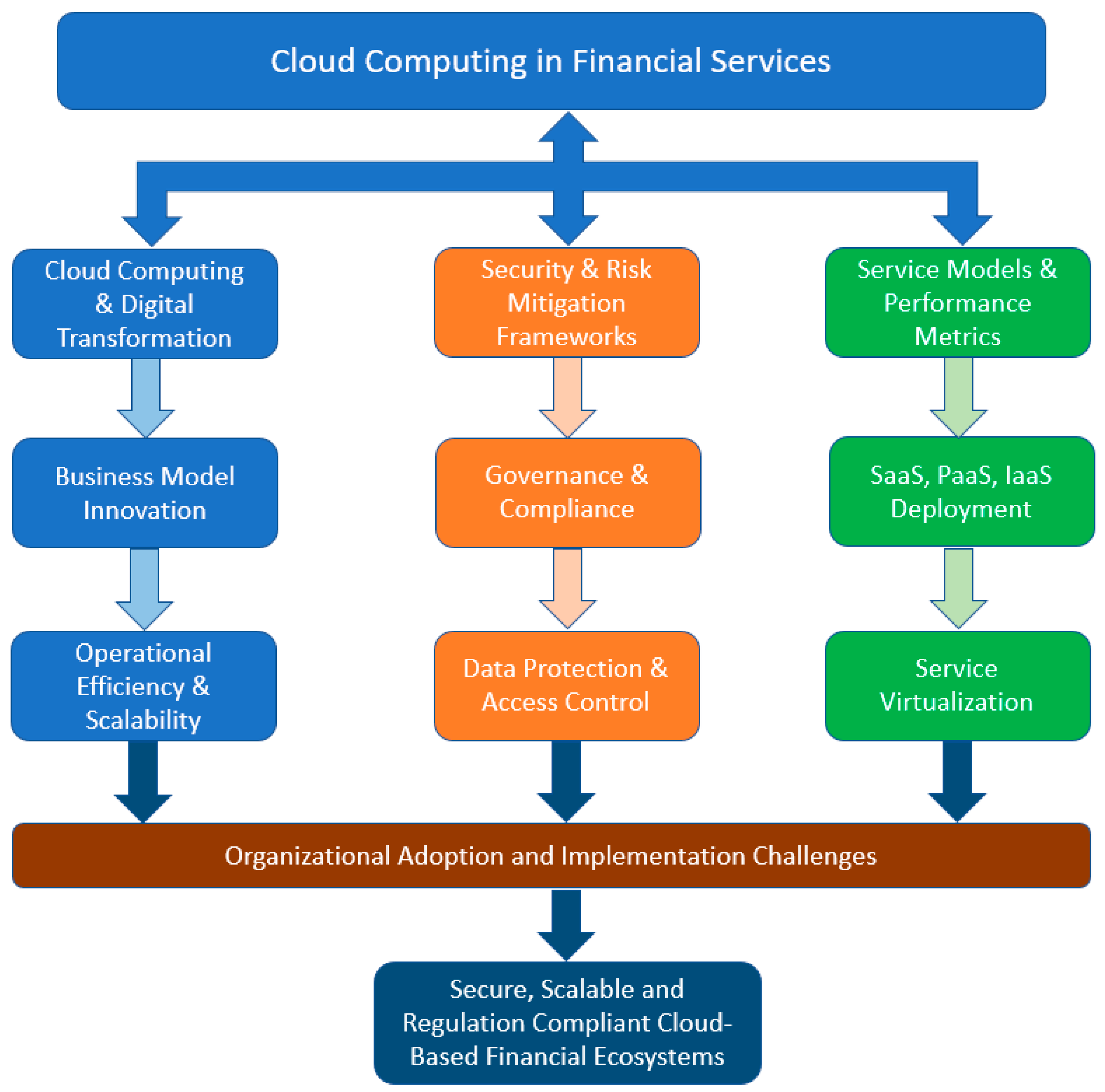
Table 2 summarizes the role of cloud technologies in enabling digital transformation, operational efficiency, and scalable service delivery, while
Figure 4 illustrates the layered cloud architecture supporting security, risk mitigation, and performance management. Together, they emphasize cloud computing as a critical enabler of modern, resilient financial infrastructures.
5. Edge Computing in Financial Services
The convergence of edge computing and financial services has emerged as a transformative force, addressing critical challenges including latency reduction, data privacy, regulatory compliance, and real-time processing requirements. The present status of research on edge computing applications in financial services is reviewed in this section, which also highlights how, in conjunction with virtualization technology, it enables distributed architectures to move processing closer to end users and data sources.
5.1. Theoretical Foundations and Architectural Frameworks
The theoretical and architectural foundation of Edge Computing is based on the integration of distributed processing closer to data generation sources so to reduce latency and improve responsiveness. In the context of financial services, frameworks that combine cloud and edge computing collaboration enable highly efficient financial tools such as wealth management and real-time trading systems with decision-making capabilities. Edge computing architectural models also feature cost-effective performance and optimal resource allocation, highlighting the potentiality of adopting edge computing to facilitate the demands for constant and data-intensive financial operations in conjunction with traditional cloud computing services.
Liao et al. (2024) propose a theoretical model for financial wealth management systems that make use of cloud-edge cooperative frameworks, putting service-based architectural concepts created especially for applications in the financial sector into practice. By demonstrating how cloud-edge collaboration allows financial organizations to achieve cross-border connectivity while maintaining data localization and reducing response times, their study lays the groundwork for distributed financial computation. This research also proposes a framework for wealth management service for financial institutions that employ collaborative filtering techniques optimized for edge computing environments. The proposed framework addresses privacy issues through decentralized data handling. Thus, the authors attempt to lay the foundations for understanding how distributed computing models could revolutionize traditional financial services, by providing customized user experience while upholding strict data security guidelines [
52].
Leiter and Bokor (2019), who suggest applying financial market ideas to Multi-access Edge Computing (MEC) infrastructure management, make a substantial theoretical addition to the understanding of edge computing in financial contexts. Their proposed concept of Cloud Stock Exchange (CSE) introduces new economic models for resource optimization in edge environments by treating virtual computing resources as tradable commodities. The study shows how conventional financial instruments, including as spot, futures, and options markets, can be modified for resource allocation in edge computing and telecommunications settings. By bridging the fields of financial economics and telecommunications engineering, this multidisciplinary approach offers market-driven pricing mechanisms that have the potential to completely transform the way financial institutions handle infrastructure resource management. A complex theoretical framework for cost optimization in edge computing deployments is provided by the application of traditional financial formulas and Geometric Brownian Movement models to resource pricing. [
53].
5.2. Edge Computing Implementations in Financial Sector
This subsection examines the intersection of edge computing with financial services, focusing on two critical areas: security and trust management, and risk management and prediction systems. The research explores how blockchain technology integration with edge computing architectures addresses fundamental security challenges in distributed financial services, including the RBaaS (Robust Blockchain as a Service) paradigm for enhanced privacy and disaster recovery, blockchain-based resource trading mechanisms for multi-tenant financial environments, and anonymous storage protocols for financial transaction data. These studies establish practical security benchmarks and demonstrate how edge computing can maintain regulatory compliance while providing real-time financial services with improved attack resistance and data localization capabilities. Simultaneously, the research demonstrates how distributed edge computing frameworks can support intelligent financial investment systems, real-time risk evaluation, and specialized financial services for diverse market segments. Studies cover comprehensive risk prediction systems utilizing artificial neural networks, mobile edge computing architectures for rapid financial analysis, and collaborative caching mechanisms for rural financial organizations. These implementations also showcase edge computing’s ability to deliver sub-second response times for financial risk assessment while maintaining high accuracy levels across various financial service contexts, from urban investment management to rural cooperative financing. The findings of these studies validate edge computing’s transformative potential in financial services sector, establishing both the security frameworks necessary for regulatory compliance and the performance capabilities required for real-time financial operations across diverse deployment scenarios.
5.2.1. Security and Trust Management in Financial Edge Computing
Security and Trust management represent a crucial sector in financial edge computing environments, where real-time transactions and distributed data processing increases risk exposure. Research outlines that blockchain-oriented frameworks offer reliable solutions for data integrity, transaction authenticity and resource sharing along cloud/edge collaboration networks. Specifically, these implementations feature reliable risk control methods for financial operations while at the same time support advanced features such as effective resource allocation and autonomous decision-making capabilities.
An important advancement in the architecture of financial services is the combination of edge computing with blockchain technology. Cai et al. (2022) introduce the RBaaS (Robust Blockchain as a Service) paradigm, addressing vendor lock-in risks and trust issues in traditional cloud-based blockchain deployments. Their cloud-edge collaborative approach enables blockchain deployment across distributed edge data centers, providing enhanced privacy through data localization and improved disaster recovery capabilities. The research demonstrates sophisticated implementation using Kubernetes-based orchestration with OpenYurt for cloud-edge coordination, addressing practical challenges including unstable network connections and communication limitations through NAT environments. This work establishes important precedents for how financial institutions can leverage blockchain technology while maintaining distributed processing capabilities essential for regulatory compliance and risk management [
54].
Kwantwi et al. (2023) advance the field by proposing blockchain-based computing resource trading in autonomous multi-access edge network slicing environments. Their work addresses the critical challenge of resource allocation in multi-tenant financial service environments, where different financial applications require varying levels of service guarantees and security isolation. The research introduces a hierarchical blockchain-based inter-slice computing resource trading (ISCRT) scheme using consortium blockchain networks with hyperledger smart contracts. The application of enhanced dueling double deep Q-network (D3QN) algorithms for optimal resource allocation demonstrates the potential for artificial intelligence integration in financial edge computing resource management, achieving improved satisfaction metrics while reducing security vulnerabilities [
55].
Li et al. (2024) focus specifically on financial network transaction risk control, combining blockchain and edge computing technologies to address security vulnerabilities in mobile financial applications. Their research introduces anonymous storage protocols for financial transaction data and trusted data synchronization systems, directly addressing critical security concerns in distributed financial computing environments. The study demonstrates system performance with round-trip times under 215 ms while maintaining resistance to various attack vectors including external attacks, edge device compromises, Man-in-the-Middle attacks, and replay attacks. This work provides practical validation for security frameworks essential for financial edge computing deployments, establishing performance benchmarks for real-world financial applications [
56].
5.2.2. Financial Risk Management and Prediction Systems
Edge computing integration can considerably improve risk management by providing real-time data analysis and prediction capabilities. Specifically, distributed architectures can support fast analysis of potential investment risks and provide proactive decision-making for financial institutions. Specifically, by employing edge computing implementations, banking organizations may gain access to rapid risk assessments, improve overall operational responsiveness and further enhance their decision-making processes in the dynamic financial market landscape.
Zhou (2022) presents a comprehensive intelligent financial investment risk prediction system utilizing edge computing technology to address growing market volatility and investment risks. The research integrates mobile edge computing frameworks with artificial neural networks, creating distributed risk assessment systems capable of real-time financial risk evaluation. The three-tier edge computing environment design featuring edge devices, edge centers, and central servers demonstrates practical architectures for regional financial risk analysis. Performance evaluation showing response times around one second for 300 concurrent users while maintaining risk prediction accuracy within 5% relative error establishes important performance benchmarks for financial edge computing applications [
57].
Kong and Lu (2021) extend edge computing applications to rural cooperative financial organizations, introducing Learning-based Collaborative Caching (LECC) mechanisms under MEC architecture. Their work addresses unique challenges in rural financing and agricultural development, demonstrating significant performance improvements with Hit Ratios exceeding traditional approaches by 17–177% depending on comparison algorithms. This research validates edge computing’s applicability across diverse financial service contexts, from sophisticated urban investment management to rural cooperative financing. The comprehensive field survey methodology involving 320 valid questionnaires across multiple Chinese provinces provides valuable empirical data on rural financial service requirements and edge computing’s potential impact [
58].
5.3. Virtualization Integration in Edge Computing
The integration of virtualization technology on edge computing implementations provides resource efficiency, flexibility and scalability in distributed environments. Virtualization platforms enable high-performance deployment on limited resources edge hardware, while single board computer (SBC) implementations provide practical approaches for handling specific edge computing workloads. The advancement of virtualization technology on edge computing facilitates unified application deployment, efficient hardware isolation and optimal resource utilization, highlighting the importance for developing virtualization-based solutions for edge computing.
Goethals et al. (2022) provide critical insights into virtualization platform performance for edge computing applications, benchmarking various lightweight virtualization solutions including microVMs and containers in edge microservice contexts. Their comprehensive evaluation covers toolchain maturity, networking capabilities, boot time, resource usage, and ARM architecture readiness. Key findings indicate that standard Docker containers offer reliable performance and low memory usage, while microVM-based solutions like Firecracker provide superior isolation. OSv unikernels demonstrate extremely low boot times and significantly better performance than Docker containers, while gVisor offers improved security with excellent compatibility but reduced performance. These findings have significant implications for financial edge computing deployments, where the choice of virtualization platform directly impacts security, performance, and resource utilization in distributed financial applications [
59].
Lambropoulos et al. (2024), investigated the feasibility of implementing virtualization technology on Single-Board Computers (SBCs) for edge computing applications, specifically examining the Raspberry Pi 4B as a cost-effective alternative to traditional x86-based infrastructure. The research employs a three-phase methodology including hardware selection and analysis, testing environment creation with hypervisor evaluation, and a real-world case study within a financial organization’s edge infrastructure. The study demonstrates that while Microsoft Hyper-V could not operate effectively on the Raspberry Pi 4B due to compatibility issues, VMware ESXi 7 on ARM64 proved fully operational with adequate performance and feature compatibility. The research reveals both opportunities and challenges in transitioning from x86 to ARM64-based edge computing, with SBCs excelling in power efficiency, compact form factor, and minimal heat generation, making them ideal for resource-constrained environments. Performance comparisons between the Raspberry Pi 4B and traditional workstation-based infrastructure show mixed results. While the SBC exhibited higher CPU utilization (41.34% average vs. 30.11%) and significantly increased storage latency (approximately ten times higher), it achieved remarkable power efficiency improvements with consumption averaging 5.8 W compared to 50.95 W for the workstation-based system. The case study successfully replaced an x86 workstation hosting two virtual machines with the Raspberry Pi infrastructure, maintaining service continuity despite performance limitations. The authors concluded that ARM64-based SBCs represent a viable solution for specific edge computing scenarios, particularly where power efficiency and space constraints are priorities, though storage performance limitations remain a significant challenge requiring future hardware improvements and standardization efforts [
21].
5.4. Emerging Applications and Future Directions
Emerging edge computing applications in the wider financial sector are expected to expand the boundaries of real-time decision making, intelligent automations and credit scoring evaluation. Integration with technologies such as Internet of Things (IoT) can facilitate low-latency financial data processing which in conjunction with Artificial Intelligence (AI) banking systems may provide innovative solutions in financial areas such as supply chain financing. Such implementations lead to future directions, where edge computing can provide enhanced operational efficiency and improved risk management through the delivery of highly responsive data-driven financial analysis.
Zhu et al. (2023), explore the intersection of finance-level Artificial Intelligence of Things (AIoT) and edge computing, focusing on trust evaluation and crowd credit assessment applications. Their low-latency edge computation offloading scheme addresses computational resource limitations in large-scale financial AI applications, proposing multiobjective optimization solutions for task allocation in 6G-driven digital financial environments [
60].
Zhen and Li (2024) investigate the integration of digital technologies and edge computing devices in accounting information systems, exploring mediating effects on strategic performance. Their research develops digital accounting systems using artificial intelligence and edge computing for data processing and storage, addressing cost barriers that prevent small-scale businesses from accessing sophisticated accounting software. The study introduces novel edge frameworks for digital data processing with advanced methods for handling IoT-generated data growth, demonstrating practical applications of edge computing in financial data management and business intelligence [
61].
Yin et al. (2024) present comprehensive IoT data management frameworks integrating blockchain and edge computing specifically for supply chain finance applications. Their three-tier architecture comprising blockchain layer, edge storage layer, and user access layer demonstrates sophisticated approaches to financial data management with smart contracts for automated transaction processing. Experimental validation across multiple system architectures shows significant performance improvements, with edge computing + blockchain systems achieving 50 ms data processing delays compared to 100 ms for blockchain-only systems, while maintaining 100% data integrity and achieving substantial risk reduction across market, credit, and operational risk categories [
62].
5.5. Summary of Edge Computing Research in Financial Services
This subsection consolidates the key insights from the reviewed literature on edge computing in financial services.
Table 3 summarizes examined studies, highlighting the theoretical foundations, practical implementations, and virtualization integration that enable low-latency, privacy-preserving, and resource-efficient financial applications.
Figure 5 represents a conceptual overview of cloud–edge collaboration architectures, illustrating how distributed processing, blockchain-based security mechanisms and virtualization technology support real-time financial operations, emphasizing edge computing as a critical technology for secure, responsive and scalable financial ecosystems, particularly in context of strict data locality requirements, rapid decision-making and regulatory compliance.
6. Summary and Gap Analysis
This systematic literature review examined the transformative impact of virtualization technology in financial services, spanning the critical technological domains of cloud computing implementations and edge computing applications. The review synthesized evidence from diverse empirical studies and theoretical frameworks to elucidate how virtualization technology is fundamentally reshaping service delivery, operational efficiency, and competitive dynamics within the financial services ecosystem. The analysis reveals that virtualization technology offers substantial opportunities for operational optimization, cost reduction, and enhanced customer experience while simultaneously presenting significant implementation challenges related to security vulnerabilities, regulatory compliance complexities, and organizational transformation requirements. The literature demonstrates consistent evidence of positive long-term performance outcomes from technological adoption, though temporal dynamics and contextual factors influencing these outcomes require continued theoretical development and empirical investigation.
The analysis of virtualization technology and their theoretical foundations receives comprehensive validation from both our findings and recent systematic literature reviews. The conceptual framework applying financial market principles to cloud computing resources, as demonstrated by Irwin et al. (2017), aligns with subsequent research showing that virtualization technology requires sophisticated economic analysis beyond traditional IT infrastructure approaches [
35]. The identification of substantial performance improvements through virtualization implementation is substantiated by empirical studies revealing average consolidation ratios of 84% and long-term ROI improvements exceeding 140% in financial institutions [
3]. Furthermore, the integration of artificial intelligence with virtualization technology, as evidenced by Chen & Metawa’s (2020) analysis showing 84.7% reduction in accounting staff requirements while achieving 300% revenue growth, validates the transformative potential identified in our theoretical framework analysis [
36].
The examination of cloud computing in financial services receives substantial empirical support from recent systematic reviews and industry implementations. A comprehensive systematic literature review of cloud computing adoption in the financial banking sector, analyzing 370 empirical studies from 2011 to 2021, revealed 14 frameworks, methods, models, or strategies for cloud computing adoption across 14 countries, validating our chapter’s emphasis on the diversity of implementation approaches [
63]. Our findings regarding positive performance outcomes from cloud computing adoption are supported by Wu and Cheng’s (2024) empirical analysis demonstrating average returns on assets of 14.2% among digitally transformed institutions, contradicting earlier relationship theories and supporting consistently positive linear relationships between digitalization and financial performance [
37]. The identified need for sophisticated security and risk management strategies finds validation in systematic literature reviews revealing critical challenges including multi-tenancy risks, data control issues, and regulatory compliance complexities that require comprehensive governance frameworks [
64,
65].
The analysis regarding Edge Computing identified significant research gaps in standardization, regulatory compliance, and performance optimization for financial environments. Recent industry analysis confirms that edge computing significantly reduces latency by processing data near its origin, which is crucial for operations like algorithmic trading and real-time fraud detection, where milliseconds can make a difference [
57,
66]. Edge computing will play an increasingly critical role in financial services evolution is corroborated by statistical evidence showing that financial institutions implementing edge computing solutions have reported an average 69% reduction in transaction processing times [
67].
A qualitative distinction emerges between the period prior to 2020 and the phase of intensive digital transformation due to COVID-19 pandemic. Specifically, prior 2020, virtualization technology, cloud computing and early edge computing applications in financial services were primarily driven by cost reduction, infrastructure consolidation and efficiency improvement, mostly due to the aftermath of the international economic crisis in 2008. On the contrary, after 2020, a major shift towards resilience, scalability and remote operability occurred driven by the disruptions caused by the pandemic and the newly introduced operating and working models [
68,
69]. Specifically, financial institutions increasingly adopted cloud and edge-based architectures so as to support large-scale remote working and uninterrupted service availability with real-time interaction for their digital channels [
70]. This rapid transition occurred simultaneously with the significant evolution of Artificial Intelligence solutions, mainly in the fields of fraud detection, risk analysis and customer service automation. Unlike earlier applications, AI solutions are considerably more tightly depended on cloud and edge infrastructures, enabling real-time distributed intelligence and analytics [
71]. These developments led financial organizations to a rapid shift from centralized on premise environments towards hybrid and distributed models featuring modularity, low latency and interoperability. At the same time, after 2020, newly emerged regulatory frameworks impacted the adoption and governance models regarding virtualization and cloud technologies in the wider financial sector. Newly introduced regulations increasingly emphasize operational resilience, third-party risk management, data ownership and cloud exit strategies, leading financial institutions to adopt more strict governance, compliance and risk management operating frameworks [
72]. These newly introduced changes considerably influenced the overall decision-making regarding the implementations associated with virtualization, cloud and edge computing adoption strategies.
To further clarify mature, adoption-phase and emerging technologies, it is important to distinguish the technological maturity levels as reflected in the reviewed literature. Specifically, Virtualization technology and cloud service models such as IaaS, PaaS and SaaS are dominant in research during the period of 2016 to 2019 and should be considered as standardized solutions that today form baseline infrastructural components for the majority of financial institutions. On the contrary, hybrid cloud-edge architectures, AI-integrated virtualization platforms and automated workload orchestration systems represent technologies in the spectrum of rapid market adoption phase, mainly defined by ongoing standardization concerns. Emerging trends such as confidential computing, regulated cloud models and AI-driven banking architectures that are particularly relevant in the timeframe between 2024 and 2025 still remain at early development or experimental stage. Specifically, between 2016 and 2019, research is limited on virtualization and cloud service models strictly as underlying enabling technologies. After 2020, published research regarding hybrid cloud and energy efficient virtualization is steadily increasing, with the highest growth occurring between 2022 and 2025, with edge computing related studies being at the epicenter, mostly concerning low-latency financial analytics, AI-assisted risk management, blockchain security and efficient edge virtualization. This trend further reflects the shift from infrastructure-oriented implementations towards distributed financial computing architectures.
Moreover, recent studies on distributed intelligence highlight further opportunities for edge computing. Li et al. [
73] reveal that Byzantine-robust aggregation in federated learning enhances security and reliability in distributed systems, protecting against malicious or faulty nodes. Wang et al. [
74] demonstrate that over-the-air computation in edge federated learning reduces latency and communication overhead, supporting real-time operations. Furthermore, the development of edge general intelligence via large language models [
75] indicates the potential for context-aware AI at the edge, enabling adaptive, intelligent decision-making potentially suitable for financial services.
To conclude, the literature demonstrates that edge computing combined with virtualization technology offers significant potential for transforming financial services through reduced latency, improved security, enhanced privacy, and better resource utilization. The integration of blockchain technology, artificial intelligence, and advanced virtualization platforms creates synergistic effects that address traditional limitations of centralized financial computing architectures. Key contributions from the reviewed literature include theoretical frameworks for cloud-edge collaboration in financial services, practical implementations of security and trust management systems, innovative approaches to risk management and prediction, as well as comprehensive performance evaluations of virtualization platforms.
6.1. Gap Analysis
This literature review acknowledges several methodological limitations that constrain the generalizability and comprehensiveness of findings. The selection of databases, while encompassing major academic repositories, may have excluded relevant studies published in specialized financial technology journals or industry reports not indexed in traditional academic databases. The predominant focus on English-language publications potentially introduces cultural and regional biases, particularly limiting insights from emerging markets where financial technology adoption patterns may differ significantly from developed economies. The temporal scope of the review, while comprehensive, reflects the rapid evolution of virtualization technology, meaning that recent developments may not be fully captured in the analyzed literature. The interdisciplinary nature of the topic necessitated inclusion of studies from computer science, information systems, finance, and management disciplines, each employing different methodological standards and theoretical frameworks, potentially creating inconsistencies in evidence quality and analytical rigor. Additionally, the heterogeneity of the examined technologies (ranging from virtualization to cloud and edge computing) required broad analytical categories that may obscure nuanced differences between specific technological implementations. Another significant limitation noted in the literature is the tendency for virtualization to be viewed exclusively as an underlying infrastructure element and not as a specific form of technological innovation. In many cases, virtualization is studied only when embedded within cloud computing implementations or as part of edge computing solutions. This limited context may inhibit a holistic understanding of virtualization’s stand-alone transformative potential within the context of financial services.
6.2. Conceptual Framework for Cloud-Edge Financial Architectures
Based on the systematic synthesis of the reviewed literature, this article proposes a conceptual structure regarding cloud-edge financial architectures that organizes virtualization technology, computing paradigms, intelligent services and governance requirements into a unified analytical framework. While previous studies mainly examine virtualization technology, cloud and edge computing and intelligent technologies such as data analytics and Artificial Intelligence as separate technological domains, this framework aims to integrate them and clarify their respective functional role within the context of financial services. The proposed framework is structured into four interrelated layers that reflect both technological progression and organizational control mechanisms. Specifically these layers are:
- (1)
Infrastructure Virtualization Layer: Includes server, storage and network virtualization technologies that enable features such as abstraction, consolidation, resource pooling and elasticity. In the context of financial services, this layer supports cost efficiency, scalability and hardware independence by creating the technical foundation for both cloud and edge computing implementations.
- (2)
Cloud-Edge Computing Layer: Represents the deployment bridge between centralized cloud platforms and decentralized edge environments. Cloud computing supports large-scale data processing and storage, enterprise analytics, regulatory reporting whereas edge computing enables low-latency applications such as real-time fraud detection, algorithmic trading and customer interaction services.
- (3)
Intelligence and Application Layer: Encompasses Artificial Intelligence and big data analytics technologies that are deployed across cloud and edge infrastructures, including federated and machine learning as well as other emerging edge solutions. In the context of financial services, this layer enables features such as automated risk assessment, fraud detection, decision support, personalization and dynamic operational optimization by leveraging distributed intelligence to enhance responsiveness and reduce latency.
- (4)
Governance, Risk, and Compliance Layer: Addresses issues of data governance, regulatory compliance, cybersecurity and operational resilience. Specifically, it includes the requirements related to data localization, cloud exit strategies, model risk management and technological auditing requirements concerning financial institutions.
The proposed framework indicates that the added value regarding financial services does not arise from isolated individual technologies, rather than their coordinated adoption across different layers. Specifically, virtualization technology enables infrastructure-level flexibility, cloud-edge architectures optimize overall performance and reduce latency and intelligent AI-driven technologies enhance decision-making capabilities, while governance mechanisms ensure systemic stability and regulatory compliance. Towards this direction, the proposed framework provides both a conceptual guide for financial services design and an organizing perspective for future theoretical research or empirical investigations. The proposed layered taxonomy is summarized in
Table 4.
From an engineering perspective, the proposed layered taxonomy features technical evaluation across key performance parameters relevant to financial sector’s computing environments. Specifically, the Infrastructure Virtualization and Cloud–Edge Computing layers directly impact latency, throughput, scalability, and resource utilization, while the Intelligence and Application layer affects decision latency, model execution efficiency, and data transaction delays. The Governance, Risk, and Compliance layer introduces concerns that impact architectural design, such as workload balancing, data localization and fault tolerance. This layered view enables the comparison of centralized versus distributed deployments and enables quantitative assessment of performance trade-offs across cloud and edge environments.
The layered conceptual framework for cloud–edge financial architectures, illustrating the role of infrastructure virtualization, cloud–edge computing, intelligent applications and governance mechanisms in financial services is presented in
Figure 6.
7. Conclusions and Future Work
This systematic literature review provides comprehensive evidence that virtualization technology is fundamentally transforming financial services through three interconnected technological domains of Cloud and Edge Computing. The analysis reveals consistent patterns of positive long-term performance outcomes, including significant improvements in operational efficiency, cost reduction, transaction processing speeds, and customer experience enhancement across diverse financial service contexts. The review identifies critical implementation challenges that require ongoing attention, including the need for standardized interoperability frameworks, sophisticated regulatory compliance mechanisms, and comprehensive organizational change management strategies. The temporal dynamics of technology adoption demonstrate initial investment costs and implementation complexities that are offset by substantial long-term benefits, supporting the business case for strategic virtualization initiatives in financial institutions.
Cloud-centric architectures optimize large-scale processing and cost efficiency but exhibit higher transaction latency compared to edge-enabled solutions, whereas edge deployments achieve superior responsiveness and reduced transaction processing times (~69% reduction) but are limited by local processing capacity. Hybrid cloud–edge architectures strategically balance latency reduction and throughput, enabling financial institutions to optimize both operational continuity and performance. This comparative assessment provides a quantitative and functional framework to evaluate deployment decisions based on specific operational priorities.
Additionally, the transition from pre-2020 centralized infrastructures to distributed architectures represents a structural technological shift driven by resilience, remote operability, and real-time analytics needs. Edge computing, combined with AI-integrated virtualization, enables distributed intelligence that significantly reduces decision latency, model execution efficiency, and fraud detection responsiveness compared to centralized models. Cloud platforms complement this by enabling large-scale analytics, regulatory reporting, and resource optimization, underscoring the complementary roles of cloud and edge architectures.
Moreover, virtualization continues to serve as a foundational technology across all paradigms; however, its practical value is increased through integration with AI-driven services, federated learning frameworks, and governance mechanisms that improve system reliability, security, and compliance outcomes.
Beyond providing a structured synthesis of existing studies, this review also provides a layered conceptual framework regarding cloud–edge financial architectures that integrates virtualization, distributed computing, artificial intelligence and governance considerations. The framework offers a unified analytical perspective for understanding technological interdependencies in financial services and provides a foundation for future empirical research, system design and regulatory analysis.
Finally, these insights support actionable recommendations for financial institutions and researchers such as adopting hybrid cloud–edge architectures tailored to specific latency and throughput requirements, integration of distributed AI solutions to enhance operational responsiveness, development of standardized evaluation protocols for transaction and processing performance across deployment models, and conducting further studies to assess the combined impact of technological evolution, regulatory shifts, and operational scaling on financial services performance.
Future research should prioritize the development of integrative theoretical frameworks that can accommodate the complex interactions between different virtualization technologies rather than examining them in isolation. The lack of standardized frameworks for AI implementation across financial institutions remains a persistent gap, suggesting urgent need for research addressing standardization challenges across all discussed technologies. Longitudinal comparative studies across different geographical and regulatory contexts are essential to enhance external validity and understand how cultural, economic, and regulatory factors influence technology adoption outcomes. Research indicates that as financial services advance, the risks and challenges of adopting new technologies will increase, requiring consideration of both service providers’ intentions and consumer acceptance across diverse topography and education levels. The regulatory dimension requires particular attention, with future research investigating adaptive regulatory frameworks capable of accommodating rapid technological evolution while maintaining prudential supervision effectiveness. Current challenges include regulatory compliance complexities where financial institutions must follow strict regulations regarding data residency and privacy that vary by country, indicating the need for comprehensive governance frameworks.
Based on the analysis of the above technologies in financial services, future research directions should prioritize the development of sophisticated integrative theoretical frameworks that can systematically accommodate the complex synergistic interactions between virtualization technology, cloud computing and edge computing implementations, rather than examining these paradigms in isolation. Critical research sectors include the establishment of standardized interoperability protocols for multi-vendor environments, the development of adaptive regulatory compliance frameworks capable of accommodating rapid technological evolution while maintaining prudential supervision effectiveness across diverse jurisdictional contexts, and the creation of comprehensive governance models that address the complex intersection of data sovereignty, cybersecurity, and operational resilience requirements in distributed financial computing architectures.
Additionally, future research should also consider the integration of distributed AI and federated intelligence into virtualization and cloud-edge computing analysis. Specifically, the application of Byzantine-robust federated learning techniques [
73] can enhance system security and reliability. The development of communication-efficient edge federated learning [
74] can address latency and bandwidth challenges in real-time financial operations. Finally, exploring edge-deployed large language models [
75] provides a method for intelligent, context-aware decision-making at the edge. Future research should continue to develop theoretical frameworks, standardization protocols and empirical studies to assess adoption capabilities, performance outcomes, and social implications of hybrid virtualization and AI-enabled edge solutions in financial services.
Longitudinal empirical investigations examining the temporal dynamics of virtualization and cloud computing adoption across different geographical, cultural, and regulatory contexts are essential to enhance external validity and understand how institutional, economic, and technological factors influence implementation outcomes and performance metrics. Furthermore, research should explore the development of novel risk assessment methodologies specifically designed for hybrid virtualization environments and examine the socioeconomic implications of widespread cloud and edge computing adoption on financial inclusion, workforce transformation, and systemic financial stability in both developed and emerging market economies.