Systematic Review

Artificial Intelligence and the Future of Mental Health in a Digitally Transformed World

by
Aggeliki Kelly Fanarioti
and
Kostas Karpouzis
*
Department of Communication, Media and Culture, Panteion University of Social and Political Sciences, GR-176 71 Athens, Greece
*
Author to whom correspondence should be addressed.
Computers 2025, 14(7), 259; https://doi.org/10.3390/computers14070259

Submission received: 19 May 2025 / Revised: 25 June 2025 / Accepted: 26 June 2025 / Published: 30 June 2025
(This article belongs to the Special Issue AI in Its Ecosystem)

Abstract

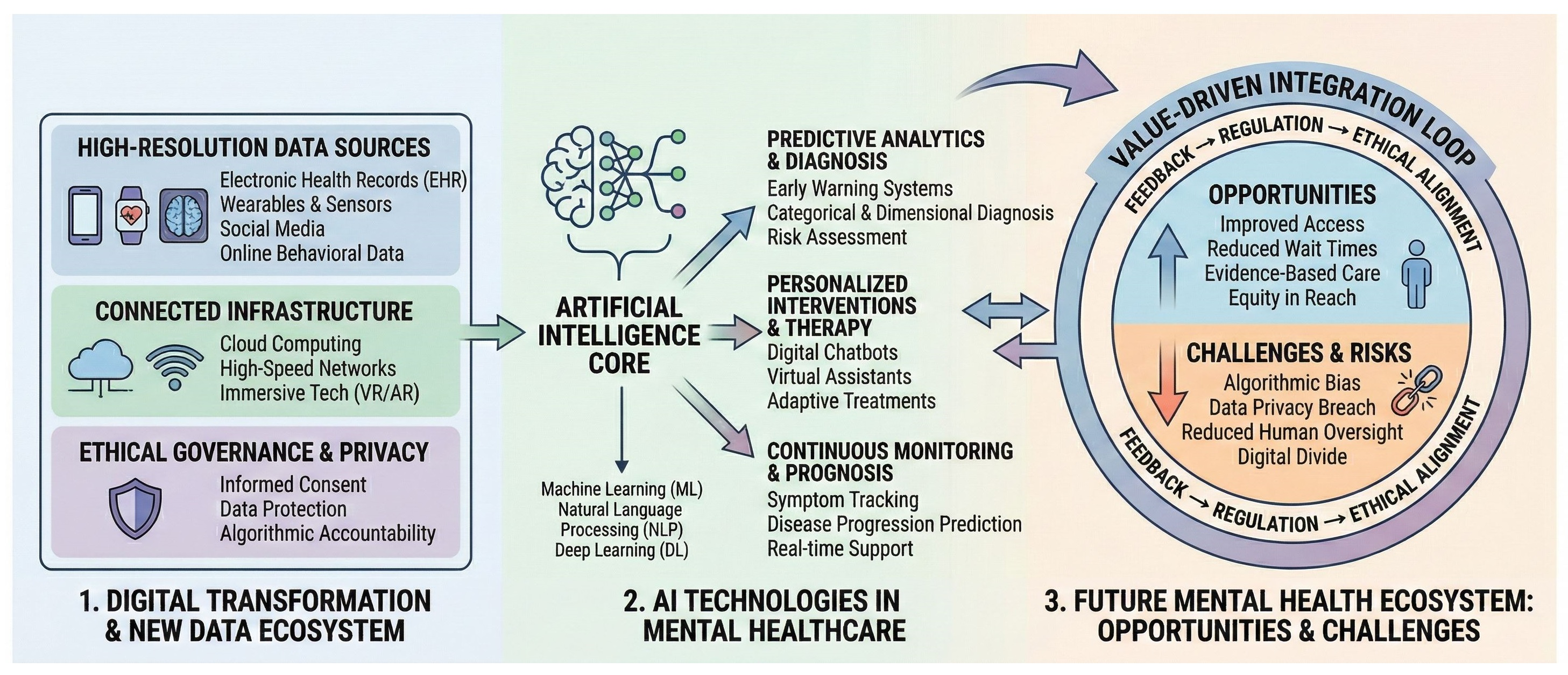
Artificial Intelligence (AI) is reshaping mental healthcare by enabling new forms of diagnosis, therapy, and patient monitoring. Yet this digital transformation raises complex policy and ethical questions that remain insufficiently addressed. In this paper, we critically examine how AI-driven innovations are being integrated into mental health systems across different global contexts, with particular attention to governance, regulation, and social justice. The study follows the PRISMA-ScR methodology to ensure transparency and methodological rigor, while also acknowledging its inherent limitations, such as the emphasis on breadth over depth and the exclusion of non-English sources. Drawing on international guidelines, academic literature, and emerging national strategies, it identifies both opportunities, such as improved access and personalized care, and threats, including algorithmic bias, data privacy risks, and diminished human oversight. Special attention is given to underrepresented populations and the risks of digital exclusion. The paper argues for a value-driven approach that centers equity, transparency, and informed consent in the deployment of AI tools. It concludes with actionable policy recommendations to support the ethical implementation of AI in mental health, emphasizing the need for cross-sectoral collaboration and global accountability mechanisms.
Keywords: artificial intelligence; digital health systems; ethical AI; health informatics; AI governance; human-centered computing; policy-aware computing artificial intelligence; digital health systems; ethical AI; health informatics; AI governance; human-centered computing; policy-aware computing
Graphical Abstract