Radiomics for Detection and Differentiation of Intrahepatic Cholangiocarcinoma: A Systematic Review and Meta-Analysis



Simple Summary
Abstract
1. Introduction
2. Methods
2.1. Inclusion and Exclusion Criteria
2.2. Information Sources and Search Strategy
2.3. Study Selection
2.4. Data Extraction
2.5. Quality Assessment
2.6. Meta-Analysis
3. Results
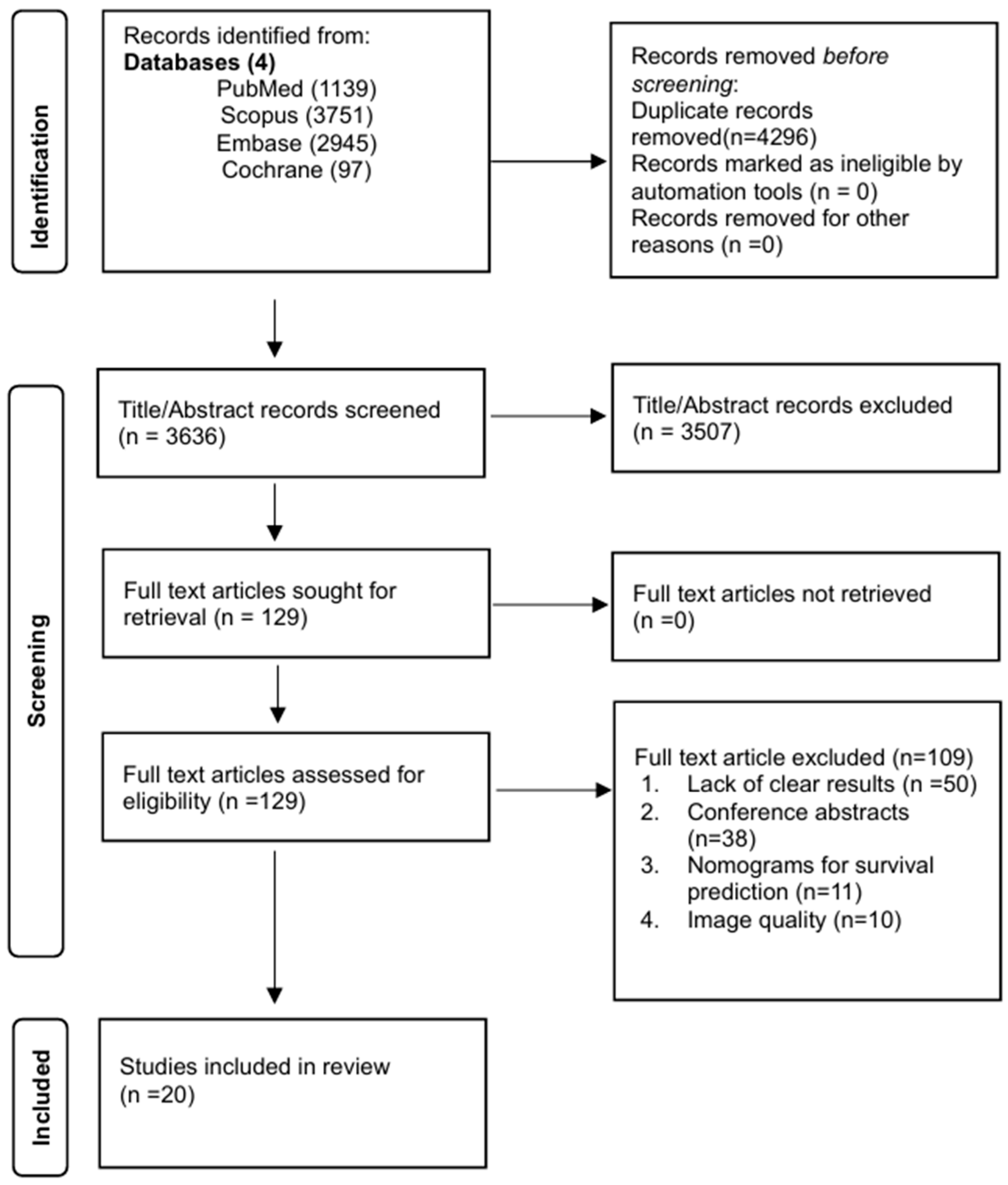
3.1. Study Selection and Characteristics
3.2. Study Participants and Algorithm Characteristics
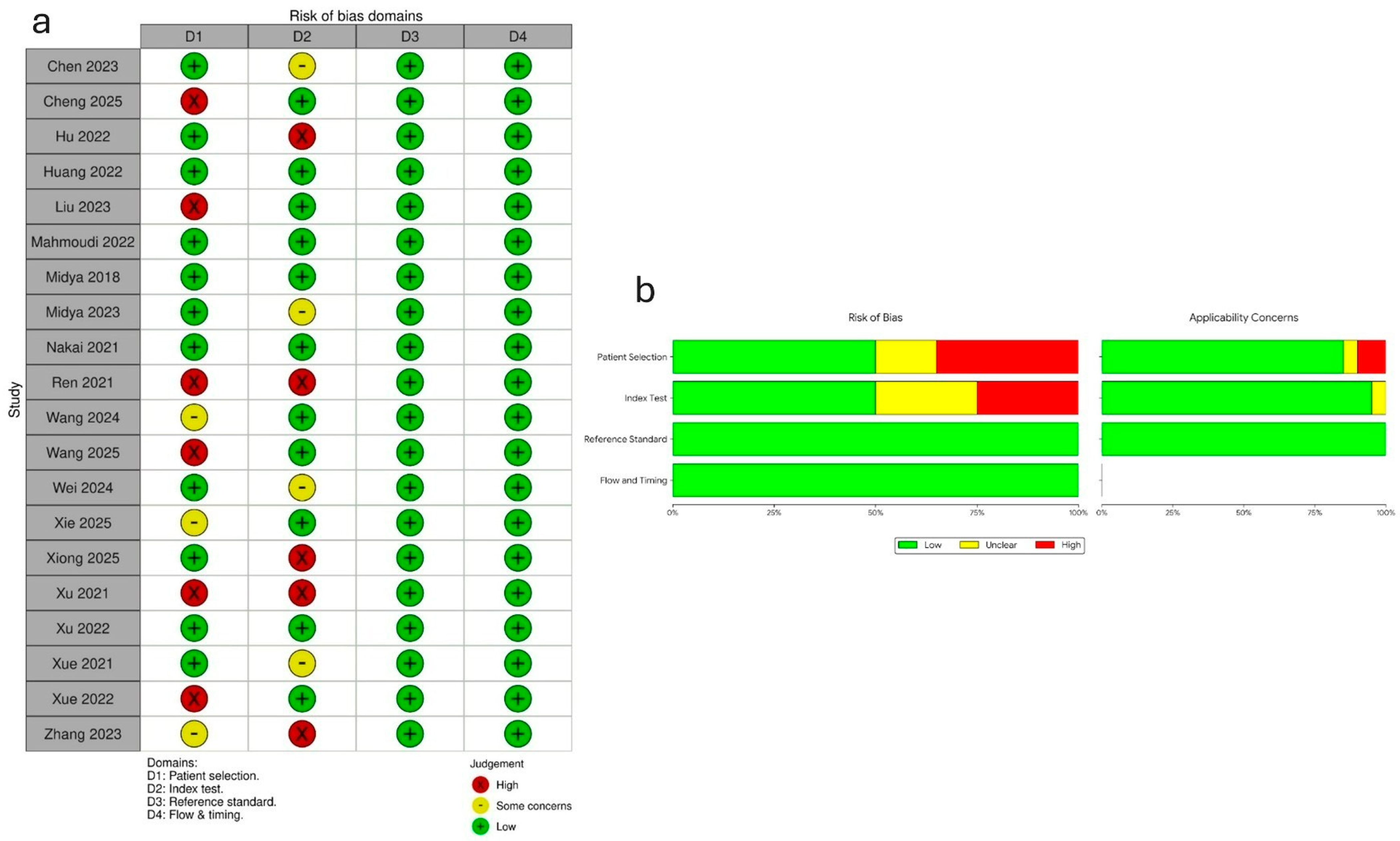
3.3. Quality Analysis
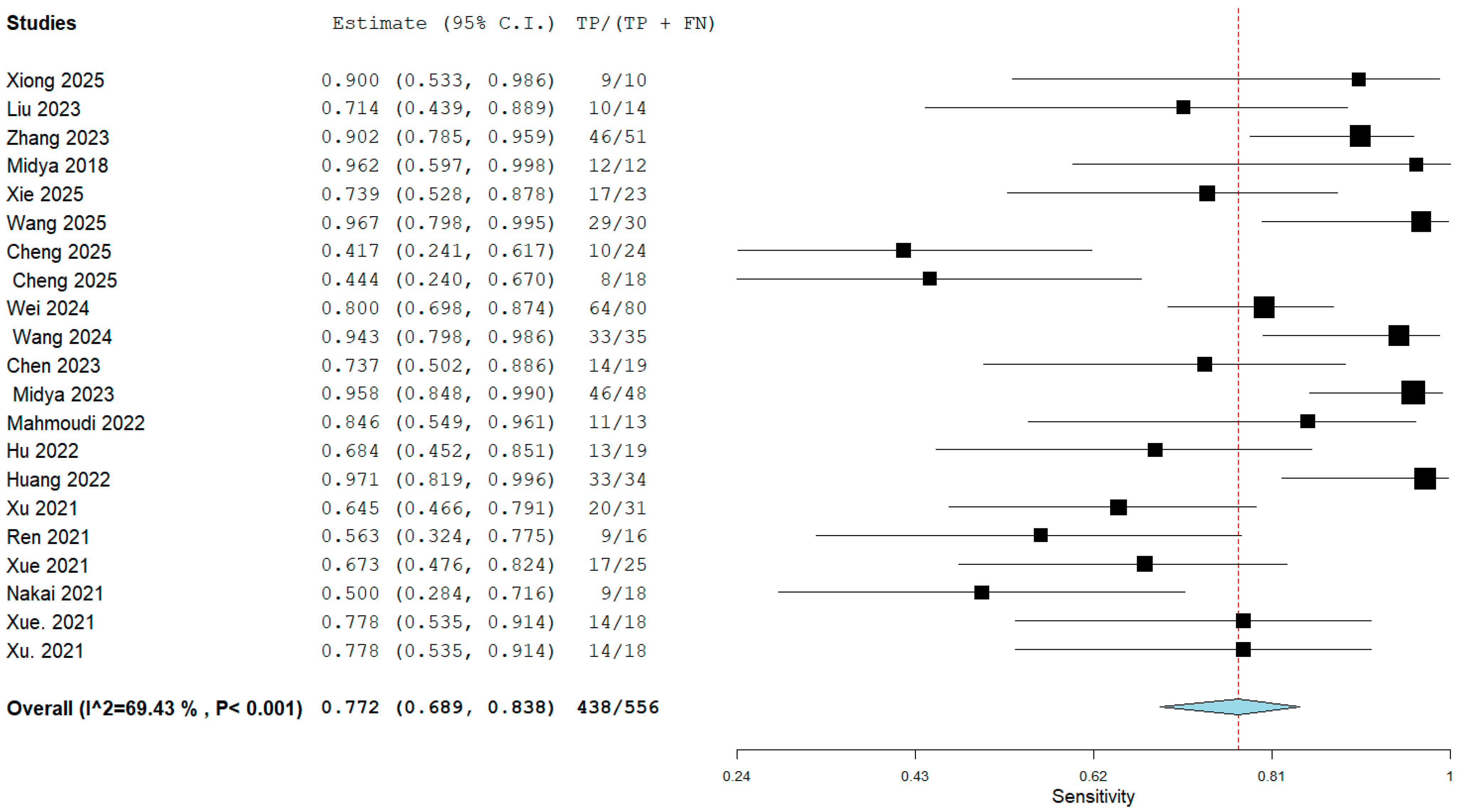
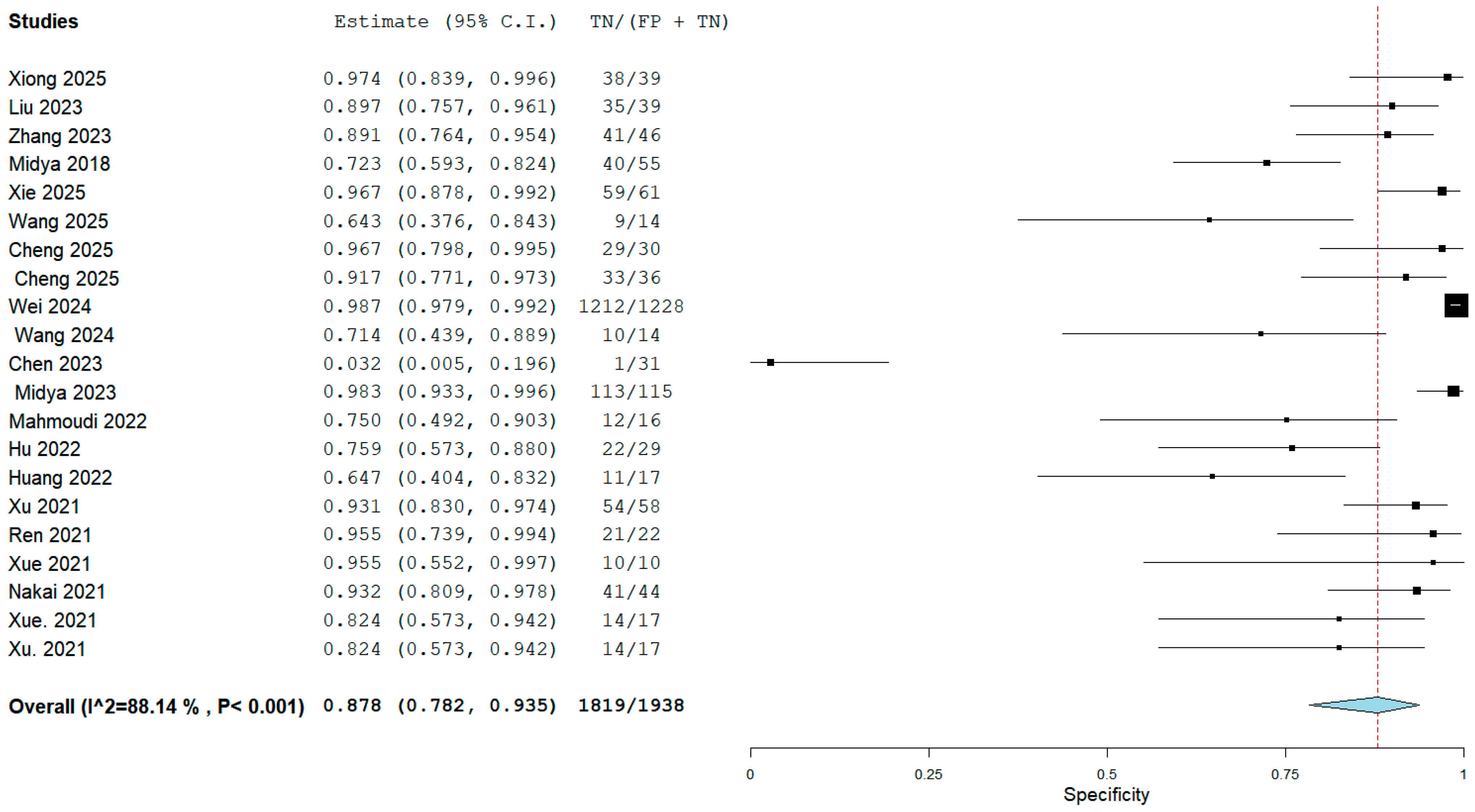
3.4. Meta-Analysis
3.5. Subgroup Analysis
4. Discussion
5. Conclusions
Supplementary Materials
Author Contributions
Funding
Institutional Review Board Statement
Informed Consent Statement
Data Availability Statement
Conflicts of Interest
References
- El-Diwany, R.; Pawlik, T.M.; Ejaz, A. Intrahepatic Cholangiocarcinoma. Surg. Oncol. Clin. N. Am. 2019, 28, 587–599. [Google Scholar] [CrossRef] [PubMed]
- Acher, A.W.; Paro, A.; Elfadaly, A.; Tsilimigras, D.; Pawlik, T.M. Intrahepatic Cholangiocarcinoma: A Summative Review of Biomarkers and Targeted Therapies. Cancers 2021, 13, 5169. [Google Scholar] [CrossRef]
- Beal, E.W.; Tumin, D.; Moris, D.; Zhang, X.F.; Chakedis, J.; Dilhoff, M.; Schmidt, C.M.; Pawlik, T.M. Cohort contributions to trends in the incidence and mortality of intrahepatic cholangiocarcinoma. Hepatobiliary Surg. Nutr. 2018, 7, 270–276. [Google Scholar] [CrossRef]
- Xu, L.; Chen, Z.; Zhu, D.; Wang, Y. The Application Status of Radiomics-Based Machine Learning in Intrahepatic Cholangiocarcinoma: Systematic Review and Meta-Analysis. J. Med. Internet Res. 2025, 27, e69906. [Google Scholar] [CrossRef]
- Chung, Y.E.; Kim, M.J.; Park, Y.N.; Choi, J.Y.; Pyo, J.Y.; Kim, Y.C.; Cho, H.Y.; Kim, K.A.; Choi, S.Y. Varying Appearances of Cholangiocarcinoma: Radiologic-Pathologic Correlation1. RadioGraphics 2009, 29, 683–700. [Google Scholar] [CrossRef]
- Cerrito, L.; Ainora, M.E.; Borriello, R.; Piccirilli, G.; Garcovich, M.; Riccardi, L.; Pompili, M.; Gasbarrini, A.; Zocco, M.A. Contrast-Enhanced Imaging in the Management of Intrahepatic Cholangiocarcinoma: State of Art and Future Perspectives. Cancers 2023, 15, 3393. [Google Scholar] [CrossRef]
- Xie, P.; Liao, Z.J.; Xie, L.; Zhong, J.; Zhang, X.; Yuan, W.; Yin, Y.; Chen, T.; Lv, H.; Wen, X.; et al. Preoperative ternary classification using DCE-MRI radiomics and machine learning for HCC, ICC, and HIPT. Insights Into Imaging 2025, 16, 178. [Google Scholar] [CrossRef]
- Parekh, V.; Jacobs, M.A. Radiomics: A new application from established techniques. Expert Rev. Precis. Med. Drug Dev. 2016, 1, 207–226. [Google Scholar] [CrossRef]
- Mariotti, F.; Agostini, A.; Borgheresi, A.; Marchegiani, M.; Zannotti, A.; Giacomelli, G.; Pierpaoli, L.; Tola, E.; Galiffa, E.; Giovagnoni, A. Insights into radiomics: A comprehensive review for beginners. Clin. Transl. Oncol. 2025, 27, 4091–4102. [Google Scholar] [CrossRef] [PubMed]
- Wu, Q.; Zhang, T.; Xu, F.; Cao, L.; Gu, W.; Zhu, W.; Fan, Y.; Wang, W.; Hu, C.; Yu, Y. MRI-based deep learning radiomics to differentiate dual-phenotype hepatocellular carcinoma from HCC and intrahepatic cholangiocarcinoma: A multicenter study. Insights Imaging 2025, 16, 27. [Google Scholar] [CrossRef] [PubMed]
- Wang, D.; Sun, L. Diagnostic Performance of Radiomics for Differentiating Intrahepatic Cholangiocarcinoma from Hepatocellular Carcinoma: A Systematic Review and Meta-analysis. Acad. Radiol. 2025, 32, 6555–6569. [Google Scholar] [CrossRef] [PubMed]
- Moher, D.; Liberati, A.; Tetzlaff, J.; Altman, D.G.; Antes, G.; Atkins, D.; Prisma Group. Preferred reporting items for systematic reviews and meta-analyses: The PRISMA statement. PLoS Med. 2009, 6, e1000097. [Google Scholar] [CrossRef] [PubMed]
- Barry, N.; Kendrick, J.; Molin, K.; Li, S.; Rowshanfarzad, P.; Hassan, G.M.; Dowling, J.; Parizel, P.M.; Hofman, M.S.; Ebert, M.A. Evaluating the impact of the Radiomics Quality Score: A systematic review and meta-analysis. Eur. Radiol. 2025, 35, 1701–1713. [Google Scholar] [CrossRef]
- Cook, C.; Cleland, J.; Huijbregts, P. Creation and Critique of Studies of Diagnostic Accuracy: Use of the STARD and QUADAS Methodological Quality Assessment Tools. J. Man. Manip. Ther. 2007, 15, 93. [Google Scholar] [CrossRef] [PubMed]
- Xiong, Y.; Huang, J.; Zhu, H.; Sun, Y.; Zhu, X.; Wu, J.J. Identifying subtypes of primary liver tumors based on ConvNeXt and efficient channel-spatial attention mechanism. In Proceedings of SPIE—The International Society for Optical Engineering; SPIE: Bellingham, WA, USA, 2025; Volume 22, Available online: https://www.scopus.com/pages/publications/85219564896 (accessed on 24 January 2026).
- Liu, N.; Wu, Y.; Tao, Y.; Zheng, J.; Huang, X.; Yang, L.; Zhang, X. Differentiation of Hepatocellular Carcinoma from Intrahepatic Cholangiocarcinoma through MRI Radiomics. Cancers 2023, 15, 5373. [Google Scholar] [CrossRef]
- Zhang, X.; Jia, N.; Wang, Y. Multi-input dense convolutional network for classification of hepatocellular carcinoma and intrahepatic cholangiocarcinoma. Biomed. Signal Process. Control 2023, 80, 104226. [Google Scholar] [CrossRef]
- Wang, X.C.; Liang, J.H.; Huang, X.Y.; Tang, W.J.; He, Y.M.; Zhong, J.Y.; Zhang, L.; Lu, L. A machine learning model based on CT radiomics for preoperatively differentiating intrahepatic mass-type cholangiocarcinoma and inflammatory pseudotumours. BMC Cancer 2025, 25, 1106. [Google Scholar] [CrossRef]
- Cheng, M.; Zhang, H.; Guo, Y.; Lyu, P.; Yan, J.; Liu, Y.; Liang, P.; Ren, Z.; Gao, J. Comparison of MRI and CT based deep learning radiomics analyses and their combination for diagnosing intrahepatic cholangiocarcinoma. Sci. Rep. 2025, 15, 9629. [Google Scholar] [CrossRef]
- Wei, Y.; Yang, M.; Zhang, M.; Gao, F.; Zhang, N.; Hu, F.; Zhang, X.; Zhang, S.; Huang, Z.; Xu, L.; et al. Focal liver lesion diagnosis with deep learning and multistage CT imaging. Nat. Commun. 2024, 15, 7040. [Google Scholar] [CrossRef]
- Wang, S.; Wang, X.; Yin, X.; Lv, X.; Cai, J. Differentiating HCC from ICC and prediction of ICC grade based on MRI deep-radiomics: Using lesions and their extended regions. Phys. Medica 2024, 120, 103322. [Google Scholar] [CrossRef]
- Chen, J.; Zhang, W.; Bao, J.; Wang, K.; Zhao, Q.; Zhu, Y.; Chen, Y. Implications of ultrasound-based deep learning model for preoperatively differentiating combined hepatocellular-cholangiocarcinoma from hepatocellular carcinoma and intrahepatic cholangiocarcinoma. Abdom. Radiol. 2024, 49, 93–102. [Google Scholar] [CrossRef]
- Hu, R.; Li, H.; Horng, H.; Thomasian, N.M.; Jiao, Z.; Zhu, C.; Zou, B.; Bai, H.X. Automated machine learning for differentiation of hepatocellular carcinoma from intrahepatic cholangiocarcinoma on multiphasic MRI. Sci. Rep. 2022, 12, 7924. [Google Scholar] [CrossRef] [PubMed]
- Huang, F.; Liu, X.; Liu, P.; Xu, D.; Li, Z.; Lin, H.; Xie, A. The Application Value of MRI T 2∗ WI Radiomics Nomogram in Discriminating Hepatocellular Carcinoma from Intrahepatic Cholangiocarcinoma. Comput. Math. Methods Med. 2022, 2022, 7099476. [Google Scholar] [CrossRef]
- Xu, X.; Mao, Y.; Tang, Y.; Liu, Y.; Xue, C.; Yue, Q.; Liu, Q.; Wang, J.; Yin, Y. Classification of Hepatocellular Carcinoma and Intrahepatic Cholangiocarcinoma Based on Radiomic Analysis. Comput. Math. Methods Med. 2022, 2022, 5334095. [Google Scholar] [CrossRef]
- Ren, S.; Li, Q.; Liu, S.; Qi, Q.; Duan, S.; Mao, B.; Li, X.; Wu, Y.; Zhang, L. Clinical Value of Machine Learning-Based Ultrasomics in Preoperative Differentiation Between Hepatocellular Carcinoma and Intrahepatic Cholangiocarcinoma: A Multicenter Study. Front. Oncol. 2021, 11, 749137. [Google Scholar] [CrossRef] [PubMed]
- Xue, B.; Wu, S.; Zhang, M.; Hong, J.; Liu, B.; Xu, N.; Zheng, Q.; Tang, K.; Zheng, X. A radiomic-based model of different contrast-enhanced CT phase for differentiate intrahepatic cholangiocarcinoma from inflammatory mass with hepatolithiasis. Abdom. Radiol. 2021, 46, 3835–3844. [Google Scholar] [CrossRef] [PubMed]
- Xue, B.; Wu, S.; Zheng, M.; Jiang, H.; Chen, J.; Jiang, Z.; Tian, T.; Tu, Y.; Zhao, H.; Shen, X.; et al. Development and Validation of a Radiomic-Based Model for Prediction of Intrahepatic Cholangiocarcinoma in Patients With Intrahepatic Lithiasis Complicated by Imagologically Diagnosed Mass. Front. Oncol. 2021, 10, 598253. [Google Scholar] [CrossRef]
- Xu, H.; Zou, X.; Zhao, Y.; Zhang, T.; Tang, Y.; Zheng, A.; Zhou, X.; Ma, X. Differentiation of Intrahepatic Cholangiocarcinoma and Hepatic Lymphoma Based on Radiomics and Machine Learning in Contrast-Enhanced Computer Tomography. Technol. Cancer Res. Treat. 2021, 20, 15330338211039125. [Google Scholar] [CrossRef]
- Midya, A.; Chakraborty, J.; Srouji, R.; Narayan, R.R.; Boerner, T.; Zheng, J.; Pak, L.M.; Creasy, J.M.; Escobar, L.A.; Harrington, K.A.; et al. Computerized Diagnosis of Liver Tumors From CT Scans Using a Deep Neural Network Approach. IEEE J. Biomed. Health Inform. 2023, 27, 2456–2464. [Google Scholar] [CrossRef]
- Chakraborty, J.; Pak, L.M.; Zheng, J.; Jarnagin, W.R.; Do, R.K.G.; Simpson, A.L.; Midya, A. Deep convolutional neural network for the classification of hepatocellular carcinoma and intrahepatic cholangiocarcinoma. In Medical Imaging 2018: Computer-Aided Diagnosis; SPIE: Bellingham, WA, USA, 2018; p. 1057528. [Google Scholar] [CrossRef]
- Mahmoudi, S.; Bernatz, S.; Ackermann, J.; Koch, V.; Dos Santos, D.P.; Grünewald, L.D.; Yel, I.; Martin, S.S.; Scholtz, J.E.; Stehle, A.; et al. Computed Tomography Radiomics to Differentiate Intrahepatic Cholangiocarcinoma and Hepatocellular Carcinoma. Clin. Oncol. 2023, 35, e312–e318. [Google Scholar] [CrossRef]
- Nakai, H.; Fujimoto, K.; Yamashita, R.; Sato, T.; Someya, Y.; Taura, K.; Isoda, H.; Nakamoto, Y. Convolutional neural network for classifying primary liver cancer based on triple-phase CT and tumor marker information: A pilot study. Jpn. J. Radiol. 2021, 39, 690–702. [Google Scholar] [CrossRef] [PubMed]
- Yahaya, B.S.; Osman, N.D.; Karim, N.K.A.; Appalanaido, G.K.; Isa, I.S. Radiomics and deep learning characterisation of liver malignancies in CT images—A systematic review. Comput. Biol. Med. 2025, 194, 110491. [Google Scholar] [CrossRef]
- Fiz, F.; Rossi, N.; Langella, S.; Conci, S.; Serenari, M.; Ardito, F.; Cucchetti, A.; Gallo, T.; Zamboni, G.A.; Mosconi, C.; et al. Radiomics of Intrahepatic Cholangiocarcinoma and Peritumoral Tissue Predicts Postoperative Survival: Development of a CT-Based Clinical-Radiomic Model. Ann. Surg. Oncol. 2024, 31, 5604–5614. [Google Scholar] [CrossRef] [PubMed]
- Yuan, E.; Chen, Y.; Song, B. Quality of radiomics for predicting microvascular invasion in hepatocellular carcinoma: A systematic review. Eur. Radiol. 2023, 33, 3467–3477. [Google Scholar] [CrossRef]
- Cannella, R.; Vernuccio, F.; Klontzas, M.E.; Ponsiglione, A.; Petrash, E.; Ugga, L.; Santos, D.P.D.; Cuocolo, R. Systematic review with radiomics quality score of cholangiocarcinoma: An EuSoMII Radiomics Auditing Group Initiative. Insights Imaging 2023, 14, 21. [Google Scholar] [CrossRef]
- Kierans, A.S.; Costello, J.; Qayyum, A.; Taouli, B.; Venkatesh, S.K.; Yoon, J.H.; Bali, M.A.; Bolan, C.W.; Lee, J.M.; Marks, R.M.; et al. Imaging cholangiocarcinoma: CT and MRI techniques. Abdom. Radiol. 2024, 50, 94–108. [Google Scholar] [CrossRef] [PubMed]
- Gillies, R.J.; Schabath, M.B. Radiomics Improves Cancer Screening and Early Detection. Cancer Epidemiol. Biomark. Prev. 2020, 29, 2556–2567. [Google Scholar] [CrossRef]
- Plested, J.; Phiri, M.; Gedeon, T. Deep transfer learning for image classification: A survey. arXiv 2025, arXiv:2205.09904. [Google Scholar] [CrossRef]
- Zhen, S.; Zhang, P.; Huang, H.; Jiang, Z.; Jiang, Y.; Sun, J.; Zhang, L.; Ruan, M.; Chen, Q.; Wang, Y.; et al. Deep learning-assisted diagnosis of liver tumors using non-contrast magnetic resonance imaging: A multicenter study. Front. Oncol. 2025, 15, 1582322. [Google Scholar] [CrossRef]
- van Timmeren, J.E.; Cester, D.; Tanadini-Lang, S.; Alkadhi, H.; Baessler, B. Radiomics in medical imaging-“how-to” guide and critical reflection. Insights Imaging 2020, 11, 91. [Google Scholar] [CrossRef]
- Zhao, X.; Liang, P.; Yong, L.; Jia, Y.; Gao, J. Radiomics Study for Differentiating Focal Hepatic Lesions Based on Unenhanced CT Images. Front. Oncol. 2022, 12, 650797. [Google Scholar] [CrossRef]
- Le, M.H.N.; Kha, H.Q.; Tran, N.M.; Nguyen, P.K.; Huynh, H.H.; Huynh, P.K.; Lam, H.; Lee, K. Radiomics in liver research: A paradigm shift in disease detection and staging. Eur. J. Radiol. Artif. Intell. 2025, 2, 100016. [Google Scholar] [CrossRef]
- Park, S.H.; Han, K. Methodologic Guide for Evaluating Clinical Performance and Effect of Artificial Intelligence Technology for Medical Diagnosis and Prediction. Radiology 2018, 286, 800–809. [Google Scholar] [CrossRef]
- Moons, K.G.M.; Altman, D.G.; Reitsma, J.B.; Ioannidis, J.P.A.; Macaskill, P.; Steyerberg, E.W.; Vickers, A.J.; Ransohoff, D.F.; Collins, G.S. Transparent Reporting of a multivariable prediction model for Individual Prognosis or Diagnosis (TRIPOD): Explanation and elaboration. Ann. Intern. Med. 2015, 162, W1–W73. [Google Scholar] [CrossRef] [PubMed]
- Zwanenburg, A.; Vallières, M.; Abdalah, M.A.; Aerts, H.J.W.L.; Andrearczyk, V.; Apte, A.; Ashrafinia, A.; Bakas, S.; Beukinga, R.J.; Boellaard, R.; et al. The Image Biomarker Standardization Initiative: Standardized Quantitative Radiomics for High-Throughput Image-based Phenotyping. Radiology 2020, 295, 328–338. [Google Scholar] [CrossRef]
- Begley, C.G.; Ellis, L.M. Raise standards for preclinical cancer research. Nature 2012, 483, 531–533. [Google Scholar] [CrossRef]
- Liu, X.; Cruz Rivera, S.; Moher, D.; Calvert, M.J.; Denniston, A.K.; Chan, A.W.; SPIRIT-AI and CONSORT-AI Working Group. Reporting guidelines for clinical trial reports for interventions involving artificial intelligence: The CONSORT-AI extension. Lancet Digit Health 2020, 2, e537–e548. [Google Scholar] [CrossRef] [PubMed]
- Li, Y.; Deng, J.; Ma, X.; Li, W.; Wang, Z. Diagnostic accuracy of CT and PET/CT radiomics in predicting lymph node metastasis in non-small cell lung cancer. Eur. Radiol. 2025, 35, 1966–1979. [Google Scholar] [CrossRef] [PubMed]
- Saini, A.; Breen, I.; Pershad, Y.; Naidu, S.; Knuttinen, M.G.; Alzubaidi, S.; Sheth, R.; Albadawi, H.; Kuo, M.; Oklu, R. Radiogenomics and Radiomics in Liver Cancers. Diagnostics 2018, 9, 4. [Google Scholar] [CrossRef]
- Segal, E.; Sirlin, C.B.; Ooi, C.; Adler, A.S.; Gollub, J.; Chen, X.; Chan, B.K.; Matcuk, G.R.; Barry, C.T.; Chang, H.Y.; et al. Decoding global gene expression programs in liver cancer by noninvasive imaging. Nat. Biotechnol. 2007, 25, 675–680. [Google Scholar] [CrossRef] [PubMed]



| Study | Year | Country | Study Design | Time Period | Comparator | Data Sets | No. of Images per Training Set | No. of Images per Validation Set | No. of Images per Local Test Set | Radiomics/Contrast | Reference Standard |
|---|---|---|---|---|---|---|---|---|---|---|---|
| Xiong et al. [15] | 2025 | China | Retrospective Case–Control | 2015–2020 | HCC patients | Single Center | 396 patients (318 HCC, 78 ICC) | 49 patients (40 HCC, 9 ICC) | 49 | Contrast CT/portal venous | Pathology diagnosis after surgery |
| Liu et al. [16] | 2023 | China | Retrospective Cohort | April 2016–December 2021. | HCC patients | Single Center | 124 | 53 | 53 | MRI/arterial and portal venous phase | Histopathology proven |
| Zhang et al. [17] | 2023 | China | Retrospective Case–Control | - | HCC patients | Single Center | 222 | - | 95 | Contrast CT/arterial and portal venous phase | Manual label for venous phase images |
| Midya et al. [31] | 2018 | USA | Retrospective Cohort | 2000–2015 | HCC patients | Single Center | 156 | 27 | 156 | Contrast CT/portal venous | Histopathology proven |
| Xie et al. [7] | 2025 | China | Retrospective Cohort | May 2008 to January 2024 | Ternary classification of hepatocellular carcinoma (HCC) and Hepatic Inflammatory Pseudotumor (HIPT) | Multicenter | 196 | - | 84 | DCE-MRI/(arterial, portal venous, delayed phases) | Histopathology proven |
| Wang et al. [18] | 2025 | China | Retrospective | - | Hepatic Inflammatory and Pseudotumors (IPT) | Multicenter | 112 | - | 146 | CT contrast scan/multiphase (SOFT, AP, PVP, DP) | Histopathological examination from surgical resection |
| Cheng et al. [19] | 2025 | China | Retrospective | January 2016–October 2023 | Oher primary liver cancers (non-iCCA: HCC and cHCC-iCCA) within PLC. | Single Center | 124 | 178 | CT (non-contrast) and MRI scan/ MRI: T1, T2, DWI, CE-MRI (arterial, venous, 3-min delayed) | Histopathological examination (from surgical resection or biopsy) | |
| Wei et al. [20] | 2024 | China | Retrospective cohort | June 2012–December 2012 | Multiclass liver pathologies (6 types) | Multicenter | 1580 | - | 130M8 | CT contrast scan/arterial and portal venous phase | Histopathology/radiologist consensus |
| Wang et al. [21] | 2024 | China | Retrospective Cohort | - | HCC patients | Single Center | 113 | 49 | 162 | MRI/delayed phase | Histopathology |
| Chen et al. [22] | 2024 | China | Retrospective Cohort | January 2017–September 2020 | HCC and cHCC-ICC patients | Single Center | 332 | 83 | 50 | Single B-mode Ultrasound (BMUS) image | Histopathology (post-resection) |
| Midya et al. [30] | 2023 | USA | Retrospective Cohort | 2003–2015 | HCC, CRLM, and benign liver tumor patients | Multicenter | 488 scans | 162 scans | 814 scans | CT contrast scan/portal venous phase | Histopathology (resection) |
| Mahmoudi et al. [32] | 2023 | Germany | Retrospective Cohort | 2014–2021 | HCC patients | Single Center | 65 | - | 94 | CT contrast scan/arterial phase | Histopathology |
| Hu et al. [23] | 2022 | China | Retrospective Cohort | 2008- 2018 | HCC patients | Multicenter | 344 | 97 | - | MRI scan T1C and T2W/arterial and portal venous phase | Histopathology |
| Huang et al. [24] | 2022 | China | Retrospective Case Control | October 2019–December 2021 | HCC patients | Single Center | 123 | 51 | - | MRI scan T2 WI | Histopathology (surgery/biopsy) |
| Xu et al. [25] | 2022 | China | Retrospective Cohort | August 2018–November 2019 | HCC patients | Single Center | 122 | 89 | 211 | Non-contrast CT | Histopathology |
| Ren et al. [26] | 2021 | China | Retrospective Cohort | January 2019–March 2021 | HCC patients | Multicenter | 149 | 77 | 187 | Ultrasound (grayscale) | Histopathology |
| Xue et al. [27] | 2021 | China | Retrospective Cohort | Jan uary 2005–June 2020 | Inflammatory mass with hepatolithiasis patients | Single Center | 110 | 35 | - | CT contrast scan/arterial and portal venous phase | Histopathology |
| Nakai et al. [33] | 2021 | Japan | Retrospective Cohort | January 2004–September 2019 | HCC patients | Single Center | 493 | 62 | 617 | Non contrast CT scan/late-arterial (23 s post-trigger) and delayed (80 s post-trigger) phase | Histopathology (surgical specimen) |
| Xue et al. [28] | 2021 | China | Retrospective Cohort | January 2005–July 2019 | Inflammatory mass with hepatolithiasis patients | Single Center | 96 | 35 | - | CT contrast scan/arterial phase | |
| Xu et al. [29] | 2021 | China | Retrospective Cohort | 2005–2019 | Inflammatory mass with hepatolithiasis patients | Multicenter | 96 | 35 | 96 | CT contrast scan/arterial phase |
| First Author | ROI | Preprocessing | Model Structure | AI Classifier | Validation | Comparison Algorithms |
|---|---|---|---|---|---|---|
| Xiong et al. [15] (2025) | Manual delineation of tumor boundary by an experienced radiologist, followed by cropping of the minimum rectangular region containing the tumor | ROI images resized to 224 × 224 pixels; data augmentation (rotation, flip) applied to the minority class (ICC) to address imbalance | ConvNeXt-ECSAM (ConvNeXt-T backbone with proposed ECSAM attention modules, fully connected layer for classification) | 2D CNN | Internal hold-out validation (8:1:1 split on patient level) | Compared with ResNet152, DenseNet121, Vision Transformer, Swin Transformer |
| Liu et al. [16] (2023) | Manual segmentation of the entire tumor volume on axial FS-T2WI, AP, and PVP images by a radiologist | Image segmentation, feature extraction using IBEX software (β1.0), Z-score normalization of features | Logistic regression model combining selected radiomics features and clinical risk factors | Radiomics (machine learning–logistic regression) | Internal hold-out validation (7:3 split on patient level) | Compared with individual sequence radiomics models (FS-T2WI, AP, PVP), joint radiomics model (JR), and clinical model (C) |
| Zhang et al. [17] (2023) | Automated segmentation of liver lesion using a modified 2D U-Net, followed by cropping a fixed-size 3D volume (256 × 256 × 36 voxels) around the centroid | Windowing transformation (arterial: [−50, 130] HU; venous: [−45, 205] HU), intensity normalization | 3D dense convolutional network with dual-branch architecture (arterial and venous), followed by a feature fusion network | 3D CNN | Internal hold-out validation (7:3 split on patient level) | Compared with arterial sub-network and venous sub-network alone |
| Midya et al. [31] (2018) | Semi-automated segmentation (Scout Liver) supervised by expert radiologist | Normalization [0, 1], intensity threshold −100 HU to 300 HU, cropped to largest tumor, resized to 299 × 299 pixels | Modified Inception-v3; last 4 layers removed; added 3 fully connected layers with 7000, 1024, 1 nodes; ReLU activations; final SoftMax output | Deep convolutional neural network (modified Inception-v3) | Random split: 70% training, 30% test | No |
| Xie et al. [7] (2025) | Sequences: T2WI, DCE-MRI (arterial, portal venous, delayed phases), DWI | Manual 3D lesion segmentation on ITK-SNAP | Resampling, min–max normalization (0–1), Z-score feature standardization | Logistic regression | Machine learning (radiomics) | Compared with radiomics-only, clinical-only, fusion model |
| Wang et al. [18] (2025) | Manual segmentation of the entire lesion slice-by-slice by two radiologists (>5 yrs experience) using ITK-SNAP, fine-tuned by senior radiologist (>15 yrs) | Spatial matching of ROI to original image, window width/level normalization. | 14 ML models tested (CatBoost, LightGBM, LR, NB, LDA, QDA, KNN, GBC, XGBoost, RF, AdaBoost, ET, DT). Optimal fused model: Linear Discriminant Analysis (LDA) | Machine learning (PyRadiomics feature extraction), LASSO for feature selection, 5-fold CV with grid search for hyperparameter tuning | Internal: 5-fold cross-validation on training set; hold-out test: 70/30 split (training n = 102/test n = 44) | Performance compared among clinical features alone, radiomic features alone, and fused radiomic + clinical features |
| Cheng et al. [19] (2025) | Manual segmentation on largest tumor slice | Resampling to 1 × 1 × 1 mm3, bicubic spline interpolation | ResNet-50 (transfer learning) | Deep learning (ResNet-50), PCA, LASSO, logistic regression | 10-fold cross-validation (training); hold-out test (70/30 split) | Intra-modality: DLRS vs. DLRR vs. radiological model; inter-modality: CT vs. MRI; fused CT-MRI model |
| Wei et al. [20] (2024) | Automatic (YOLOv8 + 3D liver segmentation) | Cropping, normalization, augmentation | ResNet50 + self-supervised pretext + SKD | Deep CNN (ResNet50-based) | Internal test, external validations | Yes (vs. radiologists) |
| Wang et al. [21] (2024) | Original tumor ROI ± expanded regions (−2 to +8 mm) | Resampling to 224 × 224, adaptive histogram equalization, normalization | ResNet50 (pre-trained) for feature extraction + SVM classifier | Deep learning (ResNet50) + machine learning (SVM) | Internal 70:30 split | No |
| Chen et al. [22] (2024) | Single optimal slice showing maximum tumor diameter and details | Data augmentation (rotation, cropping, translation) | ResNet18 (17 convolutional layers, 1 fully connected layer, 4 residual blocks); end-to-end classification | Deep learning (ResNet18) | 5-fold cross-validation on training set, final evaluation on independent test cohort | Vs. MobileNet, DenseNet121, Inception V3 |
| Midya et al. [30] (2023) | Semi-automated tumor segmentation (Scout Liver software (Analogic Corporation, Peabody, MA, USA)) | Thresholding (−100 to 300 HU), normalization (0–1), resizing to 299 × 299 px | Modified Inception v3 (final layers replaced with FC layers: 7000, 1024, 4 nodes) | Deep learning (CNN–transfer learning) | Hold-out (60/20/20 split) | Yes (vs. radiologists, VGG, ResNet, DenseNet, Inception v3) |
| Mahmoudi et al. [32] (2023) | Three spherical VOIs (1 cm diameter) in hypervascular tumor region | StandardScaler normalization, LASSO feature selection | Logistic regression classifier | Machine learning (radiomics) | Hold-out (70% train, 30% test) | Yes (vs. AdaBoost, Stochastic GB, random forest) |
| Hu et al. [23] (2022) | Manual segmentation (3D Slicer) | Feature extraction (IBSI), min–max scaling | TPOT AutoML pipeline | Genetic programming (AutoML) | Hold-out test set | Radiologist performance |
| Huang et al. [24] (2022) | Manual segmentation on largest lesion slice (ITK-SNAP) | ICC > 0.8 for feature stability, mRMR + LASSO for selection | Radiomics nomogram (LASSO + logistic regression) | Radiomics signature | Internal hold-out (7:3 split) | - |
| Xu et al. [25] (2022) | Manual segmentation (3D Slicer) by radiologists | Voxel spacing standardized to 1 × 1 × 1 mm, intensity discretization (bin width = 25 HU) | Feature extraction (Pyradiomics) → feature selection (LASSO) → SVM classification | Support vector machine (SVM) | Internal validation (split-sample) | Radiomics model vs. radiologist evaluation |
| Ren et al. [26] (2021) | Manual segmentation (ITK-SNAP) by experienced radiologists | Normalization, resampling to 1 × 1 mm, gray-level discretization (bin width = 25) | Feature extraction (Pyradiomics) → feature selection (variance filter + LASSO) → SVM classification | Support vector machine (SVM) | Internal test (n = 38) + external validation (n = 39) | Combined vs. clinical vs. ultrasonics-only models |
| Xue et al. [27] (2021) | Manual segmentation of tumor (2 radiologists) | Windowing (W:200, L:45 HU), resampling to 512 × 512, uniform slice thickness 5 mm | Radiomic signature via LASSO logistic regression combining rad score from portal venous and arterial phase | Radiomics (LIFEx) | External validation (second affiliated hospital, n = 35) | No |
| Nakai et al. [33] (2021) | Manual cropping (RectLabel) on representative axial slice ± neighboring slices (9 images/case) | Intensity truncation (–125 to 225 HU), resizing to 70 × 70, normalization (mean = 0, SD = 1) | Custom 3D CNN: 4 convolutional blocks (Conv + ReLU + MaxPool) → fully connected layers (100, 100, 30, 3 nodes) | Convolutional neural network (CNN)–PyTorch (version 1.5.0) | Hold-out test set (n = 62) | One-input model (CT only) vs. two-input model (CT + markers) vs. radiologists |
| Xue et al. [28] (2021) | Manual segmentation of tumor (2 radiologists) | Windowing (W:200, L:45 HU), resampling to 512 × 512, uniform slice thickness 5 mm | Radiomic signature via LASSO logistic regression | Radiomics (LIFEx) | External validation (second affiliated hospital, n = 35) | Yes (vs. clinical model) |
| Xu et al. [29] (2021) | Manual segmentation of tumor mass | Window: 200 HU width, 45 HU level; pixel: 512 × 512 | 1. Radiomic feature extraction (52 features); 2. feature selection (LASSO); 3. model building (logistic regression) | Logistic regression (for Rad-score and comprehensive model) | External validation cohort from another hospital | Yes (radiomic vs. clinical vs. comprehensive model) |
Disclaimer/Publisher’s Note: The statements, opinions and data contained in all publications are solely those of the individual author(s) and contributor(s) and not of MDPI and/or the editor(s). MDPI and/or the editor(s) disclaim responsibility for any injury to people or property resulting from any ideas, methods, instructions or products referred to in the content. |
© 2026 by the authors. Licensee MDPI, Basel, Switzerland. This article is an open access article distributed under the terms and conditions of the Creative Commons Attribution (CC BY) license.
Share and Cite
Alidina, Z.; Banani, I.; Abiha, U.E.; Sultan, U.; Pawlik, T.M. Radiomics for Detection and Differentiation of Intrahepatic Cholangiocarcinoma: A Systematic Review and Meta-Analysis. Cancers 2026, 18, 937. https://doi.org/10.3390/cancers18060937
Alidina Z, Banani I, Abiha UE, Sultan U, Pawlik TM. Radiomics for Detection and Differentiation of Intrahepatic Cholangiocarcinoma: A Systematic Review and Meta-Analysis. Cancers. 2026; 18(6):937. https://doi.org/10.3390/cancers18060937
Chicago/Turabian StyleAlidina, Zayan, Illiyun Banani, Umm E. Abiha, Ujala Sultan, and Timothy M. Pawlik. 2026. "Radiomics for Detection and Differentiation of Intrahepatic Cholangiocarcinoma: A Systematic Review and Meta-Analysis" Cancers 18, no. 6: 937. https://doi.org/10.3390/cancers18060937
APA StyleAlidina, Z., Banani, I., Abiha, U. E., Sultan, U., & Pawlik, T. M. (2026). Radiomics for Detection and Differentiation of Intrahepatic Cholangiocarcinoma: A Systematic Review and Meta-Analysis. Cancers, 18(6), 937. https://doi.org/10.3390/cancers18060937