1. Introduction
Sarcomas are rare malignant tumors of mesenchymal origin, with an incidence of approximately 1%. They can arise from connective tissue or bone and may occur throughout the body. Thoracic sarcomas represent a heterogeneous group that includes both soft tissue and bone sarcomas, accounting for less than 5% of all thoracic malignancies [
1]. Due to their rarity and wide spectrum of histological subtypes—each with distinct tumor biology, growth patterns, and responses to therapy—diagnosing and managing thoracic sarcomas present significant challenges.
Surgical resection with wide margins represents the cornerstone of curative treatment for thoracic sarcomas [
2] and is frequently combined with adjuvant radiotherapy in locally aggressive tumors or following marginal resections [
3,
4]. Depending on tumor location and extent, surgery may involve complex chest wall or multivisceral resections, including reconstruction with prosthetic materials and muscle flaps [
5]. For intermediate- and high-grade sarcomas and subtypes with a higher metastatic potential, neoadjuvant or adjuvant chemotherapy, often combined with regional hyperthermia, is commonly employed [
6,
7,
8]. Optimal outcomes require a multimodal treatment approach in specialized centers with close interdisciplinary collaboration.
Several prognostic factors have been reported for thoracic sarcomas, primarily based on studies focusing on specific subtypes [
9,
10,
11,
12,
13] or single-institution experiences [
14,
15,
16]. Incomplete resection [
13,
15,
17,
18] and high histological grade [
2,
15,
19,
20,
21] are consistently associated with inferior survival outcomes. Additional unfavorable factors include larger tumor size [
2,
20], metastatic disease [
17,
22], advanced age [
21,
23], and aggressive histological subtypes such as angiosarcoma [
21] and undifferentiated pleomorphic sarcoma [
22], whereas low-grade soft tissue sarcomas and chondrosarcomas generally show more favorable prognoses [
23]. However, the rarity and heterogeneity of thoracic sarcomas have limited the statistical power and generalizability of existing studies.
The aim of this study was to evaluate long-term outcomes of patients with thoracic soft tissue and bone sarcomas following surgical treatment and to identify prognostic factors for overall survival (OS) and progression-free survival (PFS). Improved understanding of the determinants of survival may support risk stratification, treatment planning, and follow-up strategies in patients with these rare and heterogeneous malignancies.
2. Materials and Methods
2.1. Study Design and Population
Following approval by the institutional ethics committee (reference number 23-0597), we retrospectively reviewed the medical records of 84 patients who underwent surgical treatment for thoracic sarcoma between January 2005 and December 2020 at Ludwig Maximilian University Hospital, Munich, and Asklepios Lung Clinic, Gauting, Germany. The requirement for informed consent was waived due to the retrospective nature of the study. We included patients with primary thoracic sarcomas of the chest wall and primary intrathoracic sarcomas, categorizing them into two groups: thoracic bone sarcomas and thoracic soft tissue sarcomas. Patients undergoing surgery for local recurrence or for metastatic thoracic involvement from a primary sarcoma at another site were excluded.
2.2. Clinical Data Collection
Clinical, pathological, and treatment-related data were retrospectively collected from institutional records. Variables included age, sex, and preoperative imaging findings obtained by computed tomography (CT), magnetic resonance imaging (MRI), and positron emission tomography (PET), and preoperative lactate dehydrogenase (LDH) and alkaline phosphatase (ALP) measurements. Surgical variables included type of resection, reconstructive procedure, and resection margin status (R0–R2).
Tumor characteristics comprised location, histological subtype, tumor size, grade, Tumor–Node–Metastasis (TNM) classification, and Union for International Cancer Control (UICC) stage. Histological grading was performed according to the French Federation of Comprehensive Cancer Centers (FNCLCC) system, based on tumor differentiation, mitotic count, and tumor necrosis. Tumors were classified as low-grade (G1), intermediate-grade (G2), or high-grade (G3). Grade 4 (G4) tumours, specific to Ewing sarcoma, were included in the high-grade category. Information on neoadjuvant and adjuvant therapies, including radiotherapy, chemotherapy, and hyperthermia, was recorded.
Postoperative complications were graded according to the Clavien–Dindo classification. Thirty- and ninety-day mortality were recorded. Oncological outcomes included time to recurrence, pattern of recurrence (local or distant), overall survival, and time to death. Follow-up and mortality data were collected through a combination of direct patient contact, linkage to national or regional death registries, and contact with primary care physicians.
2.3. Diagnostic Tools
All patients underwent a thoracic CT scan as part of the preoperative diagnostic workup. Additionally, chest MRI was performed in 43 patients (51.2%). Preoperative PET-CT was conducted in 51 patients (60.7%) to complete staging and rule out distant metastases. In earlier years, abdominal CT (n = 64, 76.2%) or bone scintigraphy (n = 10, 11.9%) were used as alternative staging tools. A preoperative biopsy was performed in 75 patients (89.3%) to establish the diagnosis.
2.4. Systemic Treatment
Given the heterogeneity of the study population, various treatment protocols were applied. High-grade osteosarcomas and chondrosarcomas were treated with perioperative EURO-B.O.S.S. chemotherapy, with postoperative methotrexate added in poor responders [
24]. Ewing sarcomas were managed according to the Euro-Ewing protocol with induction chemotherapy VIDE followed by adjuvant VAI or VAC. Patients with G2–G3 soft tissue sarcomas commonly received anthracycline- and ifosfamide-based regimens (AI 60/6 or AI 75/10) [
7,
25].
2.5. Statistical Analysis
Statistical analyses were performed using SPSS Version 26 (IBM Corp., Armonk, NY, USA) and RStudio version 4.0 (R Foundation for Statistical Computing, Vienna, Austria). Categorical variables were reported as counts and percentages, and the continuous variables as mean with standard deviation (SD) or median with interquartile range (IQR), depending on data distribution. Overall survival (OS) was defined as the time from surgery to death or the date of last follow-up for surviving patients. Patients lost to follow-up were censored at last contact. Progression-free survival (PFS) was defined as the time from surgery to the development of local recurrence or distant metastases. Survival curves were estimated using the Kaplan–Meier method. In addition, univariate and multivariate Cox regression analyses were applied to the entire study population using complete-case analysis to identify significant prognostic factors for PFS and OS. The proportional hazards assumption was assessed for all variables included in the Cox regression models, and no violations were identified. Effect modification by tumor type and multicollinearity among covariates were assessed using interaction terms and variance inflation factors (VIF), respectively. A p-value of <0.05 was considered statistically significant.
4. Discussion
Thoracic sarcomas represent a heterogeneous group of malignancies, encompassing both soft tissue and bone sarcomas, for which surgical resection with wide margins has remained the cornerstone of multimodal treatment for decades [
2]. The aim of this study was to identify the predictive factors for PFS and OS following resection of thoracic sarcomas. With 84 patients, this study represents one of the larger single-institution series of primary thoracic sarcomas reported in the literature [
15,
21,
26,
27].
Consistent with the literature, the most common histological subtypes in our cohort were chondrosarcoma (19%) and undifferentiated pleomorphic sarcoma (17.8%) [
15,
21,
28]. High-grade sarcomas comprised 45% of cases, like previous studies reporting 40–60% of G3 tumors [
2,
19,
23,
26]. Wide surgical resection and full-thickness chest wall resection or multivisceral resection were performed in 45.2% and 36.9%, respectively. R0 resection was achieved in 75% of patients, slightly lower than recent studies reporting R0 rates of 80–85% [
15,
19,
28,
29]. This difference may be related to the larger tumor size in our cohort, with a median diameter of 8 cm and 19% of tumors exceeding 15 cm. In addition, six patients underwent R2 resection because of extensive intraoperative tumor infiltration of critical structures, including the pericardium, pleura, esophagus, and aortic adventitia, where complete resection was not technically feasible despite maximal surgical debulking. No myocardial or intracardiac involvement was identified in this cohort; however, pericardial involvement requiring partial resection was observed in a small number of cases. Our morbidity and 30-day mortality rates were 25% and 1.2%, respectively, also comparable to previously reported ranges of 13–24% and 0–1.7% [
19,
23].
Thoracic sarcomas are biologically heterogeneous, and treatment strategies vary according to histological subtype. Nevertheless, for certain entities such as osteosarcoma, Ewing sarcoma, and most soft tissue sarcomas, established systemic treatment protocols can be applied regardless of tumor location [
7,
30]. In our study cohort, protocols such as EURO-B.O.S.S. or Euro Ewing were applied for patients with osteosarcoma, dedifferentiated chondrosarcoma, or Ewing sarcoma [
24,
31]. Patients with soft tissue sarcoma received neoadjuvant and adjuvant chemotherapy according to the AI60/6 or AI 75/10 protocols, tailored to tumor grade and stage. Selected patients additionally underwent regional hyperthermia based on evidence supporting its potential survival benefit [
32,
33].
Nearly half of patients with G2–G3 sarcomas received induction therapy, predominantly chemotherapy, with a subset also treated with hyperthermia, consistent with previous reports [
23,
27]. Induction radiotherapy was used less frequently, reflecting its selective application in high-grade disease. Adjuvant therapy was administered in approximately half of the cohort and included combinations of chemotherapy, radiotherapy, and hyperthermia according to individual risk profiles [
29,
30].
Despite these multimodal approaches, local recurrence occurred in 26% of patients and distant metastases in 18%, rates comparable to or slightly lower than those reported in the literature (14–33% and 20–40%, respectively) [
14,
18,
20,
22,
27]. These findings underscore the persistent risk of relapse in high-grade thoracic sarcomas and highlight that even aggressive, guideline-based treatment may not fully overcome their biological aggressiveness. Notably, our results support the integration of regional hyperthermia in selected induction and adjuvant settings, suggesting a potential contribution to improved local control and survival outcomes [
32,
33].
Several prognostic factors have been reported for thoracic sarcomas, including advanced age [
21,
23], resection margin or status [
13,
15,
17,
18], larger tumor size [
2,
20,
21], and aggressive histological subtypes [
21,
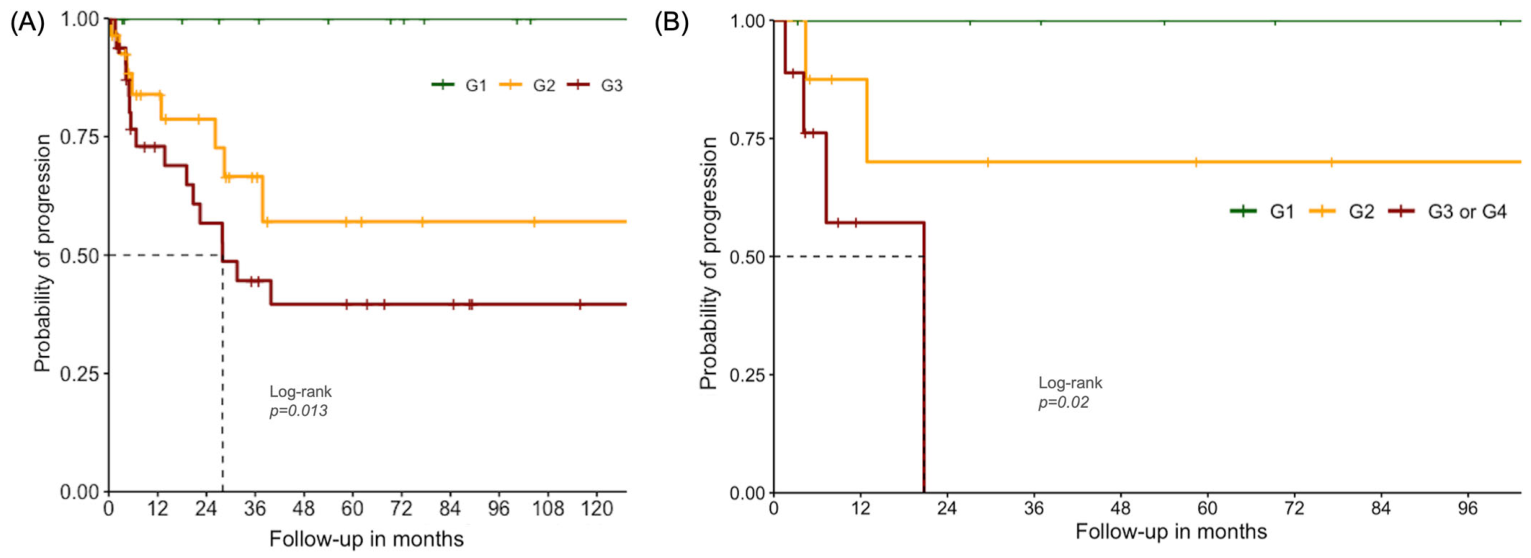
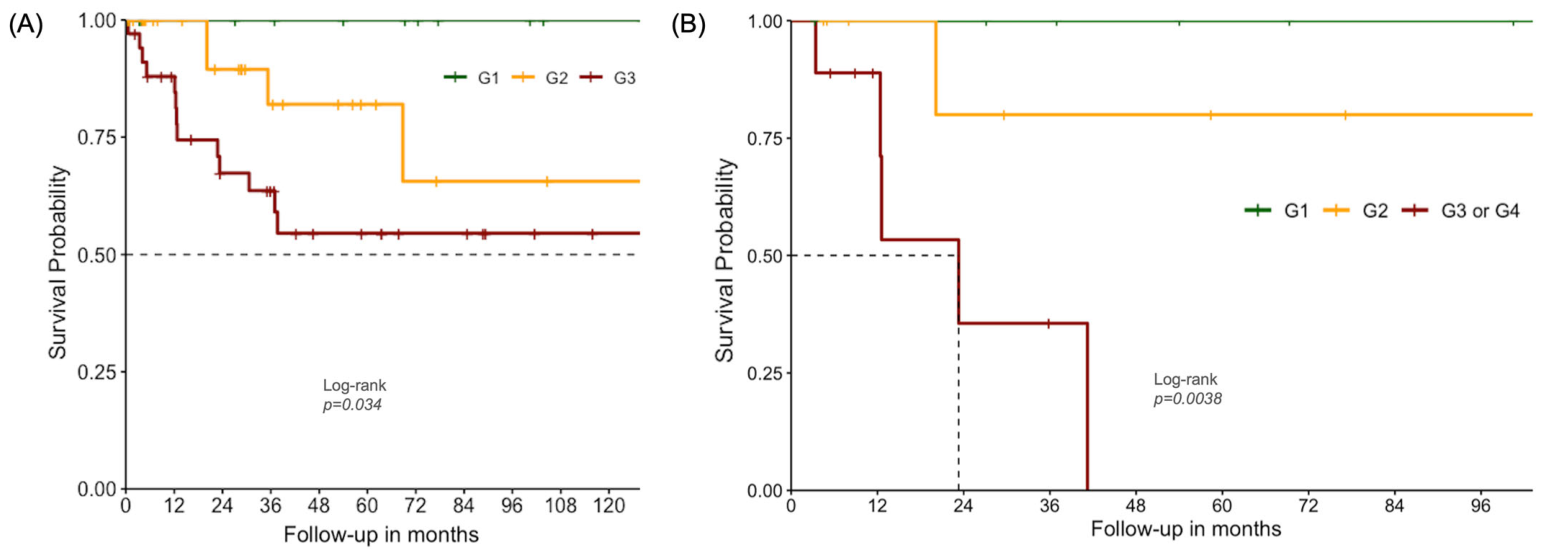
22], all associated with poorer survival. In line with the literature, our multivariate analysis identified higher tumor grade as the only independent factor associated with both worse PFS and OS [
2,
10,
15,
20,
21]. Additionally, larger tumor size and incomplete resection (R2) were independently associated with worse OS, supporting previous findings [
17,
21], whereas microscopic positive margin (R1) was not linked to worse survival, in contrast to other reports [
10,
15]. Metastatic disease at initial presentation, particularly lung metastases, was an unfavorable prognostic factor for both PFS and OS in univariate analysis, with lung metastases remaining independently associated with worse PFS, consistent with prior studies [
17]. Histology also influenced outcomes: chondrosarcoma was associated with more favorable OS compared to Ewing sarcoma and osteosarcoma [
23], while angiosarcoma showed significantly worse PFS and OS in univariate analysis, although multivariate analysis was not performed due to small sample size [
21]. Notably, age was not significantly correlated with either PFS or OS in our cohort.
Our study has some limitations. Due to its retrospective nature, some patients were lost to follow-up and were censored in survival analyses, which prevented reaching the median follow-up for certain outcomes. Another limitation is the heterogeneity of the population, including both bone sarcomas and soft tissue sarcomas, resulting in small patient numbers in subgroup analyses and reduced statistical power. Furthermore, the evaluation of (neo)adjuvant treatment effects may be influenced by selection bias, as patients receiving postoperative therapy likely represent a selected subgroup with better postoperative recovery and performance status. Therefore, all results, particularly those derived from smaller subgroups, should be interpreted with caution.
Nevertheless, we identified prognostic factors associated with worse outcomes using multivariate regression analysis and provided data from a high-volume thoracic sarcoma center. Patients with G1 sarcomas generally did not receive multimodal treatment, except for one who underwent adjuvant radiotherapy following R1 resection for a desmoid tumor, and none developed recurrence. In contrast, despite neoadjuvant and adjuvant therapies, patients with G2–G3 sarcomas frequently experienced local recurrence and distant metastases. Furthermore, patients with G2–G3 sarcomas demonstrated worse PFS and OS. These findings emphasize the prognostic value of tumor grade and highlight the importance of the critical role of a multimodal treatment approach delivered in specialized centers with close interdisciplinary collaboration.
Targeted therapies, including tyrosine kinase inhibitors (pazopanib) and trabectedin, have been increasingly used in the treatment of high-grade sarcomas to improve patient outcomes [
34,
35]. Recently, novel therapeutic agents and immunotherapies targeting T cells or natural killer cells have been evaluated in phase I–II trials, aiming to overcome poor survival, achieve disease stabilization in metastatic sarcomas, and provide options for patients with recurrent or treatment-resistant disease [
36]. Further multicenter studies are needed to evaluate treatment strategies across diverse soft tissue and bone sarcoma subgroups and to assess the efficacy of these emerging systemic therapies in phase II and III trials.
Our findings may have practical implications for the management of thoracic sarcomas. Tumor grade stratifies patients into those more likely to benefit from multimodal management versus those suitable for upfront resection, with G2–G3 tumors more frequently prompting multidisciplinary consideration of neoadjuvant systemic treatment prior to surgery. Tumor size and extent, particularly when in contact with adjacent structures, directly influence operative strategy and the anticipated complexity of chest wall resection and reconstruction. In patients with suspected pericardial or cardiac involvement, echocardiography and cross-sectional imaging may provide valuable information for preoperative assessment and surgical planning. Incomplete resection is associated with poorer outcomes, underscoring the need for careful preoperative assessment of resectability and prioritization of margin-negative resection, which in selected cases may favor a neoadjuvant approach to improve operability and local disease control. These considerations also highlight the importance of early involvement of plastic and reconstructive surgery in complex chest wall cases. These findings support risk-adapted surveillance strategies, with intensified follow-up in patients with high-grade tumors, large tumor size, or incomplete resection.



 ,
,