Transperineal Focal Laser Ablation of the Prostate for Prostate Cancer: A Systematic Review of the Literature
 , , ,
, , ,  , ,
, ,
Simple Summary
Abstract
1. Introduction
2. Materials and Methods
2.1. Selection Criteria
- P: Patients with Localized PCa,
- I: Focal therapy using transperineal laser ablation of the prostate,
- C: Single-arm or comparative studies,
- O: Oncological outcomes,
- S: Prospective or retrospective studies.
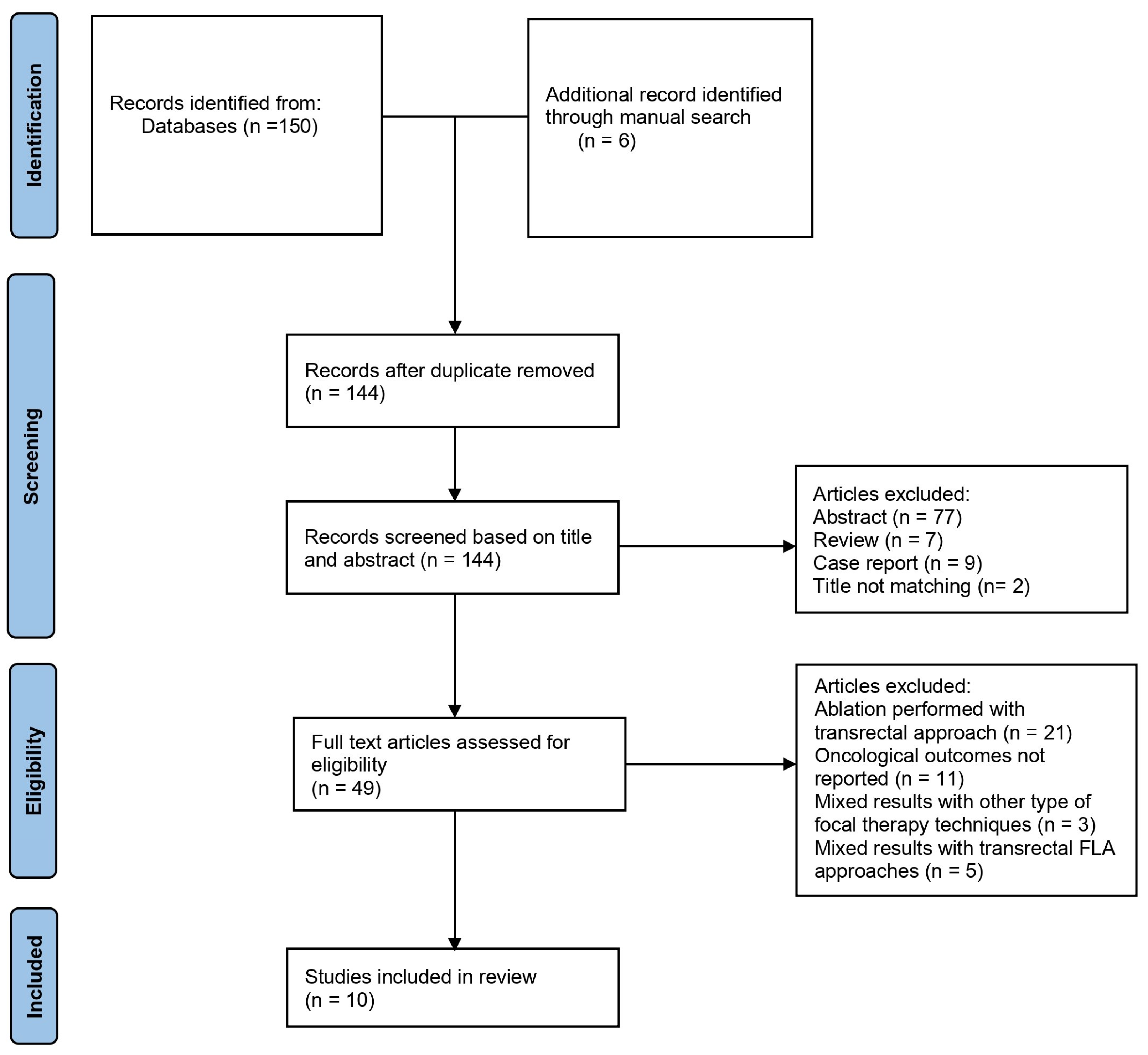
2.2. Study Screening and Selection
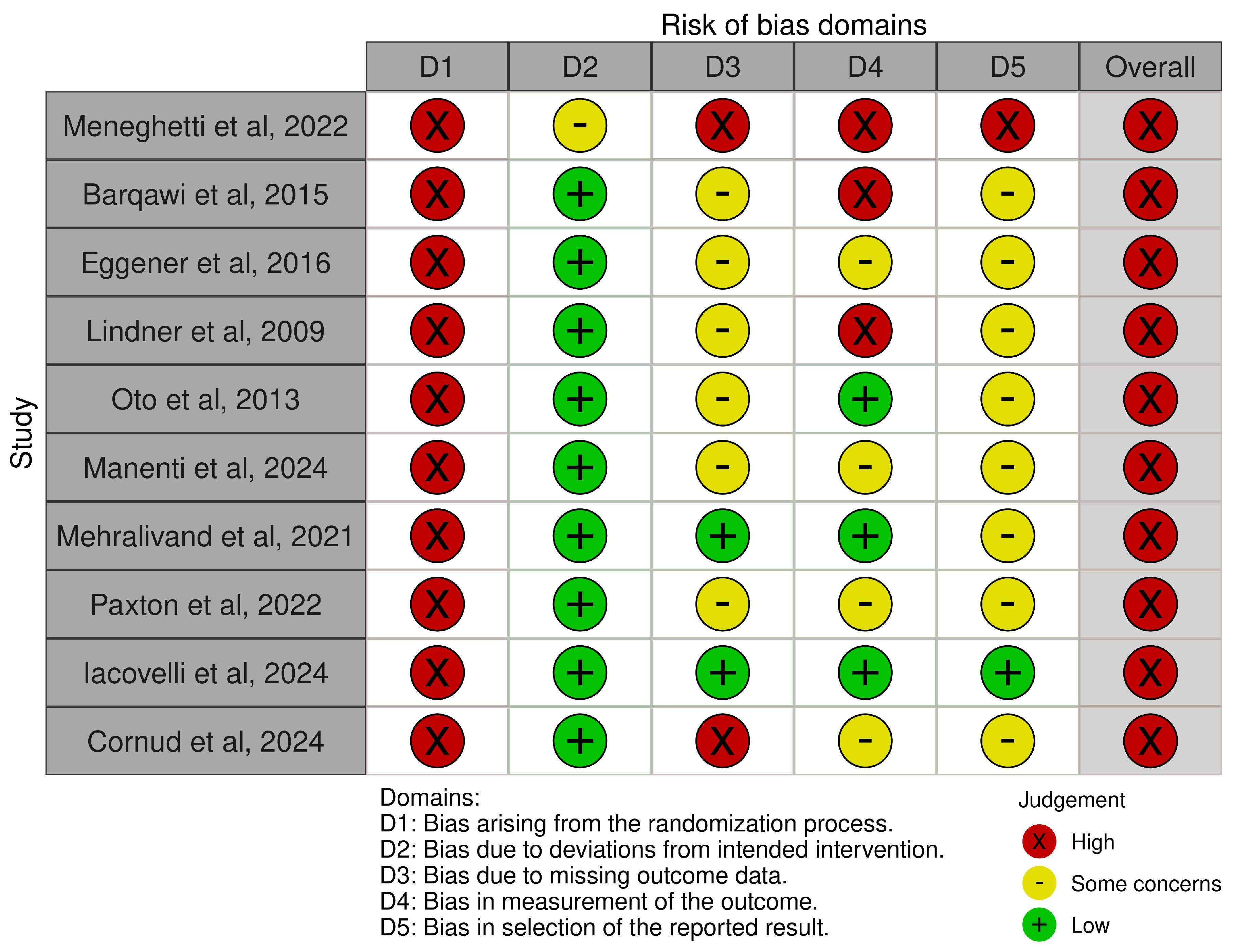
2.3. Risk of Bias Assessment
3. Results
3.1. Characteristics of the Included Studies
3.2. Risk of Bias
3.3. Preoperative Characteristics of Patients

| Study | Meneghetti et al., 2022 [14] | Barqawi et al., 2014 [15] | Eggener et al., 2016 [16] | Lindner et al., 2009 [17] | Oto et al., 2013 [18] | Manenti et al., 2024 [19] | Mehralivand et al., 2021 [20] | Paxton et al., 2022 [21] | Iacovelli et al., 2024 [22] | Cornud et al., 2024 [23] | |
|---|---|---|---|---|---|---|---|---|---|---|---|
| Type and design | Monocentric prospective non-comparative | Monocentric prospective non-comparative | Monocentric prospective non-comparative | Monocentric prospective non-comparative | Monocentric prospective non-comparative | Monocentric prospective non-comparative | Monocentric prospective Non-comparative | Monocentric retrospective non-comparative | Monocentric prospective non-comparative | Monocentric prospective non-comparative | |
| Country | Italy | USA | USA | Canada | USA | Italy | Germany | Canada | Italy | France | |
| Patients, no | 10 | 7 | 27 | 12 | 9 | 25 | 15 | 54 | 24 | 55 | |
| Age, yr | Range 60–78 | Range 56–69 | Median: 62 | Median: 56.5 (range 51–62) | Median: 61 (range 52–77) | Range 46–86 | Median: 66 (range 47–75) | Mean: 61 (range 43.1–77) | Median: 67 (SD ± 12) | median 70 (IQR 62–74) | |
| Pre- operative Imaging | MRI | MRI | MRI | MRI | MRI | MRI | MRI | MRI | MRI | mpMRI, microUS | |
| Pre- operative Biopsy | Transperineal (systematic or cognitive) | Transperineal (3DMB systematic) | NR | Transrectal (systematic) | Transrectal (systematic) | NR | Transrectal (target) | Transrectal (target) | Transperineal (systematic and target) | MRI-MicroUS-guided biopsies (systematic + targeted) | |
| Location | NR | 7 (36.8%):PZ; 1 (5.3%): junction of PZ and central gland; 11 (57.9%): TZ | NR | NR | NR | NR | 16 lesions: 3 R mid-anterior TZ, 1 L apical anterior PZ, 2 R base PZ, 1 R mid TZ, 1 L apical anterior TZ, 1 R apical | anterior PZ, 1 L mid-base anterior TZ, 1 M mid-base TZ, 2 L apical PZ, 1 M apical anterior PZ, 1 R apical anterior TZ, 1 R apical-mid anterior TZ | 51 (92.7%): PZ, 4 (7.3%): TZ | 9 (37.5%): posterior PZ; 6 (25%): anterior zone o TZ; 9 222 (37.5%): apical zone | 58 lesions: 23 (39.5%) PZpm, 7 (12%) PZpl, 5 (8.5%) PZa; 1 (2%) TZpm, 22 (38%) TZpl. 11 (19%) apex, 42 (72.5%) mid, 5 (8.5%) base |
| PSA level, ng/mL | Mean: 7.9 (SD ± 4.1; range 5.1–17.8) | Mean: 5.05 (SD ± 0.89) | Mean: 4.4 (range 0.88–8.99) | Mean 5.7 (SD ± 1.1) | Mean: 5.5 | Range: 5.5–6.9 | Median: 6.19 (range 2.16–14.5) | Mean: 5.44 (range 0.11–18.31) | Median: 5.7 (SD ± 3.9) | Median 7 (IQR 5.6–9) | |
| Gleason Score | 4 (40%): 3 + 3; 2 (20%): 3 + 4; 3 (30%): 4 + 3; 1 (10%): 4 + 4 | 7 (100%): 3 + 3 | 23 (85%): 3 + 3, 3 (11%): 3 + 4, 1 (4%): 4 + 3 | 12 (100%): 3 + 3 | NR | NR | 6 (40%): 3 + 3; 9 (60%): 3 + 4 | 33 (60%): 3 + 3, 21 (38%): 3 + 4; 1 (2%): 4 + 3 | 14 (58.3%): 3 + 3; 10 (41.7%): 3 + 4 | 10 (17%): 3 + 3; 43 (74%) 3 + 4; 3 (5.5%) 4 + 3; 2 (3.5%) 4 + 4 | |
| Risk Classification (D’Amico) | 4 (40%): Low; 5 (50%): Intermediate; 1 (10%) High | 7 (100%): Low | NR | 12 (100%): Low | NR | NR | 6 (40%): Low, 9 (60%): Intermediate | NR | NR | NR | |
3.4. Technical Aspects
3.5. Oncological Outcomes
3.6. Functional Outcomes
3.7. Complications
3.8. Urinary and Sexual Function
4. Discussion
5. Conclusions
Author Contributions
Funding
Institutional Review Board Statement
Informed Consent Statement
Data Availability Statement
Conflicts of Interest
Abbreviations
| PCa | Prostate Cancer |
| AS | Active Surveillance |
| RT | Radiotherapy |
| RP | Radical Prostatectomy |
| OS | Overall Survival |
| mpMRI | Multiparametric Magnetic Resonance Imaging |
| HIFU | High-Intensity Focused Ultrasound |
| FLA | Focal Laser Ablation |
| PRISMA | Preferred Reporting Items for Systematic Reviews and Meta-analyses |
| ISUP | International Society of Urological Pathology |
| bDFS | Biochemical Disease-Free Survival |
| ADT | Androgen Deprivation Therapy |
| LUTS | Lower Urinary Tract Symptoms |
| IPSS | International Prostatic Symptoms Score |
| IIEF-5 | Index of Erectile Function 5-items |
| SHIM | Sexual Health Inventory for Men |
| BCR | Biochemical Recurrence |
Appendix A
Appendix A.1. Search Strategy
Appendix A.1.1. Medline
Appendix A.1.2. Web of Science
References
- EAU Guidelines. Edn. Presented at the EAU Annual Congress Paris; EAU Guidelines Office: Arnhem, The Netherlands, 2024; ISBN 978-94-92671-23-3.
- Ficarra, V.; Novara, G.; Ahlering, T.E.; Costello, A.; Eastham, J.A.; Graefen, M.; Guazzoni, G.; Menon, M.; Mottrie, A.; Patel, V.R.; et al. Systematic review and meta-analysis of studies reporting potency rates after robot-assisted radical prostatectomy. Eur. Urol. 2012, 62, 418–430. [Google Scholar] [CrossRef] [PubMed]
- Ficarra, V.; Novara, G.; Rosen, R.C.; Artibani, W.; Carroll, P.R.; Costello, A.; Menon, M.; Montorsi, F.; Patel, V.R.; Stolzenburg, J.U.; et al. Systematic review and meta-analysis of studies reporting urinary continence recovery after robot-assisted radical prostatectomy. Eur. Urol. 2012, 62, 405–417. [Google Scholar] [CrossRef] [PubMed]
- Movsas, B.; Rodgers, J.P.; Elshaikh, M.A.; Martinez, A.A.; Morton, G.C.; Krauss, D.J.; Yan, D.; Citrin, D.E.; Hershatter, B.W.; Michalski, J.M.; et al. Dose-Escalated Radiation Alone or in Combination with Short-Term Total Androgen Suppression for Intermediate-Risk Prostate Cancer: Patient-Reported Outcomes from NRG/Radiation Therapy Oncology Group 0815 Randomized Trial. J. Clin. Oncol. 2023, 41, 3217–3224. [Google Scholar] [CrossRef] [PubMed] [PubMed Central]
- Hamdy, F.C.; Donovan, J.L.; Lane, J.A.; Mason, M.; Metcalfe, C.; Holding, P.; Davis, M.; Peters, T.J.; Turner, E.L.; Martin, R.M.; et al. 10-Year Outcomes after Monitoring, Surgery, or Radiotherapy for Localized Prostate Cancer. N. Engl. J. Med. 2016, 375, 1415–1424. [Google Scholar] [CrossRef] [PubMed]
- Hopstaken, J.S.; Bomers, J.G.R.; Sedelaar, M.J.P.; Valerio, M.; Fütterer, J.J.; Rovers, M.M. An Updated Systematic Review on Focal Therapy in Localized Prostate Cancer: What Has Changed over the Past 5 Years? Eur. Urol. 2022, 81, 5–33. [Google Scholar] [CrossRef] [PubMed]
- Ahmed, H.U. The index lesion and the origin of prostate cancer. N. Engl. J. Med. 2009, 361, 1704–1706. [Google Scholar] [CrossRef] [PubMed]
- Guillaumier, S.; Peters, M.; Arya, M.; Afzal, N.; Charman, S.; Dudderidge, T.; Hosking-Jervis, F.; Hindley, R.G.; Lewi, H.; McCartan, N.; et al. A Multicentre Study of 5-year Outcomes Following Focal Therapy in Treating Clinically Significant Nonmetastatic Prostate Cancer. Eur. Urol. 2018, 74, 422–429. [Google Scholar] [CrossRef] [PubMed] [PubMed Central]
- Marra, G.; Soeterik, T.; Oreggia, D.; Tourinho-Barbosa, R.; Moschini, M.; Filippini, C.; van Melick, H.H.E.; van den Bergh, R.C.N.; Gontero, P.; Cathala, N.; et al. Long-term Outcomes of Focal Cryotherapy for Low- to Intermediate-risk Prostate Cancer: Results and Matched Pair Analysis with Active Surveillance. Eur. Urol. Focus 2022, 8, 701–709. [Google Scholar] [CrossRef] [PubMed]
- Pinho, S.; Coelho, J.M.P.; Gaspar, M.M.; Reis, C.P. Advances in localized prostate cancer: A special focus on photothermal therapy. Eur. J. Pharmacol. 2024, 983, 176982. [Google Scholar] [CrossRef] [PubMed]
- Sessa, F.; Polverino, P.; Siena, G.; Bisegna, C.; Lo Re, M.; Spatafora, P.; Pecoraro, A.; Rivetti, A.; Moscardi, L.; Saladino, M.; et al. Transperineal Laser Ablation of the Prostate (TPLA) for Lower Urinary Tract Symptoms Due to Benign Prostatic Obstruction. J. Clin. Med. 2023, 12, 793. [Google Scholar] [CrossRef] [PubMed] [PubMed Central]
- Lo Re, M.; Polverino, P.; Rivetti, A.; Pecoraro, A.; Saladino, M.; Pezzoli, M.; Siena, G.; De Nunzio, C.; Marzi, V.L.; Gacci, M.; et al. Transperineal laser ablation (TPLA) of the prostate for benign prostatic obstruction: The first 100 patients cohort of a prospective, single-center study. World J. Urol. 2024, 42, 402. [Google Scholar] [CrossRef] [PubMed] [PubMed Central]
- Moher, D.; Liberati, A.; Tetzlaff, J.; Altman, D.G. PRISMA Group. Preferred reporting items for systematic reviews and meta-analyses: The PRISMA statement. PLoS Med. 2009, 6, e1000097. [Google Scholar] [CrossRef] [PubMed] [PubMed Central]
- Meneghetti, I.; Giardino, D.; Morganti, R.; Marino, V.; Menchini Fabris, F.; Bartoletti, R.; Pinzi, N. A single-operator experience using EchoLaser SoracteLiteTM for focal laser ablation of prostate cancer: One more arrow in the quiver for the conservative management of the disease. Arch. Ital. Urol. Androl. 2022, 94, 406–412. [Google Scholar] [CrossRef] [PubMed]
- Barqawi, A.; Krughoff, K.; Li, H.; Patel, N.U. Initial Experience of Targeted Focal Interstitial Laser Ablation of Prostate Cancer with MRI Guidance. Curr. Urol. 2015, 8, 199–207. [Google Scholar] [CrossRef] [PubMed] [PubMed Central]
- Eggener, S.E.; Yousuf, A.; Watson, S.; Wang, S.; Oto, A. Phase II Evaluation of Magnetic Resonance Imaging Guided Focal Laser Ablation of Prostate Cancer. J. Urol. 2016, 196, 1670–1675. [Google Scholar] [CrossRef] [PubMed]
- Lindner, U.; Weersink, R.A.; Haider, M.A.; Gertner, M.R.; Davidson, S.R.; Atri, M.; Wilson, B.C.; Fenster, A.; Trachtenberg, J. Image guided photothermal focal therapy for localized prostate cancer: Phase I trial. J. Urol. 2009, 182, 1371–1377. [Google Scholar] [CrossRef] [PubMed]
- Oto, A.; Sethi, I.; Karczmar, G.; McNichols, R.; Ivancevic, M.K.; Stadler, W.M.; Watson, S.; Eggener, S. MR imaging-guided focal laser ablation for prostate cancer: Phase I trial. Radiology 2013, 267, 932–940. [Google Scholar] [CrossRef] [PubMed]
- Manenti, G.; Perretta, T.; Nezzo, M.; Fraioli, F.R.; Carreri, B.; Gigliotti, P.E.; Micillo, A.; Malizia, A.; Di Giovanni, D.; Ryan, C.P.; et al. Transperineal Laser Ablation (TPLA) Treatment of Focal Low-Intermediate Risk Prostate Cancer. Cancers 2024, 16, 1404. [Google Scholar] [CrossRef] [PubMed] [PubMed Central]
- Mehralivand, S.; George, A.K.; Hoang, A.N.; Rais-Bahrami, S.; Rastinehad, A.R.; Lebastchi, A.H.; Ahdoot, M.; Siddiqui, M.M.; Bloom, J.; Sidana, A.; et al. MRI-guided focal laser ablation of prostate cancer: A prospective single-arm, single-center trial with 3 years of follow-up. Diagn. Interv. Radiol. 2021, 27, 394–400. [Google Scholar] [CrossRef] [PubMed] [PubMed Central]
- Paxton, M.; Barbalat, E.; Perlis, N.; Menezes, R.J.; Gertner, M.; Dragas, D.; Haider, M.A.; Finelli, A.; Trachtenberg, J.; Ghai, S. Role of multiparametric MRI in long-term surveillance following focal laser ablation of prostate cancer. Br. J. Radiol. 2022, 95, 20210414. [Google Scholar] [CrossRef] [PubMed] [PubMed Central]
- Iacovelli, V.; Carilli, M.; Bertolo, R.; Forte, V.; Vittori, M.; Filippi, B.; Di Giovanni, G.; Cipriani, C.; Petta, F.; Maiorino, F.; et al. Transperineal Laser Ablation for Focal Therapy of Localized Prostate Cancer: 12-Month Follow-up Outcomes from a Single Prospective Cohort Study. Cancers 2024, 16, 2620. [Google Scholar] [CrossRef] [PubMed] [PubMed Central]
- Cornud, F.; de Bie, K.; van Riel, L.; Lefèvre, A.; Camparo, P.; Galiano, M.; Wolfe, S. MRI-directed Micro-US-guided Transperineal Focal Laser Ablation for Localized Prostate Cancer: A 1-year Follow-up Study. Radiology 2024, 313, e233371. [Google Scholar] [CrossRef] [PubMed]
- Nicoletti, R.; Alberti, A.; Castellani, D.; Yee, C.H.; Zhang, K.; Poon, D.M.C.; Chiu, P.K.-F.; Campi, R.; Resta, G.R.; Dibilio, E.; et al. Functional outcomes and safety of focal therapy for prostate cancer: A systematic review on results and patient-reported outcome measures (PROMs). Prostate Cancer Prostatic Dis. 2024, 27, 614–622. [Google Scholar] [CrossRef] [PubMed]
- Postema, A.W.; De Reijke, T.M.; Ukimura, O.; Van den Bos, W.; Azzouzi, A.R.; Barret, E.; Baumunk, D.; Blana, A.; Bossi, A.; Brausi, M.; et al. Standardization of definitions in focal therapy of prostate cancer: Report from a Delphi consensus project. World J. Urol. 2016, 34, 1373–1382. [Google Scholar] [CrossRef] [PubMed] [PubMed Central]
- Nicoletti, R.; Alberti, A.; Castellani, D.; Yee, C.H.; Zhang, K.; Poon, D.M.C.; Chiu, P.K.-F.; Campi, R.; Resta, G.R.; Dibilio, E.; et al. Oncological results and cancer control definition in focal therapy for Prostate Cancer: A systematic review. Prostate Cancer Prostatic Dis. 2024, 27, 623–634. [Google Scholar] [CrossRef]
- Roach, M., 3rd; Hanks, G.; Thames, H., Jr.; Schellhammer, P.; Shipley, W.U.; Sokol, G.H.; Sandler, H. Defining biochemical failure following radiotherapy with or without hormonal therapy in men with clinically localized prostate cancer: Recommendations of the RTOG-ASTRO Phoenix Consensus Conference. Int. J. Radiat. Oncol. Biol. Phys. 2006, 65, 965–974. [Google Scholar] [CrossRef] [PubMed]
- Blana, A.; Brown, S.C.; Chaussy, C.; Conti, G.N.; Eastham, J.A.; Ganzer, R.; Murat, F.J.; Pasticier, G.; Rebillard, X.; Rewcastle, J.C.; et al. High-intensity focused ultrasound for prostate cancer: Comparative definitions of biochemical failure. BJU Int. 2009, 104, 1058–1062. [Google Scholar] [CrossRef] [PubMed]
- Huber, P.M.; Afzal, N.; Arya, M.; Boxler, S.; Dudderidge, T.; Emberton, M.; Guillaumier, S.; Hindley, R.G.; Hosking-Jervis, F.; Leemann, L.; et al. Prostate Specific Antigen Criteria to Diagnose Failure of Cancer Control following Focal Therapy of Nonmetastatic Prostate Cancer Using High Intensity Focused Ultrasound. J. Urol. 2020, 203, 734–742. [Google Scholar] [CrossRef] [PubMed]


| Study | Meneghetti et al., 2022 [14] | Barqawi et al., 2014 [15] | Eggener et al., 2016 [16] | Lindner et al., 2009 [17] | Oto et al., 2013 [18] | Manenti et al., 2024 [19] | Mehralivand et al., 2021 [20] | Paxton et al., 2022 [21] | Iacovelli et al., 2024 [22] | Cornud et al., 2024 [23] |
|---|---|---|---|---|---|---|---|---|---|---|
| Laser | Echolaser | Visualase | Visualase | Indigo Optima laser | Visualase | Echolaser | Visualase | Visualase | Echolaser | Echolaser |
| Type of ablation | Focal ablation | Focal ablation (real-time MRI-guided) | Focal ablation | Focal ablation | Focal ablation (MRI-guided) | Focal ablation (US/MRI-guided) | Focal ablation (real-time MRI-guided) | Focal ablation (real-time MRI-guided) | Focal ablation | Focal ablation |
| Number of fibers | NR | 1 to 3 (depending on the number of cancer foci) | 1 to 2 (occasionally, a second laser fiber was required to complete the ablation) | 1 to 2 (depending on the volume of the lesion) | 9 (100%): 1 | 1 to 3 | NR | NR | 18 (75.0%): 1; 6 (25.0%): 2 | 21 (36%): 1; 24 (41%): 2; 6 (10.5%): 3; 6 (10.5%): 4; 1 (2%): 5 |
| Length of stay (days) | NR | 7 (100%): 0 (Day Surgery) | NR | 9 (75%): 0; 3 (25%): 1 | NR | 25 (100%): 0 (Day Surgery) | NR | NR | NR | 55 (100%): 0 |
| Anesthesia | NR | General anesthesia | Conscious sedation | General anesthesia | Conscious sedation and local anesthesia | Local anesthesia | NR | Deep sedation (intravenous Propofol) | Conscious sedation and local anesthesia (anesthesia of perineal skin and peri-prostatic nerve-block) | General anesthesia |
| Study | Meneghetti et al., 2022 [14] | Barqawi et al., 2014 [15] | Eggener et al., 2016 [16] | Lindner et al., 2009 [17] | Oto et al., 2013 [18] | Manenti et al., 2024 [19] | Mehralivand et al., 2021 [20] | Paxton et al., 2022 [21] | Iacovelli et al., 2024 [22] | Cornud et al., 2024 [23] |
|---|---|---|---|---|---|---|---|---|---|---|
| Follow-up time (months) | 12 | 12 | 12 | 6 | 6 | 36 | 36 | Median: 49 (range 21–101) | 12 | 12 |
| Postfocal imaging | CEUS (1 h); MRI (3 and 12 months) | MRI | MRI | CEUS (7 days); MRI (7 days) | MRI | MRI | MRI | MRI | MRI | MRI |
| Postfocal histology (reason) | 8 (80%): systematic biopsy (by protocol); 2 (20%): refused | 5 (71%): 12 core TRUS biopsy; 1 (14%): 3DMB (by protocol); 1 (14%): lost to follow-up | 27 (100%): MRI-guided biopsy at 3 months (2 cores) and systematic biopsy at 12 months (by protocol) | 12 (100%): systematic prostate biopsies at 3 and 6 months (10 cores) (by protocol) | 9 (100%): MRI-guided biopsy (by protocol) | 25 (100%): systematic and target MRI/US fusion biopsy (by protocol) | 15 (100%): systematic and target MRI/US fusion biopsy at 12 and 24 months (by protocol); 12 (80%): systematic and target MRI/US fusion biopsy at 36 months (optional by protocol) | 51 (93%) targeted at early f-up (median 4 months), 21 (18.5%): systematic and target biopsy at late f-up (median 49 months) (by protocol) | 24 (100%): fusion biopsy at 12 months (by protocol) | 33 (60%) fusion re-biopsy (by protocol) at 12 months |
| Postfocal presence of cancer rate (%) | 2 (20%) | 4 (57%) | 1 (4%) at 3 months, 10 (37%) at 12 months | 6 (50%) | 2 (22%) | 5 (20%) | 7 (46.6%): residual cancer; 2 (13.3%): cancer outside the treatment area | 5 (9.2%) at early f-up, 8 (14.8%) at late f-up | 7 (29.2%) | 17/35 (49%) |
| Clinically significant cancer | NR | NR | 0 (0%) at 3 months; 2 (7%) at 12 months | 0 (0%) | 0 (0%) | 5 (20%) | 2 (13%) | 6 (11%) | 1 (4.2%) | 11/35 (31%) |
| bDFS, % | NR | NR | NR | NR | NR | NR | NR | NR | NR | NR |
| Criteria for bDFS | NR | NR | NR | NR | NR | NR | NR | NR | NR | NR |
| Treatment failure rate | 3 (30%) | NR | NR | 4 (30%) | NR | 5 (20%) | NR | NR | 3 (12.5%) | NR |
| Treatment failure definition | Positive MRI or biopsy | NR | NR | Any cancer in ablated zone | NR | Presence of residual lesions within the treatment field | NR | NR | Recurrence in the target treated lesion at 12 months | NR |
| PSA kinetics (at last follow-up unless otherwise stated) | 3.7 (SD ± 1.1) | 3.94 (SD ± 1.68) (p value = 0.149) | 3.4 (SD ± 2.2) (not significant) | NR | no changes in PSA level observed after treatment | decrease higher than 87% in all the patients except for the five who experimented with treatment failure | PSA level was significantly lower at follow-up than at baseline (p < 0.001)\ | Mean 6.4 (range 1.0–16.4) | Median 3.7 (SD ± 2.7) (p value: 0.9) | Single fiber median 3.4 (1.7–4.4); multifiber median 2.8 (2.3–4.5) |
| Secondary treatment | 3 (30%): FLA | NR | 1 (7%): RP | 1 (8.3%): RP | NR | NR | 2 (13%) FLA; 1 (7%) RP; 1 (7%) RP + neoadjuvant Enzalutamide + androgen deprivation therapy | 5 (9.2%): whole gland treatment (not specified) | 4 (16.7%): RP; 2 (8.3%) EBRT; 1 (4.2%): TPLA | 6 (11%): FLA; 3 (5.5%): RP |
| Mortality | 0 (0%) | 0 (0%) | 0 (0%) | 0 (0%) | 0 (0%) | 0 (0%) | 0 (0%) | 0 (0%) | 0 (0%) | 0 (0%) |
| Study | Meneghetti et al., 2022 [14] | Barqawi et al., 2014 [15] | Eggener et al., 2016 [16] | Lindner et al., 2009 [17] | Oto et al., 2013 [18] | Manenti et al., 2024 [19] | Mehralivand et al., 2021 [20] | Paxton et al., 2022 [21] | Iacovelli et al., 2024 [22] | Cornud et al., 2024 [23] |
|---|---|---|---|---|---|---|---|---|---|---|
| Overall complication rate | 4 (40%) | 1 (14%) | NR | NR | 2 (22%) | 0 (0%) | 10 (66.6%) | NR | 0 (0%) | 11 (20%) |
| Complication (description) | 4 (40%): pain | 1 (14%): urinary retention | 4 (15%): hematuria, 3 (11%) perineal ecchymosis, 2 (8%): acute urinary retention | 3 (25%) perineal discomfort; 2 mild hematuria (that did not require any intervention); 2 hematospermia; 1 fatigue | 1 (11.1%): abrasion on the perineum; 1 (11.1%): transient paresthesia | - | 2 (13.3%) hematuria; 1 (6.6%) urgency problem; 1 (6.6%) UTI; 1 (6.6%) hematuria and bladder spasm; 1 (6.6%) pressure ulcer and gross hematuria; 1 (6.6%) UTI with need for antibiotic therapy for 4 weeks; 1 (6.6%) bilateral epididymitis and gross hematuria; 1 (6.6%) LUTS; 1 (6.6%) acute prostatitis and need for catheterization | NR | - | 1 (2%) rectoprostatic fistula; 2 (3.5%) retrograde ejaculation; urinary retention; transient stress urinary incontinence; urinary tract infections |
| Urinary continence | 0 (0%) (0 pad) | NR | 1 (4%): urge incontinence at 1 month (resolved by 3 months) | NR | NR | NR | 0 (0%) (0 pad) | NR | 7 (29.2%): transient urgency (<72 h) Median ICIQ-SF: 3 months: 0 (SD ± 4) (p value 0.04); 6 months; 0 (SD ± 3) (p value 0.8); 12 months: 0 (SD ± 4) (p value 0.9) | NR |
| LUTS | IPSS: no changes | AUA-SS: data missing | IPSS: no changes | IPSS: no changes | IPSS: no significant changes | IPSS: no changes | IPSS: no changes | NR | Median IPSS: 3 months: 7 (SD ± 5) (p value: 0.009); 6 months: 7 (SD ± 6) (p value 0.7); 12 months: 6 (SD ± 6) (p value 0.3) | IPSS: no changes at 6 and 12 months |
| Erectile function | IIEF-5: no changes | SHIM: data missing | SHIM: lower at 1 month (p = 0.03), marginally lower at 3 months (p = 0.05), not significant at 12 months (p = 0.38) | IIEF-5: no changes | SHIM: no significant changes | IIEF-5: no changes | SHIM: no changes | NR | Median IIEF 5: 3 months: 20 (SD ± 7) (p value 0.2); 6 months: 21 (SD ± 6) (p value 0.5); 12 months: 20 (SD ± 6) (p value 0.8) | IIEF-5: at 6 months: 33 patients, median 19 vs. 22 p < 0.001; at 12 months: 29 patients, median 19 vs. 21 p < 0.001 |
| Quality of life | NR | NR | NR | NR | NR | NR | QoL: no changes | NR | Median IPSS QoL: 3 months: 1 (SD ± 2) (p value 0.02); 6 months: 1 (SD ± 2) (p value 0.8); 12 months: 1 (SD ± 1) (p value 0.1) | IPSS QoL: no changes at 6 and 12 months |
Disclaimer/Publisher’s Note: The statements, opinions and data contained in all publications are solely those of the individual author(s) and contributor(s) and not of MDPI and/or the editor(s). MDPI and/or the editor(s) disclaim responsibility for any injury to people or property resulting from any ideas, methods, instructions or products referred to in the content. |
© 2025 by the authors. Licensee MDPI, Basel, Switzerland. This article is an open access article distributed under the terms and conditions of the Creative Commons Attribution (CC BY) license (https://creativecommons.org/licenses/by/4.0/).
Share and Cite
Polverino, P.; Lo Re, M.; Moscardi, L.; Resta, G.R.; Caneschi, C.; Conte, F.; Giustozzi, B.; Rivetti, A.; Pecoraro, A.; Li Marzi, V.; et al. Transperineal Focal Laser Ablation of the Prostate for Prostate Cancer: A Systematic Review of the Literature. Cancers 2025, 17, 968. https://doi.org/10.3390/cancers17060968
Polverino P, Lo Re M, Moscardi L, Resta GR, Caneschi C, Conte F, Giustozzi B, Rivetti A, Pecoraro A, Li Marzi V, et al. Transperineal Focal Laser Ablation of the Prostate for Prostate Cancer: A Systematic Review of the Literature. Cancers. 2025; 17(6):968. https://doi.org/10.3390/cancers17060968
Chicago/Turabian StylePolverino, Paolo, Mattia Lo Re, Luisa Moscardi, Giulio Raffaele Resta, Corso Caneschi, Francesca Conte, Beatrice Giustozzi, Anna Rivetti, Alessio Pecoraro, Vincenzo Li Marzi, and et al. 2025. "Transperineal Focal Laser Ablation of the Prostate for Prostate Cancer: A Systematic Review of the Literature" Cancers 17, no. 6: 968. https://doi.org/10.3390/cancers17060968
APA StylePolverino, P., Lo Re, M., Moscardi, L., Resta, G. R., Caneschi, C., Conte, F., Giustozzi, B., Rivetti, A., Pecoraro, A., Li Marzi, V., Campi, R., Serni, S., & Sessa, F. (2025). Transperineal Focal Laser Ablation of the Prostate for Prostate Cancer: A Systematic Review of the Literature. Cancers, 17(6), 968. https://doi.org/10.3390/cancers17060968