Article

Pericardial Mesothelioma: Diagnostic and Therapeutic Management, a Population-Based Study in Italy


by
Simona Stella
1,
Dario Consonni
1,
Giovanni Luca Ceresoli
2,
Barbara Dallari
1,
Riccardo Perduri
3,
Cinzia Storchi
3,
Enrica Migliore
4,
Manuela Gangemi
4,
Carlo Genova
5,
Lucia Benfatto
5,
Vera Comiati
6,
Valentina Zabeo
6,
Sara Piro
7,
Lucia Giovannetti
7,
Iolanda Grappasonni
8,
Cristiana Pascucci
8,
Francesca Larese Filon
9,
Flavia D’Agostin
9,
Luigi Vimercati
10,
Ilaria Cozzi
11,
Franco Calista
12,
Giuseppe Cascone
13,
Italo Francesco Angelillo
14,
Alessandra Binazzi
15,
Alessandro Marinaccio
15 and
Carolina Mensi
1,*
add Show full author list remove Hide full author list
1
COR Lombardia, Occupational Health Unit, Fondazione IRCCS Ca’ Granda Ospedale Maggiore Policlinico, 20122 Milan, Italy
2
Department of Medical Oncology, Humanitas Gavazzeni Clinic, 24125 Bergamo, Italy
3
COR Mesoteliomi Emilia Romagna, AUSL-IRCCS di Reggio Emilia, 42123 Reggio Emilia, Italy
4
COR Piemonte, AOU Città della Salute e della Scienza di Torino and University of Turin, 10124 Torino, Italy
5
COR Liguria, Clinical Epidemiology Unit, IRCCS Ospedale Policlinico San Martino, Dipartimento di Medicina Interna e Specialità Mediche, Università degli Studi di Genova, 16132 Genova, Italy
6
COR Veneto, Azienda Zero, 35131 Padova, Italy
7
COR Toscana, Cancer Risk Factors and Lifestyle Epidemiology Unit, Institute for Cancer Research, Prevention and Clinical Network (ISPRO), 50139 Firenze, Italy
8
COR Marche, School of Medicinal and Health Products Sciences, University of Camerino, 62032 Camerino, Italy
9
COR Friuli Venezia Giulia, Clinical Unit of Occupational Medicine, University of Trieste, 34127 Trieste, Italy
10
COR Puglia, Section of Occupational Medicine ‘B Ramazzini’, Department of Interdisciplinary Medicine, University of Bari Aldo Moro, 70121 Bari, Italy
11
COR Lazio, Department of Epidemiology, Lazio Regional Health Service, ASL Roma 1, 00139 Rome, Italy
12
COR Molise, Molise Regional Health Authority Campobasso, 86100 Campobasso, Italy
13
COR Sicilia, Cancer Registry ASP Ragusa and Sicily Regional Epidemiological Observatory, 97100 Ragusa, Italy
14
COR Campania, Dipartimento di Medicina Sperimentale, Università degli Studi della Campania “Luigi Vanvitelli”, 80138 Napoli, Italy
15
DIMEILA, Department of Occupational and Environmental Medicine, Epidemiology, Hygiene, National Institute for Insurance against Accidents at Work (INAIL), 00144 Rome, Italy
*
Author to whom correspondence should be addressed.
Cancers 2025, 17(23), 3865; https://doi.org/10.3390/cancers17233865 (registering DOI)

Submission received: 30 October 2025 / Revised: 28 November 2025 / Accepted: 29 November 2025 / Published: 1 December 2025

Simple Summary

Pericardial mesothelioma (PM) is an extremely rare tumour for which only case reports, small case series, and case reviews have been published. This is a large population-based study on PM in Italy using data from the Italian National Mesothelioma Registry (Registro Nazionale Mesoteliomi, ReNaM). Information collected includes detailed clinical data on diagnosis and treatment and asbestos exposure. This study confirmed the extreme rarity of PM with crude incidence rates for men and women in 1993–2021 of 0.60 and 0.30 per 10 million person-years, respectively. Epidemiological characteristics of the tumour included late age at onset, male predominance, frequent occupational asbestos exposure, and an extremely poor median survival of 2.8 months. Surgery, when feasible, is the mainstay of treatment. The role of adjuvant treatments is unclear. An early diagnosis combined with standard treatment guidelines could improve patient prognosis and quality of life.

Abstract

Background: Pericardial mesothelioma (PM) is an extremely rare cancer with a poor prognosis and no consensus on diagnostic and therapeutic management. We conducted a registry-based study on PM cases in Italy diagnosed between 1993 and 2021. Methods: Based on data from the Italian National Mesothelioma Registry (ReNaM), we performed a descriptive analysis of PM cases including clinical presentation, diagnostic work-up, asbestos exposure, and therapeutic management. Overall survival was calculated. Hazard ratios (HRs) and 95% confidence intervals (CI) for selected variables were estimated with univariate and multivariate Cox models. Results: We identified 72 cases (46 men and 26 women). Median age was 66 years (range 22–89). The most frequent histological subtypes were epithelioid and unspecified mesothelioma. Almost two-thirds of cases had been exposed to asbestos. The most common clinical presentation was pericardial effusion. Overall median survival was 2.8 months (95% CI 1.2–6.6) and older age at diagnosis was a negative prognostic factor. Clinical and treatment data were available for 47 patients (65%). Approximately one out of two patients underwent surgery (palliative, in one-third of cases). Adjuvant therapy was administered to seven patients (15%). In cases with treatment information, sarcomatoid subtype (HR 2.74, 95% CI: 1.06–7.06) was a negative prognostic factor; adjuvant therapy was associated with better survival (HR 0.38, 95% CI 0.14–1.02), but confounding by indication cannot be excluded. Conclusions: We confirmed the very poor prognosis of PM. An international network collecting PM cases with treatment information is needed to improve patient quality of life and survival.

1. Introduction

Pericardial mesothelioma (PM) is an extremely rare cancer accounting for 1–2% of all mesotheliomas [1] and 4% of heart and pericardial tumours [2]. This malignancy arises from pericardial mesothelial cells and affects mostly males, with a gender ratio (male versus female) ranging from 1:1 to 3:1 [3,4,5,6]. In a recent Italian study [7], the gender ratio for PM was 1.95, increasing from 1.5 in 1993–2003 to 2.6 in 2004–2015. The Surveillance, Epidemiology, and End Results (SEER) Program from the US National Cancer Institute calculated mean annual standardised incidence rates for pericardial mesothelioma of 0.35 and 0.36 per 10 million person-years in men and in women, respectively [7].
Asbestos exposure is the primary risk factor: a recent case–control study in Italy estimated a fourfold increased PM risk for occupational asbestos exposure [7].
PM symptoms include fatigue, shortness of breath, chest pain, cough (frequently non-productive), and peripheral oedema; in fact, the clinical onset is generally related to signs of constrictive pericarditis, pericardial effusion, cardiac tamponade, and/or heart failure [5,8]. Other clinical unusual presentations are myocardial infarction, peripheral lymphadenopathy, and superior vena cava thrombosis [9,10,11].
PM survival is poor, typically between 6 and 18 months; moreover, up to 12.6% of cases are diagnosed after death [5]. Metastases occur in 25% to 45% of patients, and involve mostly regional lymph nodes, lungs, kidneys, and liver [8]. There is no consensus for disease management. Surgery seems to be associated with survival benefit in selected cases. Platinum-based chemotherapy showed increased survival in several reported case series [3,5,8]. Recently, a longer overall survival was observed in a few patients treated with trimodality therapy consisting of surgical resection, adjuvant chemotherapy, and sequential adjuvant intensity-modulated radiation therapy [12].

2. Materials and Methods

2.1. Study Design, Participants, and Data Sources

The Italian National Mesothelioma Registry (Registro Nazionale Mesoteliomi, ReNaM) is a population-based registry collecting information on patients with mesothelioma, at any site: pleura, peritoneum, pericardium, and tunica vaginalis testis [13]. The Registry is organised as a network of 21 regional centres (Centri Operativi Regionali, COR). In some regions, mesothelioma registration started in 1993; others began later [13].
Although compulsory by law (277/1991 and 81/2008), report of mesothelioma cases to CORs is largely incomplete [13]; therefore, CORs exploit several resources to complete case collection, including hospital discharge records and data from local health units, pathology departments, the Italian Workers’ Compensation Authority (INAIL), and mortality databases.
For each case, the CORs collects the date of diagnosis and histological subtype (epithelioid, biphasic, sarcomatoid). For confirmed cases, qualified personnel administer a standardised questionnaire to patients or their next of kin to investigate asbestos exposure (lifetime occupational and non-occupational). Asbestos exposure is then evaluated and classified according to ReNaM guidelines as occupational or non-occupational (including familial, environmental, and home-related) [13].

2.2. Variables and Outcomes

For all cases, we ascertained vital status and cause of death information as of 31 December 2023. We collected additional clinical information such as clinical presentation, symptoms, and the presence of distant metastases at diagnosis. Therapeutic management information, including the type of surgical intervention and adjuvant therapies (chemotherapy and/or loco-regional radiotherapy), was recorded.

2.3. Statistical Analysis

A descriptive analysis of patient characteristics was performed. We calculated crude and standardised rates for the period 2000–2021 using the European (2013) and world (Segi’s) standard populations. A Kaplan–Meier analysis was performed to calculate overall survival. Univariate and multivariate Cox models were used to estimate hazard ratios (HR) and 95% confidence intervals (CI) for selected variables, including age at diagnosis (<45, 45–64, 65–74, and ≥75 years), histological subtype, period of diagnosis (1993–1998, 1999–2004, 2005–2010, 2011–2016, 2017–2021), presence of distant metastasis at diagnosis (no/yes), and treatment (surgery only, surgery plus any adjuvant therapy). Statistical analyses were performed using Stata Version 19 [14].

3. Results

The ReNaM recorded 72 cases of PM between January 1993 and December 2021, 47 (65%) of which had additional information on clinical presentation and treatment. The crude incidence rates per 10 million person-years were 0.60 and 0.30 in men and in women, respectively. In men, age-standardised rates based on European and world standard population were 0.60 and 0.30, respectively. In women, both standardised rates were 0.30. The gender ratio (male vs. female) was 1.8 and median age at diagnosis was 66 years (range 22–89), with 60% of cases aged 65 years or older (Table 1). The most frequent histological subtype was epithelioid; one-third of cases were unspecified mesotheliomas.
Interviews were obtained for three-quarters of cases, the majority of which were indirect (56%). Among the 55 cases with available interview data, 32 (58%) had a history of occupational asbestos exposure, with men more frequently exposed (27/35, 77%) than women (5/20, 25%).
In 41 (87%) out of 47 cases with treatment information, the most common clinical presentations were pericardial effusion, heart failure/pericardial tamponade, and pericarditis or pleural effusion (Table 2). The most frequent reported symptoms were dyspnoea, malaise or fever, and chest pain. Metastases at diagnosis were present in five cases (11%).
Most cases were investigated using a contrast-enhanced computed tomography (CT) scan (Table 3). Pre-surgical cytological and histological diagnoses were obtained in a few cases, five (11%) and three (6%), respectively. In seven (15%) cases, diagnosis was performed at autopsy.
Twenty-three patients (49%) underwent surgery, with a major procedure (pericardiectomy or mass resection) in fifteen cases only (32%) (Table 4). Seven patients (15%) received adjuvant treatments: chemotherapy or, in one case, chemotherapy plus radiotherapy. The remaining patients received no treatment or palliative procedures only.
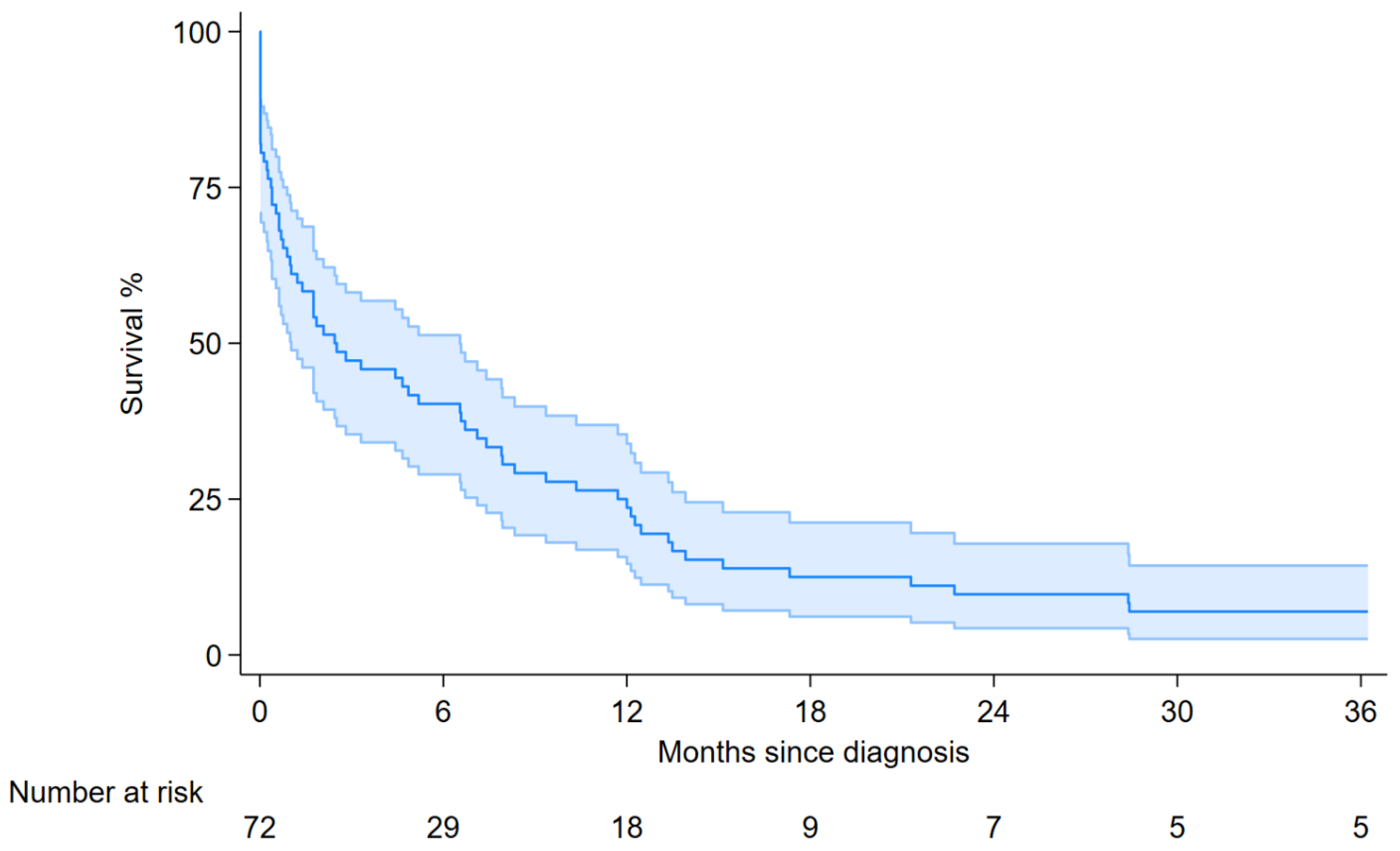
Figure 1. Three-year overall survival for 72 patients with pericardial mesothelioma, Italy, 1993–2021. Dark blue line: point estimates; light blue shade: 95% confidence bands.
Cancers 17 03865 g001
Table 5. Overall survival and hazard ratios (HRs) of deaths according to selected risk factors for pericardial mesothelioma cases, Italy, 1993–2021.
Variable NDeaths
N (%)
Overall Survival, (Months)
Median
Crude HR 95% CI
Overall7267 (93)2.8 (1.2–6.6)
Gender
Female 2625 (96)6.7 (4.4–12) 1.00Reference
Male 4642 (91)1.2 (0.5–2.8)1.310.79–2.15
Age at diagnosis (years)
<4587 (88)8.3 (0.2–12.3)1.00Reference
45–642121 (100)6.5 (1.9–13.4)1.370.57–3.26
65–742523 (92)2.1 (0.5–9.4)1.470.63–3.44
≥ 751816 (89)0.7 (0.0–1.8)2.761.10–6.92
Period of diagnosis
1993–19981212 (100)0.6 (0.0–10.3)1.00Reference
1999–200420 20 (100)1.9 (0.4–13.4)0.530.25–1.12
2005–201017 16 (94)7.1 (0.9–21.3)0.40 0.18–0.87
2011–201615 15 (100)1.8 (0.0–4.7)0.920.43–1.98
2017–20218 4 (50)6.5 (0.4–NC)0.340.11–1.05
Morphology (ICD-O-3 code)
Epithelioid (90523) 2622 (85)2.8 (0.5–12)1.00Reference
Biphasic (90533) 9 9 (100)8.3 (0.0–22.7)0.94 0.43–2.05
Sarcomatoid (90513)10 10 (100)1.2 (0.0–6.5)2.030.94–4.37
Not otherwise specified (90503) 24 23 (96)3.3 (0.7–11.7)0.990.55–1.79
Not available3 3 (100)0.9 (0.4–NC)2.720.79–9.39
Abbreviations: CI = confidence intervals; ICD-O-3, International Classification of Diseases for Oncology, Third Edition. NC = not calculable.
Overall survival was 2.8 months (95% CI 1.2–6.6). In cases with treatment information, median overall survival was 1.8 months (Table 6). The prognostic role of older age (over 75 years) was confirmed, with an HR of 4.59 (95% CI: 1.38–15.24). Sarcomatoid histology showed an HR of 2.74 (95% CI: 1.06–7.06). Conversely, the administration of adjuvant therapy was associated with a reduced risk of death, with an HR of 0.38 (95% CI: 0.14–1.02). Multivariate analysis confirmed the prognostic role of older age.

4. Discussion

In this study covering the whole Italian population over a long period (1993–2021), we found 72 cases of PM, mostly men with a history of asbestos exposure, and old age at diagnosis. Overall median survival was very poor (less than 3 months) and is consistent with previous population-based studies [3]. Older age and sarcomatoid histological subtype were negative prognostic factors. Adjuvant therapy was associated with better survival, although confounding by indication (i.e., indication of adjuvant therapy only for a few patients sufficiently healthy, thereby rendering the observed survival benefit potentially attributable to patient selection rather than the treatment itself) cannot be excluded [15].
The major strengths of this study are that the case series comes from a population-based registry (not a potentially selected hospital-based series) and the large (for this very rare disease) sample size: to our knowledge, there are no other population-based studies with larger numbers than ours. The main limitation is that we were only able to retrieve complete clinical information for 47/72 (65%) patients. This presents a potential risk of selection and constrains the applicability of the prognostic findings to the broader PM population.
The age at onset of PM is highly variable, with cases reported between the second and eighth decades of life [2]; however, the majority occur between the fourth and seventh decades [16]. Our findings are consistent with this distribution, although we observed a notable subset of patients younger than 45 years.
As previously reported [5], a male predominance was observed, with a nearly 2:1 male-to-female ratio. Due to the disease’s poor prognosis, exposure assessment was based primarily on indirect interviews, which are less informative because next of kin may not know the details of occupational or non-occupational asbestos exposure. This aspect may lead to an underestimation of cases attributable to asbestos exposure. In our case series, most patients (especially men) were occupationally exposed to asbestos.
The most common histologic subtypes were epithelioid and mesothelioma not otherwise specified (NOS). Diagnosis is often challenging due to unspecific symptoms at onset [8]. PM typically presents with dyspnoea related to pericardial effusion, thickening of the pericardium, which leads to increased intrapericardial pressure, direct myocardial infiltration by the tumour with impairment of both diastolic and systolic function, and pulmonary congestion. Pleural effusion may exacerbate dyspnoea [17,18]. Imaging combining different modalities such as echocardiography, CT scan, positron emission tomography (PET), and cardiac magnetic resonance imaging (MRI) is essential for diagnostic evaluation and classically reveals a thickened pericardium [8,18]. In our case series, nearly half of patients presented with dyspnoea, while 25% had pleural effusion. Most patients underwent two or more imaging examinations.
Differential diagnosis should be actively pursued through histopathologic examinations in patients with recurrent pericardial effusion, pericardial tamponade, progressive pericarditis, or unresponsive to anti-tuberculous and anti-inflammatory treatments [17]. However, preoperative diagnosis is uncommon in PM patients, with 10%-30% of cases only diagnosed by pericardiocentesis [5,19]. In our study, only a few cases had a cytological or histological pre-surgical diagnosis. A small proportion of cases was diagnosed via autopsy, confirming the findings of previous studies [5]. The reduced survival also affects the possibility of collecting information regarding asbestos exposure by speaking directly with the patient.
Therapeutic management for PM includes surgery, radiation, and chemotherapy. No standard treatment protocol has been established internationally [17]. Due to its dramatic clinical course, PM is often diagnosed at advanced stages [20] or post-mortem [5], although the post-mortem diagnosis rate has decreased over the years, from 75% to 13% [5]. Unfortunately, the safe, complete removal of the tumour is not possible in many cases [19]. Surgical approaches therefore include major procedures (pericardiectomy or mass resection) and palliative procedures (therapeutic pericardiocentesis and pericardial window). In our case series, only half of patients underwent surgery, and a significant proportion of these procedures were intentionally palliative.
Due to the rarity of PM, clinical trials evaluating systemic therapy and radiotherapy are lacking [17]. Patients are often treated with palliative platinum-based chemotherapy [8,18]. A recent review indicates that patients receiving platinum-based chemotherapy, with or without pemetrexed, had a better prognosis and survival [5]. The effectiveness of chemotherapy is confirmed by several case reports [17]. Additionally, evidence suggests that a multimodality approach (combining surgery, radiotherapy, and chemotherapy) may further improve prognosis [12]. In our study, 7 of 15 patients who underwent major surgery also received adjuvant chemotherapy (mostly cisplatin or carboplatin combined with pemetrexed) and this therapy group showed an improved survival. This finding is consistent with previous studies [5]. However, it should be interpreted with caution, because, as noted above, the observed survival benefit of adjuvant therapy may be attributable to confounding by indication.
In our series, older age and sarcomatoid histotype were related to a worse survival. Although metastases at diagnosis have been associated with reduced survival in other series [5], we did not find evidence supporting this association in our study. This finding could be influenced by the small number of patients with metastasis and/or incomplete information (the dramatic course of PM may have hampered a full staging procedure in a few cases). Despite the decreased rate of post-mortem diagnosis and the availability of multimodal therapeutic approaches, the prognosis of PM remains extremely poor, mainly due to the late diagnosis and the aggressiveness of the disease. An early diagnosis is of paramount importance to increase the likelihood of performing a major surgical procedure. Pericardial mesothelioma should be differentiated from benign pericardial disease and from other primary and secondary neoplasms of the pericardium [8,21]. Among emerging therapeutic perspectives, immunotherapy with nivolumab and ipilimumab, commonly used in pleural mesothelioma management, has not been reported so far in PM patients [22,23]. The administration of immunotherapy in pleural mesothelioma with pericardial involvement has been documented in isolated case reports [16,24].

5. Conclusions

In conclusion, we confirmed that PM is an extremely rare and aggressive cancer, with a poor prognosis. Due to its rarity, no standardised diagnostic and therapeutic guidelines have been currently established. Early detection is crucial for enhancing the chances of a successful major surgical intervention. On the other hand, future investigations should examine emerging therapeutic approaches such as immunotherapy in this context. Further efforts, including the implementation of an international network collecting PM cases with diagnosis and treatment data, are needed to improve both patient quality of life and survival.

Author Contributions

Conceptualization, G.L.C. and C.M.; methodology, D.C., S.S., and A.B.; formal analysis, S.S. and A.B.; data collection and curation, C.M., B.D., R.P., C.S., E.M., M.G., C.G., L.B., V.C., V.Z., S.P., L.G., I.G., C.P., F.L.F., F.D., L.V., I.C., F.C., G.C., I.F.A., A.M., and A.B.; writing original draft preparation, S.S.; funding acquisition, C.M. All authors contributed to the interpretation of findings and discussion. All authors have read and agreed to the published version of the manuscript.

Funding

This work was partially supported by the Italian National Institute for Insurance against Accidents at Work (INAIL: Istituto Nazionale per l’Assicurazione contro gli Infortuni sul Lavoro) within the Project BRIC INAIL ID 66/2022 (Grant PB-0184).

Institutional Review Board Statement

As reporting of patients with mesothelioma to the National Mesothelioma Registry (ReNaM) is compulsory by law 308/2022, ethics approval by an IRB and patients’ consent are not required.

Informed Consent Statement

As reporting of patients with mesothelioma to the National Mesothelioma Registry (ReNaM) is compulsory by law 308/2022, patients’ consent is not required.

Data Availability Statement

Data presented in this study are available on request from the corresponding author.

Acknowledgments

The authors wish to thank the patients affected by mesothelioma and or their next of kin, for granting interviews; the personnel of various institutions for collaboration in collecting information for cases.

Conflicts of Interest

D.C. and C.M. served as consultants in litigations concerning asbestos-related diseases. G.L.C. declares personal fees for advisory roles and speaker engagements for Bristol-Myers Squibb, Merck Sharp & Dohme, Novocure, Inhatarget, Astrazeneca, Bayer, and Astellas.

References

  1. Didier, A.J.; Li, M.; Gheeya, J.; Alahmadi, A.; Kaufman, J.; Memmott, R.; He, K.; Shields, P.; Carbone, D.P.; Presley, C.; et al. Trends in Mesothelioma Mortality in the United States Between 1999 and 2020. JTO Clin. Res. Rep. 2025, 6, 100804. [Google Scholar] [CrossRef]
  2. Apicella, G.; Boulemden, A.; Citarella, A.; Sushma, R.; Szafranek, A. Surgical treatment of a primary malignant pericardial mesothelioma: Case report. Acta Chir. Belg. 2022, 122, 48–50. [Google Scholar] [CrossRef]
  3. Brydges, H.; Yin, K.; Balasubramaniyan, R.; Lawrence, K.W.; Luo, R.; Karlson, K.J.; McAneny, D.B.; Edwards, N.M.; Reardon, M.J.; Dobrilovic, N. Primary Pericardial Mesothelioma: A Population-Based Propensity Score-Matched Analysis. Semin. Thorac. Cardiovasc. Surg. 2022, 34, 1113–1119. [Google Scholar] [CrossRef] [PubMed]
  4. Marinaccio, A.; Binazzi, A.; Di Marzio, D.; Scarselli, A.; Verardo, M.; Mirabelli, D.; Gennaro, V.; Mensi, C.; Merler, E.; De Zotti, R.; et al. Incidence of extrapleural malignant mesothelioma and asbestos exposure; from the Italian national register. Occup. Environ. Med. 2010, 67, 760–765. [Google Scholar] [CrossRef] [PubMed]
  5. McGehee, E.; Gerber, D.E.; Reisc, J.; Dowell, J.E. Treatment and Outcomes of Primary Pericardial Mesothelioma: A Contemporary Review of 103 Published Cases. Clin. Lung Cancer 2019, 20, e152–e157. [Google Scholar] [CrossRef] [PubMed]
  6. Mezei, G.; Chang, E.T.; Mowat, F.S.; Moolgavkar, S.H. Epidemiology of mesothelioma of the pericardium and tunica vaginalis testis. Ann. Epidemiol. 2017, 27, 348–359. [Google Scholar] [CrossRef]
  7. Marinaccio, A.; Consonni, D.; Mensi, C.; Mirabelli, D.; Migliore, E.; Magnani, C.; Di Marzio, D.; Gennaro, V.; Mazzoleni, G.; Girardi, P.; et al. Association between asbestos exposure and pericardial and tunica vaginalis testis malignant mesothelioma: A case-control study and epidemiological remarks. Scand. J. Work. Environ. Health 2020, 46, 609–617. [Google Scholar] [CrossRef]
  8. Arrossi, A.V. Pericardial Mesotheliomas. Adv. Anat. Pathol. 2023, 30, 253–258. [Google Scholar] [CrossRef]
  9. Chun, P.K.; Leeburg, W.T.; Coggin, J.T.; Zajtchuk, R. Primary pericardial malignant epithelioid mesothelioma causing acute myocardial infarction. Chest 1980, 77, 559–561. [Google Scholar] [CrossRef]
  10. Yakirevich, E.; Sova, Y.; Drumea, K.; Bergman, I.; Quitt, M.; Resnick, M.B. Peripheral lymphadenopathy as the initial manifestation of pericardial mesothelioma: A case report. Int. J. Surg. Pathol. 2004, 12, 403–405. [Google Scholar] [CrossRef]
  11. Gong, W.; Ye, X.; Shi, K.; Zhao, Q. Primary malignant pericardial mesothelioma—A rare cause of superior vena cava thrombosis and constrictive pericarditis. J. Thorac. Dis. 2014, 6, E272–E275. [Google Scholar]
  12. Offin, M.; De Silva, D.L.; Sauter, J.L.; Egger, J.V.; Yorke, E.; Adusumilli, P.S.; Rimner, A.; Rusch, V.W.; Zauderer, M.G. Multimodality Therapy in Patients with Primary Pericardial Mesothelioma. J. Thorac. Oncol. 2022, 17, 1428–1432. [Google Scholar] [CrossRef]
  13. Magnani, C.; Mensi, C.; Binazzi, A.; Marsili, D.; Grosso, F.; Ramos-Bonilla, J.P.; Ferrante, D.; Migliore, E.; Mirabelli, D.; Terracini, B.; et al. The Italian Experience in the Development of Mesothelioma Registries: A Pathway for Other Countries to Address the Negative Legacy of Asbestos. Int. J. Environ. Res. Public Health 2023, 20, 936. [Google Scholar] [CrossRef]
  14. Stata Statistical Software: Release 19; StataCorp LLC: College Station, TX, USA, 2025.
  15. Lash, T.L.; VanderWeele, T.J.; Haneuse, S.; Rothman, K.J. Modern Epidemiology, 4th ed.; Lippincott Williams and Wilkins: Philadelphia, PA, USA, 2021. [Google Scholar]
  16. Patel, J.; Sheppard, M.N. Primary malignant mesothelioma of the pericardium. Cardiovasc. Pathol. 2011, 20, 107–109. [Google Scholar] [CrossRef]
  17. Ji, Q.; Xu, C.; Wang, Q.; Wang, W.; Guo, Z.; Li, Z.; Song, Z.; Liu, A.; Yu, J.; Zhong, W.; et al. Expert Consensus on the Diagnosis and Treatment of Malignant Pericardial Mesothelioma. Med. Res. 2025, 1, 122–130. [Google Scholar] [CrossRef]
  18. Ravindra, K.; Vanchiere, C.; Ferrari, V.A. A Rare Cause of Constrictive Pericarditis: Primary Pericardial Mesothelioma. JACC Case Rep. 2025, 30, 103802. [Google Scholar] [CrossRef] [PubMed]
  19. Matsuyama, S.; Imazuru, T.; Uchiyama, M.; Ota, H.; Iida, M.; Shimokawa, T. Primary malignant pericardial mesothelioma presenting with cardiac tamponade. Int. J. Surg. Case Rep. 2020, 73, 253–256. [Google Scholar] [CrossRef] [PubMed]
  20. Hai, V.A.; Chau, N.T.M.; Hoanh, H.V.; Van Tri, H.; Pho, D.C.; Van Nam, N. Long-term survival from multidisciplinary treatment of primary malignant pericardial mesothelioma: A case report. Int. J. Surg. Case Rep. 2024, 125, 110615. [Google Scholar] [CrossRef]
  21. Saisho, C.; Ishii, H.; Edakuni, N.; Imamura, Y.; Tokito, T.; Kinoshita, T.; Azuma, K.; Yamada, K.; Hoshino, T. Sarcomatoid Type Primary Pericardial Mesothelioma with a Long-term Survival after the Onset of Cardiac Tamponade. Intern. Med. 2016, 55, 3161–3164. [Google Scholar] [CrossRef]
  22. Scherpereel, A.; Antonia, S.; Bautista, Y.; Grossi, F.; Kowalski, D.; Zalcman, G.; Nowak, A.K.; Fujimoto, N.; Peters, S.; Tsao, A.S.; et al. First-line nivolumab plus ipilimumab versus chemotherapy for the treatment of unresectable malignant pleural mesothelioma: Patient-reported outcomes in CheckMate 743. Lung Cancer 2022, 167, 8–16. [Google Scholar] [CrossRef]
  23. Peters, S.; Scherpereel, A.; Cornelissen, R.; Oulkhouir, Y.; Greillier, L.; Kaplan, M.; Talbot, T.; Monnet, I.; Hiret, S.; Baas, P.; et al. First-line nivolumab plus ipilimumab versus chemotherapy in patients with unresectable malignant pleural mesothelioma: 3-year outcomes from CheckMate 743. Ann. Oncol. 2022, 33, 488–499. [Google Scholar] [CrossRef]
  24. Seal, S.; Simon, H. Primary Pericardial Mesothelioma: A Rare but Serious Consideration. Cureus 2021, 13, e19966. [Google Scholar] [CrossRef]
Table 1. Characteristics of patients with pericardial mesothelioma, Italy, 1993–2021.
VariableN (%)Cases with Treatment Information
N (%)
Cases Without Treatment Information
N (%)
p-Value a
Total724725
Gender
Males 46 (64)31 (66)15 (60)0.62
Females26 (36)16 (34)10 (40)
Age, median (range)66 (22–89)68 (22–85)65 (34–89)0.42
Age classes (years)
<458 (11)5 (11)3 (12)0.78
45–6421 (29)12 (26)9 (36)
65–7425 (35)17 (36)8 (32)
≥ 7518 (25)13 (27)5 (20)
Period of diagnosis
1993–199812 (17)9 (19)3 (12)0.09
1999–200420 (28)14 (30)6 (24)
2005–201017 (24)10 (21)7 (28)
2011–201615 (21)12 (26)3 (12)
2017–20218 (11)2 (4)6 (24)
Morphology (ICD-O-3 code)
Epithelioid (90523)26 (36)16 (34)10 (40)0.56
Biphasic (90533)9 (13)5 (11)4 (16)
Sarcomatoid (90513)10 (14)7 (15)3 (12)
Not otherwise specified (90503)24 (33)18 (38)6 (24)
Not available 3 (4)1 (2)2 (8)
Exposure evaluation
Direct interview 15 (21)5 (11)10 (40)0.26
Indirect interview40 (56)34 (72)6 (24)
None 17 (24)8 (17)9 (36)
Sources of asbestos exposure (only for cases with exposure assessment)
Occupational 32 (58)24 (62)8 (50)0.65
Non-occupational 2 (4)1 (3)1 (6)
Unexposed 21 (38)14 (36)7 (44)
a From Wilcoxon (Mann–Whitney) test or Chi-Squared test. Abbreviations: ICD-O-3, International Classification of Diseases for Oncology, Third Edition.
Table 2. Clinical and radiological presentation of pericardial mesothelioma in 47 cases with additional information on clinical presentation and treatment, Italy, 1993–2021.
VariableN%
Total47
Age, median (range)68 (22–85)
Clinical presentation4187
Pericardial effusion30 64
Heart failure/pericardial tamponade 1736
Pericarditis 1123
Pleural effusion 1123
Peripheral lymphadenopathy 817
Cardiac arrhythmia7 15
Pericardial/mediastinal mass 5 11
Ascitic effusion 511
Other acute cardiovascular events4 9
Pneumonia 49
Peripheral oedema 24
Parapericardial hypoventilative striae12
Symptoms
Dyspnoea2349
Malaise/fever 1328
Chest pain1123
Cough 1021
Asthenia919
Gastrointestinal symptoms919
Cardiac symptoms 49
Metastases at diagnosis a
No 4289
Yes 511
a lung (N = 2), brain (N = 1), other (N = 2).
Table 3. Diagnostic workup of pericardial mesothelioma in 47 cases with additional information on clinical presentation and treatment, Italy, 1993–2021.
VariableN%
Imaging a4187
Chest X-rays3064
Contrast-enhanced computed tomography scan 3779
Magnetic resonance imaging 1226
Positron emission tomography715
Scintigraphy12
Pre-surgical cyto-histological diagnosis
Cytological examination511
Histological examination 36
Diagnosis via autopsy715
a patients may undergo two or more imaging evaluations.
Table 4. Upfront therapeutic management of pericardial mesothelioma in 47 cases with additional information on clinical presentation and treatment, Italy, 1993–2021.
VariableN %
Total47100
Surgery2349
Major surgical procedures (pericardiectomy/mass resection)1532
Palliative procedures (therapeutic pericardiocentesis/pericardial window)817
Surgery + adjuvant treatment(s)
Adjuvant chemotherapy715
Adjuvant chemotherapy and radiotherapy12
Median overall survival was 2.8 months (95% CI 1.2–6.6, Figure 1 and Table 5). Older age (over 75 years) was associated with a worse prognosis, with an HR of 2.76 (95% CI: 1.10–6.92).
Table 6. Overall survival and hazard ratios (HRs) of deaths according to selected risk factors for pericardial mesothelioma in cases with additional information on clinical presentation and treatment (N = 47), Italy, 1993–2021.
Variable NDeaths
N (%)
Overall Survival, (Months)
Median
Crude HR 95% CI
Overall4745 (96)1.8 (0.6–4.9)
Gender
Female 16 16 (100)6.6 (0.8–9.4)1.00Reference
Male 31 29 (94)1.0 (0.3–1.8)1.48 0.80–2.74
Age at diagnosis (years)
<4554 (80)8.3 (0.8–NC)1.00Reference
45–641212 (100)4.9 (0.0–13.4)2.110.67–6.67
65–741717 (100)1.8 (0.3–7.1)2.180.73–6.54
≥ 751312 (92)0.6 (0.0–1.8)4.591.38–15.24
Period of diagnosis
1993–199899 (100)0.6 (0.0–6.6)1.00Reference
1999–20041414 (100)1.0 (0.0–13.5)0.480.20–1.15
2005–2010109 (90)1.2 (0.0–7.9)0.530.21–1.38
2011–20161212 (100)1.4 (0.0–5.2)0.930.39–2.21
2017–202121 (50)4.4 (4.4–NC)0.310.04–2.44
Morphology (ICD-O-3 code)
Epithelioid (90523) 1614 (88)1.8 (0.3–9.4)1.00Reference
Biphasic (90533) 55 (100)7.1 (0.0–NC)1.150.41–3.23
Sarcomatoid (90513)77 (100)0.1 (0.0–1.4)2.741.06–7.06
Not otherwise specified (90503) 1818 (100)1.8 (0.6–6.6)1.120.55–2.25
Not available11 (100)-2.710.34–21.47
Metastases at diagnosis
No4240 (95)1.4 (0.6–4.4)1.00Reference
Yes 55 (100)6.6 (0.0–NC)1.140.44–2.93
Treatment group
No surgery 2424 (100)0.9 (0.0–1.8)1.00Reference
Palliative surgery 88 (100)1.2 (0.0–8.3)0.830.37–1.86
Surgery only 88 (100)2.1 (0.0–7.1)0.770.34–1.75
Surgery plus adjuvant therapy 75 (71)7.9 (0.8–NC)0.380.14–1.02
Disclaimer/Publisher’s Note: The statements, opinions and data contained in all publications are solely those of the individual author(s) and contributor(s) and not of MDPI and/or the editor(s). MDPI and/or the editor(s) disclaim responsibility for any injury to people or property resulting from any ideas, methods, instructions or products referred to in the content.