Clinical Implication of Bilateral and Unilateral Multifocality in Papillary Thyroid Carcinoma: A Propensity Score-Matched Study


Department of Surgery, College of Medicine, The Catholic University of Korea, Seoul 06591, Republic of Korea
*
Author to whom correspondence should be addressed.
Cancers 2023, 15(14), 3596; https://doi.org/10.3390/cancers15143596
Submission received: 12 June 2023
/
Revised: 8 July 2023
/
Accepted: 10 July 2023
/
Published: 13 July 2023
(This article belongs to the Special Issue Thyroid Cancer: Diagnosis, Prognosis and Treatment)
Simple Summary
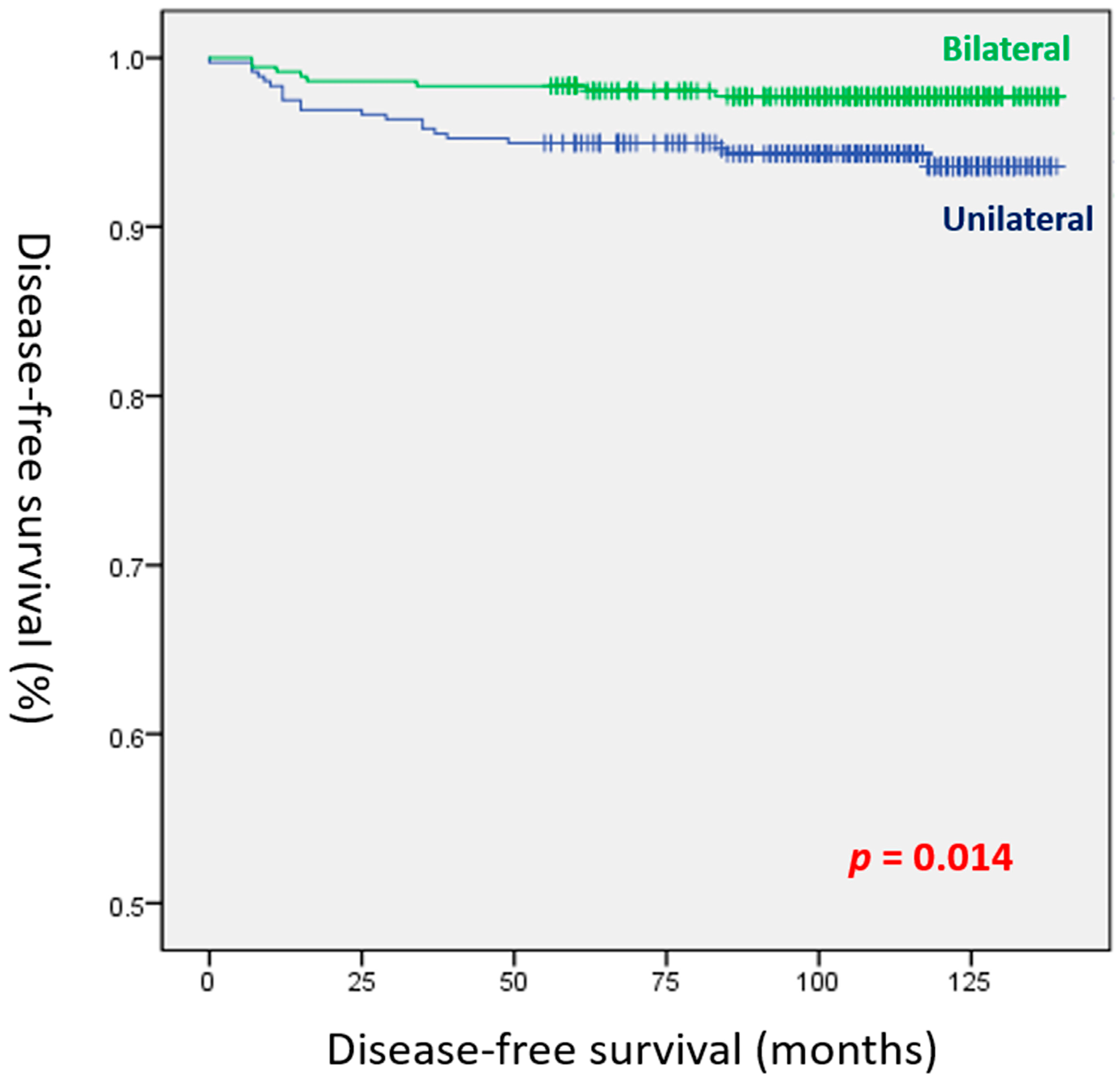
Multifocality is often found in PTC. There are contradicting evidences regarding clinical implications of cancer laterality in multifocal PTC. The current study compared the clinicopathological characteristics and the long-term oncological outcomes of bilateral and unilateral multifocal PTC. Patients with bilateral PTC were more likely to present with aggressive features, including high tumor stage, cervical LN metastasis, gross ETE, and lymphatic and perineural invasion. On the multivariate analysis using Cox regression, gross ETE, perineural invasion, LN metastasis, N1b stage, and RAI therapy were significant risk factors of recurrence. However, bilaterality was not associated with an increased risk of recurrence. In order to reduce selection bias, a subgroup analysis of patients who underwent total thyroidectomy was conducted using propensity score matching. After matching, unilateral multifocality, vascular invasion, and RAI therapy were significant risk factors of recurrence. Patients with unilateral multifocal PTC showed significantly poorer DFS than those with bilateral PTC on the Kaplan-Meier analysis.
Abstract
Papillary thyroid cancer (PTC) is commonly characterized by multifocality, which is associated with aggressive features and a less favorable prognosis. The current study aimed to compare the clinicopathologic characteristics and long-term oncological outcomes of bilateral and unilateral multifocal PTC. The medical records of 1745 patients with multifocal PTC who underwent thyroid surgery at Seoul St. Mary’s Hospital were retrospectively reviewed. The clinicopathological characteristics and recurrence rates were compared based on cancer laterality. Further, 357 patients who underwent total thyroidectomy were matched to investigate the recurrence risk and disease-free survival (DFS). Before propensity score matching (PSM), there was no significant difference in the recurrence rate between the bilateral and unilateral multifocal PTC groups. Cancer laterality was not a predictor of DFS based on the Cox regression analyses. However, after PSM, unilateral multifocality was associated with a significantly high risk of recurrence. Similarly, unilateral multifocality was associated with a significantly poor DFS based on the Kaplan–Meier analysis. Compared with bilateral PTC, unilateral multifocal PTC was associated with a poor DFS. A comprehensive preoperative examination should be performed to detect multifocality before the initial surgical intervention for optimal treatment. Postoperative short-term follow-up is recommended for unilateral multifocal PTC for recurrence surveillance.