Sex- and Co-Mutation-Dependent Prognosis in Patients with SMARCA4-Mutated Malignancies
by
 , , and
Minggui Pan
1,2,3,*,
Chen Jiang
2,
Zheyang Zhang
4,
Ninah Achacoso
2,
Aleyda V. Solorzano-Pinto
2,
Pam Tse
2,
Elaine Chung
2,
Jennifer Marie Suga
5,
Sachdev Thomas
5 and
Laurel A. Habel
2 1
Department of Oncology and Hematology, Kaiser Permanente, Santa Clara, CA 94051, USA
2
Division of Research, Kaiser Permanente, Oakland, CA 94612, USA
3
Division of Oncology, Stanford University School of Medicine, Stanford, CA 94304, USA
4
State Key Laboratory of Cellular Stress Biology, School of Life Sciences, Faculty of Medicine and Life Sciences, Xiamen University, and National Institute for Data Science in Health and Medicine, Xiamen University, Xiamen 361102, China
5
Department of Oncology and Hematology, Kaiser Permanente, Vallejo, CA 94589, USA
*
Author to whom correspondence should be addressed.
Cancers 2023, 15(10), 2665; https://doi.org/10.3390/cancers15102665
Submission received: 7 March 2023
/
Revised: 12 April 2023
/
Accepted: 3 May 2023
/
Published: 9 May 2023
(This article belongs to the Section Molecular Cancer Biology)
Simple Summary
SMARCA4-mutated tumors are associated with poor prognosis. However, it is not clear if male and female patients have the same or different prognosis and if additional common mutations within the tumor play a role in prognosis. We have found that male patients had substantially worse prognosis than female patients whose tumor carried a SMARCA4 mutation. In addition, different co-existing mutations including the mutation of TP53, KRAS, CDKN2A, STK11, and Keap1 were associated with differential prognosis. Our study provides helpful insight for prognostic stratification in clinical practice and for understanding the pathogenic mechanism of this unique subtype of malignancy.
Abstract
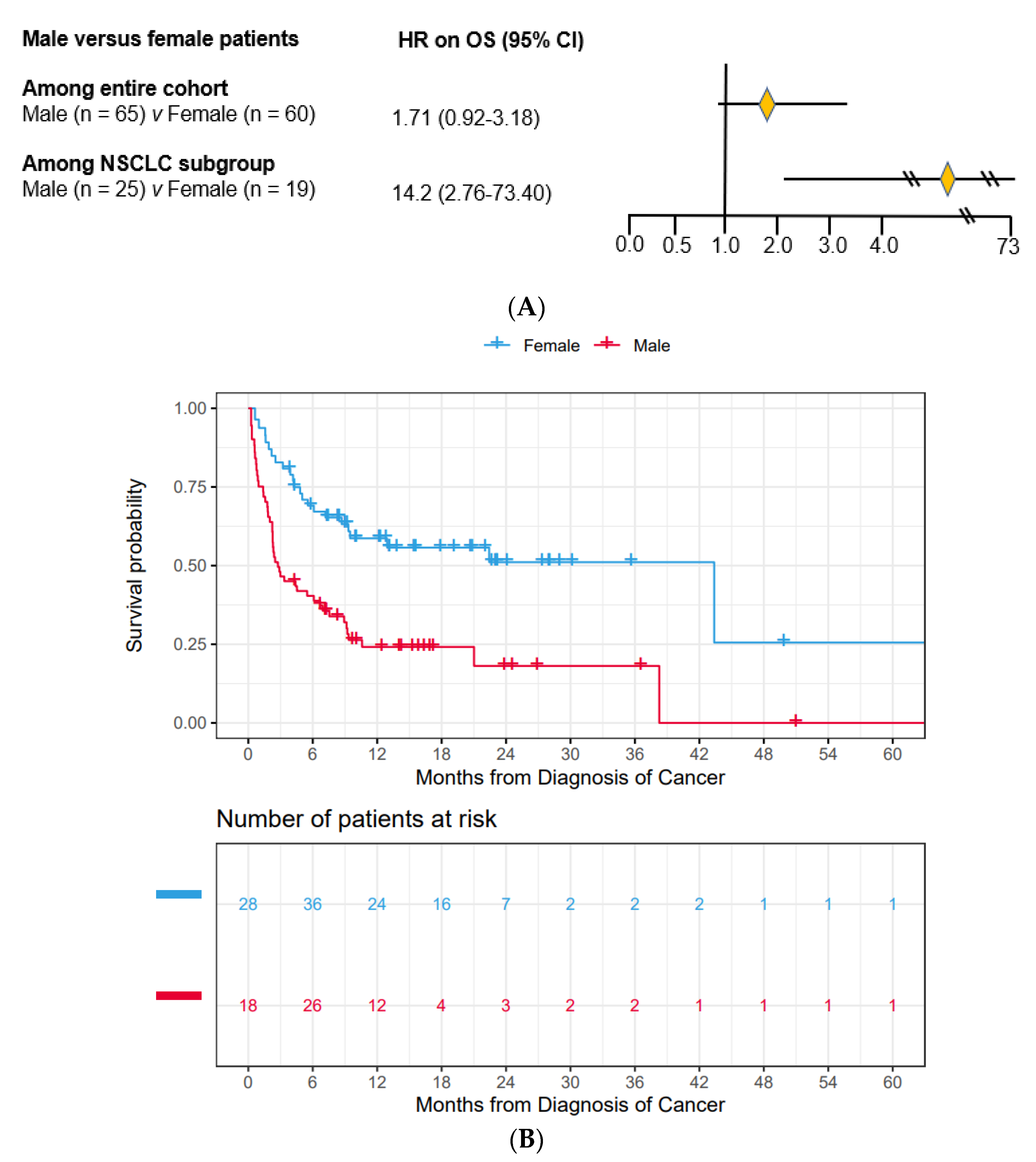
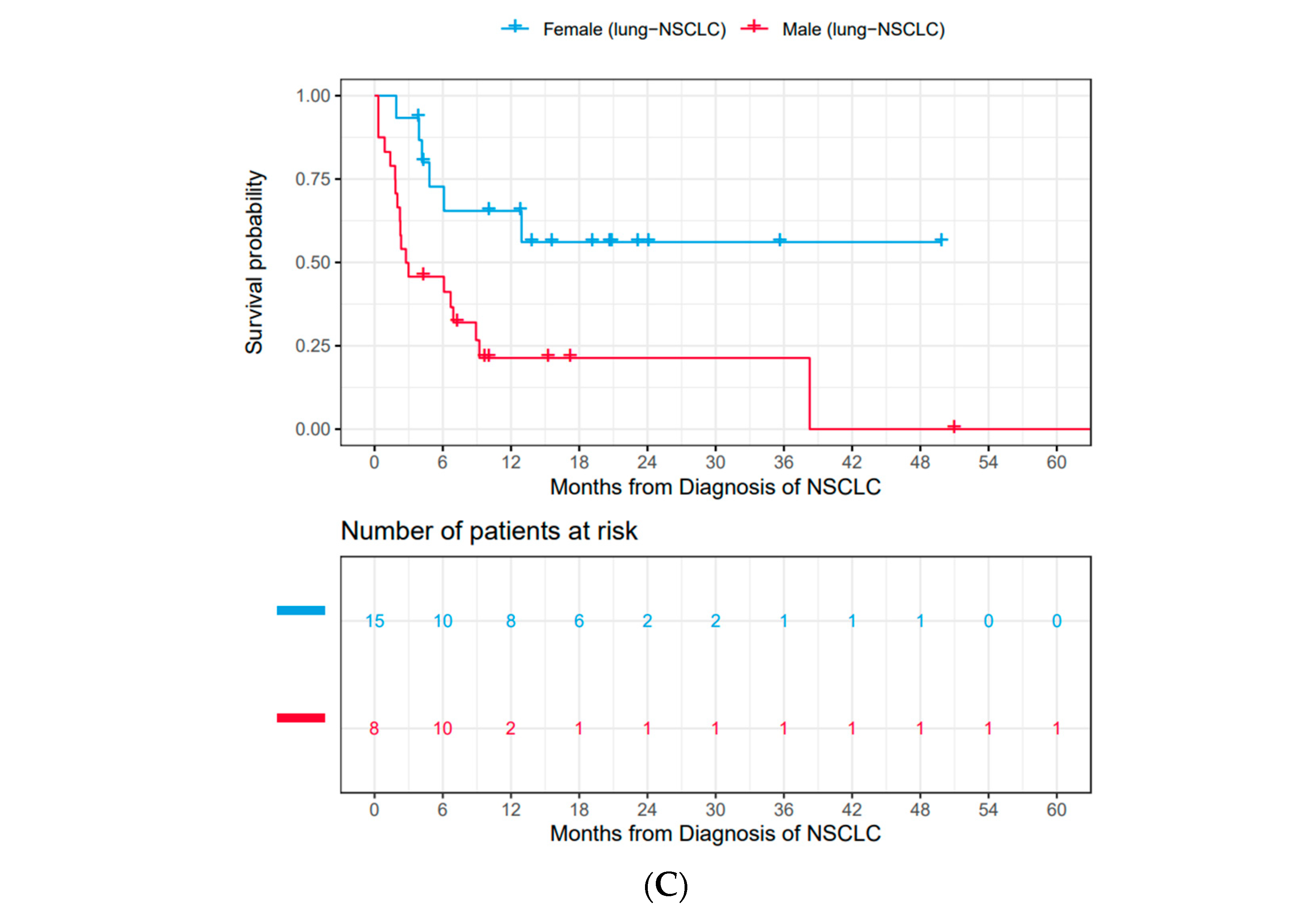
Background: Whether sex and co-mutations impact prognosis of patients with SMARCA4-mutated (mutSMARCA4) malignancies is not clear. Methods: This cohort included patients from Northern California Kaiser Permanente with next-generation sequencing (NGS) performed from August 2020 to October 2022. We used Cox regression modeling to examine the association between sex and overall survival (OS), adjusting for demographics, performance status, Charlson comorbidity index, receipt of treatment, tumor mutation burden (TMB), and TP53, KRAS, CDKN2A, STK11, and Keap1 co-mutations. Results: Out of 9221 cases with NGS performed, 125 cases (1.4%) had a mutSMARCA4. The most common malignancies with a mutSMARCA4 were non-small cell lung cancer (NSCLC, 35.2%), esophageal and stomach adenocarcinoma (12.8%), and cancer of unknown primary (11.2%). The most common co-mutations were p53 (mutp53, 59.2%), KRAS (mutKRAS, 28.8%), CDKN2A (mutCDKN2A, 31.2%), STK11 (mutSTK11, 12.8%), and Keap1 (mutKeap1, 8.8%) mutations. Male patients had substantially worse OS than female patients both among the entire mutSMARCA4 cohort (HR = 1.71, [95% CI 0.92–3.18]) with a median OS of 3.0 versus 43.3 months (p < 0.001), and among the NSCLC subgroup (HR = 14.2, [95% CI 2.76–73.4]) with a median OS of 2.75 months versus un-estimable (p = 0.02). Among all patients with mutSMARCA4, mutp53 versus wtp53 (HR = 2.12, [95% CI 1.04–4.29]) and mutSTK11 versus wtSTK11 (HR = 2.59, [95% CI 0.87–7.73]) were associated with worse OS. Among the NSCLC subgroup, mutp53 versus wtp53 (HR = 0.35, [0.06–1.97]) and mutKRAS versus wtKRAS (HR = 0.04, [0.003-.45]) were associated with better OS, while mutCDKN2A versus wtCDKN2A (HR = 5.04, [1.12–22.32]), mutSTK11 versus wtSTK11 (HR = 13.10, [95% CI 1.16–148.26]), and mutKeap1 versus wtKeap1 (HR = 5.06, [95% CI 0.89–26.61}) were associated with worse OS. Conclusion: In our cohort of patients with mutSMARCA4, males had substantially worse prognosis than females, while mutTP53, mutKRAS, mutCDKN2A, mutSTK11 and mutKeap1were differentially associated with prognosis among all patients and among the NSCLC subgroup. Our results, if confirmed, could suggest potentially unidentified mechanisms that underly this sex and co-mutation-dependent prognostic disparity among patients whose tumor bears a mutSMARCA4.