Flexible Three-Dimensional Stress Sensor for Embedded Monitoring of Solid Rocket Propellant



Abstract
1. Introduction
2. Principle
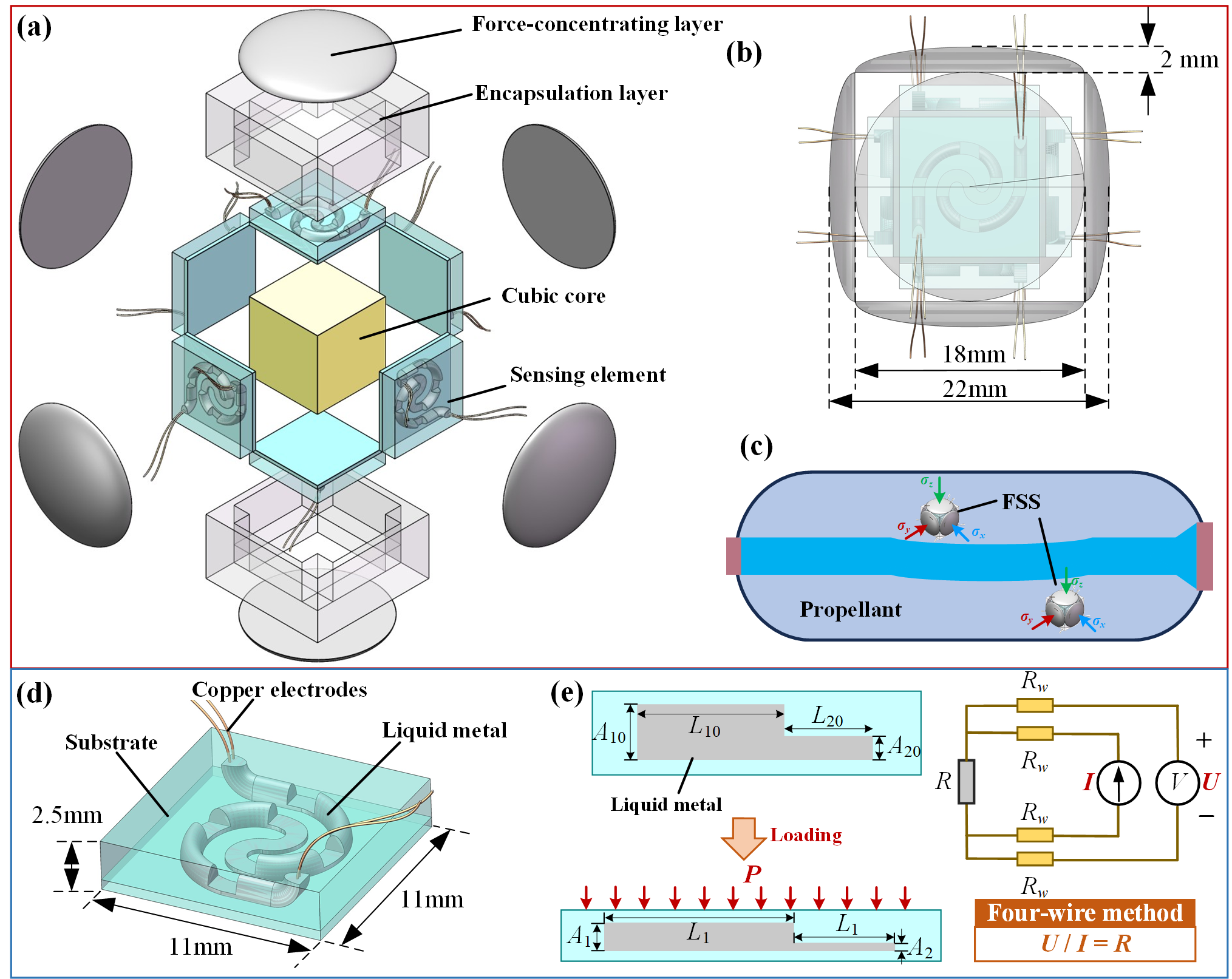
2.1. Sensing Mechanism
2.2. Mathematical Modeling of the Pressure-Sensing Element with a Variable Cross-Section
3. Finite Element Analysis
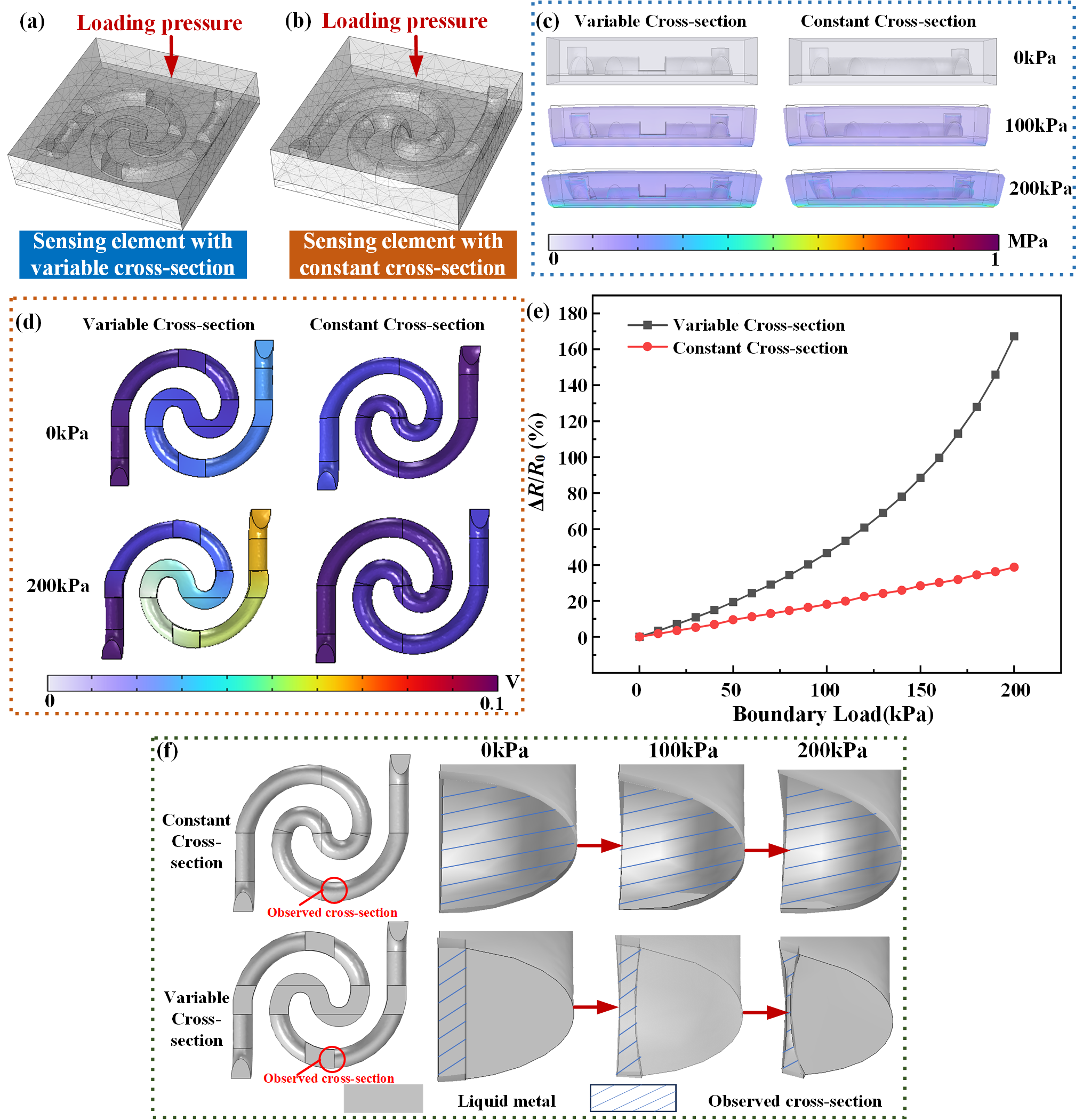
3.1. Modeling of Pressure Sensing Element
3.2. Modeling of FSS Embedded in Propellant
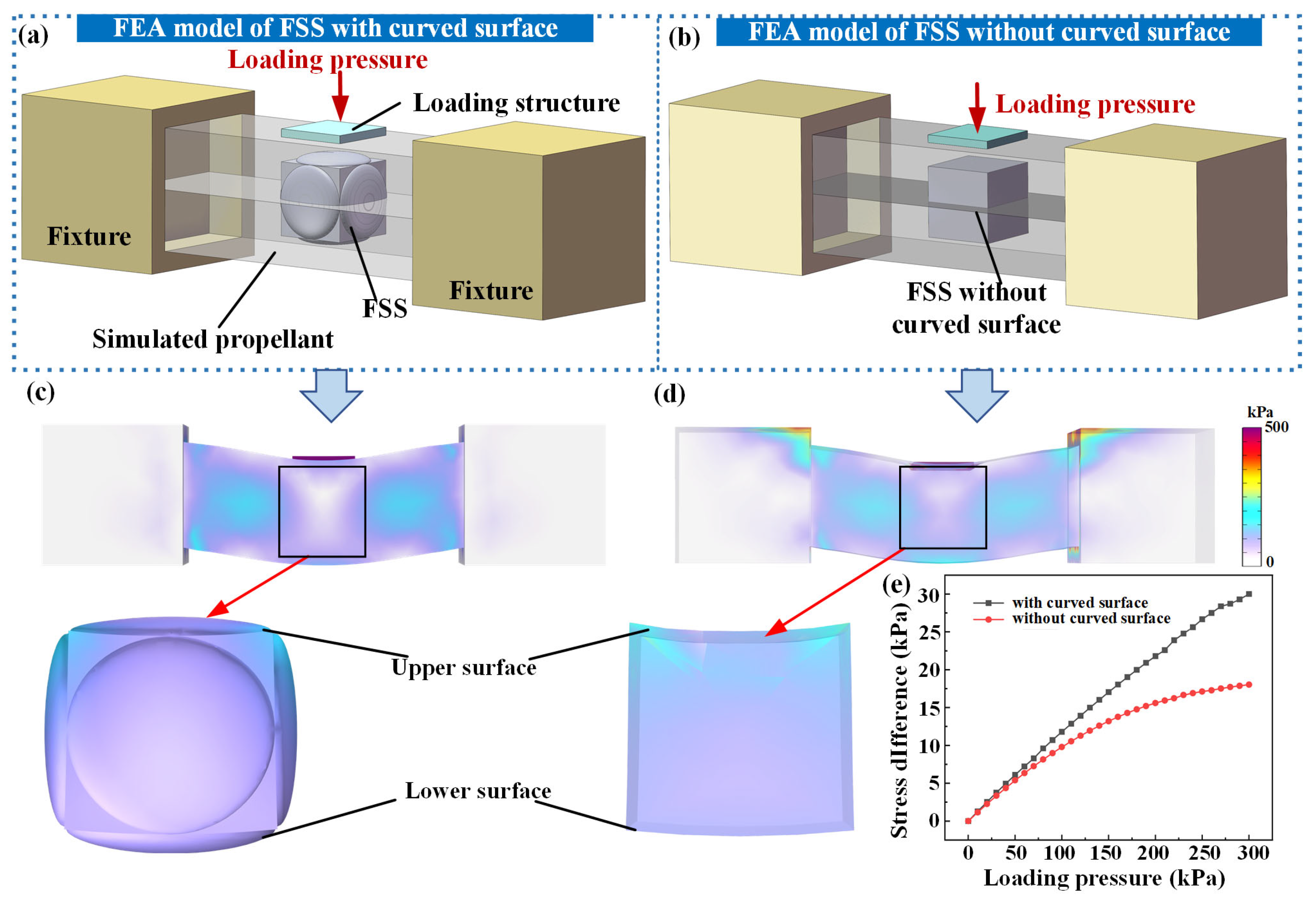
3.2.1. Uniaxial Normal Loading Simulation
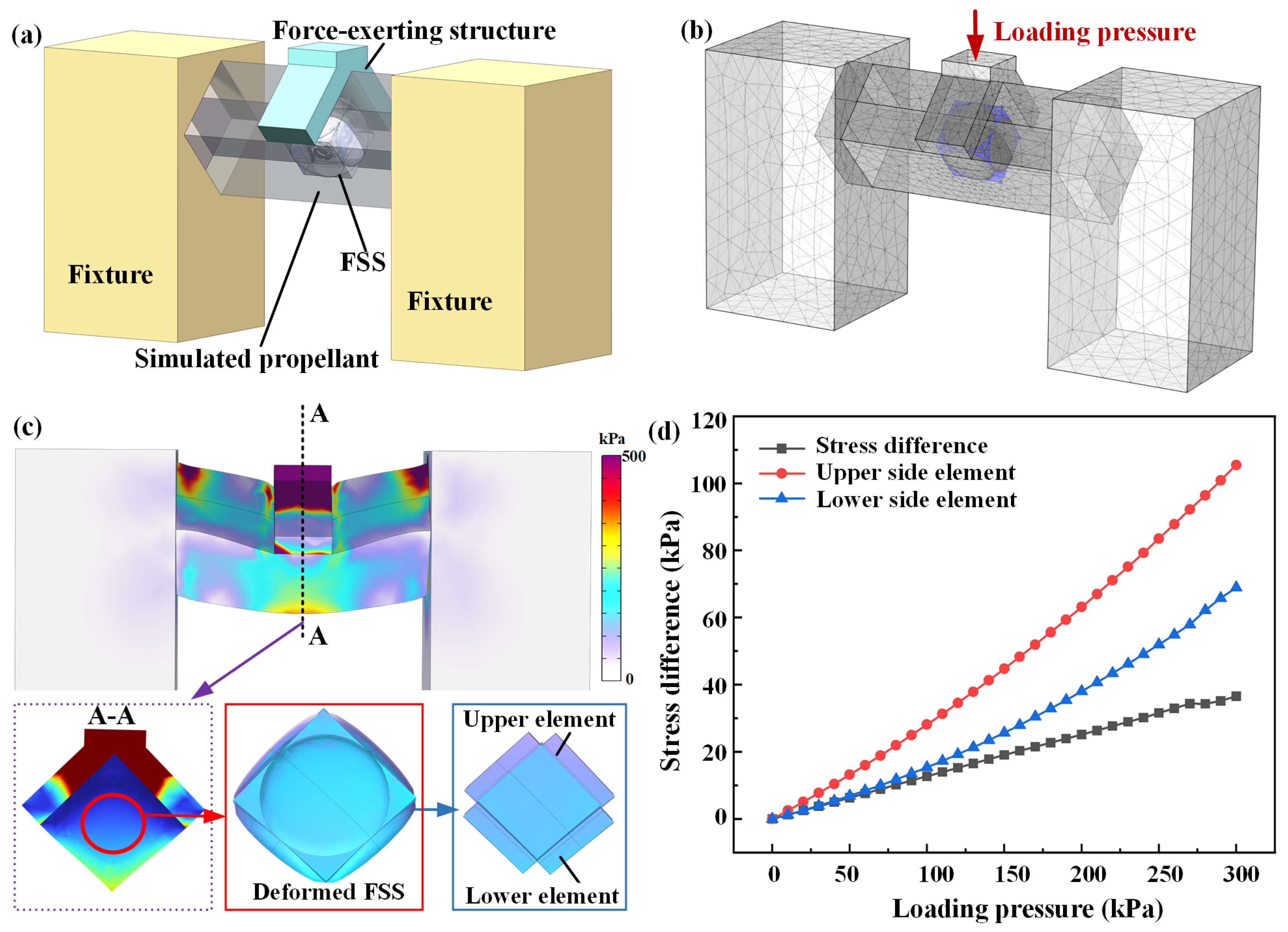
3.2.2. Multiaxial Loading Simulation
4. Fabrication Procedure
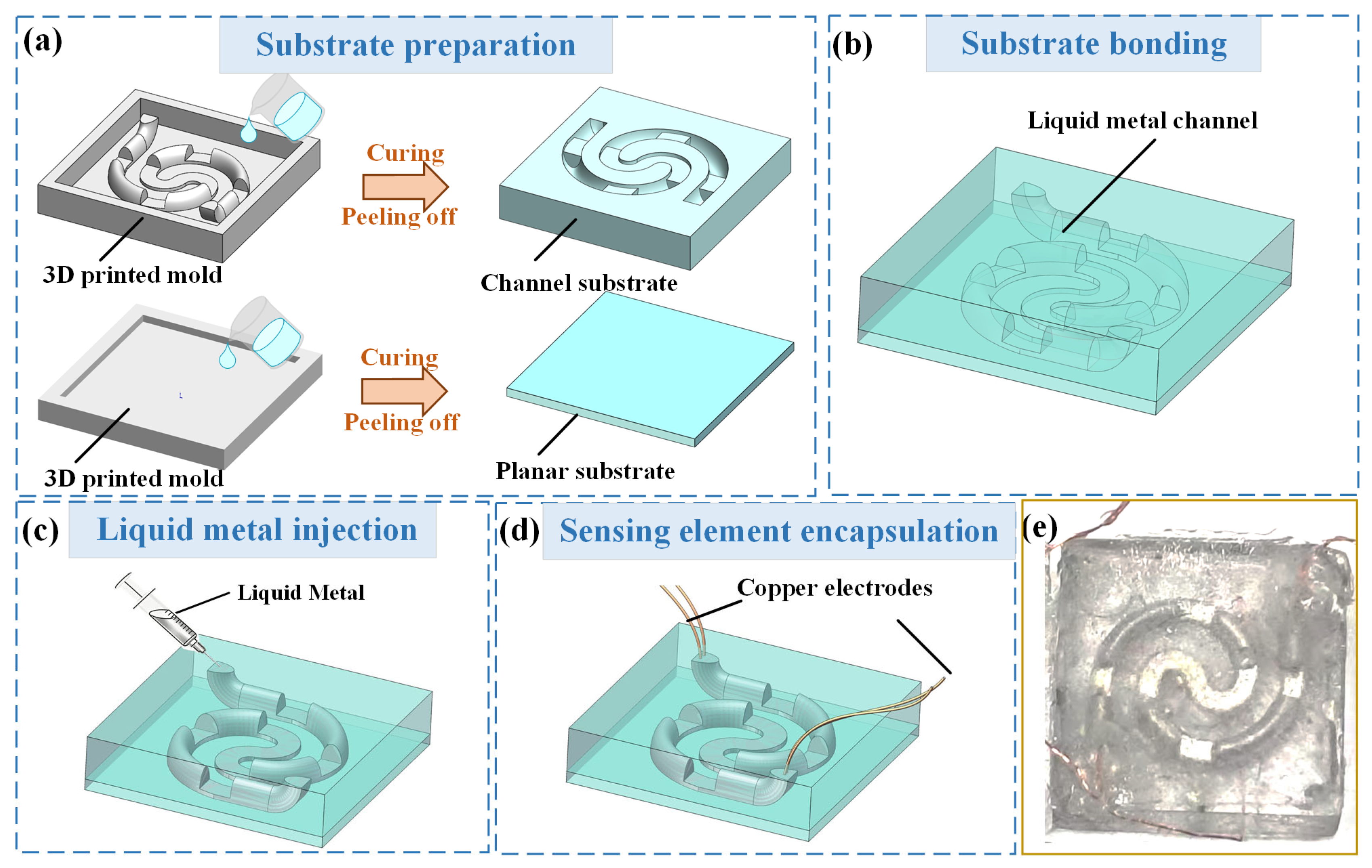
4.1. Preparation of Liquid Metal Pressure Sensing Element
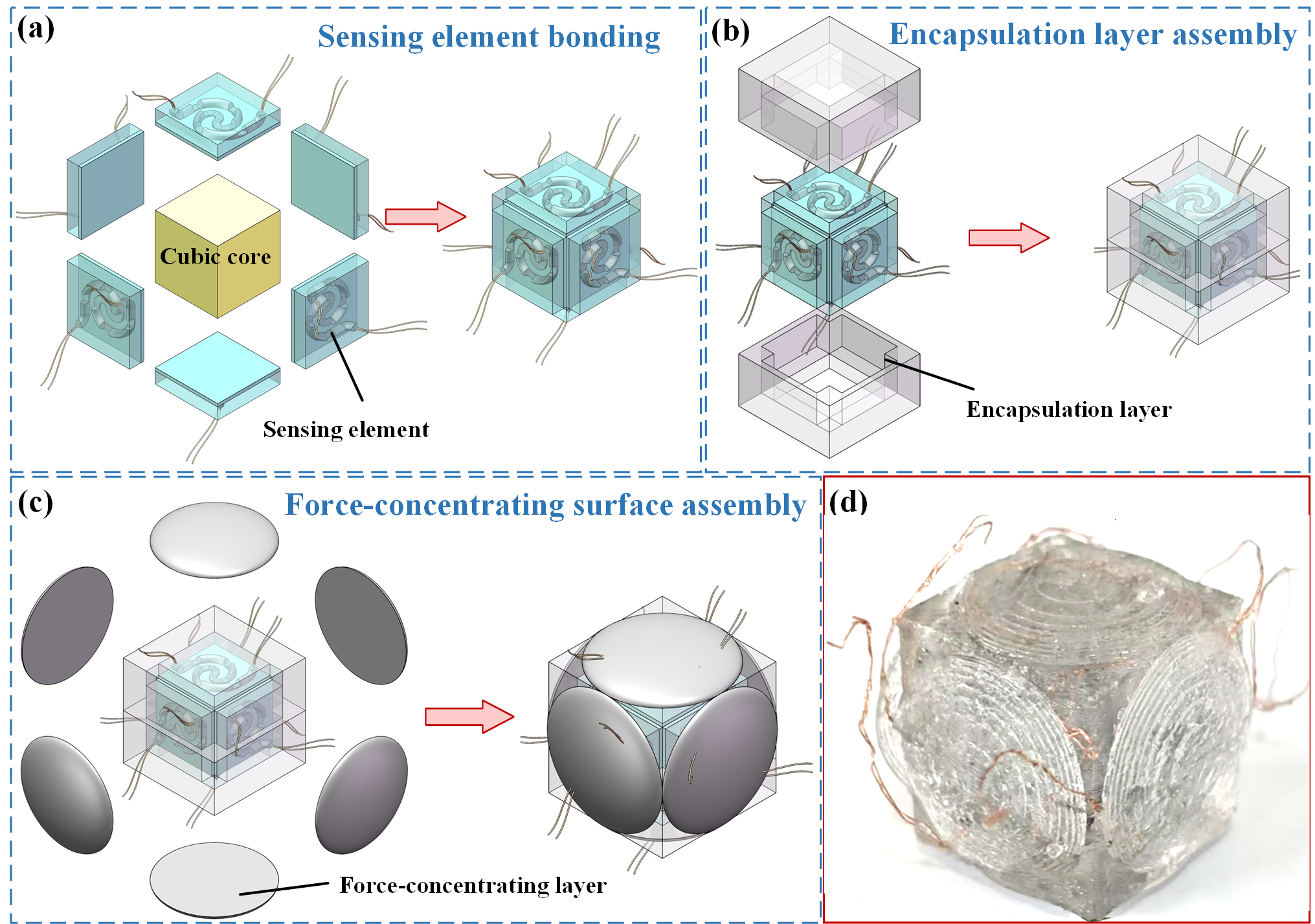
4.2. Integration of FSS
5. Experimental Results
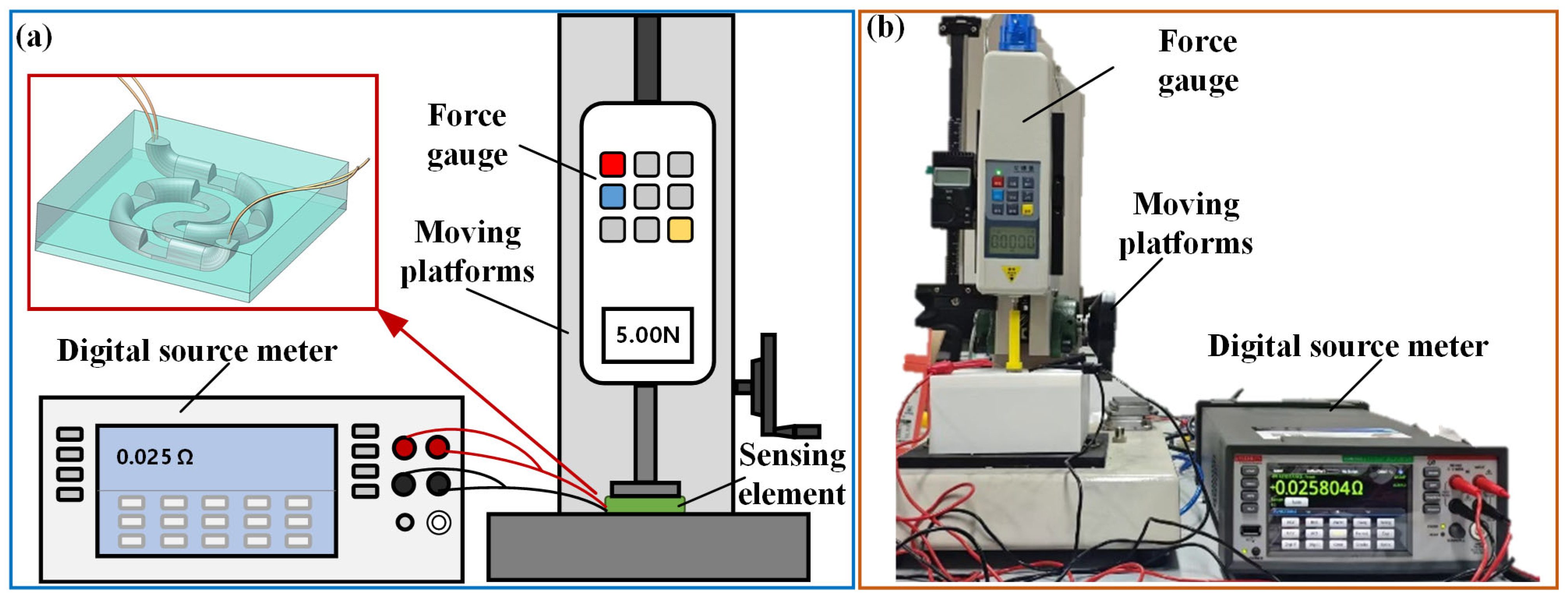
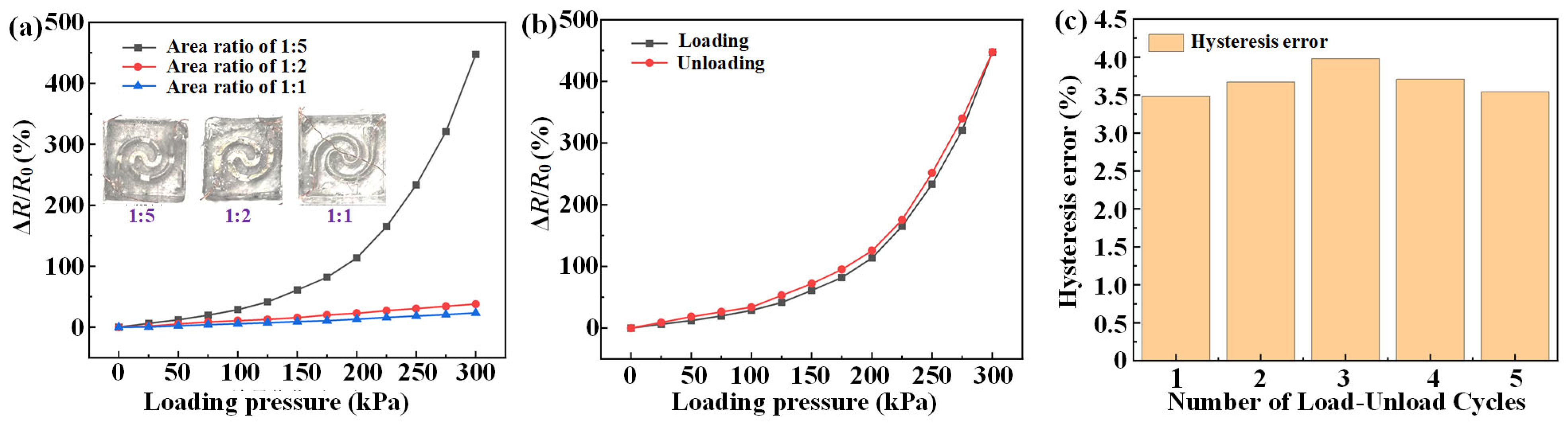
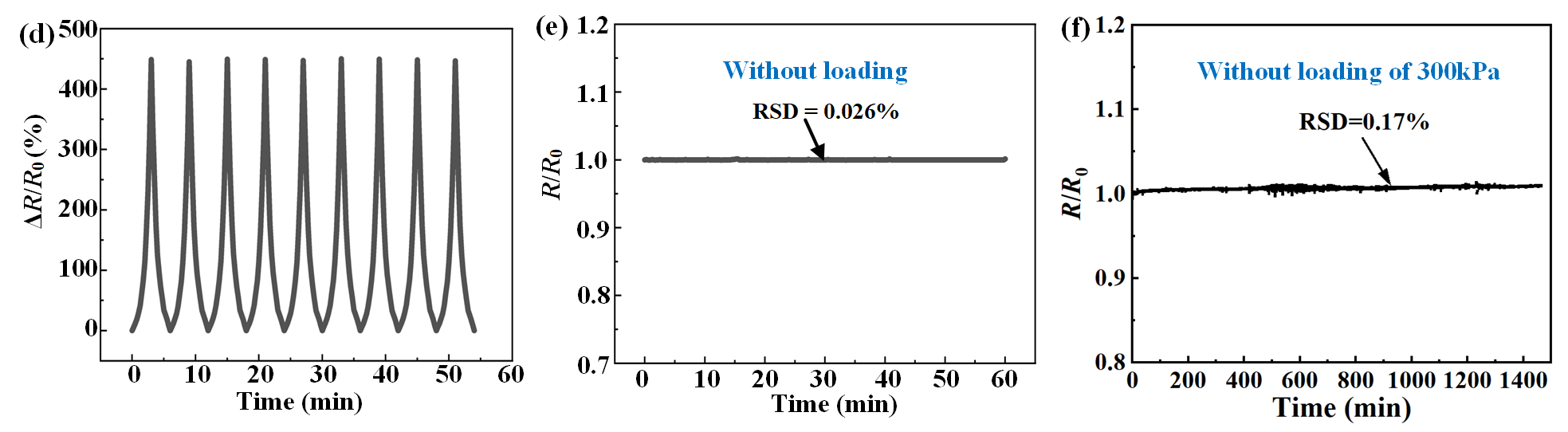
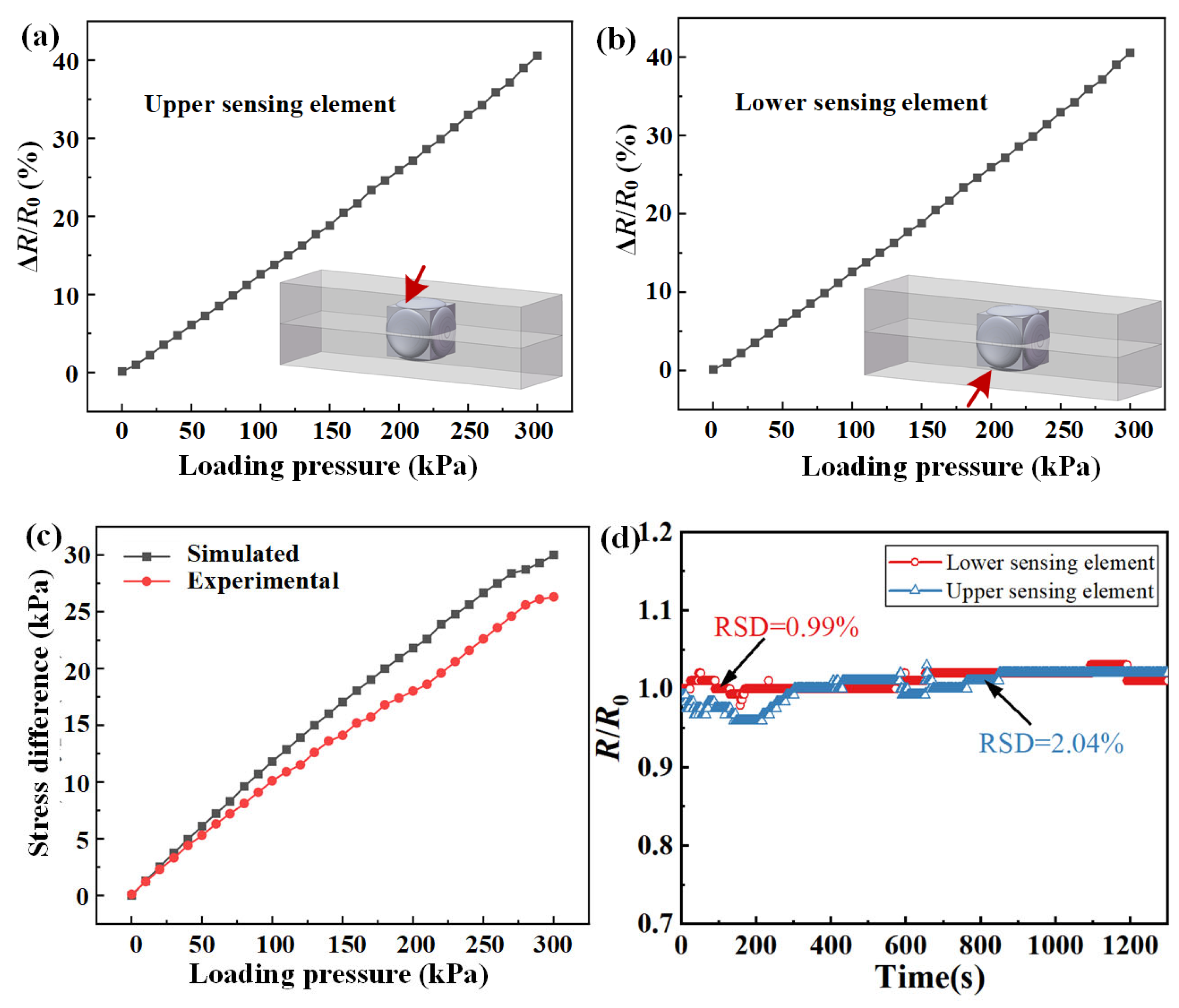
5.1. Performance of Variable Cross-Section Liquid Metal Pressure Sensing Elements
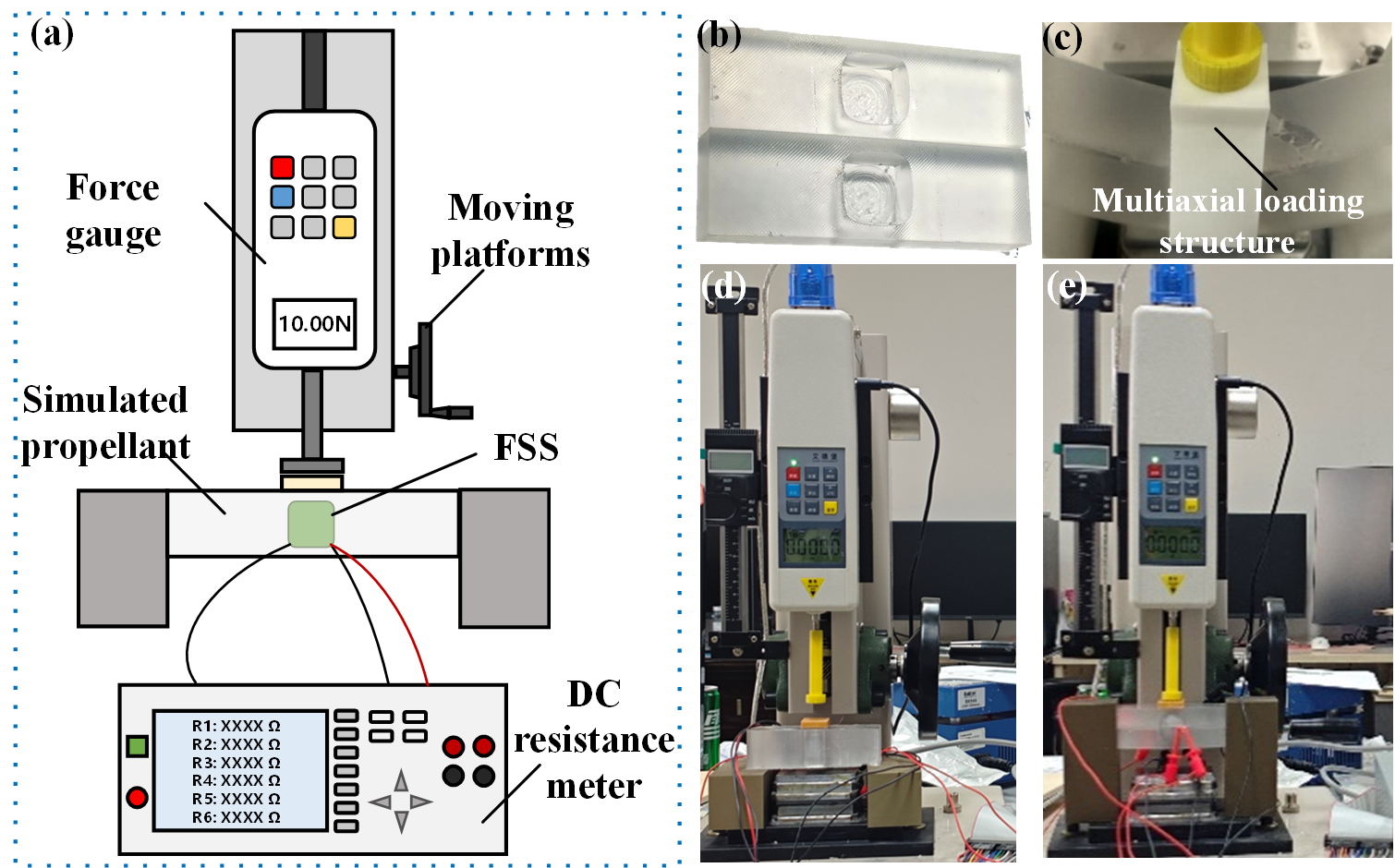
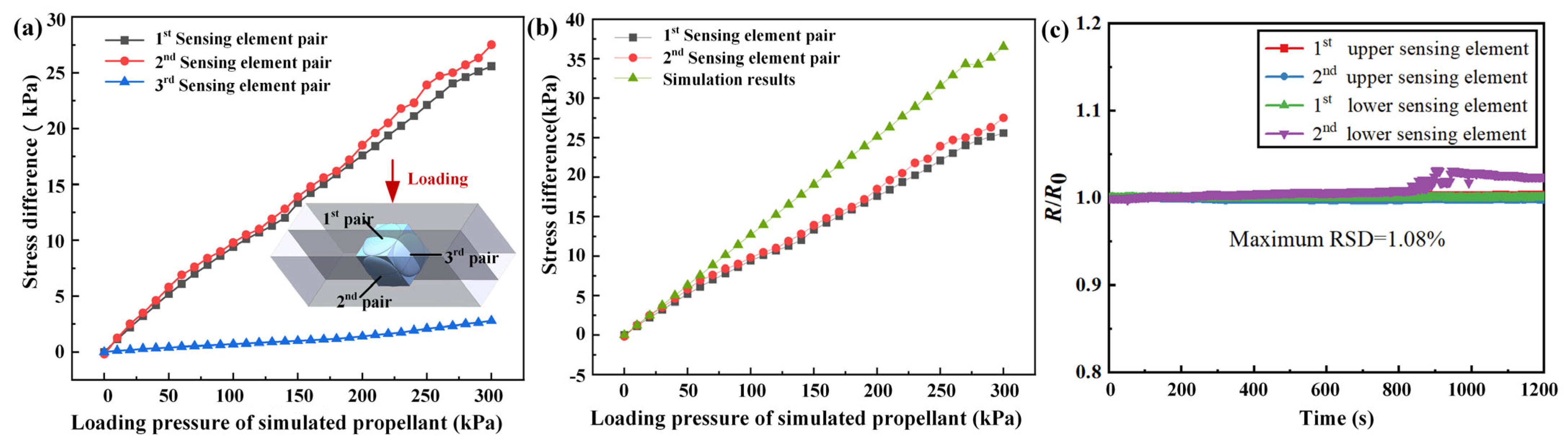
5.2. Simulated Propellant Experimental Validation of FSS
6. Conclusions
Supplementary Materials
Author Contributions
Funding
Data Availability Statement
Conflicts of Interest
References
- Srivastava, L.; Krishnanand, L.; Kishore Nath, N.; Hirwani, C.K.; Babu, M.R.M. Online Structural Integrity Monitoring of High-Performance Composite Rocket Motor Casing. Mater. Today Proc. 2022, 56, 1001–1009. [Google Scholar] [CrossRef] [Scilit]
- Li, Z.; Liu, J.; Ye, Z.; Zhang, W.; Sun, L. Heat and Mass Transfer Mechanism Model of AP/HTPB Propellant Based on Micro-CT in the Ignition Stage of a Solid Rocket Motor. Appl. Therm. Eng. 2025, 279, 127654. [Google Scholar] [CrossRef] [Scilit]
- Deng, K.W.; Li, H.Y.; Shen, Z.B.; Zhang, X.; Weng, J.X. Low Strain Rate Yield Characteristics and Failure Modes of Solid Composite Propellant. Eng. Fail. Anal. 2023, 150, 107364. [Google Scholar] [CrossRef] [Scilit]
- Xu, J.; Shen, Z.; Xu, H.; Lei, Y. In-Situ Monitor for Cure-Induced Deviatoric Stress in Propellant Charges of Solid Rocket Motors. Exp. Mech. 2025, 65, 1307–1320. [Google Scholar] [CrossRef] [Scilit]
- Korompili, G.; Mußbach, G.; Riziotis, C. Structural Health Monitoring of Solid Rocket Motors: From Destructive Testing to Perspectives of Photonic-Based Sensing. Instruments 2024, 8, 16. [Google Scholar] [CrossRef] [Scilit]
- Tunç, B.; Özüpek, Ş.; Podnos, E.; Arkun, U. Thermal Cyclic Stress Analysis of a Solid Rocket Motor. J. Spacecr. Rocket. 2018, 56, 179–189. [Google Scholar] [CrossRef] [Scilit]
- Pan, Y.; Qu, W.-Z.; Zhang, S.-C.; Xiao, L.; Chu, X.-H. A Nonlinear Ultrasonic Method for Detection and Characterization of Dewetting Damage in Solid Propellant. Propellants Explos. Pyrotech. 2022, 47, e202200079. [Google Scholar] [CrossRef] [Scilit]
- Liu, H.Q.; Sun, D.C.; Xian, G. Ultrasonic Measurement and Data Processing Method for the Dynamic Burning Rate of Large-Scale Solid Rocket Motors. Meas. J. Int. Meas. Confed. 2026, 257, 118672. [Google Scholar] [CrossRef] [Scilit]
- Yagodnikov, D.A.; Zaitsev, V.N.; Lokhanov, I.V.; Novikov, A.O.; Larionov, I.A.; Gryaznov, A.Y.; Potrakhov, N.N. X-Ray Radiography Study of the Interior Ballistics of a Model Solid Rocket Motor. Combust. Explos. Shock Waves 2025, 61, 200–205. [Google Scholar] [CrossRef] [Scilit]
- Li, L.; Ren, J.; Wang, P.; Gao, H.; Sun, M.; Sha, B.; Lü, Z.; Li, X. A Pixel-Level Weak Supervision Segmentation Method for Typical Defect Images in X-Ray Inspection of Solid Rocket Motors Combustion Chamber. Meas. J. Int. Meas. Confed. 2023, 211, 112497. [Google Scholar] [CrossRef] [Scilit]
- Liu, Y.; Qian, W.; Wang, L.; Xue, Y.; Hou, C.; Wu, S. In Situ X-Ray Tomography Study on Internal Damage Evolution of Solid Propellant for Carrier Rockets. Mater. Sci. Eng. A 2023, 882, 145451. [Google Scholar] [CrossRef] [Scilit]
- Liu, T.; Zhang, W.; Yan, S. A Novel Image Enhancement Algorithm Based on Stationary Wavelet Transform for Infrared Thermography to the De-Bonding Defect in Solid Rocket Motors. Mech. Syst. Signal Process. 2015, 62, 366–380. [Google Scholar] [CrossRef] [Scilit]
- Liu, B.; Wang, S.; Zhan, M.; Wang, H.; Zhang, G.; Jian, Q. Optical Nondestructive Evaluation for Minor Debonding Defects and Interfacial Adhesive Strength of Solid Propellant. Meas. J. Int. Meas. Confed. 2022, 194, 111066. [Google Scholar] [CrossRef] [Scilit]
- Ye, G.; Sun, H.; Deng, K.; Wu, D.; Zhang, Z. Shear Creep and Failure Model of Bonded Interface in Solid Rocket Motors. Aerosp. Sci. Technol. 2026, 168, 110915. [Google Scholar] [CrossRef] [Scilit]
- Lei, M.; Ren, S.; Chen, E.; Zhang, Z.; Xiao, J.; Wen, L.; Hou, X. Correlation between Solid Propellant Failure and Interface Debonding in Solid Rocket Motors. Polym. Test. 2022, 115, 107755. [Google Scholar] [CrossRef] [Scilit]
- Xue, X.; Ye, Q.; Yu, Y. Thermal Safety of Solid Rocket Motor with Complex Charge Structure. Appl. Therm. Eng. 2023, 222, 119932. [Google Scholar] [CrossRef] [Scilit]
- Duan, L.; Wang, X.; Qiang, H.; Pei, B.; Wang, P. Rate-Dependent Cohesive Zone Modeling and Experimental Validation for Viscoelastic Sensor-Embedded Interfaces. Polym. Test. 2025, 147, 108798. [Google Scholar] [CrossRef] [Scilit]
- Liang, M.; Fang, X.; Song, Y.; Li, S.; Chen, N.; Zhang, F. Research on Three-Dimensional Stress Monitoring Method of Surrounding Rock Based on FBG Sensing Technology. Sensors 2022, 22, 2624. [Google Scholar] [CrossRef] [Scilit] [PubMed]
- Zhang, Y.; Mu, C.; Fan, L.; Wu, D.; Liang, J.; Hu, X.; Wang, Y.; Wang, D.; Hu, S. Solid Rocket Motor Propellant Health Monitoring Based on Oxide-Doped Curved Long-Period Fiber Grating. Opt. Express 2024, 32, 6215. [Google Scholar] [CrossRef] [Scilit]
- Zhang, Y.; Wang, Y.; Fan, L.; Wang, D. Structural Integrity Health Monitoring of Solid Rocket Motor Based on High Performance Ultrashort Femtosecond Grating Arrays. IEEE Sens. J. 2025, 25, 35384–35393. [Google Scholar] [CrossRef] [Scilit]
- Huang, Z.; Wu, G.; Hu, Y.; Lv, F.; Wang, R.; Shang, R.; Wang, Y.; Wang, X.; Zhao, Y.; Zhu, M.; et al. Intrinsically Temperature-Insensitive and Highly Sensitive Flexible Wireless Strain Sensor. ACS Sens. 2025, 10, 6897–6907. [Google Scholar] [CrossRef] [Scilit] [PubMed]
- Hu, W.; Wang, F.; Yang, B.; Xian, G.; Wan, Y. In Situ Monitoring of Solid Propellants under Compressive Load by MWCNT Piezoresistive Sensor. J. Mech. Mater. Struct. 2022, 17, 169–179. [Google Scholar] [CrossRef] [Scilit]
- Yang, J.; Chen, Y.; Liu, S.; Liu, C.; Ma, T.; Luo, Z.; Ge, G. Single-Line Multi-Channel Flexible Stress Sensor Arrays. Micromachines 2023, 14, 1554. [Google Scholar] [CrossRef] [Scilit]
- Sun, X.; Sun, J.; Li, T.; Zheng, S.; Wang, C.; Tan, W.; Zhang, J.; Liu, C.; Ma, T.; Qi, Z.; et al. Flexible Tactile Electronic Skin Sensor with 3D Force Detection Based on Porous CNTs/PDMS Nanocomposites. Nano-Micro Lett. 2019, 11, 57. [Google Scholar] [CrossRef] [Scilit] [PubMed]
- Qiu, J.; Guo, X.; Chu, R.; Wang, S.; Zeng, W.; Qu, L.; Zhao, Y.; Yan, F.; Xing, G. Rapid-Response, Low Detection Limit, and High-Sensitivity Capacitive Flexible Tactile Sensor Based on Three-Dimensional Porous Dielectric Layer for Wearable Electronic Skin. ACS Appl. Mater. Interfaces 2019, 11, 40716–40725. [Google Scholar] [CrossRef] [Scilit]
- Kang, M.; Choi, H.G.; Park, K.; Pyo, S. Additively Manufactured 3D Auxetic Metamaterials for Structurally Guided Capacitive and Resistive Tactile Sensing. Adv. Funct. Mater. 2025, 35, e09704. [Google Scholar] [CrossRef] [Scilit]
- Veeramuthu, L.; Cho, C.J.; Liang, F.C.; Venkatesan, M.; Kumar, G.R.; Hsu, H.Y.; Chung, R.J.; Lee, C.H.; Lee, W.Y.; Kuo, C.C. Human Skin-Inspired Electrospun Patterned Robust Strain-Insensitive Pressure Sensors and Wearable Flexible Light-Emitting Diodes. ACS Appl. Mater. Interfaces 2022, 14, 30160–30173. [Google Scholar] [CrossRef] [Scilit] [PubMed]
- Wang, X.; Li, H.; Wang, T.; Niu, X.; Wang, Y.; Xu, S.; Jiang, Y.; Chen, L.; Liu, H. Flexible and High-Performance Piezoresistive Strain Sensors Based on Multi-Walled Carbon Nanotubes@polyurethane Foam. RSC Adv. 2022, 12, 14190–14196. [Google Scholar] [CrossRef] [Scilit]
- Fraden, J. Handbook of Modern Sensors, 5th ed.; Springer International Publishing: Cham, Swizerland, 2016; ISBN 978-3-319-19302-1. [Google Scholar]
- Luo, Y.; Shao, J.; Chen, S.; Chen, X.; Tian, H.; Li, X.; Wang, L.; Wang, D.; Lu, B. Flexible Capacitive Pressure Sensor Enhanced by Tilted Micropillar Arrays. ACS Appl. Mater. Interfaces 2019, 11, 17796–17803. [Google Scholar] [CrossRef] [Scilit]
- Xu, Z.; Wu, D.; Chen, Z.; Wang, Z.; Cao, C.; Shao, X.; Zhou, G.; Zhang, S.; Wang, L.; Sun, D. A Flexible Pressure Sensor with Highly Customizable Sensitivity and Linearity via Positive Design of Microhierarchical Structures with a Hyperelastic Model. Microsyst. Nanoeng. 2023, 9, 5. [Google Scholar] [CrossRef] [Scilit]
- Luo, N.; Zhang, J.; Ding, X.; Zhou, Z.; Zhang, Q.; Zhang, Y.T.; Chen, S.C.; Hu, J.L.; Zhao, N. Textile-Enabled Highly Reproducible Flexible Pressure Sensors for Cardiovascular Monitoring. Adv. Mater. Technol. 2018, 3, 1700222. [Google Scholar] [CrossRef] [Scilit]
- Fatema, A.; Chauhan, S.; Gupta, M.D.; Hussain, A.M. Investigation of the Long-Term Reliability of a Velostat-Based Flexible Pressure Sensor Array for 210 Days. IEEE Trans. Device Mater. Reliab. 2024, 24, 41–48. [Google Scholar] [CrossRef] [Scilit]



| Sensing Mechanism | Sensitivity | Stability Deviation | |
|---|---|---|---|
| Ref. [30] | capacitive | 0.42 kPa−1 | 1.57% |
| Ref. [31] | piezoresistive | 0.705 kPa−1 | 0.7% |
| Ref. [32] | piezoresistive | 0.061 mA kPa−1 | 5% |
| Ref. [33] | piezoresistive | - | 5.2% |
| This work | piezoresistive | 1.5% kPa−1 | 0.17% |
Disclaimer/Publisher’s Note: The statements, opinions and data contained in all publications are solely those of the individual author(s) and contributor(s) and not of MDPI and/or the editor(s). MDPI and/or the editor(s) disclaim responsibility for any injury to people or property resulting from any ideas, methods, instructions or products referred to in the content. |
© 2025 by the authors. Licensee MDPI, Basel, Switzerland. This article is an open access article distributed under the terms and conditions of the Creative Commons Attribution (CC BY) license.
Share and Cite
Shi, Y.; Lü, X.; Ren, K.; Zhu, W. Flexible Three-Dimensional Stress Sensor for Embedded Monitoring of Solid Rocket Propellant. Micromachines 2026, 17, 57. https://doi.org/10.3390/mi17010057
Shi Y, Lü X, Ren K, Zhu W. Flexible Three-Dimensional Stress Sensor for Embedded Monitoring of Solid Rocket Propellant. Micromachines. 2026; 17(1):57. https://doi.org/10.3390/mi17010057
Chicago/Turabian StyleShi, Yaoguang, Xiaozhou Lü, Kai Ren, and Wensong Zhu. 2026. "Flexible Three-Dimensional Stress Sensor for Embedded Monitoring of Solid Rocket Propellant" Micromachines 17, no. 1: 57. https://doi.org/10.3390/mi17010057
APA StyleShi, Y., Lü, X., Ren, K., & Zhu, W. (2026). Flexible Three-Dimensional Stress Sensor for Embedded Monitoring of Solid Rocket Propellant. Micromachines, 17(1), 57. https://doi.org/10.3390/mi17010057