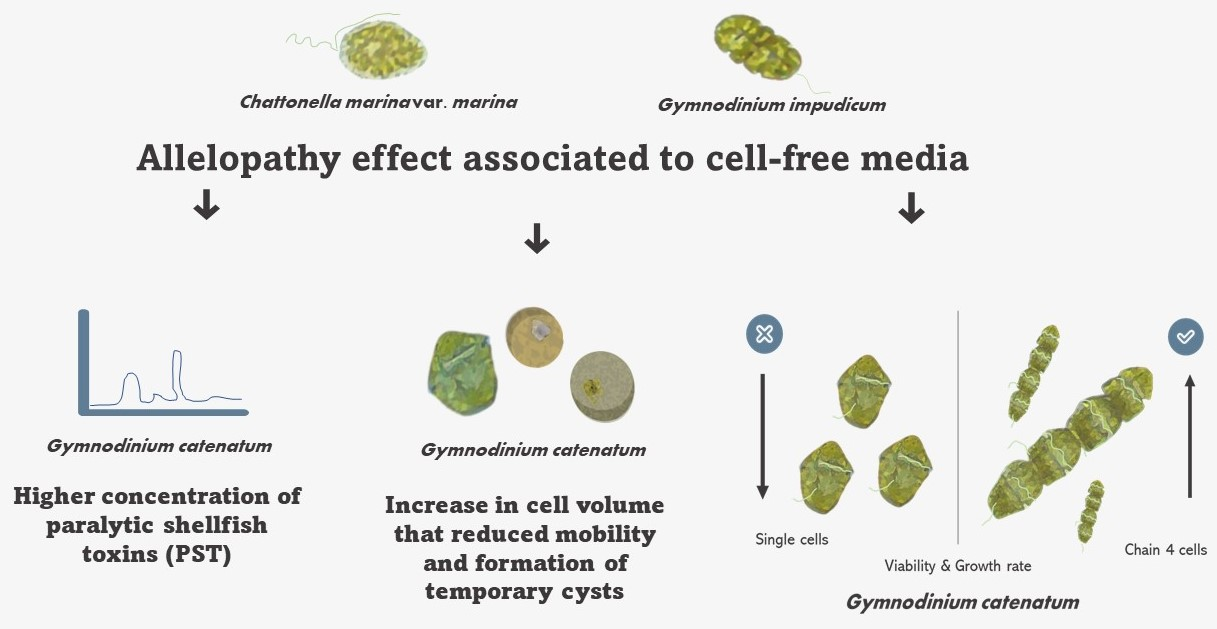
Changes in Toxin Production, Morphology and Viability of Gymnodinium catenatum Associated with Allelopathy of Chattonella marina var. marina and Gymnodinium impudicum


 , , ,
, , ,  and
and Abstract
Share and Cite
Fernández-Herrera, L.J.; Band-Schmidt, C.J.; Zenteno-Savín, T.; Leyva-Valencia, I.; Hernández-Guerrero, C.J.; Hernández-Sandoval, F.E.; Bustillos-Guzmán, J.J. Changes in Toxin Production, Morphology and Viability of Gymnodinium catenatum Associated with Allelopathy of Chattonella marina var. marina and Gymnodinium impudicum. Toxins 2022, 14, 616. https://doi.org/10.3390/toxins14090616
Fernández-Herrera LJ, Band-Schmidt CJ, Zenteno-Savín T, Leyva-Valencia I, Hernández-Guerrero CJ, Hernández-Sandoval FE, Bustillos-Guzmán JJ. Changes in Toxin Production, Morphology and Viability of Gymnodinium catenatum Associated with Allelopathy of Chattonella marina var. marina and Gymnodinium impudicum. Toxins. 2022; 14(9):616. https://doi.org/10.3390/toxins14090616
Chicago/Turabian StyleFernández-Herrera, Leyberth José, Christine Johanna Band-Schmidt, Tania Zenteno-Savín, Ignacio Leyva-Valencia, Claudia Judith Hernández-Guerrero, Francisco Eduardo Hernández-Sandoval, and José Jesús Bustillos-Guzmán. 2022. "Changes in Toxin Production, Morphology and Viability of Gymnodinium catenatum Associated with Allelopathy of Chattonella marina var. marina and Gymnodinium impudicum" Toxins 14, no. 9: 616. https://doi.org/10.3390/toxins14090616
APA StyleFernández-Herrera, L. J., Band-Schmidt, C. J., Zenteno-Savín, T., Leyva-Valencia, I., Hernández-Guerrero, C. J., Hernández-Sandoval, F. E., & Bustillos-Guzmán, J. J. (2022). Changes in Toxin Production, Morphology and Viability of Gymnodinium catenatum Associated with Allelopathy of Chattonella marina var. marina and Gymnodinium impudicum. Toxins, 14(9), 616. https://doi.org/10.3390/toxins14090616