Article

Cytotoxicity of Mycotoxins Frequently Present in Aquafeeds to the Fish Cell Line RTGill-W1

by
Elena Bernal-Algaba
,
Marta Pulgarín-Alfaro
†,‡ and
María Luisa Fernández-Cruz
*
Department of Environment and Agronomy, National Institute of Agriculture and Food Research and Technology (INIA), Spanish National Research Council (CSIC), 28040 Madrid, Spain
*
Author to whom correspondence should be addressed.
These authors contributed equally and both should be considered as first authors.
New affiliation of M.P.-A. since September 2019, Centro Nacional de Investigaciones Cardiovasculares Carlos III, Instituto de Salud Carlos III, 28029 Madrid, Spain.
Toxins 2021, 13(8), 581; https://doi.org/10.3390/toxins13080581

Submission received: 15 July 2021 / Revised: 10 August 2021 / Accepted: 17 August 2021 / Published: 20 August 2021

Abstract

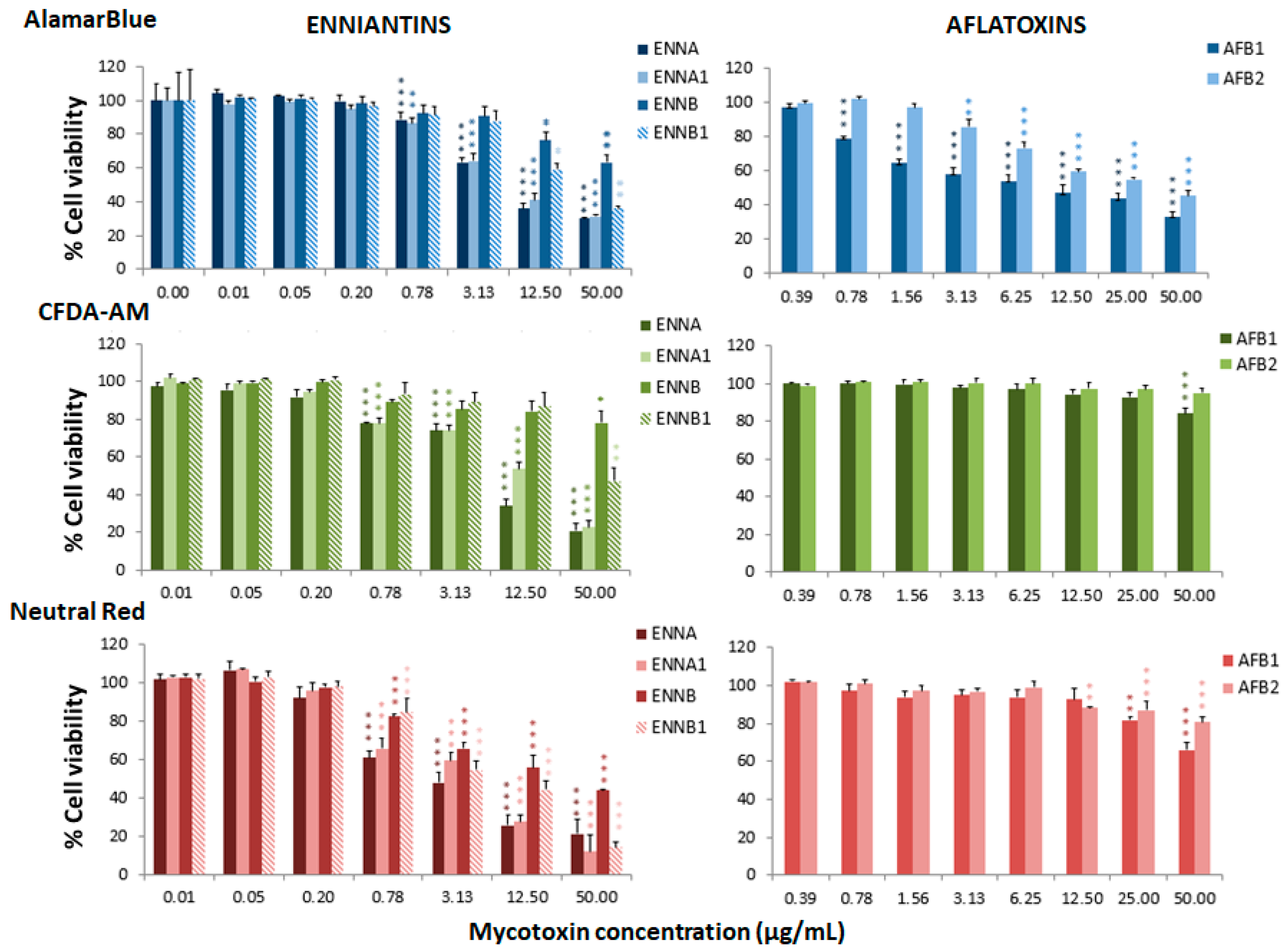
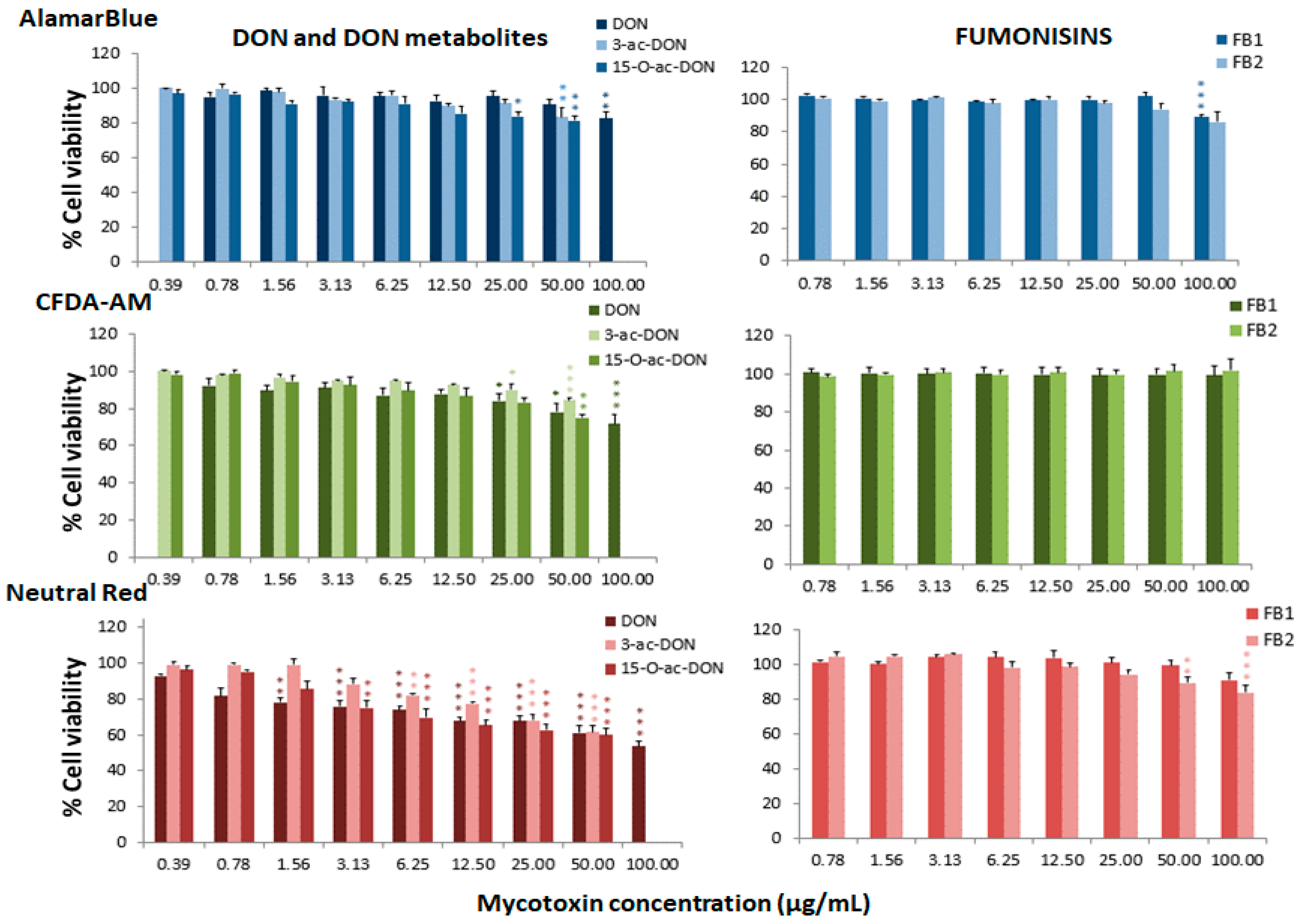
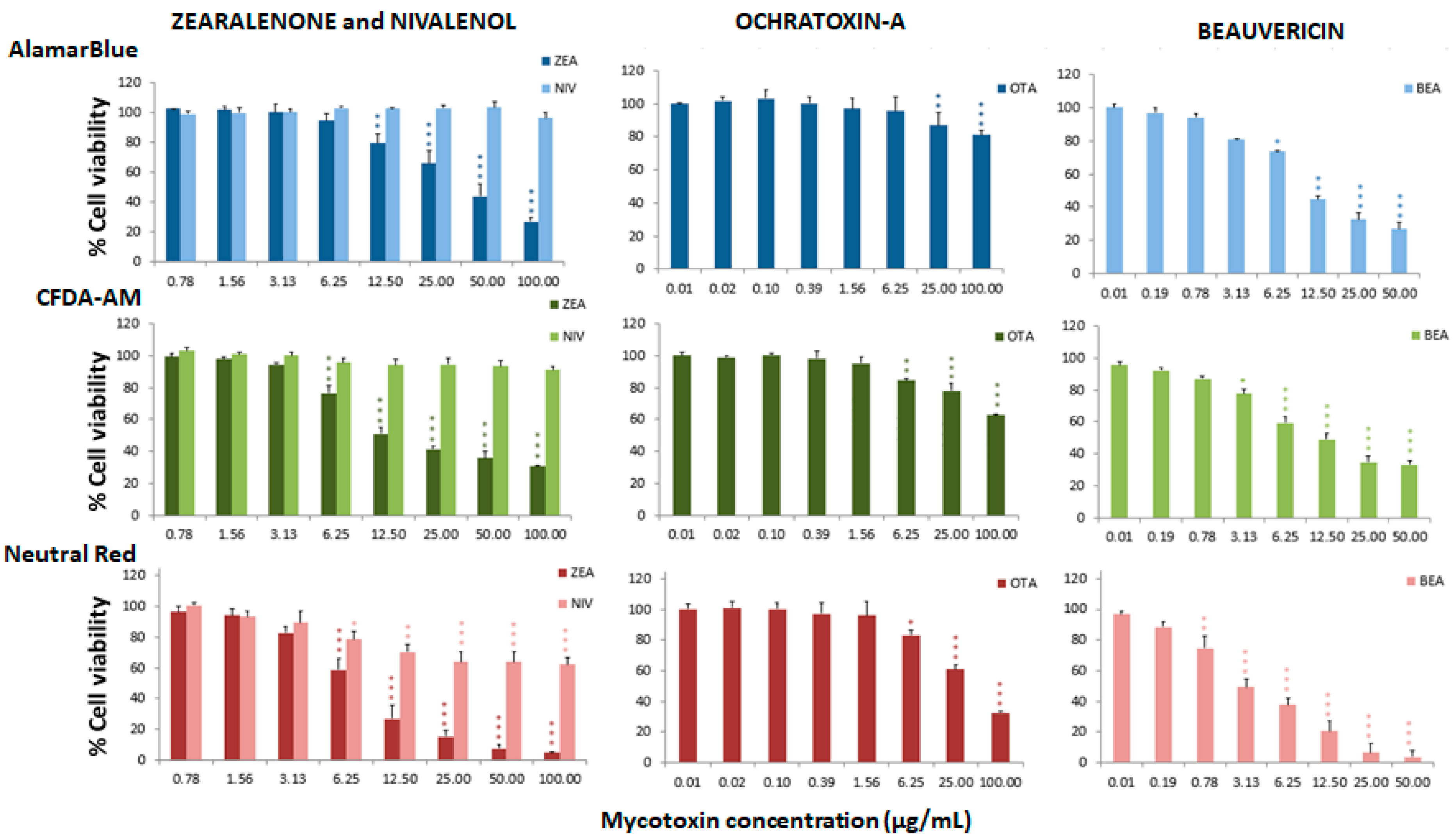
In the last decades, the aquaculture industry has introduced plant-based ingredients as a source of protein in aquafeeds. This has led to mycotoxin contaminations, representing an ecological, health and economic problem. The aim of this study was to determine in the RTgill-W1 fish cell line the toxicity of fifteen mycotoxins of common occurrence in aquafeeds. To identify the most sensitive endpoint of toxicity, the triple assay was used. It consisted of three assays: alamarBlue, Neutral Red Uptake and CFDA-AM, which revealed the mitochondrial activity, the lysosomal integrity and the plasma membrane integrity, respectively. Most of the assayed mycotoxins were toxic predominantly at lysosomal level (enniatins, beauvericin, zearalenone, ochratoxin A, deoxynivalenol (DON) and its acetylated metabolites 15-O-acetyl-DON and 3-acetyl-DON). Aflatoxins B1 and B2 exerted the greatest effects at mitochondrial level, while fumonisins B1 and B2 and nivalenol were not toxic up to 100 µg/mL. In general, low toxicity was observed at plasma membrane level. The vast majority of the mycotoxins assayed exerted a pronounced acute effect in the fish RTgill-W1 cell line, emphasizing the need for further studies to ascertain the impact of mycotoxin contamination of fish feeds in the aquaculture industry and to establish safe limits in aquafeeds.
Keywords: mycotoxins; cytotoxicity; cell viability; RTgill-W1; fish mycotoxins; cytotoxicity; cell viability; RTgill-W1; fish