Fermented Dairy Food Intake and Risk of Depression and Dementia in Later Life: Findings from a Prospective Cohort of Older Australians
 , , and
Abstract
1. Introduction
2. Methods
3. Ethics Approval
4. Habitual Dietary Intake
5. Exposure of Interest
6. Outcomes
6.1. Depressive Symptoms and Psychological Distress
6.2. Incidence of Depression
6.3. Cognitive Decline Outcomes
6.4. Incidence of Dementia
7. Other Covariates
8. Statistical Analysis
8.1. Cross-Sectional Analysis
8.2. Longitudinal Analysis
8.3. Analysis of Non-Fermented Dairy Foods
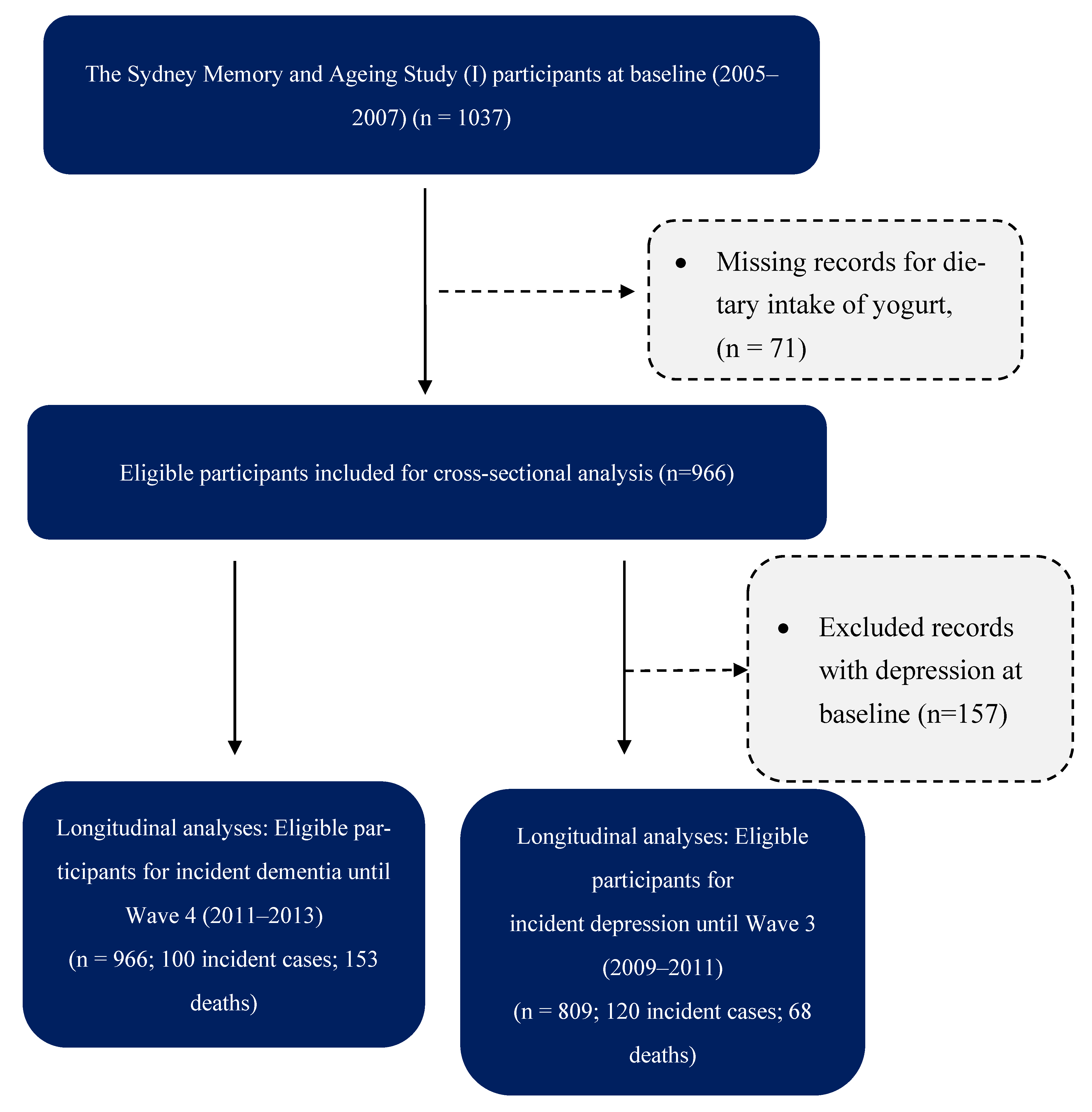
9. Results
9.1. Cross-Sectional Analysis
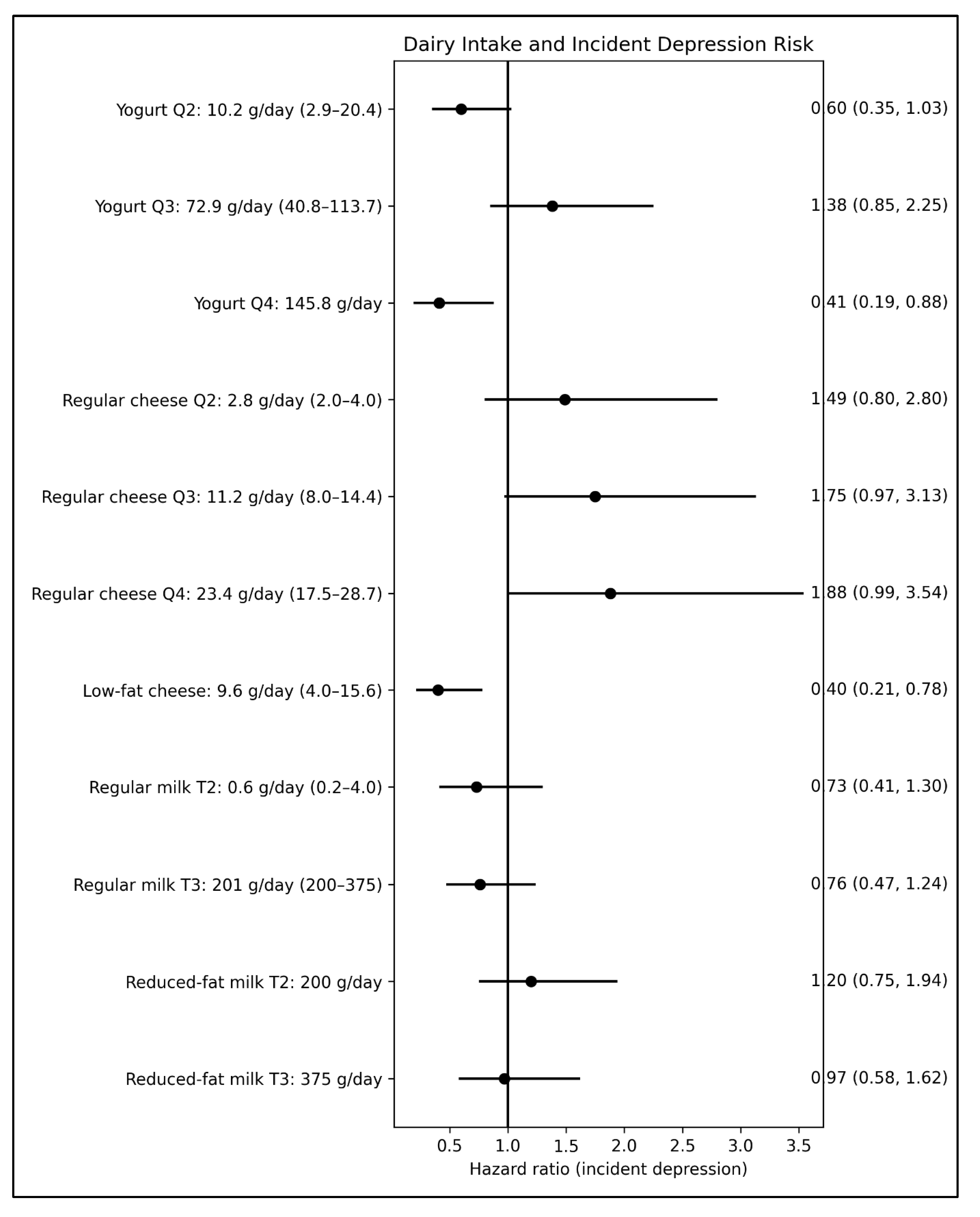
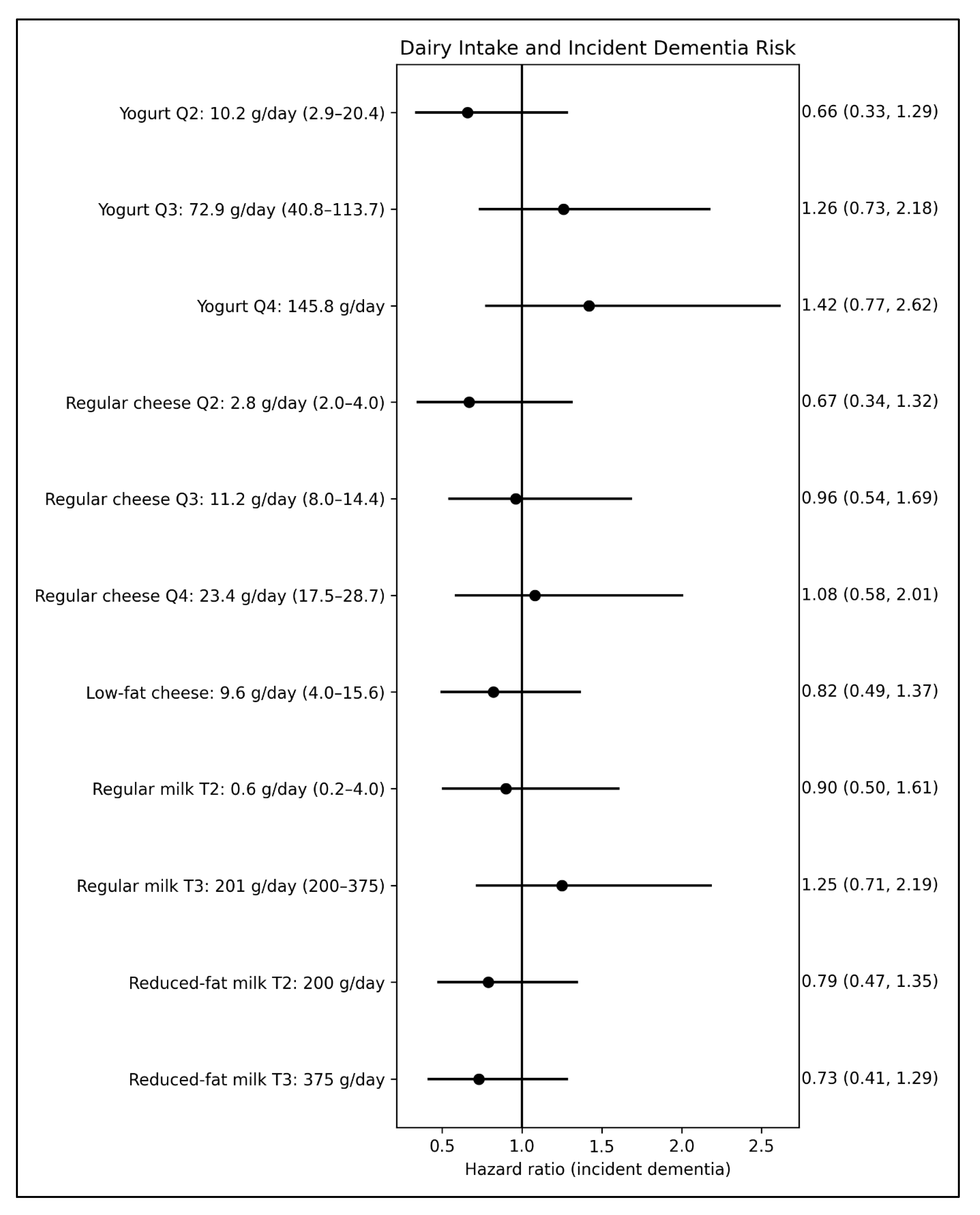
9.2. Longitudinal Analysis
10. Discussion
11. Conclusions
Supplementary Materials
Author Contributions
Funding
Institutional Review Board Statement
Informed Consent Statement
Data Availability Statement
Conflicts of Interest
References
- World Health Organization. Depressive Disorder (Depression). 2023. Available online: https://www.who.int/news-room/fact-sheets/detail/depression (accessed on 4 April 2025).
- World Health Organization. Dementia. 2023. Available online: https://www.who.int/news-room/fact-sheets/detail/dementia (accessed on 4 April 2025).
- Dias, A.; Azariah, F.; Anderson, S.J.; Sequeira, M.; Cohen, A.; Morse, J.Q.; Cuijpers, P.; Patel, V.; Reynolds, C.F., 3rd. Effect of a Lay Counselor Intervention on Prevention of Major Depression in Older Adults Living in Low- and Middle-Income Countries: A Randomized Clinical Trial. JAMA Psychiatry 2019, 76, 13–20. [Google Scholar] [CrossRef]
- Nichols, E.; Steinmetz, J.D.; Vollset, S.E.; Fukutaki, K.; Chalek, J.; Abd-Allah, F.; Abdoli, A.; Abualhasan, A.; Abu-Gharbieh, E.; Akram, T.T.; et al. Estimation of the global prevalence of dementia in 2019 and forecasted prevalence in 2050: An analysis for the Global Burden of Disease Study 2019. Lancet Public Health 2022, 7, e105–e125. [Google Scholar] [CrossRef]
- Australian Institute of Health and Welfare. Prevalence and Impact of Mental Illness. 2024. Available online: https://www.aihw.gov.au/mental-health/overview/prevalence-and-impact-of-mental-illness (accessed on 4 April 2025).
- Australian Institute of Health and Welfare. Dementia in Australia: 2021 Summary Report. 2021. Available online: https://www.aihw.gov.au/reports/dementia/dementia-in-australia-2021-summary/overview (accessed on 4 April 2025).
- Australian Institute of Health and Welfare. Dementia in Australia. 2022. Available online: https://www.aihw.gov.au/reports/dementia/dementia-in-aus/contents/summary (accessed on 4 April 2025).
- Australian Institute of Health and Welfare. Expenditure on Mental Health-Related Services. 2025. Available online: https://www.aihw.gov.au/mental-health/topic-areas/facilities-resources/expenditure (accessed on 4 April 2025).
- Xu, Y.; Zeng, L.; Zou, K.; Shan, S.; Wang, X.; Xiong, J.; Zhao, L.; Zhang, L.; Cheng, G. Role of dietary factors in the prevention and treatment for depression: An umbrella review of meta-analyses of prospective studies. Transl. Psychiatry 2021, 11, 478. [Google Scholar] [CrossRef] [PubMed]
- Arora, S.; Santiago, J.A.; Bernstein, M.; Potashkin, J.A. Diet and lifestyle impact the development and progression of Alzheimer’s dementia. Front. Nutr. 2023, 10, 1213223. [Google Scholar] [CrossRef]
- Ahmed, H.; Leyrolle, Q.; Koistinen, V.; Kärkkäinen, O.; Layé, S.; Delzenne, N.; Hanhineva, K. Microbiota-derived metabolites as drivers of gut-brain communication. Gut Microbes 2022, 14, 2102878. [Google Scholar] [CrossRef] [PubMed]
- Araujo, H.C.; de Jesus, M.S.; Sandes, R.D.; Leite Neta, M.T.; Narain, N. Functional Cheeses: Updates on Probiotic Preservation Methods. Fermentation 2024, 10, 8. [Google Scholar] [CrossRef]
- Castro, J.M.; Tornadijo, M.E.; Fresno, J.M.; Sandoval, H. Biocheese: A food probiotic carrier. Biomed. Res. Int. 2015, 2015, 723056. [Google Scholar] [CrossRef]
- Papageorgiou, M.; Lyrakou, M.; Kyriacou, A.; Biver, E.; Yannakoulia, M. Fermented Dairy Products, Musculoskeletal and Mental Health in Older Adults: Is There Evidence to Support Benefits that go Beyond Those of Non-Fermented Dairy Products? Calcif. Tissue Int. 2024, 115, 480–497. [Google Scholar] [CrossRef]
- Villoz, F.; Filippini, T.; Ortega, N.; Kopp-Heim, D.; Voortman, T.; Blum, M.R.; Del Giovane, C.; Vinceti, M.; Rodondi, N.; Chocano-Bedoya, P.O. Dairy Intake and Risk of Cognitive Decline and Dementia: A Systematic Review and Dose-Response Meta-Analysis of Prospective Studies. Adv. Nutr. 2024, 15, 100160. [Google Scholar] [CrossRef]
- Yu, B.; Zhu, Q.; Meng, G.; Gu, Y.; Zhang, Q.; Liu, L.; Wu, H.; Xia, Y.; Bao, X.; Shi, H.; et al. Habitual yoghurt consumption and depressive symptoms in a general population study of 19,596 adults. Eur. J. Nutr. 2018, 57, 2621–2628. [Google Scholar] [CrossRef]
- Luo, Y.; Li, Z.; Gu, L.; Zhang, K. Fermented dairy foods consumption and depressive symptoms: A meta-analysis of cohort studies. PLoS ONE 2023, 18, e0281346. [Google Scholar] [CrossRef]
- Berry, S.D.; Ngo, L.; Samelson, E.J.; Kiel, D.P. Competing risk of death: An important consideration in studies of older adults. J. Am. Geriatr. Soc. 2010, 58, 783–787. [Google Scholar] [CrossRef]
- Sachdev, P.S.; Brodaty, H.; Reppermund, S.; Kochan, N.A.; Trollor, J.N.; Draper, B.; Slavin, M.J.; Crawford, J.; Kang, K.; Broe, G.A.; et al. The Sydney Memory and Ageing Study (MAS): Methodology and baseline medical and neuropsychiatric characteristics of an elderly epidemiological non-demented cohort of Australians aged 70–90 years. Int. Psychogeriatr. 2010, 22, 1248–1264. [Google Scholar] [CrossRef] [PubMed]
- Cancer Council Victoria. Cancer Council Victoria Dietary Questionnaire for Epidemiological Studies Version 2 (DQES v2) User Guide; Cancer Council Victoria: Melbourne, Australia, 2018. [Google Scholar]
- Sheikh, J.I.; Yesavage, J.A. Geriatric Depression Scale (GDS): Recent evidence and development of a shorter version. Clin. Gerontol. 1986, 5, 165–173. [Google Scholar]
- Kessler, R.C.; Andrews, G.; Colpe, L.J.; Hiripi, E.; Mroczek, D.K.; Normand, S.L.; Walters, E.E.; Zaslavsky, A.M. Short screening scales to monitor population prevalences and trends in non-specific psychological distress. Psychol. Med. 2002, 32, 959–976. [Google Scholar] [CrossRef] [PubMed]
- American Psychiatric Association. Diagnostic and Statistical Manual of Mental Disorders: DSM-IV, 4th ed.; American Psychiatric Publishing, Inc.: Arlington, VA, USA, 1994. [Google Scholar]
- National Health and Medical Research Council. Eat for Health: Australian Dietary Guidelines; The Australian Government: Canberra, Australia, 2013.
- Song, F.; Poljak, A.; Crawford, J.; Kochan, N.A.; Wen, W.; Cameron, B.; Lux, O.; Brodaty, H.; Mather, K.; Smythe, G.A.; et al. Plasma apolipoprotein levels are associated with cognitive status and decline in a community cohort of older individuals. PLoS ONE 2012, 7, e34078. [Google Scholar] [CrossRef] [PubMed]
- Hockey, M.; Hoare, E.; Mohebbi, M.; Tolmunen, T.; Hantunen, S.; Tuomainen, T.P.; Macpherson, H.; Staudacher, H.; Jacka, F.N.; Virtanen, J.K.; et al. Nonfermented Dairy Intake, but Not Fermented Dairy Intake, Associated with a Higher Risk of Depression in Middle-Age and Older Finnish Men. J. Nutr. 2022, 152, 1916–1926. [Google Scholar] [CrossRef]
- Sun, J.; Wang, W.; Zhang, D. Associations of different types of dairy intakes with depressive symptoms in adults. J. Affect. Disord. 2020, 274, 326–333. [Google Scholar] [CrossRef]
- Balasubramanian, R.; Schneider, E.; Gunnigle, E.; Cotter, P.D.; Cryan, J.F. Fermented foods: Harnessing their potential to modulate the microbiota-gut-brain axis for mental health. Neurosci. Biobehav. Rev. 2024, 158, 105562. [Google Scholar] [CrossRef]
- Cristofori, F.; Dargenio, V.N.; Dargenio, C.; Miniello, V.L.; Barone, M.; Francavilla, R. Anti-Inflammatory and Immunomodulatory Effects of Probiotics in Gut Inflammation: A Door to the Body. Front. Immunol. 2021, 12, 578386. [Google Scholar] [CrossRef]
- Wang, J.; Ke, H.; Liu, K.X.; Qu, J.M. Effects of exogenous probiotics on the gut microbiota and clinical outcomes in critically ill patients: A randomized controlled trial. Ann. Palliat. Med. 2021, 10, 1180–1190. [Google Scholar] [CrossRef]
- Foster, J.A.; Rinaman, L.; Cryan, J.F. Stress & the gut-brain axis: Regulation by the microbiome. Neurobiol. Stress. 2017, 7, 124–136. [Google Scholar] [CrossRef]
- Jacka, F.N.; O’Neil, A.; Opie, R.; Itsiopoulos, C.; Cotton, S.; Mohebbi, M.; Castle, D.; Dash, S.; Mihalopoulos, C.; Chatterton, M.L.; et al. A randomised controlled trial of dietary improvement for adults with major depression (the ‘SMILES’ trial). BMC Med. 2017, 15, 23. [Google Scholar] [CrossRef]
- Valdearcos, M.; Robblee, M.M.; Benjamin, D.I.; Nomura, D.K.; Xu, A.W.; Koliwad, S.K. Microglia dictate the impact of saturated fat consumption on hypothalamic inflammation and neuronal function. Cell Rep. 2014, 9, 2124–2138. [Google Scholar] [CrossRef]
- Stranahan, A.M.; Cutler, R.G.; Button, C.; Telljohann, R.; Mattson, M.P. Diet-induced elevations in serum cholesterol are associated with alterations in hippocampal lipid metabolism and increased oxidative stress. J. Neurochem. 2011, 118, 611–615. [Google Scholar] [CrossRef] [PubMed]
- Rocha, D.M.; Caldas, A.P.; Oliveira, L.L.; Bressan, J.; Hermsdorff, H.H. Saturated fatty acids trigger TLR4-mediated inflammatory response. Atherosclerosis 2016, 244, 211–215. [Google Scholar] [CrossRef] [PubMed]
- Park, H.R.; Park, M.; Choi, J.; Park, K.Y.; Chung, H.Y.; Lee, J. A high-fat diet impairs neurogenesis: Involvement of lipid peroxidation and brain-derived neurotrophic factor. Neurosci. Lett. 2010, 482, 235–239. [Google Scholar] [CrossRef] [PubMed]
- Jacka, F.N.; Cherbuin, N.; Anstey, K.J.; Sachdev, P.; Butterworth, P. Western diet is associated with a smaller hippocampus: A longitudinal investigation. BMC Med. 2015, 13, 215. [Google Scholar] [CrossRef]
- Correia, A.S.; Cardoso, A.; Vale, N. Oxidative Stress in Depression: The Link with the Stress Response, Neuroinflammation, Serotonin, Neurogenesis and Synaptic Plasticity. Antioxidants 2023, 12, 470. [Google Scholar] [CrossRef]
- Lipnicki, D.M.; Crawford, J.D.; Dutta, R.; Thalamuthu, A.; Kochan, N.A.; Andrews, G.; Lima-Costa, M.F.; Castro-Costa, E.; Brayne, C.; Matthews, F.E.; et al. Age-related cognitive decline and associations with sex, education and apolipoprotein E genotype across ethnocultural groups and geographic regions: A collaborative cohort study. PLoS Med. 2017, 14, e1002261. [Google Scholar] [CrossRef]
- Gao, T.; Li, Y.; Niu, L.; Wang, Z.; Li, S.; Niu, Y.; Li, Y.; Meng, Y.; Gao, X.; Xu, X. Dairy products intake and its association with cognitive function in older adults: A systematic review and dose-response meta-analysis. Clin. Nutr. 2025, 55, 24–41. [Google Scholar] [CrossRef] [PubMed]
- Thorpe, M.G.; Milte, C.M.; Crawford, D.; McNaughton, S.A. Education and lifestyle predict change in dietary patterns and diet quality of adults 55 years and over. Nutr. J. 2019, 18, 67. [Google Scholar] [CrossRef] [PubMed]



| Total | Quartile 1 (Lowest Quartile, No Intake) | Quartile 2 | Quartile 3 | Quartile 4 (Highest Quartile) | |
|---|---|---|---|---|---|
| N | 966 (100.0%) | 303 (31.4%) | 293 (30.3%) | 188 (19.5%) | 182 (18.8%) |
| Yogurt intake (g/day), mean (SD) | 53.7 (67.8) | 0 | 18.1 (15.0) | 88.5 (20.0) | 164.2 (57.4) |
| Age (years) | 78.39 (4.8) | 78.9 (5.0) | 77.9 (4.8) | 77.6 (4.4) | 78.5 (4.9) |
| Sex | |||||
| Men | 430 (44.5%) | 173 (57.1%) | 121 (41.3%) | 63 (33.5%) | 73 (40.1%) |
| Women | 536 (55.5%) | 130 (42.9%) | 172 (58.7%) | 125 (66.5%) | 109 (59.9%) |
| Education level | |||||
| High school or below | 679 (70.3%) | 215 (71.0%) | 203 (69.3%) | 135 (71.8%) | 126 (69.2%) |
| Vocational education and training | 87 (9.0%) | 25 (8.3%) | 28 (9.6%) | 17 (9.0%) | 17 (9.3%) |
| University or above | 200 (20.7%) | 63 (20.8%) | 62 (21.2%) | 36 (19.1%) | 39 (21.4%) |
| English-speaking background | |||||
| English | 816 (84.5%) | 265 (87.5%) | 242 (82.6%) | 156 (83.0%) | 153 (84.1%) |
| Non-English | 150 (15.5%) | 38 (12.5%) | 51 (17.4%) | 32 (17.0%) | 29 (15.9%) |
| Main occupation before retirement | |||||
| Manager/professional | 481 (49.8%) | 139 (45.9%) | 154 (52.6%) | 90 (47.9%) | 98 (53.8%) |
| Clerical/service | 335 (34.7%) | 121 (39.9%) | 85 (29.0%) | 70 (37.2%) | 59 (32.4%) |
| Trade/labor | 94 (9.7%) | 22 (7.3%) | 41 (14.0%) | 17 (9.0%) | 14 (7.7%) |
| Homemakers or other | 56 (5.8%) | 21 (6.9%) | 13 (4.4%) | 11 (5.9%) | 11 (6.0%) |
| BMI (kg/m2) | 27.2 (4.5) | 27.4 (4.5) | 27.4 (4.7) | 26.6 (4.1) | 26.9 (4.6) |
| Smoking status | |||||
| Never smokers | 447 (46.3%) | 143 (47.2%) | 139 (47.4%) | 88 (46.8%) | 77 (42.3%) |
| Former smokers | 485 (50.3%) | 147 (48.5%) | 144 (49.1%) | 97 (51.6%) | 97 (53.6%) |
| Current smokers | 34 (3.5%) | 10 (3.3%) | 15 (5.1%) | 4 (2.1%) | 5 (2.8%) |
| Alcohol consumption | |||||
| Never drinkers | 52 (5.4%) | 18 (5.9%) | 16 (5.5%) | 10 (5.3%) | 8 (4.4%) |
| Former drinkers | 68 (7.0%) | 17 (5.6%) | 22 (7.5%) | 14 (7.4%) | 15 (8.2%) |
| Current drinkers | 841 (87.1%) | 264 (87.1%) | 257 (87.7%) | 163 (86.7%) | 157 (86.3%) |
| Moderate or vigorous physical activity (minutes/week) | 74.4 (162.7) | 47.8 (122.7) | 84.8(175.3) | 84.6 (189.2) | 91.4 (166.4) |
| Social engagement (in-person contact, times/month) | 2.2 (0.8) | 2.25 (0.89) | 2.22 (0.7) | 2.20 (0.7) | 2.20 (0.8) |
| Total energy intake (kilojoules/day) | 6426.2 (2081.2) | 6267.4 (2062.4) | 6440.4 (2141.5) | 6290.1 (2010.2) | 6813.3 (2051.5) |
| Dietary index score | 43.8 (10.1) | 40.6 (10.2) | 43.9 (9.9) | 46.4 (9.3) | 46.1 (9.7) |
| Antidepressant use at baseline | |||||
| No | 842 (87.2%) | 265 (87.5%) | 255 (87.0%) | 160 (85.1%) | 162 (89.0%) |
| Yes | 124 (12.8%) | 38 (12.5%) | 38 (13.0%) | 28 (14.9%) | 20 (11.0%) |
| APOE ε4 carrier | |||||
| Non-carrier | 717 (77.1%) | 229 (77.9%) | 222 (78.7%) | 133 (75.1%) | 133 (75.1%) |
| Carrier | 213 (22.9%) | 65 (22.1%) | 60 (21.3%) | 44 (24.9%) | 44 (24.9%) |
| Diabetes prevalence | |||||
| No | 586 (60.7%) | 178 (58.7%) | 178 (60.8%) | 118 (62.8%) | 112 (61.5%) |
| Yes | 380 (39.3%) | 125 (41.3%) | 115 (39.2%) | 70 (37.2%) | 70 (38.5%) |
| Hypertension prevalence | |||||
| No | 135 (14.0%) | 39 (12.9%) | 39 (13.3%) | 26 (13.8%) | 31 (17.0%) |
| Yes | 831 (86.0%) | 264 (87.1%) | 254 (86.7%) | 162 (86.2%) | 151 (83.0%) |
Disclaimer/Publisher’s Note: The statements, opinions and data contained in all publications are solely those of the individual author(s) and contributor(s) and not of MDPI and/or the editor(s). MDPI and/or the editor(s) disclaim responsibility for any injury to people or property resulting from any ideas, methods, instructions or products referred to in the content. |
© 2026 by the authors. Licensee MDPI, Basel, Switzerland. This article is an open access article distributed under the terms and conditions of the Creative Commons Attribution (CC BY) license.
Share and Cite
Idrus, M.; Bliuc, D.; Mather, K.A.; Brodaty, H.; Sachdev, P.S.; Numbers, K.; Dai, Z. Fermented Dairy Food Intake and Risk of Depression and Dementia in Later Life: Findings from a Prospective Cohort of Older Australians. Nutrients 2026, 18, 1020. https://doi.org/10.3390/nu18071020
Idrus M, Bliuc D, Mather KA, Brodaty H, Sachdev PS, Numbers K, Dai Z. Fermented Dairy Food Intake and Risk of Depression and Dementia in Later Life: Findings from a Prospective Cohort of Older Australians. Nutrients. 2026; 18(7):1020. https://doi.org/10.3390/nu18071020
Chicago/Turabian StyleIdrus, Muniratul, Dana Bliuc, Karen A. Mather, Henry Brodaty, Perminder S. Sachdev, Katya Numbers, and Zhaoli Dai. 2026. "Fermented Dairy Food Intake and Risk of Depression and Dementia in Later Life: Findings from a Prospective Cohort of Older Australians" Nutrients 18, no. 7: 1020. https://doi.org/10.3390/nu18071020
APA StyleIdrus, M., Bliuc, D., Mather, K. A., Brodaty, H., Sachdev, P. S., Numbers, K., & Dai, Z. (2026). Fermented Dairy Food Intake and Risk of Depression and Dementia in Later Life: Findings from a Prospective Cohort of Older Australians. Nutrients, 18(7), 1020. https://doi.org/10.3390/nu18071020