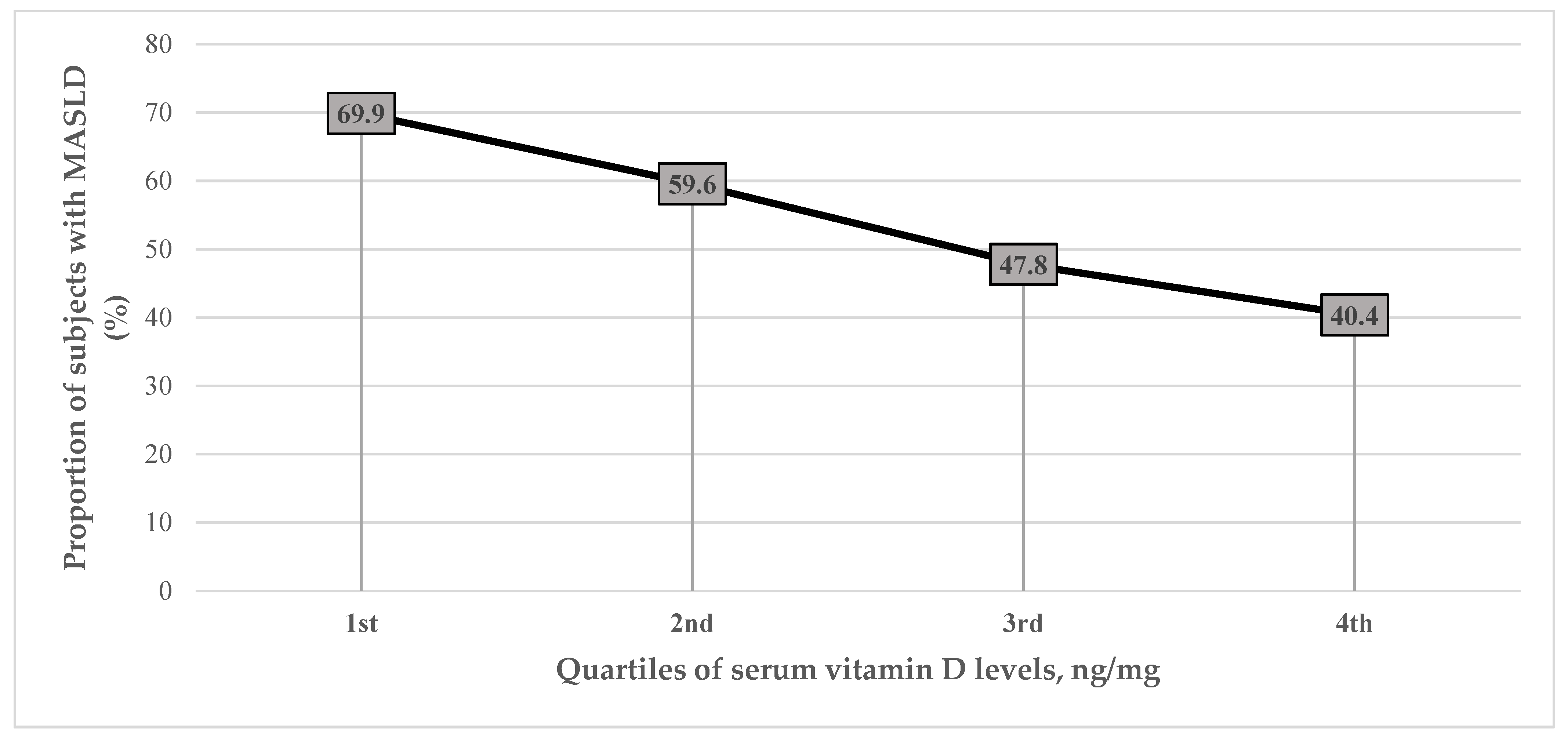
Vitamin D Sufficiency Revisited: Evidence of a Dose–Response Effect for MASLD in Adults at Risk
 , , , , and
Abstract
1. Introduction
2. Materials and Methods
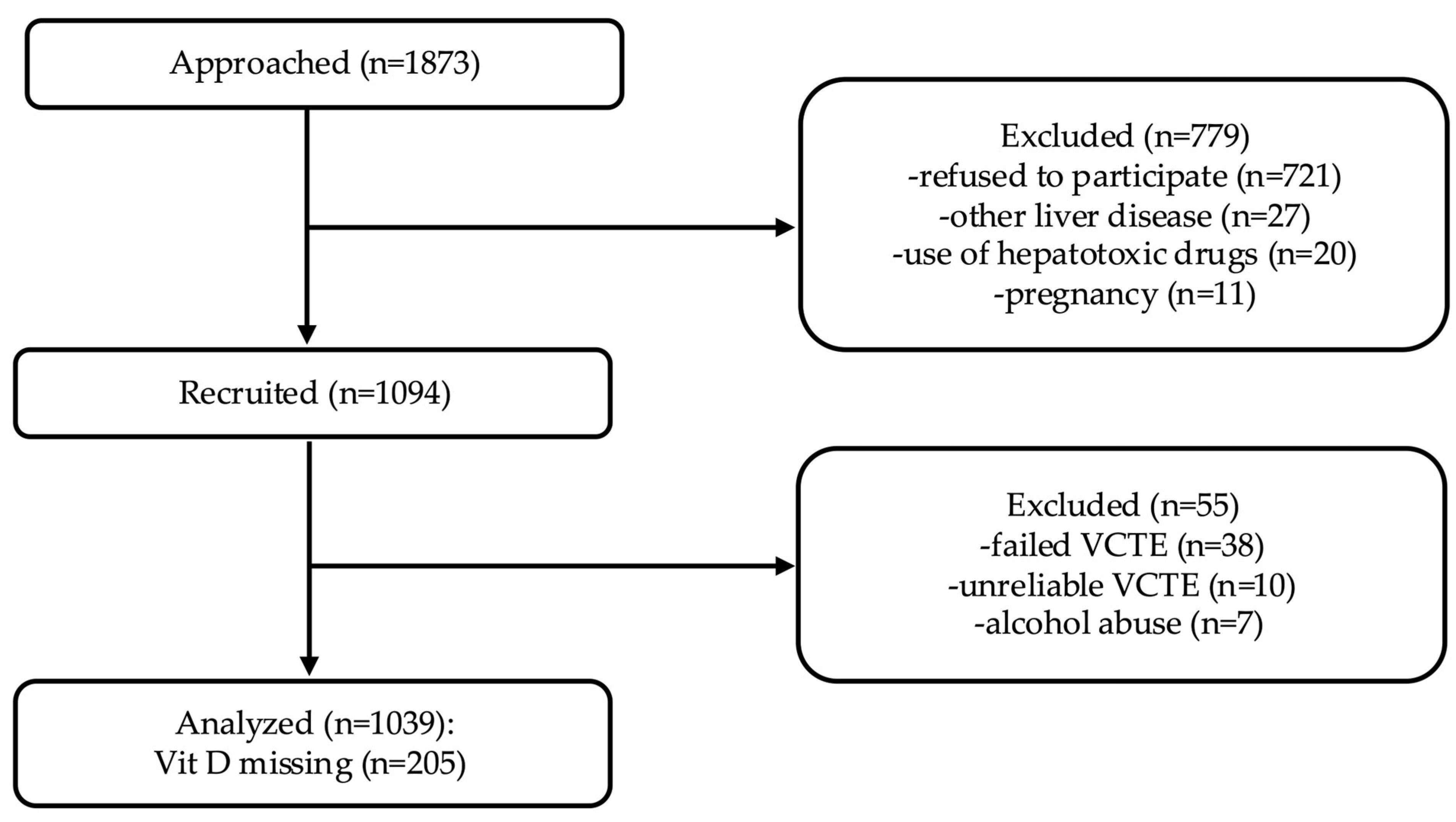
2.1. Study Population
2.2. Assessments
2.3. Clinical and Biochemical Data
2.3.1. Measurement of Serum Vitamin D Levels
2.3.2. MASLD and Fibrosis Assessment
2.3.3. Statistical Analysis
Missing Data
Primary Analysis
3. Results
3.1. Baseline Characteristics
3.2. Vitamin D and MASLD
3.3. Vitamin D and Fibrosis
4. Discussion
Supplementary Materials
Author Contributions
Funding
Institutional Review Board Statement
Informed Consent Statement
Data Availability Statement
Conflicts of Interest
References
- Xu, Z.; Gong, R.; Luo, G.; Wang, M.; Li, D.; Chen, Y.; Shen, X.; Wei, X.; Feng, N.; Wang, S. Association between vitamin D3 levels and insulin resistance: A large sample cross-sectional study. Sci. Rep. 2022, 12, 119. [Google Scholar] [CrossRef]
- Wu, J.; Atkins, A.; Downes, M.; Wei, Z. Vitamin D in Diabetes: Uncovering the Sunshine Hormone’s Role in Glucose Metabolism and Beyond. Nutrients 2023, 15, 1997. [Google Scholar] [CrossRef] [PubMed]
- Keane, J.T.; Elangovan, H.; Stokes, R.A.; Gunton, J.E. Vitamin D and the Liver-Correlation or Cause? Nutrients 2018, 10, 496. [Google Scholar] [CrossRef]
- Eliades, M.; Spyrou, E.; Agrawal, N.; Lazo, M.; Brancati, F.L.; Potter, J.J.; Koteish, A.A.; Clark, J.M.; Guallar, E.; Hernaez, R. Meta-analysis: Vitamin D and non-alcoholic fatty liver disease. Aliment. Pharmacol. Ther. 2013, 38, 246–254. [Google Scholar] [CrossRef]
- Liu, T.; Xu, L.; Chen, F.H.; Zhou, Y.B. Association of serum vitamin D level and nonalcoholic fatty liver disease: A meta-analysis. Eur. J. Gastroenterol. Hepatol. 2020, 32, 140–147. [Google Scholar] [CrossRef] [PubMed]
- Heo, N.J.; Park, H.E.; Yoon, J.W.; Kwak, M.S.; Yang, J.I.; Chung, S.J.; Yim, J.Y.; Chung, G.E. The Association between Vitamin D and Nonalcoholic Fatty Liver Disease Assessed by Controlled Attenuation Parameter. J. Clin. Med. 2021, 10, 2611. [Google Scholar] [CrossRef]
- Ciardullo, S.; Muraca, E.; Cannistraci, R.; Perra, S.; Lattuada, G.; Perseghin, G. Low 25 (OH) vitamin D levels are associated with increased prevalence of nonalcoholic fatty liver disease and significant liver fibrosis. Diabetes Metab. Res. Rev. 2023, 39, e3628. [Google Scholar] [CrossRef]
- Bril, F.; Maximos, M.; Portillo-Sanchez, P.; Biernacki, D.; Lomonaco, R.; Subbarayan, S.; Correa, M.; Lo, M.; Suman, A.; Cusi, K. Relationship of vitamin D with insulin resistance and disease severity in non-alcoholic steatohepatitis. J. Hepatol. 2015, 62, 405–411. [Google Scholar] [CrossRef]
- Lee, H.K.; Shin, S.R.; Han, A.L. Metabolic dysfunction associated fatty liver disease (MAFLD) and serum vitamin D concentration in South Korea. Asia Pac. J. Clin. Nutr. 2022, 31, 201–207. [Google Scholar] [CrossRef]
- Targher, G.; Bertolini, L.; Scala, L.; Cigolini, M.; Zenari, L.; Falezza, G.; Arcaro, G. Associations between serum 25-hydroxyvitamin D3 concentrations and liver histology in patients with non-alcoholic fatty liver disease. Nutr. Metab. Cardiovasc. Dis. 2007, 17, 517–524. [Google Scholar] [CrossRef] [PubMed]
- Barchetta, I.; Angelico, F.; Del Ben, M.; Baroni, M.G.; Pozzilli, P.; Morini, S.; Cavallo, M.G. Strong association between non alcoholic fatty liver disease (NAFLD) and low 25(OH) vitamin D levels in an adult population with normal serum liver enzymes. BMC Med. 2011, 9, 85. [Google Scholar] [CrossRef]
- Catena, C.; Cosma, C.; Camozzi, V.; Plebani, M.; Ermani, M.; Sechi, L.A.; Fallo, F. Non-alcoholic fatty liver disease is not associated with vitamin D deficiency in essential hypertension. High Blood Press. Cardiovasc. Prev. Off. J. Ital. Soc. Hypertens. 2013, 20, 33–37. [Google Scholar] [CrossRef]
- Liangpunsakul, S.; Chalasani, N. Serum vitamin D concentrations and unexplained elevation in ALT among US adults. Dig. Dis. Sci. 2011, 56, 2124–2129. [Google Scholar] [CrossRef]
- Park, E.; Park, E.Y. Inverse Association between Serum 25-hydroxyvitamin D Levels and Risk of Suspected Non-Alcoholic Fatty Liver Disease in Obese Population. Int. J. Environ. Res. Public Health 2021, 18, 8682. [Google Scholar] [CrossRef]
- Ha, Y.; Hwang, S.G.; Rim, K.S. The Association between Vitamin D Insufficiency and Nonalcoholic Fatty Liver Disease: A Population-Based Study. Nutrients 2017, 9, 806. [Google Scholar] [CrossRef]
- Udomsinprasert, W.; Jittikoon, J. Vitamin D and liver fibrosis: Molecular mechanisms and clinical studies. Biomed. Pharmacother. 2019, 109, 1351–1360. [Google Scholar] [CrossRef] [PubMed]
- Alberti, K.G.; Zimmet, P.; Shaw, J. Metabolic syndrome—A new world-wide definition. A Consensus Statement from the International Diabetes Federation. Diabet. Med. 2006, 23, 469–480. [Google Scholar] [CrossRef]
- American Diabetes Association Professional Practice Committee for Diabetes. 2. Diagnosis and Classification of Diabetes: Standards of Care in Diabetes-2026. Diabetes Care 2026, 49, S27–S49. [Google Scholar] [CrossRef] [PubMed]
- Parcha, V.; Heindl, B.; Kalra, R.; Li, P.; Gower, B.; Arora, G.; Arora, P. Insulin Resistance and Cardiometabolic Risk Profile Among Nondiabetic American Young Adults: Insights From NHANES. J. Clin. Endocrinol. Metab. 2022, 107, e25–e37. [Google Scholar] [CrossRef] [PubMed]
- Zelzer, S.; Goessler, W.; Herrmann, M. Measurement of vitamin D metabolites by mass spectrometry, an analytical challenge. J. Lab. Precis. Med. 2018, 3, 99. [Google Scholar] [CrossRef]
- Tacke, F.; Horn, P.; Wai-Sun Wong, V.; Ratziu, V.; Bugianesi, E.; Francque, S.; Zelber-Sagi, S.; Valenti, L.; Roden, M.; Schick, F.; et al. EASL&EASD&EASO Clinical Practice Guidelines on the management of metabolic dysfunction-associated steatotic liver disease (MASLD). J. Hepatol. 2024, 81, 492–542. [Google Scholar] [CrossRef]
- Karlas, T.; Petroff, D.; Sasso, M.; Fan, J.-G.; Mi, Y.-Q.; de Lédinghen, V.; Kumar, M.; Lupsor-Platon, M.; Han, K.-H.; Cardoso, A.C.; et al. Individual patient data meta-analysis of controlled attenuation parameter (CAP) technology for assessing steatosis. J. Hepatol. 2017, 66, 1022–1030. [Google Scholar] [CrossRef]
- Zhang, X.; Heredia, N.I.; Balakrishnan, M.; Thrift, A.P. Prevalence and factors associated with NAFLD detected by vibration controlled transient elastography among US adults: Results from NHANES 2017–2018. PLoS ONE 2021, 16, e0252164. [Google Scholar] [CrossRef] [PubMed]
- Ciardullo, S.; Monti, T.; Perseghin, G. Prevalence of Liver Steatosis and Fibrosis Detected by Transient Elastography in Adolescents in the 2017–2018 National Health and Nutrition Examination Survey. Clin. Gastroenterol. Hepatol. 2021, 19, 384–390.e381. [Google Scholar] [CrossRef]
- Tsochatzis, E.A.; Gurusamy, K.S.; Ntaoula, S.; Cholongitas, E.; Davidson, B.R.; Burroughs, A.K. Elastography for the diagnosis of severity of fibrosis in chronic liver disease: A meta-analysis of diagnostic accuracy. J. Hepatol. 2011, 54, 650–659. [Google Scholar] [CrossRef] [PubMed]
- White, I.R.; Royston, P.; Wood, A.M. Multiple imputation using chained equations: Issues and guidance for practice. Stat. Med. 2011, 30, 377–399. [Google Scholar] [CrossRef] [PubMed]
- Van Buuren, S. Flexible Imputation of Missing Data; CRC Press: Boca Raton, FL, USA, 2012; Volume 10. [Google Scholar]
- Dal, K.; Uzman, M.; Ata, N.; Ertugrul, D.T.; Bursa, N.; Caglayan, M.; Baser, S.; Akkan, T.; Imrat, E.; Celik, O.; et al. The effect of vitamin D status on non-alcoholic fatty liver disease: A population-based observational study. Endokrynol. Pol. 2023, 74, 63–66. [Google Scholar] [CrossRef]
- Kim, H.-S.; Rotundo, L.; Kothari, N.; Kim, S.-H.; Pyrsopoulos, N. Vitamin D Is Associated with Severity and Mortality of Non-alcoholic Fatty Liver Disease: A US Population-based Study. J. Clin. Transl. Hepatol. 2017, 5, 185–192. [Google Scholar] [CrossRef]
- Zhai, H.L.; Wang, N.J.; Han, B.; Li, Q.; Chen, Y.; Zhu, C.F.; Chen, Y.C.; Xia, F.Z.; Cang, Z.; Zhu, C.X.; et al. Low vitamin D levels and non-alcoholic fatty liver disease, evidence for their independent association in men in East China: A cross-sectional study (Survey on Prevalence in East China for Metabolic Diseases and Risk Factors (SPECT-China)). Br. J. Nutr. 2016, 115, 1352–1359. [Google Scholar] [CrossRef]
- Rhee, E.J.; Kim, M.K.; Park, S.E.; Park, C.Y.; Baek, K.H.; Lee, W.Y.; Kang, M.I.; Park, S.W.; Kim, S.W.; Oh, K.W. High serum vitamin D levels reduce the risk for nonalcoholic fatty liver disease in healthy men independent of metabolic syndrome. Endocr. J. 2013, 60, 743–752. [Google Scholar] [CrossRef]
- Wan, B.; Gao, Y.; Zheng, Y.; Chen, R. Association between serum 25-hydroxy vitamin D level and metabolic associated fatty liver disease (MAFLD)-a population-based study. Endocr. J. 2021, 68, 631–637. [Google Scholar] [CrossRef]
- Zelber-Sagi, S.; Zur, R.; Thurm, T.; Goldstein, A.; Ben-Assuli, O.; Chodick, G.; Shibolet, O. Low serum vitamin D is independently associated with unexplained elevated ALT only among non-obese men in the general population. Ann. Hepatol. 2019, 18, 578–584. [Google Scholar] [CrossRef]
- Lee, S.-b.; Jin, M.H.; Yoon, J.-H. The contribution of vitamin D insufficiency to the onset of steatotic liver disease among individuals with metabolic dysfunction. Sci. Rep. 2024, 14, 6714. [Google Scholar] [CrossRef]
- Wang, X.; Li, W.; Zhang, Y.; Yang, Y.; Qin, G. Association between vitamin D and non-alcoholic fatty liver disease/non-alcoholic steatohepatitis: Results from a meta-analysis. Int. J. Clin. Exp. Med. 2015, 8, 17221–17234. [Google Scholar]
- Dasarathy, J.; Periyalwar, P.; Allampati, S.; Bhinder, V.; Hawkins, C.; Brandt, P.; Khiyami, A.; McCullough, A.J.; Dasarathy, S. Hypovitaminosis D is associated with increased whole body fat mass and greater severity of non-alcoholic fatty liver disease. Liver Int. 2014, 34, e118–e127. [Google Scholar] [CrossRef] [PubMed]
- Hao, Y.-p.; Ma, X.-j.; Luo, Y.-q.; Ni, J.; Dou, J.-x.; Hu, Y.-q.; Zhu, J.-a.; Bao, Y.-q.; Jia, W.-p. Serum vitamin D is associated with non-alcoholic fatty liver disease in Chinese males with normal weight and liver enzymes. Acta Pharmacol. Sin. 2014, 35, 1150–1156. [Google Scholar] [CrossRef] [PubMed]
- Jablonski, K.L.; Jovanovich, A.; Holmen, J.; Targher, G.; McFann, K.; Kendrick, J.; Chonchol, M. Low 25-hydroxyvitamin D level is independently associated with non-alcoholic fatty liver disease. Nutr. Metab. Cardiovasc. Dis. 2013, 23, 792–798. [Google Scholar] [CrossRef]
- Li, L.; Zhang, L.; Pan, S.; Wu, X.; Yin, X. No Significant Association Between Vitamin D and Nonalcoholic Fatty Liver Disease in a Chinese Population. Dig. Dis. Sci. 2013, 58, 2376–2382. [Google Scholar] [CrossRef]
- Lapauw, B.; Laurent, M.R.; Rozenberg, S.; Body, J.J.; Bruyère, O.; Gielen, E.; Goemaere, S.; Iconaru, L.; Cavalier, E. When and How to Evaluate Vitamin D Status? A Viewpoint from the Belgian Bone Club. Nutrients 2024, 16, 2388. [Google Scholar] [CrossRef]
- Demay, M.B.; Pittas, A.G.; Bikle, D.D.; Diab, D.L.; Kiely, M.E.; Lazaretti-Castro, M.; Lips, P.; Mitchell, D.M.; Murad, M.H.; Powers, S.; et al. Vitamin D for the Prevention of Disease: An Endocrine Society Clinical Practice Guideline. J. Clin. Endocrinol. Metab. 2024, 109, 1907–1947. [Google Scholar] [CrossRef] [PubMed]
- Ekmekcioglu, C.; Poteser, M. The Optimal Protective 25-Hydroxyvitamin D Level for Different Health Outcomes in Adults: A Brief Summary of Dose-Response Meta-Analyses. Metabolites 2025, 15, 264. [Google Scholar] [CrossRef]
- Ji, Y.; Wei, C.B.; Gu, W.; Hou, L.L. Relevance of vitamin D on NAFLD and liver fibrosis detected by vibration controlled transient elastography in US adults: A cross-sectional analysis of NHANES 2017–2018. Ann. Med. 2023, 55, 2209335. [Google Scholar] [CrossRef]
- Konstantakis, C.; Tselekouni, P.; Kalafateli, M.; Triantos, C. Vitamin D deficiency in patients with liver cirrhosis. Ann. Gastroenterol. 2016, 29, 297–306. [Google Scholar] [CrossRef] [PubMed]
- Triantos, C.; Aggeletopoulou, I.; Thomopoulos, K.; Mouzaki, A. Vitamin D-Liver Disease Association: Biological Basis and Mechanisms of Action. Hepatology 2021, 74, 1065–1073. [Google Scholar] [CrossRef] [PubMed]
- Nasr, P.; Ignatova, S.; Kechagias, S.; Ekstedt, M. Natural history of nonalcoholic fatty liver disease: A prospective follow-up study with serial biopsies. Hepatol. Commun. 2018, 2, 199–210. [Google Scholar] [CrossRef] [PubMed]
- Ko, B.J.; Kim, Y.S.; Kim, S.G.; Park, J.H.; Lee, S.H.; Jeong, S.W.; Jang, J.Y.; Kim, H.S.; Kim, B.S.; Kim, S.M.; et al. Relationship between 25-Hydroxyvitamin D Levels and Liver Fibrosis as Assessed by Transient Elastography in Patients with Chronic Liver Disease. Gut Liver 2016, 10, 818–825. [Google Scholar] [CrossRef]


| All (n = 834) | Vitamin D Sufficient (n = 677) | Vitamin D Insufficient (n = 157) | p Value | |
|---|---|---|---|---|
| Demographics | ||||
| Age | 52.17 ± 12.99 | 53.41 ± 12.68 | 46.80 ± 13.05 | <0.001 |
| Sex (%Male) | 51.6% | 51.8% | 50.3% | NS |
| BMI (kg/m2) | 30.06 ± 5.77 | 29.39 ± 5.14 | 32.95 ± 7.28 | <0.001 |
| Lifestyle | ||||
| Alcohol (%) | 43.5% | 44.5% | 39.5% | NS |
| Smoker (%) | 30.1% | 27.5% | 41.4% | 0.001 |
| MEDAS | 6.39 ± 2.11 | 6.56 ± 2.11 | 5.66 ± 1.97 | <0.001 |
| PAL | 992.06 ± 993.04 | 1066.78 ± 1009 | 669.85 ± 849.43 | <0.001 |
| Biochemical measurements | ||||
| Total cholesterol (mg/dL) | 197.09 ± 49.24 | 197.46 ± 50.70 | 195.47 ± 42.48 | NS |
| HDL-cholesterol (mg/dL) | 50.17 ± 14.35 | 51.04 ± 14.59 | 46.45 ± 12.66 | <0.001 |
| LDL-cholesterol (mg/dL) | 119.92 ± 42.52 | 119.39 ± 43.99 | 122.21 ± 35.48 | NS |
| TAG (mg/dL) | 152.86 ± 102.01 | 146.73 ± 92.55 | 179.29 ± 132.60 | 0.004 |
| FBS (mg/dL) | 101.44 ± 38.68 | 98.77 ± 30.78 | 112.97 ± 60.97 | <0.001 |
| HbA1c (%) (n = 815) | 5.90 ± 1.15 | 5.823 ± 1.04 | 6.23 ± 1.51 | 0.002 |
| HOMA-IR | 3.81 ± 4.22 | 3.61 ± 3.85 | 4.66 ± 5.47 | 0.024 |
| 25(OH)D (ng/mL) | 34.06 ± 17.28 | 38.71 ± 15.79 | 14.02 ± 3.97 | <0.001 |
| ALT (UI/l) | 26.21 ± 17.42 | 26.11 ± 17.24 | 26.64 ± 18.26 | NS |
| AST (UI/l) | 22.0 ± 12.26 | 22.25 ± 12.47 | 21.37 ± 11.29 | NS |
| GGT (UI/l) | 28.80 ± 30.79 | 28.58 ± 32.21 | 29.79 ± 23.79 | NS |
| Liver measurements | ||||
| CAP (dB/m) | 255.54 ± 53.59 | 250.63 ± 52.40 | 276.73 ± 53.66 | <0.001 |
| LSM (kPa) | 5.46 ± 2.24 | 5.34 ± 2.14 | 5.94 ± 2.60 | 0.008 |
| FIB-4 | 0.98 ± 0.62 | 1.03 ± 0.65 | 0.77 ± 0.42 | <0.001 |
| FAST | 0.11 ± 0.14 | 0.10 ± 0.12 | 0.12 ± 0.15 | NS |
| Medical history | ||||
| MASLD (%) | 54.7 (51.3, 58.0) | 51.4 (47.6, 55.1) | 68.8 (61.2, 75.5) | <0.001 |
| Obesity (%) | 45.1 (41.7, 48.5) | 42.4 (38.7, 46.1) | 56.7 (48.9, 64.2) | 0.001 |
| Diabetes (%) | 40.3 (37.0, 43.7) | 38.8 (35.2, 42.6) | 46.5 (38.9, 54.3) | NS |
| Hypertension (%) | 61.9 (58.5, 65.1) | 63.4 (59.7, 66.9) | 55.4 (47.6, 63.0) | NS |
| Dyslipidemia (%) | 80.3 (77.5, 82.9) | 81.2 (78.1, 84.0) | 76.4 (69.2, 82.4) | NS |
| Metabolic syndrome (%) | 53.7 (50.3, 57.1) | 52.1 (48.4, 55.9) | 60.5 (52.7, 67.8) | NS |
| Crude Model | Adjusted Model a | |||
|---|---|---|---|---|
| OR (95% CI) | p | OR (95% CI) | p | |
| Vitamin D sufficiency (≥20 ng/mL) | 0.47 (0.33, 0.67) | <0.001 | 0.60 (0.36, 1.03) | 0.063 |
| Quartiles of serum Vitamin D | ||||
| 1st (≤22 ng/mL) | 1 (reference) | 1 (reference) | ||
| 2nd (23–32 ng/mL) | 0.61 (0.42, 0.89) | 0.011 | 0.65 (0.39, 1.09) | 0.102 |
| 3rd (33–43 ng/mL) | 0.42 (0.28, 0.62) | <0.001 | 0.43 (0.25, 0.75) | 0.003 |
| 4th (≥44 ng/mL) | 0.28 (0.19, 0.41) | <0.001 | 0.39 (0.21, 0.71) | 0.002 |
| Serum vitamin D (ng/mL) | 0.97 (0.96, 0.98) | <0.001 | 0.98 (0.96, 0.99) | <0.001 |
| Crude Model | Adjusted Model | |||
|---|---|---|---|---|
| OR (95% CI) | p | OR (95% CI) | p | |
| Obesity (n = 504) | ||||
| Vitamin D sufficiency (≥20 ng/mL) | 0.57 (0.30, 1.08) | 0.085 | 0.43 (0.18, 1.02) | 0.057 |
| Quartiles of serum Vitamin D | ||||
| 1st (≤22 ng/mL) | 1 (reference) | 1 (reference) | ||
| 2nd (23–32 ng/mL) | 0.48 (0.25, 0.92) | 0.026 | 0.44 (0.20, 0.98) | 0.045 |
| 3rd (33–43 ng/mL) | 0.40 (0.20, 0.79) | 0.009 | 0.31 (0.12, 0.76) | 0.010 |
| 4th (≥44 ng/mL) | 0.74 (0.31, 1.74) | 0.484 | 0.46 (0.15, 1.38) | 0.165 |
| Serum vitamin D (ng/mL) | 0.99 (0.97, 1.00) | 0.130 | 0.98 (0.96, 0.99) | 0.035 |
| Adjusted for: site, age, sex, education, income, alcohol, smoker, VitD season, DM, IR, HT, Dyslipidemia, MetS, highWC, MEDAS, PAL | ||||
| Diabetes (n = 411) | ||||
| Vitamin D sufficiency (≥20 ng/mL) | 0.42 (0.22, 0.81) | 0.009 | 0.51 (0.20, 1.30) | 0.157 |
| Quartiles of serum Vitamin D | ||||
| 1st (≤22 ng/mL) | 1 (reference) | 1 (reference) | ||
| 2nd (23–32 ng/mL) | 0.59 (0.29, 1.16) | 0.127 | 0.49 (0.20, 1.24) | 0.131 |
| 3rd (33–43 ng/mL) | 0.50 (0.26, 0.98) | 0.042 | 0.49 (0.19, 1.28) | 0.147 |
| 4th (≥44 ng/mL) | 0.20 (0.10, 0.40) | <0.001 | 0.25 (0.09, 0.70) | 0.009 |
| Serum vitamin D (ng/mL) | 0.96 (0.95, 0.98) | <0.001 | 0.96 (0.94, 0.99) | 0.002 |
| Adjusted for: site, age, sex, education, income, alcohol, smoker, VitD season, obesity, IR, HT, Dyslipidemia, MetS, highWC, MEDAS, PAL | ||||
| Metabolic Syndrome (n = 562) | ||||
| Vitamin D sufficiency (≥20 ng/mL) | 0.25 (0.11, 0.53) | <0.001 | 0.30 (0.12, 0.73) | 0.008 |
| Quartiles of serum Vitamin D | ||||
| 1st (≤22 ng/mL) | 1 (reference) | 1 (reference) | ||
| 2nd (23–32 ng/mL) | 0.29 (0.14, 0.62) | 0.001 | 0.31 (0.14, 0.72) | 0.006 |
| 3rd (33–43 ng/mL) | 0.17 (0.08, 0.36) | <0.001 | 0.19 (0.08, 0.45) | <0.001 |
| 4th (≥44 ng/mL) | 0.16 (0.08, 0.37) | <0.001 | 0.19 (0.08, 0.51) | <0.001 |
| Serum vitamin D (ng/mL) | 0.97 (0.95, 0.98) | <0.001 | 0.97 (0.95, 0.98) | <0.001 |
| Adjusted for: site, VitD season, age, sex, education, income, alcohol, smoker, obesity, DM, IR, HT, Dyslipidemia, MEDAS, PAL | ||||
| Hypertension (n = 599) | ||||
| Vitamin D sufficiency (≥20 ng/mL) | 0.32 (0.18, 0.56) | <0.001 | 0.42 (0.20, 0.92) | 0.029 |
| Quartiles of serum Vitamin D | ||||
| 1st (≤22 ng/mL) | 1 (reference) | 1 (reference) | ||
| 2nd (23–32 ng/mL) | 0.46 (0.25, 0.82) | 0.008 | 0.43 (0.19, 0.93) | 0.032 |
| 3rd (33–43 ng/mL) | 0.29 (0.17, 0.51) | <0.001 | 0.28 (0.13, 0.60) | <0.001 |
| 4th (≥44 ng/mL) | 0.18 (0.10, 0.30) | <0.001 | 0.29 (0.13, 0.65) | 0.003 |
| Serum vitamin D (ng/mL) | 0.96 (0.95, 0.97) | <0.001 | 0.97 (0.96, 0.99) | 0.002 |
| Adjusted for: site, VitD season, age, sex, education, income, alcohol, smoker, obesity, DM, IR, Dyslipidemia, MetS, highWC, MEDAS, PAL | ||||
| Dyslipidemia (n = 837) | ||||
| Vitamin D sufficiency (≥20 ng/mL) | 0.48 (0.32, 0.72) | <0.001 | 0.63 (0.35, 1.14) | 0.123 |
| Quartiles of serum Vitamin D | ||||
| 1st (≤22 ng/mL) | 1 (reference) | 1 (reference) | ||
| 2nd (23–32 ng/mL) | 0.63 (0.40, 0.98) | 0.040 | 0.68 (0.39,1.22) | 0.202 |
| 3rd (33–43 ng/mL) | 0.41 (0.27, 0.63) | <0.001 | 0.43 (0.23, 0.79) | 0.007 |
| 4th (≥44 ng/mL) | 0.28 (0.18, 0.43) | <0.001 | 0.43 (0.22, 0.84) | 0.013 |
| Serum vitamin D (ng/mL) | 0.97 (0.96, 0.98) | <0.001 | 0.98 (0.96, 0.99) | 0.001 |
| Adjusted for: site, VitD season, age, sex, education, income, alcohol, smoker, obesity, DM, IR, MetS, highWC, MEDAS, PAL | ||||
| Central Obesity (n = 780) | ||||
| Vitamin D sufficiency (≥20 ng/mL) | 0.44 (0.27, 0.71) | <0.001 | 0.44 (0.23, 0.82) | 0.010 |
| Quartiles of serum Vitamin D | ||||
| 1st (≤22 ng/mL) | 1 (reference) | 1 (reference) | ||
| 2nd (23–32 ng/mL) | 0.52 (0.32, 0.84) | 0.008 | 0.53 (0.29, 0.95) | 0.034 |
| 3rd (33–43 ng/mL) | 0.40 (0.24, 0.64) | <0.001 | 0.33 (0.17, 0.63) | <0.001 |
| 4th (≥44 ng/mL) | 0.41 (0.24, 0.69) | <0.001 | 0.39 (0.19, 0.81) | 0.012 |
| Serum vitamin D (ng/mL) | 0.98 (0.97, 0.99) | <0.001 | 0.98 (0.96, 0.99) | 0.003 |
| Adjusted for: site, VitD season, age, sex, education, income, alcohol, smoker, obesity, DM, IR, Dyslipidemia, MetS, MEDAS, PAL. | ||||
| Insulin Resistance (n = 591) | ||||
| Vitamin D sufficiency (≥20 ng/mL) | 0.54 (0.32, 0.92) | 0.024 | 0.65 (0.31, 1.34) | 0.240 |
| Quartiles of serum Vitamin D | ||||
| 1st (≤22 ng/mL) | 1 (reference) | 1 (reference) | ||
| 2nd (23–32 ng/mL) | 0.54 (0.30, 0.96) | 0.034 | 0.52 (0.26, 1.05) | 0.070 |
| 3rd (33–43 ng/mL) | 0.58 (0.32, 1.03) | 0.064 | 0.70 (0.32, 1.51) | 0.359 |
| 4th (≥44 ng/mL) | 0.31 (0.17, 0.56) | <0.001 | 0.43 (0.19, 0.98) | 0.045 |
| Serum vitamin D (ng/mL) | 0.97 (0.96, 0.99) | <0.001 | 0.98 (0.96, 0.99) | 0.030 |
| Adjusted for: site, VitD season, age, sex, education, income, alcohol, smoker, obesity, DM, Dyslipidemia, MetS, high WC, MEDAS, PAL. | ||||
Disclaimer/Publisher’s Note: The statements, opinions and data contained in all publications are solely those of the individual author(s) and contributor(s) and not of MDPI and/or the editor(s). MDPI and/or the editor(s) disclaim responsibility for any injury to people or property resulting from any ideas, methods, instructions or products referred to in the content. |
© 2026 by the authors. Licensee MDPI, Basel, Switzerland. This article is an open access article distributed under the terms and conditions of the Creative Commons Attribution (CC BY) license.
Share and Cite
Dogay Us, G.; Innocenti, F.; Koc, O.M.; Yumuk, V.D.; Gungor, Z.B.; Koek, G.H. Vitamin D Sufficiency Revisited: Evidence of a Dose–Response Effect for MASLD in Adults at Risk. Nutrients 2026, 18, 599. https://doi.org/10.3390/nu18040599
Dogay Us G, Innocenti F, Koc OM, Yumuk VD, Gungor ZB, Koek GH. Vitamin D Sufficiency Revisited: Evidence of a Dose–Response Effect for MASLD in Adults at Risk. Nutrients. 2026; 18(4):599. https://doi.org/10.3390/nu18040599
Chicago/Turabian StyleDogay Us, Gediz, Francesco Innocenti, Ozgur Muhammet Koc, Volkan Demirhan Yumuk, Zeynep Banu Gungor, and Ger H. Koek. 2026. "Vitamin D Sufficiency Revisited: Evidence of a Dose–Response Effect for MASLD in Adults at Risk" Nutrients 18, no. 4: 599. https://doi.org/10.3390/nu18040599
APA StyleDogay Us, G., Innocenti, F., Koc, O. M., Yumuk, V. D., Gungor, Z. B., & Koek, G. H. (2026). Vitamin D Sufficiency Revisited: Evidence of a Dose–Response Effect for MASLD in Adults at Risk. Nutrients, 18(4), 599. https://doi.org/10.3390/nu18040599