How We Sleep, How We Move, How Long We Expect to Live: An Integrative Review of Lifestyle Behaviors and Subjective Life Expectancy
 , , , ,
Abstract
1. Introduction
2. Materials and Methods
3. Results
3.1. Sleep and Healthy Aging
3.2. PA, Sedentary Behavior and Longevity
3.3. SLE and Psychological Dimensions of Aging
3.4. Integrative Perspective Across Domains
4. Discussion
4.1. Integrative Model: A New Contribution to the Literature
4.2. Special Considerations
4.2.1. Age
4.2.2. Gender
4.2.3. Socioeconomic Status (SES)
4.2.4. Cultural Differences
4.2.5. Wearables and Digital Health as Behavioral Reinforcers
4.3. Limitations
4.4. Gaps in Literature, Future Directions and Empirical Testing of the Model
5. Conclusions
Author Contributions
Funding
Institutional Review Board Statement
Informed Consent Statement
Data Availability Statement
Acknowledgments
Conflicts of Interest
References
- Huang, B.H.; Duncan, M.J.; Cistulli, P.A.; Nassar, N.; Hamer, M.; Stamatakis, E. Sleep and physical activity in relation to all-cause, cardiovascular disease and cancer mortality risk. Br. J. Sports Med. 2022, 56, 718–724. [Google Scholar] [CrossRef] [PubMed]
- Thomas, A.; Belsky, D.W.; Gu, Y. Healthy Lifestyle Behaviors and Biological Aging in the U.S. National Health and Nutrition Examination Surveys 1999–2018. J. Gerontol. A Biol. Sci. Med. Sci. 2023, 78, 1535–1542. [Google Scholar] [CrossRef] [PubMed]
- Stamatakis, E.; Koemel, N.A.; Biswas, R.K.; Ahmadi, M.N.; Allman-Farinelli, M.; Trost, S.G.; Inan-Eroglu, E.; Del Pozo Cruz, B.; Bin, Y.S.; Postnova, S.; et al. Minimum and optimal combined variations in sleep, physical activity, and nutrition in relation to all-cause mortality risk. BMC Med. 2025, 23, 111. [Google Scholar] [CrossRef] [PubMed]
- Sun, L.; Zhang, T.; Luo, L.; Yang, Y.; Wang, C.; Luo, J. Exercise delays aging: Evidence from telomeres and telomerase—A systematic review and meta-analysis of randomized controlled trials. Front. Physiol. 2025, 16, 1627292. [Google Scholar] [CrossRef]
- Lobelo, F.; Rohm Young, D.; Sallis, R.; Garber, M.D.; Billinger, S.A.; Duperly, J.; Hutber, A.; Pate, R.R.; Thomas, R.J.; Widlansky, M.E.; et al. Routine Assessment and Promotion of Physical Activity in Healthcare Settings: A Scientific Statement From the American Heart Association. Circulation 2018, 137, e495–e522. [Google Scholar] [CrossRef]
- Cunningham, C.; O’Sullivan, R.; Caserotti, P.; Tully, M.A. Consequences of physical inactivity in older adults: A systematic review of reviews and meta-analyses. Scand. J. Med. Sci. Sports 2020, 30, 816–827. [Google Scholar] [CrossRef]
- Kim, J.H.; Kim, J.M. Subjective life expectancy as a risk factor for perceived health status and mortality. Health Qual. Life Outcomes 2017, 15, 190. [Google Scholar] [CrossRef]
- Westerhof, G.J.; Nehrkorn-Bailey, A.M.; Tseng, H.Y.; Brothers, A.; Siebert, J.S.; Wurm, S.; Wahl, H.W.; Diehl, M. Longitudinal effects of subjective aging on health and longevity: An updated meta-analysis. Psychol. Aging 2023, 38, 147–166. [Google Scholar] [CrossRef]
- Westerhof, G.J.; Miche, M.; Brothers, A.F.; Barrett, A.E.; Diehl, M.; Montepare, J.M.; Wahl, H.W.; Wurm, S. The influence of subjective aging on health and longevity: A meta-analysis of longitudinal data. Psychol. Aging 2014, 29, 793–802. [Google Scholar] [CrossRef]
- Vanderlinden, J.; Boen, F.; van Uffelen, J.G.Z. Effects of physical activity programs on sleep outcomes in older adults. Int. J. Behav. Nutr. Phys. Act. 2020, 17, 11. [Google Scholar] [CrossRef]
- Shi, H.; Hu, F.B.; Huang, T.; Schernhammer, E.S.; Willett, W.C.; Sun, Q.; Wang, M. Sedentary Behaviors, Light-Intensity Physical Activity, and Healthy Aging. JAMA Netw. Open 2024, 7, e2416300. [Google Scholar] [CrossRef] [PubMed]
- Ortolá, R.; García-Esquinas, E.; Cabanas-Sánchez, V.; Migueles, J.; Martínez-Gómez, D.; Rodríguez-Artalejo, F. Device-measured and self-reported physical activity, sedentary behavior, and aging. J. Gerontol. A 2021, 76, 85–94. [Google Scholar] [CrossRef]
- Panagiotou, M.; Michel, S.; Meijer, J.H.; Deboer, T. The aging brain: Sleep, the circadian clock and exercise. Biochem. Pharmacol. 2021, 191, 114563. [Google Scholar] [CrossRef]
- Barragán, R.; Ortega-Azorín, C.; Sorlí, J.V.; Asensio, E.M.; Coltell, O.; St-Onge, M.P.; Portolés, O.; Corella, D. Effect of physical activity, smoking, and sleep on telomere length: A systematic review of observational and intervention studies. J. Clin. Med. 2021, 11, 76. [Google Scholar] [CrossRef]
- Yao, J.X.; Qiu, Y.; Yun, D.T. Associations between 24-h movement, mental health and cognitive function among older adults: Review and prospects. Acta Psychol. 2025, 260, 105718. [Google Scholar] [CrossRef]
- Sato, M.; Betriana, F.; Tanioka, R.; Osaka, K.; Tanioka, T.; Schoenhofer, S. Balance of autonomic nervous activity, exercise, and sleep status in older adults: A review of the literature. Int. J. Environ. Res. Public Health 2021, 18, 12896. [Google Scholar] [CrossRef]
- Christie, A.D.; Seery, E.; Kent, J.A. Physical activity, sleep quality, and self-reported fatigue across the adult lifespan. Exp. Gerontol. 2016, 77, 7–11. [Google Scholar] [CrossRef] [PubMed]
- Lee, S.A.; Fisher, Z.; Almeida, D.M. Daily reciprocal relationships between affect, physical activity, and sleep in middle and later life. Ann. Behav. Med. 2025, 59, kaae072. [Google Scholar] [CrossRef]
- Williams, J.S.; Dunford, E.C.; Cheng, J.L.; Moncion, K.; Valentino, S.E.; Droog, C.A.; Cherubini, J.M.; King, T.J.; Noguchi, K.S. The impact of the 24-h movement spectrum on vascular remodeling in older men and women: A review. Am. J. Physiol. Heart Circ. Physiol. 2021, 320, H1136–H1155. [Google Scholar] [CrossRef]
- Hakimi, S.; Kaur, S.; Ross-White, A.; Martin, L.J.; Rosenberg, M.W. A systematic review examining associations between physical activity, sedentary behaviour, and sleep duration with quality of life in older adults aged 65 years and above. Appl. Physiol. Nutr. Metab. 2023, 48, 97–162. [Google Scholar] [CrossRef] [PubMed]
- Wu, X.; Zhao, X.; Ge, A.; Han, Z.; Hou, C.; Hao, Y.; Xiao, J.; Fan, M.; Burgess, S.; Li, J.; et al. Evaluating the nonlinear effects of sleep duration on biological aging across phenotypic, genomic, and epigenomic data. Aging 2025, 17, 2126–2151. [Google Scholar] [CrossRef]
- Meyer, N.; Harvey, A.G.; Lockley, S.W.; Dijk, D.J. Circadian rhythms and disorders of the timing of sleep. Lancet 2022, 400, 1061–1078. [Google Scholar] [CrossRef]
- Franken, P.; Dijk, D.J. Sleep and circadian rhythmicity as entangled processes serving homeostasis. Nat. Rev. Neurosci. 2024, 25, 43–59. [Google Scholar] [CrossRef]
- Gao, C.; Guo, J.; Gong, T.T.; Lv, J.L.; Li, X.Y.; Liu, F.H.; Zhang, M.; Shan, Y.T.; Zhao, Y.H.; Wu, Q.J. Sleep duration/quality with health outcomes: An umbrella review of meta-analyses of prospective studies. Front. Med. 2021, 8, 813943. [Google Scholar] [CrossRef] [PubMed]
- Fostitsch, A.J.; Schwarzer, G.; Buchgeister, M.; Surbeck, W.; Lahmann, C.; Spiegelhalder, K.; Frase, L.; Spieler, D. The association between sleep quality and telomere attrition: A systematic review and meta-analysis comprising 400,212 participants. Sleep Med. Rev. 2025, 80, 102073. [Google Scholar] [CrossRef]
- Wynchank, D.; Bijlenga, D.; Penninx, B.W.; Lamers, F.; Beekman, A.T.F.; Kooij, J.J.S.; Verhoeven, J.E. Delayed sleep-onset and biological age: Late sleep-onset is associated with shorter telomere length. Sleep 2019, 42, zsz139. [Google Scholar] [CrossRef]
- Fernandez-Mendoza, J. Insomnia phenotypes, cardiovascular risk and their link to brain health. Circ. Res. 2025, 137, 727–745. [Google Scholar] [CrossRef]
- Piber, D.; Cho, J.H.; Lee, O.; Lamkin, D.M.; Olmstead, R.; Irwin, M.R. Sleep disturbance and activation of cellular and transcriptional mechanisms of inflammation in older adults. Brain Behav. Immun. 2022, 106, 67–75. [Google Scholar] [CrossRef] [PubMed]
- Larsson, S.C.; Hållström, E.; Michaëlsson, K.; Titova, O.E. Poor sleep is associated with lower physical activity. Sci. Rep. 2025, 15, 26012. [Google Scholar] [CrossRef]
- Huang, B.H.; Hamer, M.; Duncan, M.J.; Cistulli, P.A.; Stamatakis, E. The bidirectional association between sleep and physical activity: UK Biobank longitudinal analysis. Prev. Med. 2021, 143, 106315. [Google Scholar] [CrossRef] [PubMed]
- St-Onge, M.P.; Grandner, M.A.; Brown, D.; Conroy, M.B.; Jean-Louis, G.; Coons, M.; Bhatt, D.L. Sleep duration and quality: Impact on lifestyle behaviors and cardiometabolic health. Circulation 2016, 134, e367–e386. [Google Scholar] [CrossRef]
- Rogers, E.M.; Banks, N.F.; Jenkins, N.D.M. The effects of sleep disruption on metabolism, hunger, and satiety, and the influence of psychosocial stress and exercise: A narrative review. Diabetes Metab. Res. Rev. 2024, 40, e3667. [Google Scholar] [CrossRef]
- Seol, J.; Lee, J.; Park, I. Bidirectional associations between physical activity and sleep using polysomnography. Sci. Rep. 2022, 12, 15399. [Google Scholar] [CrossRef]
- Mesas, A.E.; Hagen, E.W.; Peppard, P.E. Bidirectional association between physical activity and sleep in middle-aged and older adults. Sleep 2018, 41, zsy114. [Google Scholar] [CrossRef] [PubMed]
- Chiu, C.T.; Chen, C.A.; Wang, J.; Ofstedal, M.B. Sleep quality and cognitive life expectancy in the United States. Res. Aging 2025. Online ahead of print. [Google Scholar] [CrossRef]
- Stenholm, S.; Vahtera, J.; Head, J.; Kivimäki, M.; Magnusson Hanson, L.L.; Pentti, J.; Rod, N.H.; Clark, A.J.; Oksanen, T.; Westerlund, H.; et al. Sleep duration and disturbances as predictors of healthy life expectancy. J. Gerontol. A 2019, 74, 204–210. [Google Scholar] [CrossRef]
- Zapalac, K.; Miller, M.; Champagne, F.A.; Schnyer, D.M.; Baird, B. Effects of physical activity on sleep architecture and mood in naturalistic environments. Sci. Rep. 2024, 14, 5637. [Google Scholar] [CrossRef]
- Onimaru, L.J.; Christofaro, D.G.D.; Valente, H.B.; Leoci, I.C.; Andersen, M.L.; Tufik, S.; Ferrari, G.; Vanderlei, L.C.M.; Tebar, W.R.; Morelhao, P.K. The relationship between sleep quality and cardiac autonomic modulation according to physical activity levels in adults: A cross-sectional study. Sleep Breath. 2025, 29, 216. [Google Scholar] [CrossRef] [PubMed]
- McGranahan, M.J.; O’Connor, P.J. Influence of regular physical activity on sleep. Curr. Top. Behav. Neurosci. 2024, 67, 309–328. [Google Scholar] [CrossRef]
- Gebel, K.; Ding, D.; Chey, T.; Stamatakis, E.; Brown, W.J.; Bauman, A.E. Moderate-to-vigorous physical activity and all-cause mortality. JAMA Intern. Med. 2015, 175, 970–977. [Google Scholar] [CrossRef]
- Gremeaux, V.; Gayda, M.; Lepers, R.; Sosner, P.; Juneau, M.; Nigam, A. Exercise and longevity. Maturitas 2012, 73, 312–317. [Google Scholar] [CrossRef]
- Mok, A.; Khaw, K.T.; Luben, R.; Wareham, N.; Brage, S. Physical activity trajectories and mortality. BMJ 2019, 365, l2323. [Google Scholar] [CrossRef] [PubMed]
- Schnohr, P.; O’Keefe, J.H.; Holtermann, A.; Lavie, C.J.; Lange, P.; Jensen, G.B.; Marott, J.L. Leisure-time physical activities and life expectancy. Mayo Clin. Proc. 2018, 93, 1775–1785. [Google Scholar] [CrossRef]
- Izquierdo, M.; de Souto Barreto, P.; Arai, H.; Bischoff-Ferrari, H.A.; Cadore, E.L.; Cesari, M.; Chen, L.K.; Coen, P.M.; Courneya, K.S.; Duque, G. Global consensus on exercise recommendations for healthy longevity (ICFSR). J. Nutr. Health Aging 2025, 29, 100401. [Google Scholar] [CrossRef] [PubMed]
- Chen, Z.; Collings, P.J.; Wang, M.; Shi, Q.; Luo, S.; Au Yeung, S.L.; Brage, S.; Gonzales, T.; Kim, Y. Physical fitness, biological aging, and healthy longevity. J. Am. Med. Dir. Assoc. 2025, 26, 105792. [Google Scholar] [CrossRef] [PubMed]
- Sheldon, M.R.; Gan, M.A.; Tasong, M.J.; Yap, A.; Ahmad, M.M.; Hernandes, P.R.; Viswanathan, M.K.; Setti, M.N.S.M.; Jarman, M.O.; Hoque-Uddin, M.S. Exercise-induced inflammatory and metabolic adaptations in ageing: A meta-analytic compendium. Ageing Res. Rev. 2025, 114, 102974. [Google Scholar] [CrossRef]
- El Assar, M.; Álvarez-Bustos, A.; Sosa, P.; Angulo, J.; Rodríguez-Mañas, L. Exercise, oxidative stress, and inflammation in muscle and vascular aging. Int. J. Mol. Sci. 2022, 23, 8713. [Google Scholar] [CrossRef]
- Martinez-Gomez, D.; Luo, M.; Huang, Y.; Rodríguez-Artalejo, F.; Ekelund, U.; Sotos-Prieto, M.; Ding, D.; Lao, X.-Q.; Cabanas-Sánchez, V. Physical activity and all-cause mortality by age in 4 multinational megacohorts. JAMA Netw. Open 2024, 7, e2446802. [Google Scholar] [CrossRef]
- Ramos, E.L.P.; Sousa Neto, I.V.; Pinto, A.P.; Cintra, D.E.; Ropelle, E.R.; Pauli, J.R.; de Freitas, E.C.; Mineo, T.W.P.; Ramos da Silva, A.S. Autophagy–inflammasome interactions in age-related diseases: Exercise immunology implications. Ageing Res. Rev. 2025, 110, 102821. [Google Scholar] [CrossRef]
- Goh, J.; Wong, E.; Soh, J.; Maier, A.B.; Kennedy, B.K. Targeting the molecular and cellular pillars of human aging with exercise. FEBS J. 2023, 290, 649–668. [Google Scholar] [CrossRef]
- Sambou, M.L.; Wang, Y.; Xu, F.; Yakubu, S.; Liang, S.; Dai, J. Associations of sleep, lifestyle, and physiological markers with healthspan termination: A prospective cohort analysis. Sleep Breath. 2025, 30, 2. [Google Scholar] [CrossRef]
- Raffin, J.; de Souto Barreto, P.; Le Traon, A.P.; Breuil, N.; Buckinx, F.; Béziat, S.; Gillain, S.; Muls, E.; Souron, R.; Xia, X. Sedentary behavior and the biological hallmarks of aging. Ageing Res. Rev. 2023, 83, 101807. [Google Scholar] [CrossRef] [PubMed]
- Han, M.; Fang, J.; Zhang, Y.; Song, X.; Jin, L.; Ma, Y. Associations of sleeping, sedentary and physical activity with phenotypic age acceleration: A cross-sectional isotemporal substitution model. BMC Geriatr. 2023, 23, 165. [Google Scholar] [CrossRef] [PubMed]
- Basso, J.C.; Oberlin, D.J.; Satyal, M.K.; Kaiser, S.; Awick, E.A.; Laurienti, P.J.; McAuley, E. Effect of increased aerobic exercise on psychological state and cognitive function. Front. Hum. Neurosci. 2022, 16, 833149. [Google Scholar] [CrossRef] [PubMed]
- Pedersen, B.K. Which type of exercise keeps you young? Curr. Opin. Clin. Nutr. Metab. Care 2019, 22, 167–173. [Google Scholar] [CrossRef]
- Andrade, C. Physical exercise and health: Benefits across activity patterns. J. Clin. Psychiatry 2023, 84, 23f15110. [Google Scholar] [CrossRef]
- Deeg, D.J.H.; Timmermans, E.J.; Kok, A.A.L. Subjective age, subjective life expectancy, and their links with health. J. Aging Health 2021, 33, 633–644. [Google Scholar] [CrossRef]
- Kobayashi, L.C.; Beeken, R.J.; Meisel, S.F. Biopsychosocial predictors of perceived life expectancy. PLoS ONE 2017, 12, e0189245. [Google Scholar] [CrossRef]
- Philipov, D.; Scherbov, S. Subjective length of life of European individuals at older ages. PLoS ONE 2020, 15, e0229975. [Google Scholar] [CrossRef]
- Elder, T.E. The predictive validity of subjective mortality expectations. Demography 2013, 50, 569–589. [Google Scholar] [CrossRef]
- Sajjad, A.; Freak-Poli, R.L.; Hofman, A.; Roza, S.J.; Ikram, M.A.; Tiemeier, H. Subjective measures of health and all-cause mortality—The Rotterdam study. Psychol. Med. 2017, 47, 1971–1980. [Google Scholar] [CrossRef]
- Baron-Epel, O.; Shemy, G.; Carmel, S. Prediction of survival using subjective health measures in the elderly. Soc. Sci. Med. 2004, 58, 2035–2043. [Google Scholar] [CrossRef]
- Yang, J.; Li, Z.; Wu, M.; Zhang, Y.; Zhang, B.; Shi, H. Machine learning models for identifying subjective life expectancy risk factors in middle-aged and older adults. BMC Public Health 2025, 25, 3506. [Google Scholar] [CrossRef]
- Sonnega, A.; Faul, J.D.; Ofstedal, M.B.; Langa, K.M.; Phillips, J.W.; Weir, D.R. Cohort profile: The Health and Retirement Study (HRS). Int. J. Epidemiol. 2014, 43, 576–585. [Google Scholar] [CrossRef] [PubMed]
- Steptoe, A.; Breeze, E.; Banks, J.; Nazroo, J. Cohort profile: The English Longitudinal Study of Ageing. Int. J. Epidemiol. 2013, 42, 1640–1648. [Google Scholar] [CrossRef] [PubMed]
- Börsch-Supan, A.; Brandt, M.; Hunkler, C.; Kneip, T.; Korbmacher, J.; Malter, F.; Schaan, B.; Stuck, S.; Zuber, S.; SHARE Central Coordination Team. Data resource profile: The Survey of Health, Ageing and Retirement in Europe (SHARE). Int. J. Epidemiol. 2013, 42, 992–1001. [Google Scholar] [CrossRef] [PubMed]
- Shimizu, A.; Okada, K.; Tomata, Y.; Uno, C.; Kawase, F.; Momosaki, R. Association between Japanese diet adherence and muscle weakness in Japanese adults aged ≥50 years: Findings from the JSTAR cohort study. Int. J. Environ. Res. Public Health 2023, 20, 7065. [Google Scholar] [CrossRef]
- Mądra-Gackowska, K.; Szewczyk-Golec, K.; Gackowski, M.; Hołyńska-Iwan, I.; Parzych, D.; Czuczejko, J.; Graczyk, M.; Husejko, J.; Jabłoński, T.; Kędziora-Kornatowska, K. Selected Biochemical, Hematological, and Immunological Blood Parameters for the Identification of Malnutrition in Polish Senile Inpatients: A Cross-Sectional Study. J. Clin. Med. 2025, 14, 1494. [Google Scholar] [CrossRef]
- Dagbasi, A.; Fuller, A.; Hanyaloglu, A.C.; Carroll, B.; McLaughlin, J.; Frost, G.; Holliday, A. The role of nutrient sensing dysregulation in anorexia of ageing: The little we know and the much we do not. Appetite 2024, 203, 107718. [Google Scholar] [CrossRef]
- Zeng, L.N.; Zong, Q.Q.; Yang, Y.; Yu, M.; Li, P.R.; Shi, J.; Zhao, G.; Liu, S.M.; Zhou, Y.; Zhou, Y. Gender difference in the prevalence of insomnia: A meta-analysis of observational studies. Front. Psychiatry 2020, 11, 577429. [Google Scholar] [CrossRef]
- Skurvydas, A.; Predkelienė, A.; Baranauskienė, N.; Mockeviciene, D.; Sarkauskiene, A.; Valanciene, D.; Lisinskiene, A.; Dirvanskiene, R.; Majauskiene, D. The relationships between stress, physical activity, mood, cognitive-emotional abilities, personality traits, and sleep. BMC Psychiatry 2025, 25, 1118. [Google Scholar] [CrossRef]
- Vereecke, S.; Bennett, K.; Schrempft, S.; Kobor, M.; Brauer, M.; Stringhini, S. The intersection of socioeconomic and environmental factors in aging: Insights from a narrative review. Int. J. Environ. Res. Public Health 2025, 22, 1241. [Google Scholar] [CrossRef]
- Kitayama, S.; Berg, M.K.; Chopik, W.J. Culture and well-being in late adulthood: Theory and evidence. Am. Psychol. 2020, 75, 567–576. [Google Scholar] [CrossRef] [PubMed]
- Menassa, M.; Stronks, K.; Khatmi, F.; Roa Díaz, Z.M.; Espinola, O.P.; Gamba, M.; Itodo, O.A.; Buttia, C.; Wehrli, F.; Minder, B. Concepts and definitions of healthy ageing: A systematic review and synthesis of theoretical models. EClinicalMedicine 2023, 56, 101821. [Google Scholar] [CrossRef] [PubMed]
- Beckett, D.; Curtis, R.; Szeto, K.; Maher, C. Changing user experience of wearable activity monitors over 7 years: Repeat cross-sectional survey study. J. Med. Internet Res. 2025, 27, e56251. [Google Scholar] [CrossRef] [PubMed]
- Crișan, S.; Băghină, R.-M.; Luca, S.; Pătru, O.; Lazăr, M.-A.; Văcărescu, C.; Rus, M.; Cozma, D.; Gaita, D.; Luca, C. From ECG to Imaging: Challenges in the Diagnosis of Adult Congenital Heart Diseases. J. Clin. Med. 2024, 13, 4865. [Google Scholar] [CrossRef]

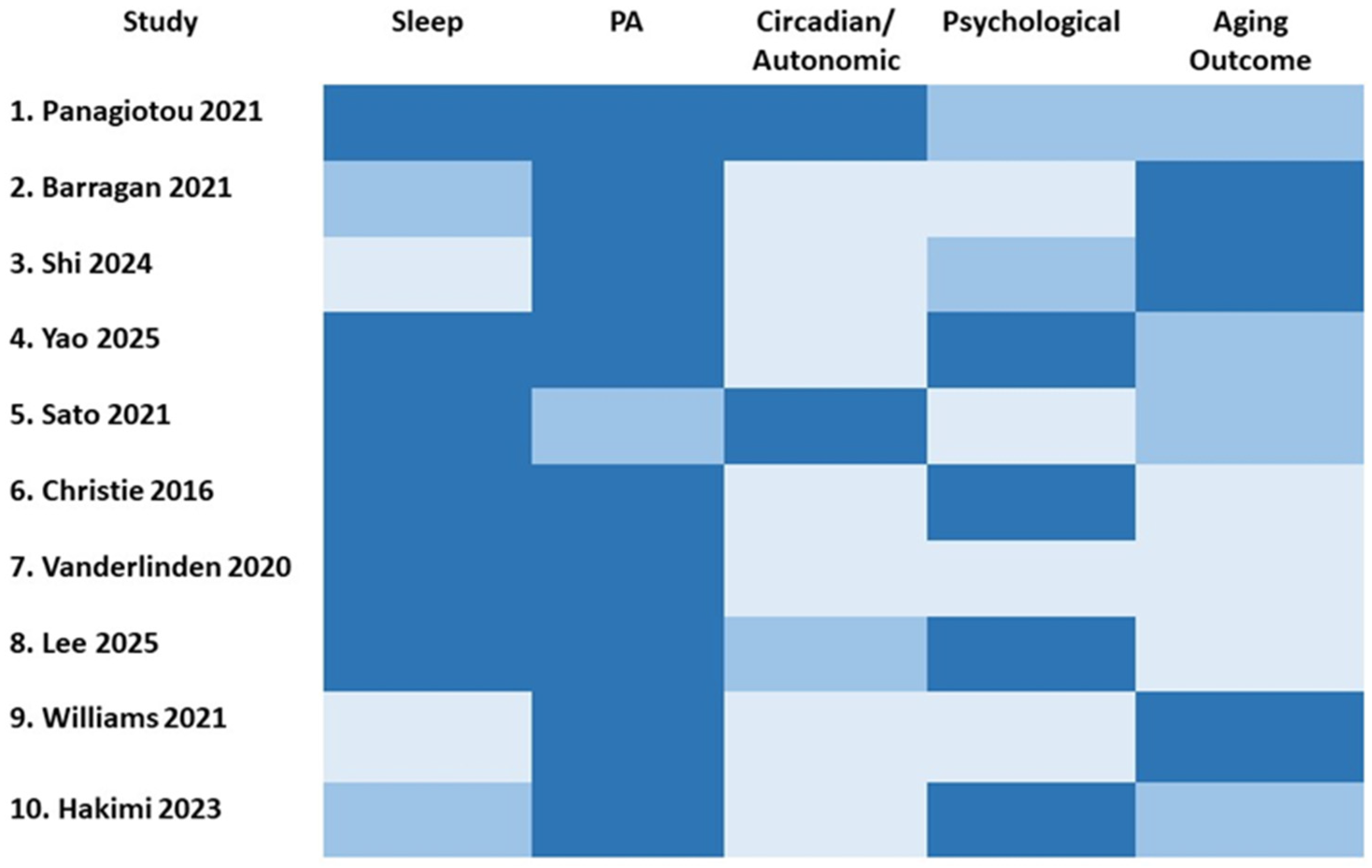



| Study (Author, Year) | Design & Sample | Key Variables | Main Findings | Relevance to Integrative Model |
|---|---|---|---|---|
| 1. Panagiotou et al., 2021 [13] The Aging Brain: Sleep, the Circadian Clock and Exercise | Mechanistic narrative review | Sleep architecture, circadian rhythms, neuroinflammation, exercise | Aging reduces circadian amplitude and SWS; exercise enhances neuroplasticity (BDNF) and improves sleep | Strong mechanistic support for Sleep ↔ PA ↔ Circadian Stability |
| 2. Barragán et al., 2021 [14] Physical Activity, Smoking, Sleep and Telomere Length | Systematic review (83 studies) | Telomere length, sleep duration/quality, PA, cellular aging | Poor sleep and inactivity predict shorter telomeres; PA and good sleep linked to slower biological aging | Supports biological aging pathways (oxidative stress, inflammation) |
| 3. Shi et al., 2024 [11] Sedentary Behavior, Light Activity and Healthy Aging | Large JAMA cohort study | Sedentary time, light PA, healthy aging index | Light PA and less sedentary time strongly associated with healthier aging trajectories | Reinforces PA → healthspan, importance of movement across the day |
| 4. Yao et al., 2025 [15] 24-h Movement, Mental Health & Cognition | Review | Sleep, PA, sedentary behavior, mental health, cognition | Integrated 24 h movement patterns strongly influence mental health and cognition; synergistic interactions | Aligns with holistic daily behavior framework central to integrative model |
| 5. Sato et al., 2021 [16] Autonomic Nervous Activity, Exercise, and Sleep in Older Adults | Narrative review | HRV, autonomic regulation, sleep efficiency, exercise | Exercise improves HRV; higher HRV connected to better sleep and functioning | Provides autonomic mechanism linking PA ↔ Sleep ↔ Aging |
| 6. Christie et al., 2016 [17] PA, Sleep Quality and Fatigue | Observational; adults across lifespan | PA, subjective SQ, fatigue | PA predicts better SQ and lower fatigue; strongest associations in older adults | Supports behavioral cascade PA → Sleep → Daytime vitality |
| 7. Vanderlinden et al., 2020 [10] PA Programs and Sleep in Older Adults | Systematic review of interventions | Structured PA, sleep outcomes (duration, efficiency) | Controlled PA programs improve sleep; real-world programs show inconsistent sleep benefits | Highlights contextual moderators (setting, adherence, sleep baseline) |
| 8. Lee et al., 2025 [18] Daily Reciprocal Relationships Between Affect, PA, and Sleep | Daily diary + accelerometry | Affect, PA, SQ/duration | Positive affect increases sleep & PA; poor sleep reduces next-day PA; strong day-level reciprocity | Demonstrates affect-driven feedback loops central to model |
| 9. Williams et al., 2021 [19] 24-h Movement Spectrum & Vascular Remodeling | Narrative review | Sedentary behavior, light/moderate/vigorous PA, vascular aging | PA across intensities improves vascular remodeling; sedentary time accelerates vascular aging | Adds vascular aging mechanism to PA pathways toward longevity |
| 10. Hakimi et al., 2023 [20] PA, Sedentary Behavior, Sleep and QoL in Older Adults | Systematic review | PA, sedentary behavior, sleep duration, QoL | Higher PA and adequate sleep predict better quality of life; sedentary behavior harms perceived health | Links behavioral patterns → QoL → subjective aging, supporting role of psychological pathways |
Disclaimer/Publisher’s Note: The statements, opinions and data contained in all publications are solely those of the individual author(s) and contributor(s) and not of MDPI and/or the editor(s). MDPI and/or the editor(s) disclaim responsibility for any injury to people or property resulting from any ideas, methods, instructions or products referred to in the content. |
© 2026 by the authors. Licensee MDPI, Basel, Switzerland. This article is an open access article distributed under the terms and conditions of the Creative Commons Attribution (CC BY) license.
Share and Cite
Pătru, O.; Păunescu, A.; Bena, A.; Luca, S.; Văcărescu, C.; Ciornei, A.-I.; Virtosu, M.; Enache, B.; Luca, C.-T.; Crisan, S. How We Sleep, How We Move, How Long We Expect to Live: An Integrative Review of Lifestyle Behaviors and Subjective Life Expectancy. Nutrients 2026, 18, 515. https://doi.org/10.3390/nu18030515
Pătru O, Păunescu A, Bena A, Luca S, Văcărescu C, Ciornei A-I, Virtosu M, Enache B, Luca C-T, Crisan S. How We Sleep, How We Move, How Long We Expect to Live: An Integrative Review of Lifestyle Behaviors and Subjective Life Expectancy. Nutrients. 2026; 18(3):515. https://doi.org/10.3390/nu18030515
Chicago/Turabian StylePătru, Oana, Andrei Păunescu, Andreea Bena, Silvia Luca, Cristina Văcărescu, Andreea-Iulia Ciornei, Mirela Virtosu, Bogdan Enache, Constantin-Tudor Luca, and Simina Crisan. 2026. "How We Sleep, How We Move, How Long We Expect to Live: An Integrative Review of Lifestyle Behaviors and Subjective Life Expectancy" Nutrients 18, no. 3: 515. https://doi.org/10.3390/nu18030515
APA StylePătru, O., Păunescu, A., Bena, A., Luca, S., Văcărescu, C., Ciornei, A.-I., Virtosu, M., Enache, B., Luca, C.-T., & Crisan, S. (2026). How We Sleep, How We Move, How Long We Expect to Live: An Integrative Review of Lifestyle Behaviors and Subjective Life Expectancy. Nutrients, 18(3), 515. https://doi.org/10.3390/nu18030515