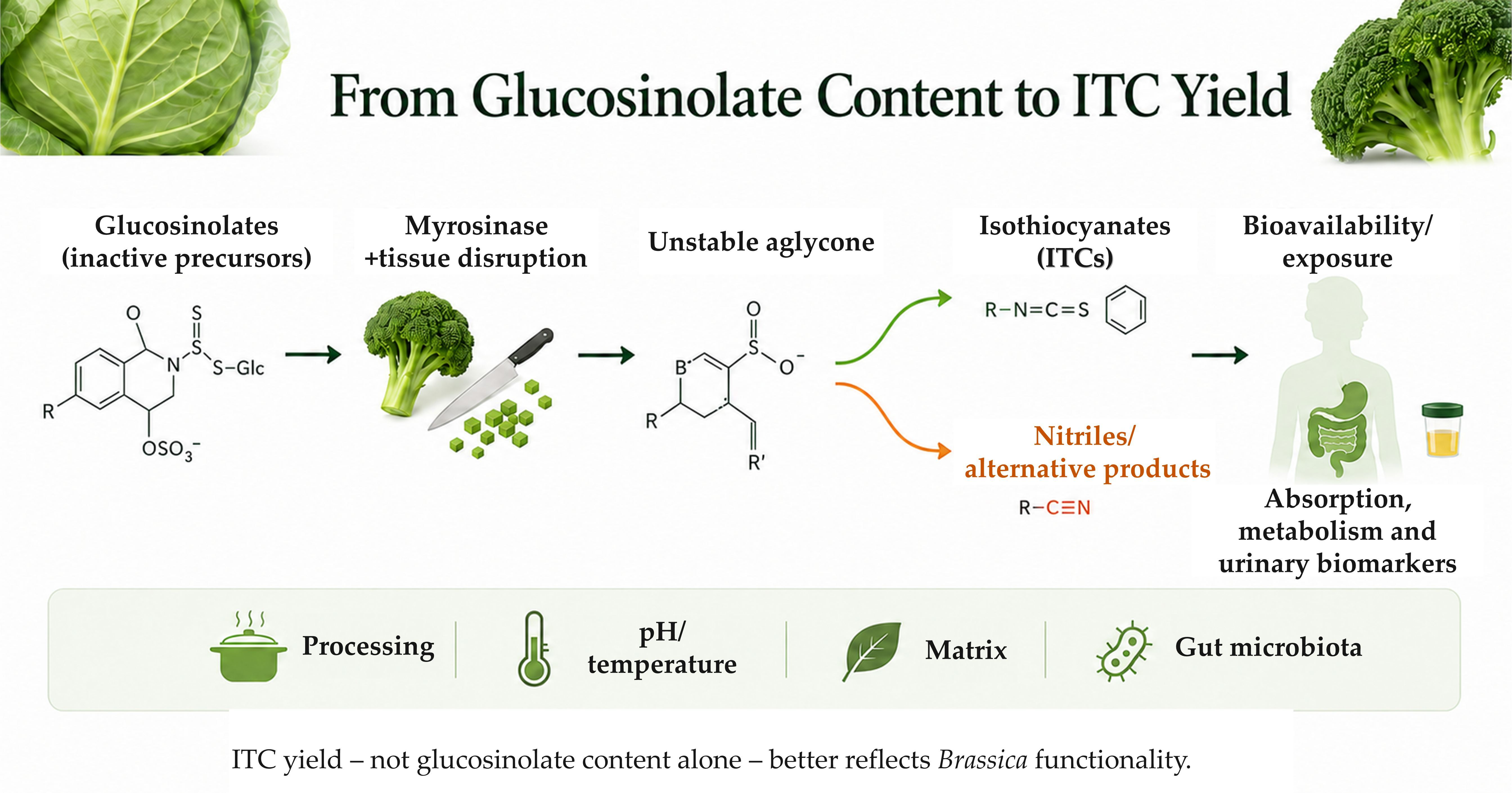
From Glucosinolate Content to Isothiocyanate Yield: Rethinking Brassica Functionality

 ,
,  , , and
Abstract
1. Introduction: Why Glucosinolate Content Is No Longer Enough
2. Literature Search Strategy
3. Glucosinolates as Precursors, Not Endpoints
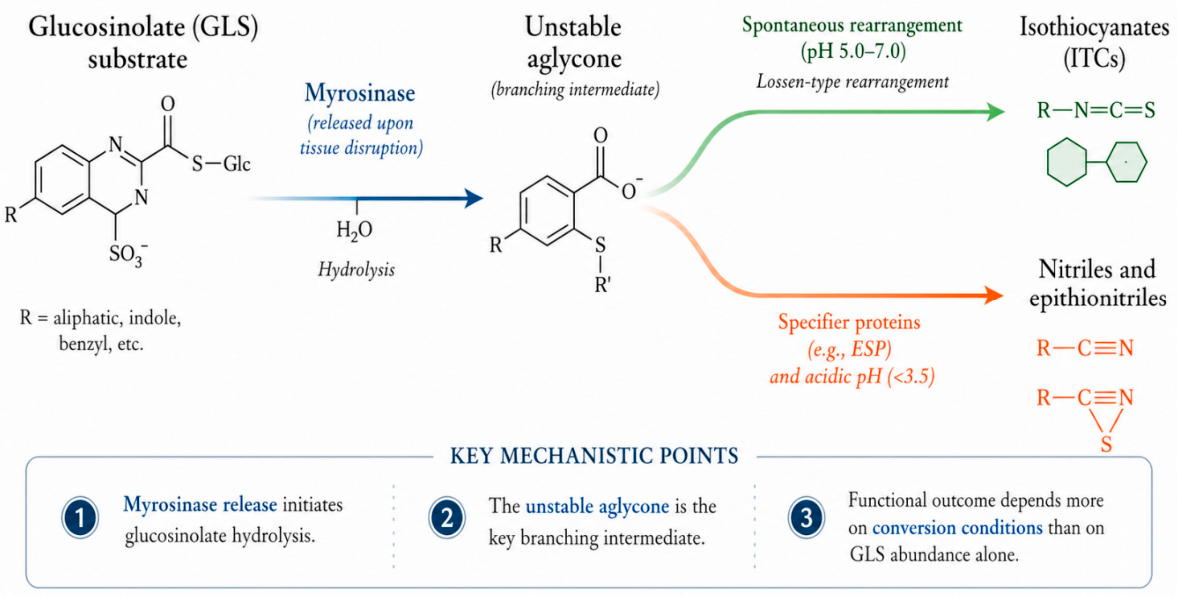
4. Glucosinolate Hydrolysis as a Functional Bottleneck
Enzymatic, Structural, and Tissue-Level Determinants of Glucosinolate Hydrolysis
5. Food Processing as a Determinant of Isothiocyanate Yield
5.1. Thermal Processing: A Double-Edged Sword
5.2. Non-Thermal and Enzyme-Assisted Strategies
6. Matrix Effects and Food Design: Brassica Functionality Depends on the System, Not Only the Plant
6.1. Co-Ingested Foods and pH Modulation
6.2. Lipid and Protein Interactions
6.3. Encapsulation and Delivery Systems
7. From Food Matrix to Human Exposure: Bioaccessibility, Gut Transformation, and the Limits of Prediction
7.1. Bioaccessibility and In Vitro Digestion
7.2. Gut Microbiota and Colonic Transformation
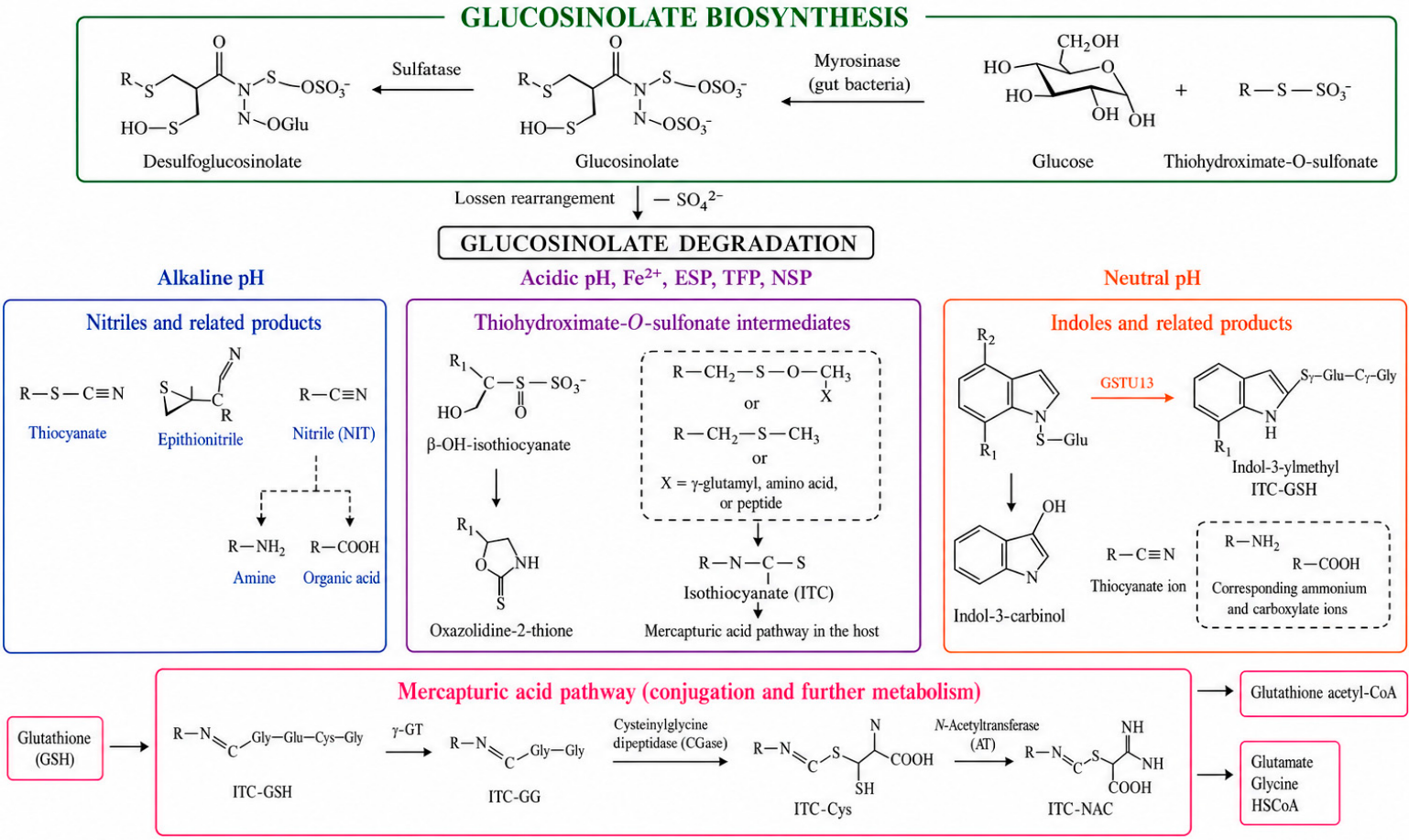
7.3. Absorption, Metabolism, and Excretion
8. Analytical Interpretation and the ITC-Yield Framework for Evaluating Brassica Foods
8.1. Glucosinolate Quantification: Precise but Incomplete
8.2. ITC Quantification: Challenges and Artifacts
8.3. Conversion Efficiency as the Analytical Bridge
initial molar amount of the available precursor glucosinolate) × 100.
8.4. Defining the ITC-Yield Framework
8.5. Implementing the ITC-Yield Framework
9. Implications for Product Development, Dietary Recommendations, and Food Innovation
9.1. Product Development and Quality Control
9.2. Dietary Recommendations and Public Health
9.3. Food Innovation and Sustainability
10. Limitations of the ITC-Yield Framework and Future Research Priorities
11. Conclusions
Author Contributions
Funding
Institutional Review Board Statement
Informed Consent Statement
Data Availability Statement
Acknowledgments
Conflicts of Interest
References
- Sarıkamış, G. Glucosinolates in Crucifers and Their Potential Effects against Cancer: Review. Can. J. Plant Sci. 2009, 89, 953–959. [Google Scholar] [CrossRef]
- Baldelli, S.; Lombardo, M.; D’Amato, A.; Karav, S.; Tripodi, G.; Aiello, G. Glucosinolates in Human Health: Metabolic Pathways, Bioavailability, and Potential in Chronic Disease Prevention. Foods 2025, 14, 912. [Google Scholar] [CrossRef] [PubMed]
- Wu, J.; Cui, S.; Liu, J.; Tang, X.; Zhao, J.; Zhang, H.; Mao, B.; Chen, W. The Recent Advances of Glucosinolates and Their Metabolites: Metabolism, Physiological Functions and Potential Application Strategies. Crit. Rev. Food Sci. Nutr. 2023, 63, 4217–4234. [Google Scholar] [CrossRef] [PubMed]
- Martinez-Ballesta, M.D.C.; Carvajal, M. Myrosinase in Brassicaceae: The Most Important Issue for Glucosinolate Turnover and Food Quality. Phytochem. Rev. 2015, 14, 1045–1051. [Google Scholar] [CrossRef]
- Wittstock, U.; Burow, M. Glucosinolate Breakdown in Arabidopsis: Mechanism, Regulation and Biological Significance. Arab. Book 2010, 8, e0134. [Google Scholar] [CrossRef] [PubMed]
- Hanschen, F.S.; Klopsch, R.; Oliviero, T.; Schreiner, M.; Verkerk, R.; Dekker, M. Optimizing Isothiocyanate Formation during Enzymatic Glucosinolate Breakdown by Adjusting pH Value, Temperature and Dilution in Brassica Vegetables and Arabidopsis Thaliana. Sci. Rep. 2017, 7, 40807. [Google Scholar] [CrossRef] [PubMed]
- Oliviero, T.; Verkerk, R.; Dekker, M. Isothiocyanates from Brassica Vegetables—Effects of Processing, Cooking, Mastication, and Digestion. Mol. Nutr. Food Res. 2018, 62, 1701069. [Google Scholar] [CrossRef] [PubMed]
- Barba, F.J.; Nikmaram, N.; Roohinejad, S.; Khelfa, A.; Zhu, Z.; Koubaa, M. Bioavailability of Glucosinolates and Their Breakdown Products: Impact of Processing. Front. Nutr. 2016, 3, 24. [Google Scholar] [CrossRef] [PubMed]
- Hinojosa-Luna, A.; Pérez-Rodríguez, F.; Lafont-Déniz, F.; Luque-Ojeda, J.L.; Cámara-Martos, F. The Influence of Physiological pH Conditions and Myrosinase Activity on Glucosinolate Hydrolysis and Isothiocyanate Formation during the in Vitro Digestion of Mustard By-Products. Food Chem. 2026, 508, 148390. [Google Scholar] [CrossRef] [PubMed]
- Ko, D.-Y.; Seo, S.-M.; Lee, Y.-H.; Gil, C.S.; Lee, H.; Ku, K.-M. Turning Glucosinolate into Allelopathic Fate: Investigating Allyl Isothiocyanate Variability and Nitrile Formation in Eco-Friendly Brassica juncea from South Korea. Sci. Rep. 2024, 14, 15423. [Google Scholar] [CrossRef] [PubMed]
- Baenas, N.; Marhuenda, J.; García-Viguera, C.; Zafrilla, P.; Moreno, D. Influence of Cooking Methods on Glucosinolates and Isothiocyanates Content in Novel Cruciferous Foods. Foods 2019, 8, 257. [Google Scholar] [CrossRef] [PubMed]
- Wu, Y.; Shen, Y.; Wu, X.; Zhu, Y.; Mupunga, J.; Bao, W.; Huang, J.; Mao, J.; Liu, S.; You, Y. Hydrolysis before Stir-Frying Increases the Isothiocyanate Content of Broccoli. J. Agric. Food Chem. 2018, 66, 1509–1515. [Google Scholar] [CrossRef] [PubMed]
- Okunade, O.; Niranjan, K.; Ghawi, S.K.; Kuhnle, G.; Methven, L. Supplementation of the Diet by Exogenous Myrosinase via Mustard Seeds to Increase the Bioavailability of Sulforaphane in Healthy Human Subjects after the Consumption of Cooked Broccoli. Mol. Nutr. Food Res. 2018, 62, 1700980. [Google Scholar] [CrossRef] [PubMed]
- Sarvan, I.; Kramer, E.; Bouwmeester, H.; Dekker, M.; Verkerk, R. Sulforaphane Formation and Bioaccessibility Are More Affected by Steaming Time than Meal Composition during in Vitro Digestion of Broccoli. Food Chem. 2017, 214, 580–586. [Google Scholar] [CrossRef] [PubMed]
- Mastaloudis, A.; Holcomb, L.; Fahey, J.W.; Sakaguchi, C.A.; Nieman, D.C.; Kay, C.; O’Donnell, R.; Pecorelli, A.; Kinney, M.; Li, Y.; et al. Exogenous Myrosinase from Mustard Seed Increases Bioavailability of Sulforaphane from a Glucoraphanin-Rich Broccoli Seed Extract in a Randomized Clinical Study. Sci. Rep. 2026, 16, 9162. [Google Scholar] [CrossRef] [PubMed]
- Sikorska-Zimny, K.; Beneduce, L. The Glucosinolates and Their Bioactive Derivatives in Brassica: A Review on Classification, Biosynthesis and Content in Plant Tissues, Fate during and after Processing, Effect on the Human Organism and Interaction with the Gut Microbiota. Crit. Rev. Food Sci. Nutr. 2021, 61, 2544–2571. [Google Scholar] [CrossRef] [PubMed]
- Sun, J.; Wang, Y.; Pang, X.; Tian, S.; Hu, Q.; Li, X.; Liu, J.; Wang, J.; Lu, Y. The Effect of Processing and Cooking on Glucoraphanin and Sulforaphane in Brassica Vegetables. Food Chem. 2021, 360, 130007. [Google Scholar] [CrossRef] [PubMed]
- Oliviero, T.; Verkerk, R.; Vermeulen, M.; Dekker, M. In Vivo Formation and Bioavailability of Isothiocyanates from Glucosinolates in Broccoli as Affected by Processing Conditions. Mol. Nutr. Food Res. 2014, 58, 1447–1456. [Google Scholar] [CrossRef] [PubMed]
- Dmytriv, T.R.; Lushchak, O.; Lushchak, V.I. Glucoraphanin Conversion into Sulforaphane and Related Compounds by Gut Microbiota. Front. Physiol. 2025, 16, 1497566. [Google Scholar] [CrossRef] [PubMed]
- Bouranis, J.A.; Beaver, L.M.; Wong, C.P.; Choi, J.; Hamer, S.; Davis, E.W.; Brown, K.S.; Jiang, D.; Sharpton, T.J.; Stevens, J.F.; et al. Sulforaphane and Sulforaphane-Nitrile Metabolism in Humans Following Broccoli Sprout Consumption: Inter-individual Variation, Association with Gut Microbiome Composition, and Differential Bioactivity. Mol. Nutr. Food Res. 2024, 68, 2300286. [Google Scholar] [CrossRef] [PubMed]
- Fahey, J.W.; Holtzclaw, W.D.; Wehage, S.L.; Wade, K.L.; Stephenson, K.K.; Talalay, P. Sulforaphane Bioavailability from Glucoraphanin-Rich Broccoli: Control by Active Endogenous Myrosinase. PLoS ONE 2015, 10, e0140963. [Google Scholar] [CrossRef] [PubMed]
- Bhat, R.; Vyas, D. Myrosinase: Insights on Structural, Catalytic, Regulatory, and Environmental Interactions. Crit. Rev. Biotechnol. 2019, 39, 508–523. [Google Scholar] [CrossRef] [PubMed]
- Liu, Y.; Rossi, M.; Liang, X.; Zhang, H.; Zou, L.; Ong, C.N. An Integrated Metabolomics Study of Glucosinolate Metabolism in Different Brassicaceae Genera. Metabolites 2020, 10, 313. [Google Scholar] [CrossRef] [PubMed]
- Wang, J.; Yu, S.; Ren, X.; Wang, Y.; Wang, Z.; Meng, Q.; Huang, Y.; Wang, Y. Integrative Analyses of Metabolites and Transcriptome Reveal the Metabolic Pattern of Glucosinolates in Potherb Mustard (Brassica juncea var. multiceps). Plants 2024, 13, 2481. [Google Scholar] [CrossRef] [PubMed]
- Yuanfeng, W.; Chengzhi, L.; Ligen, Z.; Juan, S.; Xinjie, S.; Yao, Z.; Jianwei, M. Approaches for Enhancing the Stability and Formation of Sulforaphane. Food Chem. 2021, 345, 128771. [Google Scholar] [CrossRef] [PubMed]
- Bhat, R. Glucosinolates. In Nutraceuticals and Health Care; Elsevier: Amsterdam, The Netherlands, 2022; pp. 233–243. ISBN 978-0-323-89779-2. [Google Scholar]
- Parchem, K.; Piekarska, A.; Bartoszek, A. Enzymatic Activities behind Degradation of Glucosinolates. In Glucosinolates: Properties, Recovery, and Applications; Elsevier: Amsterdam, The Netherlands, 2020; pp. 79–106. ISBN 978-0-12-816493-8. [Google Scholar]
- Hanschen, F.S.; Schreiner, M. Isothiocyanates, Nitriles, and Epithionitriles from Glucosinolates Are Affected by Genotype and Developmental Stage in Brassica oleracea Varieties. Front. Plant Sci. 2017, 8, 1095. [Google Scholar] [CrossRef] [PubMed]
- Hanschen, F.S. Acidification and Tissue Disruption Affect Glucosinolate and S-Methyl-l-Cysteine Sulfoxide Hydrolysis and Formation of Amines, Isothiocyanates and Other Organosulfur Compounds in Red Cabbage (Brassica oleracea var. capitata f. rubra). Food Res. Int. 2024, 178, 114004. [Google Scholar] [CrossRef] [PubMed]
- Mbudu, K.G.; Witzel, K.; Börnke, F.; Hanschen, F.S. Glucosinolate Profile and Specifier Protein Activity Determine the Glucosinolate Hydrolysis Product Formation in Kohlrabi (Brassica oleracea var. gongylodes) in a Tissue-Specific Way. Food Chem. 2025, 465, 142032. [Google Scholar] [CrossRef] [PubMed]
- Angelino, D.; Jeffery, E. Glucosinolate Hydrolysis and Bioavailability of Resulting Isothiocyanates: Focus on Glucoraphanin. J. Funct. Foods 2014, 7, 67–76. [Google Scholar] [CrossRef]
- Abukhabta, S.; Khalil Ghawi, S.; Karatzas, K.A.; Charalampopoulos, D.; McDougall, G.; Allwood, J.W.; Verrall, S.; Lavery, S.; Latimer, C.; Pourshahidi, L.K.; et al. Sulforaphane-Enriched Extracts from Glucoraphanin-Rich Broccoli Exert Antimicrobial Activity against Gut Pathogens in Vitro and Innovative Cooking Methods Increase in Vivo Intestinal Delivery of Sulforaphane. Eur. J. Nutr. 2021, 60, 1263–1276. [Google Scholar] [CrossRef] [PubMed]
- Kołodziejski, D.; Piekarska, A.; Hanschen, F.S.; Pilipczuk, T.; Tietz, F.; Kusznierewicz, B.; Bartoszek, A. Relationship between Conversion Rate of Glucosinolates to Isothiocyanates/Indoles and Genotoxicity of Individual Parts of Brassica Vegetables. Eur. Food Res. Technol. 2019, 245, 383–400. [Google Scholar] [CrossRef]
- Felker, P.; Bunch, R.; Leung, A.M. Concentrations of Thiocyanate and Goitrin in Human Plasma, Their Precursor Concentrations in Brassica Vegetables, and Associated Potential Risk for Hypothyroidism. Nutr. Rev. 2016, 74, 248–258. [Google Scholar] [CrossRef] [PubMed]
- Galanty, A.; Grudzińska, M.; Paździora, W.; Służały, P.; Paśko, P. Do Brassica Vegetables Affect Thyroid Function?– A Comprehensive Systematic Review. Int. J. Mol. Sci. 2024, 25, 3988. [Google Scholar] [CrossRef] [PubMed]
- Panduang, T.; Phucharoenrak, P.; Karnpanit, W.; Trachootham, D. Cooking Methods for Preserving Isothiocyanates and Reducing Goitrin in Brassica Vegetables. Foods 2023, 12, 3647. [Google Scholar] [CrossRef] [PubMed]
- Púčiková, V.; Rohn, S.; Hanschen, F.S. Glucosinolate Accumulation and Hydrolysis in Leafy Brassica Vegetables Are Influenced by Leaf Age. J. Agric. Food Chem. 2023, 71, 11466–11475. [Google Scholar] [CrossRef] [PubMed]
- Cai, Y.X.; Wang, J.H.; McAuley, C.; Augustin, M.A.; Terefe, N.S. Fermentation for Enhancing the Bioconversion of Glucoraphanin into Sulforaphane and Improve the Functional Attributes of Broccoli Puree. J. Funct. Foods 2019, 61, 103461. [Google Scholar] [CrossRef]
- Cai, Y.X.; Augustin, M.A.; Jegasothy, H.; Wang, J.H.; Terefe, N.S. Mild Heat Combined with Lactic Acid Fermentation: A Novel Approach for Enhancing Sulforaphane Yield in Broccoli Puree. Food Funct. 2020, 11, 779–786. [Google Scholar] [CrossRef] [PubMed]
- Luang-In, V.; Deeseenthum, S.; Udomwong, P.; Saengha, W.; Gregori, M. Formation of Sulforaphane and Iberin Products from Thai Cabbage Fermented by Myrosinase-Positive Bacteria. Molecules 2018, 23, 955. [Google Scholar] [CrossRef] [PubMed]
- Kong, X.Y.; Kissen, R.; Bones, A.M. Characterization of Recombinant Nitrile-Specifier Proteins (NSPs) of Arabidopsis Thaliana: Dependency on Fe(II) Ions and the Effect of Glucosinolate Substrate and Reaction Conditions. Phytochemistry 2012, 84, 7–17. [Google Scholar] [CrossRef] [PubMed]
- Eisenschmidt-Bönn, D.; Schneegans, N.; Backenköhler, A.; Wittstock, U.; Brandt, W. Structural Diversification during Glucosinolate Breakdown: Mechanisms of Thiocyanate, Epithionitrile and Simple Nitrile Formation. Plant J. 2019, 99, 329–343. [Google Scholar] [CrossRef] [PubMed]
- Witzel, K.; Abu Risha, M.; Albers, P.; Börnke, F.; Hanschen, F.S. Identification and Characterization of Three Epithiospecifier Protein Isoforms in Brassica oleracea. Front. Plant Sci. 2019, 10, 1552. [Google Scholar] [CrossRef] [PubMed]
- Han, D.; Tan, J.; Yue, Z.; Tao, P.; Lei, J.; Zang, Y.; Hu, Q.; Wang, H.; Zhang, S.; Li, B.; et al. Genome-Wide Identification and Expression Analysis of ESPs and NSPs Involved in Glucosinolate Hydrolysis and Insect Attack Defense in Chinese Cabbage (Brassica rapa subsp. pekinensis). Plants 2023, 12, 1123. [Google Scholar] [CrossRef] [PubMed]
- Mbudu, K.G.; Witzel, K.; Börnke, F.; Hanschen, F.S. Impact of Epithiospecifier Proteins on the Formation of Isothiocyanates, Nitriles and Epithionitriles from Glucosinolate Hydrolysis in Kohlrabi. Lebensmittelchemie 2022, 76, S2-347. [Google Scholar] [CrossRef]
- Pardini, A.; Tamasi, G.; De Rocco, F.; Bonechi, C.; Consumi, M.; Leone, G.; Magnani, A.; Rossi, C. Kinetics of Glucosinolate Hydrolysis by Myrosinase in Brassicaceae Tissues: A High-Performance Liquid Chromatography Approach. Food Chem. 2021, 355, 129634. [Google Scholar] [CrossRef] [PubMed]
- Liang, X.; Niu, C.; Jiang, C.; Li, D.; Zou, L.; Zhang, Y.; Benito, M.J.; Cheng, Y.; Wu, Y. Characterization of Myrosinase-Mediated Glucosinolate Degradation Pathways in Lactiplantibacillus Plantarum ZUST49. J. Agric. Food Chem. 2025, 73, 7256–7269. [Google Scholar] [CrossRef] [PubMed]
- Liu, M.; Zhang, L.; Ser, S.; Cumming, J.; Ku, K.-M. Comparative Phytonutrient Analysis of Broccoli By-Products: The Potentials for Broccoli By-Product Utilization. Molecules 2018, 23, 900. [Google Scholar] [CrossRef] [PubMed]
- Shikano, H.; Nakasato, Y.R.; Tian, R.; Shinoda, T.; Taira, S. Imaging Mass Spectrometry Reveals In Situ Conversion of Glucosinolates to Bioactive Isothiocyanates in Cabbage. J. Agric. Food Chem. 2026, 74, 706–712. [Google Scholar] [CrossRef] [PubMed]
- Lu, Y.; Pang, X.; Yang, T. Microwave Cooking Increases Sulforaphane Level in Broccoli. Food Sci. Nutr. 2020, 8, 2052–2058. [Google Scholar] [CrossRef] [PubMed]
- Castillejo, N.; Martínez-Hernández, G.B.; Lozano-Guerrero, A.J.; Pedreño-Molina, J.L.; Gómez, P.A.; Aguayo, E.; Artés, F.; Artés-Hernández, F. Microwave Heating Modelling of a Green Smoothie: Effects on Glucoraphanin, Sulforaphane and S-methyl Cysteine Sulfoxide Changes during Storage. J. Sci. Food Agric. 2018, 98, 1863–1872. [Google Scholar] [CrossRef] [PubMed]
- Wu, X.; Huang, H.; Childs, H.; Wu, Y.; Yu, L.; Pehrsson, P.R. Glucosinolates in Brassica Vegetables: Characterization and Factors That Influence Distribution, Content, and Intake. Annu. Rev. Food Sci. Technol. 2021, 12, 485–511. [Google Scholar] [CrossRef] [PubMed]
- Nugrahedi, P.Y.; Verkerk, R.; Widianarko, B.; Dekker, M. A Mechanistic Perspective on Process-Induced Changes in Glucosinolate Content in Brassica Vegetables: A Review. Crit. Rev. Food Sci. Nutr. 2015, 55, 823–838. [Google Scholar] [CrossRef] [PubMed]
- Oloyede, O.O.; Wagstaff, C.; Methven, L. The Impact of Domestic Cooking Methods on Myrosinase Stability, Glucosinolates and Their Hydrolysis Products in Different Cabbage (Brassica oleracea) Accessions. Foods 2021, 10, 2908. [Google Scholar] [CrossRef] [PubMed]
- Sadowska-Rociek, A.; Doniec, J.; Kusznierewicz, B.; Dera, T.; Filipiak-Florkiewicz, A.; Florkiewicz, A. The Influence of Different Hydrothermal Processes Used in the Preparation of Brussels Sprouts on the Availability of Glucosinolates to Humans. Foods 2024, 13, 2988. [Google Scholar] [CrossRef] [PubMed]
- Soares, A.; Carrascosa, C.; Raposo, A. Influence of Different Cooking Methods on the Concentration of Glucosinolates and Vitamin C in Broccoli. Food Bioprocess Technol. 2017, 10, 1387–1411. [Google Scholar] [CrossRef]
- Nugrahedi, P.Y.; Oliviero, T.; Heising, J.K.; Dekker, M.; Verkerk, R. Stir-Frying of Chinese Cabbage and Pakchoi Retains Health-Promoting Glucosinolates. Plant Foods Hum. Nutr. 2017, 72, 439–444. [Google Scholar] [CrossRef] [PubMed]
- Wang, Z.; Kwan, M.L.; Pratt, R.; Roh, J.M.; Kushi, L.H.; Danforth, K.N.; Zhang, Y.; Ambrosone, C.B.; Tang, L. Effects of Cooking Methods on Total Isothiocyanate Yield from Cruciferous Vegetables. Food Sci. Nutr. 2020, 8, 5673–5682. [Google Scholar] [CrossRef] [PubMed]
- Westphal, A.; Riedl, K.M.; Cooperstone, J.L.; Kamat, S.; Balasubramaniam, V.M.; Schwartz, S.J.; Böhm, V. High-Pressure Processing of Broccoli Sprouts: Influence on Bioactivation of Glucosinolates to Isothiocyanates. J. Agric. Food Chem. 2017, 65, 8578–8585. [Google Scholar] [CrossRef] [PubMed]
- Okunade, O.A.; Ghawi, S.K.; Methven, L.; Niranjan, K. Thermal and Pressure Stability of Myrosinase Enzymes from Black Mustard (Brassica nigra L. W.D.J. Koch. var. nigra), Brown Mustard (Brassica juncea L. Czern. var. juncea) and Yellow Mustard (Sinapsis alba L. subsp. maire) Seeds. Food Chem. 2015, 187, 485–490. [Google Scholar] [CrossRef] [PubMed]
- Mullaney, J.A.; Kelly, W.J.; McGhie, T.K.; Ansell, J.; Heyes, J.A. Lactic Acid Bacteria Convert Glucosinolates to Nitriles Efficiently Yet Differently from Enterobacteriaceae. J. Agric. Food Chem. 2013, 61, 3039–3046. [Google Scholar] [CrossRef] [PubMed]
- Angelino, D.; Dosz, E.B.; Sun, J.; Hoeflinger, J.L.; Van Tassell, M.L.; Chen, P.; Harnly, J.M.; Miller, M.J.; Jeffery, E.H. Myrosinase-Dependent and –Independent Formation and Control of Isothiocyanate Products of Glucosinolate Hydrolysis. Front. Plant Sci. 2015, 6, 157079. [Google Scholar] [CrossRef] [PubMed]
- Wang, G.C.; Farnham, M.; Jeffery, E.H. Impact of Thermal Processing on Sulforaphane Yield from Broccoli (Brassica oleracea L. Ssp. Italica). J. Agric. Food Chem. 2012, 60, 6743–6748. [Google Scholar] [CrossRef] [PubMed]
- Dosz, E.B.; Jeffery, E.H. Modifying the Processing and Handling of Frozen Broccoli for Increased Sulforaphane Formation. J. Food Sci. 2013, 78, H1459–H1463. [Google Scholar] [CrossRef] [PubMed]
- Ghawi, S.K.; Shen, Y.; Niranjan, K.; Methven, L. Consumer Acceptability and Sensory Profile of Cooked Broccoli with Mustard Seeds Added to Improve Chemoprotective Properties. J. Food Sci. 2014, 79, S1756–S1762. [Google Scholar] [CrossRef] [PubMed]
- Deng, Q.; Zinoviadou, K.G.; Galanakis, C.M.; Orlien, V.; Grimi, N.; Vorobiev, E.; Lebovka, N.; Barba, F.J. The Effects of Conventional and Non-Conventional Processing on Glucosinolates and Its Derived Forms, Isothiocyanates: Extraction, Degradation, and Applications. Food Eng. Rev. 2015, 7, 357–381. [Google Scholar] [CrossRef]
- Nugrahedi, P.Y.; Widianarko, B.; Dekker, M.; Verkerk, R.; Oliviero, T. Retention of Glucosinolates during Fermentation of Brassica Juncea: A Case Study on Production of Sayur Asin. Eur. Food Res. Technol. 2015, 240, 559–565. [Google Scholar] [CrossRef]
- Qinghang, W.; Zhang, C.; Zhang, J.; Xin, X.; Li, T.; He, C.; Zhao, S.; Liu, D. Variation in Glucosinolates and the Formation of Functional Degradation Products in Two Brassica Species during Spontaneous Fermentation. Curr. Res. Food Sci. 2023, 6, 100493. [Google Scholar] [CrossRef] [PubMed]
- Shokri, S.; Jegasothy, H.; Hliang, M.M.; Augustin, M.A.; Terefe, N.S. Thermosonication of Broccoli Florets Prior to Fermentation Increases Bioactive Components in Fermented Broccoli Puree. Fermentation 2022, 8, 236. [Google Scholar] [CrossRef]
- Giambanelli, E.; Verkerk, R.; Fogliano, V.; Capuano, E.; D’Antuono, L.F.; Oliviero, T. Broccoli Glucosinolate Degradation Is Reduced Performing Thermal Treatment in Binary Systems with Other Food Ingredients. RSC Adv. 2015, 5, 66894–66900. [Google Scholar] [CrossRef]
- Lopes, V.D.V.; Brito, F.O.; Lopes, J.D.O.; Fabiano, G.A.; Soares, C.L.; Citelli, M.; Zago, L.; Antunes, A.E.C.; Evans, M.; Stenvinkel, P.; et al. In Vitro Gastrointestinal Digestion of Broccolis Sprout Extract: Impact on the Bioaccesibility of Sulforaphane and Total Phenolic. Food Res. Int. 2025, 217, 116795. [Google Scholar] [CrossRef] [PubMed]
- Castro-Torres, I.G.; Castro-Torres, V.A.; Hernández-Lozano, M.; Naranjo-Rodríguez, E.B.; Domínguez-Ortiz, M.Á. Glucosinolates and Metabolism. In Glucosinolates: Properties, Recovery, and Applications; Elsevier: Amsterdam, The Netherlands, 2020; pp. 107–141. ISBN 978-0-12-816493-8. [Google Scholar]
- Salas-Millán, J.Á.; Aguayo, E. Bioaccessibility and Unravelling of Polyphenols, Sulforaphane, and Indoles Biotransformation after in Vitro Gastrointestinal Digestion of a Novel Lactofermented Broccoli Beverage. Food Funct. 2024, 15, 11949–11960. [Google Scholar] [CrossRef] [PubMed]
- Rungapamestry, V.; Duncan, A.J.; Fuller, Z.; Ratcliffe, B. Effect of Meal Composition and Cooking Duration on the Fate of Sulforaphane Following Consumption of Broccoli by Healthy Human Subjects. Br. J. Nutr. 2007, 97, 644–652. [Google Scholar] [CrossRef] [PubMed]
- Fanesi, B.; Ismaiel, L.; Nartea, A.; Orhotohwo, O.L.; Kuhalskaya, A.; Pacetti, D.; Lucci, P.; Falcone, P.M. Bioactives and Technological Quality of Functional Biscuits Containing Flour and Liquid Extracts from Broccoli By-Products. Antioxidants 2023, 12, 2115. [Google Scholar] [CrossRef] [PubMed]
- Zhang, Y.; Zhang, W.; Zhao, Y.; Peng, R.; Zhang, Z.; Xu, Z.; Simal-Gandara, J.; Yang, H.; Deng, J. Bioactive Sulforaphane from Cruciferous Vegetables: Advances in Biosynthesis, Metabolism, Bioavailability, Delivery, Health Benefits, and Applications. Crit. Rev. Food Sci. Nutr. 2025, 65, 3027–3047. [Google Scholar] [CrossRef] [PubMed]
- Orlando, P.; Nartea, A.; Silvestri, S.; Marcheggiani, F.; Cirilli, I.; Dludla, P.V.; Fiorini, R.; Pacetti, D.; Loizzo, M.R.; Lucci, P.; et al. Bioavailability Study of Isothiocyanates and Other Bioactive Compounds of Brassica oleracea L. var. Italica Boiled or Steamed: Functional Food or Dietary Supplement? Antioxidants 2022, 11, 209. [Google Scholar] [CrossRef] [PubMed]
- Tian, S.; Liu, X.; Lei, P.; Zhang, X.; Shan, Y. Microbiota: A Mediator to Transform Glucosinolate Precursors in Cruciferous Vegetables to the Active Isothiocyanates. J. Sci. Food Agric. 2018, 98, 1255–1260. [Google Scholar] [CrossRef] [PubMed]
- Cámara-Martos, F.; Bolívar, A.; Rabasco-Vílchez, L.; Lafont-Déniz, F.; Luque-Ojeda, J.L.; Pérez-Rodríguez, F. Exploring the Bioaccessibility, in Vitro Colonic Fermentation, and the Impact on the Intestinal Microbiota of Allyl-and Benzyl-Isothiocyanate from White and Ethiopian Mustard. Food Res. Int. 2025, 203, 115781. [Google Scholar] [CrossRef] [PubMed]
- Zhao, A.; Li, J.; Peterson, M.; Black, M.; Gaulke, C.A.; Jeffery, E.H.; Miller, M.J. Cooked Broccoli Alters Cecal Microbiota and Impacts Microbial Metabolism of Glucoraphanin in Lean and Obese Mice. Mol. Nutr. Food Res. 2025, 69, e202400813. [Google Scholar] [CrossRef] [PubMed]
- Bricker, G.V.; Riedl, K.M.; Ralston, R.A.; Tober, K.L.; Oberyszyn, T.M.; Schwartz, S.J. Isothiocyanate Metabolism, Distribution, and Interconversion in Mice Following Consumption of Thermally Processed Broccoli Sprouts or Purified Sulforaphane. Mol. Nutr. Food Res. 2014, 58, 1991–2000. [Google Scholar] [CrossRef] [PubMed]
- Shekarri, Q.; Dekker, M. A Physiological-Based Model for Simulating the Bioavailability and Kinetics of Sulforaphane from Broccoli Products. Foods 2021, 10, 2761. [Google Scholar] [CrossRef] [PubMed]
- Narra, F.; Galgani, G.; Harris, C.B.; Moreno, D.A.; Núñez-Gómez, V. Bioavailability, Human Metabolism, and Dietary Interventions of Glucosinolates and Isothiocyanates: Critical Insights and Future Perspectives. Foods 2025, 14, 2876. [Google Scholar] [CrossRef] [PubMed]
- Kyriakou, S.; Alshehhi, S.S.M.; Franco, R.; Pappa, A.; Panayiotidis, M.I. Comparative Profiling of Glucosinolate and Isothiocyanate Contents across Various Edible Vegetables of the Brassicaceae and Order Brassicales Superfamilies. J. Food Compos. Anal. 2026, 153, 109062. [Google Scholar] [CrossRef]
- Hahn, C.; Müller, A.; Kuhnert, N.; Albach, D.C. A Cold Case—Glucosinolate Levels in Kale Cultivars Are Differently Influenced by Cold Temperatures. Horticulturae 2023, 9, 953. [Google Scholar] [CrossRef]
- Blažević, I.; Montaut, S.; Burčul, F.; Olsen, C.E.; Burow, M.; Rollin, P.; Agerbirk, N. Glucosinolate Structural Diversity, Identification, Chemical Synthesis and Metabolism in Plants. Phytochemistry 2020, 169, 112100. [Google Scholar] [CrossRef] [PubMed]
- Agerbirk, N.; Olsen, C.E. Glucosinolate Structures in Evolution. Phytochemistry 2012, 77, 16–45. [Google Scholar] [CrossRef] [PubMed]
- Li, Z.; Zheng, S.; Liu, Y.; Fang, Z.; Yang, L.; Zhuang, M.; Zhang, Y.; Lv, H.; Wang, Y.; Xu, D. Characterization of Glucosinolates in 80 Broccoli Genotypes and Different Organs Using UHPLC-Triple-TOF-MS Method. Food Chem. 2021, 334, 127519. [Google Scholar] [CrossRef] [PubMed]
- Kapusta-Duch, J.; Kusznierewicz, B.; Leszczyńska, T.; Borczak, B. Effect of Cooking on the Contents of Glucosinolates and Their Degradation Products in Selected Brassica Vegetables. J. Funct. Foods 2016, 23, 412–422. [Google Scholar] [CrossRef]
- Atwell, L.L.; Hsu, A.; Wong, C.P.; Stevens, J.F.; Bella, D.; Yu, T.-W.; Pereira, C.B.; Löhr, C.V.; Christensen, J.M.; Dashwood, R.H.; et al. Absorption and Chemopreventive Targets of Sulforaphane in Humans Following Consumption of Broccoli Sprouts or a Myrosinase-Treated Broccoli Sprout Extract. Mol. Nutr. Food Res. 2015, 59, 424–433. [Google Scholar] [CrossRef] [PubMed]
- Clarke, J.D.; Hsu, A.; Riedl, K.; Bella, D.; Schwartz, S.J.; Stevens, J.F.; Ho, E. Bioavailability and Inter-Conversion of Sulforaphane and Erucin in Human Subjects Consuming Broccoli Sprouts or Broccoli Supplement in a Cross-over Study Design. Pharmacol. Res. 2011, 64, 456–463. [Google Scholar] [CrossRef] [PubMed]
- Miao, H.; Xia, C.; Yu, S.; Wang, J.; Zhao, Y.; Wang, Q. Enhancing Health-Promoting Isothiocyanates in Chinese Kale Sprouts via Manipulating BoESP. Hortic. Res. 2023, 10, uhad029. [Google Scholar] [CrossRef] [PubMed]
- Wang, J.; Shen, Y.; Sheng, X.; Yu, H.; Song, M.; Wang, Q.; Gu, H. Unravelling Glucoraphanin and Glucoerucin Metabolism across Broccoli Sprout Development: Insights from Metabolite and Transcriptome Analysis. Plants 2024, 13, 750. [Google Scholar] [CrossRef] [PubMed]
- Zhao, Y.; Yue, Z.; Zhong, X.; Lei, J.; Tao, P.; Li, B. Distribution of Primary and Secondary Metabolites among the Leaf Layers of Headed Cabbage (Brassica oleracea var. capitata). Food Chem. 2020, 312, 126028. [Google Scholar] [CrossRef] [PubMed]
- Pan, Q.; Zhang, J.; Yan, C.; Khan, A.; Fei, S.; Lei, T.; Xu, Z.; Li, B.; Zhang, R.; Hui, M. Distribution of Indolic Glucosinolates in Different Developmental Stages and Tissues of 13 Varieties of Cabbage (Brassica oleracea L. var. capitata). Horticulturae 2023, 9, 867. [Google Scholar] [CrossRef]
- Araki, R.; Hasumi, A.; Nishizawa, O.I.; Sasaki, K.; Kuwahara, A.; Sawada, Y.; Totoki, Y.; Toyoda, A.; Sakaki, Y.; Li, Y.; et al. Novel Bioresources for Studies of Brassica oleracea: Identification of a Kale MYB Transcription Factor Responsible for Glucosinolate Production. Plant Biotechnol. J. 2013, 11, 1017–1027. [Google Scholar] [CrossRef] [PubMed]
- Ljubej, V.; Radojčić Redovniković, I.; Salopek-Sondi, B.; Smolko, A.; Roje, S.; Šamec, D. Chilling and Freezing Temperature Stress Differently Influence Glucosinolates Content in Brassica oleracea var. acephala. Plants 2021, 10, 1305. [Google Scholar] [CrossRef] [PubMed]
- Marcinkowska, M.; Frank, S.; Steinhaus, M.; Jeleń, H.H. Key Odorants of Raw and Cooked Green Kohlrabi (Brassica oleracea var. gongylodes L.). J. Agric. Food Chem. 2021, 69, 12270–12277. [Google Scholar] [CrossRef] [PubMed]
- Zeng, W.; Tao, H.; Li, Y.; Wang, J.; Xia, C.; Li, S.; Wang, M.; Wang, Q.; Miao, H. The Flavor of Chinese Kale Sprouts Is Affected by Genotypic Variation of Glucosinolates and Their Breakdown Products. Food Chem. 2021, 359, 129824. [Google Scholar] [CrossRef] [PubMed]
- Zhou, A.; Zhang, Y.; Li, L.; Di, H.; Bian, J.; Ma, J.; Escalona, V.H.; Hong, H.; Li, H.; Tang, Y.; et al. Effects of Combined Treatment of Light Quality and Melatonin on Health-Promoting Compounds in Chinese Kale Sprouts. LWT 2024, 199, 116137. [Google Scholar] [CrossRef]
- Cools, K.; Terry, L.A. The Effect of Processing on the Glucosinolate Profile in Mustard Seed. Food Chem. 2018, 252, 343–348. [Google Scholar] [CrossRef] [PubMed]
- Bas-Bellver, C.; Barrera, C.; Betoret, N.; Seguí, L. Impact of Disruption and Drying Conditions on Physicochemical, Functional and Antioxidant Properties of Powdered Ingredients Obtained from Brassica Vegetable By-Products. Foods 2022, 11, 3663. [Google Scholar] [CrossRef] [PubMed]
- Costa-Pérez, A.; Sánchez-Bravo, P.; Medina, S.; Domínguez-Perles, R.; García-Viguera, C. Bioaccessible Organosulfur Compounds in Broccoli Stalks Modulate the Inflammatory Mediators Involved in Inflammatory Bowel Disease. Int. J. Mol. Sci. 2024, 25, 800. [Google Scholar] [CrossRef] [PubMed]
- Andernach, L.; Witzel, K.; Hanschen, F.S. Effect of Long-Term Storage on Glucosinolate and S-Methyl-l-Cysteine Sulfoxide Hydrolysis in Cabbage (Brassica oleracea var. capitata). Food Chem. 2024, 430, 136969. [Google Scholar] [CrossRef] [PubMed]
- Lafarga, T.; Bobo, G.; Viñas, I.; Collazo, C.; Aguiló-Aguayo, I. Effects of Thermal and Non-Thermal Processing of Cruciferous Vegetables on Glucosinolates and Its Derived Forms. J. Food Sci. Technol. 2018, 55, 1973–1981. [Google Scholar] [CrossRef] [PubMed]

| Processing Method | Temperature/Conditions | Myrosinase Activity (% Retained) | ESP Activity (% Retained) | Estimated ITC Conversion Efficiency (%) | Key Mechanistic Insight | Selected References |
|---|---|---|---|---|---|---|
| Raw (uncooked) | Ambient | 100 | 100 | 40–70 | Baseline conversion depends on tissue disruption, endogenous enzyme activity, and matrix characteristics. | [52,53] |
| Boiling (5–10 min) | 100 °C | <10 | <10 | <5 | Rapid myrosinase inactivation and glucosinolate leaching severely limit ITC formation. | [11,53,54] |
| Steaming (3–5 min) | 80–90 °C | 60–80 | 40–60 | 50–80 | Short steaming partly preserves myrosinase while improving enzyme–substrate contact. | [11,54,55] |
| Steaming (>10 min) | 80–90 °C | 10–30 | 10–30 | 10–30 | Prolonged steaming progressively reduces enzymatic conversion efficiency. | [11,54,55] |
| Microwaving (1–2 min) | Variable | 70–90 | 50–70 | 60–85 | Short microwave treatment may enhance ITC formation through tissue disruption with limited enzyme loss. | [50,54,56] |
| Microwaving (>3 min) | Variable | 20–40 | 20–40 | 15–35 | Longer exposure increasingly compromises myrosinase stability and ITC yield. | [50,53,56] |
| Stir-frying (<3 min) | 150–200 °C | 50–70 | 30–50 | 45–70 | Brief high-temperature treatment may retain partial hydrolytic capacity, especially after pre-hydrolysis. | [12,57,58] |
| Stir-frying (>5 min) | 150–200 °C | 10–30 | 10–30 | 10–25 | Extended stir-frying markedly reduces enzymatic conversion. | [53,57,58] |
| High-pressure processing (400–600 MPa) | Ambient | 80–100 | 20–40 | 70–90 | Moderate pressure may suppress ESP while preserving myrosinase, favoring ITC formation. | [59,60] |
| High-pressure processing (>600 MPa) | Ambient | 30–50 | <10 | 30–50 | Excessive pressure increasingly destabilizes myrosinase and lowers conversion efficiency. | [59,60] |
| Fermentation (mild acidification; pH 5.0–5.5) | 20–30 °C | 60–80 | 40–60 | 50–75 | Mild acidification may sustain partial conversion, depending on microbial and matrix conditions. | [53,61] |
| Fermentation (strong acidification; pH <4.5) | 20–30 °C | 20–40 | 60–80 | 15–35 | Strong acidification may reduce ITC formation and promote alternative hydrolysis products. | [29,61,62] |
| Hydrolysis-before-cooking | Ambient + cooking | 0 (post-cooking) | 0 (post-cooking) | 70–95 | Pre-hydrolysis enables ITC formation before thermal enzyme inactivation. | [12,63,64] |
| Exogenous myrosinase | Post-cooking | 100 (added) | 0 (inactivated) | 60–85 | External myrosinase sources can restore post-cooking glucosinolate hydrolysis. | [7,13,18,65] |
| Species/Cultivar | Tissue Type | Glucosinolate Content (μmol/g DW) | Myrosinase Activity (units/g FW) | ESP Activity (Relative Units) | Estimated ITC Conversion Efficiency (%) | Selected References |
|---|---|---|---|---|---|---|
| Broccoli | Florets | 15–25 | 8–12 | 1–2 | 60–75 | [12,18,37,48,88,93] |
| Broccoli | Stems | 8–15 | 3–6 | 2–4 | 35–50 | [12,14,18,37,48,88] |
| Cabbage | Leaves (outer) | 10–18 | 5–9 | 3–5 | 40–60 | [29,40,43,54,94] |
| Cabbage | Leaves (inner) | 12–20 | 6–10 | 2–4 | 50–70 | [29,40,43,54,94,95] |
| Kale | Leaves (young) | 20–35 | 10–15 | 1–3 | 65–80 | [4,23,37,46,83,96,97] |
| Kale | Leaves (mature) | 15–25 | 5–8 | 3–6 | 40–55 | [4,23,37,46,85,97] |
| Kohlrabi | Flesh | 8–12 | 4–7 | 2–3 | 50–65 | [30,33,46,47,98] |
| Kohlrabi | Peel | 12–18 | 6–9 | 8–12 | 20–35 | [30,43,45,46,98] |
| Chinese kale | Sprouts | 30–50 | 15–20 | 1–2 | 75–90 | [23,44,46,93,99,100] |
| Chinese kale | Mature leaves | 18–28 | 7–11 | 3–5 | 50–65 | [23,37,44,92,93,99,100] |
Disclaimer/Publisher’s Note: The statements, opinions and data contained in all publications are solely those of the individual author(s) and contributor(s) and not of MDPI and/or the editor(s). MDPI and/or the editor(s) disclaim responsibility for any injury to people or property resulting from any ideas, methods, instructions or products referred to in the content. |
© 2026 by the authors. Licensee MDPI, Basel, Switzerland. This article is an open access article distributed under the terms and conditions of the Creative Commons Attribution (CC BY) license.
Share and Cite
Wondołowska-Grabowska, A.; Szpunar-Krok, E.; Węgielewski, M.; Kowalska-Góralska, M.; Senze, M.; Czernicka, M. From Glucosinolate Content to Isothiocyanate Yield: Rethinking Brassica Functionality. Nutrients 2026, 18, 2624. https://doi.org/10.3390/nu18162624
Wondołowska-Grabowska A, Szpunar-Krok E, Węgielewski M, Kowalska-Góralska M, Senze M, Czernicka M. From Glucosinolate Content to Isothiocyanate Yield: Rethinking Brassica Functionality. Nutrients. 2026; 18(16):2624. https://doi.org/10.3390/nu18162624
Chicago/Turabian StyleWondołowska-Grabowska, Anna, Ewa Szpunar-Krok, Michał Węgielewski, Monika Kowalska-Góralska, Magdalena Senze, and Maria Czernicka. 2026. "From Glucosinolate Content to Isothiocyanate Yield: Rethinking Brassica Functionality" Nutrients 18, no. 16: 2624. https://doi.org/10.3390/nu18162624
APA StyleWondołowska-Grabowska, A., Szpunar-Krok, E., Węgielewski, M., Kowalska-Góralska, M., Senze, M., & Czernicka, M. (2026). From Glucosinolate Content to Isothiocyanate Yield: Rethinking Brassica Functionality. Nutrients, 18(16), 2624. https://doi.org/10.3390/nu18162624