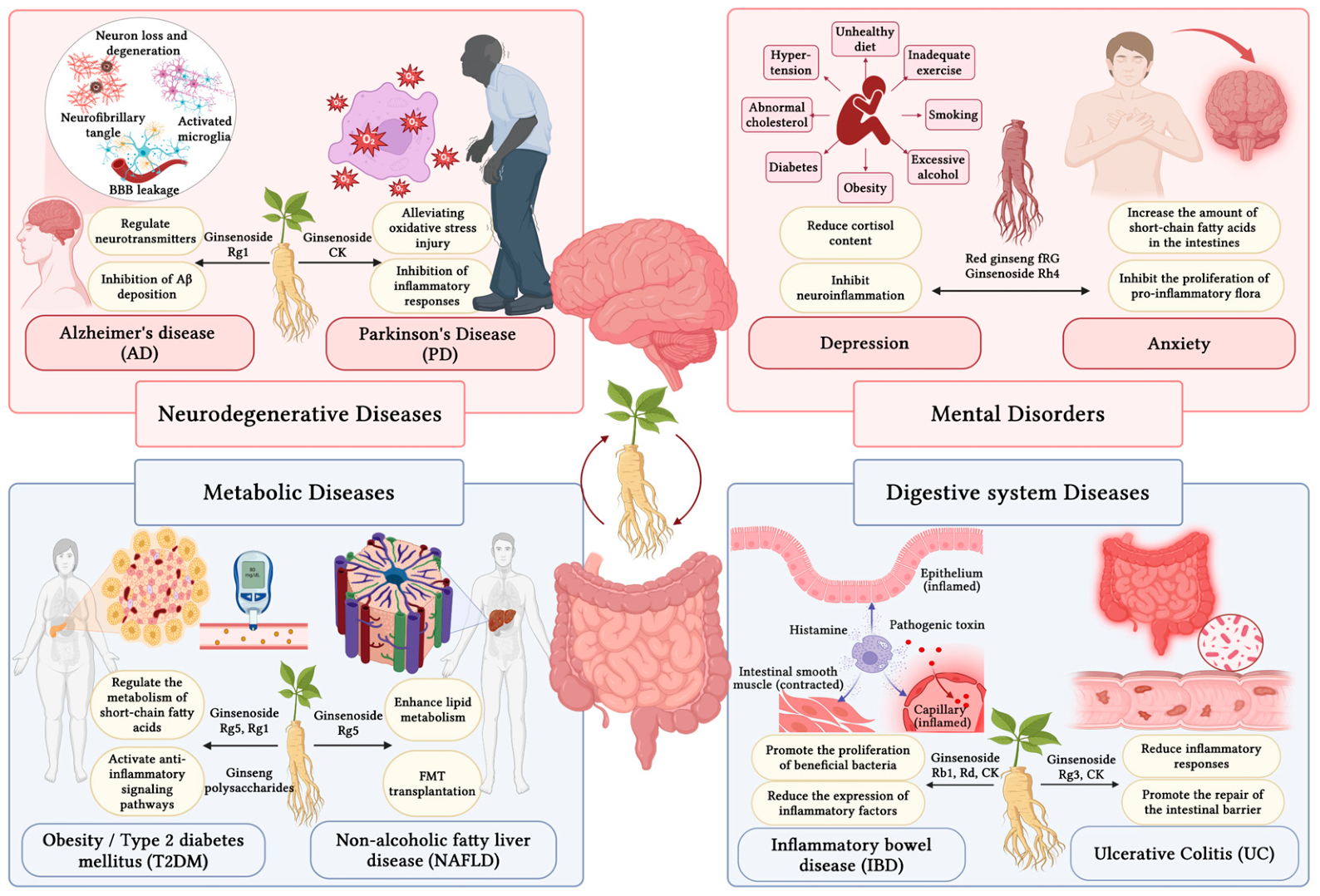
Ginseng Bioactive Components as Gut-Brain Axis-Targeted Modulators: Therapeutic Potential and Mechanisms in Multifactorial Diseases

Abstract
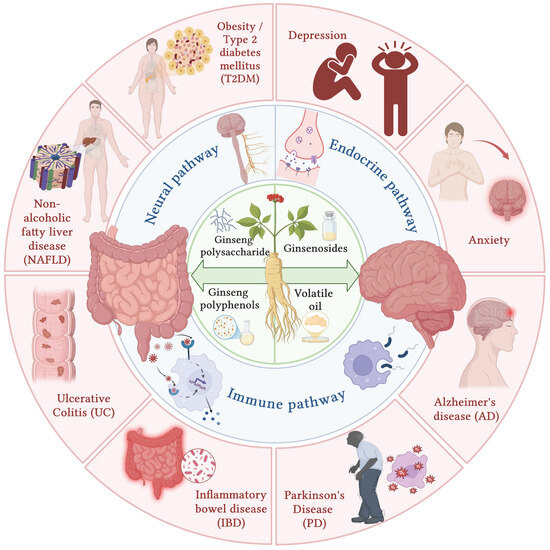
1. Introduction
2. Methods
3. Concept of Gut-Brain Axis
3.1. Components
3.1.1. Neural Pathways
3.1.2. Endocrine Pathway
3.1.3. Immune Pathway
3.1.4. Main Participating Parts
4. Pharmacological Properties of the Active Ingredients of Ginseng
4.1. Ginsenoside Components
4.2. Ginseng Polysaccharide Components
4.3. Ginseng Polyphenols and Essential Oils
4.4. Rationale for Targeting GBA
5. Mechanism of Action of Ginseng in Targeted Regulation of GBA
5.1. Gut Microbiota Regulation
5.2. Intestinal Barrier Protection
5.3. Immunity and Activation of Anti-Inflammatory Pathways
5.4. Neuroendocrine and Neural Communication
5.4.1. Regulate the Synthesis of Neurotransmitters
5.4.2. Interaction with the HPA Axis
5.4.3. Vagus Neural-Mediated Signal Transduction
6. The Therapeutic Application of Ginseng Targeting the GBA in Diseases
6.1. Neurodegenerative Diseases
6.1.1. Alzheimer’s Disease (AD)
6.1.2. Parkinson’s Disease (PD)
6.2. Depression and Anxiety
6.3. Metabolism-Related Diseases
6.3.1. Obesity and Diabetes
6.3.2. Non-Alcoholic Fatty Liver Disease (NAFLD)
6.4. Digestive System Diseases
6.4.1. Inflammatory Bowel Disease (IBD)
6.4.2. Ulcerative Colitis (UC)
7. Future Perspectives
8. Conclusions
Author Contributions
Funding
Institutional Review Board Statement
Informed Consent Statement
Data Availability Statement
Conflicts of Interest
Abbreviations
| AD | Alzheimer’s disease |
| AAD | Antibiotic-associated diarrhea |
| ANS | Autonomic nervous system |
| α-syn | α-synuclein |
| BBB | Blood-brain barrier |
| CD | Crohn’s disease |
| CNS | Central nervous system |
| DSS | Dextran sulfate sodium |
| ENS | Enteric nervous system |
| fRG | Bifidobacteria-fermented red ginseng |
| FMT | Fecal microbiota transplantation |
| GBA | Gut-brain axis |
| GABA | Gamma-aminobutyric acid |
| GTSs | Ginseng total saponins |
| GP4 | 4.7-kDa ginseng-derived polysaccharide |
| GPN | Ginseng neutral polysaccharides |
| GRb1 | Ginsenoside Rb1 |
| GPH1 | Ginseng polysaccharide |
| GP | Ginseng peptides |
| GE | Ginsenoside extract |
| GPS-1 | rhamnogalacturonan-I enriched pectin |
| HPA axis | Hypothalamic-pituitary-adrenal cortex axis |
| HFD | High-fat diet |
| HFD/STZ | High-fat diet/streptozotocin |
| IRAK-1 | Interleukin-1 receptor-associated kinase-1 |
| IS | Immobilization stress |
| IR | Insulin resistance |
| IBD | Inflammatory bowel disease |
| LPS | Lipopolysaccharide |
| MCAO/R | Middle cerebral artery occlusion/reperfusion |
| NFP | Non-saponin fraction with rich polysaccharide |
| NAFLD | Non-alcoholic fatty liver disease |
| NASH | Non-alcoholic Steatohepatitis |
| PD | Parkinson’s disease |
| PPARγ | Proliferator-activated receptor-gamma |
| PTSD | Post-traumatic stress disorder |
| RG | Red ginseng |
| STZ | Streptozotocin |
| SCFAs | Short-chain fatty acids |
| TNF-α | Tumor Necrosis Factor-alpha |
| TLR4 | Toll-like receptor 4 |
| T2DM | Type 2 diabetes mellitus |
| UDCA | Ursodeoxycholic acid |
| UCDF | the feces of patients with ulcerative colitis and depression |
| UC | Ulcerative colitis |
| WGP | ginseng polysaccharides |
| 5-HT | 5-hydroxytryptamine |
References
- Westfall, S.; Lomis, N.; Kahouli, I.; Dia, S.Y.; Singh, S.P.; Prakash, S. Microbiome, probiotics and neurodegenerative diseases: Deciphering the gut brain axis. Cell. Mol. Life Sci. 2017, 74, 3769–3787. [Google Scholar] [CrossRef]
- Toader, C.; Dobrin, N.; Costea, D.; Glavan, L.-A.; Covache-Busuioc, R.-A.; Dumitrascu, D.-I.; Bratu, B.-G.; Costin, H.-P.; Ciurea, A.V. Mind, Mood and Microbiota—Gut–Brain Axis in Psychiatric Disorders. Int. J. Mol. Sci. 2024, 25, 3340. [Google Scholar] [CrossRef]
- Dong, Y.; Cui, C. The role of short-chain fatty acids in central nervous system diseases. Mol. Cell. Biochem. 2022, 477, 2595–2607. [Google Scholar] [CrossRef]
- Vicentini, F.A.; Keenan, C.M.; Wallace, L.E.; Woods, C.; Cavin, J.-B.; Flockton, A.R.; Macklin, W.B.; Belkind-Gerson, J.; Hirota, S.A.; Sharkey, K.A. Intestinal microbiota shapes gut physiology and regulates enteric neurons and glia. Microbiome 2021, 9, 210. [Google Scholar] [CrossRef]
- Ahn, S.; Siddiqi, M.H.; Noh, H.-Y.; Kim, Y.-J.; Kim, Y.-J.; Jin, C.-G.; Yang, D.-C. Anti-inflammatory activity of ginsenosides in LPS-stimulated RAW 264.7 cells. Sci. Bull. 2015, 60, 773–784. [Google Scholar] [CrossRef]
- Chen, F.; Huang, G. Antioxidant activity of polysaccharides from different sources of ginseng. Int. J. Biol. Macromol. 2019, 125, 906–908. [Google Scholar] [CrossRef]
- Oh, J.; Kim, J.-S. Compound K derived from ginseng: Neuroprotection and cognitive improvement. Food Funct. 2016, 7, 4506–4515. [Google Scholar] [CrossRef]
- Iqbal, H.; Kim, Y.; Jin, M.; Rhee, D.-K. Ginseng as a therapeutic target to alleviate gut and brain diseases via microbiome regulation. J. Ginseng Res. 2025, 49, 12–21. [Google Scholar] [CrossRef] [PubMed]
- Shao, J.; Qu, L.; Liu, Y.; Zhang, J.; Liu, Y.; Deng, J.; Ma, X.; Fan, D. Ginsenoside Rk3 Regulates Tryptophan Metabolism along the Brain–Gut Axis by Targeting Tryptophan Hydroxylase and Remodeling the Intestinal Microenvironment to Alleviate Depressive-Like Behavior in Mice. J. Agric. Food Chem. 2024, 72, 7100–7120. [Google Scholar] [CrossRef] [PubMed]
- Page, M.J.; McKenzie, J.E.; Bossuyt, P.M.; Boutron, I.; Hoffmann, T.C.; Mulrow, C.D.; Shamseer, L.; Tetzlaff, J.M.; Akl, E.A.; Brennan, S.E.; et al. The PRISMA 2020 statement: An updated guideline for reporting systematic reviews. BMJ 2021, 372, n71. [Google Scholar] [CrossRef] [PubMed]
- Kyei-Baffour, V.O.; Vijaya, A.K.; Burokas, A.; Daliri, E.B.-M. Psychobiotics and the gut-brain axis: Advances in metabolite quantification and their implications for mental health. Crit. Rev. Food Sci. Nutr. 2025, 65, 7085–7104. [Google Scholar] [CrossRef]
- Roy, N.C. Diet, Gut Physiology, and the Microbiota-Gut-Brain Axis. Proc. Nutr. Soc. 2024, 83, E13. [Google Scholar] [CrossRef]
- Martin, C.R.; Osadchiy, V.; Kalani, A.; Mayer, E.A. The Brain-Gut-Microbiome Axis. Cell. Mol. Gastroenterol. Hepatol. 2018, 6, 133–148. [Google Scholar] [CrossRef]
- Llorente, C. The Imperative for Innovative Enteric Nervous System–Intestinal Organoid Co-Culture Models: Transforming GI Disease Modeling and Treatment. Cells 2024, 13, 820. [Google Scholar] [CrossRef] [PubMed]
- Duan, H.; Cai, X.; Luan, Y.; Yang, S.; Yang, J.; Dong, H.; Zeng, H.; Shao, L. Regulation of the Autonomic Nervous System on Intestine. Front. Physiol. 2021, 12, 700129. [Google Scholar] [CrossRef]
- Jameson, K.G.; Kazmi, S.A.; Ohara, T.E.; Son, C.; Yu, K.B.; Mazdeyasnan, D.; Leshan, E.; Vuong, H.E.; Paramo, J.; Lopez-Romero, A.; et al. Select microbial metabolites in the small intestinal lumen regulate vagal activity via receptor-mediated signaling. iScience 2025, 28, 111699. [Google Scholar] [CrossRef]
- Metta, V.; Leta, V.; Mrudula, K.R.; Prashanth, L.K.; Goyal, V.; Borgohain, R.; Chung-Faye, G.; Chaudhuri, K.R. Gastrointestinal dysfunction in Parkinson’s disease: Molecular pathology and implications of gut microbiome, probiotics, and fecal microbiota transplantation. J. Neurol. 2022, 269, 1154–1163. [Google Scholar] [CrossRef]
- Kaelberer, M.M.; Buchanan, K.L.; Klein, M.E.; Barth, B.B.; Montoya, M.M.; Shen, X.; Bohórquez, D.V. A gut-brain neural circuit for nutrient sensory transduction. Science 2018, 361, eaat5236. [Google Scholar] [CrossRef] [PubMed]
- Masse, K.E.; Lu, V.B. Short-chain fatty acids, secondary bile acids and indoles: Gut microbial metabolites with effects on enteroendocrine cell function and their potential as therapies for metabolic disease. Front. Endocrinol. 2023, 14, 1169624. [Google Scholar] [CrossRef] [PubMed]
- Montagnani, M.; Bottalico, L.; Potenza, M.A.; Charitos, I.A.; Topi, S.; Colella, M.; Santacroce, L. The Crosstalk between Gut Microbiota and Nervous System: A Bidirectional Interaction between Microorganisms and Metabolome. Int. J. Mol. Sci. 2023, 24, 10322. [Google Scholar] [CrossRef]
- Frankiensztajn, L.M.; Elliott, E.; Koren, O. The microbiota and the hypothalamus-pituitary-adrenocortical (HPA) axis, implications for anxiety and stress disorders. Curr. Opin. Neurobiol. 2020, 62, 76–82. [Google Scholar] [CrossRef]
- Parada Venegas, D.; De la Fuente, M.K.; Landskron, G.; González, M.J.; Quera, R.; Dijkstra, G.; Harmsen, H.J.M.; Faber, K.N.; Hermoso, M.A. Short Chain Fatty Acids (SCFAs)-Mediated Gut Epithelial and Immune Regulation and Its Relevance for Inflammatory Bowel Diseases. Front. Immunol. 2019, 10, 277, Correction in Front. Immunol. 2019, 10, 1486. https://doi.org/10.3389/fimmu.2019.01486. [Google Scholar] [CrossRef]
- Dong, Y.-J.; Zhang, Y.-P.; Jiang, X.-F.; Xie, Z.-Y.; Li, B.; Jiang, N.-H.; Chen, S.-H.; Lv, G.-Y. Beneficial effects of Dendrobium officinale National Herbal Drink on metabolic immune crosstalk via regulate SCFAs-Th17/Treg. Phytomedicine 2024, 132, 155816. [Google Scholar] [CrossRef]
- Hong, S.-W.; Piao, L.; Cho, E.-H.; Seo, E.-H.; Kim, S.-H. Effect of Microglial Activity on Gut Microbiota in Rats with Neuropathic Pain. Int. J. Mol. Sci. 2025, 26, 5181. [Google Scholar] [CrossRef] [PubMed]
- Lawrence, J.H.; Patel, A.; King, M.W.; Nadarajah, C.J.; Daneman, R.; Musiek, E.S. Microglia drive diurnal variation in susceptibility to inflammatory blood-brain barrier breakdown. JCI Insight 2024, 9, e180081. [Google Scholar] [CrossRef]
- Singh, V.; Roth, S.; Llovera, G.; Sadler, R.; Garzetti, D.; Stecher, B.; Dichgans, M.; Liesz, A. Microbiota Dysbiosis Controls the Neuroinflammatory Response after Stroke. J. Neurosci. 2016, 36, 7428–7440. [Google Scholar] [CrossRef]
- Rowland, I.; Gibson, G.; Heinken, A.; Scott, K.; Swann, J.; Thiele, I.; Tuohy, K. Gut microbiota functions: Metabolism of nutrients and other food components. Eur. J. Nutr. 2018, 57, 1–24. [Google Scholar] [CrossRef] [PubMed]
- Huang, L.; Li, T.; Zhou, M.; Deng, M.; Zhang, L.; Yi, L.; Zhu, J.; Zhu, X.; Mi, M. Hypoxia Improves Endurance Performance by Enhancing Short Chain Fatty Acids Production via Gut Microbiota Remodeling. Front. Microbiol. 2022, 12, 820691. [Google Scholar] [CrossRef]
- Chen, Y.; Feng, S.; Li, Y.; Zhang, C.; Chao, G.; Zhang, S. Gut microbiota and intestinal immunity—A crosstalk in irritable bowel syndrome. Immunology 2024, 172, 1–20. [Google Scholar] [CrossRef] [PubMed]
- Weingarden, A.R.; Vaughn, B.P. Intestinal microbiota, fecal microbiota transplantation, and inflammatory bowel disease. Gut Microbes 2017, 8, 238–252. [Google Scholar] [CrossRef]
- Umbrello, G.; Esposito, S. Microbiota and neurologic diseases: Potential effects of probiotics. J. Transl. Med. 2016, 14, 298. [Google Scholar] [CrossRef]
- Yan, Z.; Yang, F.; Cao, J.; Ding, W.; Yan, S.; Shi, W.; Wen, S.; Yao, L. Alterations of gut microbiota and metabolome with Parkinson’s disease. Microb. Pathog. 2021, 160, 105187. [Google Scholar] [CrossRef] [PubMed]
- Siopi, E.; Galerne, M.; Rivagorda, M.; Saha, S.; Moigneu, C.; Moriceau, S.; Bigot, M.; Oury, F.; Lledo, P.-M. Gut microbiota changes require vagus nerve integrity to promote depressive-like behaviors in mice. Mol. Psychiatry 2023, 28, 3002–3012. [Google Scholar] [CrossRef]
- Munshi, S. A depressed gut makes for a depressed brain via vagal transmission. Brain Behav. Immun. 2021, 95, 15–16. [Google Scholar] [CrossRef] [PubMed]
- Dicks, L.M.T. Gut Bacteria and Neurotransmitters. Microorganisms 2022, 10, 1838. [Google Scholar] [CrossRef] [PubMed]
- Bacqué-Cazenave, J.; Bharatiya, R.; Barrière, G.; Delbecque, J.-P.; Bouguiyoud, N.; Di Giovanni, G.; Cattaert, D.; De Deurwaerdère, P. Serotonin in Animal Cognition and Behavior. Int. J. Mol. Sci. 2020, 21, 1649. [Google Scholar] [CrossRef]
- Wang, J.; Yin, L.; Zheng, W.; Shi, S.; Hao, W.; Liu, C.; Zheng, L. Lactobacillus rhamnosus GG normalizes gut dysmotility induced by environmental pollutants via affecting serotonin level in zebrafish larvae. World J. Microbiol. Biotechnol. 2022, 38, 222. [Google Scholar] [CrossRef]
- Hamamah, S.; Aghazarian, A.; Nazaryan, A.; Hajnal, A.; Covasa, M. Role of Microbiota-Gut-Brain Axis in Regulating Dopaminergic Signaling. Biomedicines 2022, 10, 436. [Google Scholar] [CrossRef]
- Jiang, C.; Chen, Y.; Sun, T. From the gut to the brain, mechanisms and clinical applications of γ-aminobutyric acid (GABA) on the treatment of anxiety and insomnia. Front. Neurosci. 2025, 19, 1570173. [Google Scholar] [CrossRef]
- Fukasawa, N.; Tsunoda, J.; Sunaga, S.; Kiyohara, H.; Nakamoto, N.; Teratani, T.; Mikami, Y.; Kanai, T. The gut–organ axis: Clinical aspects and immune mechanisms. Allergol. Int. 2025, 74, 197–209. [Google Scholar] [CrossRef]
- Cao, C.; Li, S.; Wang, W.; Shi, L.; Ma, R.; Zhang, B.; Tian, J. Intestinal microbiota improves inflammation and cognitive function in the brain of a7nAChR deficient rat through the gut brain axis. Sci. Rep. 2025, 15, 18381. [Google Scholar] [CrossRef]
- Geng, J.; Wang, L.; Zhang, L.; Qin, C.; Song, Y.; Ma, Y.; Chen, Y.; Chen, S.; Wang, Y.; Zhang, Z.; et al. Blood-Brain Barrier Disruption Induced Cognitive Impairment Is Associated with Increase of Inflammatory Cytokine. Front. Aging Neurosci. 2018, 10, 129. [Google Scholar] [CrossRef] [PubMed]
- Hu, S.; Chen, Y.; Chen, Y.; Wang, C. Depression and Anxiety Disorders in Patients with Inflammatory Bowel Disease. Front. Psychiatry 2021, 12, 714057. [Google Scholar] [CrossRef] [PubMed]
- Doney, E.; Cadoret, A.; Dion-Albert, L.; Lebel, M.; Menard, C. Inflammation-driven brain and gut barrier dysfunction in stress and mood disorders. Eur. J. Neurosci. 2022, 55, 2851–2894. [Google Scholar] [CrossRef]
- Shin, Y.-J.; Lee, D.-Y.; Kim, J.Y.; Heo, K.; Shim, J.-J.; Lee, J.-L.; Kim, D.-H. Effect of fermented red ginseng on gut microbiota dysbiosis- or immobilization stress-induced anxiety, depression, and colitis in mice. J. Ginseng Res. 2023, 47, 255–264. [Google Scholar] [CrossRef]
- Chu, S.-F.; Zhang, Z.; Zhou, X.; He, W.-B.; Chen, C.; Luo, P.; Liu, D.-D.; Ai, Q.-D.; Gong, H.-F.; Wang, Z.-Z.; et al. Ginsenoside Rg1 protects against ischemic/reperfusion-induced neuronal injury through miR-144/Nrf2/ARE pathway. Acta Pharmacol. Sin. 2019, 40, 13–25. [Google Scholar] [CrossRef]
- Li, Y.; Li, J.; Yang, L.; Ren, F.; Dong, K.; Zhao, Z.; Duan, W.; Wei, W.; Guo, R. Ginsenoside Rb1 protects hippocampal neurons in depressed rats based on mitophagy-regulated astrocytic pyroptosis. Phytomedicine 2023, 121, 155083. [Google Scholar] [CrossRef] [PubMed]
- Li, T.; Chen, J.; Xie, Z.; Fang, J.; Wu, Q.; Cao, X.; Chen, Z.; Wang, Y.; Fan, Q.; Wang, Q.; et al. Ginsenoside Ro ameliorates cognitive impairment and neuroinflammation in APP/PS1 mice via the IBA1/GFAP-MAPK signaling pathway. Front. Pharmacol. 2025, 16, 1528590. [Google Scholar] [CrossRef]
- Sur, B.; Lee, B. Ginsenoside Rg3 modulates spatial memory and fear memory extinction by the HPA axis and BDNF-TrkB pathway in a rat post-traumatic stress disorder. J. Nat. Med. 2022, 76, 821–831. [Google Scholar] [CrossRef]
- Gao, Z.-W.; Ju, R.-L.; Luo, M.; Wu, S.-L.; Zhang, W.-T. The anxiolytic-like effects of ginsenoside Rg2 on an animal model of PTSD. Psychiatry Res. 2019, 279, 130–137. [Google Scholar] [CrossRef]
- Feng, L.; Yue, X.-F.; Chen, Y.-X.; Liu, X.-M.; Wang, L.-S.; Cao, F.-R.; Wang, Q.; Liao, Y.-H.; Pan, R.-L.; Chang, Q. LC/MS-based metabolomics strategy to assess the amelioration effects of ginseng total saponins on memory deficiency induced by simulated microgravity. J. Pharm. Biomed. Anal. 2016, 125, 329–338. [Google Scholar] [CrossRef]
- Liu, W.; Sun, M.; Wang, W.-T.; Song, J.; Wang, C.-M.; Mou, N.-Y.; Shao, T.-Q.; Zhang, Z.-H.; Wang, M.-Y.; Sun, H.-M. Ginsenoside Rh4 Ameliorates Cisplatin-Induced Intestinal Toxicity via PGC-1α-Mediated Mitochondrial Autophagy and Apoptosis Pathways. Am. J. Chin. Med. 2024, 52, 2187–2209. [Google Scholar] [CrossRef]
- Cheng, C.; Liu, K.; Zhang, J.; Han, Y.; Zhang, T.; Hou, Y.; Bai, G. Ginsenoside CK targets PHD2 to prevent platelet adhesion and enhance blood circulation by modifying the three-dimensional arrangement of collagen. Acta Pharm. Sin. B 2025, 15, 1497–1513. [Google Scholar] [CrossRef] [PubMed]
- Zhu, H.; Zhang, R.; Huang, Z.; Zhou, J. Progress in the Conversion of Ginsenoside Rb1 into Minor Ginsenosides Using β-Glucosidases. Foods 2023, 12, 397. [Google Scholar] [CrossRef] [PubMed]
- Zhang, K.-X.; Zhu, Y.; Song, S.-X.; Bu, Q.-Y.; You, X.-Y.; Zou, H.; Zhao, G.-P. Ginsenoside Rb1, Compound K and 20(S)-Protopanaxadiol Attenuate High-Fat Diet-Induced Hyperlipidemia in Rats via Modulation of Gut Microbiota and Bile Acid Metabolism. Molecules 2024, 29, 1108. [Google Scholar] [CrossRef]
- Bai, X.; Deng, J.; Duan, Z.; Fu, R.; Zhu, C.; Fan, D. Ginsenoside Rh4 alleviates gastrointestinal mucositis and enhances chemotherapy efficacy through modulating gut microbiota. Phytomedicine 2024, 128, 155577. [Google Scholar] [CrossRef]
- Liu, S.; Geng, J.; Chen, W.; Zong, Y.; Zhao, Y.; Du, R.; He, Z. Isolation, structure, biological activity and application progress of ginseng polysaccharides from the Araliaceae family. Int. J. Biol. Macromol. 2024, 276, 133925. [Google Scholar] [CrossRef]
- Hao, M.; Ding, C.; Peng, X.; Chen, H.; Dong, L.; Zhang, Y.; Chen, X.; Liu, W.; Luo, Y. Ginseng under forest exerts stronger anti-aging effects compared to garden ginseng probably via regulating PI3K/AKT/mTOR pathway, SIRT1/NF-κB pathway and intestinal flora. Phytomedicine 2022, 105, 154365. [Google Scholar] [CrossRef]
- Wan, L.; Qian, C.; Yang, C.; Peng, S.; Dong, G.; Cheng, P.; Zong, G.; Han, H.; Shao, M.; Gong, G.; et al. Ginseng polysaccharides ameliorate ulcerative colitis via regulating gut microbiota and tryptophan metabolism. Int. J. Biol. Macromol. 2024, 265, 130822. [Google Scholar] [CrossRef]
- Wang, N.; Xin, Y. Review: Gut microbiota: Therapeutic targets of ginseng polysaccharides against multiple disorders. Int. J. Biol. Macromol. 2025, 287, 138527. [Google Scholar] [CrossRef] [PubMed]
- Zhang, S.; Liu, F.; Li, J.; Jing, C.; Lu, J.; Chen, X.; Wang, D.; Cao, D.; Zhao, D.; Sun, L. A 4.7-kDa polysaccharide from Panax ginseng suppresses Aβ pathology via mitophagy activation in cross-species Alzheimer’s disease models. Biomed. Pharmacother. 2023, 167, 115442. [Google Scholar] [CrossRef]
- Zuo, Y.-H.; Han, Q.-B.; Dong, G.-T.; Yue, R.-Q.; Ren, X.-C.; Liu, J.-X.; Liu, L.; Luo, P.; Zhou, H. Panax ginseng Polysaccharide Protected H9c2 Cardiomyocyte from Hypoxia/Reoxygenation Injury Through Regulating Mitochondrial Metabolism and RISK Pathway. Front. Physiol. 2018, 9, 699. [Google Scholar] [CrossRef]
- Wang, D.; Wang, H.; Li, Y.; Lu, J.; Tang, X.; Yang, D.; Wang, M.; Zhao, D.; Liu, F.; Zhang, S.; et al. Alistipes senegalensis is Critically Involved in Gut Barrier Repair Mediated by Panax ginseng Neutral Polysaccharides in Aged Mice. Adv. Sci. 2025, 12, e16427. [Google Scholar] [CrossRef]
- Shi, Y.; Zheng, S.; Xie, K.; Xu, S.; Zhong, L.; Hu, Y. Regulatory effects of ginseng polysaccharide on growth restriction and intestinal dysfunction caused by a high cottonseed meal diet in Ctenopharyngodon idella. Int. J. Biol. Macromol. 2025, 322, 146727. [Google Scholar] [CrossRef]
- Fu, G.; Xu, Z.; Wang, Y.; Liu, Z.; Wang, Z.; Xia, J.; Hu, Y.; Zhong, L. Beneficial effects of Ginseng polysaccharide improve the growth performance, intestinal immunity, intestinal microbiota, and resistance to Yersinia ruckeri in channel catfish (Ictalurus punctatus). Fish Shellfish Immunol. 2025, 167, 110668. [Google Scholar] [CrossRef]
- Li, S.; Qi, Y.; Chen, L.; Qu, D.; Li, Z.; Gao, K.; Chen, J.; Sun, Y. Effects of Panax ginseng polysaccharides on the gut microbiota in mice with antibiotic-associated diarrhea. Int. J. Biol. Macromol. 2019, 124, 931–937. [Google Scholar] [CrossRef]
- Huo, D.-Y.; Li, Y.-F.; Song, L.-J.; Zhang, W.-X.; Li, X.-D.; Zhang, J.; Ren, S.; Wang, Z.; Li, W. Colon-Targeted Ginseng Polysaccharides-Based Microspheres for Improving Ulcerative Colitis via Anti-Inflammation and Gut Microbiota Modulation. Adv. Healthc. Mater. 2025, 14, 2404122. [Google Scholar] [CrossRef]
- Malathy, R.; Prabakaran, M.; Kalaiselvi, K.; Chung, I.-M.; Kim, S.-H. Comparative Polyphenol Composition, Antioxidant and Anticorrosion Properties in Various Parts of Panax ginseng Extracted in Different Solvents. Appl. Sci. 2021, 11, 93. [Google Scholar] [CrossRef]
- Xu, Y.; Bian, S.; Shang, L.; Wang, X.; Bai, X.; Zhang, W. Phytochemistry, pharmacological effects and mechanism of action of volatile oil from Panax ginseng C.A.Mey: A review. Front. Pharmacol. 2024, 15, 1436624. [Google Scholar] [CrossRef]
- Wang, L.; Qiao, P.; Ouyang, Z.; Li, D.; Zheng, J.; Wang, G.; Wang, F. Ginseng volatile oil prolongs the lifespan and healthspan of Caenorhabditis elegans. Biogerontology 2022, 23, 485–497. [Google Scholar] [CrossRef]
- Kawamoto, H.; Takeshita, F.; Murata, K. Inhibitory effects of essential oil extracts from Panax plants against β-secretase, cholinesterase, and amyloid aggregation. Nat. Prod. Commun. 2019, 14, 1934578X19881549. [Google Scholar] [CrossRef]
- Zhao, Y.; Jiang, Q. Roles of the Polyphenol–Gut Microbiota Interaction in Alleviating Colitis and Preventing Colitis-Associated Colorectal Cancer. Adv. Nutr. 2021, 12, 546–565. [Google Scholar] [CrossRef]
- Serra, M.P.; Boi, M.; Carta, A.; Murru, E.; Carta, G.; Banni, S.; Quartu, M. Anti-Inflammatory Effect of Beta-Caryophyllene Mediated by the Involvement of TRPV1, BDNF and trkB in the Rat Cerebral Cortex after Hypoperfusion/Reperfusion. Int. J. Mol. Sci. 2022, 23, 3633. [Google Scholar] [CrossRef]
- Monteleone, I.; Rizzo, A.; Sarra, M.; Sica, G.; Sileri, P.; Biancone, L.; MacDonald, T.T.; Pallone, F.; Monteleone, G. Aryl hydrocarbon receptor-induced signals up-regulate IL-22 production and inhibit inflammation in the gastrointestinal tract. Gastroenterology 2011, 141, 237–248.e1. [Google Scholar] [CrossRef]
- Rodríguez-Daza, M.C.; de Vos, W.M. Polyphenols as Drivers of a Homeostatic Gut Microecology and Immuno-Metabolic Traits of Akkermansia muciniphila: From Mouse to Man. Int. J. Mol. Sci. 2022, 24, 45. [Google Scholar] [CrossRef]
- Feng, Y.; Ma, F.; Wu, E.; Cheng, Z.; Wang, Z.; Yang, L.; Zhang, J. Ginsenosides: Allies of gastrointestinal tumor immunotherapy. Front. Pharmacol. 2022, 13, 922029. [Google Scholar] [CrossRef]
- Zhai, Z.; Gao, Y. Protective effects of ginsenosides in cerebral small vessel disease: Cellular and molecular mechanisms. J. Ginseng Res. 2025, 49, 640–651. [Google Scholar] [CrossRef]
- Shi, D.-D.; Huang, Y.-H.; Lai, C.S.W.; Dong, C.M.; Ho, L.C.; Li, X.-Y.; Wu, E.X.; Li, Q.; Wang, X.-M.; Chen, Y.-J.; et al. Ginsenoside Rg1 Prevents Chemotherapy-Induced Cognitive Impairment: Associations with Microglia-Mediated Cytokines, Neuroinflammation, and Neuroplasticity. Mol. Neurobiol. 2019, 56, 5626–5642. [Google Scholar] [CrossRef]
- Wang, W.; Wang, L.; Wang, L.; Li, Y.; Lan, T.; Wang, C.; Chen, X.; Chen, S.; Yu, S. Ginsenoside-Rg1 synergized with voluntary running exercise protects against glial activation and dysregulation of neuronal plasticity in depression. Food Funct. 2023, 14, 7222–7239. [Google Scholar] [CrossRef]
- Paik, S.; Song, G.Y.; Jo, E.-K. Ginsenosides for therapeutically targeting inflammation through modulation of oxidative stress. Int. Immunopharmacol. 2023, 121, 110461. [Google Scholar] [CrossRef]
- Wang, D.; Shao, S.; Zhang, Y.; Zhao, D.; Wang, M. Insight Into Polysaccharides From Panax ginseng C. A. Meyer in Improving Intestinal Inflammation: Modulating Intestinal Microbiota and Autophagy. Front. Immunol. 2021, 12, 1149–1165. [Google Scholar] [CrossRef] [PubMed]
- Duncanson, K.; Williams, G.; Hoedt, E.C.; Collins, C.E.; Keely, S.; Talley, N.J. Diet-microbiota associations in gastrointestinal research: A systematic review. Gut Microbes 2024, 16, 2350785. [Google Scholar] [CrossRef]
- Geuking, M.B.; Köller, Y.; Rupp, S.; McCoy, K.D. The interplay between the gut microbiota and the immune system. Gut Microbes 2014, 5, 411–418. [Google Scholar] [CrossRef]
- Ikeda, T.; Nishida, A.; Yamano, M.; Kimura, I. Short-chain fatty acid receptors and gut microbiota as therapeutic targets in metabolic, immune, and neurological diseases. Pharmacol. Ther. 2022, 239, 108273. [Google Scholar] [CrossRef]
- Lordan, C.; Thapa, D.; Ross, R.P.; Cotter, P.D. Potential for enriching next-generation health-promoting gut bacteria through prebiotics and other dietary components. Gut Microbes 2020, 11, 1–20. [Google Scholar] [CrossRef]
- Chen, Z.; Zhang, Z.; Liu, J.; Qi, H.; Li, J.; Chen, J.; Huang, Q.; Liu, Q.; Mi, J.; Li, X. Gut Microbiota: Therapeutic Targets of Ginseng Against Multiple Disorders and Ginsenoside Transformation. Front. Cell. Infect. Microbiol. 2022, 12, 853981. [Google Scholar] [CrossRef] [PubMed]
- Hu, J.; Lin, S.; Zheng, B.; Cheung, P.C.K. Short-chain fatty acids in control of energy metabolism. Crit. Rev. Food Sci. Nutr. 2018, 58, 1243–1249. [Google Scholar] [CrossRef]
- Luu, M.; Visekruna, A. Short-chain fatty acids: Bacterial messengers modulating the immunometabolism of T cells. Eur. J. Immunol. 2019, 49, 842–848. [Google Scholar] [CrossRef]
- Mansuy-Aubert, V.; Ravussin, Y. Short chain fatty acids: The messengers from down below. Front. Neurosci. 2023, 17, 1197759. [Google Scholar] [CrossRef]
- Yan, X.; Bai, X.; Fu, R.; Duan, Z.; Zeng, W.; Zhu, C. Ginsenoside compound K alleviates d-galactose-induced mild cognitive impairment by modulating gut microbiota-mediated short-chain fatty acid metabolism. Food Funct. 2024, 15, 9037–9052. [Google Scholar] [CrossRef] [PubMed]
- Lee, M.; Lee, S.H.; Kim, M.S.; Ahn, K.S.; Kim, M. Effect of Lactobacillus dominance modified by Korean Red Ginseng on the improvement of Alzheimer’s disease in mice. J. Ginseng Res. 2022, 46, 464–472. [Google Scholar] [CrossRef] [PubMed]
- Shi, Y.; Chen, J.; Qu, D.; Sun, Q.; Yu, Y.; Zhang, H.; Liu, Z.; Sha, J.; Sun, Y. Ginsenoside Rg5 Activates the LKB1/AMPK/mTOR Signaling Pathway and Modifies the Gut Microbiota to Alleviate Nonalcoholic Fatty Liver Disease Induced by a High-Fat Diet. Nutrients 2024, 16, 842. [Google Scholar] [CrossRef] [PubMed]
- Yang, S.-J.; Wang, J.-J.; Cheng, P.; Chen, L.-X.; Hu, J.-M.; Zhu, G.-Q. Ginsenoside Rg1 in neurological diseases: From bench to bedside. Acta Pharmacol. Sin. 2023, 44, 913–930. [Google Scholar] [CrossRef]
- Panwar, S.; Sharma, S.; Tripathi, P. Role of Barrier Integrity and Dysfunctions in Maintaining the Healthy Gut and Their Health Outcomes. Front. Physiol. 2021, 12, 715611. [Google Scholar] [CrossRef]
- Sivri, D.; Şeref, B.; Şare Bulut, M.; Gezmen Karadağ, M. Evaluation of the Effect of Probiotic Supplementation on Intestinal Barrier Integrity and Epithelial Damage in Colitis Disease: A Systematic Review. Nutr. Rev. 2025, 83, e1782–e1797. [Google Scholar] [CrossRef]
- Su, L.-J.; Ren, Y.-C.; Chen, Z.; Ma, H.-F.; Zheng, F.; Li, F.; Zhang, Y.-Y.; Gong, S.-S.; Kou, J.-P. Ginsenoside Rb1 improves brain, lung, and intestinal barrier damage in middle cerebral artery occlusion/reperfusion (MCAO/R) micevia the PPARγ signaling pathway. Chin. J. Nat. Med. 2022, 20, 561–571. [Google Scholar] [CrossRef]
- Gao, Y.; Guo, M.; Chen, J.; Sun, Y.; Wang, M. A ginseng polysaccharide protects intestinal barrier integrity in high-fat diet-fed obese mice. Int. J. Biol. Macromol. 2024, 277, 133976. [Google Scholar] [CrossRef]
- Ma, X.; Liu, X.; Feng, J.; Zhang, D.; Huang, L.; Li, D.; Yin, L.; Li, L.; Wang, X.-Z. Fraxin Alleviates LPS-Induced ARDS by Downregulating Inflammatory Responses and Oxidative Damages and Reducing Pulmonary Vascular Permeability. Inflammation 2019, 42, 1901–1912. [Google Scholar] [CrossRef]
- Zhang, D.; Han, S.; Zhou, Y.; Qi, B.; Wang, X. Therapeutic effects of mangiferin on sepsis-associated acute lung and kidney injuries via the downregulation of vascular permeability and protection of inflammatory and oxidative damages. Eur. J. Pharm. Sci. 2020, 152, 105400. [Google Scholar] [CrossRef] [PubMed]
- Kang, Z.; Zhonga, Y.; Wu, T.; Huang, J.; Zhao, H.; Liu, D. Ginsenoside from ginseng: A promising treatment for inflammatory bowel disease. Pharmacol. Rep. 2021, 73, 700–711. [Google Scholar] [CrossRef]
- Han, S.-K.; Joo, M.-K.; Kim, J.-K.; Jeung, W.; Kang, H.; Kim, D.-H. Bifidobacteria-Fermented Red Ginseng and Its Constituents Ginsenoside Rd and Protopanaxatriol Alleviate Anxiety/Depression in Mice by the Amelioration of Gut Dysbiosis. Nutrients 2020, 12, 901. [Google Scholar] [CrossRef] [PubMed]
- Gao, H.; Kang, N.; Hu, C.; Zhang, Z.; Xu, Q.; Liu, Y.; Yang, S. Ginsenoside Rb1 exerts anti-inflammatory effects in vitro and in vivo by modulating toll-like receptor 4 dimerization and NF-kB/MAPKs signaling pathways. Phytomedicine 2020, 69, 153197. [Google Scholar] [CrossRef]
- Joh, E.-H.; Lee, I.-A.; Jung, I.-H.; Kim, D.-H. Ginsenoside Rb1 and its metabolite compound K inhibit IRAK-1 activation—The key step of inflammation. Biochem. Pharmacol. 2011, 82, 278–286. [Google Scholar] [CrossRef]
- Yiu, J.H.C.; Dorweiler, B.; Woo, C.W. Interaction between gut microbiota and toll-like receptor: From immunity to metabolism. J. Mol. Med. 2017, 95, 13–20. [Google Scholar] [CrossRef] [PubMed]
- Luo, J.; Liang, S.; Jin, F. Gut microbiota and healthy longevity. Sci. China Life Sci. 2024, 67, 2590–2602. [Google Scholar] [CrossRef]
- Cook, T.M.; Mansuy-Aubert, V. Communication between the gut microbiota and peripheral nervous system in health and chronic disease. Gut Microbes 2022, 14, 2068365. [Google Scholar] [CrossRef]
- Tao, W.; Zhang, Y.; Wang, B.; Nie, S.; Fang, L.; Xiao, J.; Wu, Y. Advances in molecular mechanisms and therapeutic strategies for central nervous system diseases based on gut microbiota imbalance. J. Adv. Res. 2025, 69, 261–278. [Google Scholar] [CrossRef]
- Bao, M.; Wang, K.; Li, J.; Li, Y.; Zhu, H.; Lu, M.; Zhang, Y.; Fan, Q.; Han, L.; Wang, K.; et al. ROS Scavenging and inflammation-directed polydopamine nanoparticles regulate gut immunity and flora therapy in inflammatory bowel disease. Acta Biomater. 2023, 161, 250–264. [Google Scholar] [CrossRef]
- Ye, L.; Chen, H.; Wang, J.; Tsim, K.W.K.; Wang, Y.; Shen, X.; Lei, H.; Liu, Y. Aflatoxin B1-induced liver pyroptosis is mediated by disturbing the gut microbial metabolites: The roles of pipecolic acid and norepinephrine. J. Hazard. Mater. 2024, 474, 134822. [Google Scholar] [CrossRef]
- Li, S.; Li, X.; Wang, K.; Li, Y.; Nagaoka, K.; Li, C. Gut microbiota intervention attenuates thermogenesis in broilers exposed to high temperature through modulation of the hypothalamic 5-HT pathway. J. Anim. Sci. Biotechnol. 2023, 14, 159. [Google Scholar] [CrossRef] [PubMed]
- Qiao, T.; Wang, Y.; Liang, K.; Zheng, B.; Ma, J.; Li, F.; Liu, C.; Zhu, M.; Song, M. Effects of the Radix Ginseng and Semen Ziziphi Spinosae drug pair on the GLU/GABA-GLN metabolic cycle and the intestinal microflora of insomniac rats based on the brain–gut axis. Front. Pharmacol. 2022, 13, 1094507. [Google Scholar] [CrossRef]
- Cheng, G.; Hardy, M.; Hillard, C.J.; Feix, J.B.; Kalyanaraman, B. Mitigating gut microbial degradation of levodopa and enhancing brain dopamine: Implications in Parkinson’s disease. Commun. Biol. 2024, 7, 668. [Google Scholar] [CrossRef] [PubMed]
- Chen, M.; Zhang, Y.; Hou, L.; Zhao, Z.; Tang, P.; Sun, Q.; Zhao, J.; Wang, Q. SVHRSP protects against rotenone-induced neurodegeneration in mice by inhibiting TLR4/NF-κB-mediated neuroinflammation via gut microbiota. npj Park. Dis. 2025, 11, 43. [Google Scholar] [CrossRef] [PubMed]
- Wang, G.-L.; He, Z.-M.; Zhu, H.-Y.; Gao, Y.-G.; Zhao, Y.; Yang, H.; Zhang, L.-X. Involvement of serotonergic, noradrenergic and dopaminergic systems in the antidepressant-like effect of ginsenoside Rb1, a major active ingredient of Panax ginseng C. A. Meyer. J. Ethnopharmacol. 2017, 204, 118–124. [Google Scholar] [CrossRef] [PubMed]
- Spencer, N.J.; Keating, D.J. Role of 5-HT in the enteric nervous system and enteroendocrine cells. Br. J. Pharmacol. 2025, 182, 471–483. [Google Scholar] [CrossRef]
- Wu, Q.; He, Q.; Zhang, X.; Chen, S.; Xue, X. Systemic Modulators: Potential Mechanism for the 5-HT System to Mediate Exercise Amelioration in Alzheimer’s Disease. Aging Dis. 2025, 16, 2770–2802. [Google Scholar] [CrossRef]
- Chen, Z.; Lin, Y.; Zhou, Q.; Xiao, S.; Li, C.; Lin, R.; Li, J.; Chen, Y.; Luo, C.; Mo, Z. Ginsenoside Rg1 mitigates morphine dependence via regulation of gut microbiota, tryptophan metabolism, and serotonergic system function. Biomed. Pharmacother. 2022, 150, 112935. [Google Scholar] [CrossRef]
- Xu, J.-N.; Chen, L.-F.; Su, J.; Liu, Z.-L.; Chen, J.; Lin, Q.-F.; Mao, W.-D.; Shen, D. The anxiolytic-like effects of ginsenoside Rg3 on chronic unpredictable stress in rats. Sci. Rep. 2018, 8, 7741. [Google Scholar] [CrossRef]
- Crowley, T.; Cryan, J.F.; Downer, E.J.; O’Leary, O.F. Inhibiting neuroinflammation: The role and therapeutic potential of GABA in neuro-immune interactions. Brain Behav. Immun. 2016, 54, 260–277. [Google Scholar] [CrossRef]
- Han, J.; Hu, S.; Zhao, X.; Ding, L.; Yin, J.; Liu, J.; Li, P.; Gu, Q. High GABA-producing Lactococcus lactis ZFM559 and its derived GABA alleviates chronic unpredictable mild stress (CUMS)-induced depression via the “microbiota-brain” axis. Food Funct. 2025, 16, 8463–8483. [Google Scholar] [CrossRef]
- Shao, J.; Zheng, X.; Qu, L.; Zhang, H.; Yuan, H.; Hui, J.; Mi, Y.; Ma, P.; Fan, D. Ginsenoside Rg5/Rk1 ameliorated sleep via regulating the GABAergic/serotoninergic signaling pathway in a rodent model. Food Funct. 2020, 11, 1245–1257. [Google Scholar] [CrossRef] [PubMed]
- Hori, H.; Yoshida, F.; Ishida, I.; Matsuo, J.; Ogawa, S.; Hattori, K.; Kim, Y.; Kunugi, H. Blood mRNA expression levels of glucocorticoid receptors and FKBP5 are associated with depressive disorder and altered HPA axis. J. Affect. Disord. 2024, 349, 244–253. [Google Scholar] [CrossRef]
- Salahuddin, M.F.; Mahdi, F.; Paris, J.J. HIV-1 Tat Dysregulates the Hypothalamic-Pituitary-Adrenal Stress Axis and Potentiates Oxycodone-Mediated Psychomotor and Anxiety-Like Behavior of Male Mice. Int. J. Mol. Sci. 2020, 21, 8212. [Google Scholar] [CrossRef]
- Martins, C.S.; Elias, D.; Colli, L.M.; Couri, C.E.; Souza, M.C.L.A.; Moreira, A.C.; Foss, M.C.; Elias, L.L.K.; de Castro, M. HPA axis dysregulation, NR3C1 polymorphisms and glucocorticoid receptor isoforms imbalance in metabolic syndrome. Diabetes/Metab. Res. Rev. 2017, 33, e2842. [Google Scholar] [CrossRef]
- Chiang, J.J.; Ko, A.; Bower, J.E.; Taylor, S.E.; Irwin, M.R.; Fuligni, A.J. Stress, Psychological Resources, and HPA and Inflammatory Reactivity During Late Adolescence. Dev. Psychopathol. 2019, 31, 699–712. [Google Scholar] [CrossRef]
- Muir, R.; Klocke, B.; Foote, J.; Jennings, M.; Molina, P.; Kellum, C.; Pollock, J.; Maynard, C. Early Life Stress Induced Hypothalamic–Pituitary–Adrenal (HPA) Axis Dysfunction Promotes Chronicity of Experimental Colitis in Mice. FASEB J. 2022, 36, L7722. [Google Scholar] [CrossRef]
- Shao, J.; Ma, X.; Qu, L.; Ma, P.; Huang, R.; Fan, D. Ginsenoside Rh4 remodels the periphery microenvironment by targeting the brain-gut axis to alleviate depression-like behaviors. Food Chem. 2023, 404, 134639. [Google Scholar] [CrossRef]
- Zhang, X.; Wang, X.; Shi, R.; Ran, X.; He, X.; Dou, D. Effective substances and mechanism of red ginseng on rats with spleen-deficiency syndrome based on the substance and energy metabolism as well as the “brain-gut” axis. J. Ethnopharmacol. 2023, 311, 116438. [Google Scholar] [CrossRef] [PubMed]
- Décarie-Spain, L.; Hayes, A.M.R.; Lauer, L.T.; Kanoski, S.E. The gut-brain axis and cognitive control: A role for the vagus nerve. Semin. Cell Dev. Biol. 2024, 156, 201–209. [Google Scholar] [CrossRef]
- DiFilippo, A.H.; McLachlan, M.; McVea, A.K.; Bettcher, B.; Jonaitis, E.M.; Ennis, G.E.; Pasquesi, M.-E.; Davenport, N.J.; Thor, Y.; Grover, E.; et al. Synaptic density is correlated with Aβ plaques and neurofibrillary tau tangles across the clinical and biologic Alzheimer’s disease continuum. Alzheimer’s Dement. 2023, 19, e073837. [Google Scholar] [CrossRef]
- Sanchez-Martinez, J.; Solis-Urra, P.; Olivares-Arancibia, J.; Plaza-Diaz, J. Physical Exercise and Mechanism Related to Alzheimer’s Disease: Is Gut–Brain Axis Involved? Brain Sci. 2024, 14, 974. [Google Scholar] [CrossRef]
- Lu, D.; Huang, Y.; Kong, Y.; Tao, T.; Zhu, X. Gut microecology: Why our microbes could be key to our health. Biomed. Pharmacother. 2020, 131, 110784. [Google Scholar] [CrossRef]
- Zhang, R.; Zeng, M.; Zhang, X.; Zheng, Y.; Lv, N.; Wang, L.; Gan, J.; Li, Y.; Jiang, X.; Yang, L. Therapeutic Candidates for Alzheimer’s Disease: Saponins. Int. J. Mol. Sci. 2023, 24, 10505. [Google Scholar] [CrossRef]
- Wang, L.; Lu, J.; Zeng, Y.; Guo, Y.; Wu, C.; Zhao, H.; Zheng, H.; Jiao, J. Improving Alzheimer’s disease by altering gut microbiota in tree shrews with ginsenoside Rg1. FEMS Microbiol. Lett. 2020, 367, fnaa011. [Google Scholar] [CrossRef]
- Shin, S.J.; Nam, Y.; Park, Y.H.; Kim, M.J.; Lee, E.; Jeon, S.G.; Bae, B.S.; Seo, J.; Shim, S.L.; Kim, J.S.; et al. Therapeutic effects of non-saponin fraction with rich polysaccharide from Korean red ginseng on aging and Alzheimer’s disease. Free Radic. Biol. Med. 2021, 164, 233–248. [Google Scholar] [CrossRef]
- He, M.; Zhang, X.; Ran, X.; Zhang, Y.; Nie, X.; Xiao, B.; Lei, L.; Zhai, S.; Zhu, J.; Zhang, J.; et al. Black Phosphorus Nanosheets Protect Neurons by Degrading Aggregative α-syn and Clearing ROS in Parkinson’s Disease. Adv. Mater. 2024, 36, 2404576. [Google Scholar] [CrossRef]
- Bonaz, B. The gut-brain axis in Parkinson’s disease. Rev. Neurol. 2024, 180, 65–78. [Google Scholar] [CrossRef]
- Choi, J.H.; Jang, M.; Nah, S.-Y.; Oh, S.; Cho, I.-H. Multitarget effects of Korean Red Ginseng in animal model of Parkinson’s disease: Antiapoptosis, antioxidant, antiinflammation, and maintenance of blood–brain barrier integrity. J. Ginseng Res. 2018, 42, 379–388. [Google Scholar] [CrossRef]
- Jeon, H.; Kim, H.Y.; Bae, C.H.; Lee, Y.; Kim, S. Korean Red Ginseng Regulates Intestinal Tight Junction and Inflammation in the Colon of a Parkinson’s Disease Mouse Model. J. Med. Food 2020, 23, 1231–1237. [Google Scholar] [CrossRef]
- Erarslan, D.U.; Yapıcı Eser, H.; Hun Şenol, S.; Ercan Doğan, A. The Relationship Between Attention Deficit Hyperactivity Disorder and Major Depressive Disorder in Young Adults: Mediating Role of Mood and Anxiety Disorder Symptoms. Eur. Psychiatry 2025, 68, S377. [Google Scholar] [CrossRef]
- Mishra, A.; Singh, S.; Tiwari, V.; Parul; Shukla, S. Dopamine D1 receptor activation improves adult hippocampal neurogenesis and exerts anxiolytic and antidepressant-like effect via activation of Wnt/β-catenin pathways in rat model of Parkinson’s disease. Neurochem. Int. 2019, 122, 170–186. [Google Scholar] [CrossRef]
- Zhang, H.; Qin, X.; Song, H.; Zhou, J.; Wei, H.; Zhang, L.; Liu, Y.; Wang, Z.; Zhang, Y.; Lai, Y.; et al. A Peripheral Mechanism of Depression: Disturbed Intestinal Epithelial Per2 Gene Expression Causes Depressive Behaviors in Mice with Circadian Rhythm Disruption via Gut Barrier Damage and Microbiota Dysbiosis. Adv. Sci. 2025, 12, e01818. [Google Scholar] [CrossRef]
- Bernardes, G.; Ijzerman, R.G.; ten Kulve, J.S.; Barkhof, F.; Diamant, M.; Veltman, D.J.; Landeira-Fernandez, J.; van Bloemendaal, L.; van Duinkerken, E. Cortical and subcortical gray matter structural alterations in normoglycemic obese and type 2 diabetes patients: Relationship with adiposity, glucose, and insulin. Metab. Brain Dis. 2018, 33, 1211–1222. [Google Scholar] [CrossRef]
- Yu, Y.; Ding, Y.; Wang, S.; Jiang, L. Gut Microbiota Dysbiosis and Its Impact on Type 2 Diabetes: From Pathogenesis to Therapeutic Strategies. Metabolites 2025, 15, 397. [Google Scholar] [CrossRef]
- Kang, Y.; Kang, X.; Yang, H.; Liu, H.; Yang, X.; Liu, Q.; Tian, H.; Xue, Y.; Ren, P.; Kuang, X.; et al. Lactobacillus acidophilus ameliorates obesity in mice through modulation of gut microbiota dysbiosis and intestinal permeability. Pharmacol. Res. 2022, 175, 106020. [Google Scholar] [CrossRef]
- Gao, M.; Wang, H.; Chen, X.; Wang, W.; Liu, Y. The potential of medicinal food plant Panax ginseng C. A. Mey. in managing chronic diseases via gut microbiota regulation: A systematic review of mechanisms and evidence. Front. Pharmacol. 2025, 16, 1650565, Correction in Front. Pharmacol. 2025, 16, 1697027. https://doi.org/10.3389/fphar.2025.1697027. [Google Scholar] [CrossRef]
- Wei, Y.; Yang, H.; Zhu, C.; Deng, J.; Fan, D. Hypoglycemic Effect of Ginsenoside Rg5 Mediated Partly by Modulating Gut Microbiota Dysbiosis in Diabetic db/db Mice. J. Agric. Food Chem. 2020, 68, 5107–5117. [Google Scholar] [CrossRef]
- Peng, M.; Wang, L.; Su, H.; Zhang, L.; Yang, Y.; Sun, L.; Wu, Y.; Ran, L.; Liu, S.; Yin, M.; et al. Ginsenoside Rg1 improved diabetes through regulating the intestinal microbiota in high-fat diet and streptozotocin-induced type 2 diabetes rats. J. Food Biochem. 2022, 46, e14321. [Google Scholar] [CrossRef]
- Qi, M.-H.; Zhang, H.-Y.; Hou, Y.-Y.; Nguepi Tsopmejio, I.S.; Liu, W.; Chang, W.-G.; Chen, C.; Wang, Z.; Li, W. Ginseng-derived GABAFG ameliorates type 2 diabetes mellitus by modulating autophagy-lysosome pathway and gut microbiota. J. Adv. Res. 2025, 77, 465–480. [Google Scholar] [CrossRef]
- Han, C.; Kong, X.; Xia, X.; Huang, X.; Mao, Z.; Han, J.; Shi, F.; Liang, Y.; Wang, A.; Zhang, F. Effects of ginseng peptides on the hypoglycemic activity and gut microbiota of a type 2 diabetes mellitus mice model. J. Funct. Foods 2023, 111, 105897. [Google Scholar] [CrossRef]
- Ren, T.; Liu, F.; Wang, D.; Li, B.; Jiang, P.; Li, J.; Li, H.; Chen, C.; Wu, W.; Jiao, L. Rhamnogalacturonan-I enriched pectin from steamed ginseng ameliorates lipid metabolism in type 2 diabetic rats via gut microbiota and AMPK pathway. J. Ethnopharmacol. 2023, 301, 115862. [Google Scholar] [CrossRef] [PubMed]
- Doi, A.; Hikita, H.; Sakamori, R.; Tahata, Y.; Kai, Y.; Yamada, R.; Yakushijin, T.; Mita, E.; Ohkawa, K.; Imai, Y.; et al. Nonstructural protein 5A/P32 deletion after failure of ledipasvir/sofosbuvir in hepatitis C virus genotype 1b infection. Hepatology 2018, 68, 380–383. [Google Scholar] [CrossRef] [PubMed]
- Bashiardes, S.; Shapiro, H.; Rozin, S.; Shibolet, O.; Elinav, E. Non-alcoholic fatty liver and the gut microbiota. Mol. Metab. 2016, 5, 782–794. [Google Scholar] [CrossRef]
- Schwenger, K.J.P.; Bolzon, C.M.; Li, C.; Allard, J.P. Non-alcoholic fatty liver disease and obesity: The role of the gut bacteria. Eur. J. Nutr. 2019, 58, 1771–1784. [Google Scholar] [CrossRef]
- Shen, F.; Zheng, R.-D.; Sun, X.-Q.; Ding, W.-J.; Wang, X.-Y.; Fan, J.-G. Gut microbiota dysbiosis in patients with non-alcoholic fatty liver disease. Hepatobiliary Pancreat. Dis. Int. 2017, 16, 375–381. [Google Scholar] [CrossRef]
- Iino, C.; Endo, T.; Mikami, K.; Hasegawa, T.; Kimura, M.; Sawada, N.; Nakaji, S.; Fukuda, S. Significant decrease in Faecalibacterium among gut microbiota in nonalcoholic fatty liver disease: A large BMI- and sex-matched population study. Hepatol. Int. 2019, 13, 748–756. [Google Scholar] [CrossRef]
- Xu, T.; Wan, Y.; Zhang, J.; Liu, Q. Why ginseng has protective functions on the heart. Eur. J. Prev. Cardiol. 2018, 25, 1150–1151. [Google Scholar] [CrossRef]
- Liang, W.; Zhou, K.; Jian, P.; Chang, Z.; Zhang, Q.; Liu, Y.; Xiao, S.; Zhang, L. Ginsenosides Improve Nonalcoholic Fatty Liver Disease via Integrated Regulation of Gut Microbiota, Inflammation and Energy Homeostasis. Front. Pharmacol. 2021, 12, 622841. [Google Scholar] [CrossRef]
- Del Sordo, R.; Lougaris, V.; Bassotti, G.; Armuzzi, A.; Villanacci, V. Therapeutic agents affecting the immune system and drug-induced inflammatory bowel disease (IBD): A review on etiological and pathogenetic aspects. Clin. Immunol. 2022, 234, 108916. [Google Scholar] [CrossRef] [PubMed]
- Zhang, J. Dysbiosis exists in unaffected relatives of inflammatory bowel disease (IBD): Emphasising the critical phases in the developmental trajectory of gut microbiota. Gut 2025, 74, 1035. [Google Scholar] [CrossRef]
- Niu, Z.; Liu, Y.; Shen, R.; Jiang, X.; Wang, Y.; He, Z.; Li, J.; Hu, Y.; Zhang, J.; Jiang, Y.; et al. Ginsenosides from Panax ginseng as potential therapeutic candidates for the treatment of inflammatory bowel disease. Phytomedicine 2024, 127, 155474. [Google Scholar] [CrossRef]
- Wang, C.-Z.; Yao, H.; Zhang, C.-F.; Chen, L.; Wan, J.-Y.; Huang, W.-H.; Zeng, J.; Zhang, Q.-H.; Liu, Z.; Yuan, J.; et al. American ginseng microbial metabolites attenuate DSS-induced colitis and abdominal pain. Int. Immunopharmacol. 2018, 64, 246–251. [Google Scholar] [CrossRef]
- Yu, C.; Xu, J.; Xu, S.; Tang, L.; Han, Q.; Zeng, X.; Huang, Y.; Yu, T.; Sun, Z. Exploring genetic associations of Crohn’s disease and ulcerative colitis with extraintestinal cancers in European and East Asian populations. Front. Immunol. 2024, 15, 1339207. [Google Scholar] [CrossRef] [PubMed]
- Pesch, G.; Piseddu, I.; Gaertig, J.; Kramer, N.; Kramer, R.; Schulz, T.U.; Zwiebel, M.; Ledderose, S.; Retzlaff, J.; Eckstein, M.; et al. Deep Immune Phenotyping Reveals Distinct Immunopathogenesis in Checkpoint Inhibitor–Induced Colitis Compared with Ulcerative Colitis. Cancer Immunol. Res. 2025, 13, 1053–1069. [Google Scholar] [CrossRef]
- Lei, L.; Wang, J.; Wang, J.; He, W.; Wu, T.; Li, J.; Bi, X.; Mei, M.; Guan, X.; Zhu, X. Quercetin boosts gut microbiota-driven production of isovanillic acid to alleviate colitis via enhancing intestinal barrier function. Curr. Res. Food Sci. 2025, 11, 101183. [Google Scholar] [CrossRef] [PubMed]
- Sauk, J.S.; Ryu, H.J.; Labus, J.S.; Khandadash, A.; Ahdoot, A.I.; Lagishetty, V.; Katzka, W.; Wang, H.; Naliboff, B.; Jacobs, J.P.; et al. High Perceived Stress is Associated With Increased Risk of Ulcerative Colitis Clinical Flares. Clin. Gastroenterol. Hepatol. 2023, 21, 741–749.e3. [Google Scholar] [CrossRef]
- Liu, D.; Tian, Q.; Liu, K.; Ren, F.; Liu, G.; Zhou, J.; Yuan, L.; Fang, Z.; Zou, B.; Wang, S. Ginsenoside Rg3 Ameliorates DSS-Induced Colitis by Inhibiting NLRP3 Inflammasome Activation and Regulating Microbial Homeostasis. J. Agric. Food Chem. 2023, 71, 3472–3483. [Google Scholar] [CrossRef]


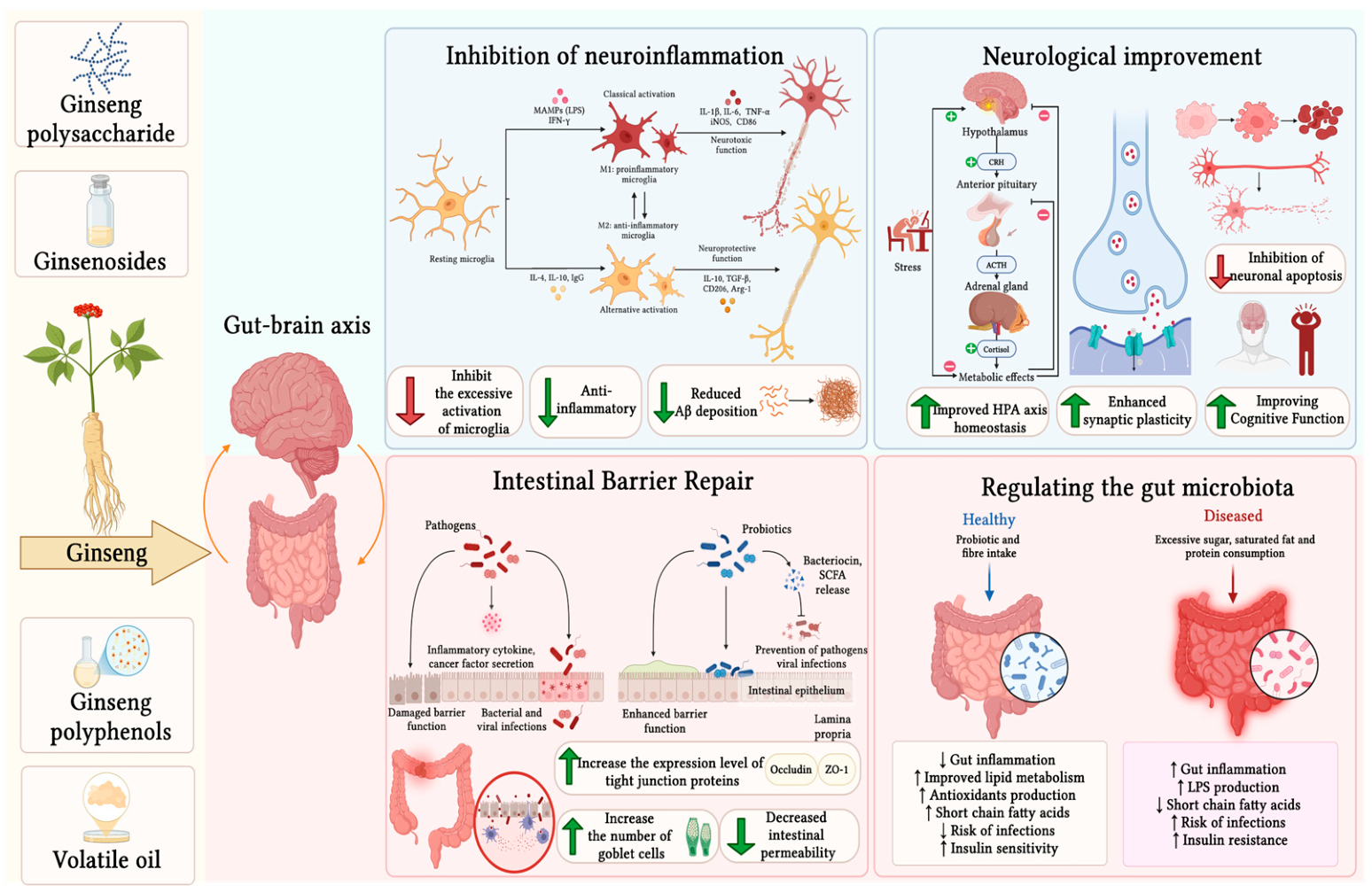


Disclaimer/Publisher’s Note: The statements, opinions and data contained in all publications are solely those of the individual author(s) and contributor(s) and not of MDPI and/or the editor(s). MDPI and/or the editor(s) disclaim responsibility for any injury to people or property resulting from any ideas, methods, instructions or products referred to in the content. |
© 2026 by the authors. Licensee MDPI, Basel, Switzerland. This article is an open access article distributed under the terms and conditions of the Creative Commons Attribution (CC BY) license.
Share and Cite
Liu, S.; Tian, L.; Chen, W.; Geng, J.; He, Z.; Zhou, J. Ginseng Bioactive Components as Gut-Brain Axis-Targeted Modulators: Therapeutic Potential and Mechanisms in Multifactorial Diseases. Nutrients 2026, 18, 1778. https://doi.org/10.3390/nu18111778
Liu S, Tian L, Chen W, Geng J, He Z, Zhou J. Ginseng Bioactive Components as Gut-Brain Axis-Targeted Modulators: Therapeutic Potential and Mechanisms in Multifactorial Diseases. Nutrients. 2026; 18(11):1778. https://doi.org/10.3390/nu18111778
Chicago/Turabian StyleLiu, Silu, Lanshi Tian, Weijia Chen, Jianan Geng, Zhongmei He, and Jia Zhou. 2026. "Ginseng Bioactive Components as Gut-Brain Axis-Targeted Modulators: Therapeutic Potential and Mechanisms in Multifactorial Diseases" Nutrients 18, no. 11: 1778. https://doi.org/10.3390/nu18111778
APA StyleLiu, S., Tian, L., Chen, W., Geng, J., He, Z., & Zhou, J. (2026). Ginseng Bioactive Components as Gut-Brain Axis-Targeted Modulators: Therapeutic Potential and Mechanisms in Multifactorial Diseases. Nutrients, 18(11), 1778. https://doi.org/10.3390/nu18111778