


Participants’ Perspectives on Health Impact, Barriers and Facilitators to Adherence in a Mediterranean Diet Lifestyle Trial

 , ,
, ,
Abstract
1. Introduction
2. Materials and Methods
2.1. Study Design
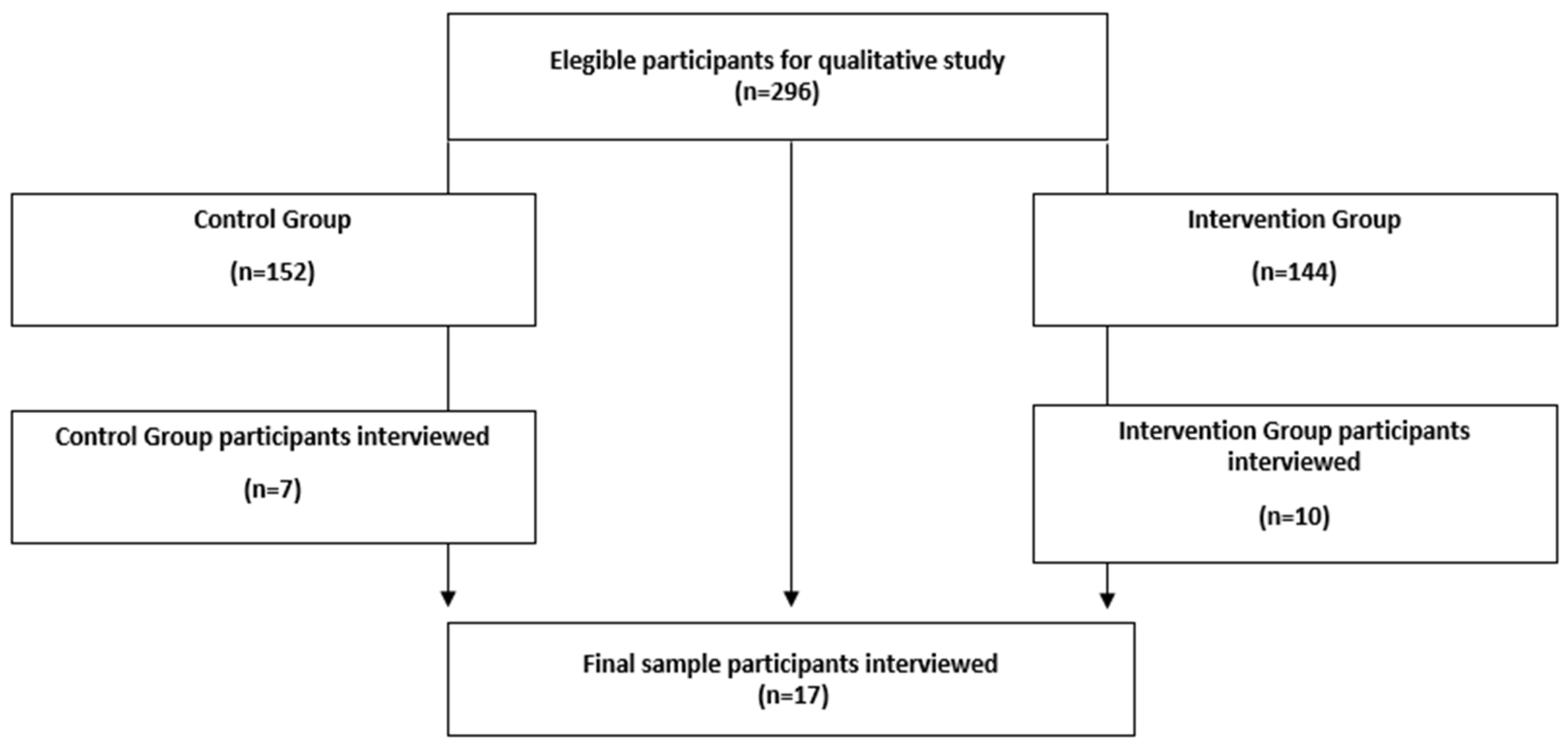
2.2. Sample Selection
2.3. Data Collection
2.4. Theoretical and Analytical Framework
2.5. Data Analysis
2.6. Ethical Statement
3. Results
3.1. Sociodemographic Characteristics of Participants
3.2. Thematic Analysis of Interviews
4. Experiences of Enrollment in a MedDiet Lifestyle Trial Study
4.1. Motivations for Participation
4.2. Challenges and Personal Goals
5. Perceived Health Impact
5.1. High Quality of Life
5.2. Moderate Quality of Life
5.3. Low Quality of Life
5.4. Health Impact on Relatives and Social Networks
6. Facilitators to Adherence with the Mediterranean Diet and Lifestyle Recommendations
6.1. Nutritional Learning and Behavioural Reinforcement
6.2. Supportive Relationship with the Research Team
6.3. Sense of Responsibility and Social Meaning
7. Barriers to Adherence with the Mediterranean Diet and Lifestyle Recommendations
7.1. Loss of Motivation and Difficulty Sustaining Discipline
7.2. Cultural and Emotional Resistance to Change Eating Habits
7.3. Physical Limitations
7.4. Gendered Challenges and Relational Barriers
8. Participants’ Opinions and Suggestions for Improving the Intervention
8.1. Overall Satisfaction and Trust in the Research Design
8.2. Unmet Expectations and Perceived Gaps in the Intervention
9. Discussion
Strengths and Limitations
10. Conclusions
Supplementary Materials
Author Contributions
Funding
Institutional Review Board Statement
Informed Consent Statement
Data Availability Statement
Conflicts of Interest
Abbreviations
| BMI | Body Mass Index |
| C | Control group |
| F | Female |
| I | Intervention group |
| ISRCTN | International Standard Randomised Controlled Trial Number |
| M | Male |
| MedDiet | Mediterranean Diet |
| MetS | Metabolic Syndrome |
| NCDs | Non-communicable diseases |
| No. | Number |
| RCT | Randomised Clinical Trial |
| SRQR | Standards for Reporting Qualitative Research |
References
- World Health Organization. World Health Statistics 2025: Monitoring Health for the SDGs, Sustainable Development Goals; WHO: Geneva, Switzerland, 2025. [Google Scholar]
- Noubiap, J.J.; Nansseu, J.R.; Lontchi-Yimagou, E.; Nkeck, J.R.; Nyaga, U.F.; Ngouo, A.T.; Tounouga, D.N.; Tianyi, F.L.; Foka, A.J.; Ndoadoumgue, A.L.; et al. Geographic Distribution of Metabolic Syndrome and Its Components in the General Adult Population: A Meta-Analysis of Global Data from 28 Million Individuals. Diabetes Res. Clin. Pract. 2022, 188, 109924. [Google Scholar] [CrossRef] [Scilit] [PubMed]
- Alberti, K.G.M.M.; Eckel, R.H.; Grundy, S.M.; Zimmet, P.Z.; Cleeman, J.I.; Donato, K.A.; Fruchart, J.C.; James, W.P.T.; Loria, C.M.; Smith, S.C. Harmonizing the Metabolic Syndrome: A Joint Interim Statement of the International Diabetes Federation Task Force on Epidemiology and Prevention; National Heart, Lung, and Blood Institute; American Heart Association; World Heart Federation; International Atherosclerosis Society; And International Association for the Study of Obesity. Circulation 2009, 120, 1640–1645. [Google Scholar] [PubMed]
- Hernández Ruiz de Eguilaz, M.; Batlle, M.A.; Martínez de Morentin, B.; San-Cristóbal, R.; Pérez-Díez, S.; Navas-Carretero, S.; Martínez, J.A. Cambios Alimentarios y de Estilo de Vida Como Estrategia En La Prevención Del Síndrome Metabólico y La Diabetes Mellitus Tipo 2: Hitos y Perspectivas. An. Sist. Sanit. Navar. 2016, 39, 269–289. [Google Scholar]
- Fernandez-Lazaro, C.I.; Toledo, E.; Buil-Cosiales, P.; Salas-Salvadó, J.; Corella, D.; Fitó, M.; Martínez, J.A.; Alonso-Gómez, Á.M.; Wärnberg, J.; Vioque, J.; et al. Factors Associated with Successful Dietary Changes in an Energy-Reduced Mediterranean Diet Intervention: A Longitudinal Analysis in the PREDIMED-Plus Trial. Eur. J. Nutr. 2022, 61, 1457–1475. [Google Scholar] [CrossRef] [Scilit]
- Nugent, R.; Bertram, M.Y.; Jan, S.; Niessen, L.W.; Sassi, F.; Jamison, D.T.; Pier, E.G.; Beaglehole, R. Investing in Non-Communicable Disease Prevention and Management to Advance the Sustainable Development Goals. Lancet 2018, 391, 2029–2035. [Google Scholar] [CrossRef] [Scilit]
- Lichtenstein, A.H.; Appel, L.J.; Vadiveloo, M.; Hu, F.B.; Kris-Etherton, P.M.; Rebholz, C.M.; Sacks, F.M.; Thorndike, A.N.; Van Horn, L.; Wylie-Rosett, J. 2021 Dietary Guidance to Improve Cardiovascular Health: A Scientific Statement from the American Heart Association. Circulation 2021, 144, E472–E487. [Google Scholar] [CrossRef] [Scilit]
- Godos, J.; Zappalà, G.; Bernardini, S.; Giambini, I.; Bes-Rastrollo, M.; Martinez-Gonzalez, M. Adherence to the Mediterranean Diet Is Inversely Associated with Metabolic Syndrome Occurrence: A Meta-Analysis of Observational Studies. Int. J. Food Sci. Nutr. 2017, 68, 138–148. [Google Scholar] [CrossRef] [Scilit]
- Virani, S.S.; Alonso, A.; Aparicio, H.J.; Benjamin, E.J.; Bittencourt, M.S.; Callaway, C.W.; Carson, A.P.; Chamberlain, A.M.; Cheng, S.; Delling, F.N.; et al. Heart Disease and Stroke Statistics—2021 Update: A Report from the American Heart Association. Circulation 2021, 143, E254–E743. [Google Scholar] [CrossRef] [Scilit]
- Franquesa, M.; Pujol-Busquets, G.; García-Fernández, E.; Rico, L.; Shamirian-Pulido, L.; Aguilar-Martínez, A.; Medina, F.X.; Serra-Majem, L.; Bach-Faig, A. Mediterranean Diet and Cardiodiabesity: A Systematic Review through Evidence-Based Answers to Key Clinical Questions. Nutrients 2019, 11, 655. [Google Scholar] [CrossRef] [Scilit]
- Martinez-Gonzalez, M.A.; Bes-Rastrollo, M.; Serra-Majem, L.; Lairon, D.; Estruch, R.; Trichopoulou, A. Mediterranean Food Pattern and the Primary Prevention of Chronic Disease: Recent Developments. Nutr Rev. 2009, 67, S111–S116. [Google Scholar] [CrossRef] [Scilit]
- Martínez-González, M.A.; Gea, A.; Ruiz-Canela, M. The Mediterranean Diet and Cardiovascular Health: A Critical Review. Circ. Res. 2019, 124, 779–798. [Google Scholar] [CrossRef] [Scilit] [PubMed]
- Frieden, T.R. Evidence for Health Decision Making—Beyond Randomized, Controlled Trials. N. Engl. J. Med. 2017, 377, 465–475. [Google Scholar] [CrossRef] [Scilit]
- Multiple Risk Factor Intervention Trial Research Group. Multiple Risk Factor Intervention Trial: Risk Factor Changes and Mortality Results. JAMA 1982, 248, 1465–1477. [Google Scholar] [CrossRef] [Scilit]
- McKinney, M.; Bell, R.; Samborski, C.; Attwood, K.; Dean, G.; Eakle, K.; Yu, W.; Edge, S.B. Clinical Trial Participation A Pilot Study of Patient-Identified Barriers. Clin. J. Oncol. Nurs. 2021, 25, 647–654. [Google Scholar] [CrossRef] [Scilit] [PubMed]
- Price, A.; Albarqouni, L.; Kirkpatrick, J.; Clarke, M.; Liew, S.M.; Roberts, N.; Burls, A. Patient and Public Involvement in the Design of Clinical Trials: An Overview of Systematic Reviews. J. Eval. Clin. Pract. 2018, 24, 240–253. [Google Scholar] [CrossRef] [Scilit]
- Thangaratinam, S.; Khan, K.S. Participation in Research as a Means of Improving Quality of Care: The Role of a Principal Investigator in Multicentre Clinical Trials. Obstet. Gynaecol. 2015, 17, 55–61. [Google Scholar] [CrossRef] [Scilit]
- Downer, M.K.; Gea, A.; Stampfer, M.; Sánchez-Tainta, A.; Corella, D.; Salas-Salvadó, J.; Ros, E.; Estruch, R.; Fitó, M.; Gómez-Gracia, E.; et al. Predictors of Short- and Long-Term Adherence with a Mediterranean-Type Diet Intervention: The PREDIMED Randomized Trial. Int. J. Behav. Nutr. Phys. Act. 2016, 13, 67. [Google Scholar] [CrossRef] [Scilit]
- Martínez-González, M.A.; Buil-Cosiales, P.; Corella, D.; Bulló, M.; Fitó, M.; Vioque, J.; Romaguera, D.; Alfredo Martínez, J.; Wärnberg, J.; López-Miranda, J.; et al. Cohort Profile: Design and Methods of the PREDIMED-Plus Randomized Trial. Int. J. Epidemiol. 2019, 48, 387–388. [Google Scholar] [CrossRef] [Scilit]
- O’Brien, B.C.; Harris, I.B.; Beckman, T.J.; Reed, D.A.; Cook, D.A. Standards for Reporting Qualitative Research: A Synthesis of Recommendations. Acad. Med. 2014, 89, 1245–1251. [Google Scholar] [CrossRef] [Scilit]
- Heidari, S.; Babor, T.F.; De Castro, P.; Tort, S.; Curno, M. Sex and Gender Equity in Research: Rationale for the SAGER Guidelines and Recommended Use. Res. Integr. Peer Rev. 2016, 1, 2. [Google Scholar] [CrossRef] [Scilit]
- Van Epps, H.; Astudillo, O.; Del Pozo Martín, Y.; Marsh, J. The Sex and Gender Equity in Research (SAGER) Guidelines: Implementation and Checklist Development. Eur. Sci. Ed. 2022, 48, e86910. [Google Scholar] [CrossRef] [Scilit]
- Patton, M.Q. Qualitative Research and Evaluation Methods: Integrating Theory and Practice; SAGE Publications Inc.: Thousand Oaks, CA, USA, 2014. [Google Scholar]
- Haskell, G.H.; Headland, T.N.; Pike, K.L.; Harris, M. Emics and Etics: The Insider/Outsider Debate. J. Am. Folk. 1992, 105, 489. [Google Scholar] [CrossRef] [Scilit]
- Pope, C.; Mays, N. (Eds.) Qualitative Research in Health Care, 4th ed.; Wiley-Blackwell: Oxford, UK, 2020; ISBN 9781119410836. [Google Scholar]
- Phull, S. The Mediterranean Diet: Socio-Cultural Relevance for Contemporary Health Promotion. Open Public Health J. 2015, 8, 35–40. [Google Scholar] [CrossRef] [Scilit]
- Medina, F.X.; Solé-Sedeno, J.M.; Bach-Faig, A.; Aguilar-Martínez, A. Obesity, Mediterranean Diet, and Public Health: A Vision of Obesity in the Mediterranean Context from a Sociocultural Perspective. Int. J. Environ. Res. Public Health 2021, 18, 3715. [Google Scholar] [CrossRef] [Scilit]
- Counihan, C. Gendering Food. In The Oxford Handbook of Food History; Pilcher, J., Ed.; Oxford University Press: Oxford, UK, 2012; pp. 99–116. [Google Scholar]
- Fournier, T.; Jarty, J.; Lapeyre, N.; Touraille, P. L’alimentation: Arme Du Genre. J. Anthropol. 2015, 140–141, 19–49. [Google Scholar] [CrossRef] [Scilit]
- McPhail, D.; Beagan, B.; Chapman, G.E. I Don’t Want to Be Sexist but "Denying and Re-Inscribing Gender through Food. Food Cult. Soc. 2012, 15, 473–489. [Google Scholar] [CrossRef] [Scilit]
- Parsons, J. Gender, Class, and Food: Families, Bodies and Health; Palgrave Macmillan: Basingstoke, UK, 2015. [Google Scholar]
- Murcott, A. The Sociology of Food and Eating: Essays on the Sociological Significance of Food; Gower: Farnham, UK, 1986. [Google Scholar]
- Murdock, G.P.; Provost, C. Factors in the Division of Labor by Sex: A Cross-Cultural Analysis. Ethnology 1973, 12, 203–225. [Google Scholar] [CrossRef] [Scilit]
- Serra-Majem, L.; Tomaino, L.; Dernini, S.; Berry, E.M.; Lairon, D.; de la Cruz, J.N.; Bach-Faig, A.; Donini, L.M.; Medina, F.X.; Belahsen, R.; et al. Updating the Mediterranean Diet Pyramid towards Sustainability: Focus on Environmental Concerns. Int. J. Environ. Res. Public Health 2020, 17, 8758. [Google Scholar] [CrossRef] [Scilit]
- Braun, V.; Clarke, V. Thematic Analysis: A Practical Guide; SAGE Publications Ltd.: London, UK, 2022; ISBN 9781473953246. [Google Scholar]
- Hewitt-Taylor, J. Use of Constant Comparative Analysis in Qualitative Research. Nurs. Stand. 2001, 15, 39–42. [Google Scholar] [CrossRef] [Scilit]
- Annells, M. Triangulation of Qualitative Approaches: Hermeneutical Phenomenology and Grounded Theory. J. Adv. Nurs. 2006, 56, 55–61. [Google Scholar] [CrossRef] [Scilit]
- Dismore, L.; Hurst, C.; Sayer, A.A.; Stevenson, E.; Aspray, T.; Granic, A. Study of the Older Adults’ Motivators and Barriers Engaging in a Nutrition and Resistance Exercise Intervention for Sarcopenia: An Embedded Qualitative Project in the MIlkMAN Pilot Study. Gerontol. Geriatr. Med. 2020, 6, 2333721420920398. [Google Scholar] [CrossRef] [Scilit] [PubMed]
- Rose, L.; Wood, A.; Gill, T. Gender Differences in Adherence and Retention in Mediterranean Diet Interventions with a Weight-Loss Outcome: A Systematic Review and Meta-Analysis. Obes. Rev. 2024, 25, e13824. [Google Scholar] [CrossRef] [Scilit] [PubMed]
- Raparelli, V.; Romiti, G.F.; Spugnardi, V.; Borgi, M.; Cangemi, R.; Basili, S.; Proietti, M.; Lenzi, A.; Tiberti, C.; Panimolle, F.; et al. Gender-Related Determinants of Adherence to the Mediterranean Diet in Adults with Ischemic Heart Disease. Nutrients 2020, 12, 759. [Google Scholar] [CrossRef] [Scilit] [PubMed]
- Basora, J.; Villalobos, F.; Pallejà-Millán, M.; Babio, N.; Goday, A.; Castañer, O.; Fitó, M.; Zomeño, M.D.; Pintó, X.; Sacanella, E.; et al. Association between the Potential Influence of a Lifestyle Intervention in Older Individuals with Excess Weight and Metabolic Syndrome on Untreated Household Cohabitants and Their Family Support: The Predimed-plus Study. Nutrients 2020, 12, 1975. [Google Scholar] [CrossRef] [Scilit]
- Marshall, N.; Butler, M.; Lambert, V.; Timon, C.M.; Joyce, D.; Warters, A. Health Literacy Interventions and Health Literacy-Related Outcomes for Older Adults: A Systematic Review. BMC Health Serv. Res. 2025, 25, 319. [Google Scholar] [CrossRef] [Scilit]
- Osborne, R.H.; Elmer, S.; Hawkins, M.; Cheng, C.C.; Batterham, R.W.; Dias, S.; Good, S.; Monteiro, M.G.; Mikkelsen, B.; Nadarajah, R.G.; et al. Health Literacy Development Is Central to the Prevention and Control of Non-Communicable Diseases. BMJ Glob. Health 2022, 7, e010362. [Google Scholar] [CrossRef] [Scilit]
- Paukkonen, L.; Oikarinen, A.; Kähkönen, O.; Kyngäs, H. Adherence to Self-Management in Patients with Multimorbidity and Associated Factors: A Cross-Sectional Study in Primary Health Care. J. Clin. Nurs. 2022, 31, 2805–2820. [Google Scholar] [CrossRef] [Scilit]
- Krukowski, R.A.; West, D.S.; Priest, J.; Ashikaga, T.; Naud, S.; Harvey, J.R. The Impact of the Interventionist–Participant Relationship on Treatment Adherence and Weight Loss. Transl. Behav. Med. 2019, 9, 368–372. [Google Scholar] [CrossRef] [Scilit]
- Hawke, L.J.; Nelson, E.; O’Brien, P.; Crossley, K.M.; Choong, P.F.; Bunzli, S.; Dowsey, M.M. Influences on Clinical Trial Participation: Enhancing Recruitment through a Gender Lens—A Scoping Review. Contemp. Clin. Trials Commun. 2024, 38, 101283. [Google Scholar] [CrossRef] [Scilit]
- Yong, C.; Suvarna, A.; Harrington, R.; Gummidipundi, S.; Krumholz, H.M.; Mehran, R.; Heidenreich, P. Temporal Trends in Gender of Principal Investigators and Patients in Cardiovascular Clinical Trials. J. Am. Coll. Cardiol. 2023, 81, 428–430. [Google Scholar] [CrossRef] [Scilit]
- Denby, K.J.; Szpakowski, N.; Silver, J.; Walsh, M.N.; Nissen, S.; Cho, L. Representation of Women in Cardiovascular Clinical Trial Leadership. JAMA Intern. Med. 2020, 180, 1382–1383. [Google Scholar] [CrossRef] [Scilit]
- Apostolaki, I.; Pepa, A.; Vlassopoulos, A.; Kapsokefalou, M. Social Capital and Self-Perceived Quality of Life-Interrelated Predictors of Mediterranean Diet Adherence in Older Adults. Nutrients 2021, 13, 3100. [Google Scholar] [CrossRef] [Scilit]
- Surrow, S.; Jessen-Winge, C.; Ilvig, P.M.; Christensen, J.R. The Motivation and Opportunities for Weight Loss Related to the Everyday Life of People with Obesity: A Qualitative Analysis within the DO:IT Study. Scand. J. Occup. Ther. 2021, 28, 479–487. [Google Scholar] [CrossRef] [Scilit]
- Murray, J.; Fenton, G.; Honey, S.; Bara, A.C.; Hill, K.M.; House, A. A Qualitative Synthesis of Factors Influencing Maintenance of Lifestyle Behaviour Change in Individuals with High Cardiovascular Risk. BMC Cardiovasc. Disord. 2013, 13, 48. [Google Scholar] [CrossRef] [Scilit]
- Trujillo-Garrido, N.; Santi-Cano, M.J. Motivation and Limiting Factors for Adherence to Weight Loss Interventions among Patients with Obesity in Primary Care. Nutrients 2022, 14, 2928. [Google Scholar] [CrossRef] [Scilit]
- Baer, N.R.; Zoellick, J.C.; Deutschbein, J.; Anton, V.; Bergmann, M.M.; Schenk, L. Dietary Preferences in the Context of Intra-Couple Dynamics: Relationship Types within the German NutriAct Family Cohort. Appetite 2021, 167, 105625. [Google Scholar] [CrossRef] [Scilit]
- Cobb, L.K.; Godino, J.G.; Selvin, E.; Kucharska-Newton, A.; Coresh, J.; Koton, S. Spousal Influence on Physical Activity in Middle-Aged and Older Adults. Am. J. Epidemiol. 2016, 183, 444–451. [Google Scholar] [CrossRef] [Scilit]
- Albanese, A.M.; Huffman, J.C.; Celano, C.M.; Malloy, L.M.; Wexler, D.J.; Freedman, M.E.; Millstein, R.A. The Role of Spousal Support for Dietary Adherence among Type 2 Diabetes Patients: A Narrative Review. Soc. Work. Health Care 2019, 58, 304–323. [Google Scholar] [CrossRef] [Scilit]
- Navarro-Martínez, R.; Mafla-España, M.A.; Cauli, O. Mediterranean Diet Adherence in Community-Dwelling Older Adults in Spain: Social Determinants Related to the Family. Nutrients 2022, 14, 5141. [Google Scholar] [CrossRef] [Scilit]

| Code | Sex 1 | Age (Years) | Marital Status | Educational Level 2 | Occupation | No. Cohabitants | Type Housing | RTC Allocation Group 3 | Weight Loss (%) 4 | Visits’ Attendance 5 | MedDiet Adherence Improvement 6 |
|---|---|---|---|---|---|---|---|---|---|---|---|
| 08007 | M | 65 | Married | Medium | Retired | 2 | Urban | I | 6.8 | 50 | +6 |
| 08027 | F | 67 | Widowed | Low | Retired | 5 | Urban | I | 2.3 | 75 | +3 |
| 08032 | M | 81 | Married | Low | Retired | 2 | Rural | I | 2.7 | 75 | 0 |
| 08093 | F | 66 | Widowed | Medium | Retired | 3 | Urban | C | 3.3 | 100 | +2 |
| 08181 | F | 70 | Married | Medium | Retired | 2 | Urban | C | 1.1 | 100 | −6 |
| 08200 | F | 67 | Married | Low | Retired | 2 | Urban | I | 13.5 | 83 | +5 |
| 08212 | M | 70 | Married | High | Retired | 1 | Rural | I | 20.7 | 83 | +4 |
| 08231 | M | 62 | Married | Medium | Retired | 2 | Urban | I | 12.2 | 17 | 0 |
| 08241 | M | 60 | Married | High | Active | 2 | Urban | I | 1.1 | 33 | 0 |
| 08259 | M | 68 | Married | Low | Retired | 2 | Rural | I | 1.3 | 100 | +4 |
| 08341 | F | 63 | Married | Low | Retired | 4 | Rural | C | −1.5 | 100 | −1 |
| 08347 | M | 69 | Married | Medium | Retired | 3 | Urban | C | −7.5 | 100 | 0 |
| 08351 | M | 74 | Married | Low | Retired | 2 | Urban | C | 0.3 | 100 | +3 |
| 08381 | F | 76 | Married | High | Retired | 1 | Urban | I | 1.0 | 100 | +1 |
| 08382 | M | 61 | Married | High | Retired | 2 | Urban | C | −3.0 | 100 | −2 |
| 08399 | F | 60 | Married | Low | Retired | 2 | Urban | C | 5.7 | 100 | 9 |
| 08412 | M | 67 | Married | Medium | Retired | 2 | Urban | I | 3.4 | 5 | +3 |
| Category | Subcategory | Verbatim Quotes |
|---|---|---|
| 2.1. High quality of life | Autonomy and active, social, and meaningful life | “Psychologically, I also feel good, fulfilled with what I am doing with my grandchildren, with the activity. I do not feel like a useless woman who is of no use, I help as much as I can and as I can (…) Life has taught me that you learn from mistakes, you learn from failures and that you should never throw in the towel and move forward.” (08200, Woman, 67 years) |
| Gratefulness for health enhancement and survival | “So, thanks to this, I am alive, plain and simple. If I hadn’t died already, if I had continued on the path I was on (…) because I ate too much and things that weren’t good for me… thanks to [the study], I am alive, it’s that simple.” (08032, Man, 81 years) “Coming here has been the best thing that has ever happened to me. I am very happy.” (08093, Woman, 67 years) “Well, I have felt very good [in the study] these seven or eight years.” (08347, Man, 69 years) | |
| Improvement in eating habits, concern for health, self-care, self-esteem | “Well, what I liked most [about the study] is that it teaches you to eat healthier. It makes you realize what you’re used to eating and encourages you to change.” (08351, Man, 74 years) “The self-esteem of being myself, of preparing my own food. (…) Teaching me to take care of myself, to eat, to know how to behave properly and do things better.” (08093, Woman, 67 years) “I think so, it’s good because it teaches you, first, to get out of the house a little bit. (…) It has helped me to think that I must take care of myself.” (08093, Woman, 67 years) | |
| Better physical appearance and self-image | “I am very happy with my physical condition because I feel young, I feel better, lighter, I am not flabby, I can wear clothes that I like, and I feel good.” (08200, Woman, 67 years) “When I enter [the meeting room] and see so many old people, I say,… I look better than 90%.” (08381, Woman, 76 years) | |
| Improvement in disease status and reduction in medical prescriptions | “It has balanced my blood pressure and weight very well, and I don’t take pills for cholesterol.” (08200, Woman, 67 years) “I was on a waiting list for a prosthesis, and I did not have surgery because the pain in my knee went away when I lost the weight.” (08032, Man, 81 years) | |
| Better medical surveillance and confidence in the research team | “They treated me very well, and the things you do here you don’t do at the [doctor’s] insurance.” (08259, Man, 68 years) “I felt more confident (...) I think there is a remedy because I feel confident with you.” (08032, Man, 81 years) | |
| 2.2. Moderate quality of life | Maintenance of health status and disease control | “I feel fine, I have my ailments, but as long as you keep moving with light physical activity and keep yourself under control, that’s it.” (08382, Man, 61 years) “All things considered, I don’t think I’m doing too badly, am I? I’m about to have a catheter fitted next week, but anyway.” (08351, Man, 74 years) |
| No concern for physical appearance, but rather for autonomy | “I have perhaps paid more attention to ensuring that I do not lose my memory, that I do not become useless in being able to walk, because I do not want to give my daughters that problem.” (08381, Woman, 76 years) | |
| 2.3. Low quality of life | Recent severe diseases and depression | “But this year life changed. I have a cardio issue that is going to complicate me and so I have neither the need nor the desire to put effort into these things [healthy habits].” (08212, Man, 70 years) “And now I feel useless, I feel depressed because [blindness] has come on almost suddenly.” (08032, Man, 81 years) |
| Problems with relationships and isolation | “[He changed his lifestyle, gave up tobacco, alcohol and soft drinks because he] was no longer any good for anything, married life. I couldn’t do anything.” (08032, Man, 81 years) “We stopped going out many years ago… our friends have disappeared, because some of them have died.” (08181, Woman, 70 years) | |
| 2.4. Health impact on relatives and social networks | Health promotion agency and vicarious health benefits | “I think so, because since I cook [healthy] food for myself, we all eat it.” (08027, Woman, 67 years) “My son used to smoke a lot, but now he doesn’t smoke as much; he’s quitting. (…) My daughter has taken advantage of that, my son too, and my neighbours.” (08200, Woman, 67 years) |
| Category | Subcategory | Participants’ Verbatim Quotes |
|---|---|---|
| 3.1. Nutritional learning and behavioural reinforcement | Awareness, responsibility, commitment, and privilege to be involved in relevant research | “I have been responsible because I consider what I am receiving here at [MedDiet trial] to be beneficial; the diet is very healthy.” (08200, Woman, 67 years) “When the study ends, I will feel satisfied that I have contributed, and that’s it, quite simply. When I started, I knew I would finish, unless I died in the pandemic, you know? I mean, when I commit to something, I carry on to the end (…) I have never thought about giving up or abandoning it. No, no.” (08341, Woman, 63 years) “No, because difficult things always take more effort, but you try to correct yourself, and I’ve liked this from day one.” (08093, Woman, 67 years) “Being here is (…) to give it coherence. If I’m here, it’s to participate seriously, and that commitment has come to me as a result. (…) There will be people who come here, I don’t know, to entertain themselves, but that doesn’t make much sense either, [coming] once every six months isn’t that much fun. But that doesn’t mean I’m not aware that I’m doing serious work, I know [this study] is multinational.” (08382, Man, 61 years) |
| Health improvement feedback and clear and adapted recommendations | “I didn’t find anything you explained to me difficult, because I did everything exactly as instructed. Well, I didn’t weigh things, but I did calculate. (…) I didn’t find it difficult at all. I thought everything was fine, because when I did it, I noticed the improvement. I didn’t find anything difficult.” (08032, Man, 81 years) | |
| 3.2. Supportive relationship with research team | Appreciation for research team support and empathy | “And it turns out that [attending the meetings] was a pleasant surprise, because everything was attentive, delicate, personal encounters, analytical… That was a huge gift for me, all the people [researchers on the team] I met (…) I will always remember them, honestly, because they helped me so much. Now [with the new researchers] too, yes, and the other one, what’s her name? I don’t want to forget her name.” (08200, Woman, 67 years) “They treated me very well.” (08399, Woman, 60 years) “The people I have had the opportunity to spend time with are very nice and have always treated me very well, etc. So, I’m fine.” (08382, Man, 61 years) “I really liked the meetings, the way they talked to us and presented things to us. Apart from that, they are wonderful people.” (08027, Woman, 67 years) “The study has been good, because, well, all the years I’ve been here, you’ve been looking for us.” (08181, Woman, 70 years) |
| Emotional support and motivation for self-esteem | “They taught me to go out and have self-esteem, to be enthusiastic, that’s why I call them ‘my girls’ because they helped me to go out and communicate and move forward and learn (…) They called me the girls who gave us the talks and told us how we had to do things. So that gave me self-esteem, taught me how to eat differently (…). (…) this half hour I spend with you means disconnecting from the four walls and that fills me with life. (…) When you call me, I’m happy. [With the team] I am very happy, they have been the best thing for me. I miss you. I have felt supported, and I really liked seeing that there are people who help me with what I need.” (08093, Woman, 67 years) “From the study [I would highlight] (…) not only the diet, [but also] the enthusiasm with which [the researchers on the team] always brought us to the meetings to encourage us, their patience in repeating things, not taking them for granted, their kindness, their psychological insight (…) Everything was very peaceful, with well-explained slides, repetition, and they gave us the opportunity to ask questions. They were patient with some cases that were unclear and insisted on one meeting, then another, and there was always the same spirit of tolerance, of explaining it again.” (08200, Woman, 67 years) | |
| Adaptation of communication and educational approach | “You give the sessions in a very generalised way, from a lower cultural level, a higher level and a not very high level, because you understand that our culture is not about teachers, but rather about housewives, a rather low-level culture, at least the people I have seen. So, it is very well adapted.” (08200, Woman, 67 years) | |
| Wish to maintain healthy habits after the end of study | “Everything you have taught me; I will continue to do. I am not going to say, ‘I have finished studying and I am stopping.’ What I have learned, I will continue to do.” (08347, Man, 69 years) “It’s a shame it’s coming to an end, as you’ll have to continue following the same rules you’ve tried to learn.” (08351, Man, 74 years) | |
| 3.3. Sense of responsibility and social meaning | Moral engagement and reflection on self-control | “Whether the programme works [for participants] is a matter of commitment.” (08200, Woman, 67 years) “I have tried to apply what I have learned and pass it on to others, because the important thing is to share what one receives.” (08032, Man, 81 years) |
| Ritualised meals and daily activities around closer social network | ‘I often go for walks with her [my wife]’ (08241, Man, 60 years, married); ‘I usually get together with a group of … friends…’ (08027, Woman, 67 years, widowed, retired); ‘I have a sister who was widowed … I go every morning … to walk with her’. (08381, Woman, 76 years, widowed, retired). |
| Category | Subcategory | Participants’ Verbatim Quotes |
|---|---|---|
| 4.1. Loss of motivation and difficulty sustaining discipline | Inconsistency and lack of determination | “…my fault is that I don’t follow a strict diet like … my brother [also a participant] did.” (08212, Man, 70 years) “[Losing 4 kg] is very difficult…because that would require an additional effort …, the habits I have incorporated are not enough.” (08241, Man, 60 years) “I don’t eat badly, but of course, there are things that I shouldn’t eat, and I do. (…) If I’m not losing weight, I’m not going to get obsessed either.” (08351, Man, 74 years) |
| Fatigue and loss of enthusiasm | “At first, I was more motivated, but now I have less willpower; it’s tiring always being on a diet.” (08181, Woman, 70 years) “I do it but not like in the beginning; there are times when I slack off.” (08027, Woman, 67 years) | |
| 4.2. Cultural and emotional resistance to change eating habits | Difficulty breaking lifelong eating habits | “It takes a lot of effort, because we’re already addicted … You can’t cut things out immediately, because it might make things even worse … At my age, 74, it’s very difficult to break old habits.” (08212, Man, 70 years, married) “I have a problem, … I always have a big appetite…I really enjoy food, and I care a lot about it.” (08241, Man, 60 years) |
| Emotional attachment and pleasure from food | “Food is one of the few pleasures left in life, and at our age, we shouldn’t deprive ourselves too much.” (08382, Man, 61 years) “There comes a time when I’m not going to stop doing what I like.” (08212, Man, 70 years) “Especially at my age, you say, ‘Let’s see if you haven’t had one [beer] today and tomorrow, you’re dead and you can’t have one either,’ right?” (08231, Man, 62 years) | |
| 4.3. Physical limitations | Health-related constraints and frailty | “I … have a total knee prosthesis, … I can’t walk as fast as I used to walk. It is something that weighs heavily on me and that I have not adapted … [since] almost a year.” (08212, Man, 70 years) “I used to have a land, but now I’ve given it up because I’ve been having such a rough time … and I wasn’t feeling well, so I sold it.” (08032, Man, 81 years) |
| 4.4. Gendered challenges and relational barriers. | Caregiving obligations | “This year I signed up to do sport…, and I had to cancel [because]… I must look after my grandson … I must think about going out for longer because my joints and bones are crying out for it.” (08093, Woman, 66 years). “I can’t always attend meetings or go walking, because I’m taking care of my grandchildren.” |
| Partners’ non-compliance and lack of involvement | “I call it a problem, gluttony…In fact, he’s put on 20 kilos lately … Now I let it go because it’s his freedom and I’m not going to be like a police officer.” (08200, Woman, 67 years). “He says he hasn’t worked his whole life to retire and now, to give up the few things he enjoys”. (08399 Woman, 60 years) “I say [to him]: ‘Let’s go out, let’s join a gym…’ [He answered]: ‘No, because you walk too slowly.” (08181 Woman, 70 years). | |
| Dependence on research team’s support | “Once this research is over, I may not be able to lose weight on my own. (…) I’ll have to prepare myself mentally for … and resign myself to them calling me from time to time.” (08027, Woman, 67 years). |
Disclaimer/Publisher’s Note: The statements, opinions and data contained in all publications are solely those of the individual author(s) and contributor(s) and not of MDPI and/or the editor(s). MDPI and/or the editor(s) disclaim responsibility for any injury to people or property resulting from any ideas, methods, instructions or products referred to in the content. |
© 2025 by the authors. Licensee MDPI, Basel, Switzerland. This article is an open access article distributed under the terms and conditions of the Creative Commons Attribution (CC BY) license.
Share and Cite
Massó Guijarro, P.; Durán-Luque, M.; Rojas-Medina, C.; Cano-Ibáñez, N. Participants’ Perspectives on Health Impact, Barriers and Facilitators to Adherence in a Mediterranean Diet Lifestyle Trial. Nutrients 2026, 18, 63. https://doi.org/10.3390/nu18010063
Massó Guijarro P, Durán-Luque M, Rojas-Medina C, Cano-Ibáñez N. Participants’ Perspectives on Health Impact, Barriers and Facilitators to Adherence in a Mediterranean Diet Lifestyle Trial. Nutrients. 2026; 18(1):63. https://doi.org/10.3390/nu18010063
Chicago/Turabian StyleMassó Guijarro, Paloma, María Durán-Luque, Claudia Rojas-Medina, and Naomi Cano-Ibáñez. 2026. "Participants’ Perspectives on Health Impact, Barriers and Facilitators to Adherence in a Mediterranean Diet Lifestyle Trial" Nutrients 18, no. 1: 63. https://doi.org/10.3390/nu18010063
APA StyleMassó Guijarro, P., Durán-Luque, M., Rojas-Medina, C., & Cano-Ibáñez, N. (2026). Participants’ Perspectives on Health Impact, Barriers and Facilitators to Adherence in a Mediterranean Diet Lifestyle Trial. Nutrients, 18(1), 63. https://doi.org/10.3390/nu18010063

