Comparing the Effects of Dairy and Soybean on Bone Health in Women: A Food- and Component-Level Network Meta-Analysis

Abstract
1. Introduction
2. Materials and Methods
2.1. Search Strategy
2.2. Inclusion and Exclusion Criteria
- (1)
- Participants were healthy female adults aged ≥18 years, which included those with overweight or obesity but excluded individuals with other diseases known to affect bone metabolism (see exclusion criteria 2 below).
- (2)
- Study design was a randomized controlled trial (RCT).
- (3)
- Intervention groups received single or combined treatments of dairy products (milk, yogurt, milk powder, cheese), milk-derived proteins (milk protein, casein, whey protein, milk basic protein), soybean, soy protein, or soy isoflavones.
- (4)
- Control groups received no treatment, placebo, or any intervention listed in (3).
- (5)
- Data for ≥1 bone health outcome (BMD or bone turnover markers) were reported or calculable.
- (1)
- Non-English publications, abstracts, letters, conference reports, or duplicate publications.
- (2)
- Studies involving women with any disease that affects bone metabolism, including renal failure, liver disorders, hyperparathyroidism, hyperthyroidism, diabetes mellitus, or cancer.
- (3)
- Interventions confounded by nontarget components (e.g., vitamin D).
- (4)
- Cointerventions (e.g., exercise programs).
- (5)
- No complete data regarding the effect sizes could be extracted from this study, nor could such information be derived through reliable methods.
2.3. Data Extraction
2.4. Risk-of-Bias Assessment
2.5. Statistical Analysis
3. Results
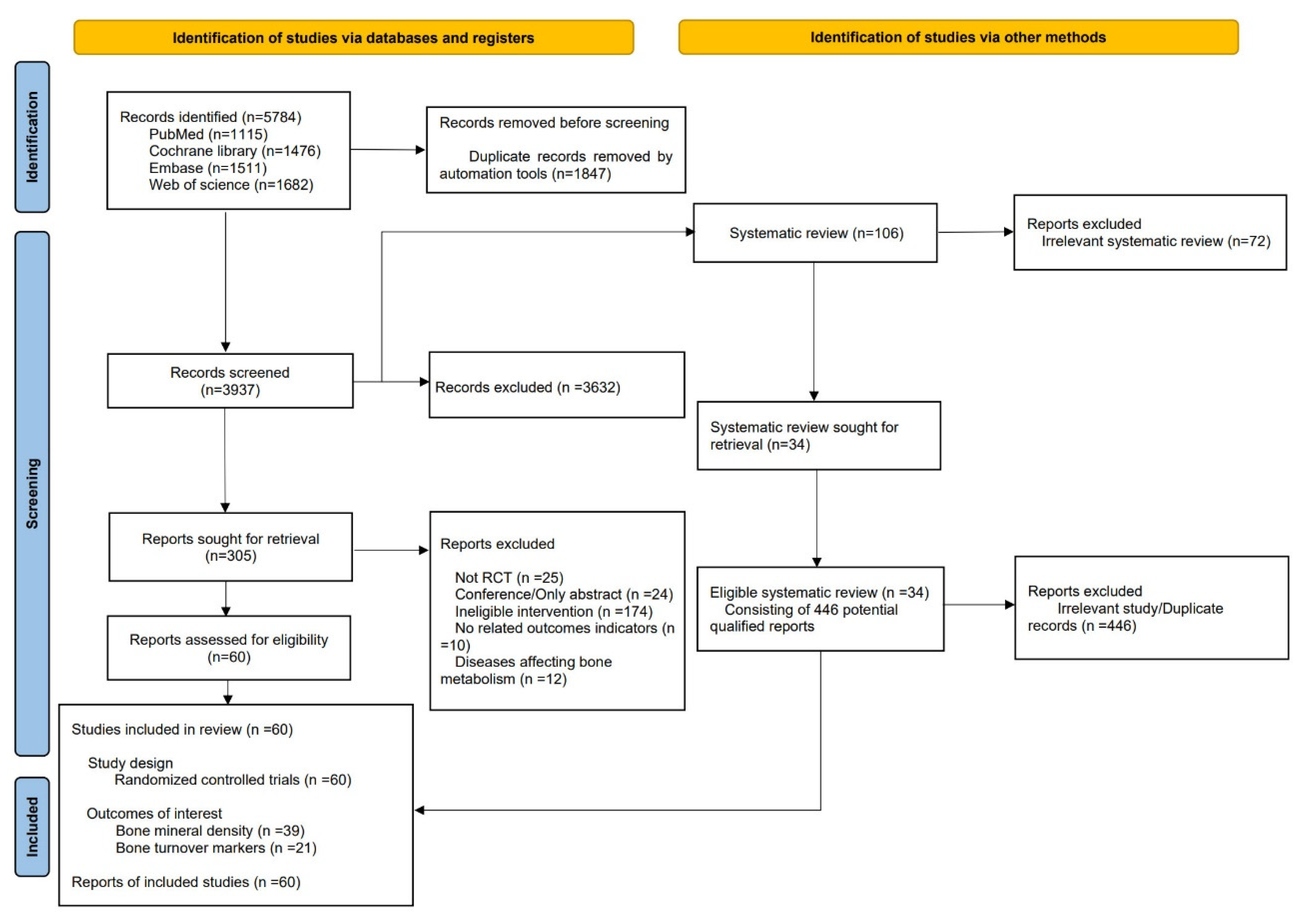
3.1. Literature Search and Screening
3.2. Study Characteristics
3.3. Network Meta-Analysis of the Impact of Interventions on Bone Health
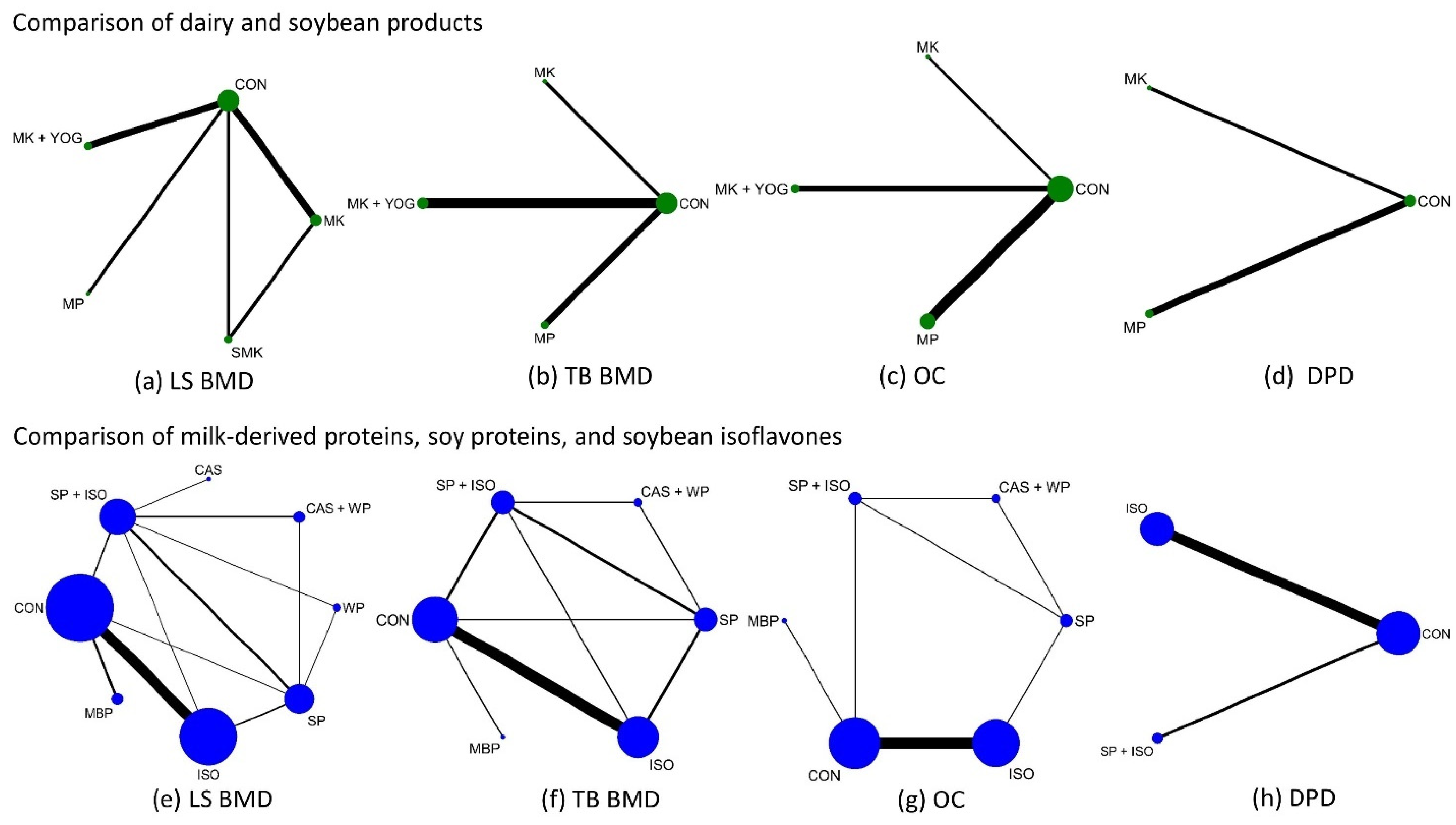
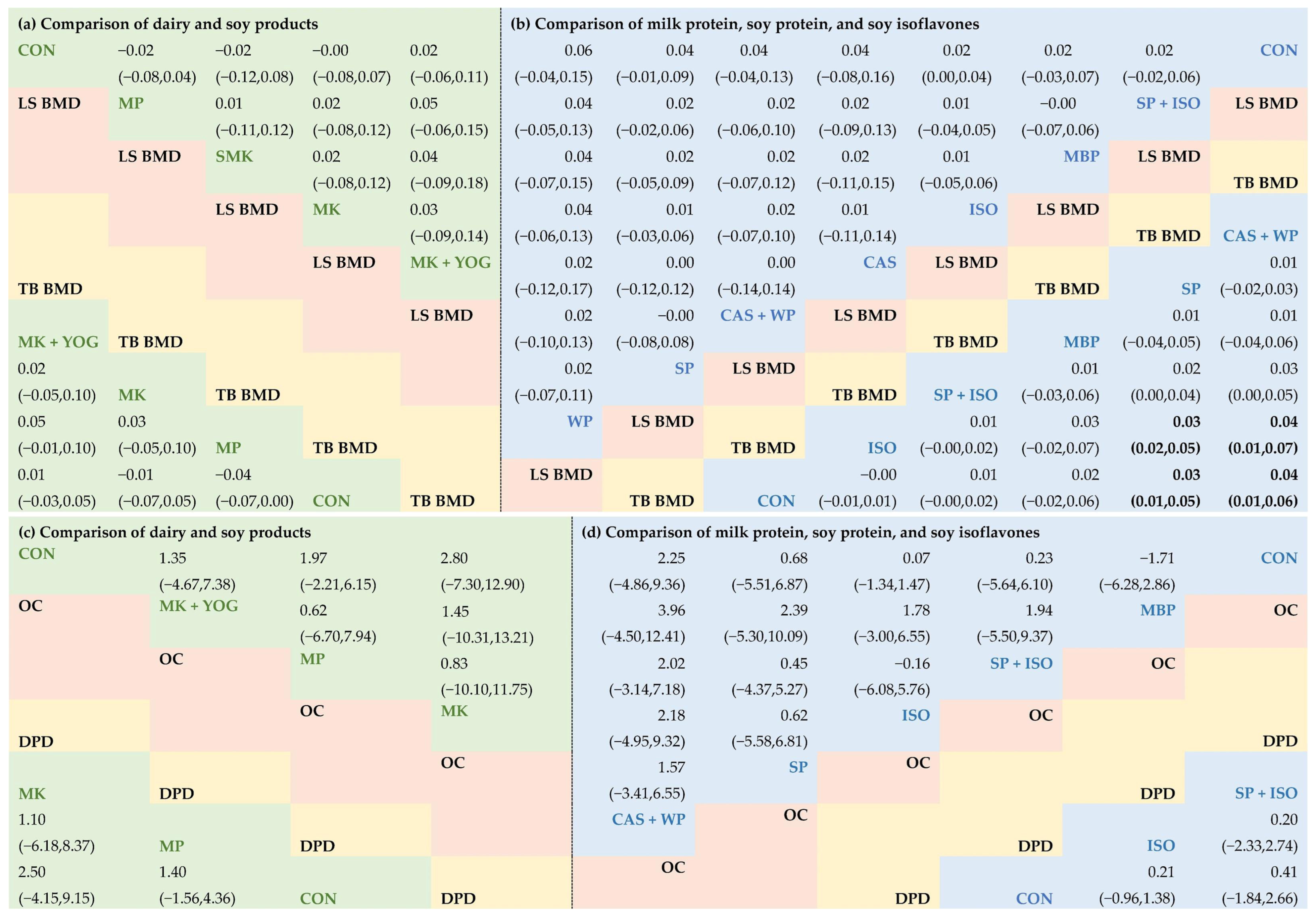
3.3.1. Food-Class Level: Effects of Dairy and Soybean Products on Bone Health Outcomes
3.3.2. Bioactive-Component Level: Effects of Milk-Derived Proteins, Soybean Proteins, and Soybean Isoflavones on Bone Health Outcomes
3.4. Subgroup Analysis and Sensitivity Analysis
3.5. Risk-of-Bias Assessment
3.6. Publication Bias
4. Discussion
5. Conclusions
Supplementary Materials
Author Contributions
Funding
Data Availability Statement
Conflicts of Interest
Abbreviations
| BAP | bone-specific alkaline phosphatase |
| BMD | bone mineral density |
| CTx | C-terminal telopeptide of type I collagen |
| DPD | deoxypyridinoline |
| IGF-1 | insulin-like growth factor 1 |
| LS | lumbar spine |
| MBP | milk basic protein |
| MDs | mean differences |
| NMA | network meta-analysis |
| NTx | N-terminal telopeptide of type I collagen |
| OC | osteocalcin |
| PINP | procollagen type I N-terminal propeptide |
| PROSPERO | Prospective Register of Systematic Reviews |
| PTH | parathyroid hormone |
| Pyr | pyridinoline |
| RCTs | randomized controlled trials |
| SD | standard deviations |
| SE | standard errors |
| SUCRA | surface under the cumulative ranking curve |
| TB | total body |
| 25(OH)D | 25-hydroxyvitamin D |
References
- Shetty, S.; Kapoor, N.; Bondu, J.D.; Thomas, N.; Paul, T.V. Bone turnover markers: Emerging tool in the management of osteoporosis. Indian J. Endocrinol. Metab. 2016, 20, 846–852. [Google Scholar] [CrossRef]
- Eastell, R.; Szulc, P. Use of bone turnover markers in postmenopausal osteoporosis. Lancet Diabetes Endocrinol. 2017, 5, 908–923. [Google Scholar] [CrossRef]
- Akhlaghi, M.; Ghasemi Nasab, M.; Riasatian, M.; Sadeghi, F. Soy isoflavones prevent bone resorption and loss, a systematic review and meta-analysis of randomized controlled trials. Crit. Rev. Food Sci. Nutr. 2019, 60, 2327–2341. [Google Scholar] [CrossRef]
- Crandall, C.J.; Larson, J.; Wright, N.C.; Laddu, D.; Stefanick, M.L.; Kaunitz, A.M.; Watts, N.B.; Wactawski-Wende, J.; Womack, C.R.; Johnson, K.C.; et al. Serial bone density measurement and incident fracture risk discrimination in postmenopausal women. JAMA Intern. Med. 2020, 180, 1232–1240. [Google Scholar] [CrossRef]
- Cheng, C.H.; Chen, L.R.; Chen, K.H. Osteoporosis due to hormone imbalance: An overview of the effects of estrogen deficiency and glucocorticoid overuse on bone turnover. Int. J. Mol. Sci. 2022, 23, 1376. [Google Scholar] [CrossRef]
- Kanis, J.A.; McCloskey, E.V.; Johansson, H.; Cooper, C.; Rizzoli, R.; Reginster, J.Y. European guidance for the diagnosis and management of osteoporosis in postmenopausal women. Osteoporos. Int. 2013, 24, 23–57. [Google Scholar] [CrossRef]
- Benova, A.; Tencerova, M. Obesity-Induced Changes in Bone Marrow Homeostasis. Front. Endocrinol. 2020, 11, 294. [Google Scholar] [CrossRef] [PubMed]
- Moscatelli, F.; Monda, A.; Messina, G.; Picciocchi, E.; Monda, M.; Di Padova, M.; Monda, V.; Mezzogiorno, A.; Dipace, A.; Limone, P.; et al. Exploring the Interplay between Bone Marrow Stem Cells and Obesity. Int. J. Mol. Sci. 2024, 25, 2715. [Google Scholar] [CrossRef] [PubMed]
- Denova-Gutiérrez, E.; Méndez-Sánchez, L.; Muñoz-Aguirre, P.; Tucker, K.L.; Clark, P. Dietary Patterns, Bone Mineral Density, and Risk of Fractures: A Systematic Review and Meta-Analysis. Nutrients 2018, 10, 1922. [Google Scholar] [CrossRef]
- Fabiani, R.; Naldini, G.; Chiavarini, M. Dietary Patterns in Relation to Low Bone Mineral Density and Fracture Risk: A Systematic Review and Meta-Analysis. Adv. Nutr. 2019, 10, 219–236. [Google Scholar] [CrossRef] [PubMed]
- Matía-Martín, P.; Torrego-Ellacuría, M.; Larrad-Sainz, A.; Fernández-Pérez, C.; Cuesta-Triana, F.; Rubio-Herrera, M. Effects of Milk and Dairy Products on the Prevention of Osteoporosis and Osteoporotic Fractures in Europeans and Non-Hispanic Whites from North America: A Systematic Review and Updated Meta-Analysis. Adv. Nutr. 2019, 10, S120–S143. [Google Scholar] [CrossRef]
- Wallace, T.C.; Bailey, R.L.; Lappe, J.; O’Brien, K.O.; Wang, D.D.; Sahni, S.; Weaver, C.M. Dairy intake and bone health across the lifespan: A systematic review and expert narrative. Crit. Rev. Food Sci. Nutr. 2021, 61, 3661–3707. [Google Scholar] [CrossRef]
- Hidayat, K.; Chen, J.S.; Wang, T.C.; Liu, Y.J.; Shi, Y.J.; Su, H.W.; Liu, B.; Qin, L.Q. The Effects of Milk Supplementation on Bone Health Indices in Adults: A Meta-Analysis of Randomized Controlled Trials. Adv. Nutr. 2022, 13, 1186–1199. [Google Scholar] [CrossRef]
- Lydeking-Olsen, E.; Beck-Jensen, J.E.; Setchell, K.D.; Holm-Jensen, T. Soymilk or progesterone for prevention of bone loss—A 2 year randomized, placebo-controlled trial. Eur. J. Nutr. 2004, 43, 246–257. [Google Scholar] [CrossRef]
- Rizzoli, R. Dairy products, yogurts, and bone health. Am. J. Clin. Nutr. 2014, 99, 1256s–1262s. [Google Scholar] [CrossRef]
- Kostelac, D.; Rechkemmer, G.; Briviba, K. Phytoestrogens modulate binding response of estrogen receptors alpha and beta to the estrogen response element. J. Agric. Food Chem. 2003, 51, 7632–7635. [Google Scholar] [CrossRef]
- Margeat, E.; Bourdoncle, A.; Margueron, R.; Poujol, N.; Cavaillès, V.; Royer, C. Ligands differentially modulate the protein interactions of the human estrogen receptors alpha and beta. J. Mol. Biol. 2003, 326, 77–92. [Google Scholar] [CrossRef] [PubMed]
- Zheng, X.; Lee, S.K.; Chun, O.K. Soy Isoflavones and Osteoporotic Bone Loss: A Review with an Emphasis on Modulation of Bone Remodeling. J. Med. Food 2016, 19, 1–14. [Google Scholar] [CrossRef] [PubMed]
- Haas, J.; Kim, B.J.; Atamer, Z.; Wu, C.; Dallas, D.C. Effects of spray drying and freeze drying on the protein profile of whey protein concentrate. J. Food Sci. 2024, 89, 7477–7493. [Google Scholar] [CrossRef] [PubMed]
- Zhang, Y.; Chang, S.K.; Liu, Z. Isoflavone profile in soymilk as affected by soybean variety, grinding, and heat-processing methods. J. Food Sci. 2015, 80, C983–C988. [Google Scholar] [CrossRef]
- Kent, G.; Kehoe, L.; Flynn, A.; Walton, J. Plant-based diets: A review of the definitions and nutritional role in the adult diet. Proc. Nutr. Soc. 2022, 81, 62–74. [Google Scholar] [CrossRef]
- Lee, J.T.; Moore, C.E.; Radcliffe, J.D. Consumption of calcium-fortified cereal bars to improve dietary calcium intake of healthy women: Randomized controlled feasibility study. PLoS ONE 2015, 10, e0125207. [Google Scholar] [CrossRef]
- Kanis, J.A.; Cooper, C.; Rizzoli, R.; Reginster, J.Y. Executive summary of the European guidance for the diagnosis and management of osteoporosis in postmenopausal women. Calcif. Tissue Int. 2019, 104, 235–238. [Google Scholar] [CrossRef]
- Zhao, J.G.; Zeng, X.T.; Wang, J.; Liu, L. Association Between Calcium or Vitamin D Supplementation and Fracture Incidence in Community-Dwelling Older Adults: A Systematic Review and Meta-analysis. JAMA 2017, 318, 2466–2482. [Google Scholar] [CrossRef] [PubMed]
- Reid, I.R.; Bolland, M.J.; Grey, A. Effects of vitamin D supplements on bone mineral density: A systematic review and meta-analysis. Lancet 2014, 383, 146–155. [Google Scholar] [CrossRef] [PubMed]
- Méndez-Sánchez, L.; Clark, P.; Winzenberg, T.M.; Tugwell, P.; Correa-Burrows, P.; Costello, R. Calcium and vitamin D for increasing bone mineral density in premenopausal women. Cochrane Database Syst. Rev. 2023, 1, Cd012664. [Google Scholar] [CrossRef] [PubMed]
- Shams-White, M.M.; Chung, M.; Du, M.; Fu, Z.; Insogna, K.L.; Karlsen, M.C.; LeBoff, M.S.; Shapses, S.A.; Sackey, J.; Wallace, T.C.; et al. Dietary protein and bone health: A systematic review and meta-analysis from the National Osteoporosis Foundation. Am. J. Clin. Nutr. 2017, 105, 1528–1543. [Google Scholar] [CrossRef]
- Darling, A.L.; Manders, R.J.F.; Sahni, S.; Zhu, K.; Hewitt, C.E.; Prince, R.L.; Millward, D.J.; Lanham-New, S.A. Dietary protein and bone health across the life-course: An updated systematic review and meta-analysis over 40 years. Osteoporos. Int. 2019, 30, 741–761. [Google Scholar] [CrossRef]
- Hidayat, K.; Tong, X.; Rizzoli, R.; Fan, J.B.; Shi, Y.J.; Su, H.W.; Liu, B.; Qin, L.Q. The skeletal safety of milk-derived proteins: A meta-analysis of randomized controlled trials. Osteoporos. Int. 2023, 34, 1937–1949. [Google Scholar] [CrossRef]
- Gorissen, S.H.M.; Crombag, J.J.R.; Senden, J.M.G.; Waterval, W.A.H.; Bierau, J.; Verdijk, L.B.; van Loon, L.J.C. Protein content and amino acid composition of commercially available plant-based protein isolates. Amino Acids 2018, 50, 1685–1695. [Google Scholar] [CrossRef]
- Shams-White, M.M.; Chung, M.; Fu, Z.; Insogna, K.L.; Karlsen, M.C.; LeBoff, M.S.; Shapses, S.A.; Sackey, J.; Shi, J.; Wallace, T.C.; et al. Animal versus plant protein and adult bone health: A systematic review and meta-analysis from the National Osteoporosis Foundation. PLoS ONE 2018, 13, e0192459. [Google Scholar] [CrossRef]
- Mills, E.J.; Ioannidis, J.P.; Thorlund, K.; Schünemann, H.J.; Puhan, M.A.; Guyatt, G.H. How to use an article reporting a multiple treatment comparison meta-analysis. JAMA 2012, 308, 1246–1253. [Google Scholar] [CrossRef]
- Shu, W.-B.; Zhang, X.-b.; Lu, H.-y.; Wang, H.-H.; Lan, G.-H. Comparison of effects of four treatment methods for unstable intertrochanteric fractures: A network meta-analysis. Int. J. Surg. 2018, 60, 173–181. [Google Scholar] [CrossRef]
- Xu, Z.; Wang, H.; Shi, Y.; Shen, Q.; Tsamlag, L.; Wang, Z.; Yu, S.; Shen, T.; Wang, Y.; Cai, Y. Impact of calcium, vitamin D, vitamin K, oestrogen, isoflavone and exercise on bone mineral density for osteoporosis prevention in postmenopausal women: A network meta-analysis. Br. J. Nutr. 2019, 123, 84–103. [Google Scholar] [CrossRef]
- Hutton, B.; Salanti, G.; Caldwell, D.M.; Chaimani, A.; Schmid, C.H.; Cameron, C.; Ioannidis, J.P.; Straus, S.; Thorlund, K.; Jansen, J.P.; et al. The PRISMA Extension Statement for Reporting of Systematic Reviews Incorporating Network Meta-analyses of Health Care Interventions: Checklist and Explanations. Ann. Intern. Med. 2015, 162, 777–784. [Google Scholar] [CrossRef] [PubMed]
- Wan, X.; Wang, W.; Liu, J.; Tong, T. Estimating the sample mean and standard deviation from the sample size, median, range and/or interquartile range. BMC Med. Res. Methodol. 2014, 14, 135. [Google Scholar] [CrossRef]
- Inpan, R.; Na Takuathung, M.; Sakuludomkan, W.; Dukaew, N.; Teekachunhatean, S.; Koonrungsesomboon, N. Isoflavone intervention and its impact on bone mineral density in postmenopausal women: A systematic review and meta-analysis of randomized controlled trials. Osteoporos. Int. 2023, 35, 413–430. [Google Scholar] [CrossRef]
- Higgins, J.P.T.; Altman, D.G.; Gotzsche, P.C.; Juni, P.; Moher, D.; Oxman, A.D.; Savovic, J.; Schulz, K.F.; Weeks, L.; Sterne, J.A.C. The Cochrane Collaboration’s tool for assessing risk of bias in randomised trials. BMJ 2011, 343, d5928. [Google Scholar] [CrossRef] [PubMed]
- Zhang, S.; Huang, X.; Zhao, X.; Li, B.; Cai, Y.; Liang, X.; Wan, Q. Effect of exercise on bone mineral density among patients with osteoporosis and osteopenia: A systematic review and network meta-analysis. J. Clin. Nurs. 2021, 31, 2100–2111. [Google Scholar] [CrossRef]
- Sadeghirad, B.; Foroutan, F.; Zoratti, M.J.; Busse, J.W.; Brignardello-Petersen, R.; Guyatt, G.; Thabane, L. Theory and practice of Bayesian and frequentist frameworks for network meta-analysis. BMJ Evid.-Based Med. 2023, 28, 204–209. [Google Scholar] [CrossRef]
- Seide, S.E.; Jensen, K.; Kieser, M. A comparison of Bayesian and frequentist methods in random-effects network meta-analysis of binary data. Res. Synth. Methods 2020, 11, 363–378. [Google Scholar] [CrossRef]
- Marcucci, M.; Etxeandia-Ikobaltzeta, I.; Yang, S.; Germini, F.; Gupta, S.; Agarwal, A.; Ventresca, M.; Tang, S.; Morgano, G.P.; Wang, M.; et al. Benefits and harms of direct oral anticoagulation and low molecular weight heparin for thromboprophylaxis in patients undergoing non-cardiac surgery: Systematic review and network meta-analysis of randomised trials. BMJ 2022, 376, e066785. [Google Scholar] [CrossRef]
- Fujii, T.; Salanti, G.; Belletti, A.; Bellomo, R.; Carr, A.; Furukawa, T.A.; Luethi, N.; Luo, Y.; Putzu, A.; Sartini, C.; et al. Effect of adjunctive vitamin C, glucocorticoids, and vitamin B1 on longer-term mortality in adults with sepsis or septic shock: A systematic review and a component network meta-analysis. Intensive Care Med. 2022, 48, 16–24. [Google Scholar] [CrossRef]
- Ho, E.K.; Chen, L.; Simic, M.; Ashton-James, C.E.; Comachio, J.; Wang, D.X.M.; Hayden, J.A.; Ferreira, M.L.; Ferreira, P.H. Psychological interventions for chronic, non-specific low back pain: Systematic review with network meta-analysis. BMJ 2022, 376, e067718. [Google Scholar] [CrossRef]
- Yeh, W.H.; Ju, Y.J.; Shaw, F.Z.; Liu, Y.T. Comparative effectiveness of electroencephalogram-neurofeedback training of 3-45 frequency band on memory in healthy population: A network meta-analysis with systematic literature search. J. Neuroeng. Rehabil. 2025, 22, 94. [Google Scholar] [CrossRef]
- Albertazzi, P.; Steel, S.A.; Bottazzi, M. Effect of pure genistein on bone markers and hot flushes. Climacteric 2005, 8, 371–379. [Google Scholar] [CrossRef]
- Alekel, D.L.; Germain, A.S.; Peterson, C.T.; Hanson, K.B.; Stewart, J.W.; Toda, T. Isoflavone-rich soy protein isolate attenuates bone loss in the lumbar spine of perimenopausal women. Am. J. Clin. Nutr. 2000, 72, 844–852. [Google Scholar] [CrossRef] [PubMed]
- Anderson, J.J.B.; Chen, X.; Boass, A.; Symons, M.; Kohlmeier, M.; Renner, J.B.; Garner, S.C. Soy isoflavones: No effects on bone mineral content and bone mineral density in healthy, menstruating young adult women after one year. J. Am. Coll. Nutr. 2002, 21, 388–393. [Google Scholar] [CrossRef] [PubMed]
- Aoe, S.; Koyama, T.; Toba, Y.; Itabashi, A.; Takada, Y. A controlled trial of the effect of milk basic protein (MBP) supplementation on bone metabolism in healthy menopausal women. Osteoporos. Int. 2005, 16, 2123–2128. [Google Scholar] [CrossRef] [PubMed]
- Arjmandi, B.H.; Khalil, D.A.; Smith, B.J.; Lucas, E.A.; Juma, S.; Payton, M.E.; Wild, R.A. Soy protein has a greater effect on bone in postmenopausal women not on hormone replacement therapy, as evidenced by reducing bone resorption and urinary calcium excretion. J. Clin. Endocrinol. Metab. 2003, 88, 1048–1054. [Google Scholar] [CrossRef] [PubMed]
- Arjmandi, B.H.; Lucas, E.A.; Khalil, D.A.; Devareddy, L.; Smith, B.J.; McDonald, J.; Arquitt, A.B.; Payton, M.E.; Mason, C. One year soy protein supplementation has positive effects on bone formation markers but not bone density in postmenopausal women. Nutr. J. 2005, 4, 8. [Google Scholar] [CrossRef]
- Atteritano, M.; Mazzaferro, S.; Frisina, A.; Cannata, M.L.; Bitto, A.; D’Anna, R.; Squadrito, F.; Macrì, I.; Frisina, N.; Buemi, M. Genistein effects on quantitative ultrasound parameters and bone mineral density in osteopenic postmenopausal women. Osteoporos. Int. 2009, 20, 1947–1954. [Google Scholar] [CrossRef]
- Bonjour, J.-P.; Brandolini-Bunlon, M.; Boirie, Y.; Morel-Laporte, F.; Braesco, V.; Bertière, M.-C.; Souberbielle, J.-C. Inhibition of bone turnover by milk intake in postmenopausal women. Br. J. Nutr. 2008, 100, 866–874. [Google Scholar] [CrossRef]
- Bonjour, J.-P.; Dontot-Payen, F.; Rouy, E.; Walrand, S.; Rousseau, B. Evolution of serum 25OHD in response to vitamin D3–fortified yogurts consumed by healthy menopausal women: A 6-month randomized controlled trial assessing the interactions between doses, baseline vitamin D status, and seasonality. J. Am. Coll. Nutr. 2018, 37, 34–43. [Google Scholar] [CrossRef]
- Brink, E.; Coxam, V.; Robins, S.; Wahala, K.; Cassidy, A.; Branca, F. Long-term consumption of isoflavone-enriched foods does not affect bone mineral density, bone metabolism, or hormonal status in early postmenopausal women: A randomized, double-blind, placebo controlled study. Am. J. Clin. Nutr. 2008, 87, 761–770. [Google Scholar] [CrossRef] [PubMed]
- Brooks, J.D.; Ward, W.E.; Lewis, J.E.; Hilditch, J.; Nickell, L.; Wong, E.; Thompson, L.U. Supplementation with flaxseed alters estrogen metabolism in postmenopausal women to a greater extent than does supplementation with an equal amount of soy. Am. J. Clin. Nutr. 2004, 79, 318–325. [Google Scholar] [CrossRef] [PubMed]
- Chee, W.S.S.; Suriah, A.R.; Chan, S.P.; Zaitun, Y.; Chan, Y.M. The effect of milk supplementation on bone mineral density in postmenopausal Chinese women in Malaysia. Osteoporos. Int. 2003, 14, 828–834. [Google Scholar] [CrossRef] [PubMed]
- Chen, Y.-M.; Ho, S.C.; Lam, S.S.H.; Ho, S.S.S.; Woo, J.L.F. Soy isoflavones have a favorable effect on bone loss in chinese postmenopausal women with lower bone mass: A double-blind, randomized, controlled trial. J. Clin. Endocrinol. Metab. 2003, 88, 4740–4747. [Google Scholar] [CrossRef]
- Chilibeck, P.D.; Vatanparast, H.; Pierson, R.; Case, A.; Olatunbosun, O.; Whiting, S.J.; Beck, T.J.; Pahwa, P.; Biem, H.J. Effect of exercise training combined with isoflavone supplementation on bone and lipids in postmenopausal women: A randomized clinical trial. J. Bone Miner. Res. 2013, 28, 780–793. [Google Scholar] [CrossRef]
- Cleghom, D.B.; O’Loughlin, P.D.; Schroeder, B.J.; Nordin, B.E.C. An open, crossover trial of calcium-fortified milk in prevention of early postmenopausal bone los. Med. J. Aust. 2001, 175, 242–245. [Google Scholar] [CrossRef]
- Choquette, S.; Riesco, É.; Cormier, É.; Dion, T.; Aubertin-Leheudre, M.; Dionne, I.J. Effects of soya isoflavones and exercise on body composition and clinical risk factors of cardiovascular diseases in overweight postmenopausal women: A 6-month double-blind controlled trial. Br. J. Nutr. 2011, 105, 1199–1209. [Google Scholar] [CrossRef]
- Dalais, F.S.; Ebeling, P.R.; Kotsopoulos, D.; McGrath, B.P.; Teede, H.J. The effects of soy protein containing isoflavones on lipids and indices of bone resorption in postmenopausal women. Clin. Endocrinol. 2003, 58, 704–709. [Google Scholar] [CrossRef] [PubMed]
- Gallagher, J.C.; Satpathy, R.; Rafferty, K.; Haynatzka, V. The effect of soy protein isolate on bone metabolism. Menopause 2004, 11, 290–298. [Google Scholar] [CrossRef] [PubMed]
- Green, J.H.; Booth, C.; Bunning, R. Impact of supplementary high calcium milk with additional magnesium on parathyroid hormone and biochemical markers of bone turnover in postmenopausal women. Asia Pac. J. Clin. Nutr. 2002, 11, 268–273. [Google Scholar] [CrossRef] [PubMed]
- Gui, J.C.; Brašić, J.R.; Liu, X.D.; Gong, G.Y.; Zhang, G.M.; Liu, C.J.; Gao, G.Q. Bone mineral density in postmenopausal Chinese women treated with calcium fortification in soymilk and cow’s milk. Osteoporos. Int. 2012, 23, 1563–1570. [Google Scholar] [CrossRef] [PubMed]
- Harkness, L.S.; Fiedler, K.; Sehgal, A.R.; Oravec, D.; Lerner, E. Decreased bone resorption with soy isoflavone supplementation in postmenopausal women. J. Women’s Health 2004, 13, 1000–1007. [Google Scholar] [CrossRef] [PubMed]
- Huang, H.-Y.; Yang, H.-P.; Yang, H.-T.; Yang, T.-C.; Shieh, M.-J.; Huang, S.-Y. One-year soy isoflavone supplementation prevents early postmenopausal bone loss but without a dose-dependent effect. J. Nutr. Biochem. 2006, 17, 509–517. [Google Scholar] [CrossRef]
- Ilich, J.Z.; Kelly, O.J.; Liu, P.-Y.; Shin, H.; Kim, Y.; Chi, Y.; Wickrama, K.K.A.S.; Colic-Baric, I. Role of calcium and low-fat dairy foods in weight-loss outcomes revisited: Results from the randomized trial of effects on bone and body composition in overweight/obese postmenopausal women. Nutrients 2019, 11, 1157. [Google Scholar] [CrossRef]
- Kenny, A.M.; Mangano, K.M.; Abourizk, R.H.; Bruno, R.S.; Anamani, D.E.; Kleppinger, A.; Walsh, S.J.; Prestwood, K.M.; Kerstetter, J.E. Soy proteins and isoflavones affect bone mineral density in older women: A randomized controlled trial. Am. J. Clin. Nutr. 2009, 90, 234–242. [Google Scholar] [CrossRef]
- Kreijkamp-Kaspers, S.; Kok, L.; Grobbee, D.E.; de Haan, E.H.F.; Aleman, A.; Lampe, J.W.; van der Schouw, Y.T. Effect of soy protein containing isoflavones on cognitive function, bone mineral density, and plasma lipids in postmenopausal women. JAMA 2004, 292, 65–74. [Google Scholar] [CrossRef]
- Kruger, M.C.; Booth, C.L.; Coad, J.; Schollum, L.M.; Kuhn-Sherlock, B.; Shearer, M.J. Effect of calcium fortified milk supplementation with or without vitamin K on biochemical markers of bone turnover in premenopausal women. Nutrition 2006, 22, 1120–1128. [Google Scholar] [CrossRef]
- Kruger, M.C.; Schollum, L.M.; Kuhn-Sherlock, B.; Hestiantoro, A.; Wijanto, P.; Li-Yu, J.; Agdeppa, I.; Todd, J.M.; Eastell, R. The effect of a fortified milk drink on vitamin D status and bone turnover in post-menopausal women from South East Asia. Bone 2010, 46, 759–767. [Google Scholar] [CrossRef] [PubMed]
- Kruger, M.C.; Ha, P.C.; Todd, J.M.; Kuhn-Sherlock, B.; Schollum, L.M.; Ma, J.; Qin, G.; Lau, E. High-calcium, vitamin D fortified milk is effective in improving bone turnover markers and vitamin D status in healthy postmenopausal Chinese women. Eur. J. Clin. Nutr. 2012, 66, 856–861. [Google Scholar] [CrossRef]
- Lau, E.M.C.; Woo, J.; Lam, V.; Hong, A. Milk supplementation of the diet of postmenopausal Chinese women on a low calcium intake retards bone loss. J. Bone Miner. Res. 2001, 16, 1704–1709. [Google Scholar] [CrossRef]
- Lau, E.M.C.; Lynn, H.; Chan, Y.H.; Woo, J. Milk supplementation prevents bone loss in postmenopausal chinese women over 3 years. Bone 2002, 31, 536–540. [Google Scholar] [CrossRef]
- Lee, H.; Choue, R.; Lim, H. Effect of soy isoflavones supplement on climacteric symptoms, bone biomarkers, and quality of life in Korean postmenopausal women: A randomized clinical trial. Nutr. Res. Pract. 2017, 11, 223–231. [Google Scholar] [CrossRef]
- Levis, S. Soy isoflavones in the prevention of menopausal bone loss and menopausal symptoms. Arch. Intern. Med. 2011, 171, 1363–1369. [Google Scholar] [CrossRef]
- Liu, Z.-M.; Chen, B.; Li, S.; Li, G.; Zhang, D.; Ho, S.C.; Chen, Y.-m.; Ma, J.; Qi, H.; Ling, W.-h. Effect of whole soy and isoflavones daidzein on bone turnover and inflammatory markers: A 6-month double-blind, randomized controlled trial in Chinese postmenopausal women who are equol producers. Ther. Adv. Endocrinol. Metab. 2020, 11, 14. [Google Scholar] [CrossRef]
- Manios, Y.; Moschonis, G.; Trovas, G.; Lyritis, G.P. Changes in biochemical indexes of bone metabolism and bone mineral density after a 12-mo dietary intervention program: The Postmenopausal Health Study. Am. J. Clin. Nutr. 2007, 86, 781–789. [Google Scholar] [CrossRef] [PubMed]
- Marini, H.; Minutoli, L.; Polito, F.; Bitto, A.; Altavilla, D.; Atteritano, M.; Gaudio, A.; Mazzaferro, S.; Frisina, A.; Frisina, N.; et al. Effects of the Phytoestrogen Genistein on Bone Metabolism in Osteopenic Postmenopausal Women. Ann. Intern. Med. 2007, 146, 839–847. [Google Scholar] [CrossRef] [PubMed]
- Morabito, N.; Crisafulli, A.; Vergara, C.; Gaudio, A.; Lasco, A.; Frisina, N.; D’Anna, R.; Corrado, F.; Pizzoleo, M.A.; Cincotta, M.; et al. Effects of genistein and hormone-replacement therapy on bone loss in early postmenopausal women: A randomized double-blind placebo-controlled study. J. Bone Miner. Res. 2002, 17, 1904–1912. [Google Scholar] [CrossRef]
- Mori, M.; Sagara, M.; Ikeda, K.; Miki, T.; Yamori, Y. Soy isoflavones improve bone metabolism in postmenopausal Japanese women. Clin. Exp. Pharmacol. Physiol. 2004, 31, S44–S46. [Google Scholar] [CrossRef]
- Mori, M.; Aizawa, T.; Tokoro, M.; Miki, T.; Yamori, Y. Soy isoflavone tablets reduce osteoporosis risk factors and obesity in middle-aged Japanese women. Clin. Exp. Pharmacol. Physiol. 2004, 31, S39–S41. [Google Scholar] [CrossRef]
- Moschonis, G.; Katsaroli, I.; Lyritis, G.P.; Manios, Y. The effects of a 30-month dietary intervention on bone mineral density: The Postmenopausal Health Study. Br. J. Nutr. 2010, 104, 100–107. [Google Scholar] [CrossRef]
- Norton, C.; Hettiarachchi, M.; Cooke, R.; Kozior, M.; Kontro, H.; Daniel, R.; Jakeman, P. Effect of 24-week, late-evening ingestion of a calcium-fortified, milk-based protein matrix on biomarkers of bone metabolism and site-specific bone mineral density in postmenopausal women with osteopenia. Nutrients 2022, 14, 3486. [Google Scholar] [CrossRef] [PubMed]
- Prince, R.; Devine, A.; Dick, I.; Criddle, A.; Kerr, D.; Kent, N.; Randell, A.; Price, R. The effects of calcium supplementation (milk powder or tablets) and exercise on bone density in postmenopausal women. J. Bone Miner. Res. 1995, 10, 1068–1075. [Google Scholar] [CrossRef]
- Radhakrishnan, G.; Rashmi; Agarwal, N.; Vaid, N.B. Evaluation of isoflavone rich soy protein supplementation for postmenopausal therapy. Pak. J. Nutr. 2009, 8, 1009–1017. [Google Scholar] [CrossRef]
- Sathyapalan, T.; Aye, M.; Rigby, A.S.; Fraser, W.D.; Thatcher, N.J.; Kilpatrick, E.S.; Atkin, S.L. Soy reduces bone turnover markers in women during early menopause: A randomized controlled trial. J. Bone Miner. Res. 2017, 32, 157–164. [Google Scholar] [CrossRef] [PubMed]
- Spence, L.A.; Lipscomb, E.R.; Cadogan, J.; Martin, B.; Wastney, M.E.; Peacock, M.; Weaver, C.M. The effect of soy protein and soy isoflavones on calcium metabolism in postmenopausal women: A randomized crossover study. Am. J. Clin. Nutr. 2005, 81, 916–922. [Google Scholar] [CrossRef]
- Tai, T.Y.; Tsai, K.S.; Tu, S.T.; Wu, J.S.; Chang, C.I.; Chen, C.L.; Shaw, N.S.; Peng, H.Y.; Wang, S.Y.; Wu, C.H. The effect of soy isoflavone on bone mineral density in postmenopausal Taiwanese women with bone loss: A 2-year randomized double-blind placebo-controlled study. Osteoporos. Int. 2012, 23, 1571–1580. [Google Scholar] [CrossRef]
- Tousen, Y.; Ezaki, J.; Fujii, Y.; Ueno, T.; Nishimuta, M.; Ishimi, Y. Natural S-equol decreases bone resorption in postmenopausal, non-equol-producing Japanese women. Menopause 2011, 18, 563–574. [Google Scholar] [CrossRef]
- Turhan, N.O.; Bolkan, F.; Duvan, C.I.; Ardiçoglu, Y. The effect of isoflavones on bone mass and bone remodelling markers in postmenopausal women. Turk. J. Med. Sci. 2008, 38, 145–152. [Google Scholar]
- Uenishi, K.; Ishida, H.; Toba, Y.; Aoe, S.; Itabashi, A.; Takada, Y. Milk basic protein increases bone mineral density and improves bone metabolism in healthy young women. Osteoporos. Int. 2007, 18, 385–390. [Google Scholar] [CrossRef]
- Uesugi, T.; Fukui, Y.; Yamori, Y. Beneficial effects of soybean isoflavone supplementation on bone metabolism and serum lipids in postmenopausal Japanese women: A four-week study. J. Am. Coll. Nutr. 2002, 21, 97–102. [Google Scholar] [CrossRef]
- Uesugi, T.; Toda, T.; Okuhira, T.; Chen, J.-T. Evidence of estrogenic effect by the three-month-intervention of isoflavone on vaginal maturation and bone metabolism in early postmenopausal women. Endocr. J. 2003, 50, 613–619. [Google Scholar] [CrossRef] [PubMed][Green Version]
- Vupadhyayula, P.M.; Gallagher, J.C.; Templin, T.; Logsdon, S.M.; Smith, L.M. Effects of soy protein isolate on bone mineral density and physical performance indices in postmenopausal women—A 2-year randomized, double-blind, placebo-controlled trial. Menopause 2009, 16, 320–328. [Google Scholar] [CrossRef] [PubMed]
- Wangen, K.E.; Duncan, A.M.; Merz-Demlow, B.E.; Xu, X.; Marcus, R.; Phipps, W.R.; Kurzer, M.S. Effects of soy isoflavones on markers of bone turnover in premenopausal and postmenopausal women. J. Clin. Endocrinol. Metab. 2000, 85, 3043–3048. [Google Scholar] [CrossRef][Green Version]
- Woo, J.; Lau, W.; Xu, L.; Lam, C.W.K.; Zhao, X.; Yu, W.; Xing, X.; Lau, E.; Kuhn-Sherlock, B.; Pocock, N.; et al. Milk supplementation and bone health in young adult Chinese women. J. Womens Health 2007, 16, 692–702. [Google Scholar] [CrossRef] [PubMed]
- Wu, J.; Oka, J.; Tabata, I.; Higuchi, M.; Toda, T.; Fuku, N.; Ezaki, J.; Sugiyama, F.; Uchiyama, S.; Yamada, K.; et al. Effects of Isoflavone and Exercise on BMD and Fat Mass in Postmenopausal Japanese Women: A 1-Year Randomized Placebo-Controlled Trial. J. Bone Miner. Res. 2006, 21, 780–789. [Google Scholar] [CrossRef]
- Wu, J.; Oka, J.; Ezaki, J.; Ohtomo, T.; Ueno, T.; Uchiyama, S.; Toda, T.; Uehara, M.; Ishimi, Y. Possible role of equol status in the effects of isoflavone on bone and fat mass in postmenopausal Japanese women. Menopause 2007, 14, 866–874. [Google Scholar] [CrossRef] [PubMed]
- Yamori, Y.; Moriguchi, E.H.; Teramoto, T.; Miura, A.; Fukui, Y.; Honda, K.-i.; Fukui, M.; Nara, Y.; Taira, K.; Moriguchi, Y. Soybean isoflavones reduce postmenopausal bone resorption in female Japanese immigrants in Brazil: A ten-week study. J. Am. Coll. Nutr. 2002, 21, 560–563. [Google Scholar] [CrossRef]
- Ye, Y.-B.; Tang, X.-Y.; Verbruggen, M.A.; Su, Y.-X. Soy isoflavones attenuate bone loss in early postmenopausal Chinese women. Eur. J. Nutr. 2006, 45, 327–334. [Google Scholar] [CrossRef] [PubMed]
- Zhu, K.; Meng, X.; Kerr, D.A.; Devine, A.; Solah, V.; Binns, C.W.; Prince, R.L. The effects of a two-year randomized, controlled trial of whey protein supplementation on bone structure, IGF-1, and urinary calcium excretion in older postmenopausal women. J. Bone Miner. Res. 2011, 26, 2298–2306. [Google Scholar] [CrossRef]
- Zou, Z.-Y.; Lin, X.-M.; Xu, X.-R.; Xu, R.; Ma, L.; Li, Y.; Wang, M.-F. Evaluation of milk basic protein supplementation on bone density and bone metabolism in Chinese young women. Eur. J. Nutr. 2009, 48, 301–306. [Google Scholar] [CrossRef]
- Ong, A.M.; Kang, K.; Weiler, H.A.; Morin, S.N. Fermented Milk Products and Bone Health in Postmenopausal Women: A Systematic Review of Randomized Controlled Trials, Prospective Cohorts, and Case-Control Studies. Adv. Nutr. 2020, 11, 251–265. [Google Scholar] [CrossRef]
- Hulmi, J.J.; Lockwood, C.M.; Stout, J.R. Effect of protein/essential amino acids and resistance training on skeletal muscle hypertrophy: A case for whey protein. Nutr. Metab. 2010, 7, 51. [Google Scholar] [CrossRef] [PubMed]
- Bar-Maisels, M.; Menahem, C.; Gabet, Y.; Hiram-Bab, S.; Phillip, M.; Gat-Yablonski, G. Different Effects of Soy and Whey on Linear Bone Growth and Growth Pattern in Young Male Sprague-Dawley Rats. Front. Nutr. 2021, 8, 739607. [Google Scholar] [CrossRef]
- Bu, T.; Huang, J.; Yu, Y.; Sun, P.; Yang, K. Whey Protein Hydrolysate Ameliorated High-Fat-Diet Induced Bone Loss via Suppressing Oxidative Stress and Regulating GSK-3β/Nrf2 Signaling Pathway. Nutrients 2023, 15, 2863. [Google Scholar] [CrossRef]
- Duque, G.; Al Saedi, A.; Rivas, D.; Miard, S.; Ferland, G.; Picard, F.; Gaudreau, P. Differential Effects of Long-Term Caloric Restriction and Dietary Protein Source on Bone and Marrow Fat of the Aging Rat. J. Gerontol. Ser. A Biol. Sci. Med. Sci. 2020, 75, 2031–2036. [Google Scholar] [CrossRef] [PubMed]
- Miura, A.; Sugiyama, C.; Sakakibara, H.; Simoi, K.; Goda, T. Bioavailability of isoflavones from soy products in equol producers and non-producers in Japanese women. J. Nutr. Intermed. Metab. 2016, 6, 41–47. [Google Scholar] [CrossRef]
- Liu, Z.M.; Huang, Q.; Li, S.Y.; Liu, Y.P.; Wu, Y.; Zhang, S.J.; Li, B.L.; Chen, Y.M. A 1:1 matched case-control study on dietary protein intakes and hip fracture risk in Chinese elderly men and women. Osteoporos. Int. 2021, 32, 2205–2216. [Google Scholar] [CrossRef] [PubMed]
- Zhong, Y.; Okoro, C.A.; Balluz, L.S. Association of total calcium and dietary protein intakes with fracture risk in postmenopausal women: The 1999–2002 National Health and Nutrition Examination Survey (NHANES). Nutrition 2009, 25, 647–654. [Google Scholar] [CrossRef] [PubMed]
- GBD 2017 Diet Collaborators. Health effects of dietary risks in 195 countries, 1990–2017: A systematic analysis for the Global Burden of Disease Study 2017. Lancet 2019, 393, 1958–1972. [Google Scholar] [CrossRef] [PubMed]



| Study (Year) | Country | Intervention Period | n | Age (Years) | BMI (kg/m2) | Comparison | Outcomes |
|---|---|---|---|---|---|---|---|
| (M ± SD) | |||||||
| 1 Albertazzi (2005) [46] | UK | 6 weeks | 100 | 53.5 ± 3.0 | 27.0 ± 6.1 | Isoflavone (genistein, 90 mg) vs. placebo | OC, CTx |
| 2 Alekel (2000) [47] | USA | 24 weeks | 69 | 50.2 ± 3.9 | 24.0 ± 3.2 | Soy protein (40 g/d) vs. whey protein (40 g/d) vs. soy protein (40 g/d) with isoflavone (80.4 mg/d) | BMD (LS) |
| 3 Anderson (2002) [48] | USA | 12 months | 28 | 23.9 ± 1.0 | 21.4 ± 3.8 | Isoflavone (90 mg/d) vs. soy protein | BMD (TB, FN, LS, trochanter, intertrochanter, WT) |
| 4 Aoe (2005) [49] | Japan | 6 months | 27 | 50.5 ± 3.0 | 21.6 ± 2.9 | MBP (40 mg/d) vs. placebo | OC, NTx |
| 5 Arjmandi (2003) [50] | USA | 3 months | 42 | 62.1 ± 4.9 | 32.2 ± 7.9 | Soy protein (40 g/d) vs. milk protein (casein-whey protein, 40 g/d) | BAP, DPD, IGF-1 |
| 6 Arjmandi (2005) [51] | USA | 12 months | 62 | 54.3 ± 5.7 | 28.0 ± 5.3 | Soy protein (25 g/d) with isoflavone (60 mg/d) vs. placebo | BMD (TB, LS, TH), OC, BAP, DPD, IGF-1 |
| 7 Atteritano (2009) [52] | Italy | 2 years | 138 | 52.5 ± 2.1 | 24.5 ± 3.5 | Isoflavone (genistein, 54 mg/d) vs. placebo | BMD (FN, LS) |
| 8 Bonjour (2008) [53] | France | 6 weeks | 60 | 59.5 ± 3.3 | 23.7 ± 3.4 | Semi-skimmed milk (500 mL/d) vs. no treatment | OC, BAP, PINP, CTx, PTH, IGF-1, 25(OH)D |
| 9 Bonjour (2018) [54] | France | 16 weeks | 133 | 61.5 ± 5.0 | 24.6 ± 2.9 | Yogurts (125 g/d or 250 g/d) vs. no treatment | 25(OH)D |
| 10 Brink (2008) [55] | Netherlands, Italy, France | 53 weeks | 237 | 53.0 ± 3.0 | 24.5 ± 2.1 | Isoflavone vs. placebo | BMD (TB, LS), BAP, PINP, DPD, Pyr, PTH, 25(OH)D |
| 11 Brooks (2004) [56] | Canada | 16 weeks | 28 | 53.4 ± 3.2 | 27.4 ± 5.3 | Soy (25 g/d) with isoflavones (41.9 mg/d) vs. placebo | BAP, DPD |
| 12 Chee (2003) [57] | China | 24 months | 173 | 58.8 ± 3.5 | 23.8 ± 3.5 | High-calcium skimmed milk powder (50 g/d) vs. no treatment | BMD (TB, FN, LS, TH), OC, DPD, PTH, 25(OH)D |
| 13 Chen (2003) [58] | China | 1 year | 175 | 54.2 ± 3.1 | 24.0 ± 3.5 | Isoflavones (40 mg/d or 80 mg/d) vs. placebo | BMD (TB, FN, LS, TH, trochanter, intertrochanter) |
| 14 Chilibeck (2013) [59] | Canada | 2 years | 149 | 55.7 ± 6.9 | 27.1 ± 3.9 | Isoflavone (165 mg/d) vs. placebo | BMD (TB, FN, LS, TH, trochanter, WT) |
| 15 Cleghorn (2001) [60] | Australia | 1 year | 72 | 52.0 ± 3.0 | 26.1 ± 5.4 | Calcium-fortified milk (3 L/wk) vs. no treatment | DPD |
| 16 Choquette (2011) [61] | Canada | 6 months | 45 | 59.0 ± 5.0 | 30.1 ± 2.8 | Isoflavones (70 mg/d) vs. placebo | BMD (TB, FN, LS, TH, trochanter, WT) |
| 17 Dalais (2003) [62] | Australia | 3 months | 78 | 60.0 ± 6.2 | 25.4 ± 4.7 | Soy protein (40 g/d) with isoflavones (118 mg/d) vs. casein (40 g/d) | DPD, Pyr |
| 18 Gallagher (2004) [63] | USA | 15 months | 50 | 55.4 ± 4.6 | 26.4 ± 5.3 | soy protein (40 g/d) vs. soy protein (40 g/d) with isoflavones (52 mg/d or 96 mg/d) | BMD (FN, LS, trochanter), OC, NTx |
| 19 Green (2002) [64] | New Zealand | 4 weeks | 50 | 67.6 ± 6.7 | 27.5 ± 4.5 | High-calcium skim milk powder (50 g/d) vs. placebo | PINP, DPD, NTx, CTx, PTH |
| 20 Gui (2012) [65] | China | 18 months | 98 | 56.3 ± 4.2 | 24.5 ± 3.0 | Calcium-fortified milk (250 mL/d) vs. soy milk (250 mL/d) vs. no treatment | BMD (FN, LS, TH) |
| 21 Harkness (2004) [66] | USA | 6 months | 38 | 70.6 ± 6.3 | 25.9 ± 3.5 | Soy isoflavone (110 mg/d) vs. placebo | BMD (TS, trochanter, intertrochanter), OC, BAP |
| 22 Huang (2006) [67] | China | 12 months | 42 | 52.4 ± 2.8 | 23.5 ± 2.6 | Soy isoflavone (100 mg/d or 200 mg/d) vs. no treatment | BMD (FN, femoral trochanter, LS, WT), BAP, DPD, NTx |
| 23 Ilich (2019) [68] | USA | 6 months | 60 | 55.8 ± 4.3 | 31.5 ± 5.1 | Low-fat dairy foods (cheeses, milk, yogurt, pudding, low-fat ice cream, 4–5 servings/d) vs. placebo | BMD (TB, FN, LS, WF, radius 1/3 of styloid process, whole forearms), OC, NTx, CTx, PTH, 25(OH)D |
| 24 Kenny (2009) [69] | USA | 1 year | 97 | 73.1 ± 5.9 | 28.3 ± 5.4 | Soy protein (20 g/d) vs. soy isoflavones (105 mg/d) vs. placebo | BMD (TB, FN, LS, WF, trochanter, WT, forearm 33% radius, ultradistal radius, total radius), BAP, NTx |
| 25 Kreijkamp-Kaspers (2004) [70] | Netherlands | 12 months | 175 | 66.6 ± 4.7 | 26.2 ± 3.8 | Soy protein (25.6 g/d) with isoflavones (99 mg/d) vs. 25.6 g of total milk protein (casein-whey protein) | BMD (LS, TH, trochanter, intertrochanter, WT), BAP |
| 26 Kruger (2006) [71] | New Zealand | 16 weeks | 55 | 27.1 ± 4.8 | 24.1 ± 2.9 | High calcium skim milk powder (50 g/d) vs. no treatment | OC, PINP, CTx, PTH, IGF-1, 25(OH)D |
| 27 Kruger (2010) [72] | South East Asia | 16 weeks | 113 | 57.5 ± 4.4 | 24.8 ± 3.8 | High-calcium vitamin D fortified milk powder (60 g/d) vs. placebo | OC, PINP, CTx, PTH |
| 28 Kruger (2012) [73] | China | 12 weeks | 58 | 62.1 ± 4.2 | 25.7 ± 2.3 | High-calcium vitamin D fortified milk (two servings/d) vs. placebo | PINP, CTx, PTH, 25(OH)D |
| 29 Lau (2001) [74] | China | 24 months | 185 | 56.7 ± 1.7 | 26.2 ± 3.8 | High calcium, low-fat, low-lactose milk powder (50 g/d) vs. no treatment | BMD (TB, FN, LS, TH, intertrochanter) |
| 30 Lau (2002) [75] | China | 3 years | 197 | 56.9 ± 1.7 | 24.1 ± 4.1 | High calcium, low-fat, low-lactose milk powder (50 g/d) vs. no treatment | BMD (TB, FN, LS, TH, intertrochanter) |
| 31 Lee (2017) [76] | Korea | 12 weeks | 84 | 53.6 ± 3.4 | —— | Isoflavones (70 mg/d) vs. placebo | OC, BAP, DPD, NTx, CTx |
| 32 Levis (2011) [77] | USA | 24 months | 177 | 52.5 ± 3.3 | 26.3 ± 3.3 | Isoflavones (200 mg/d) vs. placebo | BMD (FN, LS, TH), NTx, 25(OH)D |
| 33 Liu (2020) [78] | China | 6 months | 270 | 57.9 ± 5.0 | —— | Soy flour (40 g/d) vs. low-fat milk powder (40 g/d) | OC, BAP, PINP, CTx, 25(OH)D |
| 34 Lydeking-Olsen (2004) [14] | Denmark | 2 years | 45 | 57.1 ± 7.6 | 23.9 ± 3.8 | Soy milk (500 mL/d) with isoflavone (76.0 mg/d) vs. soy milk (500 mL/d) | BMD (LS) |
| 35 Manios (2007) [79] | Greece | 12 months | 55 | 60.9 ± 4.8 | 29.4 ± 4.8 | Dairy products fortified with calcium and vitamin D3 (3 portions/d, one portion equals 250 mL milk and 200 g yogurt) vs. no treatment | BMD (TB, LS, TS, pelvis, arms, legs), OC, CTx, PTH, IGF-1, 25(OH)D |
| 36 Marini (2007) [80] | Italy | 2 years | 304 | 54.5 ± 3.1 | 25.0 ± 3.8 | Isoflavone (genistein, 54 mg/d) vs. placebo | BMD (FN, LS), BAP, DPD, Pyr, IGF-1, 25(OH)D |
| 37 Morabito (2002) [81] | Italy | 12 months | 60 | 51.5 ± 3.5 | 24.0 ± 2.5 | Isoflavone (genistein, 54 mg/day) vs. placebo | BMD (FN, LS, WT), OC, BAP, DPD, PTH, 25(OH)D |
| 38 Mori (2004) [82] | Japan | 4 weeks | 43 | 40–63 | 22.3 ± 2.0 | Isoflavones (40 mg/d) vs. placebo | OC, DPD |
| 39 Mori (2004) [83] | Japan | 24 weeks | 70 | 49.7 ± 4.8 | 22.0 ± 2.7 | Isoflavones (100 mg/d) vs. placebo | BMD (TB) |
| 40 Moschonis (2010) [84] | Greece | 30 months | 66 | 59.8 ± 4.7 | 28.9 ± 5.1 | Low-fat dairy products fortified with Ca and vitamin D3 (3 portions/d, milk and yogurt) vs. no treatment | BMD (TB, TS, pelvis, arms, legs) |
| 41 Norton (2022) [85] | Ireland | 24 weeks | 67 | 62.8 ± 6.0 | 26.2 ± 4.3 | Milk protein (casein-whey protein) vs. placebo | PINP, CTx |
| 42 Prince (1995) [86] | Australia | 2 years | 84 | 63.0 ± 4.0 | —— | Milk powder (208 mL/d) vs. placebo | BMD (FN, trochanter, intertrochanter) |
| 43 Radhakrishnan (2009) [87] | India | 6 months | 85 | 48.9 ± 6.4 | 25.5 ± 4.4 | Soy protein (25 g/d) with isoflavone (75 mg/d) vs. casein protein (25 g/d) | BMD (FN, LS) |
| 44 Sathyapalan (2017) [88] | UK | 6 months | 200 | 52.0 ± 4.5 | 25.5 ± 4.5 | Soy protein (15 g/d) with isoflavones (66 mg/d) vs. soy protein (15 g/d) | PINP, CTx |
| 45 Spence (2005) [89] | New Zealand | 12 weeks | 45 | 57.0 ± 6.0 | 29.0 ± 7.0 | Soy protein (40 g/d) with isoflavones vs. soy protein (40 g/d) vs. milk protein (casein-whey protein, 40 g/d) | OC, BAP, NTx, PTH, 25(OH)D |
| 46 Tai (2012) [90] | China | 96 weeks | 396 | 55.8 ± 3.8 | 22.9 ± 2.6 | Isoflavone (300 mg/d) vs. placebo | BMD (LS), BAP, NTx |
| 47 Tousen (2011) [91] | Japan | 12 months | 93 | 53.8 ± 3.7 | 22.0 ± 3.0 | Isoflavone (S-equol, 2 mg/d or 6 mg/d or 10 mg/d) vs. placebo | BMD (TB, FN, LS, TH, trochanter, intertrochanter, WT), OC, BAP, DPD, NTx |
| 48 Turhan (2008) [92] | Turkey | 6 months | 90 | 53.9 ± 7.1 | 27.0 ± 3.1 | Isoflavone (genistein, 60 mg/d) vs. placebo | OC, CTx |
| 49 Uenishi (2007) [93] | Japan | 6 months | 35 | 21.0 ± 1.0 | 20.8 ± 2.3 | MBP (40 mg/d) vs. placebo | BMD (LS), OC, NTx, CTx |
| 50 Uesugi (2002) [94] | Japan | 4 weeks | 23 | 51.4 ± 5.9 | 22.6 ± 2.8 | Isoflavones (61.8 mg/d) vs. placebo | OC, DPD, Pyr |
| 51 Uesugi (2003) [95] | Japan | 3 months | 21 | 51.5 ± 5.3 | 22.5 ± 2.7 | Isoflavones (61.8 mg/d) vs. placebo | BMD (LS), Pyr |
| 52 Vupadhyayula (2009) [96] | USA | 24 months | 157 | 63.6 ± 4.5 | 26.2 ± 4.0 | Soy protein (25 g/d) vs. casein and whey protein (25 g/d) vs. soy protein (25 g/d) with isoflavones (90 mg/d) | BMD (TB, FN, femoral trochanter, LS, WF) |
| 53 Wangen (2000) [97] | USA | 12 weeks | 51 | 57.1 ± 5.9 | 25.2 ± 3.7 | Isoflavones (65 mg/d or 130 mg/d) vs. placebo | OC, BAP, DPD, CTx, IGF-1 |
| 54 Woo (2007) [98] | China | 24 months | 408 | 28.0 ± 8.0 | 20.4 ± 3.6 | Milk powder (two sachets/d) vs. no treatment | BMD (TB, TH, TS), OC, BAP, PINP, NTx, CTx, PTH, 25(OH)D |
| 55 Wu (2006) [99] | Japan | 12 months | 66 | 54.4 ± 2.9 | 21.1 ± 2.3 | Isoflavone (75 mg/d) vs. placebo | BMD (TB, FN, LS, TH, trochanter, WT), OC, BAP, DPD |
| 56 Wu (2007) [100] | Japan | 12 months | 54 | 54.4 ± 2.9 | 21.1 ± 2.5 | Isoflavone (75 mg/d) vs. placebo | BMD (TB, FN, LS, TH, trochanter, intertrochanter, WT) |
| 57 Yamori (2002) [101] | Japan | 10 weeks | 40 | 53.2 ± 3.5 | 25.8 ± 3.7 | Isoflavones (37.3 mg/d) vs. placebo | DPD, Pyr |
| 58 Ye (2006) [102] | China | 6 months | 84 | 52.3 ± 3.3 | 22.7 ± 2.4 | Soy isoflavones (84 mg/d or 126 mg/d) vs. placebo | BMD (FN, LS, TH, trochanter, intertrochanter), OC, BAP, DPD |
| 59 Zhu (2011) [103] | Australia | 2 years | 196 | 74.2 ± 2.7 | 26.7 ± 3.9 | Whey protein (30 g/d) vs. placebo | BMD (FN, TH), IGF-1 |
| 60 Zou (2009) [104] | China | 8 months | 81 | 19.6 ± 0.6 | 20.4 ± 1.8 | MBP (40 mg/d) vs. whole milk (250 mL/d) vs. no treatment | BMD (TB, LS, Dist R + U 1/10) |
| Rank | LS BMD | TB BMD | OC | DPD | ||||
|---|---|---|---|---|---|---|---|---|
| Intervention | SUCRA (%) | Intervention | SUCRA (%) | Intervention | SUCRA (%) | Intervention | SUCRA (%) | |
| Comparison of dairy and soy products | ||||||||
| 1 | MK + YOG | 73.1 | MK + YOG | 81.9 | MK | 62.3 | MK | 69.1 |
| 2 | CON | 55.8 | CON | 60.7 | MP | 61.2 | MP | 60.2 |
| 3 | MK | 53.0 | MK | 46.5 | MK + YOG | 49.5 | CON | 20.7 |
| 4 | SMK | 38.7 | MP | 1.1 | CON | 27.0 | ||
| 5 | MP | 29.4 | ||||||
| Comparison of milk protein, soy protein, and soy isoflavones | ||||||||
| 1 | WP | 74.4 | CAS + WP | 86.3 | CAS + WP | 75.9 | SP + ISO | 61.0 |
| 2 | SP | 63.9 | SP | 79.7 | SP | 54.9 | ISO | 53.4 |
| 3 | CAS + WP | 60.8 | MBP | 63.2 | ISO | 49.2 | CON | 35.6 |
| 4 | CAS | 56.4 | SP + ISO | 43.4 | SP + ISO | 48.2 | ||
| 5 | ISO | 48.7 | CON | 18.1 | CON | 47.6 | ||
| 6 | MBP | 40.5 | ISO | 9.1 | MBP | 24.3 | ||
| 7 | SP + ISO | 39.4 | ||||||
| 8 | CON | 15.9 | ||||||
Disclaimer/Publisher’s Note: The statements, opinions and data contained in all publications are solely those of the individual author(s) and contributor(s) and not of MDPI and/or the editor(s). MDPI and/or the editor(s) disclaim responsibility for any injury to people or property resulting from any ideas, methods, instructions or products referred to in the content. |
© 2025 by the authors. Licensee MDPI, Basel, Switzerland. This article is an open access article distributed under the terms and conditions of the Creative Commons Attribution (CC BY) license (https://creativecommons.org/licenses/by/4.0/).
Share and Cite
You, L.; Wang, L.; Zhou, S.; Guan, Y.; Liu, Y.; Zhu, R.; Chen, H.; Guo, J.; Li, K.; Bao, X.; et al. Comparing the Effects of Dairy and Soybean on Bone Health in Women: A Food- and Component-Level Network Meta-Analysis. Nutrients 2025, 17, 2833. https://doi.org/10.3390/nu17172833
You L, Wang L, Zhou S, Guan Y, Liu Y, Zhu R, Chen H, Guo J, Li K, Bao X, et al. Comparing the Effects of Dairy and Soybean on Bone Health in Women: A Food- and Component-Level Network Meta-Analysis. Nutrients. 2025; 17(17):2833. https://doi.org/10.3390/nu17172833
Chicago/Turabian StyleYou, Li, Langrun Wang, Shiwen Zhou, Yiran Guan, Yan Liu, Ruixin Zhu, Huiyu Chen, Jie Guo, Keji Li, Xingyu Bao, and et al. 2025. "Comparing the Effects of Dairy and Soybean on Bone Health in Women: A Food- and Component-Level Network Meta-Analysis" Nutrients 17, no. 17: 2833. https://doi.org/10.3390/nu17172833
APA StyleYou, L., Wang, L., Zhou, S., Guan, Y., Liu, Y., Zhu, R., Chen, H., Guo, J., Li, K., Bao, X., Feng, H., Szeto, I. M. Y., He, J., Wang, R., & He, J. (2025). Comparing the Effects of Dairy and Soybean on Bone Health in Women: A Food- and Component-Level Network Meta-Analysis. Nutrients, 17(17), 2833. https://doi.org/10.3390/nu17172833