Article

Vegan and Vegetarian Soups Are Excellent Sources of Cholinesterase Inhibitors

by
Dorota Gajowniczek-Ałasa
*,
Ewa Baranowska-Wójcik
and
Dominik Szwajgier
Department of Biotechnology, Microbiology and Human Nutrition, University of Life Sciences in Lublin, Skromna 8, 20-704 Lublin, Poland
*
Author to whom correspondence should be addressed.
Nutrients 2024, 16(13), 2025; https://doi.org/10.3390/nu16132025
Submission received: 23 May 2024 / Revised: 21 June 2024 / Accepted: 25 June 2024 / Published: 26 June 2024
(This article belongs to the Section Phytochemicals and Human Health)

Abstract

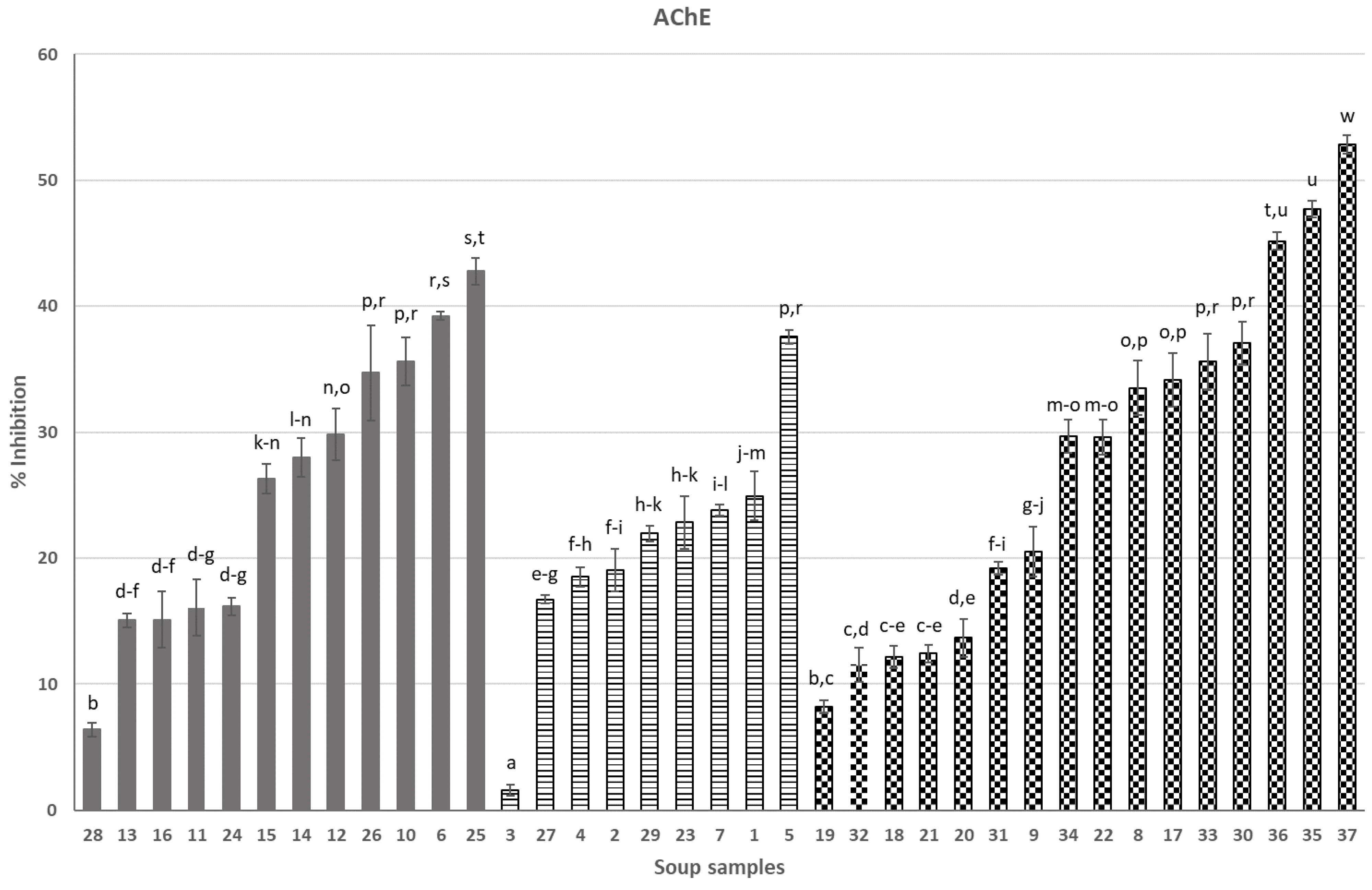
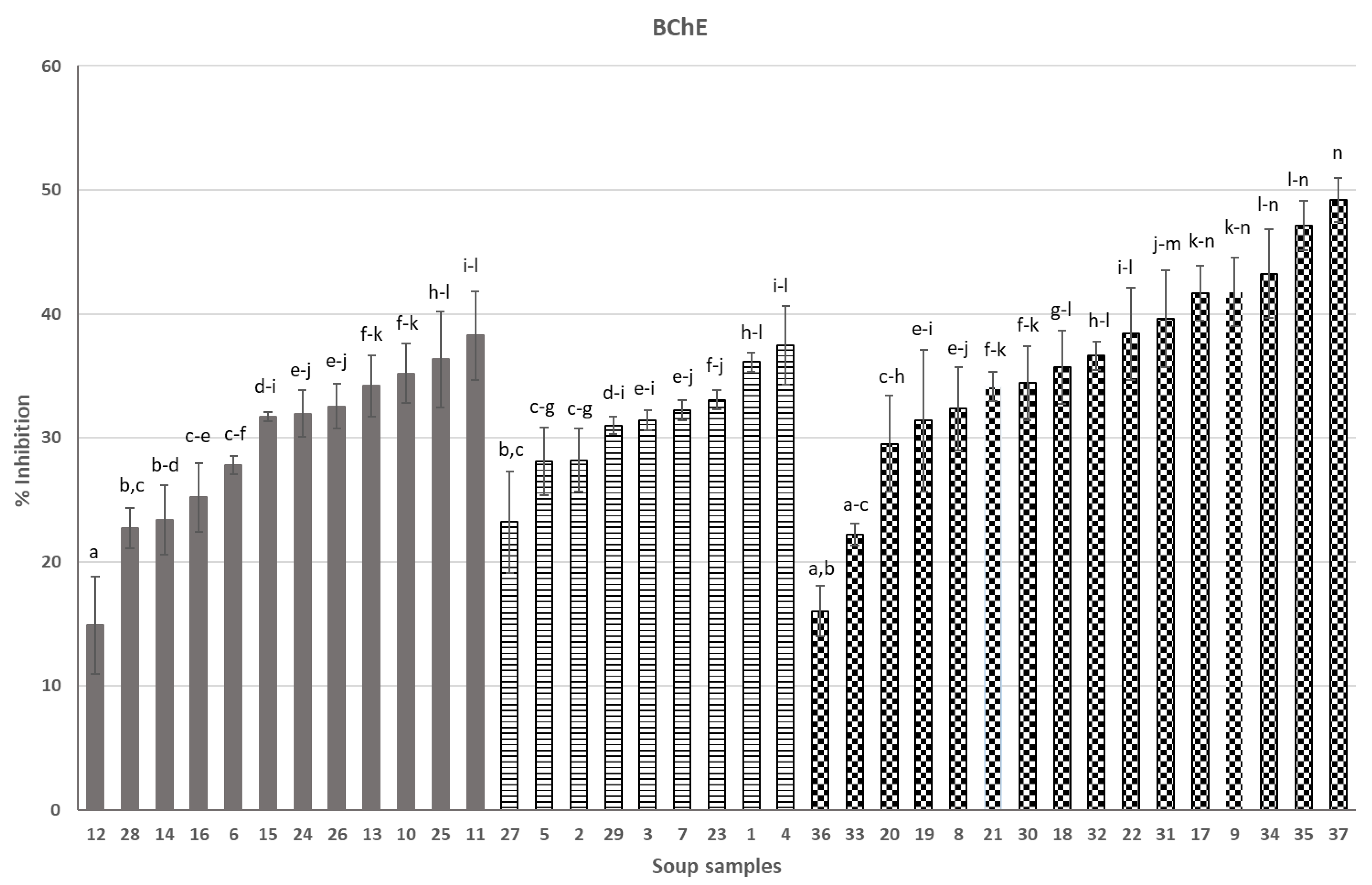
Background: The cholinesterase theory stands as the most popular worldwide therapy for Alzheimer’s disease (AD). Given the absence of a cure for AD, a plant-based diet has been repeatedly shown as positive in the prevention of AD, including exploring ready-made products in stores and the development of new functional foods. Goal: This study compared the anti-acetyl- and butyrylcholinesterase activity of thirty-two Polish market soups and five newly formulated soups intended to be functional. Additionally, the research aimed to assess the significance of animal content, distinguishing between vegan and vegetarian options, in cholinesterase inhibition. Materials and methods: The anticholinesterase activity was investigated using a spectrophotometric method, and the inhibitory activity was expressed as % inhibition of the enzyme. The study categorized soups into three groups based on ingredients: those containing animal-derived components, vegetarian soups and vegan soups. Results: Soups exhibited varying levels of activity against acetylcholinesterase (AChE) and butyrylcholinesterase (BChE), indicating differences in their compositions. Composition appeared to be the primary factor influencing anticholinesterase activity, as soups within each group showed significant variability in activity levels. While some commercial soups demonstrated notable anticholinesterase activity, they did not surpass the effectiveness of the optimized soups developed in the laboratory. Certain ingredients were associated with higher anticholinesterase activity, such as coconut, potato, onion, garlic, parsley and various spices and herbs. Conclusions: Vegetarian and vegan soups exhibited comparable or even superior anticholinesterase activity compared to animal-derived soups, highlighting the importance of plant-based ingredients. The study underscores the need for further research to explore the mechanisms underlying the anticholinesterase activity of soups, including the impact of ingredient combinations and processing methods.
Keywords: AChE inhibitors; BChE inhibitors; Alzheimer’s disease; plant-based diet; vegan; vegetarian diet AChE inhibitors; BChE inhibitors; Alzheimer’s disease; plant-based diet; vegan; vegetarian diet