Article

Trajectory of Food Insecurity and Its Association with Longitudinal Mental Health and Sleep Outcomes in Adolescents from Economically Disadvantaged Families

1
School of Medicine, College of Medicine, National Cheng Kung University, Tainan 70101, Taiwan
2
Department of Public Health, National Cheng Kung University Hospital, College of Medicine, National Cheng Kung University, Tainan 70101, Taiwan
3
Institute of Allied Health Sciences, College of Medicine, National Cheng Kung University, Tainan 70101, Taiwan
4
Department of Family Medicine, National Cheng Kung University Hospital, College of Medicine, National Cheng Kung University, Tainan 70101, Taiwan
5
Department of Pediatrics, National Cheng Kung University Hospital, College of Medicine, National Cheng Kung University, Tainan 70101, Taiwan
*
Author to whom correspondence should be addressed.
Nutrients 2021, 13(5), 1696; https://doi.org/10.3390/nu13051696
Submission received: 23 March 2021 / Revised: 11 May 2021 / Accepted: 15 May 2021 / Published: 17 May 2021
(This article belongs to the Special Issue Diet and Wellbeing across the Life Course)

Abstract

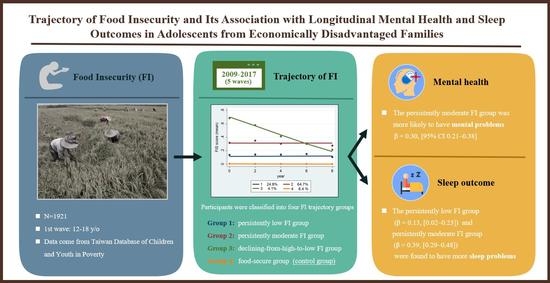
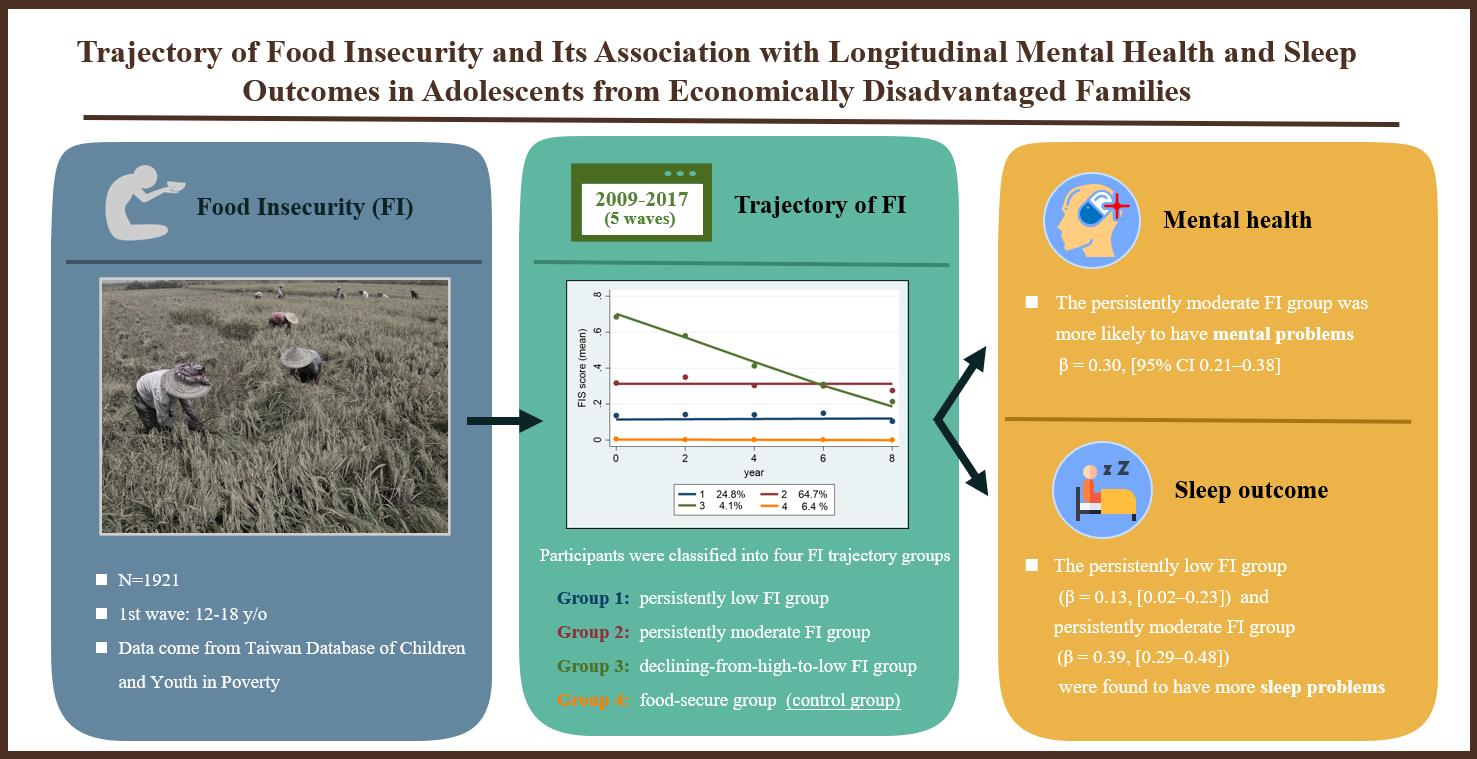
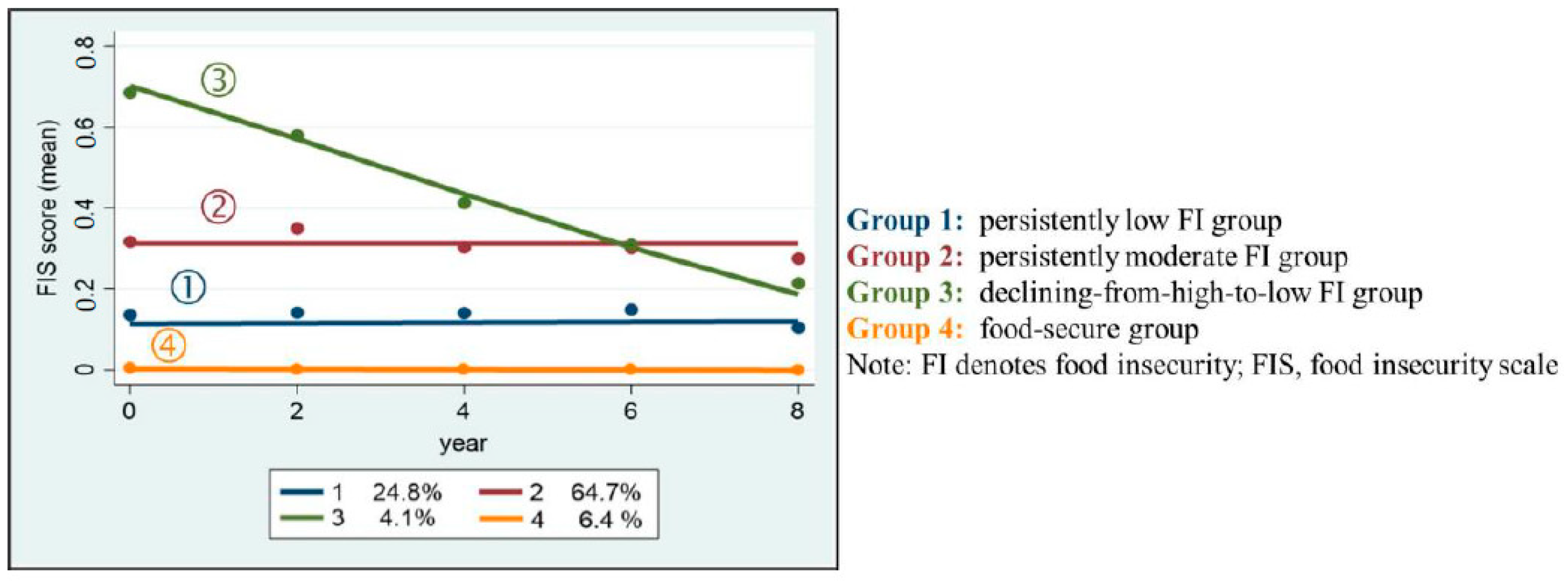
Background: Adolescence is a critical transition period in the course of human development. Although food insecurity (FI) has been shown to be associated with adverse mental health and sleep outcomes in US adolescents, there is a paucity of research examining the relationships between FI, mental health, and sleep outcomes in Taiwanese adolescents. Furthermore, it is unknown how the change of FI over time (i.e., the trajectory of FI) is related to health outcomes. Methods: The data come from the Taiwan Database of Children and Youth in Poverty, which is a national longitudinal project measuring FI in five survey waves (2009–2017). We employed group-based trajectory modeling to classify various FI trends over the five waves using STATA. Furthermore, a generalized estimating equation analysis was conducted with FI trajectories as the independent variable to see how FI trajectory is related to mental health and sleep outcomes. Results: In total, 1921 participants aged 12–18 years in the first wave were deemed valid for the analysis. We classified the participants into four FI trajectory groups: persistently low FI (24.8%), persistently moderate FI (64.7%), declining from high to low FI (4.1%), and food-secure groups (6.4%). As compared to food-secure adolescents, the persistently moderate FI group was more likely to have mental problems (β = 0.30, [95% confidence interval 0.21–0.38]), while the other FI groups were only marginally associated with mental health problems. Moreover, adolescents in the persistently low FI group (β = 0.13, [0.02–0.23]) and persistently moderate FI group (β = 0.39, [0.29–0.48]) were found to have more sleep problems than those in the food-secure group. Conclusions: Our study describes the FI profile of adolescents from economically disadvantaged families and the difficulties they might encounter. With this information, healthcare providers can aid adolescents in the early stages of mental health problems and provide guidance when appropriate.
Keywords: adolescent; food insecurity; mental health; sleep outcome; trajectory analysis adolescent; food insecurity; mental health; sleep outcome; trajectory analysis
Graphical Abstract