Article

Time-Lapse Absolute Gravity Measurements Unveil Subsurface Water Content Variations in Central Italy


1
Osservatorio Nazionale Terremoti, Istituto Nazionale di Geofisica e Vulcanologia, 00143 Roma, Italy
2
Sezione di Bologna, Istituto Nazionale di Geofisica e Vulcanologia, 40127 Bologna, Italy
3
Osservatorio Etneo, Istituto Nazionale di Geofisica e Vulcanologia, 95125 Catania, Italy
4
Osservatorio Vesuviano, Istituto Nazionale di Geofisica e Vulcanologia, 80124 Napoli, Italy
*
Author to whom correspondence should be addressed.
Remote Sens. 2026, 18(9), 1377; https://doi.org/10.3390/rs18091377
Submission received: 17 February 2026 / Revised: 14 April 2026 / Accepted: 25 April 2026 / Published: 29 April 2026

Highlights

What are the main findings?
  • Repeated absolute gravity measurements (2018–2023) at four Central Italy sites revealed gravity variations of ~20 μGal at three locations, while the L’Aquila (AQUI) site exhibited a more pronounced amplitude of ~40 μGal.
  • Sentinel-1 PS-InSAR time series constrained vertical ground displacements to within ±3 mm, firmly excluding vertical crustal deformation as the primary driver of these significant gravimetric changes.
What are the implications of the main findings?
  • While regional gravity variations are largely driven by terrestrial water storage variations (captured by GLDAS and GRACE-FO), these regional models fail to explain the highly localized, extreme gravity changes.
  • The massive, non-deformative mass loss at L’Aquila demonstrates that absolute gravimetry can detect highly localized subsurface mass redistributions. This opens new avenues for studying localized processes—such as porosity readjustments and fluid migrations linked to post-seismic activity in karst environments—which remain invisible to InSAR and coarse satellite gravimetry.

Abstract

We present and discuss time-lapse gravity variations recorded by a large-scale absolute gravity network operating in Central Italy. The network comprises four stations distributed across the Lazio, Umbria, and Abruzzo regions, areas affected by the significant seismic activity of 2009 and 2016–2017. From 2018 to 2023, six campaigns were carefully conducted using an FG5 absolute gravimeter. We detected significant gravity decreases around 2020 reaching between −15 and −20 μGal in three sites and approximately −37 μGal at the fourth. The Sentinel-1 time series of permanent scatterers (PS) allowed us to exclude significant contribution from vertical deformations to the observed gravity changes. We analyzed both ground-based data (rainfall gauges and well water levels) and satellite-based observations (the Gravity Recovery and Climate Experiment-Follow-On, GRACE-FO, mission) together with the Global Land Data Assimilation System (GLDAS) and precipitation models. The results reveal a significant decrease in the regional groundwater content from 2018 to the end of 2020, which coincides temporally with the observed gravity decrease. We show that the absolute gravity variation trends observed at all stations are consistent with regional-scale hydrological processes, pointing to a significant decrease in terrestrial water storage (TWS) during the same time interval. At L’Aquila (AQUI), the gravity anomaly is larger than expected from regional hydrological products alone, suggesting an additional local component possibly related to the hydrogeological response of the fractured karst system undergoing significant post-seismic activity.

1. Introduction

Time-varying gravimetry has long been used to measure non-tidal gravity variations and has contributed to geodynamic research by monitoring vertical crustal motions and internal mass redistributions, particularly in volcanic areas (e.g., refs. [1,2] and references therein). With the development of transportable absolute gravimeters, repeated high-precision measurements can now be performed over time for regional and local gravimetric control, supporting volcano monitoring and geodynamic investigations at tectonic plate boundaries (e.g., [3,4,5,6,7,8]).
The accuracy of absolute gravimeters, estimated from repeated drop measurements, is on the order of ~3 µGal, and the uncertainty in temporal gravity changes derived from absolute surveys is generally below 5 µGal. Consequently, only processes producing gravimetric effects larger than this threshold can be detected. The gravity field is highly sensitive to subsurface mass variations also associated with water storage and transfer, which show strong spatial variability depending on climatic forcing (rainfall, snow and glacier melt, flooding, atmospheric pressure, evapotranspiration) and hydrogeological conditions (aquifer properties, piezometric level changes, human activity). These hydrological signatures have been widely documented in the literature (e.g., [4,9,10]), and it has been shown that natural groundwater fluctuations may mask tectonic gravity signals [11].
Time-varying gravimetry is directly related to density variations in the subsurface: a horizontally infinite water layer produces an increase in gravity of approximately 42 µGal (42 × 10−8 m s−2) per meter of water thickness, depending on porosity, independently of the sensor height above the layer [12]. Seasonal gravity variations of 10–15 µGal associated with piezometric level changes have been reported and exploited in time-lapse gravity surveys to constrain groundwater models (e.g., [4,8,13,14]). The amplitude of the observed signals strongly depends on local hydrogeological settings [14,15,16].
Hydrologically driven surface deformation can also be investigated using satellite remote sensing techniques such as permanent scatterers-Interferometric Synthetic Aperture Radar (PS-InSAR), the Gravity Recovery and Climate Experiment Follow-On (GRACE-FO) mission, and Global Navigation Satellite Systems (GNSS), each characterized by different spatial and temporal resolutions. GNSS time series affected by climatological hydrological loading typically show periodic inter-annual signals (e.g., [17,18,19,20]). However, GNSS is generally less sensitive to vertical deformation than PS-InSAR, which is therefore particularly effective for mapping vertical ground motion [21].
GRACE-FO provides observations of gravity potential variations at regional to global scales. For this reason, the joint analysis of satellite-derived deformation data and gravity variations is essential to discriminate between tectonic deformation, hydrological mass transfer, or their combined effects.
In recent decades, both satellite and ground-based gravity observations have yielded abundant research achievements in the field of terrestrial water storage (TWS) dynamic monitoring. At the regional to global scale, the GRACE and GRACE-FO missions have revolutionized hydrogeodesy by providing unprecedented quantifications of total water storage anomalies and large-scale aquifer depletion (e.g., [22,23]). Conversely, at the local scale, ground-based absolute gravimetry has proven highly effective in tracking shallow groundwater storage variations, constraining specific yield, and monitoring piezometric level changes with high precision (e.g., [10,24]).
Despite these advancements, significant scientific gaps remain when attempting to disentangle hydrological mass transfers from tectonic deformation, particularly in seismically active regions. Existing studies often rely on single-technique approaches or struggle with spatial scale mismatches: satellite gravimetry lacks the spatial resolution necessary for local fault-scale monitoring (e.g., [22,25]), while ground-based gravimetry is frequently contaminated by unquantified localized surface deformation (e.g., refs. [9,10,12,26,27] and references therein). Consequently, effectively isolating tectonic gravity signals from background hydrogeological noise remains a major challenge. This study addresses these limitations by proposing a multi-source framework. Our core scientific contribution lies in the integration of ground-based absolute gravity, PS-InSAR deformation monitoring, and high-resolution hydrological models Global Land Data Assimilation System (GLDAS) specifically applied to tectonically active areas. While the combination of these techniques has been previously explored, our incremental novelty consists in demonstrating that this integrated framework is essential to unveil highly localized subsurface mass redistributions—such as porosity readjustments during the seismic cycle. By cross-validating these diverse datasets, we show that ground-based absolute gravimetry is potentially capable of detecting these complex fault-scale mechanisms, which occur without vertical surface deformation (thus invisible to InSAR) and remain entirely masked by the coarse spatial resolution of satellite gravimetry.
Central Italy has recently been affected by the L’Aquila (2009, Mw 6.3) and Amatrice–Norcia (2016, Mw 6.1 and 6.5) earthquakes, producing long-lasting aftershock sequences. The resulting deformation field after the main shocks reached several centimetres, and the modelled impact of these events could have altered the gravity field by up to 157–170 μGal (e.g., refs. [28,29] and references therein). This made the region particularly suitable for episodic monitoring of both ground deformations and gravity variations over different timescales. Medium- to long-term gravity and deformation changes potentially related to post-seismic relaxation could be expected if vertical topographic movements are still ongoing, possibly accompanied by internal mass redistributions [30].
Therefore, a multidisciplinary approach combining joint measurements of ground deformation and gravity is essential to understand the ongoing geophysical processes. To this aim, the Istituto Nazionale di Geofisica e Vulcanologia (INGV) funded three projects to monitor ground deformations and gravity variations in Central Italy over the 2018–2023 period. During this period, the L’Aquila area experienced about 2000 aftershocks with M ≤ 3.8, following the 2016–2017 seismic sequence [31].
The network design, absolute gravimeters, and the results obtained from the 2018 and 2020 surveys are summarized in [6] and references therein. Here, we present the complete dataset, including three additional surveys, interpreted in the context of deformation analysis and hydrological data.

2. Materials and Methods

2.1. The Network and Absolute Gravity Measurements

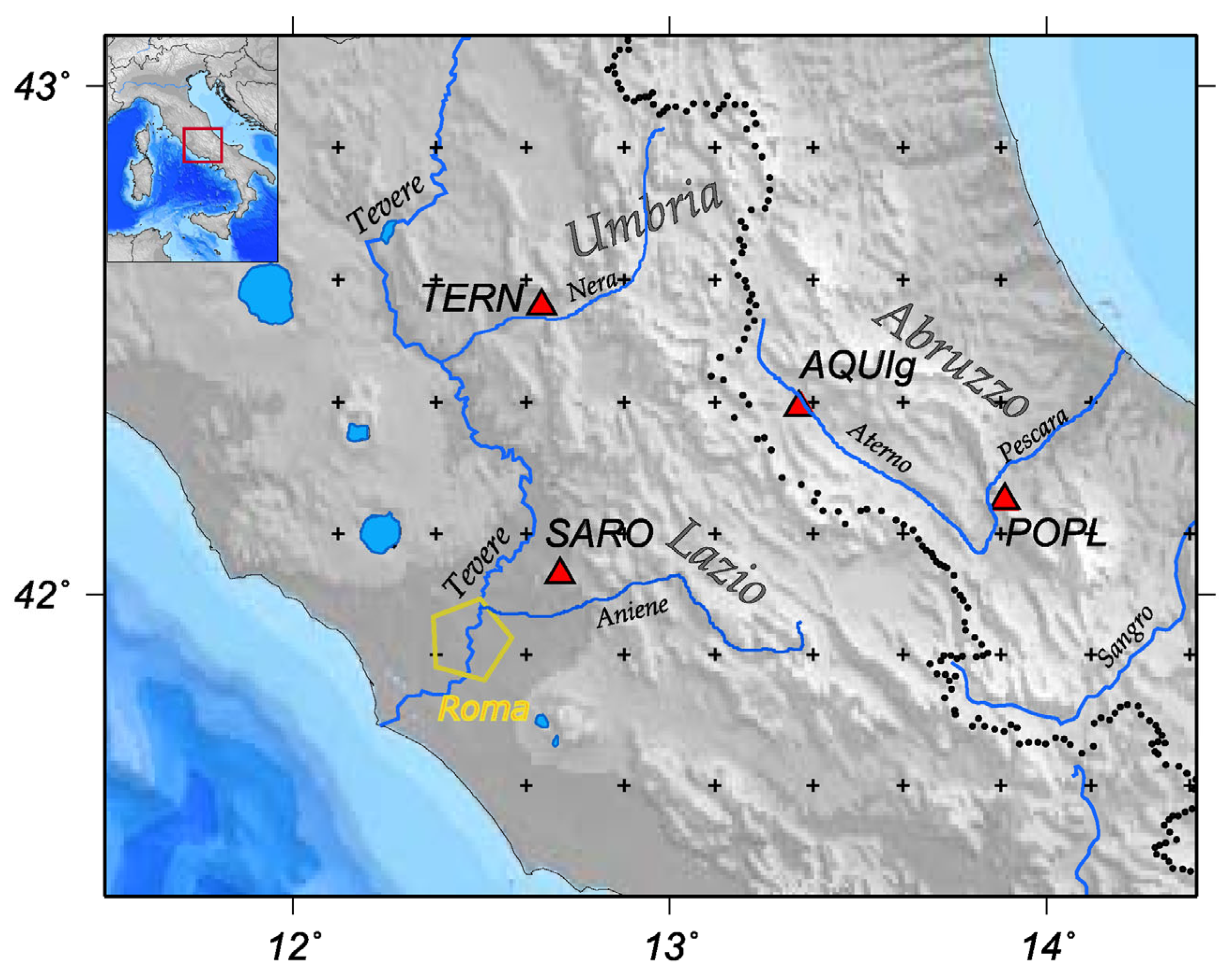
The network, located in Central Italy, comprises the following stations (Figure 1):
  • L’Aquila (Province of L’Aquila, Abruzzo Region—AQUIg);
  • Popoli (Province of Pescara, Abruzzo Region—POPL);
  • Sant’Angelo Romano (Province of Rome, Lazio Region—SARO);
  • Terni (Province of Terni, Umbria Region—TERN).
A major factor in site selection was the identification of enclosed and secure facilities for installing the absolute gravimeters and providing electrical power, together with an assessment of their reusability, reliability, and low-noise environment, to ensure measurements of high precision and accuracy.
From a geological perspective, both AQUI and POPL are located on deposits of the fractured and karstic carbonate platform of the Central Apennines (e.g., [32]), within basins formed by NE–SW extensional tectonics and surrounded by high mountain ranges. Both areas experience significant seismic activity (http://www.ingv.it), particularly L’Aquila, as mentioned in the Introduction Section.
The gravimetric station of AQUI (Coppito) lies on complex deposits of the Aterno basin, characterized by alternating lacustrine sediments, silts and clays, and alluvial plain deposits, gravels and sands; the calcareous–marly bedrock of the area (Cretaceous and/or Miocene) shows medium-to-high permeability controlled by fracturing and karstification [33]. POPL is located at the confluence of Apennine valleys with a stratigraphy dominated by recent detrital and alluvial covers of soft clay silts on a rigid (or semi-rigid) substrate of gravels and Miocene fractured limestones [34].
SARO is located in the middle Tiber valley, near Rome, and is characterized by low seismicity. It is located on the Cornicolani Hills, a structural high consisting of Mesozoic carbonate unit phenomena of the Tyrrhenian margin of Lazio [35]. Limestones are subjected to karst fractures and karst phenomena (caves, sinkholes). The most notable example is the Pozzo del Merro (in Sant’Angelo Romano), which demonstrates exceptional “conduit” porosity that allows for rapid groundwater circulation [36]. Tuffs and pozzolanas coming from the Roman volcanic district can cover somewhere karstified limestones.
TERN is located within a typical pre-Apennine intermontane basin of the Umbria–Marche geological sequence, composed of Mesozoic carbonates (limestones and dolomites of the Umbrian facies) overlain by Paleogene flysch deposits. It is affected by NE–SW extensional tectonics (e.g., [37]), generating moderate seismicity. Between the Middle Pliocene and the Early Pleistocene, the basin was occupied by the southern branch of the Tiberino Lake [38]; subsequently, the Terni Basin began to be filled discontinuously, with continental sediments—initially lacustrine and then alluvial—reaching thickness of approximately 30 m [39].
Since AQUI, POPL and TERN are located in alluvial basins, their yield porosity ranges between 20 and 30% [40,41], whereas the mixed lithology of SARO is associated with higher variability, with porosity values ranging from 2% to 20% [42].
All gravimetric sites are indoors, with the absolute gravimeter positioned directly on the floor to minimize noise and instability. At each station, absolute measurements were collected from the late afternoon onward and through the night to reduce disturbances from human activity. The measurements were performed using the Micro-g LaCoste (Lafayette, CO 80026 USA) FG5#238 absolute gravimeter, a high-precision instrument that operates on the principle of free-fall measurement using laser interferometry, supported by an atomic clock for an ultra-accurate time reference. The FG5 includes a vibration isolation system to minimize environmental noise and a control/data processing unit for experiment management. Detailed operation of the FG5 is described in [6] and references therein.
While absolute observations were occasionally complemented by the portable Micro-g LaCoste (Lafayette, CO 80026 USA) A10 #39 gravimeter, this study considers only the longer time series acquired with the FG5#238 [6,7]. This instrument has participated in both international and national comparison campaigns, including comparisons with the Italian reference absolute gravimeter IMGC-02 operated by INRIM (Turin, Italy; [43,44,45,46,47,48]).
Additionally, absolute gravity measurements were accompanied by the determination of the local vertical gravity gradient at each station [7] in order to transfer the measured g value to any required height and to account for potential vertical ground changes. Absolute measurements were organized into sessions of 12–24 h, consisting of sets of 50–100 drops each (see Table 1, Table 2, Table 3 and Table 4). These sessions achieved high precision with uncertainties of approximately 3 µGal (3 × 10⁻⁸ m/s2). The reference height of the FG5 measurements was approximately 1.21 m, with minor variations of 2–5 mm between installations. Observations were corrected for known effects, including tides, atmospheric pressure, ocean loading, polar motion, self-attraction, and diffraction. Atmospheric mass variations were corrected using a barometric admittance factor of −0.3 µGal/hPa [49] and the difference between measured and nominal atmospheric pressure, depending on station elevation. During acquisition, any drop exceeding the 3σ range was rejected. The corrected g values were associated with a combined uncertainty, as described in [6,7].
The FG5 surveys began in June 2018, with subsequent campaigns in October 2018, October 2020, May and December 2022, and May 2023. Due to the COVID-19 pandemic, planned surveys in 2020 and 2021 were not conducted. Most sites consist of six surveys, except for TERN, which has five. Table 1, Table 2, Table 3 and Table 4 summarize, for each site, the survey date, UTC time, nominal local air pressure (hPa), instrumental height above the ground, number of sets and drops per set, total drops per session, absolute gravity values at the measured height, and combined uncertainty. The absolute g values are reported at the effective instrumental height (distance between benchmark and free-fall position, ~1.21 m for FG5), where g is invariant with respect to the vertical gravity gradient. Achieved uncertainties of ~3.3 µGal are also indicated.
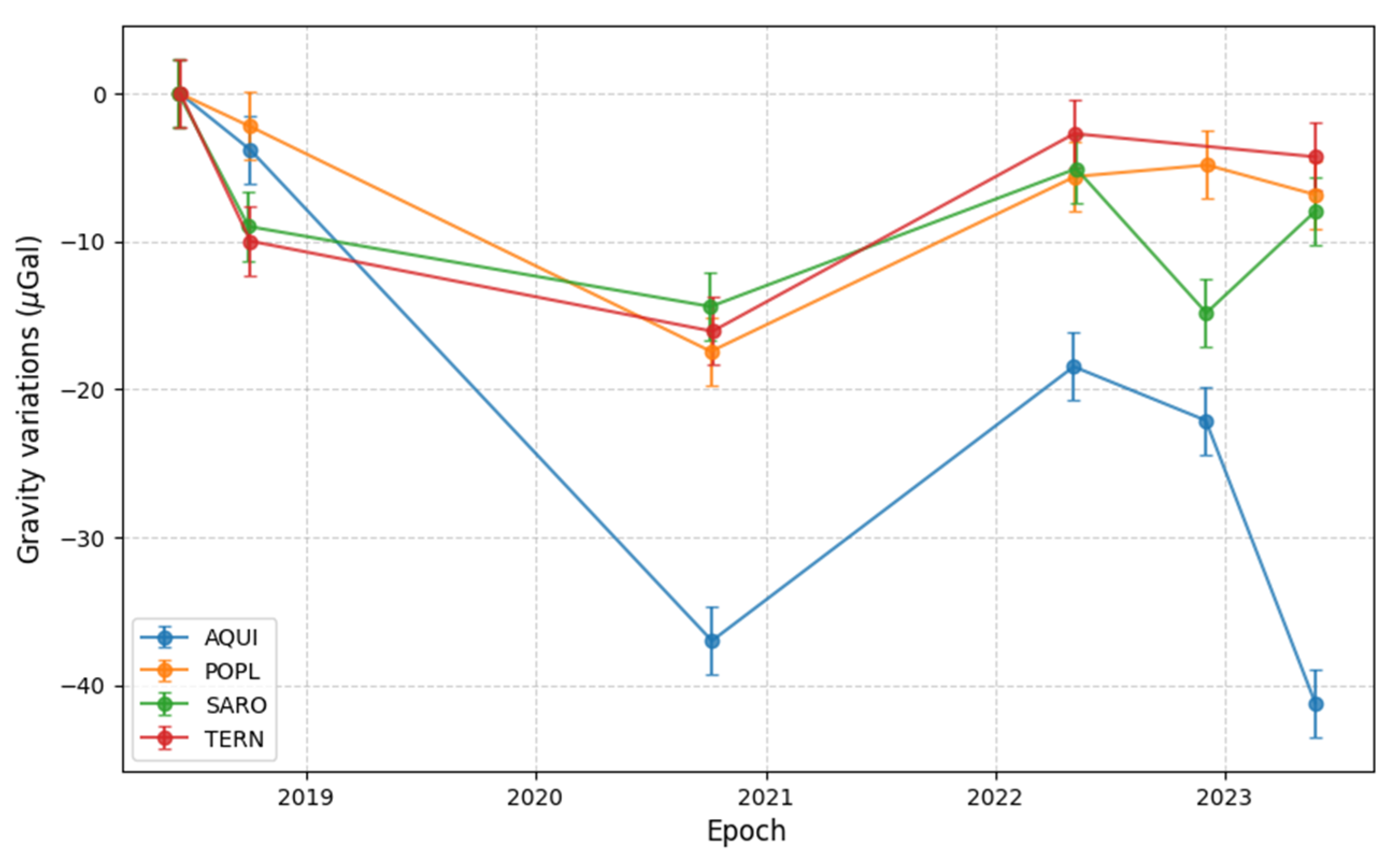
The absolute gravity changes computed at each site relative to the first survey carried out in 2018 are shown in Figure 2.
It is important to acknowledge the inherent temporal limitations of ground-based absolute gravity surveys. The main drawback of repeated gravity measurements is the lack of information on the rate at which the detectable processes occur, as only changes between successive survey epochs (ranging usually between a few months and a few years) can be assessed. Consequently, six campaigns conducted between 2018 and 2023 cannot fully resolve high-frequency seasonal hydrological variations or capture the exact peak of transient climatic extremes, such as the severe drought of autumn 2022, which drastically impacted the groundwater recharge of carbonate aquifers across the Central Apennines [50]. Nonetheless, the primary strength of this absolute gravity network lies in its microGal accuracy for detecting long-term, inter-annual mass trends. To compensate for the sparse temporal sampling, this study relies on the continuous temporal coverage provided by GLDAS, GRACE-FO, and PS-InSAR time series. This multi-source integration effectively bridges the temporal gaps between field campaigns, ensuring that the long-term trend analysis remains reliable and properly contextualized.

2.2. Vertical Ground Deformation Monitoring

The absolute gravity changes recorded at each site over the entire period (Figure 2) are well above the measurement uncertainty (Table 1, Table 2, Table 3 and Table 4). Relative to the first survey carried out in 2018, these changes show a maximum decrease of approximately 37 µGal at AQUI and 15–20 µGal at the other sites during October 2020 and May 2023. Since a decrease in gravity may also correspond to ground uplift, it is important to assess whether these changes could result from episodic vertical motion.
The height variation corresponding to a gravity change of ~10 µGal can be approximated using the formula Δg ≈ −(2g0/R)·Δh, where Δg is the gravity change due to a vertical height variation Δh, g0 is the gravitational acceleration at the Earth’s surface (~981 cm/s2), and R is the Earth’s radius (~6.368·108 cm at our latitude). The factor (2g0/R) represents the free-air correction, applicable when gravity changes are exclusively due to vertical motion without mass redistribution. Using this relation, a Δg of 10 µGal corresponds to Δh ≈ 3.1 cm.
Given the observed gravity decreases of 15–37 µGal, the corresponding surface uplift would be ~4.6–12 cm, respectively. To verify whether ground deformations of this magnitude occurred during the study period in Central Italy, we analyzed vertical time series from Sentinel-1 InSAR solutions provided by the European Ground Motion Service (EGMS).
The EGMS InSAR time series detect and measure ground displacements across Europe with millimetric precision. We used the Level-3 Ortho Products, with ascending and descending observations transformed into vertical and east–west components on a 100 m resampled grid. This aggregation ensures that individual PS positioning errors are well-contained within the pixel bounds and spatially averaged (see Table 5).
For each gravimetric site, we selected the permanent scatterer (PS) closest to the station. Since EGMS provides overlapping five-year solutions (2018–2022 and 2019–2023), we reconstructed the complete 2018–2023 time series by removing offsets between the two solutions.
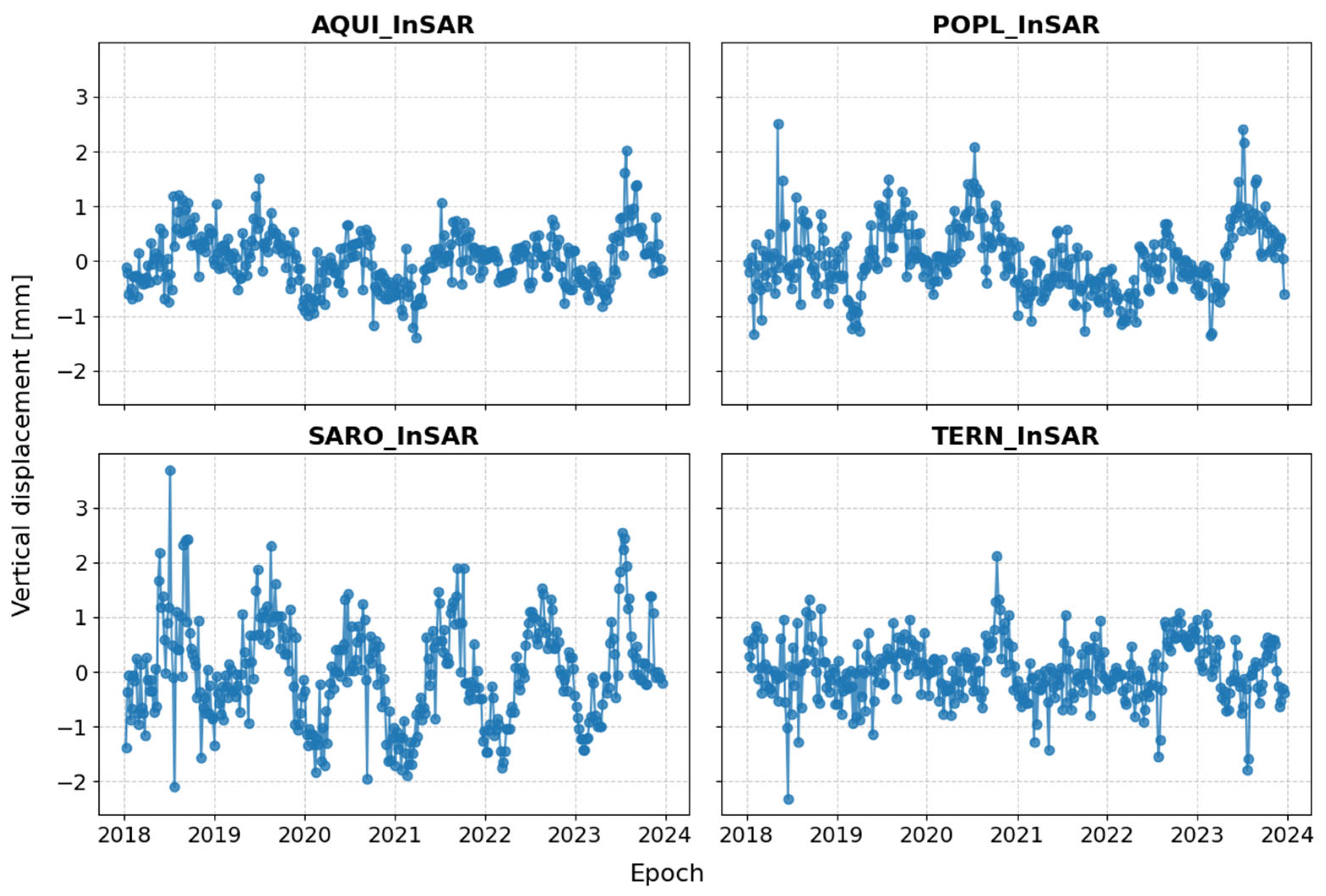
All four PS-InSAR time series show a clear seasonal (annual) signal, characterized by alternating uplift and subsidence phases. Such periodic behavior is commonly interpreted as the surface response to hydrological elastic loading and unloading, driven by seasonal variations in terrestrial water content. During wet periods, increased water storage induces elastic subsidence of the crust, whereas drying phases lead to uplift due to mass loss (e.g., [51,52,53]). Nonetheless, seasonal deformation can also be significantly influenced by thermoelastic effects. Temperature-driven expansion and contraction of the shallow subsurface and near-surface structures (including bedrock, soil, and monuments) can produce vertical displacements with annual periodicity comparable in amplitude to hydrological signals (e.g., [54]). The detrended PS time series near each gravimetric station show vertical displacements within ±3 mm (Figure 3), excluding one outlier. Such small vertical motion would correspond to a gravity change of ~1 µGal, well within the measurement uncertainties. Therefore, the significant gravity changes observed in Figure 2 are unlikely to be caused by vertical ground motion and are more probably due to internal mass redistribution.

2.3. Hydrological Data Analysis

To provide a comprehensive view of hydrological dynamics in Central Italy, particularly in the proximity of the absolute gravity stations, we considered both satellite-based and local ground-based hydrological data. Satellite products provide a regional perspective on TWS variations, including surface water, groundwater, soil moisture, snow, ice, and canopy water content. In contrast, local observations, in contrast, respond more rapidly to climatic variations or anthropogenic activities and may therefore differ from regional models [55].

2.3.1. Satellite-Based Global Models

Terrestrial water storage was evaluated using the Catchment Land Surface Model (CLSM) driven by the Global Land Data Assimilation System (GLDAS, [56]), together with Equivalent Water Height (EWH) values from the GRACE-FO mission. GLDAS provides the TWS for a given area, representing the sum of water stored in all components within a grid cell, including surface water, soil moisture at different depths, snow water equivalent, and groundwater.
We selected 0.25° × 0.25° latitude–longitude grid cells (Figure 1) and downloaded daily TWS values in mm of water, corresponding to an area of ~620 km2 at our latitude. The average uncertainty of TWS from GLDAS is estimated at 20–40 mm, depending on the region [56].
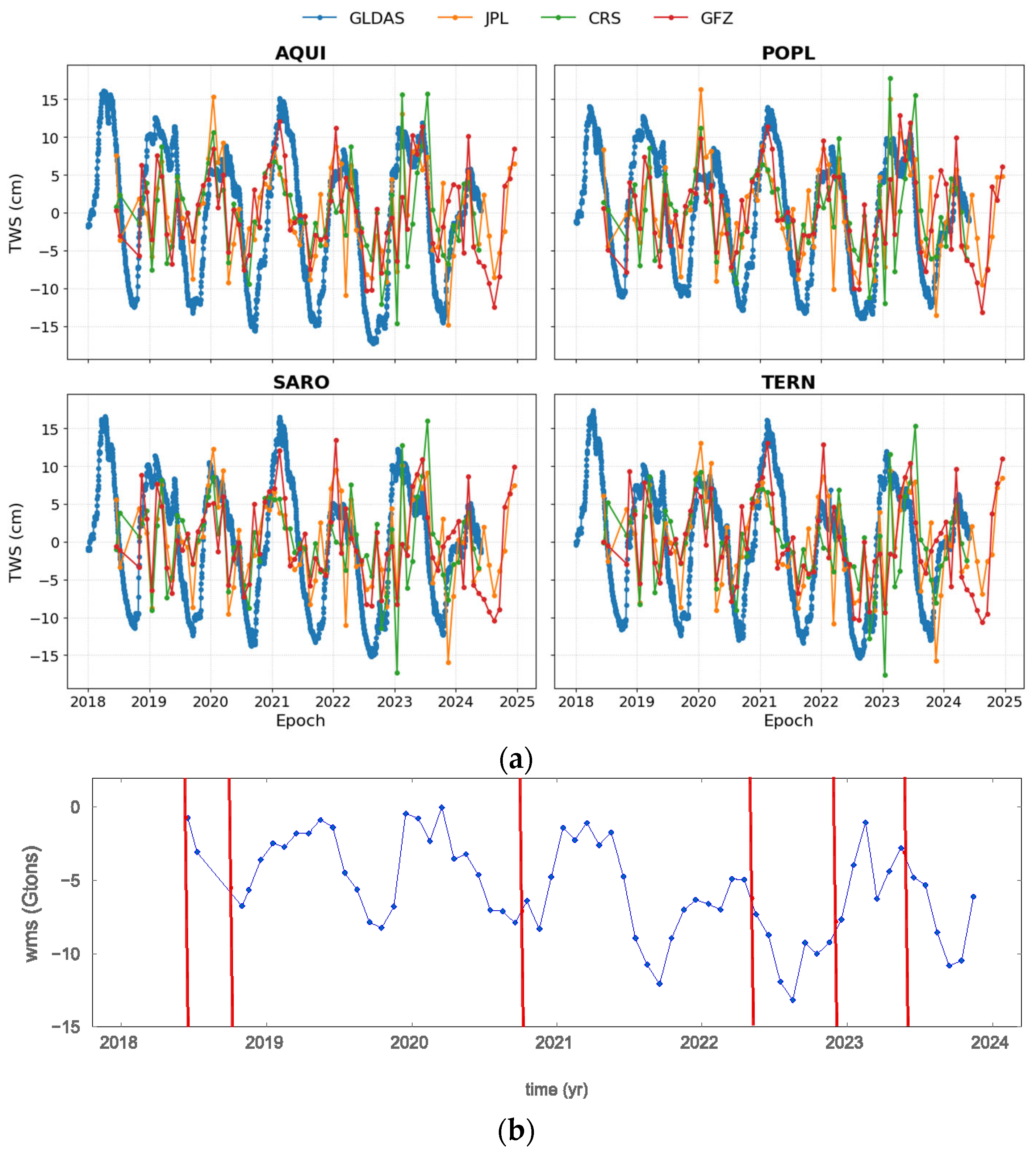
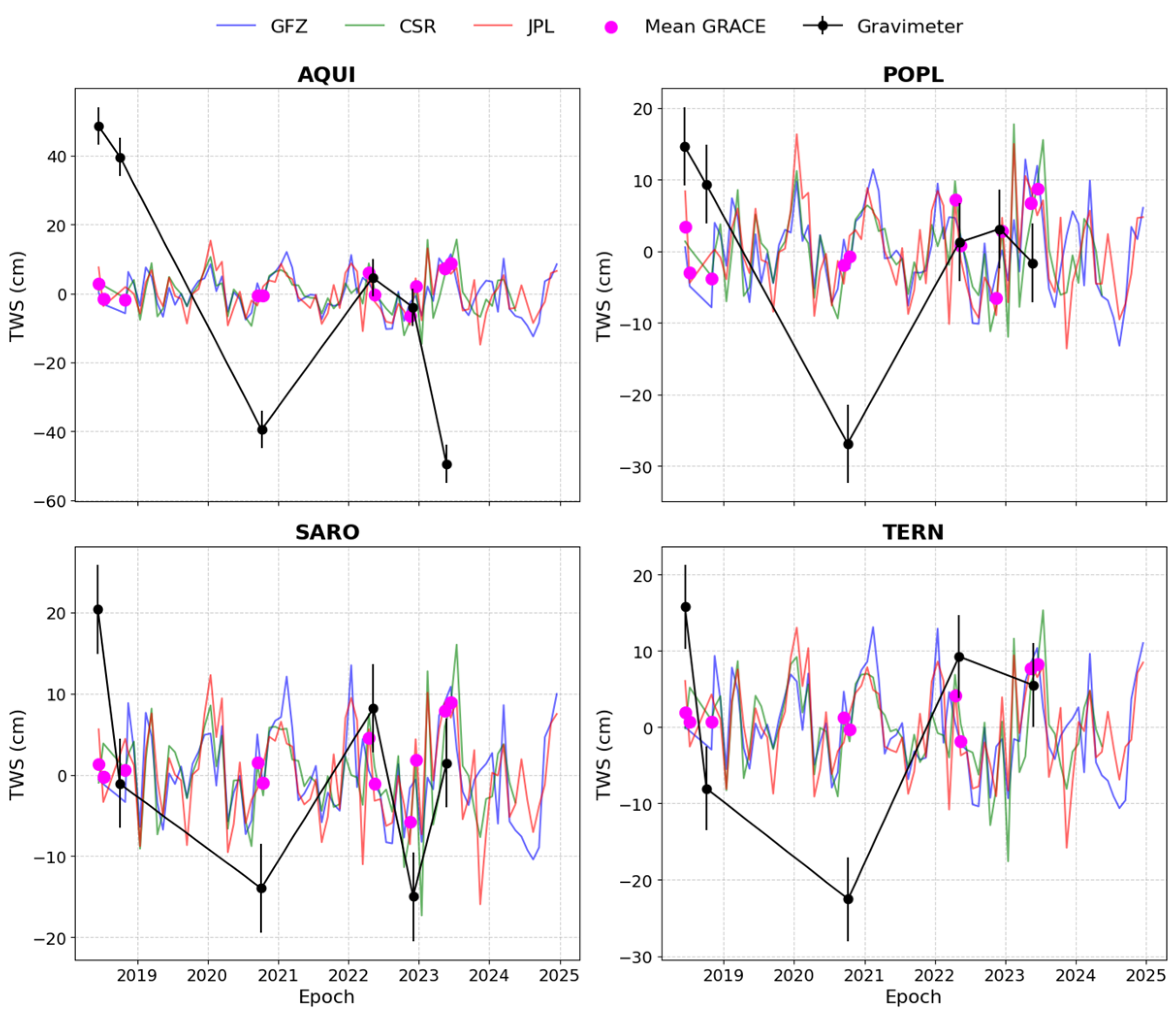
Figure 4a shows TWS variations estimated by GLDAS for the four grid cells encompassing the gravimetric stations, along with TWS estimates from GRACE-FO solutions provided by JPL, CSR [57], and GFZ [58]. These models were selected to provide complementary perspectives on terrestrial water storage dynamics: GLDAS offers higher spatial resolution and integrates both satellite and ground-based data, effectively capturing local variations, while the three GRACE-FO solutions represent independent, globally recognized estimates of gravity-derived water mass changes, allowing for the assessment of uncertainties and consistency across different processing approaches. TWS at the gravimetric sites was computed using GRACE-FO static geopotential coefficients https://icgem.gfz-potsdam.de/sl/temporal (accessed on 24 April 2026), applying a denoising and decorrelation kernel filter (DDK5). The uncertainty of GRACE-FO TWS can reach 40 mm, depending on topographic complexity [59].
The GLDAS solutions are in good agreement with each other and show a temporal evolution and amplitudes broadly consistent with the GRACE-FO results.
A clear overview of groundwater mass variations over the 2018–2023 period can be obtained from the monthly JPL GRACE-FO time series for the Central Italy pixel. Covering an area of approximately 254 × 254 km2 (Figure 4b), beyond the annual variations, GRACE-FO indicates a water mass deficit of roughly 9 Gt between 2018 and autumn 2020, decreasing to about 12 Gt in autumn 2022. Because this estimate represents an average over a very large area, local groundwater losses within individual basins may be significantly larger than the pixel-averaged value.

2.3.2. Local Precipitation Data

Precipitation-based models were obtained from the Global Precipitation Climatology Project (GPCP) Monthly Precipitation Climate Data Record (CDR), which provides monthly satellite-gauge estimates and associated error values from January 1979 to the present. The CDR merges precipitation data from multiple satellite and in situ sources to produce a high-accuracy record.
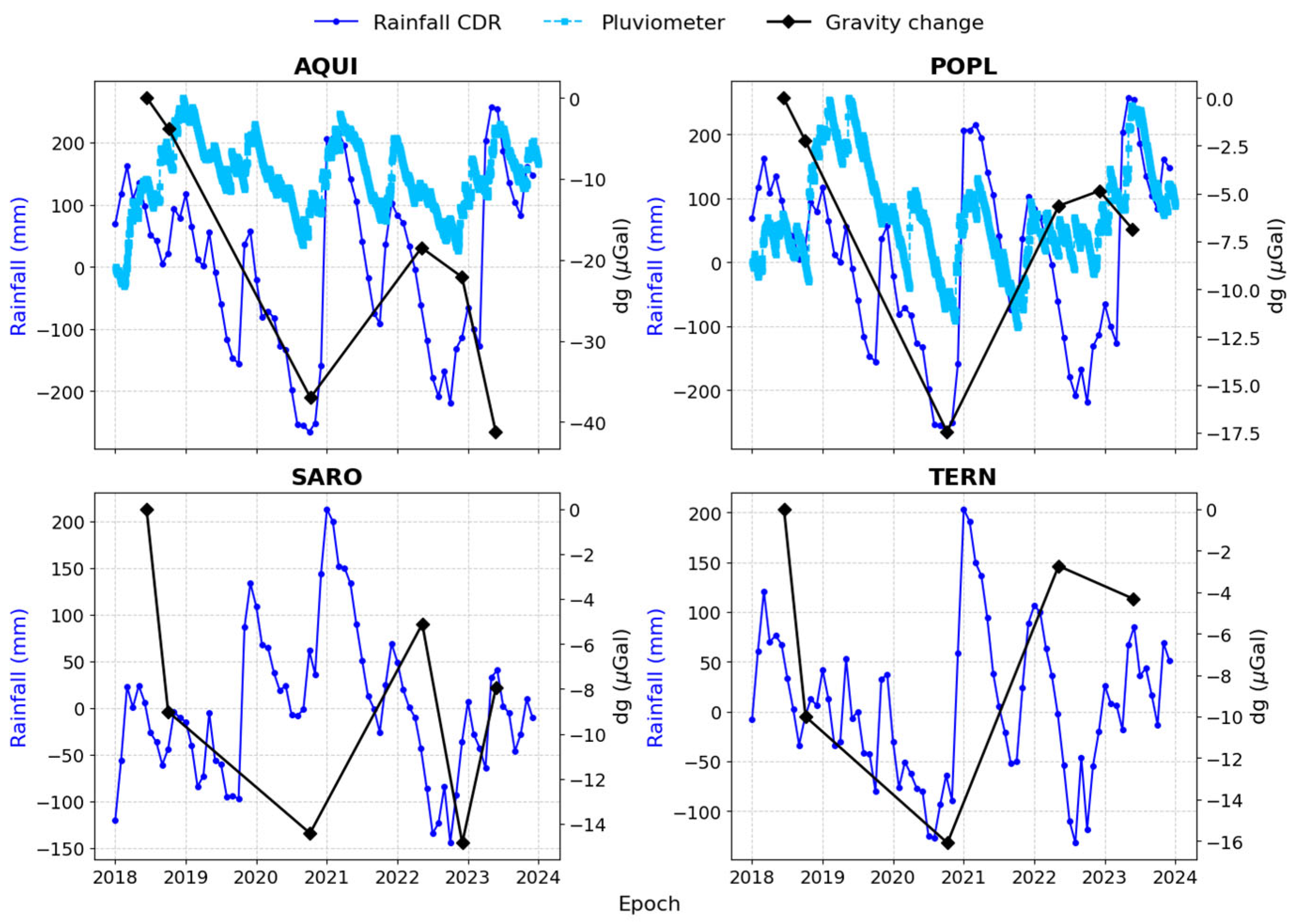
We aggregated and detrended the monthly time series of annual-average precipitation, obtaining the precipitation anomaly relative to the 2018–2023 trend for each gravimetric station (Figure 5). The four time series are broadly consistent, showing a clear seasonal pattern with variable amplitude, including a minimum in autumn 2020 and a maximum in early 2021.
Rainfall data from local gauges at L’Aquila (ADA0097) and Popoli (ADA0224), managed by the Regional Civil Protection Agency and pre-processed by CETEMPS, University of L’Aquila, were also analyzed. These time series, aggregated and detrended, are shown in Figure 5 alongside CDR data and gravity variations. We note that single-gauge measurements may not fully represent the localized rainfall at the gravimetric sites [60], particularly since the gauges are not co-located with the stations.

2.3.3. Groundwater Levels from Wells and River Flow

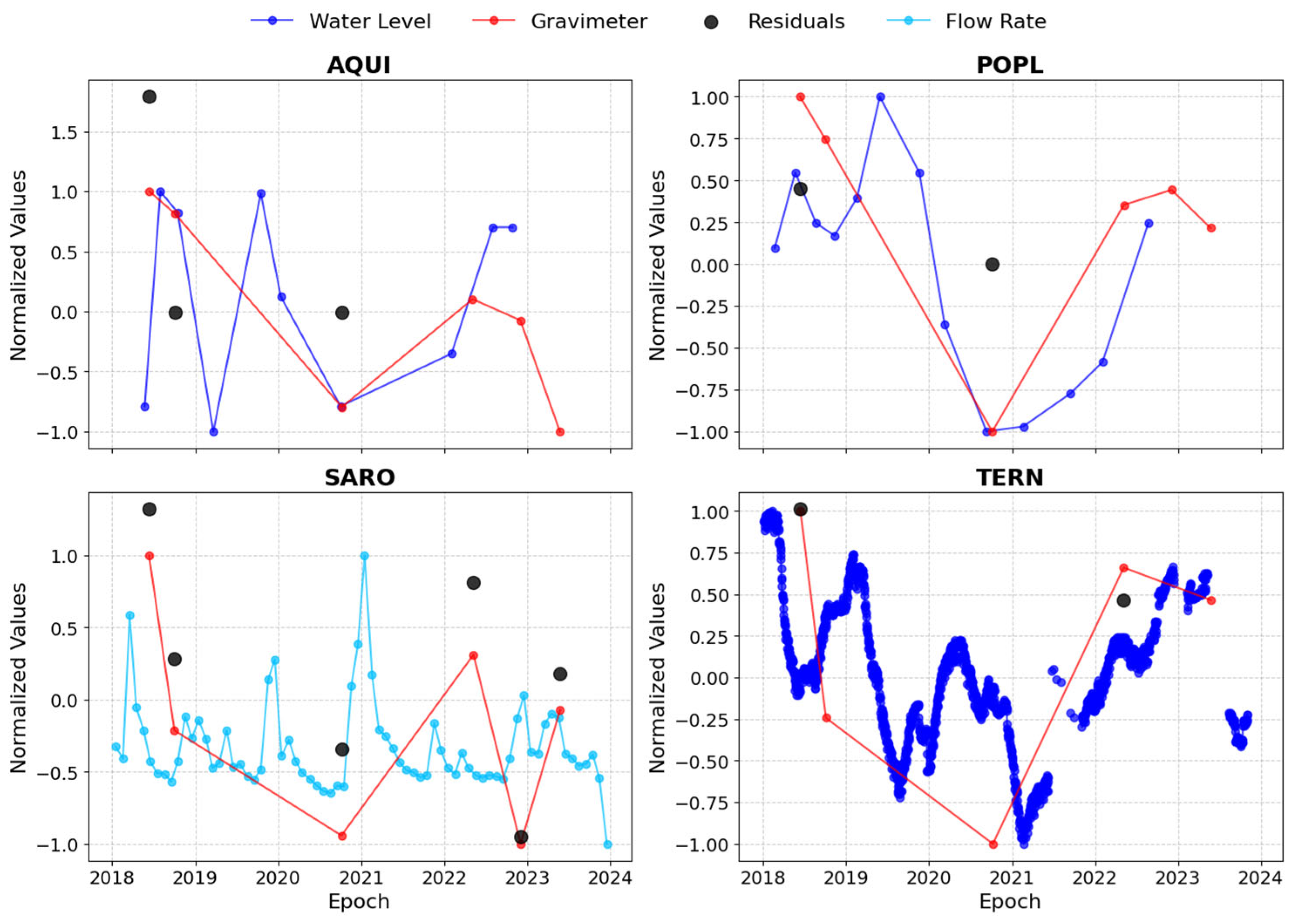
Water table level variations from wells are limited and sporadic. Available data were obtained from wells AVA11 (near L’Aquila) and MR11 (near Popoli), managed by the Regional Agency for Environmental Protection of Abruzzo (ARTA), and P14 (near Terni, but not very close), managed by the Regional Agency for Environmental Protection of Umbria (ARPA). No well data are available near SARO; instead, flow rate data from the Aniene River (~10 km from the station) were used, provided by the Regional Agency for Environmental Protection of Lazio (ARPA). The time series are shown in Figure 6, where the normalized values are reported.
These data reflect groundwater level changes, indicating recharge, depletion, or extraction in shallow aquifers. Variations in subsurface water storage alter mass distribution, producing detectable gravity anomalies—positive when water storage increases, negative during depletion [61]. During the 2018–2023 period, the measured water levels at AVA11 ranged between 1.73 m to 2.87 m, while those at MR11 ranged from 0.94 m to 1.21 m. Relative minimum water levels were observed in autumn 2020 at AVA11 and MR11, coinciding with the minimum gravity values recorded at AQUI and POPL. The measured water levels from the TERN well P14 are largely continuous, and their values range between 4.82 m and 6.88 m. The minimum at P14 occurred in early 2021. The flow rate of the Aniene river ranged between 272.5 m3/s in summer 2020 and 1550.2 m3/s in winter 2021.
To enable a direct comparison of the trends in well water levels, flow rate, and absolute gravity variations, the data were normalized to the range −1 to 1 and are presented in Figure 6.
To summarize the capabilities, characteristics and limitations of the datasets used in this study, Table 5 reports their spatial support, effective temporal sampling, main uncertainty metric, and role in the interpretation framework.

3. Results

We compare the temporal evolution of gravity changes at the four sites with the hydrological datasets described above, including rain gauges, wells, GRACE-FO, and GLDAS.
The comparison with pluviometric data is considered the least significant and mainly qualitative. In fact, precipitation anomalies represent only a proxy for terrestrial water storage variations, and cannot be directly converted into mass changes. The gravity–precipitation comparison shown in Figure 5 demonstrates a general correspondence among most of minimum values.
The comparison between gravity and groundwater level variations measured in wells is shown in Figure 6 and allows for a more quantitative assessment. Because both gravity and water level observations are episodic, it is difficult to assess whether their temporal evolution strictly follows the same pattern. Nevertheless, the two datasets show a general agreement in their temporal evolution.
Knowledge of detailed local hydrogeological parameters is essential to model the relation between gravity and well water level changes. However, since we have only sporadic gravity and well surveys, whith measurements taken on non-coinciding dates, we conduct our analysis by considering the reported range of parameters and data.
Based on the infinite Bouguer slab approximation, the expected gravity change (dgw, in µGal) resulting from a water level fluctuation (dh, in m) is calculated as dgw = 2πG·ρw·P·dh ≈ 42·P·dh, where ρw is the water density (≈1000 kg/m3) and P is the effective porosity. By applying the maximum p values (Section 2.1) to the water level variations observed between the 2018 and 2020 surveys, we obtain the following results for each site (Table 6):
As shown in Table 6, the expected gravity changes are systematically lower than the measured values, particularly at the AQUI and POPL stations, despite the relatively consistent temporal trends displayed in Figure 6. Table 6 also presents the corresponding gravity residuals—representing the portion of the signal not captured by the wells—alongside the percentage effect of groundwater on the measured gravity changes (dgexp/dgmeas). The data indicate that groundwater variation plays a predominant role only at the TERN station (accounting for 84% of the observed change). In contrast, significant residuals remain at AQUI and POPL, where water table changes account for only 39% and 15% of the variations, respectively. These discrepancies between expected and observed values are most likely due to the lack of co-location between the wells and the gravity stations, as well as temporal mismatches between water level readings and gravity data acquisition. Additionally, the water level measurements from a single well may not accurately represent the groundwater variations across the broader area that influences the gravity measurements, and vice versa.
Furthermore, it is worth noting that gravimetry provides an integral measure of all mass variations in the surrounding environment. Consequently, isolating the specific contributions of soil moisture, surface water, and groundwater is physically unfeasible using gravity data alone. The large residuals shown in Table 6—where isolated groundwater wells account for only a fraction of the total gravity signal—may indicate that the gravimeters are capturing a broader spectrum of hydrological mass changes, including unquantified variations in the vadose zone and soil moisture that the discrete wells inherently fail to record. Given that gravity measurements cannot resolve these distinct layers, any analytical separation based on sparse well data would remain highly speculative. Therefore, comparing integrated gravity observations directly with aggregated TWS from GLDAS and GRACE-FO—which explicitly sum all hydrological compartments—represents the most robust and physically coherent methodological approach for this study. While both GLDAS and GRACE-FO provide spatially representative TWS estimates at a regional scale, it is important to note their limitations in capturing localized hydrological features, particularly regarding GRACE-FO, whose spatial and temporal resolution is significantly coarser than that of GLDAS [62].
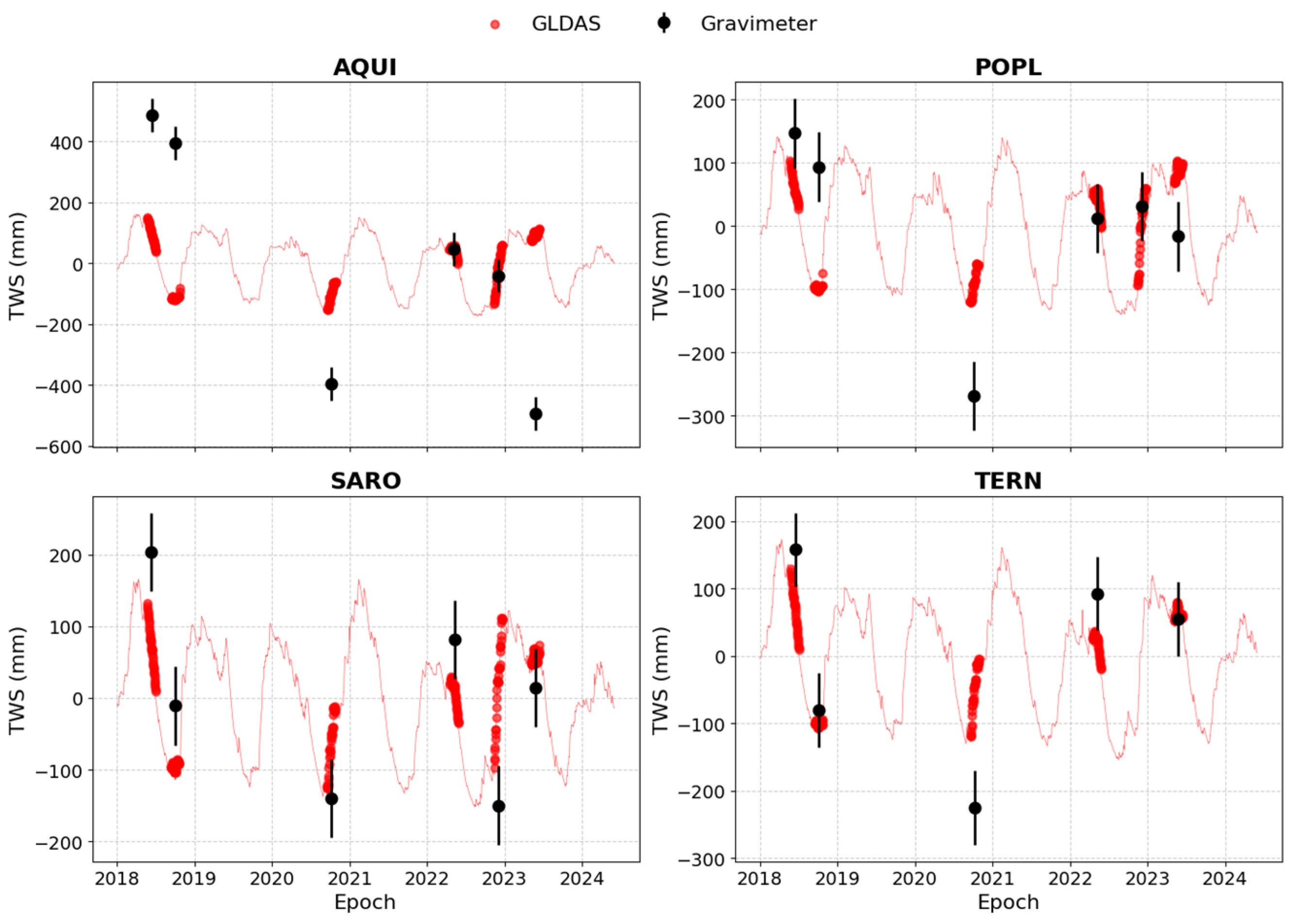
To compare the regional-scale TWS from GLDAS with the local variations sampled by gravimetric data, we adopt a first-order approximation of an infinite horizontal water layer, which yields a gravity change of approximately 42 µGal per meter of water thickness. This simplified approach neglects site-specific parameters such as ground porosity, specific yield, and volumetric soil moisture as these local properties are not representative of the regional average provided by the GLDAS model [15]. Consequently, because these local factors significantly modulate the gravity signal, the comparison presented in Figure 7 remains qualitative. More specifically, the comparison with GLDAS and GRACE-FO is intended as a consistency check on the sign, timing, and order of magnitude of the observed variations, rather than as a strict point-scale validation of the gravimetric signal.
Considering the sparse sampling of the gravity data and the uncertainties inherent in both observations and models, Figure 7 shows that GLDAS-derived TWS agrees reasonably well with the gravity-derived TWS at POPL, TERN, and SARO. The agreement is evident in both temporal evolution and amplitude, whereas it remains poor at AQUI. To facilitate comparison, GLDAS data points falling within a 20-day window of the gravimetric measurements are highlighted.
By integrating satellite and in situ data, GLDAS is expected to provide a more accurate representation of local hydrology than GRACE-FO. In fact, Figure 8 shows that GRACE-FO signals have systematically lower amplitudes—likely due to the spatial smoothing inherent in its coarse resolution—and demonstrate a poorer correlation with the measured gravity changes.
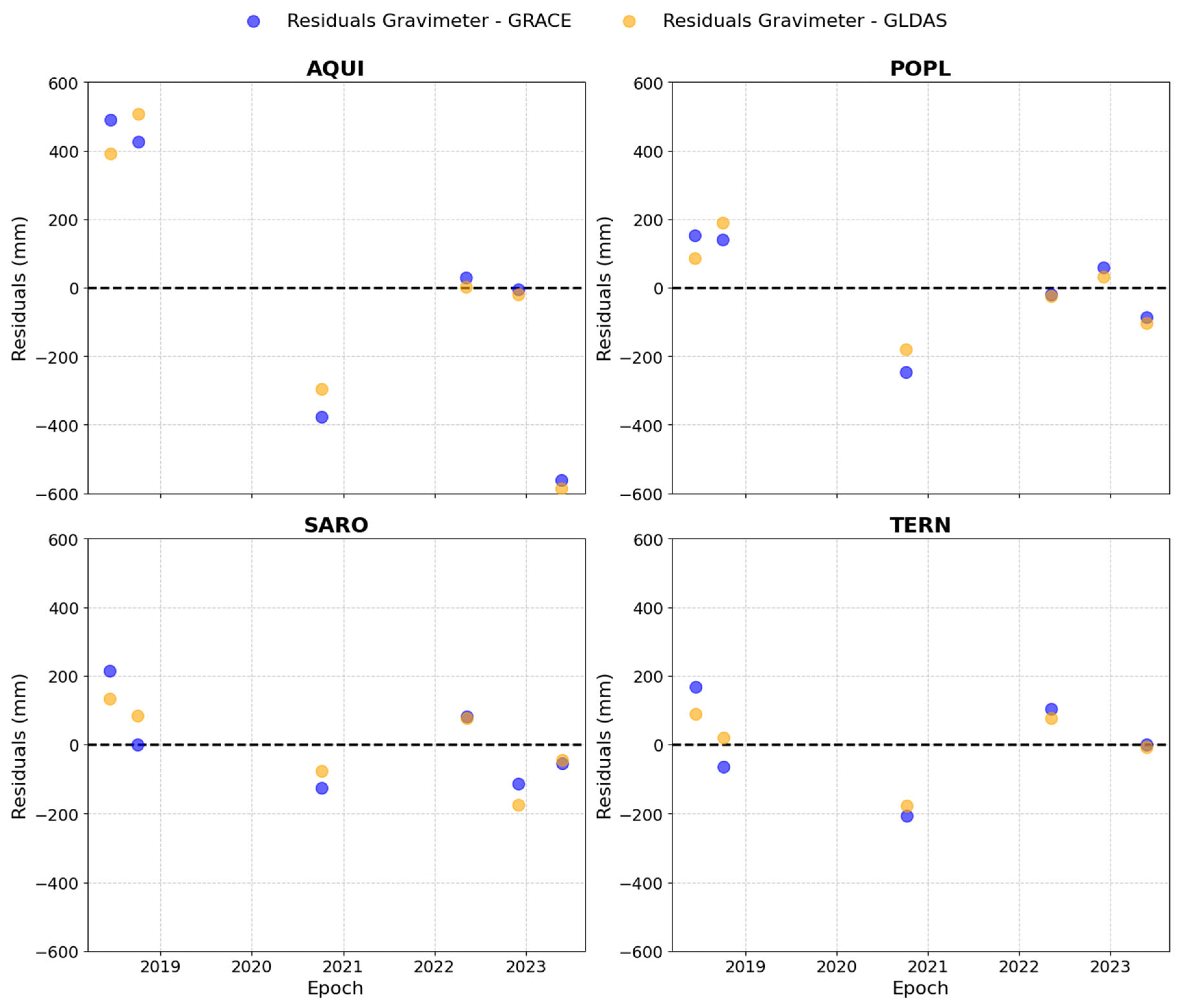
To evaluate which model better reproduces the gravity observations, we computed the residuals between the gravity-derived TWS and the TWS from each model (Figure 9) corresponding to the gravity measurement epochs (highlighted in Figure 7 and Figure 8).
Figure 9 reveals no statistically significant difference between GLDAS and GRACE-FO performance, given the combined uncertainty budget (~11 cm for gravity-derived TWS and ~4 cm for the models). At all sites, inter-model differences are generally below 8.5 cm, with a single exception at AQUI (~10 cm). However, while the residuals between model-predicted and gravity-derived TWS remain within ±20 cm at POPL, SARO, and TERN, AQUI exhibits much larger discrepancies, ranging from −60 to +50 cm.

4. Discussion

Global models suggest that gravity variations at POPL, SARO, and TERN seem mainly dominated by TWS changes, while AQUI is subject to additional driving forces.
The inability of GRACE-FO and GLDAS to capture the anomalously large signal at AQUI can be explained by a critical spatial scale mismatch. GRACE-FO and GLDAS provide regional estimates, averaging water mass variations over areas of tens of thousands to hundreds of square kilometers. Conversely, in tectonically active karstic regions, porosity readjustments and variations in subsurface groundwater flow are highly localized, fault-scale processes. Consequently, such localized mass redistributions are inevitably diluted and averaged out within the coarse spatial resolution of global models, which also lack the specific parameterization to simulate complex post-seismic poro-elastic dynamics.
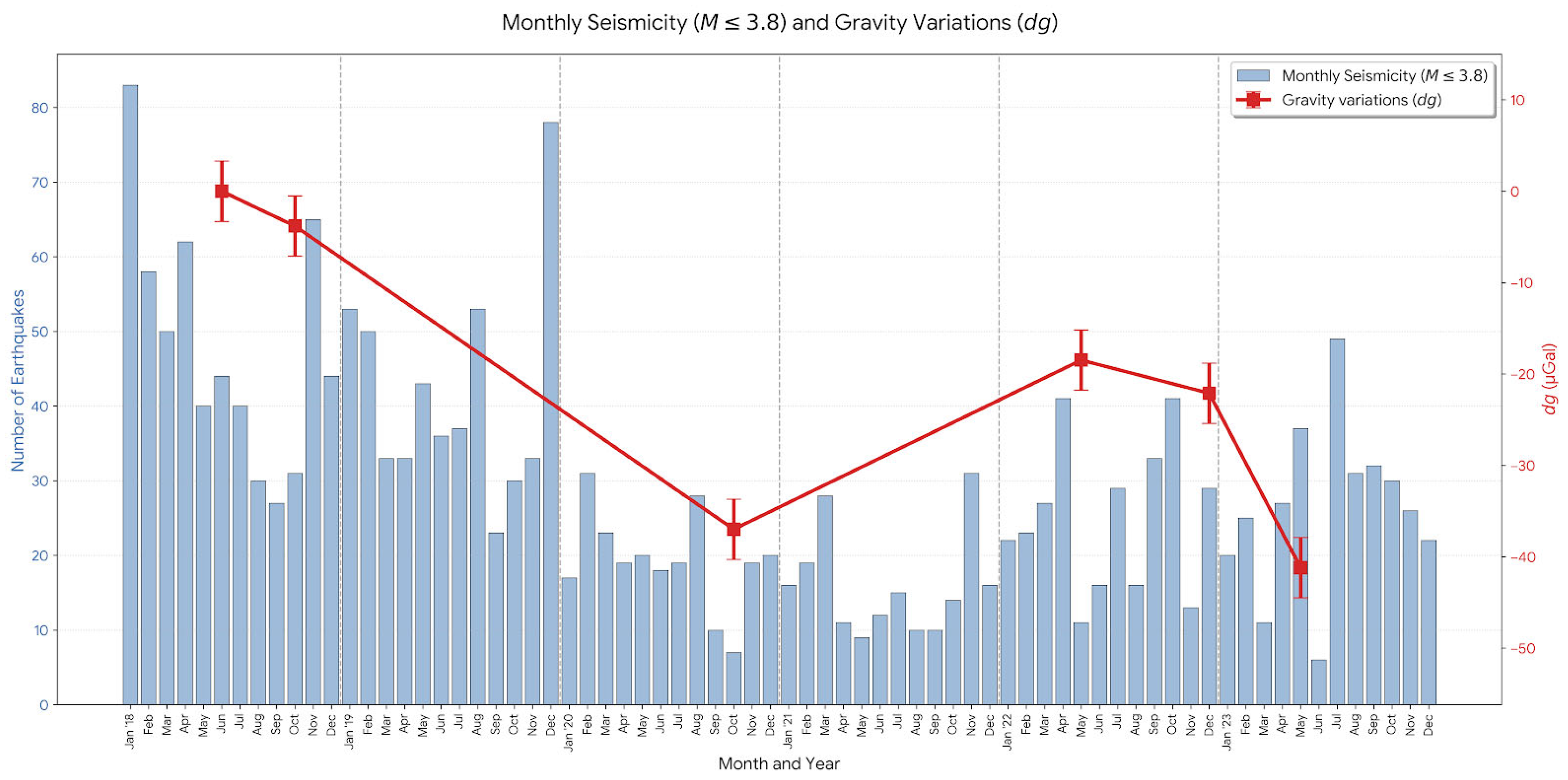
Therefore, we hypothesize that the larger-than-expected gravity variations at AQUI might be partially related to localized porosity readjustments induced by the 2009 and 2016–2017 earthquakes and long-lasting aftershock sequences (Figure 10, [31]). In seismic regions, pore pressure variations frequently modulate groundwater levels during the seismic cycle [63].
In the presence of deep karstic limestones, mass redistributions due to microfracture changes can occur without significant surface deformation [64], which could plausibly explain the observation of large gravity changes at AQUI without concomitant vertical deformation.
The absolute minimum in background seismicity observed in October 2020 corresponds to the local gravity minimum detected at AQUI during our surveys. In the fractured, karst-dominated Central Apennines, this direct correlation may be governed by crustal fluid dynamics: a significant reduction in deep groundwater mass (negative gravity anomaly) leads to a decrease in fault pore pressure. As observed by [65] in the Irpinia fault area and discussed in [66], this reduction increases the effective normal stress, temporarily clamping the fracture networks and bringing background micro-seismicity to an absolute minimum. This interpretation is supported by the fact that the measured gravity decrease at AQUI is significantly larger than what can be explained by surface hydrology alone, as only 39% of the signal is accounted for by local well variations.
However, without a detailed local physical model, this mechanism remains a working hypothesis that requires further hydrogeological investigation. The integration of absolute gravity data with PS-InSAR (which excluded vertical deformation as a cause) and hydrological models provides a robust framework to suggest that these anomalies reflect internal mass redistributions within the fractured karst system undergoing post-seismic activity.

5. Conclusions

This study presents a multi-source framework—integrating ground-based absolute gravimetry, PS-InSAR deformation monitoring, and regional hydrological models (GLDAS, GRACE-FO)—to disentangle tectonic from hydrological mass redistributions in the complex environment of Central Italy. Rather than merely observing gravity variations, we show that significant gravity decreases measured between 2018 and 2023 (up to −37 µGal at AQUI, and −15 to −20 µGal at POPL, SARO, and TERN) are likely almost entirely driven by subsurface mass redistributions. Indeed, PS-InSAR time series constrained vertical ground displacements to within ±3 mm (producing negligible gravity effects < 1 µGal), effectively ruling out vertical deformation as the dominant driver of the observed gravity changes. At a regional scale, satellite and model data revealed a coherent terrestrial water mass deficit of ~9 Gt between 2018 and autumn 2020. At POPL, SARO, and TERN, the timing and order of magnitude of gravity-derived TWS are broadly consistent with the regional TWS estimates. At these sites, gravity-derived TWS aligns with GLDAS and GRACE-FO models within our combined uncertainty budgets (~11 cm for gravity-derived TWS vs. 2–4 cm for regional models). However, ground-based measurements highlighted critical localized dynamics: while local groundwater levels accounted for 84% of the gravity signal at TERN, they explained only 15% to 39% at other sites, confirming the complexity of localized aquifer responses compared to regional averages.
To properly contextualize these findings, several methodological limitations of this study must be systematically acknowledged. First, the temporal sparsity of our six absolute gravity campaigns inherently prevents the capture of high-frequency seasonal dynamics or transient climatic extremes, requiring reliance on continuous models to bridge the temporal gaps. Second, a severe spatial scale mismatch exists between point-scale gravimetry and the coarse resolution of satellite products. Third, converting absolute gravity into TWS required adopting a simplified infinite Bouguer slab approximation, which inevitably neglects local 3D variations in rock porosity and specific yield. Finally, the lack of perfectly co-located and temporally continuous well observations makes the rigorous separation of deep groundwater versus shallow soil moisture contributions physically and mathematically unfeasible using current local data.
Despite these limitations, the added value of our research emerges particularly when confronting local observations with regional models. At the AQUI station, gravity variations significantly exceeded regional predictions, with equivalent water height residuals ranging from −60 to +50 cm. In such seismically active and deeply karstified environments, our integrated approach provides complementary insights that are difficult to capture using regional satellite or hydrological models alone. We hypothesize that these large anomalies might reflect localized subsurface mass redistributions—such as post-seismic micro-fractures readjustments and pore pressure variations due to the occurrence of several aftershocks. These processes can occur without detectable vertical ground deformation (thus remaining unobserved by InSAR) and are likely confined at spatial scales that are too fine to be resolved by the coarse grids of GRACE-FO and GLDAS.
Ultimately, this study suggests that maintaining high-precision, ground-based absolute gravity networks remains a valuable asset in tectonically active karst regions. It offers an important observational tool to investigate deep, complex hydrogeological dynamics that typically fall below the spatial resolution limits of modern satellite remote sensing.

Author Contributions

F.R., F.G. and G.B. conceived and designed the research. F.G. and G.B. surveyed and processed the gravimetric data. F.R. managed InSAR analysis. F.P. and F.R. analysed and processed hydrological data and models. Funding acquisition: F.R., F.G. and G.B. All authors have read and agreed to the published version of the manuscript.

Funding

This research has been developed within three projects, “Ricerca Libera” 2018, 2019 and 2021, funded by INGV, and entitled, respectively, “Feasibility of an absolute gravity network in central Italy: toward a multi-disciplinary approach to natural risk assessment”, D.P. 453/2017 (Prot. N. 14830) (proponents, F.G., F.R. and G.B.; principal responsibility, G.B.); “Consolidation and development of an absolute gravity and GNSS network in central Italy to improve the multi-disciplinary approach to natural risks assessment”, D.P. 53/2020 (Prot. N. 3876) (proponents, F.G., F.R. and G.B.; principal responsibility, F.G.); and “Absolute Gravity And Vertical Estimation with the joint use of quantum and ballistic absolute gravimeters and GNSS measurements to approach a multi-disciplinary study of natural risks in Central Italy—AGAVE”, D.P. n. 214/2021 (proponents, F.R., F.G., and G.B.; principal responsibility, F.R.).

Data Availability Statement

Data presented in this study are available on request from the corresponding author.

Acknowledgments

We wish acknowledge the editors and three anonymous reviewers for their constructive suggestions. The authors are very grateful to Alfio Amantia, Angelo Massucci, Luca Mirabella, Luca Samperi, Danilo Contrafatto and Giuseppe Ricciardi for their valuable support in the field surveys. The GRACE-FO land model is available at http://grace.jpl.nasa.gov (24 April 2026), supported by the NASA MEaSUREs Program, Data Portal: https://ccar.colorado.edu/grace/ (24 April 2026) National Centers for Environmental information, Climate at a Glance: Global Time Series, published November 2024, retrieved on 10 December 2024 from https://www.ncei.noaa.gov/access/monitoring/climate-at-a-glance/global/time-series (24 April 2026). We wish to thank ARTA Abruzzo (https://www.artaabruzzo.it/acque-sotterranee.php), ARPA Umbria (https://apps.arpa.umbria.it/acqua/contenuto/Livelli-Di-Falda) and ARPA Lazio (https://sira.arpalazio.it/corpi-idrici-e-reti-di-monitoraggio (24 April 2026)) for the freely available hydrological database of the Abruzzo, Umbria and Lazio Regions. We thank Gabriele Curci (CETEMPS, L’Aquila) for the daily rainfall data of L’Aquila and Popoli stations. The English text of this manuscript was reviewed and refined using AI. The Graphical Abstract and Figure 10 were generated with the help of Gemini 3 Flash (Web version, April 2026).

Conflicts of Interest

The authors declare no conflicts of interest.

References

  1. Berrino, G. Gravity changes induced by height-mass variations at the Campi Flegrei caldera. J. Volcanol. Geotherm. Res. 1994, 61, 293–309. [Google Scholar] [CrossRef]
  2. Carbone, D.; Cannavò, F.; Montagna, C.P.; Greco, F. Gas buffering of magma chamber contraction during persistent explosive activity at Mt. Etna volcano. Commun. Earth Environ. 2023, 4, 471. [Google Scholar] [CrossRef]
  3. Berrino, G. Absolute gravimetry and gradiometry on active volcanoes of Southern Italy. Boll. Geofis. Teor. Appl. 1995, 37, 131–144. [Google Scholar]
  4. Berrino, G. Combined gravimetry in the observation of volcanic processes in Southern Italy. J. Geodyn. 2000, 30, 371–388. [Google Scholar] [CrossRef]
  5. Greco, F.; Currenti, G.; D’Agostino, G.; Germak, A.; Napoli, R.; Pistorio, A.; Del Negro, C. Combining relative and absolute gravity measurements to enhance volcano monitoring at Mt Etna (Italy). Bull. Volcanol. 2012, 74, 1745–1756. [Google Scholar] [CrossRef]
  6. Greco, F.; Riguzzi, F.; Berrino, G. Insights into Seismogenetic Areas in Central Italy from Combined Absolute Gravity and GNSS Measurements. Remote Sens. 2021, 13, 4649. [Google Scholar] [CrossRef]
  7. Greco, F.; Berrino, G.; Riguzzi, F.; Amantia, A.; Massucci, A.; Ricciardi, G. The first combined absolute gravity and GNSS network in Central Italy. Quad. Geofis. 2021, 167, 126. [Google Scholar]
  8. Berrino, G.; Ricciardi, G. Repeated absolute gravity measurements on a dense network at Campi Flegrei—A reliable tool for volcano monitoring. Adv. Geosci. 2020, 52, 41–54. [Google Scholar] [CrossRef]
  9. Zerbini, S.; Richter, B.; Rocca, F.; van Dam, T.; Matonti, F. A combination of space and terrestrial geodetic techniques to monitor land subsidence: Case study, the southeastern Po plain, Italy. J. Geophys. Res. 2007, 112, B05401. [Google Scholar] [CrossRef]
  10. Van Camp, M.; de Viron, O.; Watlet, A.; Meurers, B.; Francis, O.; Caudron, C. Geophysics from terrestrial time-variable gravity measurements. Rev. Geophys. 2017, 55, 938. [Google Scholar] [CrossRef]
  11. Lambert, A.; Baumont, C. Nano Variations in Gravity Due to Seasonal Groundwater Movements: Implications for the Gravitational Detection of Tectonic Movements. J. Geophys. Res. 1977, 82, 297–306. [Google Scholar] [CrossRef]
  12. Kennedy, J.R. Changes in Earth’s Gravity Reveal Changes in Groundwater Storage: U.S. Geological Survey Fact Sheet 2018–3032; US Geological Survey: Reston, VA, USA, 2018. [CrossRef]
  13. Leirião, S.; Xin, H.; Christiansen, L.; Andersen, O.B.; Bauer-Gottwein, P. Calculation of the temporal gravity variation from spatially variable water storage change in soils and aquifers. J. Hydrol. 2009, 365, 302–309. [Google Scholar] [CrossRef]
  14. Christiansen, L.; Binning, P.J.; Rosbjerg, D.; Andersen, O.B.; Bauer-Gottwein, P. Using time-lapse gravity for groundwater model calibration: An application to alluvial aquifer storage. Water Resour. Res. 2011, 47, W06503. [Google Scholar] [CrossRef]
  15. Smith, A.B.; Walker, J.P.; Western, A.W.; Ellet, K.M. Using ground-based gravity measurements to monitor changes in terrestrial water storage. In Proceedings of the Engineers Australia 29th Hydrology and Water Resource Symposium, Canberra, Australia, 21–23 February 2005. [Google Scholar]
  16. Chen, K.H.; Hwang, C.; Chang, L.C.; Tsai, J.P.; Yeh, T.C.J.; Cheng, C.C.; Ke, C.; Feng, W. Measuring aquifer specific yields with absolute gravimetry: Result in the Choushui River Alluvial Fan and Mingchu Basin, central Taiwan. Water Resour. Res. 2020, 56, e2020WR027261. [Google Scholar] [CrossRef]
  17. Devoti, R.; Riguzzi, F.; Cinti, F.R.; Ventura, G. Long-term strain oscillations related to the hydrological interaction between aquifers in intra-mountain basins: A case study from Apennines Chain (Italy). Earth Planet. Sci. Lett. 2018, 501, 1–12. [Google Scholar] [CrossRef]
  18. Silverii, F.; D’Agostino, N.; Borsa, A.A.; Calcaterra, S.; Gambino, P.; Giuliani, R.; Mattone, M. Transient crustal deformation from karst aquifers hydrology in the Apennines (Italy). Earth Planet. Sci. Lett. 2019, 506, 23–37. [Google Scholar] [CrossRef]
  19. Pintori, F.; Sparacino, F.; Riguzzi, F. Hydrology Drives Crustal Deformation and Modulates Seismicity in the Matese Massif (Italy). Seismol. Res. Lett. 2024, 95, 1899–1912. [Google Scholar] [CrossRef]
  20. Pintori, F.; Serpelloni, E. Drought-induced vertical displacements and water loss in the Po river basin (Northern Italy) from GNSS measurements. Earth Space Sci. 2024, 11, e2023EA003326. [Google Scholar] [CrossRef]
  21. Crosetto, M.; Solari, L.; Mróz, M.; Balasis-Levinsen, J.; Casagli, N.; Frei, M.; Oyen, A.; Moldestad, D.A.; Bateson, L.; Guerrieri, L.; et al. The evolution of wide-area DinSAR: From regional and national services to the European ground motion service. Remote Sens. 2020, 12, 2043. [Google Scholar] [CrossRef]
  22. Tapley, B.D.; Watkins, M.M.; Flechtner, F.; Reigber, C.; Bettadpur, S.; Rodell, M.; Sasgen, I.; Famiglietti, J.S.; Landerer, F.W.; Chambers, D.P.; et al. Contributions of GRACE to understanding climate change. Nat. Clim. Change 2019, 9, 358–369. [Google Scholar] [CrossRef] [PubMed]
  23. Rodell, M.; Famiglietti, J.S.; Wiese, D.N.; Reager, J.T.; Beaudoing, H.K.; Landerer, F.W.; Lo, M.-H. Emerging trends in global freshwater availability. Nature 2018, 557, 651–659. [Google Scholar] [CrossRef] [PubMed]
  24. Jacob, T.; Bayer, R.; Chery, J.; Jourde, H.; Le Moigne, N.; Boy, J.-P.; Hinderer, J.; Luck, B.; Brunet, P. Absolute gravity monitoring of water storage variation in a karst aquifer on the Larzac plateau (Southern France). J. Hydrol. 2008, 359, 105–117. [Google Scholar] [CrossRef]
  25. Vishwakarma, B.D.; Devaraju, B.; Sneeuw, N. What is the spatial resolution of GRACE satellite products for hydrology? Remote Sens. 2018, 10, 852. [Google Scholar] [CrossRef]
  26. Mouyen, M.; Steer, P.; Chang, K.-J.; Le Moigne, N.; Hwang, C.; Hsieh, W.-C.; Jeandet, L.; Longuevergne, L.; Cheng, C.-C.; Boy, J.-P.; et al. Quantifying sediment mass redistribution from joint time-lapse gravimetry and photogrammetry surveys. Earth Surf. Dyn. 2020, 8, 555–571. [Google Scholar] [CrossRef]
  27. Pivetta, T.; Braitenberg, C.; Gabrovšek, F.; Gabriel, G.; Meurers, B. Gravity as a tool to improve the hydrologic mass budget in karstic areas. Hydrol. Earth Syst. Sci. 2021, 25, 6001–6021. [Google Scholar] [CrossRef]
  28. Devoti, R.; Riguzzi, F. The velocity field of the Italian area. Rend. Fis. Acc. Lincei Sci. Fis. Nat. 2018, 29, 51. [Google Scholar] [CrossRef]
  29. Riguzzi, F.; Tan, H.; Shen, C. Surface volume and gravity changes due to significant earthquakes occurred in central Italy from 2009 to 2016. Int. J. Earth Sci. 2019, 108, 2047–2056. [Google Scholar] [CrossRef]
  30. Mandler, E.; Pintori, F.; Gualandi, A.; Anderlini, L.; Serpelloni, E.; Belardinelli, M.E. Post-seismic deformation related to the 2016 Central Italy seismic sequence from GPS displacement time-series. J. Geophys. Res. Solid Earth 2021, 126, e2021JB022200. [Google Scholar] [CrossRef]
  31. ISIDe Working Group. Italian Seismological Instrumental and Parametric Data-Base (ISIDe); Istituto Nazionale di Geofisica e Vulcanologia (INGV): Roma, Italy, 2007. [Google Scholar] [CrossRef]
  32. Cosentino, D.; Cipollari, P.; Marsili, P.; Scrocca, D. Geology of the Central Apennines: A regional review. J. Virt. Explor. 2010, 36, 12. [Google Scholar] [CrossRef]
  33. Bertini, T.; Totani, G.; Cugusi, F.; Faraoni, A. Caratterizzazione Geologica e Geotecnica dei Sedimenti Quaternari del Settore Occidentale della Conca Aquilana; Pubblicazione DISAT, Università dell’Aquila: L’Aquila, Italy, 1992. [Google Scholar]
  34. Regione Abruzzo; Protezione Civile. Microzonazione Sismica del Comune di Popoli (PE)—Livello 1 e 3; Relazione Illustrativa e Carta Geologico-Tecnica, L’Aquila, Italy, 2012/2013; Regione Abruzzo: L’Aquila, Italy; Protezione Civile: Roma, Italy, 2013.
  35. Martinis, B. Un elemento tettonico particolare dei Monti Cornicolani (Lazio Centrale). Rend. Fis. Acc. Lincei 1991, 2, 253–260. [Google Scholar] [CrossRef]
  36. Caramanna, G.; Argentieri, A.; Buonfiglio, V. The “Pozzo del Merro” drowned sinkhole: 20 years of exploration and study. Ital. J. Groundw. 2022, 11, 73–78. [Google Scholar] [CrossRef]
  37. Barchi, M.R.; Alvarez, W.; Shimabukuro, D.H. The Umbria-Marche Apennines as a double Orogen: Observations and hypotheses. Ital. J. Geosci. 2012, 131, 258–271. [Google Scholar] [CrossRef]
  38. Fazzini, P.; Maffei, M. Appunti di geologia e geomorfologia della Conca Ternana. In Terni—Interamna Nahars: Nascità e Sviluppo di una Città alla Luce delle più Recenti Ricerche Archeologiche; Atti della giornata di studi, Roma, 18 December 2002; Publications de l’École française de Rome, 362; École Française de Rome: Rome, Italy, 2006; pp. 57–62. [Google Scholar]
  39. Boscherini, A.; Checcucci, R.; Natale, G.; Natali, N. Carta idrogeologica della Regione Umbria a scala 1:100.000. G. Geol. Appl. 2005, 2, 399–404. [Google Scholar] [CrossRef]
  40. Petrella, E.; Celico, P. Mixing of Water in a Carbonate Aquifer, Southern Italy, Analysed Through Stable Isotope Investigations. Int. J. Speleol. 2013, 42, 25–33. [Google Scholar] [CrossRef]
  41. Di Matteo, L.; Dragoni, W.; Maccari, D.; Piacentini, S.M. Climate change, water supply and environmental problems of headwaters: The paradigmatic case of the Tiber, Savio and Marecchia rivers (Central Italy). Sci. Total Environ. 2017, 598, 733–748. [Google Scholar] [CrossRef] [PubMed]
  42. Capelli, G.; Cosentino, D.; Messina, P.; Raffi, R.; Ventura, G. Modalità di ricarica e assetto strutturale dell’acquifero delle sorgenti Capore–S. Angelo (Monti Lucretili–Sabina Meridionale) (Recharge and structural setting of the Capore–S. Angeolo springs’ reservoir—Lucretili Mt.s–South Sabina). Geol. Romana 1987, 26, 419–447. [Google Scholar]
  43. Facello, F.; Germak, A.; Prato, A.; Greco, F.; Samperi, L.; Contrafatto, D.; Berrino, G.; Riguzzi, F.; Barzaghi, R.; Mazzoni, A. Metrological traceability for the absolute gravity Italian network. Meas. Sens. 2025, 38, 101389. [Google Scholar] [CrossRef]
  44. Greco, F.; Biolcati, E.; Pistorio, A.; D’Agostino, G.; Germak, A.; Origlia, C.; Del Negro, C. Absolute gravity measurements at three sites characterized by different environmental conditions using two portable ballistic gravimeters. Eur. Phys. J. Plus 2015, 130, 38. [Google Scholar] [CrossRef]
  45. Jiang, Z.; Pálinkáš, V.; Arias, F.E.; Liard, J.; Merlet, S.; Wilmes, H.; Vitushkin, L.; Robertsson, L.; Tisserand, L.; dos Santos, F.P.; et al. The 8th International Comparison of Absolute Gravimeters 2009: The first Key Comparison (CCM.G-K1) in the field of absolute gravimetry. Metrologia 2012, 49, 666–684. [Google Scholar] [CrossRef]
  46. Newell, D.B.; VanWestrum, D.; Francis, O.; Kanney, J.; Liard, J.; Ramirez, A.E.; Lucero, B.; Ellis, B.; Greco, F.; Pistorio, A.; et al. Regional comparison of absolute gravimeters SIM.M.G-K1 key comparison. Metrologia 2017, 54, 07019. [Google Scholar] [CrossRef]
  47. Pálinkáš, V.; Francis, O.; Val’Ko, M.; Kostelecký, J.; Van Camp, M.; Castelein, S.; Bilker-Koivula, M.; Näränen, J.; Lothhammer, A.; Falk, R.; et al. Regional comparison of absolute gravimeters, EURAMET.M.G-K2 key comparison. Metrologia 2017, 54, 07012. [Google Scholar] [CrossRef]
  48. Falk, R.; Pálinkáš, V.; Wziontek, H.; Rülke, A.; Val’Ko, M.; Ullrich, C.; Butta, H.; Kostelecký, J.; Bilker-Koivula, M.; Näränen, J.; et al. Final report of EURAMET.M.G-K3 regional comparison of absolute gravimeters. Metrologia 2020, 57, 07019. [Google Scholar] [CrossRef]
  49. International Association of Geodesy (IAG). Resolution No. 9: Atmospheric Pressure Correction. In Proceedings of the XVIII General Assembly of the IAG, Hamburg, Germany, 15–27 August 1983. [Google Scholar]
  50. SNPA (Sistema Nazionale per la Protezione dell’Ambiente). Il Clima in Italia nel 2022; Report SNPA; SNPA: Rome, Italy, 2023; Volume 36. [Google Scholar]
  51. Crosetto, M.; Monserrat, O.; Cuevas-González, M.; Devanthéry, N.; Crippa, B. Persistent Scatterer Interferometry: A review. ISPRS J. Photogramm. Remote Sens. 2016, 115, 78–89. [Google Scholar] [CrossRef]
  52. Hu, Z.; Chen, J.; Li, Z.; Liu, J. Seasonal land deformation induced by groundwater fluctuations in the North China Plain revealed by InSAR observations. Remote Sens. Environ. 2018, 202, 756–768. [Google Scholar] [CrossRef]
  53. Wdowinski, S.; Amelung, F.; Miralles-Wilhelm, F.; Dixon, T.H.; Carande, R. Space-based measurements of sheet-flow characteristics in the Everglades wetland, Florida. Geophys. Res. Lett. 2008, 35, L16403. [Google Scholar] [CrossRef]
  54. Fattahi, H.; Amelung, F. DEM error correction in InSAR time series. IEEE Trans. Geosci. Remote Sens. 2013, 51, 4249–4259. [Google Scholar] [CrossRef]
  55. Gleeson, T.; Wagener, T.; Döll, P.; Zipper, S.C.; West, C.; Wada, Y.; Taylor, R.; Scanlon, B.; Rosolem, R.; Rahman, S.; et al. GMD perspective: The quest to improve the evaluation of groundwater representation in continental- to global-scale models. Geosci. Model Dev. 2021, 14, 7545–7571. [Google Scholar] [CrossRef]
  56. Rodell, M.; Houser, P.R.; Jambor, U.; Gottschalck, J.; Mitchell, K.; Meng, C.-J.; Arsenault, K.; Cosgrove, B.; Radakovich, J.; Bosilovich, M.; et al. The Global Land Data Assimilation System. Bull. Am. Meteorol. Soc. 2004, 85, 381–394. [Google Scholar] [CrossRef]
  57. Landerer, F.W.; Flechtner, F.M.; Save, H.; Webb, F.H.; Bandikova, T.; Bertiger, W.I.; Bettadpur, S.V.; Byun, S.H.; Dahle, C.; Dobslaw, H.; et al. Extending the global mass change data record: GRACE Follow-On instrument science data performance. Geophys. Res. Lett. 2020, 47, e2020GL088306. [Google Scholar] [CrossRef]
  58. Dahle, C.; Flechtner, F.; Murböck, M.; Michalak, G.; Neumayer, K.H.; Abrykosov, O.; Reinhold, A.; König, R. GRACE-FO Geopotential GSM Coefficients GFZ RL06; GFZ Data Services: Potsdam, Germany, 2019. [Google Scholar] [CrossRef]
  59. Liu, S.; Yang, F.; Forootan, E. SAGEA: A toolbox for comprehensive error assessment of GRACE and GRACE-FO based mass changes. Comput. Geosci. 2025, 196, 105825. [Google Scholar] [CrossRef]
  60. WMO. WMO Field Intercomparison of Rainfall Intensity Gauges; TD-No. 1504; World Meteorological Organization: Geneva, Switzerland, 2009; 290p. [Google Scholar]
  61. Khorrami, B.; Arik, F.; Gunduz, O. Land deformation and sinkhole occurrence in response to the fluctuations of groundwater storage: An integrated assessment of GRACE gravity measurements, ICESat/ICESat-2 altimetry data, and hydrologic models. GISci. Remote Sens. 2021, 58, 1518–1542. [Google Scholar] [CrossRef]
  62. Ali, S.; Khorrami, B.; Jehanzaib, M.; Tariq, A.; Ajmal, M.; Arshad, A.; Shafeeque, M.; Dilawar, A.; Basit, I.; Zhang, L.; et al. Spatial Downscaling of GRACE Data Based on XGBoost Model for Improved Understanding of Hydrological Droughts in the Indus Basin Irrigation System (IBIS). Remote Sens. 2023, 15, 873. [Google Scholar] [CrossRef]
  63. Sciortino, A.; Guerriero, V.; Marini, R.; Spadi, M.; Mazzanti, P.; Tallini, M. Geological and hydrogeological drivers of seismic deformation in L’Aquila, Italy: Insights from InSAR analysis. Geomat. Nat. Hazards Risk 2024, 15, 2362395. [Google Scholar] [CrossRef]
  64. Hartmann, A.; Goldscheider, N.; Wagener, T.; Lange, J.; Weiler, M. Karst water resources in a changing world: Review of hydrological modelling approaches. Rev. Geophys. 2014, 52, 218–242. [Google Scholar] [CrossRef]
  65. Tarantino, S.; Poli, P.; D’Agostino, N.; Vassallo, M.; Festa, G.; Ventafridda, G.; Zollo, A. Non-linear elasticity, earthquake triggering and seasonal hydrological forcing along the Irpinia fault, Southern Italy. Nat. Commun. 2024, 15, 9821. [Google Scholar] [CrossRef] [PubMed]
  66. Doglioni, C.; Barba, S.; Carminati, E.; Riguzzi, F. Fault on-off versus coseismic fluids reaction. Geosci. Front. 2014, 5, 767–780. [Google Scholar] [CrossRef]
Figure 1. Sketch map of Central Italy showing the absolute gravity network (red triangles), measured six times in 2018, 2019, 2020, 2022, and 2023. Black crosses indicate terrestrial water storage (TWS) extracted from the grid cells of Global Land Data Assimilation System (GLDAS) (Section 2.3.1). The orange pentagonal line corresponds to the Rome urban area. The dotted line indicates the water divide. The main rivers and lakes are also reported as blue lines and areas respectively.
Remotesensing 18 01377 g001
Figure 2. Absolute gravity changes at each station relative to the initial survey conducted in 2018. Error bars represent combined uncertainties.
Remotesensing 18 01377 g002
Figure 3. Detrended vertical displacements derived from Sentinel-1 PS near each absolute gravity station. The vertical motion remains within ±3 mm.
Remotesensing 18 01377 g003
Figure 4. (a): TWS variations from GLDAS grid cells and GRACE-FO solutions (JPL, CSR, and GFZ) at the absolute gravity stations. (b): Monthly JPL GRACE-FO water mass variations for the Central Italy pixel (~254 × 254 km2), indicating a pixel-averaged water mass deficit of ~9 Gt between 2018 and autumn 2020. Vertical red bars indicate the absolute gravity survey epochs. While the first three surveys capture the decreasing trend, the maximum water deficit, which occurred in autumn 2022, was not sampled by any gravimetric observations.
Remotesensing 18 01377 g004
Figure 5. Monthly precipitation from CDR at the absolute gravimetry stations (blue) compared with rain gauge data at L’Aquila and Popoli (light blue). Absolute gravity variations relative to the first survey epoch are superimposed for comparison.
Remotesensing 18 01377 g005
Figure 6. Normalized variations in water levels from wells AVA11, MR11, and P14, alongside Aniene River flow rates. The data show both seasonal fluctuations and a long-term trend consistent with gravity variations (black dots highlight the observed deviations).
Remotesensing 18 01377 g006
Figure 7. Comparison between TWS variations derived from absolute gravity changes (converted to equivalent water height; black dots) and TWS estimates from the GLDAS model at the four gravity stations (red lines). GLDAS values corresponding to the gravity survey epochs are highlighted as red dots. For the SARO station, gravity-derived TWS is qualitatively compared with the Aniene River flow rate.
Remotesensing 18 01377 g007
Figure 8. Comparison between TWS variations derived from absolute gravity changes and TWS estimates from GRACE-FO solutions (JPL, CSR, GFZ) at the four gravity stations. Markers indicate the TWS values corresponding to the absolute gravity survey epochs.
Remotesensing 18 01377 g008
Figure 9. Deviations between gravity-derived TWS variations and estimates from GLDAS and GRACE-FO, averaged across the survey epochs for each station. The larger deviations observed at AQUI indicate the presence of local hydrological processes not captured by regional-scale models.
Remotesensing 18 01377 g009
Figure 10. Monthly seismic activity (M ≤ 3.8) recorded in the L’Aquila area compared with absolute gravity changes relative to the first epoch at AQUI (red points).
Remotesensing 18 01377 g010
Table 1. Absolute gravity survey at AQUIg (FG5#238).
Date
Time UTC [from ÷ to]
P (hPa)
Effective Height of Measure
(m)
Number of Sets/Drops Per Set/Total Dropsg at Effective Height
(µGal)
13–14 June 2018
13:54 ÷ 05:54
931.9
1.21415/100/1500980,203,167.35 ± 3.3
3–4 October 2018
14:46 ÷ 05:46
945.2
1.21616/100/1600980,203,163.54 ± 3.3
6–7 October 2020
11:11 ÷ 05:32
940.6
1.21818/100/1800980,203,130.35 ± 3.3
5–6 May 2022
13:39 ÷ 06:39
937.6
1.21918/100/1800980,203,148.87 ± 3.3
1–2 December 2022
14:54 ÷ 06:54
937.6
1.21717/100/1700980,203,145.24 ± 3.3
24–25 May 2023
11:32 ÷ 05:44
937.6
FG5#238
1.213
19/100/1900980,203,126.16 ± 3.3
Table 2. Absolute gravity survey at POPL (FG5#238).
Date
Time UTC [from ÷ to]
P (hPa)
Effective Height of Measure
(m)
Number of Sets/Drops Per Set/Total Dropsg at Effective Height
(µGal)
12–13 June 2018
14:25 ÷ 06:25
978.7
1.21717/100/1700980,265,036.80 ± 3.3
2–3 October 2018
12:01 ÷ 05:33
989.8
1.21719/100/1900980,265,034.57 ± 3.3
5–6 October 2020
11:48 ÷ 07:35
985.6
1.21921/100/2100980,265,019.35 ± 3.3
7–8 May 2022
10:23 ÷ 06:29
984.2
1.22321/100/2100980,265,031.16 ± 3.3
3–4 December 2022
12:22 ÷ 06:59
984.2
1.21620/100/2000980,265,031.94 ± 3.3
23–24 May 2023
16:02 ÷ 07:04
984.2
1.21016/100/1600980,265,029.95 ± 3.3
Table 3. Absolute gravity survey at SARO (FG5#238).
Date
Time UTC [from ÷ to]
P (hPa)
Effective Height of Measure
(m)
Number of Sets/Drops Per Set/Total Dropsg at Effective Height
(µGal)
11–12 June 2018
17:21 ÷ 06:21
964.6
1.21814/100/1400980,285,604.58 ± 3.3
1–2 October 2018
14:46 ÷ 06:15
962.5
1.21517/100/1700980,285,595.57 ± 3.3
4–5 October 2020
16:38 ÷ 06:34
963.6
1.21715/100/1500980,285,590.16 ± 3.3
09–10 May 2022
18:09 ÷ 06:03
966.3
1.21910/100/1000980,285,599.47 ± 3.3
2–3 December 2022
11:45 ÷ 06:41
966.3
1.21520/100/2000980,285,589.73 ± 3.3
24–25 May 2023
10:43 ÷ 06:15
966.3
1.21221/100/2100980,285,596.63 ± 3.3
Table 4. Absolute gravity survey at TERN (FG5#238).
Date
Time UTC [from ÷ to]
P (hPa)
Effective Height of Measure
(m)
Number of Sets/Drops Per Set/Total Dropsg at Effective Height
(µGal)
14–15 June 2018
12:07 ÷ 06:51
991.1
1.2169/100/900980,380,705.08 ± 3.3
4–5 October 2018
10:34 ÷ 06:24
1004.9
1.2217/100/700980,380,695.08 ± 3.3
7–8 October 2020
13:06 ÷ 06:15
1000.4
1.21619/100/1900980,380,688.99 ± 3.3
6–7 May 2022
16:14 ÷ 06:14
998.1
1.21713/100/1300980,380,702.34 ± 3.3
25–26 May 2023
09:59 ÷ 05:48
998.1
1.21322/100/2200980,380,700.77 ± 3.3
Table 5. Summary of the datasets used in this study, including spatial support, temporal sampling, main uncertainty metric, and role in the interpretation framework.
DatasetSpatial ResolutionTemporal SamplingUncertainty MetricRole in This Study
Absolute GravityPoint-scale6 field campaigns (planned at ~1–2 per year, with unavoidable gaps due to COVID-19 travel restrictions)~3.3 µGal (~11 cm for the gravity-derived Equivalent Water Height)Highly effective in tracking local shallow groundwater storage variations and detecting long-term subsurface mass redistributions
PS-InSAR (Sentinel-1)100 m resampled grid6 daysEpoch position 2–5 mm
Velocity field < 2 mm/yr
Particularly effective for mapping vertical ground motion, allowing exclusion of vertical deformations as the cause of gravity changes
GLDAS0.25° × 0.25° grid cellsDaily20–40 mmEvaluates terrestrial water storage integrating multiple components, providing an intermediate spatial scale capable of capturing local variations better than satellite gravimetry
GRACE-FOCoarse, ~254 × 254 km2 for the Central Italy pixelMonthlyUp to 40 mmProvides a regional-to-global baseline quantification of total water storage anomalies and large-scale aquifer depletion
Table 6. Expected and measured gravity changes due to water level variations.
SitePorositydh Water
(m)
dg Exp
(µGal)
dg Meas
(µGal)
dg Res
(µGal)
% of Water Influence
AQUI0.3−1.14−14.4−37.0−22.639
POPL0.3−0.21−2.6−17.5−14.915
SARO0.2--−14.4--
TERN0.3−1.08−13.6−16.1−2.584
SARO is excluded from this quantitative comparison because well data are unavailable with only the Aniene river flow rate being recorded.
Disclaimer/Publisher’s Note: The statements, opinions and data contained in all publications are solely those of the individual author(s) and contributor(s) and not of MDPI and/or the editor(s). MDPI and/or the editor(s) disclaim responsibility for any injury to people or property resulting from any ideas, methods, instructions or products referred to in the content.