Nutrient and Dissolved Oxygen (DO) Estimation Using Remote Sensing Techniques: A Literature Review


 ,
, 
 and
and 
Highlights
- There are two main model categories for predicting nutrient and DO concentration: empirical and artificial intelligence (AI). Model accuracy is strongly influenced by the size of the training dataset. Comparative studies conducted in the same study area have shown that ML and NNs achieve higher prediction accuracy than empirical models under the same sample size. However, the exact number of samples needed for either approach is not clearly provided in the literature. ML models (e.g., SVR, XGBoost) often outperform NNs when training data are limited, as they are generally less prone to overfitting under small-sample conditions.
- Current models are site-specific, and their transferability across different regions may be restricted. To improve their transferability, models should be validated across diverse regions and time periods, including a wide range of environmental conditions (e.g., trophic state, seasonality, depth and bottom characteristics).
- In Case II water bodies, eutrophication has emerged as a major water quality issue, calling for prompt management actions. Remote sensing facilitates its monitoring through changes in ocean color linked to chlorophyll a (chl a) fluctuations. While chl a indicates the effects of eutrophication, nutrient levels—its primary drivers—are key to predicting phytoplankton growth and implementing preventive measures.
- Long-term monitoring of nutrients and DO, combined with multiple water quality indicators (e.g., chl a) based on remotely sensed data, could enable more efficient assessment of the trophic state of water bodies and facilitate timely management actions.
Abstract
1. Introduction
2. Methodology
- (“nutrient”) AND (“remote sensing”) AND (“water quality”) AND (“empirical” OR “analytical” OR “semi-empirical” OR “artificial intelligence” OR “machine learning” OR “deep learning”) AND NOT (“total nitrogen” OR “TN” OR “total phosphorus” OR “TP” OR “urban” OR “land” OR “crop” OR “soil” OR “groundwater” OR “agriculture”);
- (“dissolved oxygen”) AND (“remote sensing”) AND (“water quality”) AND (“empirical” OR “analytical” OR “semi-empirical” OR “artificial intelligence” OR “machine learning” OR “deep learning”) AND NOT (“total nitrogen” OR “TN” OR “total phosphorus” OR “TP” OR “urban” OR “land” OR “crop” OR “soil” OR “groundwater” OR “agriculture”).
- Bibliographic details (authors and year of publication);
- Parameters retrieved (NH3, NH4+, AN, NO2−, NO3−, PO43−, SiO2, DIN, DIP or DO);
- Water type (coastal or inland; lake, river, reservoir, wetland, stream/stream network, lagoon or other);
- Location of the study area (country);
- Sensor (spaceborne, airborne, ground-based/multispectral or hyperspectral);
- Number of samples;
- Bands/band indices or equation;
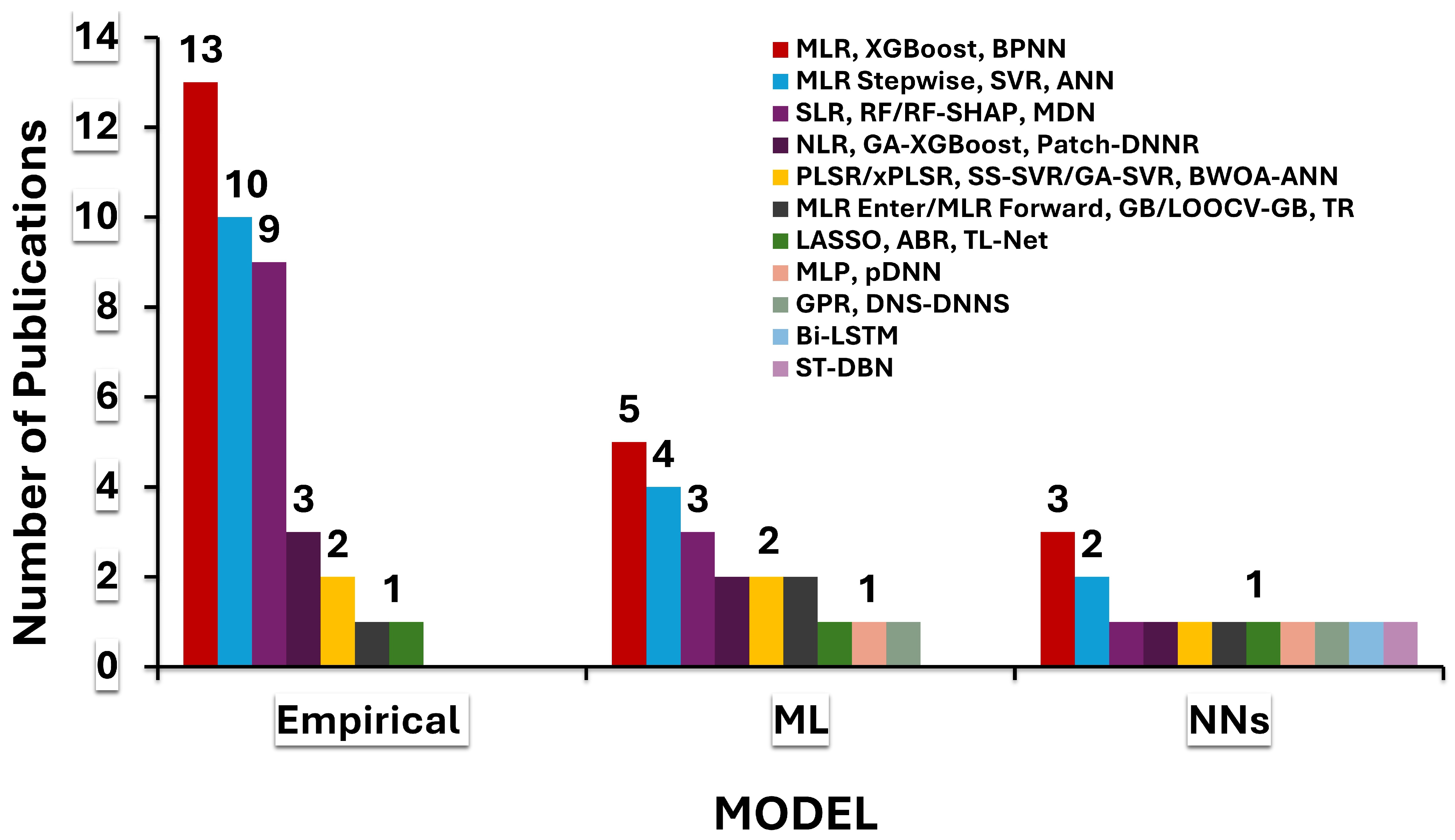
- Retrieval model (empirical, machine learning (ML) or neural networks (NNs));
- Validation metrics (e.g., coefficient of determination (R2), root mean square error (RMSE), mean absolute error (MAE), etc.).
3. Nutrients—The Primary “Drivers” of Eutrophication
3.1. Un-Ionized Ammonia (NH3), Ammonium (NH4+) and Ammoniacal Nitrogen (AN)
3.2. Nitrite (NO2−) and Nitrate (NO3−)
3.3. Phosphate (PO43−)
3.4. Silicate (SiO2)
3.5. Sources of Nutrient Enrichment
3.6. Impacts on Aquatic Environment
4. Water Quality Monitoring Using Remote Sensing
4.1. Light–Water Interaction
4.2. Optically Active and Inactive Constituents of Water
4.3. Remote Sensing Imagery
4.3.1. Optical Remote Sensing
4.3.2. Microwave Remote Sensing
4.4. Remotely Sensed WQP Retrieval Methods
4.4.1. Empirical Method
4.4.2. Analytical Method
4.4.3. Semi-Empirical Method
4.4.4. AI Method
ML
- Supervised learning;
- Unsupervised learning;
- Reinforcement learning.
NNs
5. Narrative Literature Synthesis
5.1. Types of Water Bodies
5.2. Remote Sensing Systems for the Retrieval of Nutrients and DO
5.3. Remote Sensing Methods for the Retrieval of Nutrients and DO
5.3.1. Empirical Models
5.3.2. ML Models
5.3.3. NN Models
- Pixel based-Deep Neural Network Regression (pixel-DNNR) [94];
- Patch based-Deep Neural Network Regression (patch-DNNR) [94];
- Binary Whale Optimization Algorithm-Artificial Neural Network (BWOA-ANN) [101];
- Deep learning model that integrates Transformer and LSTM Networks (TL-Net) [105];
- Fully Connected Neural Network (FCNN) [109];
- Recurrent Neural Network (RNN) [109];
- Long Short-Term Memory (LSTM) [105];
- Vanilla-Long Short-Term Memory (V-LSTM) [109];
- Stacked-Long Short-Term Memory (S-LSTM) [109];
- Bidirectional-Long Short-Term Memory (Bi-LSTM) [109];
- Convolutional-Long Short-Term Memory (Conv-LSTM) [109];
- Convolutional Neural Network-Long Short-Term Memory (CNN-LSTM) [109];
- Progressively decreasing Deep Neural Network (pDNN) [107];
- Dynamic Network Surgery-Deep Neural Network (DNS-DNNS) [108];
- Spatiotemporal-Deep Belief Network (ST-DBN) [113];
- Message Passing Neural Network (MPNN) [113];
- Generalized Regression Neural Network (GRNN) [113].
5.3.4. Comparative Analysis of Predictive Accuracy: Empirical, ML and NN Models
Empirical vs. ML Models
Empirical vs. NN Models
ML vs. NN Models
Empirical vs. ML vs. NN Models
5.4. Parameters That Influence the Accuracy of the Retrieval Models
6. Discussion and Conclusions
Supplementary Materials
Author Contributions
Funding
Conflicts of Interest
Abbreviations
| AAE | Average Absolute Error |
| ABR | Adaptive Boosting Regression |
| Acc. | Accuracy |
| AdaBoost | Adaptive Boosting |
| Adj. R2 | Adjusted R2 |
| AI | Artificial Intelligence |
| ANN | Artificial Neural Network |
| AOP | Apparent Optical Property |
| ARE | Absolute Relative Error |
| ASTER | Advanced Spaceborne Thermal Emission and Reflection Radiometer |
| Bi-LSTM | Bidirectional-Long Short-Term Memory |
| BGT | Brightness index |
| BOD | Biochemical Oxygen Demand |
| BPNN | Backpropagation Neural Network |
| BR | Brazil |
| BR | Coastal/NIR of the Landsat 8 (OLI) |
| BWOA-ANN | Binary Whale Optimization Algorithm-Artificial Neural Network |
| CA | Canada |
| CatBoost | Categorical Boosting |
| Chl a | Chlorophyll |
| Chlam-1 | Chlorophyll a in One Month Prior |
| CDOM | Colored Dissolved Organic Matter |
| CMEMS | Copernicus Marine Environment Monitoring Service |
| CN | China |
| CNN | Convolutional Neural Network |
| CNN-LSTM | Convolutional Neural Network-Long Short-Term Memory |
| CO | Colombia |
| COD | Chemical Oxygen Demand |
| CODMn | Chemical Oxygen Demand using Permanganate |
| Conv-LSTM | Convolutional-Long Short-Term Memory |
| DBN | Deep Belief Network |
| DIN | Dissolved Inorganic Nitrogen |
| DIP | Dissolved Inorganic Phosphorus |
| DL | Deep Learning |
| DNN | Deep Neural Network |
| DNS-DNN | Dynamic Network Surgery-Deep Neural Network |
| DO | Dissolved Oxygen |
| DST | Disturbance index |
| EE | Estonia |
| EG | Egypt |
| ELM | Extreme Learning Machine |
| ENR | Elastic Net Regression |
| ETM+ | Enhanced Thematic Mapper Plus |
| ETR | Extra Trees Regression |
| EVI | Enhanced Vegetation Index |
| FCM-BC | Fuzzy C-Means Band Combination |
| FCNN | Fully Connected Neural Network |
| FPR | Fraction of Photosynthetically active radiation |
| GA | Genetic Algorithm |
| GA-SVR | Genetic Algorithm-Support Vector Regression |
| GA-XGBoost | Genetic Algorithm-Extreme Gradient Boosting |
| GB | Gradient Boosting |
| GBM | Gradient Boosting Machine |
| GIS | Geographic Information System |
| GOCI | Geostationary Ocean Color Imager |
| GPP | Gross Primary Productivity |
| GPR | Gaussian Process Regression |
| GR | Greece |
| GREON | Great Rivers Ecological Observation Network |
| GRN | Greenness index |
| GRNN | Generalized Regression Neural Network |
| GVF | Green Vegetation |
| H2S | Generating Hydrogen Sulfide |
| HJ | Huang Jing |
| IN | India |
| IOA | Index Of Agreement |
| IOP | Inherent Optical Property |
| IQ | Iraq |
| IRS LISS | Indian Remote Sensing Linear Imaging Self-Scanning Sensor |
| k-NNR | k-Nearest Neighbor Regression |
| KR | (South) Korea |
| LAI | Leaf Area Index |
| LASSO | Least Absolute Shrinkage and Selection Operator |
| LOOCV-GB | Combining Leave-One-Out Cross Validation with Gradient Boosting |
| LR | Linear Regression |
| LSTM | Long Short Term Memory |
| MA | Morocco |
| MAD | Mean Absolute Deviation |
| MAE | Mean Absolute Error |
| MAPE | Mean Absolute Percentage Error |
| MDN | Mixture Density Network |
| ML | Machine Learning |
| MLP | Multilayer Perceptron |
| MLR | Multiple Linear Regression |
| MNB | Mean Normalized Bias |
| MODIS | Moderate Resolution Imaging Spectroradiometer |
| MPNN | Message Passing Neural Network |
| MRE | Mean Relative Error |
| MSE | Mean Square Error |
| MSFD | Marine Strategy Framework Directive |
| MSI | Multi-Spectral Instrument |
| MWR | Microwave Radiometers |
| N | Nitrogen, Number of Samples |
| NA | Non-Available |
| NDV | Normalized Difference Vegetation index |
| NDVILP | Normalized Difference Water Index After Applying Low-Pass Filter |
| NDWI2 | (NIR − SWIR)/(NIR + SWIR) of Landsat 8 (OLI) |
| NH3 | Un-Ionized Ammonia |
| NH4+ | Ammonium |
| NIR | Near-Infrared |
| NLP | Natural Language Processing |
| NLR | Non-Linear Regression |
| NN | Neural Network |
| NO2− | Nitrite |
| NO3− | Nitrate |
| NPV | Non-Photosynthetic Vegetation |
| NRMSE | Normalized Root Mean Square Error |
| OACs | Optically Active Constituents |
| OCR | Ocean Color Radiometry |
| OHS | Orbita Hyperspectral Satellite |
| OLCI | Ocean and Land Colour Instrument |
| OLI | Operational Land Imager |
| P | Phosphorus |
| PC4 | Principal Component 4 |
| PC4_SR2 | Principal Component 4 of Surface Reflectance, Using Post DOS |
| PC5_SR1 | Principal Component 5 of Surface Reflectance, Using Post FLAASH |
| PCP | Ocean Physio-Chemical Properties |
| p-DNN | Progressively Decreasing Deep Neural Network |
| Patch-DNNR | Patch-Based-Deep Neural Network |
| PH | Philippines |
| pH | Potential of Hydrogen |
| pixel-DNNR | Pixel-Based-Deep Neural Network Regression |
| PK | Pakistan |
| PLSR | Partial Least Squares Regression |
| PO43− | Phosphate |
| PS | Palestine |
| R | Correlation Coefficient, Reflectance |
| R2 | Coefficient of Determination |
| Rrs | Remote Sensing Reflectance |
| RF | Random Forest |
| RF-SHAP | Random Forest-Shapley Additive Explanation |
| RMSE | Root Mean Square Error |
| RMSLE | Root Mean Squared Log-Error |
| RNN | Recurrent Neural Network |
| RPD | Residual Prediction Deviation |
| ROD | Rate of decrease |
| ROI | Rate of increase |
| RT | Regression Tree |
| RTOAB7 | Top Of Atmosphere Reflectance Band 7 |
| SA | Saudi Arabia |
| SAR | Synthetic Aperture Radar |
| SDD | Secchi Disk Depth |
| SE | Standard Error |
| SEE | Standard Estimated Error |
| SGS | Submarine Groundwater Seepage |
| Si | Silicon |
| Sig. | Significance |
| SiO2 | Silicate |
| SLR | Simple Linear Regression |
| S-LSTM | Stacked-Long Short-Term Memory |
| SOI | Soil |
| SPOT 5 | Satellite pour l’Observation de la Terre 5 |
| SR2B1 | Surface Reflectance Band 1 calibration Using Post-DOS |
| SSS | Sea Surface Salinity |
| SS-SVR | Semi-Supervised Support Vector Regression |
| SST | Sea Surface Temperature |
| SSTm-1 | Sea Surface Temperature in One Month Prior |
| ST-DBN | Spatiotemporal-Deep Belief Network |
| STI | Spatio-Temporal Information |
| ST-MLR | Spatiotemporal-Multiple Linear Regression |
| SVR | Support Vector Regression |
| SWIR | Short-Wave Infrared |
| TDS | Total Dissolved Solids |
| TIR | Thermal Infrared |
| TL-Net | Deep learning model that integrates Transformer and LSTM Networks |
| TM | Thematic Mapper |
| TN | Total Nitrogen |
| Tol. | Tolerance |
| TP | Total Phosphorus |
| TR | Turkey, Transformer |
| UAV | Unmanned Aerial Vehicle |
| UC-BC | Unclustered Band Combination |
| URB | Urban |
| USA | United States of America |
| UV | Ultraviolet |
| VIIRS | Visible Infrared Imaging Radiometer Suite |
| VIS | Visible |
| V-LSTM | Vanilla-Long Short-Term Memory |
| WET | Wetness index |
| WQP | Water Quality Parameter |
| WSN | Wireless Sensor Network |
| XGBoost | Extreme Gradient Boosting |
| xPLSR | Extended Partial Least Squares Regression |
| ZY3 | Ziyuan-3 |
Appendix A
Appendix A.1

| Multi-spectral | Satellite Sensor | Launch Date | Temporal Resolution (Days) | Spatial Resolution (m) | Spectral Resolution (nm) Band/Wavelength | Reference | ||
| Landsat 4, 5 (TM) | 1982, 1984 | 16 | 30 | B1 | 450–520 | Blue | [118,119] | |
| B2 | 520–600 | Green | ||||||
| B3 | 630–690 | Red | ||||||
| B4 | 760–900 | NIR | ||||||
| B5 | 1550–1750 | SWIR 1 | ||||||
| B7 | 2080–2350 | SWIR 2 | ||||||
| 120 | B6 | 10,410–12,500 | TIR | |||||
| Landsat 7 (ETM+) | 1999 | 16 | 15 | B8 | 520–900 | Pan | [120] | |
| 30 | B1 | 450–520 | Blue | |||||
| B2 | 520–600 | Green | ||||||
| B3 | 630–690 | Red | ||||||
| B4 | 770–900 | NIR | ||||||
| B5 | 1550–1750 | SWIR 1 | ||||||
| B7 | 2090–2350 | SWIR 2 | ||||||
| 60 | B6 | 10,400–12,500 | TIR | |||||
| IKONOS | 1999 | ~3 | 0.82 | NA | 526–929 | Pan | [121] | |
| 3.2 | B1 | 445–516 | Blue | |||||
| B2 | 506–595 | Green | ||||||
| B3 | 632–698 | Red | ||||||
| B4 | 757–853 | NIR | ||||||
| MODIS | 1999 | 1–2 | 250 | B1 | 620–670 | Red | [122] | |
| B2 | 841–876 | NIR | ||||||
| 500 | B3 | 459–479 | Blue | |||||
| B4 | 545–565 | Green | ||||||
| B5 | 1230–1250 | SWIR | ||||||
| B6 | 1628–1652 | |||||||
| B7 | 2105–2155 | |||||||
| 1000 | B8 | 405–420 | Violet | |||||
| B9 | 438–448 | Blue | ||||||
| B10 | 483–493 | Blue-Green | ||||||
| B11 | 526–536 | Green | ||||||
| B12 | 546–556 | |||||||
| B13 | 662–672 | Red | ||||||
| B14 | 673–683 | |||||||
| B15 | 743–753 | NIR | ||||||
| B16 | 862–877 | |||||||
| B17 | 890–920 | |||||||
| B18 | 931–941 | |||||||
| B19 | 915–965 | |||||||
| B26 | 1360–1390 | SWIR | ||||||
| B20-B36 | 3660–14,385 | TIR | ||||||
| SPOT 5 | 2002 | 2–3 | 2.5–5 | NA | 480–710 | Pan | [123] | |
| 10 | B1 | 500–590 | Green | |||||
| B2 | 610–680 | Red | ||||||
| B3 | 78–890 | NIR | ||||||
| 20 | NA | 1580–1750 | SWIR | |||||
| IRS LISS III | 2003 | 24 | 23.5 | B1 | 520–590 | Green | [124] | |
| B2 | 620–680 | Red | ||||||
| B3 | 770–860 | NIR | ||||||
| B4 | 1550–1700 | SWIR | ||||||
| ASTER | 2003 | 16 | 15 | B1 | 520–600 | VIS | [125] | |
| B2 | 630–690 | |||||||
| B3n | 760–860 | NIR | ||||||
| B3b | 760–860 | |||||||
| 30 | B4 | 1600–1700 | SWIR | |||||
| B5 | 2145–2185 | |||||||
| B6 | 2185–2225 | |||||||
| B7 | 2235–2285 | |||||||
| B8 | 2295–2365 | |||||||
| B9 | 2360–2430 | |||||||
| 90 | B10 | 8125–8475 | TIR | |||||
| B11 | 8475–8825 | |||||||
| B12 | 8925–9275 | |||||||
| B13 | 10,250–10,950 | |||||||
| B14 | 10,950–11,650 | TIR | ||||||
| HJ-1 | 2008 | 2–3 | 30 | B1 | 430–520 | Blue | [126] | |
| B2 | 520–600 | Green | ||||||
| B3 | 630–690 | Red | ||||||
| B4 | 760–900 | NIR | ||||||
| WorldView-2 | 2009 | 1.1 | 0.46 | NA | 450–800 | Pan | [127] | |
| 1.8 | B1 | 400–450 | Coastal Blue | |||||
| B2 | 450–510 | Blue | ||||||
| B3 | 510–580 | Green | ||||||
| B4 | 585–625 | Yellow | ||||||
| B5 | 630–690 | Red | ||||||
| B6 | 705–745 | Red Edge | ||||||
| Β7 | 770–895 | NIR 1 | ||||||
| Β8 | 860–1040 | NIR 2 | ||||||
| GOCI | 2010 | 1 | 500 | B1 | 412 | Blue | [128] | |
| B2 | 443 | |||||||
| B3 | 490 | Blue-Green | ||||||
| B4 | 555 | Green | ||||||
| B5 | 660 | Red | ||||||
| B6 | 680 | |||||||
| B7 | 745 | NIR | ||||||
| B8 | 865 | |||||||
| ZY-3 | 2012 | 5 | ~2.1 | NA | 500–800 | Pan | [129] | |
| ~3.5–3.6 | B1 | 450–520 | Blue | |||||
| B2 | 520–590 | Green | ||||||
| B3 | 630–690 | Red | ||||||
| B4 | 770–890 | NIR | ||||||
| Landsat 8 (OLI), Landsat 9 (OLI-2) | 2013, 2021 | 16 | 15 | B8 | 500–680 | Pan | [130,131] | |
| 30 | B1 | 433–453 | Coastal/Aerosol | |||||
| B2 | 450–515 | Blue | ||||||
| B3 | 525–600 | Green | ||||||
| B4 | 630–680 | Red | ||||||
| B5 | 845–885 | NIR | ||||||
| B6 | 1560–1660 | SWIR 1 | ||||||
| B7 | 2100–2300 | SWIR 2 | ||||||
| B9 | 1360–1390 | Cirrus | ||||||
| 100 | B10 | 10,600–11,200 | TIR 1 | |||||
| B11 | 11,500–12,500 | TIR 2 | ||||||
| Sentinel-2 (MSI) | 2015, 2017 | 5 | 10 | B2 | 490 | Blue | [132] | |
| B3 | 560 | Green-peak | ||||||
| B4 | 665 | Red | ||||||
| B8 | 842 | NIR | ||||||
| 20 | B5 | 705 | Red Edge | |||||
| B6 | 740 | |||||||
| B7 | 783 | |||||||
| B8a | 865 | Narrow NIR | ||||||
| B11 | 1610 | SWIR 1 | ||||||
| B12 | 2190 | SWIR 2 | ||||||
| 60 | B1 | 443 | Coastal/Aerosol | |||||
| B9 | 940 | Water vapor | ||||||
| B10 | 1375 | Cirrus | ||||||
| Sentinel-3 (OLCI) | 2016, 2018 | 1–2 | 300 | B1 | 400 | Coastal Blue | [133] | |
| B2 | 412.5 | |||||||
| B3 | 442.5 | Blue | ||||||
| B4 | 442 | Blue-Green | ||||||
| B5 | 510 | Greenish Cyan | ||||||
| B6 | 560 | Green | ||||||
| B7 | 620 | Yellow-Orange | ||||||
| B8 | 665 | Red | ||||||
| B9 | 673.75 | |||||||
| B10 | 681.25 | |||||||
| B11 | 708.75 | Red Edge | ||||||
| B12 | 753.75 | NIR | ||||||
| B13 | 761.25 | |||||||
| B14 | 764.38 | |||||||
| B15 | 767.5 | |||||||
| B16 | 778.75 | |||||||
| B17 | 865 | |||||||
| B18 | 885 | |||||||
| Sentinel-3 (OLCI) | 2016, 2018 | 1–2 | 300 | B19 | 900 | NIR | [133] | |
| B20 | 940 | |||||||
| B21 | 1020 | SWIR | ||||||
| PlanetScope (SuperDove) | 2018 | 1 | 3 | B1 | 431–452 | Coastal Blue | [134] | |
| B2 | 465–515 | Blue | ||||||
| B3 | 513–549 | Green | ||||||
| B4 | 547–583 | |||||||
| B5 | 600–620 | Yellow | ||||||
| B6 | 650–680 | Red | ||||||
| B7 | 697–713 | Red Edge | ||||||
| B8 | 845–885 | NIR | ||||||
| Hyper-spectral | Zhuhai-1 OHS-2A (OHS) | 2018 | 6 | 10 | B1 | 443 | Violet-Blue | [135] |
| B2 | 466 | Blue | ||||||
| B3 | 490 | Blue-Green | ||||||
| B4 | 500 | Green | ||||||
| B5 | 510 | Yellow-Green | ||||||
| B6 | 531 | Green-Yellow | ||||||
| B7 | 550 | Yellow | ||||||
| B8 | 560 | Yellow-Orange | ||||||
| B9 | 580 | Orange | ||||||
| B10 | 596 | Orange-Red | ||||||
| B11 | 620 | Red | ||||||
| Zhuhai-1 OHS-2A (OHS) | 2018 | 6 | 10 | B12 | 640 | Deep Red | [135] | |
| B13 | 665 | |||||||
| B14 | 670 | |||||||
| B15 | 686 | Red-NIR | ||||||
| B16 | 700 | |||||||
| B17 | 709 | NIR | ||||||
| B18 | 730 | |||||||
| B19 | 746 | |||||||
| B20 | 760 | |||||||
| B21 | 776 | |||||||
| B22 | 780 | |||||||
| B23 | 806 | |||||||
| B24 | 820 | |||||||
| B25 | 833 | |||||||
| B26 | 850 | |||||||
| B27 | 865 | |||||||
| B28 | 880 | |||||||
| B29 | 896 | |||||||
| B30 | 910 | |||||||
| B31 | 926 | |||||||
| B32 | 940 | |||||||
Appendix A.2
| Airborne UAV Platform | Spatial Resolution (m) | Spectral Resolution (nm) Band/Wavelength | Reference | |||
|---|---|---|---|---|---|---|
| Multi-spectral | DJI M600 pro | 0.155 | NA | 395–1000 | NA | [108] |
| Red edge-MX | 0.1 | B1 | 475 | Blue | [90] | |
| B2 | 560 | Green | ||||
| B3 | 670 | Red | ||||
| B4 | 720 | Red Edge | ||||
| B5 | 840 | NIR | ||||
| DJI P4, DJI P4M, DJI Elf 4 | NA, 0.06, NA | B1 | 450 | Blue | [77,91,103] | |
| B2 | 560 | Green | ||||
| B3 | 650 | Red | ||||
| B4 | 730 | Red Edge | ||||
| B5 | 840 | NIR | ||||
| DJI M300 RTK | 0.15 | B1 | 444 | Coastal Blue | [93] | |
| B2 | 475 | Blue | ||||
| B3 | 531 | Green | ||||
| B4 | 560 | |||||
| B5 | 650 | Red | ||||
| B6 | 668 | |||||
| B7 | 705 | Red Edge | ||||
| B8 | 717 | |||||
| B9 | 740 | |||||
| B10 | 842 | NIR | ||||
| Hyper-spectral | DJ M600 pro | 0.185 | NA | 400–900 | NA | [95] |
| NA | 2 | NA | 400–1000 | NA | [94] | |
| DJI M300 | 0.12 | NA | NA | [105] | ||
References
- Ferreira, J.G.; Andersen, J.H.; Borja, A.; Bricker, S.B.; Camp, J.; da Silva, M.C.; Garcés, E.; Heiskanen, A.S.; Humborg, C.; Ignatiades, L.; et al. Marine Strategy Framework Directive Task Group 5 report eutrophication. In JRC Scientific and Technical Reports EUR; Zampoukas, N., Ed.; Scientific and Technical Research Series; European Union: Brussels, Belgium, 2010. [Google Scholar]
- Boesch, D.F. Challenges and Opportunities for Science in Reducing Nutrient Over-Enrichment of Coastal Ecosystems. Estuaries 2002, 25, 886–900. [Google Scholar] [CrossRef]
- Khan, M.N.; Mohammad, F. Eutrophication: Challenges and Solutions. In Eutrophication: Causes, Consequences and Control; Ansari, A.A., Gill, S.S., Eds.; Springer: Dordrecht, The Netherlands, 2014; Volume 2, pp. 1–45. [Google Scholar] [CrossRef]
- Ferreira, J.G.; Andersen, J.H.; Borja, A.; Bricker, S.B.; Camp, J.; Cardoso da Silva, M.; Garcés, E.; Heiskanen, A.S.; Humborg, C.; Ignatiades, L.; et al. Overview of Eutrophication Indicators to Assess Environmental Status within the European Marine Strategy Framework Directive. Estuar. Coast. Shelf Sci. 2011, 93, 117–131. [Google Scholar] [CrossRef]
- Zhang, Y.; Li, M.; Dong, J.; Yang, H.; Van Zwieten, L.; Lu, H.; Alshameri, A.; Zhan, Z.; Chen, X.; Jiang, X.; et al. A Critical Review of Methods for Analyzing Freshwater Eutrophication. Water 2021, 13, 225. [Google Scholar] [CrossRef]
- Yan, T.; Shen, S.L.; Zhou, A. Indices and Models of Surface Water Quality Assessment: Review and Perspectives. Environ. Pollut. 2022, 308, 119611. [Google Scholar] [CrossRef]
- Yao, L.; Wang, W.; Yu, K.; Song, Z.; Lei, K.; AN, L. Assessment of Marine Eutrophication: Challenges and Solutions Ahead. Mar. Pollut. Bull. 2025, 216, 117977. [Google Scholar] [CrossRef]
- Gholizadeh, M.H.; Melesse, A.M.; Reddi, L. A Comprehensive Review on Water Quality Parameters Estimation Using Remote Sensing Techniques. Sensors 2016, 16, 1298. [Google Scholar] [CrossRef]
- Neofitou, N.; Papadimitriou, K.; Domenikiotis, C.; Tziantziou, L.; Panagiotaki, P. GIS in Environmental Monitoring and Assessment of Fish Farming Impacts on Nutrients of Pagasitikos Gulf, Eastern Mediterranean. Aquaculture 2019, 501, 62–75. [Google Scholar] [CrossRef]
- Dimoudi, A.; Karampetsou, P.; Domenikiotis, C.; Tziantziou, L.; Klaoudatos, D.; Skordas, K.; Panagiotaki, P.; Neofitou, N. A Spatial Interpolation Approach for Environmental Assessment of Aquaculture Effects on Water Quality of Pagasitikos Gulf (Eastern Mediterranean). Mar. Environ. Res. 2023, 188, 106036. [Google Scholar] [CrossRef]
- Ocean Biology Processing Group. Ocean Color Web. Available online: https://oceancolor.gsfc.nasa.gov/ (accessed on 26 January 2025).
- Dierssen, H.M.; Randolph, K. Remote Sensing of Ocean Color. In Earth System Monitoring; Orcutt, J., Ed.; Springer: New York, NY, USA, 2013; pp. 439–472. [Google Scholar] [CrossRef]
- Wang, X.; Yang, W. Water Quality Monitoring and Evaluation Using Remote-Sensing Techniques in China: A Systematic Review. Ecosyst. Health Sust. 2019, 5, 47–56. [Google Scholar] [CrossRef]
- Hassan, N.; Woo, C.S. Machine Learning Application in Water Quality Using Satellite Data. IOP Conf. Ser. Earth Environ. Sci. 2021, 842, 012018. [Google Scholar] [CrossRef]
- Yang, H.; Kong, J.; Hu, H.; Du, Y.; Gao, M.; Chen, F. A Review of Remote Sensing for Water Quality Retrieval: Progress and Challenges. Remote Sens. 2022, 14, 1770. [Google Scholar] [CrossRef]
- Adjovu, G.E.; Stephen, H.; James, D.; Ahmad, S. Overview of the Application of Remote Sensing in Effective Monitoring of Water Quality Parameters. Remote Sens. 2023, 15, 1938. [Google Scholar] [CrossRef]
- Page, M.J.; McKenzie, J.E.; Bossuyt, P.M.; Boutron, I.; Hoffmann, T.C.; Mulrow, C.D.; Shamseer, L.; Tetzlaff, J.M.; Akl, E.A.; Brennan, S.E.; et al. The PRISMA 2020 Statement: An Updated Guideline for Reporting Systematic Reviews. Br. Med. J. 2021, 372, n71. [Google Scholar] [CrossRef] [PubMed]
- Page, M.J.; Moher, D.; Bossuyt, P.M.; Boutron, I.; Hoffmann, T.C.; Mulrow, C.D.; Shamseer, L.; Tetzlaff, J.M.; Akl, E.A.; Brennan, S.E.; et al. PRISMA 2020 Explanation and Elaboration: Updated Guidance and Exemplars for Reporting Systematic Reviews. Br. Med. J. 2021, 372, n160. [Google Scholar] [CrossRef]
- Jessen, C.; Bednarz, V.N.; Rix, L.; Teichberg, M.; Wild, C. Marine Eutrophication. In Environmental Indicators; Armon, R.H., Hänninen, O., Eds.; Springer: Dordrecht, The Netherlands, 2015; pp. 177–203. [Google Scholar] [CrossRef]
- Devlin, M.; Brodie, J. Nutrients and Eutrophication. In Marine Pollution—Monitoring Management and Mitigation; Reichelt-Brushett, A., Ed.; Springer: Berlin, Germany, 2023; pp. 76–100. [Google Scholar] [CrossRef]
- Lin, K.; Zhu, Y.; Zhang, Y.; Lin, H. Determination of Ammonia Nitrogen in Natural Waters: Recent Advances and Applications. Trends Environ. Anal. Chem. 2019, 24, e00073. [Google Scholar] [CrossRef]
- Camargo, J.A.; Alonso, A.; Salamanca, A. Nitrate Toxicity to Aquatic Animals: A Review with New Data for Freshwater Invertebrates. Chemosphere 2005, 58, 1255–1267. [Google Scholar] [CrossRef]
- Smith, T.M.; Smith, R.L. Elements of Ecology, 9th ed.; Pearson Education: London, UK, 2015. [Google Scholar]
- Kim, E.; Yoo, S.; Ro, H.Y.; Han, H.J.; Baek, Y.W.; Eom, I.C.; Kim, H.M.; Kim, P.; Choi, K. Aquatic Toxicity Assessment of Phosphate Compounds. Environ. Health Toxicol. 2013, 28, e2013002. [Google Scholar] [CrossRef]
- Ittekkot, V.; Humborg, C.; Schäfer, P. Hydrological Alterations and Marine Biogeochemistry: A Silicate Issue? BioScience 2000, 50, 776–782. [Google Scholar] [CrossRef]
- Van Dokkum, H.P.; Hulskotte, J.H.J.; Kramer, K.J.M.; Wilmot, J. Emission, Fate and Effects of Soluble Silicates (Waterglass) in the Aquatic Environment. Environ. Sci. Technol. 2004, 38, 515–521. [Google Scholar] [CrossRef]
- Burnett, W.C.; Bokuniewicz, H.; Huettel, M.; Moore, W.S.; Taniguchi, M. Groundwater and Pore Water Inputs to the Coastal Zone. Biogeochemistry 2003, 66, 3–33. [Google Scholar] [CrossRef]
- Burnett, W.C.; Aggarwal, P.K.; Aureli, A.; Bokuniewicz, H.; Cable, J.E.; Charette, M.A.; Kontar, E.; Krupa, S.; Kulkarni, K.M.; Loveless, A.; et al. Quantifying Submarine Groundwater Discharge in the Coastal Zone via Multiple Methods. Sci. Total Environ. 2006, 367, 498–543. [Google Scholar] [CrossRef]
- Wang, X.; Cuthbertson, A.; Gualtieri, C.; Shao, D. A Review on Mariculture Effluent: Characterization and Management Tools. Water 2020, 12, 2991. [Google Scholar] [CrossRef]
- Karakassis, I.; Pitta, P.; Krom, M.D. Contribution of Fish Farming to the Nutrient Loading of the Mediterranean. Sci. Mar. 2005, 69, 313–321. [Google Scholar] [CrossRef]
- Mascarenhas, V.; Keck, T. Marine Optics and Ocean Color Remote Sensing. In YOUMARES 8—Oceans Across Boundaries: Learning from Each Other. Proceedings of the 2017 Conference for YOUngMARineRESearchers in Kiel, Germany; Jungblut, S., Liebich, V., Bode, M., Eds.; Springer: Cham, Switzerland, 2018; pp. 41–54. [Google Scholar] [CrossRef]
- Zaneveld, R.; Barnard, A.; Lee, Z. Why are Inherent Optical Properties Needed in Ocean-Colour Remote Sensing? In Remote Sensing of Inherent Optical Properties: Fundamentals, Tests of Algorithms, and Applications; Lee, Z.P., Ed.; Reports of the International Ocean-Colour Coordinating Group; IOCCG: Dartmouth, MA, Canada, 2006; Volume 5, pp. 1–10. [Google Scholar]
- Jaywant, S.A.; Arif, K.M. Remote Sensing Techniques for Water Quality Monitoring: A Review. Sensors 2024, 24, 8041. [Google Scholar] [CrossRef] [PubMed]
- Sathyendranath, S. General Information. In Remote Sensing of Ocean Colour in Coastal, and Other Optically-Complex, Waters; Sathyendranath, S., Ed.; Reports of the International Ocean-Colour Coordinating Group; IOCCG: Dartmouth, MA, Canada, 2000; Volume 3, pp. 5–21. [Google Scholar]
- Binding, C.; Stumpf, R.P.; Schaeffer, B.A.; Tyler, A.; Hunter, P. Introducing to Deriving Water Quality Measures from Satellites. In Earth Observations in Support of Global Water Quality Monitoring; Greb, S., Dekker, A., Binding, C., Eds.; Reports of the International Ocean-Colour Coordinating Group; IOCCG: Dartmouth, MA, Canada, 2018; Volume 17, pp. 15–27. [Google Scholar]
- Sagan, V.; Peterson, K.T.; Maimaitijiang, M.; Sidike, P.; Sloan, J.; Greeling, B.A.; Maalouf, S.; Adams, C. Monitoring Inland Water Quality Using Remote Sensing: Potential and Limitations of Spectral Indices, Bio-Optical Simulations, Machine Learning, and Cloud Computing. Earth-Sci. Rev. 2020, 205, 103187. [Google Scholar] [CrossRef]
- Zhu, B.; Bai, Y.; Zhang, Z.; He, X.; Wang, Z.; Zhang, S.; Dai, Q. Satellite Remote Sensing of Water Quality Variation in a Semi-Enclosed Bay (Yueqing Bay) under Strong Anthropogenic Impact. Remote Sens. 2022, 14, 550. [Google Scholar] [CrossRef]
- Earth Science Data Systems. Remote Sensing. Available online: https://www.earthdata.nasa.gov/learn/earth-observation-data-basics/remote-sensing (accessed on 28 January 2025).
- EARTHDATA. Algorithm Publication Tool. Remote Sensing Reflectance. Available online: https://www.earthdata.nasa.gov/apt/documents/rrs/v1.1#doc-header (accessed on 28 January 2025).
- Werdell, P.J.; McClain, C.R. Satellite Remote Sensing: Ocean Color. In Encyclopedia of Ocean Sciences, 3rd ed.; Elsevier: Amsterdam, The Netherlands, 2019; Volume 5, pp. 443–454. [Google Scholar] [CrossRef]
- Earth Science Data Systems. Synthetic Aperture Radar (SAR). Available online: https://www.earthdata.nasa.gov/learn/earth-observation-data-basics/sar (accessed on 2 February 2025).
- Gentemann, C.L.; Wentz, F.J.; Brewer, M.; Hilburn, K.; Smith, D. Passive Microwave Remote Sensing of the Ocean: An Overview. In Oceanography from Space; Barale, V., Gower, J.F.R., Alberotanza, L., Eds.; Springer: Hague, The Netherlands, 2010; pp. 13–33. [Google Scholar]
- Asiyabi, R.M.; Ghorbanian, A.; Tameh, S.N.; Amani, M.; Jin, S.; Mohammadzadeh, A. Synthetic Aperture Radar (SAR) for Ocean: A Review. IEEE J. Sel. Top. Appl. Earth Obs. Remote Sens. 2023, 16, 9106–9138. [Google Scholar] [CrossRef]
- Mohseni, F.; Saba, F.; Mirmazloumi, S.M.; Amani, M.; Mokhtarzade, M.; Jamali, S.; Mahdavi, S. Ocean Water Quality Monitoring Using Remote Sensing Techniques: A Review. Mar. Environ. Res. 2022, 180, 105701. [Google Scholar] [CrossRef]
- Topp, S.N.; Pavelsky, T.M.; Jensen, D.; Simard, M.; Ross, M.R.V. Research Trends in the Use of Remote Sensing for Inland Water Quality Science: Moving towards Multidisciplinary Applications. Water 2020, 12, 169. [Google Scholar] [CrossRef]
- Janiesch, C.; Zschech, P.; Heinrich, K. Machine Learning and Deep Learning. Electron. Mark. 2021, 31, 685–695. [Google Scholar] [CrossRef]
- Sarker, I.H. AI-Based Modeling: Techniques, Applications and Research Issues Towards Automation, Intelligent and Smart Systems. SN Comput. Sci. 2022, 3, 158. [Google Scholar] [CrossRef]
- Alaskar, S. Proceedings of Integrated Intelligence Enable Networks and Computing; Singh Mer, K.K., Semwal, V.B., Bijalwan, V., Crespo, R.G., Eds.; Springer: Singapore, 2021. [Google Scholar] [CrossRef]
- Nguyen, G.; Dlugolinsky, S.; Bobák, M.; Tran, V.; LópezGarcía, Á.; Heredia, I.; Malík, P.; Hluchý, L. Machine Learning and Deep Learning Frameworks and Libraries for Large-Scale Data Mining: A Survey. Artif. Intell. Rev. 2019, 52, 77–124. [Google Scholar] [CrossRef]
- He, W.; Chen, S.; Liu, X.; Chen, J. Water Quality Monitoring in a Slightly-Polluted Inland Water Body Through Remote Sensing—Case study of the Guanting Reservoir in Beijing, China. Front. Environ. Sci. Eng. China 2008, 2, 163–171. [Google Scholar] [CrossRef]
- Dong, G.; Hu, Z.; Liu, X.; Fu, Y.; Zhang, W. Spatio-Temporal Variation of Total Nitrogen and Ammonia Nitrogen in the Water Source of the Middle Route of the South-to-North Water Diversion Project. Water 2020, 12, 2615. [Google Scholar] [CrossRef]
- Theologou, I.; Patelaki, M.; Karantzalos, K. Can Single Empirical Algorithms Accurately Predict Inland Shallow Water Quality Status from High Resolution, Multi-Sensor, Multi-Temporal Satellite Data? Int. Arch. Photogramm. Remote Sens. Spt. Inf. Sci. 2015, 40, 1511. [Google Scholar] [CrossRef]
- Liu, D.; Song, L.; Ji, D.; Hui, E. Nutrient Estimation by HJ-1 Satellite Imagery of Xiangxi Bay, Three Gorges Reservoir, China. Environ. Earth Sci. 2016, 75, 633. [Google Scholar] [CrossRef]
- Markogianni, V.; Kalivas, D.; Petropoulos, G.; Dimitriou, E. Analysis on the Feasibility of Landsat 8 Imagery for Water Quality Parameters Assessment in an Oligotrophic Mediterranean Lake. Int. J. Geol. Environ. Eng. 2017, 11, 906–914. [Google Scholar]
- Markogianni, V.; Kalvas, D.; Petropoulos, G.P.; Dimitriou, E. An Appraisal of the Potential of Landsat 8 in Estimating Chlorophyll-a, Ammonium Concentrations and Other Water Quality Indicators. Remote Sens. 2018, 10, 1018. [Google Scholar] [CrossRef]
- Al-Shaibah, B.; Liu, X.; Zhang, J.; Tong, Z.; Zhang, M.; El-Zeiny, A.; Faichia, C.; Hussain, M.; Tayyab, M. Modeling Water Quality Parameters Using Landsat Multispectral Images: A Case Study of Erlong Lake, Northeast China. Remote Sens. 2021, 13, 1603. [Google Scholar] [CrossRef]
- Khattab, M.F.O.; Merkel, B.J. Application of Landsat 5 and Landsat 7 Images Data for Water Quality Mapping in Mosul Dam Lake, Northern Iraq. Arab. J. Geosci. 2014, 7, 3557–3573. [Google Scholar] [CrossRef]
- Bilge, F.; Yazici, B.; Dogeroglu, T.; Ayday, C. Statistical Evaluation of Remotely Sensed Data for Water Quality Monitoring. Int. J. Remote Sens. 2003, 24, 5317–5326. [Google Scholar] [CrossRef]
- Singh, A.; Jakubowski, A.R.; Chidister, I.; Townsend, P.A. A MODIS Approach to Predicting Stream Water Quality in Wisconsin. Remote Sens. Environ. 2013, 128, 74–86. [Google Scholar] [CrossRef]
- Elhag, M.; Gitas, I.; Othman, A.; Bahrawi, J.; Gikas, P. Assessment of Water Quality Parameters Using Temporal Remote Sensing Spectral Reflectance in Arid Environments, Saudi Arabia. Water 2019, 11, 556. [Google Scholar] [CrossRef]
- Karaoui, I.; Arioua, A.; Boudhar, A.; Hssaisoune, M.; Mouatassime, S.E.; Ouhamchich, K.A.; Elhamdouni, D. Evaluating the Potential of Sentinel-2 Satellite Images for Water Quality Characterization of Artificial Reservoirs: The Bin El Ouidane Reservoir Case Study (Morocco). Meteorol. Hydrol. Water Manag. 2019, 7, 31–39. [Google Scholar] [CrossRef]
- Padilla-Mendoza, C.; Torres-Bejarano, F.; Campo-Daza, G.; González-Márquez, L.C. Potential of Sentinel Images to Evaluate Physicochemical Parameters Concentrations in Water Bodies-Application in a Wetlands System in Northern Colombia. Water 2023, 15, 789. [Google Scholar] [CrossRef]
- El Saadi, A.M.; Yousry, M.M.; Jahin, H.S. Statistical Estimation of Rosetta Branch Water Quality Using Multi-Spectral Data. Water Sci. 2014, 28, 18–30. [Google Scholar] [CrossRef]
- Mushtaq, F.; Nee Lala, M.G. Remote Estimation of Water Quality Parameters of Himalayan Lake (Kashmir) Using Landsat 8 OLI Imagery. Geocarto Int. 2017, 32, 274–285. [Google Scholar] [CrossRef]
- Abdelmalik, K.W. Role of Statistical Remote Sensing for Inland Water Quality Parameters Prediction. Egypt. J. Remote Sens. Space Sci. 2018, 21, 193–200. [Google Scholar] [CrossRef]
- Dewidar, K.; Khedr, A.A. Remote Sensing of Water Quality for Burullus Lake, Egypt. Geocarto Int. 2005, 20, 43–49. [Google Scholar] [CrossRef]
- Dewidar, K.; Khedr, A. Water Quality Assessment with Simultaneous Landsat-5 TM at Manzala Lagoon, Egypt. Hydrobiologia 2001, 457, 49–58. [Google Scholar] [CrossRef]
- Wang, X.J.; Ma, T. Application of Remote Sensing Techniques in Monitoring and Assessing the Water Quality of Taihu Lake. Bull. Environ. Contam. Toxicol. 2001, 67, 863–870. [Google Scholar] [CrossRef] [PubMed]
- Qiu, Y.; Zhang, H.E.; Tong, X.; Zhang, Y.; Zhao, J. Monitoring the water quality of water resources reservation area in upper region of Huangpu River using remote sensing. In Proceedings of the 2006 IEEE International Symposium on Geoscience and Remote Sensing, Denver, CO, USA, 31 July–4 August 2006; pp. 1074–1077. [Google Scholar] [CrossRef]
- Mallick, J.; Hasan, M.A.; Alashker, Y.; Ahmed, M. Bathymetric and Geochemical Analysis of Lake Al-Saad, Abha, Kingdom of Saudi Arabia Using Geoinformatics Technology. J. Geogr. Inf. Syst. 2014, 6, 440–452. [Google Scholar] [CrossRef]
- Somvanshi, S.; Kunwar, P.; Singh, N.B.; Shukla, S.P.; Pathak, V. Integrated Remote Sensing and GIS Approach for Water Quality Analysis of Gomti River, Uttar Pradesh. Int.J. Environ. Sci. 2012, 3, 62. [Google Scholar]
- Khalil, M.T.; Ahmed, M.H.; Kafrawy, S.B.E.; Emam, W.W.M.; El-Halim, A.; Saad, A.; Ahmed, M.H.M. Integrated Field Study, Remote Sensing and GIS Approach for Assessing and Monitoring Some Chemical Water Quality Parameters in Bardawil Lagoon, Egypt. Int. J. Innov. Res. Sci. Eng. Technol. 2016, 5, 14656–14669. [Google Scholar] [CrossRef]
- Gonzalez-Marquez, L.C.; Torres-Bejarano, F.M.; Torregroza-Espinosa, A.C.; Hansen-Rodríguez, I.V.; Rodríguez-Gallegos, H.B. Use of LANDSAT 8 Images for Depth and Water Quality Assessment of El Guajaro Reservoir, Colombia. J. S. Am. Earth Sci. 2018, 82, 231–238. [Google Scholar] [CrossRef]
- Japitana, M.V.; Burce, M.E.C. A Satellite-Based Remote Sensing Technique for Surface Water Quality Estimation. Eng. Technol. Appl. Sci. Res. 2019, 9, 3965–3970. [Google Scholar] [CrossRef]
- Pizani, F.M.C.; Maillard, P.; Ferreira, A.F.F.; De Amorim, C.C. Estimation of Water Quality in a Reservoir from Sentinel-2 MSI and Landsat-8 OLI Sensors. ISPRS Ann. Photogramm. Remote Sens. Spat. Inf. Sci. 2020, 3, 401–408. [Google Scholar] [CrossRef]
- Ahmed, W.; Mohammed, S.; El-Shazly, A.; Morsy, S. Tigris River Water Surface Quality Monitoring Using Remote Sensing Data and GIS Techniques. Egypt. J. Remote Sens. Space Sci. 2023, 26, 816–825. [Google Scholar] [CrossRef]
- Zhang, Y.; Jing, W.; Deng, Y.; Zhou, W.; Yang, J.; Li, Y.; Cai, Y.; Hu, Y.; Peng, X.; Lan, W.; et al. Water Quality Parameters Retrieval of Coastal Mariculture Ponds Based on UAV Multispectral Remote Sensing. Front. Environ. Sci. 2023, 11, 1079397. [Google Scholar] [CrossRef]
- Satapathy, D.R.; Vijay, R.; Kamble, S.R.; Sohony, R.A. Remote Sensing of Turbidity and Phosphate in Creeks and Coast of Mumbai: An Effect of Organic Matter. Trans. GIS 2010, 14, 811–832. [Google Scholar] [CrossRef]
- Xu, Y.; Zhang, Y.; Zhang, D. Retrieval of Dissolved Inorganic Nitrogen from Multi-Temporal MODIS Data in Haizhou Bay. Mar. Geod. 2010, 33, 1–15. [Google Scholar] [CrossRef]
- Yu, X.; Yi, H.; Liu, X.; Wang, Y.; Liu, X.; Zhang, H. Remote-Sensing Estimation of Dissolved Inorganic Nitrogen Concentration in the Bohai Sea Using Band Combinations Derived from MODIS Data. Int. J. Remote Sens. 2016, 37, 327–340. [Google Scholar] [CrossRef]
- Kim, Y.H.; Son, S.; Kim, H.C.; Kim, B.; Park, Y.G.; Nam, J.; Ryu, J. Application of Satellite Remote Sensing in Monitoring Dissolved Oxygen Variabilities: A Case Study for Coastal Waters in Korea. Environ. Int. 2020, 134, 105301. [Google Scholar] [CrossRef] [PubMed]
- Bourouhou, I.; Salmoun, F. Sea Water Quality Monitoring Using Remote Sensing Techniques: A Case Study in Tangier-Ksar Sghir Coastline. Environ. Monit. Assess. 2021, 193, 557. [Google Scholar] [CrossRef]
- Dong, L.; Wang, D.; Song, L.; Gong, F.; Chen, S.; Huang, J.; He, X. Monitoring Dissolved Oxygen Concentrations in the Coastal Waters of Zhejiang Using Landsat-8/9 Imagery. Remote Sens. 2024, 16, 1951. [Google Scholar] [CrossRef]
- Abualhin, K.; Abushaban, S. Predictive models of non-optically active coastal water quality parameters by remote sensing imagery. Marit. Technol. Res. 2024, 7, 274944. [Google Scholar] [CrossRef]
- Wang, X.; Ma, L.; Wang, X. Apply Semi-Supervised Support Vector Regression for Remote Sensing Water Quality Retrieving. In Proceedings of the IEEE International Geoscience and Remote Sensing Symposium, Honolulu, HI, USA, 25–30 July 2010; pp. 2757–2760. [Google Scholar] [CrossRef]
- Wang, X.; Fu, L.; He, C. Applying Support Vector Regression to Water Quality Modelling by Remote Sensing Data. Int. J. Remote Sens. 2011, 32, 8615–8627. [Google Scholar] [CrossRef]
- Tian, S.; Guo, H.; Xu, W.; Zhu, X.; Wang, B.; Zeng, Q.; Mai, Y.; Huang, J.J. Remote Sensing Retrieval of Inland Water Quality Parameters Using Sentinel-2 and Multiple Machine Learning Algorithms. Environ. Sci. Pollut. Res. 2023, 30, 18617–18630. [Google Scholar] [CrossRef]
- Song, W.; Yinglan, A.; Wang, Y.; Fang, Q.; Tang, R. Study on Remote Sensing Inversion and Temporal-Spatial Variation of Hulun Lake Water Quality Based on Machine Learning. J. Contam. Hydrol. 2024, 260, 104282. [Google Scholar] [CrossRef]
- Liu, Y.; Wang, Z.; Yue, H. Water Quality Parameters Retrieval and Nutrient Status Evaluation Based on Machine Learning Methods and Sentinel-2 Imagery: A Case Study of the Hongjiannao Lake. Environ. Monit. Assess. 2025, 197, 556. [Google Scholar] [CrossRef]
- Chen, B.; Mu, X.; Chen, P.; Wang, B.; Choi, J.; Park, H.; Xu, S.; Wu, Y.; Yang, H. Machine Learning-Based Inversion of Water Quality Parameters in Typical Reach of the Urban River by UAV Multispectral Data. Ecol. Indic. 2021, 133, 108434. [Google Scholar] [CrossRef]
- Lo, Y.; Fu, L.; Lu, T.; Huang, H.; Kong, L.; Xu, Y.; Zhang, C. Medium-Sized Lake Water Quality Parameters Retrieval Using Multispectral UAV Image and Machine Learning Algorithms: A Case Study of the Yuandang Lake, China. Drones 2023, 7, 244. [Google Scholar] [CrossRef]
- Zhao, Y.; Yu, T.; Hu, B.; Zhang, Z.; Liu, Y.; Liu, X.; Liu, H.; Liu, J.; Wang, X.; Song, S. Retrieval of Water Quality Parameters Based on Near-Surface Remote Sensing and Machine Learning Algorithm. Remote Sens. 2022, 14, 5305. [Google Scholar] [CrossRef]
- Tian, D.; Zhao, X.; Gao, L.; Liang, Z.; Yang, Z.; Zhang, P.; Wu, Q.; Ren, K.; Li, R.; Yang, C.; et al. Estimation of Water Quality Variables Based on Machine Learning Model and Cluster Analysis-Based Empirical Model Using Multi-Source Remote Sensing Data in Inland Reservoirs, South China. Environ. Pollut. 2024, 342, 123104. [Google Scholar] [CrossRef] [PubMed]
- Niu, C.; Tan, K.; Jia, X.; Wang, X. Deep Learning Based Regression for Optically Inactive Inland Water Quality Parameter Estimation Using Airborne Hyperspectral Imagery. Environ. Pollut. 2021, 286, 117534. [Google Scholar] [CrossRef]
- Wang, Z.; Wei, L.; He, C.; Lu, Q. Ammonia Nitrogen Monitoring of Urban Rivers with UAV-Borne Hyperspectral Remote Sensing Imagery. In Proceedings of the 2021 IEEE International Geoscience and Remote Sensing Symposium IGARSS, Brussels, Belgium, 11–16 July 2021; pp. 3713–3716. [Google Scholar] [CrossRef]
- Fu, B.; Lao, Z.; Liang, Y.; Sun, J.; He, X.; Deng, T.; He, W.; Fan, D.; Gao, E.; Hou, Q. Evaluating Optically and Non-Optically Active Water Quality and Its Response Relationship to Hydro-Meteorology Using Multi-Source Data in Poyang Lake, China. Ecol. Indic. 2022, 145, 109675. [Google Scholar] [CrossRef]
- Toming, K.; Liu, H.; Soomets, T.; Uuemaa, E.; Nõges, T.; Kutser, T. Estimation of the Biogeochemical and Physical Properties of Lakes Based on Remote Sensing and Artificial Intelligence Applications. Remote Sens. 2024, 16, 464. [Google Scholar] [CrossRef]
- Cao, Q.; Yu, G.; Sun, S.; Dou, Y.; Li, H.; Qiao, Z. Monitoring Water Quality of the Haihe River Based on Ground-Based Hyperspectral Remote Sensing. Water 2022, 14, 22. [Google Scholar] [CrossRef]
- Li, N.; Ning, Z.; Chen, M.; Wu, D.; Hao, C.; Zhang, D.; Bai, R.; Liu, H.; Chen, X.; Li, W.; et al. Satellite and Machine Learning Monitoring of Optically Inactive Water Quality Variability in a Tropical River. Remote Sens. 2022, 14, 5466. [Google Scholar] [CrossRef]
- Amanollahi, J.; Kaboodvandpour, S.; Majidi, H. Evaluating the Accuracy of ANN and LR Models to Estimate the Water Quality in Zarivar International Wetland, Iran. Nat. Hazards 2017, 85, 1511–1527. [Google Scholar] [CrossRef]
- Hassan, G.; Goher, M.E.; Shaheen, M.; Taie, A.S.A. Hybrid Predictive Model for Water Quality Monitoring Based on Sentinel-2A L1C Data. IEEE Access 2021, 9, 65730–65749. [Google Scholar] [CrossRef]
- Krishnaraj, A.; Honnasiddaiah, R. Remote Sensing and Machine Learning Based Framework for the Assessment of Spatio-Temporal Water Quality in the Middle Ganga Basin. Environ. Sci. Pollut. Res. 2022, 29, 64939–64958. [Google Scholar] [CrossRef] [PubMed]
- Yang, W.; Fu, B.; Li, S.; Lao, Z.; Deng, T.; He, W.; He, H.; Chen, Z. Monitoring Multi-Water Quality of Internationally Important Karst Wetland through Deep Learning, Multi-Sensor and Multi-Platform Remote Sensing Images: A Case Study of Guilin, China. Ecol. Indic. 2023, 154, 110755. [Google Scholar] [CrossRef]
- Vatitsi, K.; Siachalou, S.; Latinopoulos, D.; Kagalou, I.; Akratos, C.S.; Mallinis, G. Monitoring Water Quality Parameters in Small Rivers Using SuperDove Imagery. Water 2024, 16, 758. [Google Scholar] [CrossRef]
- Li, H.; Wang, N.; Du, Z.; Huang, D.; Shi, M.; Zhong, Z.; Yuan, D. Multi-Parameter Water Quality Inversion in Heterogeneous Inland Waters Using UAV-Based Hyperspectral Data and Deep Learning Methods. Remote Sens. 2025, 17, 2191. [Google Scholar] [CrossRef]
- Sharaf El Din, E.; Zhang, Y.; Suliman, A. Mapping Concentrations of Surface Water Quality Parameters Using a Novel Remote Sensing and Artificial Intelligence Framework. Int. J. Remote Sens. 2017, 38, 1023–1042. [Google Scholar] [CrossRef]
- Peterson, K.T.; Sagan, V.; Sloan, J.J. Deep Learning-Based Water Quality Estimation and Anomaly Detection Using Landsat-8/Sentinel-2 Virtual Constellation and Cloud Computing. GIsci. Remote Sens. 2020, 57, 510–525. [Google Scholar] [CrossRef]
- Wang, L.; Yue, X.; Wang, H.; Ling, K.; Liu, Y.; Wang, J.; Hong, J.; Pen, W.; Song, H. Dynamic Inversion of Inland Aquaculture Water Quality Based on UAVs-WSN Spectral Analysis. Remote Sens. 2020, 12, 402. [Google Scholar] [CrossRef]
- Ahmed, M.; Mumtaz, R.; Anwar, Z.; Shaukat, A.; Arif, O.; Shafait, F. A Multi–Step Approach for Optically Active and Inactive Water Quality Parameter Estimation Using Deep Learning and Remote Sensing. Water 2022, 14, 2112. [Google Scholar] [CrossRef]
- Wang, D.; Cui, Q.; Gong, F.; Wang, L.; He, X.; Bai, Y. Satellite Retrieval of Surface Water Nutrients in the Coastal Regions of the East China Sea. Remote Sens. 2018, 10, 1896. [Google Scholar] [CrossRef]
- Huang, J.; Wang, D.; Pan, S.; Li, H.; Gong, F.; Hu, H.; He, X.; Bai, Y.; Zheng, Z. A New High-Resolution Remote Sensing Monitoring Method for Nutrients in Coastal Waters. IEEE Trans. Geosci. Remote Sens. 2023, 61, 4206315. [Google Scholar] [CrossRef]
- Zhu, L.; Cui, T.; Runa, A.; Pan, X.; Zhao, W.; Xiang, J.; Cao, M. Robust Remote Sensing Retrieval of Key Eutrophication Indicators in Coastal Waters Based on Explainable Machine Learning. ISPRS J. Photogramm. Remote Sens. 2024, 211, 262–280. [Google Scholar] [CrossRef]
- Wu, S.; Qi, J.; Yan, Z.; Lyu, F.; Lin, T.; Wang, Y.; Du, Z. Spatiotemporal Assessments of Nutrients and Water Quality in Coastal Areas Using Remote Sensing and a Spatiotemporal Deep Learning Model. Int. J. Appl. Earth Obs. Geoinf 2022, 112, 102897. [Google Scholar] [CrossRef]
- Chatziantoniou, A.; Spondylidis, S.C.; Stavrakidis-Zachou, O.; Papandroulakis, N.; Topouzelis, K. Dissolved Oxygen Estimation in Aquaculture Sites Using Remote Sensing and Machine Learning. Remote Sens. Appl. Soc. Environ. 2022, 28, 100865. [Google Scholar]
- Zhu, X.; Guo, H.; Huang, J.J.; Tian, S.; Xu, W.; Mai, Y. An Ensemble Machine Learning Model for Water Quality Estimation in Coastal Area Based on Remote Sensing Imagery. J. Environ. Manag. 2022, 323, 116187. [Google Scholar] [CrossRef]
- Ouma, Y.O.; Waga, J.; Okech, M.; Lavisa, O.; Mbuthia, D. Estimation of Reservoir Bio-Optical Water Quality Parameters Using Smartphone Sensor Apps and Landsat ETM+: Review and Comparative Experimental Results. J. Sens. 2018, 2018, 1–32. [Google Scholar] [CrossRef]
- Dimoudi, A.; Domenikiotis, C.; Klaoudatos, D.; Neofitou, N. A Methodological Approach for Retrieval of Ammonium in Coastal Aquaculture Based on Remotely Sensed Imagery and Machine Learning Algorithms. Aquac. Int. 2025, 33, 459. [Google Scholar] [CrossRef]
- NASA. Landsat Science. Landsat 4. Available online: https://landsat.gsfc.nasa.gov/satellites/landsat-4/ (accessed on 16 February 2025).
- NASA. Landsat Science. Thematic Mapper (TM). Available online: https://landsat.gsfc.nasa.gov/thematic-mapper/ (accessed on 16 February 2025).
- Sayler, K. Landsat 7 (L7) Data Users Handbook. Version 3.0. 2024. Available online: https://www.usgs.gov/media/files/landsat-7-data-users-handbook (accessed on 16 February 2025).
- GeoEye. IKONOS Imagery Products Guide. Version 1.5. 2006. Available online: https://earth.esa.int/eogateway/documents/20142/37627/IKONOS-Imagery-Product-Guide.pdf (accessed on 16 February 2025).
- LAADS DAAC. Terra & Aqua Moderate Resolution Imaging Spectroradiometer (MODIS). Available online: https://ladsweb.modaps.eosdis.nasa.gov/missions-and-measurements/modis/ (accessed on 16 February 2025).
- ESA. SPOT 5. Available online: https://earth.esa.int/eogateway/missions/spot-5 (accessed on 16 February 2025).
- ESA. IRS-R2 (ResourceSat-2). Available online: https://earth.esa.int/eogateway/missions/resourcesat-2 (accessed on 16 February 2025).
- Pérez-Planells, L.; Valor, E.; Coll, C.; Niclòs, R. Comparison and Evaluation of the TES and ANEM Algorithms for Land Surface Temperature and Emissivity Separation Over the Area of Valencia, Spain. Remote Sens. 2017, 9, 1251. [Google Scholar] [CrossRef]
- Wang, Q. Technical System Design and Construction of China’s HJ-1 Satellites. Int. J. Digit. Earth 2012, 5, 202–216. [Google Scholar] [CrossRef]
- ESA. WorldView-2. Available online: https://earth.esa.int/eogateway/missions/worldview-2 (accessed on 16 February 2025).
- Lamquin, N.; Mazeran, C.; Doxaran, D.; Ryu, J.H.; Park, Y.J. Assessment of GOCI Radiometric Products Using MERIS, MODIS and Field Measurements. Ocean Sci. J. 2012, 47, 287–311. [Google Scholar] [CrossRef]
- CEOS; ESA. ZY-3-01 Mission. Available online: https://database.eohandbook.com/database/missionsummary.aspx?missionID=732&utm_source=eoportal&utm_content=zy-3a (accessed on 16 February 2025).
- Ihlen, V. Landsat 8 (L8) Data Users Handbook. Version 5.0. 2019. Available online: https://www.usgs.gov/media/files/landsat-8-data-users-handbook (accessed on 16 February 2025).
- Sayler, K. Landsat 9 Data Users Handbook. Version 1.0. 2022. Available online: https://www.usgs.gov/media/files/landsat-9-data-users-handbook (accessed on 16 February 2025).
- ESA. S2 Mission. Available online: https://sentiwiki.copernicus.eu/web/s2-mission (accessed on 16 February 2025).
- LAADS DAAC. Copernicus Sentinel-3 Ocean and Land Colour Instrument (OLCI). Available online: https://ladsweb.modaps.eosdis.nasa.gov/missions-and-measurements/olci/ (accessed on 27 April 2025).
- ESA. PlanetScope. Available online: https://earth.esa.int/eogateway/missions/planetscope (accessed on 16 February 2025).
- Jian, W.; Yi, W.; Wenlong, W.; Lei, S.; Haiping, S. Transfer-Learning-Based Cloud Detection for Zhuhai-1 Satellite Hyperspectral Imagery. Front. Environ. Sci. 2022, 10, 1039249. [Google Scholar] [CrossRef]


| WQP | Study Area | Sensor | N | Model | Equation or Band/Band Indices | Accuracy | Reference |
|---|---|---|---|---|---|---|---|
| NH3 | Guanting Reservoir (CN) | Landsat 5 (TM) | 76 | MLR stepwise | Sig. = 0.00, R = 0.81, MRE(%) = 28.00% | [50] | |
| Danjiangkou Reservoir (CN) | Sentinel-2 (MSI) | 140 | SLR | R2 = 0.85, MAE = 0.01, RMSE = 0.01 | [51] | ||
| NH4+ | Karla Lake (GR) | Landsat 7 (ETM+) | NA | SLR | R2(%) = 94.32% | [52] | |
| Landsat 8 (OLI) | R2(%) = 80.64% | ||||||
| Xiangxi River (CN) | HJ-1 | NA | NLR | R2 = 0.34 | [53] | ||
| Trichonis Lake (GR) | Landsat 8 (OLI) | 44 | SLR | R2 = 0.47, R = 0.69, SE = 0.00, F value = 5.42, Sig. = 0.01 | [54,55] | ||
| Erlong Lake (CN) | Landsat 5 (TM), Landsat 7 (ETM+), Landsat 8 (OLI) | 31 | SLR | R2 = 0.86, RMSE = 0.65, Sig. =0.00 1 | [56] | ||
| R2 = 0.95, RMSE = 0.53 2 | |||||||
| NO2− | Mosul Dam Lake (IQ) | Landsat 5 (TM) | 12 | SLR | R2 = 0.92, SEE = 0.00, Sig. = 0.01 | [57] | |
| Landsat 7 (ETM+) | MLR | R2 = 0.99, SEE = 0.01, Sig. = 0.00 | |||||
| NO3− | Porsuk Dam Reservoir (TR) | Landsat 4 (TM) | NA | MLR Stepwise | R2 = 0.86 | [58] | |
| Guanting Reservoir (CN) | Landsat 5 (TM) | 76 | MLR Stepwise | Sig. = 0.00, R = 0.92, MRE(%) = 4.40% | [50] | ||
| Wisconsin streams (USA) | MODIS | 315 | xPLSR | BGT, SOI, EVI, DST, NPV, NDV, GRN, GVF, LAI, FPR, WET, GPP | R2 = 0.80, Bias = 0.00 | [59] | |
| Mosul Dam Lake (IQ) | Landsat 5 (TM) | 12 | NLR | R2 = 0.93, SEE = 0.10, Sig. = 0.01 | [57] | ||
| Landsat 7 (ETM+) | SLR | R2 = 0.60, SEE = 1.51, Sig. = 0.04 | |||||
| Karla Lake (GR) | Landsat 7 (ETM+) | NA | SLR | R2(%) = 55.50% | [52] | ||
| Landsat 8 (OLI) | R2(%) = 55.50% | ||||||
| Xiangxi River (CN) | HJ-1 | NA | SLR | R2 = 0.75 | [53] | ||
| Dam Lake of Wadi Baysh (SA) | Sentinel-2 (MSI) | 120 | MLR | R2 = 0.94, Adj. R2 = 0.94, RMSE = 0.07, Mean Response = 0.49 | [60] | ||
| NO3− | Bin El Ouidance Reservoir (MA) | Sentinel-2 (MSI) | 19 | MLR Stepwise | R2 = 0.67, RMSE = 0.62 | [61] | |
| Erlong Lake (CN) | Landsat 5 (TM), Landsat 7 (ETM+), Landsat 8 (OLI) | 31 | SLR | R2 = 0.88, RMSE = 8.50, Sig. = 0.00 1 | [56] | ||
| R2 = 0.99, RMSE = 1.05 2 | |||||||
| Guartinaja, Sapal, Momil Wetlands (CO) | Sentinel-2 (MSI) | NA | MLR | R2 = 0.86, RMSE = 0.20 | [62] | ||
| Guanting Reservoir (CN) | Landsat 5 (TM) | 76 | MLR Stepwise | Sig. = 0.00, R = 0.96, MRE(%) = 15% | [50] | ||
| Winconsin streams (USA) | MODIS | 315 | xPLSR | EVI, SOI, DST, ROD, GRN, GVF, LAI, URB, ROI, NDV | R2 = 0.51, Bias = 0.00 | [59] | |
| Rosetta River Nile Branch (EG) | Worldview-2 | 38 | MLR Stepwise | —East Side | R2 = 0.19 | [63] | |
| —West Side | R2 = 0.80 | ||||||
| Mosul Dam Lake (IQ) | Landsat 5 (TM) | 12 | SLR | R2 = 0.75, SEE = 0.48, Sig. = 0.05 | [57] | ||
| Landsat 7 (ETM+) | MLR | R2 = 0.96, SEE = 0.03, Sig. = 0.00 | |||||
| Xiangxi River (CN) | HJ-1 | NA | SLR | R2 = 0.18 | [53] | ||
| Wular Lake (IN) | Landsat 8 (OLI) | 11 | SLR | R2 = 0.73, Sig. = 0.00 | [64] | ||
| Quaroum Lake (EG) | ASTER | 18 | MLR | R2 = 0.94, RMSE = 0.01, SEE = 0.01, Sig. = 0.01 1 | [65] | ||
| RMSE = 0.01, SEE = 0.00 2 | |||||||
| Bin El Ouidance Reservoir (MA) | Sentinel-2 (MSI) | 19 | MLR Stepwise | R2 = 0.54, RMSE = 1.02 | [61] | ||
| SiO2 | Xiangxi River (CN) | HJ-1 | NA | SLR | R2 = 0.56 | [53] | |
| DIN | Burullus Lake (EG) | Landsat (TM) | NA | MLR Stepwise | NA | NA | [66] |
| DO | Mazala Lagoon (EG) | Landsat 5 (TM) | NA | MLR Stepwise | NA | NA | [67] |
| Taihu Lake (CN) | Landsat 5 (TM) | 15 | NLR | NA | [68] | ||
| Burullus Lake (EG) | Landsat (TM) | NA | MLR | NA | NA | [66] | |
| Huangpu River (CN) | Landsat (TM) | NA | MLR | R2 = 0.68 | [69] | ||
| Al-Saad Lake (SA) | Worldview-2 | 46 | MLR | R2 = 0.67 | [70] | ||
| Rosetta River Nile Branch (EG) | Worldview-2 | 38 | MLR Stepwise | —East Side | R2 = 0.44 | [63] | |
| )—West side | R2 = 0.38 | ||||||
| Gomti River (IN) | IRS LISS III | NA | MLR | —Pre monsoon | R2 = 0.76 | [71] | |
| —Post monsoon | R2 = 0.57 | ||||||
| Karla Lake (GR) | Landsat 7 (ETM+) | NA | SLR | R2(%) = 88.53% | [52] | ||
| Landsat 8 (OLI) | R2(%) = 80.49% | ||||||
| Bardawil Lagoon (EG) | Landsat 8 (OLI) | NA | MLR Stepwise | —Spring | R2 = 0.57, SE = 0.32, RMSE = 0.39, Bias = 0.00 | [72] | |
| —Summer | R2 = 0.78, SE = 0.23, RMSE = 0.24, Bias = 0.00 | ||||||
| —Autumn | R2 = 0.33, SE = 0.26, RMSE = 0.42, Bias = 0.00 | ||||||
| DO | —Winter | R2 = 0.67, SE = 0.31, RMSE = 0.35, Bias = 0.00 | |||||
| Wular Lake (IN) | Landsat 8 (OLI) | 11 | SLR | R2 = 0.43, Sig. = 0.03 | [64] | ||
| El Guajaro Reservoir (CO) | Landsat 8 (OLI) | NA | MLR Stepwise | R2 = 0.93, RMSE = 0.09 | [73] | ||
| Tubay River (PH) | Landsat 8 (OLI) | NA | MLR Enter | R2(%) = 100% | [74] | ||
| MLR Forward | R2(%) = 88.50%, SE = 0.83 | ||||||
| Bin El Ouidance Reservoir (MA) | Sentinel-2 (MSI) | 19 | MLR Stepwise | R2 = 0.74, RMSE = 0.20 | [61] | ||
| Três Marias Reservoir (BR) | Sentinel-2 (MSI) | 13 | MLR | —30 × 30 m kernels | R2 = 0.85, MAE = 0.06, RMSE = 0.07, NRMSE = 36.2, p < 0.01 | [75] | |
| —90 × 90 m kernels | R2 = 0.83, MAE = 0.06, RMSE = 0.08, NRMSE = 38.6, p < 0.01 | ||||||
| Landsat 8 (OLI) | —90 × 90 m kernels | R2 = 0.69, MAE = 0.08, RMSE = 0.11, | |||||
| DO | —90 × 90 m kernels | NRMSE = 53.10, p = 0.03 | |||||
| Erlong Lake (CN) | Landsat 5 (TM), Landsat 7 (ETM+), Landsat 8 (OLI) | 31 | SLR | R2 = 0.30, RMSE = 0.75, Sig. = 0.00 1 | [56] | ||
| R2 = 0.62, RMSE = 1.39 2 | |||||||
| Tigris River (IQ) | Landsat 8 (OLI) | NA | LASSO | NA | R2 = 0.76, RMSE = 0.25 | [76] | |
| Guartinaja, Sapal, Momil Wetlands (CO) | Sentinel-2 (MSI) | NA | MLR | R2 = 0.95, RMSE = 0.18 | [62] |
| WQP | Study Area | Sensor | N | Model | Equation or Bands/Band Indices | Accuracy | Reference |
|---|---|---|---|---|---|---|---|
| NH3 | Qinzhou Bay (CN) | DJI Elf 4 UAV | NA | PLSR | R2 = 0.56, RMSE = 1.06, MAE = 0.83 1 | [77] | |
| R = 0.43, RMSE = 0.78, MAE = 0.60 2 | |||||||
| NO2− | Qinzhou Bay (CN) | DJI Elf 4 UAV | NA | PLSR | R2 = 0.33, RMSE = 0.52, MAE = 0.32 1 | [77] | |
| R = 0.57, RMSE = 0.23, MAE = 0.18 2 | |||||||
| NO3− | Qinzhou Bay (CN) | DJI Elf 4 UAV | NA | PLSR | R2 = 0.59, RMSE = 0.74, MAE = 0.45 1 | ||
| R = 0.81, RMSE = 0.32, MAE = 0.25 2 | |||||||
| West Coast of Mumbai (IN) | IKONOS | NA | MLR | —Coast | R2 = 0.98 | [78] | |
| —Creek | |||||||
| —Seashore | |||||||
| Landsat 7 (ETM+) | NA | MLR | —Coast | R2 = 0.97 | |||
| —Creek | |||||||
| —Seashore | |||||||
| Qinzhou Bay (CN) | DJI Elf 4 UAV | NA | PLSR | R2 = 0.48, RMSE = 0.46, MAE = 0.37 1 | [77] | ||
| R = 0.72, RMSE = 0.36, MAE = 0.29 2 | |||||||
| DIN | Haizhou Bay (CN) | MODIS | 41 | SLR | —70 μg/L ≥ DIN ≥ 70 μg/L | R2 = 0.72, AAE = 31.10, RMSE = 34.40 1 | [79] |
| —70 μg/L ≥ DIN ≥ 70 μg/L | AAE = 35.50, RMSE = 37.20 2 | ||||||
| —DIN > 70 μg/L | R2 = 0.88, MAE = 18.22, RMSE(%) = 23.97% 1 | ||||||
| MAE = 13.50, RMSE(%) = 17.48% 2 | |||||||
| Bohai Sea (CN) | MODIS | 51 | MLR Stepwise | — Bohai-Iaizhou Bay | R2 = 0.85, RMSE = 39.43, RPD = 2.58 1 | [80] | |
| R2 = 0.82, RMSE = 41.12, RPD = 2.27 2 | |||||||
| 10 | —Liadong Bay | R2 = 0.98, RMSE = 17.04, RPD = 7.10 1 | |||||
| R2 = 0.99, RMSE = 7.18, RPD = 21.98 2 | |||||||
| 59 | —Inner Sea | R2 = 0.77, RMSE = 3.74, RPD = 2.07 1 | |||||
| R2 = 0.79, RMSE = 2.35, RPD = 2.05 2 | |||||||
| 120 | —Entire Bohai Sea | R2 = 0.60, RMSE = 57.49, RPD = 1.58 1 | |||||
| R2 = 0.68, RMSE = 49.23, RPD = 1.74 2 | |||||||
| Qinzhou Bay (CN) | DJI Elf 4 UAV | NA | PLSR | R2 = 0.57, RMSE = 1.87, MAE = 1.17 1 | [77] | ||
| R = 0.76, RMSE = 0.85, MAE = 0.66 2 | |||||||
| DO | Eastern coastal region of the Yellow Sea (KR) | MODIS, VIIRS | 166 | MLR Stepwise | ARE(%) = 89.20%, IOA(%) = 78.60% | [81] | |
| Tangier—Ksar Sghir coastline (MA) | Landsat 8 (OLI) | NA | MLR | R2 = 0.73, SEE = 0.22, p < 0.0001, RMSE = 0.25, Tol. = 0.24 1 | [82] | ||
| SEE = 0.47, RMSE = 0.69 2 | |||||||
| Qinzhou Bay (CN) | DJI Elf 4 UAV | NA | PLSR | R2 = 0.26, RMSE = 2.43, MAE = 1.72 1 | [77] | ||
| R = 0.51, RMSE = 1.27, MAE = 1.05 2 | |||||||
| Zhejiang coastal waters (CN) | Landsat 8 (OLI), Landsat 9 (OLI-2) | 95 | MLR | R2 = 0.59, Adj. R2 = 0.58 1 | [83] | ||
| R2 = 0.70, Adj. R2 = 0.64, RMSE = 0.55 2 | |||||||
| Coastal waters of the Gaza Strip (PS) | Sentinel-2 (MSI) | NA | MLR | R2 = 0.73, RMSE(%) = 0.21%, MAPE(%) = 6.60% | [84] |
| WQP | Study Area | Sensor | N | Model | Algorithm | Bands/Band Indices | Accuracy | Reference |
|---|---|---|---|---|---|---|---|---|
| NH3 | Weihe River (CN) | SPOT 5 | NA | ML | SS-SVR | B1, B2, B3, SWIR | R2 = 0.98, MSE = 0.05 | [85] |
| Weihe River (CN) | SPOT 5 | 13 | ML | GA-SVR | B1, B2, B3, SWIR | R2 = 0.98, MSE = 0.77, MAD = 0.43 | [86] | |
| Q Reservoir (CN) | Sentinel-2 (MSI) | NA | ML | XGBoost | B2, B3, B4, B5, B6, B7, B8, B8A | R2 = 0.82, RMSE = 0.09, MAPE = 28.60, Bias = −21.80 | [87] | |
| Hulum Lake (CN) | Landsat 8 (OLI) | 221 | ML | RF | B1− B5, B4 − B5, B6/B7, B3 − B5, (B6 − B7)/(B6 + B7), B2 − B5, (B3 − B5)/(B3 + B5), B5 + B6 | R2 = 0.71, MAE = 0.09, RMSE = 0.13 | [88] | |
| Hongjianao Lake (CN) | Sentinel-2 (MSI) | NA | ML | RF-SHAP | B3 + B7 | R2 = 0.59, RMSE = 0.11, MAE = 0.09, RPD = 1.58 | [89] | |
| Nanfei River (CN) | Red edge-MX UAV | 67 | ML | GA-XGBoost | (B3 + B4)/B2, (B2 + B3 + B4)/B2, (B3 + B4)/(B1 + B2), (B2 + B3 + B4)/(B3 + B4) | R2 = 0.69, MAE = 0.14, RMSE = 0.16 | [90] | |
| Yuandang Lake (CN) | DJI P4 UAV | 60 | ML | GB | B3−1 − B4−1 | R2 = 0.84, RMSE = 0.06 1 | [91] | |
| R2 = 0.55, RMSE = 0.12, MAE = 0.09 2 | ||||||||
| Yuhe River (CN) | Ground- based | NA | ML | ABR | Red | R2 = 0.93, RMSE = 0.08, MAE = 0.07, MAPE(%) = 22.93%, Acc.(%) = 71.67% 1 | [92] | |
| R2 = 0.95, RMSE = 0.12, MAE = 0.10, MAPE(%) = 22.25, Acc.(%) = 78.95% 2 | ||||||||
| NH3 | Quinwu, Longjing, Nanshan Reservoirs (CN) | Sentinel-2 (MSI) | NA | NNs | MDN | B2, B3, B4, B5, B6, B7, B8 | NA | [93] |
| Landsat 7 (ETM+) | B1, B2, B3, B4 | |||||||
| DJI M300 UAV | B1, B2, B3, B4, B5, B6, B7, B8, B9, B10 | R2 = 0.78, RMSE = 0.17, MAE = 0.04 1 | ||||||
| R2 = 0.98, RMSE = 0.09, MAE = 0.04 2 | ||||||||
| Guanhe River (CN) | Airborne | 60 | NNs | Patch-DNNR | 778.15/429.76 | R2 = 0.64, MSE = 0.19, MAE = 0.35, MNB = 5.72 1 | [94] | |
| R2 = 0.62, MSE = 0.22, MAE = 0.35, MNB = 7.87, RPD = 1.62 2 | ||||||||
| NH4+ | Shahu Port (CN) | UAV | NA | ML | XGBoost | 400–900 nm | R2 = 0.99, RMSE = 0.04, MAE = 0.03 1 | [95] |
| R2 = 0.95, RMSE = 0.09, MAE = 0.08 2 | ||||||||
| Xunsi River (CN) | R2 = 0.91, RMSE = 0.08, MAE = 0.06 1 | |||||||
| R2 = 0.83, RMSE = 0.09, MAE = 0.08 2 | ||||||||
| NH4+ | Poyang Lake (CN) | Landsat 8 (OLI), Sentinel-2 (MSI), Zhuhai-1 OHS-2A (OHS) | NA | ML | LOOCV-GB | Red, NIR | R2 = 0.63, MRE(%) = 14.09% | [96] |
| 45 Lakes (EE) | Sentinel-2 (MSI) | 102 | ML | GA-XGBoost | B2 − (B3 + B4)/2, B3 − (B6 + B1)/2, (B6 − B8A) × B5, B2/B4 − B2/B6, B2/B6 − B2/B4, B4/B8A − B4/B1 | R2 = 0.99, MAPE(%) = 3.39%, RMSE = 0.00 1 | [97] | |
| R2 = 0.79, MAPE(%) = 75.50%, RMSE = 0.02 2 | ||||||||
| R2 = 0.68, MAPE(%) = 161.00%, RMSE = 0.19 3 | ||||||||
| Haihe River (CN) | Ground- based | 111 | NNs | BPNN | 400–900 nm | R2 = 0.96, RMSE = 0.25 1 | [98] | |
| R2 = 0.90, RMSE = 0.35 2 | ||||||||
| AN | Nandu River (CN) | Landsat 8 (OLI) | 67 | NNs | ANN | B1, B2, B3, B4, B5, B6, B7 | R2 = 0.99, RMSE = 0.01, MAPE(%) = 6.09, p < 0.01 1 | [99] |
| R2 = 0.44, RMSE = 0.19, MAPE(%) = 318.07, p < 0.01 2 | ||||||||
| NO3− | Zarivar International Wetland (IN) | Landsat 8 (OLI) | NA | NNs | ANN | B4 | R2 = 0.28, RMSE = 0.10, MAE = 0.08 1 | [100] |
| R2 = 0.28, RMSE = 0.70, MAE = 0.04 2 | ||||||||
| Nasser Lake (EG) | Sentinel-2 (MSI) | NA | NNs | BWOA-ANN | B1, B2, B3, chl a, TDS—August 2016 | NA | [101] | |
| NA—April 2016 | ||||||||
| Bin El Ouidane Reservoir (MA) | B1, B3, B11, chl a—May 2017 | |||||||
| Haihe River (CN) | Ground- Based | 111 | NNs | BPNN | 400–900 nm | R2 = 0.93, RMSE = 0.911 | [98] | |
| R2 = 0.77, RMSE = 2.16 2 | ||||||||
| Quinwu, Longjing Nanshan Reservoir (CN) | Sentinel-2 (MSI) | NA | NNs | MDN | B2, B3, B4, B5, B6, B7, B8 | NA | [93] | |
| Landsat 7 (ETM+) | B1, B2, B3, B4 | |||||||
| DJI M300 UAV | B1, B2, B3, B4, B5, B6, B7, B8, B9, B10 | R2 = 0.96, RMSE = 0.06, MAE = 0.02 1 | ||||||
| R2 = 0.96, RMSE = 0.06, MAE = 0.02 2 | ||||||||
| PO43− | 45 Lakes (EE) | Sentinel-2 (MSI) | 99 | ML | GA-XGBoost | B2 × B6/B1, B3 × B6/B2, B7 × B3/B2, B2/(B7 + B6), B2 − (B6 + B4)/2, B5 − (B2 + B3)/2, (B2 − B7) × B4, (B2 − B6)/(B2 − B6), (B2/B6) × (B2/B6) | R2 = 0.99, MAPE(%) = 7.24%, RMSE = 0.00 1 | [97] |
| R2 = 0.87, MAPE(%) = 43.9%, RMSE = 0.00 2 | ||||||||
| B2 × B6/B1, B3 × B6/B2, B7 × B3/B2, B2/(B7 + B6), B2 − (B6 + B4)/2, B5 − (B2 + B3)/2, (B2 − B7) × B4, (B2 − B6)/(B2 − B6), (B2/B6) × (B2/B6) | R2 = 0.45, MAPE(%) = 43.80%, RMSE = 0.00 3 | |||||||
| Zarivar International Wetland (IN) | Landsat 8 (OLI) | NA | NNs | ANN | B3 | R2 = 0.49, RMSE = 1.3, MAE = 0.09 1 | [100] | |
| R2 = 0.35, RMSE = 1.28, MAE = 0.85 2 | ||||||||
| Nasser Lake (EG) | Sentinel-2 (MSI) | NA | NNs | BWOA-ANN | B1, B3, B4, B5, B8A, chl a—August 2016 | NA | [101] | |
| NA—April 2016 | ||||||||
| Bin El Ouidane Reservoir (MA) | B1, B3, B8A, B11, chl a—May 2017 | |||||||
| SiO2 | Ganga River Basin (IN) | Landsat 8 (OLI) | NA | ML | XGBoost | B1, B2, B3, B4 | R = 0.97, R2 = 0.94, Adj. R2 = 0.94 | [102] |
| 45 Lakes (EE) | Sentinel-2 (MSI) | 100 | ML | GA-XGBoost | B3 × B8A/B4, B4 × B1/B7, B4/B2 − B4/B1, B1/(B7 + B2), (B3 + B5)/B1, (B7 + B2)/B1, B1-(B7 + B6)/2, (B1 − B3) × B5, (B8A − B7) × B6 | R2 = 0.99, MAPE(%) = 0.89%, RMSE = 0.03 1 | [97] | |
| R2 = 0.69, MAPE(%) = 168.00%, RMSE = 3.26 2 | ||||||||
| R2 = 0.58, MAPE(%) = 123.00%, RMSE = 5.20 3 | ||||||||
| DO | Weihe River (CN) | SPOT 5 | NA | ML | SS-SVR | B1,B2, B3, SWIR | R2 = 1.00, MSE = 0.00 | [85] |
| Ganga River Basin (IN) | Landsat 8 (OLI) | NA | ML | XGBoost | B1, B2, B3, B4 | R = 0.90, R2 = 0.80, Adj. R2 = 0.80 | [102] | |
| Yuhe River (CN) | Groundbased | NA | ML | MLP | Red, Green, NIR | R2 = 1.00, RMSE = 0.23, MAE = 0.16, MAPE(%) = 1.23, Acc.(%) = 100.00% 1 | [92] | |
| Yuhe River (CN) | Ground- based | NA | ML | MLP | Red, Green, NIR | R2 = 0.91, RMSE = 1.16, MAE = 0.99, MAPE(%) = 10.59, Acc.(%) = 94.74% 2 | [92] | |
| Yuandang Lake (CN) | DJI P4 UAV | 60 | ML | RF | R2 = 0.96, RMSE = 0.22 1 | [91] | ||
| R2 = 0.67, RMSE = 0.62, MAE = 0.41 2 | ||||||||
| Q Reservoir (CN) | Sentinel-2 (MSI) | NA | ML | XGBoost | B2, B3, B4, B5, B6, B7, B8, B8A | R2 = 0.90, RMSE = 0.14, MAPE = 0.71, Bias = 0.07 | [87] | |
| Huixian karst Wetland (CN) | Sentinel-2 (MSI) | 263 | NNs | TR | R2 = 0.45, RMSE = 0.81 | [103] | ||
| Ziyuan-3 (ZY3) | R2 = 0.59, RMSE = 0.68 | |||||||
| Zhuhai-1 Orbita OHS-01 | R2 = 0.64, RMSE = 0.62 | |||||||
| UAV | R2 = 0.54, RMSE = 0.72 | |||||||
| Hulum Lake (CN) | Landsat 8 (OLI) | 221 | ML | RF | (B6 − B7)/(B6 + B7), B6/B7, B6 − B7, B4 − B5, B3 − B4, (B3 − B4)/(B3 + B4), B5 − B7, B1 − B7 | R2 = 0.84, MAE = 0.68, RMSE = 0.89 | [88] | |
| 45 Lakes (EE) | Sentinel-2 (MSI) | 84 | ML | GA-XGBoost | B5 × B2/B3, (B4 + B8A) × B3, B5-(B4 + B8A)/2, (B1 − B8A) × B6 | R2 = 0.99, MAPE(%) = 1.98%, RMSE = 0.21 1 | [97] | |
| DO | B5 × B2/B3, (B4 + B8A) × B3, B5-(B4 + B8A)/2, (B1 − B8A) × B6 | R2 = 0.62, MAPE(%) = 15.20%, RMSE = 1.31 2 | ||||||
| R2 = 0.62, MAPE(%) = 46.10%, RMSE = 4.543 | ||||||||
| Laspias, Lissos Rivers (GR) | PlanetScope(SuperDove) | NA | ML | SVR | B1, B2, B3, B4, B5, B6, B7, B8 | R2 = 0.89, RMSE = 0.71, MAE = 0.53 | [104] | |
| R2 = 0.82, RMSE = 1.41, MAE = 1.07 | ||||||||
| R2 = 0.80, RMSE = 0.50, MAE = 0.31 | ||||||||
| R2 = 0.65, RMSE = 0.77, MAE = 0.82 | ||||||||
| R2 = 0.55, RMSE = 1.82 | ||||||||
| R2 = 0.81, RMSE = 1.18, MAE = 0.72 | ||||||||
| R2 = 0.69, RMSE = 2.27, MAE = 0.78 | ||||||||
| Jingsi Lake, Najing Tonqwei Aquaculture Base (CN) | DJI M300 UAV | 50 | NNs | TL-Net | NA | R2 = 0.99, MSE = 0.01, RMSE, 0.11, MAE = 0.07, MAPE = 10.94 | [105] | |
| Saint John River (CA) | Landsat 8 (OLI) | 38 | NNs | BPNN | B1, B2, B3, B4, B5, B6, B7 | R2 = 0.99, RMSE = 0.07, p < 0.005 1 | [106] | |
| DO | R2 = 0.94, RMSE = 0.19, p < 0.005 2 | |||||||
| R2 = 0.93, RMSE = 0.46, p < 0.005 3 | ||||||||
| Mississippi River, Decatur, Carlyle Lake (USA) | Landsat 8 (OLI), Sentinel-2 (MSI), GREON | 97 | NNs | pDNN | Coastal Blue, Blue, Green, Red, NIR, SWIR | R2 = 0.91, RMSE = 2.06, MAPE = 9.01 1 | [107] | |
| R2 = 0.89, RMSE, 1.81, MAPE = 9.08 2 | ||||||||
| Inland water (CN) | DJI M600 pro UAV, WSN | NA | NNs | DNS-DNNs | R850, R632/R550, R590 + R850, (R850 − R632)/R590, (R632 − R590)/R850, (R632 + R590) × R850 | R2 = 0.87, RMSE = 0.19 1 | [108] | |
| R2 = 0.80, RMSE = 0.19 2 | ||||||||
| Nasser Lake (EG) | Sentinel-2 (MSI) | NA | NNs | BWOA-ANN | B3, B5, B6, chl a—August and April 2016 | NA | [101] | |
| Bin El Ouidane Reservoir (MA) | B5, B8A, B11, chl a—May 2017 | |||||||
| Rawal watershed (stream network) (PK) | Landsat 8 (OLI) | NA | NNs | Bi-LSTM | R2 = 0.20, MAE = 0.15, MAPE = 0.11 | [109] | ||
| Quinwu, Longjing Nanshan Reservoirs (CN) | Sentinel-2 (MSI) | NA | NNs | MDN | B2, B3, B4, B5, B6, B7, B8 | NA | [93] | |
| Landsat 7 (ETM+) | B1, B2, B3, B4 | |||||||
| DJI M300 UAV | B1, B2, B3, B4, B5, B6, B7, B8, B9, B10 | R2 = 0.95, RMSE = 0.19, MAE = 0.12 1 | ||||||
| R2 = 0.94, RMSE = 0.24, MAE = 0.12 2 |
| WQP | Study Area | Sensor | N | Model | Algorithm | Bands/Band Indices | Accuracy | Reference |
|---|---|---|---|---|---|---|---|---|
| NO3− | Coastal Regions of the East China Sea (CN) | GOCI | 193 | NNs | BPNN | B1,B2, B3, B4, B5, B6 | R2 = 0.98, RMSE = 6.14, MRE(%) = 13.50% 1 | [110] |
| R2 = 0.98, RMSE = 7.68, MRE(%) = 17.70% 2 | ||||||||
| R2 = 0.99, RMSE = 6.13, MRE(%) = 11.20% 3 | ||||||||
| R2 = 0.98, RMSE = 6.38, MRE(%) = 13.80% 4 | ||||||||
| PO43− | Yueqing Bay (CN) | Landsat 8 (OLI) | 73 | ML | SVR | B4, B5 | R2 = 0.86, p < 0.001, Bias: [−0.49, 0.24], MAE(%) = 0.23%, RMSE = 0.00 1 | [37] |
| R2 = 0.76, p < 0.001, Bias: [−0.36, 0.60], MAE(%) = 0.45%, RMSE = 0.00 2 | ||||||||
| Dayu Bay (CN) | Sentinel-2 (MSI) | NA | ML | GPR | B3, B4, B5, B6, B8 | R2 = 0.97, RMSE = 3.26 1 | [111] | |
| Sentinel-3 (OLCI) | B6, B8, B11, B12, B17 | R2 = 0.60, RMSE = 1.32 2 | ||||||
| Coastal Regions of the East China Sea (CN) | GOCI | 193 | NNs | BPNN | B1, B2, B3, B4, B5, B6 | R2 = 0.86, RMSE = 0.20, MRE(%) = 14.60% 1 | [110] | |
| R2 = 0.75, RMSE = 0.25, MRE(%) = 16.70% 2 | ||||||||
| R2 = 0.83, RMSE = 0.22, MRE(%) = 13.3% 3 | ||||||||
| R2 = 0.84, RMSE = 0.21, MRE(%) = 14.70% 4 | ||||||||
| DIN | Yuequing Bay (CN) | Landsat 8 (OLI) | 80 | ML | SVR | B4, B5, B6, B7 | R2 = 0.84, p < 0.001, Bias: [−0.24, 0.32], MAE(%) = 3.48%, RMSE = 0.06 1 | [37] |
| R2 = 0.81, p < 0.001, Bias: [−0.40, 0.30], MAE(%) = 4.72%, RMSE = 0.06 2 | ||||||||
| Dayu Bay (CN) | Sentinel-2 (MSI) | NA | ML | SVR | B3, B4, B5, B6, B8 | R2 = 0.67, RMSE = 1.44 1 | [111] | |
| DIN | Sentinel-3 (OLCI) | B6, B8, B11, B12, B17 | R2 = 0.69, RMSE = 1.33 2 | |||||
| Coastal Waters, Northern South China Sea (CN) | MODIS | 4038 | ML | XGBoost | OCR, PCP, STI | R2 = 0.88, MRE = 24.39, RMSE = 0.12 | [112] | |
| Zhejiang Coastal Sea (CN) | MODIS | NA | NNs | ST-DBN | B1, B2, B3, B4, SWIR | R2 = 0.83, RMSE = 0.21, MAE = 0.14 5 | [113] | |
| R2 = 0.84, RMSE = 0.21, MAE = 0.14 6 | ||||||||
| DIP | Zhejiang Coastal Sea (CN) | MODIS | NA | NNs | ST-DBN | B1, B2, B3, B4, SWIR | R2 = 0.64, RMSE = 0.01, MAE = 0.01 5 | [113] |
| R2 = 0.65, RMSE = 0.01, MAE = 0.01 6 | ||||||||
| DO | Lesvos island (GR) | CMEMS | NA | ML | SVR | NA | R2 = 0.32, MAE = 0.11, RMSE = 0.13 | [114] |
| Shenzhen Bay (CN) | Sentinel-2 (MSI) | 64 | ML | XGBoost | B2, B3, B4, Red edge, B8, B8A | Error(%) = 0.02%, Bias(%) = 0.00%, Slope = 0.89, RMSLE = 0.07 | [115] |
Disclaimer/Publisher’s Note: The statements, opinions and data contained in all publications are solely those of the individual author(s) and contributor(s) and not of MDPI and/or the editor(s). MDPI and/or the editor(s) disclaim responsibility for any injury to people or property resulting from any ideas, methods, instructions or products referred to in the content. |
© 2025 by the authors. Licensee MDPI, Basel, Switzerland. This article is an open access article distributed under the terms and conditions of the Creative Commons Attribution (CC BY) license (https://creativecommons.org/licenses/by/4.0/).
Share and Cite
Dimoudi, A.; Domenikiotis, C.; Vafidis, D.; Mallinis, G.; Neofitou, N. Nutrient and Dissolved Oxygen (DO) Estimation Using Remote Sensing Techniques: A Literature Review. Remote Sens. 2025, 17, 4044. https://doi.org/10.3390/rs17244044
Dimoudi A, Domenikiotis C, Vafidis D, Mallinis G, Neofitou N. Nutrient and Dissolved Oxygen (DO) Estimation Using Remote Sensing Techniques: A Literature Review. Remote Sensing. 2025; 17(24):4044. https://doi.org/10.3390/rs17244044
Chicago/Turabian StyleDimoudi, Androniki, Christos Domenikiotis, Dimitris Vafidis, Giorgos Mallinis, and Nikos Neofitou. 2025. "Nutrient and Dissolved Oxygen (DO) Estimation Using Remote Sensing Techniques: A Literature Review" Remote Sensing 17, no. 24: 4044. https://doi.org/10.3390/rs17244044
APA StyleDimoudi, A., Domenikiotis, C., Vafidis, D., Mallinis, G., & Neofitou, N. (2025). Nutrient and Dissolved Oxygen (DO) Estimation Using Remote Sensing Techniques: A Literature Review. Remote Sensing, 17(24), 4044. https://doi.org/10.3390/rs17244044