FSMD–Net: Joint Spatial–Channel Spectral Modeling for SAR Ship Detection in Complex Inshore Scenarios



Highlights
- FSMD–Net establishes a unified spatial–channel spectral modeling framework and consistently improves SAR ship detection performance across multiple benchmark datasets.
- The integration of multi–spectral channel attention and spatial frequency–domain denoising significantly enhances small–target detection under complex inshore and strong–scattering conditions.
- The results demonstrate that frequency–domain modulation in SAR detection benefits from cross–dimensional structural modeling rather than isolated single–domain denoising.
- Joint spatial–channel spectral constraints provide a robust and extensible strategy for improving detection stability in clutter–dominated SAR environments.
Abstract
1. Introduction
- (1)
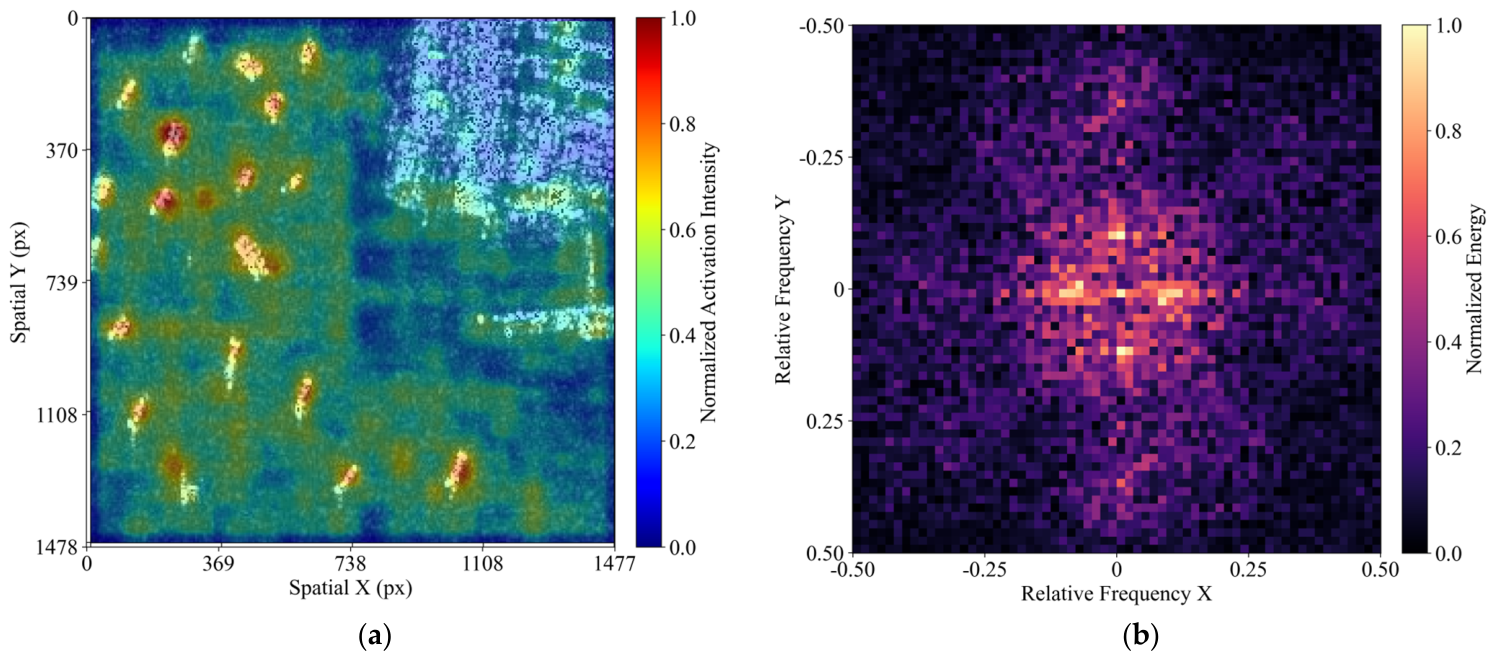
- The relationship between spatial–domain and channel–domain frequency modeling is systematically re–examined from a joint modeling perspective. It is demonstrated that discriminative information in SAR features is simultaneously distributed across the spatial spectrum, the channel spectrum, and the amplitude–phase structure of the spectrum. A more comprehensive utilization of channel–domain spectral information is advocated, and the attention mechanism is reinterpreted as a directional frequency–domain feature enhancement process for weak and small ship targets under complex scenarios. Rather than acting along a single dimension, spectral modulation is characterized as a cooperative enhancement mechanism operating jointly in both spatial and channel dimensions. This perspective provides a new viewpoint for frequency–domain modeling in SAR ship detection.
- (2)
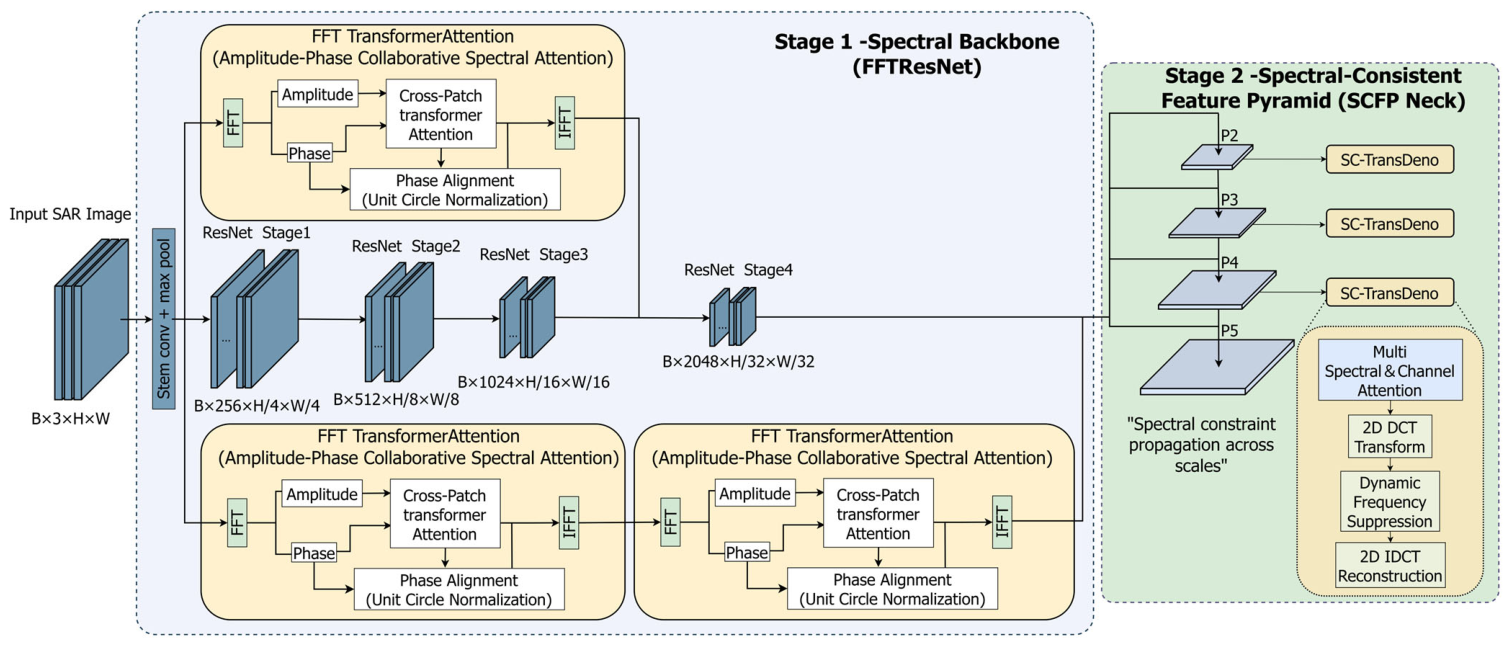
- A spatial–channel joint spectral detection architecture, termed FSMD–Net, is established to enforce multi–scale spectral consistency constraints. Through this design, features at different pyramid levels are guided to follow consistent discriminative criteria, thereby preventing noise from being cumulatively amplified during cross–scale fusion.
- (3)
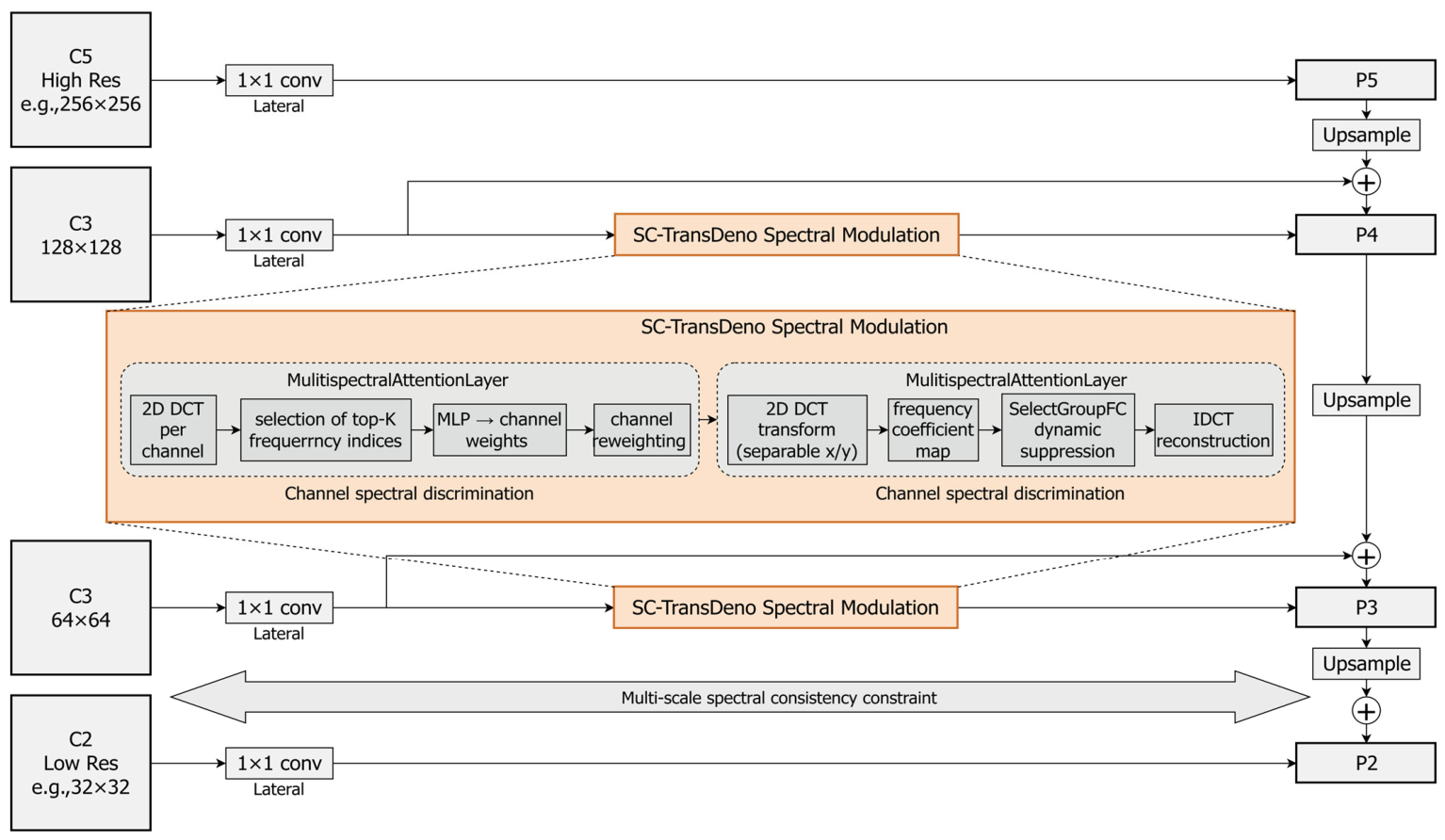
- To integrate spatial and channel spectral information, a Spectral–Consistent Feature Pyramid (SCFP) is introduced within the feature pyramid structure. Cooperative modulation between multi–spectral channel attention and spatial frequency–domain denoising is implemented, enabling coordinated clutter suppression and target–relevant spectral preservation during multi–scale feature propagation.
- (4)
- Experimental results on SARDet–100K, HRSID, and AIR–SARShip–2.0 demonstrate that FSMD–Net achieves consistent improvements in overall detection accuracy as well as small–object detection performance, verifying the effectiveness and robustness of joint spatial–channel spectral modeling.
2. Spatial–Channel Fusion Modeling
2.1. Spatial Frequency–Domain Denoising
2.2. Channel Frequency–Domain Attention
2.3. Necessity of Fusion Learning
3. Methodology
3.1. FFT–ResNet Backbone
3.2. Spectral–Consistent Feature Pyramid with Joint Channel–Spatial Denoising (SCFP)
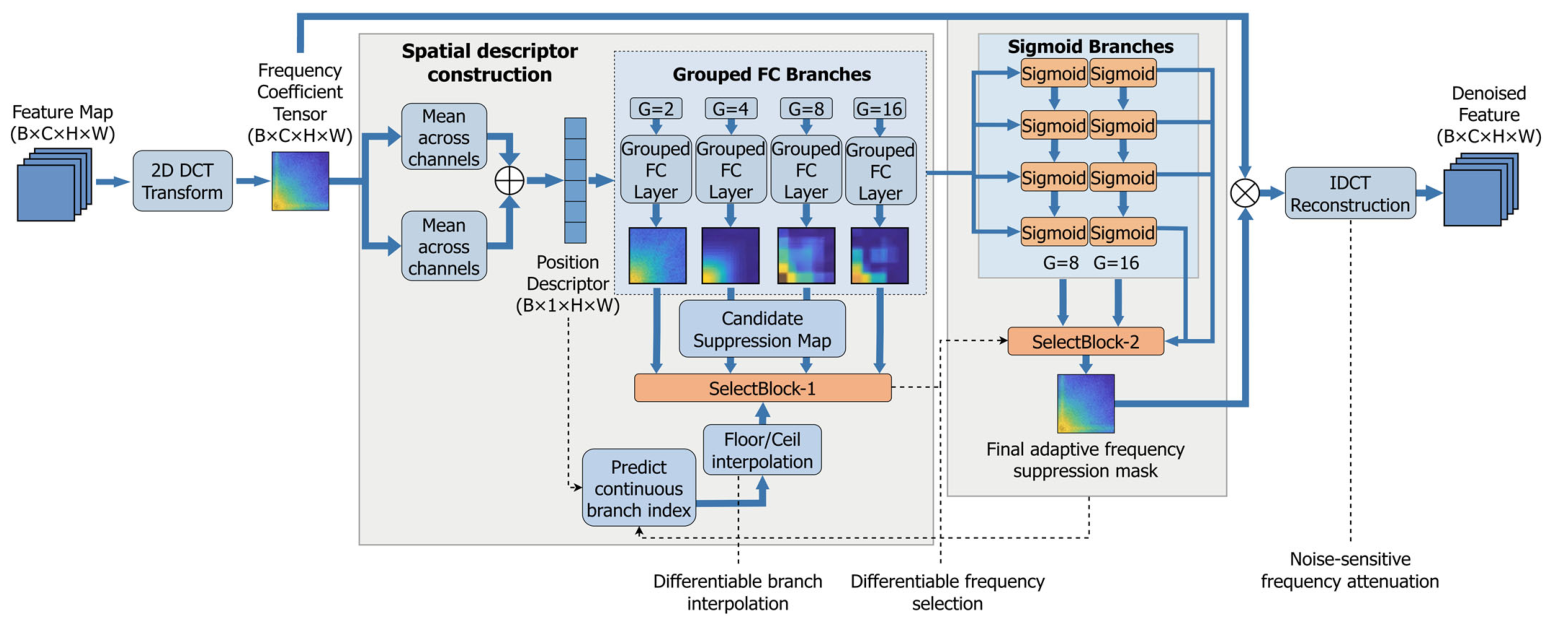
3.3. SC–TransDeno: Multi–Spectral Channel Attention and Learnable Denoising in the Spatial DCT Domain
4. Experiments and Discussion
4.1. Experimental Datasets
4.2. Experimental Environment and Implementation Details
4.3. Experimental Results
4.4. Ablation Study
4.5. Computational Complexity and Efficiency Analysis
4.6. Phase Contribution and Internal Visualization Analysis
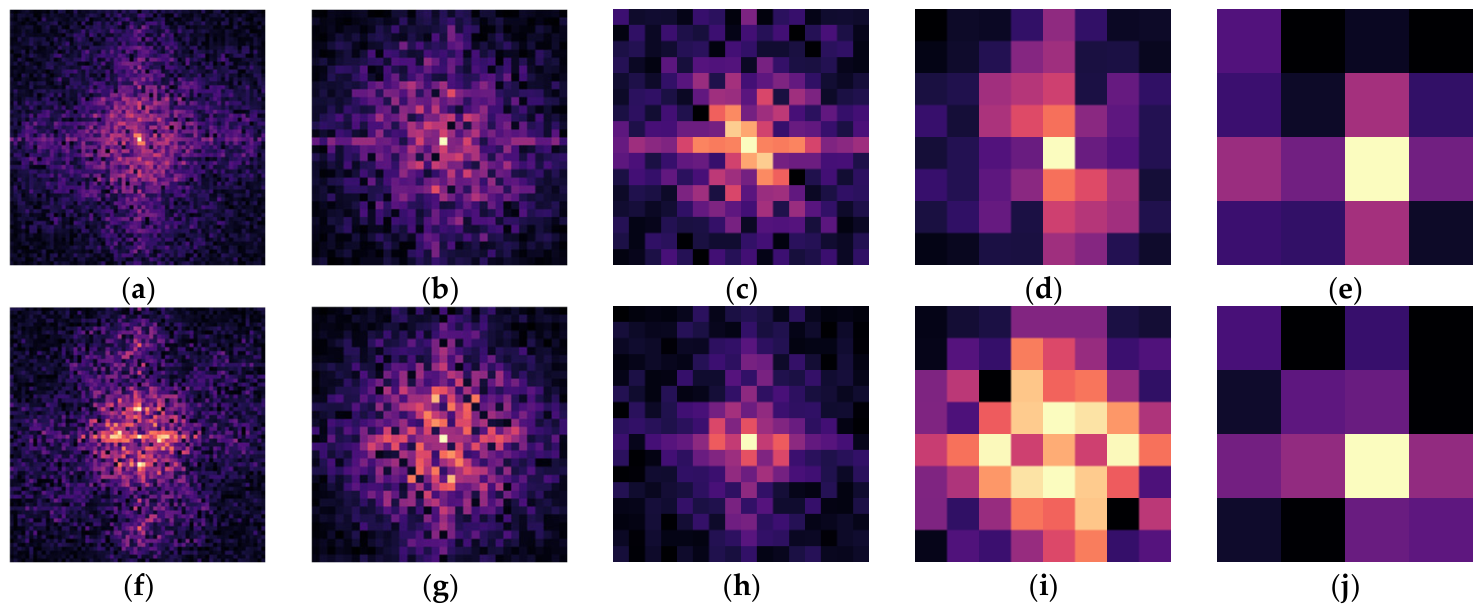
4.6.1. Phase Contribution to Structural Representation
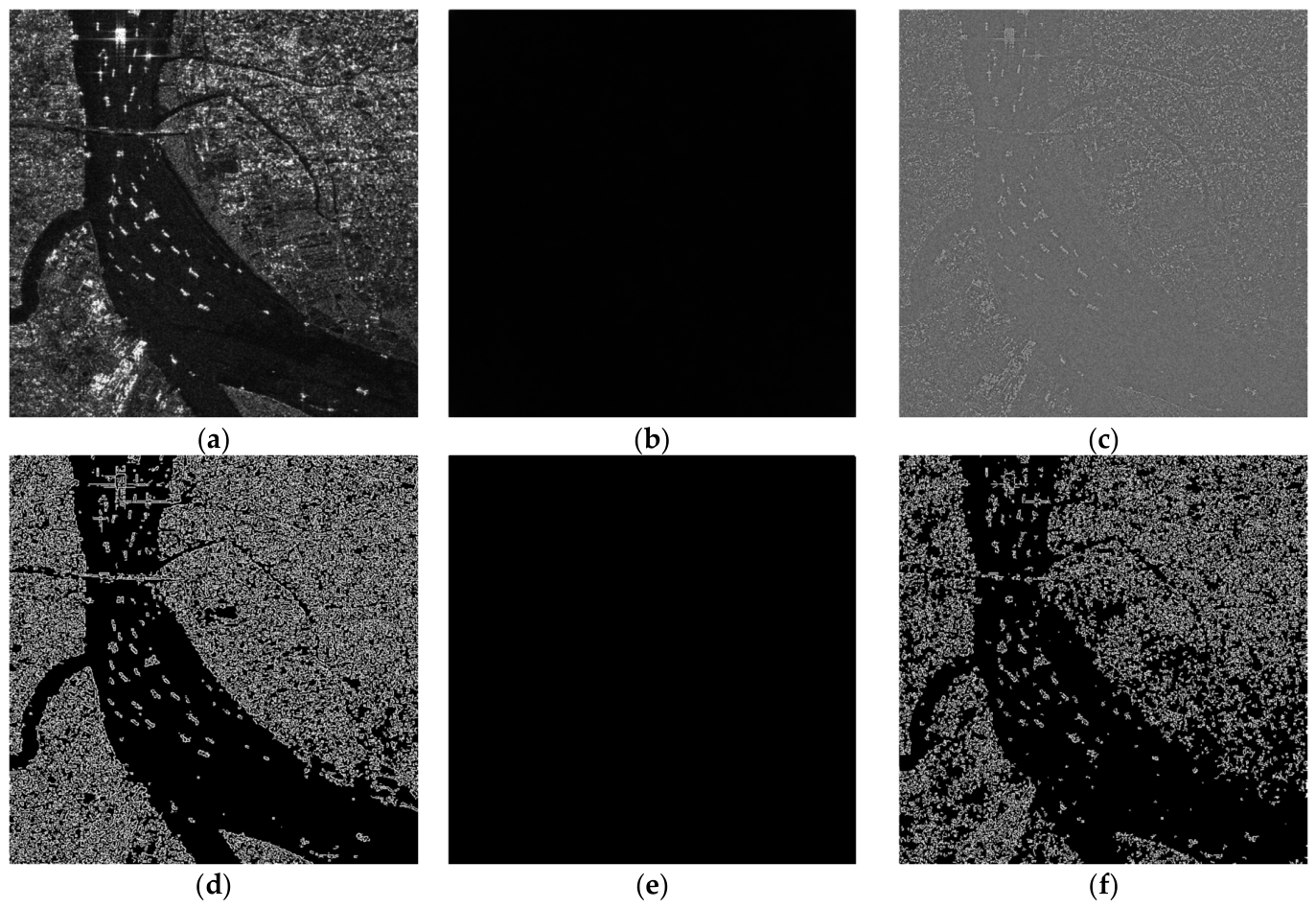
- (1)
- Full–spectrum reconstruction;
- (2)
- Amplitude–only reconstruction;
- (3)
- Phase–only reconstruction.
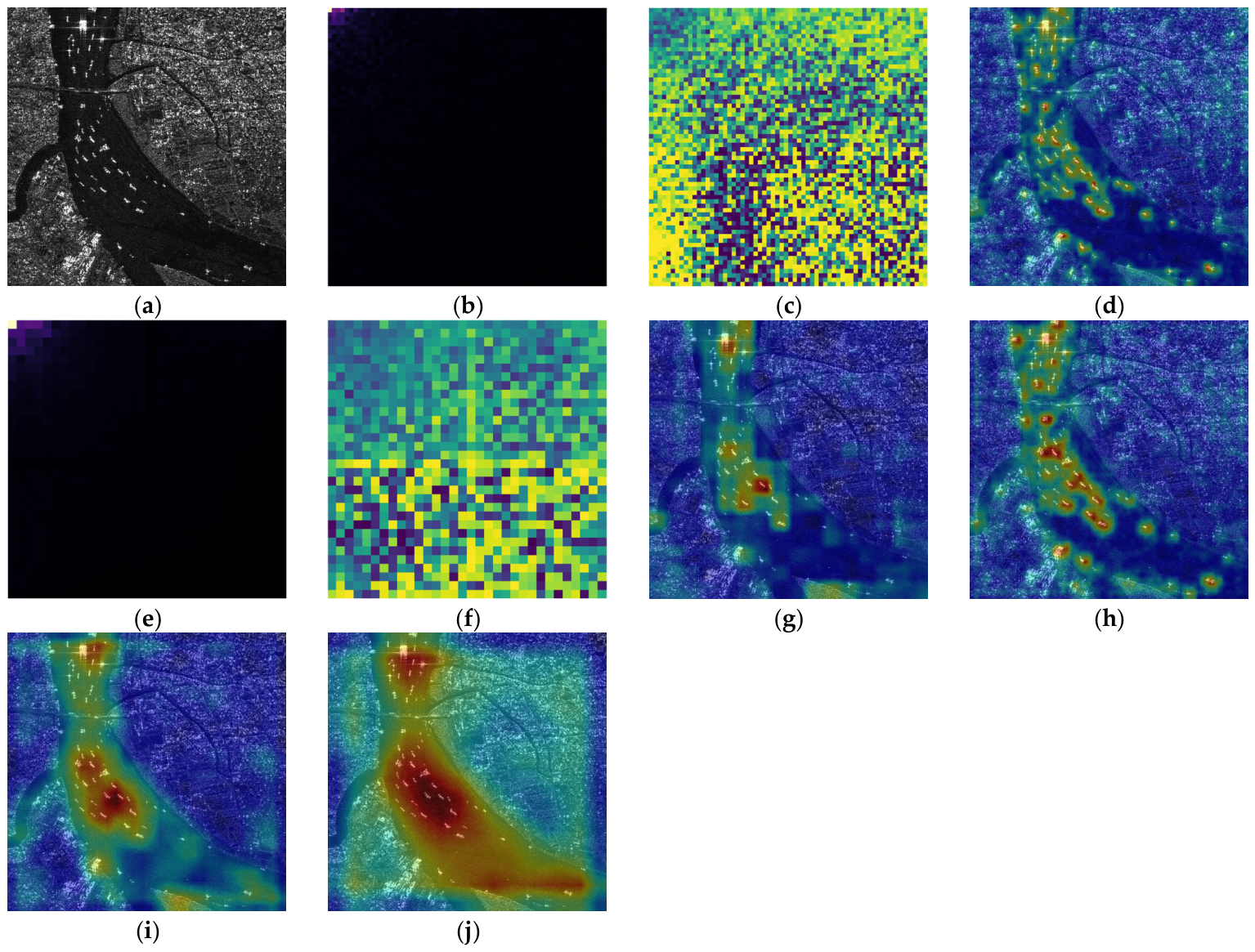
4.6.2. Visualization of Channel–Spatial Spectral Modulation
- (1)
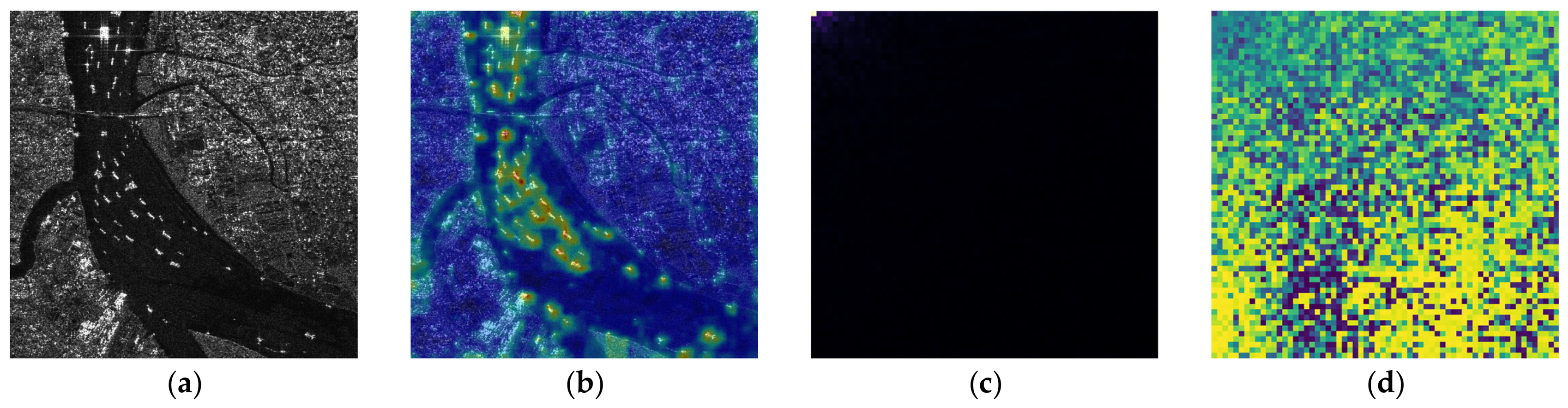
- Channel–frequency selection in MSCA;
- (2)
- Spatial frequency–domain suppression in SC–TransDeno;
- (3)
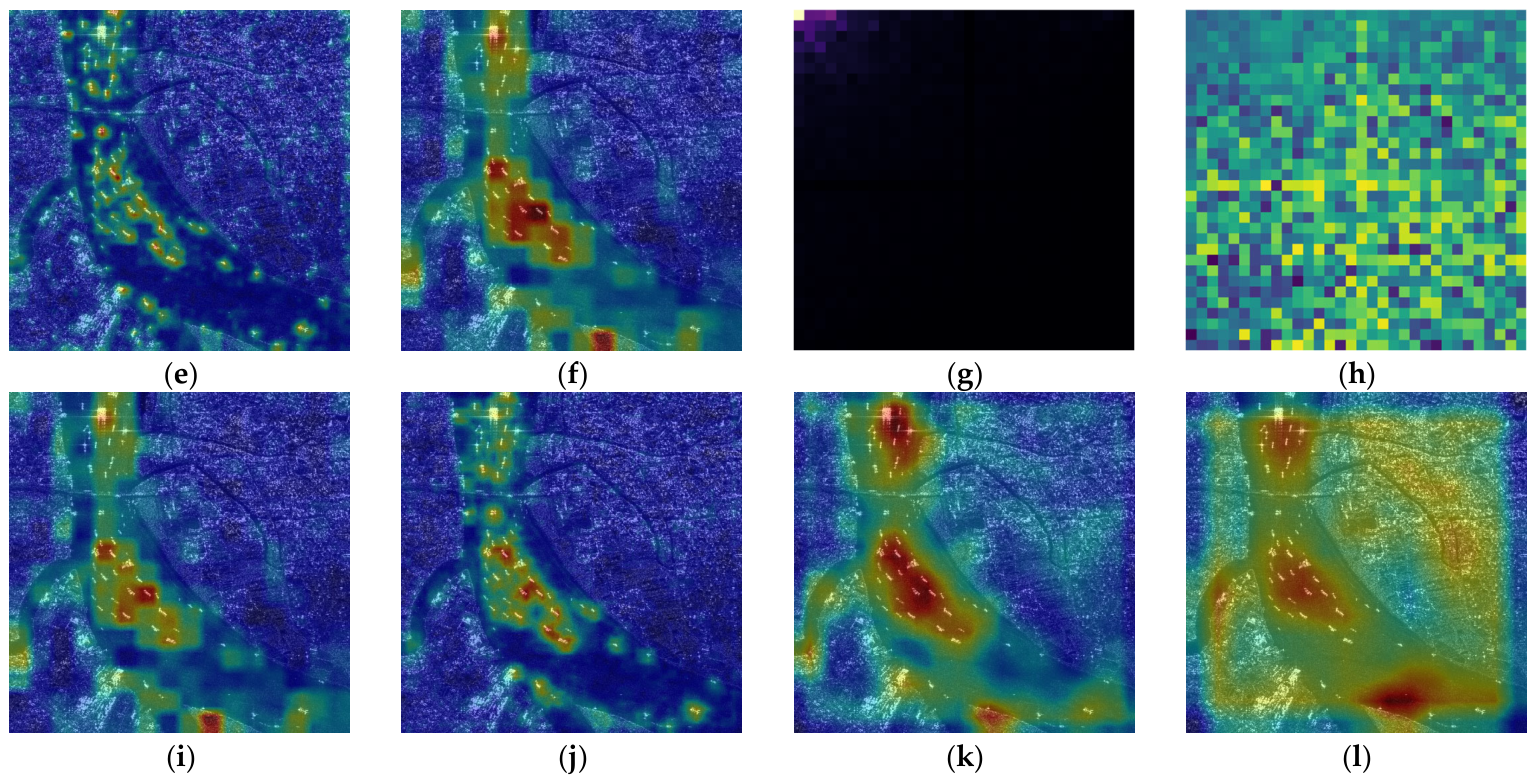
- Multi–level feature propagation across the feature pyramid.
- (1)
- Channel–Frequency Selection in MSCA
- (2)
- Frequency–Domain Suppression in SC–TransDeno
- (3)
- Multi–Level Feature Pyramid Analysis
- (4)
- Summary
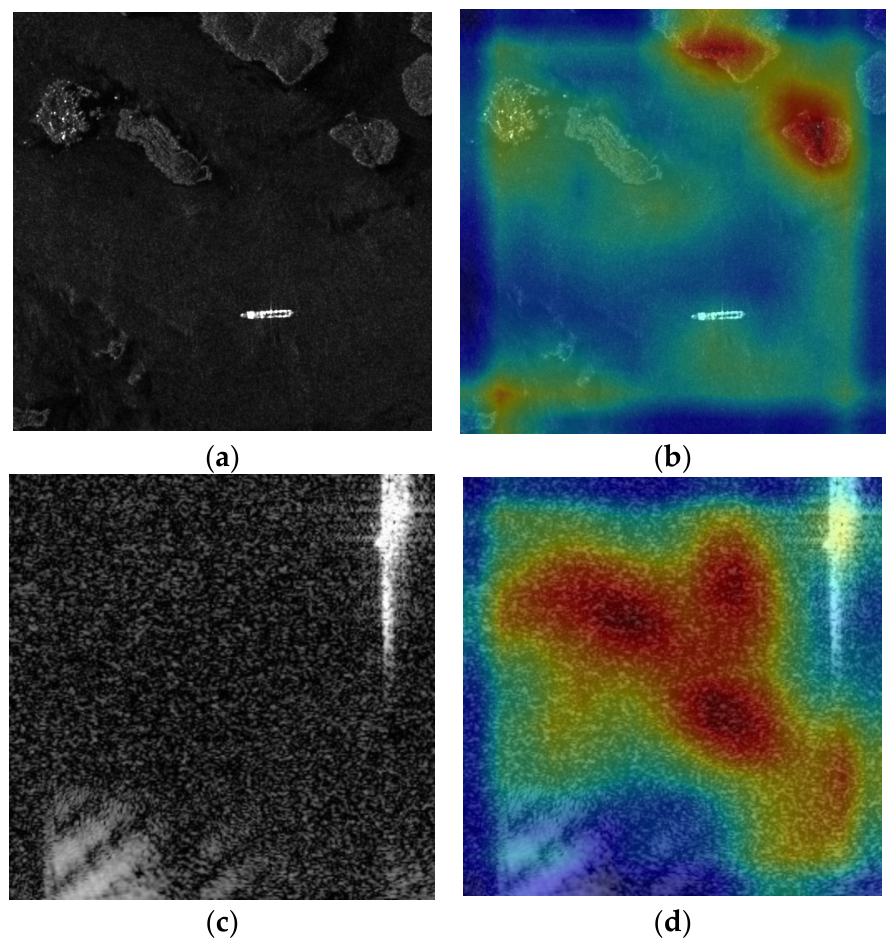
4.7. Broader Discussion, Scope, and Failure Cases
5. Conclusions
Author Contributions
Funding
Data Availability Statement
Conflicts of Interest
References
- Alexandre, C.; Devillers, R.; Mouillot, D.; Seguin, R.; Catry, T. Ship Detection With SAR C-Band Satellite Images: A Systematic Review. IEEE J. Sel. Top. Appl. Earth Obs. Remote Sens. 2024, 17, 14353–14367. [Google Scholar] [CrossRef] [Scilit]
- Yasir, M.; Wan, J.; Xu, M.; Sheng, H.; Zeng, Z.; Liu, S.; Colak, A.T.I.; Hossain, M.S. Ship Detection Based on Deep Learning Using SAR Imagery: A Systematic Literature Review. Soft Comput. 2023, 27, 63–84. [Google Scholar] [CrossRef] [Scilit]
- Wang, C.; Liao, M.; Li, X. Ship Detection in SAR Image Based on the Alpha-Stable Distribution. Sensors 2008, 8, 4948–4960. [Google Scholar] [CrossRef] [Scilit]
- Zhao, Z.; Ji, K.; Xing, X.; Zou, H. Adaptive CFAR Detection of Ship Targets in High Resolution SAR Imagery. In MIPPR 2013: Multispectral Image Acquisition, Processing, and Analysis; SPIE: Bellingham, WA, USA, 2013; p. 89170L. [Google Scholar] [CrossRef] [Scilit]
- Sun, S.; Wang, J. Ship Detection in SAR Images Based on Steady CFAR Detector and Knowledge-Oriented GBDT Classifier. Electronics 2024, 13, 2692. [Google Scholar] [CrossRef] [Scilit]
- Meng, S.; Ren, K.; Lu, D.; Gu, G.; Chen, Q.; Lu, G. A Novel Ship CFAR Detection Algorithm Based on Adaptive Parameter Enhancement and Wake-Aided Detection in SAR Images. Infrared Phys. Technol. 2018, 89, 263–270. [Google Scholar] [CrossRef] [Scilit]
- Mazzeo, A.; Renga, A.; Graziano, M.D. A Systematic Review of Ship Wake Detection Methods in Satellite Imagery. Remote Sens. 2024, 16, 3775. [Google Scholar] [CrossRef] [Scilit]
- Zhang, T.; Zhang, X.; Li, J.; Xu, X.; Wang, B.; Zhan, X.; Xu, Y.; Ke, X.; Zeng, T.; Su, H.; et al. SAR Ship Detection Dataset (SSDD): Official Release and Comprehensive Data Analysis. Remote Sens. 2021, 13, 3690. [Google Scholar] [CrossRef] [Scilit]
- Wei, S.; Zeng, X.; Qu, Q.; Wang, M.; Su, H.; Shi, J. HRSID: A High-Resolution SAR Images Dataset for Ship Detection and Instance Segmentation. IEEE Access 2020, 8, 120234–120254. [Google Scholar] [CrossRef] [Scilit]
- Cheng, M.-M.; Hou, Q.; Li, W.; Li, X.; Li, Y.; Liu, L.; Yang, J. SARDet-100K: Towards Open-Source Benchmark and ToolKit for Large-Scale SAR Object Detection. In Proceedings of the Advances in Neural Information Processing Systems 37; Neural Information Processing Systems Foundation, Inc. (NeurIPS): Vancouver, BC, Canada, 2024; pp. 128430–128461. [Google Scholar]
- Liu, W.; Anguelov, D.; Erhan, D.; Szegedy, C.; Reed, S.; Fu, C.-Y.; Berg, A.C. SSD: Single Shot MultiBox Detector. In Computer Vision–ECCV 2016; Leibe, B., Matas, J., Sebe, N., Welling, M., Eds.; Lecture Notes in Computer Science; Springer International Publishing: Cham, Switzerland, 2016; Volume 9905, pp. 21–37. ISBN 978-3-319-46447-3. [Google Scholar]
- Redmon, J.; Farhadi, A. YOLOv3: An Incremental Improvement. arXiv 2018, arXiv:1804.02767. [Google Scholar] [CrossRef] [Scilit]
- Lin, T.-Y.; Dollar, P.; Girshick, R.; He, K.; Hariharan, B.; Belongie, S. Feature Pyramid Networks for Object Detection. In Proceedings of the 2017 IEEE Conference on Computer Vision and Pattern Recognition (CVPR); IEEE: Honolulu, HI, USA, 2017; pp. 936–944. [Google Scholar]
- Lin, T.-Y.; Goyal, P.; Girshick, R.; He, K.; Dollar, P. Focal Loss for Dense Object Detection. In Proceedings of the 2017 IEEE International Conference on Computer Vision (ICCV); IEEE: Venice, Italy, 2017; pp. 2999–3007. [Google Scholar]
- Tian, Z.; Shen, C.; Chen, H.; He, T. FCOS: Fully Convolutional One-Stage Object Detection. In Proceedings of the 2019 IEEE/CVF International Conference on Computer Vision (ICCV); IEEE: Seoul, Republic of Korea, 2019; pp. 9626–9635. [Google Scholar]
- Zhang, S.; Chi, C.; Yao, Y.; Lei, Z.; Li, S.Z. Bridging the Gap Between Anchor-Based and Anchor-Free Detection via Adaptive Training Sample Selection. In Proceedings of the 2020 IEEE/CVF Conference on Computer Vision and Pattern Recognition (CVPR); IEEE: Seattle, WA, USA, 2020; pp. 9756–9765. [Google Scholar]
- Chang, Y.-L.; Anagaw, A.; Chang, L.; Wang, Y.C.; Hsiao, C.-Y.; Lee, W.-H. Ship Detection Based on YOLOv2 for SAR Imagery. Remote Sens. 2019, 11, 786. [Google Scholar] [CrossRef] [Scilit]
- Sun, Z.; Leng, X.; Lei, Y.; Xiong, B.; Ji, K.; Kuang, G. BiFA-YOLO: A Novel YOLO-Based Method for Arbitrary-Oriented Ship Detection in High-Resolution SAR Images. Remote Sens. 2021, 13, 4209. [Google Scholar] [CrossRef] [Scilit]
- Yu, C.; Shin, Y. SAR Ship Detection Based on Improved YOLOv5 and BiFPN. ICT Express 2024, 10, 28–33. [Google Scholar] [CrossRef] [Scilit]
- Girshick, R. Fast R-CNN. In Proceedings of the 2015 IEEE International Conference on Computer Vision (ICCV); IEEE: Santiago, Chile, 2015; pp. 1440–1448. [Google Scholar]
- Ren, S.; He, K.; Girshick, R.; Sun, J. Faster R-CNN: Towards Real-Time Object Detection with Region Proposal Networks. IEEE Trans. Pattern Anal. Mach. Intell. 2017, 39, 1137–1149. [Google Scholar] [CrossRef] [Scilit] [PubMed]
- Liu, L.; Pan, Z.; Lei, B. Learning a Rotation Invariant Detector with Rotatable Bounding Box. arXiv 2017, arXiv:1711.09405. [Google Scholar] [CrossRef] [Scilit]
- Han, J.; Ding, J.; Li, J.; Xia, G.-S. Align Deep Features for Oriented Object Detection. arXiv 2020, arXiv:2008.09397. [Google Scholar] [CrossRef] [Scilit]
- Yu, X.; Lin, M.; Lu, J.; Ou, L. Oriented Object Detection in Aerial Images Based on Area Ratio of Parallelogram. arXiv 2021, arXiv:2109.10187. [Google Scholar] [CrossRef] [Scilit]
- Carion, N.; Massa, F.; Synnaeve, G.; Usunier, N.; Kirillov, A.; Zagoruyko, S. End-to-End Object Detection with Transformers. arXiv 2020, arXiv:2005.12872. [Google Scholar]
- Zhu, X.; Su, W.; Lu, L.; Li, B.; Wang, X.; Dai, J. Deformable DETR: Deformable Transformers for End-to-End Object Detection. arXiv 2021, arXiv:2010.04159. [Google Scholar]
- Dai, Y.; Zou, M.; Li, Y.; Li, X.; Ni, K.; Yang, J. DenoDet: Attention as Deformable Multisubspace Feature Denoising for Target Detection in SAR Images. IEEE Trans. Aerosp. Electron. Syst. 2025, 61, 4729–4743. [Google Scholar] [CrossRef] [Scilit]
- Zhou, Y.; Liu, H.; Ma, F.; Pan, Z.; Zhang, F. A Sidelobe-Aware Small Ship Detection Network for Synthetic Aperture Radar Imagery. IEEE Trans. Geosci. Remote Sens. 2023, 61, 5205516. [Google Scholar] [CrossRef] [Scilit]
- Qin, Z.; Zhang, P.; Wu, F.; Li, X. FcaNet: Frequency Channel Attention Networks. In Proceedings of the 2021 IEEE/CVF International Conference on Computer Vision (ICCV); IEEE: Montreal, QC, Canada, 2021; pp. 763–772. [Google Scholar]
- Oppenheim, A.V.; Lim, J.S. The Importance of Phase in Signals. Proc. IEEE 1981, 69, 529–541. [Google Scholar] [CrossRef] [Scilit]
- Ni, X.S.; Huo, X. Statistical Interpretation of the Importance of Phase Information in Signal and Image Reconstruction. Stat. Probab. Lett. 2007, 77, 447–454. [Google Scholar] [CrossRef] [Scilit]
- Sun, X.; Wang, Z.; Sun, Y. AIR-SARShip-1.0: High-Resolution SAR Ship Detection Dataset. J. Radars 2019, 8, 852–862. [Google Scholar] [CrossRef]
- Singh, P.; Shankar, A.; Diwakar, M. Review on Nontraditional Perspectives of Synthetic Aperture Radar Image Despeckling. J. Electron. Imaging 2022, 32, 021609. [Google Scholar] [CrossRef] [Scilit]
- Liu, G.; Kang, H.; Wang, Q.; Tian, Y.; Wan, B. Contourlet-CNN for SAR Image Despeckling. Remote Sens. 2021, 13, 764. [Google Scholar] [CrossRef] [Scilit]
- Choi, H.; Jeong, J. Speckle Noise Reduction Technique for SAR Images Using Statistical Characteristics of Speckle Noise and Discrete Wavelet Transform. Remote Sens. 2019, 11, 1184. [Google Scholar] [CrossRef] [Scilit]
- Huang, Y.; Xin, Z.; Liao, G.; Huang, P.; Hou, G.; Zou, R. Unsupervised SAR Image Change Detection Based on Curvelet Fusion and Local Patch Similarity Information Clustering. Remote Sens. 2025, 17, 840. [Google Scholar] [CrossRef] [Scilit]
- Xiao, Z.; He, F.; Sun, Z.; Zhang, Z. Mitigation of Suppressive Interference in AMPC SAR Based on Digital Beamforming. Remote Sens. 2024, 16, 2812. [Google Scholar] [CrossRef] [Scilit]
- Chang, S.; Tang, S.; Deng, Y.; Zhang, H.; Liu, D.; Wang, W. An Advanced Scheme for Deceptive Jammer Localization and Suppression in Elevation Multichannel SAR for Underdetermined Scenarios. IEEE Trans. Aerosp. Electron. Syst. 2026, 62, 3952–3970. [Google Scholar] [CrossRef] [Scilit]






| Model | Pre. | mAP | mAP@0.5 | mAP@0.75 | mAP_s | mAP_m | mAP_l |
|---|---|---|---|---|---|---|---|
| One–stage | |||||||
| YOLOF | IN | 0.474 | 0.788 | 0.503 | 0.391 | 0.626 | 0.561 |
| FCOS | IN | 0.525 | 0.858 | 0.549 | 0.471 | 0.661 | 0.578 |
| GFL | IN | 0.551 | 0.851 | 0.589 | 0.494 | 0.673 | 0.605 |
| RepPoints | IN | 0.517 | 0.864 | 0.540 | 0.467 | 0.633 | 0.538 |
| ATSS | IN | 0.550 | 0.876 | 0.583 | 0.499 | 0.679 | 0.590 |
| CenterNet | IN | 0.539 | 0.862 | 0.573 | 0.489 | 0.662 | 0.577 |
| PAA | IN | 0.522 | 0.857 | 0.548 | 0.460 | 0.639 | 0.576 |
| TOOD | IN | 0.547 | 0.869 | 0.584 | 0.502 | 0.667 | 0.586 |
| DDOD | IN | 0.540 | 0.866 | 0.572 | 0.493 | 0.647 | 0.580 |
| VFNet | IN | 0.530 | 0.843 | 0.563 | 0.474 | 0.654 | 0.580 |
| AutoAssign | IN | 0.540 | 0.896 | 0.560 | 0.501 | 0.634 | 0.547 |
| Two–stage | |||||||
| Faster R–CNN | IN | 0.392 | 0.700 | 0.399 | 0.326 | 0.472 | 0.420 |
| Cascade R–CNN | IN | 0.536 | 0.873 | 0.568 | 0.491 | 0.629 | 0.487 |
| Dynamic R–CNN | IN | 0.498 | 0.810 | 0.539 | 0.431 | 0.597 | 0.548 |
| Grid R–CNN | IN | 0.501 | 0.806 | 0.535 | 0.424 | 0.620 | 0.527 |
| Libra R–CNN | IN | 0.521 | 0.835 | 0.558 | 0.459 | 0.635 | 0.554 |
| ConvNeXt | IN | 0.532 | 0.855 | 0.573 | 0.457 | 0.646 | 0.586 |
| ConvNeXtV2 | IN | 0.539 | 0.860 | 0.589 | 0.476 | 0.647 | 0.596 |
| LSKNet | IN | 0.524 | 0.851 | 0.570 | 0.452 | 0.636 | 0.592 |
| End2end | |||||||
| DenoDet | IN | 0.559 | 0.858 | 0.602 | 0.506 | 0.685 | 0.610 |
| FSMD–Net (ours) | IN | 0.565 | 0.864 | 0.609 | 0.507 | 0.691 | 0.611 |
| Model | mAP | mAP@0.5 | mAP@0.75 | mAP_s | mAP_m | mAP_l |
|---|---|---|---|---|---|---|
| One–stage | ||||||
| YOLOF | 0.233 | 0.490 | 0.188 | 0.248 | 0.208 | 0.025 |
| SRDet | 0.705 | 0.906 | 0.802 | 0.714 | 0.720 | 0.360 |
| DSDet | 0.605 | 0.907 | 0.746 | 0.668 | 0.640 | 0.076 |
| Two–stage | ||||||
| HRSDNet | 0.694 | 0.893 | 0.798 | 0.703 | 0.711 | 0.289 |
| CenterNet2 | 0.694 | 0.895 | 0.794 | 0.700 | 0.714 | 0.375 |
| End2end | ||||||
| DenoDet | 0.561 | 0.800 | 0.624 | 0.562 | 0.632 | 0.304 |
| FSMD–Net(ours) | 0.575 | 0.813 | 0.638 | 0.576 | 0.640 | 0.314 |
| Model | Pre. | mAP | mAP@0.5 | mAP@0.75 |
|---|---|---|---|---|
| One–stage | ||||
| RetinaNet | IN | 0.206 | 0.577 | 0.065 |
| FCOS | IN | 0.222 | 0.590 | 0.102 |
| GFL | IN | 0.255 | 0.581 | 0.146 |
| YOLOv3–t | IN | 0.350 | 0.755 | 0.389 |
| Two–stage | ||||
| Faster–RCNN | IN | 0.359 | 0.723 | 0.290 |
| Cascade–RCNN | IN | 0.325 | 0.732 | 0.325 |
| Grid–RCNN | IN | 0.302 | 0.685 | 0.205 |
| Libra–RCNN | IN | 0.240 | 0.590 | 0.124 |
| End2end | ||||
| ATSS | IN | 0.274 | 0.645 | 0.179 |
| CenterNet | IN | 0.133 | 0.416 | 0.035 |
| DINO | IN | 0.261 | 0.538 | 0.160 |
| RTD–Det–R50 | IN | 0.329 | 0.662 | 0.271 |
| DenoDet | IN | 0.348 | 0.733 | 0.288 |
| FSMD–Net (ours) | IN | 0.379 | 0.756 | 0.343 |
| SFD | CA–GAP | CA–MS | SARDet–100K | HRSID | AIR–SARShip–2.0 |
|---|---|---|---|---|---|
| mAP(07) | mAP(07) | mAP(07) | |||
| × | × | × | 0.525 | 0.271 | 0.220 |
| √ | × | × | 0.533 | 0.553 | 0.321 |
| √ | √ | × | 0.559 | 0.561 | 0.348 |
| √ | × | √ | 0.565 | 0.575 | 0.379 |
| K | mAP | mAP@50 | mAP@75 | mAP_s | mAP_m | mAP_l |
|---|---|---|---|---|---|---|
| 1 | 0.566 | 0.798 | 0.631 | 0.569 | 0.626 | 0.248 |
| 2 | 0.561 | 0.793 | 0.624 | 0.564 | 0.614 | 0.196 |
| 4 | 0.565 | 0.802 | 0.622 | 0.569 | 0.608 | 0.257 |
| 8 | 0.572 | 0.808 | 0.638 | 0.575 | 0.625 | 0.280 |
| 16 | 0.569 | 0.803 | 0.631 | 0.571 | 0.635 | 0.261 |
| 32 | 0.570 | 0.801 | 0.638 | 0.574 | 0.616 | 0.208 |
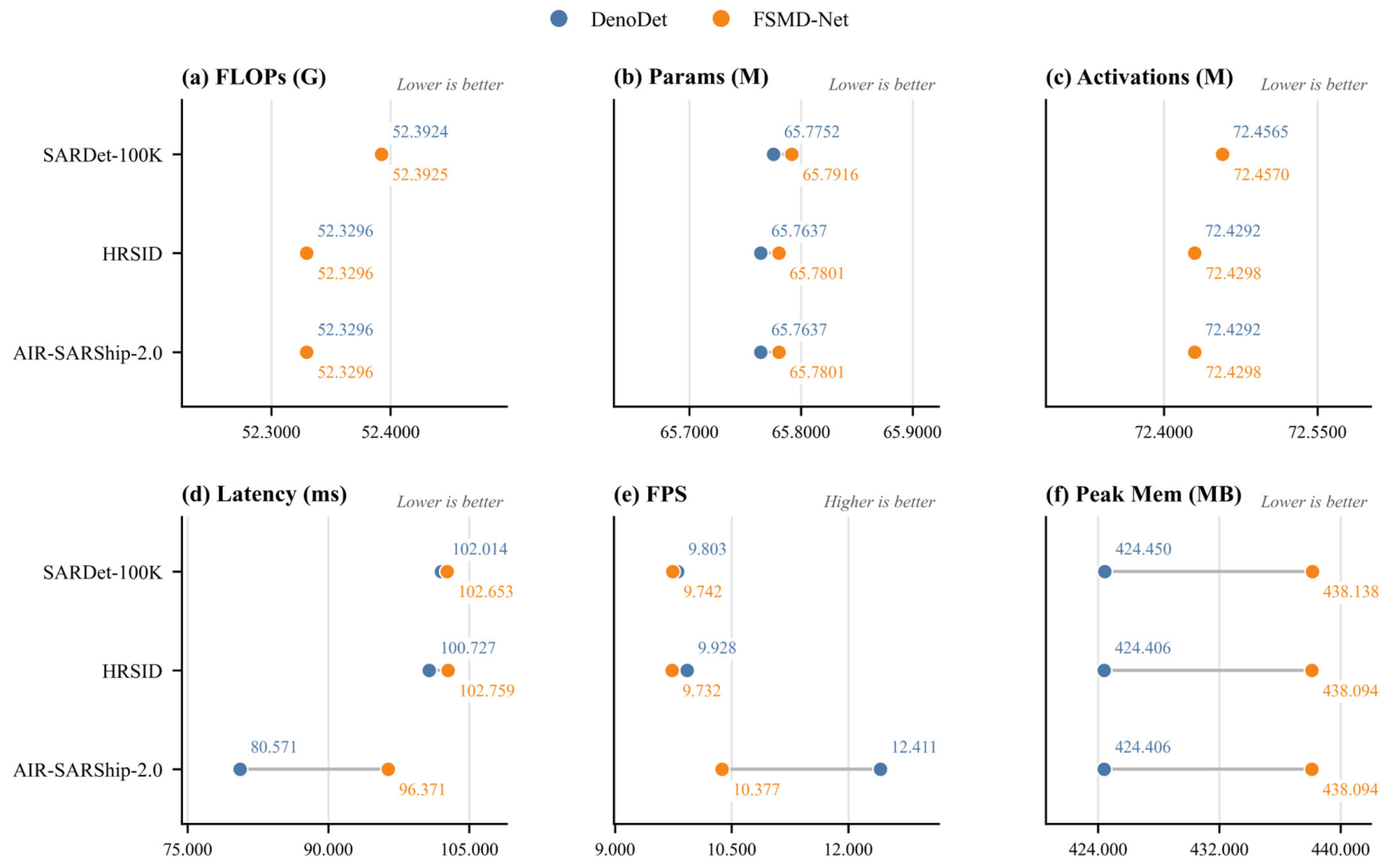
| Datasets | Model | FLOPs(G) | Params (M) | Activations (M) | Latency (ms) | FPS | Peak Mem (MB) |
|---|---|---|---|---|---|---|---|
| SARDet–100K | DenoDet | 52.392444 | 65.775247 | 72.456496 | 102.014492 | 9.802529 | 424.450195 |
| FSMDnet (Ours) | 52.392460 | 65.791631 | 72.457040 | 102.653118 | 9.741545 | 438.137695 | |
| HRSID | DenoDet | 52.329591 | 65.763722 | 72.429216 | 100.727285 | 9.927797 | 424.406250 |
| FSMDnet (Ours) | 52.329607 | 65.780106 | 72.429760 | 102.759006 | 9.731507 | 438.093750 | |
| AIR–SARship–2.0 | DenoDet | 52.329591 | 65.763722 | 72.429216 | 80.570813 | 12.411442 | 424.406250 |
| FSMDnet (Ours) | 52.329607 | 65.780106 | 72.429760 | 96.371194 | 10.376545 | 438.093750 |
Disclaimer/Publisher’s Note: The statements, opinions and data contained in all publications are solely those of the individual author(s) and contributor(s) and not of MDPI and/or the editor(s). MDPI and/or the editor(s) disclaim responsibility for any injury to people or property resulting from any ideas, methods, instructions or products referred to in the content. |
© 2026 by the authors. Licensee MDPI, Basel, Switzerland. This article is an open access article distributed under the terms and conditions of the Creative Commons Attribution (CC BY) license.
Share and Cite
Yao, X.; Shen, Y.; Lei, Y. FSMD–Net: Joint Spatial–Channel Spectral Modeling for SAR Ship Detection in Complex Inshore Scenarios. Remote Sens. 2026, 18, 1254. https://doi.org/10.3390/rs18081254
Yao X, Shen Y, Lei Y. FSMD–Net: Joint Spatial–Channel Spectral Modeling for SAR Ship Detection in Complex Inshore Scenarios. Remote Sensing. 2026; 18(8):1254. https://doi.org/10.3390/rs18081254
Chicago/Turabian StyleYao, Xianxun, Yijiang Shen, and Yuheng Lei. 2026. "FSMD–Net: Joint Spatial–Channel Spectral Modeling for SAR Ship Detection in Complex Inshore Scenarios" Remote Sensing 18, no. 8: 1254. https://doi.org/10.3390/rs18081254
APA StyleYao, X., Shen, Y., & Lei, Y. (2026). FSMD–Net: Joint Spatial–Channel Spectral Modeling for SAR Ship Detection in Complex Inshore Scenarios. Remote Sensing, 18(8), 1254. https://doi.org/10.3390/rs18081254