Article

Fusion and Analysis of Multi-Source Precipitation Data (2003–2021) in the Yangtze River Basin

1
College of Marine Science and Technology, China University of Geosciences, Wuhan 430074, China
2
Delta Gamma (Beijing) Technology Co., Ltd., Beijing 100094, China
3
School of Civil Engineering, Jilin University of Architecture and Technology, Changchun 130114, China
4
Key Laboratory of Poyang Lake Wetland and Watershed Research of Ministry of Education, School of Geography and Environment, Jiangxi Normal University, Nanchang 330022, China
*
Author to whom correspondence should be addressed.
Remote Sens. 2026, 18(8), 1191; https://doi.org/10.3390/rs18081191
Submission received: 9 February 2026 / Revised: 12 April 2026 / Accepted: 14 April 2026 / Published: 16 April 2026

Highlights

What are the main findings?
  • Among the seven major precipitation datasets in the Yangtze River Basin, the Multi-Source Weighted-Ensemble Precipitation (MSWEP) dataset performed the best overall. The combined precipitation data, based on the Extended Triple Collocation (MTC) method, achieved the better fusion effect. All of its evaluation indicators were improved.
  • The examination of precipitation over the Yangtze River Basin shows that the performance of the Triple Collocation (TC) series methods varies spatially. The data accuracy is better in the northwest region of the Yangtze River and has greater deviations in the southeast region.
What is the implication of the main finding?
  • By resolving the shortcomings of the current data selection and inadequate accuracy, this work determines the best precipitation datasets and fusion technique, offering high-precision data support for Yangtze River Basin water resources research.
  • In addition to offering guidance for improving models and techniques for evaluating precipitation, the broad applicability of TC methods and the geographical patterns of precipitation data also establish a basis for improving ecological management and water security in the Yangtze River Basin.

Abstract

A vital region for China’s water resource storage and ecological balance maintenance, the Yangtze River Basin is strategically significant for maintaining regional water security and promoting long-term social and economic development. Precipitation is the main driver of the hydrological cycle. In order to address current problems with the basin’s ecological environment and water supplies, comprehensive analyses of multi-source precipitation data are necessary. They provide an essential scientific basis for evaluating the sustainability of water resources in the Yangtze River Basin in the context of climate change. Most existing precipitation fusion studies utilize only a limited number of datasets and do not fully consider the independence among different data sources, which leads to less-than-ideal fusion accuracy and assessment metrics. This paper employs the Triple Collocation (TC) method to evaluate and fuse multiple precipitation datasets over a 19-year period from 2003 to 2021, with the aim of enhancing precipitation accuracy in the Yangtze River Basin. The Multi-Source Weighted-Ensemble Precipitation (MSWEP) precipitation data were found to have the highest accuracy among seven datasets, with a Correlation Coefficient (CC), Relative Bias (Rbias), and Root Mean Square Error (RMSE) of 0.907, −0.027, and 25.930 mm, respectively. The “MSWEP–PERSIANN–NOAH (MPN)” fusion was shown to be the best using the Multiplicative Triple Collocation (MTC) method in conjunction with cross-error analysis. Compared to MSWEP alone, it improved CC by 0.8% and decreased RMSE by 3.8%, with matching spatial-grid CC and RMSE improvements of 1.2% and 1.8%, respectively. Further spatiotemporal analysis of the fused data increase detection capabilities for short-term flood and waterlogging occurrences and provide better knowledge of basin water-resource status.

1. Introduction

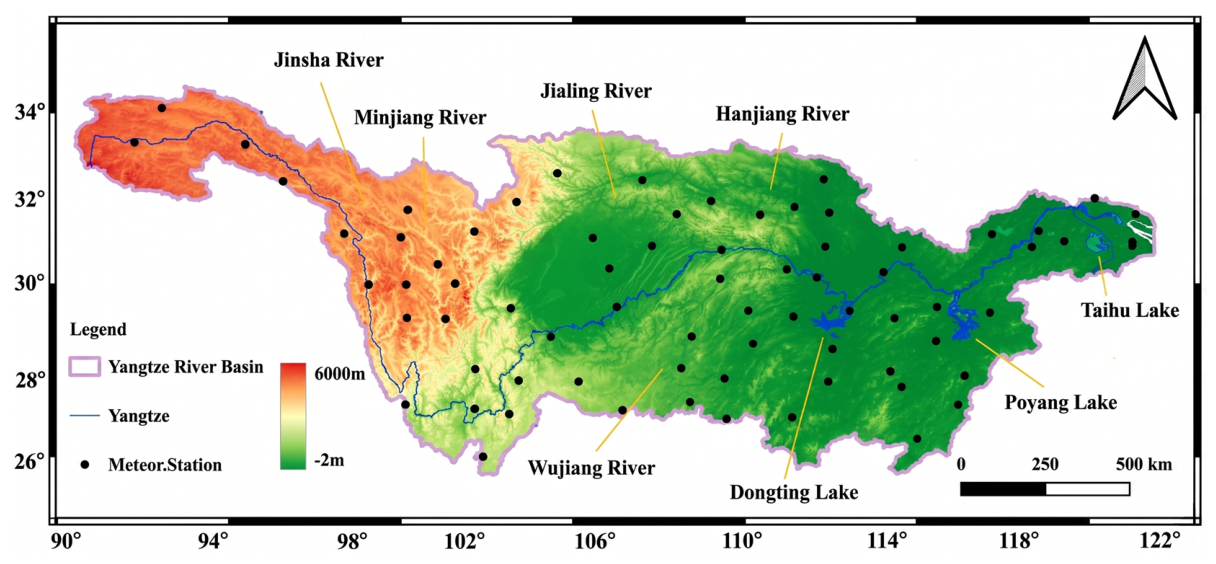
In addition to serving as a vital ecological security barrier for China, the Yangtze River Basin is a vital source of water resources that promote sustainable development. The prudent management and preservation of water resources in this basin are especially important in light of the difficulties brought on by global climate change. As shown in Figure 1, excluding the source area and the Yangtze River Delta, the basin spans more than 3000 km in a straight line from east to west and is roughly 1000 km wide from north to south. This region has a large economy and is home to major cities including Shanghai, Nanjing, Chongqing, and Wuhan. Even though the Yangtze River Basin receives 1067 mm of precipitation on average each year, the basin’s vast area, complex topography, and distinct monsoon climate traits lead to wildly disparate temporal and geographic precipitation distributions. The Earth’s water cycle depends on precipitation to sustain Terrestrial Water Storage (TWS) and ecosystem health. It replenishes groundwater and surface water bodies and influences the distribution and use of water resources through surface runoff and infiltration processes. As global climate change has worsened, the effects of altered precipitation patterns on TWS have become more prominent. Reasonable planning and management of precipitation resources are crucial for reducing the impact of extreme weather events, ensuring the sustainable use of water resources, and maintaining ecosystem stability.
Precipitation is an important component of hydrological modeling and the global water cycle, but producing reliable precipitation data has long been a problem for academics [1]. Rain-gauge stations, satellite sensors, meteorological radars, and reanalysis models are the four primary techniques used to collect precipitation date [2]. The most widely used technique for calculating precipitation is the use of rain gauge stations, which use rain gauges to provide precise measurements of rainfall at observation locations [3]. Rain-gauge stations are not evenly distributed. They are extremely rare or nonexistent in some places, such as isolated rural areas or mountainous areas with complicated topography, making it impossible to get measured precipitation data in these areas [4]. Due to the influence of various factors on the rain gauge, the precipitation data inevitably has certain errors. The rain gauge station can only provide the precipitation at the current site. Interpolation is needed to obtain the gridded precipitation data. And in areas without actual measurement data, interpolation will lead to large errors. Therefore, the insufficient spatial coverage resulting in low data resolution is a major problem of the rain gauge station [5]. The meteorological radar calculates the intensity and amount of precipitation based on the intensity of the radar echoes. However, the obstruction of the signal beam and the reduction in the radar beam power in complex terrains are the main factors causing errors [6]. Satellite sensors have broad application prospects, but their accuracy is still affected by various errors, including their own conditions, environmental influences, and algorithm principles [7,8]. Although remote sensing precipitation data products can capture the precipitation distribution in small areas, their spatial resolution is generally quite low. Reanalysis precipitation data can accurately depict precipitation in high-latitude areas, forecasting models and meteorological input observation mistakes are unavoidable. Under such circumstances, fusing different precipitation products can combine their respective advantages, compensate for shortcomings, and improve the quality of precipitation estimation [9,10].
Data fusion technology can significantly improve the accuracy of predictions in climate science and hydrology while reducing estimation uncertainty. The Simple Model Averaging (SMA) approach improved the performance of fused products over all single-product data [11]. The efficiency of combining satellite and reanalysis precipitation data using the Optimal Interpolation (OI) approach was then confirmed [12]. In 2013, a study utilized the linear weighting method to combine the 3B42 data from the Tropical Rainfall Measuring Mission (TRMM) with rain gauge measurements, thereby significantly improving the accuracy of estimating the spatial distribution of rainfall [13]. Building on this basis, some scholars investigated precipitation fusion in the Qinghai-Tibet Plateau using techniques such as inverse mean square error weighting, arithmetic averaging, and outlier removal [14], and discovered that these approaches were more reliable than the SMA method. By integrating multiple precipitation datasets, the Multi-Source Weighted- Ensemble Precipitation (MSWEP) model was established, aiming to provide more accurate and higher-resolution global precipitation estimations, and to fill the gaps in coverage, accuracy and timeliness of traditional single data sources [15]. The product performed better than a number of cutting-edge datasets, such as the Global Precipitation Climatology Project One-Degree Daily Precipitation Data Sets (GPCP-1DD) and the Tropical Rainfall Measuring Mission (TRMM) data. The Dynamic Bayesian Model Averaging (DBMA) technique was adopted to integrate four satellite-based precipitation data products [2]. The DBMA method outperformed several other fusion methods and achieved more reasonable precipitation estimation than MSWEP, according to their results, which were obtained in the Qinghai-Tibet Plateau region under a variety of seasonal and topographical conditions. However, putting these fusion techniques into practice is usually difficult and complex. A random forest-based fusion method that incorporates data from ground measurements, cutting-edge precipitation products, and terrain-related features to improve the accuracy of spatiotemporal precipitation distribution was proposed in 2020 in order to overcome this limitation [16].
The reliability of the aforementioned fusion techniques is limited in regions with a lack of measurement stations since they rely on rain-gauge data to determine fusion weights. Precipitation fusion in sparsely gauged regions is more important and urgent than in densely gauged regions because, in practice, satellite and reanalysis products are subject to significant uncertainties in the absence of adequate ground observations for error correction or meteorological forcing. The fusion and validation of geophysical data sets presents a formidable challenge as all products are in different and subject to errors. The collocation technique permits the retrieval of the error variances of different data sources without the need to specify one data set as a reference [17,18]. The Triple Collocation (TC) was first suggested in 1998 as a way to assess the precision of ocean wind speed data, and it has since been expanded to a number of different fields [19]. Unlike conventional validation methods that depend on standard instruments, the TC method effectively predicts errors using three distinct input datasets without requiring prior knowledge of the actual target variable values [20]. Since the TC method has shown great promise in error evaluation and data fusion of multi-source precipitation products, its use in precipitation estimation has steadily expanded in recent years. The applicability of the TC method was first confirmed, and it can successfully evaluate the accuracy of the ground base, multiple satellites, and re-analyzed precipitation products [21]. Later in 2020, the TC method can improve precipitation prediction accuracy by offering a TC-based framework for merging precipitation data from many sources when there are no high-quality ground observations available [22]. In the same year, the research indicates that there are differences between the TC method and the traditional methods in the assessment of precipitation data in Germany, and it also demonstrates the sensitivity of the TC method when dealing with zero precipitation data [9]. The study demonstrated the significant impact that different strategies for handling zero-precipitation data had on the results of the TC method [23]. The case study of the Yangtze River Basin demonstrates the advantages of the TC technology in data fusion, particularly in enhancing geographical consistency and reducing errors in precipitation products [24]. By integrating an improved inverse distance weighting interpolation method with a machine learning-based Light Gradient Boosting Machine (LGBM) algorithm, the optimized dataset is consistent with the overall spatiotemporal distribution pattern of the existing gridded precipitation dataset. Substantial improvements have been achieved in precipitation event detection and precipitation value estimation [25].
The aforementioned experiments show how reliable and successful the TC method is for estimating precipitation. Despite progress, handling precipitation underestimation and zero-inflated datasets remains problematic due to underlying sample distribution imbalance and estimation bias. In light of the shortcomings of current data-fusion techniques (limited data breadth and inadequate consideration of data independence), this study combines seven different datasets and thoroughly assesses their accuracy. The Yangtze River Basin’s top-performing dataset is then chosen for additional fusion and analysis, serving as a fundamental component for further studies.

2. Materials and Methods

2.1. Dataset

This paper utilizes eight publicly available precipitation datasets, categorized into three groups based on their data sources and generation methods: (1) reanalysis-based datasets (ERA5 and MSWEP); (2) satellite-derived datasets (CMORPH, GPM, and PERSIANN-CDR); and (3) model-simulated datasets (Noah and VIC from the CLDAS system). The CHMP dataset serves as the ground reference measurements for accuracy validation (Table 1).
The China Hydro-Meteorology Precipitation (CHMP) dataset is a gauge-only daily precipitation product aimed at China and its surrounding areas, derived strictly from in situ precipitation readings at 2839 national meteorological stations [26]. The gridded dataset is generated using topographic correction techniques, benchmark precipitation fields and precipitation ratio fields, and spatial interpolation algorithms rather than atmospheric or land surface models. Crucially, it must be emphasized that the CHMP dataset relies entirely on ground-based rain gauge observations and does not incorporate any satellite-derived or reanalysis precipitation data. Therefore, utilizing the CHMP dataset as an independent ground reference to evaluate multi-source precipitation products ensures the objectivity of the assessment and strictly avoids the risk of data circularity. To verify its precision, CHMP was compared to interpolated daily precipitation data collected from more than 40,000 sites in China from 2015 to 2019. The evaluation findings show that CHMP represents the spatial distribution of precipitation effectively. In comparison to the daily precipitation data from high-density stations, the median correlation coefficient is 0.78 and the median Root Mean Square Error (RMSE) is 8.8 mm. This suggests a good level of agreement with currently used precipitation datasets, including CGDPA, CN05.1, and CMA V2.0. This dataset spans the years 1961 to the present and has spatial resolutions of 0.1°, 0.25°, and 0.5°, respectively.
For use in eight to ten decades of previous weather research and global climate analysis, the European Centre for Medium-Range Weather Forecasts (ECMWF) created the fifth-generation atmospheric reanalysis product, also referred to as the ERA5 dataset [27]. In place of the ERA-Interim reanalysis dataset, ERA5 has been available since 1940. The reanalysis process combines model-derived data with global observational records based on physical laws, generating a globally consistent and homogeneous dataset. This principle, known as data assimilation, is built on the methodology adopted by numerical weather prediction centers. At regular intervals (12 h for ECMWF), the previous forecast is optimally integrated with newly available observations to produce an updated best estimate of the atmospheric state, termed an analysis, from which improved subsequent forecasts are derived. The reanalysis operates on the same principles but with reduced resolution to enable the production of multi-decadal datasets. Unconstrained by the time-sensitive requirements of real-time forecast issuance, reanalysis allows extended periods for observational data collection and incorporates improved versions of historical raw observations during retrospective processing, both of which contribute to the high quality of reanalysis products.
The MSWEP dataset is a global precipitation product that offers data from 1979 to near-real time with a temporal resolution of 3 h and a spatial resolution of 0.1°. Near-real-time estimates are provided with a lag of roughly 3 h. MSWEP outperforms other precipitation products in both densely gauged regions and unmeasured areas [15]. This product’s distinct advantage is its multi-source data fusion framework, which combines satellite-retrieved, gauge-based, and reanalysis-derived precipitation estimates to maximize performance in three different weather scenarios: frontal precipitation, convection-dominated precipitation, and dense gauge coverage. The temporal discrepancy between satellite-reanalysis estimates and ground-based station data is largely attributed to the integration of daily in situ observations within MSWEP.
A global precipitation product with high spatiotemporal resolution, the CMORPH dataset was developed by the U.S. National Weather Service’s Climate Prediction Center (CPC). By merging satellite observation data, including observations from many microwave and infrared sensors, the approach uses Morphing technology for spatiotemporal interpolation to provide a global high-resolution precipitation dataset [28]. At 3 h, 24 h, and 48 h intervals, CMORPH provides precipitation estimates with a spatial resolution of 0.25° and a configurable temporal precision of 30 min to 3 h.
The Global Precipitation Measurement (GPM) mission is a worldwide satellite project on which NASA and JAXA are partners. A multi-sensor, multi-satellite, and multi-algorithm fusion retrieval framework is used in this effort to generate more precise precipitation datasets by combining satellite constellation observations with ground-based gauge data. With coverage extending to the Arctic and Antarctic Circles, the GPM dataset offers worldwide precipitation and snowfall products with a 3 h temporal resolution obtained from microwave observations and a 30 min temporal resolution from microwave-infrared combined observations [29]. A primary observatory satellite and approximately ten constellation satellites make up the program. Level-1, Level-2, and Level-3 are the three levels into which GPM data products are divided. Raw observational data obtained directly by satellite-borne equipment is referred to as level-1 data. Level-2 data is processed from Level-1 data at consistent spatial resolutions and geographic locations, deriving geophysical variables associated with precipitation. Level-3 data is further interpolated onto fixed spatiotemporal grids based on Level-2 data, yielding gridded products with high data completeness and consistency, including 30 min, daily, and monthly mean precipitation datasets.
The Precipitation Estimation from Remotely Sensed Information using Artificial Neural Networks Climate Data Record (PERSIANN-CDR) dataset, a multi-source satellite-based precipitation product, was retrieved using an artificial neural network technique [30]. It is designed for higher-resolution hydrological cycle investigations. The National Centers for Environmental Prediction (NCEP) Stage IV hourly precipitation data is used to train the neural network, and the PERSIANN method is applied to GridSat-B1 infrared satellite data to provide precipitation estimates. To match the monthly outputs of the Global Precipitation Climatology Project (GPCP) Version 2.2, PERSIANN-CDR has been adjusted to downscale its monthly mean values to a spatial resolution of 2.5°. The purpose of this dataset, known as a Climate Data Record (CDR), is to provide continuous, dependable, and sufficiently long time series for climate change research. According to the U.S. National Research Council (NRC), PERSIANN-CDR is unique because it uses artificial neural network technology, which allows for accurate precipitation estimation and enhances understanding of hydrological cycles and climatic patterns.
Catchment, Noah, CLM, VIC, and Mosaic land surface models all employ simulated precipitation data from the Global Land Data Assimilation System (GLDAS). Ground-based measurements, land surface model outputs, and satellite observations are all combined to create the data assimilation product known as GLDAS. It was jointly created by NASA’s Goddard Space Flight Center (GSFC), the National Centers for Environmental Prediction, and the National Oceanic and Atmospheric Administration (NOAA). In situ observations, reanalysis datasets, and atmospheric assimilation outputs are among the forcing datasets it provides [31,32]. This research has generated a large collection of observational and simulated data, such as parameter maps, model outputs, and global-scale surface meteorological datasets.

2.2. Data Processing Methods

Eight monthly scale precipitation datasets from 2003 to 2021 were gathered and preprocessed for this study. These datasets were categorized into three groups according to their data sources: satellite-derived, reanalysis-based, and model-simulated. Ground-based station observations served as the ground reference measurements for accuracy evaluation. Using cross-correlation analysis, one representative dataset from each of the three categories was selected for permutation and combination. To match the coarsest resolution among the datasets, original high-resolution products were resampled to 0.5° via bilinear interpolation, resulting in a unified spatial grid for all analyses. While we recognize that this aggregation smooths local extremes and impacts uncertainty estimates. More importantly, the spatiotemporal aggregation can effectively filter out the representative differences caused by short-duration and small-scale random convective precipitation. This helps to make the errors of each data set participating in the fusion more close to the normal distribution and zero mean. The strategy was necessary to meet the strict co-location criteria of the TC method. Furthermore, it prevents the introduction of artificial precision associated with downscaling low-resolution data, thereby ensuring a more reliable inter-comparison. Then, using the Extended Triple Collocation (ETC) and Multiplicative Triple Collocation (MTC) methods to calculate errors, the best dataset triplet was identified. The temporal–spatial fusion and reconstruction of a 0.5° daily scale precipitation dataset were based on this ideal triplet. Finally, the spatiotemporal distribution features of the fused dataset were analyzed.

2.2.1. Extended Triple Collocation (ETC)

Without the need for ground reference measurement data, the TC method can be used to measure the error variance of geophysical variables by using three independent datasets. Three mathematical presumptions form the basis of the TC method’s proposal: (1) that the random errors of all three input data estimates have zero expected values; (2) that there is no covariance between the random errors of all three input data estimates and the actual precipitation; and (3) there is no correlation between the random errors of all three input data estimates. Assuming that the errors between these different data are independent and follow an additive distribution, unlike the traditional TC method, in order to quantify the uncertainty of this precipitation product without relying on specific ground measured data, the ETC can simultaneously estimate the variance of the errors and the correlation coefficient with the unknown true signal [23,33].
The RMSE and Correlation Coefficient (CC) of precipitation in the absence of accurate values are determined in this study using the ETC method. The relationship between the estimated value and true values in the ETC method can be stated as follows:
P i = α i + β i t + ε i
where Pi (i = 1, 2, 3) represents the estimate of the true value t with random error ε i (i = 1, 2, 3); α i and βi and are the intercept and slope of the ordinary least squares method, respectively. The covariance between two different products, defined as Cij (ij), can be calculated as follows:
C i j = β i β j σ T 2 + β i E ε j T + α i E ε j + α j E ε i + E ε i ε j
With the three presumptions mentioned above, Equation (2) can be changed into:
C i j = C o v R i , R j = β i β j σ T 2 , i j β i 2 σ T 2 + σ ε i 2 , i = j
To solve the problem of six equations with seven unknowns (β1, β2, β3, σ1, σ2, σ3, and σt), we can define:
θ i = β i σ i
The covariance between each pair of precipitation datasets can be expressed as follows:
C 11 = θ 1 2 + σ ε 1 2 C 22 = θ 2 2 + σ ε 2 2 C 33 = θ 3 2 + σ ε 3 2 , C 12 = θ 1 θ 2 C 13 = θ 1 θ 3 C 23 = θ 2 θ 3
The RMSE ( σ ε i 2 ) between each precipitation estimate and the actual value can be calculated without knowing the actual value.
σ ε 1 2 = C 11 C 13 C 23 C 12 σ ε 2 2 = C 22 C 12 C 23 C 13 σ ε 3 2 = C 33 C 13 C 23 C 12
More significantly, the CC between precipitation data and the actual value can be found using θi. This constraint is addressed by the ETC method, which generates the CC between each dataset and the unknown true value by altering the TC method. The CC enhances the usefulness of uncertainty assessment when combined with RMSE.
ρ P i , t = C o v R i , t σ R i 2 σ t 2 = θ i C i i
ρ t , 1 2 = C 12 C 13 C 11 C 23 , ρ t , 2 2 = C 12 C 23 C 22 C 13 , ρ t , 3 2 = C 13 C 23 C 33 C 12

2.2.2. Multiplicative Triple Collocation (MTC)

Given the extremely uneven distribution of precipitation and the multiplicative nature of its inversion errors, the MTC method can also be employed. By applying a logarithmic transformation to the non-zero precipitation rates, the multiplicative error model can be converted into an additive model, thereby enabling the estimation of relative errors and correlations in the logarithmic space [33]. In contrast to ETC, the MTC technique estimates precipitation errors using a multiplicative error model. The random error ( e ε i ) is a multiplicative factor in the multiplicative error model. The following is the definition of the multiplicative error model:
P i = α i t β i e ε i
Through logarithmic transformation and substitution, defining α i = ln ( α i ) , t = ln ( t ) , and P i = ln ( P i ) , Equation (9) can be simplified to the linear form of Equation (10) as follows:
P i = α i + β i t + ε i
Equations (2)–(6) are used to calculate the RMSE in MTC, same as they are for calculating the RMSE in TC. However, the RMSE obtained via the MTC method is on a logarithmic scale and thus requires conversion to the original precipitation scale by multiplying with the average value of precipitation.
σ P i = μ P i σ ε i
where σ ε i denotes RMSE on the logarithmic scale, and μ P i denotes the average value of precipitation data.

2.2.3. Least Squares Data Fusion Based on the TC Method

The least squares-based data fusion method is a technique that integrates multiple data sources into a consistent framework by optimizing the objective function. This method is typically used to combine information from different sensors, instruments, or data sources to improve data accuracy, stability, and consistency [34]. The fundamental principle of least squares-based data fusion is demonstrated as follows, based on ETC and MTC estimates:
P fuse = ω 1 2 P 1 2 + ω 2 2 P 2 2 + ω 3 2 P 3 2
ω 1 + ω 2 + ω 3 = 1
where w1, w2, and w3 are the weights of each precipitation estimate, respectively. Pfuse is the fused precipitation estimate. By calculating the variance of Equation (12), Equation (14) is obtained. According to the objective of minimizing D, the weights can be calculated using Equations (15)–(17).
σ P f 2 = ω 1 2 σ P 1 2 + ω 2 2 σ P 1 2 + 1 ω 1 ω 2 2 σ P 3 2
ω 1 = σ P 2 2 σ P 3 2 σ P 1 2 σ P 2 2 + σ P 1 2 σ P 3 2 + σ P 2 2 σ P 3 2
ω 2 = σ P 1 2 σ P 3 2 σ P 1 2 σ P 2 2 + σ P 1 2 σ P 3 2 + σ P 2 2 σ P 3 2
ω 3 = σ P 1 2 σ P 2 2 σ P 1 2 σ P 2 2 + σ P 1 2 σ P 3 2 + σ P 2 2 σ P 3 2
Without requiring ground truth measured precipitation data, Equation (12) can provide the data fusion result of multi-source precipitation data using the weights previously collected. However, the Pfuse results obtained using MTC are method in logarithms form. Therefore, in the MTC method, Equation (18) must be used for inverse transformation to obtain the true Pfuse.
  P fuse   = exp ω 1 P 1 + ω 2 P 2 + ω 3 P 3

3. Results

3.1. Precipitation Data Evaluation

In this paper, multi-source precipitation datasets with high correlation were fused and optimized to improve the accuracy of precipitation data. With the temporal resolution unified to the monthly scale and the spatial resolution unified to 0.5°, all precipitation datasets were standardized to a common scale. The ground reference measurements dataset was the CHMP dataset, which was provided by the National Tibetan Plateau Data Center [26] and is based on 2839 weather stations in China, and its neighboring regions from 1961 to the present. However, the CHMP dataset was generated by interpolating discrete site data. This process of interpolation from points to surfaces inevitably introduces significant uncertainty, especially in areas with sparse sites or complex terrain. This is precisely the reason why this study introduced TC method. The TC method does not require the assumption of perfect “true values” and can quantitatively estimate the error variance of each independent data source to a certain extent. In this study, the evaluation metrics between the precipitation data directly calculated via formulas and ground reference measurements were uniformly defined as traditional accuracy metrics.
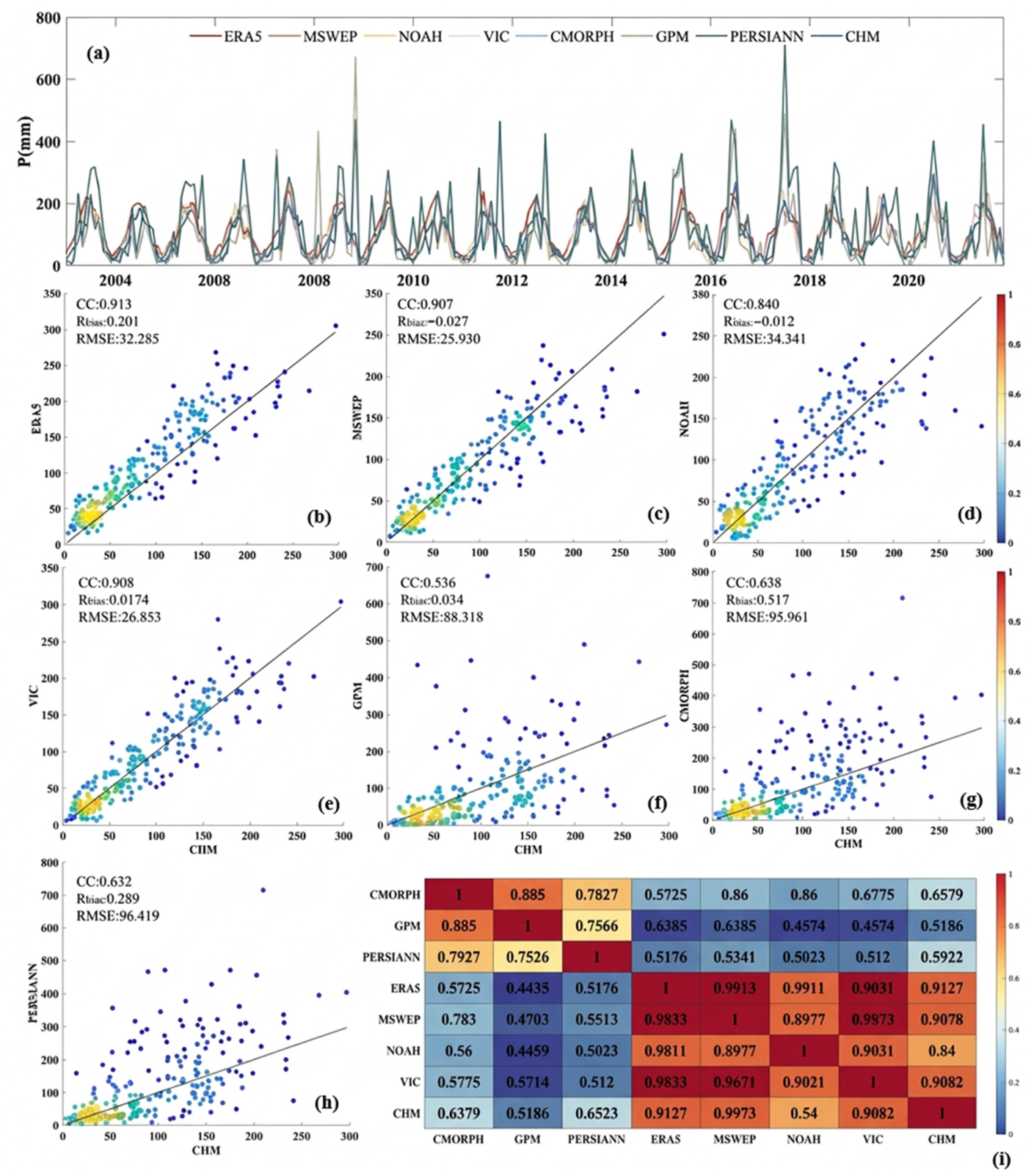
As shown in Figure 2, when comparing the typical accuracy metrics (RMSE, CC, and Rbias) of all precipitation products, the accuracy of reanalysis precipitation datasets is substantially higher than that of others, with an overall RMSE of 29.108 mm and a CC of 0.910. Specifically, the MSWEP dataset yields the smallest RMSE of 25.930 mm among all datasets, while the ERA5-Land dataset achieves a comparably high CC of 0.913. This suggests that there is greater consistency between the reanalysis precipitation datasets and the ground reference measurements. The accuracy of precipitation datasets derived from land surface models is close to that of reanalysis datasets, with an RMSE of 30.567 mm and a CC of 0.874.
In contrast, satellite-based precipitation datasets exhibit the poorest performance across the three categories, with an overall RMSE of 93.566 mm and a CC of 0.602. Among these satellite datasets, PERSIANN has the largest RMSE of 96.419 mm, and GPM has the lowest CC of 0.536. This sub-optimal performance of Satellite Precipitation Products (SPPs) is largely driven by their distinct “two-regime” error characteristics, as revealed by the scatter plots in Figure 2. In the low-precipitation regime (<50 mm/month), SPPs show extremely high uncertainties with relative errors nearly reaching 100%. This is likely due to the limited sensitivity of Infrared (IR) and Passive Microwave (PMW) sensors to shallow clouds and light orographic rain. Conversely, in the high-precipitation regime (>100 mm/month), the fitting performance improves significantly (with errors dropping below 50%), as deep convective systems with abundant ice-phase particles provide stronger microwave scattering signals that are more easily captured by satellite sensors. This inherent uncertainty in low-intensity precipitation events is a major contributor to their overall lower accuracy.
Reanalysis precipitation datasets can provide more thorough and precise precipitation information because they often incorporate several observational data and sophisticated assimilation processes [35]. The results of the GLDAS land surface model may be limited by model assumptions and parameterization schemes, which in some situations may not adequately represent actual precipitation conditions, even though it can simulate precipitation based on physical processes—an approach that more accurately reflects the interaction between precipitation and surface hydrological processes [36]. Despite the advantages of high spatiotemporal resolution and global coverage, there are some circumstances in which satellite-based precipitation databases may produce imprecise precipitation estimates because of variables like cloud cover, sensor accuracy, and atmospheric conditions [37,38].
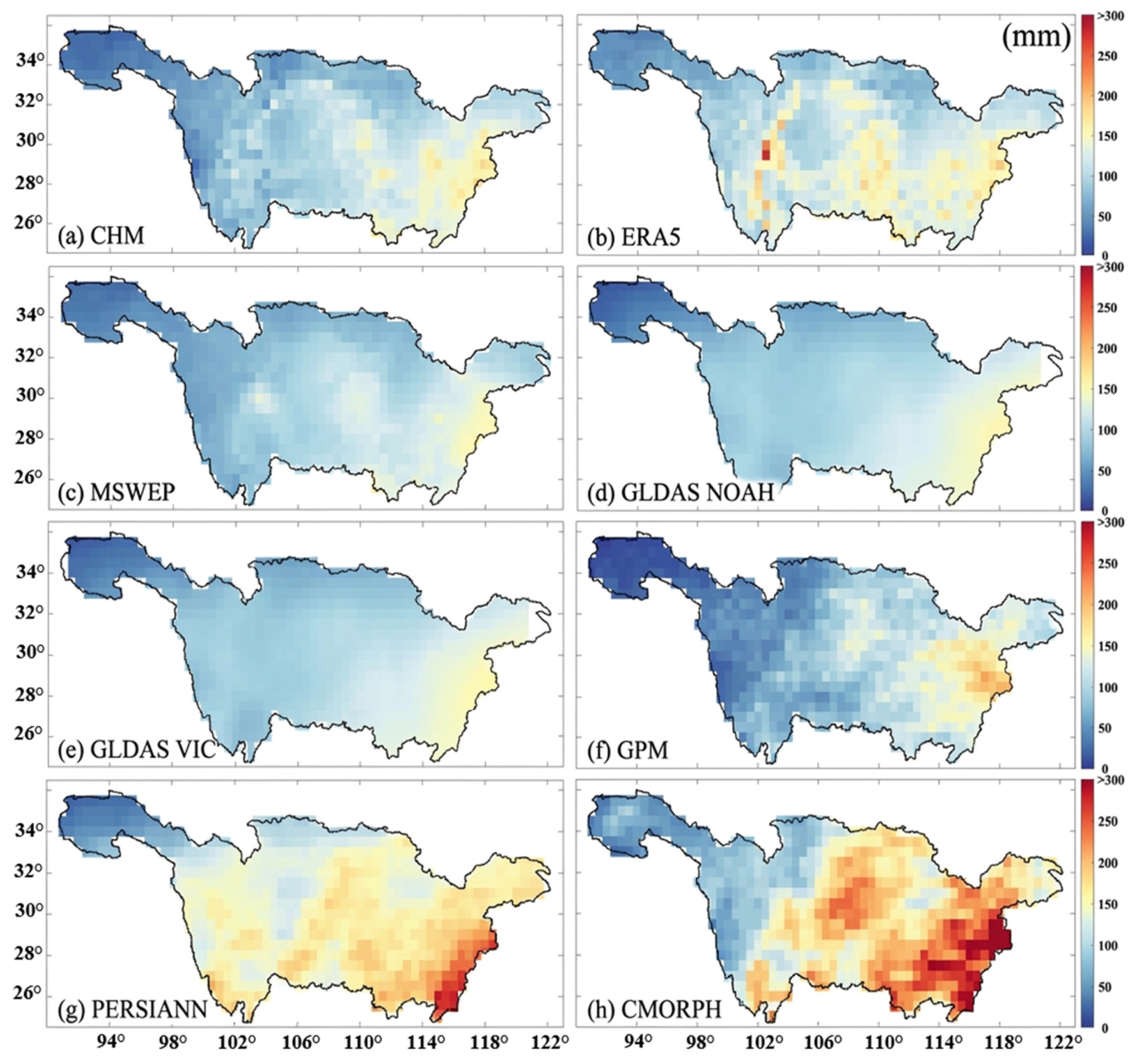
Figure 3 compares the spatial mean distribution of seven different precipitation datasets in the Yangtze River Basin from 2003 to 2021 with the ground reference measurements (CHMP dataset). The spatial distribution of the CHMP dataset, shown in Figure 3a as the benchmark, which demonstrates that the Poyang Lake and Dongting Lake basins within the Yangtze River Basin have significantly higher annual average precipitation than other locations. The high regions of the Jinsha River Basin, on the other hand, experience the least amount of annual average precipitation of any sub-basin. The spatial distribution properties of the CHMP dataset are comparable to those of other precipitation datasets, such as ERA5, MSWEP, NOAH, VIC, and GPM. However, the distribution trends in the NOAH and VIC datasets are very smooth, while the geographical features in the ERA5, MSWEP, and GPM datasets provide more thorough information. The different observational techniques and processing algorithms employed by each dataset may account for this discrepancy. A number of factors, including cloud cover, sensor accuracy, atmospheric condition uncertainties, and changes in land cover, can combine to cause biases in precipitation estimation over the Yangtze River Basin that are either overestimated or underestimated in satellite-based precipitation datasets.

3.2. Precipitation Data Error Estimation and Fusion

According to studies, distortions in error estimation results can arise from breaking the TC assumptions. This could be explained by the fact that many precipitation products employ the same equipment and observational techniques [39]. The great majority of satellite-based solutions use measurement data from microwave and infrared sensors to estimate precipitation. Measurements from several identical observation stations are also included in reanalysis and gauge-based outputs. Additionally, gauge-based data is used for bias correction in a wide variety of goods. As a result, selecting precipitation datasets carefully is essential to guaranteeing accurate TC technique outcomes. According to current ideas, triplets that contain three different kinds of precipitation products should produce the most accurate uncertainty estimates in order to maximize the independence of datasets.
Considering the TC assumptions, this paper designed cross-experiment groups for analysis, where one dataset was randomly selected from each category of reanalysis datasets, satellite-based datasets, and land surface model monthly scale datasets to form triplets for ETC and MTC analyses. A total of 12 triplet datasets were generated through permutation and combination of the three categories of datasets to identify the optimal triplet, namely: ERA5-PERSIANN-NOAH (EPN), ERA5-CMORPH-NOAH (ECN), ERA5-GPM-NOAH (EGN), ERA5-PERSIANN-VIC (EPV), ERA5-CMORPH-VIC (ECV), ERA5-GPM-VIC (EGV), MSWEP-PERSIANN-NOAH (MPN), MSWEP-CMORPH-NOAH (MCN), MSWEP-GPM-NOAH (MGN), MSWEP-PERSIANN-VIC (MPV), MSWEP-CMORPH-VIC (MCV), and MSWEP-GPM-VIC (MGV).
These designed combinations follow the “high-medium-high” arrangement of the original data accuracy, aiming to enhance the diversity and dynamic range of the datasets through the combination of data at different accuracy levels. This strategy not only helps to more comprehensively capture the variations and fluctuations in precipitation estimates, but also enables more accurate modeling and understanding of system behavior by integrating data across different accuracy levels, thereby improving the reliability and robustness of precipitation estimates. Multi-level data combinations also facilitate the evaluation and correction of potential biases among datasets with different accuracy levels, further improving the overall data quality.
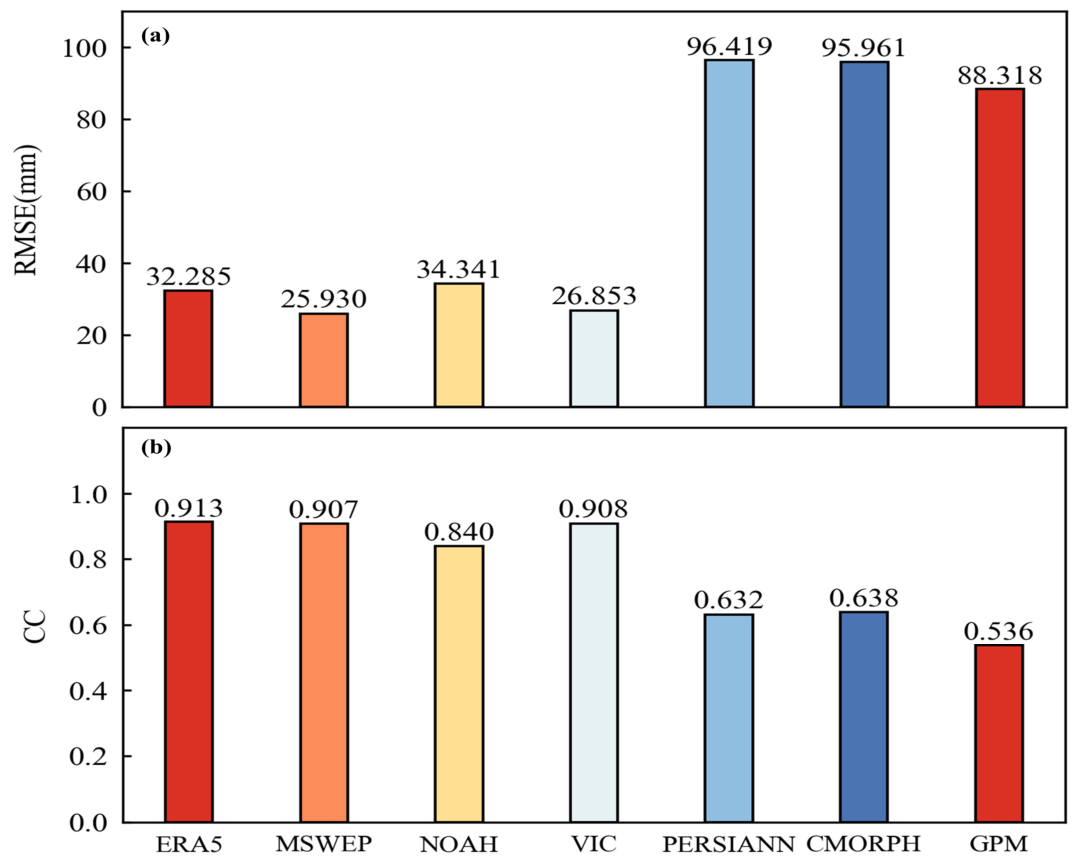
Figure 4 presents the traditional accuracy metrics of seven precipitation datasets, including the RMSE and CC, which are used for comparison with the accuracy evaluation metrics derived from the TC method. In addition to evaluating the differences between the evaluation metrics produced by the ETC and MTC methods to choose the best triplets for data fusion, this comparison attempts to confirm the accuracy of the evaluation metrics computed by the TC method in the absence of ground truth data.
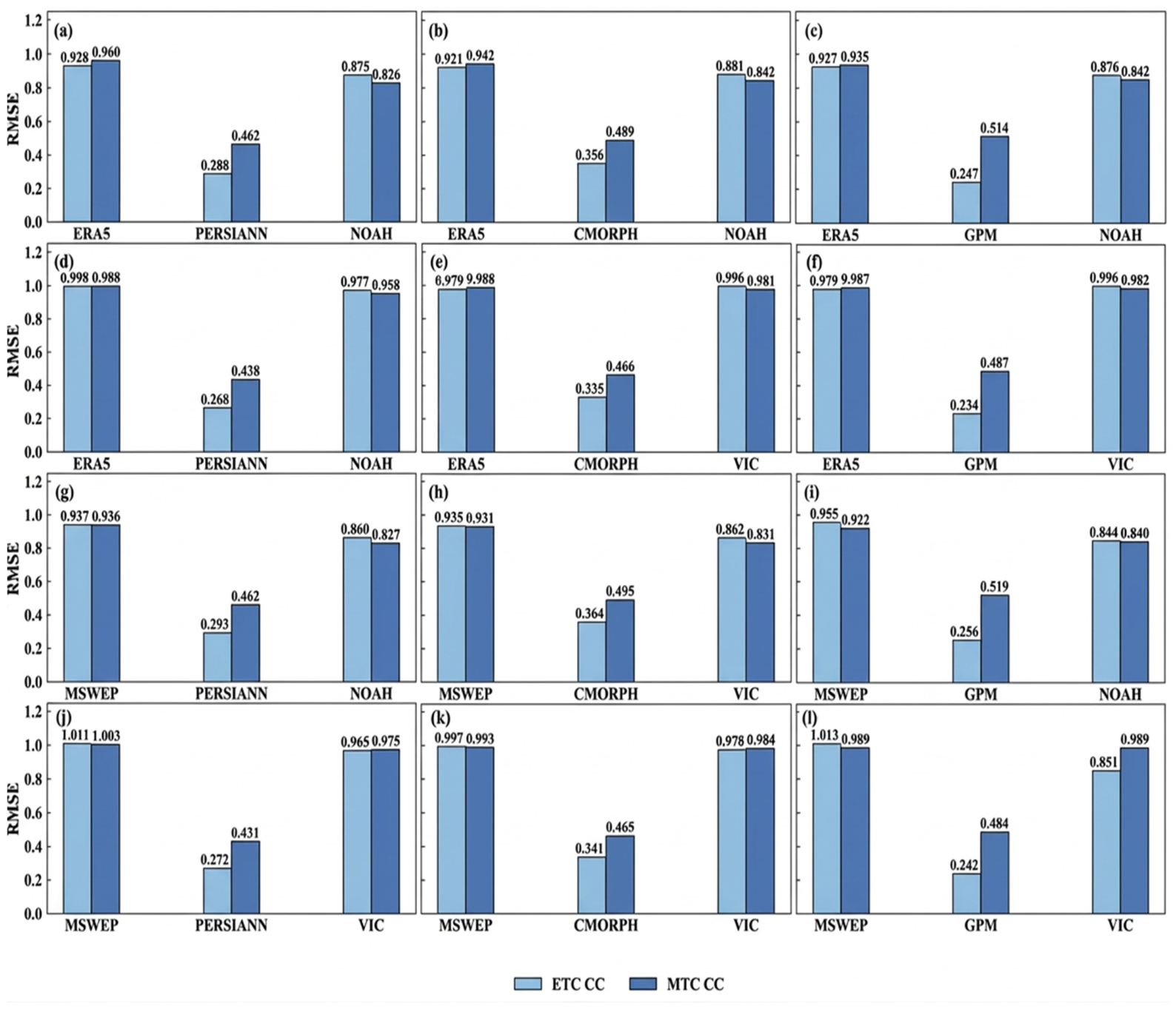
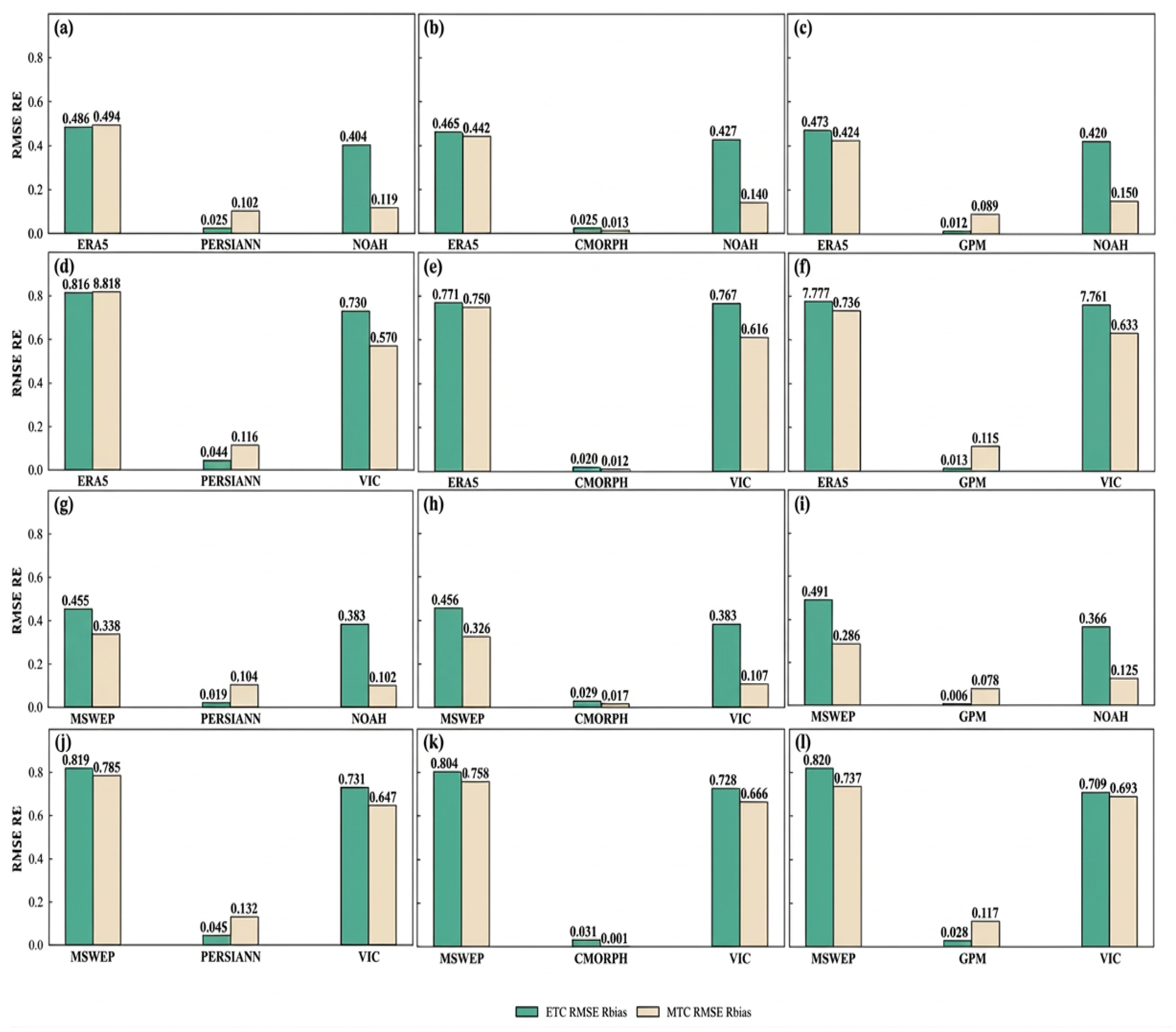
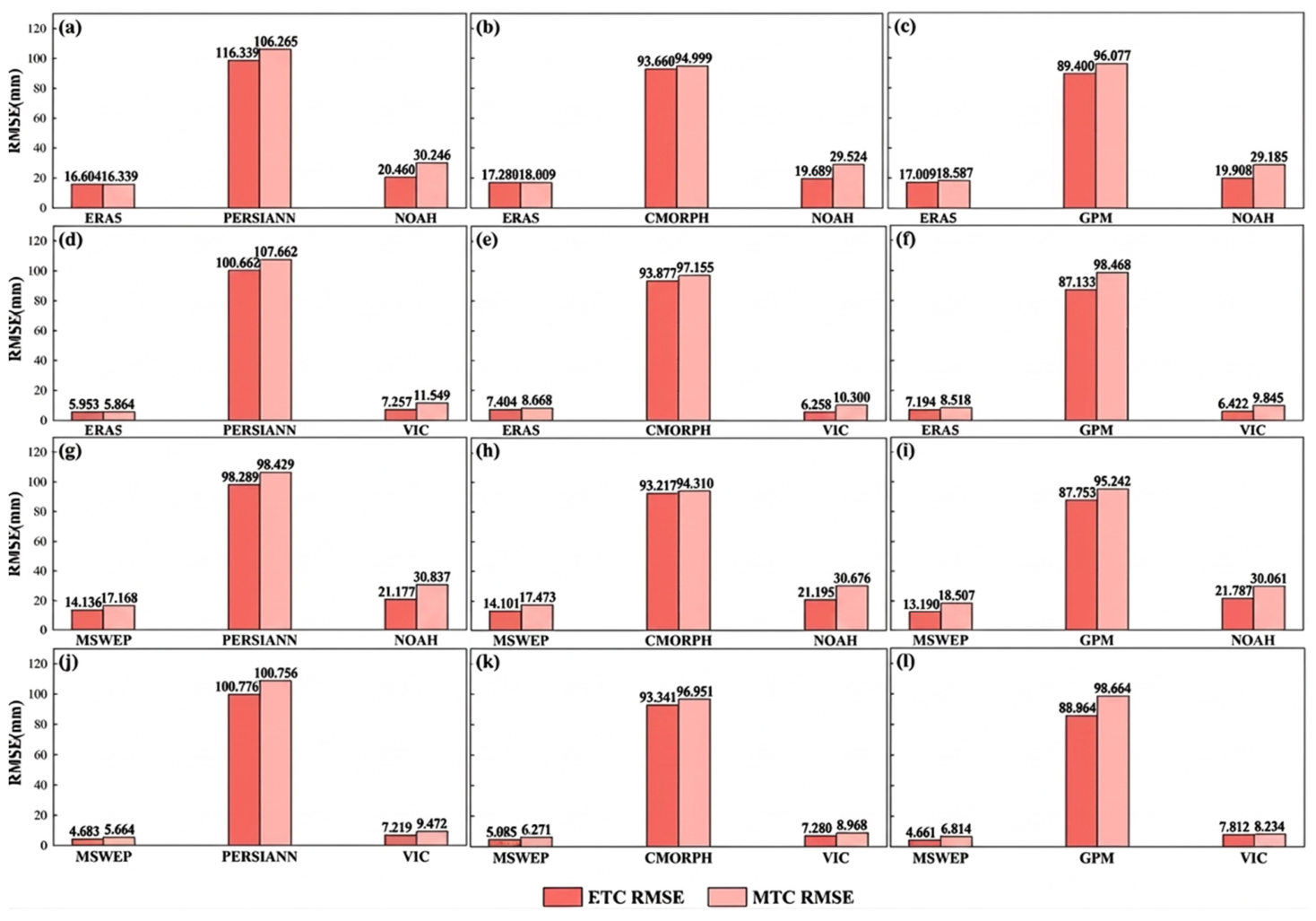
The comparison of RMSE calculated using the ETC and MTC method for various triplet combinations is shown in Figure 5a–l. As shown in Figure 5, the ETC method tends to underestimate the RMSE when evaluating high-precision precipitation datasets. Specifically, the RMSE values of ERA5 and MSWEP calculated by the ETC method are generally below 20 mm, whereas the RMSE derived from the traditional accuracy assessment metric reaches 32.285 mm. The RMSE calculated using the ETC method is reasonably consistent with the actual values when analyzing low-precision precipitation datasets, with both values typically falling between 90 and 100 mm.
Although the MTC method also tends to underestimate the RMSE when evaluating high-precision precipitation datasets, the RMSE values estimated by this method are larger than those derived from the ETC method. Moreover, for the second high-precision precipitation dataset in the high-medium-high triplet combination, the MTC method yields results that are closer to the traditional accuracy metric. For example, in the case of NOAH, the RMSE calculated by the MTC method is more consistent with that of the traditional accuracy metric, with values roughly ranging from 30 to 35 mm. When evaluating low-precision precipitation datasets, the MTC method may slightly overestimate the RMSE. Figure 6 illustrates the comparison of CC values derived from the two methods, and Figure 7 displays the relative errors between the RMSEs estimated by the two TC methods and the RMSE calculated using the traditional accuracy metric, where a smaller relative error indicates a closer agreement with the traditional RMSE. It is evident from the data shown in Figure 7 that the RMSE estimated by the MTC method has smaller relative errors than the RMSE determined by the ETC method.
In the comparative analysis of CC, as shown in Figure 6, both the ETC and MTC methods tend to overestimate CC when evaluating high-precision precipitation datasets, whereas they may underestimate CC when evaluating low-precision precipitation datasets. Nevertheless, the CC values calculated by the MTC method are more consistent with the results derived from the traditional accuracy assessment metric.
Consequently, the MTC method provides a more accurate estimation of the true errors in precipitation datasets. This outcome is consistent with other previous studies’ findings [31], demonstrating that the MTC method outperforms the ETC method in assessing the accuracy of precipitation datasets. To verify how effectively the two strategies function in terms of data fusion, more testing is still required.
Based on the evaluation metrics estimated by the TC methods, a series of screening and comparison processes were conducted in this study to identify the optimal triplet combinations for fusion to improve precipitation accuracy. Among the initial twelve combinations, those with abnormal evaluation results were excluded according to the traditional accuracy metrics (RMSE and CC). By analyzing the data presented in Figure 5, Figure 6 and Figure 7, it was found that four combinations, namely ERA5-PERSIANN-VIC (EPV), ERA5-CMORPH-VIC (ECV), ERA5-GPM-VIC (EGV) and MSWEP-GPM-VIC (MGV), exhibited significant deviations from the traditional accuracy metrics, and thus these combinations were excluded from subsequent analyses.
After excluding the aforementioned four combinations, the optimal triplet combinations were further screened from the remaining eight. The screening criteria were based on the relative errors between the RMSEs estimated by the ETC and MTC methods and the RMSE derived from the traditional accuracy metric. If the relative errors of the two precipitation datasets were relatively low and the difference between them was within an acceptable range, these two combinations were considered approximate and thus could be selected as the optimal triplet combinations.
Specifically, the combinations with superior relative errors estimated by the ETC method are ERA5-GPM-NOAH (EGN) and MSWEP-GPM-NOAH (MGN), as shown in Table 2. In contrast, the combinations with better relative errors obtained via the MTC method are ERA5-PERSIANN-NOAH (EPN) and MSWEP-PERSIANN-NOAH (MPN), presented in Table 3. Ultimately, these four groups of data were selected as optimal triplets, which will be applied in the subsequent data fusion process to achieve precipitation estimates with higher accuracy.
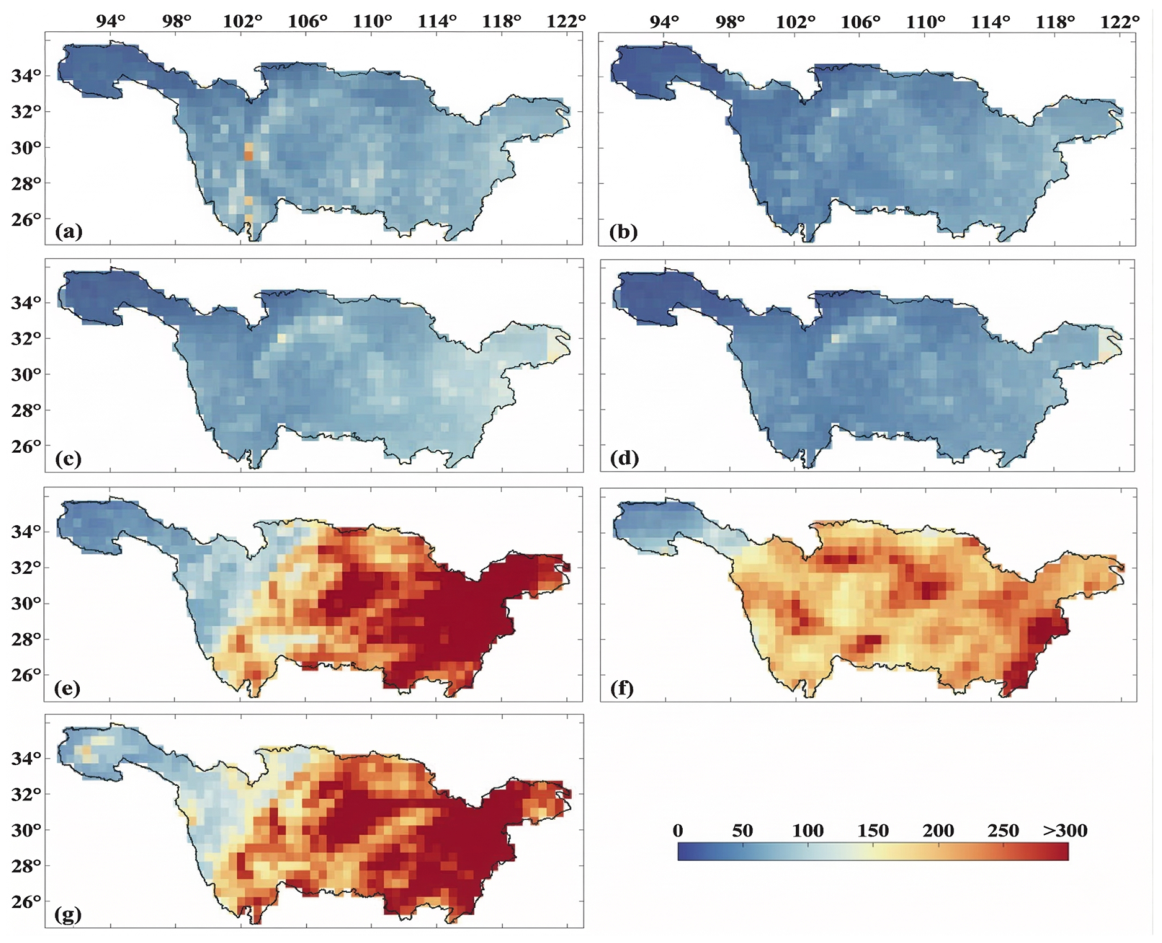
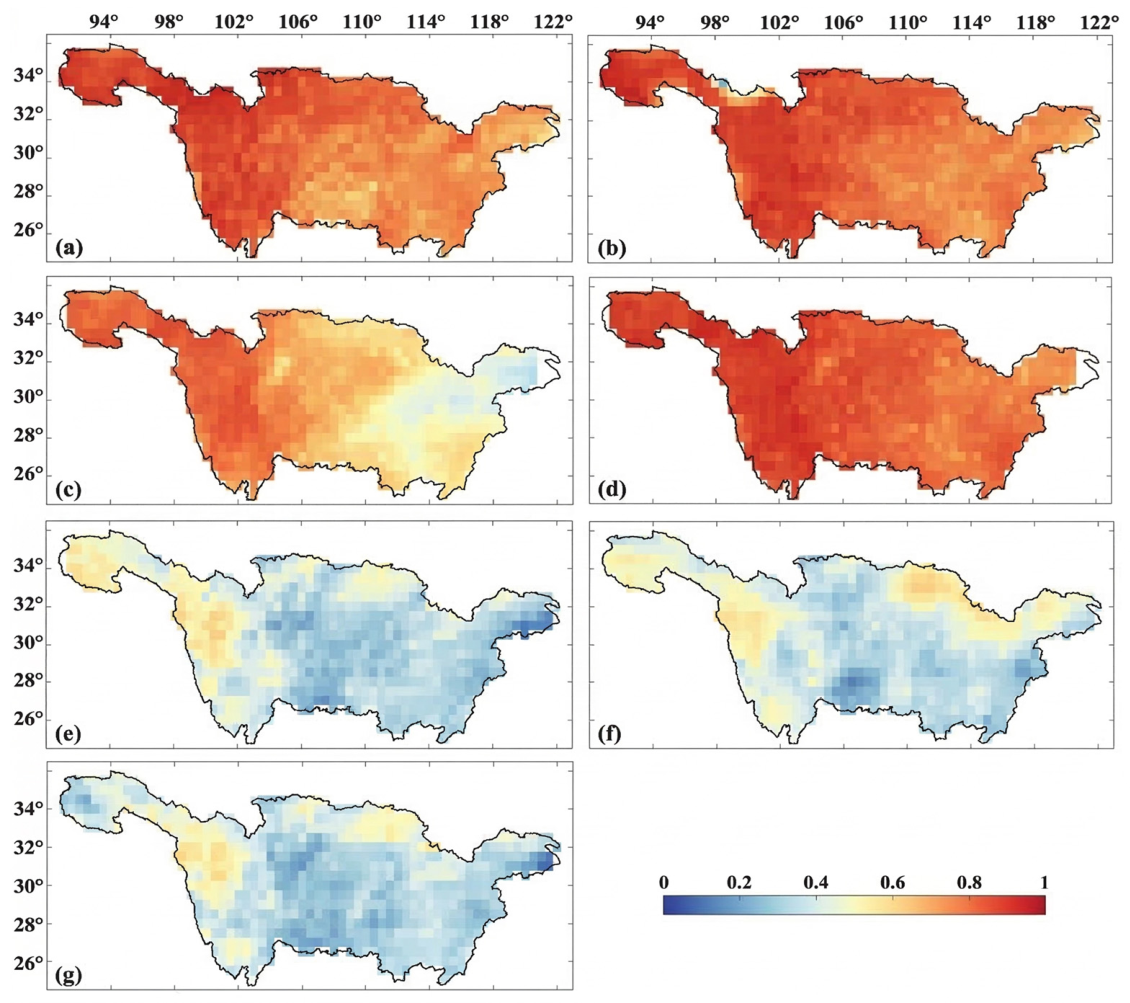
As shown in Figure 8 and Figure 9, additional spatial distribution analysis was carried out to produce the spatial distribution maps of seven precipitation datasets based on the two conventional accuracy evaluation metrics (RMSE and CC). Table 4 provides a detailed list of these dataset’s spatial mean values. Among the four datasets (ERA5, MSWEP, GLDAS NOAH, and GLDAS VIC), it is evident that the land surface model and reanalysis precipitation datasets perform better in terms of spatial RMSE and CC than the satellite-based datasets (GPM, PERSIANN, and CMORPH). Significant inaccuracies in the spatial precipitation estimation of these two satellite datasets are shown by the fact that, specifically, the spatial RMSE for CMORPH and GPM surpasses 300 mm in over half of the study area. In contrast, the MSWEP dataset has the lowest spatial average RMSE (only 21.097 mm) and a CC of 0.795, demonstrating high accuracy; whereas the CMORPH dataset shows the highest spatial average RMSE (up to 92.500 mm) and a CC of 0.360, indicating relatively low accuracy.
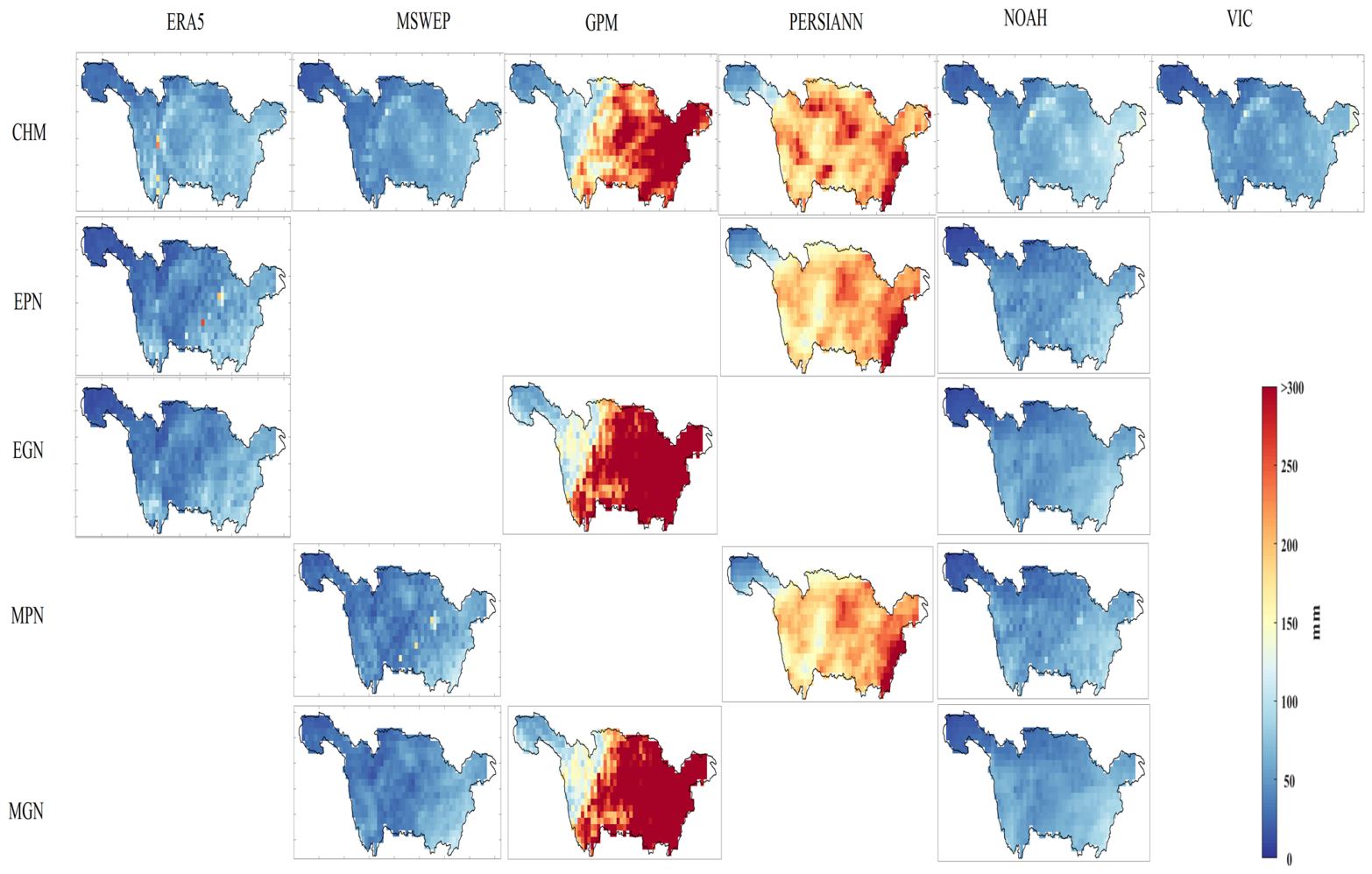
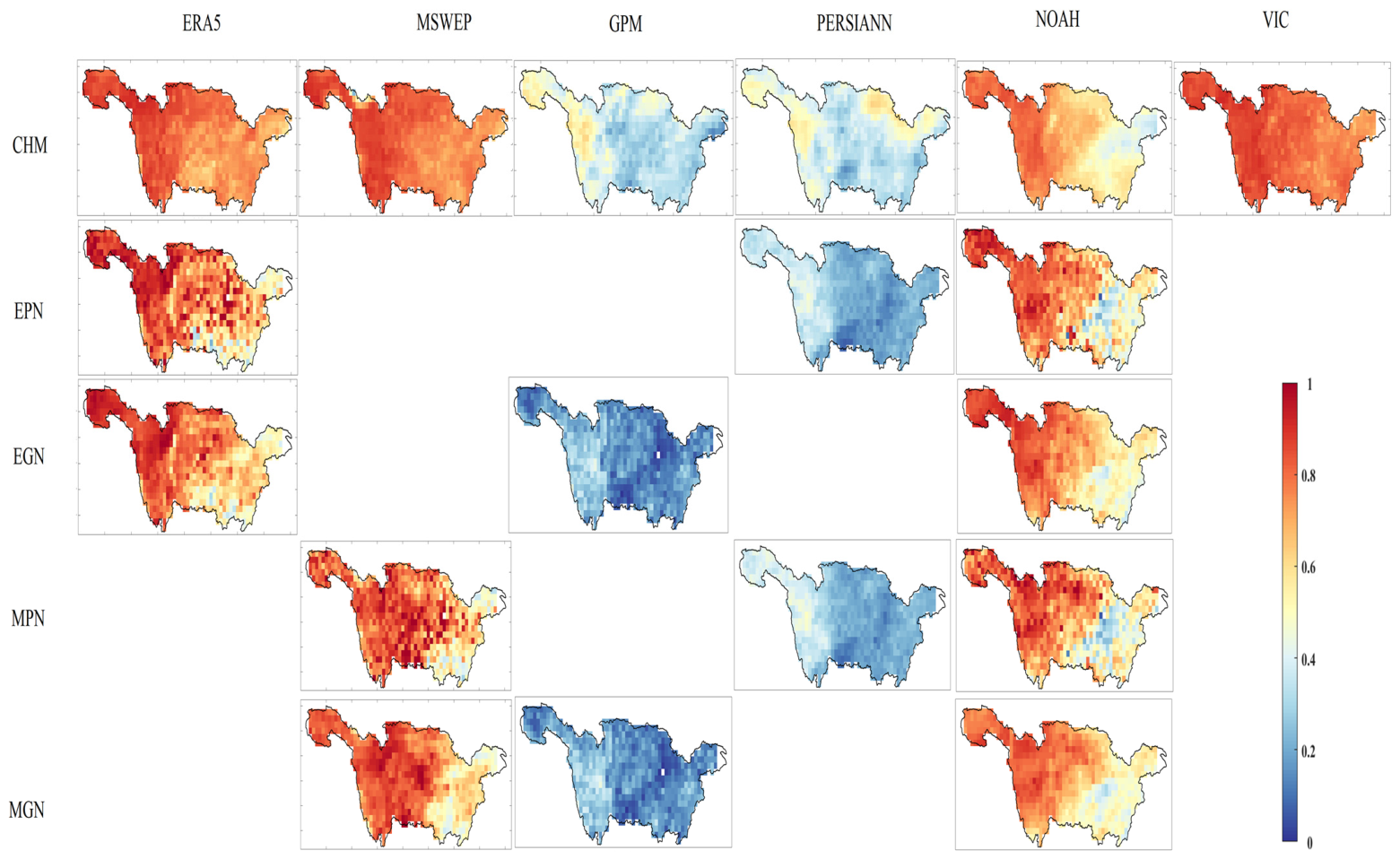
Four triplet combinations were selected: EPN, EGN, MPN, and MGN. The evaluation metrics (RMSE and CC) computed by the TC techniques were subjected to spatial distribution analysis. EGN and MGN are based on evaluation metrics obtained from the ETC method, whereas EPN and MPN are based on the evaluation metrics obtained from the MTC method. The spatial distribution maps of the conventional accuracy evaluation metrics are displayed in the first row of Figure 10 and Figure 11 to evaluate the accuracy of the RMSE determined by the TC methods. Following that, these maps are contrasted with the RMSE and CC spatial distribution maps that the TC methods below produced.
The spatial distribution of RMSE determined by the TC method for the four triplet combinations is mostly comparable to that obtained using the conventional accuracy evaluation metrics, as shown by the RMSE spatial distribution maps in Figure 10. However, in some regions, especially when evaluating precipitation datasets with low accuracy, the RMSE values calculated by the TC methods are generally higher. For example, in the EGN and MGN triplet combinations, the areas where the RMSE of the GPM datasets estimated by the TC methods exceeds 300 mm are significantly larger than those covered by the RMSE derived from the traditional accuracy evaluation metrics. This indicates that the TC methods may overestimate the errors to a certain extent when processing satellite-based datasets. While the spatial distribution trends are essentially unchanged, the RMSE values estimated by the TC methods for the high-precision precipitation datasets in the triplet combinations are about 10 mm higher than those obtained from the traditional accuracy evaluation metrics in the lower reaches of the Jinsha River Basin, Minjiang River Basin, Jialing River Basin, upper reaches of the Yangtze River Basin, and Wujiang River Basin. This suggests that the TC methods still maintain good consistency in the evaluation of these high-precision datasets, but there is a certain deviation in the numerical values.
Combined with the spatial average RMSE data presented in Table 5, it can be found that the RMSE of the MPN triplet combination estimated by the TC method is the closest to that derived from the traditional accuracy evaluation metric, with the minimum relative error compared with the RMSE of the traditional accuracy evaluation. Specifically, the relative errors for MSWEP, PERSIANN, and NOAH were 0.109, 0.124, and 0.192, respectively. These results indicate that within these specific triplets, the TC method can accurately characterize the error properties of precipitation data. Notably, in the MPN combination, the TC estimates exhibited the highest consistency with traditional evaluation metrics.
As shown in Figure 11, the CC values calculated by the TC methods tend to be relatively low when evaluating low-precision precipitation datasets. Particularly in regions such as the Jinsha River Basin and the Hanjiang River Basin, the CC values of the PERSIANN dataset in the EPN and MPN triplet combinations, as well as those of the GPM dataset in the EGN and MGN triplet combinations, are substantially lower than the CC values obtained from the conventional accuracy evaluation metrics. On the other hand, the CC values determined by the TC methods are considerably higher in the upper reaches of the Yangtze River Basin but lower in the lower reaches when analyzing high-precision precipitation datasets, such as the ERA5 and MSWEP datasets included in the four triplet combinations. This trend is even more noticeable in the NOAH dataset.

3.3. Comparison and Evaluation of Precipitation Data Fusion

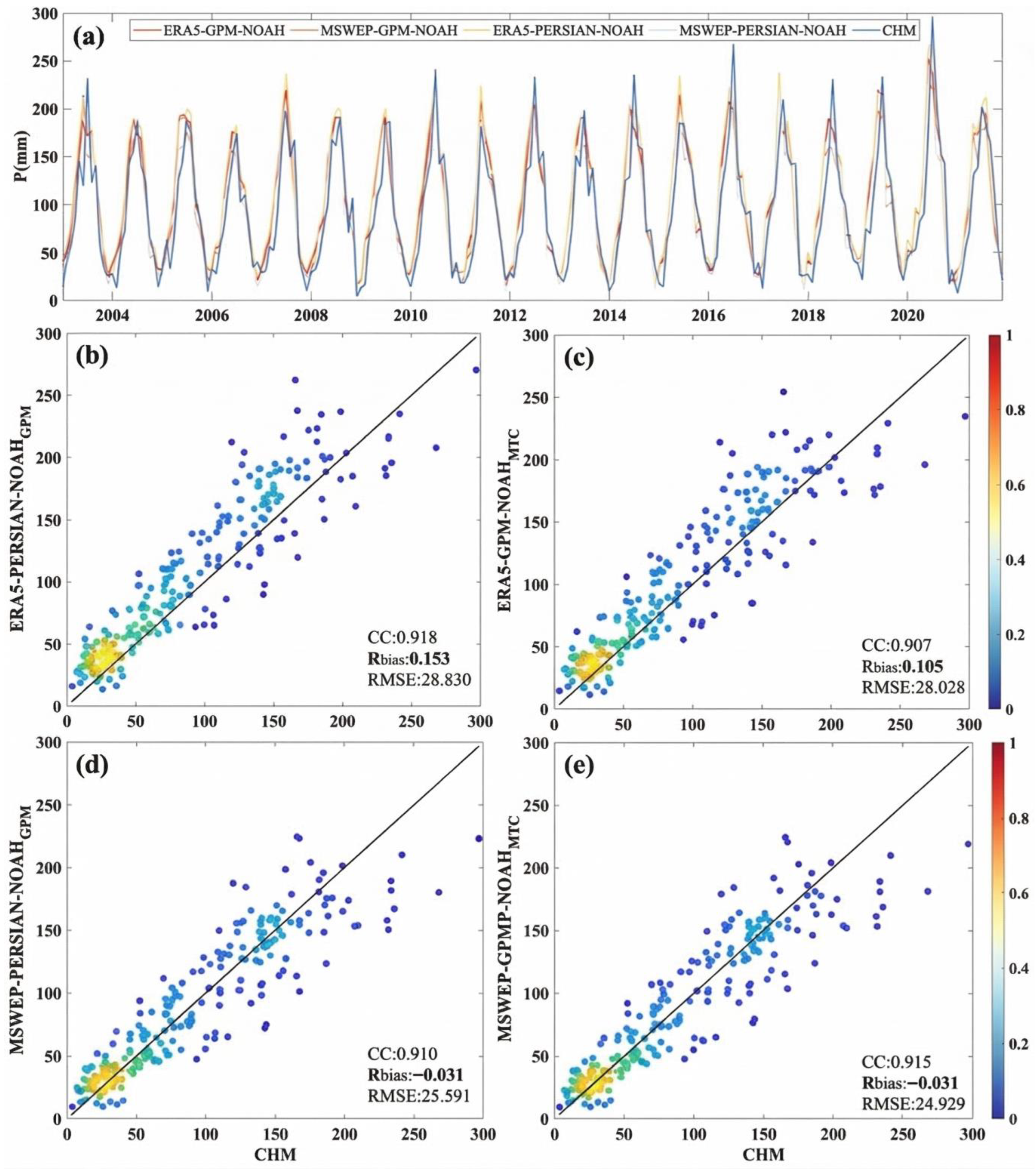
Figure 12 shows the time series comparison between the four precipitation datasets fused by the ETC and MTC methods and the reference dataset CHMP. The figure shows that, in terms of the general trend, the datasets fused using the ETC and MTC methods both retain good consistency with the CHMP reference dataset. However, there are certain differences between the fused datasets and the reference dataset at extreme points such as periodic peaks or troughs, which reflects the challenges of TC-based least squares fusion in capturing the extreme value changes of precipitation datasets. A further analysis of the scatter plots in Figure 12b–e reveals that the scatter distribution of the four groups of fused datasets is relatively uniform, indicating that the fusion methods can balance the errors of different data sources to a certain extent and provide relatively reliable precipitation estimations. Among these fusion results, the MPN triplet combination fused by the MTC method performs best, with the lowest RMSE among the traditional accuracy evaluation metrics at only 24.929 mm, demonstrating high precision. Meanwhile, its CC reaches 0.915, ranking second highest, which further confirms the strong correlation between the fused dataset of the MPN triplet combination and the reference dataset. In addition, the Rbias value is −0.031, indicating that the MTC method achieves effectively constrains Rbias relative to the reference dataset when fusing the MPN triplet combination.
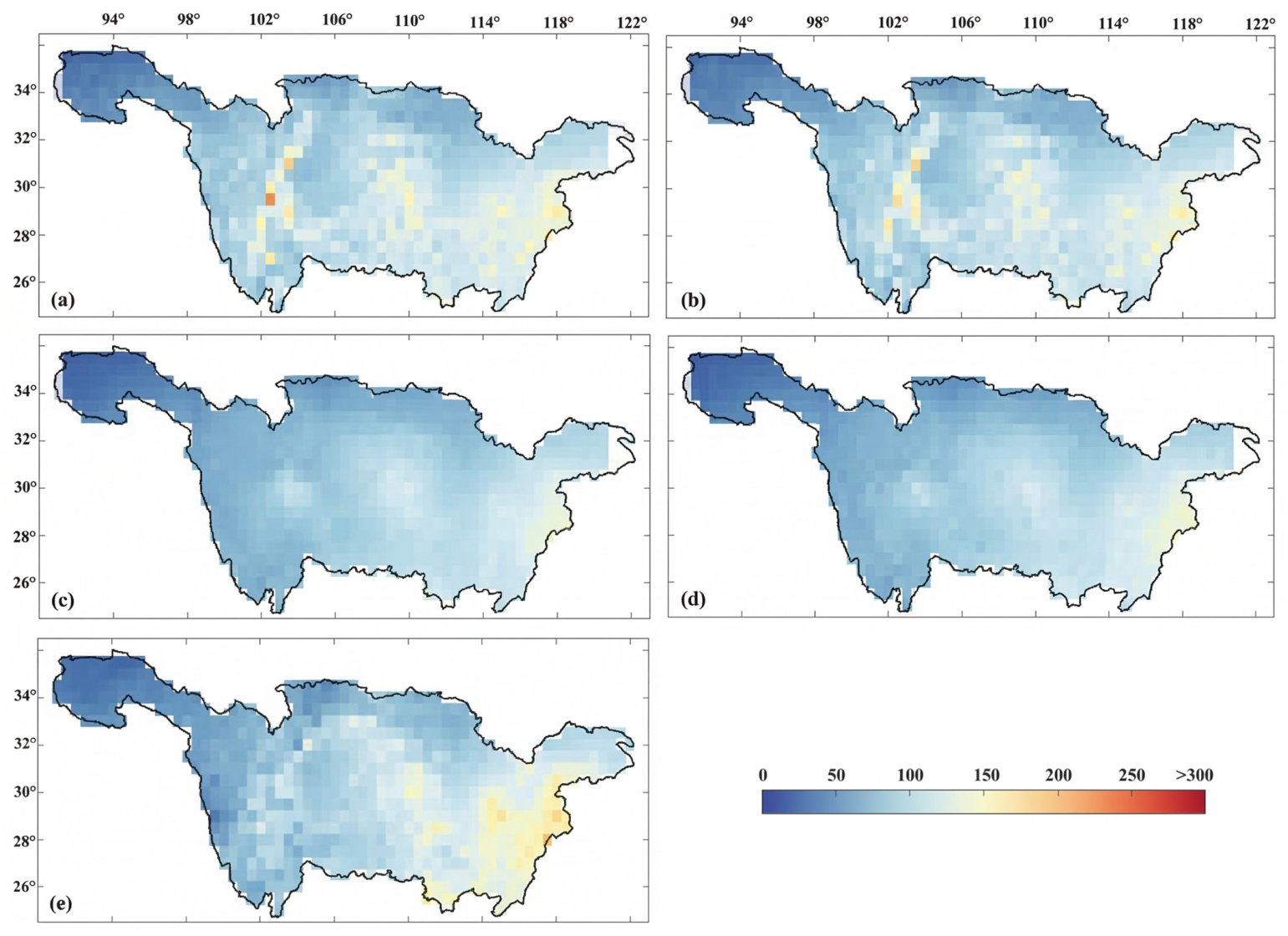
The spatial distribution of mean grids for the four fused precipitation datasets is shown in Figure 13. The fusion results of the EPN and MPN combinations processed by the MTC method exhibit a high degree of consistency with the reference dataset CHMP in terms of spatial distribution. In contrast, there are some differences between the ETC method and the reference dataset CHMP in small locations, despite the ETC method maintaining strong overall consistency in spatial distribution. This could be because different data sources have varied spatial resolutions and temporal synchronization, or because the ETC method is highly sensitive to local intense precipitation occurrences when processing diverse data sources. However, the ETC method is still able to produce reasonably accurate precipitation estimates, suggesting that it has some resilience when combining precipitation datasets.
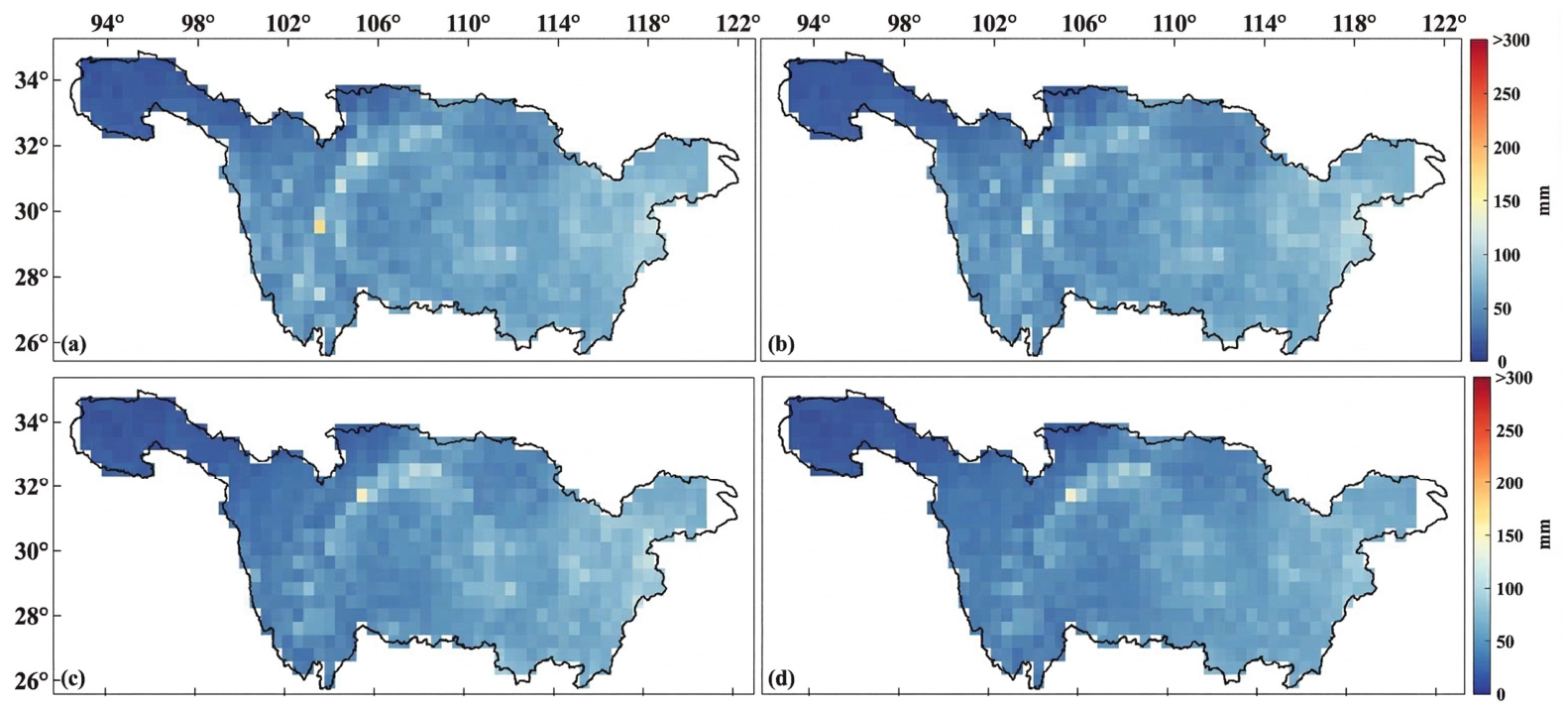
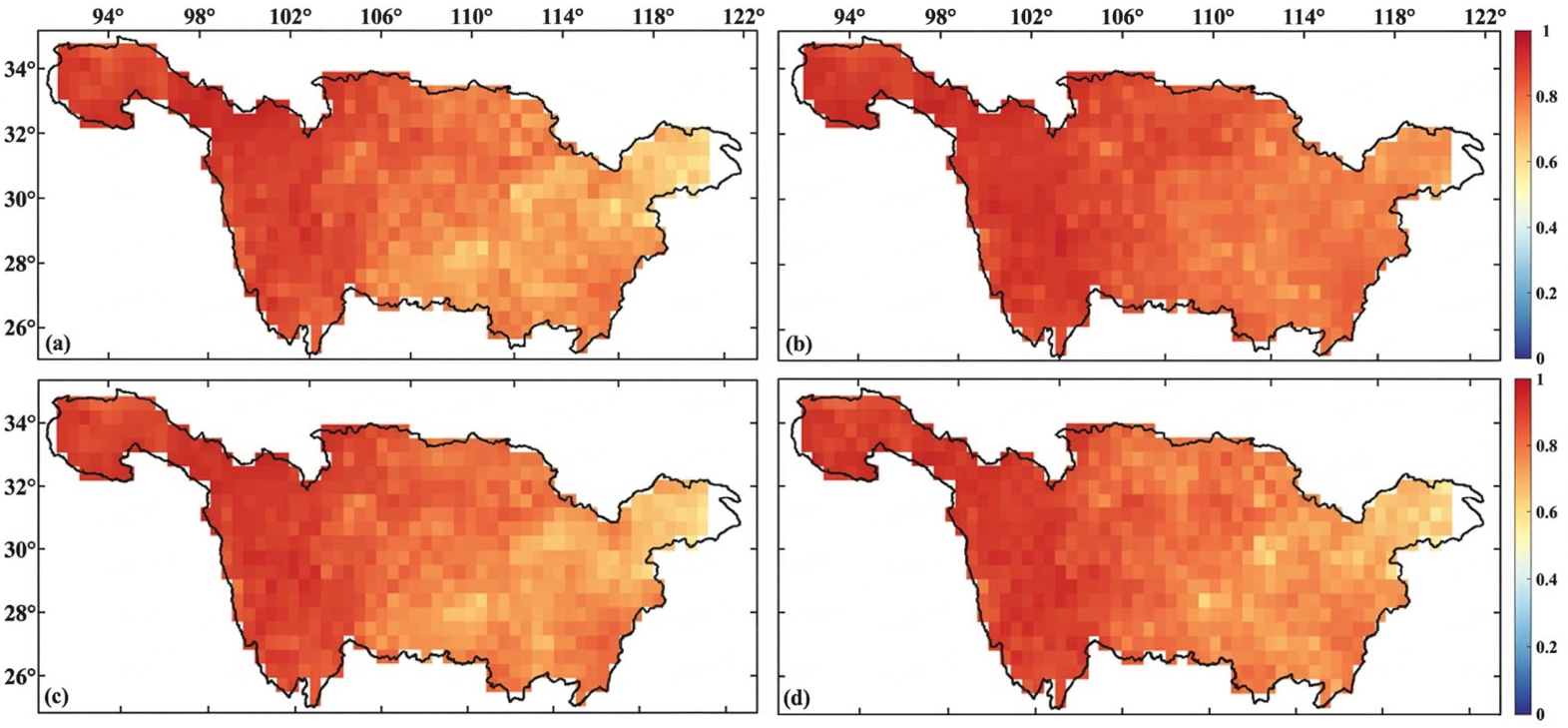
The spatial distribution of the conventional accuracy evaluation measures (RMSE and CC) for the four fused precipitation datasets are displayed in Figure 14 and Figure 15, respectively. Overall, there is good consistency between the fused precipitation datasets and the reference CHMP dataset. When combining the EPN and MPN combinations, the MTC method produces a comparatively low RMSE geographic distribution for Figure 14a,b, suggesting that these combinations achieve good overall accuracy in precipitation estimation. As shown in Table 6, the mean RMSE value for the MPN combination is the smallest, with a value of 51.422 mm. This further supports the MTC algorithm’s superior performance in handling this particular combination. Furthermore, compared to the other three fused datasets, the CC values of the MPN combination in Figure 15b are more evenly distributed. The highest mean value of 0.800 indicates a significant correlation with ground reference measurements. This suggests that the MTC method can provide more accurate precipitation estimates by reducing errors while maintaining high correlation. For Figure 14c,d, although the ETC method can still provide relatively stable precipitation estimations when fusing the EGN and MGN combinations, the RMSE values may be relatively high in local areas. The CC values of the EGN and MGN combinations in Figure 15c,d are still high in the majority of locations, although they are lower in the lower portions of the Taihu Lake Basin and Yangtze River Basin, ranging from 0.5 to 0.6. This indicates that the ETC fusion has relatively high uncertainty in these regions.

4. Discussion

4.1. Analysis of Regional Differences in the Spatial Distribution of Precipitation Data in the Yangtze River Basin

The spatial distribution of conventional accuracy assessment criteria for satellite precipitation data across the Yangtze River Basin exhibits significant regional variations. In the northwest Yangtze River Basin, especially the Jinsha River Basin, satellite precipitation data frequently have low CC and RMSE. This may be related to the climate and precipitation patterns of the area. This tendency implies that satellite-based precipitation forecasts may be more accurate in this area. In the northwest region of the Yangtze River Basin (especially in the Jinsha River Basin), due to the fact that this area is located deep inland and is blocked by complex mountainous and canyon terrain, it is less influenced by the East Asian summer monsoon. The precipitation is mainly weak precipitation formed by local topographic uplift. This unique climate feature and the complex underlying surface conditions result in satellite sensors exhibiting different error characteristics when capturing low-intensity precipitation compared to other middle and lower reaches river basins. Furthermore, in the high-altitude headwater regions of the Yangtze River where elevations can exceed 6000 m, the complexity of topography and the prevalence of solid precipitation (snow and ice-phase precipitation) further exacerbate measurement uncertainties. It is important to clarify that the ground reference dataset (CHMP) used in this study relies on gauge observations that have been uniformly converted to Liquid Water Equivalent according to the China Meteorological Administration standards, thus bypassing the need for additional Snow Water Equivalent conversions in our analysis. However, the accurate measurement of solid precipitation in such extreme alpine environments remains a formidable challenge. As demonstrated by earlier research conducted by scholars, the complex microphysical evolution of ice-phase clouds and the severe wind-induced undercatch of snow significantly degrade the reliability of gauge-based observations. These inherent observational limitations of the reference data itself, combined with the physical deficiencies of satellite sensors in retrieving cold-cloud precipitation, collectively contribute to the pronounced discrepancies observed in these high-altitude regions [40,41].
As the area extends along the main stem of the Yangtze River, encompassing its upper, middle, and lower reaches, both the RMSE and CC exhibit a gradual increasing trend. Further southeast, the RMSE and CC remain high, particularly in the Dongting Lake and Poyang Lake Basins, suggesting that satellite precipitation data in these regions is not very reliable. This outcome may be caused by the distinct climate, complex geography, and potential air interferences of the research area. This finding aligns with conclusions from numerous previous studies, which indicate that topographic complexity and unique climatic conditions significantly increase the uncertainty of satellite-based precipitation retrievals [42].
In contrast to satellite precipitation data, the geographic distribution trends of precipitation data obtained from land surface models and reanalysis are rather uniform, with far fewer noticeable regional differences. This is most likely because reanalysis and land surface model data are more consistently applicable and accurate across different regions, and their specific processing and correction techniques have somewhat reduced spatial heterogeneity. The TC method may somewhat overstate mistakes while processing satellite precipitation data. Despite the generally consistent spatial distribution trends in Figure 10, the RMSE estimates derived from the TC method for the high-precision precipitation datasets in the lower Jinsha, Minjiang, Jialing, and Wujiang basins are about 10 mm slightly higher than those obtained from conventional accuracy evaluation metrics, this discrepancy is negligible when contextualized against the regional monthly precipitation totals, which often exceed several hundred millimeters. Such a difference falls well within the range of expected systematic fluctuations. Crucially, both methods exhibit a strong consistency in their spatial distribution patterns. This alignment underscores that the TC method effectively captures error characteristics comparable to traditional metrics, validating its robustness for assessing high-precision satellite precipitation products even in the absence of ground truth. However, the TC method can cause RMSE and CC to be underestimated for low-precision precipitation datasets. While the relative RMSE error suggests that the metrics of the MGN triplet estimated by the MTC method are more consistent with those derived from traditional accuracy evaluation metrics when compared to other triplets, the RMSE values estimated by the ETC and MTC method demonstrate minimal differences.

4.2. Analysis of Precipitation Data Fusion Accuracy

As shown in Figure 2 and Figure 12, the long-term sequence changes have been clearly presented. These sequences can already reflect the seasonal and interannual fluctuations of precipitation. At the same time, by quantifying RMSE and CC, the differences in long-term precipitation trends can be further understood and analyzed. This content is also the key direction for future research. Overall consistency between the fused precipitation data and the reference data was observed based on the spatial distribution of the traditional accuracy evaluation measures (CC and RMSE) for fused precipitation data. Precipitation estimation reached a comparatively high overall accuracy when the EPN and MPN combinations were fused using the MTC method. The MPN combination’s mean RMSE decreased to 51.422 mm, indicating the MTC algorithm’s greater processing power for this specific combination. Compared to other fused datasets, the MPN combination displayed a greater correlation with ground reference measurements, indicating that the MTC algorithm can maintain a high correlation while lowering errors to produce more precise precipitation estimates.
The CC values obtained by fusing the EGN and MGN combinations using the ETC method remained high in the majority of locations. However, the Taihu Lake Basin and Lower Yangtze River Basin had lower CC values (varying from 0.5 to 0.6) than other basins. This indicates that the ETC fusion method in these domains is relatively high uncertainty. The MTC algorithm efficiently balances multiple mistakes by taking into account the error characteristics of diverse data sources and their reciprocal correlations. The MTC method is more reliable than the ETC method when integrating multiple precipitation data sources. This is especially true when it comes to improving the overall accuracy of precipitation estimation and reducing the intrinsic errors of precipitation data. From the theoretical model analysis, the ETC method is based on the additive error model, while the MTC method adopts the multiplicative error model. In hydrology, precipitation exhibits high spatial heterogeneity and skewed distribution characteristics, and its errors tend to increase with the increase in precipitation intensity. The MTC method demonstrates superior performance in evaluating the precipitation data compared to the ETC method, which also explains that the MTC multiplicative error model based on logarithmic transformation is more in line with the actual physical characteristics of precipitation data.

5. Conclusions

In this paper, seven mainstream monthly precipitation datasets (2003–2021) were divided into three groups, and a cross-error analysis experiment was designed for screening purposes. The CHMP dataset was used as ground reference measurements. Based on TC error estimation and multi-source data fusion, the main conclusions are as follows. MSWEP exhibited the best performance: its monthly mean RMSE was the smallest among the seven datasets (25.930 mm/month), its monthly mean correlation coefficient (CC) ranked among the top three (0.907), and the average grid RMSE and CC were the best (52.351 mm and 0.796, respectively). Compared with traditional accuracy metrics referenced to ground reference measurements, the TC method tended to underestimate RMSE, while the MTC method produced results closer to ground reference measurements than the ETC method. Both the ETC and MTC had two optimal triplet combinations, which only slightly violated the zero-error-correlation assumption. Four fused datasets were evaluated; the fusion from the optimal triplet MSWEP–PERSIANN–NOAH (MPN) using MTC performed best. Relative to the single MSWEP dataset, the fused dataset showed improved traditional accuracy metrics: monthly mean CC increased by 0.8% and RMSE decreased by 3.8%; spatial-grid CC increased by 1.2% and RMSE decreased by 1.8%. For the grid regional average, RMSE decreased by 0.929 mm and CC increased by 0.004, indicating that the MTC-fused precipitation dataset can effectively improve estimation accuracy.

Author Contributions

Conceptualization, R.S. and Y.Z.; methodology, R.S. and G.C.; validation, R.S. and J.C. (Jinglin Cong); formal analysis, R.S. and Y.Z.; investigation, J.C. (Jinglin Cong); resources, Y.Z.; data curation, R.S.; writing—original draft preparation, R.S.; writing—review and editing, R.S. and G.C.; visualization, J.C. (Jifa Chen); supervision, Y.Z.; project administration, R.S.; funding acquisition, G.C. All authors have read and agreed to the published version of the manuscript.

Funding

The project was funded by the National Natural Science Foundation of China (42274012), the Jiangxi Provincial Natural Science Foundation (20252BAC240255; 20242BAB20126); and the Science and Technology Research Project of Jiangxi Provincial Department of Education (GJJ2400202).

Data Availability Statement

The authors can provide the data in this work upon the appropriate request. Due to other current studies, the data are not momentarily available.

Acknowledgments

The authors would like to express their gratitude to the Hubei Key Laboratory of Marine Geological Resources for its generous support. We thank the teams at the Key Laboratory of Poyang Lake Wetland and Watershed Research of Ministry of Education. The authors express their gratitude to the anonymous reviewers for their helpful criticism.

Conflicts of Interest

Author Yanbo Zhang was employed by the company Delta Gamma (Beijing) Technology Co., Ltd. The remaining authors declare that the research was conducted in the absence of any commercial or financial relationships that could be construed as a potential conflict of interest.

References

  1. Li, C.; Tang, G.; Hong, Y. Cross-Evaluation of Ground-Based, Multi-Satellite and Reanalysis Precipitation Products: Applicability of the Triple Collocation Method across Mainland China. J. Hydrol. 2018, 562, 71–83. [Google Scholar] [CrossRef]
  2. Ma, Y.; Yang, Y.; Han, Z.; Tang, G.; Maguire, L.; Chu, Z.; Hong, Y. Comprehensive Evaluation of Ensemble Multi-Satellite Precipitation Dataset Using the Dynamic Bayesian Model Averaging Scheme over the Tibetan Plateau. J. Hydrol. 2018, 556, 634–644. [Google Scholar] [CrossRef]
  3. Shen, Y.; Xiong, A. Validation and Comparison of a New Gauge-Based Precipitation Analysis over Mainland China: New Gauge-based Precipitation over China. Int. J. Climatol. 2016, 36, 252–265. [Google Scholar] [CrossRef]
  4. Hisam, E.; Danandeh Mehr, A.; Alganci, U.; Zafer Seker, D. Comprehensive Evaluation of Satellite-Based and Reanalysis Precipitation Products over the Mediterranean Region in Turkey. Adv. Space Res. 2023, 71, 3005–3021. [Google Scholar] [CrossRef]
  5. Katiraie-Boroujerdy, P.-S.; Rahnamay Naeini, M.; Akbari Asanjan, A.; Chavoshian, A.; Hsu, K.; Sorooshian, S. Bias Correction of Satellite-Based Precipitation Estimations Using Quantile Mapping Approach in Different Climate Regions of Iran. Remote Sens. 2020, 12, 2102. [Google Scholar] [CrossRef]
  6. Teschl, R.; Randeu, W.L.; Teschl, F. Improving Weather Radar Estimates of Rainfall Using Feed-Forward Neural Networks. Neural Netw. 2007, 20, 519–527. [Google Scholar] [CrossRef]
  7. Yu, C.; Hu, D.; Liu, M.; Wang, S.; Di, Y. Spatio-Temporal Accuracy Evaluation of Three High-Resolution Satellite Precipitation Products in China Area. Atmos. Res. 2020, 241, 104952. [Google Scholar] [CrossRef]
  8. Huang, M.; Cao, S.; Zhu, D.; Liu, X.; Luo, J.; Chen, Y.; Niu, J.; Zhang, L.; Huang, X.; Lin, H. CBRNet: Corner-Guided Boundary Refinement Network for High-Precision Building Extraction From Remote Sensing Imagery. IEEE Trans. Geosci. Remote Sens. 2026, 64, 4406216. [Google Scholar] [CrossRef]
  9. Lyu, F.; Tang, G.; Behrangi, A.; Wang, T.; Tan, X.; Ma, Z.; Xiong, W. Precipitation Merging Based on the Triple Collocation Method Across Mainland China. IEEE Trans. Geosci. Remote Sens. 2021, 59, 3161–3176. [Google Scholar] [CrossRef]
  10. Mo, S.; Zhong, Y.; Forootan, E.; Mehrnegar, N.; Yin, X.; Wu, J.; Feng, W.; Shi, X. Bayesian Convolutional Neural Networks for Predicting the Terrestrial Water Storage Anomalies during GRACE and GRACE-FO Gap. J. Hydrol. 2022, 604, 127244. [Google Scholar] [CrossRef]
  11. Raftery, A.E.; Gneiting, T.; Balabdaoui, F.; Polakowski, M. Using Bayesian Model Averaging to Calibrate Forecast Ensembles. Mon. Weather Rev. 2005, 133, 1155–1174. [Google Scholar] [CrossRef]
  12. Sapiano, M.R.P.; Smith, T.M.; Arkin, P.A. A New Merged Analysis of Precipitation Utilizing Satellite and Reanalysis Data. J. Geophys. Res. 2008, 113, 2008JD010310. [Google Scholar] [CrossRef]
  13. Woldemeskel, F.M.; Sivakumar, B.; Sharma, A. Merging Gauge and Satellite Rainfall with Specification of Associated Uncertainty across Australia. J. Hydrol. 2013, 499, 167–176. [Google Scholar] [CrossRef]
  14. Shen, Y.; Xiong, A.; Hong, Y.; Yu, J.; Pan, Y.; Chen, Z.; Saharia, M. Uncertainty Analysis of Five Satellite-Based Precipitation Products and Evaluation of Three Optimally Merged Multi-Algorithm Products over the Tibetan Plateau. Int. J. Remote Sens. 2014, 35, 6843–6858. [Google Scholar] [CrossRef]
  15. Beck, H.E.; Van Dijk, A.I.J.M.; Levizzani, V.; Schellekens, J.; Miralles, D.G.; Martens, B.; De Roo, A. MSWEP: 3-Hourly 0.25° Global Gridded Precipitation (1979–2015) by Merging Gauge, Satellite, and Reanalysis Data. Hydrol. Earth Syst. Sci. 2017, 21, 589–615. [Google Scholar] [CrossRef]
  16. Baez-Villanueva, O.M.; Zambrano-Bigiarini, M.; Beck, H.E.; McNamara, I.; Ribbe, L.; Nauditt, A.; Birkel, C.; Verbist, K.; Giraldo-Osorio, J.D.; Xuan Thinh, N. RF-MEP: A Novel Random Forest Method for Merging Gridded Precipitation Products and Ground-Based Measurements. Remote Sens. Environ. 2020, 239, 111606. [Google Scholar] [CrossRef]
  17. Zwieback, S.; Scipal, K.; Dorigo, W.; Wagner, W. Structural and Statistical Properties of the Collocation Technique for Error Characterization. Nonlin. Process. Geophys. 2012, 19, 69–80. [Google Scholar] [CrossRef]
  18. Huang, M.; Zhong, S.; Ge, Y.; Lin, H.; Chang, L.; Zhu, D.; Zhang, L.; Xiao, C.; Altan, O. Evaluating the Performance of SDGSAT-1 GLI Data in Urban Built-Up Area Extraction From the Perspective of Urban Morphology and City Scale: A Case Study of 15 Cities in China. IEEE J. Sel. Top. Appl. Earth Obs. Remote Sens. 2025, 18, 17166–17180. [Google Scholar] [CrossRef]
  19. Stoffelen, A. Toward the True Near-surface Wind Speed: Error Modeling and Calibration Using Triple Collocation. J. Geophys. Res. 1998, 103, 7755–7766. [Google Scholar] [CrossRef]
  20. Alemohammad, S.H.; McColl, K.A.; Konings, A.G.; Entekhabi, D.; Stoffelen, A. Characterization of Precipitation Product Errors across the United States Using Multiplicative Triple Collocation. Hydrol. Earth Syst. Sci. 2015, 19, 3489–3503. [Google Scholar] [CrossRef]
  21. Li, F.; Kusche, J.; Rietbroek, R.; Wang, Z.; Forootan, E.; Schulze, K.; Lück, C. Comparison of Data-Driven Techniques to Reconstruct (1992–2002) and Predict (2017–2018) GRACE-Like Gridded Total Water Storage Changes Using Climate Inputs. Water Resour. Res. 2020, 56, e2019WR026551. [Google Scholar] [CrossRef]
  22. Dong, J.; Lei, F.; Wei, L. Triple Collocation Based Multi-Source Precipitation Merging. Front. Water 2020, 2, 1. [Google Scholar] [CrossRef]
  23. Duan, Z.; Duggan, E.; Chen, C.; Gao, H.; Dong, J.; Liu, J. Comparison of Traditional Method and Triple Collocation Analysis for Evaluation of Multiple Gridded Precipitation Products across Germany. J. Hydrometeorol. 2021, 22, 1637–1656. [Google Scholar] [CrossRef]
  24. Chen, C.; He, M.; Chen, Q.; Zhang, J.; Li, Z.; Wang, Z.; Duan, Z. Triple Collocation-Based Error Estimation and Data Fusion of Global Gridded Precipitation Products over the Yangtze River Basin. J. Hydrol. 2022, 605, 127307. [Google Scholar] [CrossRef]
  25. Hu, J.; Miao, C.; Su, J.; Zhang, Q.; Gou, J.; Sun, Q. An Upgraded High-Precision Gridded Precipitation Dataset for the Chinese Mainland Considering Spatial Autocorrelation and Covariates. Earth Syst. Sci. Data 2025, 17, 3987–4004. [Google Scholar] [CrossRef]
  26. Han, J.; Miao, C.; Gou, J.; Zheng, H.; Zhang, Q.; Guo, X. A New Daily Gridded Precipitation Dataset for the Chinese Mainland Based on Gauge Observations. Earth Syst. Sci. Data 2023, 15, 3147–3161. [Google Scholar] [CrossRef]
  27. Nogueira, M. Inter-Comparison of ERA-5, ERA-Interim and GPCP Rainfall over the Last 40 Years: Process-Based Analysis of Systematic and Random Differences. J. Hydrol. 2020, 583, 124632. [Google Scholar] [CrossRef]
  28. Joyce, R.J.; Janowiak, J.E.; Arkin, P.A.; Xie, P. CMORPH: A Method That Produces Global Precipitation Estimates from Passive Microwave and Infrared Data at High Spatial and Temporal Resolution. J. Hydrometeor 2004, 5, 487–503. [Google Scholar] [CrossRef]
  29. Wang, J.; Shen, Y.; Awange, J.L.; Yang, L. A Deep Learning Model for Reconstructing Centenary Water Storage Changes in the Yangtze River Basin. Sci. Total Environ. 2023, 905, 167030. [Google Scholar] [CrossRef]
  30. Ashouri, H.; Hsu, K.-L.; Sorooshian, S.; Braithwaite, D.K.; Knapp, K.R.; Cecil, L.D.; Nelson, B.R.; Prat, O.P. PERSIANN-CDR: Daily Precipitation Climate Data Record from Multisatellite Observations for Hydrological and Climate Studies. Bull. Am. Meteorol. Soc. 2015, 96, 69–83. [Google Scholar] [CrossRef]
  31. Meng, F.; Su, F.; Li, Y.; Tong, K. Changes in Terrestrial Water Storage During 2003–2014 and Possible Causes in Tibetan Plateau. JGR Atmos. 2019, 124, 2909–2931. [Google Scholar] [CrossRef]
  32. Wu, Z.; Feng, H.; He, H.; Zhou, J.; Zhang, Y. Evaluation of Soil Moisture Climatology and Anomaly Components Derived From ERA5-Land and GLDAS-2.1 in China. Water Resour. Manag. 2021, 35, 629–643. [Google Scholar] [CrossRef]
  33. Jia, Y.; Li, C.; Yang, H.; Yang, W.; Liu, Z. Assessments of Three Evapotranspiration Products over China Using Extended Triple Collocation and Water Balance Methods. J. Hydrol. 2022, 614, 128594. [Google Scholar] [CrossRef]
  34. Li, X.; Zhang, W.; Vermeulen, A.; Dong, J.; Duan, Z. Triple Collocation-Based Merging of Multi-Source Gridded Evapotranspiration Data in the Nordic Region. Agric. For. Meteorol. 2023, 335, 109451. [Google Scholar] [CrossRef]
  35. Xie, J.; Xu, Y.-P.; Yu, H.; Huang, Y.; Guo, Y. Monitoring the Extreme Flood Events in the Yangtze River Basin Based on GRACE and GRACE-FO Satellite Data. Hydrol. Earth Syst. Sci. 2022, 26, 5933–5954. [Google Scholar] [CrossRef]
  36. Gao, G.; Zhao, J.; Wang, J.; Zhao, G.; Chen, J.; Li, Z. Spatiotemporal Variation and Driving Analysis of Groundwater in the Tibetan Plateau Based on GRACE Downscaling Data. Water 2022, 14, 3302. [Google Scholar] [CrossRef]
  37. Min, M.; Bai, C.; Guo, J.; Sun, F.; Liu, C.; Wang, F.; Xu, H.; Tang, S.; Li, B.; Di, D.; et al. Estimating Summertime Precipitation from Himawari-8 and Global Forecast System Based on Machine Learning. IEEE Trans. Geosci. Remote Sens. 2019, 57, 2557–2570. [Google Scholar] [CrossRef]
  38. Sun, H.; Huang, M.; Lin, H.; Ge, Y.; Zhu, D.; Gong, D.; Altan, O. Spatiotemporal Dynamics of Ecological Environment Quality in Arid and Sandy Regions with a Particular Remote Sensing Ecological Index: A Study of the Beijing-Tianjin Sand Source Region. Geo-Spat. Inf. Sci. 2025, 28, 1–20. [Google Scholar] [CrossRef]
  39. Cammalleri, C.; Vogt, J.V.; Bisselink, B.; De Roo, A. Comparing Soil Moisture Anomalies from Multiple Independent Sources over Different Regions across the Globe. Hydrol. Earth Syst. Sci. 2017, 21, 6329–6343. [Google Scholar] [CrossRef]
  40. Gultepe, I. Mountain Weather: Observation and Modeling. In Advances in Geophysics; Elsevier: Amsterdam, The Netherlands, 2015; Volume 56, pp. 229–312. ISBN 978-0-12-802248-1. [Google Scholar] [CrossRef]
  41. Gultepe, I.; Heymsfield, A.J.; Field, P.R.; Axisa, D. Ice-Phase Precipitation. Meteorol. Monogr. 2017, 58, 6.1–6.36. [Google Scholar] [CrossRef]
  42. Derin, Y.; Anagnostou, E.; Berne, A.; Borga, M.; Boudevillain, B.; Buytaert, W.; Chang, C.-H.; Chen, H.; Delrieu, G.; Hsu, Y.C.; et al. Evaluation of GPM-Era Global Satellite Precipitation Products over Multiple Complex Terrain Regions. Remote Sens. 2019, 11, 2936. [Google Scholar] [CrossRef]
Figure 1. Geographic distribution of the Yangtze River Basin.
Remotesensing 18 01191 g001
Figure 2. Scatter plots of seven precipitation datasets against ground reference measurements and temporal series of eight precipitation datasets in the Yangtze River Basin. (a) Precipitation datasets in temporal series; (bh) comparison scatter plots; (i) heatmap of correlation coefficients.
Remotesensing 18 01191 g002
Figure 3. Spatial distribution map of mean precipitation (mm).
Remotesensing 18 01191 g003
Figure 4. Traditional accuracy metrics of seven precipitation datasets: (a) RMSE; (b) CC.
Remotesensing 18 01191 g004
Figure 5. The RMSE of the 12 triplets (al) estimated by ETC (left bars) and MTC (right bars).
Remotesensing 18 01191 g005
Figure 6. CC of Twelve Triplets (al) Estimated by ETC and MTC Methods. Left bars: ETC; Right bars: MTC.
Remotesensing 18 01191 g006
Figure 7. Rbias of Traditional RMSE for Twelve Triplets (al) Estimated by ETC and MTC Methods. Left bars: ETC; Right bars: MTC.
Remotesensing 18 01191 g007
Figure 8. Spatial distribution maps of traditional RMSE metrics for the seven precipitation datasets: (a) ERA5; (b) MSWEP; (c) GLDAS NOAH; (d) GLDAS VIC; (e) GPM; (f) PERSIANN; (g) CMORPH.
Remotesensing 18 01191 g008
Figure 9. Spatial distribution maps of traditional CC metrics for the seven precipitation datasets: (a) ERA5; (b) MSWEP; (c) GLDAS NOAH; (d) GLDAS VIC; (e) GPM; (f) PERSIANN; (g) CMORPH.
Remotesensing 18 01191 g009
Figure 10. Spatial Distribution of RMSE for Precipitation Datasets Using Four Optimal Triplets (EPN, EGN, MPN, MGN) via the TC Method. Row 1: Traditional RMSE; Rows 2–5: TC-Estimated RMSE.
Remotesensing 18 01191 g010
Figure 11. Spatial Distribution of CC for Precipitation Datasets Using Four Optimal Triplets (EPN, EGN, MPN, MGN) via the TC Method. Row 1: Traditional CC; Rows 2–5: TC-Estimated CC.
Remotesensing 18 01191 g011
Figure 12. Time series of the fourfused precipitation datasets (EPN, EGN, MPN, MGN) and scatter plots for comparison with the reference dataset CHMP: (a) Time series of fused precipitation datasets; (b) EPN; (c) EGN; (d) MGN; (e) MPN.
Remotesensing 18 01191 g012
Figure 13. Spatial distribution of the mean grid for four precipitation fusion datasets: (a) EPN; (b) MPN; (c) EGN; (d) MGN; (e) CHMP.
Remotesensing 18 01191 g013
Figure 14. The spatial distribution of RMSE, a traditional accuracy evaluation metric, for the four fused precipitation datasets: (a) EPN; (b) MPN; (c) EGN; (d) MGN.
Remotesensing 18 01191 g014
Figure 15. The spatial distribution of CC, a traditional accuracy evaluation metric, for the four fused precipitation datasets: (a) EPN; (b) MPN; (c) EGN; (d) MGN.
Remotesensing 18 01191 g015
Table 1. Overview of selected precipitation datasets.
DataCoverageSpatial ResolutionTemporal ResolutionTemporal Coverage
CHMPChina 0.5 ° Daily2003.01~2021.12
ERA5Global 0.25 ° Monthly/Hourly2003.01~2021.12
MSWEPGlobal0.1°Monthly2003.01~2021.12
GLDAS VICGlobal 1.0 ° Monthly2003.01~2021.12
GLDAS NOAHGlobal 1.0 ° Monthly2003.01~2021.12
CMORPH 60 ° S ~ 60 ° N 0.25 ° Daily2003.01~2021.12
GPM 60 ° S ~ 60 ° N 0.1°Daily2003.01~2021.12
PERSIANN-CDR 60 ° S ~ 60 ° N 0.25 ° Daily2003.01~2021.12
Table 2. The relative errors of RMSE for the two optimal triplet combinations derived from the ETC method.
TripletsERA5MSWEPPERSIANNCMORPHGPMNOAHVIC
1EGN0.473 0.0120.420
2MGN 0.491 0.0060.366
Table 3. The relative errors of RMSE for the two optimal triplet combinations derived from the MTC method.
TripletsERA5MSWEPPERSIANNCMORPHGPMNOAHVIC
1EPN0.494 0.102 0.119
2MPN 0.3380.104 0.102
Table 4. Spatial average RMSE and CC of the traditional accuracy evaluation metrics for seven precipitation datasets.
RMSECC
1ERA5-Land62.6900.794
2MSWEP52.3510.796
3GLDAS NOAH68.1450.651
4GLDAS VIC53.1480.812
5GPM194.7010.396
6CMORPH229.5370.360
7PERSIANN213.4870.373
Table 5. The comparison between the spatial average RMSE of Traditional Accuracy Evaluation Metrics (TAEM) and the spatial average RMSE estimated by the TC methods.
TripletsERA5MSWEPPERSIANNCMORPHGPMNOAHVIC
TAEM62.69052.351213.487229.537194.70168.14553.148
EPN49.190 (0.215) 187.877 (0.120) 53.417 (0.216)
EGN49.738 (0.206) 306.363 (0.574)52.974 (0.223)
MPN 46.647 (0.109)187.096 (0.124) 55.037 (0.192)
MGN 48.319 (0.077) 305.625 (0.570)53.331 (0.217)
Table 6. Regional averages of RMSE and CC for the four fused precipitation datasets by using CHMP as the reference.
RMSECC
MSWEP52.3510.796
EPN54.5130.792
MPN51.4220.800
EGN55.3190.787
MGN51.8370.792
Disclaimer/Publisher’s Note: The statements, opinions and data contained in all publications are solely those of the individual author(s) and contributor(s) and not of MDPI and/or the editor(s). MDPI and/or the editor(s) disclaim responsibility for any injury to people or property resulting from any ideas, methods, instructions or products referred to in the content.