Fusion-Based Regional ZTD Modeling Using ERA5 and GNSS via Residual Correction Kriging

 , and
, and
Highlights
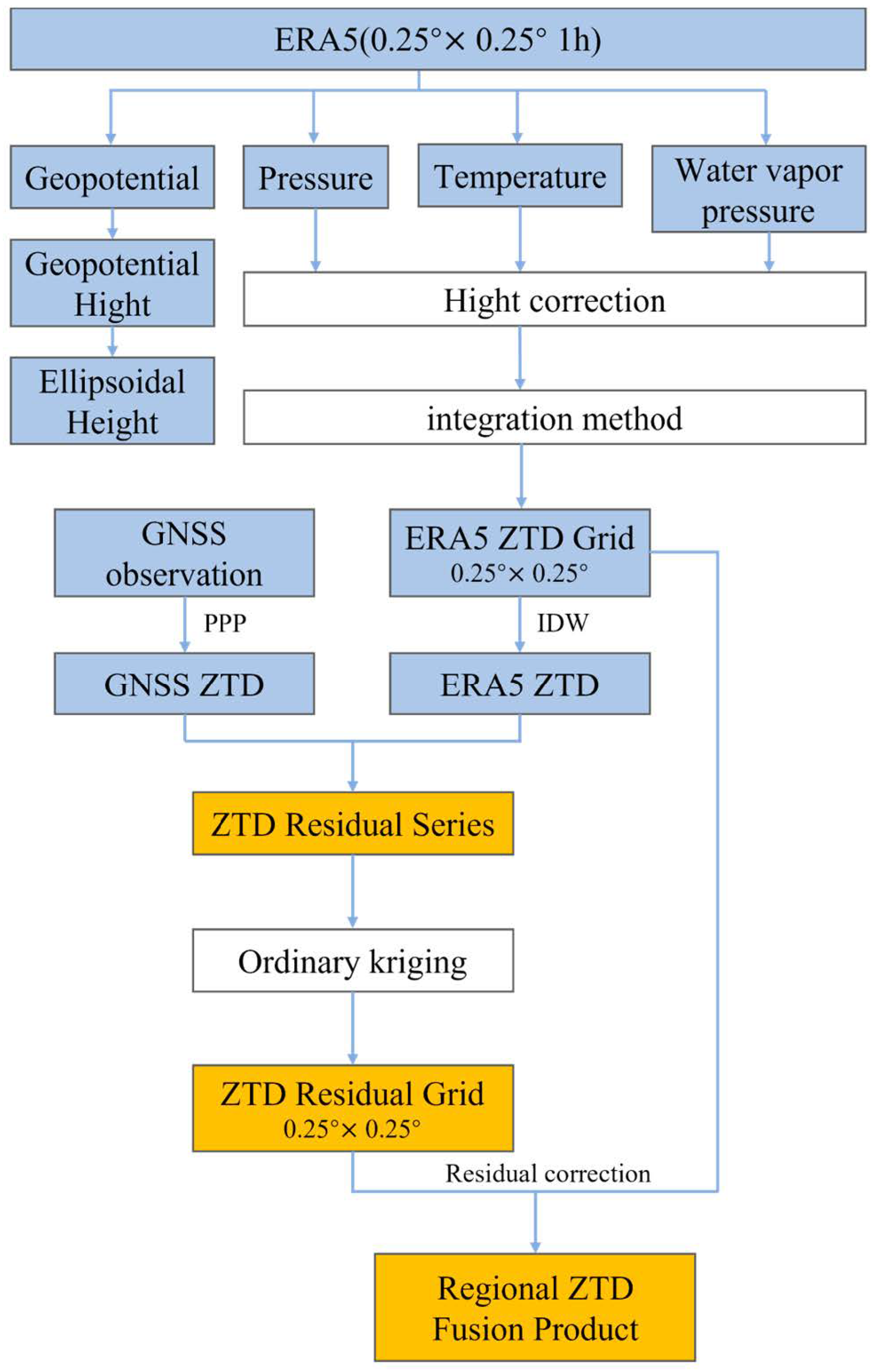
- RK ZTD applies Kriging interpolation to the GNSS–ERA5 residuals, rather than directly interpolating GNSS ZTD, to correct the ERA5 ZTD grids.
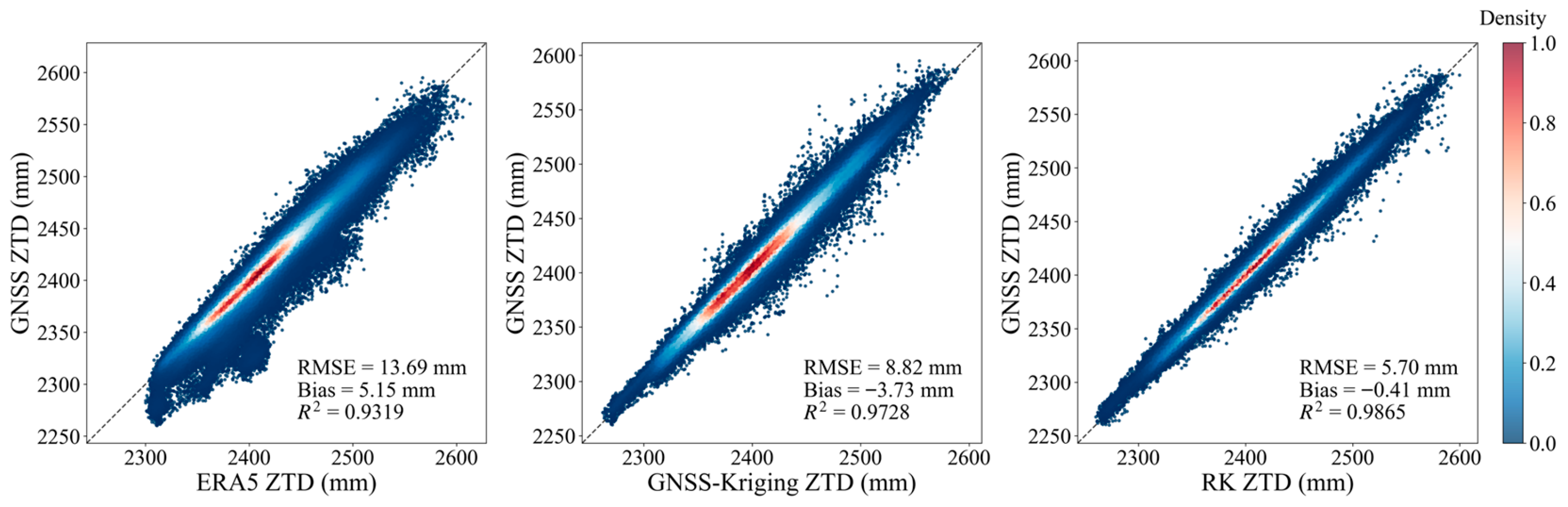
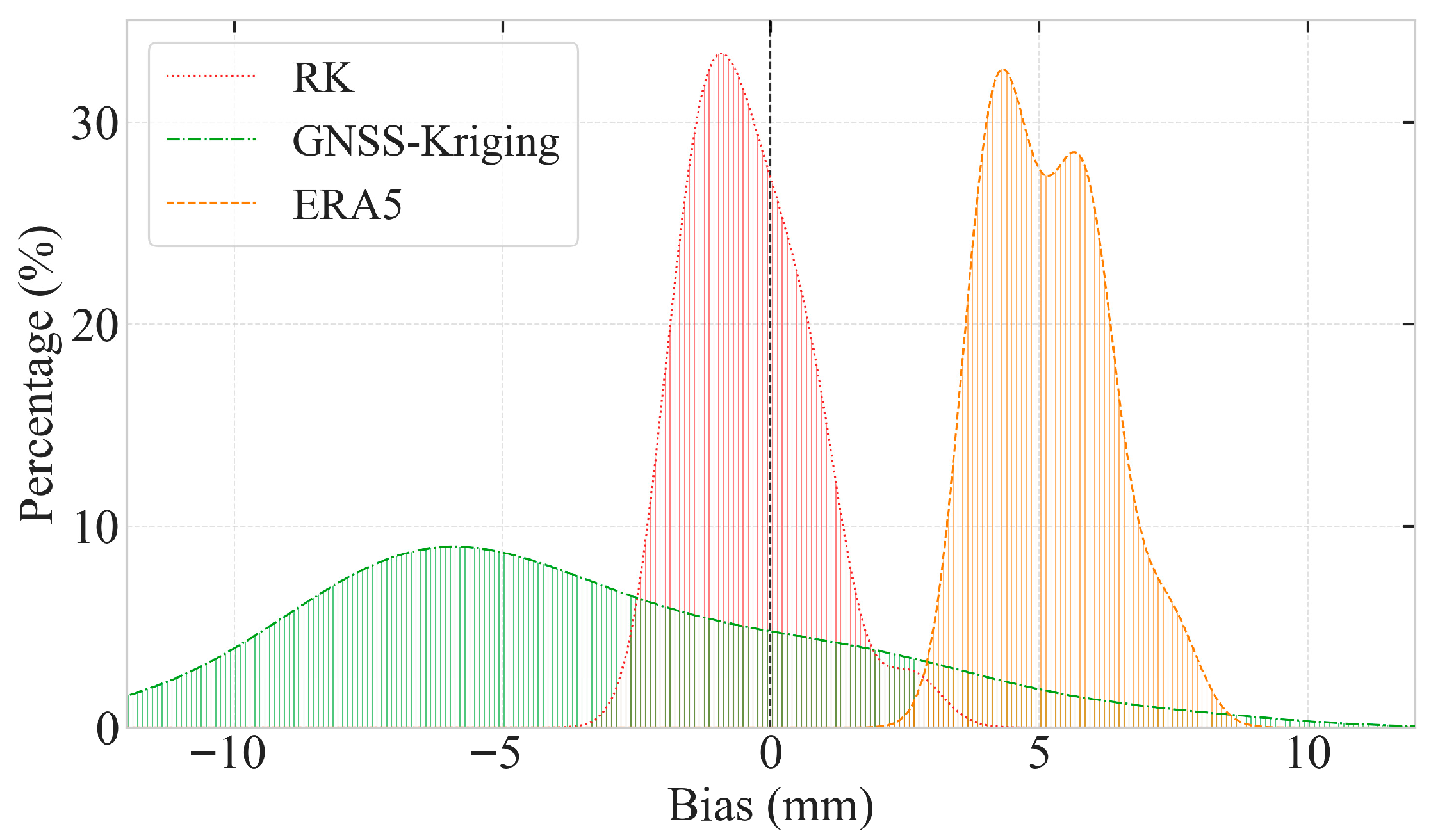
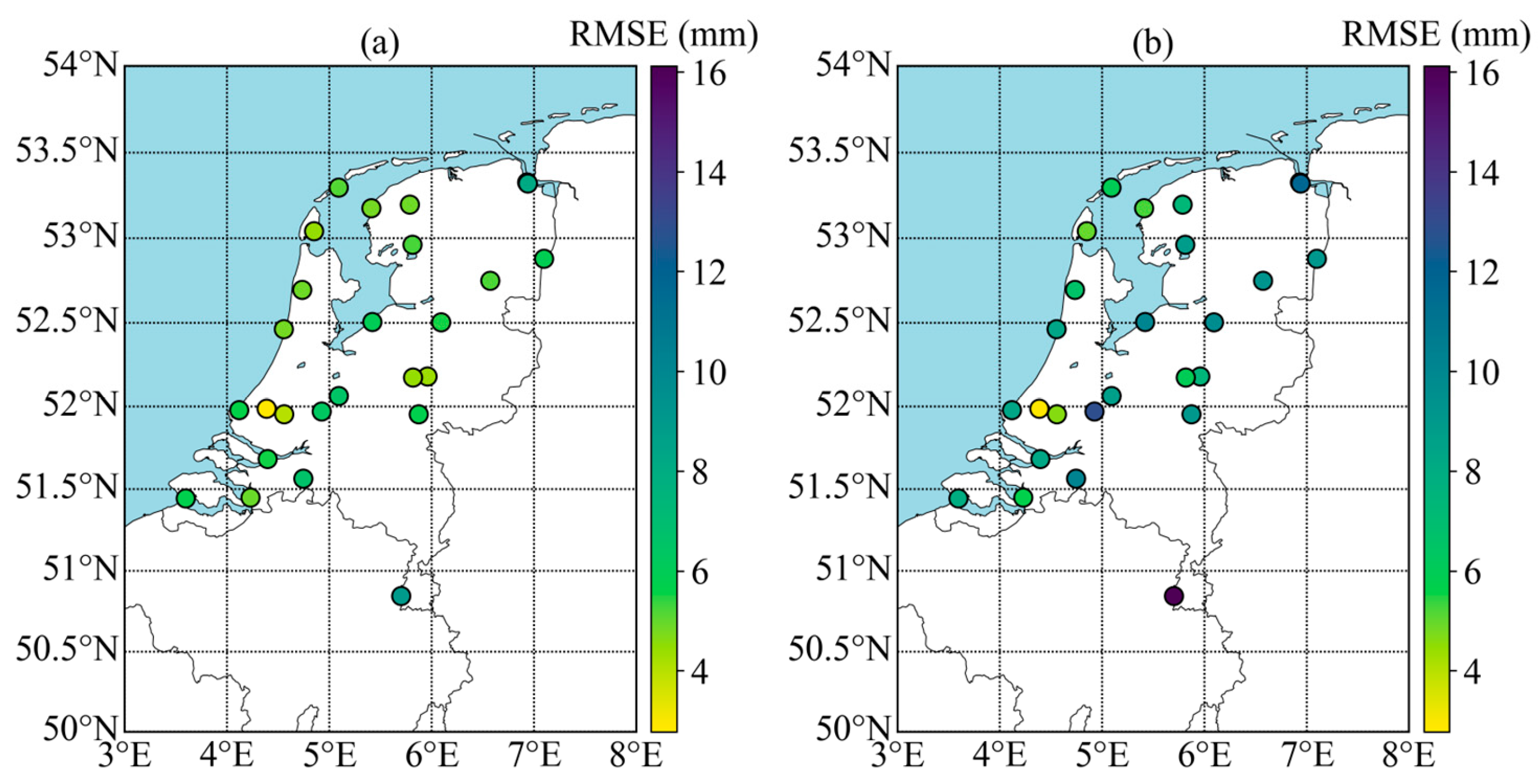
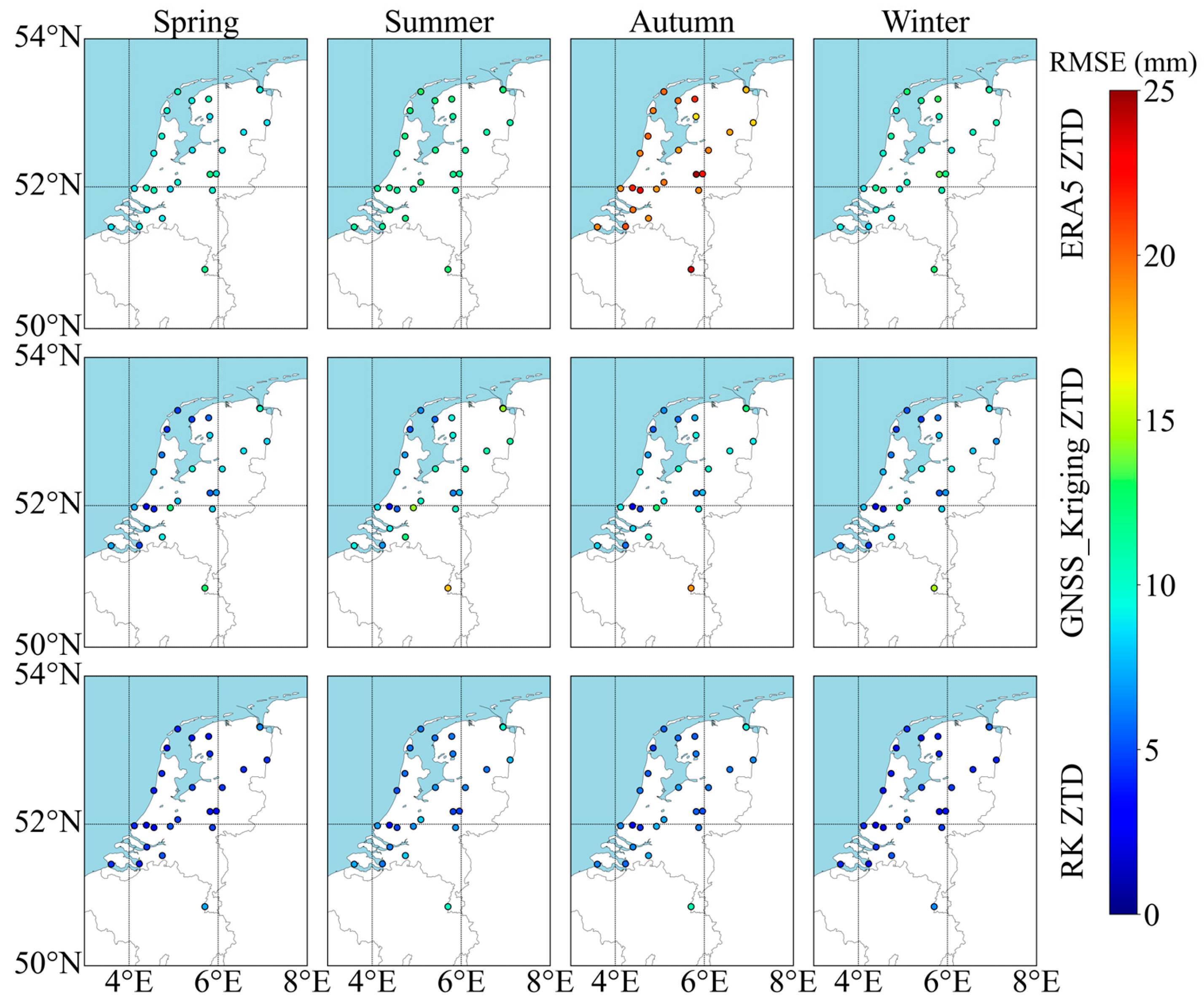
- In the Netherlands during 2023, RK ZTD achieves high accuracy, with an RMSE of 5.70 mm and a bias of 0.41 mm.
- RK ZTD outperforms both the original ERA5 ZTD and the GNSS-Kriging ZTD derived from GNSS ZTD alone, demonstrating the effectiveness of the residual-correction framework.
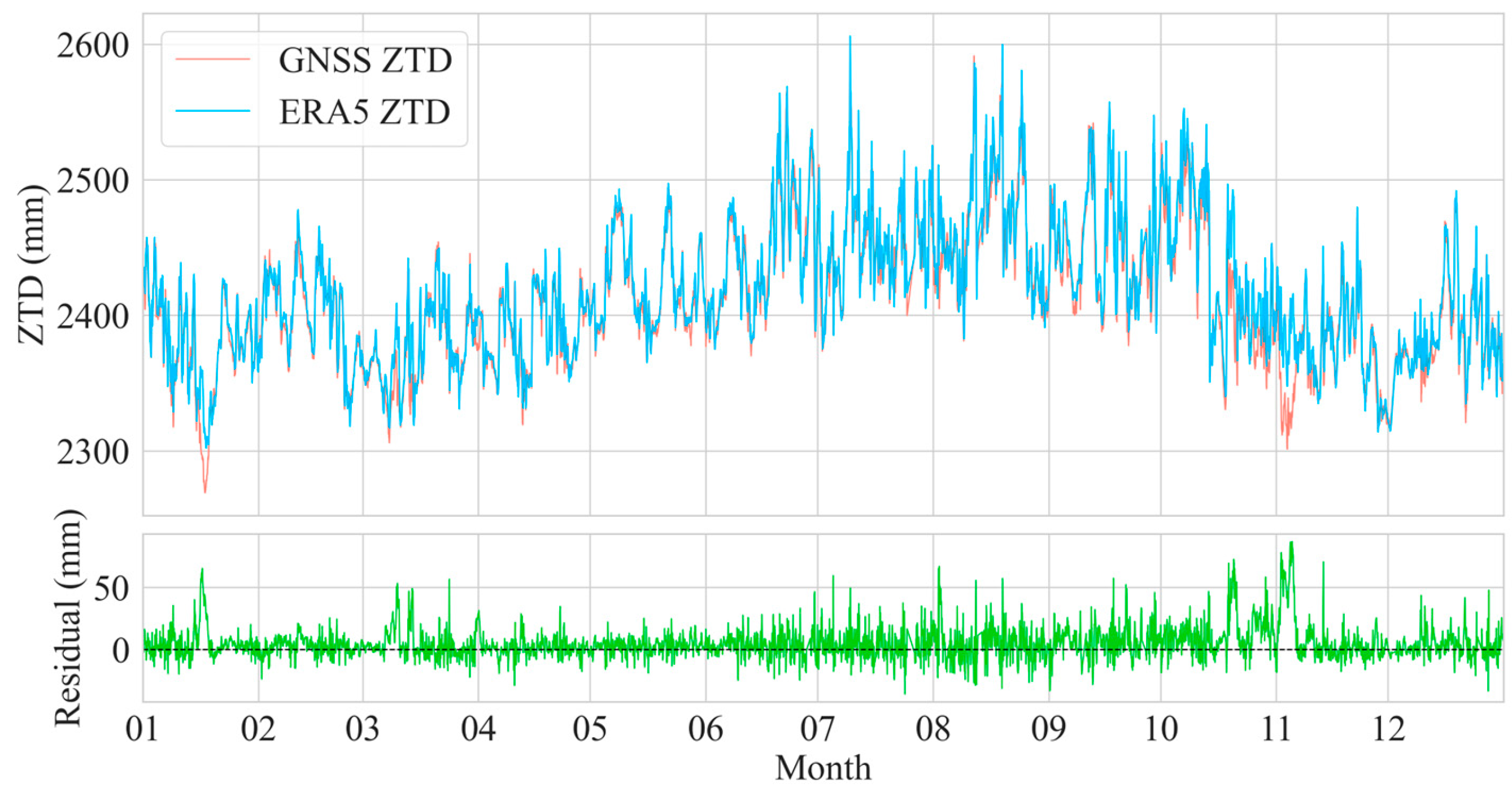
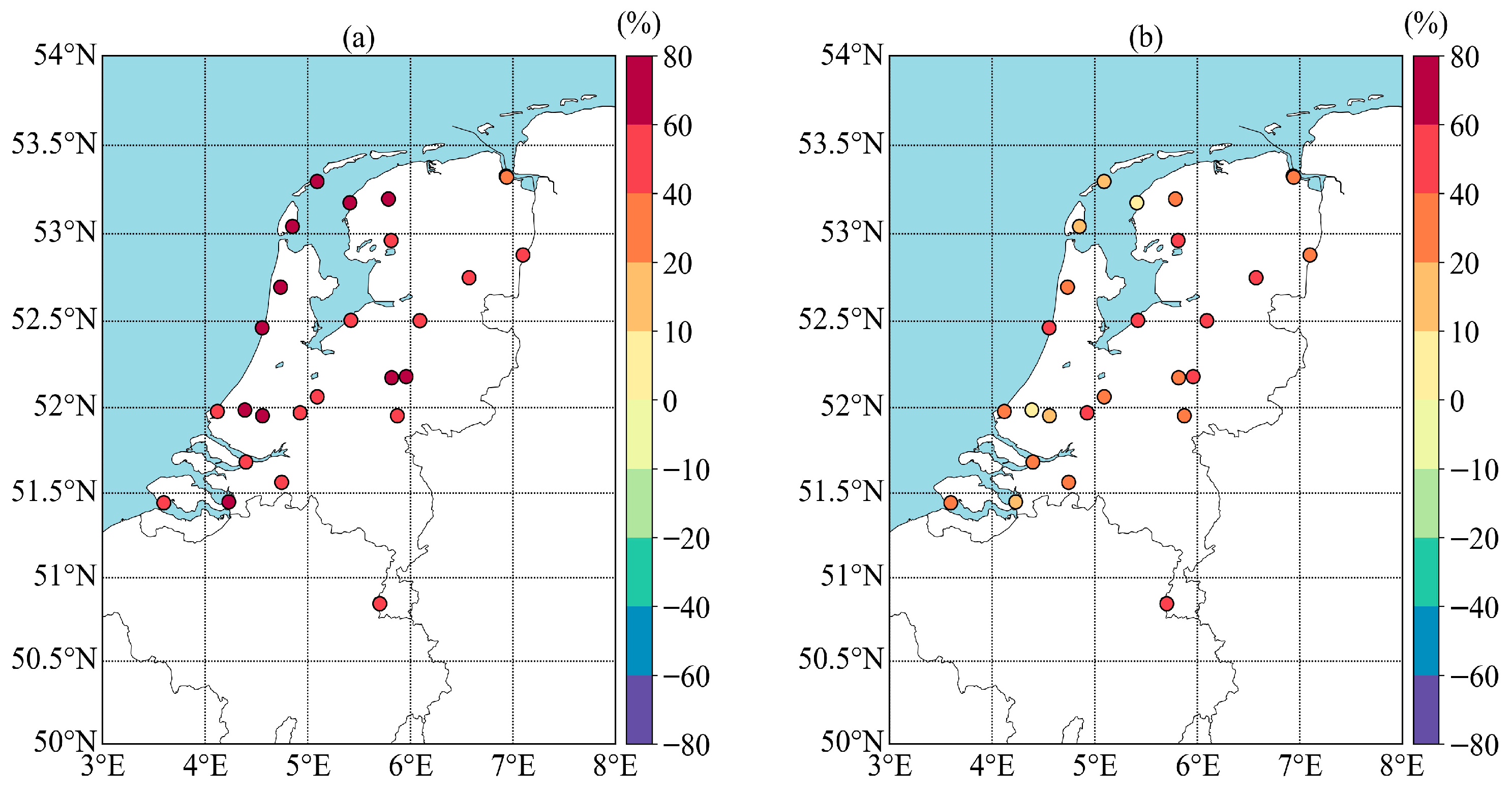
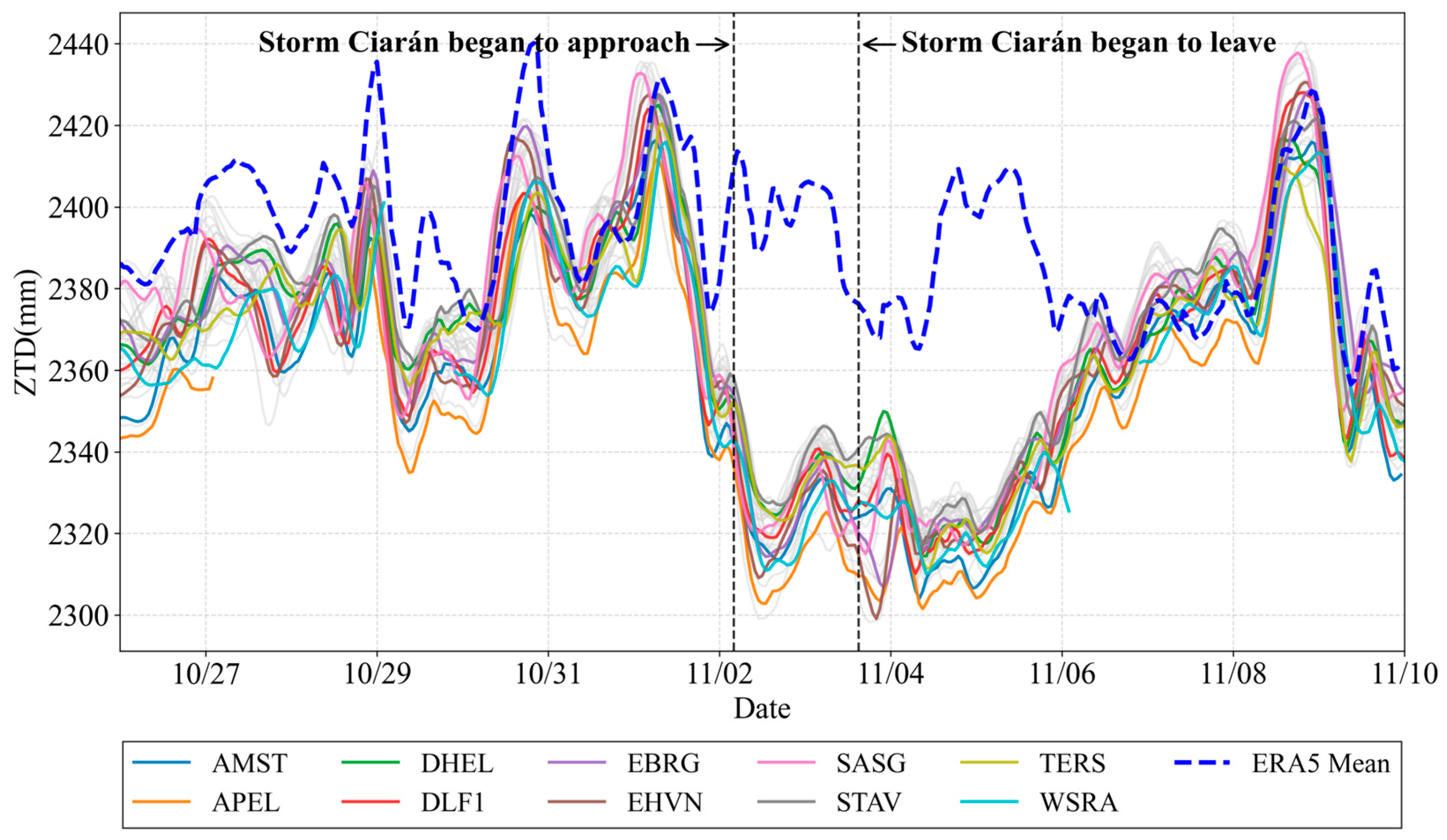
- The residual-correction strategy effectively mitigates the systematic overestimation in ERA5 ZTD.
- By correcting ERA5 ZTD while preserving its original grid structure, the method maintains spatial completeness for regional applications.
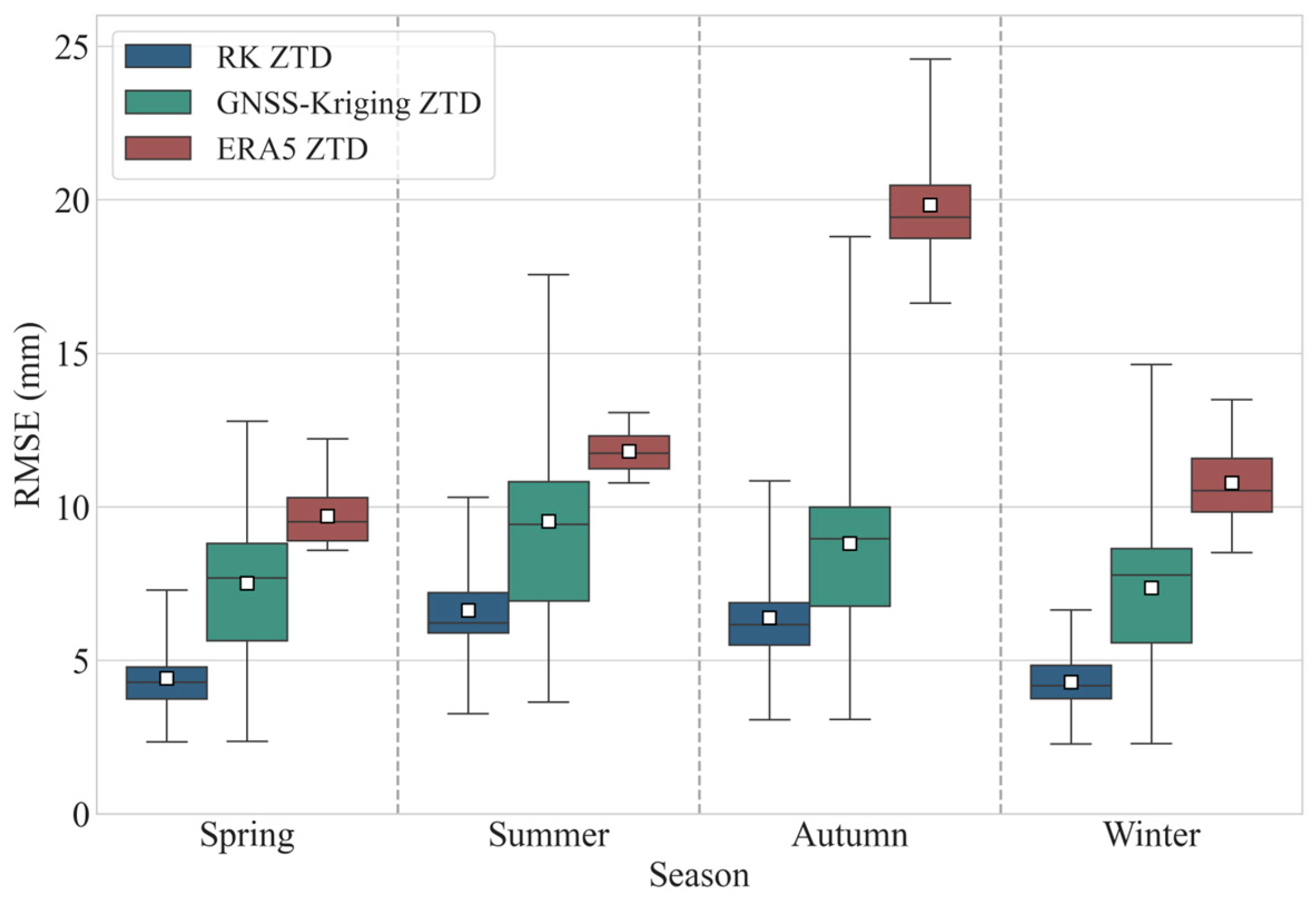
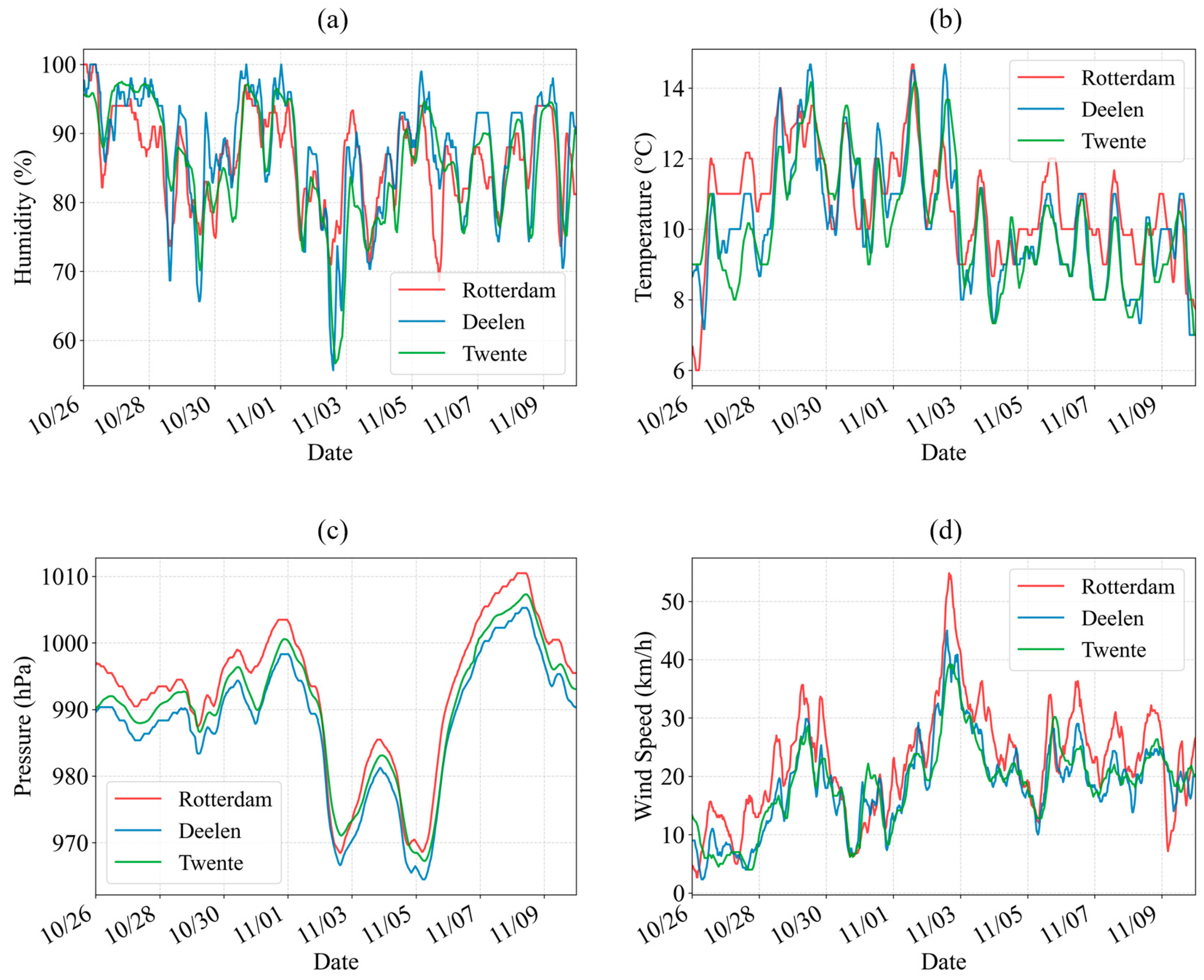
- The stable performance across different seasons and during Storm Ciarán suggests that the method is reliable for regional ZTD refinement under both typical and extreme weather conditions.
Abstract
1. Introduction
2. Methods
2.1. ZTD Retrieval from the GNSS
2.2. ZTD Retrieval from ERA5 Products
2.3. Residual Correction Kriging Method for ZTD
3. Results
3.1. Data Sources
3.2. Analysis of ERA5 ZTD Bias Characteristics
3.3. Performance of the RK ZTD
3.4. Impact of Storm Ciarán on ZTD Accuracy
4. Discussion
5. Conclusions
Author Contributions
Funding
Data Availability Statement
Acknowledgments
Conflicts of Interest
References
- Zumberge, J.F.; Heflin, M.B.; Jefferson, D.C.; Watkins, M.M.; Webb, F.H. Precise point positioning for the efficient and robust analysis of gps data from large networks. J. Geophys. Res. Solid Earth 1997, 102, 5005–5017. [Google Scholar] [CrossRef] [Scilit]
- Gao, Y.; Shen, X. A New Method for Carrier-Phase-Based Precise Point Positioning. Navigation 2002, 49, 109–116. [Google Scholar] [CrossRef] [Scilit]
- Bosser, P.; Bock, O.; Pelon, J.; Thom, C. An improved mean-gravity model for gps hydrostatic delay calibration. IEEE Geosci. Remote Sens. Lett. 2007, 4, 3–7. [Google Scholar] [CrossRef] [Scilit]
- Ma, H.; Zhao, Q.; Verhagen, S.; Psychas, D.; Liu, X. Assessing the performance of multi-gnss ppp-rtk in the local area. Remote Sens. 2020, 12, 3343. [Google Scholar] [CrossRef] [Scilit]
- Saastamoinen, J. Contributions to the theory of atmospheric refraction. Bull. Géodésique 1972, 105, 279–298. [Google Scholar] [CrossRef] [Scilit]
- Hopfield, H.S. Two-quartic tropospheric refractivity profile for correcting satellite data. J. Geophys. Res. 1969, 74, 4487–4499. [Google Scholar] [CrossRef] [Scilit]
- Black, H.D. An easily implemented algorithm for the tropospheric range correction. J. Geophys. Res. Solid Earth 1978, 83, 1825–1828. [Google Scholar] [CrossRef] [Scilit]
- Yang, F.; Guo, J.; Zhang, C.; Li, Y.; Li, J. A regional zenith tropospheric delay (ztd) model based on gpt3 and ann. Remote Sens. 2021, 13, 838. [Google Scholar] [CrossRef] [Scilit]
- Leandro, R.F.; Langley, R.B.; Santos, M.C. Unb3m_pack: A neutral atmosphere delay package for radiometric space techniques. GPS Solut. 2007, 12, 65–70. [Google Scholar] [CrossRef] [Scilit]
- Landskron, D.; Bohm, J. Vmf3/gpt3: Refined discrete and empirical troposphere mapping functions. J. Geod. 2018, 92, 349–360. [Google Scholar] [CrossRef] [Scilit]
- Sun, J.; Wu, Z.; Yin, Z.; Ma, B. A simplified gnss tropospheric delay model based on the nonlinear hypothesis. GPS Solut. 2017, 21, 1735–1745. [Google Scholar] [CrossRef] [Scilit]
- Schüler, T. The tropgrid2 standard tropospheric correction model. GPS Solut. 2013, 18, 123–131. [Google Scholar] [CrossRef] [Scilit]
- Fan, Y.; Xia, F.; Sha, Z.; Jiang, N. A refined spatiotemporal ztd model of the chinese region based on era and gnss data. Remote Sens. 2024, 16, 4515. [Google Scholar] [CrossRef] [Scilit]
- Ma, H.; Psychas, D.; Xing, X.; Zhao, Q.; Verhagen, S.; Liu, X. Influence of the inhomogeneous troposphere on gnss positioning and integer ambiguity resolution. Adv. Space Res. 2021, 67, 1914–1928. [Google Scholar] [CrossRef] [Scilit]
- Lu, C.; Zus, F.; Ge, M.; Heinkelmann, R.; Dick, G.; Wickert, J.; Schuh, H. Tropospheric delay parameters from numerical weather models for multi-gnss precise positioning. Atmos. Meas. Tech. 2016, 9, 5965–5973. [Google Scholar] [CrossRef] [Scilit]
- Hersbach, H.; Bell, B.; Berrisford, P.; Hirahara, S.; Horányi, A.; Muñoz-Sabater, J.; Nicolas, J.; Peubey, C.; Radu, R.; Schepers, D.; et al. The era5 global reanalysis. Q. J. R. Meteorol. Soc. 2020, 146, 1999–2049. [Google Scholar] [CrossRef] [Scilit]
- Jiang, C.; Xu, T.; Wang, S.; Nie, W.; Sun, Z. Evaluation of zenith tropospheric delay derived from era5 data over china using gnss observations. Remote Sens. 2020, 12, 663. [Google Scholar] [CrossRef] [Scilit]
- Zhao, Q.; Wang, W.; Li, Z.; Du, Z.; Yang, P.; Yao, W.; Yao, Y. A high-precision ztd interpolation method considering large area and height differences. GPS Solut. 2023, 28, 4. [Google Scholar] [CrossRef] [Scilit]
- Ratnam, D.V.; Dabbakuti, J.K.; Sunda, S.; Sensing, R. Modeling of ionospheric time delays based on a multishell spherical harmonics function approach. IEEE J. Sel. Top. Appl. Earth Obs. Remote Sens. 2017, 10, 5784–5790. [Google Scholar] [CrossRef] [Scilit]
- Shi, G.; Liu, J.; Yang, C.; An, Q.; Tian, Z.; Chen, C.; Zhang, J.; Li, X.; Zhang, Y.; Xu, J. Study on the spatiotemporal evolution of urban spatial structure in Nanjing’s main urban area: A coupling study of POI and nighttime light data. Front. Archit. Res. 2025, 14, 1780–1793. [Google Scholar] [CrossRef] [Scilit]
- Lu, C.; Zhong, Y.; Wu, Z.; Zheng, Y.; Wang, Q. A tropospheric delay model to integrate era5 and gnss reference network for mountainous areas: Application to precise point positioning. GPS Solut. 2023, 27, 81. [Google Scholar] [CrossRef] [Scilit]
- Xia, P.; Tong, M.; Ye, S.; Qian, J.; Fangxin, H. Establishing a high-precision real-time ztd model of china with gps and era5 historical data and its application in ppp. GPS Solut. 2022, 27, 2. [Google Scholar] [CrossRef] [Scilit]
- Liu, J.; Shi, C.; Huang, J.; Zheng, G.; Zhang, R.; Haase, J.S.; Lou, Y.; Zhang, W. The use of ground-based gps precipitable water measurements over china to assess radiosonde and era-interim moisture trends and errors from 1999 to 2015. J. Clim. 2017, 30, 7643–7667. [Google Scholar]
- Xu, C.; Liu, C.; Yao, Y.; Wang, Q.; Wang, X. Tibetan zenith wet delay model with refined vertical correction. J. Geod. 2023, 97, 31. [Google Scholar] [CrossRef] [Scilit]
- Wu, H.; Xu, X.; Luo, T.; Yang, Y.; Xiong, Z.; Wang, Y. Variation and comparison of cloud cover in modis and four reanalysis datasets of era-interim, era5, merra-2 and ncep. Atmos. Res. 2023, 281, 106477. [Google Scholar] [CrossRef] [Scilit]
- Ma, H.; Li, R.; Tao, J.; Zhao, Q. Bds ppp-iar: Apply and assess the satellite corrections from different regional networks. Measurement 2023, 211, 112582. [Google Scholar] [CrossRef] [Scilit]
- Ma, H.; Zhao, Q.; Verhagen, S.; Psychas, D.; Dun, H. Kriging interpolation in modelling tropospheric wet delay. Atmosphere 2020, 11, 1125. [Google Scholar] [CrossRef] [Scilit]
- Saastamoinen, J. Atmospheric correction for the troposphere and stratosphere in radio ranging satellites. In The Use of Artificial Satellites for Geodesy; American Geophysical Union: Washington, DC, USA, 2013; pp. 247–251. [Google Scholar]
- Niell, A.E. Global mapping functions for the atmosphere delay at radio wavelengths. J. Geophys. Res. Solid Earth 1996, 101, 3227–3246. [Google Scholar] [CrossRef] [Scilit]
- Yang, L.; Gao, J.; Zhu, D.; Zheng, N.; Li, Z. Improved zenith tropospheric delay modeling using the piecewise model of atmospheric refractivity. Remote Sens. 2020, 12, 3876. [Google Scholar] [CrossRef] [Scilit]
- Fotopoulos, G. Calibration of geoid error models via a combined adjustment of ellipsoidal, orthometric and gravimetric geoid height data. J. Geod. 2005, 79, 111–123. [Google Scholar] [CrossRef] [Scilit]
- Liu, Y.; Zhuo, L.; Pregnolato, M.; Han, D. An assessment of statistical interpolation methods suited for gridded rainfall datasets. Int. J. Climatol. 2021, 42, 2754–2772. [Google Scholar] [CrossRef] [Scilit]
- Bevis, M.; Businger, S.; Chiswell, S.; Herring, T.A.; Anthes, R.A.; Rocken, C.; Ware, R.H. GPS meteorology: Mapping zenith wet delays onto precipitable water. J. Appl. Meteorol. Climatol. 1994, 33, 379–386. [Google Scholar] [CrossRef] [Scilit]
- Huang, M.; Cao, S.; Zhu, D.; Liu, X.; Luo, J.; Chen, Y.; Niu, J.; Zhang, L.; Huang, X.; Lin, H. CBRNet: Corner-Guided Boundary Refinement Network for High-Precision Building Extraction from Remote Sensing Imagery. IEEE Trans. Geosci. Remote Sens. 2026, 64, 1–16. [Google Scholar] [CrossRef] [Scilit]
- Lian, D.; He, Q.; Li, L.; Zhang, K.; Fu, E.; Li, G.; Wang, R.; Gao, B.; Song, K. A novel method for monitoring tropical cyclones’ movement using gnss zenith tropospheric delay. Remote Sens. 2023, 15, 3247. [Google Scholar] [CrossRef] [Scilit]
- He, Q.; Zhang, K.; Wu, S.; Zhao, Q.; Wang, X.; Shen, Z.; Li, L.; Wan, M.; Liu, X. Real-time gnss-derived pwv for typhoon characterizations: A case study for super typhoon mangkhut in hong kong. Remote Sens. 2019, 12, 104. [Google Scholar] [CrossRef] [Scilit]
- Li, H.; Wang, X.; Wu, S.; Zhang, K.; Chen, X.; Qiu, C.; Zhang, S.; Zhang, J.; Xie, M.; Li, L. Development of an improved model for prediction of short-term heavy precipitation based on gnss-derived pwv. Remote Sens. 2020, 12, 4101. [Google Scholar] [CrossRef] [Scilit]



| Item | Setting |
|---|---|
| Estimation interval | 1 h |
| Elevation cutoff angle | 7° |
| Precise orbit | WHU SP3 products |
| Precise clock | WHU CLK products |
| ERP correction | WUM ERP products |
| Ionosphere correction | IF combination |
| Troposphere correction | STO ZTD; PWC grad (720 min) |
| Mapping function | NMF |
| Ambiguity | Fixed |
| Antenna phase center correction | IGS20 ANTEX |
| Parameter estimation | LSQ |
| Tides correction | Solid Earth, pole, ocean loading |
| Station | Bias (mm) | Station | Bias (mm) |
|---|---|---|---|
| AMST | −6.4 | EHVN | −4.6 |
| APEL | −8.8 | SASG | −4.3 |
| DHEL | −4.3 | STAV | −3.5 |
| DLF1 | −4.8 | TERS | −4.6 |
| EBRG | −5.3 | WSRA | −7.9 |
| Season | RMSE (mm) | ||
|---|---|---|---|
| RK ZTD | GNSS-Kriging ZTD | ERA5 ZTD | |
| Spring | 4.5 | 7.9 | 9.7 |
| Summer | 6.8 | 10.0 | 11.8 |
| Autumn | 6.6 | 9.3 | 19.9 |
| Winter | 4.4 | 7.8 | 10.9 |
Disclaimer/Publisher’s Note: The statements, opinions and data contained in all publications are solely those of the individual author(s) and contributor(s) and not of MDPI and/or the editor(s). MDPI and/or the editor(s) disclaim responsibility for any injury to people or property resulting from any ideas, methods, instructions or products referred to in the content. |
© 2026 by the authors. Licensee MDPI, Basel, Switzerland. This article is an open access article distributed under the terms and conditions of the Creative Commons Attribution (CC BY) license.
Share and Cite
Cai, Y.; Ma, H.; Wang, Z.; Jia, S.; Duan, X.; Shi, G.; Chen, C. Fusion-Based Regional ZTD Modeling Using ERA5 and GNSS via Residual Correction Kriging. Remote Sens. 2026, 18, 963. https://doi.org/10.3390/rs18060963
Cai Y, Ma H, Wang Z, Jia S, Duan X, Shi G, Chen C. Fusion-Based Regional ZTD Modeling Using ERA5 and GNSS via Residual Correction Kriging. Remote Sensing. 2026; 18(6):963. https://doi.org/10.3390/rs18060963
Chicago/Turabian StyleCai, Yang, Hongyang Ma, Zhiliang Wang, Shuaishuai Jia, Xin Duan, Ge Shi, and Chuang Chen. 2026. "Fusion-Based Regional ZTD Modeling Using ERA5 and GNSS via Residual Correction Kriging" Remote Sensing 18, no. 6: 963. https://doi.org/10.3390/rs18060963
APA StyleCai, Y., Ma, H., Wang, Z., Jia, S., Duan, X., Shi, G., & Chen, C. (2026). Fusion-Based Regional ZTD Modeling Using ERA5 and GNSS via Residual Correction Kriging. Remote Sensing, 18(6), 963. https://doi.org/10.3390/rs18060963