1. Introduction
In recent years, ship classification in remote sensing images, particularly Synthetic Aperture Radar (SAR), has gained significant interest. Accurate identification of ships is essential for a variety of maritime applications, including traffic monitoring, port management, environmental monitoring, and security. Even in challenging conditions, SAR imagery provides a distinct advantage by capturing detailed ship information regardless of weather condition or illumination, making it suitable for operational monitoring. SAR images can be used to classify ships of different types, using radar signals to analyze their shape, size, and structural features.
Variations in ship design, size, and shape, together with limited amounts of annotated data, transform ship classification into a challenging task. An accurate classification framework relies on the analysis of distinctive structural characteristics and radar response patterns that separate one type of ship from another. Developing models that can reliably distinguish between ship categories under diverse maritime conditions continues to be an important and challenging area of research.
In this paper, we propose a real-time dual-polarization SAR ship classification framework based on the MobileViT V2 architecture. The model is adapted to process both VH and VV polarization modes. By combining convolutional inductive biases with transformer-based global context modeling, MobileViT V2 achieves a balance between local feature extraction and long-range dependency modeling, making it suitable for real-time maritime monitoring scenarios.
In order to evaluate the impact of using dual polarization, we conduct a comparison between three training strategies. In the first strategy, the model is trained using mixed polarizations, where available polarization modes are included in the same training dataset but treated as independent samples. In the second strategy, the model is trained using a single polarization only. In the third strategy, a dual-polarization configuration is employed, where both polarization modes corresponding to the same target are used simultaneously. This comparison allows a proper quantification of the contribution of each polarization strategy and to assess the benefit of combining dual-polarization information for the ship classification task.
Furthermore, the proposed approach is benchmarked against several widely used architectures, including MobileNet, Vision Transformer (ViT), ResNet, and EfficientNet. The evaluation considers not only classification performance, but also model complexity in terms of the number of parameters and inference time, providing an accuracy-efficiency trade-off analysis.
We also investigate the influence of loss function design by comparing Categorical Cross-Entropy and Focal Loss, analyzing their effect on classification robustness and class separability. The experiments are conducted on two widely used SAR ship classification datasets, OpenSARShip 2.0 [
1] (i.e., an extended and upgraded version of OpenSARShip dataset [
2]) and FUSAR-Ship [
3].
Overall, the experimental results show that using both polarization modes improves classification performance while maintaining a balance between accuracy and computational cost. The main contributions of this work can be summarized as follows:
- 1.
Real-time dual-polarization SAR ship classification framework: We develop a SAR ship classification model based on the MobileViT V2 architecture that uses dual-polarization modes.
- 2.
Comparison of polarization strategies: We compare three training approaches: (1) mixed-polarization training using unpaired polarizations, (2) single-polarization training, and (3) paired dual-polarization training when multiple polarizations per target are available.
- 3.
Benchmarking with well-known architectures: We evaluate the proposed model against several classic architectures, comparing classification accuracy, number of parameters, and inference time.
- 4.
Evaluation of both full and reduced datasets: We highlight that dual-polarization feature fusion in proposed architecture improves classification accuracy, while dataset reduction provides a practical strategy to mitigate class imbalance when dual-polarization information is unavailable.
- 5.
Analysis of loss functions: We compare Categorical Cross-Entropy and Focal Loss to study their influence on robustness and class separability.
The rest of the paper is structured as follows.
Section 2 presents the related work in terms of SAR ship classification, the proposed method is presented in
Section 3, the experimental results are provided in
Section 4.
Section 5 provides an in-depth discussion of the experimental results, whilst
Section 6 concludes the paper.
2. Related Work
Various deep learning approaches have been explored for SAR ship classification, including convolutional neural networks (CNN), attention-based models, multimodal fusion frameworks, and transfer learning techniques. Although CNN-based models are effective at extracting local features, they can struggle to capture long-range dependencies and the overall contextual structure of the data. To overcome these limitations, recent studies have explored the use of attention modules, feature fusion strategies, and hybrid architectures that integrate convolutional and transformer components. Furthermore, other challenges related to limited amount of training data, class imbalance, and domain adaptation have been overcome through feature augmentation, metric learning, self-distillation, and semi-supervised strategies.
Zhao et al. proposed LN-SCNet [
4], a lightweight CNN for SAR ship classification, combining preprocessing to reduce speckle noise, feature extraction with dilated convolutions and channel attention, a feature fusion module for multi-size ships, and a seesaw loss [
5] to address class imbalance. Feng et al. [
6] proposed SeDSG, a dual-branch SAR ship classification network that fuses real and simulated images (BNM) to enhance feature extraction, structural perception, and cross-scene generalization.
Recent research has explored incorporating non-visual information to improve classification performance. Liang Chen et al. introduced PGMNet [
7], a prototype-guided multimodal network that combines key-area guidance with image-text fusion to increase feature representation and consistency. Similarly, Jinyue Chen et al. proposed TeMSC [
8], a text-enhanced framework that integrates geometric information in textual form with visual and polarimetric embeddings, employing multimodal fusion and two-stage training to increase classification generalization.
Several approaches aim to leverage both deep features and hand-crafted descriptors for improved representation. Zheng et al. introduced MFCFNet [
9], a multi-feature collaborative fusion network with deep supervision that adaptively integrates hand-crafted and deep features using attention and synergy losses. Zhang et al. developed HOG-ShipCLSNet [
10], which combines HOG descriptors with CNN features and incorporates multiscale classification, global self-attention, and feature-balancing mechanisms. DCPNet, developed by Feng et al. [
11], represent a dual-stream contrastive framework that exploits unlabeled data and models the interaction between deep and handcrafted features to improve representation learning and class separability in SAR ship classification. Al Hinai et al. [
12] proposed a contour-based framework for ship classification in SAR imagery, introducing 13 handcrafted features extracted from ship contours. Contours are extracted via watershed and U-Net, and features are evaluated with SVM, RF, and GPC classifiers. Hu et al. [
13] combined deep learning with wavelet scattering transform features in a semi-supervised few-shot SAR target recognition framework.
Capturing elongated ship shapes and scale variations has driven the design of specialized architectures. HDSS-Net [
14] uses a task-specific hierarchical architecture with multi-scale feature aggregation, rectangular receptive field refinement, and a spherical space classifier to enhance discriminative representation beyond standard CNN designs. Similarly, SA2Net [
15] incorporates multiscale attention and ship shape priors along with rectangular receptive fields to better capture geometric characteristics of elongated targets. In an attempt to preserve spatial information and to improve representation of multi-scale SAR ship features, FWPN-Net [
16] and MS-CNN [
17] focus on pyramid networks and multi-scale feature fusion systems that integrate both high-level semantic information and low-level detailed information. A CNN–LSTM architecture for SAR ship classification was proposed by Toumi et al. [
18].
Attention-based methods highlight discriminative components across regions, scales and polarizations. Zheng et al. [
19] integrates spatial and channel-wise attention with multi-scale feature fusion. Wang et al. [
20] proposed a SAR ship recognition method that combines multiscale feature attention with an adaptive-weighted classifier. The approach was based on an in-network feature pyramid, that enhances discriminative components at each scale, and adaptively selects the most effective scales for classification [
20]. Yoon et al. proposed hybrid conv-attention networks that combine CNNs and transformers for SAR target recognition [
21]. Wang et al. [
22] proposed FDSANet, a feature disentanglement network for SAR-based automatic target recognition that separates target and background features using dual-mask-guided slot attention. Guo et al. [
23] proposed LDF-D-MLCNNs, dual Metaformer-like CNNs [
24] with learnable decision fusion that combines two networks with different kernel sizes, and pyramid squeeze and excitation attention that emphasizes feature regions from targets, clutter, and speckles to improve SAR ship classification. Shao et al. [
25] proposed DPIG-Net, a SAR ship classification network using dual-polarization guidance with cross-attention and dilated residual dense learning to enhance feature extraction and fusion. A multiscale cross-modal attention framework for SAR target recognition was developed by Wang et al. [
26], while Xie et al. [
27] introduced a multimodal triple-attention mechanism for feature fusion, and He et al. [
28] proposed an attention-based network for dual-polarized SAR ship classification.
Techniques addressing class imbalance and rare categories include the seesaw loss [
5], as proposed in LN-SCNet [
4]. Other approaches to address the imbalanced distribution of ship targets focus on dynamic weighted sampling with soft threshold adjustment, as integrated by Zhang et al. [
29] in the SAR ship recognition framework. Additionally, Chen et al. [
30] proposed a diffusion-based SAR ship image generation method to augment datasets and improve recognition performance for limited or imbalanced data.
In order to deal with the limited amount of available annotated data, transfer learning and ensemble methods have been explored. Lang et al. [
31] propose MS-HeTL, a multisource heterogeneous transfer learning framework using heterogeneous feature augmentation and an SVM classifier to leverage complementary knowledge from multiple domains. An automated heterogeneous ensemble of deep CNNs was introduced in MetaBoost [
32], which is built on a self configuring algorithm that determines the optimal subset of classifiers through a two-stage filtration strategy. Experiments conducted over OpenSARShip and FUSAR-Ship datasets show that the proposed approach outperforms individual classifiers, traditional ensemble models, and other feature injection techniques.
Although transfer learning techniques are often regarded as possible solutions to deal with the decreased amount of available annotated data, experiments conducted on the OpenSARShip dataset emphasize that conventional natural image transfer does not fully generalize to SAR imagery, highlighting the need for SAR-specific strategies [
33]. Complementary methods include virtual feature augmentation and dynamic hierarchical feature refinement for enhancing discriminative capabilities with limited data [
34].
The limited labeled datasets and the inherent noise of SAR data usually lead to severe overfitting issues. DRRNet-SKD [
35] employs double reverse regularization with self-knowledge distillation and adaptive weight assignment to mitigate overfitting in few-shot SAR classification. CE-ViT [
36] uses a compressed and excited Vision Transformer with local feature fusion and squeeze-and-excitation mechanisms to improve representation for categories with limited samples. Wei et al. [
37] proposed an adversarially robust CNN architecture to improve generalization and robustness in SAR image classification.
Exploiting unlabeled data has gained attention in SAR automatic target recognition. DCPNet [
11] is built upon a dual-stream contrastive framework that integrates unlabeled data while modeling feature interactions. Similarly, a semi-supervised framework, proposed by Wang et al. [
38], includes self-consistent augmentation, mixup-based sampling strategy, and weighted loss to improve performance while reducing the dependency on labeled data. Another approach is proposed by Hu et al. [
13], introducing a semi-supervised few-shot learning method that leverages unlabeled SAR data through pseudo-labeling and consistency regularization.
In an attempt to improve generalization and guide training, methods that enhance feature separability and relational reasoning have been proposed. SM-CNN [
39] integrates a separability measure and applies the principle of maximal coding rate reduction (MCR2) to the backbone module to extract meaningful information from CNN-derived feature maps. Prior to SM-CNN, a two-stage approach, where CNN-extracted features are further processed by an end-to-end metric network to measure inter-feature relations, was proposed by Li et al. [
40], while more recent work explores alternative architectures such as Siamese spiking neural networks, as proposed by Jiang et al. [
41], to further enhance feature separability and classification performance.
An improved target discrimination can be achieved by fusing dual-polarized SAR data. In this sense, He et al. [
42] propose a group bilinear CNN (GBCNN) to extract discriminative second-order features from dual-polarization (VH and VV) SAR images. Self-bilinear and cross-bilinear pooling capture single-pol and dual-pol features, while a multi-polarization fusion loss enhances representation learning [
42]. Additionally, a cross-polarimetric interaction network for fusing dual-polarized SAR features in ship classification was proposed by He et al. [
28].
Most of approaches towards SAR ship classification rely on CNNs and attention-based models. The potential of Bayesian CNNs (BCNNs) to provide uncertainty decomposition and more reliable predictions compared to traditional CNNs in SAR ship classification has been exploited in [
43].
Overall, recent research highlights the importance of combining multi-scale feature extraction, multimodal information, attention mechanisms, and data-efficient strategies to approach the unique challenges of SAR ship classification, including speckle noise, elongated target structures, class imbalance, and limited labeled data.
3. Proposed Approach
This section describes the proposed SAR ship classification framework and its components. We begin by presenting the general architecture, that incorporates MobileViT V2, to solve the SAR ship classification task. Next, we introduce the polarization configurations considered in this paper and discuss their conceptual differences. The dual-polarization feature fusion approach is then described, followed by the loss functions used during the training stage. While maintaining a lightweight architecture, the importance of fusing both polarization modes available for SAR data is also outlined.
3.1. Overview of the Proposed Architecture
For the proposed SAR ship classification framework, we implement the MobileViT V2 neural network [
44]. The first version of MobileVIT was a lightweight hybrid network that combined convolutional operations with transformer-based self-attention, allowing it to capture both local features and long-range dependencies while remaining suitable for devices with limited computational resources [
45].
While CNN-based models excel at learning local representations, they have difficulties in capturing global context. Vision transformers (ViTs) effectively model long-range dependencies but are typically highly computationally demanding. MobileViT resolves this trade-off by integrating transformer operations within a convolutional framework, leveraging the advantages of convolutional neural networks and vision transformers [
45].
Although the first MobileViT version demonstrates impressive performance on mobile vision tasks such as image classification and object detection, it can be slow due to the computational demands of its multi-headed self-attention (MHA). MobileViT V2 addresses this limitation by employing separable self-attention, which significantly reduces computation while maintaining high accuracy. This enhancement makes MobileViT V2 particularly suitable for devices with limited resources [
44].
In this paper, we adopt MobileViT V2 [
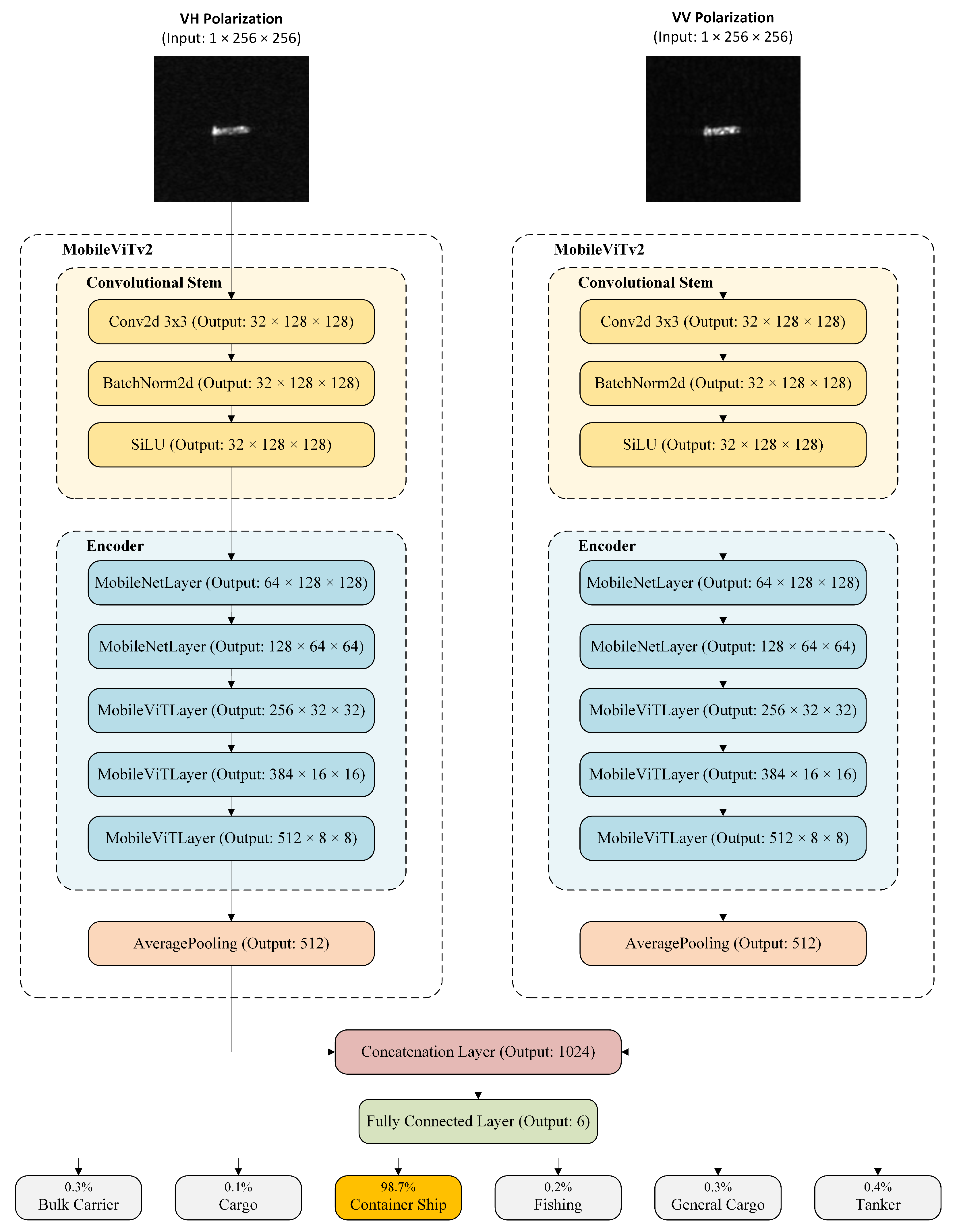
44] as the core architecture of our classification model to efficiently extract features from SAR images. The general structure of the proposed framework is illustrated in
Figure 1. Each MobileViTv2 branch progressively extracts hierarchical feature representations from the input images, using convolutional and encoder stages. The two architectural branches consist of a convolutional stem followed by an encoder composed of MobileNetV2 and MobileViT-specific blocks.
The proposed network receives SAR images resized to 256 × 256 pixels, with separate inputs corresponding to the VV and VH polarization channels. Since the original architecture is designed for three channel inputs, the first convolutional layer was modified to accept a single-channel input in order to process SAR images.
The convolutional stem performs the initial low-level feature extraction. It includes a convolutional layer followed by batch normalization and SiLU activation, reducing the spatial resolution from 256 × 256 to 128 × 128 while increasing the channel dimension to 32. In this stage, the SAR input’s fundamental structural patterns are extracted, and the feature maps are ready for deeper processing.
The encoder stage progressively refines the representations through a sequence of MobileNet-based layers and MobileViT-specific blocks. The MobileNet layers perform efficient spatial downsampling and channel expansion, while the MobileViT layers introduce transformer-based global modeling within the convolutional framework. A final feature map with dimensions of 512 × 8 × 8 is obtained by progressively decreasing the spatial resolution and increasing the channel dimension. Then, an average pooling operation across spatial dimensions produces a 512-dimensional feature vector for each branch.
The proposed network consists of two identical MobileViT V2 branches operating in parallel, each processing one polarization channel independently. The original MobileViT V2 architecture ends with a linear classification layer. In our implementation, this layer is removed to enable feature-level fusion. Each branch produces a 512-dimensional feature vector, and the resulting vectors are concatenated to form a 1024-dimensional representation. This fused representation is passed through a fully connected layer that performs classification into the desired number of classes, e.g., six classes for the OpenSarShip2 dataset used in a subset of experiments.
3.2. Polarization Configurations
Synthetic Aperture Radar (SAR) systems can operate with different combinations of polarization modes, depending on the orientation of the transmitted and received electromagnetic waves. The most widely used channels for dual-polarization acquisitions are VV (vertical transmit-vertical receive), VH (vertical transmit-horizontal receive), and HH (horizontal transmit-horizontal receive). These modes correspond to different transmit-receive polarization combinations and may highlight distinct scattering behaviors of the observed targets [
46]. Therefore, classification performance can be affected by how the polarization modes are integrated into the machine learning task.
In this paper, three distinct polarization training approaches are evaluated.
In the first training approach, the VV and VH modes from the OpenSarShip2 dataset are included in the same training dataset but treated as independent samples. Each polarization mode is processed separately by the network, without explicitly modeling the relationship between modes that correspond to the same ship target. For the FUSAR-Ship dataset, the VV and HH modes are similarly treated, with each polarization processed independently for its corresponding targets.
In the second approach, training is performed using a single polarization mode, either VV or VH from the OpenSarShip2 dataset, or VV or HH from the FUSAR-Ship dataset. This configuration serves as a baseline for evaluating the discriminative power of each polarization independently and for quantifying its individual contribution to the ship classification task.
The third approach involves simultaneously feeding the network with paired VV and VH modes acquired over the same target. This approach is applied only to the OpenSarShip2 dataset, as the FUSAR-Ship dataset does not contain multiple polarizations for the same target. Each polarization is processed through a dedicated branch, after which feature-level fusion is performed. This approach uses dual-polarization information to improve features’ representation.
Through this comparative analysis, we evaluate how different polarization approaches influence feature representation and overall classification performance.
3.3. Dual-Polarization Feature Fusion
In the proposed architecture, feature fusion is performed after the independent extraction of high-level representations from each polarization branch. Each MobileViT V2 branch outputs a 512-dimensional feature vector corresponding to either the VV or VH input SAR image.
The two polarization-specific feature vectors are concatenated into a single representation to perform feature fusion, as shown in Equation (
1):
The resulting fused vector is then fed into a fully connected layer that produces the final class predictions.
Concatenation is chosen as the fusion mechanism because it retains the full set of features extracted from each polarization branch without altering their original representations. During training, the fully connected layer learns how to integrate information from both polarizations and identifies the most relevant relationships for classification.
Despite the possibility of using other fusion strategies, such as element-wise summation, averaging, or attention-based fusion, concatenation provides a straightforward and computationally efficient approach while preserving full representational capacity.
3.4. Loss Functions
To train the proposed classification model, two loss functions are considered: Categorical Cross-Entropy and Focal Loss. The comparison between these two loss functions allows us to evaluate the impact of a standard multi-class loss versus a loss designed to address class imbalance.
Categorical Cross-Entropy (CCE) is the standard objective function for multi-class classification problems. In discriminative probabilistic models, the posterior class probabilities are obtained through the softmax transformation of the logits [
47].
Let
denote the vector of logits produced by the network for
C classes. The predicted probability for class
i is computed as:
which corresponds to the softmax function [
47].
Given a one-hot encoded ground-truth label vector
, the Categorical Cross-Entropy loss is defined as:
This formulation is equivalent to maximum likelihood estimation in multi-class logistic regression. The loss penalizes incorrect predictions while encouraging the predicted probability of the true class to approach one [
47].
Dominant classes can substantially influence the optimization process when the training data is imbalanced. As noted in
Section 4, the datasets used in this paper present an uneven class distribution. To enhance robustness under these conditions, Focal Loss is also considered.
Focal Loss, originally introduced by Lin et al. [
48], extends Cross-Entropy by incorporating a modulating factor
that reduces the contribution of well-classified examples and emphasizes harder samples.
For the multi-class case, Focal Loss is defined as:
where
denotes the predicted probability assigned to the ground-truth class,
is the focusing parameter that controls how strongly the loss focuses on difficult examples, and
is a class-specific weighting factor associated with the ground-truth class [
48].
When
, Focal Loss becomes equivalent to standard Cross-Entropy. As
increases, the contribution of well-classified examples (
) is gradually reduced, allowing the model to concentrate more on misclassified or under-represented samples [
48].
4. Results
This section describes the datasets used for evaluation, the experimental setup and implementation details, and the obtained experimental results. The experiments are designed to ensure a fair comparison with existing state-of-the-art methods across multiple class configurations.
4.1. Datasets
The OpenSARShip 2.0 [
1] is a large-scale SAR dataset designed for ship target interpretation in Sentinel-1 imagery. It contains 34,528 ship chips extracted from 87 Sentinel-1 scenes. The dataset includes both GRD and SLC products and integrates Automatic Identification System (AIS) information to ensure reliable annotation.
In this work, experiments are conducted using the GRD products with VV and VH dual polarization. The GRD imagery has a spatial resolution of approximately m (range × azimuth) with a pixel spacing of m. Each ship chip is a cropped SAR patch centered on the vessel, preserving both its scattering characteristics and the surrounding sea clutter.
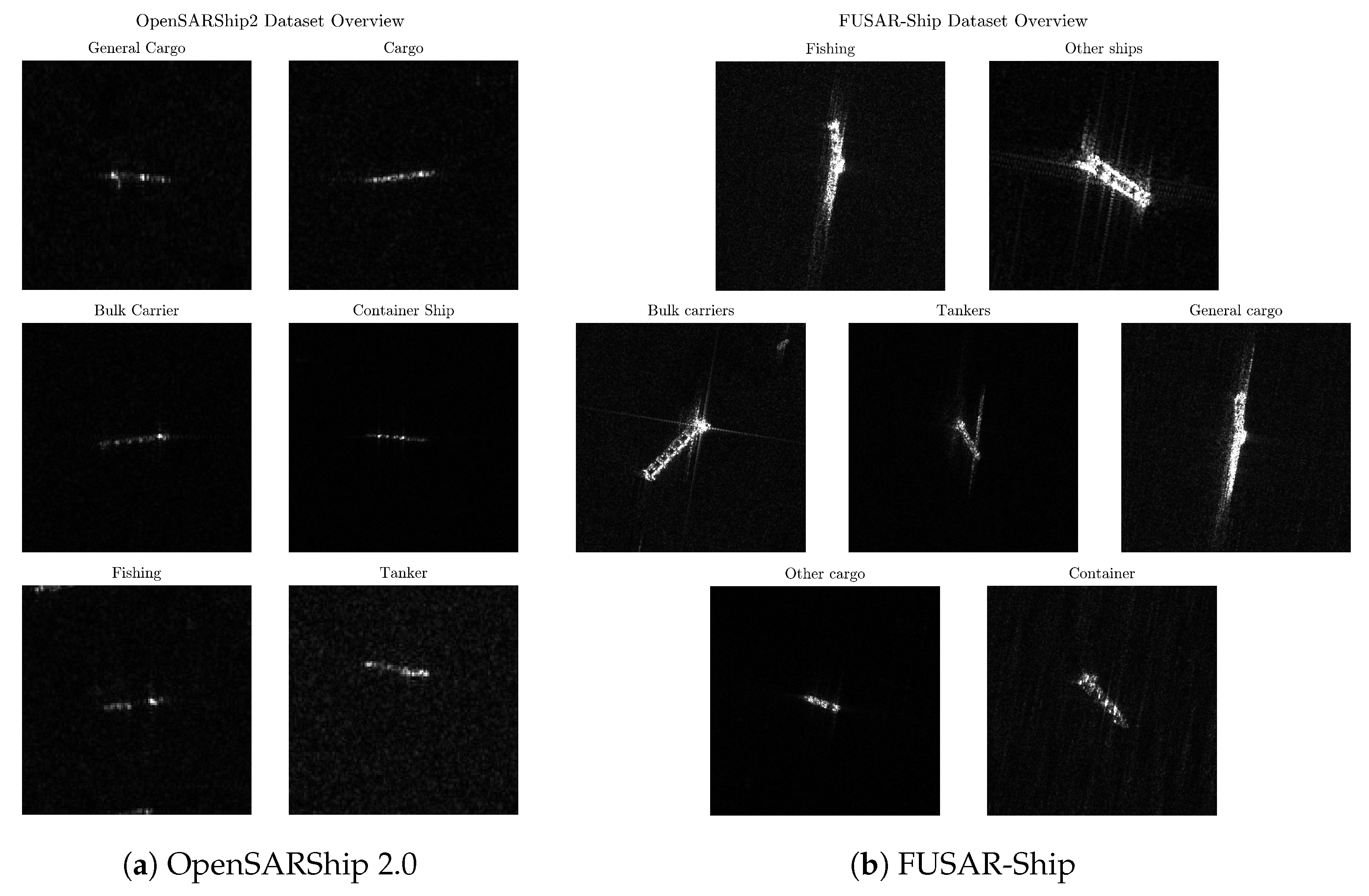
In our setup, 6 ship categories are selected to provide enough samples for achieving an effective deep learning solution while remaining consistent with common 3-class and 6-class settings reported in the literature. The 3-class setting includes Bulk Carrier, Container Ship, and Tanker, while the 6-class setting includes Bulk Carrier, Cargo, Container Ship, Fishing, General Cargo, and Tanker. Experiments are conducted under both configurations to enable fair comparison with prior work. Example images of the six classes are shown in
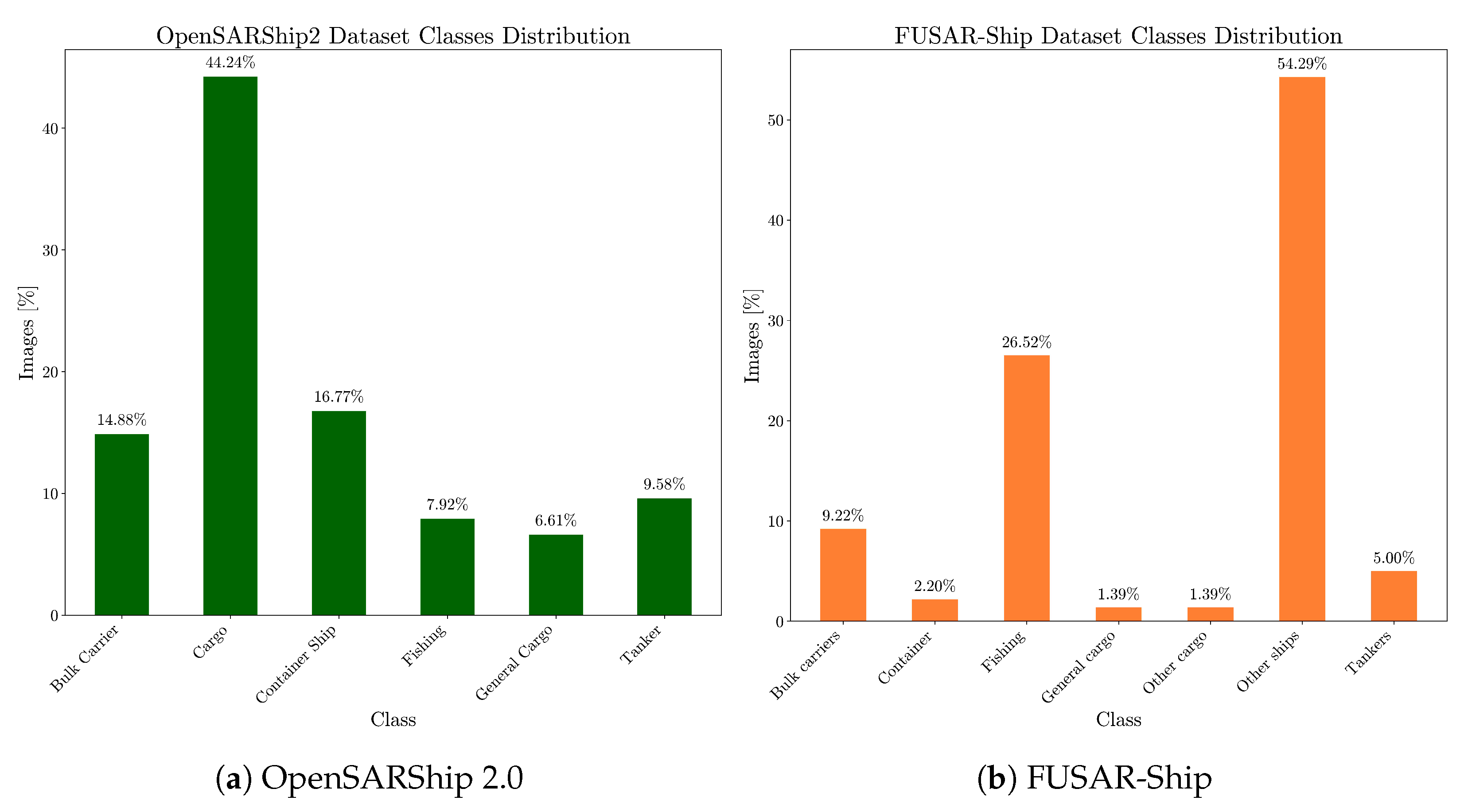
Figure 2a, and the original class distribution is illustrated in
Figure 3a. A significant class imbalance is observed, with cargo ship class dominating the dataset. To evaluate the impact of this imbalance, training is conducted on both the full dataset and a reduced version, where a maximum of 1700 samples per class is imposed. This reduction strategy mitigates the dominance of overrepresented classes while maintaining adequate intra-class diversity.
Table 1 provides a summary of the total number of training, testing, and training samples.
The second dataset used in our experiments, FUSAR-Ship, was acquired by the Gaofen-3 (GF-3) satellite and consists of 126 scenes captured in ultrafine strip-map (UFS) mode across diverse environments, including open sea, coastal areas, rivers, islands, and near-shore regions. It provides a four-level maritime taxonomy with 15 ship categories and 98 subcategories, along with non-ship classes, and contains over 10,000 annotated maritime object chips labeled via automatic SAR-AIS matching. All images are amplitude data with dual-polarization (HH and VV). Ship chips are cropped around detected targets to a fixed size of
pixels, preserving both the vessel’s scattering characteristics and surrounding sea clutter [
3].
Unlike OpenSARShip2, where VV and VH channels are simultaneously available for each ship instance, FUSAR-Ship does not provide dual-polarization data for the same target chip. Instead, HH and VV samples are distributed across different ships acquired in separate scenes. Therefore, dual-polarization information is available at the dataset level rather than at the individual sample level.
For consistency existing studies in the literature, we adopt a 7-class configuration. This choice enables direct comparison while ensuring sufficient data per class for reliable training.
Representative samples of the selected seven categories are illustrated in
Figure 2b, while their distribution is shown in
Figure 2b. The dataset shows a clear class imbalance, with some categories containing substantially more samples than others. To assess the effect of this imbalance, training is performed on both the full dataset and a reduced version, in which each class is limited to a maximum of 700 samples. The resulting number of training, testing, and total samples for the selected seven classes is summarized in
Table 1.
The OpenSARShip 2.0 and FUSAR-Ship datasets consist of preprocessed image chips, which limits direct access to phase information and full polarimetric scattering characteristics.
4.2. Experimental Setup
The experimental setup used for model training is presented below. The hardware configuration, training hyperparameters, and data augmentation settings are summarized in
Table 2.
All experiments were conducted using an 80–20% train/test split. Ship images were resized to
pixels, except for ViT experiments, which required
pixels. Data augmentation was applied at each epoch to increase input variability and improve model robustness. Specifically, the set of employed augmentation techniques, based on [
49], consists of random resized cropping, which simulates variations in scale and viewpoint, horizontal and vertical flipping, which improve invariance to different ship orientations, and brightness/contrast adjustments, which enhances robustness to lighting and contrast differences.
Classical deep learning models, including ViT, ResNet, MobileNet, EfficientNet, and MobileViTv2, were trained prior to evaluating the proposed method. All models were initialized with pretrained weights. All models were trained using focal loss, while a subset of models were also trained with categorical cross-entropy loss for comparison. The AdamW optimizer [
50] was used during training, and the coefficients for computing the running averages of gradient and its square were
,
, whereas the weight decay was fixed to
. The learning rate is set to
for the encoder and
for the classification head. In addition, a cosine annealing scheduler with a 5-epoch warmup is employed. We considered a batch size of 8, and 100 epochs are used to train the models. Cross-entropy or focal loss was employed depending on the experiment. For focal loss, the focusing parameter
was set to 2, and class-balancing weights
were computed from the class distribution of the training set, assigning higher weights to underrepresented classes. Both
and
were fixed during training and not trainable. For cross-entropy, class weights derived from the same distribution were similarly applied during training to mitigate class imbalance.
In order to assess the performance of the proposed framework and to provide a thorough comparison with other methods, we consider several evaluation metrics, namely accuracy, precision, recall, and F1-score. Accuracy reflects the overall correctness of predictions, precision indicates how reliable the positive predictions are, recall measures the ability to identify all true positives, and the F1-score provides a balance between precision and recall, which is especially useful for unbalanced datasets.
4.3. Experimental Results
In the following, we present the experimental results obtained on the OpenSARShip 2.0 and FUSAR-Ship datasets.
Table 3 summarizes all classification results, including the 3-class and 6-class configurations for OpenSARShip 2.0 and the 7-class configuration for FUSAR-Ship.
All classical architectures (ViT, ResNet, MobileNet, and EfficientNet) as well as MobileViTv2 and the proposed DPSSMobileViTv2 were evaluated on the full OpenSARShip 2.0 dataset. Additionally, for the 6-class OpenSARShip 2.0 configuration, DPSSMobileViTv2 were also evaluated on a reduced version of the dataset. For the FUSAR-Ship dataset, where dual-polarization information is unavailable, additional experiments with reduced dataset were conducted using the MobileViTv2 architecture.
For OpenSARShip 2.0, the reported results include experiments conducted with independent polarization samples (VV and VH treated separately), single-polarization training (VV-only and VH-only), and dual-polarization feature fusion.
In the case of FUSAR-Ship, polarization modes are included within the training data but processed as independent samples, as the dataset does not provide paired polarization acquisitions corresponding to the same ship instance. Therefore, both mixed-polarization training and single-polarization configurations (each mode used independently) are considered, while feature-level fusion cannot be applied.
The effect of class imbalance becomes more pronounced as the number of classes increases.
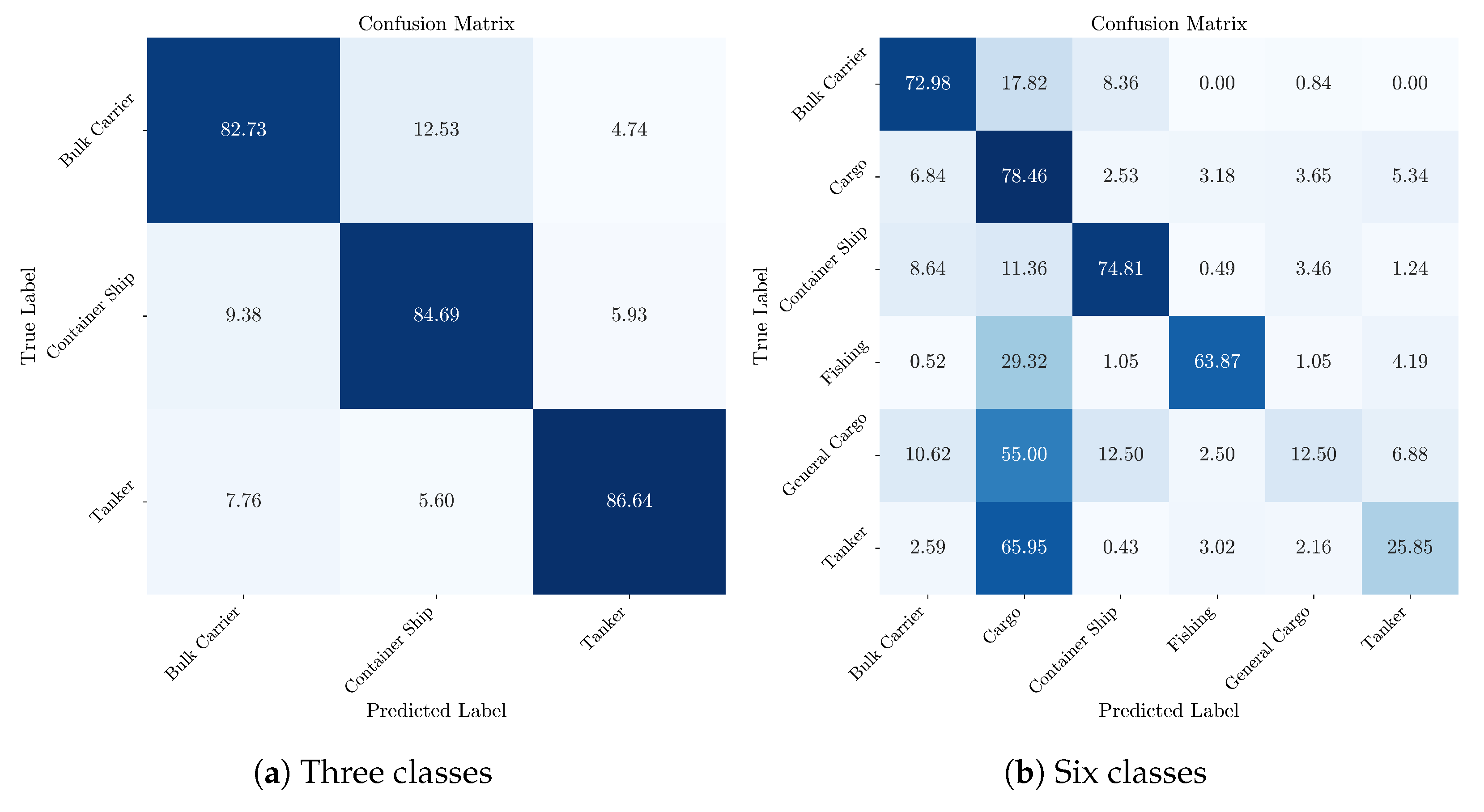
Figure 4 illustrates confusion matrices obtained using MobileViTv2 on the full OpenSARShip 2.0 dataset. Performance is clearly degraded by class imbalance, resulting in misclassifications, particularly among classes such as tanker and general cargo.
To address the class imbalance without modifying the dataset, we evaluate the proposed DPSSMobileViTv2 model on the full OpenSARShip 2.0 dataset.
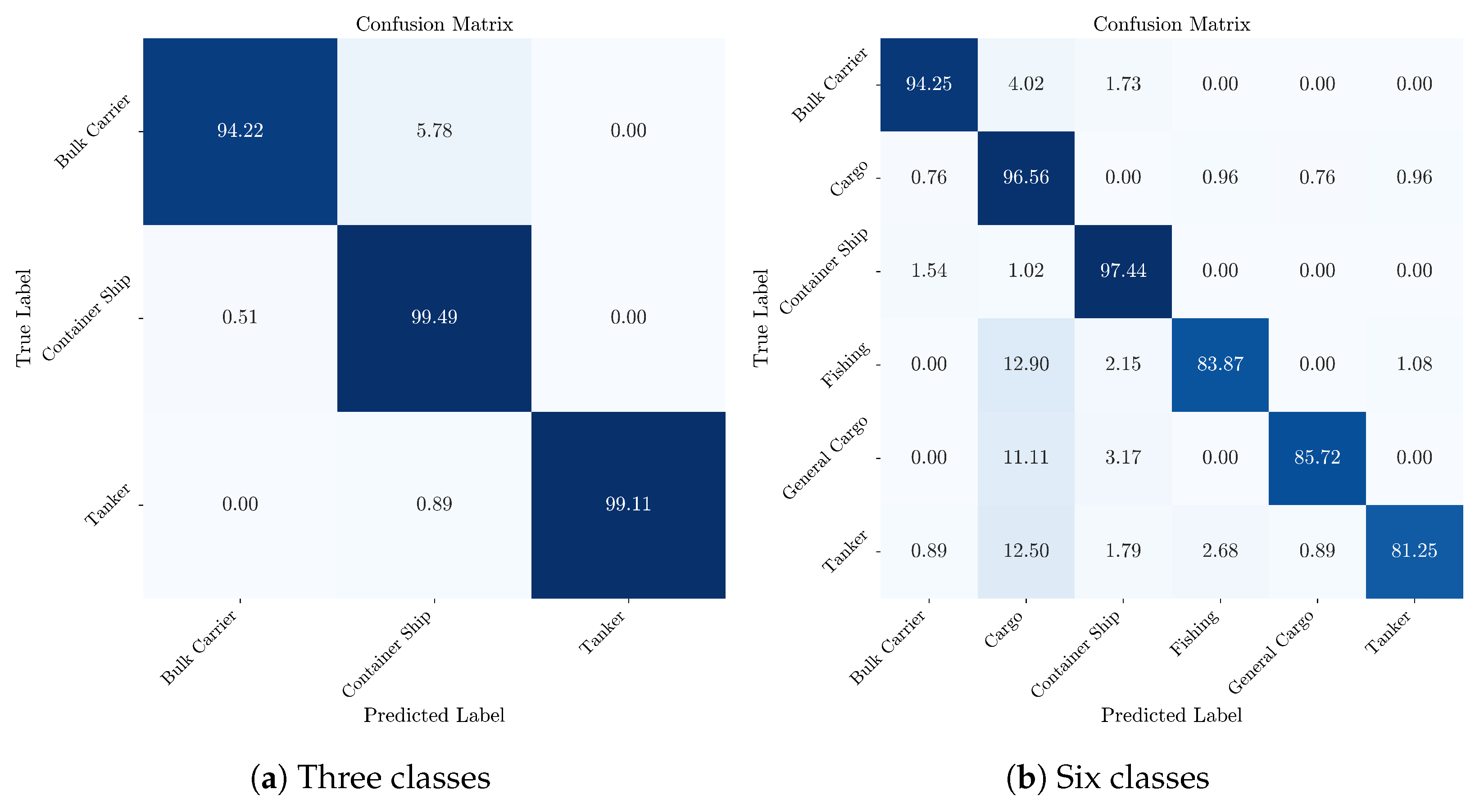
Figure 5 presents the confusion matrices for both the 3-class and 6-class configurations. Compared with
Figure 4, the use of dual-polarization information substantially reduces misclassifications, resulting in a more pronounced diagonal and clearer separation between classes. This improvement is particularly evident in the 6-class configuration.
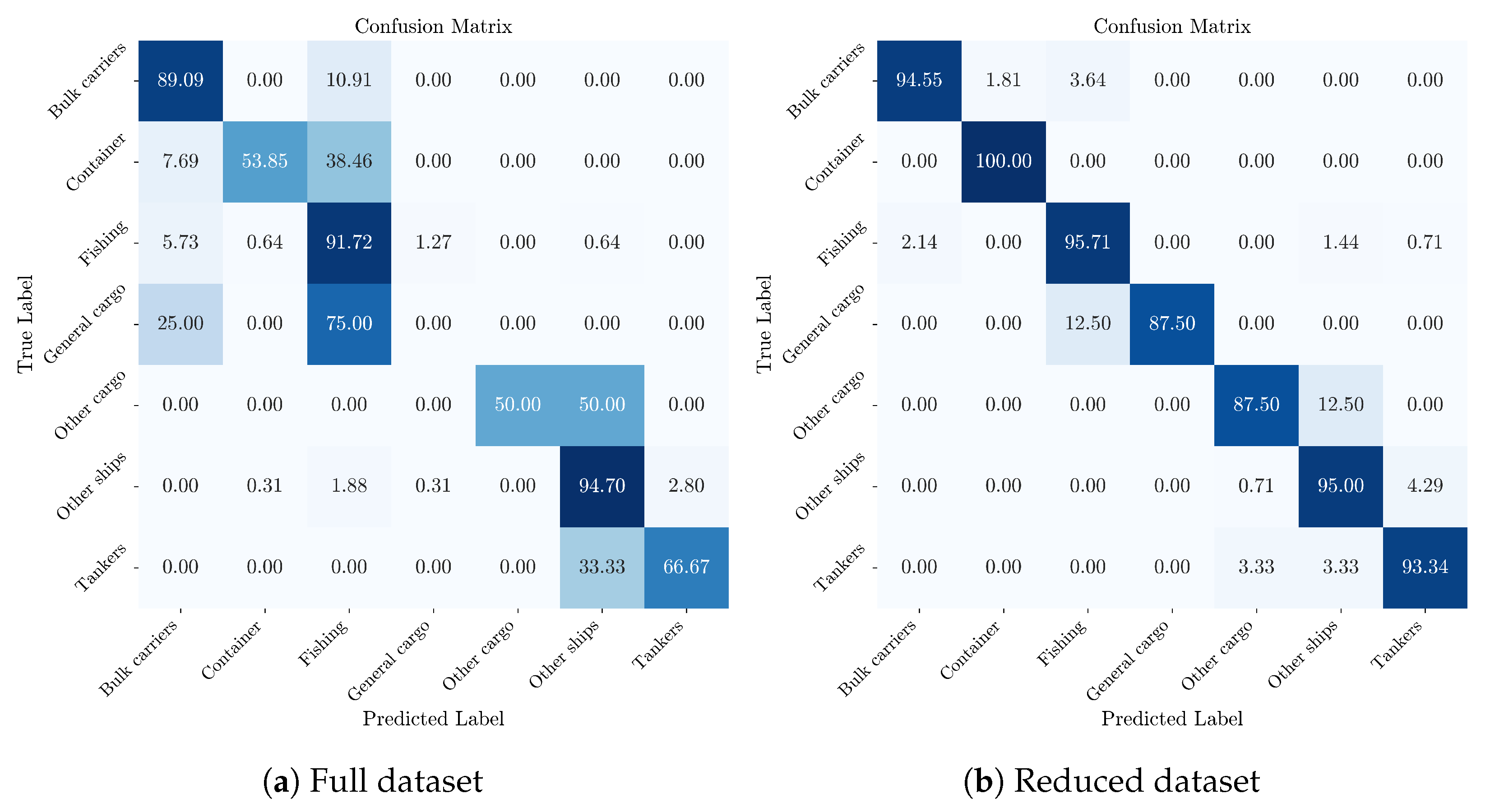
For the FUSAR Ship dataset, where dual-polarization data is not available, we explore a dataset-level reduction strategy. Limiting the number of samples per class helps mitigate class imbalance, leading to improved performance of the single-branch MobileViTv2 model.
Figure 6 illustrates the impact of dataset reduction: in the full dataset, misclassifications are prominent, whereas in the reduced dataset, classification performance is substantially improved.
In the 6-class configuration of the OpenSARShip 2.0 dataset, training the DPSSMobileViTv2 model on the reduced dataset results in a performance decrease of over 3% compared to the full dataset. This degradation highlights the trade-off introduced by dataset reduction: while limiting the number of samples per class helps mitigate class imbalance and produce more balanced confusion matrices, it can also remove valuable intra-class variability, slightly reducing overall classification accuracy.
The analysis of polarization effects highlights dataset-specific trends. For OpenSARShip 2.0, using only VH polarization results in a 2% decrease in accuracy compared to the combined VV+VH configuration, whereas VV-only increases accuracy by 3%. In contrast, for the FUSAR-Ship dataset, VV images are severely underrepresented. The VV dataset is 9 times smaller than the HH dataset. HH-only training increases performance by 6% compared with the combined VV+HH configuration, while VV-only training reaches 100%, due to the very limited number of VV samples.
To further investigate the impact of polarization fusion, we also evaluated a two-channel input configuration obtained by concatenating the VH and VV images as input to the MobileViTv2 model (reported in
Table 3 as MobileViTv2 (VH|VV)). This approach leads to a significant improvement compared to single-polarization inputs, confirming that the two polarizations provide complementary information for ship classification. However, the proposed dual-branch architecture achieves higher accuracy than the two-channel MobileViTv2 input, improving results by 2% in the 3-class case and by nearly 5% in the 6-class case. This indicates that learning polarization-specific features in separate branches before feature fusion is more effective than directly combining the polarizations at the input level.
The results indicate that combining different polarization modes in a single architecture can enhance feature representations. Rather than relying on a single polarization perspective, the model leverages data from multiple polarization modes, which provide additional information for marine target classification. This performance improvement supports the idea that each polarization mode captures unique aspects of target backscattering behavior, thereby aiding in better class separability.
In terms of model complexity, the proposed DPSSMobileViTv2 model achieves a favorable trade-off between classification performance and computational efficiency. Although the dual-branch architecture doubles both the number of parameters and the inference time compared to MobileViTv2, it delivers substantial performance gains, especially in challenging scenarios involving high inter-class similarity. This favorable trade-off between computational cost and accuracy highlights the practical value of the proposed approach.
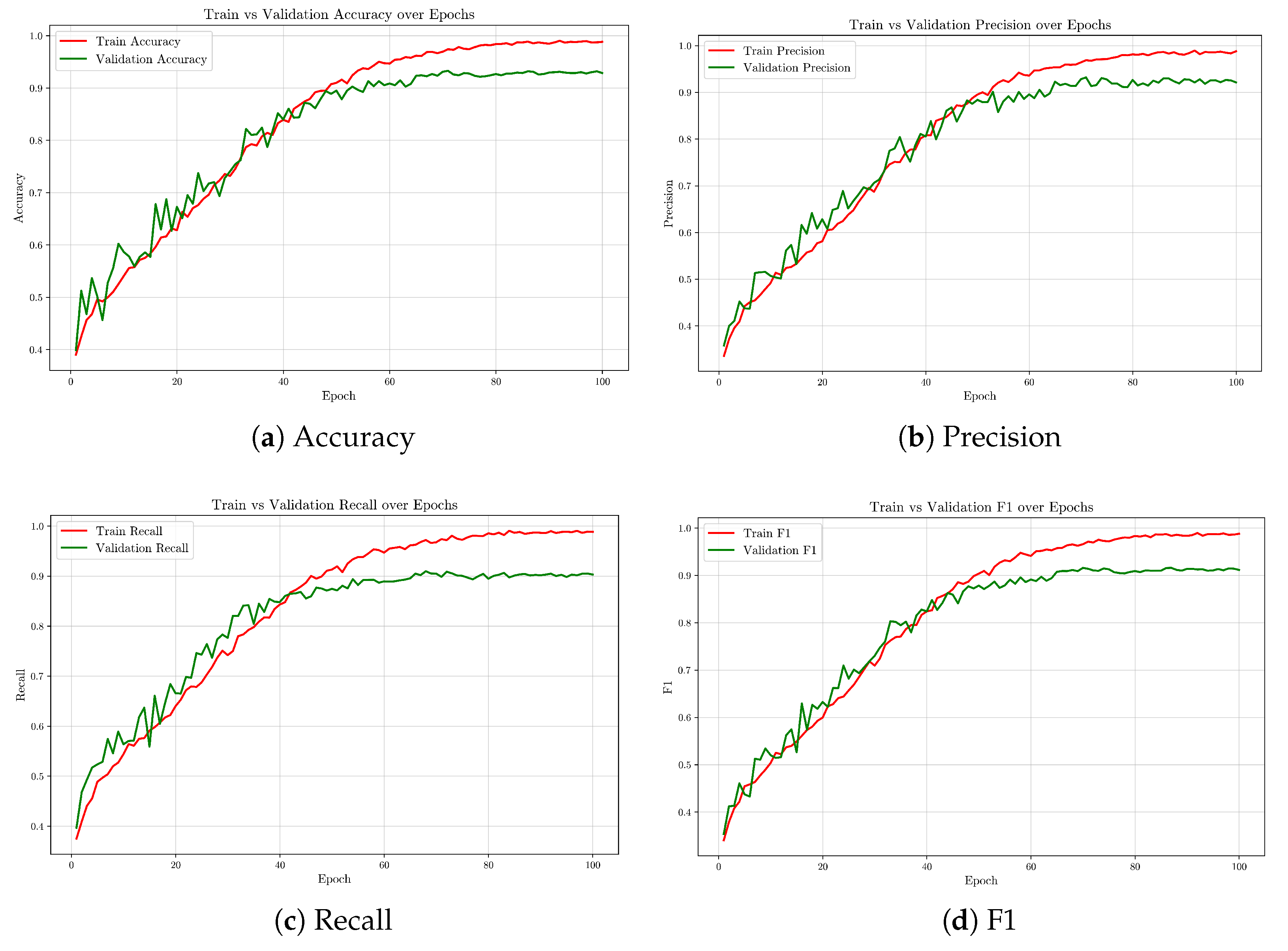
The evolution of the training and testing performance for the DPSSMobileViTv2 model on the OpenSARShip 2.0 dataset with 6 classes during the 100 training epochs is presented in
Figure 7. Four evaluation metrics are considered, namely accuracy, precision, recall, and F1 score, which are computed on both the training and test sets. The results highlight the ability of the model to generalize across the dataset. Notably, stabilization of performance is observed around epoch 60, indicating the model’s convergence and the effectiveness of the proposed DPSSMobileViTv2 architecture for this classification task.
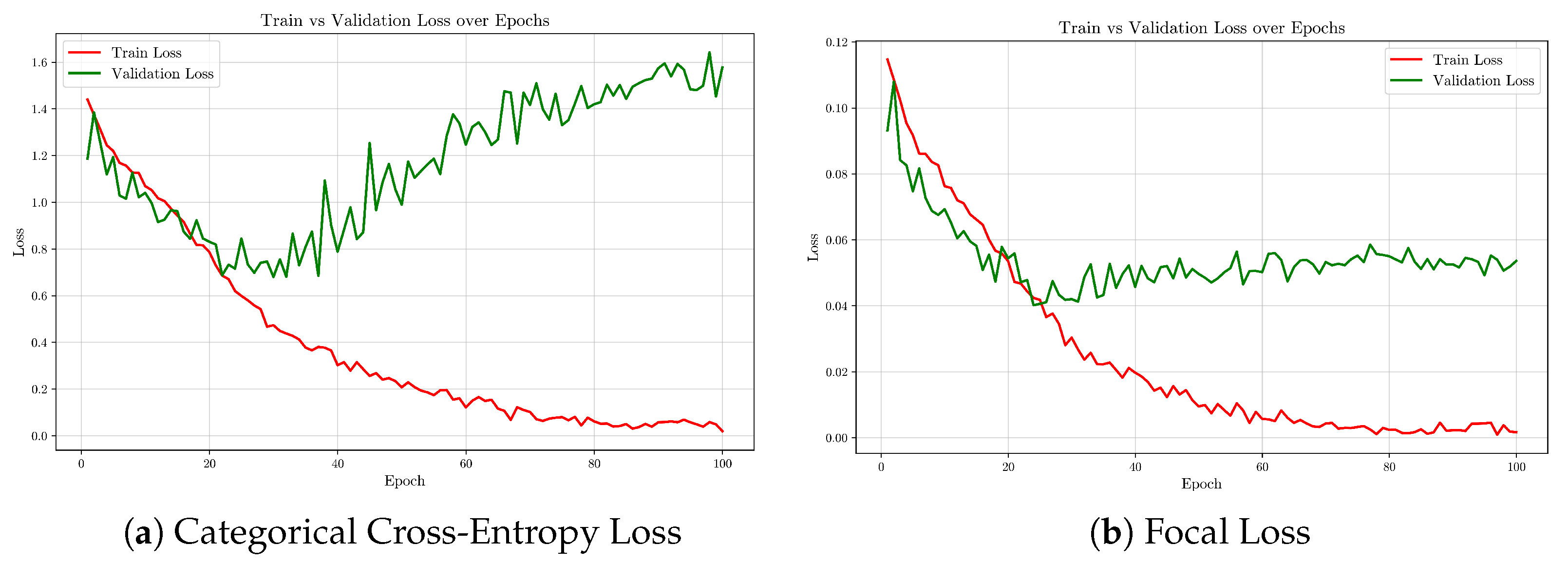
Figure 8 shows the comparison of loss evolution during training on the OpenSARShip 2.0 dataset with 6 classes using the DPSSMobileViTv2 model.
Figure 8a illustrates the evolution of the categorical cross-entropy loss, where the test loss decreases until around epoch 40, after which it starts to increase during the remaining epochs. In contrast,
Figure 8b presents the focal loss, where the loss computed on the test set begins to stabilize around epoch 40 and remains steady throughout the rest of the training.
To identify a suitable fusion strategy, several low-complexity approaches were evaluated, including sum fusion, average fusion,
convolution, and concatenation. As shown in
Table 4, the performance across all strategies is relatively similar. Among them, concatenation shows a slight advantage, with marginal improvements of up to approximately 1%. Therefore, concatenation was selected as the final fusion strategy.
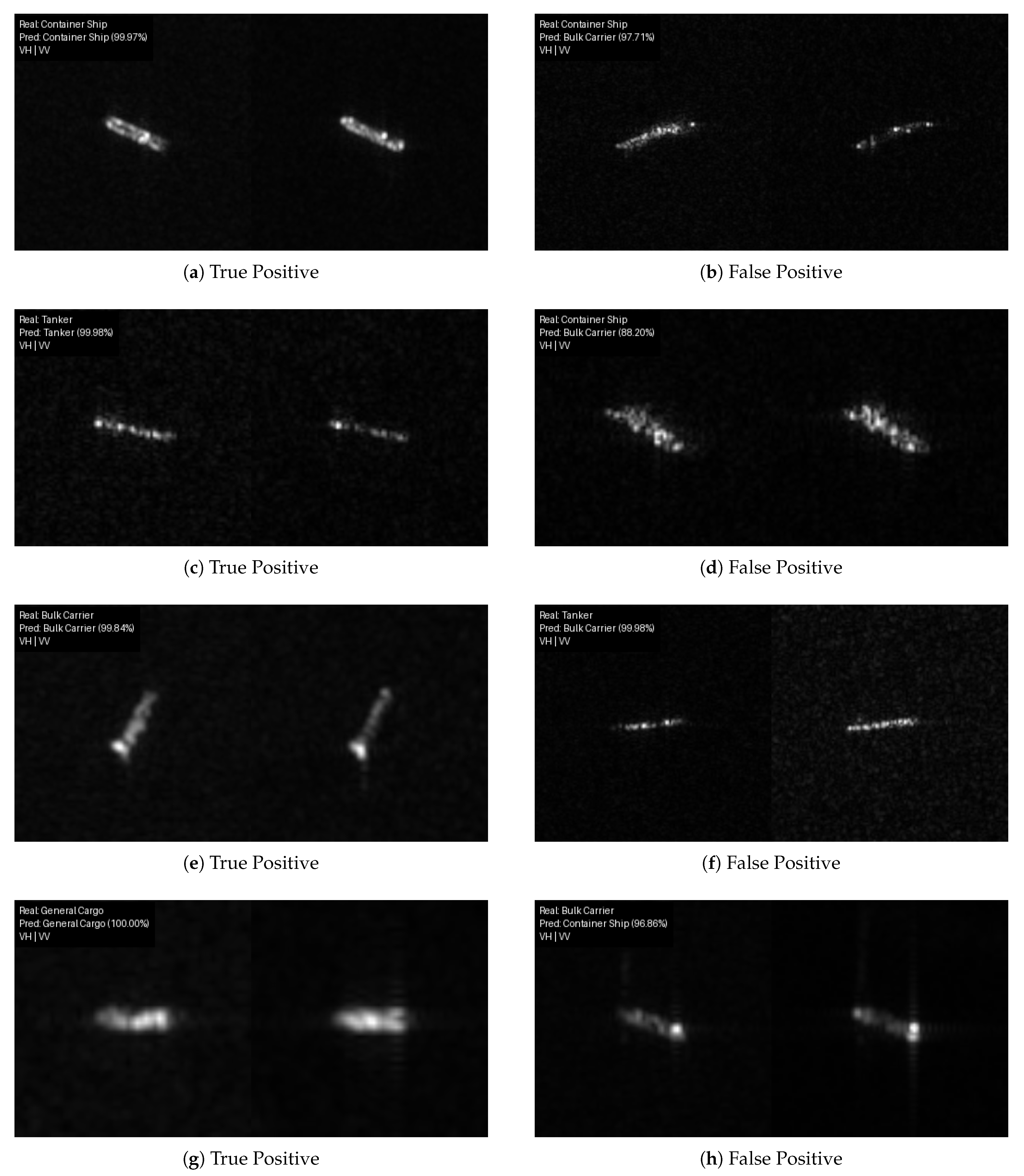
Several comparisons between correct and incorrect predictions made by the DPSSMobileViTv2 model on the OpenSARShip 2.0 dataset are presented in
Figure 9. Each image pair consists of two separate images: on the left is the VH polarization mode, and on the right is the VV polarization mode. For each pair, the upper-left corner of the image displays the true label, predicted label, and accuracy of the model’s prediction. The left column contains examples of correct predictions (True Positives), while the right column shows examples of incorrect predictions (False Positives).
5. Discussion
Three central research hypotheses guided the present work, more precisely, (i) hybrid convolution-transformer architectures are particularly suitable for SAR ship classification, (ii) the integration of dual-polarization modes can enhance class discrimination, and (iii) a parallel dual-branch design can improve predictive performance without introducing substantial computational overhead. These hypotheses are supported by the experimental results provided in
Table 5, which includes a comparison between the proposed approach and previously reported results from the literature.
On the OpenSARShip 2.0 dataset, the proposed DPSSMobileViTv2 model achieves performance improvements of approximately 9% and 12% over previously reported methods for the 3-class and 6-class configurations, respectively. The improved performance obtained by DPSSMobileViTv2 model, particularly in the more complex 6-class configuration, indicates that the proposed architecture remains robust as inter-class similarity increases. While the MobileViTv2 model was trained on the full dataset, the DPSSMobileViTv2 model was evaluated on the same full dataset and benefited from dual-polarization feature-level fusion. These findings reinforce the first hypotheses that hybrid convolution-transformer architectures are well suited for SAR ship classification tasks.
The second hypothesis concerned the benefit of integrating dual-polarization modes. The performance gains observed in the dual-mode configuration on OpenSARShip 2.0 indicate that combining polarization modes within a unified framework leads to improved classification accuracy. Feature-level fusion reduces misclassifications and enhances class separability, particularly in the 6-class configuration where inter-class similarity is higher. This indicates that the polarization modes provide additional information, which enhances class separability when fused at the feature level.
For the FUSAR-Ship dataset, dual-polarization data is unavailable, so only the original MobileViTv2 model could be evaluated. To address class imbalance, a dataset-level reduction strategy was applied, limiting the number of samples per class. As shown in the previous section, dataset reduction substantially improves performance. These findings indicate that, while dual-polarization fusion cannot be applied, dataset reduction is an effective strategy to mitigate imbalance and enhance model robustness, producing results that remain competitive compared to literature-reported baselines.
The third hypothesis concerns computational efficiency. The DPSSMobileViTv2 model achieves a favorable balance between accuracy and computational cost: although the dual-branch design approximately doubles both the number of parameters and the inference time compared to MobileViTv2, the substantial improvements in classification performance, particularly in the challenging 6-class OpenSARShip 2.0 configuration, justify the additional cost. This demonstrates that the proposed architecture maintains low computational overhead while remaining suitable for real-time maritime monitoring.
Despite the strong performance, several limitations should be acknowledged. First, a direct comparison with previously published results may be influenced by variations in dataset partitioning and experimental settings, as not all studies report identical training configurations. Second, the evaluation was conducted on two C-band datasets, which limits conclusions regarding generalization to other frequency bands or sensor platforms. Additionally, the absence of paired polarization acquisitions in FUSAR-Ship dataset prevented the assessment of dual-mode feature fusion across both benchmarks.
Beyond these limitations, an important direction concerns the operational deployment of the proposed framework. Evaluating its behavior in large-scale maritime monitoring scenarios, including imbalanced distributions and unseen ship categories, would provide a deeper insight into its practical readiness. Future work will focus on domain adaptation strategies, incremental learning mechanisms, and real-time inference optimization to support deployment in practical maritime monitoring systems.