Article

Spatiotemporal Patterns of Ground Deformation in the Beijing Plain Under the South-to-North Water Diversion Project: Integrating InSAR and ICA

1
College of Resources Environment and Tourism, Capital Normal University, Beijing 100048, China
2
Key Laboratory of Mechanism, Prevention and Mitigation of Land Subsidence, Capital Normal University, Beijing 100048, China
3
Beijing Laboratory of Water Resources Security, Capital Normal University, Beijing 100048, China
4
Cangzhou Groundwater and Land Subsidence National Observation and Research Station, Cangzhou 061000, China
5
School of Electrical Engineering and Automation, Nantong University, Nantong 226019, China
6
Technical Centre for Soil, Agriculture and Rural Ecology and Environment, Ministry of Ecology and Environment, Beijing 100012, China
*
Author to whom correspondence should be addressed.
These authors contributed equally to this work.
Remote Sens. 2026, 18(7), 1077; https://doi.org/10.3390/rs18071077
Submission received: 28 February 2026 / Revised: 30 March 2026 / Accepted: 31 March 2026 / Published: 3 April 2026
(This article belongs to the Special Issue Role of SAR/InSAR Techniques in Investigating Ground Deformation)

Highlights

What are the main findings?
  • Three dominant deformation patterns in Beijing Plain: quasi-linear subsidence (−108 mm/yr), Chaobai River rebound (+20 mm/yr), and “subsidence-to-rebound” transition.
  • A 5.5-year lag between SNWDP and regional rebound; deformation asymmetry linked to aquifer lithology.
What are the implications of the main findings?
  • Provides scientific basis for zoned groundwater management in Beijing (deep extraction control, shallow recharge).
  • InSAR-ICA framework offers transferable reference for water-scarce megacities globally.

Abstract
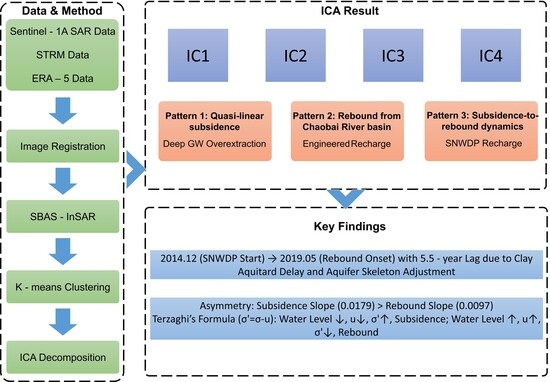
Following adjustments in regional water resource management policies and changes in hydrogeological conditions, significant shifts have occurred in Beijing’s water consumption patterns, which have effectively mitigated land subsidence and triggered a trend of ground rebound. This study systematically analyzed the spatiotemporal characteristics and transition mechanisms of ground deformation (subsidence-rebound) driven by water consumption changes, integrating InSAR, ICA (independent component analysis), and regional hydrogeological data. InSAR time-series analysis derived 2015–2023 Beijing Plain deformation data, with ICA identifying key drivers, supported by hydrogeological interpretation. Three primary patterns emerged: (1) quasi-linear subsidence from persistent deep groundwater overextraction; (2) rebound from Chaobai River basin engineered recharge; (3) “subsidence-to-rebound” dynamics due to reduced shallow groundwater extraction and enhanced precipitation infiltration. The results indicate that a regional rebound emerged 5.5 years after the initiation of the South-to-North Water Diversion Project (SNWDP), which quantifies, for the first time, the direct temporal lag between the initiation of water diversion and the geomechanical deformation response. ICA further revealed that deformation asymmetry (subsidence trend slope > rebound trend slope) correlates with aquifer lithology (clay vs. sand-gravel layers). The results offer a scientific framework for urban groundwater management and subsidence mitigation, not only in Beijing but also in analogous regions globally, highlighting a paradigm shift in ground deformation dynamics under integrated water governance.

1. Introduction

Ground subsidence, a critical geological hazard characterized by persistent surface elevation reduction due to subsurface stratum compression, is typically induced by groundwater overexploitation. It has become a global issue [1], widely affecting plain regions worldwide, including the Central Valley Plain in California [2], the Mexico Plain [3,4,5], the Phoenix Plain [6], and the Central Iran Plain [7,8]. In China, where ground subsidence has already impacted key plains (e.g., the North China Plain (NCP) [9,10], this hazard is particularly threatening amid the country’s massive urbanization—especially in coastal areas. By 2120, due to the combined effects of urban subsidence and sea-level rise, 22 to 26% of China’s coastal lands will have a relative elevation lower than sea level, hosting 9 to 11% of the coastal population [11].
As a core part of the NCP and a vital political and cultural hub, the Beijing Plain faces acute challenges of surface and groundwater scarcity amidst rapid socio-economic development. In 2019, Beijing (population over 21.5 million) had a per capita water resource of 114.0 cubic meters [12], far below the 500 cubic meters international absolute scarcity level. As groundwater is its main water source, long-term overexploitation has caused significant groundwater level drops and ground subsidence [10]. Over 1992–2022, the Beijing Plain formed three major subsidence funnels due to massive groundwater exploitation, with maximum cumulative subsidence reaching 1.98 m [13], a 1 m water level drop corresponds to 10.12 mm subsidence [14].
The South-to-North Water Diversion Project (SNWDP) diverts a portion of the abundant water resources from the Yangtze River Basin in China to northern regions of the country. Since the South-to-North Water Diversion Project-Middle Route (SNWDP-MR) opened in late 2014, over 6.459 × 10⁹ cubic meters had been delivered to Beijing by May 2021. The water use structure in Beijing has undergone profound changes [15]. The water diversion has replaced part of the groundwater, reducing extraction and leading to a rise in the groundwater level [16,17]. Consistent with this trend, from 2015 to 2020 (post-implementation), the first to fourth aquifer groups rose by 2.72–3.68 m [18], and local ground rebound has even occurred [19]. The water diversion from SNWDP-MR to Beijing has reduced the cumulative consumption of groundwater, accounting for 40% of the total groundwater recovery [20].
Against this new hydrological backdrop, there is an urgent need to analyze the dynamic transition mechanisms between subsidence and rebound in the Beijing Plain. The shift from subsidence to rebound involves complex and understudied dynamics, particularly the temporal lag between water policy implementation and surface response, which await clarification. Understanding such dynamics is critical for predicting future risks and optimizing mitigation strategies under altered groundwater conditions.
Interferometric Synthetic Aperture Radar (InSAR) technology [21] is renowned for its high precision, high resolution, and all-weather operation capabilities. It can utilize two or more satellite radar images acquired in the same area to obtain millimeter-level surface deformation. Many scholars have studied ground subsidence in Beijing using various SAR images, noting that it is primarily associated with declining groundwater levels. However, under the new hydrological backdrop, such subsidence has been effectively controlled [22,23].
As InSAR observations typically represent the composite response of natural and anthropogenic factors acting on geological strata, unraveling spatiotemporal deformation signals from complex time-series datasets attributable to distinct driving processes remains a key challenge in current research—particularly separating mixed signals (e.g., groundwater/tectonic). This challenge has prompted the application of signal decomposition methods like Principal Component Analysis (PCA) [24], Independent Component Analysis (ICA) [25], and Wavelet Transform [26]. These methods, rooted in the broader challenge of blind source separation (BSS) within signal processing, have proven powerful not only for InSAR but also in other SAR applications such as interference suppression [27]. Despite not originally developed for this purpose, have shown unique advantages in handling InSAR time-series data through in-depth investigations into their applicability for dissecting InSAR deformation signals.
ICA, as a signal decomposition method, is based on the assumption that each independent component follows a non-Gaussian probability distribution [28]. This allows the separation of mixed multi-source signals into linear combinations of mutually independent sources. Therefore, the results of InSAR can be decomposed into multiple independent source signals using this method. Emerging research has highlighted ICA’s exceptional efficacy in processing InSAR time-series data, enabling the effective isolation of noise components such as Digital Elevation Model (DEM) errors [29], orbital errors [30], and atmospheric delay disturbances [31]. Beyond mere noise mitigation, ICA further enables the characterization of volcanic deformation, mapping of permafrost zones [32], and enhancement of landslide identification techniques [33]. Notably, ICA has demonstrated distinct advantages in applications ranging from analyzing land reclamation consolidation patterns [34] to identifying drivers of regional ground subsidence [35]. Given its proven efficacy in dissecting complex deformation signals and identifying subsidence drivers, ICA was incorporated into this study’s analytical framework to investigate the Beijing Plain’s subsidence-rebound dynamics transition mechanism.
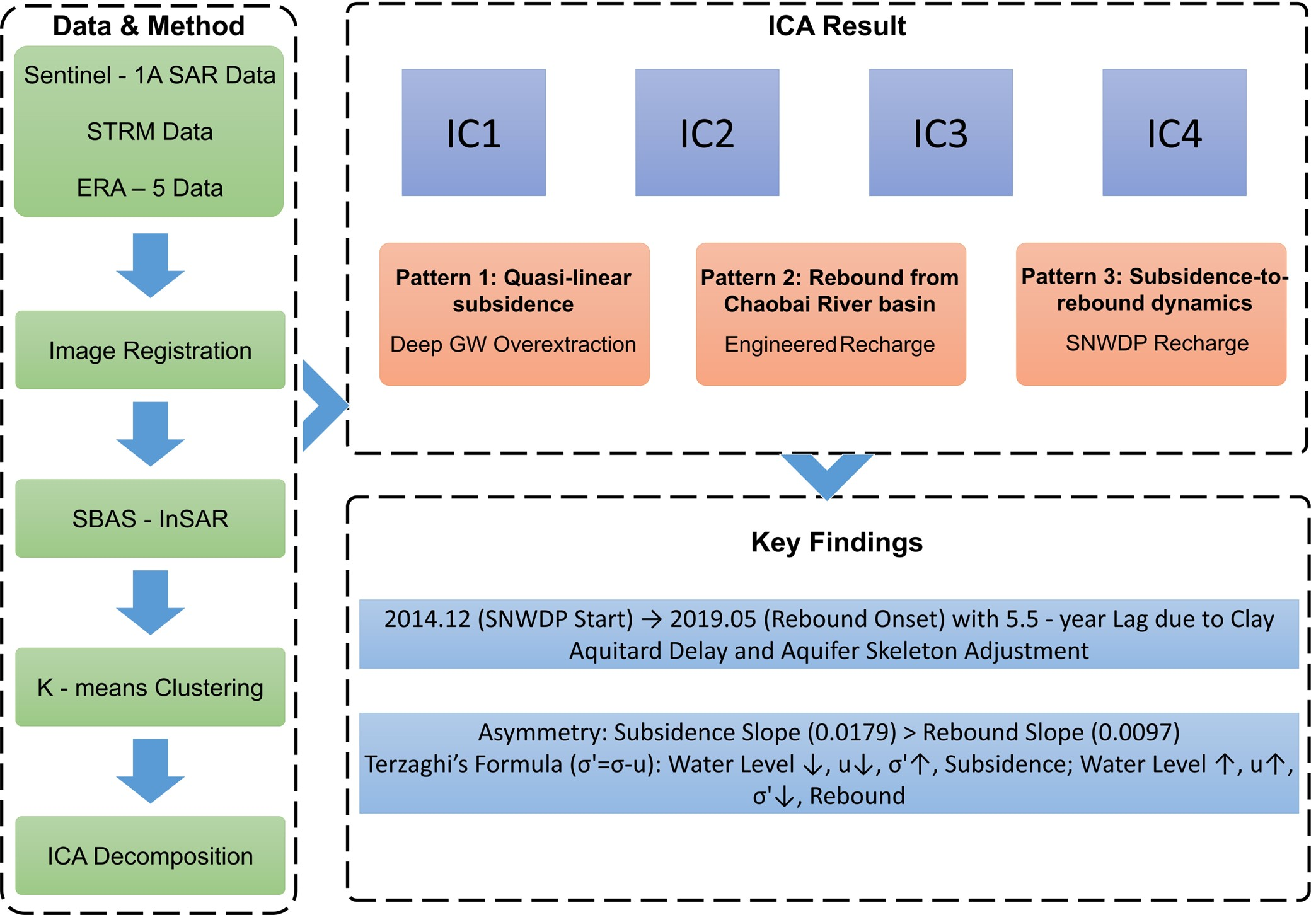
This study first employed an improved SBAS-InSAR technology based on C-band Sentinel-1A data (2015–2023) to characterize ground deformation across the Beijing Plain. Thereafter, K-means clustering was applied to analyze the characteristics of spatial deformation. Building on this, the ICA algorithm was utilized to extract the spatiotemporal evolution features of ground subsidence, successfully isolating four distinct temporal trend components: (1) quasi-linear deformation; (2) irregular fluctuations; (3) subsidence-rebound deformation; and (4) irregular fluctuations. In the discussion, these components were analyzed in depth to infer their potential driving factors. Moreover, this study not only validates the applicability of the ICA method in analyzing ground subsidence within the Beijing Plain but also paves the way for future explorations of this technique under complex geological and hydrogeological scenarios.

2. Materials and Methods

2.1. Study Area

2.1.1. Location

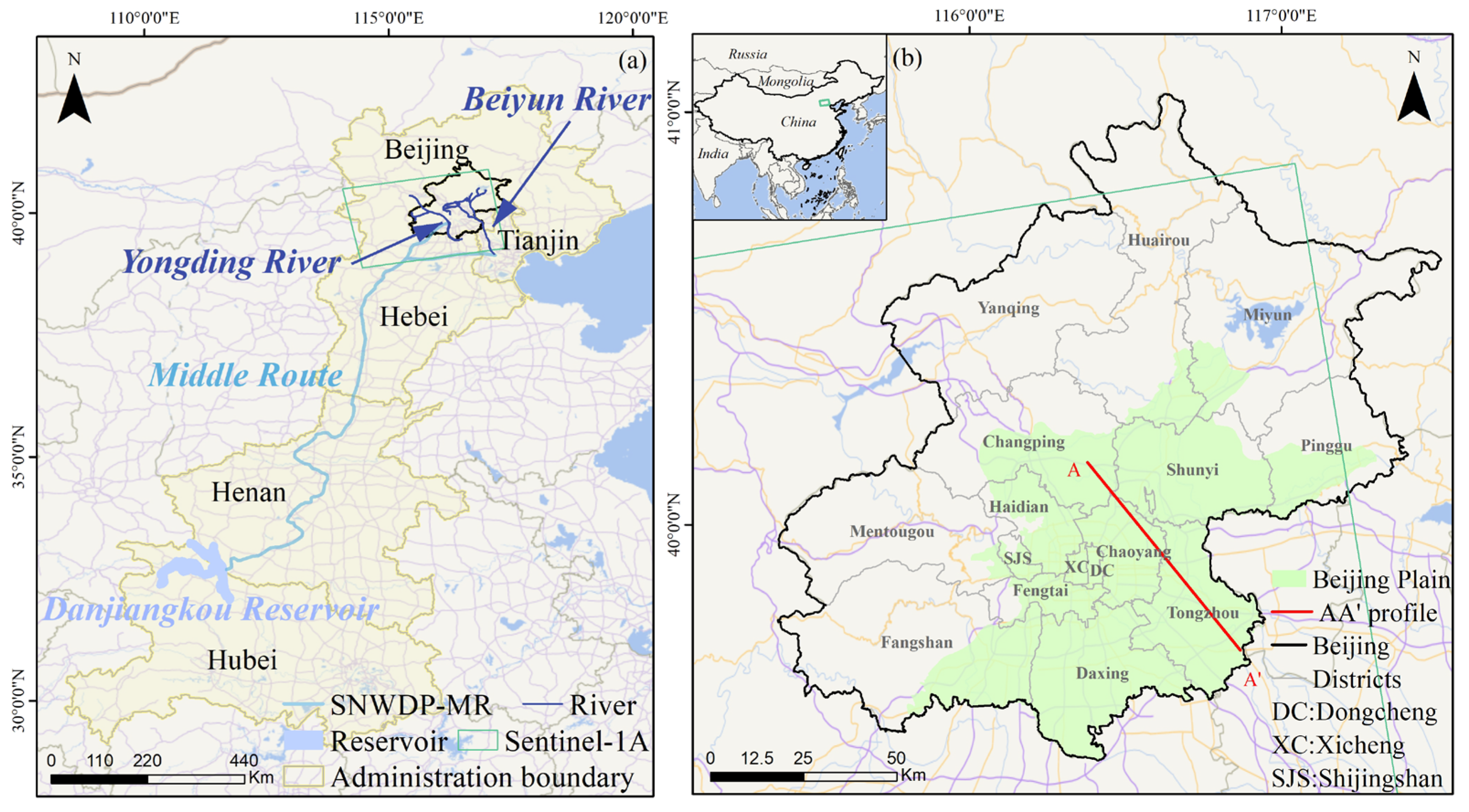
The Beijing Plain (Figure 1), situated in the northwestern corner of the NCP, borders Tianjin to the east and Hebei Province to the south. It is characterized by a terrain that is higher in the northwest and lower in the southeast. Geomorphologically, it constitutes an alluvial fan complex formed by five major drainage systems [36,37]. As a principal component of the Beijing Municipality, the Beijing Plain spans ~6400 km2 (39% of Beijing Municipality) with a temperate continental monsoon climate (mean annual precipitation 580 mm, temperature 10–12 °C [38]).

2.1.2. Geological Setting

The Beijing Plain’s Quaternary sediments include four vertically stratified aquifer groups, with lithology directly influencing deformation:
First Aquifer Group (Aquifer I) is located within the Holocene (Q4) alluvial-pluvial deposits, with a bottom depth of approximately 50 m. The lithology consists primarily of Holocene to Upper Pleistocene alluvial and lacustrine-alluvial silty clay and clayey soil, exhibiting medium plasticity and medium compressibility.
Second Aquifer Group (Aquifer II) is distributed within the Upper Pleistocene (Q3) alluvial-pluvial deposits, with a bottom depth ranging from approximately 80 m to 120 m. The lithology is dominated by Middle Pleistocene alluvial-pluvial and lacustrine-alluvial silty clay and clayey soil layers, exhibiting medium to low plasticity and medium to low compressibility.
Third Aquifer Group (Aquifer III) is situated within the Middle Pleistocene (Q2) alluvial strata, with a bottom depth of approximately 180 m. The lithology is primarily composed of medium-coarse sand, with some gravel.
Fourth Aquifer Group (Aquifer IV) is distributed in the older Lower Pleistocene (Q1) alluvial strata, with a bottom boundary at 260–300 m. Dominated by medium-coarse sand and gravel, this aquifer group has high permeability but is difficult to recharge due to its depth. Long-term overexploitation here (exceeding 1.2 × 10⁸ m3/yr in Chaoyang-Tongzhou) leads to persistent effective stress increase in overlying clay layers (compression coefficient > 0.3 MPa−1), resulting in Quasi-linear subsidence (IC1 component) [39].
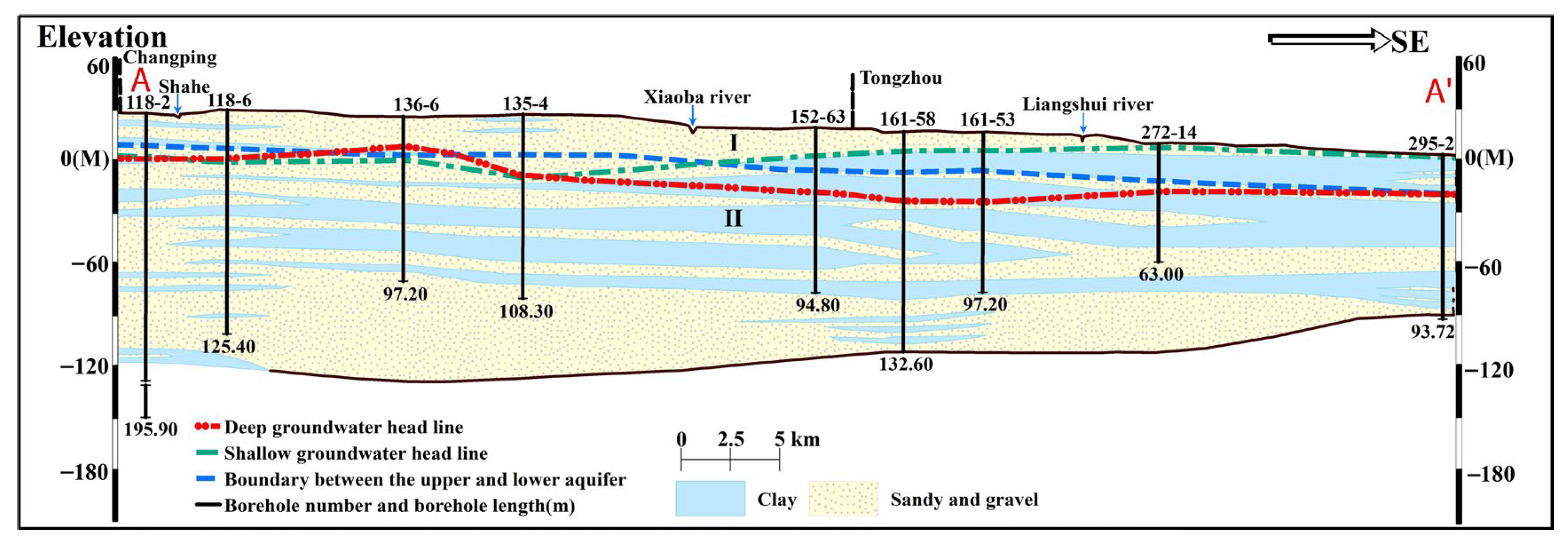
The spatial distribution characteristics of these aquifer groups determine the groundwater occurrence conditions and their exploitation potential. Due to the gradual fining downward of sediment particles and significant lithological variations, the dynamic responses of groundwater exhibit distinct variations across different regions (Figure 2).

2.1.3. Hydrological Regime

Beijing Plain’s hydrology is strongly influenced by the SNWDP-MR and ecological recharge. Since December 2014, ~60 × 108 m3 of water has been delivered to Beijing through the SNWDP-MR (2014–2020), among which 12 × 108 m3 used for groundwater recharge [40]. Groundwater recovery—2015–2020 saw rising water levels (Aquifer Groups I–IV rebounded 2.72–3.68 m [18])—driven by SNWDP-MR recharge and enhanced precipitation infiltration (annual rainfall > 500 mm since 2014 [41]). Unlined channels (e.g., Chaobai River) facilitate infiltration, with ~4.5 × 10⁸ m3 of SNWDP and reclaimed water infiltrating 2007–2016, raising groundwater levels by up to 13.99 m in recharge zones [42].
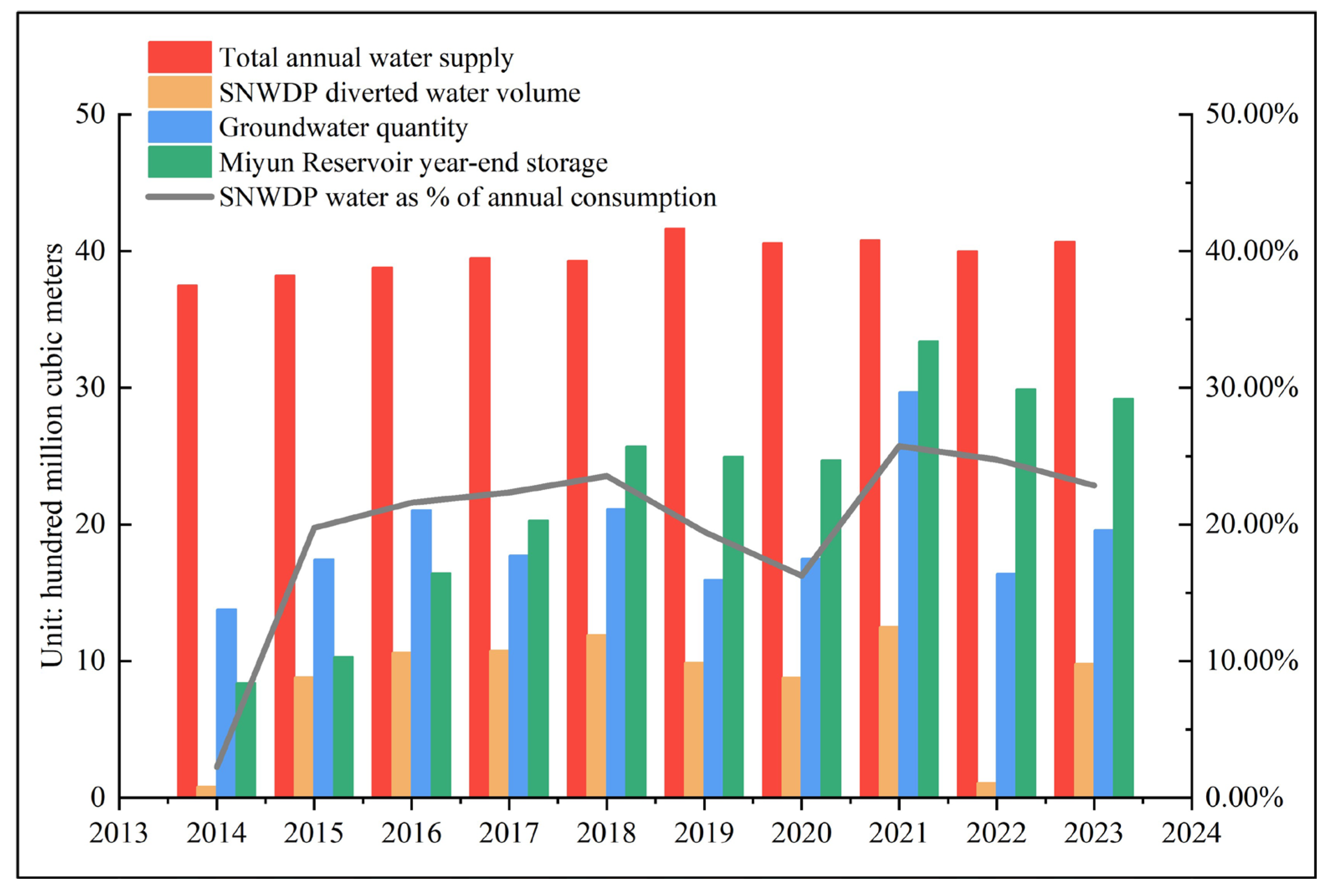
As illustrated in Figure 3, Beijing’s total annual water supply volume has remained relatively stable. However, the proportion of water supplied by the SNWDP-MR within the total supply has been steadily increasing. In recent years, SNWDP-MR water has accounted for approximately one-quarter of the total supply. Concurrently, the year-end storage capacity of the Miyun Reservoir has also been rising annually. This evidence indicates a substantial transition in Beijing’s water use structure. The arrival of SNWDP-MR water has significantly ameliorated the water scarcity situation in Beijing. Therefore, under the new hydrological backdrop shaped by the interaction between the SNWDP-MR and groundwater exploitation, it is imperative to reveal the ground subsidence patterns driven by various factors. Reassessing the spatiotemporal evolution of regional subsidence carries significant practical implications for the rational utilization of water resources, the promotion of sustainable regional development, and the safeguarding of regional security.
In summary, the geological structure of the Beijing Plain (e.g., aquifer grouping) exhibits significant spatial coupling with hydrological processes (e.g., SNWDP-MR recharge, precipitation infiltration). The shallow sand-gravel aquifers in the northwest (with high permeability coefficients) are susceptible to surface recharge, while the deep clay aquifers in the southeast (with high compressibility) respond more significantly to groundwater overexploitation. This heterogeneity lays the foundation for the differentiation of subsequent deformation patterns (see overlay analysis of Figure 2 and Figure 3).

2.2. Dataset

2.2.1. Sentinel-1 SAR Data

The Sentinel-1A (S1A) satellite, launched by the European Space Agency (ESA) in 2014, is a C-band Earth observation satellite with a revisit period of 12 days. It operates in a near-polar sun-synchronous orbit with an altitude of 693 km, an inclination of 98.18°, and an orbital period of 99 min, featuring multiple imaging modes and polarization options.
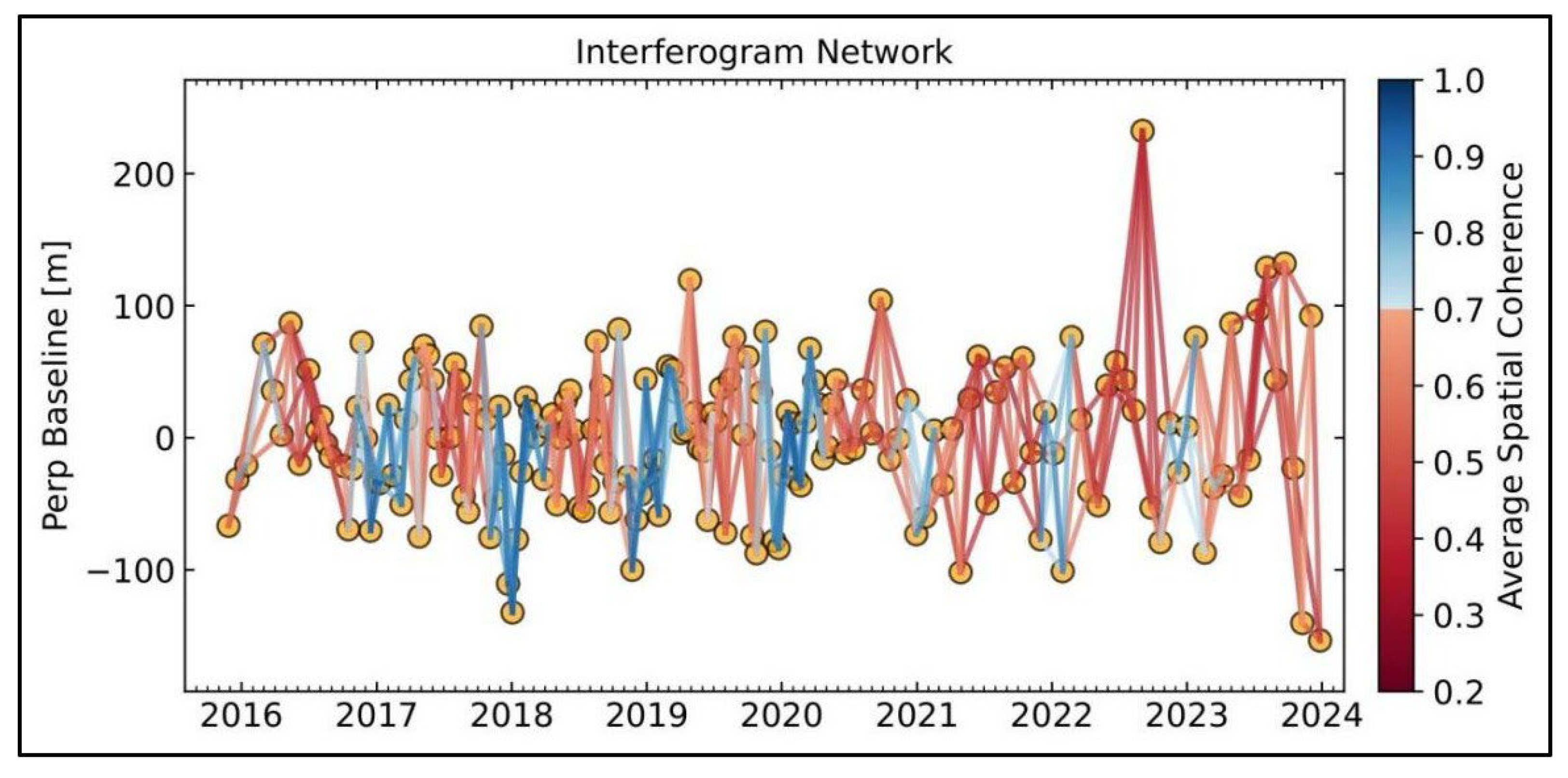
This study utilizes 172 scenes of Sentinel-1 Interferometric Wide swath (IW) mode descending pass SAR data, spanning from 27 November 2015 to 27 December 2023. All data were acquired in vertical-vertical (VV) polarization, with a spatial resolution of 5 m (range) × 20 m (azimuth) and a swath width of 250 km per scene. The coverage area is shown in Figure 1. The selected SAR dataset consists of Single Look Complex (SLC) images generated after focusing processing. The data exhibit good temporal continuity, maintaining adequate interferometric coherence between adjacent acquisitions (Figure 4).

2.2.2. SRTM v4 DEM Data

The Shuttle Radar Topography Mission (SRTM) data were acquired by the National Aeronautics and Space Administration (NASA) as part of a global mapping initiative. This study primarily employs SRTM version 4 (v4) [43]. This version utilizes the interpolation scheme proposed by Reuter et al. [43], combined with auxiliary datasets, to fill data voids present in the original SRTM data, resulting in a seamless dataset. Its reported vertical accuracy is 16 m.

2.2.3. ERA-5 Meteorological Data

ECMWF ERA-5 data (European Centre for Medium-Range Weather Forecasts) (0.25° × 0.25° resolution) corrected tropospheric delay in InSAR interferograms [44].

2.3. Method

2.3.1. Enhanced SBAS-InSAR Processing

The interferometric processing of SAR data and time-series inversion were performed within a Linux environment using the integrated InSAR Scientific Computing Environment (ISCE v2.6.4) [45] and Miami INsar Time-series software in PYthon (MintPy v1.6.2) [46] packages. The key steps are as follows:
(a)
SAR Image Interferometric Processing and Generation of Small Baseline Subset (SBAS) Interferogram Stacks: During interferometric pair selection, the temporal baseline threshold was set to 48 days (Figure 5), with no constraint on the spatial baseline. The spatiotemporal baseline network was optimized using the Minimum Spanning Tree (MST) method. Following the generation of the SBAS interferogram network, pixels with an average coherence greater than 0.9 were selected for the subsequent time-series inversion to ensure high signal-to-noise ratio. Interferometric pairs with an average coherence lower than 0.5 were discarded and did not enter the subsequent time-series inversion. The remaining pairs were selected to maintain a Minimum Spanning Tree (MST) network, which preserves temporal connectivity and minimizes unwrapping errors. The absolute reference point for the entire inversion was selected in a tectonically stable area of the Beijing Plain (Figure 6a). For tropospheric delay correction, the zenith total delay for each SAR acquisition was calculated and removed using the PyAPS v0.3.7 tool [47] integrated with ECMWF ERA5 reanalysis data (0.25° × 0.25°). It should be noted that the ERA-5 data (~31 km spatial resolution) primarily corrects for large-scale systematic delays, while its capability to mitigate localized turbulent atmospheric delays is limited.
(b)
Error Correction and Time-Series Inversion: To enhance phase unwrapping accuracy, wavelet-based filtering was applied during processing following the method described in our patent [48]. DEM errors were estimated and removed using Legendre polynomial expansion. These steps are implemented via custom scripts and are not part of the standard MintPy workflow. The solid Earth tide phase component was modeled and removed. Finally, the time-series of surface deformation and deformation velocity were estimated by solving the system using the Weighted Iterative Least Squares (WLS) method.
For detailed descriptions of the key processing steps involved in this workflow, refer to the official MintPy documentation (https://mintpy.readthedocs.io/en/latest/ (accessed on 5 June 2024)).
In this study, we used descending Sentinel-1 data exclusively. The Beijing Plain is located in a tectonically stable region where ground deformation is primarily driven by vertical compaction or expansion of aquifer systems in response to groundwater extraction and recharge. Horizontal displacement components, especially in the east–west direction, are typically more than an order of magnitude smaller than the vertical component in such hydrogeological settings [35,49]. Therefore, the LOS displacement of each pixel was converted to an approximate vertical displacement by dividing by the cosine of the radar incidence angle (cos θ).
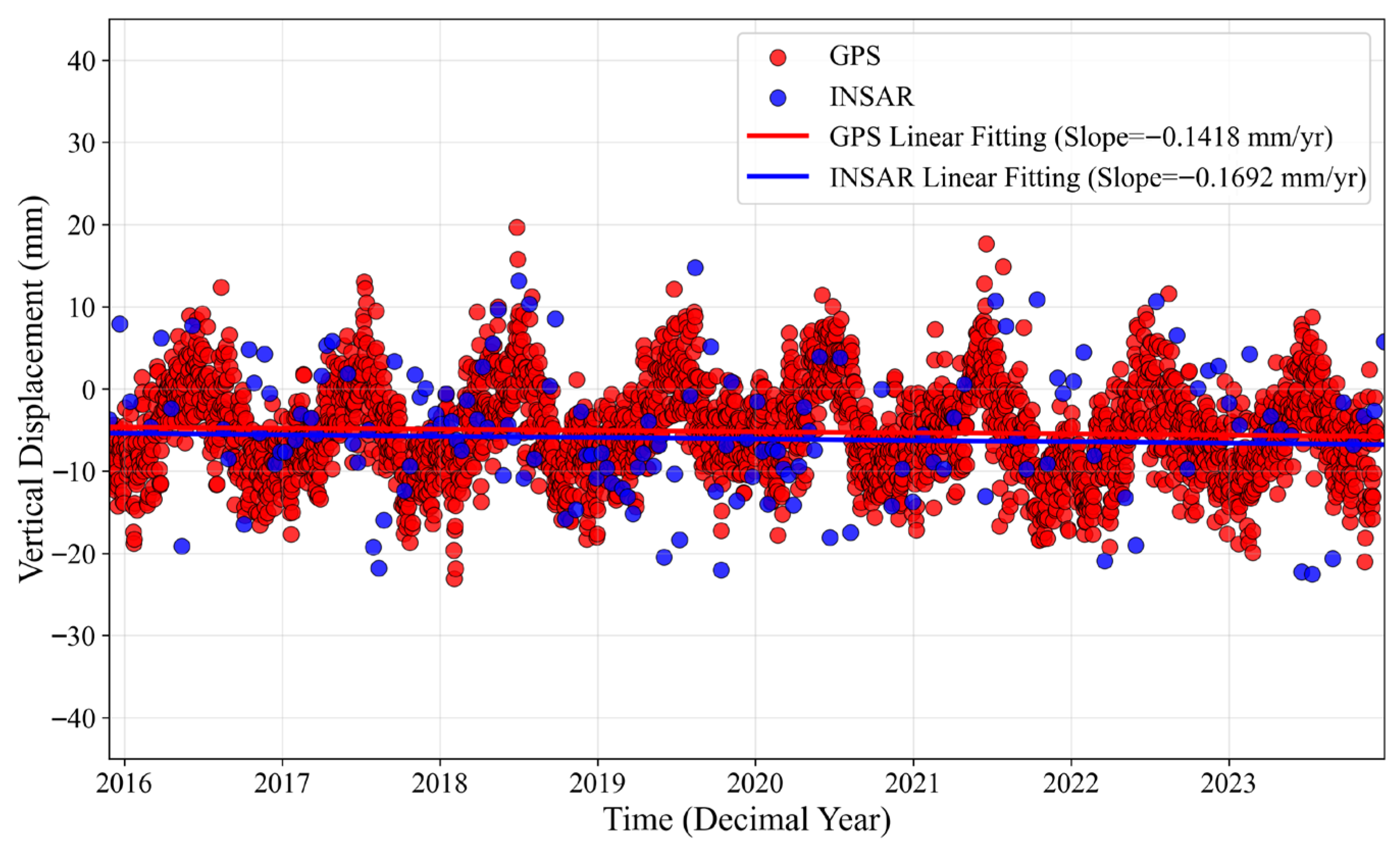
To validate this approximation, we compared our InSAR-derived vertical displacements against independent continuous GPS measurements at the BJFS station (Figure 7). The linear deformation rates from InSAR (0.169 mm/yr) and GPS (0.142 mm/yr) show a difference of less than 0.03 mm/yr, confirming the reliability of our processing strategy. While combining ascending and descending tracks would enable a full three-dimensional decomposition, the focus of this study is on capturing macro-scale spatial patterns, relative trends, and the temporal lag in deformation response—objectives for which single-track data with GPS validation are sufficient and widely adopted in similar subsidence studies.

2.3.2. K-Means Clustering

The K-means clustering algorithm is a quintessential data-driven approach that utilizes distance as the similarity metric, assigning data points to clusters based on their proximity to the cluster centroid; it was first proposed by James MacQueen in 1967 [50]. The fundamental principle of the K-means algorithm is: first, K initial cluster centroids are selected; then, each data point in the dataset is assigned to the cluster whose centroid is nearest to it, forming an initial clustering configuration; under this configuration, the centroids of each cluster are recalculated, and all data points are then reassigned according to the nearest neighbor rule; this process iterates continuously until the centroids of all clusters stabilize.

2.3.3. ICA Signal Decomposition

The deformation derived from InSAR results is the outcome of multiple contributing factors. Prior to ICA decomposition, the InSAR time-series data were preprocessed to minimize systematic errors, including DEM error correction using Legendre polynomial expansion, tropospheric delay correction with ERA5 atmospheric data (via PyAPS), and solid Earth tide removal. Only pixels with average coherence ≥ 0.9 were retained, and the reference point was selected in a stable area. These steps ensure that the input to ICA is dominated by geophysical signals rather than instrumentation artifacts.
ICA is a Blind Source Separation (BSS) technique aimed at decomposing mixed signals into linear combinations of statistically independent components [51]. It achieves effective signal separation by maximizing the non-Gaussianity or minimizing the mutual information of the individual components. In contrast, PCA extracts uncorrelated principal components (PCs) based solely on second-order statistics (variance) of the mixed signals. In practical applications, dimensionality reduction via PCA is often performed first to remove noise and redundant information, followed by ICA to further isolate independent components [35]. As an extension of PCA, ICA utilizes higher-order statistical information to assess the statistical independence of source signals [52].
The relationship between the observed signals and the independent sources can be expressed as:
O t × n = D t × l · S l × n
where O is the observed InSAR time-series matrix; D is the mixing matrix, with each column representing the contribution coefficients of each independent source; S is the source matrix, with each row corresponding to an independent component; l is the number of independent components; t is the number of SAR acquisitions; and n is the number of pixels per acquisition.
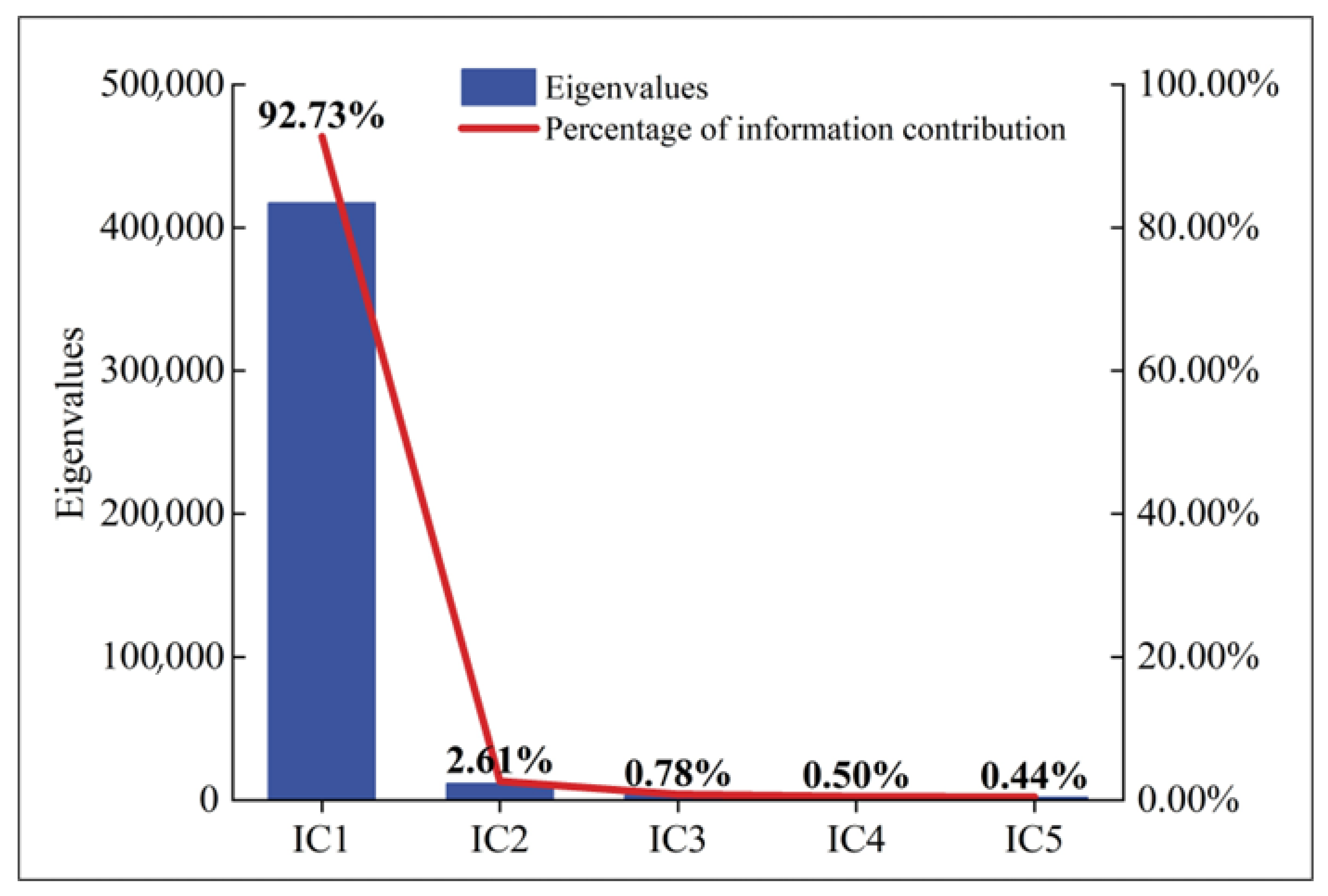
In this study, the FastICA algorithm (version 2.5) [53] was employed to decompose the InSAR results. First, PCA was applied to preprocess the data and reduce its dimensionality. Based on the variance eigenvalues, the first four principal components were selected, collectively encompassing 96.62% of the total variance. Subsequently, centering and whitening operations were performed. Centering subtracts the mean from each variable to ensure zero mean, while whitening linearly transforms the mixed signals into uncorrelated variables with unit variance, which simplifies the ICA estimation and reduces the number of parameters to be estimated [53]. After centering and whitening, the transformed signals are denoted by W, and the problem becomes W = D′·S, where D′ is an orthogonal mixing matrix. The source matrix S can then be estimated as S = U·W, where U is the unmixing matrix. Finally, using the fixed-point iteration algorithm intrinsic to FastICA, which maximizes the spatial non-Gaussianity of the sources, the source matrix S, the mixing matrix D, and the unmixing matrix U are derived, thereby completing the decomposition of the InSAR time series.
The ICA model O = D·S does not explicitly include a noise term; instead, noise components are expected to be separated into independent components with distinct statistical properties. In practice, PCA dimensionality reduction (retaining 96.62% variance) removes a portion of the uncorrelated noise before ICA. After ICA, components exhibiting high-frequency random fluctuations with no temporal trend were interpreted as residual noise (atmospheric turbulence, orbital errors), consistent with recent studies that isolate InSAR noise via ICA [54]. This separation confirms that the remaining components (IC1 and IC3) represent physically meaningful deformation signals.

3. Results

3.1. InSAR Result Analysis

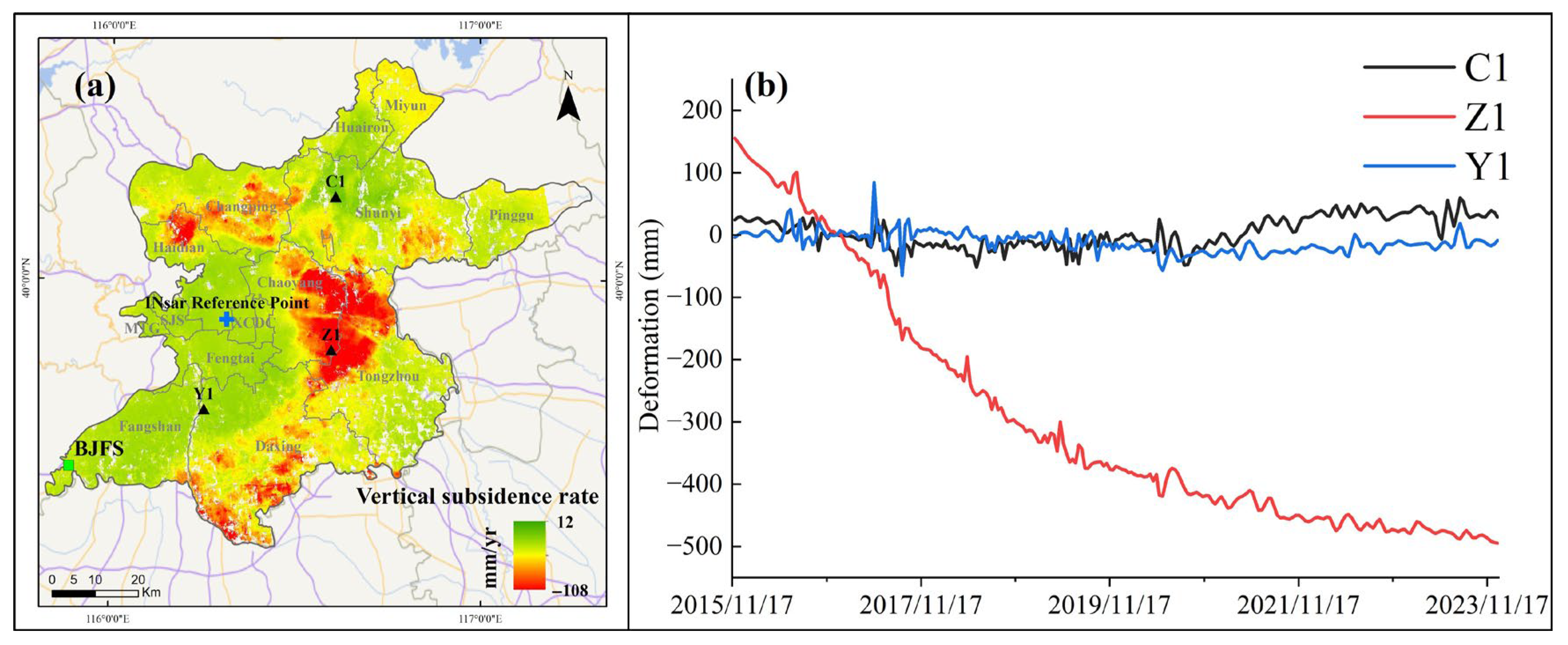
The vertical deformation rate of the Beijing Plain during the period 2015–2023 is presented in Figure 6a. The figure reveals that the areas experiencing ground subsidence within the plain are highly localized, primarily concentrated in the southern, northwestern, and central-eastern regions, exhibiting pronounced spatial heterogeneity. Starting from the western and northern parts of Haidian District, the subsidence zone extends southwestward to the northern area of Tongzhou District, forming a distinct belt-shaped pattern with multiple identifiable subsidence bowls (or centers). The maximum subsidence rate (−108 mm/yr) occurs in the Chaoyang-Tongzhou corridor (Figure 6a), coinciding with intensive exploitation of the Aquifer III and Aquifer IV (extraction rate 80 × 104 m3/km2/yr) and thick compressible clay layers.
To compare the characteristics of ground subsidence development in different areas, three representative locations were selected: one in the upper reaches of the Chaobai River (C1), one within the Chaoyang-Tongzhou subsidence zone (Z1), and one along the Yongding River (Y1), as indicated in Figure 6a. The time-series of surface displacement at these locations are shown in Figure 6b. Analysis reveals that location Z1, located within the subsidence zone, displays a rapid subsiding trend; however, its subsidence rate decelerated markedly post-2019. Concurrently, location Y1 shows no significant subsidence, while location C1 exhibits a short-term rebound trend.
To quantitatively assess the reliability of our InSAR-derived vertical displacement estimates and to justify our methodological assumption that LOS deformation is predominantly vertical, we performed a validation using independent continuous GPS data from the BJFS station. This station is strategically located within the BJFS Station, which served as the stable reference point for our InSAR processing, ensuring spatial consistency for the comparison.
As illustrated in Figure 7, the vertical displacement time-series derived from InSAR shows excellent agreement with the GPS observations throughout the entire study period (2015–2023). Both datasets capture consistent interannual fluctuations and a negligible long-term trend. Linear regression analysis yields vertical deformation rates of 0.1418 mm/yr from GPS and 0.1692 mm/yr from InSAR. The difference of approximately 0.03 mm/yr is well within the typical accuracy range of InSAR measurements and confirms the high fidelity of our time-series results. This strong correlation not only validates our data processing strategy but also supports the fundamental premise that vertical motion is the dominant component of surface deformation in the tectonically stable Beijing Plain under the influence of groundwater changes. This validation provides a robust foundation for the subsequent ICA decomposition and hydrogeological interpretation.

3.2. K-Means Result Analysis

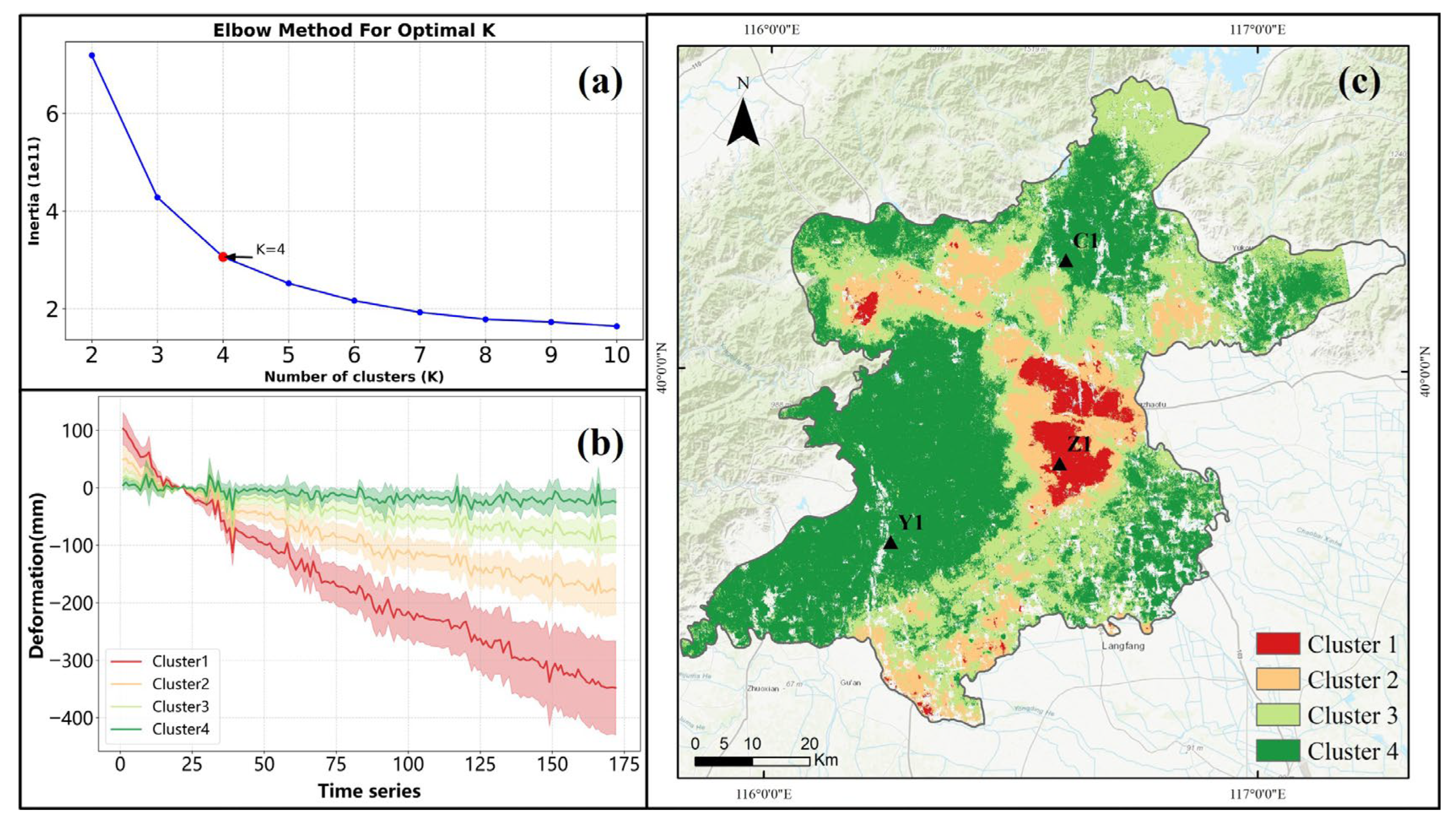
To further investigate the spatiotemporal evolution characteristics of ground subsidence in the Beijing Plain, the unsupervised K-means method was employed to partition the region based on deformation characteristics and magnitudes in both the spatial and temporal domains. The elbow method was used to determine the optimal number of clusters, ultimately identifying four clusters. Figure 8a illustrates the process of determining the four clusters using the elbow method; Figure 8b shows the temporal characteristics of each cluster, where all four clusters exhibit subsiding trends, with the subsidence rate progressively decreasing from Cluster 1 to Cluster 4. Specifically, Cluster 1 represents the area experiencing the most severe subsidence in Beijing, with cumulative surface displacements ranging from 26 to 50 cm. Cluster 2 exhibits smaller cumulative displacements compared to Cluster 1, primarily distributed in the peripheral areas surrounding Cluster 1, with maximum displacements between 15 and 27 cm. Locations within Cluster 3 experienced cumulative displacements less than 10 cm. In contrast, Cluster 4 marks a relatively stable area with surface displacement fluctuating around the zero axis (mean ± SD: 0.2 ± 2.3 mm), consistent with the typical InSAR measurement error (~5 mm), indicating no significant deformation trend. The spatial distribution of Clusters 1 to 4 is shown in Figure 8c. The study area contains a total of 4,086,322 target points, with Cluster 1, Cluster 2, Cluster 3, and Cluster 4 encompassing 178,653, 548,476, 2,039,574, and 1,319,619 target points, respectively. Therefore, the spatial heterogeneity of ground subsidence across the Beijing Plain is pronounced, with only a small proportion of the area exhibiting large cumulative displacements (e.g., areas corresponding to Clusters 1 and 2), which are primarily concentrated within the Chaoyang-Tongzhou subsidence corridor. As shown in Figure 8c, the C1 and Y1 locations fall within Cluster 4, whereas the Z1 location is situated in Cluster 1. This spatial distribution aligns with the pattern of subsidence rates presented in Figure 6a. Specifically, Cluster 1 (where Z1 is located) corresponds to the area of relatively high subsidence rates in Figure 6a, and Cluster 4 (containing C1 and Y1) matches the region with lower or controlled subsidence rates, reflecting a coherent relationship between the clustering results and the subsidence rate distribution.
The K-means clustering results effectively reveal the spatial heterogeneity of ground deformation in the Beijing Plain from a phenomenological perspective, identifying severe subsidence zones (Cluster 1), transitional areas (Cluster 2 and Cluster 3), and stable regions (Cluster 4). However, since this method is based on the original deformation time series—which inherently mixes all potential driving signals (e.g., groundwater extraction, artificial recharge, atmospheric noise)—it cannot elucidate the independent physical driving mechanisms behind the observed spatiotemporal patterns. To further decode these complex signals and isolate their dominant sources, this study subsequently employs Independent Component Analysis (ICA).

3.3. ICA Result Analysis

To overcome the limitations of K-means in revealing driving mechanisms and to probe into the source signals underlying the deformation, this study employs the ICA method to separate and extract potential independent driving factors. It is crucial to determine the number of independent components a priori when applying ICA to a time series-an excessive number can lead to information redundancy. Therefore, prior to ICA decomposition, this study utilizes PCA to reduce the dimensionality of the ground displacement time series. The contribution (variance explained) of each principal component is shown in Figure 9. Setting a percentage threshold for information content retention at 0.5%, Figure 9 reveals that the first to fourth principal components (PC1 to PC4) retain 92.73%, 2.61%, 0.78%, and 0.50% of the information, respectively. Collectively, these top four principal components encompass 96.62% of the original information content. Given the complexity of the subsidence driving mechanisms within the study area, these four principal components were selected for subsequent Independent Component decomposition.
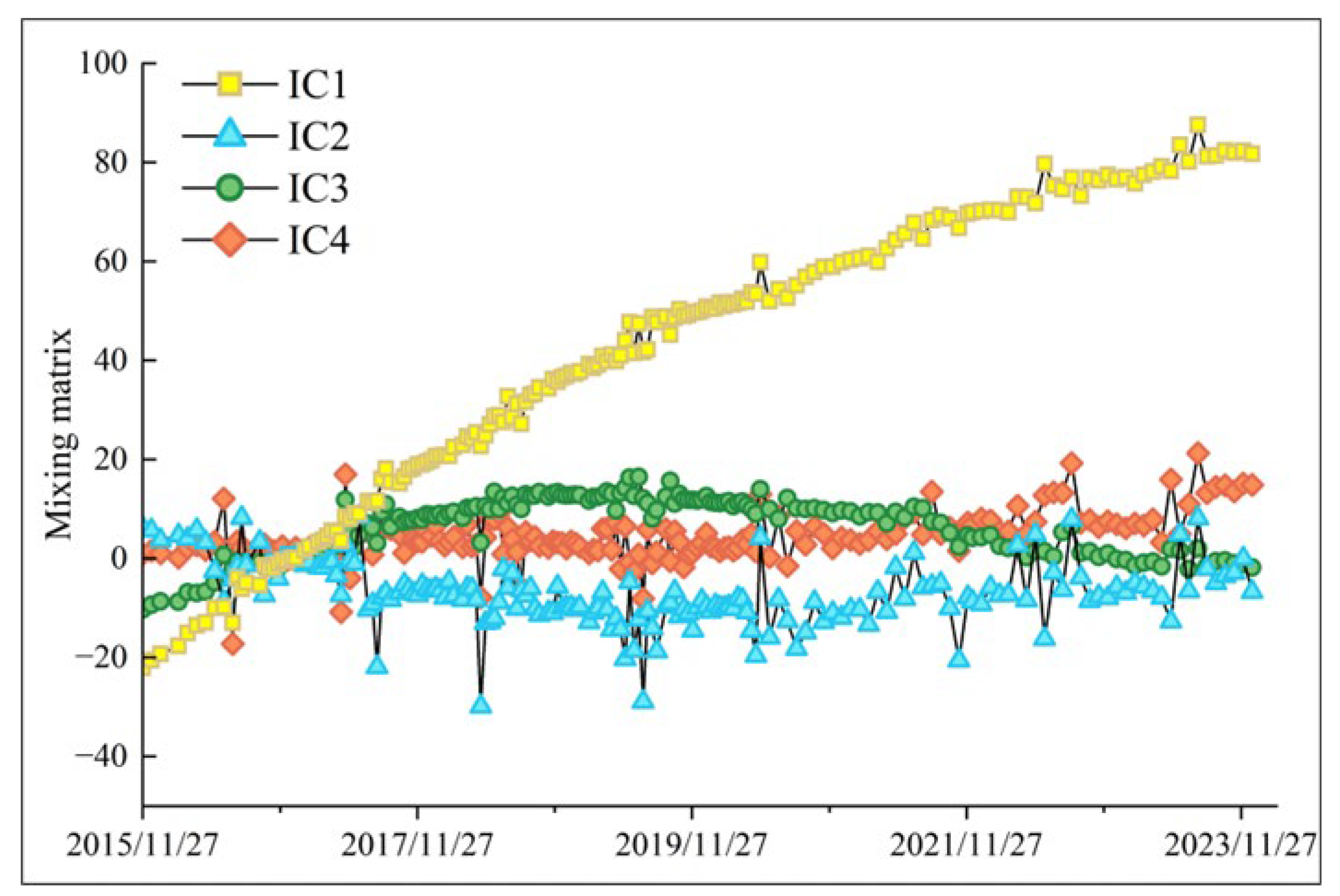
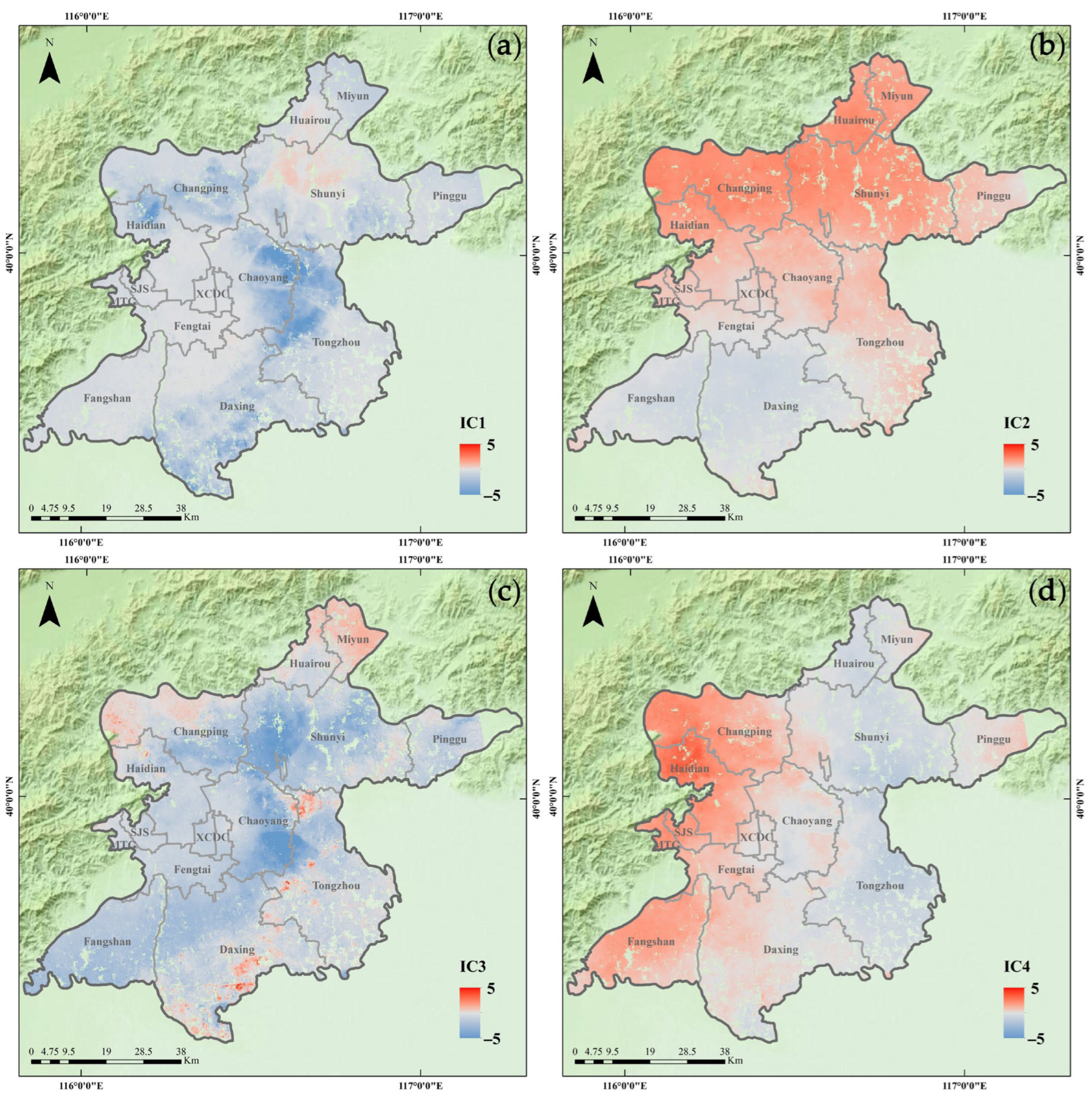
Analysis of the estimated mixing matrix derived from the ICA (Figure 10) reveals distinct temporal signatures among the independent components (ICs). IC1 demonstrates a consistent upward trend over time, while IC3 exhibits an initial increase followed by a subsequent decrease. In contrast, IC2 and IC4 are characterized predominantly by random fluctuations lacking any discernible systematic trend; based on these stochastic characteristics, they are classified as noise components (atmospheric residuals and orbital errors).
The spatial contribution maps generated from the ICA decomposition are presented in Figure 11. Within these maps, regions depicted in blue correspond to a negative contribution mode, signifying ground subsidence, whereas regions in red represent a positive contribution mode, indicative of ground rebound. Examining the spatial distribution associated with IC1 (Figure 11a), the blue areas, denoting subsidence, are primarily concentrated in eastern Chaoyang District and northern Tongzhou District, with sporadic occurrences observed in Changping, Haidian, and Daxing Districts. Conversely, the red areas, signifying rebound associated with to IC1, are predominantly located in northern Shunyi District and southern Huairou District. This spatial pattern closely mirrors the distribution of ground subsidence rates documented in Figure 6a. The spatial contribution map for IC3 (Figure 11c) is overwhelmingly dominated by blue (negative contribution) areas. Integrating this spatial dominance with the temporal evolution of IC3 evident in the mixing matrix (Figure 10, IC3 curve) further demonstrates that within the affected region, the ground surface underwent a distinct sequence of initial subsidence followed by subsequent rebound.
The spatial distribution associated with IC1 (Figure 11a) closely mirrors the distribution of ground subsidence rates documented in Figure 6, thereby quantifying the most significant linear subsidence pattern. The spatial contribution map for IC3 (Figure 11c) is overwhelmingly dominated by blue (negative contribution) areas. Integrating this with its temporal evolution (Figure 10, IC3 curve) demonstrates a distinct sequence of initial subsidence followed by subsequent rebound across a widespread area, which is a key spatiotemporal pattern that we seek to explain mechanistically.
The separation of these distinct spatiotemporal patterns (IC1 and IC3) provides the first crucial hydrological insight: the deformation response to the SNWDP is not uniform but is fundamentally controlled by the interplay between anthropogenic water allocation and pre-existing hydrogeological heterogeneity.

4. Discussion

4.1. Drivers of the Quasi-Linear Subsidence Pattern

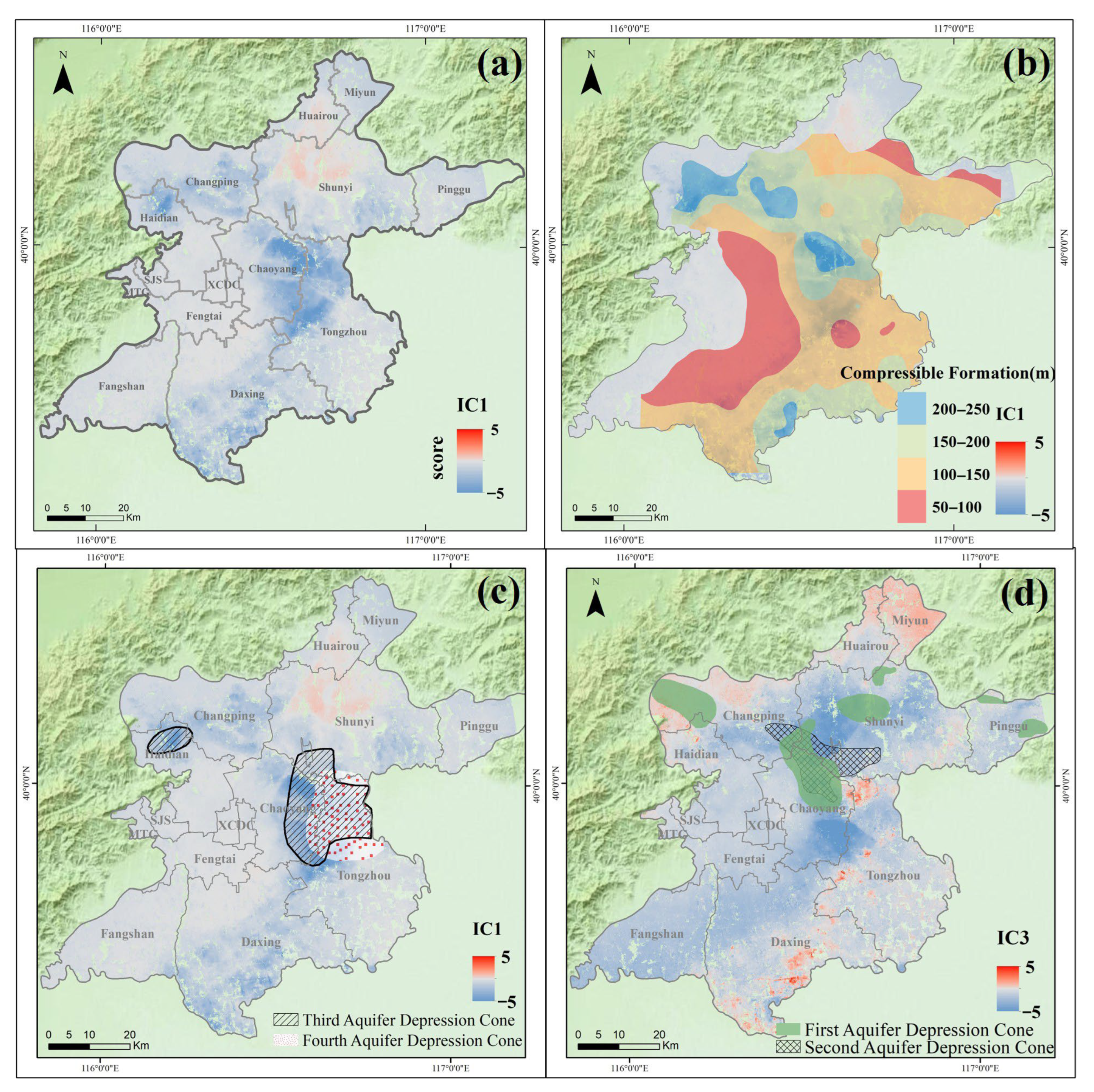
The quasi-linear subsidence pattern captured by IC1 (Figure 11a) identifies and elucidates the mechanism of one of the dominant deformation modes: persistent groundwater overexploitation in deep aquifers. This component exhibits a near-linear, monotonic decreasing trend (Figure 10) and is spatially concentrated in the eastern Chaoyang District and northern Tongzhou District corridor (Figure 12a). Mechanistically, this pattern is driven by the long-term and excessive extraction of groundwater from the deep, confined Aquifer Groups III and IV (Q1–Q2).
The hydrogeological setting of this region is the primary culprit for this irreversible trend. These deep aquifers, composed of medium-coarse sand and gravel, are overlain by exceptionally thick (>150 m) sequences of compressible clay layers (Figure 12b). Due to their great depth (180–300 m), the natural recharge potential for these aquifers is severely limited. Long-term extraction rates in the Chaoyang-Tongzhou corridor have historically exceeded 1.2 × 10⁸ m3/yr [39], leading to a sustained and pronounced decline in hydraulic head within the deep aquifers (Figure 12c).
This decline triggers a fundamental hydrogeological process described by Terzaghi’s principle of effective stress [55]: the reduction in pore water pressure increases effective stress, leading to inelastic (plastic) compaction of the thick, interbedded clay layers, which manifests as permanent surface subsidence.
The key hydrological insight derived from IC1 is the identification of a deeply rooted, anthropogenic subsidence driver that is largely decoupled from short-term climatic fluctuations or surface water management policies. The spatial correlation between the IC1 subsidence pattern and the depression cone of Aquifer Groups III–IV (Figure 12c) is striking and confirms that this deformation is a direct consequence of deep groundwater mining. This implies that simply increasing surface water supply (e.g., via SNWDP) is insufficient to halt this specific subsidence trend in the short term. Mitigating this pattern requires direct and stringent management interventions targeted specifically at reducing extraction from these deep, confined aquifers, as their physical properties and depth preclude rapid natural recovery. This critical distinction forms the basis for the zoned management strategies proposed in Section 4.4. The slight flattening of the IC1 trend after 2020 likely reflects the containment of overexploitation intensity and the consequent slowdown in the rate of effective stress increase, resulting from the implementation of control policies on deep groundwater extraction under Beijing’s optimized water source structure.

4.2. Drivers of the Chaobai River Region Rebound Pattern

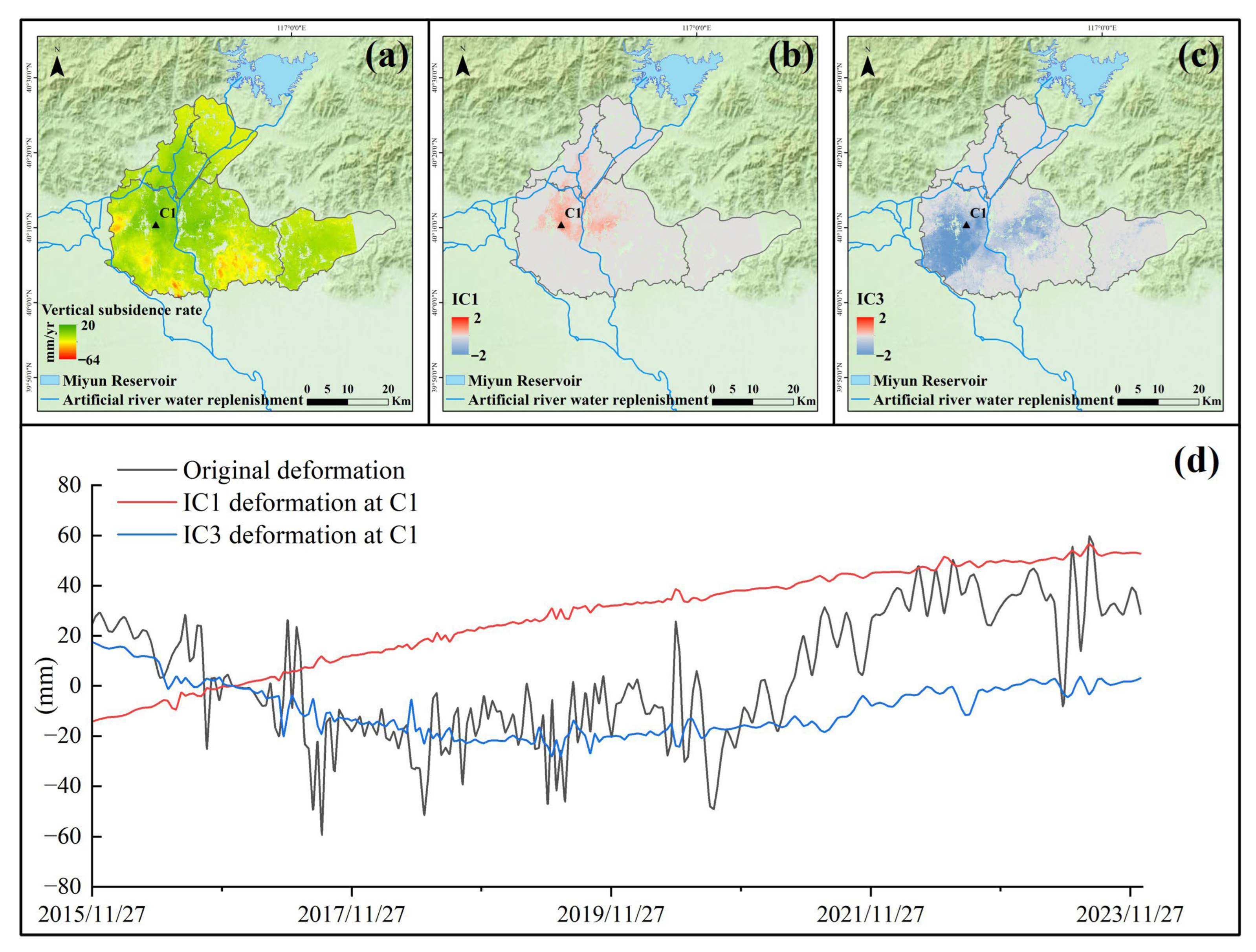
Since 2015, multiple artificial groundwater recharge operations have been implemented in the sand-cobble gravel aquifer system upstream of the Chaobai River to mitigate localized ground subsidence, primarily targeting shallow and intermediate aquifers. The effectiveness of these measures is evident in the ICA decomposition results, which show a superposition of Chaobai River region rebound and subsidence-to-rebound modes (Figure 12). The vertical deformation rate and its ICA decomposition for the upstream Chaobai River area (Figure 13) reveal a maximum vertical rebound rate of up to 20 mm/yr, confirming the efficacy of artificial replenishment. The location C1 (same as above, marked as black triangle in Figure 13a) within the overlapping spatial region of IC1 and IC3 was selected for detailed analysis. The temporal deformation signal at C1, reconstructed by multiplying the spatial contribution values of IC1 and IC3 with their respective mixing matrix time series (Figure 13b), represents an overall rebound trend with reduced fluctuations compared to the original data—highlighting ICA’s advantage in extracting key features.
Notably, IC1 manifests a Chaobai River region rebound trend, while IC3 shows an initial decline followed by a rise. This difference stems from the distinct aquifer layers driving deformation. IC1 here indicates shallow aquifer responses (given the absence of thick deep compressible strata), whereas IC3 captures dynamic adjustments to recharge. The asymmetry between the maximum subsidence rate (108 mm/yr, IC1) and peak rebound rate (20 mm/yr) is attributed to the dominance of sand-cobble gravel strata in the upstream Chaobai River, where compression is primarily elastic. This limits permanent settlement even after recharge, unlike areas with thick plastic clays.
Thus, IC1’s signal varies with geological context. in regions with thick compressible strata, it denotes deep-layer deformation, while in the upstream Chaobai River (thin compressible strata), it corresponds to shallow-layer responses. The large-scale recharge projects in this region, which primarily replenish deep aquifers, suggest that sustained rises in deep groundwater levels may drive significant deep strata rebound in areas with thick compressible layers.

4.3. Drivers of the Subsidence-to-Rebound Transition Pattern

The IC3 component captures the most significant and widespread hydrological response to the South-to-North Water Diversion Project (SNWDP) in the Beijing Plain. It elucidates the driving mechanisms, quantifies the temporal lag, and underscores the management implications. This pattern represents a fundamental transition from long-term subsidence to a nascent rebound phase, governed by the recovery of shallow groundwater aquifers.

4.3.1. Coupling Between Shallow Groundwater Regulation and Precipitation Infiltration

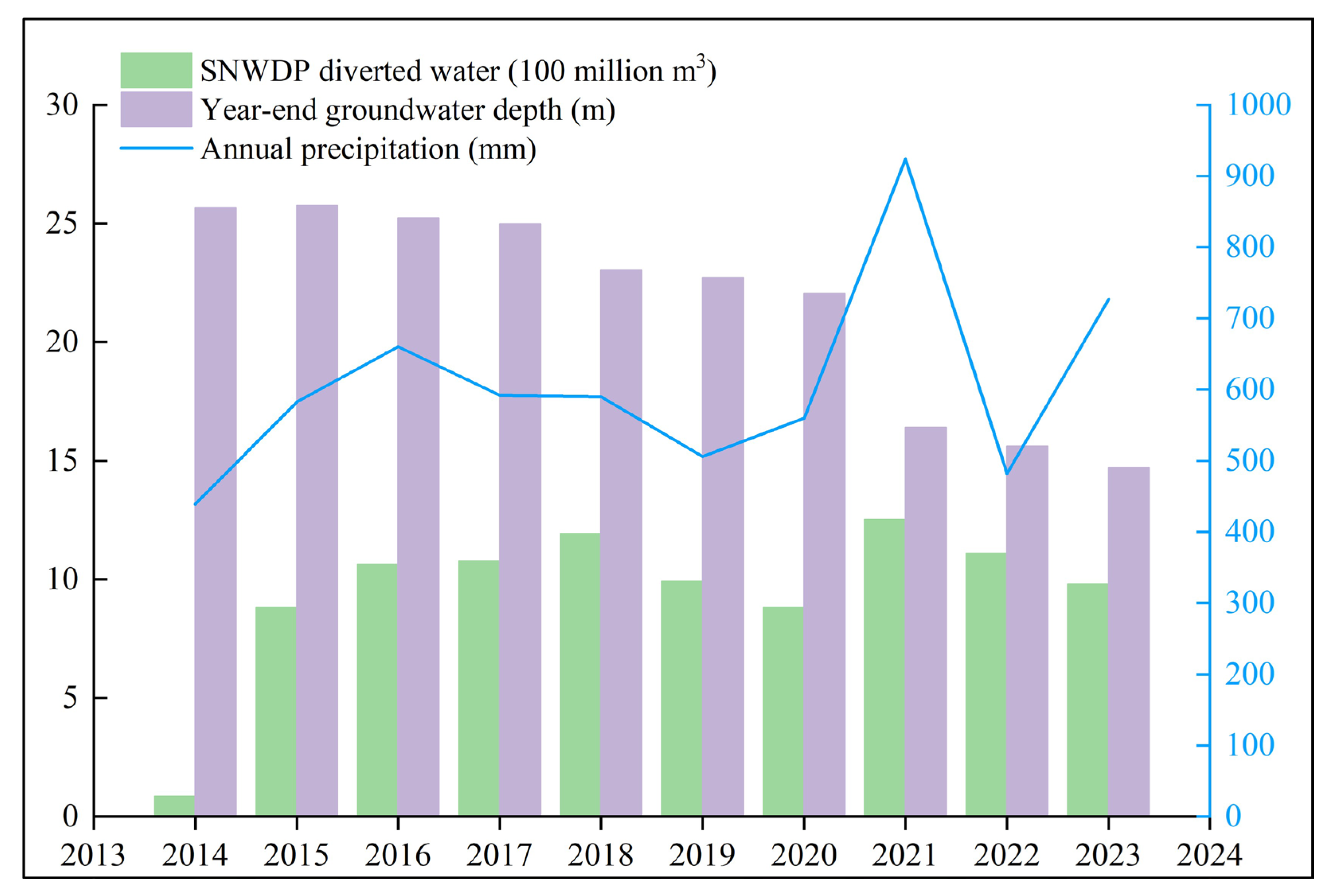
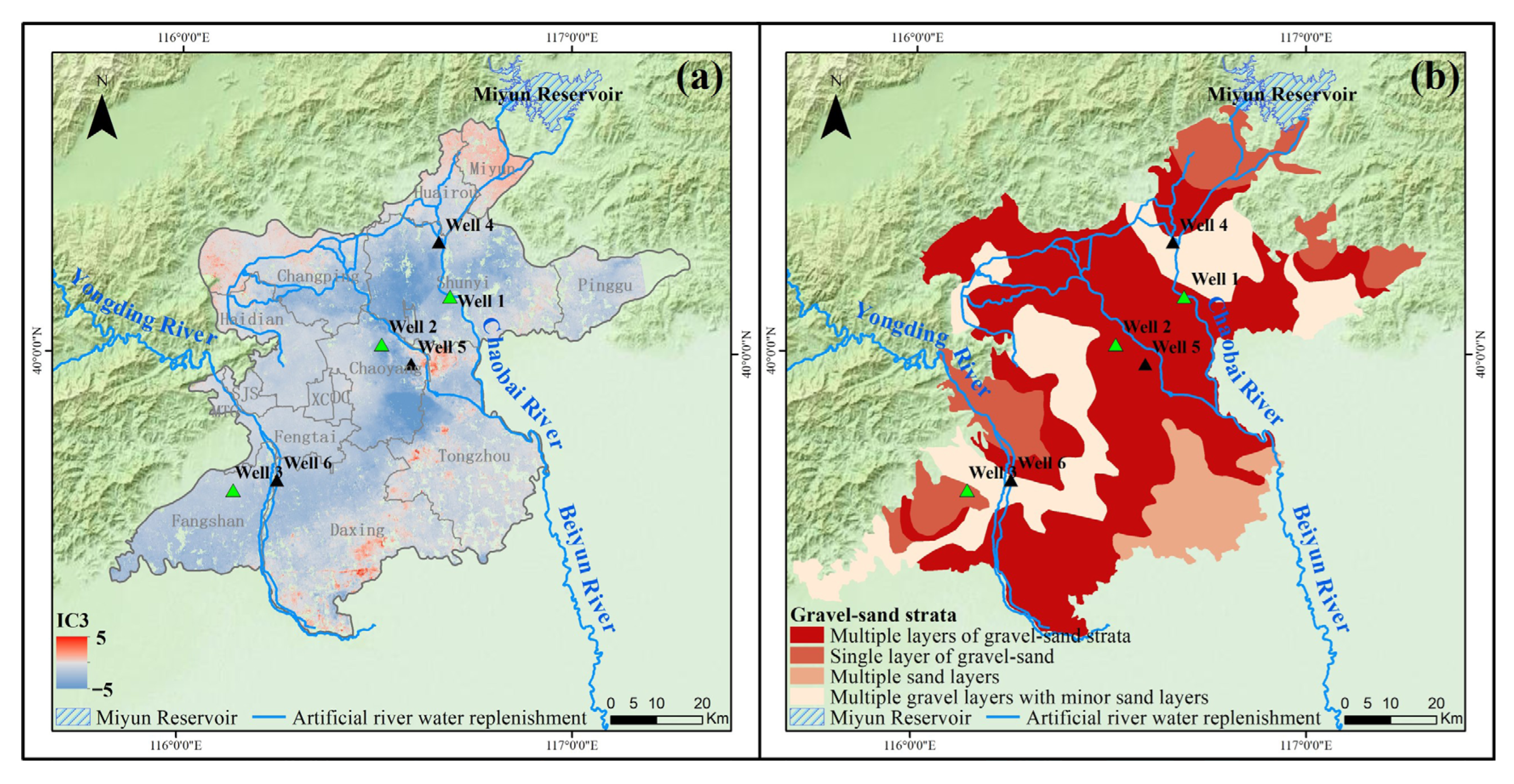
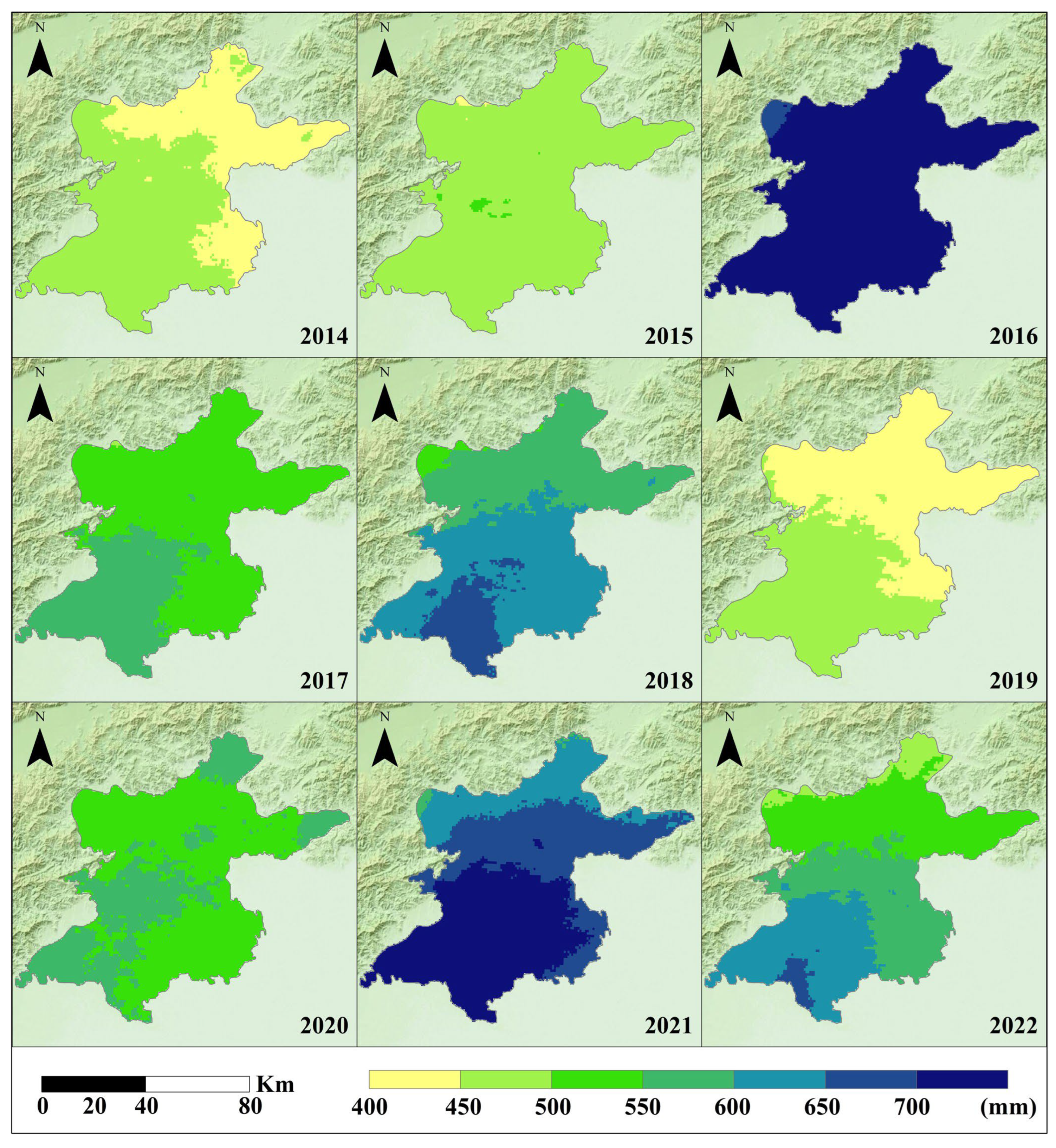
The “subsidence-to-rebound” transition captured by IC3 is primarily driven by the combined effects of shallow groundwater recovery and enhanced precipitation infiltration (Figure 14). Following the SNWDP-MR water delivery in 2014, reduced groundwater extraction and artificial recharge (~4.5 × 10⁸ m3 via unlined river channels) led to sustained water level rises in shallow aquifers, particularly after 2018 [42]. Concurrently, annual precipitation frequently exceeded 500 mm since 2014, providing substantial recharge to the highly permeable sand-gravel strata prevalent in the central plain (Figure 15 and Figure 16). This dual mechanism promoted elastic expansion of the aquifer skeleton, reversing long-term subsidence into regional rebound.
Notably, the water storage capacity (WSC) of shallow geological materials varies spatially [40,56], with WSCmulti-layered sand-gravel > WSCsingle-layered sand-gravel > WSCmulti-layered sand > WSCmulti-layered gravel with minor sand. This heterogeneity correlates strongly with the spatial pattern of IC3-derived deformation: areas with superior storage properties (e.g., thick multi-layered sand-gravel in the central plain) exhibit more pronounced shallow groundwater level rises and elastic rebound following rainfall recharge, even without direct surface water replenishment (Figure 15).
The IC3 component spatially correlates with areas benefiting from this combined “policy + climate” effect (Figure 15a and Figure 17). The process is mechanistic: as shallow groundwater levels rise, the increased pore water pressure reduces the effective stress on the aquifer skeleton. In these sand-gravel dominated sequences, the resulting deformation is primarily elastic expansion, manifesting as the widespread “subsidence-to-rebound” transition captured by IC3. This provides a critical hydrological insight: successful subsidence mitigation requires managing the shallow groundwater system, and its recovery can be effectively accelerated by leveraging natural infiltration processes through favorable lithology.

4.3.2. Lagged Rebound Induced by the SNWDP

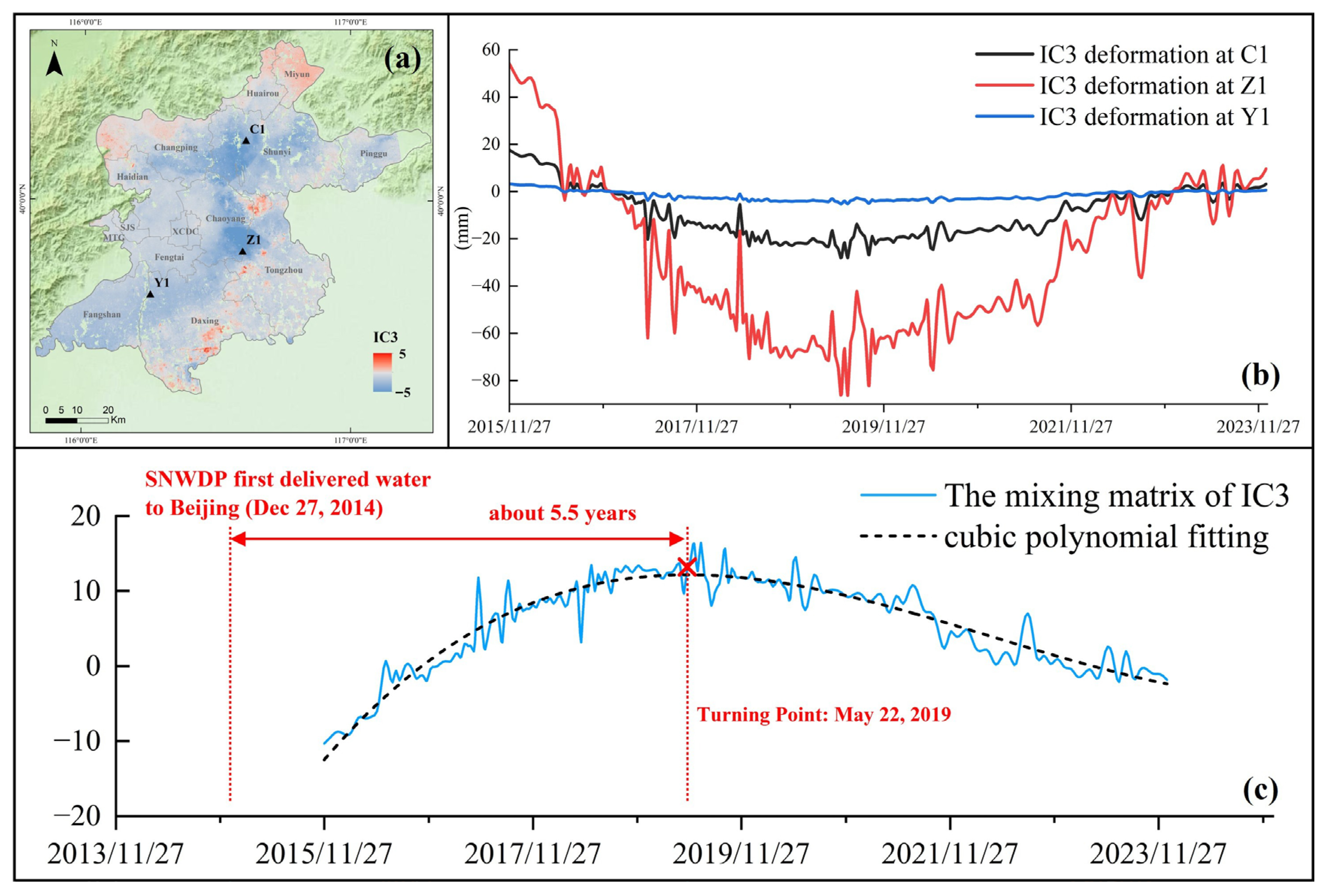
A pivotal finding of this study is the quantification of a significant time lag between the hydrological intervention and the regional geomechanical response. Analysis of the IC3 time series reveals a ~5.5-year lag between the initiation of SNWDP water delivery (December 2014) and the widespread onset of regional rebound (May 2019, Figure 18c). This lag embodies two key hydrogeological processes: (1) the time required for water diversion to infiltrate through clayey aquitards and replenish shallow aquifers, particularly in areas with thick (>50 m) low-permeability strata; (2) the gradual adjustment of aquifer skeletons from a compressed state to elastic expansion, as soil particles slowly reorient under reduced effective stress.
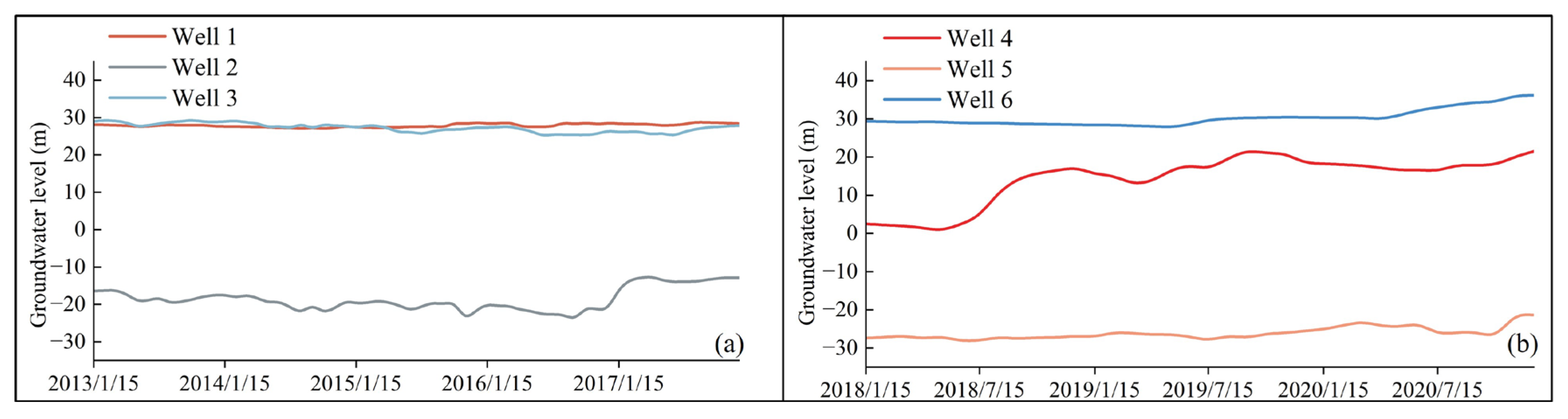
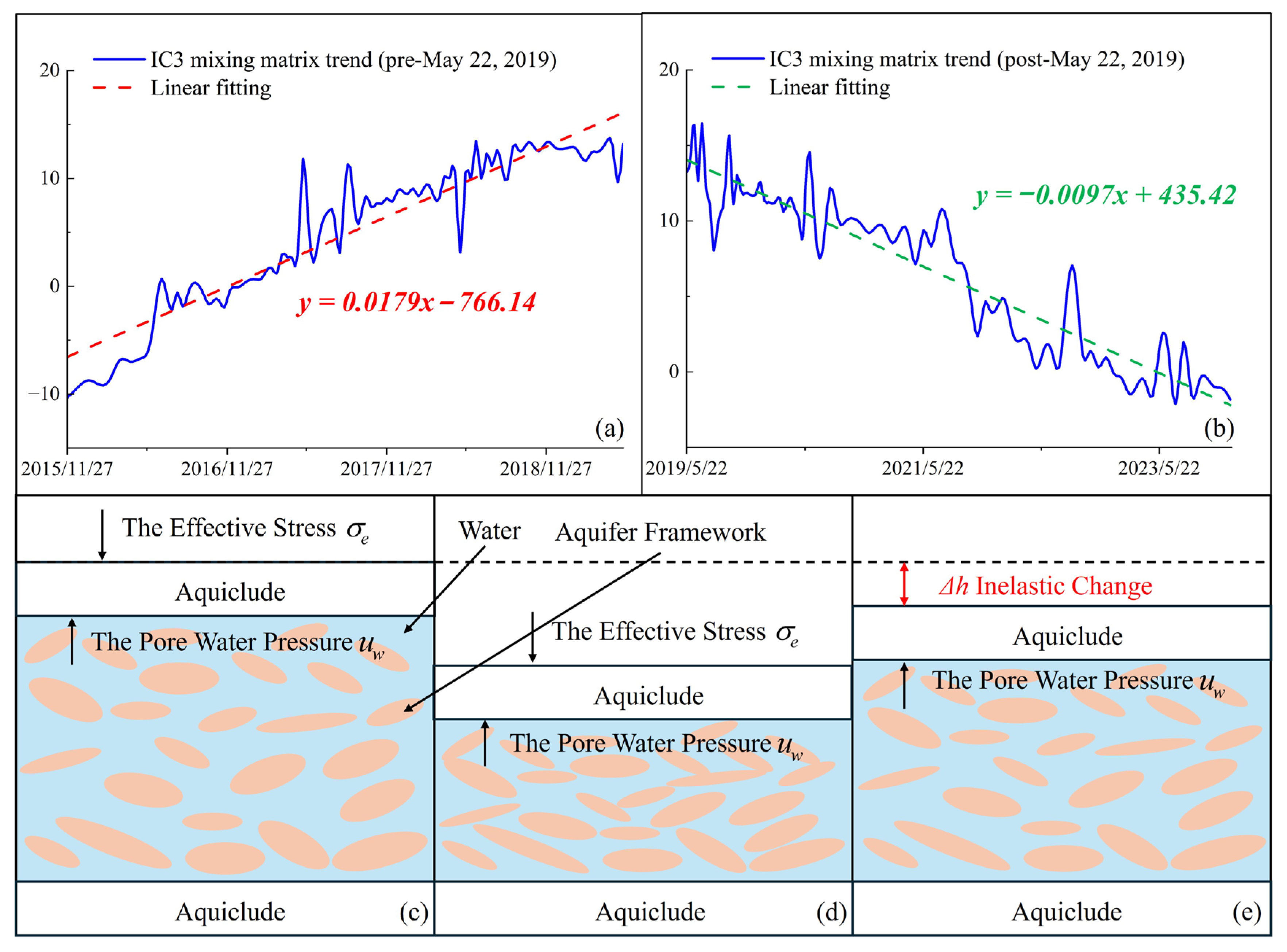
Piecewise linear regression of IC3’s deformation rates confirm this pattern: subsidence persisted from 2015 to 2019, with the absolute value of the slope of the mixing matrix being 0.0179, and the absolute value being 0.0097 post-2019. The asymmetry between the subsidence and rebound slopes (|0.0179| vs. |0.0097|) is a direct manifestation of the inelastic (plastic) deformation of compressible clay layers, consistent with Terzaghi’s principle. This theoretical interpretation is strongly supported by field monitoring data. As shown in Figure 17, groundwater levels at multiple monitoring wells (e.g., Well 1, Well 2, Well 3) began to rise soon after the SNWDP water delivery in 2015. Following this, a more pronounced and widespread water level recovery occurred after 2018 (e.g., Well 4, Well 5, Well 6), with a total rise of up to 18.99 m in some areas. This sustained hydraulic recovery provided the driving force for ground rebound. However, the rate of rebound (slope = −0.0097) was significantly lower than the preceding subsidence rate (slope = 0.0179). This observed asymmetry quantifies the hysteretic and incomplete nature of the deformation recovery: while the aquifer system responds elastically to water level rise in sandy layers, the thick, compressible clay layers undergo irreversible plastic compaction during the long-term drawdown period, which cannot be fully recovered upon reloading, thereby resulting in a slower rebound rate. The asymmetry between subsidence and rebound rates aligns with Terzaghi’s principle [55]:
σ e = p u w
where σ e is the effective stress, p is the total stress, and u w is the pore water pressure. When the water level declines, the effective stress increases. This augments the pressure between soil particles, causing them to become more densely packed and reducing pore volume, thereby resulting in soil compression. Plastic deformation during subsidence creates stable particle arrangements that resist full recovery, even as groundwater levels rise (Figure 19). This lag highlights the importance of long-term monitoring in evaluating water transfer impacts, as short-term data (≤5 years) may underestimate rebound potential.
Notably, the lag period varies spatially with lithology. In sand-gravel-dominated zones (e.g., Chaobai River upstream), rebound initiates ~1–2 years (Figure 13d) earlier than in clay-rich areas, confirming that aquifer permeability modulates response speed. This spatial variability underscores the need to tailor SNWDP recharge strategies to local geological conditions, ensuring that water delivery schedules account for infiltration delays.
This section selects monitoring location C1 on the Chaobai River and Y1 on the Yongding River. The ICA mixed matrix was used to reconstruct their ground surface deformation time series within the IC3 component. Both datasets exhibit a characteristic subsidence-to-rebound evolutionary pattern (Figure 18).
Similarly, analysis of geological profiles across the Beijing Plain corroborates our interpretation (Figure 2). The profile reveals a systematic decrease in the depth to the phreatic water table from the northwest to the southeast. When precipitation or surface runoff increases, the infiltrating water, impeded by thick clay aquitards, undergoes delayed recharge, leading to a regional rise in shallow groundwater levels. The spatial distribution pattern of this hydrogeological process exhibits significant coupling with the spatial field of the IC3 component extracted via ICA. Areas of high IC3 values correspond closely with zones of reduced hydraulic gradient in shallow aquifers and regions characterized by the development of lenticular clay bodies. This correspondence collectively demonstrates that shallow groundwater dynamics are governed by the combined regulation of infiltration-recharge mechanisms and the spatial configuration of aquitards.

4.4. Management Recommendations Based on Deformation Patterns

The spatiotemporal heterogeneity of deformation patterns, decoded by the ICA, provides a robust scientific basis for formulating targeted groundwater management strategies. It translates our hydrological insights into practical recommendations for sustainable groundwater utilization and subsidence mitigation in Beijing and analogous regions. A “one-size-fits-all” approach is now obsolete. Instead, a zoned management framework, tailored to the distinct drivers captured by the IC1 and IC3 components, is imperative.
For regions dominated by the IC1 signal (e.g., Chaoyang-Tongzhou corridor), where deep groundwater overexploitation drives persistent linear subsidence, strict constraints on extraction from Aquifer Groups III and IV are critical. These areas, characterized by thick compressible clay layers (>150 m) with high compressibility coefficients, require prioritizing alternative water sources [57] (e.g., SNWDP water) to reduce effective stress in subsurface strata. Long-term monitoring here should integrate InSAR-derived deformation rates with deep groundwater level data to track the efficacy of extraction reduction measures.
In contrast, regions dominated by the IC3 signal (e.g., Chaobai and Yongding River basins) benefit from enhancing engineered recharge practices. The high permeability of sand-gravel aquifers in these areas facilitates rapid infiltration of water diversion [58], but recharge intensity must be calibrated to avoid exceeding aquifer storage capacity—this can be achieved by correlating recharge volumes to real-time groundwater level monitoring. Additionally, leveraging unlined river channels for infiltration can amplify the “precipitation + artificial recharge” coupling effect, accelerating shallow aquifer rebound.
Zoned management frameworks should be established to reconcile these needs. In IC1-dominated areas, regulatory policies should restrict new groundwater extraction permits and mandate periodic assessments of compressible stratum thickness to update subsidence risk. While in IC3-dominated areas, adaptive management—adjusting recharge schedules based on seasonal precipitation forecasts—can optimize the timing of artificial replenishment. Ultimately, integrating deformation patterns with hydrogeological data (e.g., aquifer permeability, clay layer thickness) will enable a science-driven balance between water security and geohazard mitigation.

4.5. Potential for Multi-Source Data Fusion in ICA

While the present study successfully employs ICA on InSAR time series alone to isolate dominant deformation patterns and their driving mechanisms, we acknowledge that incorporating independent observations such as continuous GPS measurements and stratified groundwater level data could further enhance the analysis. GPS data, which provide three-dimensional deformation fields, could help constrain the vertical-only assumption used here and potentially separate horizontal components if combined with ascending/descending InSAR in a joint ICA framework. More importantly, well hydrographs from different aquifer groups (I–IV) could serve as explicit reference signals in a multi-variate ICA or multi-source factor analysis, allowing a more quantitative attribution of each independent component to specific aquifer layers and their mechanical responses. Such integration could also improve the temporal resolution of lag detection and refine the understanding of viscoelastic versus elastic deformation. We therefore suggest that future studies explore the combined application of ICA on multi-source geodetic and hydrological datasets to further disentangle the complex interactions between water management and ground deformation.

5. Conclusions

This study systematically investigated the spatiotemporal characteristics, dominant patterns, and driving mechanisms of ground surface deformation (subsidence-rebound) in the Beijing Plain under the new hydrological backdrop, utilizing InSAR time series analysis, ICA, and regional hydrogeological data. The principal conclusions are as follows:
(1)
Spatiotemporal Patterns: Three dominant deformation patterns were identified across the Beijing Plain: (i) a quasi-linear subsidence pattern (−108 mm/yr) concentrated in the Chaoyang-Tongzhou corridor, driven by persistent overexploitation of deep groundwater; (ii) a localized rebound pattern (up to +20 mm/yr) in the Chaobai River basin, triggered by engineered aquifer recharge; and (iii) a widespread “subsidence-to-rebound” transition pattern, signaling a regional shift from long-term decline to recovery in areas benefitting from increased shallow groundwater recharge.
(2)
Driving Mechanisms: The ICA successfully isolated and elucidated the hydrogeological mechanisms behind these patterns. The quasi-linear subsidence (IC1) is attributed to irreversible plastic compaction of thick (>150 m), compressible clay layers due to sustained drawdown in deep Aquifer Groups III and IV. Conversely, the regional transition (IC3) signifies elastic expansion of the aquifer skeleton in response to rising shallow groundwater levels. This recovery is driven by a synergistic combination of policy intervention (reduced extraction and artificial recharge of ~12 × 108 m3 via SNWDP) and climatic favorability (increased precipitation > 500 mm/yr post-2014) infiltrating through permeable sand-gravel strata.
(3)
Temporal Response Lag: A critical finding of this study is the quantification of a ~5.5-year lag between the initiation of SNWDP water delivery (December 2014) and the onset of widespread regional rebound (May 2019). This hysteresis is a fundamental property of the aquifer system, representing the time required for water to infiltrate through low-permeability layers and for the aquifer skeleton to hydraulically and mechanically adjust from a state of compaction to expansion.
(4)
Hydrological Insights and Management Implications: This study yields two key hydrological insights with direct implications for regional management: First, the response is spatially heterogeneous and hysteretic, governed by aquifer lithology. This is evidenced by the stark asymmetry between the steep subsidence trend (slope |0.0179|) and the gentler rebound trend (slope |0.0097|), a direct result of plastic deformation in clay sequences that limits recovery compared to elastic responses in sand-gravel areas. Second, integrated water governance can reverse long-term subsidence trends. The experience in Beijing demonstrates that large-scale engineering projects like the SNWDP, when coupled with natural aquifer recharge processes, can effectively mitigate a critical geohazard.
In conclusion, our findings mandate a paradigm shift towards zoned groundwater management strategies for the Beijing Plain: imposing strict extraction controls on deep aquifers in the eastern corridor while actively enhancing engineered recharge in the northwestern alluvial fans. The methodologies and insights presented here offer a transferable framework. This framework can be applied to quantify the effectiveness of water policies and to design tailored mitigation strategies for megacities worldwide that face the intertwined challenges of water scarcity, groundwater overexploitation, and land subsidence.

Author Contributions

Conceptualization, Y.L. and M.G.; methodology, Y.L.; software, M.G.; validation, H.G. (Huili Gong); formal analysis, B.C.; investigation, Y.H.; resources, H.G. (Huayu Guan) and M.S.; data curation, J.W.; writing—original draft preparation, Y.L.; writing—review and editing, M.G.; visualization, J.S.; supervision, Z.C.; project administration, H.G. (Huili Gong); funding acquisition, B.C. and M.S. All authors have read and agreed to the published version of the manuscript.

Funding

This research was supported by the National Natural Science Foundation of China (No. 42371081 and No. 42371089) and Basic Research Program of Jiangsu (BK20230620).

Data Availability Statement

The original contributions presented in the study are included in the article, further inquiries can be directed to the corresponding author.

Acknowledgments

We thank the European Space Agency for their great efforts in developing and distributing remotely sensed SAR data and for their generosity in making Sentinel-1 available at no cost (https://search.asf.alaska.edu/#/ (accessed on 11 March 2024)). The authors thank Hugo Gävert, Jarmo Hurri, Jaakko Särélä, and Aapo Hyvärinen for making the FastICA algorithm (version 2.5) publicly available. We also thank the developers of ISCE (v2.6.4), MintPy (v1.6.2), and PyAPS (v0.3.7) for making their software openly available.

Conflicts of Interest

The authors declare no conflicts of interest.

References

  1. Herrera-García, G.; Ezquerro, P.; Tomás, R.; Caro-Calvo, D.; Martín, J.D.; Fernández, J.M. Mapping the global threat of land subsidence. Science 2021, 371, 34–36. [Google Scholar] [CrossRef]
  2. Galloway, D.L.; Hudnut, K.W.; Ingebritsen, S.E.; Newman, W.E.; Burbey, J.S. Detection of aquifer system compaction and land subsidence using interferometric synthetic aperture radar, Antelope Valley, Mojave Desert, California. Water Resour. Res. 1998, 34, 2573–2585. [Google Scholar] [CrossRef]
  3. Cabral-Cano, E.; Solano-Rojas, D.; Oliver-Cabrera, T.; Garduño-Monroy, A.; Díaz-González, J.A. Subsidence and associated shallow faulting hazard assessment in central Mexico using InSAR and GPS. In Proceedings of the 2014 AGU Fall Meeting, San Francisco, CA, USA, 15–19 December 2014; American Geophysical Union (AGU): Washington, DC, USA, 2014; pp. 15–19. [Google Scholar]
  4. Cigna, F.; Tapete, D. Present-day land subsidence rates, surface faulting hazard and risk in Mexico City with 2014–2020 Sentinel-1 IW InSAR. Remote Sens. Environ. 2021, 253, 112161. [Google Scholar] [CrossRef]
  5. Cigna, F.; Tapete, D. Satellite InSAR survey of structurally-controlled land subsidence due to groundwater exploitation in the Aguascalientes Valley, Mexico. Remote Sens. Environ. 2021, 254, 112254. [Google Scholar] [CrossRef]
  6. Miller, M.M.; Shirzaei, M. Spatiotemporal characterization of land subsidence and uplift in Phoenix using InSAR time series and wavelet transforms. J. Geophys. Res. Solid Earth 2015, 120, 5822–5842. [Google Scholar] [CrossRef]
  7. Haghighi, M.H.; Motagh, M.; Alizadeh, A.A.; Shamsoddini, S. Ground surface response to continuous compaction of aquifer system in Tehran, Iran: Results from a long-term multi-sensor InSAR analysis. Remote Sens. Environ. 2019, 221, 534–550. [Google Scholar] [CrossRef]
  8. Mirzadeh, S.M.J.; Jin, S.; Parizi, E.; Motagh, M.; Mahdianpari, A.; Safari, B. Characterization of irreversible land subsidence in the Yazd-Ardakan plain, Iran from 2003 to 2020 InSAR time series. J. Geophys. Res. Solid Earth 2021, 126, e2021JB022258. [Google Scholar] [CrossRef]
  9. Guo, H.; Zhang, Z.; Cheng, G.; Zhang, L.; Liu, Y. Groundwater-derived land subsidence in the North China Plain. Environ. Earth Sci. 2015, 74, 1415–1427. [Google Scholar] [CrossRef]
  10. Gong, H.; Pan, Y.; Zheng, L.; Wang, J.; Gao, M. Long-term groundwater storage changes and land subsidence development in the North China Plain (1971–2015). Hydrogeol. J. 2018, 26, 1417–1427. [Google Scholar] [CrossRef]
  11. Ao, Z.; Hu, X.; Tao, S.; Zhang, Y.; Li, L.; Chen, J. A national-scale assessment of land subsidence in China’s major cities. Science 2024, 384, 301–306. [Google Scholar] [CrossRef]
  12. Bian, Y. Study on the Influence of Ecological Water Supplement of Yongding River on Groundwater Dynamics in Beijing. Master’s Thesis, China University of Geosciences (Beijing), Beijing, China, 2020. [Google Scholar]
  13. Dong, J.; Guo, S.; Wang, N.; Gong, H.; Gao, M.; Chen, B. Tri-decadal evolution of land subsidence in the Beijing Plain revealed by multi-epoch satellite InSAR observations. Remote Sens. Environ. 2023, 286, 113446. [Google Scholar] [CrossRef]
  14. Liu, M.K.; Kou, W.J.; Luo, Y.; Zhang, H. Analysis of the relationship between groundwater exploitation and land subsidence in Beijing. Urban Geol. 2016, 11, 21–25. [Google Scholar]
  15. Shi, M.; Gao, M.; Chen, Z.; Gong, H.; Chen, B.; Han, Y. Land subsidence in Beijing: Response to the joint influence of the South-to-North Water Diversion Project and ecological water replenishment, observed by satellite radar interferometry. GISci. Remote Sens. 2024, 61, 2315708. [Google Scholar] [CrossRef]
  16. Sun, J.; Hu, L.; Li, D.; Zhang, Y.; Wang, H. Data-driven models for accurate groundwater level prediction and their practical significance in groundwater management. J. Hydrol. 2022, 608, 127630. [Google Scholar] [CrossRef]
  17. Yang, W.; Long, D.; Scanlon, B.R.; Sun, J.; Chen, L. Human intervention will stabilize groundwater storage across the North China Plain. Water Resour. Res. 2022, 58, e2021WR030884. [Google Scholar] [CrossRef]
  18. Lei, K.; Ma, F.; Chen, B.; Gong, H.; Gao, M. Effects of South-to-North Water Diversion Project on groundwater and land subsidence in Beijing, China. Bull. Eng. Geol. Environ. 2023, 82, 18. [Google Scholar] [CrossRef]
  19. Zhou, C.; Tang, Q.; Zhao, Y.; Gong, H.; Gao, M.; Chen, B. Reduction of subsidence and large-scale rebound in the Beijing plain after anthropogenic water transfer and ecological recharge of groundwater: Evidence from long time-series satellites InSAR. Remote Sens. 2024, 16, 1528. [Google Scholar] [CrossRef]
  20. Long, D.; Yang, W.; Scanlon, B.R.; Sun, J.; Chen, L.; Zhang, K. South-to-North Water Diversion stabilizing Beijing’s groundwater levels. Nat. Commun. 2020, 11, 3665. [Google Scholar] [CrossRef] [PubMed]
  21. Gabriel, A.K.; Goldstein, R.M.; Zebker, H.A. Mapping small elevation changes over large areas: Differential radar interferometry. J. Geophys. Res. Solid Earth 1989, 94, 9183–9191. [Google Scholar] [CrossRef]
  22. Zhou, C.; Gong, H.; Zhang, Y.; Gao, M.; Chen, B. Spatiotemporal evolution of land subsidence in the Beijing plain 2003–2015 using persistent scatterer interferometry (PSI) with multi-source SAR data. Remote Sens. 2018, 10, 552. [Google Scholar] [CrossRef]
  23. Zhang, S.; Zhang, Y.; Yu, J.; Gong, H.; Gao, M. Interpretation of the spatiotemporal evolution characteristics of land deformation in Beijing during 2003–2020 using sentinel, ENVISAT, and Landsat data. Remote Sens. 2022, 14, 2242. [Google Scholar] [CrossRef]
  24. Chen, Y.; Tan, K.; Yan, S.; Zhang, L.; Li, H. Monitoring land surface displacement over Xuzhou (China) in 2015–2018 through PCA-based correction applied to SAR interferometry. Remote Sens. 2019, 11, 1494. [Google Scholar] [CrossRef]
  25. Peng, M.; Lu, Z.; Zhao, C.; Li, J.; Wang, H. Mapping land subsidence and aquifer system properties of the Willcox Basin, Arizona, from InSAR observations and independent component analysis. Remote Sens. Environ. 2022, 271, 112894. [Google Scholar] [CrossRef]
  26. Wen, N.; Dai, K.; Deng, J.; Zhang, L.; Li, H. Periodic displacement accurate extraction of reservoir active slopes through InSAR observation and independent component analysis-based wavelet transform. Int. J. Appl. Earth Obs. Geoinf. 2024, 130, 103919. [Google Scholar] [CrossRef]
  27. Chang, S.; Tang, S.; Deng, Y.; Zhang, H.; Liu, D.; Wang, W. An Advanced Scheme for Deceptive Jammer Localization and Suppression in Elevation Multichannel SAR for Underdetermined Scenarios. IEEE Trans. Aerosp. Electron. Syst. 2025, 62, 3952–3970. [Google Scholar] [CrossRef]
  28. Gaddes, M.E.; Hooper, A.; Bagnardi, M.; Poland, D.P.; Hickey, J.W. Blind signal separation methods for InSAR: The potential to automatically detect and monitor signals of volcanic deformation. J. Geophys. Res. Solid Earth 2018, 123, 10226–10251. [Google Scholar] [CrossRef]
  29. Liang, H.; Zhang, L.; Lu, Z.; Li, J.; Wang, H. Nonparametric estimation of DEM error in multitemporal InSAR. IEEE Trans. Geosci. Remote Sens. 2019, 57, 10004–10014. [Google Scholar] [CrossRef]
  30. Hu, J.; Zhu, K.; Fu, H.; Zhang, L.; Li, J. Isolating orbital error from multitemporal InSAR derived tectonic deformation based on wavelet and independent component analysis. IEEE Geosci. Remote Sens. Lett. 2022, 19, 4510705. [Google Scholar] [CrossRef]
  31. Shi, G.; Huang, B.; Leung, A.K.; Li, H.; Wang, J. Millimeter slope ratcheting from multitemporal SAR interferometry with a correction of coastal tropospheric delay: A case study in Hong Kong. Remote Sens. Environ. 2022, 280, 113148. [Google Scholar] [CrossRef]
  32. Xing, X.; Ge, J.; Peng, W.; Zhang, L.; Li, H. Independent component analysis (ICA) based method for estimating the deformation of highways in permafrost region (HPICA)—A case study of Maduo section of Gongyu highway. IEEE J. Sel. Top. Appl. Earth Obs. Remote Sens. 2023, 17, 970–984. [Google Scholar] [CrossRef]
  33. Xia, Z.; Motagh, M.; Li, T.; Wang, H.; Li, J. A methodology to characterize 4D post-failure slope instability dynamics using remote sensing measurements: A case study of the Aniangzhai landslide in Sichuan, Southwest China. ISPRS J. Photogramm. Remote Sens. 2023, 196, 402–414. [Google Scholar] [CrossRef]
  34. Jiang, Z.; Shi, G.; Wu, S.; Li, H.; Wang, J. Unveiling multimodal consolidation process of the newly reclaimed HKIA 3rd runway from satellite SAR interferometry, ICA analytics and Terzaghi consolidation theory. Remote Sens. Environ. 2024, 318, 114561. [Google Scholar] [CrossRef]
  35. Lai, S.; Lin, J.; Dong, J.; Gong, H.; Gao, M.; Chen, B. Investigating overlapping deformation patterns of the Beijing Plain by independent component analysis of InSAR observations. Int. J. Appl. Earth Obs. Geoinf. 2024, 135, 104279. [Google Scholar] [CrossRef]
  36. Hu, B.; Wang, H.S.; Sun, Y.L.; Gong, H.; Gao, M. Long-term land subsidence monitoring of Beijing (China) using the small baseline subset (SBAS) technique. Remote Sens. 2014, 6, 3648–3661. [Google Scholar] [CrossRef]
  37. Gao, M.; Gong, H.; Chen, B.; Wang, J.; Han, Y. InSAR time-series investigation of long-term ground displacement at Beijing Capital International Airport, China. Tectonophysics 2016, 691, 271–281. [Google Scholar] [CrossRef]
  38. Beijing Bureau of Geology and Mineral Exploration and Development. Groundwater in Beijing; China Land Press: Beijing, China, 2008. [Google Scholar]
  39. Zhao, L.; Jiang, X.W.; Li, Y.M.; Zhang, H.; Wang, J. Groundwater Level Changes and Their Impact on Land Subsidence in the Beijing Plain During the Past 10 Years. Acta Geol. Sin. 2025, 99, 1792–1806. [Google Scholar]
  40. Lei, K.C. Evolution Characteristics of Groundwater and Land Subsidence in Beijing Plain Before and After South-to-North Water Diversion. Acta Geol. Sin. 2024, 98, 591–610. [Google Scholar]
  41. 1 km Monthly Precipitation Dataset for China (1901–2020). Natl. Tibetan Plateau Data Center (NTPDC), 2019, Updated 2020. Available online: https://zenodo.org/record/3114194 (accessed on 15 October 2024).
  42. Zhang, D.S.; Wu, J.; Zhang, S.W.; Li, H.; Wang, J. Study on Groundwater Resources Regulation and Storage in Mihuaishun Area of Beijing Based on Numerical Simulation. J. Beijing Norm. Univ. (Nat. Sci.) 2019, 55, 627–634. [Google Scholar]
  43. Reuter, H.I.; Nelson, A.; Jarvis, A. An evaluation of void-filling interpolation methods for SRTM data. Int. J. Geogr. Inf. Sci. 2007, 21, 983–1008. [Google Scholar] [CrossRef]
  44. Hoffmann, L.; Günther, G.; Li, D.; Stohl, A.; Elbern, H. From ERA-Interim to ERA5: The considerable impact of ECMWF’s next-generation reanalysis on Lagrangian transport simulations. Atmos. Chem. Phys. 2019, 19, 3097–3124. [Google Scholar] [CrossRef]
  45. Rosen, P.A.; Gurrola, E.; Sacco, G.F.; Zebker, H. The InSAR Scientific Computing Environment. In Proceedings of the 9th European Conference on Synthetic Aperture Radar (EUSAR 2012), Nuremberg, Germany, 23–26 April 2012. [Google Scholar]
  46. Zhang, Y.; Fattahi, H.; Amelung, F. Small baseline InSAR time series analysis: Unwrapping error correction and noise reduction. Comput. Geosci. 2019, 133, 104331. [Google Scholar] [CrossRef]
  47. Jolivet, R.; Grandin, R.; Lasserre, C.; Doin, M.P.; Peltzer, G. Systematic InSAR tropospheric delay correction from global atmospheric reanalysis data. Geophys. Res. Lett. 2011, 38, L17311. [Google Scholar] [CrossRef]
  48. Capital Normal University. A Small Baseline Subset Interferometric Measurement Method Based on Wavelet Filtering. CN202310494895.8, 23 July 2024. [Google Scholar]
  49. Zhang, X.; Chen, B.; Gong, H.; Lei, K.; Zhou, C.; Lu, Z.; Zhao, D. Inversion of Groundwater Storage Variations Considering Lag Effect in Beijing Plain, from RadarSat-2 with SBAS-InSAR Technology. Remote Sens. 2022, 14, 991. [Google Scholar] [CrossRef]
  50. MacQueen, J. Multivariate observations. In Proceedings of the 5th Berkeley Symposium on Mathematical Statistics and Probability, Berkeley, CA, USA, 21 June–18 July 1965 and 27 December 1965–7 January 1966; University of California Press: Oakland, CA, USA, 1966; Volume 1, pp. 281–297. [Google Scholar]
  51. Ebmeier, S.K. Application of independent component analysis to multitemporal InSAR data with volcanic case studies. J. Geophys. Res. Solid Earth 2016, 121, 8970–8986. [Google Scholar] [CrossRef]
  52. Zhu, K.; Zhang, X.; Sun, Q.; Li, J.; Wang, H. Characterizing spatiotemporal patterns of land deformation in the Santa Ana Basin, Los Angeles, from InSAR time series and independent component analysis. Remote Sens. 2022, 14, 2624. [Google Scholar] [CrossRef]
  53. Hyvärinen, A. Fast and robust fixed-point algorithms for independent component analysis. IEEE Trans. Neural Netw. 1999, 10, 626–634. [Google Scholar] [CrossRef]
  54. Belhadj-Aissa, S.; Simard, M.; Jones, C.E.; Oliver-Cabrera, T.; Christensen, A. Separation of water level change from atmospheric artifacts through application of independent component analysis to InSAR time series. Earth Space Sci. 2024, 11, e2024EA003540. [Google Scholar] [CrossRef]
  55. Terzaghi, K. Principles of soil mechanics. IV. Settlement and consolidation of clay. Eng. News-Record 1925, 95, 874. [Google Scholar]
  56. Zhao, L. Three-Dimensional Geological Modeling and Aquifer Water Storage Potential Analysis of Dongting Lake Basin. Master’s Thesis, Changsha University of Science and Technology, Changsha, China, 2022. [Google Scholar]
  57. Yang, L.Z. Evolution Mechanism and Controllability of Deep Groundwater Depression Cone in Dezhou. Ph.D. Dissertation, Chinese Academy of Geological Sciences, Beijing, China, 2009. [Google Scholar]
  58. Hong, Z.T. Comprehensive Analysis of Influencing Factors and Control Measures of Land Subsidence in the Main Urban Area of Jiading New Town. Master’s Thesis, Liaoning Normal University, Dalian, China, 2022. [Google Scholar]
Figure 1. Description of the study area. (a) The South-to-North Water Diversion Project-Middle Route (SNWDP-MR), including key rivers (Beiyun River, Yongding River), reservoirs (Danjiangkou Reservoir), and administrative boundaries (Beijing, Tianjin, Hebei, etc.). (b) Location and extent of the Beijing Plain, showing districts (e.g., DC: Dongcheng, XC: Xicheng), AA’ profile, and spatial scope.
Remotesensing 18 01077 g001
Figure 2. Hydrogeological cross-section from Changping to Tongzhou (marked as section AA’ in Figure 1).
Remotesensing 18 01077 g002
Figure 3. Beijing’s water consumption trends between 2014–2023.
Remotesensing 18 01077 g003
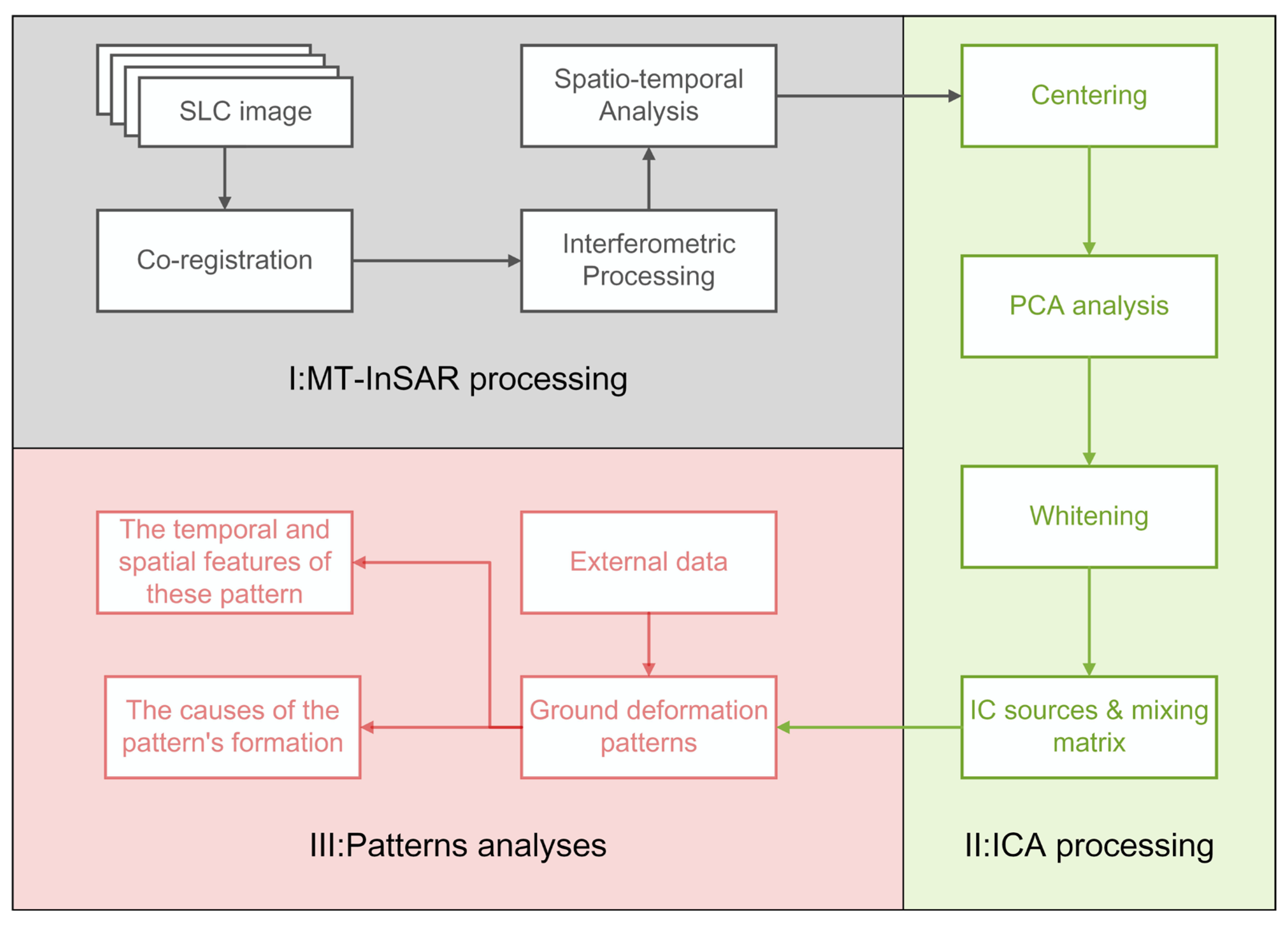
Figure 4. Data processing flowchart.
Remotesensing 18 01077 g004
Figure 5. Temporal baseline distribution. Pairs with average coherence < 0.5 (appearing as gray/dark tones in the figure) were excluded from the deformation rate estimation.
Remotesensing 18 01077 g005
Figure 6. Vertical deformation rate and time series at representative sites. (a) Deformation rate distribution in the study area between 2015–2023. The blue cross indicates the InSAR reference point, and the green square indicates the BJFS GNSS station. (b) Displacement time series of locations C1, Y1, and Z1.
Remotesensing 18 01077 g006
Figure 7. Validation of InSAR-derived vertical displacements against GPS measurements at the BJFS station.
Remotesensing 18 01077 g007
Figure 8. K-means clustering results. (a) Determination of optimal cluster number via elbow method, with inertia plotted against number of clusters (K), identifying K = 4 as optimal. (b) Deformation (mm) time-series for four clusters (Cluster 1 to 4), showing distinct temporal variation patterns. (c) Spatial distribution of the four clusters in the study area, marked with representative sites (C1, Z1, Y1) and color-coded clusters.
Remotesensing 18 01077 g008
Figure 9. Eigenvalues and variance contribution of the first five components.
Remotesensing 18 01077 g009
Figure 10. Mixing matrix columns for the ICs.
Remotesensing 18 01077 g010
Figure 11. ICA results. (a) IC1. (b) IC2. (c) IC3. (d) IC4.
Remotesensing 18 01077 g011
Figure 12. Spatial distributions. (a) IC1 loading. (b) Compressible strata thickness. (c) Deep aquifers (Aquifer III-Aquifer IV). (d) Shallow aquifers (Aquifer I–Aquifer II).
Remotesensing 18 01077 g012
Figure 13. Deformation in the Chaobai River area. (a) Subsidence rate in the Chaobai River region. (b) Positive scores in IC1. (c) Negative scores in IC3. (d) Deformation time series of (ac) at location C1.
Remotesensing 18 01077 g013
Figure 14. Hydrological condition changes in Beijing.
Remotesensing 18 01077 g014
Figure 15. Distribution of key recharge rivers for SNWDP in the Beijing Plain. (a) Spatial pattern of IC3 with monitoring wells and river networks. (b) Geological strata (gravel-sand) distribution along recharge rivers.
Remotesensing 18 01077 g015
Figure 16. Groundwater level monitoring data. (a) Time-series of groundwater levels (2013–2017) for Well 1, Well 2, Well 3. (b) Time-series of groundwater levels (2018–2020) for Well 4, Well 5, Well 6 (revised after China Institute of Geological Environment Monitoring).
Remotesensing 18 01077 g016
Figure 17. Annual rainfall contour maps of the Beijing Plain from 2014 to 2022. It shows the spatial distribution and variation in rainfall over the years, with color gradients representing different rainfall magnitudes (mm) and a scale bar for distance reference [41].
Remotesensing 18 01077 g017
Figure 18. Temporal analysis of IC3. (a) Spatial distribution of IC3 loading with marked representative sites (C1, Z1, Y1). (b) IC3 displacement time-series at sites C1, Z1, Y1. (c) Cubic polynomial fitting of IC3 mixing matrix, showing the impact of SNWDP water delivery (27 December 2014) and turning point (22 May 2019).
Remotesensing 18 01077 g018
Figure 19. Deformation mechanisms of IC3’s mixing matrix. (a) Pre-22 May 2019: IC3 mixing matrix trend with linear fitting (y = 0.0179x − 766.14). (b) Post-22 May 2019: IC3 mixing matrix trend with linear fitting (y = −0.0097x + 435.42). (ce): Schematic of aquifer deformation mechanisms, showing effective stress ( σ e ), pore water pressure ( u w ), and inelastic change (Δh).
Remotesensing 18 01077 g019
Disclaimer/Publisher’s Note: The statements, opinions and data contained in all publications are solely those of the individual author(s) and contributor(s) and not of MDPI and/or the editor(s). MDPI and/or the editor(s) disclaim responsibility for any injury to people or property resulting from any ideas, methods, instructions or products referred to in the content.