1. Introduction
Landslides are among the most hazardous natural phenomena worldwide, often causing significant loss of life, damage to infrastructure, and disruption of livelihoods [
1,
2]. Understanding and characterizing ground movement associated with landslide processes requires thorough knowledge of local and regional conditions, as slope instabilities commonly result from complex interactions among geological, geomorphological, hydrological, and anthropogenic factors. Key parameters such as displacement magnitude, rate, and spatial distribution can only be reliably assessed through continuous and long-term monitoring, which is essential for detecting changes in slope behaviour and identifying potential precursory signals of failure [
3,
4].
Among the monitoring techniques, the Global Navigation Satellite System (GNSS) provides highly accurate, absolute three-dimensional displacement measurements at discrete locations. Repeated GNSS campaigns, therefore, allow detailed reconstruction of displacement vectors and velocities, including their north, east, and vertical components. However, GNSS observations are spatially sparse and often constrained by economic and logistical factors, limiting their ability to capture the spatial heterogeneity of deformation across an entire landslide. Conversely, satellite-based multi-temporal Differential Interferometric Synthetic Aperture Radar (MT-DInSAR) [
5] enables the detection and quantification of ground surface deformation over large areas, independently of daylight and weather conditions, and is particularly well suited for monitoring slow-moving landslides. Nevertheless, MT-DInSAR has limited sensitivity to north–south displacement due to the near-polar orbit geometry of most SAR satellites. Because InSAR measures displacement along the Line-of-Sight (LoS) [
6], the observations are primarily sensitive to vertical and East–West motion components, whereas the North–South component contributes only weakly to the measured signal and is therefore difficult to detect reliably. For this reason, the GNSS monitoring network plays a critical role in capturing the full three-dimensional displacement field on the landslide.
Because landslide types, mechanisms, and environmental settings vary widely, no single monitoring strategy can be considered universally applicable [
7]. A common approach to address this complexity involves the integration of multiple acquisition techniques [
8,
9], which can be broadly classified into: (i) satellite and remote sensing methods; (ii) photogrammetric techniques; (iii) geodetic measurements; and (iv) in situ geotechnical and geophysical investigations [
10]. While conventional ground-based methods have been used for several decades, most satellite-based techniques have been developed and extensively applied only in the last 25 years [
11,
12]. The combined use of GNSS and MT-DInSAR has therefore become a well-established approach in deformation monitoring, aiming to exploit the complementary strengths of point-based absolute measurements and spatially continuous relative observations [
13,
14,
15]. Since the late 1990s, these techniques have been jointly applied to a wide range of geophysical processes, including subsidence, tectonic deformation, volcanic activity, and landslides, the latter representing one of the most common fields of application [
16]. Despite their widespread use, several challenges remain unresolved, particularly in complex urban environments. These include the reconciliation of measurements acquired at different spatial and temporal scales, the limited sensitivity of MT-DInSAR to north–south motion, and the interpretation of deformation patterns in areas characterized by heterogeneous or uncontrolled radar scatterer distributions.
In this context, the present study addresses the challenge of characterizing the spatial and temporal evolution of a slow-moving urban landslide through a complementary GNSS and MT-DInSAR monitoring strategy. Rather than proposing a new algorithmic integration framework, this work focuses on a systematic component-wise comparison and joint interpretation of repeated Differential GNSS (DGPS) measurements and MT-DInSAR observations, with particular emphasis on identifying dominant displacement components and assessing their consistency across techniques. The proposed approach is applied to a slow-moving landslide affecting the University of Azuay campus, located in the southeastern sector of the city of Cuenca, Ecuador. The campus, constructed between 1982 and 1984 on an unstable slope, represents a strategic infrastructure for the province of Azuay. Persistent ground deformation has caused significant structural damage to several buildings, particularly the Faculty of Philosophy, where fissures and fractures testify to ongoing instability. This case study represents one of the first integrated GNSS–MT-DInSAR–geophysical investigations of an urban landslide in the Ecuadorian Andes and provides valuable insights into the effectiveness and limitations of multi-sensor monitoring in complex urban and geomorphological settings, with direct implications for landslide risk assessment and land-use planning.
2. Geological and Geomorphological Setting of the Study Area
Cuenca, like much of Ecuador, exhibits high susceptibility to gravitational processes due to its steep topography, active tectonics, and intense seasonal rainfall [
17,
18]. This natural predisposition is further exacerbated by rapid urban expansion into landslide-prone areas, particularly high-slope zones. A landmark event demonstrating this vulnerability is the 1993 La Josefina landslide, which released over 20 million cubic meters of material and temporarily dammed the Paute River, threatening Ecuador’s principal hydroelectric infrastructure [
19,
20]. Recent initiatives, such as the MARLI mobile application [
17], have strengthened the systematic documentation of landslides across southern Ecuador, including the Cuenca–Paute basin, enhancing the capacity for hazard assessment and early warning in regions historically affected by catastrophic slope failures.
The University of Azuay case study is located in the central-eastern sector of the Cuenca Basin, an intermontane depression in southern Ecuador (Azuay Province), situated between the Western and Eastern Cordilleras of the Andes. The area exhibits an altitudinal gradient ranging from ~2500 m to ~4500 m a.s.l., shaped by long-term compressional tectonics and Andean orogeny-related uplift. The Cuenca Basin rests on a Palaeozoic metamorphic basement and contains a complex sequence of Mesozoic to Quaternary marine, fluvial, and volcanic deposits. NE-SW trending faults controlled both basin formation and sedimentation patterns [
21,
22]. Two principal depositional phases are recognized:
The first phase involved continuous sedimentation in deltaic to marginal marine environments, mainly sourced from the Eastern Cordillera, characterized by metamorphic clasts, fade associations, and paleocurrent indicators.
The second phase represents a transition to coarse-grained fluvial and alluvial systems derived from the Western Cordillera, deposited unconformably over deformed older units.
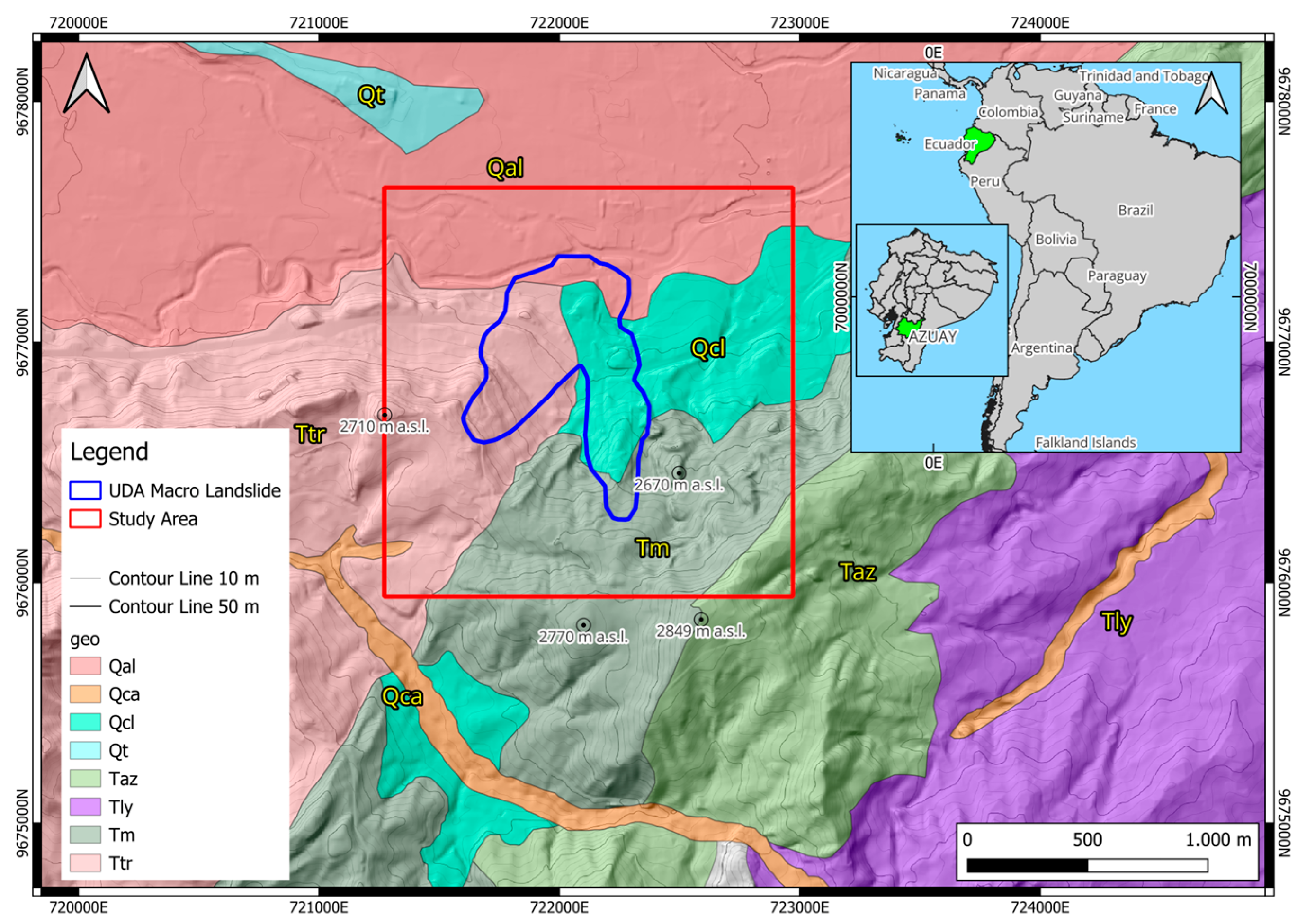
Within the study area and surrounding sectors, several stratigraphic units contribute to structural and geotechnical complexity (
Figure 1):
Azogues Formation (Late Miocene): thick-bedded brown sandstones, shales, and conglomerates in fluvio-lacustrine settings. Spheroidal weathering is common, especially in the southern sectors.
Loyola Formation (Middle Miocene): grey shales and cream-colored claystones with quartz lenses and soft sandstones rich in iron oxides.
Mangan Formation (Middle Miocene): brown sandstones, green and red laminated shales, often associated with coal seams.
Biblián Formation (Early Miocene): up to 1200 m thick; fluvial continental detrital deposits, micaceous and volcanic-rich sands, shales, and common gypsum nodules.
Turi Formation (Late Eocene–Oligocene): alternating conglomerates (0.9–2.5 m thick), sandstones, and limonitic layers representing high-energy depositional environments.
The University of Azuay is located on a geomorphologically unstable slope in the southeastern part of Cuenca. The terrain is composed of interbedded sedimentary units from the Mangán, Turi, and Loyola formations, resting over older alluvial terraces and dissected by artificial cuts from infrastructure such as the Cuenca–Azogues highway. The slope morphology and subsurface stratigraphy favor the occurrence of slow-moving, shallow translational landslides [
23]. The combination of soft lithologies (Loyola and Mangan formations), high precipitation, and seismicity predisposes the area to shallow slope failures.
This litho-stratigraphic and geomorphological framework underpins both the surface morphology and subsoil behaviour of the University of Azuay and its vicinity. The detailed geophysical surveys (electrical resistivity tomography and seismic profiling), landslide risk assessments, and geodetic monitoring presented in the following sections build directly upon this geological context, enabling a comprehensive interpretation of slope instability and subsurface conditions.
2.1. Historical Reconstruction of the Landslide and Observed Damage
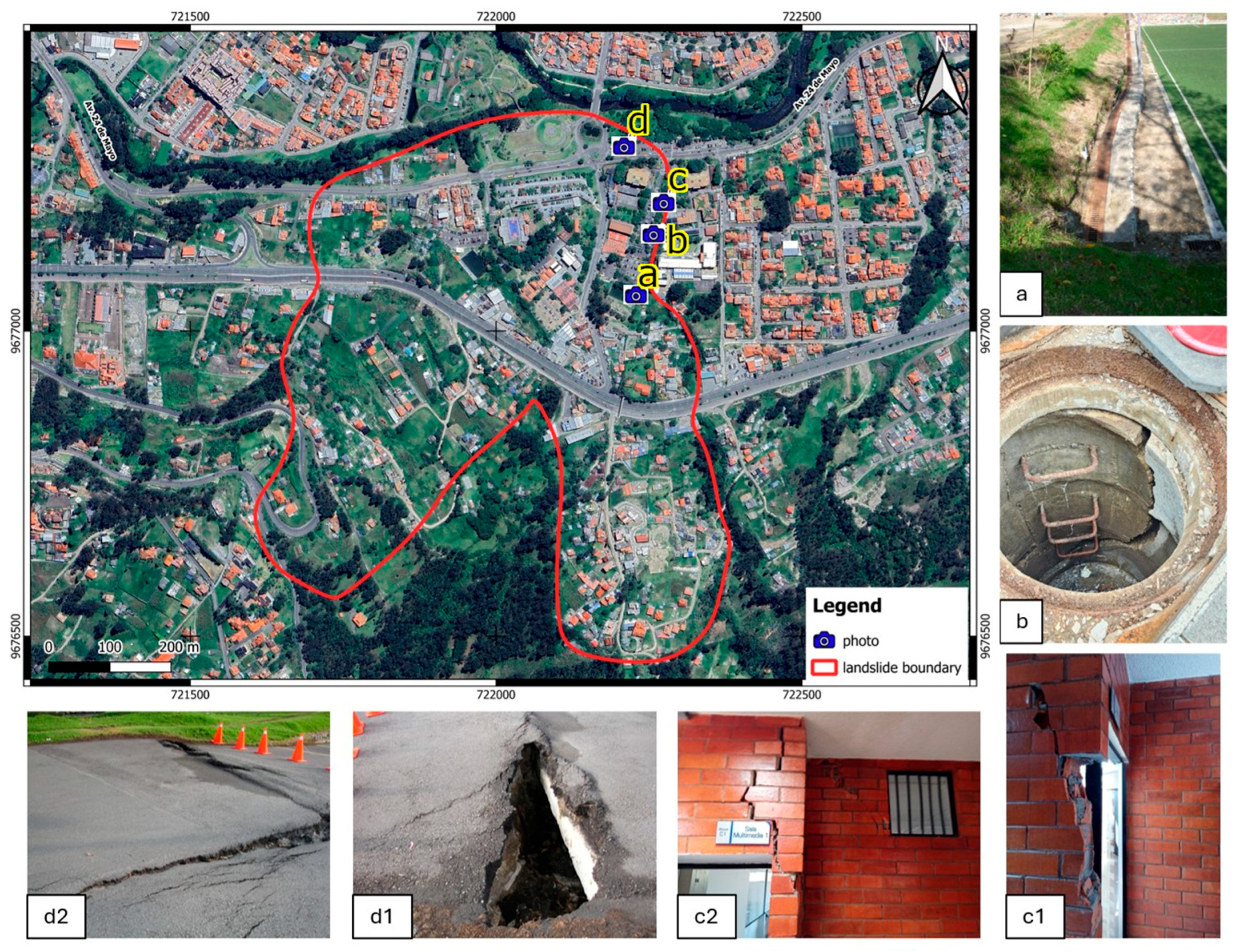
Figure 2 illustrates the planimetric layout of the landslide body affecting the University of Azuay campus, together with the locations of the photographic observation points. The side and bottom panels show examples of structural and infrastructural damage observed in the field.
The first evidence of ground deformation within the campus dates back to the early 2000s, when localized instability was detected in the southeastern sector of the study area [
17]. In December 2006, the Rectorate established a Landslide Movement Monitoring Commission with the aim of assessing ground displacements and proposing technical solutions to the emerging instability problems.
The instability processes were further exacerbated by the construction of the Cuenca–Azogues expressway and the Nero water project, both of which significantly altered the local hydrogeological regime and the stress conditions along the slopes adjacent to the campus. Among the most critical situations was the instability affecting the lateral wall of the Auditorium building, which was at risk of collapse due to the pressure exerted by the soil mass on the right bank of a nearby ravine (
Figure 2(c1,c2)). To mitigate this condition and prevent structural failure, the soil pressing against the wall was removed and a longitudinal trench was excavated down to the foundation level, thereby reducing the lateral earth pressure. Another critical area was identified in the main parking lot, where macro-movements affected the upper soil layers (
Figure 2(d1,d2)). The adopted mitigation strategy consisted of excavating narrow and deep trenches (approximately 50 cm wide) down to the siltstone interface. These trenches were excavated sequentially in order to dissipate the kinetic energy of the moving soil mass. This intervention proved effective in significantly reducing the displacement rate. The Commission operated continuously until December 2015, submitting monthly technical reports to the Rectorate and recommending corrective works whenever necessary. In 2019, the monitoring program was reactivated under the institutional coordination of the university’s technical department, restoring systematic observation of ground stability across the campus. During this phase, more than 80 technical reports were produced, incorporating photographic documentation, geotechnical observations, and comparative analyses aimed at reconstructing the evolution of deformation processes (
Figure 2a,b).
At present, the monitoring program integrates geodetic, geophysical, and remote sensing techniques [
17], including Differential Interferometric Synthetic Aperture Radar (DInSAR), in order to ensure high-precision tracking of ground deformation. A GNSS/DGPS monitoring network with forced-centering benchmarks has been installed across the campus to measure slow-moving displacements with sub-centimeter accuracy [
24].
2.2. Geophysical Investigation
To complement the geological framework of the University of Azuay sector and to constrain the internal structure of the unstable slope, a geophysical investigation was conducted using Electrical Resistivity Tomography (ERT) and seismic refraction techniques, including Refraction Microtremor (ReMi), Multichannel Analysis of Surface Waves (MASW), and Extended Spatial AutoCorrelation (ESAC) analyses [
17]. These methods provide high-resolution subsurface information that is essential for stratigraphic interpretation, geotechnical characterization, and landslide modelling. Their application is particularly relevant in the study area, where no boreholes, geognostic drillings, or lithostratigraphic logs are available. Consequently, the geophysical dataset represents the only source of quantitative information on subsurface geometry and mechanical contrasts. The adopted methodological approach follows protocols successfully applied in comparable Andean settings, including those reported by [
17] for a strategic building located within the same landslide body. ERT allows the delineation of subsurface resistivity variations primarily controlled by lithology, porosity, clay content, and moisture conditions, whereas seismic methods provide estimates of elastic properties through P-wave velocities (
Vp), enabling the identification of mechanical contrasts and potential groundwater levels. The complementary use of these techniques enhances the reliability of subsurface interpretations, facilitating the identification of weak horizons and supporting the inference of the depth and geometry of the basal sliding surface, as well as the hydro-mechanical conditions controlling landslide kinematics.
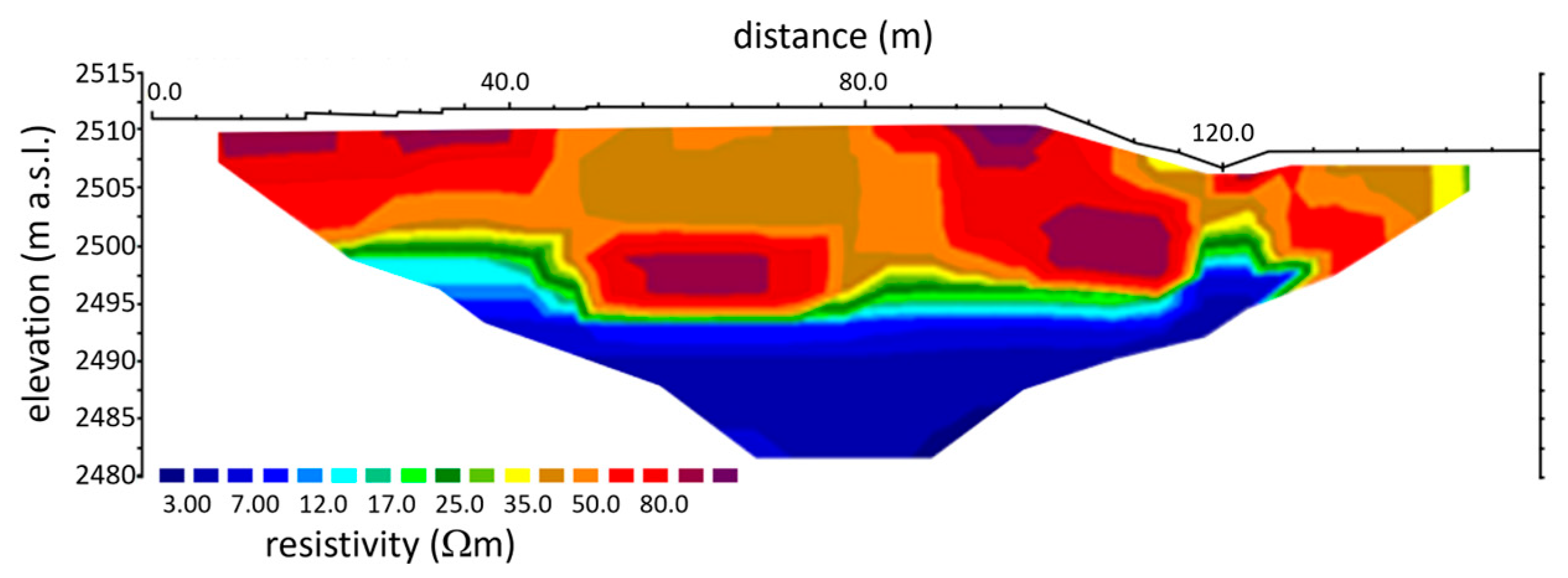
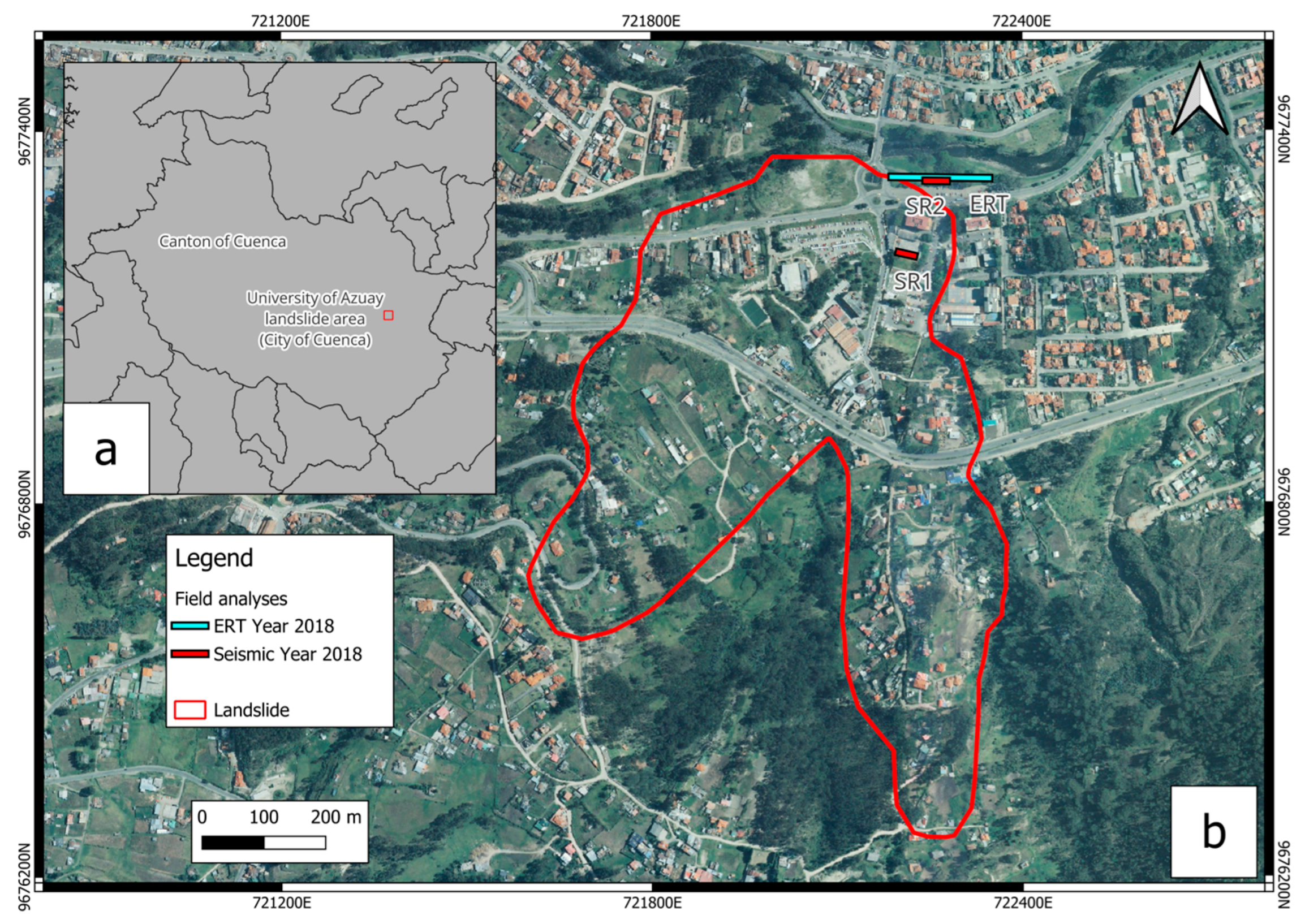
Figure 3 shows the inverted resistivity model obtained from the ERT survey carried out within the University of Azuay campus along a profile 155 m long (
Figure 4) using a Wenner–Schlumberger array with 32 electrodes. The inversion of the apparent resistivity data resulted in a root-mean-square (RMS) misfit error of 3%.
The resistivity cross-section is characterized by values ranging from <3 to >80 Ω·m. The low-resistivity horizon is interpreted as the basal sliding surface of the landslide. This interpretation is supported by both the geophysical data and the geological context of the study area, where slope instability is associated with weak fine-grained levels of the Mangan Formation. Given the decreasing vertical resolution of ERT with depth, this conductive horizon cannot be resolved as a very thin feature and may represent either a discrete shear zone or a somewhat thicker weak clay-rich layer. Above this conductive unit, discrete high-resistivity blocks are observed, suggesting the presence of displaced materials, coarser volcanic layers, or compacted sandy deposits. These heterogeneities are consistent with post-depositional deformation processes and support the interpretation of a shallow translational landslide. To further characterize the mechanical stratigraphy of the unstable slope, two seismic refraction profiles were acquired [
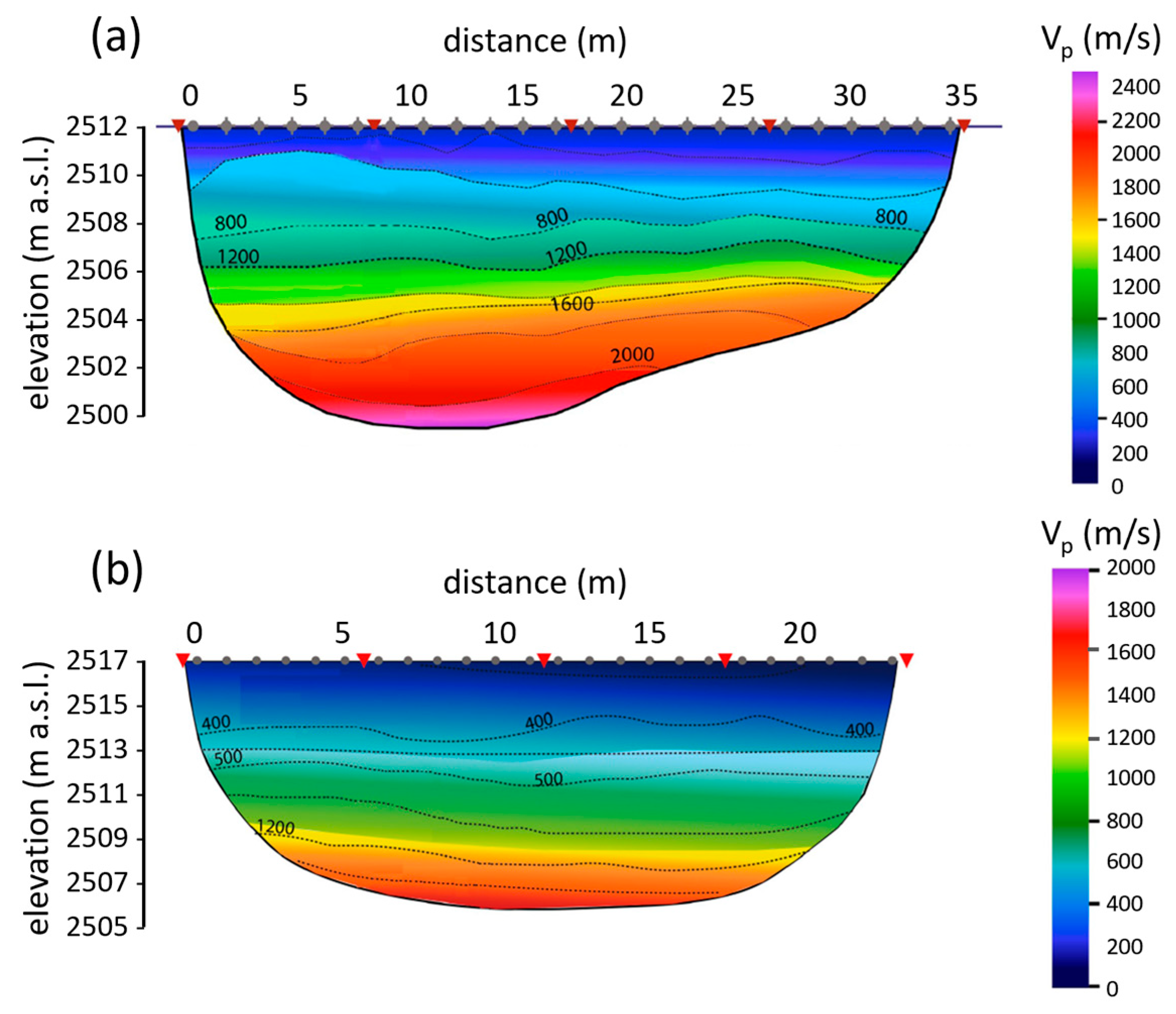
19] (
Figure 5): a 23 m long line within the University of Azuay campus and a 36 m long line outside the unstable area (SR1 and SR2 in
Figure 4, respectively). Both surveys employed 24 vertical-component geophones and an impulsive seismic source, with geophone spacing adapted to local topographic constraints. To increase the robustness of the velocity models, refraction data were integrated with ReMi, MASW, and ESAC analyses, enabling a detailed characterization of the P-wave velocity (
Vp) distribution [
25]. The inverted models yielded an RMS misfit error of 1.4%, indicating a good fit between the observed and calculated travel times and supporting the reliability of the resulting velocity models shown in
Figure 5a,b. The seismic models consistently delineate three main mechanical units:
- (1)
a shallow low-velocity layer (Vp < 200 m/s), interpreted as loose fill and reworked colluvial material, highly susceptible to near-surface deformation;
- (2)
an intermediate layer (Vp = 200–400 m/s), indicative of partially saturated sandy silts, consistent with the heterogeneous deposits observed in the resistivity model; and
- (3)
a deeper competent stratum (Vp > 500 m/s), corresponding to lithified volcanic or sedimentary units that form the mechanically strong substrate underlying the landslide.
The seismic data also indicate a groundwater table at approximately 5 m depth, in agreement with low-resistivity anomalies detected in the ERT model. Vp values of approximately 1800–2000 m/s inferred at greater depths are consistent with water-saturated cohesive sediments. The pronounced mechanical contrast between the intermediate and deeper units, together with the presence of a saturated fine-grained layer at depth identified by the ERT survey, suggests the presence of a laterally continuous saturated weak layer that likely controls the landslide kinematics and may correspond to the horizon along which basal sliding localizes.
3. GNSS and DInSAR Methodology
GNSS and MT-DInSAR data were analysed and jointly interpreted to investigate the stability of the landslide affecting the University of Azuay. The two techniques are inherently complementary: GNSS provides discrete, point-based measurements of three-dimensional ground displacements through time, while satellite interferometry offers spatially continuous information on surface deformation patterns, allowing the assessment of both the landslide body and the surrounding areas.
GNSS positioning is based on the Time of Arrival (TOA) principle and relies on a constellation of satellites transmitting signals with known orbital parameters and emission times. A ground-based receiver determines its position by measuring the travel time of the signals received from multiple satellites and converting these time delays into distances using the signal propagation velocity [
26]. To ensure accurate positioning and redundancy, several satellite constellations are currently operational, including GPS (USA), GALILEO (Europe), GLONASS (Russia), QZSS (Japan), among others. By simultaneously processing observations from multiple satellites with well-defined orbital positions, GNSS techniques allow the precise estimation of receiver coordinates and their temporal evolution, enabling the quantification of displacement rates and deformation trends. GNSS monitoring is widely applied in geoscientific studies and has proven effective for characterizing a broad range of geohazards, including landslides [
27], sinkholes [
28], and earthquakes [
29]. MT-DInSAR is a remote sensing technique extensively used to analyze ground deformation associated with natural and anthropogenic processes. It exploits the phase information of multiple Synthetic Aperture Radar (SAR) images acquired over the same area at different times by satellite missions such as Sentinel-1 (European Space Agency), COSMO Sky-Med (Italian Space Agency), TerraSAR-X (German), ALOS (Japanese Space Agency), and others. By computing phase differences between temporally separated SAR acquisitions, MT-DInSAR allows the detection and quantification of surface displacements over large areas with centimetric to millimetric accuracy [
30,
31,
32,
33]. Despite its high spatial coverage and sensitivity, MT-DInSAR measurements are intrinsically constrained by the side-looking geometry and near-polar orbits of SAR satellites. As a result, the technique is primarily sensitive to deformation components projected along the radar Line of Sight (LoS), which mainly reflect West–East and vertical displacement components, whereas surface movements oriented approximately in the North–South direction (i.e., parallel to the satellite flight path) cannot be reliably detected [
34].
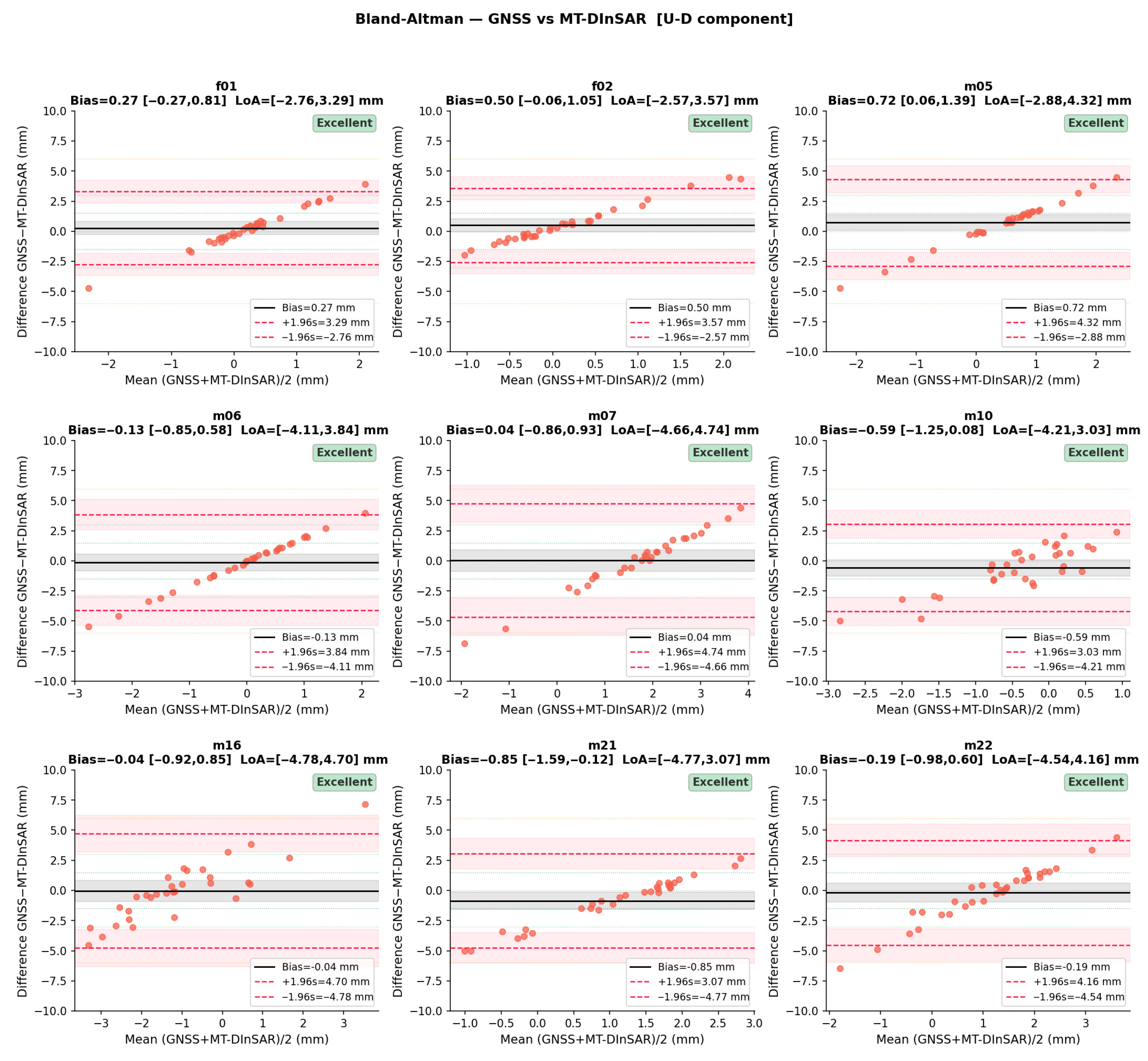
To evaluate the agreement between the two measurement techniques and assess the comparability of the obtained data, the Bland–Altman method was applied. Originally proposed by Bland and Altman in 1986 [
35], this technique is used to compare measurements obtained with different methods and to determine whether they can be considered interchangeable. It has been extensely adopted in the literature to assess the level of agreement between different analytical techniques [
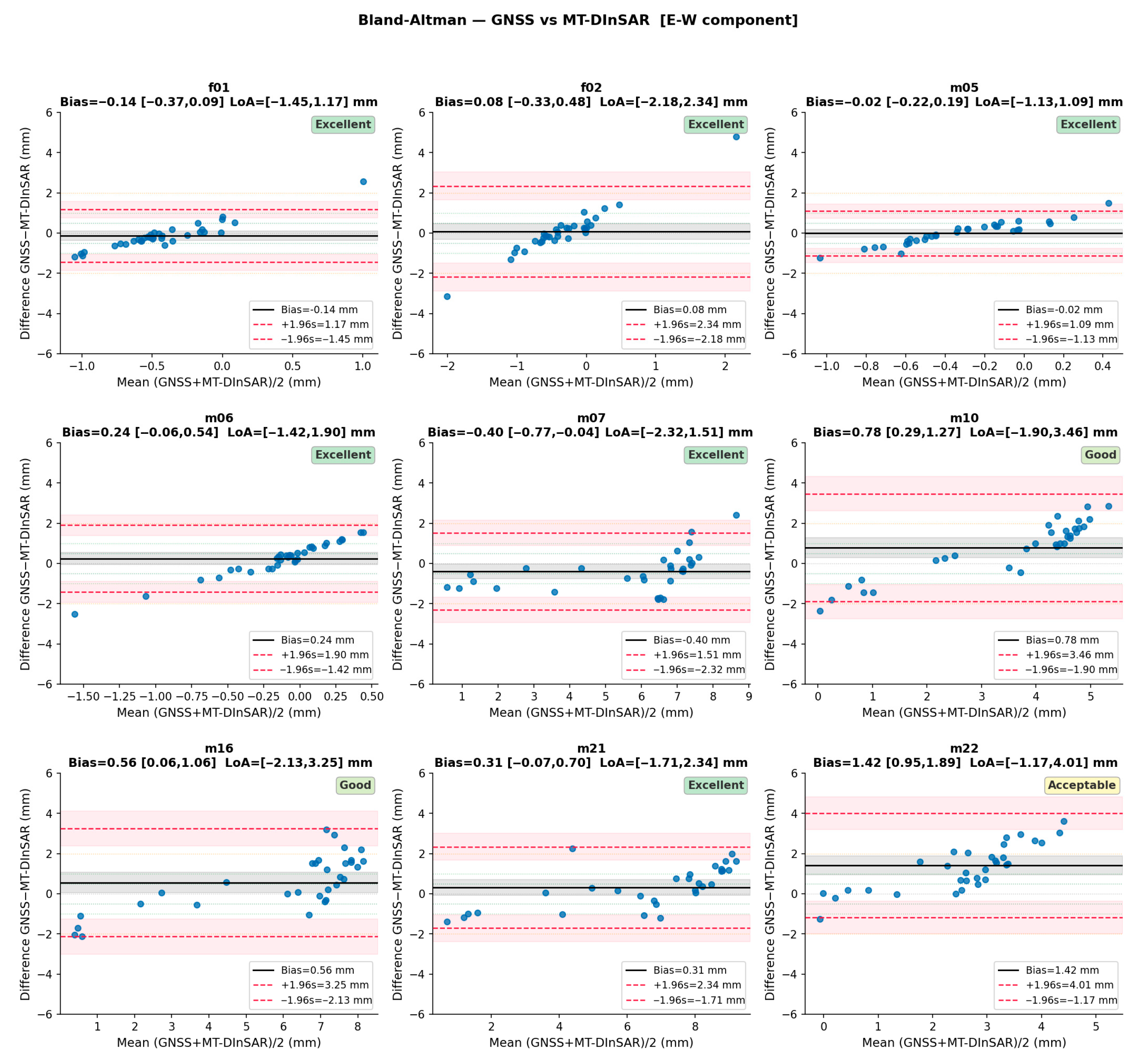
36]. The first step of the analysis is the evaluation of the practical precision of the instruments, as differences below this threshold are considered irrelevant, being entirely attributable to noise or instrumental errors. The bias is defined as the mean difference d between the two measurement series. The Limits of Agreement (LoA) are then computed as d ± 1.96s, where s is the standard deviation of the differences, and the factor 1.96 corresponds to the 95% interval of a normal distribution, thus defining the range within which 95% of the individual differences between the two instruments are expected to fall. If the differences between measurements fall within these limits, the instruments can be considered interchangeable. The agreement was classified based on the absolute value of the mean difference |d| relative to the GNSS practical precision σ: Excellent if |d| < σ/2, Good if σ/2 ≤ |d| < σ, Acceptable if σ ≤ |d| < 2σ, and Poor if |d| ≥ 2σ.
3.1. GNSS Monitoring Network and Data Processing
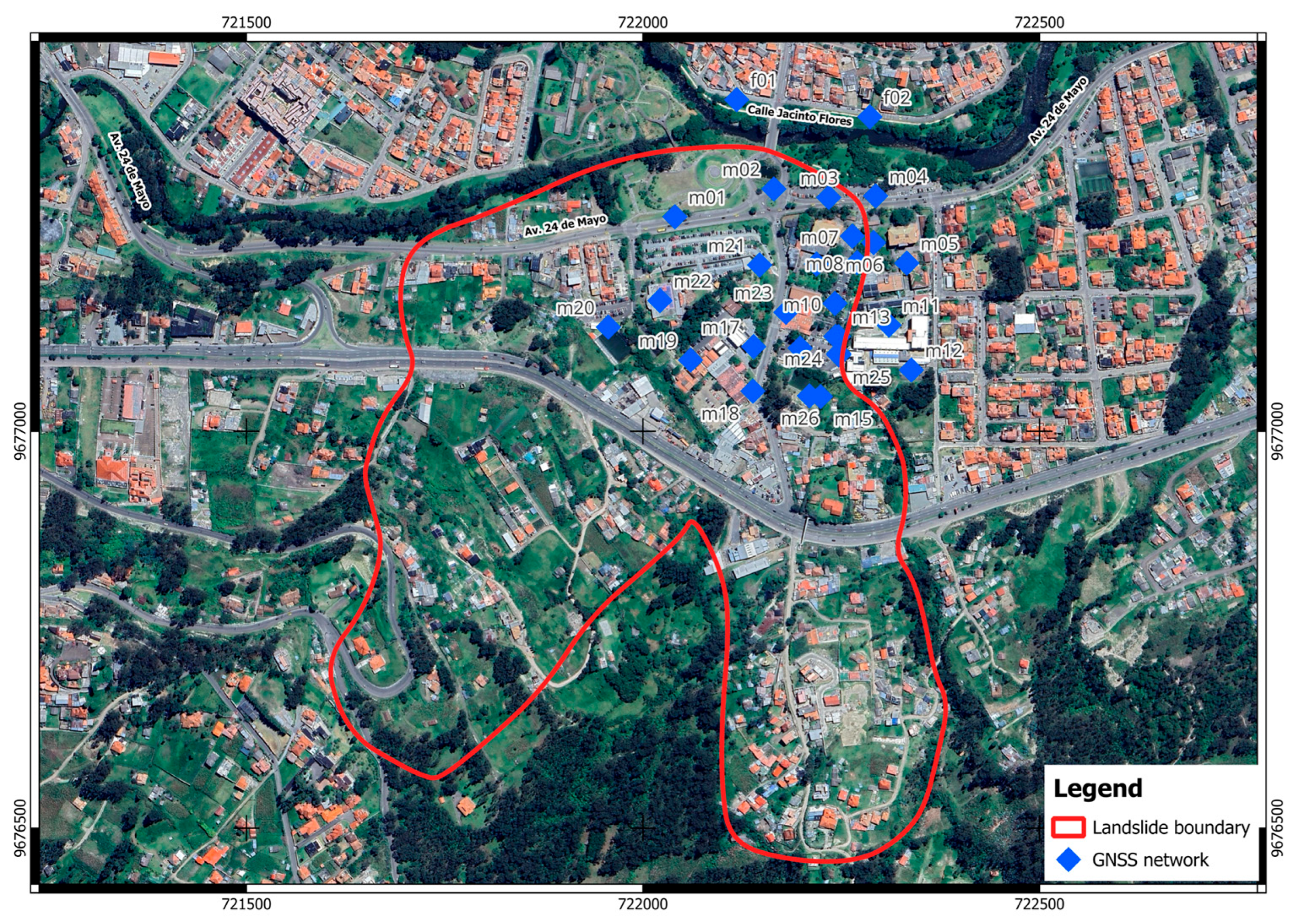
To monitor ground deformations with high precision, a dedicated geodetic network of 28 permanent fourth-order DGPS markers was established across the University of Azuay campus and adjacent sectors, including Av. 24 de Mayo and Calle Jacinto Flores (
Figure 6). Each marker was constructed according to forced-centering specifications, consisting of buried concrete foundations (~0.6–1.0 m depth) and steel plates (0.5 × 0.5 m) reinforced with iron cores to ensure mechanical cohesion with the moving soil mass. This design guarantees that the recorded displacements accurately represent ground movement, minimizing errors due to marker instability or surface disturbances. All GNSS benchmarks were monumented using a forced-centring system to ensure repeatable antenna positioning between observation sessions. This configuration allows the antenna to be mounted in a fixed mechanical position relative to the benchmark, minimizing setup errors and improving measurement repeatability. The GNSS monitoring network is installed within the premises of the Universidad del Azuay. Although the mapped landslide extends beyond the university campus into adjacent urban areas, the installation of monitoring points outside the university property falls under municipal jurisdiction and was therefore beyond the scope of this study. Consequently, the network was designed to monitor the portion of the landslide affecting the university facilities, while the broader deformation field is complemented by the MT-DInSAR analysis.
The monitoring program began in 2017 with the acquisition of Trimble R8s receivers. Initial tests using real-time kinematic (RTK) positioning at 2 min intervals proved insufficient, as horizontal and vertical uncertainties exceeded 1 cm. To improve measurement accuracy, the methodology was refined to 30 min static sessions and later to fast-static sessions of 1 h per point, with strict forced-centering to ensure reproducibility. These adjustments enabled the generation of reliable time series capturing the temporal evolution of surface displacement vectors [
37]. The GNSS receivers tracked multiple constellations, including GPS, GLONASS, and Galileo, acquiring data on the L1 and L2 frequencies. For this study, data collected between July 2021 and June 2024 from 28 observation points were analyzed, with a sampling rate of 1 Hz, while measurement campaigns were conducted monthly. One receiver was used as a reference station while the remaining receivers were deployed at the monitoring points.
Data processing was performed using RTKLib (v. 2.4.3) [
38,
39], an open-source software package for standard and precise positioning. RTKLib provides a library and several application programs (APs) operable via a graphical user interface (GUI) or a command-line user interface (CUI AP), supporting multiple positioning modes, including real-time and post-processing methods, such as Single, DGPS/DGNSS, Kinematic, Static, Moving-Baseline, Fixed, Precise Point Positioning (PPP-Kinematic, PPP-Static, and PPP-Fixed). To achieve the millimetric accuracy required for this monitoring program, all analyses were conducted in post-processing using the RTKpost module of RTKLib. Processing requires RINEX (Receiver Independent Exchange Format) observation files from both rover and base station, along with satellite ephemeris, clock, ionospheric and tropospheric correction files, which were obtained from the NASA archive (
https://cddis.nasa.gov/archive/gnss/products/, accessed on 2 December 2025). The reference base station used was CUEC, managed by the Instituto Geográfico Militar of Ecuador, located approximately 4 km from the study area. The data from this station were obtained through the IGM portal (
https://www.geoportaligm.gob.ec/downloads/public/home, accessed on 2 December 2025). Since the original files from both the receivers and the base station were in T02 format, they were converted to RINEX format using Trimble’s “Convert to RINEX” (v. 3.53) software [
40,
41].
The GNSS observations were processed using RTKLib following a static positioning strategy. The processing generated output files reporting the average coordinates of each point (East, North, Up), together with quality indicators and formal standard deviations derived from the least-squares adjustment. These formal errors may reach values on the order of hundredths of a millimeter; however, they represent internal precision indicators of the adjustment rather than the true positioning accuracy. Considering the dispersion observed in the coordinate time series, the practical precision of the GNSS measurements is estimated to be within a few millimeters for the horizontal components and several millimeters for the vertical component. Finally, the daily position files for each observation were aggregated to construct the complete time series corresponding to the monitoring period, providing a robust dataset for the analysis of landslide kinematics across the study area.
3.2. Multi-Temporal DInSAR Processing and LoS Decomposition
In this study, interferometric analysis was performed using the MT-DInSAR technique, which processes time series of SAR images acquired at different epochs [
5]. To improve the robustness and accuracy of the analysis, the Small BAseline Subset (SBAS) method was adopted [
42,
43], which generates a network of interferograms with small spatial and temporal baselines, enabling precise estimation of surface displacements. SBAS is particularly effective for analysing Distributed Scatterers (DS), radar targets characterized by gradual and continuous phase variations over time. Importantly, DS can also be detected in vegetated areas, making SBAS suitable for monitoring deformations in non-urbanized environments. For this study, C-band SAR images were employed due to their longer wavelength, which allows greater penetration through the ground surface and vegetation canopy [
44]. The SUBSIDENCE software (v. 32.0.0), based on the Coherent Pixels Technique (CPT) [
45], developed by researchers at the Universitat Politècnica de Catalunya (Barcelona), was used for SBAS processing. A comprehensive description of the algorithm can be found in [
46,
47]. The dataset used consisted of Sentinel-1 (S1A) Single Look Complex (SLC) images, made available by the European Space Agency (ESA), acquired in both ascending and descending orbits and spanning the period from July 2021 to June 2024, with a revisit interval of 12 days.
As previously noted, SAR satellites follow near-polar (North–South) orbits, meaning that MT-DInSAR measurements remain primarily sensitive to deformations along the LoS, capturing mainly vertical and West–East motion. In ascending orbit acquisitions, positive LoS values indicate displacement towards the satellite in the East–West direction, while negative values correspond to motion in the opposite (West–East) direction. In descending acquisitions, the interpretation is reversed: positive values indicate motion towards the satellite in the West–East direction, and negative values indicate East–West displacement. In this study, the LoS measurements were decomposed into West–East and vertical components following the methodology of [
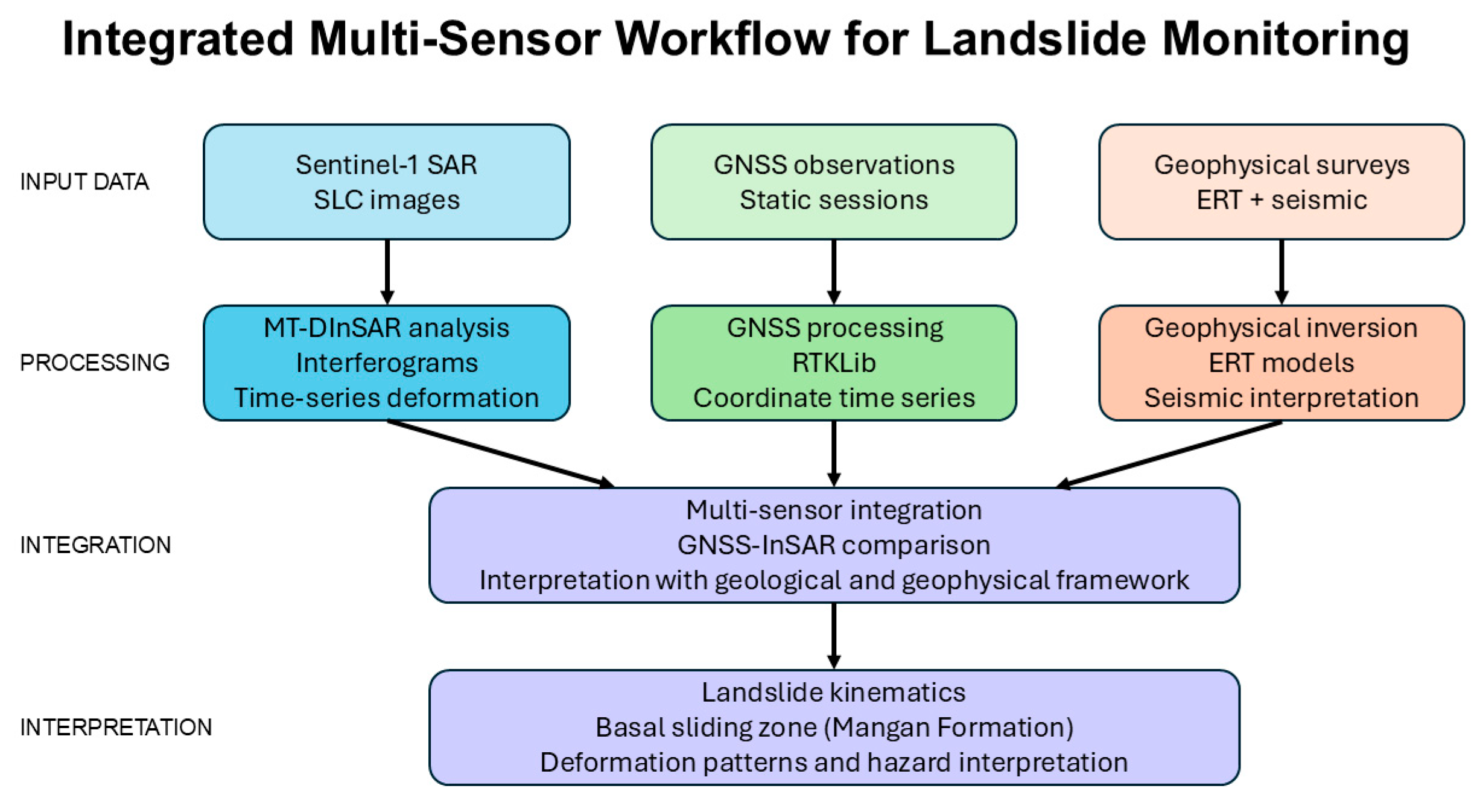
48], which incorporates the directional cosines of the satellite acquisitions. This decomposition is limited to these two directions due to the semipolar satellite geometry; displacements occurring along the satellite flight direction (North–South) are not detectable. Consequently, landslides oriented parallel to the North–South axis are more difficult to detect than those with a West–East orientation. The full multi-sensor workflow is shown in
Figure 7.
4. Results
The results obtained from the GNSS and MT-DInSAR analyses are presented separately in the following sections and subsequently compared to assess the consistency and complementarity of the two methodologies.
4.1. GNSS Displacement Time Series
GNSS displacement time series were derived from the monitoring network and processing strategy described in
Section 3.1. Monthly surveys conducted between July 2021 and June 2024 on 28 DGPS markers installed across the University of Azuay campus and surrounding areas (
Figure 6) were analysed to quantify three-dimensional ground displacements.
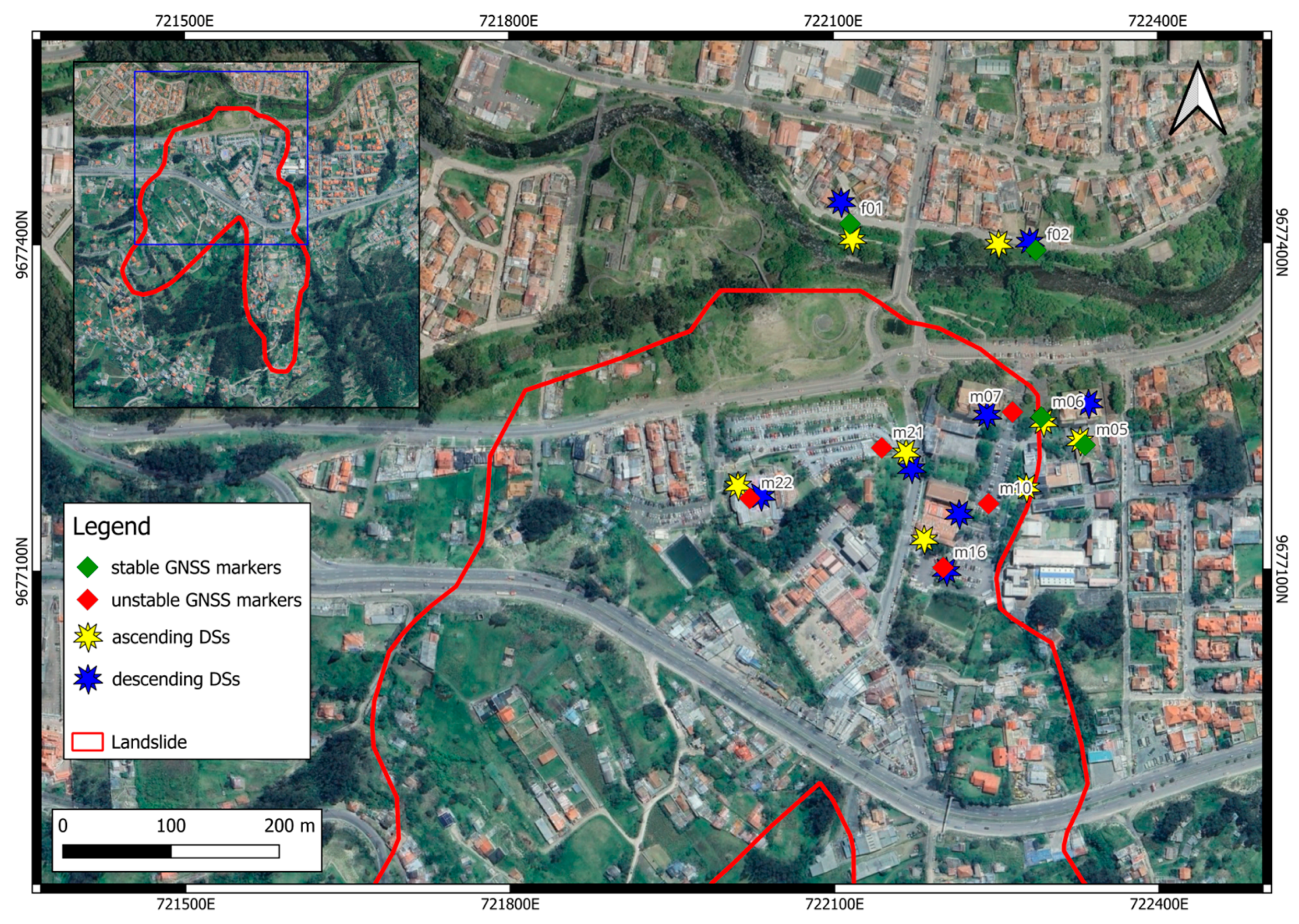
Among the 28 installed markers, nine stations were selected as the most representative of the deformation behaviour observed in the study area (
Figure 8). Of these, four markers (green symbols) are located outside the mapped landslide boundaries and are therefore considered stable reference points, while the remaining five (red symbols) are situated within the landslide-affected area, in proximity to the university campus. The results are expressed as three-dimensional displacement time series in the East–West, North–South, and vertical components.
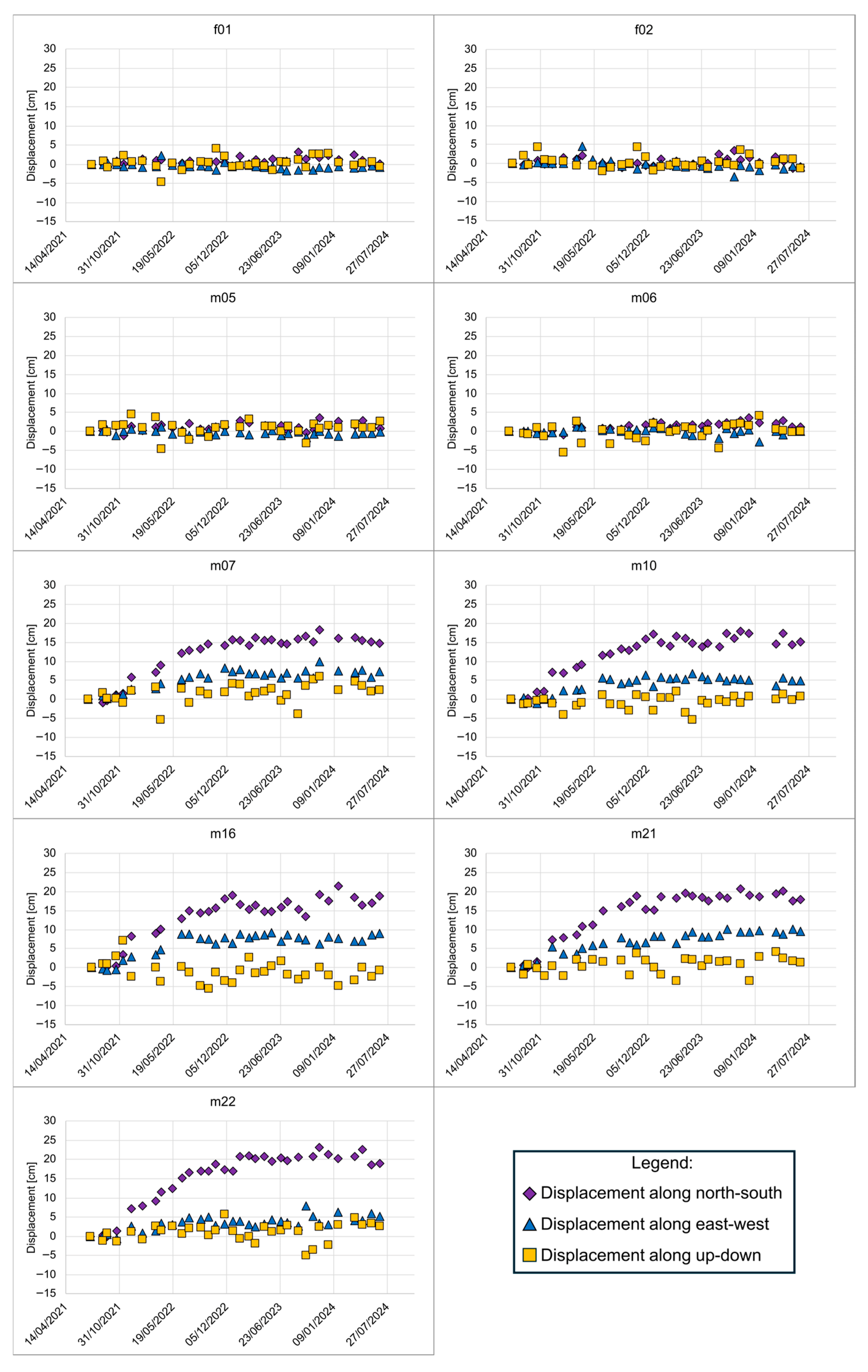
Figure 9 shows the displacement time series for the nine selected markers.
As expected, no significant ground deformation is observed in any of the three spatial components for the markers located outside the landslide zone (
Figure 9—f01, f02, m05, and m06), confirming their stability throughout the monitoring period. In contrast, the markers positioned within the unstable area exhibit clear and systematic displacement trends (
Figure 9—m07, m10, m16, m21, and m22). In particular, these stations show predominant northward motion, with cumulative displacements reaching approximately 22 cm over slightly more than two years. Additionally, all internal markers show consistent eastward movement, with cumulative displacements on the order of 10 cm.
4.2. MT-DInSAR Deformation Patterns
Using the Small BAseline Subset (SBAS) approach within the MT-DInSAR framework, applied to Sentinel-1 interferometric (see
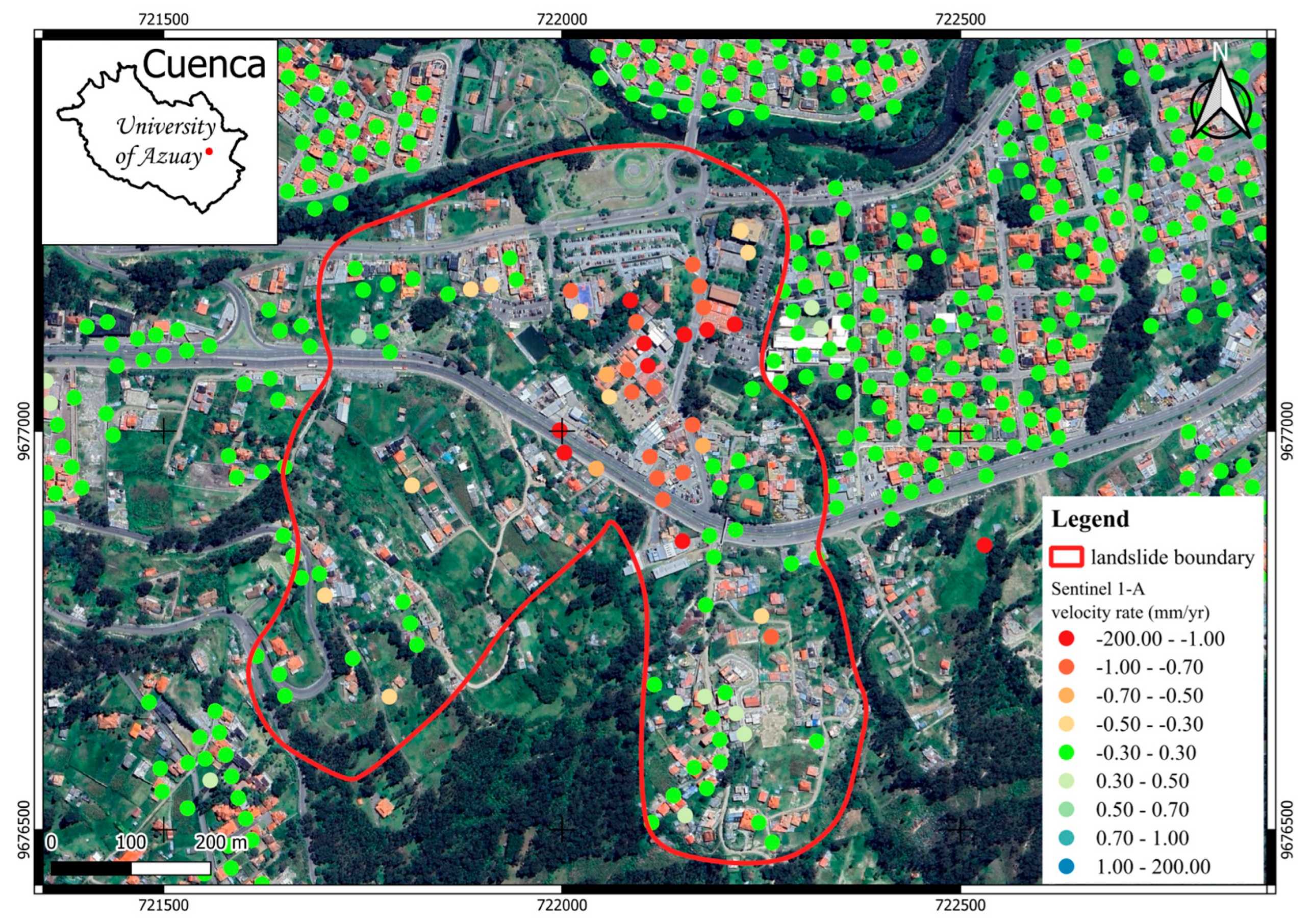
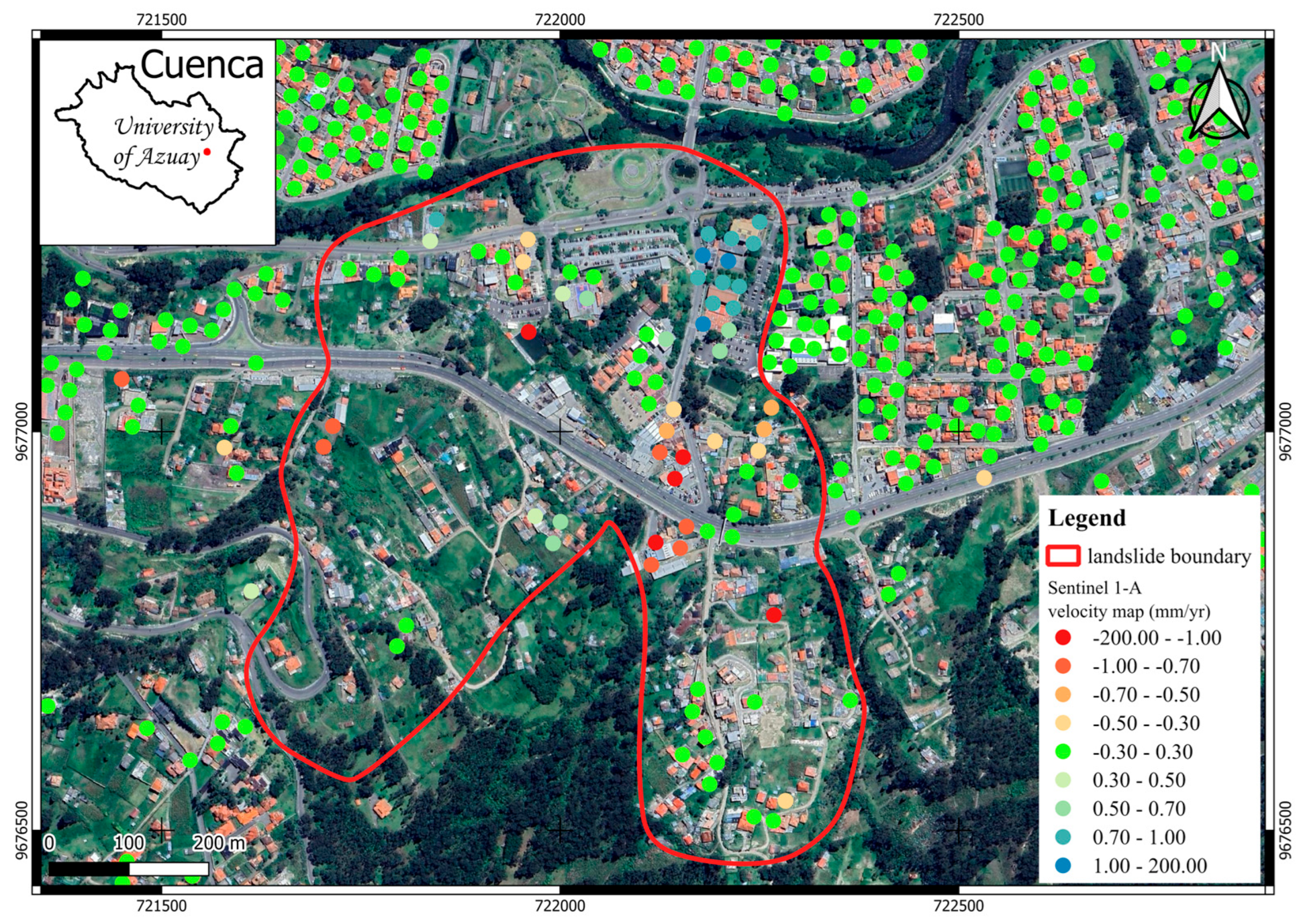
Section 3.2), mean displacement rate maps were generated for both ascending and descending orbits. The resulting velocity fields indicate an overall slow kinematic behavior of the landslide. In particular, ascending-orbit data (
Figure 10) show maximum displacement rates of up to −1.53 cm/year, concentrated in the central sector of the landslide body, with significant anomalies in correspondence with the main buildings of the University campus. Similarly, descending-orbit results (
Figure 11) show maximum velocities of approximately −1.26 cm/year in the same central area, while positive displacement rates of up to 1.11 cm/year are observed along the toe of the landslide. Following the methodology indicated by [
43], the LoS displacements obtained from both ascending and descending geometries were decomposed into East–West and vertical (Up–Down) components.
The resulting deformation values represent cumulative displacements, referenced to the first acquisition date and thus initialized to zero at the beginning of the observation period. Distributed Scatterers (DS) located within a 50 m radius of each GNSS station were selected to allow comparison between the satellite-derived deformation time series and the ground-based displacement measurements (
Figure 8).
Although this analysis was carried out for all available GNSS stations, only the most representative cases are presented here.
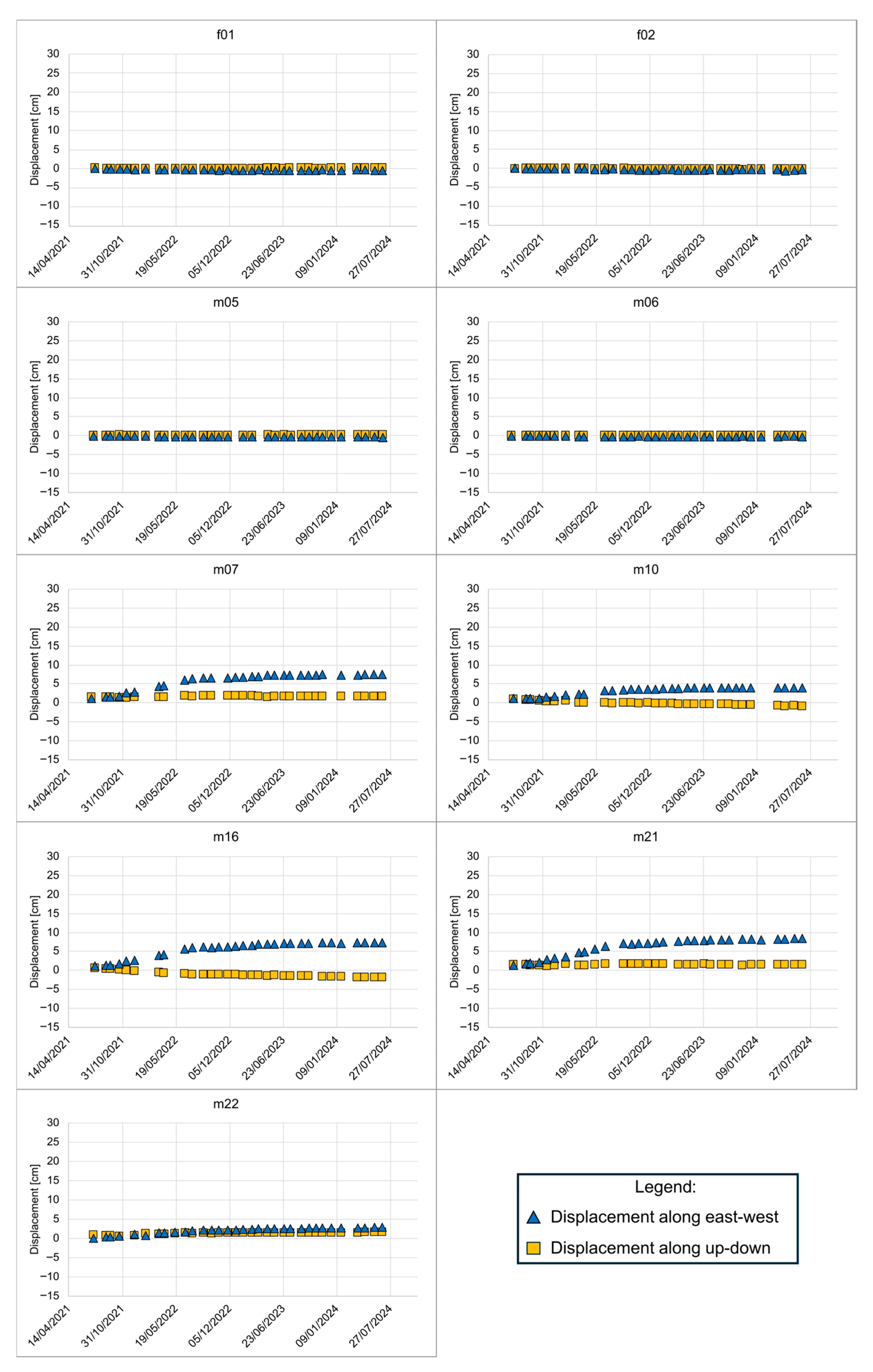
Figure 12 illustrates the displacement time series of four stable points (f01, f02, m05, m06) located outside the landslide boundaries, in the western sector of the study area and the time series of five unstable points (m07, m10, m16, m21, m22) situated in the north-eastern sector of the landslide area. These unstable DS exhibit cumulative eastward displacements of up to approximately 8 cm (corresponding to markers m07, m16, and m21), along with a maximum vertical subsidence of about 2 cm, observed at marker m10.
4.3. Comparison Between GNSS and MT-DInSAR-Derived Displacements
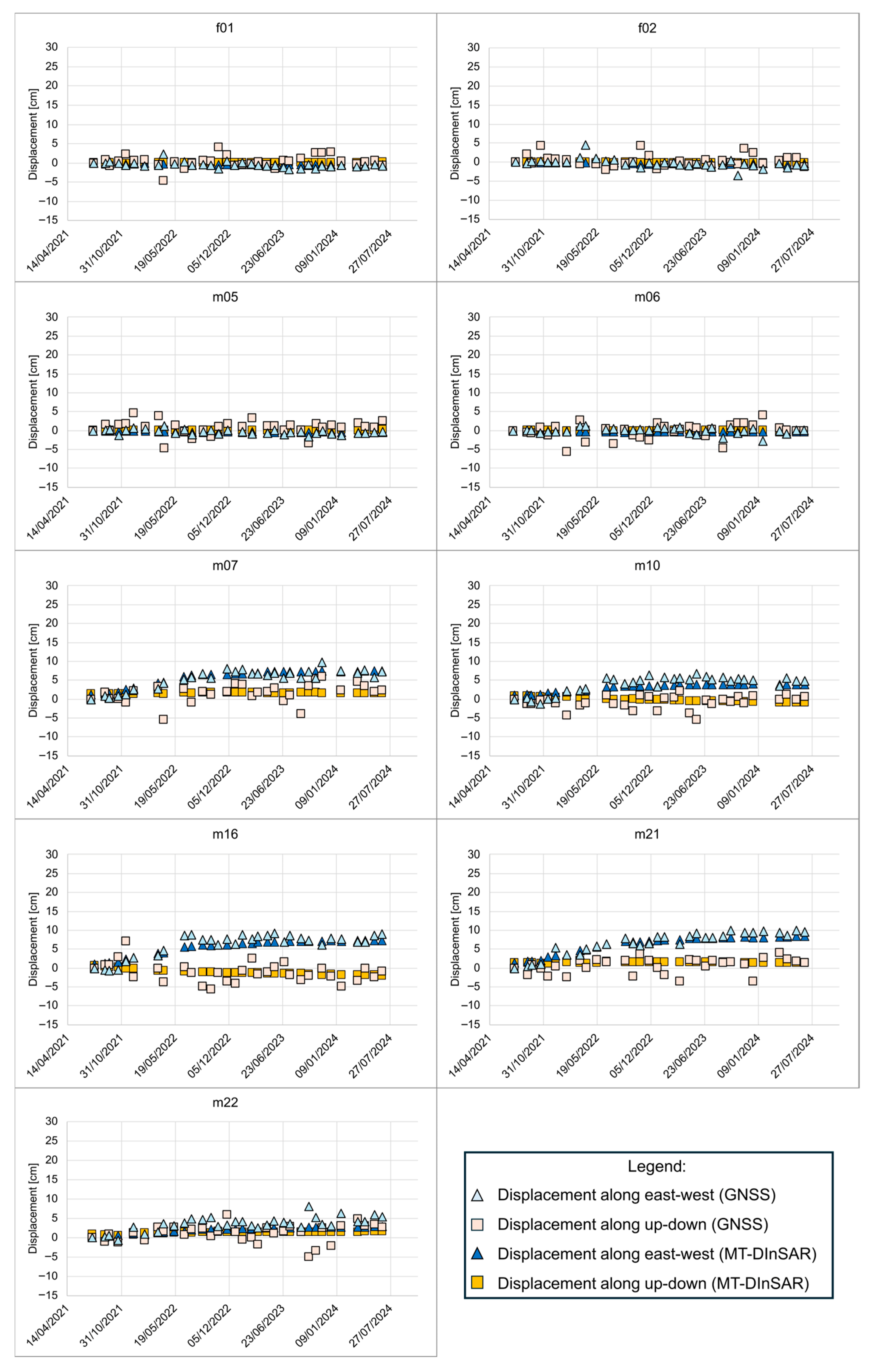
To evaluate the consistency between the two independent monitoring methodologies, GNSS and MT-DInSAR-derived displacements were directly compared by overlaying their respective time series in a single graph (
Figure 13). This approach allows a clear visual assessment of the temporal trends captured by both techniques and facilitates the identification of any similarities or discrepancies. A visual inspection of the resulting plots indicates a very good agreement between the GNSS measurements and the displacements derived from the MT-DInSAR analysis, confirming the reliability and complementarity of the two datasets in capturing the landslide kinematics.
The results were also analyzed using the Bland–Altman analysis and are summarized in the
Figure 14 and
Figure 15. The validation results are excellent for most markers, except for marker m22 [east–west component], which is nonetheless classified as acceptable, and markers m10 and m16 [both east–west component], whose results are classified as good (
Figure 14). Meanwhile, all the markers highlighted excellent correspondence between GNSS and MT-DInSAR data regarding the up-down component (
Figure 15). The GNSS practical precision σ, assumed as of a few millimeters along the East–West component and of several millimeters along the Up-Down component, has been precautionarily assumed as 1 mm for the East–West component and 3 mm for the Up-Down component.
5. Discussion
The present study applies an integrated multi-sensor approach that combines GNSS, MT-DInSAR, and geophysical investigations through a point-to-point co-location strategy and LoS displacement decomposition. GNSS-derived three-dimensional displacement vectors and MT-DInSAR East–West and vertical deformation components are jointly interpreted in the light of subsurface information provided by Electrical Resistivity Tomography (ERT) and seismic surveys conducted in the study area. This workflow enables a consistent, component-wise representation of slope kinematics across spatial scales and allows direct validation of MT-DInSAR trends using high-accuracy GNSS benchmarks. To our knowledge, such an integrated application has not previously been implemented for urban landslides in the Ecuadorian Andes.
MT-DInSAR identifies the central sector of maximum displacement and localized uplift at the toe, while GNSS confirms the three-dimensional displacement field. In turn, the geophysical results constrain the internal stratigraphy, indicate the presence of a weak saturated horizon, and support the interpretation of a shallow translational landslide controlled by a basal shear surface.
Average velocity maps derived from the interferometric analysis (
Figure 10 and
Figure 11) clearly delineate the spatial extent of the landslide, with all moving Distributed Scatterers (DS) located within the previously identified unstable area. The high spatial resolution and sensitivity of MT-DInSAR measurements further reveal the presence of two distinct deformation zones within the slope, characterized by different displacement rates and kinematic behaviour. In particular, localized uplift observed at the toe of the landslide is interpreted as the result of material convergence from upslope sectors, leading to accumulation and upward displacement at the slope base.
Time series obtained by decomposing LoS displacements into East–West and vertical (Up–Down) components allowed quantification of surface movements from 2021 and 2024. However, due to the near-polar orbit geometry of SAR satellites, MT-DInSAR measurements remain largely insensitive to North–South displacement. In the geomorphological context of the study area, this limitation could lead to a significant underestimation of the total landslide activity if MT-DInSAR data were considered alone. The integration with the GNSS monitoring network therefore proves essential: 3D GNSS measurements demonstrate that North–South motion dominates the overall displacement field, with cumulative deformation exceeding 20 cm in the northward direction, significantly greater than the East–West (~10 cm) and vertical components.
While MT-DInSAR effectively delineates the spatial extent of the landslide and constrains its East–West and vertical kinematics, GNSS measurements are fundamental for capturing the full three-dimensional displacement field, including the dominant North–South component that cannot be resolved by SAR observations. Along the East–West and vertical directions, the two techniques show generally good agreement; nevertheless, some discrepancies reflect inherent differences in measurement principles and sensitivities. In particular, Sentinel-1 data tend to underestimate locally higher deformation rates, as observed at markers m10, m16, and m22 (
Figure 13), where the East–West deformation detected through interferometry is lower than that recorded by GNSS. On the other hand, the GNSS vertical component, although more sensitive, is more affected by instrumental and environmental noise, resulting in increased scatter time series. Despite this, the Bland–Altman analysis highlighted an excellent agreement between the GNSS and MT-DInSAR data (
Figure 14 and
Figure 15), confirming that the two methodologies can both be used and compared. The integration of geodetic measurements with geophysical results enables a more trough interpretation of landslide kinematics. Areas characterized by moving DS and MT-DInSAR coherence loss correspond closely with low-resistivity and low-velocity zones identified in the ERT and seismic surveys, indicating that saturated fine-grained deposits exert a strong control on deformation patterns. The spatial distribution of GNSS displacement vectors is also consistent with geophysically inferred structural weaknesses, with accelerated motion occurring in sectors underlain by mechanically weaker materials. This convergence of evidence confirms that subsurface heterogeneities, lithological contrasts, and hydrogeological conditions govern both the magnitude and direction of surface displacements.
The deformation pattern observed in the monitoring data suggests a slow-moving translational landslide controlled by weak fine-grained layers associated with the Mangan Formation. Progressive displacement occurs along this mechanically weak horizon, while localized compression and uplift are observed near the toe of the slope.
Rainfall is also an important external factor that can influence slope stability by affecting pore-water pressure within the soil and rock mass. In the city of Cuenca, the mean annual precipitation ranges approximately between 1100 and 1600 mm, depending on the observation period and dataset. Rainfall is strongly seasonal and is mainly concentrated between January and May, with peak precipitation typically occurring during March and April. These seasonal rainfall patterns may contribute to variations in groundwater conditions within the slope materials and potentially influence the slow deformation patterns detected by the GNSS and MT-DInSAR monitoring systems. No major seismic events were recorded in the study area during the monitoring period that could explain abrupt deformation changes.
The results obtained in this study are consistent with previous research highlighting the advantages of integrating satellite-based interferometric measurements with ground-based geodetic monitoring. Several studies have demonstrated that the combination of GNSS and InSAR techniques provides a more complete characterization of landslide kinematics by combining the spatial coverage of satellite observations with the high precision of ground-based measurements. In this context, the integrated monitoring approach applied in this study allows a more reliable interpretation of the deformation patterns affecting the study area.
The geophysical contribution is particularly critical in landslide-prone areas where boreholes or direct geognostic investigations are unavailable, as in the present study, where it represents the only source of subsurface constraints. This integrated approach demonstrates the effectiveness of multi-sensor monitoring strategies in complex urban environments and highlights the necessity of incorporating subsurface information to accurately characterize slow-moving landslides and support reliable hazard assessment and risk mitigation efforts.
6. Conclusions
The integrated analysis of GNSS and multi-temporal DInSAR data provided a detailed three-dimensional characterization of ground deformation affecting the slope on which the University of Azuay campus is located in Cuenca (Ecuador). The results confirm the effectiveness of a multi-technique monitoring strategy for investigating slow-moving landslides in complex urban environments.
The observed deformation pattern is consistent with a slow-moving translational landslide and accumulation at the slope toe near the Yanuncay River. GNSS monitoring enabled the reconstruction of 3D displacement time series, revealing cumulative ground movements exceeding 20 cm in the northward direction and approximately 10 cm eastward. In parallel, MT-DInSAR analysis based on ascending and descending Sentinel-1 acquisitions delineated the spatial extent of the landslide and identified deformation rates of up to −1.5 cm/year in its central sector. Decomposition of interferometric Line of Sight measurements into East–West and vertical components allowed a direct comparison with GNSS data, demonstrating good consistency between the two techniques in the components measurable by MT-DInSAR.
The joint use of GNSS and MT-DInSAR observations highlights the intrinsic limitations of satellite interferometry in detecting North–South motion and underscores the critical role of ground-based geodetic measurements in capturing the full three-dimensional displacement field. The complementary strengths of the two techniques allow both spatially continuous mapping of deformation and precise quantification of displacement vectors at key locations, improving the reliability of landslide kinematic interpretation. These findings, further supported by independent geophysical investigations, enhance the understanding of the mechanical behaviour of the unstable slope and provide a robust basis for interpreting surface deformation in relation to subsurface structure and hydro-mechanical conditions.
Finally, the use of long-duration DGPS campaigns and forced-centering baselines significantly reduced morphological, anthropogenic, and instrumental errors, enabling millimetric detection of ground deformation. As a result, the current DGPS network represents a reliable diagnostic and early-warning tool for monitoring the ongoing instability affecting the University campus and surrounding infrastructure.
From an applied perspective, the high-resolution spatial and temporal information provided by the integrated GNSS–MT-DInSAR approach offers critical support for land-use planning, infrastructure management, and risk mitigation strategies. The implementation of continuous and near-real-time monitoring systems represents a key step toward the development of effective early warning frameworks, contributing to risk reduction and to the long-term safety and sustainability of urban infrastructures in landslide-prone areas. In this context, the existing geodetic monitoring network at the study site is being further enhanced through the planned deployment of a permanent GNSS monitoring system, developed within a joint research program involving the University of Naples Federico II, the University of Azuay, and the Irpinia section of the National Institute of Geophysics and Volcanology (Italy). The network will include multiple rover stations installed within the landslide body and a reference base station located outside the unstable area, coupled with an automated data processing workflow capable of generating near-real-time displacement time series. The integration of alert functionalities based on predefined displacement thresholds represents an important step toward the implementation of an operational early warning system, with direct benefits for both local communities and critical infrastructure.
Author Contributions
Conceptualization, R.D.M., M.R. and D.C.; methodology, L.M., A.V., G.B. and R.A.R.; software, L.M.; validation, C.A.S. and D.D.M.; formal analysis, L.M., G.B., G.F. and R.A.R.; investigation, G.F., and R.A.R.; resources, R.A.R. and C.A.S.; data curation, L.M. and D.D.M.; writing—original draft preparation, L.M., A.V. and R.A.R.; writing—review and editing, R.D.M., D.D.M., C.A.S., G.B. and M.R.; visualization, L.M. and G.B.; supervision, D.D.M.; funding acquisition, D.D.M. All authors have read and agreed to the published version of the manuscript.
Funding
This research received no external funding.
Data Availability Statement
The datasets generated and analyzed during the current study are not publicly available due to the sensitive nature of the study area but are available from the authors upon reasonable request.
Acknowledgments
This study stems from an in-progress project between the University of Naples Federico II and the University of Azuay (UNINA-IERSE 2020). We thank the editors and the anonymous reviewers for their comments that have significantly contributed to improving the quality of the manuscript.
Conflicts of Interest
The authors declare no conflicts of interest.
References
- Marín-Rodríguez, N.J.; Vega, J.; Zanabria, O.B.; González-Ruiz, J.D.; Botero, S. Towards an Understanding of Landslide Risk Assessment and Its Economic Losses: A Scientometric Analysis. Landslides 2024, 21, 1865–1881. [Google Scholar] [CrossRef]
- Bhuyan, K.; Rana, K.; Ferrer, J.V.; Cotton, F.; Ozturk, U.; Catani, F.; Malik, N. Landslide Topology Uncovers Failure Movements. Nat. Commun. 2024, 15, 2633. [Google Scholar] [CrossRef] [PubMed]
- Marr, P.; Donato, Y.A.J.; Carraro, E.; Kanta, R.; Glade, T. The Role of Historical Data to Investigate Slow-Moving Landslides by Long-Term Monitoring Systems in Lower Austria. Land 2023, 12, 659. [Google Scholar] [CrossRef]
- Ebrahim, K.M.P.; Gomaa, S.M.M.H.; Zayed, T.; Alfalah, G. Recent Phenomenal and Investigational Subsurface Landslide Monitoring Techniques: A Mixed Review. Remote Sens. 2024, 16, 385. [Google Scholar] [CrossRef]
- Franceschetti, G.; Merolla, S.; Tesauro, M. Phase Quantized SAR Signal Processing: Theory and Experiments. IEEE Trans. Aerosp. Electron. Syst. 1999, 35, 201–214. [Google Scholar] [CrossRef]
- Yun, S.-H.; Zebker, H.; Segall, P.; Hooper, A.; Poland, M. Interferogram Formation in the Presence of Complex and Large Deformation. Geophys. Res. Lett. 2007, 34, L12305. [Google Scholar] [CrossRef]
- Mihalić Arbanas, S.; Krkač, M.; Bernat, S. Application of Innovative Technologies in Landslide Research in the Area of the City of Zagreb (Croatia, Europe). Geol. Croat. 2016, 69, 231–243. [Google Scholar] [CrossRef]
- Calvello, M. Early Warning Strategies to Cope with Landslide Risk. Riv. Ital. Geotec. 2017, 2, 63–91. [Google Scholar] [CrossRef]
- Mori, S.; Washida, T.; Kurosawa, A.; Masui, T. Assessment of Mitigation Strategies as Tools for Risk Management under Future Uncertainties: A Multi-Model Approach. Sustain. Sci. 2018, 13, 329–349. [Google Scholar] [CrossRef]
- Whiteley, J.S.; Chambers, J.E.; Uhlemann, S.; Wilkinson, P.B.; Kendall, J.M. Geophysical Monitoring of Moisture-Induced Landslides: A Review. Rev. Geophys. 2019, 57, 106–145. [Google Scholar] [CrossRef]
- Casagli, N.; Frodella, W.; Morelli, S.; Tofani, V.; Ciampalini, A.; Intrieri, E.; Raspini, F.; Rossi, G.; Tanteri, L.; Lu, P. Spaceborne, UAV and Ground-Based Remote Sensing Techniques for Landslide Mapping, Monitoring and Early Warning. Geoenviron. Disasters 2017, 4, 9. [Google Scholar] [CrossRef]
- Huang, G.; Du, S.; Wang, D. GNSS Techniques for Real-Time Monitoring of Landslides: A Review. Satell. Navig. 2023, 4, 5. [Google Scholar] [CrossRef]
- Amitrano, D.; Guida, R.; Dell’Aglio, D.; Martino, G.D.; Martire, D.D.; Iodice, A.; Costantini, M.; Malvarosa, F.; Minati, F. Long-Term Satellite Monitoring of the Slumgullion Landslide Using Space-Borne Synthetic Aperture Radar Sub-Pixel Offset Tracking. Remote Sens. 2019, 11, 369. [Google Scholar] [CrossRef]
- Memarian Sorkhabi, O.; Khajehzadeh, M.; Keawsawasvong, S. Landslides Monitoring with SBAS-InSAR and GNSS. Phys. Chem. Earth Parts A/B/C 2023, 132, 103486. [Google Scholar] [CrossRef]
- Savchyn, I.; Kukhtar, D.; Danyliv, N. Comprehensive Geodetic Station for Multi-Technique Ground Motion Monitoring. In International Conference of Young Professionals «GeoTerrace-2025»; European Association of Geoscientists & Engineers: Utrecht, The Netherlands, 2025; Volume 2025, pp. 1–5. [Google Scholar]
- Del Soldato, M.; Confuorto, P.; Bianchini, S.; Sbarra, P.; Casagli, N. Review of Works Combining GNSS and InSAR in Europe. Remote Sens. 2021, 13, 1684. [Google Scholar] [CrossRef]
- Sellers, C.; Rodas, R.; Carrasco, N.P.; De Stefano, R.; Di Martire, D.; Ramondini, M. Ground Deformation Monitoring of a Strategic Building Affected by Slow-Moving Landslide in Cuenca (Ecuador). In Proceedings of the European Workshop on Structural Health Monitoring; Springer: Berlin/Heidelberg, Germany, 2020; pp. 149–158. [Google Scholar]
- Miele, P.; Di Napoli, M.; Guerriero, L.; Ramondini, M.; Sellers, C.; Annibali Corona, M.; Di Martire, D. Landslide Awareness System (LAwS) to Increase the Resilience and Safety of Transport Infrastructure: The Case Study of Pan-American Highway (Cuenca–Ecuador). Remote Sens. 2021, 13, 1564. [Google Scholar] [CrossRef]
- Plaza, G.; Hermanns, R.L.; Sandoval, F.; Cepeda, J.; Chávez, F. La Josefina Landslide Dam and Its Catastrophic Breaching in the Andean Region of Ecuador. In Landslide Science and Practice: Volume 3—Spatial Analysis and Modelling; Margottini, C., Canuti, P., Sassa, K., Eds.; Springer: Berlin/Heidelberg, Germany, 2013; pp. 95–102. [Google Scholar]
- Harden, C.P. Book Review: The 1993 Landslide Dam at La Josefina in Southern Ecuador: A Review of Sin Plazo Para La Esperanza. Eng. Geol. 2004, 74, 157–161. [Google Scholar] [CrossRef]
- Bristow, C.R.; Guevara, E. Cuenca Area Geology; Geological Society of Ecuador: Quito, Ecuador, 1980. [Google Scholar]
- Noblet, C.; Dugas, F.; Vera, R. Sedimentacion continental en las cuencas intramontanosas terciarias del Ecuador: Un analisis preliminar. Cult. Rev. Banco Cent. Ecuad. 1986, 8, 141–150. [Google Scholar]
- Bravo-López, E.; Castillo, T.; Sellers, C.; Delgado, J. Landslide Susceptibility Mapping of Landslides with Artificial Neural Networks: Multi-Approach Analysis of Backpropagation Algorithm Applying the Neuralnet Package in Cuenca, Ecuador. Remote Sens. 2022, 14, 3495. [Google Scholar] [CrossRef]
- Khalili, M.A.; Coda, S.; Calcaterra, D.; Di Martire, D. Synergistic Use of SAR Satellites with Deep Learning Model Interpolation for Investigating of Active Landslides in Cuenca, Ecuador. Geomat. Nat. Hazards Risk 2024, 15, 2383270. [Google Scholar] [CrossRef]
- Tran, K.; Hiltunen, D. A Comparison of Shear Wave Velocity Profiles from SASW, MASW, and ReMi Techniques. In Proceedings of the Geotechnical Earthquake Engineering and Soil Dynamics IV, Sacramento, CA, USA, 18–22 May 2008; p. 9. [Google Scholar]
- Kaplan, E.D.; Hegarty, C.J. Understanding GPS/GNSS: Principles and Applications, 3rd ed.; Arthech House: Boston, MA, USA, 2017. [Google Scholar]
- Geirsson, H.; Sæmundsson, Þ. The Role of GNSS Monitoring in Landslide Research. In GNSS Monitoring of the Terrestrial Environment; Elsevier: Amsterdam, The Netherlands, 2024; pp. 243–255. [Google Scholar]
- Intrieri, E.; Confuorto, P.; Bianchini, S.; Rivolta, C.; Leva, D.; Gregolon, S.; Buchignani, V.; Fanti, R. Sinkhole Risk Mapping and Early Warning: The Case of Camaiore (Italy). Front. Earth Sci. 2023, 11, 1172727. [Google Scholar] [CrossRef]
- Jin, S.; Occhipinti, G.; Jin, R. GNSS Ionospheric Seismology: Recent Observation Evidences and Characteristics. Earth-Sci. Rev. 2015, 147, 54–64. [Google Scholar] [CrossRef]
- Moretto, S.; Bozzano, F.; Esposito, C.; Mazzanti, P.; Rocca, A. Assessment of Landslide Pre-Failure Monitoring and Forecasting Using Satellite SAR Interferometry. Geosciences 2017, 7, 36. [Google Scholar] [CrossRef]
- Liu, X.; Zhao, C.; Zhang, Q.; Yin, Y.; Lu, Z.; Samsonov, S.; Yang, C.; Wang, M.; Tomás, R. Three-Dimensional and Long-Term Landslide Displacement Estimation by Fusing C- and L-Band SAR Observations: A Case Study in Gongjue County, Tibet, China. Remote Sens. Environ. 2021, 267, 112745. [Google Scholar] [CrossRef]
- Casagli, N.; Intrieri, E.; Tofani, V.; Gigli, G.; Raspini, F. Landslide Detection, Monitoring and Prediction with Remote-Sensing Techniques. Nat. Rev. Earth Environ. 2023, 4, 51–64. [Google Scholar] [CrossRef]
- Chang, F.; Dong, S.; Yin, H.; Ye, X.; Wu, Z.; Zhang, W.; Zhu, H. Unravelling Long-Term Spatiotemporal Deformation and Hydrological Triggers of Slow-Moving Reservoir Landslides with Multi-Platform SAR Data. Int. J. Appl. Earth Obs. Geoinf. 2024, 135, 104301. [Google Scholar] [CrossRef]
- Massonnet, D.; Feigl, K.L. Radar Interferometry and Its Application to Changes in the Earth’s Surface. Rev. Geophys. 1998, 36, 441–500. [Google Scholar] [CrossRef]
- Bland, J.M.; Altman, D.G. Statistical methods for assessing agreement between two methods of clinical measurement. Lancet 1986, 327, 307–310. [Google Scholar] [CrossRef]
- Kuras, P.; Ortyl, Ł.; Owerko, T.; Borecka, A. The Geodetic Detection of the Variable Load Impact on the Earth-Filled Structure. Appl. Geomat. 2021, 13, 19–35. [Google Scholar] [CrossRef]
- Toral, R.A.R.; Sellers, C.; Pacheco-Prado, D.; Bravo-López, P.; Delgado, O. Establecimiento de una red de monitoreo GPS diferencial para el monitoreo de movimiento de tierras. Rev. Geoespacial 2022, 19, 01–11. (In Spanish) [Google Scholar]
- Takasu, T. RTKLIB: Open Source Program Package for RTK-GPS. In Proceedings of the FOSS4G 2009, Tokyo, Japan, 2 November 2009. [Google Scholar]
- Takasu, T.; Kubo, N.; Yasuda, A. Development, Evaluation and Application of RTKLIB: A Program Library for RTK-GPS. In Proceedings of the GPS/GNSS Symposium, Tokyo, Japan, 20 November 2007; Volume 2007. [Google Scholar]
- Gurtner, W. RINEX: The Receiver-Independent Exchange Format. GPS World 2000, 5, 48–52. [Google Scholar]
- Gurtner, W.; Mader, G.; MacArthur, D. A Common Exchange Format for GPS Data. CSTG GPS Bull. 1989, 2, 21–30. [Google Scholar]
- Berardino, P.; Fornaro, G.; Lanari, R.; Sansosti, E. A New Algorithm for Surface Deformation Monitoring Based on Small Baseline Differential SAR Interferograms. IEEE Trans. Geosci. Remote Sens. 2002, 40, 2375–2383. [Google Scholar] [CrossRef]
- Lanari, R.; Mora, O.; Manunta, M.; Mallorquí, J.J.; Berardino, P.; Sansosti, E. A Small-Baseline Approach for Investigating Deformations on Full-Resolution Differential SAR Interferograms. IEEE Trans. Geosci. Remote Sens. 2004, 42, 1377–1386. [Google Scholar] [CrossRef]
- Li, S.; He, S.; Yue, T.; Du, Z.; Zhao, N.; Zhao, Y.; Jiao, Y.; Fan, B.; Liu, Y.; Xu, Z.; et al. Mapping Bamboo Forest and Expansion Intensity in China by Coupling Vegetation Phenology and C-Band SAR with Sentinel-1 and Sentinel-2 Images. Int. J. Appl. Earth Obs. Geoinf. 2023, 121, 103384. [Google Scholar] [CrossRef]
- Mora, O.; Mallorqui, J.J.; Broquetas, A. Linear and Nonlinear Terrain Deformation Maps from a Reduced Set of Interferometric SAR Images. IEEE Trans. Geosci. Remote Sens. 2003, 41, 2243–2253. [Google Scholar] [CrossRef]
- Blanco-Sanchez, P.; Mallorquí, J.J.; Duque, S.; Monells, D. The Coherent Pixels Technique (CPT): An Advanced DInSAR Technique for Nonlinear Deformation Monitoring. Pure Appl. Geophys. 2008, 165, 1167–1193. [Google Scholar] [CrossRef]
- Iglesias, R.; Mallorqui, J.J.; Monells, D.; López-Martínez, C.; Fabregas, X.; Aguasca, A.; Gili, J.A.; Corominas, J. PSI Deformation Map Retrieval by Means of Temporal Sublook Coherence on Reduced Sets of SAR Images. Remote Sens. 2015, 7, 530–563. [Google Scholar] [CrossRef]
- Cascini, L.; Peduto, D.; Reale, D.; Arena, L.; Ferlisi, S.; Verde, S.; Fornaro, G. Detection and Monitoring of Facilities Exposed to Subsidence Phenomena via Past and Current Generation SAR Sensors. J. Geophys. Eng. 2013, 10, 4001. [Google Scholar] [CrossRef]
Figure 1.
Geological sketch map of the area surrounding the University of Azuay (UDA) landslide (Cuenca, Ecuador). The map shows the Loyola Formation (Tly), Biblián Formation (Tbi), Azogues Formation (Taz), Mangan Formation (Tm), and Turi Formation (Ttr), along with the Quaternary alluvial terrace deposits (Qt), colluvio–alluvial deposits (Qca), colluvial slope deposits (Qcl), and alluvial deposits (Qal). The blue line delineates the boundary of the UDA landslide, while the red box indicates the extent of the study area.
Figure 1.
Geological sketch map of the area surrounding the University of Azuay (UDA) landslide (Cuenca, Ecuador). The map shows the Loyola Formation (Tly), Biblián Formation (Tbi), Azogues Formation (Taz), Mangan Formation (Tm), and Turi Formation (Ttr), along with the Quaternary alluvial terrace deposits (Qt), colluvio–alluvial deposits (Qca), colluvial slope deposits (Qcl), and alluvial deposits (Qal). The blue line delineates the boundary of the UDA landslide, while the red box indicates the extent of the study area.
Figure 2.
Orthophoto of the University of Azuay campus showing the mapped landslide boundary (red line) and the locations of the photographic observation points (blue markers). The panels illustrate examples of structural and infrastructural damage related to slope instability: (a) Deformation along the edge of a synthetic sports field (December 2022); (b) Marked fissure on manhole; (c1,c2) Severe structural damage in the masonry of Block C1—Multimedia Room 1; (d1) Detail of road damage and the sinkhole in the municipal parking lot; (d2) Evidence of subsidence and deformation in the main municipal parking lot of the University of Azuay campus (December 2021).
Figure 2.
Orthophoto of the University of Azuay campus showing the mapped landslide boundary (red line) and the locations of the photographic observation points (blue markers). The panels illustrate examples of structural and infrastructural damage related to slope instability: (a) Deformation along the edge of a synthetic sports field (December 2022); (b) Marked fissure on manhole; (c1,c2) Severe structural damage in the masonry of Block C1—Multimedia Room 1; (d1) Detail of road damage and the sinkhole in the municipal parking lot; (d2) Evidence of subsidence and deformation in the main municipal parking lot of the University of Azuay campus (December 2021).
Figure 3.
ERT inverted resistivity section within the University of Azuay campus (after [
17]). See
Figure 4 for the location of the cross section (cyan line).
Figure 3.
ERT inverted resistivity section within the University of Azuay campus (after [
17]). See
Figure 4 for the location of the cross section (cyan line).
Figure 4.
(
a) Location of the University of Azuay within the Cuenca Canton, and (
b) location of the ERT and seismic analyses at the toe of the landslide (
Figure 1). Satellite imagery from Esri, Maxar, Earthstar Geographics, and the GIS User Community. Field analyses location from [
17].
Figure 4.
(
a) Location of the University of Azuay within the Cuenca Canton, and (
b) location of the ERT and seismic analyses at the toe of the landslide (
Figure 1). Satellite imagery from Esri, Maxar, Earthstar Geographics, and the GIS User Community. Field analyses location from [
17].
Figure 5.
Seismic velocity models (after [
17]) obtained along the surveyed profiles: (
a) profile located outside the University of Azuay campus (SR2 in
Figure 4); and (
b) profile located within the campus area (SR1 in
Figure 4).
Figure 5.
Seismic velocity models (after [
17]) obtained along the surveyed profiles: (
a) profile located outside the University of Azuay campus (SR2 in
Figure 4); and (
b) profile located within the campus area (SR1 in
Figure 4).
Figure 6.
Georeferenced positions of GNSS monitoring stations relative to the delineated landslide boundary.
Figure 6.
Georeferenced positions of GNSS monitoring stations relative to the delineated landslide boundary.
Figure 7.
Integrated multi-sensor workflow illustrating the processing and integration of Sentinel-1 MT-DInSAR analysis, GNSS observations, and geophysical investigations (ERT and seismic surveys). The workflow summarizes the methodological steps used to interpret landslide kinematics and identify the basal sliding zone associated with the Mangan Formation.
Figure 7.
Integrated multi-sensor workflow illustrating the processing and integration of Sentinel-1 MT-DInSAR analysis, GNSS observations, and geophysical investigations (ERT and seismic surveys). The workflow summarizes the methodological steps used to interpret landslide kinematics and identify the basal sliding zone associated with the Mangan Formation.
Figure 8.
Location of the nine selected GNSS markers used for landslide monitoring. The boundaries of the unstable area are outlined on the map. Markers located within the landslide (red symbols) exhibit unstable behavior, whereas those outside the landslide boundaries (green symbols) are considered stable. The figure also highlights the location of the GNSS monitoring markers and the corresponding Distributed Scatterers (DS) identified in both ascending (yellow symbols) and descending (blue symbols) acquisition geometries.
Figure 8.
Location of the nine selected GNSS markers used for landslide monitoring. The boundaries of the unstable area are outlined on the map. Markers located within the landslide (red symbols) exhibit unstable behavior, whereas those outside the landslide boundaries (green symbols) are considered stable. The figure also highlights the location of the GNSS monitoring markers and the corresponding Distributed Scatterers (DS) identified in both ascending (yellow symbols) and descending (blue symbols) acquisition geometries.
Figure 9.
Displacement time series of the four stable GNSS markers (f01, f02, m05, m06—green symbols in
Figure 8) and five unstable GNSS markers (m07, m10, m16, m21, m22—red symbols in
Figure 8) in the east–west, north–south, and vertical directions.
Figure 9.
Displacement time series of the four stable GNSS markers (f01, f02, m05, m06—green symbols in
Figure 8) and five unstable GNSS markers (m07, m10, m16, m21, m22—red symbols in
Figure 8) in the east–west, north–south, and vertical directions.
Figure 10.
Mean displacement rate map in ascending orbit.
Figure 10.
Mean displacement rate map in ascending orbit.
Figure 11.
Mean displacement rate map in descending orbit.
Figure 11.
Mean displacement rate map in descending orbit.
Figure 12.
Displacement time series of selected stable Distributed Scatterers (DS) in the East–West and vertical directions.
Figure 12.
Displacement time series of selected stable Distributed Scatterers (DS) in the East–West and vertical directions.
Figure 13.
Comparison of displacement time series obtained from GNSS and MT-DInSAR measurements. The figure highlights the agreement between the two monitoring techniques over the study period.
Figure 13.
Comparison of displacement time series obtained from GNSS and MT-DInSAR measurements. The figure highlights the agreement between the two monitoring techniques over the study period.
Figure 14.
Bland–Altman comparison analysis for the east–west component of the markers.
Figure 14.
Bland–Altman comparison analysis for the east–west component of the markers.
Figure 15.
Bland–Altman comparison analysis for the up-down component of the markers.
Figure 15.
Bland–Altman comparison analysis for the up-down component of the markers.
| Disclaimer/Publisher’s Note: The statements, opinions and data contained in all publications are solely those of the individual author(s) and contributor(s) and not of MDPI and/or the editor(s). MDPI and/or the editor(s) disclaim responsibility for any injury to people or property resulting from any ideas, methods, instructions or products referred to in the content. |



 ,
,