Technical Note

Improved Land AOD Retrieval of GK-2A/AMI via Background Surface Reflectance Based on sRTLS-BRDF Inversion

1
Division of Earth Environmental System Science, Major of Spatial Information Engineering, Pukyong National University, 45, Yongso-ro, Nam-gu, Busan 48513, Republic of Korea
2
Pukyong National University Industry-University Cooperation Foundation, Pukyong National University, 45, Yongso-ro, Nam-gu, Busan 48513, Republic of Korea
*
Author to whom correspondence should be addressed.
Remote Sens. 2026, 18(7), 1018; https://doi.org/10.3390/rs18071018 (registering DOI)
Submission received: 28 February 2026 / Revised: 23 March 2026 / Accepted: 26 March 2026 / Published: 28 March 2026

Highlights

What are the main findings?
  • Pixel-level sRTLS-BRDF inversion from geostationary time-series observations yields background surface reflectance without a 2.1 μm SWIR channel, achieving R = 0.86 and RMSE = 0.15 against 74 AERONET sites across 2023—compared with R = 0.59 and RMSE = 0.25 for the operational NMSC product.
  • Accuracy gains are largest at AOD extremes: bias is reduced from +0.11 to +0.03 at AOD ≤ 0.1 and from −0.85 to −0.12 at AOD > 0.8; within the geographic dust-zone mask, a spheroid dust model applied during spring narrows the negative bias from −0.11 to −0.03 (dust-zone subset).
What are the implications of the main findings?
  • Accurate land AOD retrieval from a geostationary imager is demonstrated without a 2.1 μm SWIR channel, offering a viable retrieval pathway for spectrally limited sensors beyond GK-2A/AMI.
  • Inverting BRDF coefficients directly from satellite-observed reflectances, rather than relying on pre-built spectral databases, eliminates land cover-dependent errors and allows uniform processing across diverse surface types—including bright arid regions where conventional dark target methods degrade.

Abstract

The Advanced Meteorological Imager (AMI) on GEO-KOMPSAT-2A (GK-2A) lacks a 2.1 μm shortwave infrared channel, precluding the dark target surface reflectance estimation that other geostationary aerosol retrievals rely on. We propose an improved land aerosol optical depth (AOD) retrieval in which background surface reflectance (BSR) is derived entirely from pixel-level bidirectional reflectance distribution function (BRDF) inversion using the scaled Ross-Thick Li-Sparse (sRTLS) kernel model fitted to geostationary time-series observations. Unlike existing approaches, the algorithm inverts the BRDF independently at each retrieval channel without relying on spectral reflectance relationships or external surface reflectance products; it assumes a low-background AOD during an initial accumulation period and then iteratively refines both BRDF coefficients and AOD. Two aerosol models—generic and dust—are supported, with a geographic dust-zone mask activating two-model selection during spring. Validation against 74 Aerosol Robotic Network sites over 2023 yields R = 0.86, RMSE = 0.15, and bias = −0.02, compared with R = 0.59, RMSE = 0.25, and bias = −0.04 for the National Meteorological Satellite Center (NMSC) GK-2A AOD product. The largest improvements appear at AOD ≤ 0.1 (bias: +0.03 versus +0.11) and AOD > 0.8 (bias: −0.12 versus −0.85). The full March–May (MAM) evaluation yields bias = −0.06 across all 74 sites. As a separate parallel retrieval restricted to matchups inside the geographic dust-zone mask, the proposed algorithm (dust model included) gives bias = −0.03, which worsens to −0.11 when only the generic model is applied—nearly a fourfold increase. A comparison against Himawari-9/Advanced Himawari Imager (AHI)—a co-located geostationary sensor carrying a 2.3 μm shortwave infrared (SWIR) channel—shows that the proposed algorithm (R = 0.897) outperforms Himawari-9/AHI (R = 0.855) across all metrics, demonstrating competitive accuracy without relying on a SWIR channel.

1. Introduction

Atmospheric aerosols scatter and absorb solar radiation, directly altering Earth’s radiation budget [1,2]. Quantifying the spatiotemporal distribution of aerosol loading is essential for climate research and air quality assessment. Aerosol optical depth (AOD), the column-integrated atmospheric extinction, has been designated an Essential Climate Variable (ECV) by the Global Climate Observing System [3]. Geostationary satellites observe the same location at approximately 10-min intervals, capturing aerosol diurnal variability and short-term transient events that polar-orbiting sensors cannot resolve [4]. At present, the Advanced Baseline Imager (ABI) on the Geostationary Operational Environmental Satellite-R (GOES-R) series, the Advanced Himawari Imager (AHI) on Himawari-8/9, and the Advanced Meteorological Imager (AMI) on GEO-KOMPSAT-2A (GK-2A) provide operational geostationary AOD coverage over the Americas, the western Pacific, and East Asia, respectively [5].
Retrieving AOD over land requires separating atmospheric and surface contributions to the top-of-atmosphere (TOA) reflectance. The dark target algorithm achieves this separation by exploiting a shortwave infrared (SWIR) channel near 2.1 μm [6,7], at which aerosol extinction is negligible and the observed TOA reflectance serves as a proxy for the surface. Empirical spectral reflectance relationships then propagate the SWIR surface reflectance to visible wavelengths, allowing AOD to be retrieved [8]. The Moderate Resolution Imaging Spectroradiometer (MODIS), the Visible Infrared Imaging Radiometer Suite (VIIRS), ABI, and AHI all carry bands in the 2.1–2.3 μm region for this purpose [5,9]. These relationships, however, are grounded in the absorption properties of vegetation [6]; over surfaces with low vegetation cover they become uncertain, which is why the VIIRS Enterprise algorithm maintains separate coefficients for each land cover type [5]. Bright surfaces violate the dark target condition altogether, requiring a separate static channel-ratio database at 0.1° resolution [5,10]. In short, both dark and bright surface regimes depend on pre-built empirical relationships or databases, and neither is immune to errors arising from land cover misclassification and mixed-pixel effects. These limitations are particularly pronounced across the GK-2A field of view, which encompasses extensive arid and semi-arid zones in northern China, Mongolia, and inland Australia.
GK-2A/AMI carries six channels in the visible through shortwave infrared: 0.47, 0.51, 0.64, 0.86, 1.37, and 1.6 μm [11]. A 2.1 μm band was not included in this channel configuration, precluding direct application of the SWIR-based dark target scheme that AHI (2.3 μm) and ABI (2.25 μm) employ. The operational GK-2A AOD product, generated by the National Meteorological Satellite Center (NMSC) of the Korea Meteorological Administration, provides near-real-time aerosol distribution over East Asia for air quality monitoring; according to the publicly available Algorithm Theoretical Basis Document (ATBD), the algorithm was developed using proxy data from Himawari prior to the satellite launch. Published information on how the absence of a 2.1 μm channel was accommodated in the surface reflectance estimation, however, is limited. With the development of the follow-on GEO-KOMPSAT-5 (GK-5) sensor under way, establishing a surface reflectance estimation methodology that operates independently of SWIR channels has practical urgency beyond the current mission.
Estimating surface reflectance without a SWIR anchor requires confronting the aerosol–surface reflectance coupling dilemma [12]: accurate AOD retrieval presupposes knowledge of the surface contribution, yet precise atmospheric correction demands AOD as input. The dark target framework avoids this coupling by anchoring the surface reflectance to the SWIR channel. The Multi-Angle Implementation of Atmospheric Correction (MAIAC) algorithm [12] addressed the coupling explicitly by constructing a bidirectional reflectance distribution function (BRDF) from time-series observations at 2.1 μm and jointly updating AOD and BRDF. In MAIAC, however, the surface reflectance of the blue channel—the band most sensitive to aerosol loading—is not derived from BRDF inversion but is instead predicted from the 2.1 μm BRDF through spectral reflectance relationships [12]. Over bright surfaces, MAIAC replaces the spectral relationship with a blue/green band ratio, a fallback that has been reported to underestimate AOD by 20–50% under heavy aerosol loading [12]. Moreover, MAIAC requires a 2.1 μm channel and therefore cannot be applied to GK-2A. Tian et al. [13] proposed an alternative for Landsat 8 Operational Land Imager (OLI) in which blue-channel surface reflectance is computed directly from the MODIS BRDF/Albedo product (MCD43A1) at the observation geometry, bypassing both the SWIR channel and spectral relationships. This approach, though, treats the MODIS BRDF climatology as a fixed surface characterization that cannot track changes in the actual surface state at the time of observation [14,15]. Across the broader literature, geostationary AOD retrieval methods have similarly struggled with this surface–aerosol coupling: applying spectral surface reflectance relationships to geostationary imagers introduces geometry-dependent diurnal biases, whether the relationships are ported from polar-orbiting sensors or derived sensor-specifically [16,17], while Kalman filter-based BRDF estimation must substitute climatological AOD over bright surfaces where simultaneous aerosol–surface inversion becomes underdetermined [18,19].
We propose an improved AOD retrieval algorithm for GK-2A/AMI over land that circumvents the absence of a 2.1 μm SWIR channel. The algorithm requires no external surface reflectance database. During an initial accumulation period, a background AOD of 0.05 is assumed to derive top-of-canopy (TOC) reflectances from the observed TOA signal; a similar low-AOD assumption is adopted in MAIAC for initialization over snow-covered and high-altitude surfaces [12]. These TOC reflectances are fitted to the scaled Ross-Thick Li-Sparse (sRTLS) BRDF model, after which the algorithm leverages the continuously varying solar geometry inherent to geostationary orbit to invert pixel-level BRDF kernel coefficients independently for the blue and red channels [13,20,21,22]. From the inverted BRDF, background surface reflectance (BSR) [23] is computed at each observation geometry, AOD is retrieved, and the retrieved AOD is fed back into the BRDF inversion—iteratively updating both quantities together. Blue-channel BRDF inversion does carry uncertainty due to the high aerosol sensitivity at this wavelength, but the approach avoids spectral reflectance relationships entirely, eliminating land cover-dependent errors at their source and overcoming the limitation of prior work that relied on fixed BRDF climatologies. The same retrieval framework applies uniformly to all land pixels without distinguishing between dark and bright targets—a distinction that even SWIR-equipped sensors must manage through separate processing paths.
The aerosol model configuration follows the VIIRS Enterprise algorithm framework [5] but is limited to two types—generic and dust—reflecting the channel constraints of AMI (Section 3.1). The dust model incorporates non-spherical scattering properties [24,25], and look-up tables (LUTs) are generated with the Second Simulation of a Satellite Signal in the Solar Spectrum—Vector (6SV) radiative transfer model [26] using the GK-2A spectral response functions. During spring, when East Asian dust transport is prevalent, a geographic mask activates a two-model selection that compares observed and modeled TOA reflectances in the blue and red channels simultaneously; at all other times, only the generic model is used (Section 3.3). Validation covers the full year 2023 using Aerosol Robotic Network (AERONET) [27] Level 2.0 data, and performance is evaluated quantitatively against the operational NMSC GK-2A AOD product under identical matchup conditions. To place the retrieval accuracy in a broader context, the proposed algorithm is additionally benchmarked against Himawari-9/AHI—a co-located geostationary sensor carrying a 2.3 μm SWIR channel covering the same domain as GK-2A.

2. Data

2.1. GK-2A/AMI Observations

GK-2A occupies a geostationary orbit at 128.2°E and carries AMI. The native spatial resolution is 1 km for the 0.47 μm (blue) band and 0.5 km for the 0.64 μm (red) band; both are resampled to a common 2 km grid. This study uses hourly full-disk images rather than the full 10-min cadence. Level 1B calibrated TOA reflectances from the blue and red channels constitute the primary input. Ancillary inputs include the AMI Level 2 cloud mask and snow/ice cover, total precipitable water (TPW) and total column ozone (TCO) fields, and surface elevation from the Shuttle Radar Topography Mission (SRTM) 30 m Digital Elevation Model (DEM) spatially averaged to the 2 km analysis grid. The analysis period covers January through December 2023.

2.2. NMSC Operational GK-2A AOD Product

The operational GK-2A Level 2 AOD product, generated by the NMSC, is used as a comparison baseline. The algorithm was originally developed using proxy data from AHI and subsequently adapted to the AMI channel configuration.

2.3. Himawari-9/AHI AOD Product

The Himawari-9/AHI operational AOD product (L2ARP031), provided by the Japan Meteorological Agency (JMA), is included for inter-sensor comparison. AHI is a co-located geostationary sensor covering a similar domain to GK-2A and carries a 2.3 μm SWIR channel. The product provides AOD at 500 nm at 0.05° (5 km) spatial resolution on an equal latitude–longitude grid. Spectral conversion to 550 nm and satellite–ground matchup criteria are described in Section 4.1.

2.4. AERONET

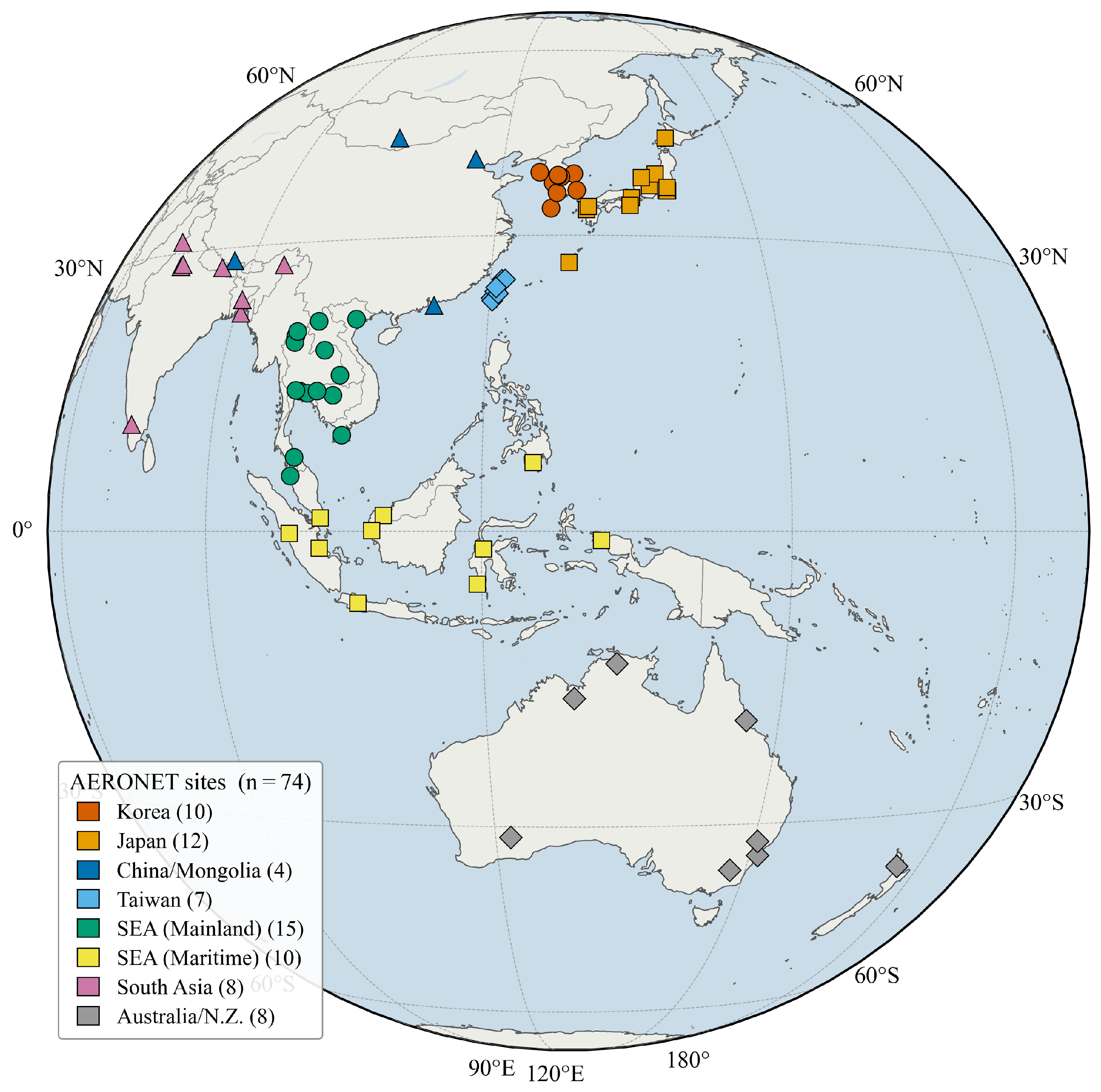
Ground-based AOD measurements from AERONET [27] serve as the validation reference. Version 3, Level 2.0 data—cloud-screened and quality-assured—are used throughout this study. The 74 AERONET sites used for validation span the full GK-2A field of view, covering eight geographic subregions: Korea (10), Japan (12), China/Mongolia (4), Taiwan (7), Southeast Asia (SEA) Mainland (15), SEA Maritime (10), South Asia (8), and Australia/New Zealand (8). The geographic distribution of these sites is shown in Figure 1. The spectral interpolation to 550 nm and satellite–ground matchup criteria are described in Section 4.1.

3. Methods

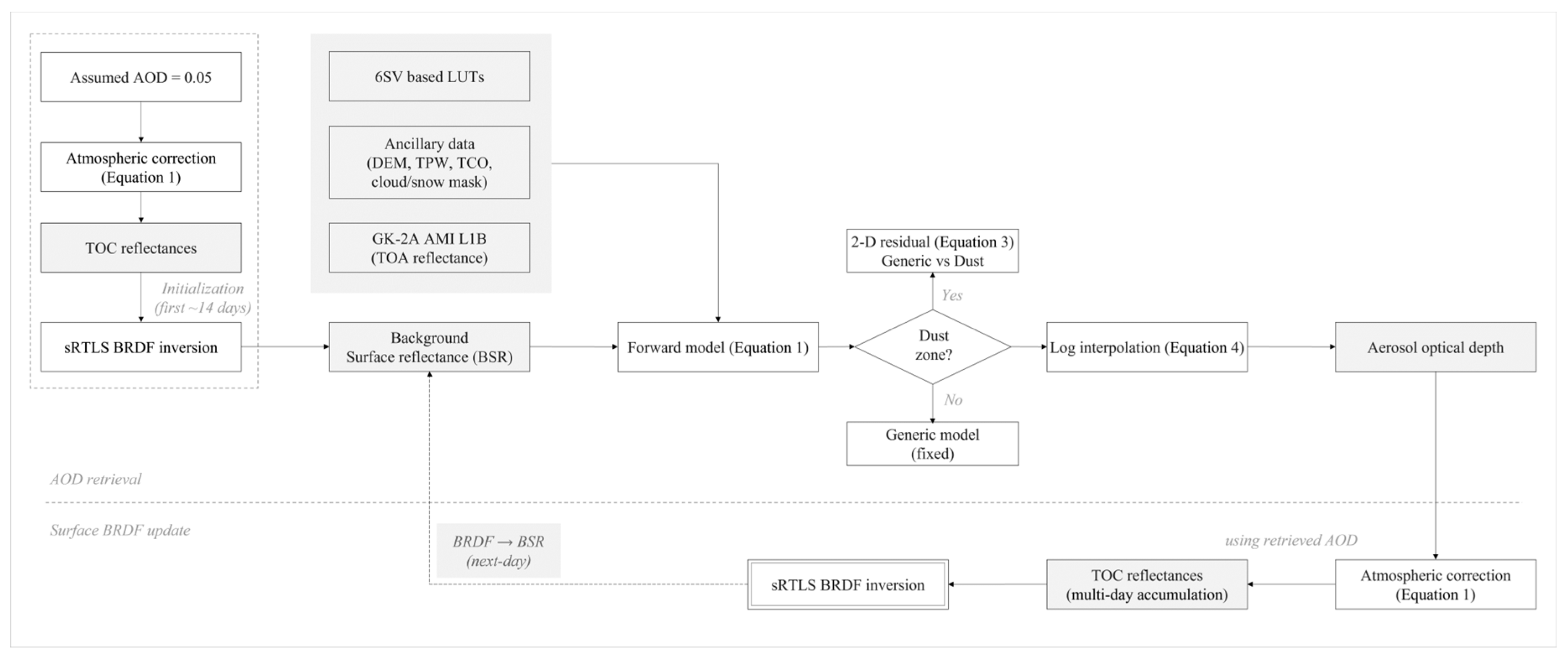
An overview of the algorithm is shown in Figure 2. The retrieval system consists of two coupled components: (1) AOD retrieval using BSR and LUTs, and (2) surface BRDF update using the retrieved AOD for atmospheric correction. Input observations were restricted to cloud-free, snow-free land pixels with solar zenith angle (SZA) ≤ 70° and viewing zenith angle (VZA) ≤ 70°.

3.1. Forward Model and Look-Up Table Construction

The TOA reflectance observed by the satellite is expressed as:
ρ TOA = T gas T gas , w ( ρ atm ρ atm , R ) T gas , w / 2 + ρ atm , R + T gas T d T u ρ sfc 1 S ρ sfc
where ρ atm is the atmospheric path reflectance (Rayleigh + aerosol), ρ atm , R the Rayleigh-only component, T d and T u the downward and upward diffuse transmittances, S the spherical albedo, ρ sfc the surface bidirectional reflectance, and T gas , T gas , w , T gas , w / 2 the total, water-vapor, and half-path water-vapor gas transmittances, respectively [26].
The aerosol model framework follows the VIIRS Enterprise algorithm [5], which defines four types—generic, dust, smoke, and urban—each as a bimodal lognormal size distribution with AOD-dependent microphysical parameters. Because AMI lacks a deep-blue channel near 410 nm, the smoke and urban types cannot be distinguished from the generic model at 470 nm; dust remains separable owing to its distinct non-spherical phase function. The algorithm therefore retains two types: generic and dust. Single-scattering properties for the generic model are computed with Mie theory; those for the dust model are obtained from the MOPSMAP v1.0 package [25] using the spheroid scattering kernel database of Dubovik et al. [24]. Fine- and coarse-mode results are combined by scattering-cross-section weighting and passed to the 6SV radiative transfer code [26] as external aerosol files to generate LUTs of atmospheric reflectance, transmittance, and spherical albedo.
The LUT adapts the scattering-angle parameterization of Laszlo and Liu [5] with a fixed 4° interval. The remaining dimensions are SZA (19 nodes, 0–72°), VZA (21 nodes, 0–73.29°), AOD550 (22 nodes, 0.01–5.0), surface elevation (9 nodes, 0–4 km), TPW (13 nodes, 0–6 g cm−2), and TCO (7 nodes, 0.20–0.50 cm-atm). A separate LUT was generated for each aerosol model and AMI channel. Atmospheric reflectance, transmittance, and spherical albedo at arbitrary geometries were obtained by linear interpolation across the LUT grid dimensions.

3.2. Background Surface Reflectance Computation

The surface reflectance at each observation geometry was computed from the sRTLS kernel-driven BRDF model [22]:
ρ sfc ( θ s , θ v , ϕ ) = k L + k V f V ( θ s , θ v , ϕ ) + k G f G ( θ s , θ v , ϕ )
where k L , k V , k G are the isotropic, volumetric, and geometric kernel coefficients, and f V and f G are the corresponding kernel functions. The sRTLS model differs from the standard RTLS in two respects: (1) a hotspot factor following Maignan et al. [28] was incorporated into the volumetric kernel, and (2) the cosines of zenith angles were scaled at angles exceeding 60°, constraining the kernel divergence that occurs in the standard RTLS.
The BRDF coefficients ( k L , k V , k G ) were updated once per day (Figure 2). During the initial accumulation period (approximately 14 days), when no GK-2A-derived BRDF was yet available, a background AOD of 0.05 was assumed for each clear-sky observation. This assumption was applied to Equation (1) to derive TOC reflectances, which were then fitted to the sRTLS model to produce the first set of BRDF kernel coefficients. A similar low-AOD initialization is standard practice in time-series-based algorithms; for example, MAIAC assumes AOD = 0.05 over snow-covered surfaces during its initialization phase [12]. Once the initial BRDF was established, the algorithm entered the iterative cycle described in Section 3.4, and the assumed AOD was no longer used.

3.3. AOD Retrieval

For each qualifying pixel, the BSR from Equation (2) and ancillary data (TPW, TCO, surface elevation) were fed into the forward model (Equation (1)) to compute modeled TOA reflectances at every LUT AOD node.
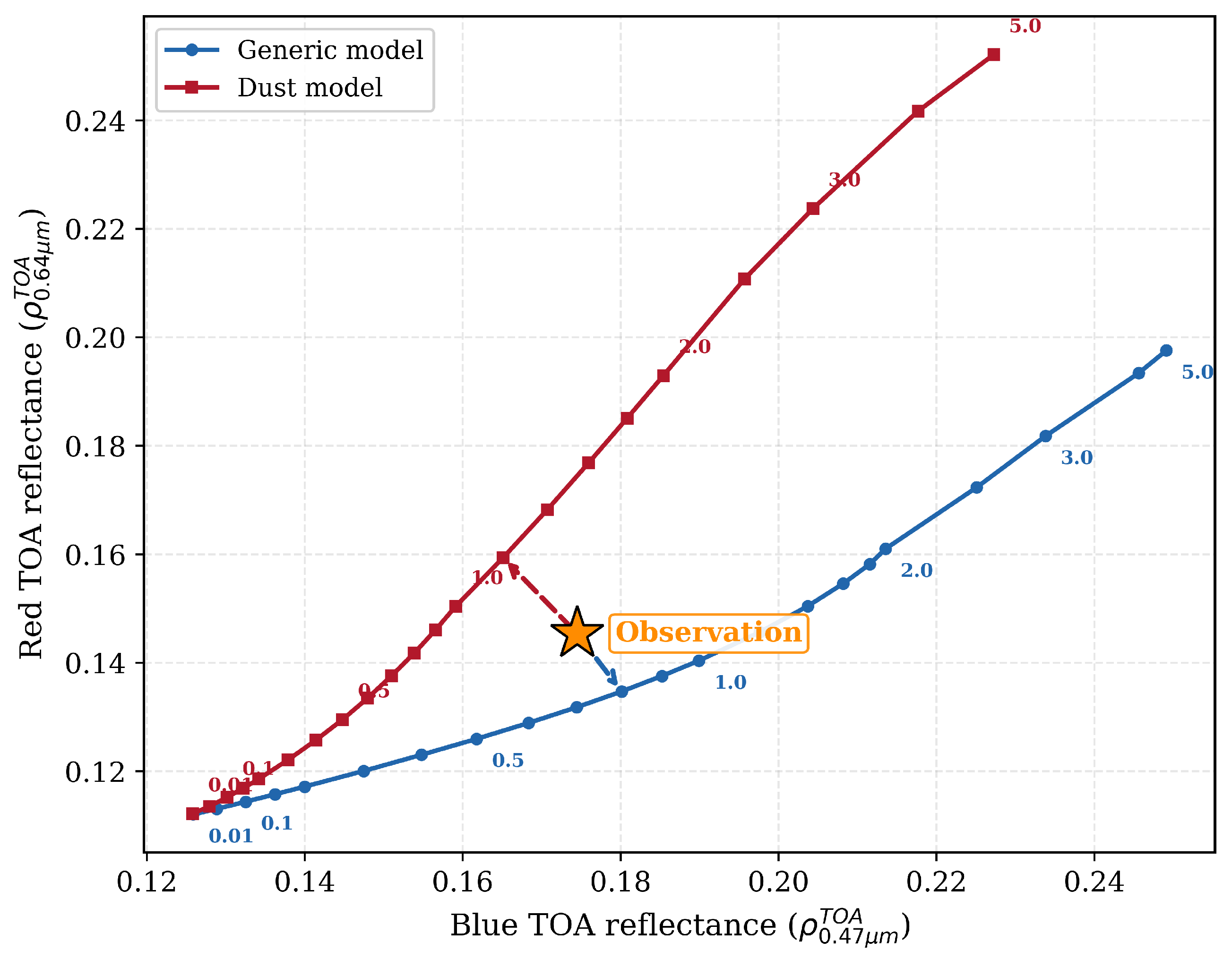
Aerosol model selection was performed first. During spring (March–May), when transboundary dust transport from East Asian deserts is prevalent, a geographic dust-zone mask defined by the Model 6 (dust) region in the global aerosol model zone map of Lyapustin et al. [12] (their Figure 4), clipped to the GK-2A domain, was activated. Within this mask, trajectories were generated for both the generic and dust models in the blue–red reflectance space [29] using the 0.47 and 0.64 μm channels. The point on each trajectory nearest to the observed ( ρ TOA , 0.47 obs , ρ TOA , 0.64 obs ) pair was located, and a two-dimensional residual was computed:
ε m = ρ TOA , 0.47 obs ρ TOA , 0.47 mod ( τ m ) 2 + ρ TOA , 0.64 obs ρ TOA , 0.64 mod ( τ m ) 2
where m denotes the aerosol model and τ m the AOD at the nearest trajectory point. The model yielding the smaller ε m was adopted (Figure 3). Outside the dust zone, or during non-spring months, the generic model was applied using only the 0.47 μm channel without the two-dimensional residual test. To evaluate whether the dust model provides a measurable benefit, a parallel retrieval using only the generic model was also performed for the dust zone during MAM (Section 4.1).
In both cases, the final AOD550 was obtained from the 0.47 μm channel. The two adjacent LUT nodes whose modeled blue-channel reflectances bracket the observed value were identified, and AOD was determined by logarithmic interpolation [5]:
AOD 550 = τ i ln ρ i + 1 mod ln ρ obs + τ i + 1 ln ρ obs ln ρ i mod ln ρ i + 1 mod ln ρ i mod
where τ i and τ i + 1 are the bounding AOD nodes, and ρ i mod , ρ i + 1 mod are the corresponding modeled blue-channel TOA reflectances.

3.4. Surface BRDF Update

After AOD retrieval, Equation (1) was inverted for each clear-sky observation to derive the TOC reflectance ( ρ sfc ). These TOC reflectances were accumulated over the preceding 14 days. At the end of each day, the accumulated reflectances were fitted to the sRTLS model (Equation (2)) via linear least squares, yielding a new set of k L , k V , k G for each channel. These coefficients were then used to compute BSR for the next day’s retrievals, forming the feedback loop illustrated in Figure 2.

4. Results

4.1. Comparison with AERONET

AERONET AOD at 550 nm is obtained by fitting a second-order polynomial in logarithmic space to measurements at 440, 675, 870, and 1020 nm [30]:
ln AOD λ = a 0 + a 1 ln λ + a 2 ln λ 2 , λ = 550 nm
where a 0 , a 1 , and a 2 are regression coefficients. Satellite–ground matchup pairs are constructed following Laszlo and Liu [5]: satellite retrievals within 20 km of each site are spatially averaged (minimum 20% valid pixels), with temporal coincidence of ±30 min. These criteria yield 24,995 pairs from 74 sites over 2023. The NMSC product is evaluated under identical conditions. For the inter-sensor comparison with Himawari-9/AHI, Himawari-9 AOD is originally provided at 500 nm and converted to 550 nm using the co-located Angström Exponent ( α ) from the same product file: AOD 550 = AOD 500 × ( 550 / 500 ) α . A common matchup subset is then defined as observations for which all three products simultaneously provide valid retrievals, yielding N = 10,845 observations from 68 sites overall and site-level subsets ranging from 45 to 351 observations at the five representative sites.
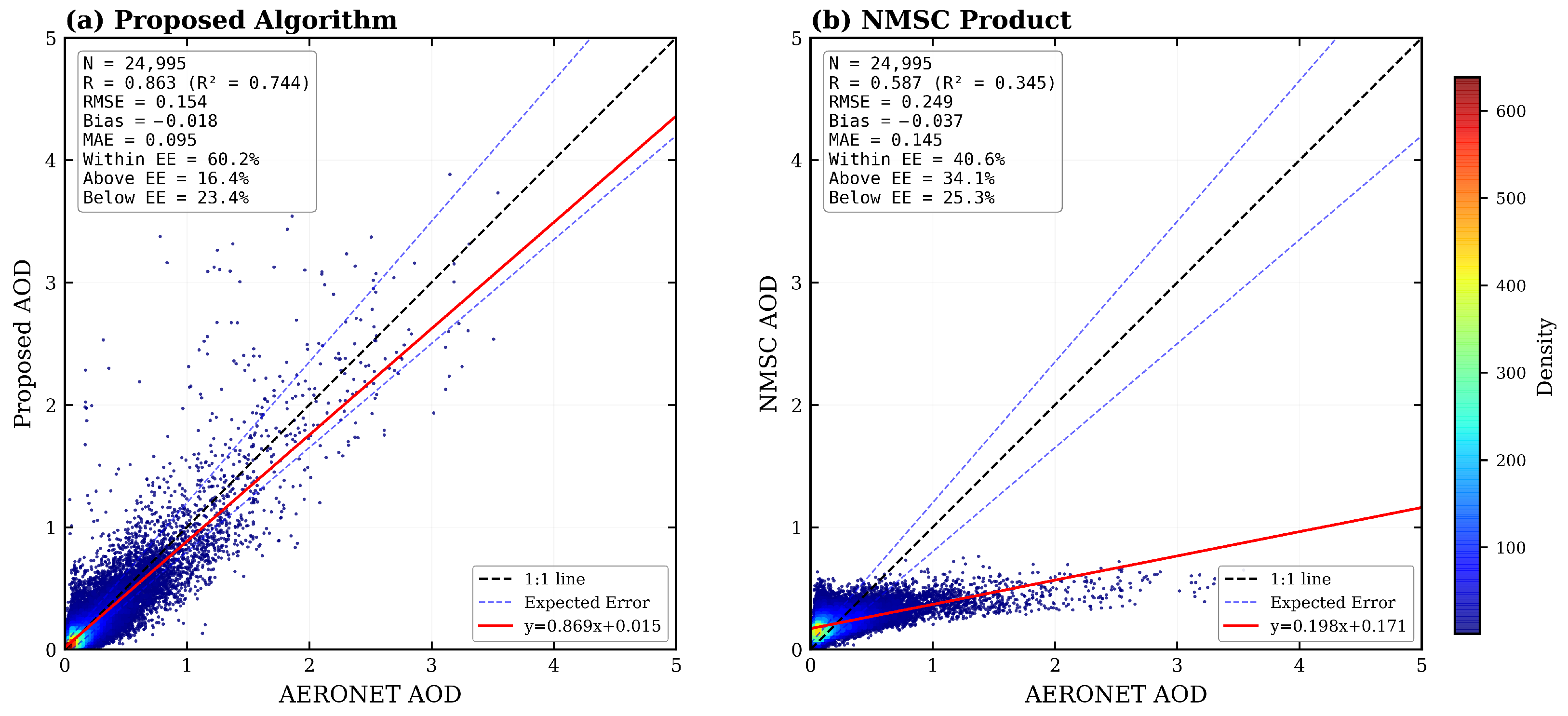
Figure 4 compares the two products against AERONET. The BRDF-based retrieval gives R = 0.86, RMSE = 0.15, and bias = −0.02; the NMSC product gives R = 0.59, RMSE = 0.25, and bias = −0.04. In Figure 4a the proposed retrievals track the 1:1 line across the observed AOD range. Figure 4b shows that the operational retrievals cluster near 0.1–0.3 regardless of AERONET AOD.
Table 1 reports seasonal statistics (DJF: December–February; MAM: March–May; JJA: June–August; SON: September–November). JJA shows the lowest RMSE for both products, and both exhibit a slight positive bias in DJF. The largest difference between the two products occurs in MAM (R: 0.89 vs. 0.64; RMSE: 0.19 vs. 0.36), which is also the season with the most matchups and the highest dust loading over East Asia. To assess how much the non-spherical dust model contributes to this MAM performance, the retrieval was repeated with the generic model only (i.e., without the dust-zone two-model selection). In that generic-only configuration, the mean bias within the dust zone during MAM worsens from −0.03 (dust-zone subset) to −0.11, confirming that the spheroid scattering representation corrects a systematic underestimation present in the generic model under dust-dominated conditions. This dust-zone subset result is distinct from the full MAM bias of −0.06 in Table 1, which covers all 74 sites.
Table 2 stratifies the comparison by AOD magnitude. At AOD ≤ 0.1 (31% of matchups), the NMSC product shows bias = +0.11 versus +0.03 for the BRDF-based retrieval. Both products show comparable RMSE in the 0.1–0.8 range (0.14 vs. 0.15). Above AOD = 0.8, the operational product yields bias = −0.85 and RMSE = 0.97; the present algorithm gives bias = −0.12 and RMSE = 0.44.

4.2. Site-Level Comparison

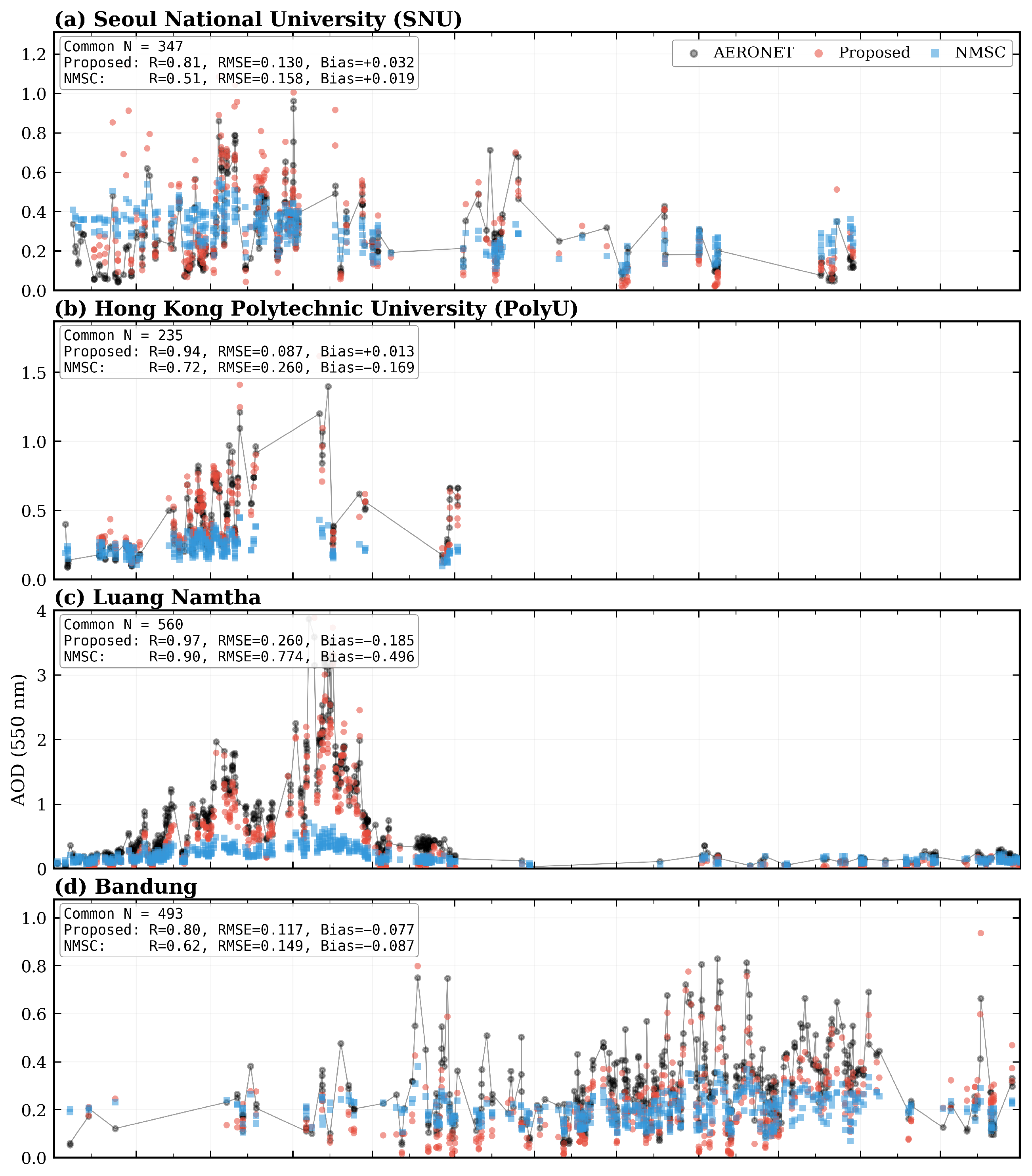
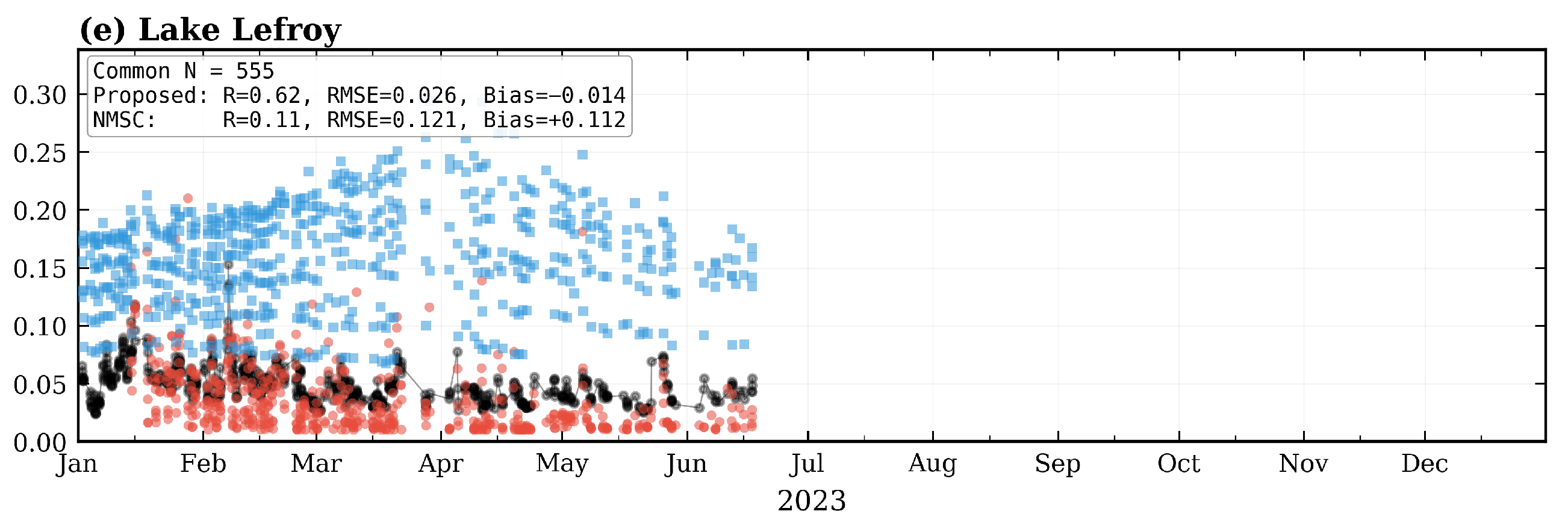
Figure 5 compares AOD time series at five AERONET sites. Seoul SNU (Figure 5a) shows spring high-AOD episodes followed by lower values in summer and autumn. The BRDF-based retrieval (R = 0.81) reproduces this variation; the operational product (R = 0.51) remains near 0.1–0.2 throughout the year. Hong Kong PolyU (Figure 5b), a subtropical coastal site, yields R = 0.94 for the present algorithm even when AOD exceeds 1.0; the NMSC retrieval (R = 0.72) underestimates at the upper end. At Luang Namtha (Figure 5c) in northern Laos, springtime biomass burning [31] drives AOD above 3.0. Both products follow the temporal pattern (R: 0.97 vs. 0.90), but the NMSC product underestimates peak magnitudes. Bandung (Figure 5d) has limited clear-sky observations; the proposed algorithm gives R = 0.80 versus 0.62 for NMSC. Lake Lefroy (Figure 5e), a bright salt lake in Western Australia with background AOD near 0.03–0.05 [32], shows R = 0.62 for the BRDF-based retrieval and R = 0.11 for the operational product.

4.3. Inter-Sensor Comparison with Himawari-9/AHI

To further evaluate the proposed algorithm relative to a SWIR-equipped geostationary sensor, we compare its performance against Himawari-9/AHI using a common matchup subset in which all three products simultaneously provide valid retrievals (N = 10,845, 68 sites). Table 3 presents overall statistics, and Table 4 presents site-level results at five representative AERONET sites.
Despite the absence of a SWIR channel, the proposed algorithm (R = 0.897, RMSE = 0.164) outperforms Himawari-9/AHI (R = 0.855, RMSE = 0.208) across all metrics (Table 3). At the site level, the proposed algorithm achieves the highest 5-site mean correlation (R = 0.850, RMSE = 0.123) compared with Himawari-9/AHI (R = 0.703, RMSE = 0.171) and NMSC (R = 0.605, RMSE = 0.315). The advantage is most pronounced at Lake Lefroy, where the proposed algorithm achieves R = 0.64 and EE = 100% compared with R = 0.20 for Himawari-9/AHI, confirming that direct BRDF inversion offers a clear advantage over bright arid surfaces where SWIR-based spectral relationships degrade. At Luang Namtha, Himawari-9/AHI (R = 0.95) shows comparable correlation to the proposed algorithm but substantially larger negative bias (−0.29) and higher RMSE (0.42 vs. 0.30), reflecting that the SWIR-based approach also struggles under optically thick biomass burning conditions.

5. Discussion

The two products diverge most at the extremes of the AOD distribution (Table 2). At low AOD the atmospheric contribution to the TOA signal is small, and the retrieval outcome depends heavily on the accuracy of the surface estimate; the BRDF-based retrieval reduces the bias at AOD ≤ 0.1 from +0.11 to +0.03. Above AOD = 0.8, the bias improves from −0.85 to −0.12, though a negative residual persists; only 1110 matchups (4.4% of the total) fall in this range, limiting further analysis. In the 0.1–0.8 range both products yield comparable RMSE (0.14 vs. 0.15), largely because the operational product concentrates its retrievals in this interval regardless of the actual aerosol loading (Figure 4b). These patterns indicate that the NMSC output distribution is compressed into the 0.1–0.3 band; the present algorithm reduces this compression, recovering more of the observed dynamic range. This compression is most evident at Luang Namtha (Figure 5c), where springtime biomass burning drives AOD above 3.0 yet the NMSC product saturates below 0.3, while the proposed algorithm tracks the peak magnitude.
The site-level results reflect a common underlying mechanism. Because BSR is recomputed at each observation geometry from frequently updated BRDF coefficients rather than from a fixed spectral relationship or external climatology, the retrieval adapts to actual surface conditions and applies uniformly to both dark vegetated and bright arid surfaces. At Lake Lefroy, where the operational product yields R = 0.11, the present algorithm achieves R = 0.62 (Section 4.2)—a meaningful improvement at a surface type where empirical approaches are known to fail. The residual scatter at this site is consistent with the lower aerosol sensitivity of the blue channel over bright surfaces: over high-reflectance targets, the blue-channel TOA signal is dominated by the surface contribution, reducing the sensitivity to AOD variations [12], and making BRDF inversion at this wavelength inherently less constrained.
This bright-surface advantage is further substantiated by the inter-sensor comparison against Himawari-9/AHI. Over the common matchup subset (N = 10,845, Table 3), the proposed algorithm (R = 0.897, RMSE = 0.164) outperforms Himawari-9/AHI (R = 0.855, RMSE = 0.208) despite the absence of a SWIR channel. The site-level comparison (Table 4) reinforces this finding: across the five representative sites, the proposed algorithm achieves higher mean correlation (R = 0.850, RMSE = 0.123) than Himawari-9/AHI (R = 0.703, RMSE = 0.171). At Lake Lefroy, the proposed algorithm achieves R = 0.64 and EE = 100% (Table 4) compared with R = 0.20 for Himawari-9/AHI, confirming that direct BRDF inversion without SWIR-based spectral relationships offers a clear advantage over bright arid surfaces where the dark target condition breaks down.
The MAM performance gap (Table 1) coincides with the peak of East Asian dust activity [33]. The ablation test shows that removing the spheroid dust model and using only the spherical generic model worsens the spring bias inside the dust zone from −0.03 (dust-zone subset) to −0.11. Retaining the spheroid dust model corrects this tendency.
The two-model configuration reflects a fundamental constraint of the AMI channel set. Distinguishing absorbing aerosol types such as biomass burning smoke from the generic continental model requires spectral information at wavelengths shorter than 0.47 μm, where absorption contrast between types is largest. AMI’s shortest channel is 0.47 μm, precluding the deep-blue absorption parameter test that MAIAC employs for smoke detection [12]. Without a reliable type-selection criterion, incorporating additional aerosol models risks introducing misclassification errors larger than those from retaining a single generic model. At Luang Namtha, where springtime biomass burning drives AOD above 3.0, the generic model yields R = 0.97 (Figure 5c), suggesting that the incremental benefit of a dedicated biomass burning model may be modest under heavy aerosol loading; in regions with moderate biomass burning or urban pollution, however, a residual bias in retrieved AOD magnitude is expected. A systematic evaluation using multi-year GK-2A observations and AMI-specific look-up tables is identified as a priority for future algorithm development.

6. Conclusions

An AOD retrieval algorithm for GK-2A/AMI over land was improved in which background surface reflectance is estimated through pixel-level sRTLS-BRDF inversion from geostationary time-series observations. No external surface reflectance database is required; the algorithm initializes by assuming a low-background AOD, builds BRDF coefficients from the satellite’s own observations, and then alternates between AOD retrieval and atmospheric correction to refine both quantities. Validation against 74 AERONET sites during 2023 gives R = 0.86 and RMSE = 0.15, compared with R = 0.59 and RMSE = 0.25 for the NMSC operational product. The gap is widest at the extremes of the AOD distribution: below 0.1 (bias: +0.03 versus +0.11) and above 0.8 (bias: −0.12 versus −0.85). During spring, incorporating a spheroid dust model reduces the negative bias within the dust zone from −0.11 to −0.03 (dust-zone subset). A comparison against Himawari-9/AHI—a co-located geostationary sensor carrying a 2.3 μm SWIR channel—shows that the proposed algorithm outperforms Himawari-9/AHI in both the full common-matchup comparison (R: 0.897 vs. 0.855) and the 5-site mean (R: 0.850 vs. 0.703), confirming that sRTLS-BRDF inversion achieves competitive accuracy without relying on a SWIR channel.
Several limitations warrant mention. The algorithm currently operates with only two aerosol models; smoke plumes or urban haze whose optical properties fall between the generic and dust archetypes may be misclassified. Validation covers a single calendar year and may not capture the full range of interannual variability in surface conditions and aerosol loading. In particular, interannual changes in surface BRDF—arising from land use change, drought, or vegetation phenology shifts—are not represented in the single-year dataset, and multi-year validation is needed to assess algorithm stability across varying surface states. Expanding the aerosol model library—which would require additional spectral information at shorter wavelengths to resolve aerosol absorption—and multi-year validation are the principal remaining tasks.

Author Contributions

Conceptualization, methodology and formal analysis, D.J., S.S., S.L. and K.-S.H.; software, D.J., S.S. and J.W.; validation and visualization, D.J., S.S. and S.K.; investigation, D.J., S.S., S.C. and K.-S.H.; resources and data curation, S.S., S.C., J.W. and S.P.; writing—original draft preparation, D.J. and S.S.; writing—review and editing, K.-S.H.; supervision, project administration and funding acquisition, K.-S.H. All authors have read and agreed to the published version of the manuscript.

Funding

This work was funded by the Korea Meteorological Administration Research and Development Program under Grant (RS-2025-02219688).

Data Availability Statement

GK-2A/AMI Level 1B data are provided by Korea Meteorological Administration (KMA). Himawari-9/AHI AOD data are provided by the Japan Meteorological Agency (JMA). AERONET data are available through NASA Goddard Space Flight Center.

Conflicts of Interest

The authors declare no conflict of interest.

References

  1. Penner, J.; Andreae, M.; Annegarn, H.; Barrie, L.; Feichter, J.; Hegg, D.; Jayaraman, A.; Leaitch, R.; Murphy, D.; Nganga, J.; et al. Aerosols, their direct and indirect effects. In Climate Change 2001: The Scientific Basis, Contribution of Working Group I to the Third Assessment Report of the Intergovernmental Panel on Climate Change; Cambridge University Press: Cambridge, UK, 2001. [Google Scholar]
  2. Li, J.; Carlson, B.E.; Yung, Y.L.; Lv, D.; Hansen, J.; Penner, J.E.; Liao, H.; Ramaswamy, V.; Kahn, R.A.; Zhang, P.; et al. Scattering and absorbing aerosols in the climate system. Nat. Rev. Earth Environ. 2022, 3, 363–379. [Google Scholar] [CrossRef]
  3. Zemp, M.; Chao, Q.; Han Dolman, A.; Herold, M.; Krug, T.; Speich, S.; Suda, K.; Thorne, P.; Yu, W. GCOS 2022 implementation plan. In Global Climate Observing System GCOS-244; UN Environment Programme: Nairobi, Kenya, 2022; p. 85. [Google Scholar]
  4. Kim, M.; Kim, J.; Lim, H.; Lee, S.; Cho, Y.; Lee, Y.G.; Go, S.; Lee, K. Aerosol optical depth data fusion with Geostationary Korea Multi-Purpose Satellite (GEO-KOMPSAT-2) instruments GEMS, AMI, and GOCI-II: Statistical and deep neural network methods. Atmos. Meas. Tech. 2024, 17, 4317–4335. [Google Scholar] [CrossRef]
  5. Laszlo, I.; Liu, H. EPS Aerosol Optical Depth (AOD) Algorithm Theoretical Basis Document; NOAA NESDIS Center for Satellite Appllications and Research: College Park, MD, USA, 2022.
  6. Kaufman, Y.; Tanré, D.; Remer, L.A.; Vermote, E.; Chu, A.; Holben, B. Operational remote sensing of tropospheric aerosol over land from EOS moderate resolution imaging spectroradiometer. J. Geophys. Res. Atmos. 1997, 102, 17051–17067. [Google Scholar] [CrossRef]
  7. Remer, L.A.; Kaufman, Y.; Tanré, D.; Mattoo, S.; Chu, D.; Martins, J.V.; Li, R.R.; Ichoku, C.; Levy, R.; Kleidman, R.; et al. The MODIS aerosol algorithm, products, and validation. J. Atmos. Sci. 2005, 62, 947–973. [Google Scholar] [CrossRef]
  8. Levy, R.C.; Remer, L.A.; Mattoo, S.; Vermote, E.F.; Kaufman, Y.J. Second-generation operational algorithm: Retrieval of aerosol properties over land from inversion of Moderate Resolution Imaging Spectroradiometer spectral reflectance. J. Geophys. Res. Atmos. 2007, 112, D13211. [Google Scholar] [CrossRef]
  9. Jackson, J.M.; Liu, H.; Laszlo, I.; Kondragunta, S.; Remer, L.A.; Huang, J.; Huang, H.C. Suomi-NPP VIIRS aerosol algorithms and data products. J. Geophys. Res. Atmos. 2013, 118, 12673–12689. [Google Scholar] [CrossRef]
  10. Zhang, H.; Kondragunta, S.; Laszlo, I.; Liu, H.; Remer, L.A.; Huang, J.; Superczynski, S.; Ciren, P. An enhanced VIIRS aerosol optical thickness (AOT) retrieval algorithm over land using a global surface reflectance ratio database. J. Geophys. Res. Atmos. 2016, 121, 10717–10738. [Google Scholar] [CrossRef]
  11. Jee, J.; Lee, K.H.; Lee, K. GK-2A AMI Algorithm Theoretical Basis Document: Aerosol Optical Depth and Ångström Exponent Product; Technical Report Version 1.0, 2019-04-25; National Meteorological Satellite Center, Korea Meteorological Administration: Jincheon, Republic of Korea, 2019.
  12. Lyapustin, A.; Wang, Y.; Korkin, S.; Huang, D. MODIS collection 6 MAIAC algorithm. Atmos. Meas. Tech. 2018, 11, 5741–5765. [Google Scholar] [CrossRef]
  13. Tian, X.; Liu, Q.; Song, Z.; Dou, B.; Li, X. Aerosol optical depth retrieval from Landsat 8 OLI images over urban areas supported by MODIS BRDF/Albedo data. IEEE Geosci. Remote Sens. Lett. 2018, 15, 976–980. [Google Scholar] [CrossRef]
  14. Wang, Q.; Li, S.; Zeng, Q.; Sun, L.; Yang, J.; Lin, H. Retrieval and validation of AOD from Himawari-8 data over Bohai Rim Region, China. Remote Sens. 2020, 12, 3425. [Google Scholar] [CrossRef]
  15. Zhou, D.; Wang, Q.; Li, S.; Yang, J. Preliminary retrieval and validation of aerosol optical depths from FY-4B advanced geostationary radiation imager images. Remote Sens. 2024, 16, 372. [Google Scholar] [CrossRef]
  16. Zhang, H.; Kondragunta, S.; Laszlo, I.; Zhou, M. Improving GOES Advanced Baseline Imager (ABI) aerosol optical depth (AOD) retrievals using an empirical bias correction algorithm. Atmos. Meas. Tech. 2020, 13, 5955–5975. [Google Scholar] [CrossRef]
  17. Kim, M.; Levy, R.C.; Remer, L.A.; Mattoo, S.; Gupta, P. Parameterizing spectral surface reflectance relationships for the Dark Target aerosol algorithm applied to a geostationary imager. Atmos. Meas. Tech. 2024, 17, 1913–1939. [Google Scholar] [CrossRef]
  18. Ceamanos, X.; Six, B.; Moparthy, S.; Carrer, D.; Georgeot, A.; Gasteiger, J.; Riedi, J.; Attié, J.L.; Lyapustin, A.; Katsev, I. Instantaneous aerosol and surface retrieval using satellites in geostationary orbit (iAERUS-GEO)–estimation of 15 min aerosol optical depth from MSG/SEVIRI and evaluation with reference data. Atmos. Meas. Tech. 2023, 16, 2575–2599. [Google Scholar] [CrossRef]
  19. Georgeot, A.; Ceamanos, X.; Attié, J.L. Quantitative assessment of the potential of optimal estimation for aerosol retrieval from geostationary weather satellites in the frame of the iAERUS-GEO algorithm. Atmos. Sci. Lett. 2024, 25, e1199. [Google Scholar] [CrossRef]
  20. Schaaf, C.B.; Gao, F.; Strahler, A.H.; Lucht, W.; Li, X.; Tsang, T.; Strugnell, N.C.; Zhang, X.; Jin, Y.; Muller, J.P.; et al. First operational BRDF, albedo nadir reflectance products from MODIS. Remote Sens. Environ. 2002, 83, 135–148. [Google Scholar] [CrossRef]
  21. Lucht, W.; Schaaf, C.B.; Strahler, A.H. An algorithm for the retrieval of albedo from space using semiempirical BRDF models. IEEE Trans. Geosci. Remote Sens. 2000, 38, 977–998. [Google Scholar] [CrossRef]
  22. Lyapustin, A.; Wang, Y.; Korkin, S.; Schaaf, C.; Wang, W.; Wang, Z. Scaled RTLS BRDF model extended to high zenith angles. Front. Remote Sens. 2025, 6, 1533803. [Google Scholar] [CrossRef]
  23. Sim, S.; Choi, S.; Jung, D.; Woo, J.; Kim, N.; Park, S.; Kim, H.; Jeong, U.; Hong, H.; Han, K.S. Retrieval of pseudo-BRDF-adjusted surface reflectance at 440 nm from the Geostationary Environmental Monitoring Spectrometer (GEMS). Atmos. Meas. Tech. 2024, 17, 5601–5618. [Google Scholar] [CrossRef]
  24. Dubovik, O.; Sinyuk, A.; Lapyonok, T.; Holben, B.N.; Mishchenko, M.; Yang, P.; Eck, T.F.; Volten, H.; Muñoz, O.; Veihelmann, B.; et al. Application of spheroid models to account for aerosol particle nonsphericity in remote sensing of desert dust. J. Geophys. Res. Atmos. 2006, 111, D11208. [Google Scholar] [CrossRef]
  25. Gasteiger, J.; Wiegner, M. MOPSMAP v1. 0: A versatile tool for the modeling of aerosol optical properties. Geosci. Model Dev. 2018, 11, 2739–2762. [Google Scholar] [CrossRef]
  26. Vermote, E.; Tanré, D.; Deuzé, J.; Herman, M.; Morcrette, J.; Kotchenova, S. Second simulation of a satellite signal in the solar spectrum–vector 6S User Guide Version 3. In Remote Sensing: Models and Methods for Image Processing; Academic Press: Cambridge, MA, USA, 2006. [Google Scholar]
  27. Giles, D.M.; Sinyuk, A.; Sorokin, M.G.; Schafer, J.S.; Smirnov, A.; Slutsker, I.; Eck, T.F.; Holben, B.N.; Lewis, J.R.; Campbell, J.R.; et al. Advancements in the Aerosol Robotic Network (AERONET) Version 3 database–automated near-real-time quality control algorithm with improved cloud screening for Sun photometer aerosol optical depth (AOD) measurements. Atmos. Meas. Tech. 2019, 12, 169–209. [Google Scholar] [CrossRef]
  28. Maignan, F.; Bréon, F.M.; Lacaze, R. Bidirectional reflectance of Earth targets: Evaluation of analytical models using a large set of spaceborne measurements with emphasis on the Hot Spot. Remote Sens. Environ. 2004, 90, 210–220. [Google Scholar] [CrossRef]
  29. Laszlo, I.; Ciren, P.; Liu, H.; Kondragunta, S.; Tarpley, J.D.; Goldberg, M.D. Remote sensing of aerosol and radiation from geostationary satellites. Adv. Space Res. 2008, 41, 1882–1893. [Google Scholar] [CrossRef]
  30. Li, Y.; Chen, J.; Ma, Q.; Zhang, H.K.; Liu, J. Evaluation of Sentinel-2A surface reflectance derived using Sen2Cor in North America. IEEE J. Sel. Top. Appl. Earth Obs. Remote Sens. 2018, 11, 1997–2021. [Google Scholar] [CrossRef]
  31. Reid, J.S.; Hyer, E.J.; Johnson, R.S.; Holben, B.N.; Yokelson, R.J.; Zhang, J.; Campbell, J.R.; Christopher, S.A.; Di Girolamo, L.; Giglio, L.; et al. Observing and understanding the Southeast Asian aerosol system by remote sensing: An initial review and analysis for the Seven Southeast Asian Studies (7SEAS) program. Atmos. Res. 2013, 122, 403–468. [Google Scholar] [CrossRef]
  32. Yang, X.; Zhao, C.; Yang, Y.; Fan, H. Long-term multi-source data analysis about the characteristics of aerosol optical properties and types over Australia. Atmos. Chem. Phys. 2021, 21, 3803–3825. [Google Scholar] [CrossRef]
  33. Tan, S.; Chen, B.; Wang, H.; Che, H.; Yu, H.; Shi, G. Variations in aerosol optical properties over East Asian dust storm source regions and their climatic factors during 2000–2021. Atmosphere 2022, 13, 992. [Google Scholar] [CrossRef]
Figure 1. Geographic distribution of the 74 AERONET sites used for validation. Marker shape and colour denote the subregion: Korea (orange circle), Japan (orange square), China/Mongolia (dark blue triangle), Taiwan (light blue diamond), SEA Mainland (green circle), SEA Maritime (yellow square), South Asia (pink triangle), and Australia/New Zealand (grey diamond). All sites lie within the GK-2A field of view.
Remotesensing 18 01018 g001
Figure 2. Flowchart of the proposed AOD retrieval algorithm. The upper path (AOD retrieval) uses background surface reflectance (BSR) and 6SV-based LUTs to derive AOD through forward model matching and aerosol model selection. The lower path (surface BRDF update) performs atmospheric correction using the retrieved AOD, accumulates top-of-canopy (TOC) reflectances, and inverts the sRTLS BRDF model to update BSR for the next day.
Remotesensing 18 01018 g002
Figure 3. Aerosol model selection in the blue–red TOA reflectance space. The blue and dark-red curves trace the modeled TOA reflectance for the generic and dust models as AOD550 increases (labeled values). The orange star marks an observation. The model whose trajectory passes closer to the observation (smaller ε m ) is selected. This two-model selection is applied only within the dust zone during spring (March–May); at all other times and locations, the generic model is used.
Remotesensing 18 01018 g003
Figure 4. Density scatter plots of satellite versus AERONET AOD at 550 nm for (a) the proposed algorithm and (b) the NMSC product. Dashed black: 1:1 line; blue dashed: expected error (EE) = ± ( 0.05 + 0.15 × AOD AERONET ) ; red solid: linear regression. N = 24,995 from 74 sites during 2023.
Remotesensing 18 01018 g004
Figure 5. AOD time series at 550 nm during 2023 at (a) Seoul National University (SNU), (b) Hong Kong Polytechnic University (PolyU), (c) Luang Namtha, (d) Bandung, and (e) Lake Lefroy. Black: AERONET; red: proposed algorithm; blue: NMSC product. R, RMSE, and bias are shown in each panel.
Remotesensing 18 01018 g005aRemotesensing 18 01018 g005b
Table 1. Seasonal statistics against AERONET (±30 min, 20 km, 74 sites, 2023).
SeasonProductNRRMSEBias
AllProposed24,9950.860.15−0.02
NMSC24,9950.590.25−0.04
DJFProposed55580.780.16+0.03
NMSC55580.510.19+0.01
MAMProposed93770.890.19−0.06
NMSC93770.640.36−0.14
JJAProposed50750.800.10−0.02
NMSC50750.570.12+0.01
SONProposed49850.710.12+0.01
NMSC49850.420.14+0.05
Table 2. Statistics by AERONET AOD range (±30 min, 20 km).
AOD RangeProductNRMSEBias
≤0.1Proposed78270.08+0.03
NMSC78270.13+0.11
0.1–0.8Proposed16,0580.14−0.03
NMSC16,0580.15−0.05
>0.8Proposed11100.44−0.12
NMSC11100.97−0.85
Table 3. Inter-sensor AOD validation statistics for the proposed algorithm, NMSC, and Himawari-9/AHI over a common matchup subset (N = 10,845, ±30 min, 20 km, 68 sites, 2023).
ProductRRMSEBiasWithin EE (%)
Proposed0.8970.164−0.04357.8
NMSC0.6690.311−0.09839.4
Himawari-9/AHI0.8550.208−0.08054.8
Table 4. Site-level AOD validation statistics for the proposed algorithm, NMSC, and Himawari-9/AHI at five AERONET sites using common matching (±30 min, 20 km, 2023).
SiteProductNRRMSEBiasEE (%)
SNUProposed1820.8920.094+0.01778.6
NMSC1820.5490.156−0.02441.8
Himawari-9/AHI1820.8670.103−0.00573.1
PolyUProposed450.9340.076+0.00693.3
NMSC450.8390.338−0.30111.1
Himawari-9/AHI450.8480.162−0.12062.2
Luang NamthaProposed3300.9660.299−0.23123.6
NMSC3300.9120.794−0.52020.9
Himawari-9/AHI3300.9490.421−0.28930.9
BandungProposed3510.8200.124−0.09346.2
NMSC3510.6500.147−0.09150.1
Himawari-9/AHI3510.6450.135−0.07454.7
Lake LefroyProposed470.6390.024−0.021100.0
NMSC470.0760.138+0.1340.0
Himawari-9/AHI470.1870.036+0.02287.2
5-site meanProposed9550.8500.123−0.06568.3
NMSC9550.6050.315−0.16124.8
Himawari-9/AHI9550.7030.171−0.09462.1
Disclaimer/Publisher’s Note: The statements, opinions and data contained in all publications are solely those of the individual author(s) and contributor(s) and not of MDPI and/or the editor(s). MDPI and/or the editor(s) disclaim responsibility for any injury to people or property resulting from any ideas, methods, instructions or products referred to in the content.