Monitoring and Analysis of Surface Deformation in Mining Area Based on LuTan-1 and Sentinel-1A Data
Highlights
- Through a systematic comparative study using DInSAR and SBAS-InSAR, L-band LuTan-1 SAR demonstrated substantially superior monitoring performance in high-intensity mining areas compared with C-band Sentinel-1A.
- Accuracy validation indicates that DInSAR monitoring results derived from L-SAR data are in strong agreement with levelling measurements, enabling centimeter-level accuracy in mine subsidence monitoring.
- Compared with C-band Sentinel-1A, L-band SAR provides superior coherence preservation and deformation sensitivity, offering a practical solution for operational monitoring in active mining areas characterized by rapid subsidence, anthropogenic disturbances, and dense vegetation.
- The results confirm the advantages of L-SAR for mine subsidence monitoring and provide scientific evidence and technical guidance for applying InSAR-based approaches to mining hazard risk management.
Abstract
1. Introduction
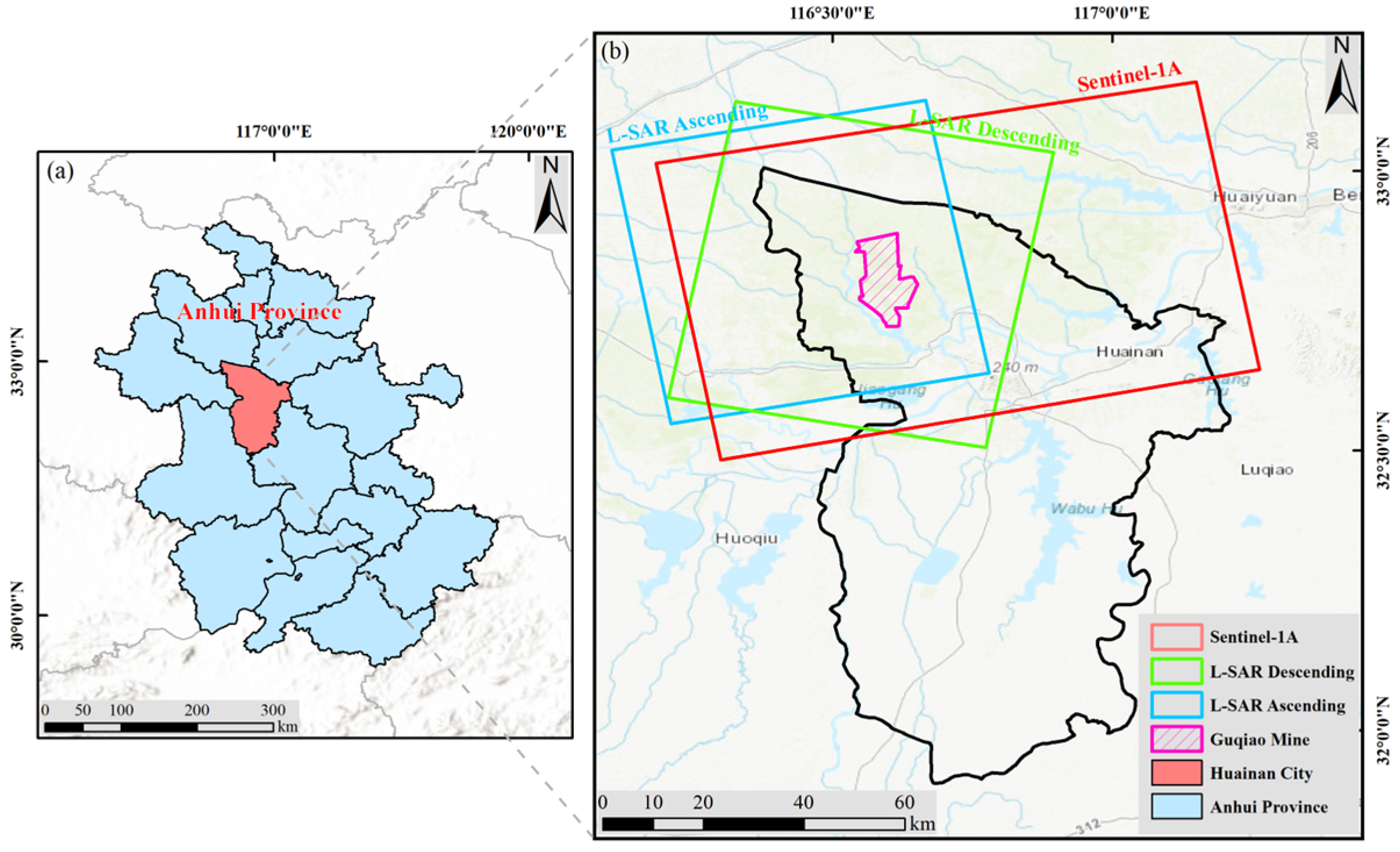
2. Study Area and Datasets
2.1. Study Area
2.2. Datasets
3. Methods
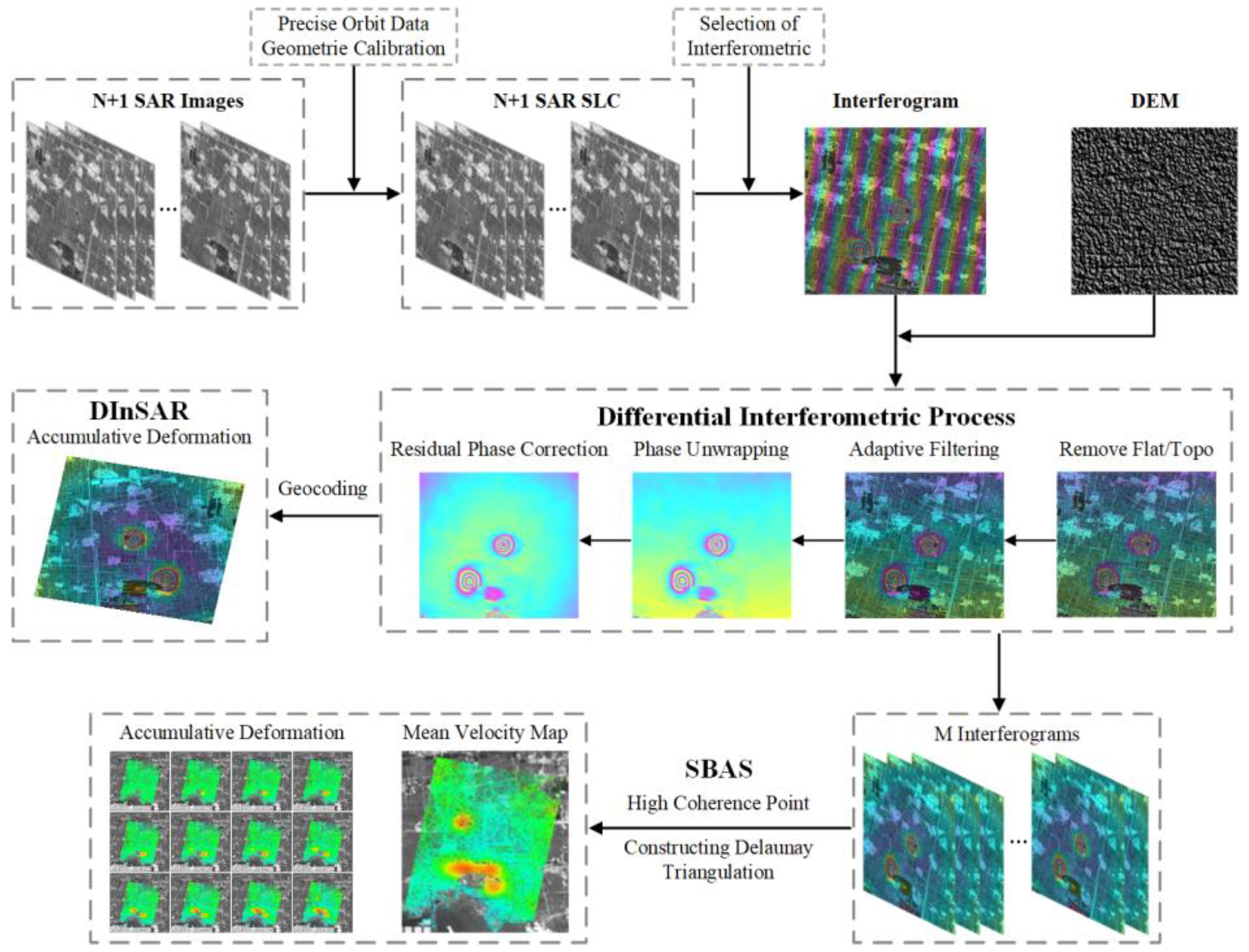
3.1. DInSAR Method
3.2. SBAS-InSAR Method
- (1)
- Differential interferogram generation. Assuming N + 1 SAR acquisitions, one image is chosen as the common master image based on temporal and spatial baselines and Doppler centroid frequency, and the remaining N images are treated as secondary images to be co-registered to the master. According to prescribed temporal and spatial baseline thresholds, the N + 1 images are combined into M SBAS time-series interferometric pairs, where M satisfies (N + 1)/2 ≤ M ≤ N(N + 1)/2, and the interferometric pairs must form a fully connected network. The assembled SBAS time-series interferometric pairs are co-registered, interfered, corrected for flat-earth phase, and filtered to produce the corresponding sequence of differential interferograms [9].
- (2)
- Selection of Slowly Decorrelating Filtered Phase (SDFP) target points. Amplitude information is analyzed, and unlike the conventional amplitude-dispersion threshold, the initial candidates are selected using the amplitude-dispersion index. For Gaussian scattering pixels, the amplitude-dispersion index can be expressed by Equation (3) (the threshold is typically set to 0.6).
- (3)
- Construction and optimization of the temporal-coherence coefficient for SDFP points, as given in Equation (4).
- (2)
- Estimation of deformation rate and time-series deformation. Using the selected SDFP points, a Delaunay triangulation is constructed and a three-dimensional phase-unwrapping algorithm is applied to obtain the unwrapped phase for each high-coherence point. Exploiting the differing temporal and spatial characteristics of orbital phase, deformation phase, and atmospheric noise, temporal-domain low-pass and spatial-domain high-pass filters are applied to separate and remove undesired components. The resulting deformation phase for each high-coherence point is then used to derive the deformation rate and the time-series displacement of the SDFP points.
4. Results
4.1. DInSAR Results
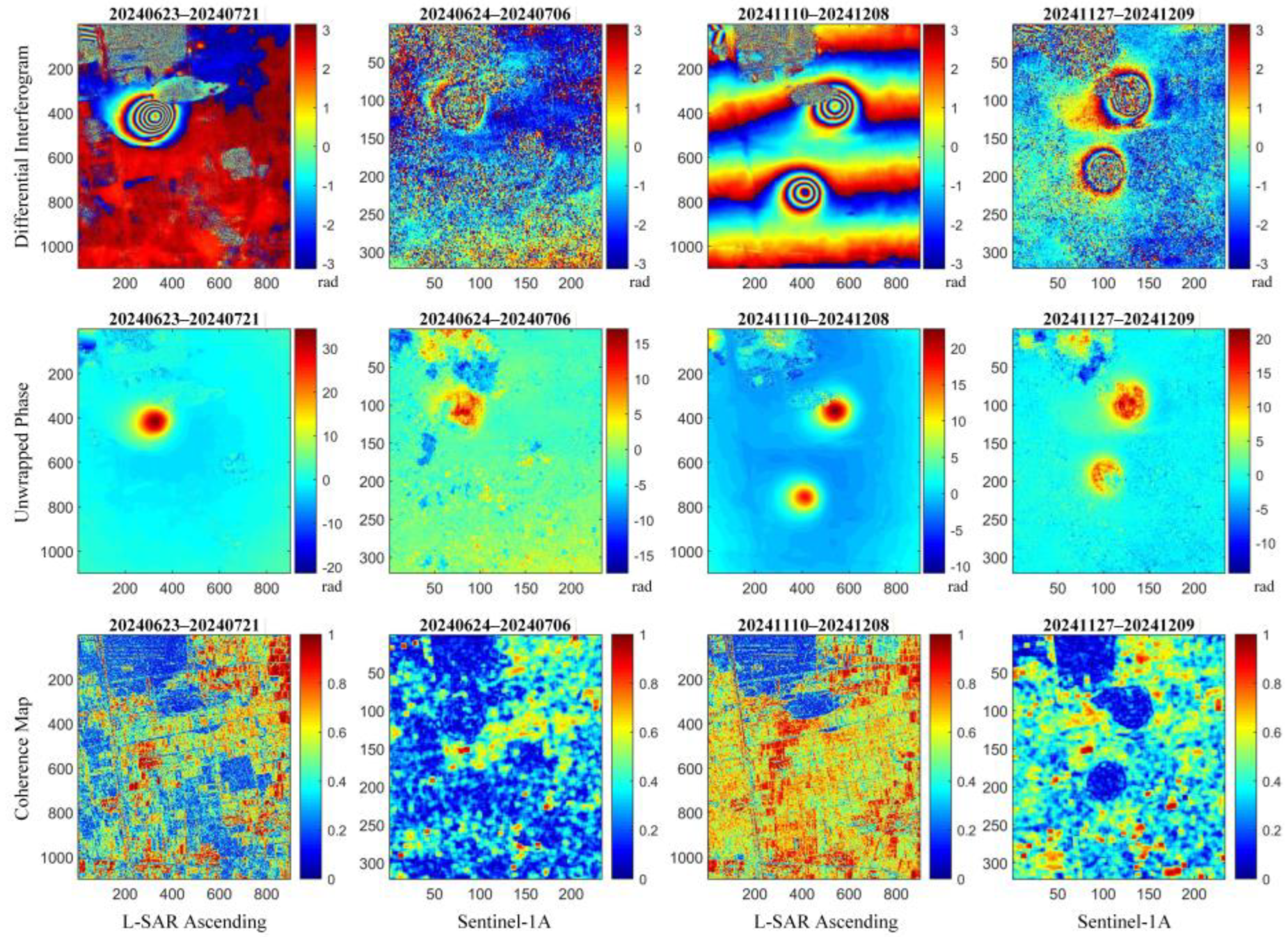
4.1.1. Interferogram Processing, Phase Unwrapping, and Coherence Analysis
4.1.2. DInSAR Monitoring Results and Comparison
4.2. SBAS-InSAR Results
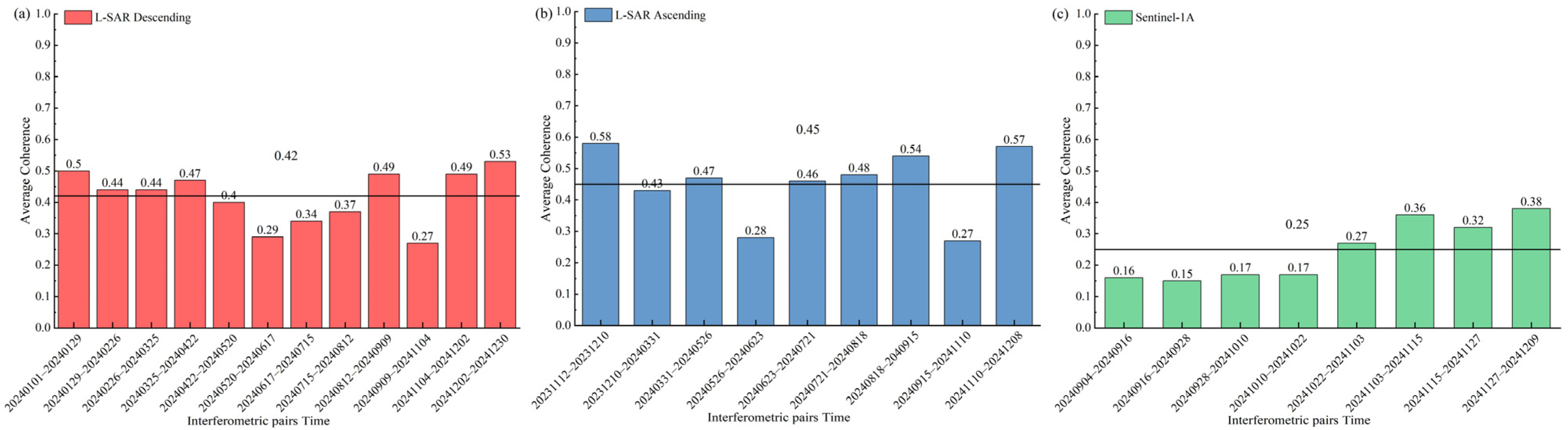
4.2.1. SBAS-InSAR Parameter Settings and Coherence Analysis
4.2.2. SBAS-InSAR Monitoring Results and Comparison
5. Discussion
6. Conclusions
- (1)
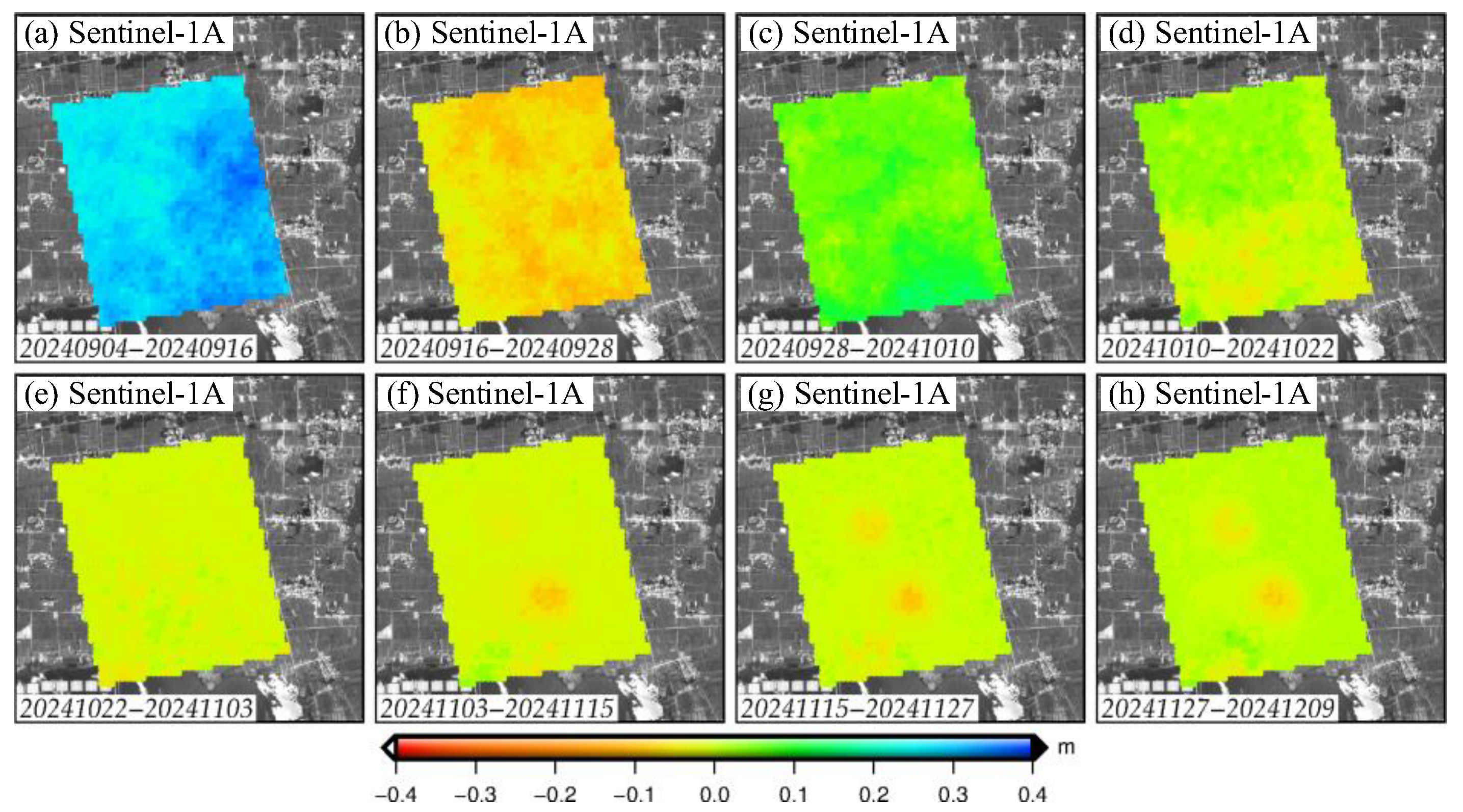
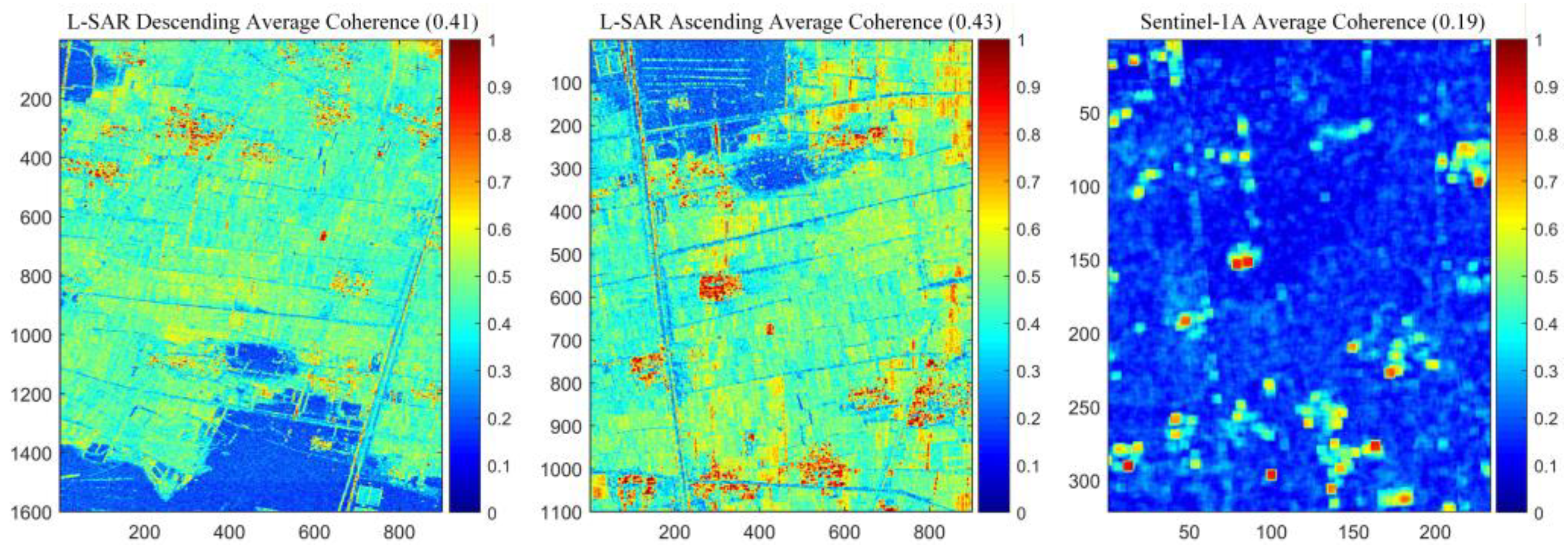
- L-band L-SAR demonstrates clear superiority over C-band Sentinel-1A in terms of interferometric coherence within the mining area. In the interferometric pairs analyzed, descending and ascending L-SAR data achieve mean coherence values of approximately 0.42 and 0.45, respectively, substantially exceeding the 0.25 observed for Sentinel-1A. Under conditions of extended temporal baselines and surface coverage by cropland and vegetation, L-SAR maintains high coherence across most land cover types except water bodies, benefiting from its longer wavelength and finer spatial sampling rate. In contrast, the relatively coarse resolution of Sentinel-1A results in larger ground areas covered by each pixel, which leads to volume decorrelation and mixed pixel effects when non-uniform deformation occurs within a pixel. These effects increase the uncertainty in phase unwrapping and cause rapid coherence loss in areas of intense deformation and vegetation cover, rendering it inadequate for high-precision deformation retrieval.
- (2)
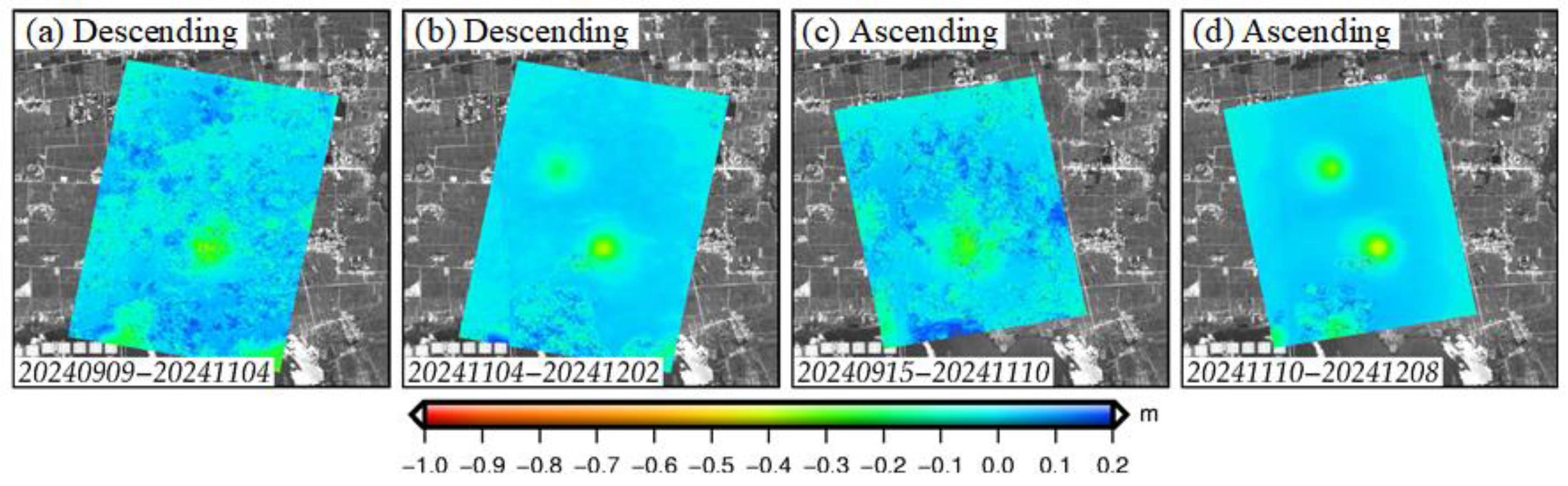
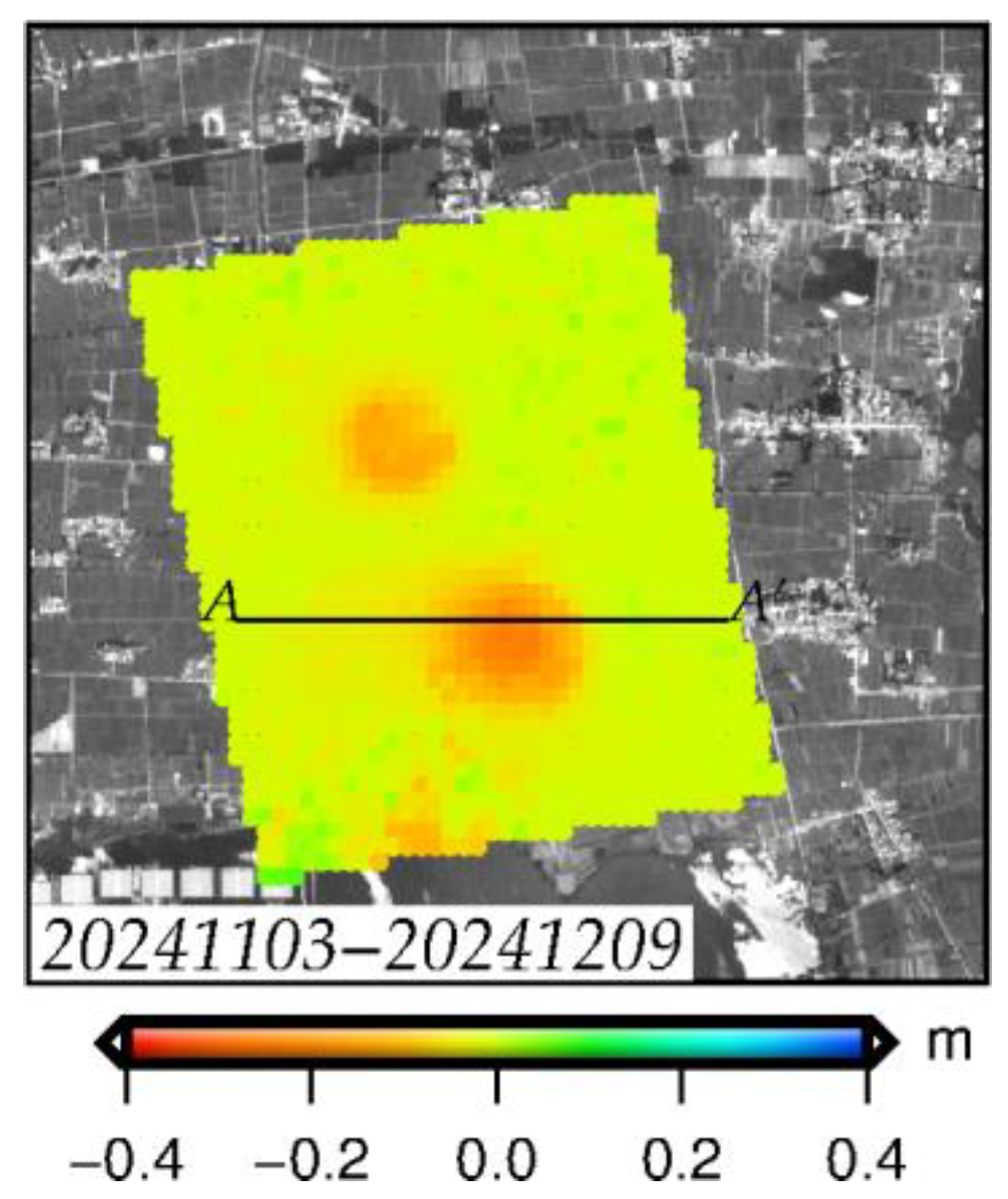
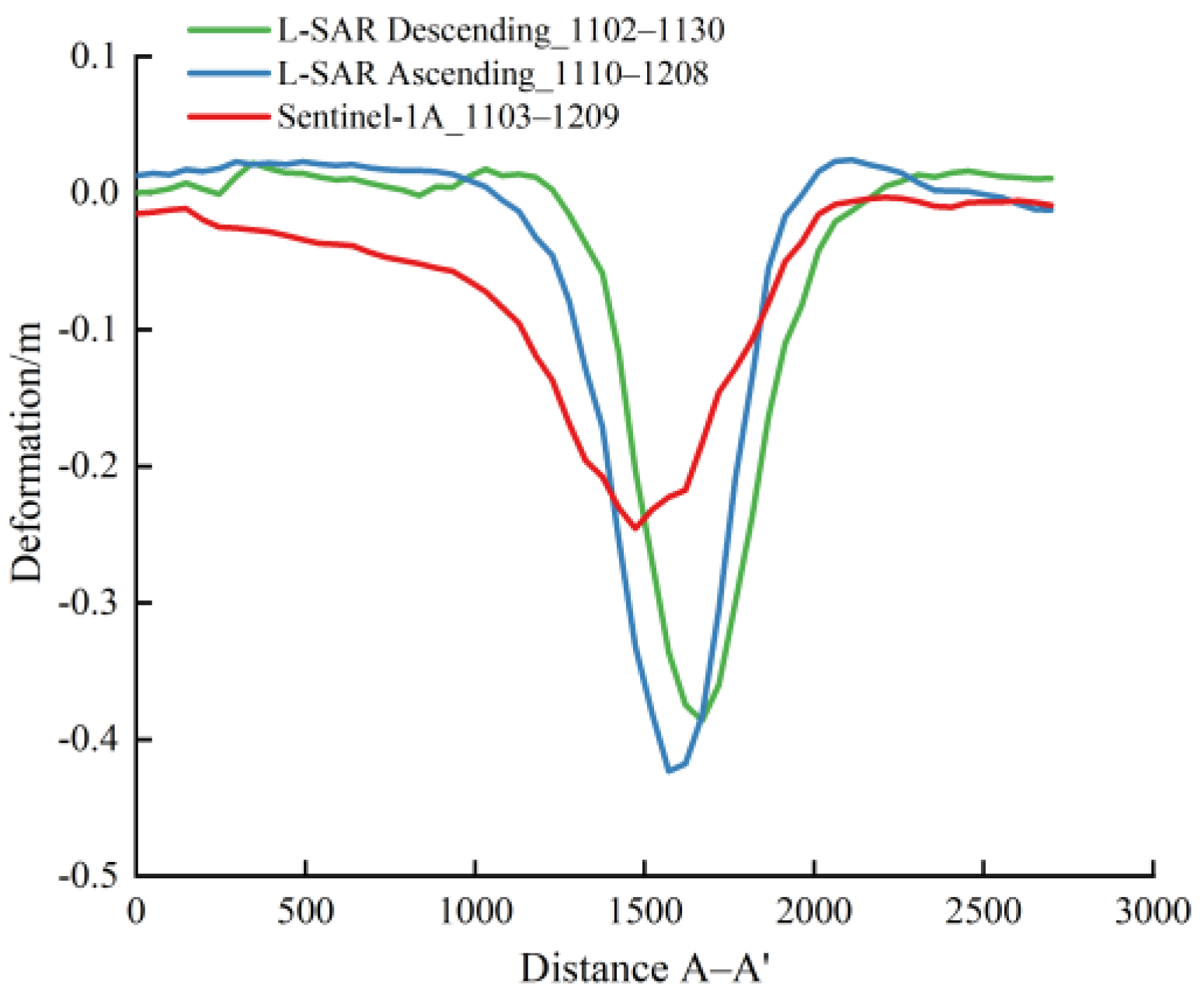
- In DInSAR deformation monitoring, L-SAR more faithfully captures the magnitude of large-gradient mining subsidence. While all three datasets demonstrate good consistency in identifying the subsidence location and overall extent, the maximum LOS displacements along profile A–A′ differ substantially between sensors. Descending and ascending L-SAR data yield approximately −0.40 m and −0.43 m, respectively, whereas Sentinel-1A measures only about −0.25 m. This pronounced discrepancy in magnitude indicates that L-SAR, benefiting from the longer wavelength and higher spatial resolution of L-band, exhibits stronger deformation detection capability in large-gradient deformation zones.
- (3)
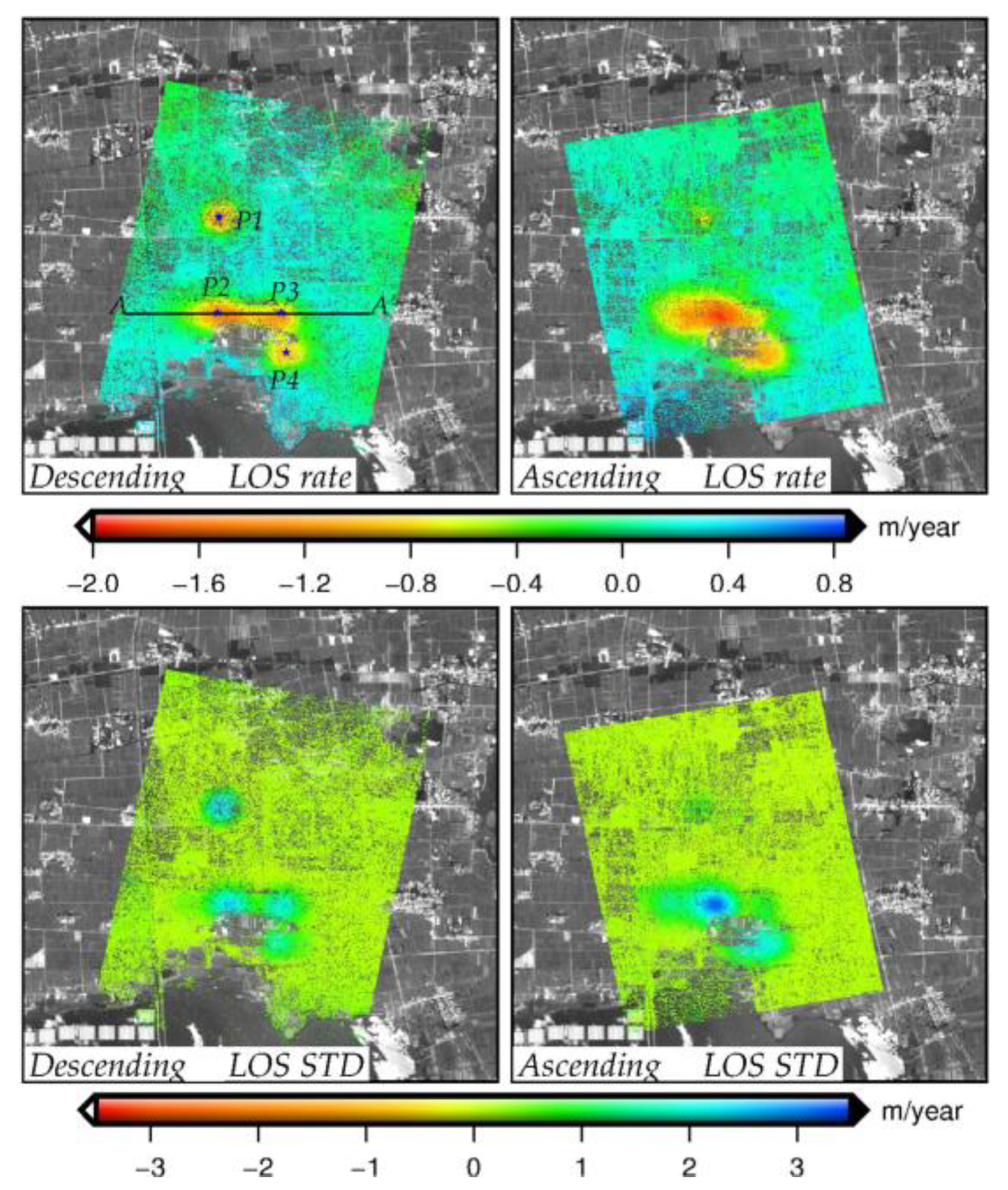
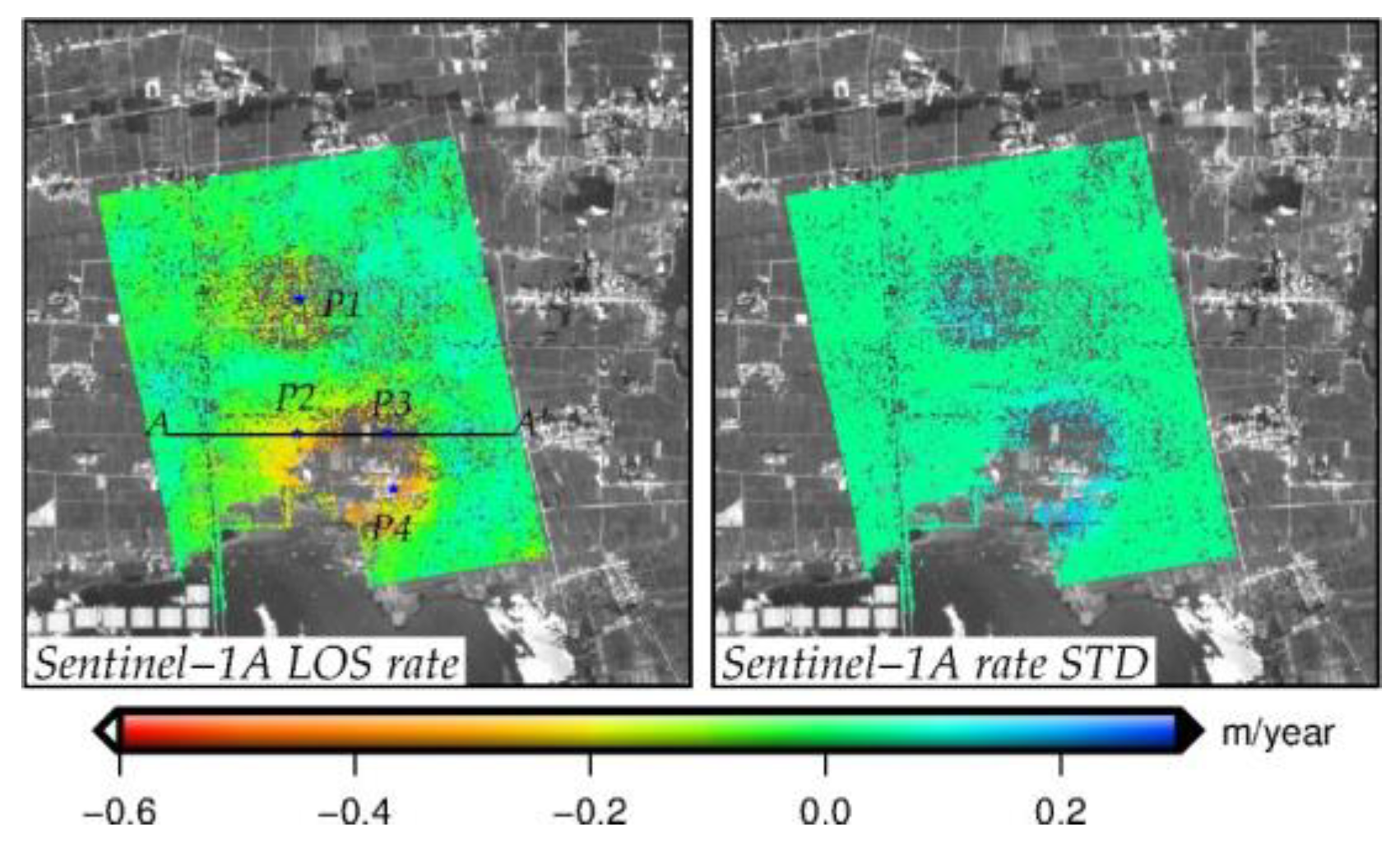
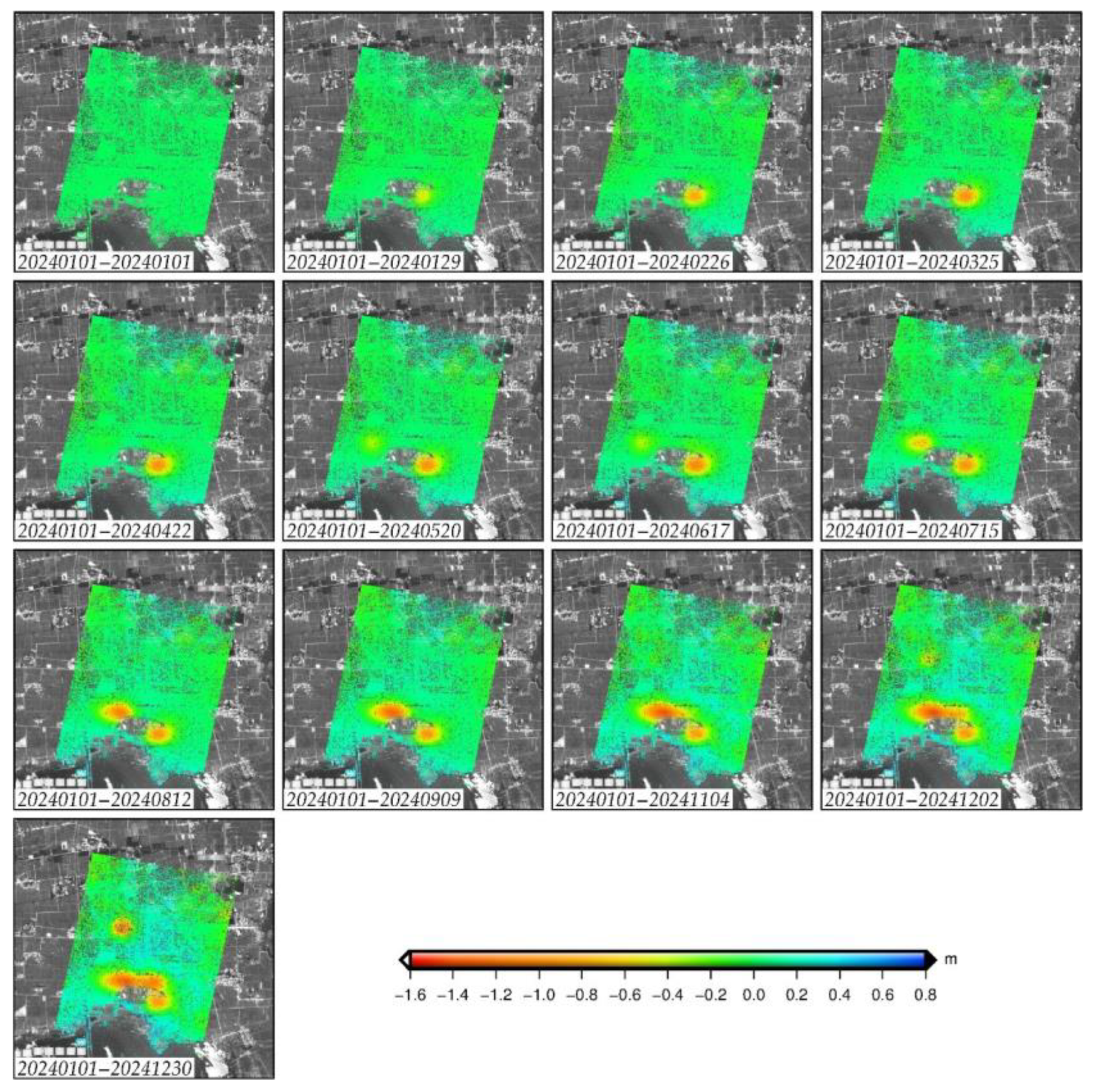
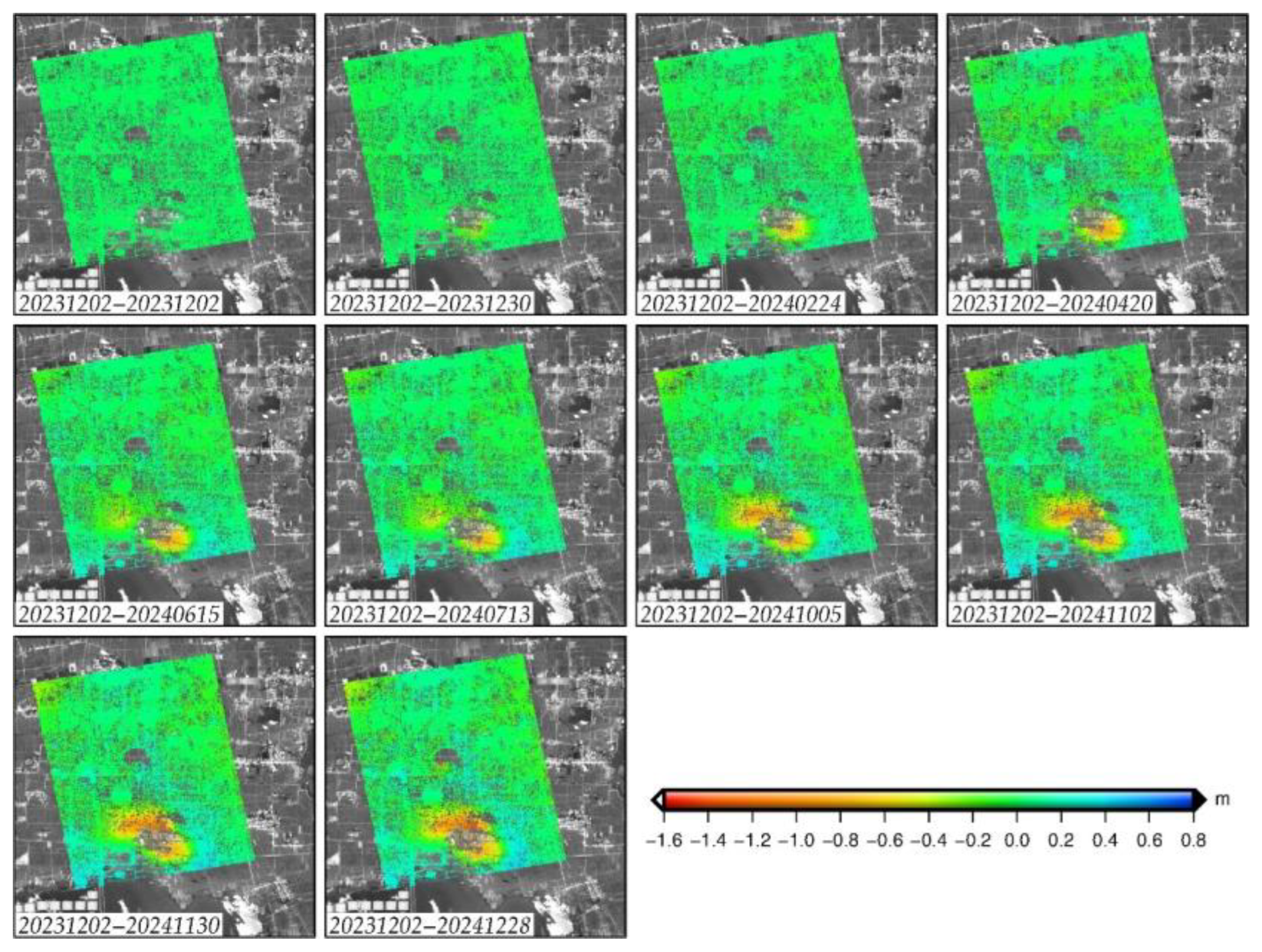
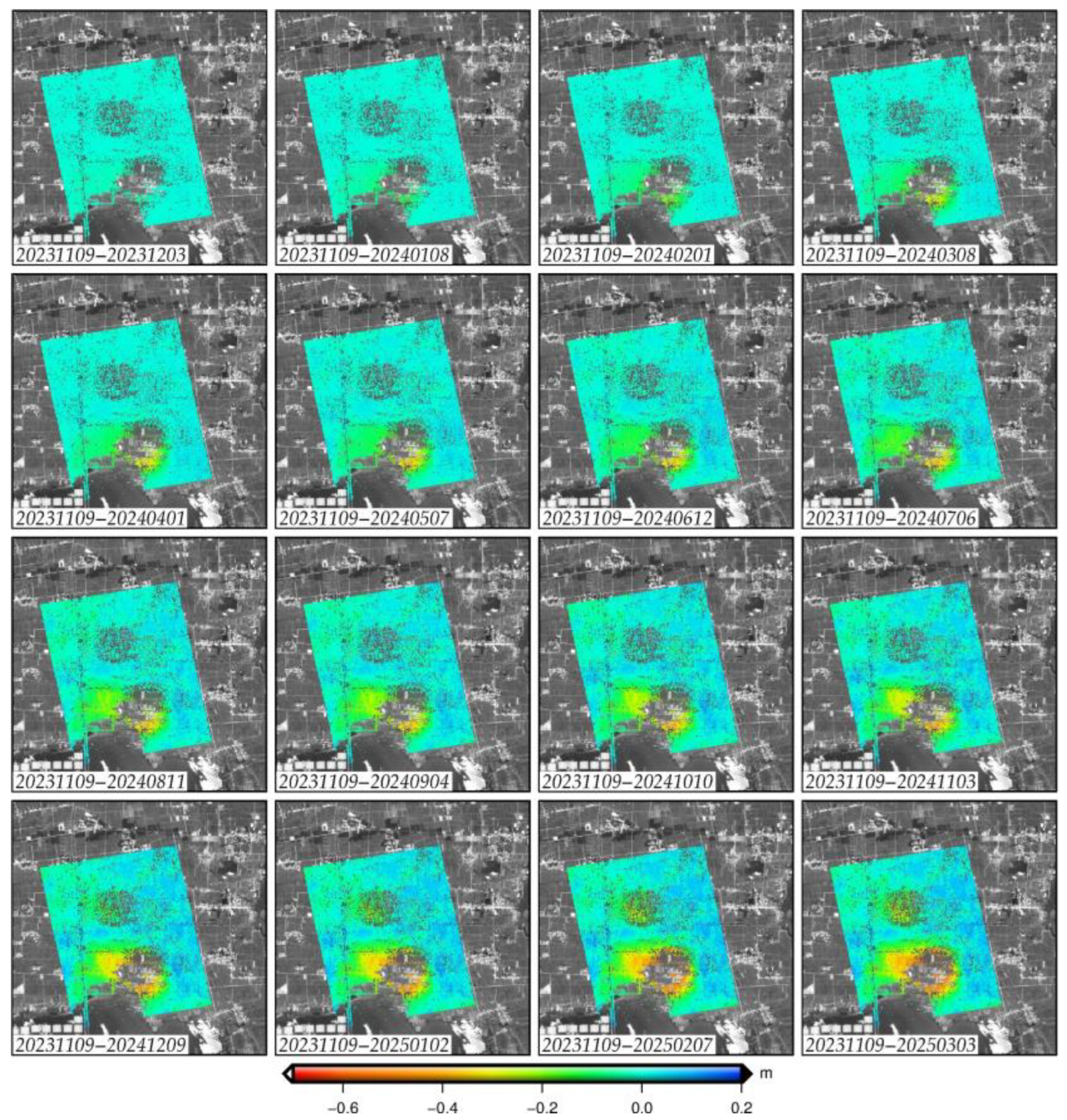
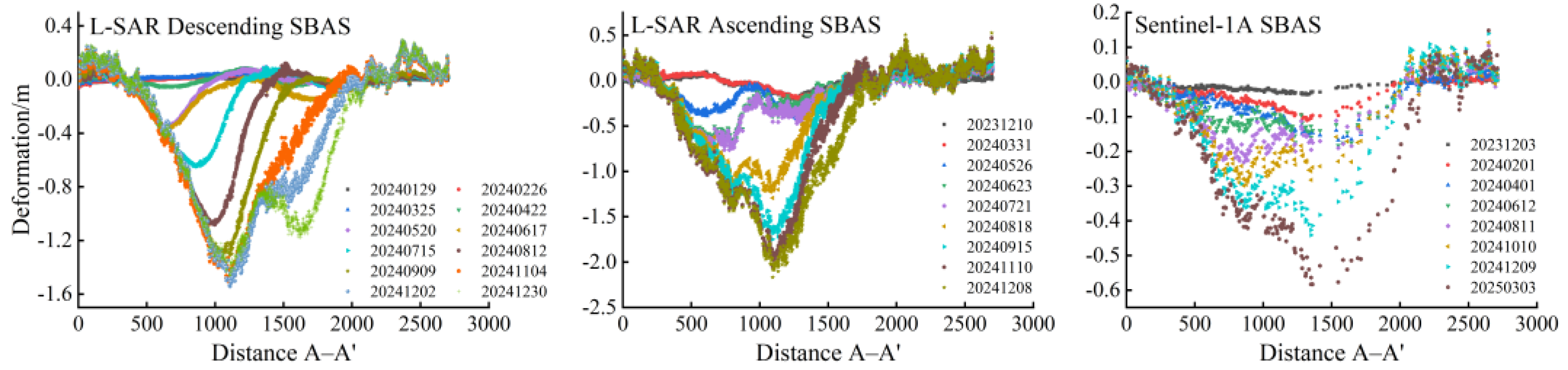
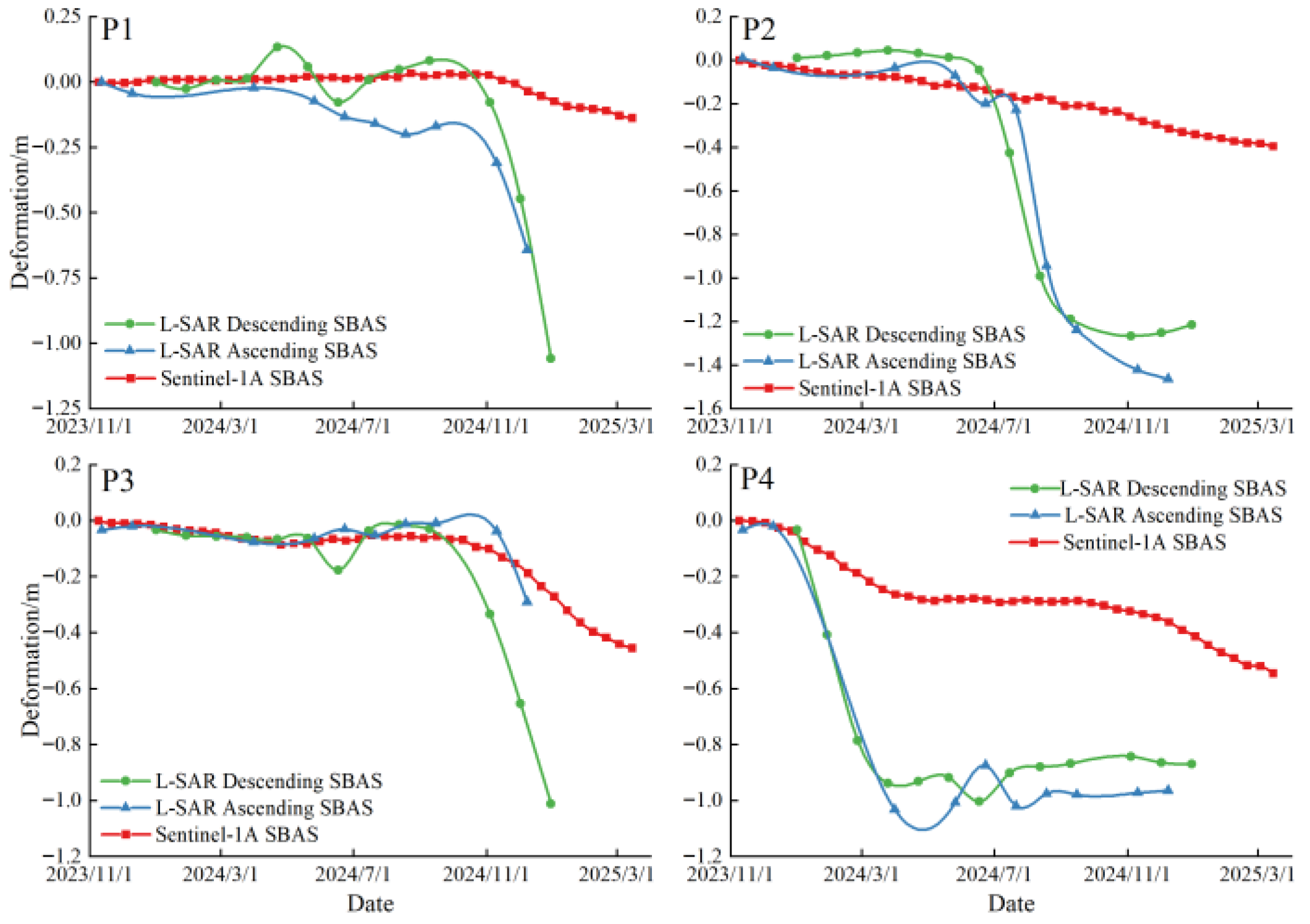
- In SBAS-InSAR time-series inversion, L-SAR data are able to fully reveal the nonlinear evolution of the subsidence areas. The descending- and ascending-track L-SAR datasets yield 209,418 and 228,388 coherent points, respectively. In the time-series deformation fields, three subsidence zones and their evolution are clearly identifiable: the lower subsidence zone appeared first and gradually stabilized, the middle subsidence zone continued to develop, and the upper subsidence zone was in the initial stage of mining. The maximum LOS deformation rates for descending- and ascending-track L-SAR data are approximately −1.54 m·yr−1 and −2.0 m·yr−1, respectively. By contrast, Sentinel-1A selects only 81,669 coherent points; severe loss of coherent points in the central subsidence area leads to blurred boundaries, smoothing and underestimation of deformation magnitudes, and a maximum deformation rate of only about −0.48 m·yr−1, which prevents accurate characterization of rapid, nonlinear subsidence processes in the mine.
- (4)
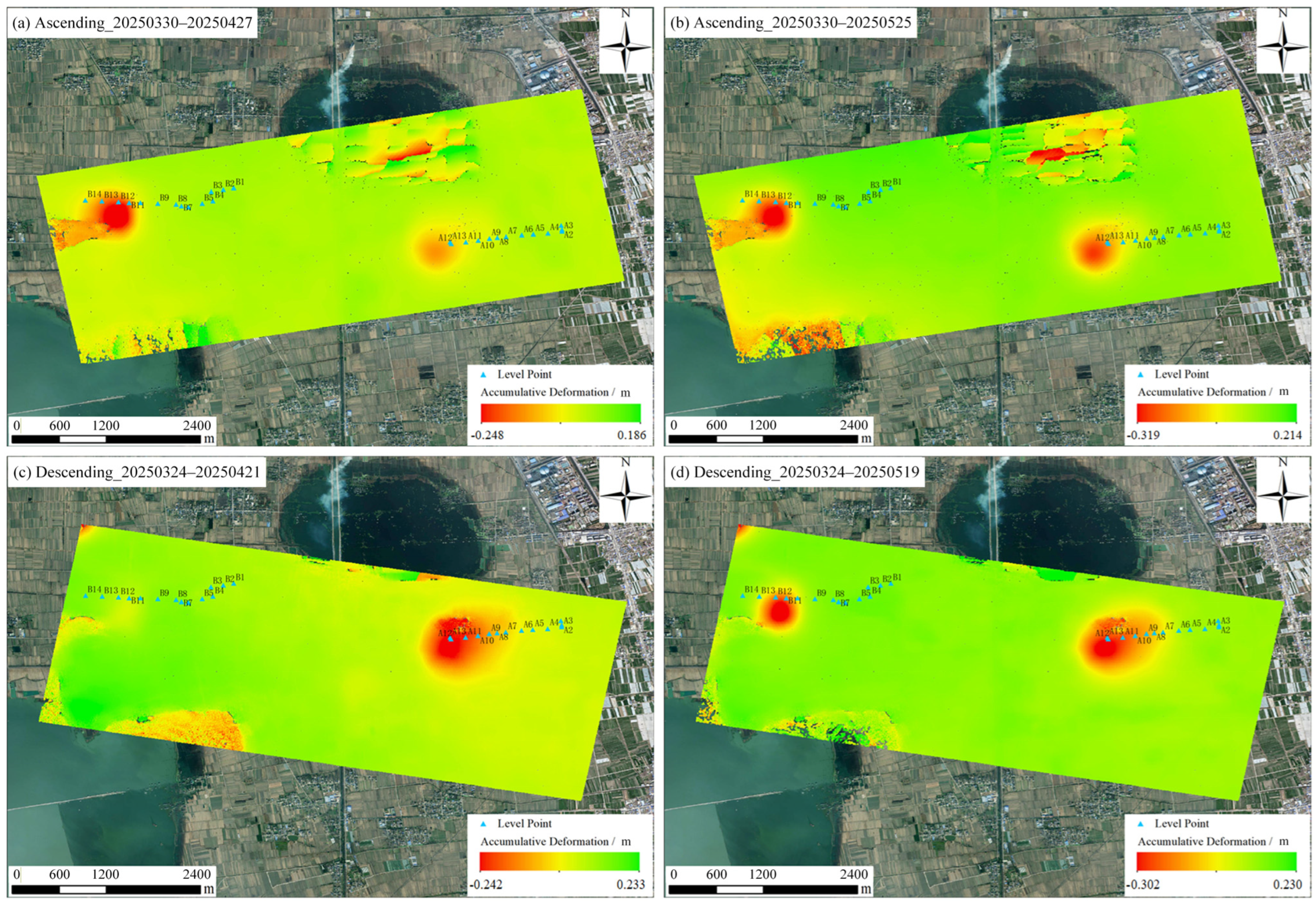
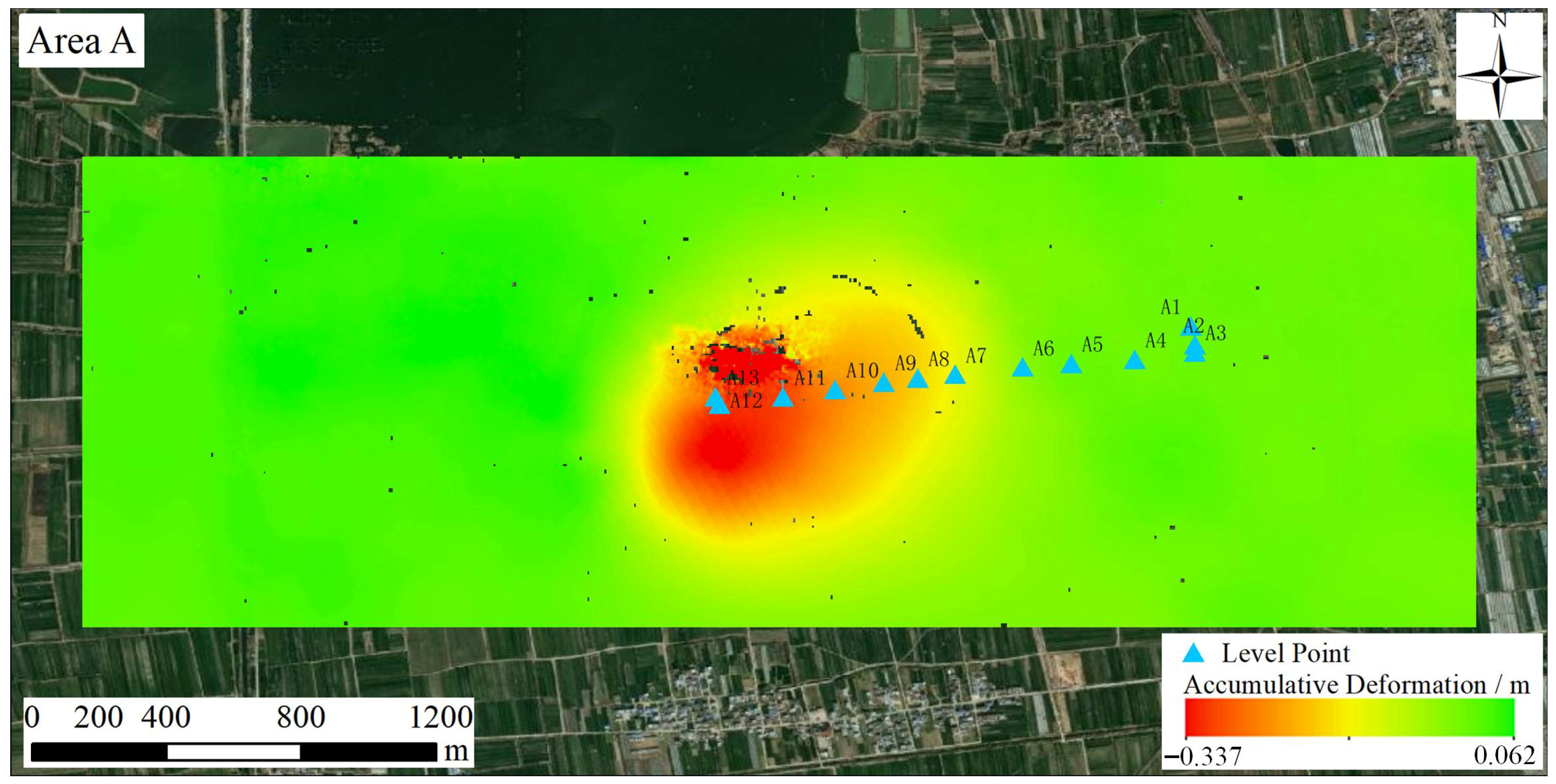
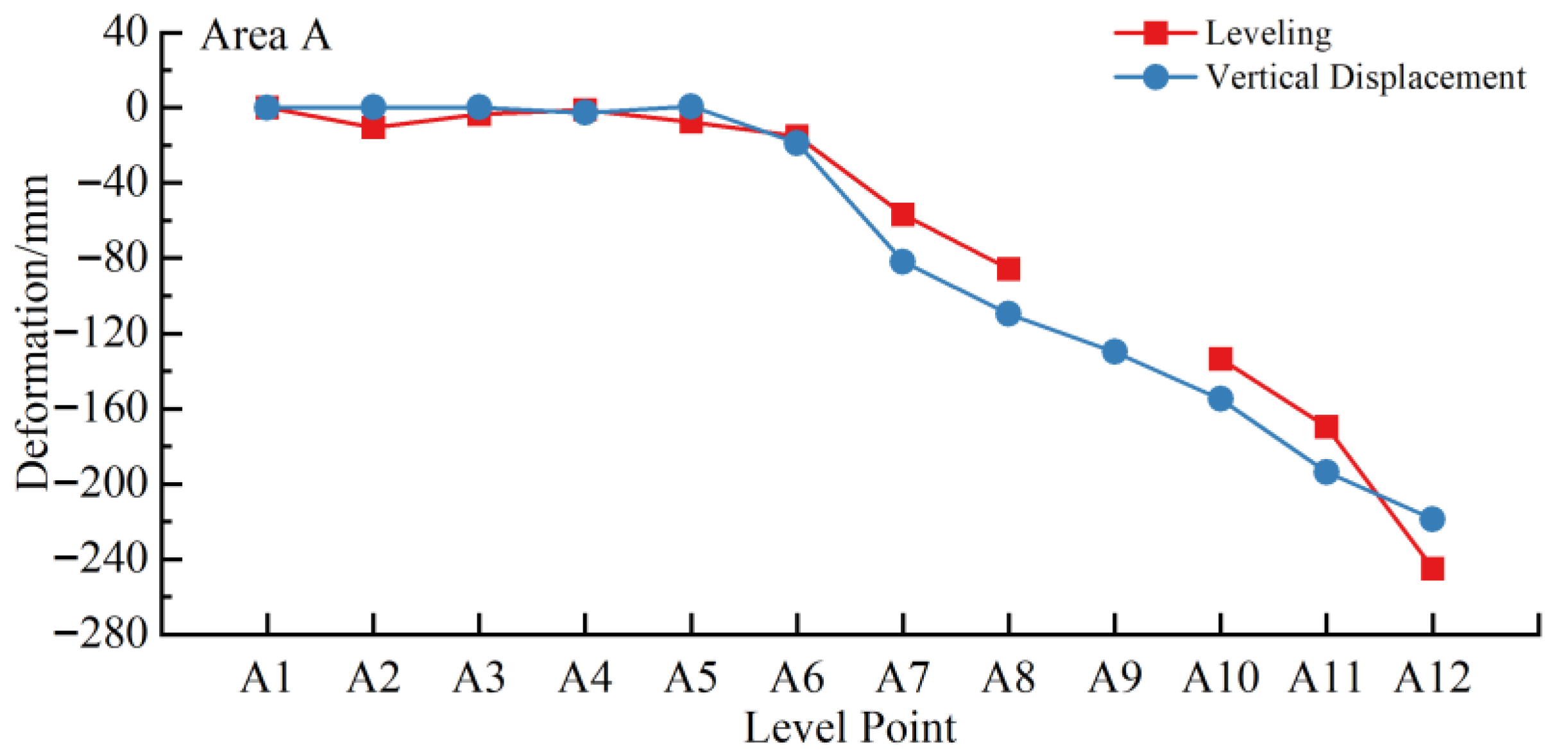
- The vertical displacements obtained from D-InSAR monitoring results based on L-SAR data show high consistency with levelling measurements, enabling centimeter-level accuracy for mining subsidence monitoring. Accuracy assessment against fourth-order levelling results indicates that D-InSAR results from descending and ascending L-SAR data can reproduce the subsidence zones spatially, with subsidence extent and magnitude generally agreeing with levelling observations, achieving a RMSE of 16.1 mm. These results validate that DInSAR technology based on L-SAR data can achieve centimeter-level accuracy for mining area surface deformation monitoring, and the obtained results possess high precision and reliability.
Author Contributions
Funding
Data Availability Statement
Acknowledgments
Conflicts of Interest
References
- Huning, L.S.; Love, C.A.; Anjileli, H.; Vahedifard, F.; Zhao, Y.; Chaffe, P.L.; Cooper, K.; Alborzi, A.; Pleitez, E.; Martinez, A.; et al. Global land subsidence: Impact of climate extremes and human activities. Rev. Geophys. 2024, 62, e2023RG000817. [Google Scholar] [CrossRef]
- Ma, S.; Qiu, H.; Yang, D.; Wang, J.; Zhu, Y.; Tang, B.; Sun, K.; Cao, M. Surface multi-hazard effect of underground coal mining. Landslides 2023, 20, 39–52. [Google Scholar] [CrossRef]
- Chen, W.; Xiao, W.; He, T.; Ruan, L.; Zhao, Y.; Hu, Z. Quantify the extensive crop damage and grain losses caused by underground coal mining subsidence in eastern China. J. Clean. Prod. 2024, 469, 143204. [Google Scholar] [CrossRef]
- Zhang, Z.; Wang, C.; Tang, Y.; Fu, Q.; Zhang, H. Subsidence monitoring in coal area using time-series InSAR combining persistent scatterers and distributed scatterers. Int. J. Appl. Earth Obs. Geoinf. 2015, 39, 49–55. [Google Scholar] [CrossRef]
- Zangenehnejad, F.; Gao, Y. GNSS smartphones positioning: Advances, challenges, opportunities, and future perspectives. Satell. Navig. 2021, 2, 24. [Google Scholar] [CrossRef] [PubMed]
- Xu, Y.; Li, T.; Tang, X.; Zhang, X.; Fan, H.; Wang, Y. Research on the applicability of DInSAR, stacking-InSAR and SBAS-InSAR for mining region subsidence detection in the datong coalfield. Remote Sens. 2022, 14, 3314. [Google Scholar] [CrossRef]
- He, Y.; Chen, B.; Motagh, M.; Zhu, Y.; Shao, S.; Li, J.; Zhang, B.; Kaufmann, H. Zero-shot detection for InSAR-based land displacement by the deformation-prompt-based SAM method. Int. J. Appl. Earth Obs. Geoinf. 2025, 136, 104407. [Google Scholar] [CrossRef]
- Yang, Z.; Li, Z.; Zhu, J.; Wang, Y.; Wu, L. Use of SAR/InSAR in mining deformation monitoring, parameter inversion, and forward predictions: A review. IEEE Geosci. Remote Sens. Mag. 2020, 8, 71–90. [Google Scholar] [CrossRef]
- Zhang, R.; Zhang, W.; Huang, W.; Ma, T.; Wang, Q.; Fang, K.; Wang, K. High-precision monitoring method for airport deformation based on time-series InSAR technology. Constr. Build. Mater. 2023, 366, 130144. [Google Scholar] [CrossRef]
- Zhang, G.; Xu, Z.; Chen, Z.; Wang, S.; Cui, H.; Zheng, Y. Predictable condition analysis and prediction method of SBAS-InSAR coal mining subsidence. IEEE Trans. Geosci. Remote Sens. 2022, 60, 1–14. [Google Scholar] [CrossRef]
- Novellino, A.; Cesarano, M.; Cappelletti, P.; Di Martire, D.; Di Napoli, M.; Ramondini, M.; Sowter, A.; Calcaterra, D. Slow-moving landslide risk assessment combining Machine Learning and InSAR techniques. Catena 2021, 203, 105317. [Google Scholar] [CrossRef]
- Qu, F.; Zhang, Q.; Lu, Z.; Zhao, C.; Yang, C.; Zhang, J. Land subsidence and ground fissures in Xi’an, China 2005–2012 revealed by multi-band InSAR time-series analysis. Remote Sens. Environ. 2014, 155, 366–376. [Google Scholar] [CrossRef]
- Witkowski, W.T.; Łucka, M.; Guzy, A.; Sudhaus, H.; Barańska, A.; Hejmanowski, R. Impact of mining-induced seismicity on land subsidence occurrence. Remote Sens. Environ. 2024, 301, 113934. [Google Scholar] [CrossRef]
- Wang, T.; DeGrandpre, K.; Lu, Z.; Freymueller, J.T. Complex surface deformation of Akutan volcano, Alaska revealed from InSAR time series. Int. J. Appl. Earth Obs. Geoinf. 2018, 64, 171–180. [Google Scholar] [CrossRef]
- Zhang, B.; Liao, X.; Zhang, J.; Xiong, S.; Wang, C.; Wu, S.; Zhu, C.; Zhu, J.; Qin, X.; Li, Q. Megalopolitan-scale ground deformation along metro lines in the Guangdong-Hong Kong-Macao Greater Bay Area, China, revealed by MT-InSAR. Int. J. Appl. Earth Obs. Geoinf. 2023, 122, 103432. [Google Scholar] [CrossRef]
- Meng, L.; Yan, C.; Lv, S.; Sun, H.; Xue, S.; Li, Q.; Zhou, L.; Edwing, D.; Edwing, K.; Geng, X.; et al. Synthetic aperture radar for geosciences. Rev. Geophys. 2024, 62, e2023RG000821. [Google Scholar] [CrossRef]
- Grebby, S.; Sowter, A.; Gluyas, J.; Toll, D.; Gee, D.; Athab, A.; Girindran, R. Advanced analysis of satellite data reveals ground deformation precursors to the Brumadinho Tailings Dam collapse. Commun. Earth Environ. 2021, 2, 2. [Google Scholar] [CrossRef]
- Chen, Y.; Li, J.; Li, H.; Gao, Y.; Li, S.; Chen, S.; Guo, G.; Wang, F.; Zhao, D.; Zhang, K.; et al. Revealing land surface deformation over the Yineng backfilling mining area, China, by integrating distributed scatterer SAR interferometry and a mining subsidence model. IEEE J. Sel. Top. Appl. Earth Obs. Remote Sens. 2023, 16, 3611–3634. [Google Scholar] [CrossRef]
- Rucci, A.; Ferretti, A.; Guarnieri, A.M.; Rocca, F. Sentinel 1 SAR interferometry applications: The outlook for sub millimeter measurements. Remote Sens. Environ. 2012, 120, 156–163. [Google Scholar] [CrossRef]
- Elliott, J.R. Earth observation for the assessment of earthquake hazard, risk and disaster management. Surv. Geophys. 2020, 41, 1323–1354. [Google Scholar] [CrossRef]
- Delgado, F.; Shreve, T.; Borgstrom, S.; León-Ibáñez, P.; Castillo, J.; Poland, M. A global assessment of SAOCOM-1 L-band stripmap data for InSAR characterization of volcanic, tectonic, cryospheric, and anthropogenic deformation. IEEE Trans. Geosci. Remote Sens. 2024, 62, 1–21. [Google Scholar] [CrossRef]
- Ottinger, M.; Kuenzer, C. Spaceborne L-band synthetic aperture radar data for geoscientific analyses in coastal land applications: A review. Remote Sens. 2020, 12, 2228. [Google Scholar] [CrossRef]
- Chen, H.; Qin, Z.; Liu, B.; Peng, R.; Yu, Z.; Yao, T.; Yang, Z.; Feng, G.; Wang, W. Assessing the Landslide Identification Capability of LuTan-1 in Hilly Regions: A Case Study in Longshan County, Hunan Province. Remote Sens. 2025, 17, 960. [Google Scholar] [CrossRef]
- Wang, W.; Motagh, M.; Zhou, C.; Xia, Z.; Lyu, S.; Peng, M.; Tan, G.; Yan, C. Slope Deformation Analysis of Muyubao Landslide, China, Using Lutan-1 InSAR Data. J. Earth Sci. 2025, 36, 2825–2829. [Google Scholar] [CrossRef]
- Kim, T.; Han, H. Coseismic displacement fields and the slip mechanism of the 2021 Mw 6.7 Hovsgol earthquake in Mongolia constrained by Sentinel-1 and ALOS-2 InSAR. GISci. Remote Sens. 2023, 60, 2180026. [Google Scholar] [CrossRef]
- Deng, J.; Dai, K.; Liang, R.; Chen, L.; Wen, N.; Zheng, G.; Xu, H. Interferometric synthetic aperture radar applicability analysis for potential landslide identification in steep mountainous areas with C/L band data. Remote Sens. 2023, 15, 4538. [Google Scholar] [CrossRef]
- Himematsu, Y.; Ozawa, T.; Aoki, Y. Precursory crater contraction associated with the 2017 eruption of Shinmoe-dake volcano (Japan) detected by PALSAR-2 and Sentinel-1 InSAR. Earth Planets Space 2024, 76, 141. [Google Scholar] [CrossRef]
- Chen, Z.; Montpetit, B.; Banks, S.; White, L.; Behnamian, A.; Duffe, J.; Pasher, J. Insar monitoring of arctic landfast sea ice deformation using l-band alos-2, c-band radarsat-2 and sentinel-1. Remote Sens. 2021, 13, 4570. [Google Scholar] [CrossRef]
- Yang, L.; Huang, C.; Feng, T.; Duan, R.; Guo, W.; Dou, P.; Hou, J.; Zhang, Y. Mapping above-ground biomass and canopy mean height in high mountainous forest areas with Sentinel-2 multi-spectral image based on machine learning algorithms. Int. J. Digit. Earth 2025, 18, 2558924. [Google Scholar] [CrossRef]
- Monserrat, O.; Crosetto, M.; Luzi, G. A review of ground-based SAR interferometry for deformation measurement. ISPRS J. Photogramm. Remote Sens. 2014, 93, 40–48. [Google Scholar] [CrossRef]
- Xu, G.; Gao, Y.; Li, J.; Xing, M. InSAR phase denoising: A review of current technologies and future directions. IEEE Geosci. Remote Sens. Mag. 2020, 8, 64–82. [Google Scholar] [CrossRef]
- Manconi, A. How phase aliasing limits systematic space-borne DInSAR monitoring and failure forecast of alpine landslides. Eng. Geol. 2021, 287, 106094. [Google Scholar] [CrossRef]
- Hooper, A.; Zebker, H.A. Phase unwrapping in three dimensions with application to InSAR time series. J. Opt. Soc. Am. A 2007, 24, 2737–2747. [Google Scholar] [CrossRef]
- Wang, S.; Zhang, G.; Chen, Z.; Cui, H.; Zheng, Y.; Xu, Z.; Li, Q. Surface deformation extraction from small baseline subset synthetic aperture radar interferometry (SBAS-InSAR) using coherence-optimized baseline combinations. GISci. Remote Sens. 2022, 59, 295–309. [Google Scholar] [CrossRef]
- Tao, Q.; Gao, T.; Hu, L.; Wang, Z. Optimal selection and application analysis of multi-temporal differential interferogram series in StaMPS-based SBAS InSAR. Eur. J. Remote Sens. 2018, 51, 1070–1086. [Google Scholar] [CrossRef]



| Data Type | Band | Wavelength (cm) | Incidence Angle (°) | Azimuth Angle (°) | Spatial Resolution (m) (Range × Azimuth) | Swath Width (km) | Revisit Cycle (Days) |
|---|---|---|---|---|---|---|---|
| L-SAR Ascending | L | 23.8 | 32.93 | 349.45 | 1.7 × 1.7 | 50 | 28 |
| L-SAR Descending | L | 23.8 | 30.29 | 190.81 | 1.7 × 1.4 | 50 | 28 |
| Sentinel-1A | C | 5.6 | 33.74 | 347.14 | 2.3 × 14.0 | 250 | 12 |
| Number | L-SAR Ascending | L-SAR Descending | Sentinel-1A | ||
|---|---|---|---|---|---|
| 1 | 20231112 | 20240101 | 20231109 | 20240425 | 20241010 |
| 2 | 20231210 | 20240129 | 20231121 | 20240507 | 20241022 |
| 3 | 20240331 | 20240226 | 20231203 | 20240519 | 20241103 |
| 4 | 20240526 | 20240325 | 20231215 | 20240531 | 20241115 |
| 5 | 20240623 | 20240422 | 20231227 | 20240612 | 20241127 |
| 6 | 20240721 | 20240520 | 20240108 | 20240624 | 20241209 |
| 7 | 20240818 | 20240617 | 20240120 | 20240706 | 20241221 |
| 8 | 20240915 | 20240715 | 20240201 | 20240718 | 20250102 |
| 9 | 20241110 | 20240812 | 20240213 | 20240730 | 20250114 |
| 10 | 20241208 | 20240909 | 20240225 | 20240811 | 20250126 |
| 11 | 20241104 | 20240308 | 20240823 | 20250207 | |
| 12 | 20241202 | 20240320 | 20240904 | 20250219 | |
| 13 | 20241230 | 20240401 | 20240916 | 20250303 | |
| 14 | 20240413 | 20240928 | 20250315 | ||
| Parameter | Parameter Function | L-SAR | Sentinel-1A |
|---|---|---|---|
| max_topo_err | Estimating phase-unwrapped DEM phase, filtering, and eliminating coherent points with large noise | 5 | 5 |
| filter_grid_size | 50 | 32 | |
| weed_standard_dev | 5 | 1 | |
| weed_max_noise | 10 | 5 | |
| unwrap_prefilter_flag | Phase unwrapping | y | y |
| unwrap_grid_size | 8 | 8 | |
| unwrap_time_win | 12 | 50 | |
| scla_deramp | Removal of orbital, DEM, and atmospheric phases | y | y |
| Maximum Error (mm) | Minimum Error (mm) | Standard Deviation (mm) | RMSE (mm) |
|---|---|---|---|
| 26.4 | 1.6 | 17.0 | 16.1 |
Disclaimer/Publisher’s Note: The statements, opinions and data contained in all publications are solely those of the individual author(s) and contributor(s) and not of MDPI and/or the editor(s). MDPI and/or the editor(s) disclaim responsibility for any injury to people or property resulting from any ideas, methods, instructions or products referred to in the content. |
© 2026 by the authors. Licensee MDPI, Basel, Switzerland. This article is an open access article distributed under the terms and conditions of the Creative Commons Attribution (CC BY) license.
Share and Cite
Cheng, Z.; Zheng, M.; Guo, Q.; Wang, Y.; Li, J.; Zhang, X. Monitoring and Analysis of Surface Deformation in Mining Area Based on LuTan-1 and Sentinel-1A Data. Remote Sens. 2026, 18, 713. https://doi.org/10.3390/rs18050713
Cheng Z, Zheng M, Guo Q, Wang Y, Li J, Zhang X. Monitoring and Analysis of Surface Deformation in Mining Area Based on LuTan-1 and Sentinel-1A Data. Remote Sensing. 2026; 18(5):713. https://doi.org/10.3390/rs18050713
Chicago/Turabian StyleCheng, Zisu, Meinan Zheng, Qingbiao Guo, Yingchun Wang, Jinchao Li, and Xiang Zhang. 2026. "Monitoring and Analysis of Surface Deformation in Mining Area Based on LuTan-1 and Sentinel-1A Data" Remote Sensing 18, no. 5: 713. https://doi.org/10.3390/rs18050713
APA StyleCheng, Z., Zheng, M., Guo, Q., Wang, Y., Li, J., & Zhang, X. (2026). Monitoring and Analysis of Surface Deformation in Mining Area Based on LuTan-1 and Sentinel-1A Data. Remote Sensing, 18(5), 713. https://doi.org/10.3390/rs18050713