Retrieval of Significant Wave Height in Coastal Seas of China from GaoFen-3 Satellites Based on Deep Learning


Highlights
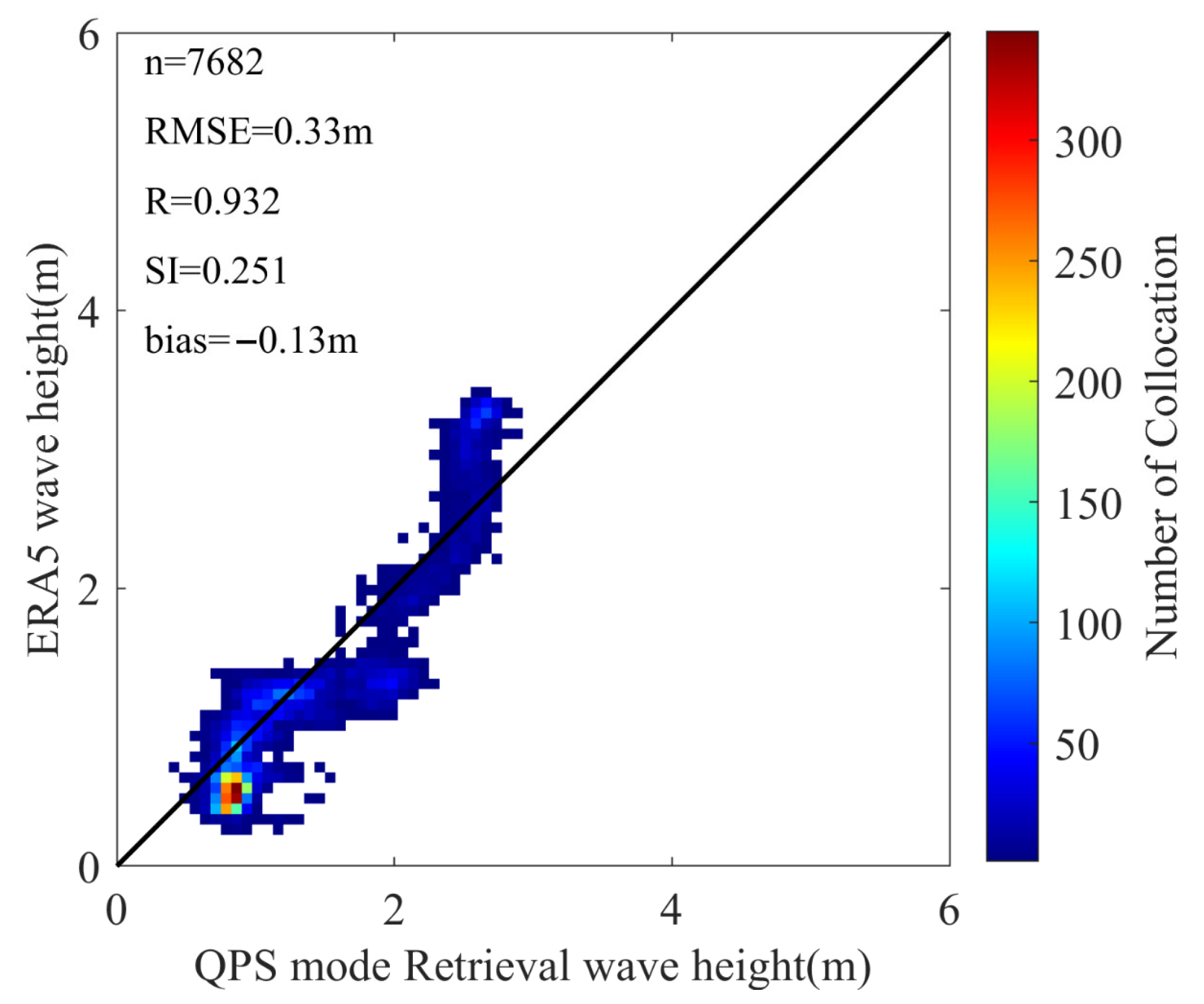
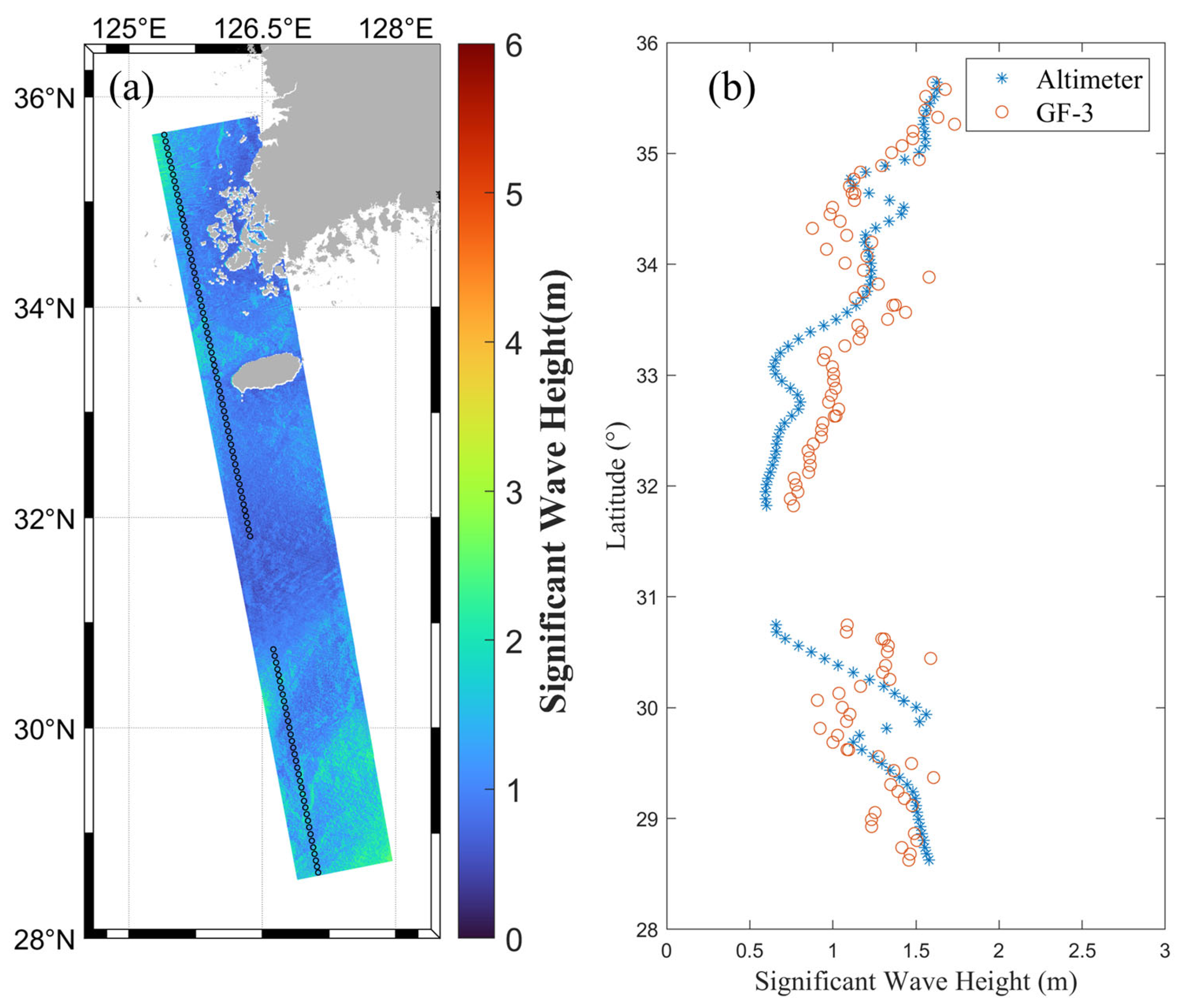
- A deep learning-based significant wave height (SWH) retrieval method in China’s coastal seas from Gaofen-3 Quad-Polarization Stripmap (QPS) mode was developed, achieving an RMSE of 0.33 m and a bias of −0.13 m. The SWH retrieval results from along-track SAR images exhibit good continuity.
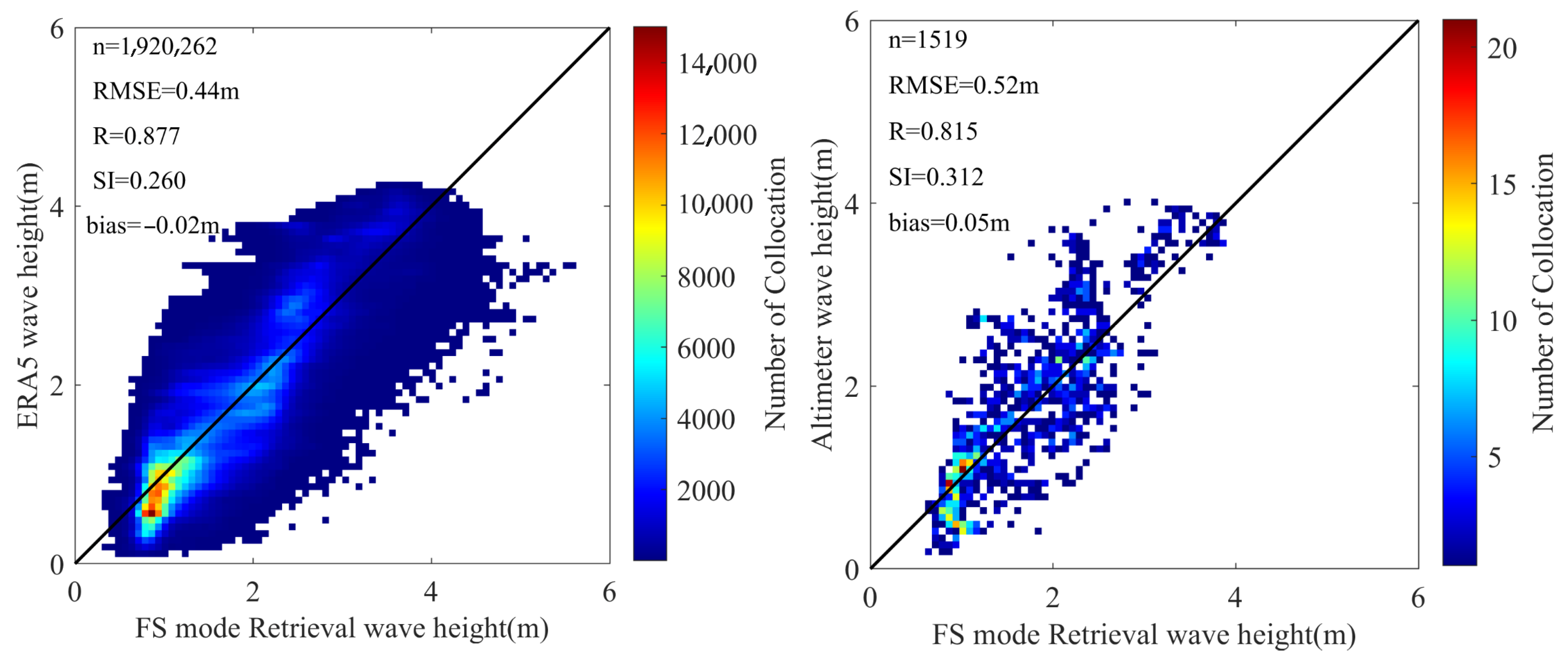
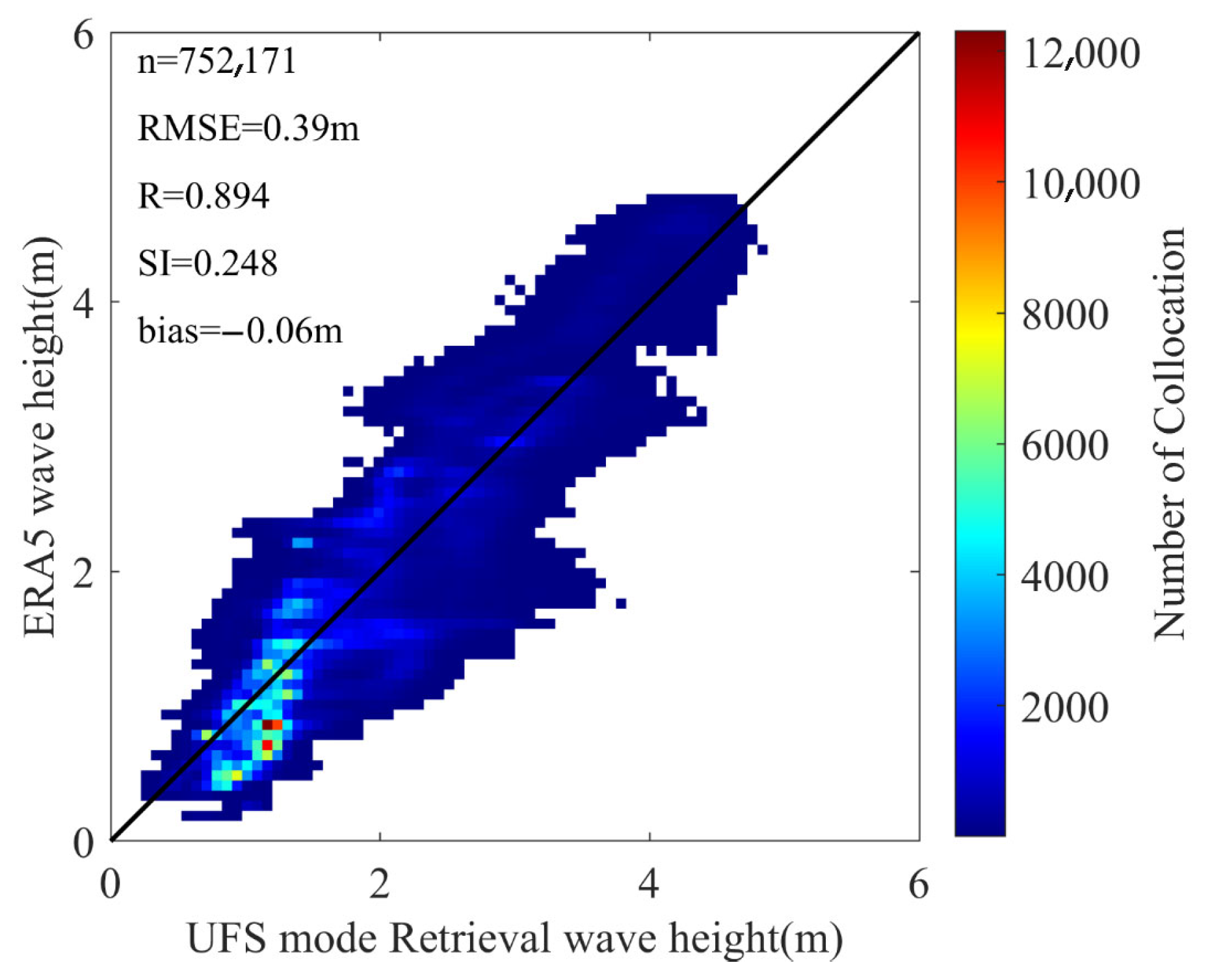
- Based on the polarization ratio model, the SWH retrieval method was extend to Fine Stripmap (FS) and Ultra Fine Stripmap (UFS). Evaluation results demonstrate that the SWH retrieved from both FS and UFS data is encouraging, with RMSEs of 0.44 m and 0.39 m, respectively.
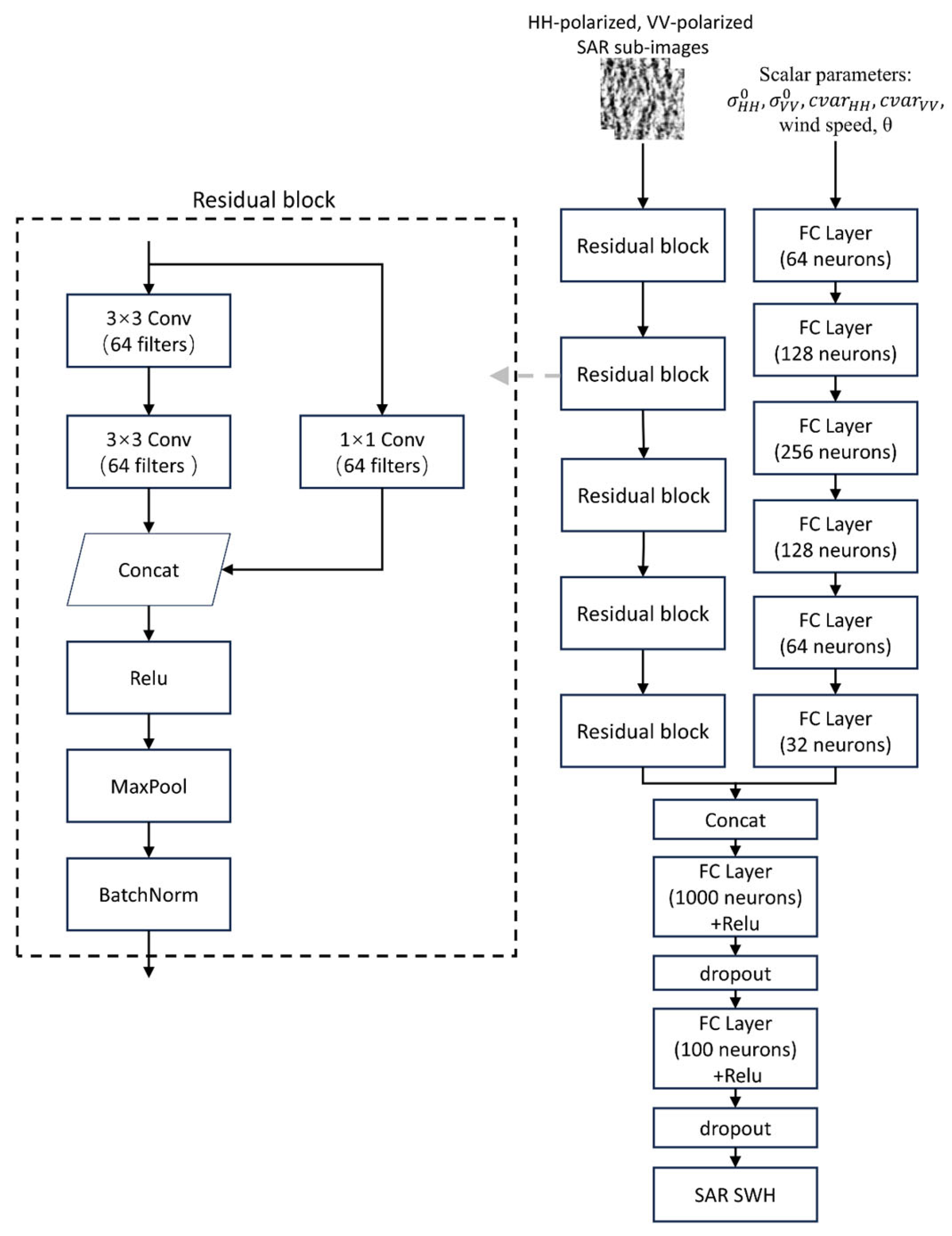
- Different from the conventional single-mode retrieval framework, this study introduced a multi-polarization, multi-observation, high-precision SWH retrieval method, enriching SAR SWH retrieval with more encouraging results.
- The method proposed in this study enables the retrieval of SWH in coastal areas, which can provide data support for human activities and climate studies.
Abstract
1. Introduction
2. Data and Methods
2.1. Data
2.1.1. GF-3 SAR Images
2.1.2. Altimeter Wave Height Data
2.1.3. ERA5 Reanalysis Data
2.2. Methods
2.2.1. SAR Image Preprocessing
2.2.2. Training Dataset Generation
2.2.3. Retrieval Model Construction
2.2.4. Retrieval Results Validation
3. Results
3.1. The Evaluation of QPS Mode-Retrieved SWH
3.2. The Evaluation of FS Mode- and UFS Mode-Retrieved SWH
4. Discussion
5. Conclusions
Author Contributions
Funding
Data Availability Statement
Conflicts of Interest
References
- Collard, F.; Ardhuin, F.; Chapron, B. Monitoring and analysis of ocean swell fields from space: New methods for routine observations. J. Geophys. Res. Oceans 2009, 114, C07023. [Google Scholar] [CrossRef]
- Hasselmann, K.; Raney, R.K.; Plant, W.J.; Alpers, W.; Shuchman, R.A.; Lyzenga, D.R.; Rufenach, C.L.; Tucker, M.J. Theory of synthetic aperture radar ocean imaging: A MARSEN view. J. Geophys. Res. Oceans 1985, 90, 4659–4686. [Google Scholar] [CrossRef]
- Hasselmann, K.; Hasselmann, S. On the nonlinear mapping of an ocean wave spectrum into a synthetic aperture radar image spectrum and its inversion. J. Geophys. Res. Oceans 1991, 96, 10713–10729. [Google Scholar] [CrossRef]
- Mastenbroek, C.D.; De Valk, C.F. A semiparametric algorithm to retrieve ocean wave spectra from synthetic aperture radar. J. Geophys. Res. Oceans 2000, 105, 3497–3516. [Google Scholar] [CrossRef]
- Schulz-Stellenfleth, J.; Lehner, S.; Hoja, D. A parametric scheme for the retrieval of two-dimensional ocean wave spectra from synthetic aperture radar look cross spectra. J. Geophys. Res. Oceans 2005, 110, C05004. [Google Scholar] [CrossRef]
- Jian, S.; Changlong, G. Parameterized first-guess spectrum method for retrieving directional spectrum of swell-dominated waves and huge waves from SAR images. Chin. J. Oceanol. Limnol. 2006, 24, 12–20. [Google Scholar] [CrossRef]
- Schulz-Stellenfleth, J.; König, T.; Lehner, S. An empirical approach for the retrieval of integral ocean wave parameters from synthetic aperture radar data. J. Geophys. Res. Oceans 2007, 112, C03019. [Google Scholar] [CrossRef]
- Stopa, J.E.; Mouche, A. Significant wave heights from Sentinel-1 SAR: Validation and applications. J. Geophys. Res. Oceans 2017, 122, 1827–1848. [Google Scholar] [CrossRef]
- Li, X.M.; Lehner, S.; Bruns, T. Ocean wave integral parameter measurements using Envisat ASAR wave mode data. IEEE Trans. Geosci. Remote Sens. 2010, 49, 155–174. [Google Scholar] [CrossRef]
- Pleskachevsky, A.L.; Rosenthal, W.; Lehner, S. Meteo-marine parameters for highly variable environment in coastal regions from satellite radar images. ISPRS J. Photogramm. Remote Sens. 2016, 119, 464–484. [Google Scholar] [CrossRef]
- Wang, H.; Wang, J.; Yang, J.; Ren, L.; Zhu, J.; Yuan, X.; Xie, C. Empirical algorithm for significant wave height retrieval from wave mode data provided by the Chinese satellite Gaofen-3. Remote Sens. 2018, 10, 363. [Google Scholar] [CrossRef]
- Leng, S.; Hao, M.; Shao, W.; Marino, A.; Jiang, X. A technique for SAR significant wave height retrieval using azimuthal cut-off wavelength based on machine learning. Remote Sens. 2024, 16, 1644. [Google Scholar] [CrossRef]
- Gao, D.; Liu, Y.; Meng, J.; Jia, Y.; Fan, C. Estimating significant wave height from SAR imagery based on an SVM regression model. Acta Oceanol. Sin. 2018, 37, 103–110. [Google Scholar] [CrossRef]
- Gao, Y.; Wang, Y.; Zhang, Y.; Jiang, W. A retrieval Approach for significant Wave Height Based on Multi-Layer Perceptron and Parameters acquired by Sentinel-1 SAR. Period. Ocean Univ. China 2024, 54, 121–133. [Google Scholar] [CrossRef]
- Wang, H.; Yang, J.; Lin, M.; Li, W.; Zhu, J.; Ren, L.; Cui, L. Quad-polarimetric SAR sea state retrieval algorithm from Chinese Gaofen-3 wave mode imagettes via deep learning. Remote Sens. Environ. 2022, 273, 112969. [Google Scholar] [CrossRef]
- Yan, Q.; Fan, C.; Meng, J.; Song, T.; Zhang, J.; Sun, W. Comparison of BPNN and dual-branch CNN for significant wave height estimation from polarimetric Gaofen-3 SAR wave mode data. IEEE J. Sel. Top. Appl. Earth Obs. Remote Sens. 2024, 17, 9582–9594. [Google Scholar] [CrossRef]
- Quach, B.; Glaser, Y.; Stopa, J.E.; Mouche, A.A.; Sadowski, P. Deep learning for predicting significant wave height from synthetic aperture radar. IEEE Trans. Geosci. Remote Sens. 2020, 59, 1859–1867. [Google Scholar] [CrossRef]
- Wu, K.; Li, X.M.; Huang, B. Retrieval of ocean wave heights from spaceborne SAR in the Arctic Ocean with a neural network. J. Geophys. Res. Oceans 2021, 126, E2020JC016946. [Google Scholar] [CrossRef]
- Xue, S.; Geng, X.; Yan, X.H.; Xie, T.; Yu, Q. Significant wave height retrieval from Sentinel-1 SAR imagery by convolutional neural network. J. Oceanogr. 2020, 76, 465–477. [Google Scholar] [CrossRef]
- De Carlo, M.; Ardhuin, F. Along-track resolution and uncertainty of altimeter-derived wave height and sea level: Re-defining the significant wave height in extreme storms. J. Geophys. Res. Oceans 2024, 129, E2023JC020832. [Google Scholar] [CrossRef]
- Huang, L.; Yang, J.; Meng, J.; Zhang, J. Underwater Topography Detection and Analysis of the Qilianyu Islands in the South China Sea Based on GF-3 SAR Images. Remote Sens. 2021, 13, 76. [Google Scholar] [CrossRef]
- Wang, Z.; Qin, Y.; Zhang, Q.; Li, Y.; Liu, J.; Yuan, X.; Zhao, L.; Li, M.; Cao, S. China’s GaoFen-3 Mission: A review. IEEE Geosci. Remote Sens. Mag. 2025, 13, 79–115. [Google Scholar] [CrossRef]
- Wang, J.; Wang, Y. Evaluation of the ERA5 significant wave height against NDBC buoy data from 1979 to 2019. Mar. Geod. 2022, 45, 151–165. [Google Scholar] [CrossRef]
- Wang, J.; Yu, T.; Deng, F.; Ruan, Z.; Jia, Y. Acquisition of the wide swath significant wave height from HY-2C through deep learning. Remote Sens. 2021, 13, 4425. [Google Scholar] [CrossRef]
- Schulz-Stellenfleth, J.; Lehner, S. Measurement of 2-D sea surface elevation fields using complex synthetic aperture radar data. IEEE Trans. Geosci. Remote Sens. 2004, 42, 1149–1160. [Google Scholar] [CrossRef]
- He, K.; Zhang, X.; Ren, S.; Sun, J. Deep residual learning for image recognition. In Proceedings of the IEEE Conference on Computer Vision and Pattern Recognition, Las Vegas, NV, USA, 27–30 June 2016; IEEE: Piscataway, NJ, USA, 2016; pp. 770–778. [Google Scholar]
- Mouche, A.A.; Hauser, D.; Daloze, J.F.; Guérin, C. Dual-polarization measurements at C-band over the ocean: Results from airborne radar observations and comparison with ENVISAT ASAR data. IEEE Trans. Geosci. Remote Sens. 2005, 43, 753–769. [Google Scholar] [CrossRef]
- Zhang, T.; Li, X.M.; Feng, Q.; Ren, Y.; Shi, Y. Retrieval of sea surface wind speeds from Gaofen-3 full polarimetric data. Remote Sens. 2019, 11, 813. [Google Scholar] [CrossRef]









| Mode | Incidence (Degree) | Imaging Swath (km) | Polarization |
|---|---|---|---|
| FS | 19~51 | 50~110 | HH, HV/VV, VH |
| QPS | 19~50 | 20~50 | HH, HV, VH, VV |
| UFS | 21~50 | 30 | HH |
Disclaimer/Publisher’s Note: The statements, opinions and data contained in all publications are solely those of the individual author(s) and contributor(s) and not of MDPI and/or the editor(s). MDPI and/or the editor(s) disclaim responsibility for any injury to people or property resulting from any ideas, methods, instructions or products referred to in the content. |
© 2026 by the authors. Licensee MDPI, Basel, Switzerland. This article is an open access article distributed under the terms and conditions of the Creative Commons Attribution (CC BY) license.
Share and Cite
Sun, F.; Li, X.; Li, X.-M.; Ren, Y.; Wu, K. Retrieval of Significant Wave Height in Coastal Seas of China from GaoFen-3 Satellites Based on Deep Learning. Remote Sens. 2026, 18, 966. https://doi.org/10.3390/rs18060966
Sun F, Li X, Li X-M, Ren Y, Wu K. Retrieval of Significant Wave Height in Coastal Seas of China from GaoFen-3 Satellites Based on Deep Learning. Remote Sensing. 2026; 18(6):966. https://doi.org/10.3390/rs18060966
Chicago/Turabian StyleSun, Fengjia, Xing Li, Xiao-Ming Li, Yongzheng Ren, and Ke Wu. 2026. "Retrieval of Significant Wave Height in Coastal Seas of China from GaoFen-3 Satellites Based on Deep Learning" Remote Sensing 18, no. 6: 966. https://doi.org/10.3390/rs18060966
APA StyleSun, F., Li, X., Li, X.-M., Ren, Y., & Wu, K. (2026). Retrieval of Significant Wave Height in Coastal Seas of China from GaoFen-3 Satellites Based on Deep Learning. Remote Sensing, 18(6), 966. https://doi.org/10.3390/rs18060966