Shallow Water Bathymetry Inversion Method Based on Spatiotemporal Coupling Correlation Adaptive Spectroscopy

 ,
,
Highlights
- A shallow water bathymetry inversion method based on spatiotemporal coupled adaptive spectroscopy has been proposed, which enables dynamic filtering of pixel-level features and effectively mitigates the interference of spatiotemporal heterogeneity on water bathymetry inversion.
- XGBoost model performs optimally with the support of this inversion method, achieving an R2 of 0.93 and an RMSE of 0.16 m, which is 56% lower than that of the traditional spectral inversion method.
- Breaking through the limitations of traditional fixed feature combinations, it provides a new paradigm for multi-dimensional feature optimization in remote sensing water bathymetry inversion.
- Developing a low-cost, high-frequency shallow water bathymetry inversion scheme based on open-source data can provide high-precision bathymetry data support for scenarios such as nearshore marine monitoring and marine resource management.
Abstract
1. Introduction
2. Materials and Methods
2.1. Study Area and Data
2.1.1. Study Area and In Situ Bathymetric Data
2.1.2. Sentinel-2 Data
2.2. Methodology
2.2.1. In Situ Data Pre-Processing
2.2.2. Sentinel-2 Image Pre-Processing
2.2.3. Feature Engineering
2.2.4. Bathymetric Inversion Model
3. Results
3.1. Temporal Features
3.2. Bathymetric Inversion
3.3. Evaluation of Model Accuracy
3.4. Mapping
4. Discussion
4.1. Advantages of STCCAS Inversion Method
4.2. Mechanisms of Effectiveness
4.3. Limitations and Future Directions
5. Conclusions
Author Contributions
Funding
Data Availability Statement
Conflicts of Interest
Abbreviations
| STCCAS | Spatio-temporal coupling and correlation adaptive spectral |
| RF | Random forest |
| XGBoost | Extreme gradient boosting |
| SVR | Support vector regression |
| MLP | Multi-layer perceptron |
| ALB | Airborne lidar bathymetry |
| TSI | Temporal stability index |
| NDTI | Normalized difference turbidity index |
| OSF | Original spectral features |
| SDB | Satellite-derived bathymetry |
References
- Taak, M.; Yasrab, M.; Jamshed, A. Ocean Bathymetry: Decadal Advances, Persistent Challenges, and Future Horizons. Int. Hydrogr. Rev. 2025, 31, 196–204. [Google Scholar] [CrossRef]
- de Michele, M.; Raucoules, D.; Idier, D.; Smai, F.; Foumelis, M. Shallow Bathymetry from Multiple Sentinel 2 Images via the Joint Estimation of Wave Celerity and Wavelength. Remote Sens. 2021, 13, 2149. [Google Scholar] [CrossRef]
- Hobohm, C.; Schaminée, J.; van Rooijen, N. Coastal Habitats, Shallow Seas and Inland Saline Steppes: Ecology, Distribution, Threats and Challenges. In Perspectives for Biodiversity and Ecosystems; Hobohm, C., Ed.; Springer International Publishing: Cham, Switzerland, 2021; pp. 279–310. ISBN 978-3-030-57710-0. [Google Scholar]
- Cho, Y.; Nakamura, T.; Mizutani, N.; Sugimoto, W. Small Ship Collisions in Coastal Areas during Tsunamis: Impact on Seawalls behind Sand Dunes. Coast. Eng. 2024, 189, 104486. [Google Scholar] [CrossRef]
- Yu, Y.; Chen, L.; Shu, Y.; Zhu, W. Evaluation Model and Management Strategy for Reducing Pollution Caused by Ship Collision in Coastal Waters. Ocean Coast. Manag. 2021, 203, 105446. [Google Scholar] [CrossRef]
- Luczkovich, J.J.; Wagner, T.W.; Michalek, J.L.; Stoffle, R.W. Discrimination of Coral Reefs, Seagrass Meadows, and Sand Bottom Types from Space: A Dominican Republic Case Study. Photogramm. Eng. Remote Sens. 1993, 59, 385–389. [Google Scholar]
- Chu, S.; Cheng, L.; Ruan, X.; Zhuang, Q.; Zhou, X.; Li, M.; Shi, Y. Technical Framework for Shallow-Water Bathymetry With High Reliability and No Missing Data Based on Time-Series Sentinel-2 Images. IEEE Trans. Geosci. Remote Sens. 2019, 57, 8745–8763. [Google Scholar] [CrossRef]
- Xu, N.; Ma, X.; Ma, Y.; Zhao, P.; Yang, J.; Wang, X.H. Deriving Highly Accurate Shallow Water Bathymetry From Sentinel-2 and ICESat-2 Datasets by a Multitemporal Stacking Method. IEEE J. Sel. Top. Appl. Earth Obs. Remote Sens. 2021, 14, 6677–6685. [Google Scholar] [CrossRef]
- Almar, R.; Bergsma, E.W.J.; Thoumyre, G.; Solange, L.-C.; Loyer, S.; Artigues, S.; Salles, G.; Garlan, T.; Lifermann, A. Satellite-Derived Bathymetry from Correlation of Sentinel-2 Spectral Bands to Derive Wave Kinematics: Qualification of Sentinel-2 S2Shores Estimates with Hydrographic Standards. Coast. Eng. 2024, 189, 104458. [Google Scholar] [CrossRef]
- Chen, Z.; Zhang, H.; Xu, M.; Liu, Y.; Fang, J.; Yu, X.; Zhang, S. A Study on the Ecological Zoning of the Nantong Coastal Zone Based on the Marxan Model. Ocean Coast. Manag. 2022, 229, 106328. [Google Scholar] [CrossRef]
- Zong, S.; Hu, Y.; Zhang, Y.; Wang, W. Identification of Land Use Conflicts in China’s Coastal Zones: From the Perspective of Ecological Security. Ocean Coast. Manag. 2021, 213, 105841. [Google Scholar] [CrossRef]
- Bertin, S.; Floc’h, F.; Le Dantec, N.; Jaud, M.; Cancouët, R.; Franzetti, M.; Cuq, V.; Prunier, C.; Ammann, J.; Augereau, E.; et al. A Long-Term Dataset of Topography and Nearshore Bathymetry at the Macrotidal Pocket Beach of Porsmilin, France. Sci. Data 2022, 9, 79. [Google Scholar] [CrossRef]
- Kumar, S.V.V.A.; Venkateswarlu, C.; Sivaiah, B.; Prasad, K.V.S.R.; Sharma, R.; Kumar, R. Retrieval of High-Resolution Nearshore Bathymetry from Sentinel-2 Twin Multispectral Imagers Using a Multi-Scene Approach. Curr. Sci. 2020, 119, 1824–1830. [Google Scholar] [CrossRef]
- Gibeaut, J.C.; Gutierrez, R.; Kyser, J.A. Increasing the Accuracy and Resolution of Coastal Bathymetric Surveys. J. Coast. Res. 1998, 14, 1082–1098. [Google Scholar]
- Le, Y.; Sun, X.; Chen, Y.; Zhang, D.; Wu, L.; Liu, H.; Hu, M. High-Accuracy Shallow-Water Bathymetric Method Including Reliability Evaluation Based on Sentinel-2 Time-Series Images and ICESat-2 Data. Front. Mar. Sci. 2024, 11, 1470859. [Google Scholar] [CrossRef]
- McCaffrey, E.K. A Review of the Bathymetric Swath Survey System. Int. Hydrogr. Rev. 1981, LVIII, 19–27. [Google Scholar]
- Costa, B.M.; Battista, T.A.; Pittman, S.J. Comparative Evaluation of Airborne LiDAR and Ship-Based Multibeam SoNAR Bathymetry and Intensity for Mapping Coral Reef Ecosystems. Remote Sens. Environ. 2009, 113, 1082–1100. [Google Scholar] [CrossRef]
- Erena, M.; Domínguez, J.A.; Atenza, J.F.; García-Galiano, S.; Soria, J.; Pérez-Ruzafa, Á. Bathymetry Time Series Using High Spatial Resolution Satellite Images. Water 2020, 12, 531. [Google Scholar] [CrossRef]
- Ashphaq, M.; Srivastava, P.K.; Mitra, D. Review of Near-Shore Satellite Derived Bathymetry: Classification and Account of Five Decades of Coastal Bathymetry Research. J. Ocean Eng. Sci. 2021, 6, 340–359. [Google Scholar] [CrossRef]
- Xie, C.; Chen, P.; Pan, D.; Zhong, C.; Zhang, Z. Improved Filtering of ICESat-2 Lidar Data for Nearshore Bathymetry Estimation Using Sentinel-2 Imagery. Remote Sens. 2021, 13, 4303. [Google Scholar] [CrossRef]
- Kulbacki, A.; Lubczonek, J.; Zaniewicz, G. Acquisition of Bathymetry for Inland Shallow and Ultra-Shallow Water Bodies Using PlanetScope Satellite Imagery. Remote Sens. 2024, 16, 3165. [Google Scholar] [CrossRef]
- Lubczonek, J.; Kazimierski, W.; Zaniewicz, G.; Lacka, M. Methodology for Combining Data Acquired by Unmanned Surface and Aerial Vehicles to Create Digital Bathymetric Models in Shallow and Ultra-Shallow Waters. Remote Sens. 2021, 14, 105. [Google Scholar] [CrossRef]
- Salavitabar, S.; Li, S.S.; Lak, B. Mapping Underwater Bathymetry of a Shallow River from Satellite Multispectral Imagery. Geosciences 2022, 12, 142. [Google Scholar] [CrossRef]
- Da Silveira, C.B.L.; Strenzel, G.M.R.; Maida, M.; Araújo, T.C.M.; Ferreira, B.P. Multiresolution Satellite-Derived Bathymetry in Shallow Coral Reefs: Improving Linear Algorithms with Geographical Analysis. J. Coast. Res. 2020, 36, 1247–1265. [Google Scholar] [CrossRef]
- Bannari, A.; Kadhem, G.; Bannari, A.; Kadhem, G. MBES-CARIS Data Validation for Bathymetric Mapping of Shallow Water in the Kingdom of Bahrain on the Arabian Gulf. Remote Sens. 2017, 9, 385. [Google Scholar] [CrossRef]
- Kutser, T.; Hedley, J.; Giardino, C.; Roelfsema, C.; Brando, V.E. Remote Sensing of Shallow Waters—A 50 Year Retrospective and Future Directions. Remote Sens. Environ. 2020, 240, 111619. [Google Scholar] [CrossRef]
- Su, H.; Liu, H.; Wang, L.; Filippi, A.M.; Heyman, W.D.; Beck, R.A. Geographically Adaptive Inversion Model for Improving Bathymetric Retrieval From Satellite Multispectral Imagery. IEEE Trans. Geosci. Remote Sens. 2014, 52, 465–476. [Google Scholar] [CrossRef]
- Figliomeni, F.G.; Parente, C. Bathymetry from Satellite Images: A Proposal for Adapting the Band Ratio Approach to IKONOS Data. Appl. Geomat. 2023, 15, 565–581. [Google Scholar] [CrossRef]
- Fang, S.; Wu, Z.; Wu, S.; Chen, Z.; Shen, W.; Mao, Z. Enhancing Water Depth Inversion Accuracy in Turbid Coastal Environments Using Random Forest and Coordinate Attention Mechanisms. Front. Mar. Sci. 2024, 11, 1471695. [Google Scholar] [CrossRef]
- Cao, B.; Deng, R.; Zhu, S.; Liu, Y.; Liang, Y.; Xiong, L. Bathymetric Retrieval Selectively Using Multiangular High-Spatial-Resolution Satellite Imagery. IEEE J. Sel. Top. Appl. Earth Obs. Remote Sens. 2021, 14, 1060–1074. [Google Scholar] [CrossRef]
- Lee, S.-J.; Kim, H.-S.; Yun, H.-S.; Lee, S.-H. Satellite-Derived Bathymetry Using Sentinel-2 and Airborne Hyperspectral Data: A Deep Learning Approach with Adaptive Interpolation. Remote Sens. 2025, 17, 2594. [Google Scholar] [CrossRef]
- Polcyn, F.C.; Lyzenga, D.R. Calculations of Water Depth from ERTS-MSS Data; NASA: Hampton, VA, USA, 1973; pp. 1433–1441. [Google Scholar]
- Lyzenga, D.R.; Malinas, N.P.; Tanis, F.J. Multispectral Bathymetry Using a Simple Physically Based Algorithm. IEEE Trans. Geosci. Remote Sens. 2006, 44, 2251–2259. [Google Scholar] [CrossRef]
- Sandidge, J.C.; Holyer, R.J. Coastal Bathymetry from Hyperspectral Observations of Water Radiance. Remote Sens. Environ. 1998, 65, 341–352. [Google Scholar] [CrossRef]
- Manessa, M.D.M.; Kanno, A.; Sekine, M.; Haidar, M.; Yamamoto, K.; Imai, T.; Higuchi, T. Satellite-Derived Bathymetry Using Random Forest Algorithm and WORLDVIEW-2 Imagery. Geoplanning J. Geomat. Plan. 2016, 3, 117–126. [Google Scholar] [CrossRef]
- Wang, Y.; Zhou, X.; Li, C.; Chen, Y.; Yang, L. Bathymetry Model Based on Spectral and Spatial Multifeatures of Remote Sensing Image. IEEE Geosci. Remote Sens. Lett. 2020, 17, 37–41. [Google Scholar] [CrossRef]
- Ji, X.; Ma, Y.; Zhang, J.; Xu, W.; Wang, Y. A Sub-Bottom Type Adaption-Based Empirical Approach for Coastal Bathymetry Mapping Using Multispectral Satellite Imagery. Remote Sens. 2023, 15, 3570. [Google Scholar] [CrossRef]
- Xie, C.; Chen, P.; Zhang, S.; Huang, H.; Xie, C.; Chen, P.; Zhang, S.; Huang, H. Nearshore Bathymetry from ICESat-2 LiDAR and Sentinel-2 Imagery Datasets Using Physics-Informed CNN. Remote Sens. 2024, 16, 511. [Google Scholar] [CrossRef]
- Müller-Wilm, U.; Louis, J.; Richter, R.; Gascon, F.; Niezette, M. Sentinel-2 Level 2A Prototype Processor: Architecture, Algorithms and First Results. In Proceedings of the ESA Living Planet Symposium 2013, Edinburgh, UK, 9–13 September 2013. [Google Scholar]
- Drusch, M.; Del Bello, U.; Carlier, S.; Colin, O.; Fernandez, V.; Gascon, F.; Hoersch, B.; Isola, C.; Laberinti, P.; Martimort, P.; et al. Sentinel-2: ESA’s Optical High-Resolution Mission for GMES Operational Services. Remote Sens. Environ. 2012, 120, 25–36. [Google Scholar] [CrossRef]
- Phiri, D.; Simwanda, M.; Salekin, S.; Nyirenda, V.R.; Murayama, Y.; Ranagalage, M. Sentinel-2 Data for Land Cover/Use Mapping: A Review. Remote Sens. 2020, 12, 2291. [Google Scholar] [CrossRef]
- van der Meer, F.D.; van der Werff, H.M.A.; van Ruitenbeek, F.J.A. Potential of ESA’s Sentinel-2 for Geological Applications. Remote Sens. Environ. 2014, 148, 124–133. [Google Scholar] [CrossRef]
- Hedley, J.D.; Roelfsema, C.; Brando, V.; Giardino, C.; Kutser, T.; Phinn, S.; Mumby, P.J.; Barrilero, O.; Laporte, J.; Koetz, B. Coral Reef Applications of Sentinel-2: Coverage, Characteristics, Bathymetry and Benthic Mapping with Comparison to Landsat 8. Remote Sens. Environ. 2018, 216, 598–614. [Google Scholar] [CrossRef]
- Rincy, T.N.; Gupta, R. Ensemble Learning Techniques and Its Efficiency in Machine Learning: A Survey. In Proceedings of the 2nd International Conference on Data, Engineering and Applications (IDEA), Bhopal, India, 28–29 February 2020; pp. 1–6. [Google Scholar]
- Mienye, I.D.; Sun, Y. A Survey of Ensemble Learning: Concepts, Algorithms, Applications, and Prospects. IEEE Access 2022, 10, 99129–99149. [Google Scholar] [CrossRef]
- Belgiu, M.; Drăguţ, L. Random Forest in Remote Sensing: A Review of Applications and Future Directions. ISPRS J. Photogramm. Remote Sens. 2016, 114, 24–31. [Google Scholar] [CrossRef]
- Jing, X.; Zou, Q.; Yan, J.; Dong, Y.; Li, B. Remote Sensing Monitoring of Winter Wheat Stripe Rust Based on mRMR-XGBoost Algorithm. Remote Sens. 2022, 14, 756. [Google Scholar] [CrossRef]
- Bhagwat, R.U.; Uma Shankar, B. A Novel Multilabel Classification of Remote Sensing Images Using XGBoost. In Proceedings of the 2019 IEEE 5th International Conference for Convergence in Technology (I2CT), Bombay, India, 29–31 March 2019; pp. 1–5. [Google Scholar]
- Wang, P.; Tan, S.; Zhang, G.; Wang, S.; Wu, X. Remote Sensing Estimation of Forest Aboveground Biomass Based on Lasso-SVR. Forests 2022, 13, 1597. [Google Scholar] [CrossRef]
- Xiao, X.; Zhang, T.; Zhong, X.; Shao, W.; Li, X. Support Vector Regression Snow-Depth Retrieval Algorithm Using Passive Microwave Remote Sensing Data. Remote Sens. Environ. 2018, 210, 48–64. [Google Scholar] [CrossRef]
- Ren, J.; Cui, J.; Dong, W.; Xiao, Y.; Xu, M.; Liu, S.; Wan, J.; Li, Z.; Zhang, J. Remote Sensing Inversion of Typical Offshore Water Quality Parameter Concentration Based on Improved SVR Algorithm. Remote Sens. 2023, 15, 2104. [Google Scholar] [CrossRef]
- Foody, G.M. Thematic Mapping from Remotely Sensed Data with Neural Networks: MLP, RBF and PNN Based Approaches. J. Geogr. Syst. 2001, 3, 217–232. [Google Scholar] [CrossRef]
- Shawky, O.A.; Hagag, A.; El-Dahshan, E.-S.A.; Ismail, M.A. Remote Sensing Image Scene Classification Using CNN-MLP with Data Augmentation. Optik 2020, 221, 165356. [Google Scholar] [CrossRef]
- Zhang, C.; Pan, X.; Li, H.; Gardiner, A.; Sargent, I.; Hare, J.; Atkinson, P.M. A Hybrid MLP-CNN Classifier for Very Fine Resolution Remotely Sensed Image Classification. ISPRS J. Photogramm. Remote Sens. 2018, 140, 133–144. [Google Scholar] [CrossRef]
- Breiman, L. Random Forests. Mach. Learn. 2001, 45, 5–32. [Google Scholar] [CrossRef]
- Chen, T.; Guestrin, C. XGBoost: A Scalable Tree Boosting System. In Proceedings of the 22nd ACM SIGKDD International Conference on Knowledge Discovery and Data Mining, San Francisco, CA, USA, 13–17 August 2016; ACM: San Francisco, CA, USA, 2016; pp. 785–794. [Google Scholar]
- Sain, S.R. The Nature of Statistical Learning Theory. Technometrics 1996, 38, 409. [Google Scholar] [CrossRef]
- Drucker, H.; Burges, C.J.C.; Kaufman, L.; Smola, A.J.; Vapnik, V. Support Vector Regression Machines. In Advances in Neural Information Processing Systems 9; MIT Press: Cambridge, MA, USA, 1997. [Google Scholar]
- Rumelhart, D.E.; Hinton, G.E.; Williams, R.J. Learning Representations by Back-Propagating Errors. Nature 1986, 323, 533–536. [Google Scholar] [CrossRef]





| Index | Sentinel-2 Image File | Time | Cloud Cover (%) |
|---|---|---|---|
| 1 | S2B_MSIL2A_20211109T160459 | 09-11-2021 16:04 | 0.34 |
| 2 | S2A_MSIL2A_20211124T160611 | 24-11-2021 16:06 | 0.03 |
| 3 | S2B_MSIL2A_20211129T160619 | 29-11-2021 16:06 | 0.38 |
| 4 | S2A_MSIL2A_20211224T160701 | 24-12-2021 16:07 | 0.04 |
| 5 | S2B_MSIL2A_20211229T160649 | 29-12-2021 16:06 | 0.03 |
| 6 | S2B_MSIL2A_20220108T160639 | 08-01-2022 16:06 | 9.76 |
| 7 | S2A_MSIL2A_20220113T160631 | 13-01-2022 16:06 | 7.96 |
| 8 | S2B_MSIL2A_20220118T160559 | 18-01-2022 16:05 | 0.45 |
| 9 | S2A_MSIL2A_20220202T160501 | 02-02-2022 16:05 | 9.55 |
| 10 | S2A_MSIL2A_20220212T160401 | 12-02-2022 16:04 | 5.73 |
| 11 | S2A_MSIL2A_20220304T160151 | 04-03-2022 16:01 | 2.37 |
| 12 | S2B_MSIL2A_20220329T155819 | 29-03-2022 15:58 | 0.03 |
| 13 | S2B_MSIL2A_20220408T155819 | 08-04-2022 15:58 | 6.92 |
| 14 | S2B_MSIL2A_20220508T155819 | 08-05-2022 15:58 | 2.36 |
| Feature Type | Feature | Feature Description | |
|---|---|---|---|
| Original Spectral Feature | B2 Reflectance | Blue Band (490 nm) | |
| B3 Reflectance | Green Band (560 nm) | ||
| B4 Reflectance | Red Band (665 nm) | ||
| B8 Reflectance | Near-infrared Band (833 nm) | ||
| Spectral Fusion Feature | Band Combination | B3/B2 | Ratio of Green and Blue Bands |
| B4/B3 | Ratio of Red and Green Bands | ||
| Water Body Index | NDWI | Normalized Difference Water Index | |
| Temporal Feature | TSI | Temporal Stability of Spectral Features (B2, B3, B4, B8) | |
| NDTI | Temporal Stability of Water Turbidity | ||
| Location Feature | X | X Coordinate of Pixel (WGS 1984 UTM Zone 17N) | |
| Y | Y Coordinate of Pixel (WGS 1984 UTM Zone 17N) | ||
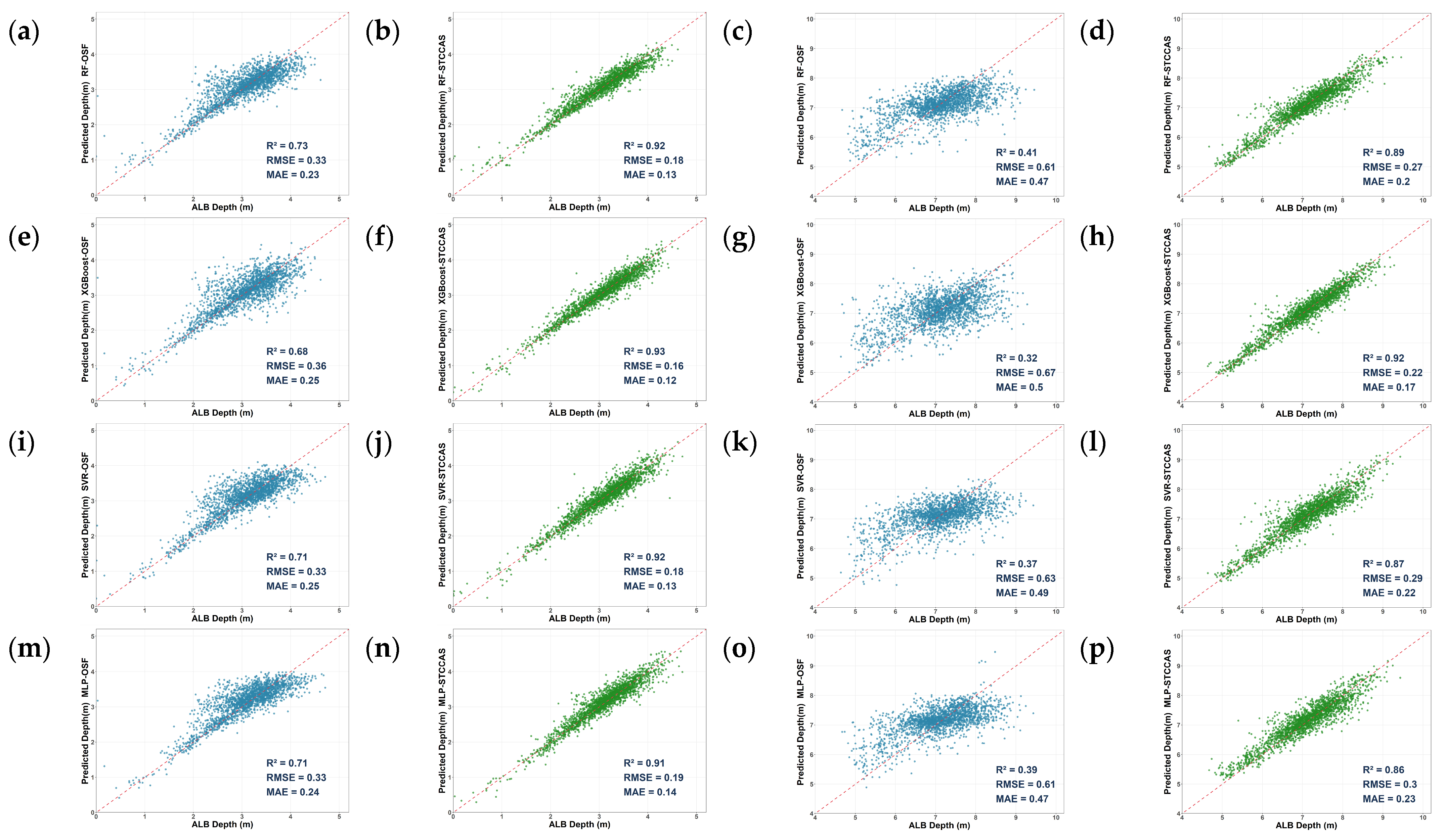
| Model | R2 | RMSE(m) | MAE(m) | |||
|---|---|---|---|---|---|---|
| Region 1 | Region 2 | Region 1 | Region 2 | Region 1 | Region 2 | |
| RF-OSF | 0.73 | 0.41 | 0.33 | 0.61 | 0.23 | 0.47 |
| RF-STCCAS (variation) | 0.92 (+0.19) | 0.89 (+0.48) | 0.18 (−0.15) | 0.27 (−0.34) | 0.13 (−0.10) | 0.20 (−0.27) |
| XGBoost-OSF | 0.68 | 0.32 | 0.36 | 0.67 | 0.25 | 0.50 |
| XGBoost-STCCAS (variation) | 0.93 (+0.25) | 0.92 (+0.60) | 0.16 (−0.20) | 0.22 (−0.45) | 0.12 (−0.13) | 0.17 (−0.33) |
| SVR-OSF | 0.71 | 0.37 | 0.33 | 0.63 | 0.25 | 0.49 |
| SVR-STCCAS (variation) | 0.92 (+0.21) | 0.87 (+0.60) | 0.18 (−0.15) | 0.29 (−0.34) | 0.13 (−0.12) | 0.22 (−0.27) |
| MLP-OSF | 0.71 | 0.39 | 0.33 | 0.61 | 0.24 | 0.47 |
| MLP-STCCAS (variation) | 0.91 (+0.20) | 0.86 (+0.47) | 0.19 (−0.14) | 0.30 (−0.31) | 0.14 (−0.10) | 0.23 (−0.24) |
Disclaimer/Publisher’s Note: The statements, opinions and data contained in all publications are solely those of the individual author(s) and contributor(s) and not of MDPI and/or the editor(s). MDPI and/or the editor(s) disclaim responsibility for any injury to people or property resulting from any ideas, methods, instructions or products referred to in the content. |
© 2026 by the authors. Licensee MDPI, Basel, Switzerland. This article is an open access article distributed under the terms and conditions of the Creative Commons Attribution (CC BY) license.
Share and Cite
Du, J.; Li, H.; Jia, S.; Li, G.; Dong, J.; Liu, B.; Bian, S. Shallow Water Bathymetry Inversion Method Based on Spatiotemporal Coupling Correlation Adaptive Spectroscopy. Remote Sens. 2026, 18, 741. https://doi.org/10.3390/rs18050741
Du J, Li H, Jia S, Li G, Dong J, Liu B, Bian S. Shallow Water Bathymetry Inversion Method Based on Spatiotemporal Coupling Correlation Adaptive Spectroscopy. Remote Sensing. 2026; 18(5):741. https://doi.org/10.3390/rs18050741
Chicago/Turabian StyleDu, Jiaxing, Houpu Li, Shuaidong Jia, Gaixiao Li, Jian Dong, Bing Liu, and Shaofeng Bian. 2026. "Shallow Water Bathymetry Inversion Method Based on Spatiotemporal Coupling Correlation Adaptive Spectroscopy" Remote Sensing 18, no. 5: 741. https://doi.org/10.3390/rs18050741
APA StyleDu, J., Li, H., Jia, S., Li, G., Dong, J., Liu, B., & Bian, S. (2026). Shallow Water Bathymetry Inversion Method Based on Spatiotemporal Coupling Correlation Adaptive Spectroscopy. Remote Sensing, 18(5), 741. https://doi.org/10.3390/rs18050741