1. Introduction
Fuel moisture content (FMC) plays a central role in fire danger assessment, directly influencing both the probability of ignition and the rate of fire spread [
1,
2]. Beyond its importance for fire danger indices, FMC is a critical input parameter for wildfire behavior modeling systems that simulate the progression of wildland fires in real-time [
3,
4,
5], with operational fire spread models [
6,
7] explicitly incorporating fuel moisture as a rate-limiting factor through moisture of extinction thresholds. The accuracy of FMC estimates therefore has direct implications for fire management decisions, evacuation planning, and resource allocation during active fire events. Fuel moisture directly modulates fire intensity and flame dynamics [
8], making accurate FMC estimation essential for predicting fire behavior transitions from surface to crown spread. Given the increasing frequency and intensity of wildfire activity across many regions [
9,
10,
11,
12], improved FMC retrieval methods are needed for operational fire management and research applications.
Satellite retrievals have become essential tools for FMC estimation, though the distinct physical properties of live versus dead fuels necessitate different methodological approaches. While live FMC retrieval relies on well-established relationships between water absorption and spectral reflectance in the near-infrared and shortwave infrared regions [
13,
14,
15,
16,
17], dead FMC estimation depends more on near-surface meteorological conditions including temperature, relative humidity, and precipitation [
18,
19,
20]. Recent advances have demonstrated the value of integrating satellite retrievals with meteorological data using machine learning frameworks to improve dead FMC predictions [
21,
22,
23,
24,
25]. Random forest and other ensemble methods [
26] have shown particular promise for capturing nonlinear relationships in FMC estimation [
27,
28], with relative humidity consistently identified as the dominant predictor across multiple geographic regions and fuel types.
The operational challenge of dead FMC estimation lies in achieving both adequate spatial resolution to capture landscape heterogeneity and sufficient temporal frequency to track rapid moisture dynamics during critical fire weather periods. Traditional approaches using numerical weather prediction (NWP) models provide meteorological inputs at regular temporal intervals but may not fully resolve fine-scale spatial variability in complex terrain [
29]. Convection-allowing models like HRRR [
29] provide improved spatial detail compared to coarser global models, yet still smooth subgrid variability that influences fuel moisture heterogeneity. Ground-based fuel moisture observation networks, while providing direct measurements, suffer from sparse spatial coverage and may not represent conditions across diverse landscapes [
30]. Satellite remote sensing can address these limitations through synoptic spatial coverage and, in the case of geostationary platforms, high temporal frequency observations.
In our previous work [
24], we developed machine learning-based regression models to retrieve 10 h dead FMC over the contiguous U.S. (CONUS) using predictors from the High Resolution Rapid Refresh (HRRR) model, the National Water Model, and Visible Infrared Imaging Radiometer Suite (VIIRS) retrievals of land surface temperature and reflectances. This approach provided daily FMC estimates during daytime overpasses and demonstrated that incorporating VIIRS data significantly improved model accuracy compared to models relying solely on meteorological inputs. However, a key limitation was the inability to capture intradiurnal FMC variability due to VIIRS’s single daily overpass over most of CONUS. This limitation is critical because fuel moisture exhibits strong diurnal cycles driven by solar radiation, temperature, and humidity variations [
31,
32,
33], with afternoon conditions often representing peak fire danger when fuels reach minimum FMC. The timelag classification system [
34] categorizes fuels by diameter-dependent moisture equilibration rates, with 10 h fuels representing intermediate response timescales appropriate for operational fire danger assessment.
Capturing this temporal evolution requires observation systems capable of resolving subdaily dynamics. While polar-orbiting satellites like Suomi-NPP provide high spatial resolution (375–750 m for VIIRS), their once-daily overpass limits temporal coverage for tracking rapid moisture changes [
35]. Geostationary platforms offer complementary advantages through continuous monitoring at 10–15 min intervals, though at coarser spatial scales (0.5–2 km for GOES-16 ABI) [
36]. The integration of both observing systems can leverage their respective strengths for fuel moisture characterization across both spatial and temporal dimensions.
To exploit these complementary capabilities, geostationary satellite data from the Advanced Baseline Imager (ABI) aboard GOES-16 offers a promising solution through hourly retrievals over CONUS. Previous studies have utilized geostationary satellite data for fire detection and monitoring [
37,
38], but applications to FMC estimation remain limited. International efforts have explored similar approaches using Meteosat and Himawari platforms for global live FMC monitoring [
13], though systematic comparisons of polar-orbiting versus geostationary contributions for dead FMC estimation have not been conducted.
This work extends our VIIRS-based methodology [
24] by examining the potential for incorporating ABI data to produce hourly 10 h dead FMC retrievals. We quantify the added value of VIIRS, ABI, and their combination using HRRR-only retrievals as baseline reference. Our methodological approach makes several novel contributions: (1) We provide the first systematic comparison of VIIRS versus ABI satellite contributions for dead FMC estimation, (2) we demonstrate hourly FMC retrieval capability that captures the complete diurnal cycle rather than single-time daily estimates, (3) we implement a lag-hour predictor that enables VIIRS data to contribute to predictions even when temporally separated from the target time, (4) we conduct comprehensive seasonal and diurnal validation analyses to assess the temporal consistency of the satellite data value, and (5) we employ multiple explainable AI methods to interpret how different predictor types contribute to model performance.
Our analysis proceeds in two stages: First, we compare the performance of VIIRS, ABI, and combined approaches during daytime VIIRS overpasses when both satellites are temporally co-located, establishing relative performance against our established methodology; second, we evaluate these approaches for hourly FMC retrieval capability across the complete diurnal cycle. To our knowledge, this represents the first comprehensive assessment of ABI and VIIRS integration for hourly 10 h dead FMC retrieval over CONUS, providing both methodological advances and operational insights for satellite-enhanced fire danger monitoring systems.
The manuscript proceeds as follows:
Section 2 describes the datasets used for model training,
Section 3 presents the methodology,
Section 4 reports the results,
Section 5 provides discussion, and
Section 6 concludes the work.
2. Datasets
The following sections describe the datasets used to train and evaluate the machine learning models and our strategy to organize the dataset to train the regression models. The predictand dataset consists in 10 h FMC observations from the Meteorological Assimilation Data Ingeset System (MADIS) archive (
Section 2.1). The predictors consist of near-surface atmospheric variables from the HRRR model run by NOAA and satellite retrievals from Suomi-NPP VIIRS and GOES-16 ABI (
Section 2.2). The datasets span a two-year period (2020–2021) and were split to independently train and validate the models (
Section 2.3).
2.1. Predictand Dataset
We used the 10 h FMC dataset described in [
24]. The original FMC observations were downloaded from the MADIS archive (
ftp://madis-data.ncep.noaa.gov//archive/ (accessed on 8 January 2026) from 1 July 2001 through 31 December 2021 (A 21-year period). The observations were extracted from hourly files and grouped together into a NetCDF file. We only kept sites with accurate metadata information and valid FMC observations. In this study, we used data for the years 2020 and 2021 since this is the period covered by the predictor datasets.
2.2. Predictor Dataset
The predictor datasets consist of variables from three different sources (
Table 1): (1) near-surface atmospheric variables and soil state information from NOAA’s HRRR model; (2) surface reflectances (sfc rfl, VNP09) and land surface temperature (LST) retrievals (VNP21) from the VIIRS instrument on board Suomi-NPP; and (3) the reflectances (rfl, channels 1–6), brightness temperatures (BT, channels 7–16), and LST retrievals from the ABI instrument on board the GOES-16 satellite.
The HRRR is NOAA’s operational hourly updating NWP model covering the CONUS with 3 km grid spacing [
39]. The Rapid Update Cycle (RUC) is the land surface model used by HRRR to represent temperature and moisture processes through nine soil levels [
40]. The majority of the dataset used in this study (2020–2021) corresponds to HRRR version 4, which became operational on 12 February 2020 to replace the previous version 3. The impacts of this change are described in [
39,
41]. Although this change is undesired since it could be the source of inhomogeneities in the variables, the majority of the period (more than 22 months out of 24) is covered by the same HRRR version (version 4).
The satellite predictors consist of retrievals from VIIRS aboard Suomi-NPP and ABI aboard GOES-16. The VIIRS retrievals are the sfc rfl and the LST. The sfc rfl are available (12 channels) at 750 m (M bands) and 375 m (I bands) grid spacing (see
Table 1). The sfc rfl predictors are only available during daytime and under clear sky conditions. Hence, there is, in general, only one valid VIIRS retrieval per day over CONUS (except for overlaps of the swath on consecutive overpasses). Only those retrievals without clouds or snow were used. On the other hand, the ABI predictors used herein consist of hourly rfls (no sfc rfl retrievals are available) and the BTs from the 16 channels available as well as the LST retrieval. The grid spacing ranges from 500 m to 2 km depending on the channel. Only clear sky retrievals were used.
The predictor datasets have different spatio-temporal resolution, so some data manipulation was necessary to pair them with the predictand dataset (see
Section 2.1) to create the training dataset. The temporal pairing of HRRR is straightforward since it is available every hour, which is the resolution of the predictand dataset. The GOES-16 ABI retrievals are available every 10 min, and we selected the nearest retrieval to the top of the hour. Finally, the VIIRS retrievals are available for download every six minutes, and each one of these granules were assigned to the nearest hour.
All the datasets were spatially interpolated into a grid over CONUS at 375 m grid spacing, and the closest point to the FMC observational sites was selected. We used 375 m because this was the finest grid spacing of the predictors. The nearest neighbor interpolation was used to put the retrievals in the target grid.
To account for the once-per-day availability of VIIRS retrievals in our hourly training dataset, we introduced a predictor that tracks the temporal offset between the most recent VIIRS observation and the prediction time. For example, if VIIRS last observed at 19:00 UTC, and we are making a prediction for 22:00 UTC, then the lag hour would be 3. In other words, we kept the VIIRS retrieval constant until there was an updated retrieval, and we kept track of the number of hours the VIIRS retrieval fell behind. Only a maximum of 72 h lag was allowed, as VIIRS observations older than 3 days were found to provide minimal predictive value for current FMC conditions. Finally, we only retained FMC data points for which all satellite bands from both GOES-16 and VIIRS were available. Data points with any missing channels from either satellite were excluded from the dataset. This filtering requirement ensured complete spectral coverage but reduced the available training samples compared to models using individual satellites alone. When the VIIRS lag hour is zero (i.e., a new retrieval is available at the target time), we have 35,253 data points. Across all lag hours, the total number of data points is 1,004,567.
2.3. Data Splitting and Standardization
The dataset was processed to prepare it for eXtreme Gradient Boosting (XGBoost) [
42] modeling. A subset of the data, termed the ‘daily dataset’, was created by selecting only those instances with available VIIRS retrievals. This resulted in a dataset with approximately one observation per day per site, and was used to evaluate the contribution of VIIRS and ABI predictors in conjunction with HRRR predictors.
To train and validate the XGBoost model, the data was divided into training (80%), validation (10%), and testing (10%) partitions. A 10-fold spatial cross-validation procedure was employed, involving repeated resampling of the training and validation sets while maintaining a fixed test set. To ensure that the FMC distribution was consistent across all partitions, a stratified random site assignment based on geographic location (latitude, longitude) to ensure representative spatial coverage across CONUS in each partition.
Prior to model training, the predictor variables and the FMC values were standardized to z-scores to ensure that no single predictor unduly influenced the model. The standardization was performed using the following equation:
where mean and standard_deviation are computed from the training data for each variable
. The standardization parameters were derived from the training set and applied to the validation and test sets. After prediction, the FMC values were rescaled to the original units using the inverse transformation.
3. Methods
3.1. Experiments
In the first assessment, we used the daily dataset (i.e., VIIRS lag hour zero) and tested four regression models. The first model included only HRRR predictors and served as the baseline. The second and third models added VIIRS and ABI predictors, respectively, to the HRRR baseline. The fourth model combined HRRR, VIIRS, and ABI predictors. By comparing the performance of these models, we quantified the individual contributions of VIIRS and ABI beyond HRRR, as well as the added value of using both satellite datasets together.
The second assessment used the hourly dataset and included four regression models. The first model again used only HRRR predictors. The second model added ABI predictors to the HRRR baseline, while the third model combined HRRR and VIIRS predictors and included a lag-hour predictor to account for the temporal offset of VIIRS retrievals. Finally, the fourth model included HRRR, ABI, and VIIRS predictors along with the lag-hour variable. This set of experiments allowed us to quantify the added value of ABI alone, VIIRS alone (with lag information), and the combined use of ABI and VIIRS for hourly FMC estimation.
A summary of all eight experiments, including predictor combinations and their purpose, is provided in
Table 2.
3.2. Machine Learning Models
This study employs XGBoost [
42], a scalable gradient-boosted decision tree algorithm that builds predictive models through iterative ensemble learning. XGBoost trains sequentially on the residuals of previous iterations to progressively reduce prediction error, making it particularly effective for tabular datasets and remote sensing applications [
43] where it frequently outperforms deep learning approaches while requiring less computational overhead and hyperparameter tuning—important considerations for operational deployment.
Given the demonstrated effectiveness of XGBoost in our previous FMC retrieval work [
24], we adopt the same hyperparameter configuration established in that study for all models presented here. Our prior extensive hyperparameter optimization using 1000 trials with the Earth Computing Hyperparameter Optimization package yielded a robust XGBoost configuration that performed consistently well across different spatial splits and validation scenarios. This configuration, which optimized learning rate, minimum loss reduction (
), maximum tree depth, number of estimators, and subsampling parameters, provides a reliable baseline that enables direct comparison of satellite data contributions without confounding effects from model tuning differences. As will be demonstrated in the results, this established XGBoost configuration continues to perform effectively for the current analysis.
3.3. Statistical Metrics
Model performance was assessed using several key metrics: the mean-absolute error (MAE), the root-mean-square error (RMSE), and the coefficient of determination (
). These metrics provide complementary evaluations of prediction accuracy. The MAE and RMSE, calculated as
quantify the average magnitude of errors between predicted (
) and observed (
) fuel moisture values. MAE represents the average absolute difference between predictions and observations, offering a straightforward interpretation of error magnitude. RMSE, on the other hand, penalizes larger errors more heavily, making it more sensitive to outliers.
The
metric, computed as
indicates the proportion of variance in the observed FMC explained by the model, where
represents the mean of the observed values, and
N is the number of data points. To evaluate the model’s skill relative to the HRRR, three skill scores were calculated:
Skill scores above zero suggest the model’s superior performance compared to the HRRR (with 1 being a perfect score), while scores below zero indicate that the HRRR performs better. A skill score of zero implies equivalent performance.
3.4. Model Interpretation
To gain insight into the relationship between the input predictors and the XGBoost model’s 10 h dead FMC predictions, we utilized several feature importance techniques. First, permutation importance was calculated to evaluate the impact of each predictor on model accuracy. This technique involves randomly shuffling the values of a single predictor and measuring the resulting increase in prediction error. A substantial increase in error suggests that the predictor is crucial for accurate predictions.
Second, SHapley Additive exPlanations (SHAP) [
44,
45] were employed to provide a more granular understanding of feature contributions. These interpretability methods [
46] are essential for building trust in operational ML systems and understanding physical relationships underlying statistical predictions. SHAP values quantify the influence of each predictor on individual predictions, relative to the average prediction. These values allow us to determine whether a specific predictor’s value increased or decreased the predicted 10 h dead FMC for a particular instance. The SHAP value represents a feature’s average marginal contribution across all possible combinations of predictors [
44].
Lastly, we leveraged the gain-based feature importance provided by the XGBoost algorithm. The gain metric reflects the improvement in model accuracy brought about by each predictor when it is used to split nodes in the decision trees. Predictors with higher gain are considered more influential in the model’s predictions.
4. Results
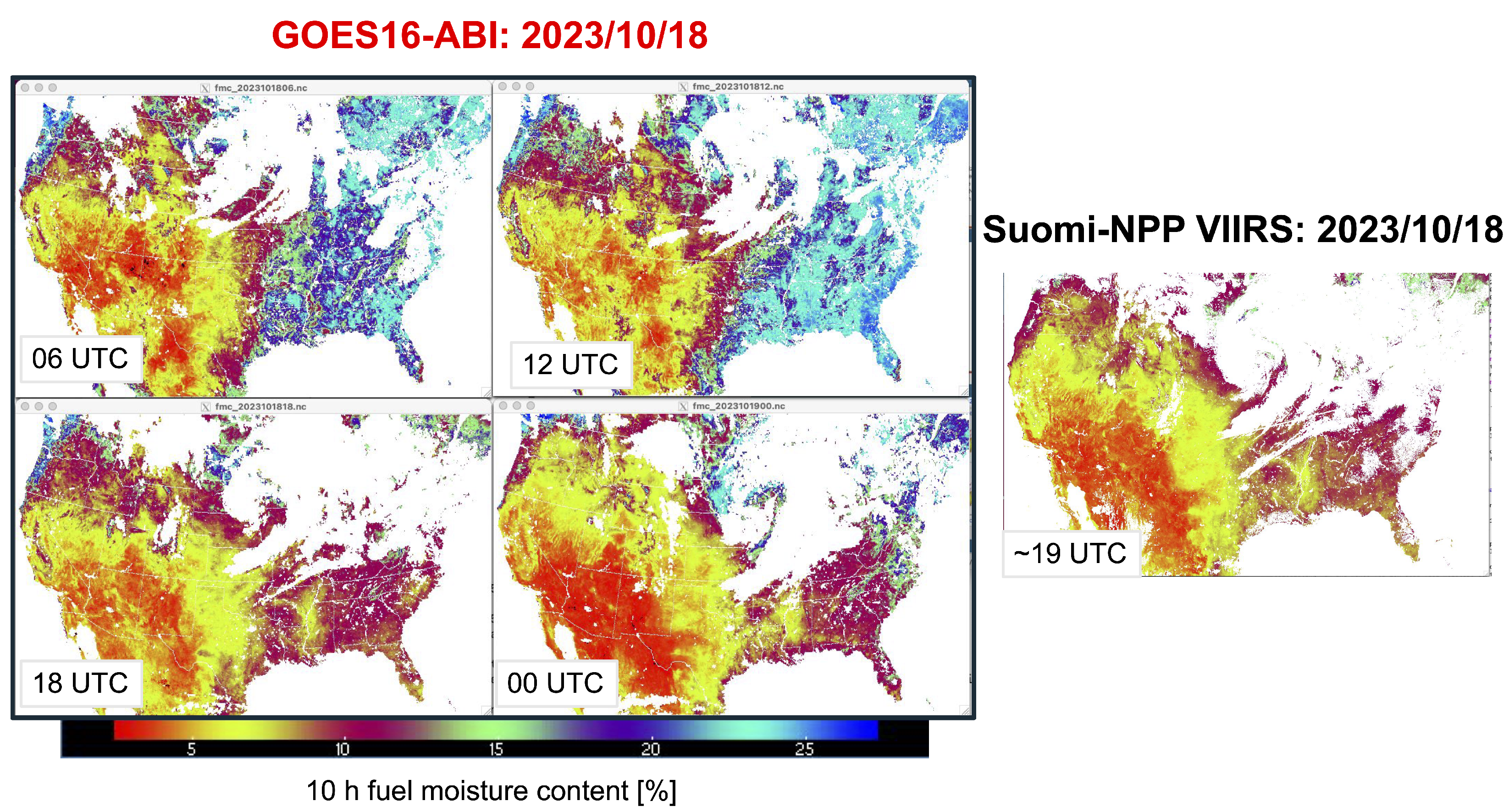
Figure 1 presents satellite-based FMC retrievals from GOES-16 ABI and Suomi-NPP VIIRS, demonstrating the pronounced diurnal cycle across CONUS for 18 October 2023. Observations reveal systematic moisture depletion from morning (06 UTC) through late afternoon (18 UTC), with recovery beginning in evening hours (00 UTC). This diurnal amplitude is particularly evident in eastern CONUS where higher baseline FMC creates larger absolute variations, while western regions maintain relatively dry conditions throughout the cycle. The VIIRS observation at approximately 19 UTC provides temporal alignment with GOES observations during the afternoon moisture minimum, enabling direct comparison between the two satellite systems during peak fire danger conditions.
To assess the impact of integrating GOES-16 ABI alongside Suomi-NPP VIIRS, we focus on the daily and hourly experiments summarized in
Table 2. In case 1 (daily), VIIRS and ABI are temporally co-located, meaning the VIIRS lag hour is zero and both sensors observe the scene at the same time. This configuration enables us to evaluate the added value of ABI when its observations are temporally aligned with VIIRS, despite differences in their spatial and spectral characteristics. It is worth noting that the dataset used in this analysis is more limited than our previous work [
24], covering a shorter temporal period (2020 onward versus 2019 in the previous study) and fewer observation sites due to the requirement for temporal alignment with ABI data. Despite these constraints, baseline model performance remains comparable to our earlier findings (see
Figure 2 in [
24]), confirming the robustness of the XGBoost approach across different dataset configurations. In case 2 (hourly), only ABI observations are fixed in time, while VIIRS is allowed to have a nonzero lag hour—representing a more typical operational scenario where the two sensors are not temporally synchronized. Since ABI provides higher temporal resolution and VIIRS offers finer spatial detail, comparing these two cases allows us to assess the sensitivity of model performance to temporal alignment and to determine whether ABI still contributes meaningful information when not co-timed with VIIRS.
4.1. Baseline Model Performance Using HRRR Data
We first examine how HRRR data performs as input to an XGBoost model under both modeling scenarios.
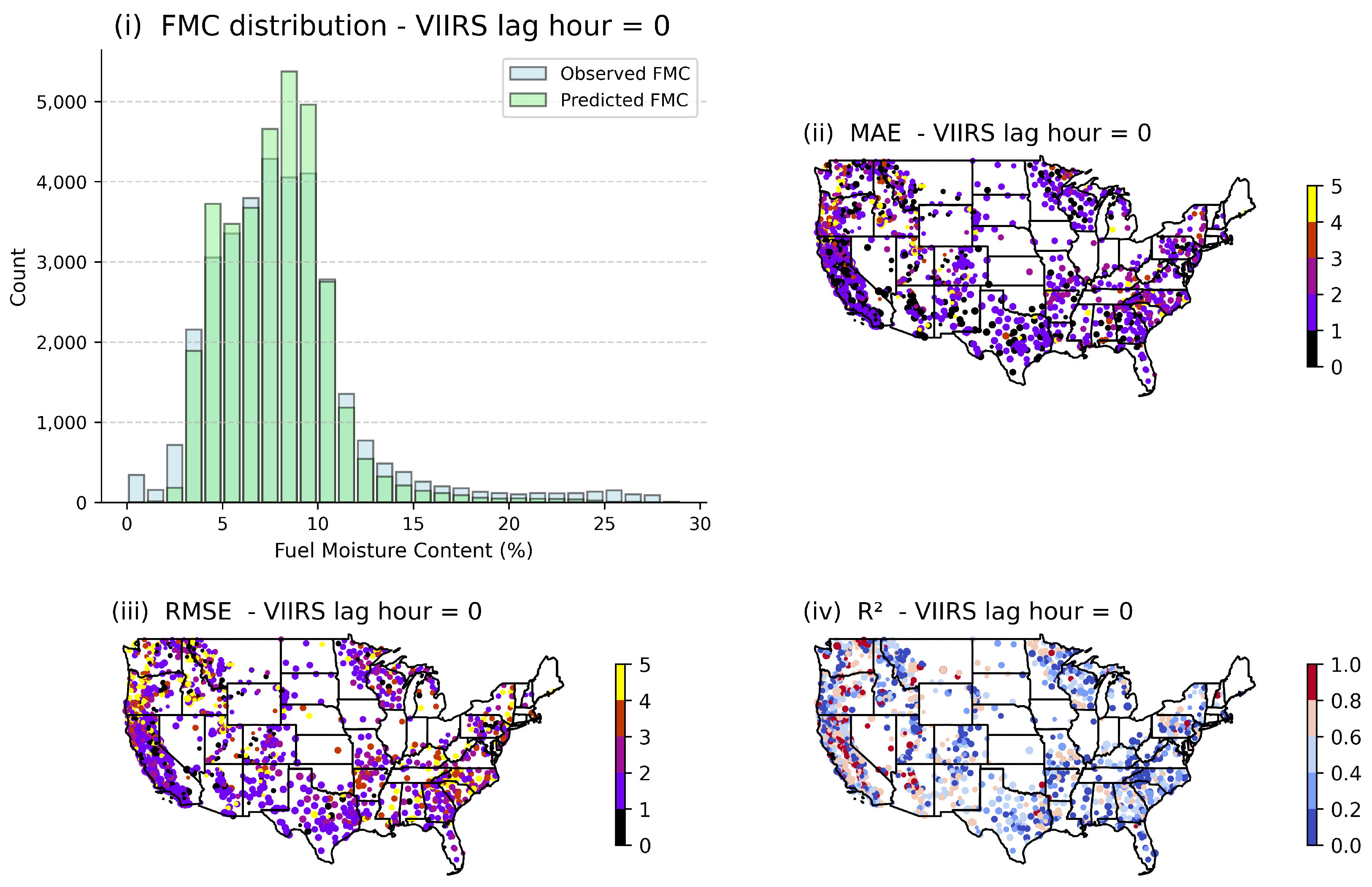
Figure 2 demonstrates HRRR-only baseline performance during co-located satellite observations (VIIRS lag hour = 0), achieving moderate skill with MAE of 1.68% and R
2 of 0.51 across CONUS test sites. Performance metrics across the CONUS are computed in aggregate and listed in
Table 3, with histogram and spatial distributions of the errors shown in
Figure 2. These HRRR-only results serve as the baseline for evaluating the impact of additional predictors in later experiments.
The co-located dataset (
Figure 2) samples FMC conditions around the VIIRS overpass time (approximately 19 UTC), capturing primarily afternoon states with a narrower dynamic range of FMC values—mostly below 15%, as shown in
Figure 2i. This afternoon-only sampling represents conditions during peak fire danger but limits exposure to the full moisture range. Despite this restricted variability, the HRRR-only model achieves a mean MAE of 1.68 and RMSE of 3.11 (
Table 3), with performance metrics consistent with our previous VIIRS-HRRR results [
24]. Spatially, MAE values (
Figure 2ii) remain generally below 3% across CONUS, with slightly higher errors in mountainous regions. RMSE patterns (
Figure 2iii) show larger errors in mountainous and southeastern regions where terrain complexity and vegetation density create greater prediction challenges. The moderate R
2 of 0.51 (
Figure 2iv) reflects both model skill and the restricted variability inherent to afternoon-only sampling, where limited moisture range reduces the denominator in R
2 calculations.
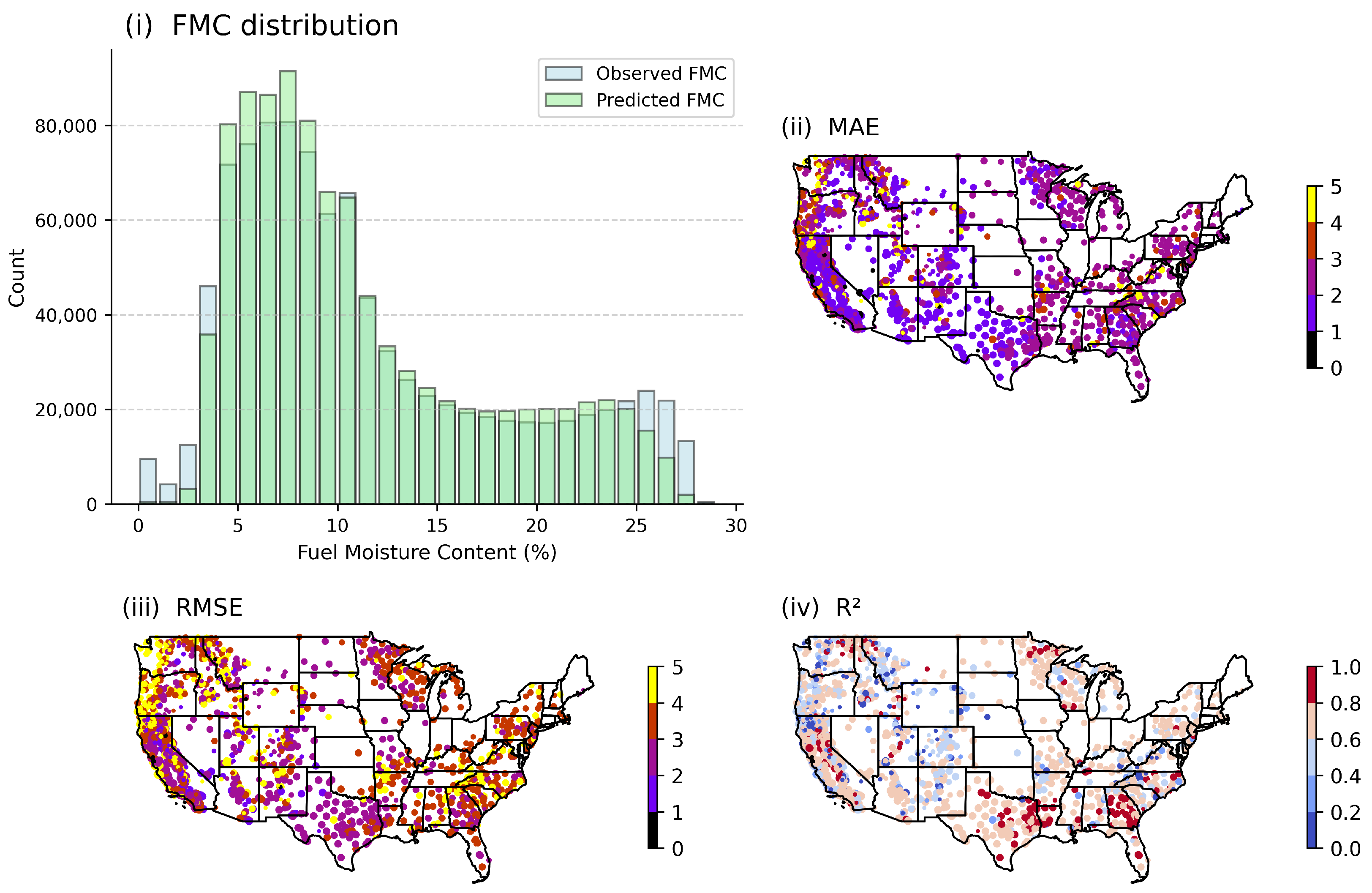
Figure 3 presents HRRR-only model performance for the hourly dataset encompassing the complete diurnal cycle. The model demonstrates improved explained variance (R
2 = 0.71) compared to the co-located case despite higher absolute errors (MAE = 2.36%, RMSE = 3.88%), indicating enhanced capture of temporal dynamics across diverse moisture conditions. This 39% increase in R
2 (from 0.51 to 0.71) represents a critical finding: Models trained on complete diurnal cycles develop substantially improved physical fidelity to underlying moisture processes, even as they encounter broader ranges of atmospheric conditions that increase point-to-point errors.
In contrast to the co-located case, the hourly scenario exposes the model to the full diurnal cycle of FMC values (
Figure 3i), with observations spanning from dry afternoon minima below 10% to moist morning maxima exceeding 20%. While absolute errors increase relative to the co-located case (MAE rises to 2.36 and RMSE to 3.88) the model achieves a substantially higher R
2 of 0.71 (
Figure 3iv). This improvement in explained variance despite higher absolute errors constitutes a critical finding: The hourly model better captures FMC temporal dynamics across diverse moisture conditions, providing substantially more robust characterization of FMC variability than afternoon-only sampling.
Spatially, higher errors concentrate in eastern, southeastern, and Pacific Northwest regions (
Figure 3ii,iii) where diurnal changes are most pronounced due to higher baseline moisture and stronger diurnal cycles. Western arid regions show relatively consistent error patterns despite their importance for fire management, suggesting that the model handles both spatial and temporal variability effectively in these landscapes. The 39% increase in R
2 (from 0.51 to 0.71) demonstrates that models trained on complete diurnal cycles develop improved physical fidelity to underlying moisture processes, even as they encounter broader ranges of atmospheric conditions that increase point-to-point errors. This enhanced representation of temporal dynamics provides a more robust foundation for assessing satellite data contributions across operationally relevant time scales.
4.2. Impact of Satellite Predictors on Model Performance
We now evaluate the impact of adding satellite data using HRRR-only performance as baseline. The complete performance metrics for all eight experimental configurations are presented in
Table 3. Standard deviations reported in parentheses reflect variability across the 10-fold cross-validation procedure and indicate the consistency of performance improvements across different data splits.
4.2.1. Case 1 (Co-Located): Temporal Alignment Benefits
In the co-located scenario where VIIRS and ABI observations are temporally aligned with HRRR, incorporating either satellite product consistently improves model performance across all metrics. ABI alone marginally outperforms VIIRS, particularly in RMSE and R2. This is a first indication of the complementary information provided by the ABI and VIIRS variables. In this direction, the greatest improvements emerge when both datasets are combined, yielding reductions of 11.1% in MAE, 9.1% in RMSE, and a notable 16.9% increase in R2. This synergistic effect demonstrates the complementary strengths of ABI and VIIRS instruments for FMC estimations.
4.2.2. Case 2 (Hourly): Full Diurnal Cycle Representation
The hourly configuration, which incorporates the complete diurnal cycle without requiring temporal alignment, exhibits markedly different characteristics. As anticipated from the expanded dynamic range of FMC observations, absolute error metrics (MAE and RMSE) increase relative to case 1. However, R2 values continue to improve substantially, indicating enhanced model fidelity to the underlying FMC dynamics. Most remarkably, the skill improvements in this scenario often exceed those from the co-located case. The combined ABI + VIIRS model delivers the strongest performance, with 27.5% improvement in MAE, 27.0% in RMSE, and a substantial 46.7% increase in R2 compared to the HRRR baseline. The small standard deviations relative to the magnitude of skill improvements (e.g., 27.5% ± 0.4% MAE improvement) indicate these performance gains are robust across cross-validation folds.
4.2.3. Implications for Operational Applications
These results reveal a trade-off in FMC modeling approaches. While the co-located case achieves lower absolute errors by sampling a narrower moisture range, the hourly approach better captures FMC dynamics across the complete diurnal cycle, resulting in higher R2 despite increased MAE and RMSE. The consistently superior performance of the combined ABI + VIIRS approach across both cases reinforces the operational value of integrating complementary satellite observations: On top of using complementary variables, ABI provides the temporal resolution necessary to capture diurnal dynamics, while VIIRS contributes the spatial detail essential for heterogeneous landscape conditions.
4.3. Spatial Distribution of Skill Improvements
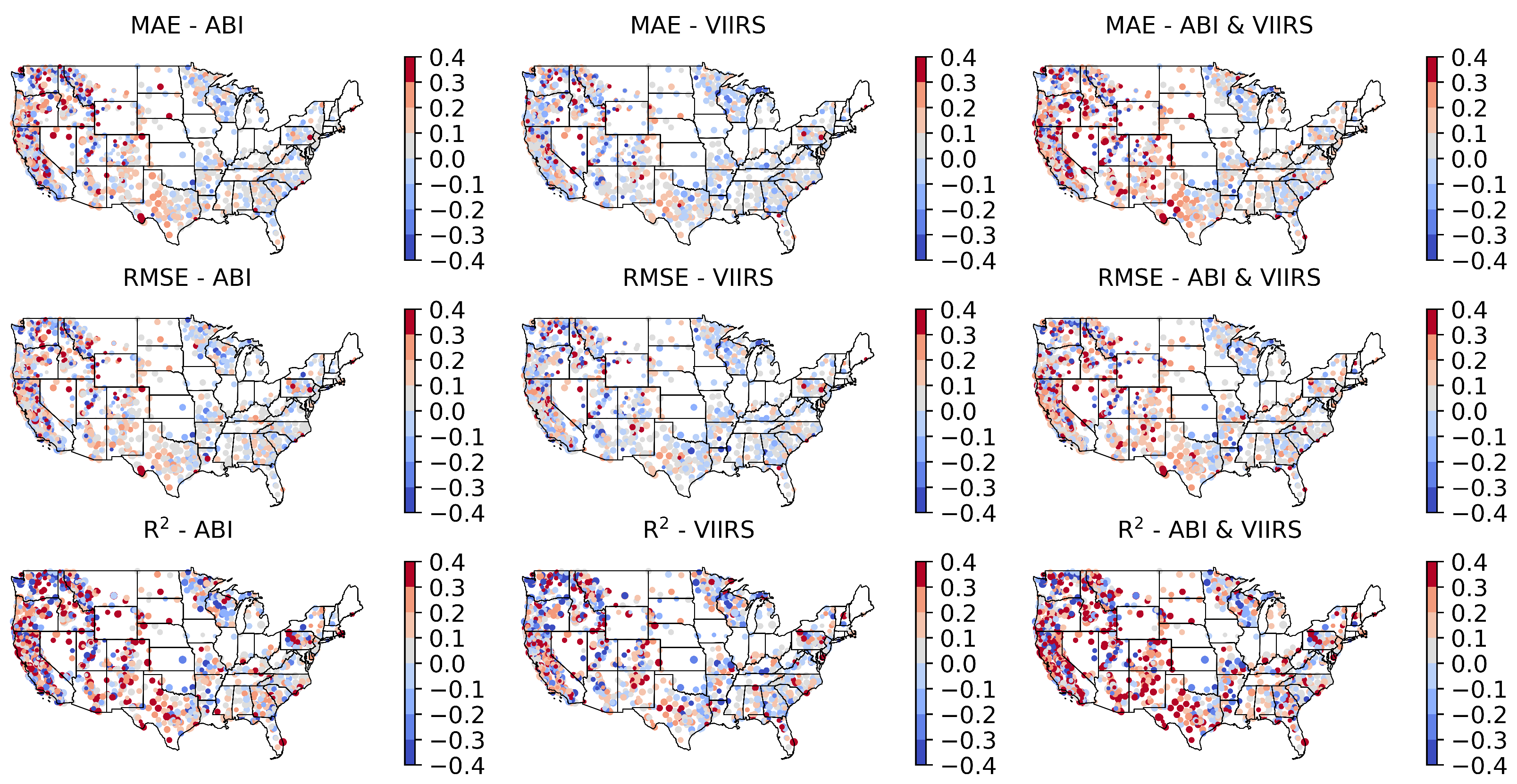
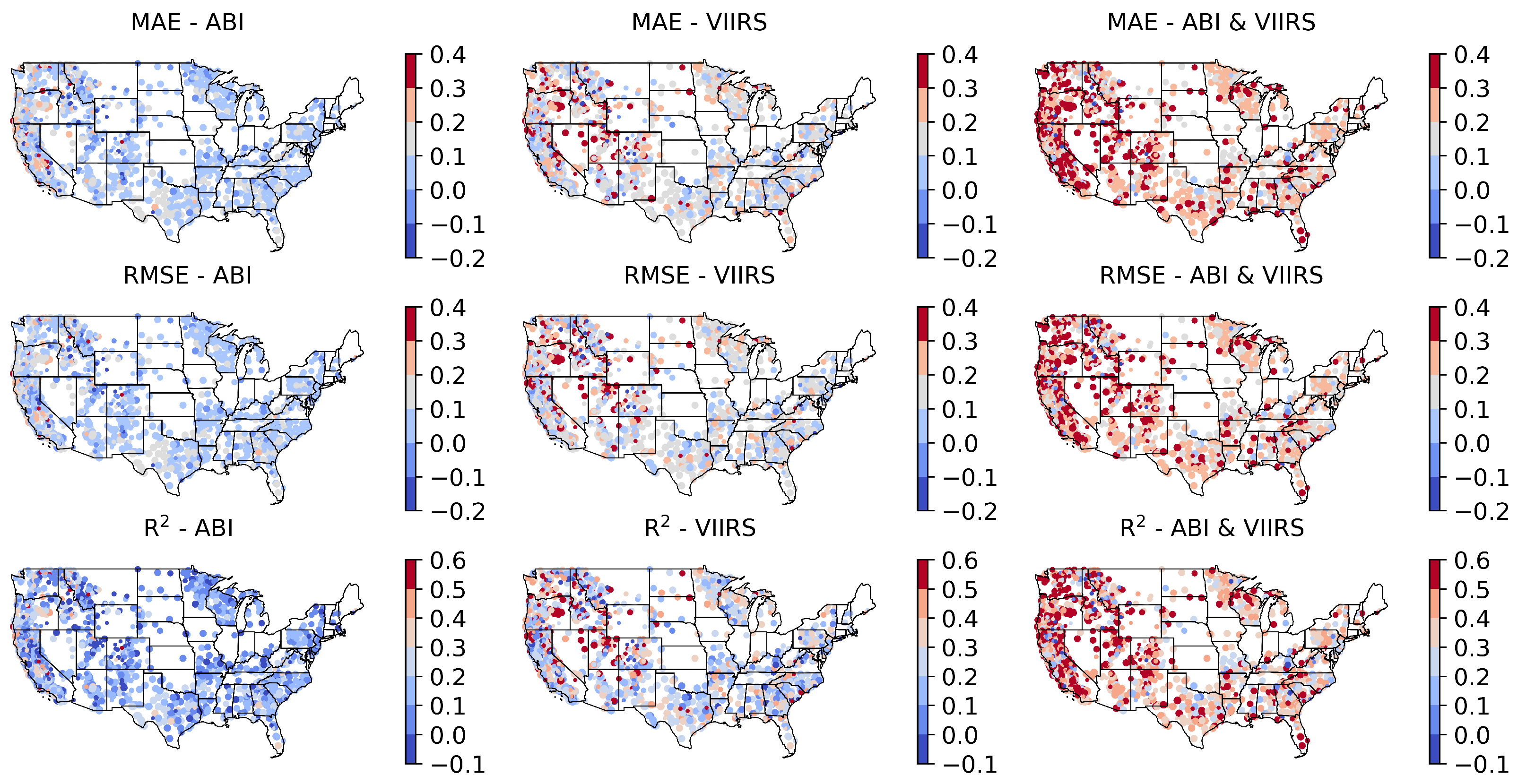
We examine the spatial distribution of model improvements across CONUS by evaluating skill scores for the daily and hourly datasets in
Figure 4 and
Figure 5, respectively. In each scenario, satellite-derived predictors are added incrementally to the HRRR baseline: HRRR + ABI, HRRR + VIIRS, and HRRR + ABI + VIIRS. These figures display spatial differences in skill for MAE, RMSE, and R
2, with red indicating improved performance relative to the HRRR-only baseline and blue indicating degraded performance.
4.3.1. Co-Located Case Performance Patterns
The spatial patterns in
Figure 4 show that integrating satellite observations in the co-located case yields consistent improvements across multiple skill metrics. MAE skill improvements are most pronounced across the western U.S., particularly over California, Nevada, and the northern Rockies, where the model achieves reduced average errors. These improvements indicate regions where satellite data corrects systematic biases or captures fine-scale variability that HRRR meteorological analysis cannot resolve.
RMSE skill patterns closely follow the MAE results, confirming that both average error and error variability decrease with satellite input. This indicates the combined model handles both typical and extreme deviations more effectively than HRRR alone. ABI data gives most of the improvements across the West and Southwest (California, Texas, the Pacific Northwest, and the northern Rockies), probably because its higher temporal resolution better captures strong diurnal cycles in these regions. VIIRS shows smaller, more localized improvements scattered across the country, with some apparent gains in areas like Wisconsin and Minnesota where the finer spatial resolution may help resolve heterogeneous land cover and terrain features, though the overall pattern is less clear.
R2 skill scores support these findings, showing improved model fit when ABI and VIIRS are combined. While the R2 improvements are moderate, the spatial extent of positive skill expands compared to either satellite alone, particularly across complex terrain and arid regions where HRRR has difficulty capturing fine-scale meteorological variability.
4.3.2. Geographic Bias and Temporal Alignment Effects
The skill improvements concentrate in the western half of CONUS, with smaller but consistent positive signals in portions of the central and eastern U.S. This geographic distribution likely reflects the afternoon satellite overpass timing (~19 UTC), which coincides with peak drying conditions in western regions where fire danger is most acute during these hours. The eastern U.S., characterized by higher baseline FMC and more complex diurnal cycles, shows less-pronounced benefits but still achieves measurable improvements relative to HRRR-only predictions.
The combined ABI + VIIRS configuration consistently enhances skill across all metrics, with the spatial pattern indicating that ABI data provides the dominant contribution in this co-located context while VIIRS adds valuable localized detail. This performance suggests that advantages from ABI retrievals outweigh the spatial resolution benefits of VIIRS variables when observations are temporally aligned.
4.3.3. Hourly Case Performance and Diurnal Cycle Representation
The performance metrics for case 2 in
Figure 5 reflect the model’s ability to capture the full diurnal cycle of FMC conditions, resulting in improved overall fit across CONUS. All three satellite-enhanced configurations consistently produce MAE and RMSE values comparable to or lower than the HRRR-only baseline, despite operating over a broader and more variable moisture range throughout the day.
ABI data addition yields moderate but widespread improvements, primarily concentrated across the western U.S. and parts of the Southeast. VIIRS enhancements follow similar spatial patterns but with more pronounced gains in the western CONUS characterized by complex terrain and fine-scale variability that benefit from higher spatial resolution observations. The combined ABI + VIIRS configuration outperforms either satellite alone, producing the most extensive improvements across all skill metrics, including substantial R2 increases over much of CONUS.
4.3.4. Quantitative Assessment of Combined Satellite Benefits
The spatial distribution of the top 10% of sites exhibiting the largest MAE skill gains provides insight into where satellite combinations are most effective. At these locations, the ABI + VIIRS combination delivers gains over ABI alone ranging from approximately 0.3 to 1.0 in skill scores, predominantly across the northern Rockies, Pacific Northwest, and parts of the Intermountain West. Similarly, gains relative to VIIRS alone reach between 0.2 and 0.57 in key western regions, demonstrating the complementary strengths of the two data sources, with ABI’s temporal sampling providing substantial additional value in flatter, more arid areas where the benefits of VIIRS’s spatial resolution may be more limited.
The aggregate performance metrics in
Table 3 show that the ABI + VIIRS approach reduces MAE and RMSE by more than 25% and increases R
2 by nearly 47% relative to HRRR alone. These improvements are particularly pronounced in areas with significant diurnal moisture variability such as the central and eastern U.S. which are better represented in this all-hours analysis. The temporal resolution of ABI in combination with VIIRS proves critical for tracking rapid moisture dynamics, while VIIRS’ higher spatial resolution seems to help resolve localized features in more topographically complex regions. The synergy between these satellite systems enables the model to better represent fuel moisture changes across diverse terrain and temporal scales throughout the complete diurnal cycle.
4.4. Seasonal Variability in Satellite Data Contributions
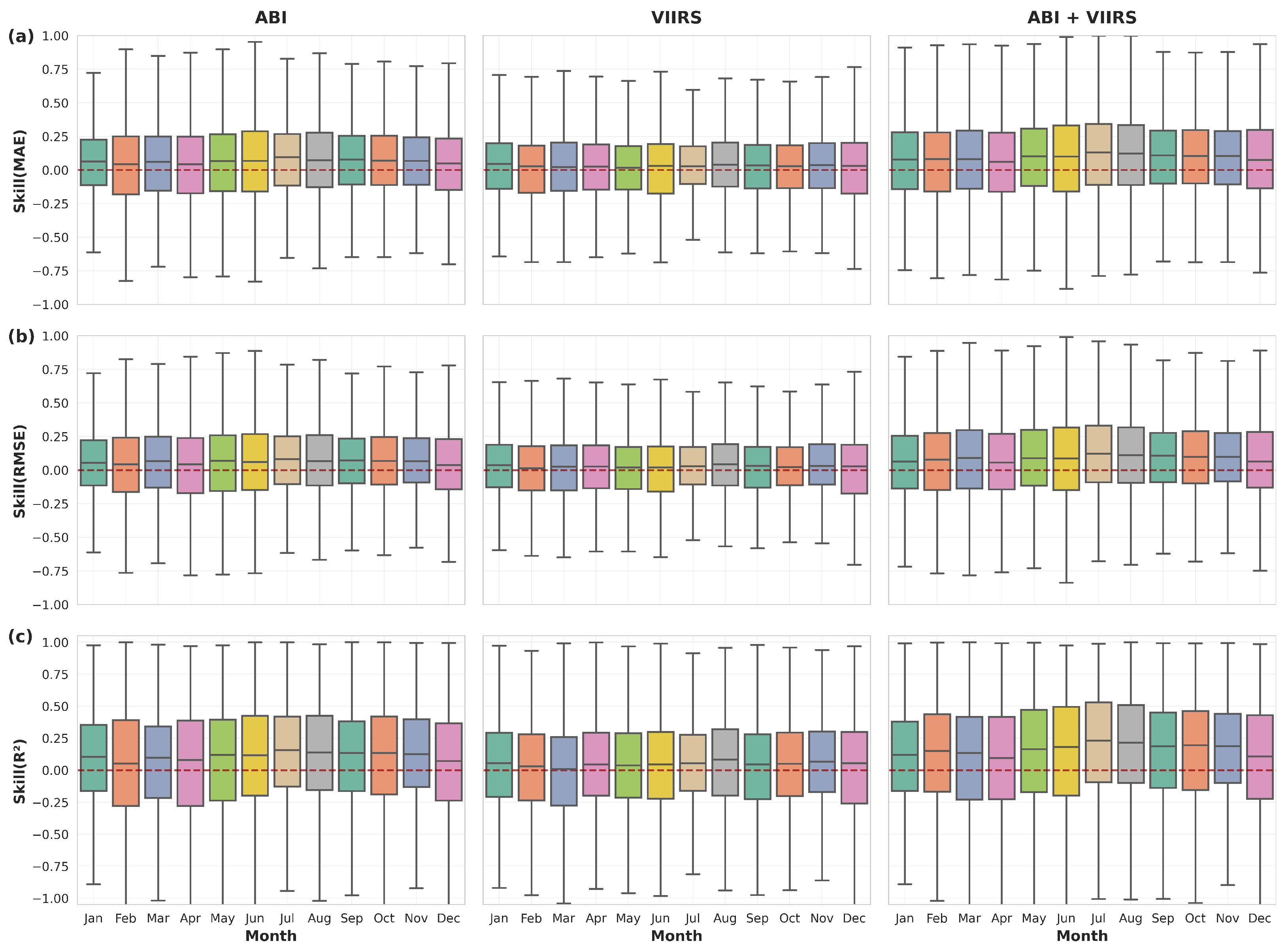
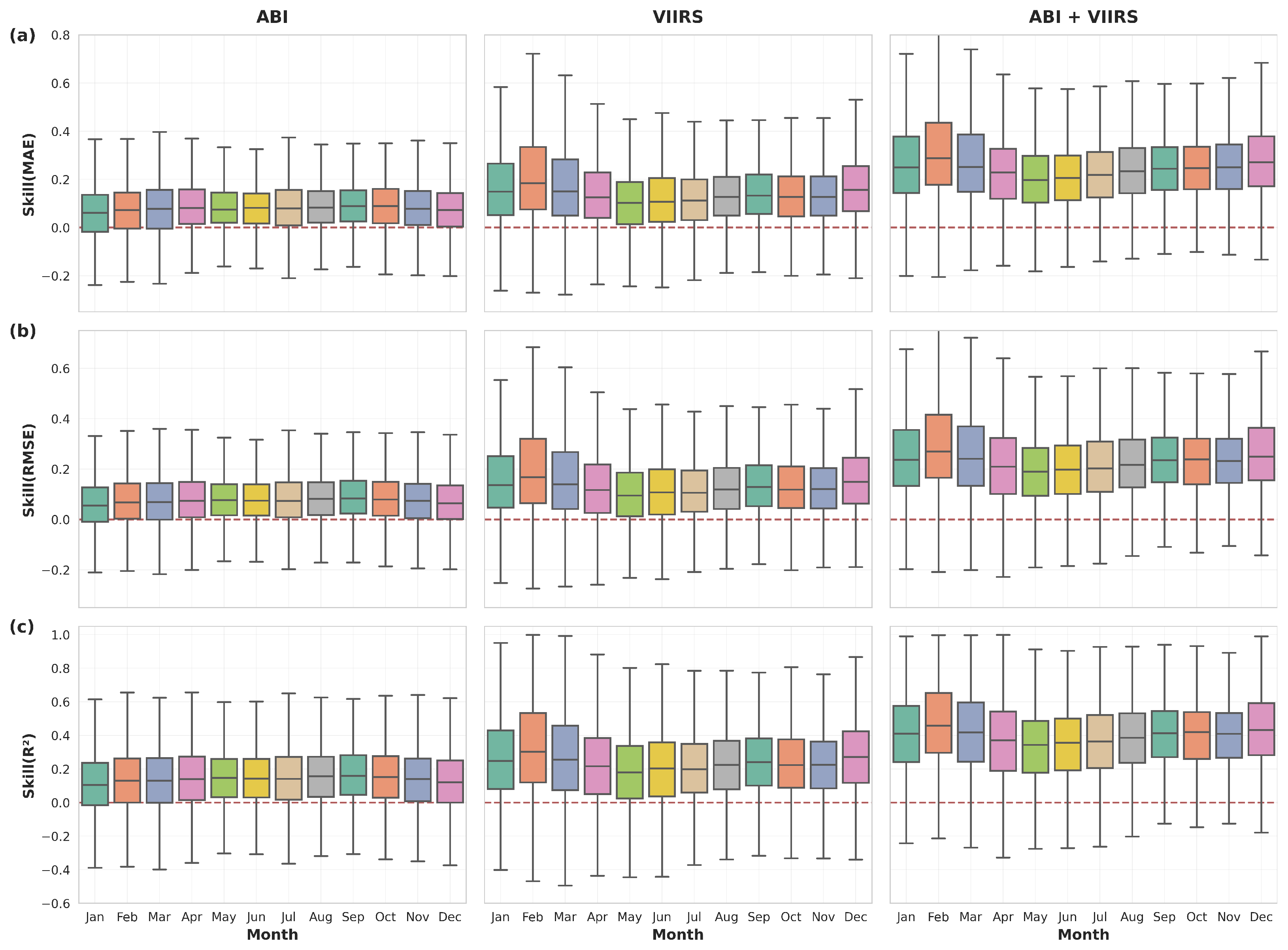
We evaluate the seasonal consistency of satellite data contributions through monthly boxplot distributions of skill scores in
Figure 6 and
Figure 7. Both figures present skill scores normalized relative to the HRRR baseline for three experimental configurations: ABI (+HRRR), VIIRS (+HRRR), and the combined ABI + VIIRS (+HRRR) across MAE, RMSE, and R
2 metrics. The horizontal red dashed line at zero represents the HRRR-only baseline, with positive values indicating performance enhancements from satellite data integration.
4.4.1. Co-Located Case: Consistent Annual Performance
Figure 6 shows that the co-located observation scenario demonstrates consistent improvement patterns throughout the annual cycle when augmenting HRRR predictions with satellite-derived variables. All three satellite configurations exhibit predominantly positive skill scores across monthly aggregations, with median values consistently above the zero threshold for MAE, RMSE, and R
2 metrics. The ABI + VIIRS combination achieves the highest median improvement magnitude (approximately 0.2 for R
2 compared to 0.1 for individual satellites) but exhibits wider interquartile range distributions, indicating greater potential benefits alongside increased variance in performance enhancement. This suggests the combined approach offers superior predictive capabilities while introducing higher statistical variability in prediction outcomes.
4.4.2. Hourly Case: Enhanced Performance Across All Seasons
Figure 7 illustrates the hourly scenario with comprehensive temporal coverage and reveals more pronounced improvements, particularly for the ABI + VIIRS approach, which exhibits R
2 skill scores with median values consistently in the 0.4–0.5 range throughout the year. All three satellite configurations maintain statistically significant positive skill scores across all seasonal periods, with consistent positive skill throughout the year with stable median values in the ABI-only case and slightly more pronounced seasonal variability for VIIRS and the combined approach. The uniform year-round improvement pattern with minimal seasonal degradation indicates that satellite observations provide systematically valuable information complementary to numerical weather prediction data regardless of seasonal atmospheric conditions or surface vegetation phenological states. The most substantial enhancements are achieved through integrating both satellite systems, suggesting that the variables retrieved from each instrument as well as the temporal resolution of ABI and spatial resolution of VIIRS contribute complementary information across different seasonal contexts.
4.5. Diurnal Variation in Model Performance
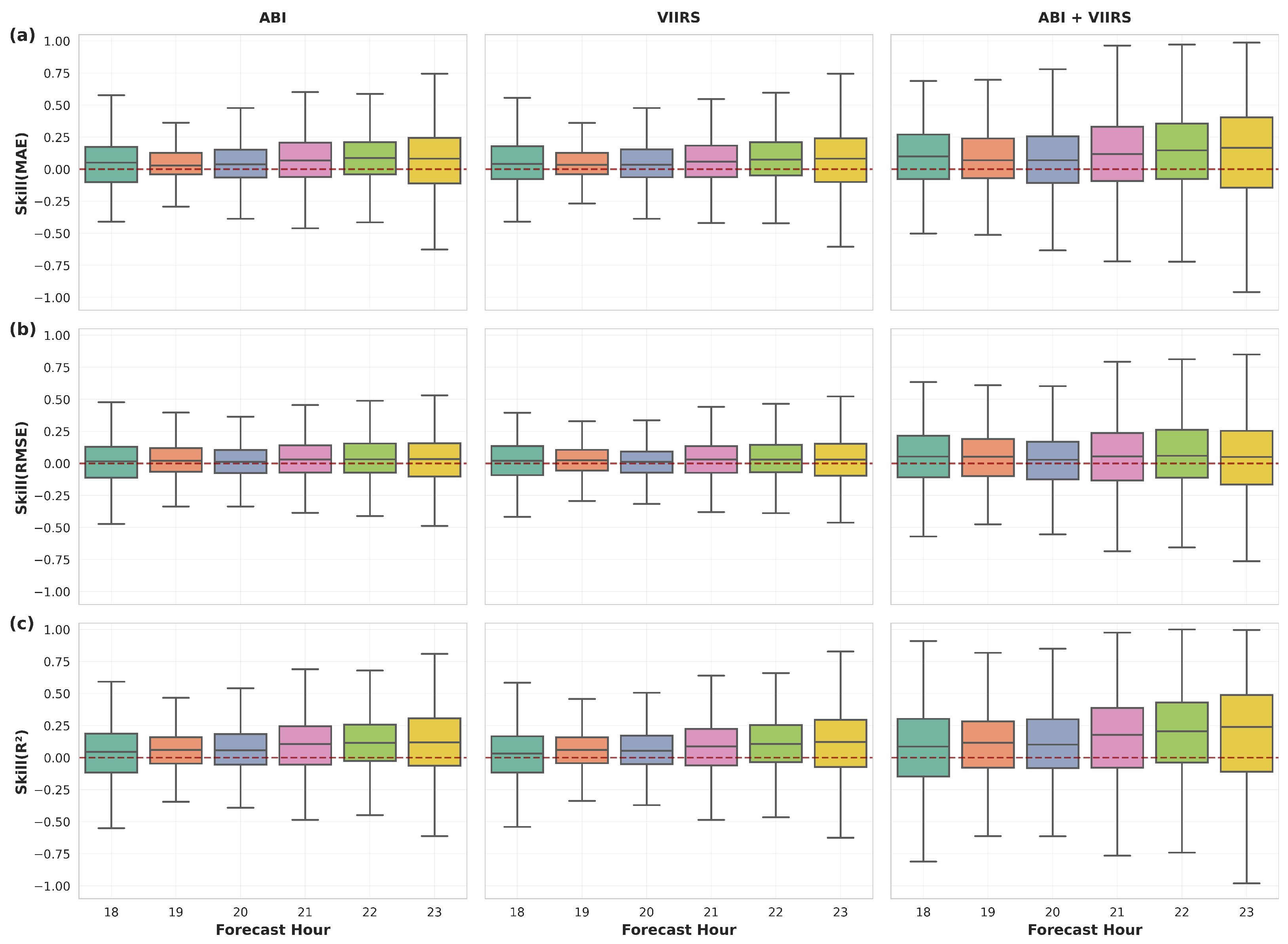
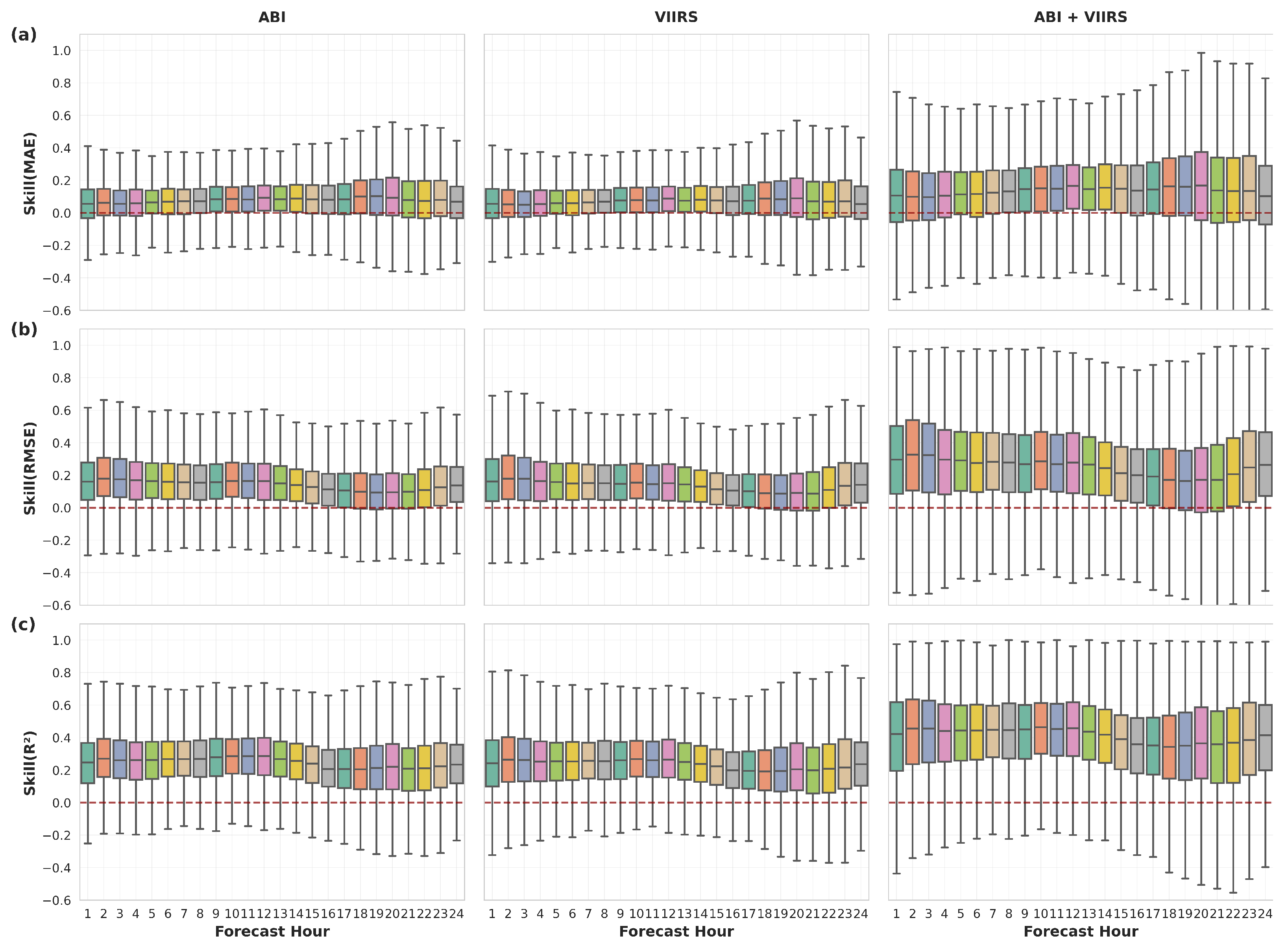
We examine diurnal performance patterns through hourly boxplot distributions in
Figure 8 and
Figure 9, analogous to the monthly analyses but stratified by hour across CONUS.
Figure 8 focuses on hours 18–23 UTC, corresponding to typical co-located satellite observation windows, while
Figure 9 extends the analysis across the complete 24 h diurnal cycle. Both figures display statistical distributions of MAE, RMSE, and R
2 skill scores relative to the HRRR-only baseline for ABI, VIIRS, and combined ABI + VIIRS approaches.
4.5.1. Co-Located Hours Performance Analysis
Figure 8 shows that incorporating satellite-derived variables consistently enhances model performance during afternoon and early evening periods. Both ABI and VIIRS data integration, particularly when combined, systematically increases the skill of the metrics, as evidenced by boxplot distributions predominantly above the zero reference line. During several evening hours, the combined ABI + VIIRS input yields median MAE-based skill scores of approximately 0.2 and RMSE-based skill scores approaching 0.1. The R
2 values exhibit positive skill enhancement, around 0.2, indicating improved explanatory capacity for FMC variance during peak fire danger periods.
These improvements remain modest compared to the all-hours case shown in
Figure 9. The limited gains in the co-located setting likely reflect both reduced temporal coverage and the narrower training context, suggesting that while satellite inputs provide benefits during co-located observations, their full potential is realized when models are trained across the complete diurnal cycle.
4.5.2. Complete Diurnal Cycle Assessment
Figure 9 provides comprehensive analysis of satellite data impact throughout the entire 24 h cycle. The boxplot distributions for MAE and RMSE consistently demonstrate statistically significant error reduction when ABI and VIIRS data are incorporated, both individually and in combination. The combined ABI + VIIRS approach yields the most substantial and consistent improvements across all hours, with median MAE improvements of approximately 0.15 and RMSE improvements of about 0.3.
For R
2,
Figure 9 demonstrates positive skill enhancement across all diurnal periods for all three satellite-enhanced configurations, with the combined ABI + VIIRS approach frequently exhibiting the highest improvement values (median R
2 enhancement of 0.4 compared to 0.2–0.3 for individual satellites). This pattern confirms the consistent value of incorporating multi-sensor satellite data across the complete diurnal cycle, substantially enhancing the model’s capacity to capture temporal dynamics of fuel moisture beyond the limited co-located observation window.
The sustained improvement in all metrics throughout 24 h highlights the role of satellite observations in providing more robust and physically representative characterization of FMC dynamics for operational fire danger assessment applications.
4.6. Feature Importance Analysis Using Explainable AI Methods
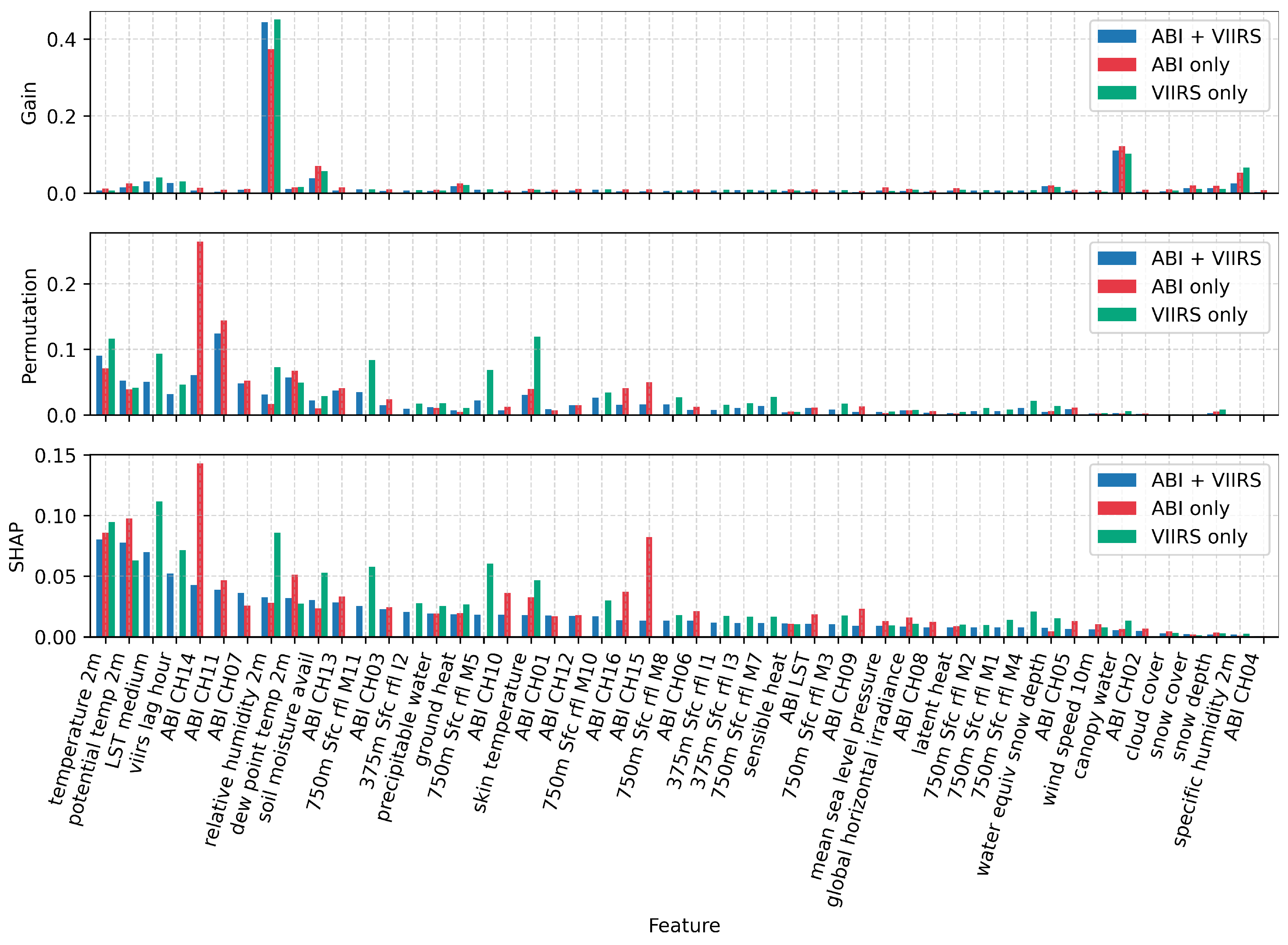
We analyze feature contributions to model performance using three explainable AI (XAI) methods in
Figure 10: gain-based importance, permutation importance, and SHAP values across ABI, VIIRS, and combined ABI + VIIRS configurations for the all-hours case. Each method captures different aspects of how variables contribute to FMC prediction performance, revealing distinct patterns that provide insight into model decision-making processes.
4.6.1. Contrasting Importance Metrics
Gain-based importance reveals a clearly different pattern from permutation and SHAP methods. Gain analysis shows extreme concentration in just two HRRR variables: Relative humidity at 2 m above ground level dominates with an importance score of approximately 0.45, while canopy water exhibits a secondary peak near 0.1. All remaining features, including satellite-specific variables, exhibit minimal gain importance (values below 0.05) across all configurations. This dominance of relative humidity and canopy water is physically reasonable given their fundamental role in controlling FMC dynamics through atmospheric moisture availability and evapotranspiration processes. The near-zero gain importance for satellite features suggests these variables are not primary drivers of tree-splitting decisions in the XGBoost algorithm, despite their demonstrated value in improving prediction accuracy.
In contrast, both permutation importance and SHAP methods reveal distributed importance across many features, with satellite observations contributing prominently. Permutation importance identifies ABI thermal infrared channel 11 (8.4 μm) as the leading contributor with importance near 0.3, followed closely by temperature 2 m, goes16 CH14 (11.2 μm), and dewpoint temp 2 m. Multiple ABI thermal channels (CH07 at 3.9 μm, CH13 at 10.3 μm) appear in the top ten features alongside VIIRS products including land surface temperature and surface reflectance band M11. SHAP analysis shows a similar distributed pattern with slightly different ordering: Atmospheric temperature variables (temperature 2 m, potential temp 2 m) lead with importance values near 0.09, followed immediately by VIIRS land surface temperature, VIIRS lag-hour, and the same suite of ABI thermal infrared channels. The consistency between permutation and SHAP methods, where both show distributed importance with satellites contributing significantly, stands in stark contrast to the concentrated pattern observed in gain importance.
The VIIRS lag hour feature appears only in VIIRS and combined ABI + VIIRS configurations, consistently ranking in the top ten for both SHAP (#4) and permutation (#10) methods while showing negligible gain importance. This temporal lag feature represents the time difference between VIIRS observation and prediction time, indicating that the model successfully learns to extract value from temporally offset observations. The prominence of ABI thermal infrared channels across both permutation and SHAP rankings, particularly channels sensitive to surface temperature and atmospheric water vapor (3.9, 8.4, 10.3, 11.2 μm), reflects the physical importance of thermal dynamics for FMC equilibration rates.
4.6.2. Physical Interpretation
The substantial divergence between gain importance and the other two methods indicates that features important for tree-splitting decisions are not necessarily the same as features important for overall model performance or individual prediction contributions. Gain importance reflects the total improvement in loss function when a feature is used for splits across all trees in the ensemble, effectively measuring how the algorithm structures its primary decision logic. Permutation and SHAP importance instead measure how features contribute to final prediction accuracy—permutation through degradation when shuffled, SHAP through marginal contribution across all possible feature combinations.
The observed patterns suggest a hierarchical prediction framework. HRRR meteorological variables, particularly relative humidity and canopy water, provide the baseline physical structure for FMC prediction, establishing primary decision thresholds based on atmospheric moisture availability. These variables dominate tree-splitting decisions because they capture the fundamental equilibrium state toward which fuel moisture tends under given atmospheric conditions. Satellite observations, while not driving primary splits, contribute meaningfully to prediction refinement, as evidenced by their prominence in permutation and SHAP importance. The 3 km grid spacing of HRRR necessarily averages subgrid variability in surface thermal properties, vegetation characteristics, and topographic effects. VIIRS observations at 375–750 m resolution and ABI’s hourly temporal sampling preserve fine-scale spatial structure and rapid thermal fluctuations that influence actual fuel conditions at management-relevant scales. The model learns to use these satellite observations as corrections to the HRRR-based baseline, refining predictions based on observed surface conditions rather than modeled atmospheric state alone.
This complementary structure—HRRR providing synoptic-scale atmospheric context with satellite data resolving local-scale heterogeneity—explains why combining multiple data sources yields substantially better performance than any single source. The distributed importance across both atmospheric variables and satellite products in permutation/SHAP analysis, contrasted with concentrated importance of atmospheric variables alone in gain analysis, demonstrates that effective FMC prediction requires both establishing correct atmospheric context and capturing fine-scale surface variations that modulate local moisture conditions within that broader context.
5. Discussion
5.1. Novel Contributions
This work provides the first systematic comparison of VIIRS versus ABI satellite contributions for dead FMC estimation. While previous studies demonstrated the value of individual satellites [
21,
24], none directly compared polar-orbiting versus geostationary platforms for this application. We demonstrate hourly FMC retrieval capability using geostationary data, extending beyond previous daily-only approaches that could not resolve intradiurnal moisture dynamics. The lag-hour predictor shows VIIRS observations retain predictive value up to 72 h after acquisition, enabling operational flexibility when real-time data are unavailable. Comprehensive seasonal and diurnal analyses reveal consistent performance improvements across temporal scales, while explainable AI methods demonstrate that satellite data provides complementary fine-scale information rather than replacing fundamental meteorological drivers.
5.2. Integration with Numerical Weather Prediction
Integration of satellite data with numerical weather prediction models shows advantages over HRRR-only approaches. Results showing 47% R
2 improvement when combining satellites with HRRR align with findings from other machine learning applications to FMC estimation. Chae et al. [
27] demonstrated that ensemble machine learning methods substantially outperform traditional meteorological approaches in South Korea, though without satellite retrievals. Nolan et al. [
28] found similar patterns using random forests for Australian fuel types. This work quantifies the contributions of high-resolution spatial information (VIIRS) and high-frequency temporal information (ABI) beyond meteorological predictors alone. Feature importance analysis (
Figure 10) reveals contrasting patterns across methods: Gain-based importance shows relative humidity and canopy water dominating tree-splitting decisions, while permutation and SHAP importance demonstrate distributed contributions from atmospheric temperature variables, ABI thermal infrared channels, and VIIRS products. This pattern corroborates findings from Chae et al. [
27] and Nolan et al. [
28] showing that atmospheric state variables are fundamental for FMC prediction, while extending those results by demonstrating significant satellite contributions to prediction refinement.
McCandless et al. [
21] demonstrated the value of integrating MODIS land surface temperature with meteorological variables for 10 h dead FMC estimation across the western United States, achieving RMSE values of 2–3% depending on fuel type and region. Our VIIRS-enhanced results showing MAE of 1.49% when satellites are co-located represent comparable or improved performance, likely due to VIIRS’s finer spatial resolution (375–750 m vs. MODIS 1 km) and additional spectral information from surface reflectance bands. Our previous work [
24] established that VIIRS integration with HRRR reduced RMSE by approximately 15% for daily FMC estimates. The current study’s 27% RMSE reduction when combining both VIIRS and ABI for hourly estimation represents substantial advancement, particularly notable given the expanded temporal scope from afternoon-only overpasses to complete diurnal cycles including nighttime when solar-driven variability is absent.
5.3. Complementary Satellite Characteristics
Combining ABI and VIIRS leverages their distinct retrieved variables and complementary observational characteristics. ABI brightness temperature channels (7–16) provide thermal dynamics information at hourly temporal resolution, capturing rapid surface temperature changes that drive FMC equilibration rates through vapor pressure deficit mechanisms. ABI’s infrared channels (particularly 3.9 μm, 10.3 μm, and 11.2 μm bands) enable discrimination of surface thermal properties and atmospheric moisture that affect radiative energy balance at fuel surfaces [
36]. VIIRS surface reflectance bands (M1–M11, I1–I3) resolve fine-scale surface heterogeneity at 375–750 m resolution, capturing spatial variability in vegetation cover, topographic shading effects, and surface moisture patterns that influence local FMC conditions at scales below HRRR’s 3 km grid spacing [
35].
Beyond their spatial and temporal sampling characteristics, the variables retrieved from VIIRS and ABI provide fundamentally complementary physical information. VIIRS surface reflectance products (VNP09) are atmospherically corrected to represent actual surface properties, removing atmospheric path effects to isolate surface spectral signatures related to vegetation moisture status and soil characteristics. In contrast, ABI measurements represent top-of-atmosphere reflectances (channels 1–6) that retain atmospheric contribution signatures, along with thermal infrared channels (7–16) that extend well beyond VIIRS’s spectral range which terminates in the near-infrared. ABI’s thermal channels access wavelengths from 3.9 μm through 13.3 μm, providing sensitivity to surface skin temperature, atmospheric water vapor profiles, and cloud-top properties that are not observable in VIIRS’s shorter wavelength coverage. This spectral complementarity enables the model to leverage both surface-specific information from VIIRS and integrated surface-atmosphere thermal signatures from ABI, explaining why combined models achieve performance gains beyond either satellite system individually.
The temporal versus spatial resolution trade-off affects operational FMC monitoring. VIIRS provides approximately 4–16 times finer spatial resolution than ABI (depending on the specific channel comparison), while ABI’s hourly temporal sampling captures complete diurnal moisture cycles including rapid afternoon drying and evening moisture recovery. This complementarity is relevant in mountainous terrain where elevation gradients, aspect-driven solar radiation differences, and topographic channeling of winds create fine-scale moisture variability within HRRR grid cells. This is variability that VIIRS spatial resolution resolves but ABI’s temporal frequency tracks through time. The VIIRS lag-hour predictor maintaining predictive value up to 72 h provides operational flexibility and suggests fine-scale spatial patterns captured by VIIRS evolve more slowly than temporal variations captured by ABI. This finding has practical implications for operational systems where real-time VIIRS data may be unavailable due to cloud cover or orbital gaps. The model learns to weight VIIRS information according to temporal staleness, utilizing spatial detail from recent observations while relying more heavily on ABI for current temporal dynamics.
5.4. Operational Implications
Hourly satellite-enhanced FMC estimates provide operational value for wildfire management. Fire managers can track moisture depletion throughout critical afternoon burning periods rather than relying on single daily updates that may not capture rapid afternoon drying. Western CONUS improvements align with regions of high wildfire activity, where afternoon FMC minima influence fire behavior transitions from surface to crown fire spread. Integration with fire danger rating systems such as the National Fire Danger Rating System (NFDRS) [
30] could improve both spatial resolution and the temporal accuracy of ignition probability assessments, enabling spatially explicit sub-kilometer fire danger maps for more targeted resource allocation and public warning communications.
Satellite-enhanced FMC products support multiple operational decision contexts: resource pre-positioning during forecast extreme fire danger periods enabling faster initial attack response, red flag warning decisions by National Weather Service forecast offices providing objective FMC thresholds complementing subjective forecaster assessment, prescribed burn timing identifying optimal moisture windows for achieving management objectives while minimizing escape risk, and tactical firefighting decisions during active incidents informing line construction strategies and spot fire probability assessment. Real-time operational implementation appears feasible given ABI data latency of 10–15 min and the demonstrated value of the VIIRS lag-hour predictor over extended periods.
5.5. Limitations and Technical Considerations
Several technical limitations warrant discussion. MADIS FMC observations represent point measurements that may not capture fine-scale spatial variability within satellite pixels. Fuel sticks are typically deployed in open areas representative of general conditions but may not reflect moisture states in microsites with different sun exposure, wind patterns, or fuel bed characteristics. This spatial representativeness concern is relevant when validating 375 m VIIRS retrievals, where a single pixel may encompass substantial heterogeneity in terrain and vegetation. VIIRS surface reflectance retrievals require cloud-free conditions, limiting coverage during overcast periods common in some regions. Our analysis excluded cloudy observations, potentially biasing results toward clear-sky conditions when FMC dynamics may differ from cloudy periods. During extended cloudy periods, the lag-hour predictor enables continued value from older VIIRS observations up to 72 h, but performance likely degrades compared to clear-sky conditions. This clear-sky limitation represents a fundamental constraint in current satellite-based FMC estimation: both VIIRS surface reflectances and ABI visible channels require unobstructed views of the surface, restricting operational coverage during the overcast conditions that often accompany high-moisture, low-fire-danger periods. While this limitation is less critical during peak fire danger periods which typically coincide with clear-sky conditions, it nonetheless restricts comprehensive all-weather monitoring capabilities.
ABI’s coarser spatial resolution (0.5–2 km depending on channel) compared to VIIRS (375–750 m) may smooth subgrid heterogeneity in complex terrain. While ABI temporal resolution compensates through capturing rapid temporal dynamics, spatial detail provided by VIIRS remains valuable for applications requiring fine-scale fuel moisture maps. The 2020–2021 study period included severe to exceptional drought conditions across the Interior West, Southwest, and California. These conditions, while representative of contemporary western U.S. climate and periods when fire danger assessment is most critical, may have reduced FMC variability compared to wetter years.
Machine learning models, while effective for prediction, provide limited insight into underlying physical processes compared to mechanistic modeling approaches. XGBoost does not explicitly represent physical processes of FMC equilibration, vapor pressure deficit effects, or radiative heating that govern FMC dynamics. While ML approaches excel at prediction, they complement rather than replace physically-based radiative transfer models [
47] that explicitly represent surface-atmosphere energy balance and vegetation water status. The study focuses on 10 h dead FMC, representing small dead fuels 0.25–1 inches in diameter that equilibrate relatively quickly with atmospheric conditions. Larger fuel classes (100 h and 1000 h) exhibit slower moisture dynamics and different relationships with meteorological and satellite predictors.
5.6. Future Research Directions
Extension to additional fuel moisture timelag classes beyond 10-h fuels would address broader operational needs. The 1-h fuels (0–0.25 inch diameter) equilibrate most rapidly and may benefit more from high-frequency ABI observations, while 100-h and 1000-h fuels (1–3 inch and 3–8 inch diameter) require longer temporal integration windows reflecting their distinct equilibration timescales. Integration of additional satellite-derived variables beyond current retrievals may provide incremental improvements, including ABI-derived atmospheric stability indices, precipitable water vapor, and additional VIIRS spectral bands. Development of operational data pipelines for automated product generation and integration with existing fire management decision support systems represents the necessary next step for transitioning these research findings to operational use. Satellite-enhanced FMC products could serve as training data for AI-based forecasting models, enabling medium-range predictions that extend operational planning horizons beyond current observational constraints.
Extension to all-sky conditions including cloudy periods would address operational coverage limitations. The current clear-sky restriction, while consistent with standard satellite retrieval practice, limits availability during overcast periods when satellite observations become unavailable. Future research could explore multiple approaches: (1) leveraging ABI’s rapid temporal cadence to interpolate through brief cloud gaps, (2) developing retrieval algorithms that exploit longer-wavelength infrared channels less affected by cloud contamination, (3) implementing statistical propagation methods that maintain FMC estimates during extended cloudy periods using HRRR meteorological evolution and the demonstrated persistence captured by the lag-hour predictor, and (4) integrating microwave satellite observations (e.g., AMSR2, SMAP) that penetrate clouds but provide coarser spatial resolution. An all-sky FMC product would provide continuous monitoring regardless of cloud cover conditions. This capability may become more relevant as climate patterns alter cloud and precipitation regimes in fire-prone regions.
6. Conclusions
This study provides the first systematic comparison of VIIRS and ABI satellite contributions for 10 h dead FMC estimation. Their combination with HRRR numerical weather prediction achieves 27% RMSE reduction and 47% R2 improvement relative to meteorological data alone. ABI’s hourly temporal resolution captures rapid diurnal moisture dynamics throughout the 24 h cycle, while VIIRS’s 375–750 m spatial resolution resolves fine-scale heterogeneity in complex terrain that influences fuel conditions at management-relevant scales. The synergy between temporal and spatial sampling enables hourly FMC products representing both rapid moisture changes and landscape variability—a critical advancement over previous daily-only estimation approaches. Satellite data contributions show consistency across temporal scales: year-round seasonal analysis reveals sustained improvements across all months with minimal fluctuation, while diurnal analysis shows that satellite benefits extend across all hours including nighttime, indicating the model learns relationships between satellite-observed surface properties and moisture dynamics throughout the complete diurnal cycle. Spatial patterns of improvement concentrate in fire-prone western regions where afternoon satellite overpass timing aligns with peak fire danger conditions. The VIIRS lag-hour predictor successfully maintains observational value up to 72 h after acquisition, enabling flexible operational implementation when real-time polar-orbiting data are unavailable due to cloud cover or orbital gaps. Explainable AI analysis reveals that meteorological variables from HRRR provide the fundamental physical framework for FMC prediction, while satellite observations contribute complementary fine-scale information that refines estimates—a hierarchical relationship where HRRR captures atmospheric moisture availability and energy balance at synoptic scales while satellite data resolves surface heterogeneity and rapid temporal variations.
These results support the development of operational hourly FMC products for fire management applications. Enhanced temporal resolution allows tracking moisture depletion through critical afternoon burning periods rather than relying on daily updates that may miss rapid drying events. Improved spatial resolution provides sub-kilometer fire danger maps for targeted resource allocation during high-risk periods. Integration with existing systems like NFDRS could improve ignition probability assessment accuracy through spatially explicit moisture fields. Applications span red flag warning decisions with objective FMC thresholds, prescribed burn timing identification for management objectives, suppression resource pre-positioning during forecast extreme fire danger, and tactical firefighting operations during active incidents requiring detailed moisture information for line construction and spot fire assessment. Extension to additional fuel moisture timelag classes (1 h, 100 h, 1000 h fuels) with different equilibration timescales, integration of supplementary satellite-derived variables, and development of operational data pipelines represent necessary next steps for transitioning research findings to operational decision support systems. These capabilities address needs during an era of increasing fire activity driven by climate change, longer fire seasons, and expanding wildland–urban interface areas.