WCMNet: A Wavelet-Guided and CNN–Mamba Hybrid Network Approach for Unsupervised Domain Adaptation in Building Extraction

Highlights
- A wavelet-guided and CNN–Mamba hybrid framework, WCMNet, is proposed for unsupervised domain adaptation in remote sensing building extraction.
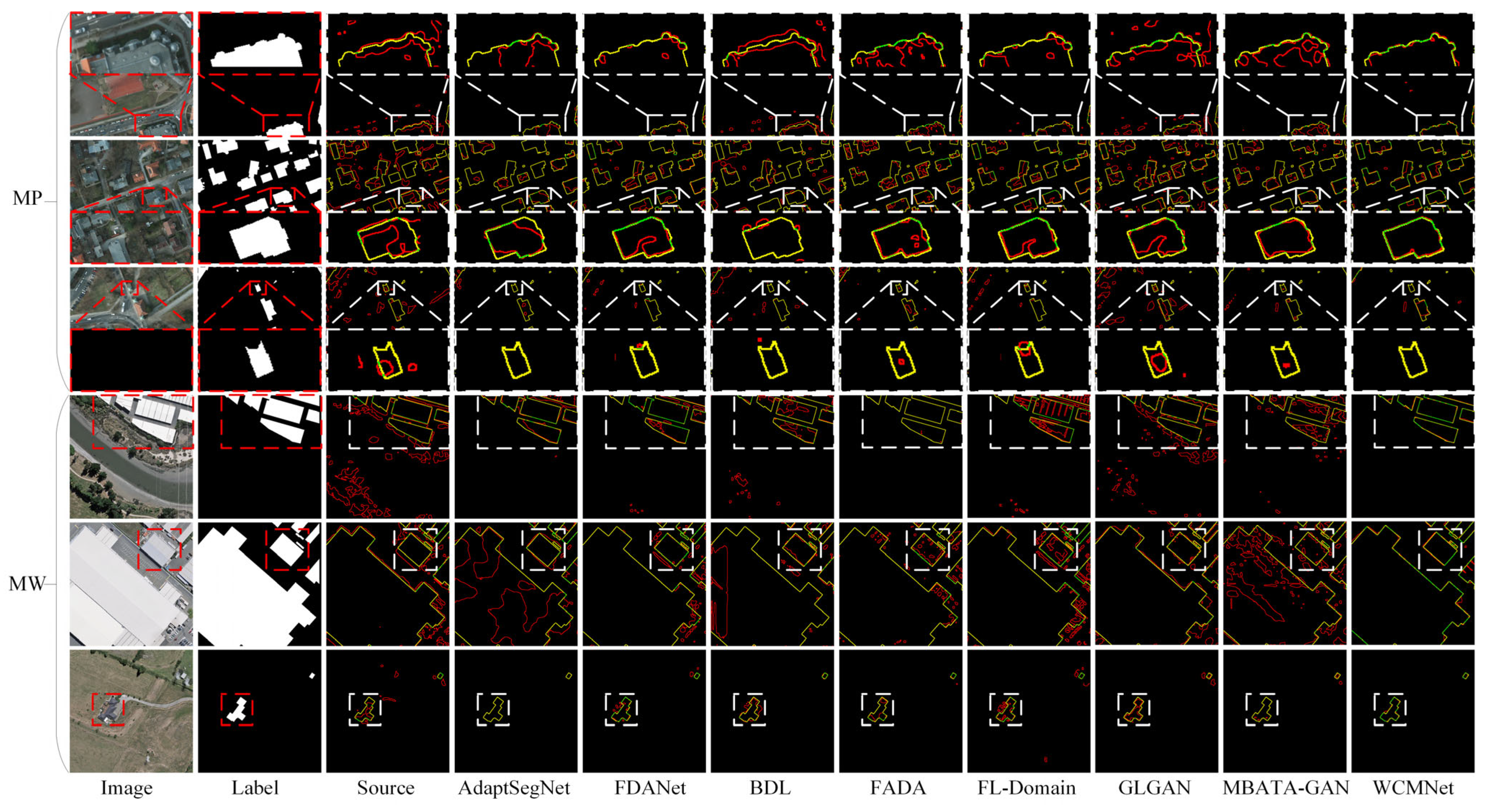
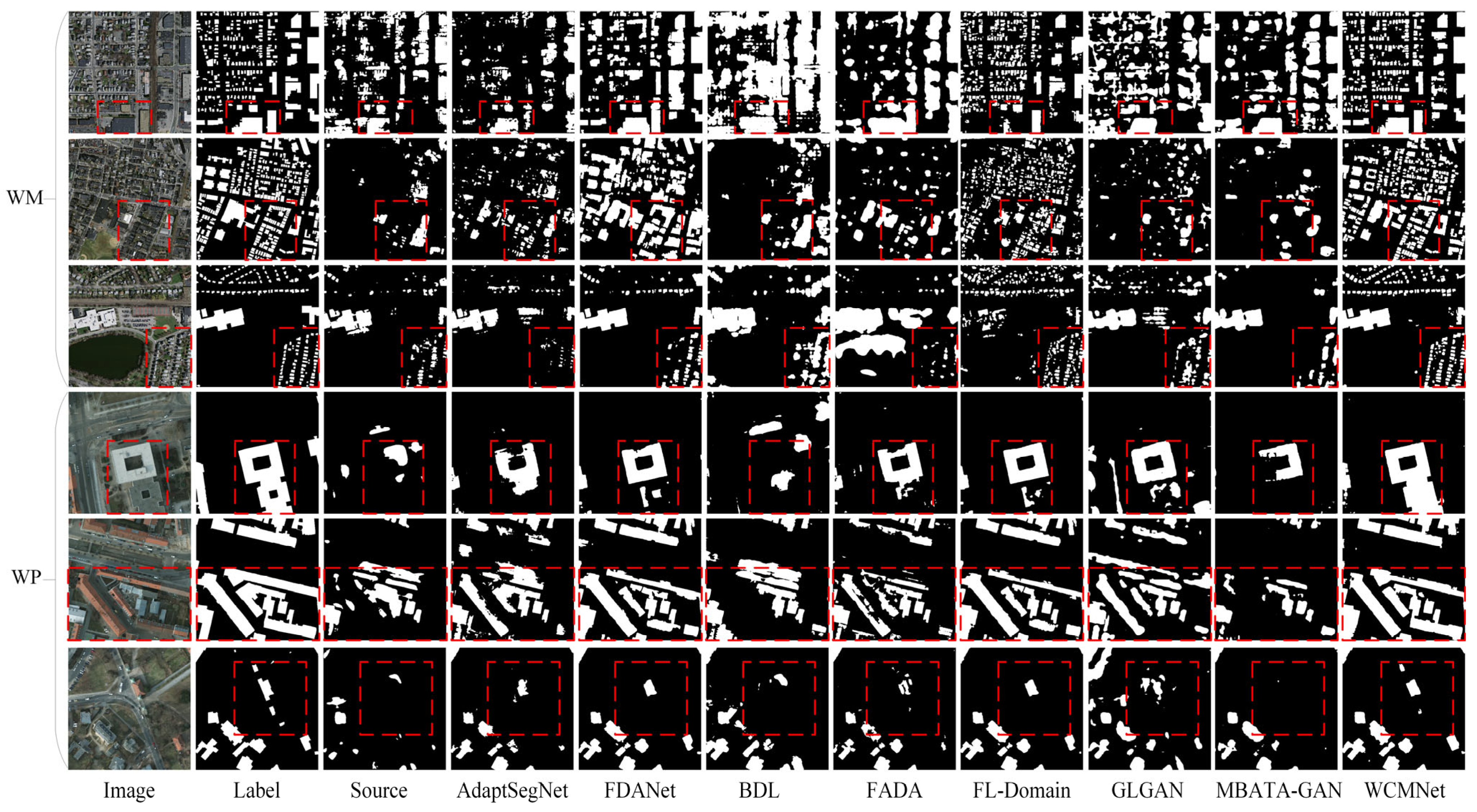
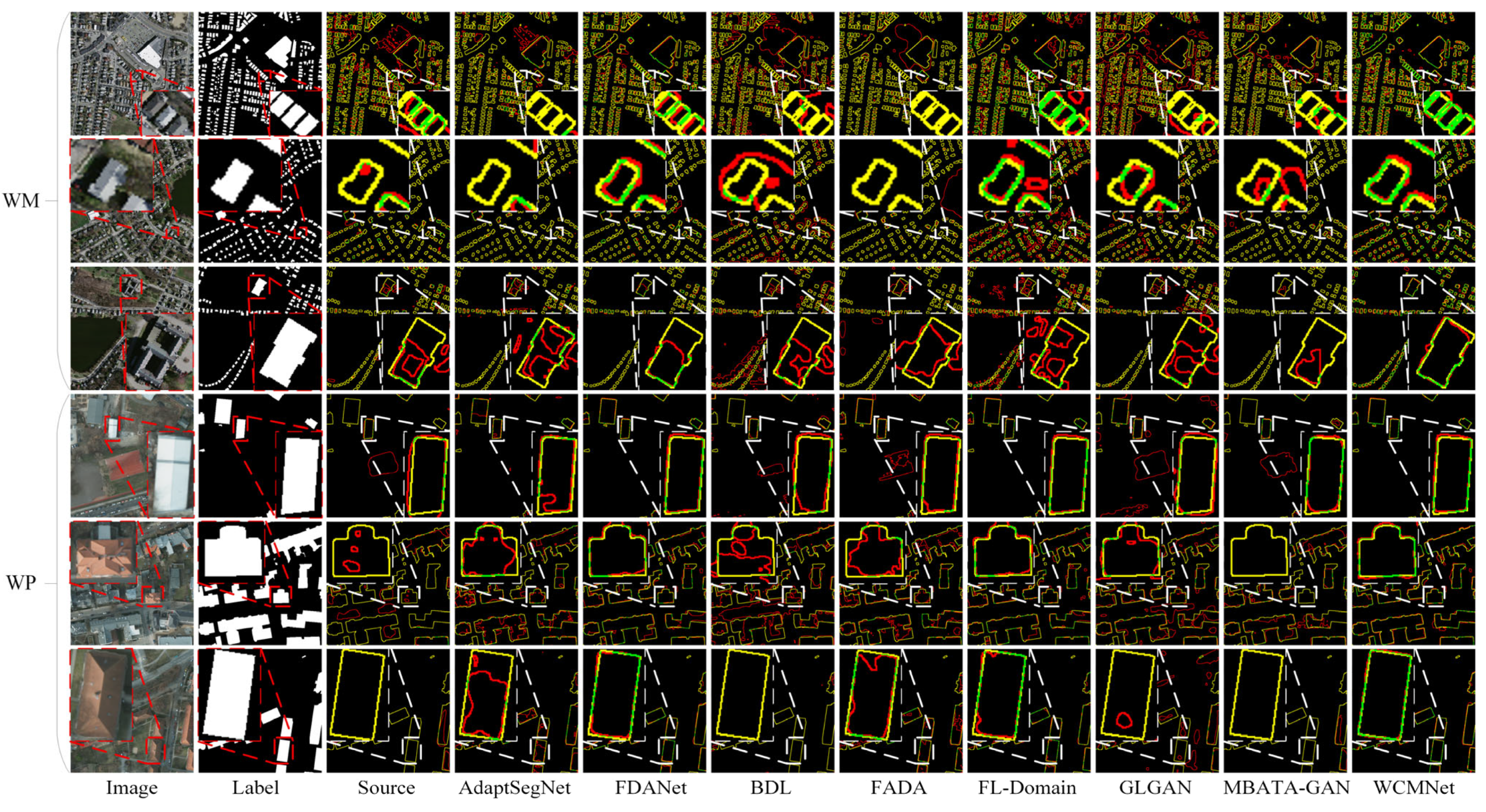
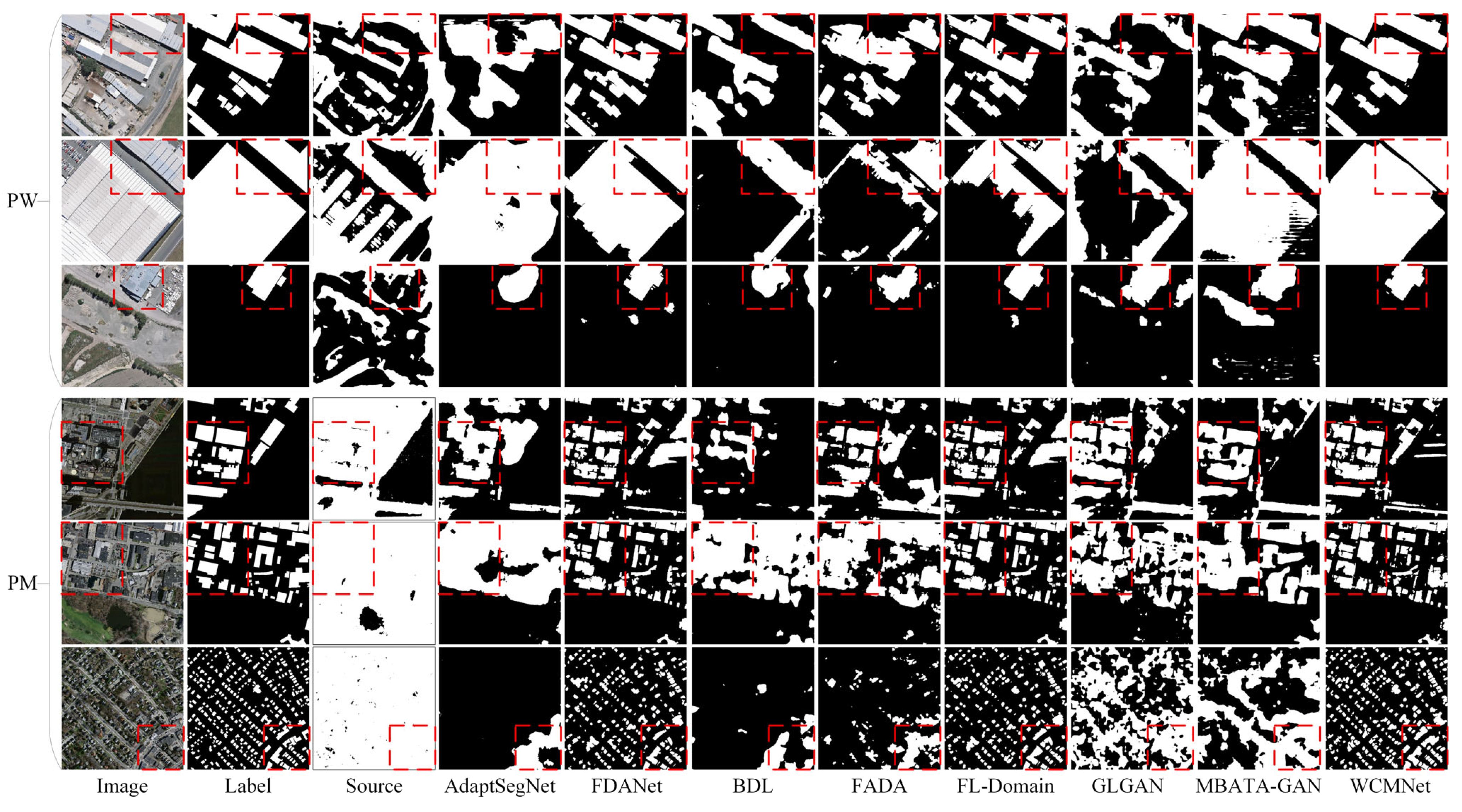
- WCMNet achieves superior cross-domain building extraction performance, improving building completeness, boundary delineation, and robustness across the WHU, Massachusetts, and Potsdam datasets.
- Selective low-frequency style alignment, preserving high-frequency details, is effective for reducing structural degradation during cross-domain image translation.
- Joint modeling of local textures and global context provides a practical solution for cross-resolution, cross-scene, and cross-sensor building extraction in remote sensing.
Abstract
1. Introduction
- (1)
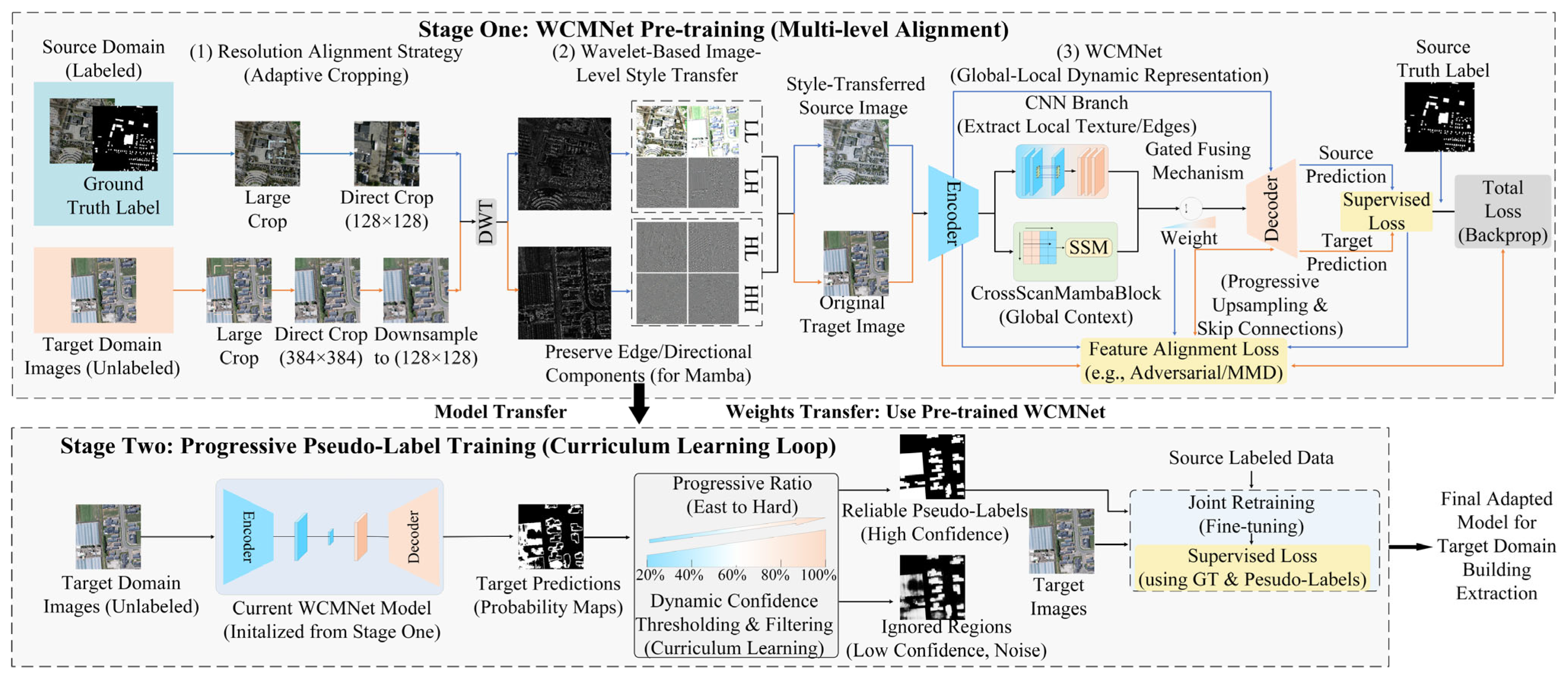
- We propose WCMNet, a novel UDA framework for cross-domain building extraction. It is designed to jointly address two key problems: image-level appearance discrepancies caused by cross-sensor and cross-resolution variations, and feature-level distribution shifts that weaken target-domain generalization. By integrating wavelet-based alignment with a CNN–Mamba hybrid model, WCMNet provides a unified solution to improve building completeness, boundary delineation, and cross-domain robustness.
- (2)
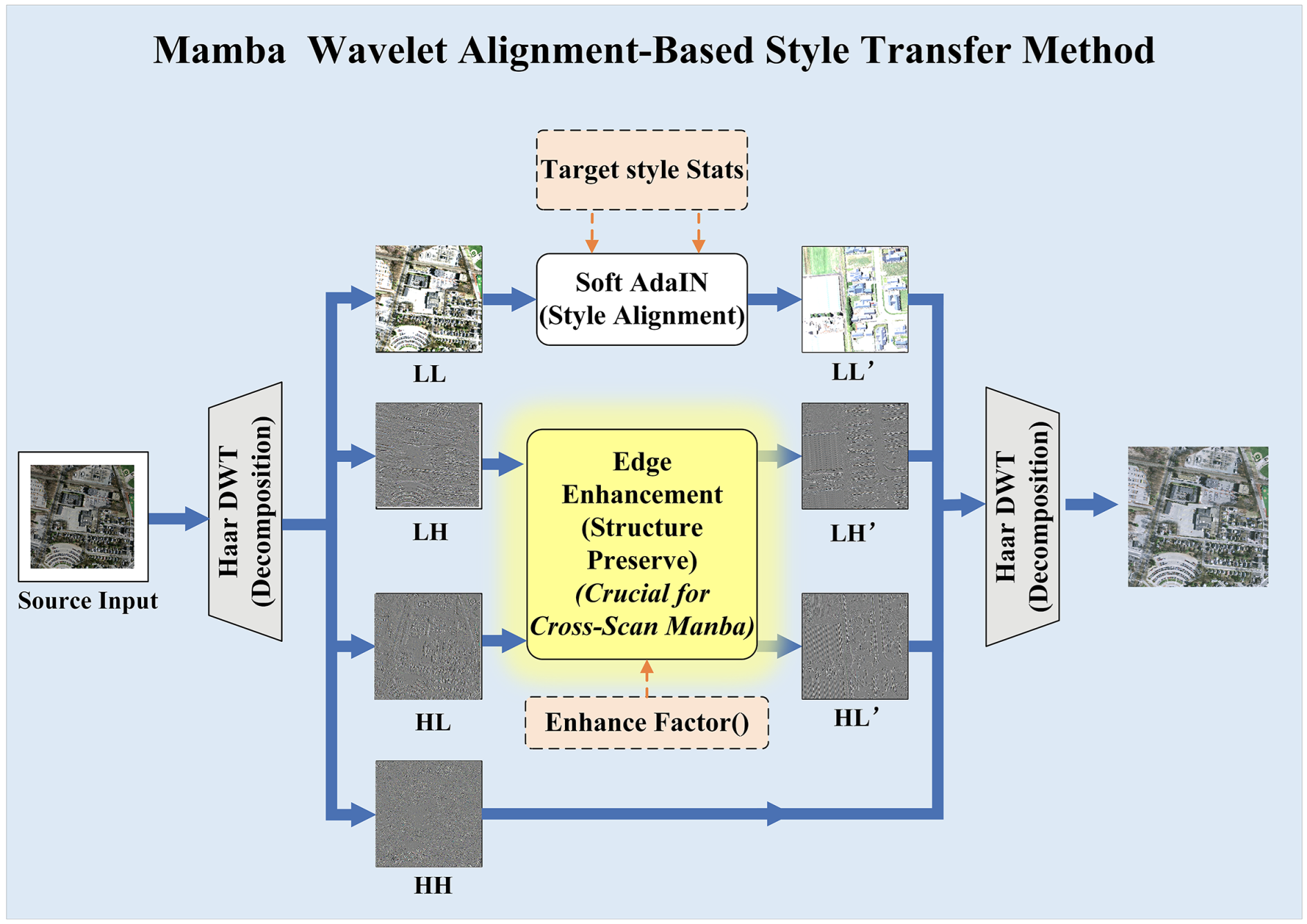
- We design a Mamba Wavelet Alignment (MWA) module to address structural degradation during domain translation. Unlike conventional image-level alignment methods that may blur building contours or distort local textures, MWA selectively aligns low-frequency style statistics while explicitly preserving directional high-frequency edge information. This design reduces cross-domain appearance discrepancy while maintaining boundary-related structural cues, which is particularly important for dense buildings, slender boundaries, and complex roof structures.
- (3)
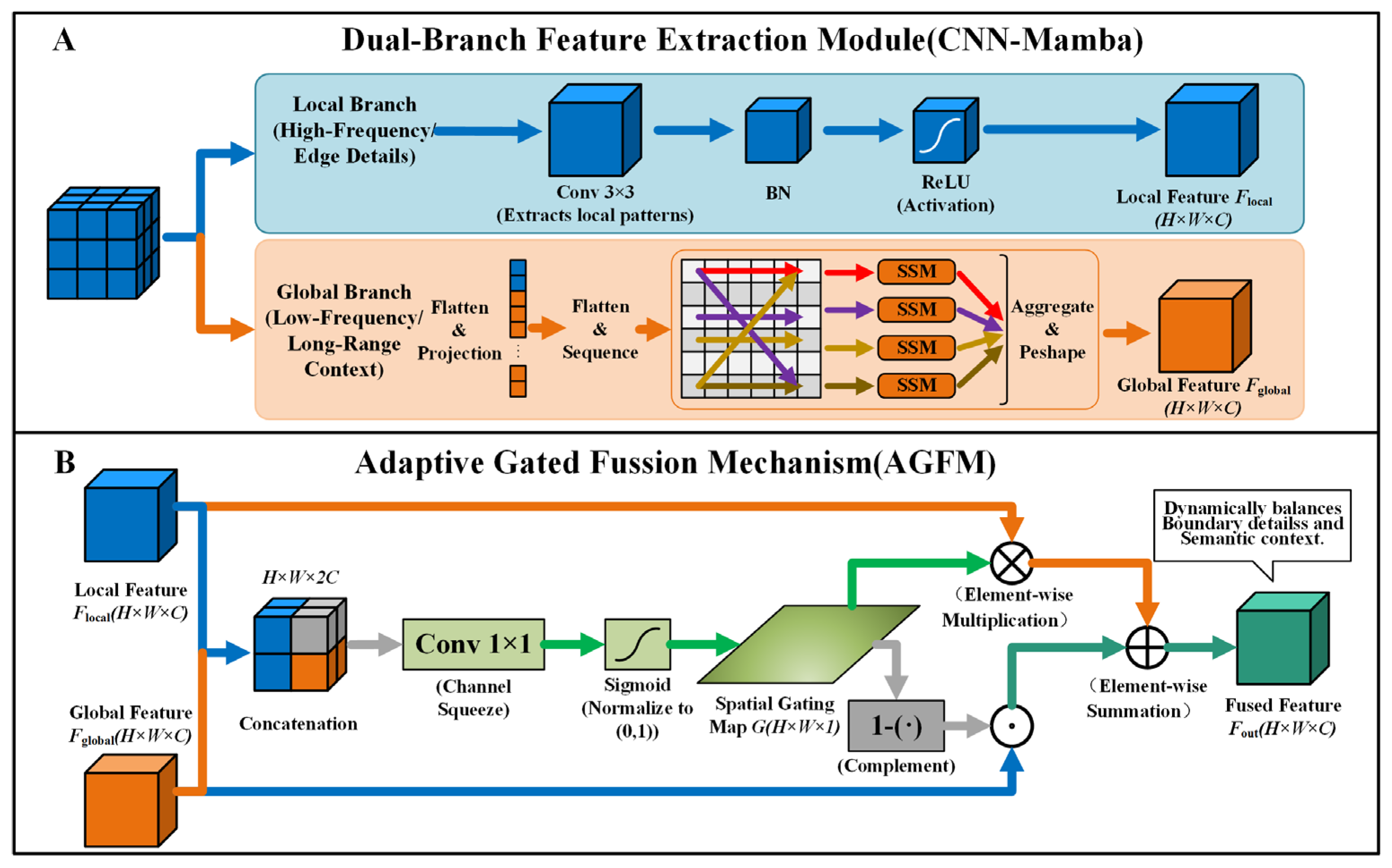
- We introduce a Global–Local Mamba Block (GLMB) to address the insufficient global context modeling and local detail preservation of existing UDA backbones. In GLMB, Cross-Scan Mamba captures long-range semantic dependencies, while the CNN branch extracts fine-grained textures and boundary details. An adaptive gated fusion mechanism is further used to dynamically balance global semantics and local structural cues, thereby improving structural consistency and reducing omission and false-positive errors in complex cross-domain scenarios.
2. Related Work
2.1. Unsupervised Domain Adaptation in Remote Sensing
2.2. State Space Models and Mamba
2.3. Wavelet Transform for Style Transfer
3. Methodology
3.1. Overall Overview of the Method
- (1)
- Resolution Alignment: Due to differences in spatial resolution across datasets, image patches of the same size may correspond to different physical coverage areas. To ensure that source-domain and target-domain input patches are comparable in terms of physical scale, we adopt an adaptive cropping strategy based on the resolution ratio. Specifically, for high-resolution data with a spatial resolution of 0.3 m, a 384 × 384 region is first cropped and then resized to 128 × 128, while for lower-resolution data with a spatial resolution of 1.0 m, a 128 × 128 patch is directly cropped. This strategy normalizes the effective spatial scale of the two domains: the resized high-resolution patch corresponds to an effective ground sampling distance of approximately 0.9 m, which is close to that of the 1.0 m data. Although the resizing operation inevitably removes some very fine spatial details, these details are not consistently observable at lower resolution and may introduce a source-domain-specific texture bias. Therefore, this resolution alignment strategy is adopted to reduce scale-induced domain discrepancy and encourage the model to learn more transferable building representations across domains.
- (2)
- Image-Level Alignment: To reduce cross-domain appearance discrepancy while preserving building structural boundaries as much as possible, we employ a wavelet-transform-based image-level style alignment strategy. The core idea is to decompose an image into frequency subbands and process the different frequency components separately. Unlike conventional image-level style alignment methods, which may damage edge information or cause excessive smoothing, the proposed method preserves the directional high-frequency components (LH/HL/HH) while aligning style information. In this way, critical edge structures can be stably retained during domain translation. More importantly, this coupling is not a simple serial combination between style transfer and sequence modeling. Instead, the wavelet alignment module is deliberately designed to produce direction-aware, structure-preserved representations that are better aligned with the subsequent Cross-Scan Mamba. Specifically, by suppressing low-frequency appearance discrepancy while retaining directional high-frequency boundary cues, the transformed features provide more reliable structural signals for Mamba to model long-range spatial dependencies along different scanning paths. As a result, the proposed frequency-domain alignment strategy is intrinsically coupled with the CNN–Mamba hybrid architecture, jointly suppressing appearance discrepancy while enhancing structural consistency.
- (3)
- Feature-Level Alignment: At the feature level, we adopt a classical encoder–decoder segmentation framework and introduce a Cross-Scan Mamba Block during the encoding stage for global–local feature extraction. Specifically, the two-dimensional feature maps are unfolded into one-dimensional sequences along the horizontal and vertical directions. Then, the selective state-space modeling capability of the Mamba is leveraged to capture global context and long-range spatial dependencies, thereby enhancing scene-level semantic representation. Meanwhile, the CNN branch is responsible for extracting local texture patterns and edge details. Subsequently, a gated fusion mechanism is employed to adaptively integrate these two types of features, allowing the network to dynamically balance global semantics and local details according to spatial locations. During the decoding stage, progressive upsampling and skip connections are used to fuse multi-scale features, and the final pixel-wise building segmentation map is generated. Compared with pure CNN- or Transformer-based architectures, the proposed strategy achieves better synergy between fine-grained boundary delineation and global spatial layout understanding while maintaining near-linear computational complexity.
3.2. Mamba Wavelet Alignment-Based Style Transfer Method
| Algorithm 1 Mamba Wavelet Alignment |
| Input: source image , source-domain statistics (, ), wavelet level , fixed subband policy , optional edge enhancement factor γ, post-reconstruction global correction, adaptive texture-guided fusion |
| Output: aligned image |
| 1: Single-level Haar wavelet decomposition |
| 2: ← AdaIN( Full style alignment on low-frequency subband |
| 3: ← , ← Preserve directional high-frequency structure |
| 4: if edge enhancement is enabled then |
| 5: Optional enhancement for directional edge cues |
| 6: end if |
| 7: ← Keep diagonal high-frequency component unchanged |
| 8: Inverse wavelet reconstruction |
| 9: Iwave ← GlobalStatAlign(Iwave; , ) Post-reconstruction global statistical correction |
| 10: Mtex ← TextureMap(; variance window = 15 × 15, Gaussian smoothing = 21 × 21) |
| 11: Iglobal ← GlobalStatAlign(; , ) |
| 12: ← Mtex Iwave + (1 − Mtex) Iglobal |
| 13: return |
3.3. Global–Local Dynamic Feature Learning via CNN–Mamba Hybrid Modeling
| Algorithm 2 Dual-Branch Global–Local Feature Extraction and Fusion |
| Input: Input feature tensor |
| Parameters: |
| Output: Fused feature representation Y |
| //Captures high-frequency details (e.g., edges, corners) |
| //Captures high-frequency details (e.g., edges, corners) |
| 1: |
| 2: |
| //Branch2: Global Context Modeling (Cross-Scan Mamba) |
| //Captures long-rang semantic dependencies |
| 3: Reshape to , where |
| 4: |
| 5: |
| 6: for each direction do |
| 7: Scan Reorder spatial sequence |
| 8: SSM Selective State Space Model |
| 9: ReverseScan Restore spatial alignment |
| 10: . append |
| 11: end for |
| 12: Aggregate multi-directional features |
| 13: |
| //Stage 3: Adaptive Gated Fusing Mechanism |
| //Dynamically balance local details and global semantics |
| 14: Concat |
| 15: Spatial Gating Map |
| 16: Complementary Fusion |
| 17: return Y |
3.4. Overall Loss
4. Experiment
4.1. Datasets and Experimental Settings
4.1.1. Dataset Description
4.1.2. Experimental Setup
4.1.3. Compared Methods
4.2. Results with Massachusetts as the Source Domain
4.2.1. Quantitative Analysis
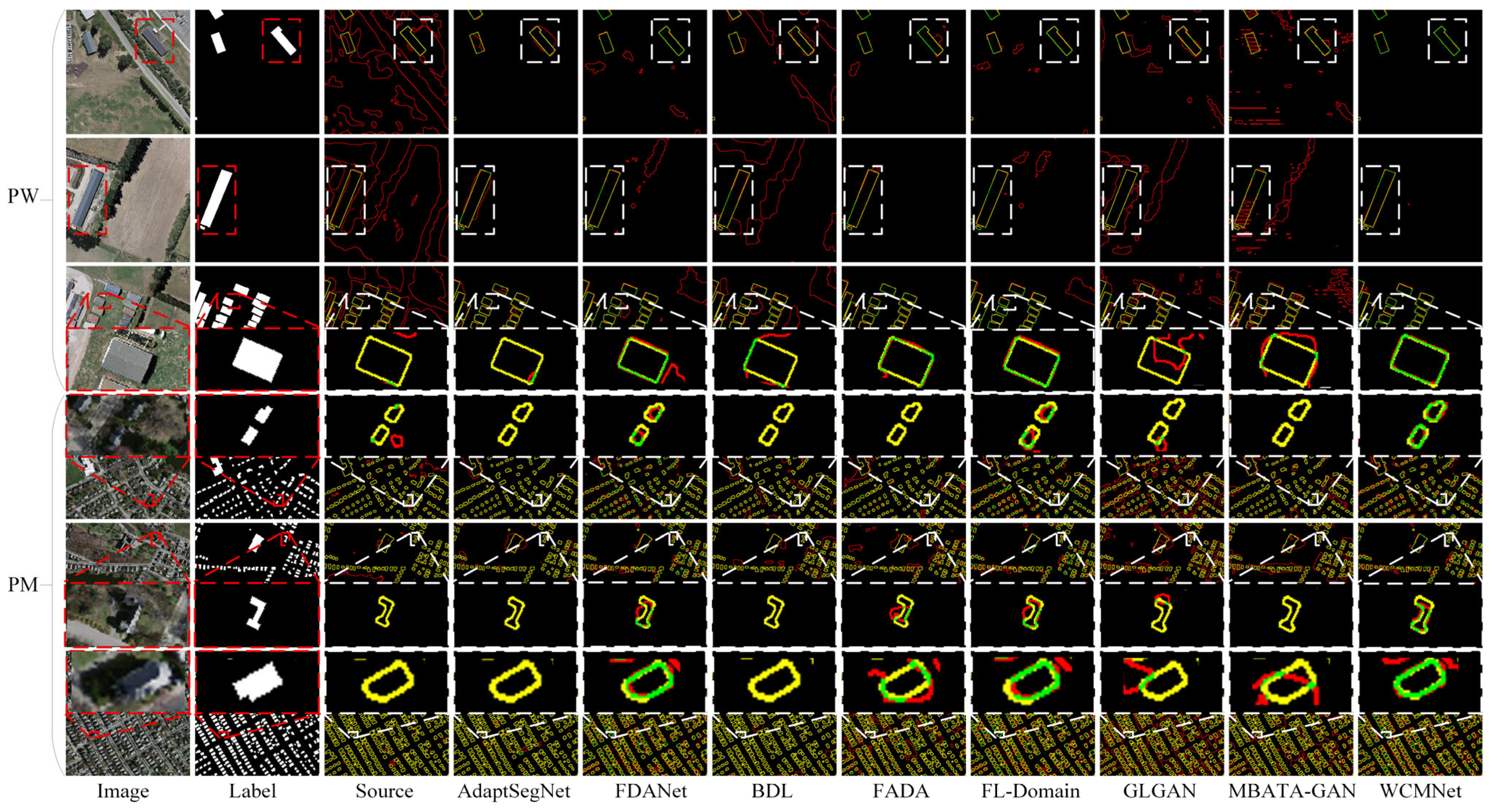
4.2.2. Visual Analysis
4.3. Results with WHU as the Source Domain
4.3.1. Quantitative Analysis
4.3.2. Visual Analysis
4.4. Results with Potsdam as the Source Domain
4.4.1. Quantitative Analysis
4.4.2. Visual Analysis
5. Discussion
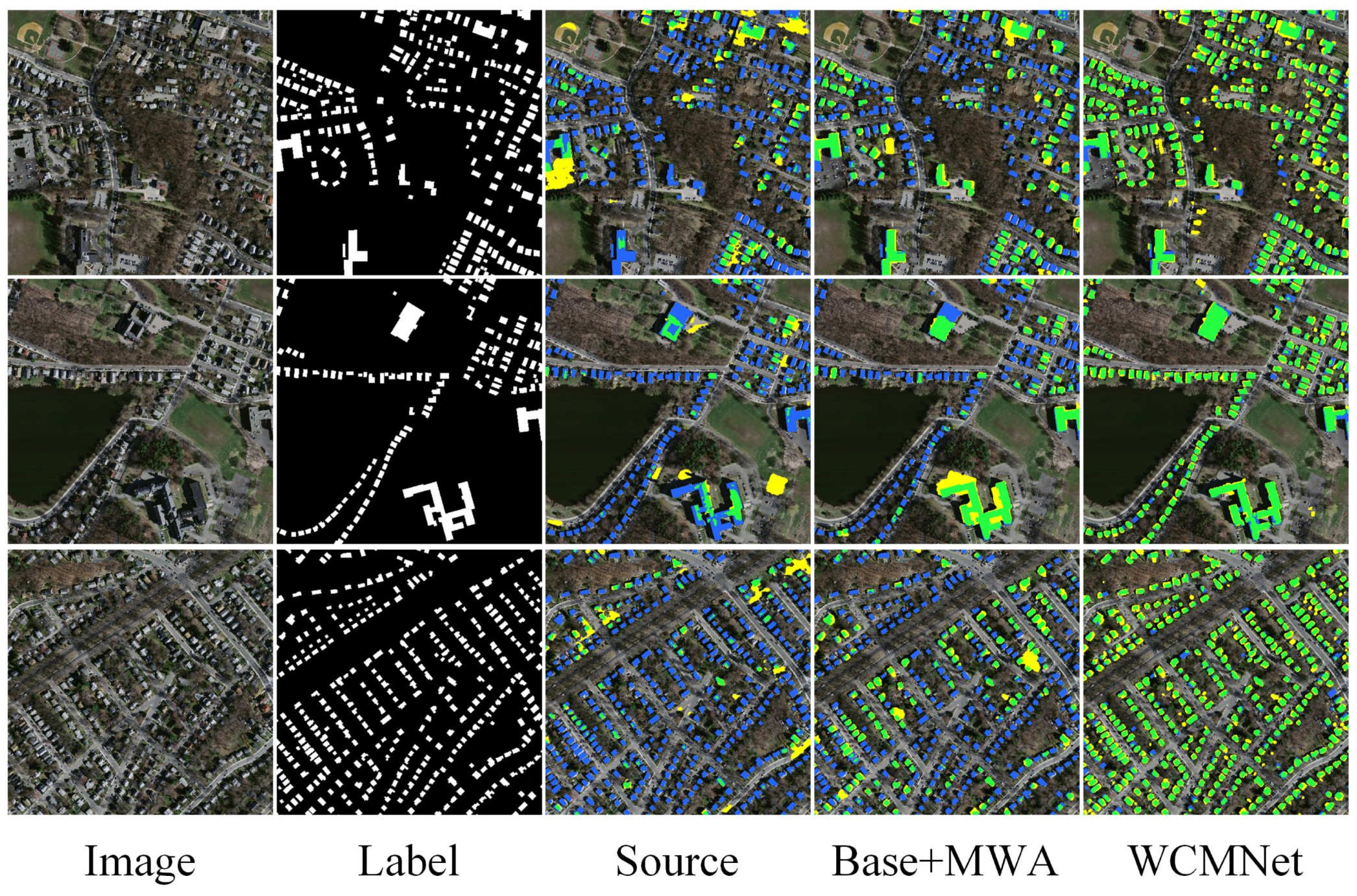
5.1. Progressive Contribution of the Main Modules
5.2. Independent Contribution of Key Components
5.3. Visual Interpretation of Module Effects
6. Conclusions
Author Contributions
Funding
Data Availability Statement
Conflicts of Interest
References
- Song, W.; Zhao, Y.; Tu, J.; Chen, M.; Xie, Y.; Cui, X. A visual attention-guided approach for concrete crack detection in complex environments. Eng. Appl. Artif. Intell. 2026, 173, 114439. [Google Scholar] [CrossRef]
- Xie, Y.; Liu, S.; Chen, H.; Cao, S.; Zhang, H.; Feng, D.; Wan, Q.; Zhu, J.; Zhu, Q. Localization, balance, and affinity: A stronger multifaceted collaborative salient object detector in remote sensing images. IEEE Trans. Geosci. Remote Sens. 2024, 63, 4700117. [Google Scholar] [CrossRef]
- Ran, S.; Gao, X.; Yang, Y.; Li, S.; Zhang, G.; Wang, P. Building multi-feature fusion refined network for building extraction from high-resolution remote sensing images. Remote Sens. 2021, 13, 2794. [Google Scholar] [CrossRef]
- Yang, D.; Gao, X.; Yang, Y.; Guo, K.; Han, K.; Xu, L. Advances and Future Prospects in Building Extraction from High-Resolution Remote Sensing Images. IEEE J. Sel. Top. Appl. Earth Obs. Remote Sens. 2025, 18, 6994–7016. [Google Scholar] [CrossRef]
- Chang, J.; Gao, X.; Yang, Y.; Wang, N. Object-oriented building contour optimization methodology for image classification results via generalized gradient vector flow snake model. Remote Sens. 2021, 13, 2406. [Google Scholar] [CrossRef]
- Long, J.; Shelhamer, E.; Darrell, T. Fully convolutional networks for semantic segmentation. In 2015 IEEE Conference on Computer Vision and Pattern Recognition (CVPR); IEEE: Piscataway, NJ, USA, 2015; pp. 3431–3440. [Google Scholar]
- Dosovitskiy, A.; Beyer, L.; Kolesnikov, A.; Weissenborn, D.; Zhai, X.; Unterthiner, T.; Dehghani, M.; Minderer, M.; Heigold, G.; Gelly, S. An image is worth 16x16 words: Transformers for image recognition at scale. arXiv 2020, arXiv:2010.11929. [Google Scholar]
- Yang, D.; Gao, X.; Yang, Y.; Jiang, M.; Guo, K.; Liu, B.; Li, S.; Yu, S. Csa-net: Complex scenarios adaptive network for building extraction for remote sensing images. IEEE J. Sel. Top. Appl. Earth Obs. Remote Sens. 2024, 17, 938–953. [Google Scholar] [CrossRef]
- Cheng, X.; Han, K.; Xu, J.; Li, G.; Xiao, X.; Zhao, W.; Gao, X. SPFDNet: Water extraction method based on spatial partition and feature decoupling. Remote Sens. 2024, 16, 3959. [Google Scholar] [CrossRef]
- Tsai, Y.-H.; Hung, W.-C.; Schulter, S.; Sohn, K.; Yang, M.-H.; Chandraker, M. Learning to adapt structured output space for semantic segmentation. In 2018 IEEE/CVF Conference on Computer Vision and Pattern Recognition (CVPR); IEEE: Piscataway, NJ, USA, 2018; pp. 7472–7481. [Google Scholar]
- Zou, Y.; Yu, Z.; Kumar, B.; Wang, J. Unsupervised domain adaptation for semantic segmentation via class-balanced self-training. In Proceedings of the European Conference on Computer Vision (ECCV); Springer: Berlin/Heidelberg, Germany, 2018; pp. 289–305. [Google Scholar]
- Hoffman, J.; Tzeng, E.; Park, T.; Zhu, J.-Y.; Isola, P.; Saenko, K.; Efros, A.; Darrell, T. Cycada: Cycle-consistent adversarial domain adaptation. In Proceedings of the 35th International Conference on Machine Learning (ICML); PMLR: Cambridge, MA, USA, 2018; pp. 1989–1998. [Google Scholar]
- Li, D.; Yang, J.; Kreis, K.; Torralba, A.; Fidler, S. Semantic segmentation with generative models: Semi-supervised learning and strong out-of-domain generalization. In Proceedings of the IEEE/CVF Conference on Computer Vision and Pattern Recognition (CVPR); IEEE: Piscataway, NJ, USA, 2021; pp. 8300–8311. [Google Scholar]
- Liu, Z.; Lin, Y.; Cao, Y.; Hu, H.; Wei, Y.; Zhang, Z.; Lin, S.; Guo, B. Swin transformer: Hierarchical vision transformer using shifted windows. In Proceedings of the IEEE/CVF International Conference on Computer Vision (ICCV); IEEE: Piscataway, NJ, USA, 2021; pp. 10012–10022. [Google Scholar]
- Gu, A.; Dao, T. Mamba: Linear-time sequence modeling with selective state spaces. arXiv 2023, arXiv:2312.00752. [Google Scholar]
- Xie, Y.; Zhan, N.; Zhu, J.; Xu, B.; Chen, H.; Mao, W.; Luo, X. Landslide extraction from aerial imagery considering context association characteristics. Int. J. Appl. Earth Obs. Geoinf. 2024, 131, 103950. [Google Scholar] [CrossRef]
- Song, W.; Cui, X.; Xie, Y.; Wang, G.; Ma, J. Monocular depth estimation via a detail semantic collaborative network for indoor scenes. Sci. Rep. 2025, 15, 10990. [Google Scholar] [CrossRef] [PubMed]
- Tuia, D.; Persello, C.; Bruzzone, L. Domain adaptation for the classification of remote sensing data: An overview of recent advances. IEEE Geosci. Remote Sens. Mag. 2016, 4, 41–57. [Google Scholar] [CrossRef]
- Chen, M.; Xue, H.; Cai, D. Domain adaptation for semantic segmentation with maximum squares loss. In Proceedings of the IEEE/CVF International Conference on Computer Vision (ICCV); IEEE: Piscataway, NJ, USA, 2019; pp. 2090–2099. [Google Scholar]
- Mei, K.; Zhu, C.; Zou, J.; Zhang, S. Instance adaptive self-training for unsupervised domain adaptation. In Proceedings of the European Conference on Computer Vision (ECCV); IEEE: Piscataway, NJ, USA, 2020; pp. 415–430. [Google Scholar]
- Zhu, L.; Liao, B.; Zhang, Q.; Wang, X.; Liu, W.; Wang, X. Vision mamba: Efficient visual representation learning with bidirectional state space model. arXiv 2024, arXiv:2401.09417. [Google Scholar] [CrossRef]
- Liu, Y.; Tian, Y.; Zhao, Y.; Yu, H.; Xie, L.; Wang, Y.; Ye, Q.; Jiao, J. Vmamba: Visual state space model. In Proceedings of the Advances in Neural Information Processing Systems 37 (NeurIPS 2024); Curran Associates Inc.: Red Hook, NY, USA, 2024; pp. 103031–103063. [Google Scholar]
- Yoo, J.; Uh, Y.; Chun, S.; Kang, B.; Ha, J.-W. Photorealistic style transfer via wavelet transforms. In Proceedings of the IEEE/CVF International Conference on Computer Vision (ICCV); IEEE: Piscataway, NJ, USA, 2019; pp. 9036–9045. [Google Scholar]
- Huang, X.; Belongie, S. Arbitrary style transfer in real-time with adaptive instance normalization. In Proceedings of the IEEE International Conference on Computer Vision (ICCV); IEEE: Piscataway, NJ, USA, 2017; pp. 1501–1510. [Google Scholar]
- Li, Y.; Liu, M.-Y.; Li, X.; Yang, M.-H.; Kautz, J. A closed-form solution to photorealistic image stylization. In Proceedings of the European conference on computer vision (ECCV); IEEE: Piscataway, NJ, USA, 2018; pp. 453–468. [Google Scholar]
- Yang, Y.; Soatto, S. Fda: Fourier domain adaptation for semantic segmentation. In Proceedings of the IEEE/CVF Conference on Computer Vision and Pattern Recognition (CVPR); IEEE: Piscataway, NJ, USA, 2020; pp. 4085–4095. [Google Scholar]
- Rottensteiner, F.; Sohn, G.; Jung, J.; Gerke, M.; Baillard, C.; Benitez, S.; Breitkopf, U. The ISPRS benchmark on urban object classification and 3D building reconstruction. ISPRS J. Photogramm. Remote Sens. 2012, I-3, 293–298. [Google Scholar] [CrossRef]
- Ji, S.; Wei, S.; Lu, M. Fully convolutional networks for multisource building extraction from an open aerial and satellite imagery data set. IEEE Trans. Geosci. Remote Sens. 2018, 57, 574–586. [Google Scholar] [CrossRef]
- Mnih, V. Machine Learning for Aerial Image Labeling; University of Toronto: Toronto, ON, Canada, 2013. [Google Scholar]
- Peng, D.; Guan, H.; Zang, Y.; Bruzzone, L. Full-level domain adaptation for building extraction in very-high-resolution optical remote-sensing images. IEEE Trans. Geosci. Remote Sens. 2021, 60, 5607317. [Google Scholar] [CrossRef]
- Ma, X.; Zhang, X.; Ding, X.; Pun, M.-O.; Ma, S. Decomposition-based unsupervised domain adaptation for remote sensing image semantic segmentation. IEEE Trans. Geosci. Remote Sens. 2024, 62, 5645118. [Google Scholar] [CrossRef]
- Ma, X.; Zhang, X.; Wang, Z.; Pun, M.-O. Unsupervised domain adaptation augmented by mutually boosted attention for semantic segmentation of VHR remote sensing images. IEEE Trans. Geosci. Remote Sens. 2023, 61, 5400515. [Google Scholar] [CrossRef]



| Network Model | Transfer Method | OA/% | P/% | R/% | IoU/% | F1/% | BIoU% |
|---|---|---|---|---|---|---|---|
| Source | M-P | 73.42 ± 0.59 | 49.92 ± 2.57 | 21.53 ± 2.40 | 17.65 ± 1.30 | 30.00 ± 1.87 | 36.20 ± 1.82 |
| AdaptSegNet [10] | M-P | 79.23 ± 0.46 | 85.77 ± 0.23 | 25.95 ± 2.16 | 24.87 ± 1.97 | 39.82 ± 2.52 | 29.58 ± 16.89 |
| FDANet [30] | M-P | 77.57 ± 0.20 | 90.95 ± 1.51 | 17.11 ± 1.19 | 16.82 ± 1.09 | 28.79 ± 1.60 | 35.40 ± 0.91 |
| BDL | M-P | 72.74 ± 0.33 | 46.79 ± 1.44 | 20.65 ± 1.08 | 16.73 ± 0.90 | 28.65 ± 1.32 | 14.66 ± 1.75 |
| FADA | M-P | 79.52 ± 0.70 | 83.99 ± 13.90 | 29.18 ± 4.03 | 27.35 ± 2.07 | 42.93 ± 2.55 | 25.22 ± 1.61 |
| FL-Domain | M-P | 78.45 ± 0.21 | 90.71 ± 1.40 | 20.85 ± 1.29 | 20.40 ± 1.17 | 33.89 ± 1.62 | 30.50 ± 13.69 |
| GLGAN [31] | M-P | 76.08 ± 0.27 | 60.80 ± 1.65 | 27.58 ± 0.62 | 23.41 ± 0.20 | 37.94 ± 0.26 | 22.57 ± 0.18 |
| MBMTA-GAN [32] | M-P | 77.50 ± 0.24 | 89.58 ± 0.12 | 17.11 ± 1.07 | 16.78 ± 1.03 | 28.72 ± 1.50 | 16.41 ± 1.14 |
| WCMNet | M-P | 87.60 ± 0.33 | 94.60 ± 1.24 | 56.48 ± 2.15 | 54.70 ± 1.60 | 70.71 ± 1.34 | 74.52 ± 0.52 |
| Source | M-W | 84.70 ± 1.07 | 39.39 ± 1.94 | 68.99 ± 1.67 | 33.44 ± 1.01 | 50.12 ± 1.14 | 33.56 ± 1.00 |
| AdaptSegNet | M-W | 92.56 ± 0.04 | 76.62 ± 0.92 | 47.68 ± 1.61 | 41.61 ± 0.95 | 58.76 ± 0.95 | 30.53 ± 12.80 |
| FDANet | M-W | 94.87 ± 0.17 | 79.73 ± 1.04 | 72.31 ± 3.65 | 61.04 ± 1.99 | 75.80 ± 1.53 | 48.16 ± 9.94 |
| BDL | M-W | 86.93 ± 4.34 | 47.05 ± 10.84 | 71.25 ± 17.34 | 38.09 ± 2.19 | 55.15 ± 2.30 | 22.44 ± 3.97 |
| FADA | M-W | 92.18 ± 1.72 | 73.24 ± 14.70 | 48.21 ± 3.15 | 41.03 ± 6.90 | 58.02 ± 6.95 | 34.97 ± 9.14 |
| FL-Domain | M-W | 94.86 ± 0.18 | 80.24 ± 4.53 | 71.94 ± 8.84 | 60.76 ± 3.75 | 75.56 ± 2.90 | 40.96 ± 1.26 |
| GLGAN | M-W | 90.25 ± 0.68 | 55.32 ± 2.98 | 65.81 ± 1.79 | 42.92 ± 1.04 | 60.06 ± 1.02 | 41.98 ± 0.57 |
| MBMTA-GAN | M-W | 89.85 ± 1.16 | 56.70 ± 8.41 | 43.52 ± 4.82 | 32.31 ± 0.09 | 48.84 ± 0.11 | 19.78 ± 0.04 |
| WCMNet | M-W | 96.62 ± 0.07 | 88.16 ± 1.41 | 80.54 ± 2.38 | 72.65 ± 0.98 | 84.16 ± 0.66 | 60.12 ± 0.32 |
| Network Model | Transfer Method | OA/% | P/% | R/% | IoU/% | F1/% | BIoU% |
|---|---|---|---|---|---|---|---|
| Source | W-M | 80.85 ± 0.83 | 48.47 ± 2.53 | 34.42 ± 11.67 | 24.74 ± 5.59 | 39.50 ± 7.20 | 46.23 ± 7.55 |
| AdaptSegNet | W-M | 83.91 ± 0.23 | 66.53 ± 1.48 | 27.23 ± 0.73 | 23.95 ± 0.76 | 38.64 ± 0.98 | 18.72 ± 1.77 |
| FDANet | W-M | 87.06 ± 0.40 | 66.23 ± 2.18 | 62.44 ± 1.92 | 47.32 ± 0.01 | 64.24 ± 0.01 | 52.72 ± 18.43 |
| BDL | W-M | 74.24 ± 0.61 | 35.72 ± 0.15 | 48.05 ± 4.78 | 25.74 ± 1.45 | 40.93 ± 1.84 | 21.96 ± 1.94 |
| FADA | W-M | 80.68 ± 0.50 | 47.63 ± 1.51 | 37.32 ± 2.31 | 26.43 ± 0.70 | 41.81 ± 0.87 | 19.83 ± 0.86 |
| FL-Domain | W-M | 83.21 ± 0.74 | 55.62 ± 2.98 | 50.14 ± 4.42 | 35.69 ± 1.02 | 52.61 ± 1.11 | 33.56 ± 0.45 |
| GLGAN | W-M | 79.65 ± 0.28 | 44.28 ± 0.69 | 36.08 ± 0.87 | 24.81 ± 0.19 | 39.75 ± 0.25 | 22.55 ± 0.25 |
| MBMTA-GAN | W-M | 83.47 ± 0.01 | 63.32 ± 3.56 | 27.29 ± 5.93 | 23.40 ± 3.92 | 37.84 ± 5.15 | 21.11 ± 2.85 |
| WCMNet | W-M | 91.09 ± 0.45 | 78.03 ± 4.33 | 72.95 ± 3.87 | 60.37 ± 0.06 | 75.29 ± 0.04 | 87.12 ± 0.06 |
| Source | W-P | 77.32 ± 0.52 | 74.77 ± 5.44 | 22.41 ± 6.32 | 20.66 ± 5.02 | 34.10 ± 6.90 | 34.69 ± 6.51 |
| AdaptSegNet | W-P | 85.86 ± 0.48 | 91.41 ± 3.35 | 51.55 ± 0.28 | 49.15 ± 0.72 | 65.91 ± 0.64 | 55.85 ± 16.56 |
| FDANet | W-P | 92.39 ± 0.33 | 95.56 ± 2.82 | 74.07 ± 2.18 | 71.56 ± 0.45 | 83.42 ± 0.30 | 84.87 ± 0.37 |
| BDL | W-P | 80.74 ± 1.39 | 75.35 ± 9.19 | 41.52 ± 2.31 | 36.37 ± 0.38 | 53.34 ± 0.41 | 32.16 ± 1.21 |
| FADA | W-P | 87.02 ± 0.55 | 91.66 ± 0.45 | 56.18 ± 2.60 | 53.44 ± 2.20 | 69.64 ± 1.87 | 46.79 ± 2.16 |
| FL-Domain | W-P | 92.06 ± 0.06 | 94.91 ± 1.81 | 74.07 ± 1.81 | 71.21 ± 0.65 | 83.19 ± 0.45 | 74.33 ± 14.78 |
| GLGAN | W-P | 83.48 ± 0.24 | 75.92 ± 2.23 | 55.30 ± 1.78 | 47.02 ± 0.43 | 63.96 ± 0.40 | 39.71 ± 0.27 |
| MBMTA-GAN | W-P | 81.74 ± 1.56 | 92.76 ± 2.75 | 33.92 ± 7.56 | 32.94 ± 6.82 | 49.36 ± 7.72 | 29.00 ± 4.75 |
| WCMNet | W-P | 93.64 ± 0.29 | 89.27 ± 2.11 | 86.51 ± 1.50 | 78.25 ± 0.51 | 87.80 ± 0.33 | 87.84 ± 0.47 |
| Network Model | Transfer Method | OA/% | P/% | R/% | IoU/% | F1/% | BIoU% |
|---|---|---|---|---|---|---|---|
| Source | P-W | 72.49 ± 2.00 | 20.70 ± 0.66 | 51.86 ± 3.51 | 17.34 ± 0.07 | 29.56 ± 0.11 | 21.73 ± 0.08 |
| AdaptSegNet | P-W | 90.22 ± 0.59 | 54.76 ± 2.37 | 70.56 ± 1.34 | 44.54 ± 1.03 | 61.63 ± 0.99 | 24.92 ± 8.99 |
| FDANet | P-W | 92.22 ± 0.47 | 60.00 ± 1.82 | 90.48 ± 1.16 | 56.42 ± 1.16 | 72.14 ± 0.95 | 50.57 ± 0.51 |
| BDL | P-W | 87.76 ± 2.33 | 47.00 ± 8.31 | 51.04 ± 9.05 | 31.73 ± 0.29 | 48.17 ± 0.33 | 17.24 ± 1.16 |
| FADA | P-W | 92.37 ± 2.46 | 62.84 ± 10.63 | 81.73 ± 0.46 | 54.98 ± 7.96 | 70.78 ± 6.65 | 41.51 ± 5.62 |
| FL-Domain | P-W | 93.24 ± 0.45 | 63.84 ± 2.06 | 90.81 ± 1.10 | 59.95 ± 1.34 | 74.95 ± 1.05 | 44.96 ± 11.51 |
| WCMNet | P-W | 95.83 ± 0.21 | 77.28 ± 1.95 | 88.56 ± 1.48 | 70.24 ± 0.68 | 82.52 ± 0.47 | 57.98 ± 0.32 |
| GLGAN | P-W | 81.46 ± 1.20 | 34.83 ± 1.05 | 76.12 ± 4.79 | 31.36 ± 0.03 | 47.75 ± 0.04 | 19.72 ± 0.55 |
| MBMTA-GAN | P-W | 88.46 ± 0.34 | 48.90 ± 0.90 | 81.52 ± 0.35 | 44.01 ± 0.62 | 61.13 ± 0.60 | 22.47 ± 0.61 |
| Source | P-M | 38.52 ± 17.14 | 20.74 ± 0.84 | 80.52 ± 26.98 | 19.47 ± 0.93 | 32.59 ± 1.29 | 34.33 ± 9.64 |
| AdaptSegNet | P-M | 77.46 ± 1.32 | 41.61 ± 1.51 | 51.41 ± 6.41 | 29.75 ± 1.39 | 45.85 ± 1.65 | 25.59 ± 14.91 |
| FDANet | P-M | 82.53 ± 0.73 | 52.25 ± 1.58 | 72.99 ± 3.46 | 43.73 ± 0.14 | 60.86 ± 0.13 | 60.94 ± 20.67 |
| BDL | P-M | 72.02 ± 0.24 | 29.49 ± 0.04 | 36.18 ± 0.82 | 19.40 ± 0.22 | 32.49 ± 0.31 | 13.11 ± 0.04 |
| FADA | P-M | 78.66 ± 1.03 | 44.58 ± 1.77 | 59.68 ± 0.70 | 34.24 ± 0.82 | 51.02 ± 0.91 | 38.94 ± 17.10 |
| FL-Domain | P-M | 83.12 ± 1.66 | 52.93 ± 2.69 | 70.60 ± 3.98 | 43.28 ± 0.30 | 60.42 ± 0.29 | 76.14 ± 0.18 |
| WCMNet | P-M | 88.08 ± 0.84 | 65.44 ± 3.48 | 76.81 ± 3.73 | 54.54 ± 0.54 | 70.58 ± 0.45 | 81.21 ± 0.33 |
| GLGAN | P-M | 63.98 ± 2.08 | 30.52 ± 0.98 | 73.03 ± 2.67 | 27.41 ± 0.42 | 43.03 ± 0.52 | 23.38 ± 0.33 |
| MBMTA-GAN | P-M | 72.23 ± 1.65 | 36.30 ± 1.16 | 64.82 ± 4.23 | 30.29 ± 0.12 | 46.49 ± 0.14 | 25.13 ± 0.11 |
| Network Model | OA/% | P/% | R/% | IoU/% | F1/% |
|---|---|---|---|---|---|
| Base | 81.44 | 50.26 | 26.16 | 20.78 | 34.41 |
| Base + MWA | 88.79 | 78.05 | 55.32 | 47.87 | 64.75 |
| WCMNet | 90.77 | 74.97 | 75.69 | 60.41 | 75.32 |
| Network Model | OA/% | P/% | R/% | IoU/% | F1/% |
|---|---|---|---|---|---|
| Base | 81.44 | 50.26 | 26.16 | 20.78 | 34.41 |
| Base + Mamba Only | 87.18 | 81.14 | 40.57 | 37.07 | 54.09 |
| Base + Gated Fusion Only | 83.88 | 59.18 | 43.17 | 33.26 | 49.92 |
| Base + Pseudo-Labeling Only | 87.49 | 80.80 | 43.01 | 39.02 | 56.14 |
| WCMNet | 90.77 | 74.97 | 75.69 | 60.41 | 75.32 |
Disclaimer/Publisher’s Note: The statements, opinions and data contained in all publications are solely those of the individual author(s) and contributor(s) and not of MDPI and/or the editor(s). MDPI and/or the editor(s) disclaim responsibility for any injury to people or property resulting from any ideas, methods, instructions or products referred to in the content. |
© 2026 by the authors. Licensee MDPI, Basel, Switzerland. This article is an open access article distributed under the terms and conditions of the Creative Commons Attribution (CC BY) license.
Share and Cite
Yang, D.; Han, K.; Yang, Y.; Gao, X.; Guo, K.; Gao, X.; Huang, R. WCMNet: A Wavelet-Guided and CNN–Mamba Hybrid Network Approach for Unsupervised Domain Adaptation in Building Extraction. Remote Sens. 2026, 18, 2265. https://doi.org/10.3390/rs18132265
Yang D, Han K, Yang Y, Gao X, Guo K, Gao X, Huang R. WCMNet: A Wavelet-Guided and CNN–Mamba Hybrid Network Approach for Unsupervised Domain Adaptation in Building Extraction. Remote Sensing. 2026; 18(13):2265. https://doi.org/10.3390/rs18132265
Chicago/Turabian StyleYang, Dongjie, Kuikui Han, Yuanwei Yang, Xianjun Gao, Kangliang Guo, Xinlong Gao, and Ruijing Huang. 2026. "WCMNet: A Wavelet-Guided and CNN–Mamba Hybrid Network Approach for Unsupervised Domain Adaptation in Building Extraction" Remote Sensing 18, no. 13: 2265. https://doi.org/10.3390/rs18132265
APA StyleYang, D., Han, K., Yang, Y., Gao, X., Guo, K., Gao, X., & Huang, R. (2026). WCMNet: A Wavelet-Guided and CNN–Mamba Hybrid Network Approach for Unsupervised Domain Adaptation in Building Extraction. Remote Sensing, 18(13), 2265. https://doi.org/10.3390/rs18132265