Article

Automated Intertidal Beach Profile Reconstruction from Timex Video Imagery: A Case Study of Xisha Bay Beach, China


1
Laboratory of Ocean and Coast Geology, Third Institute of Oceanography, Ministry of Natural Resources, Xiamen 361005, China
2
Southern Marine Science and Engineering Guangdong Laboratory (Zhuhai), Zhuhai 519000, China
3
Observation and Research Station of Coastal Wetland Ecosystem in Beibu Gulf, MNR, Beihai 536015, China
4
College of Ocean and Earth Sciences, Xiamen University, Xiamen 361104, China
*
Author to whom correspondence should be addressed.
Remote Sens. 2026, 18(12), 1893; https://doi.org/10.3390/rs18121893 (registering DOI)
Submission received: 30 March 2026 / Revised: 31 May 2026 / Accepted: 5 June 2026 / Published: 8 June 2026
(This article belongs to the Special Issue Applications of Radar Remote Sensing in Earth Observation)

Highlights

What are the main findings?
  • Shore-based video remote sensing allows intertidal topography monitoring with accuracy better than 0.22 m.
  • Deep learning accurately detects waterline breakpoints in complex single-pixel-wide video images.
What are the implications of the main findings?
  • Target profile topography can be automatically extracted directly from video images without generating a DEM.
  • High-frequency intertidal profile reconstruction reveals the spatiotemporal morphodynamical response of sandy beaches.

Abstract

The intertidal beach profile provides a fundamental representation of beach morphology and serves as a key indicator of shoreline morphodynamics. To enable frequent and accurate mapping of intertidal beach profiles, this study proposes an automated reconstruction framework that integrates single-pixel image columns with a stacked bidirectional long short-term memory (Bi-LSTM) network. Time-exposure imagery, commonly referred to as Timex imagery, acquired from a shore-based video monitoring station at Xisha Bay, China, is used as the primary data source, while wave records obtained from a wave buoy are incorporated to assign elevations to the detected waterline breakpoints, thereby enabling automatic beach profile reconstruction. The stacked Bi-LSTM network is trained for land–sea segmentation and waterline breakpoint localization. achieving the best performance among the tested methods, with precision, recall, accuracy, and F1 score values of 0.951, 0.894, 0.978, and 0.903, respectively, and a mean breakpoint localization error of 2.23 pixels. Breakpoint elevations were then estimated using a local slope–wave setup attribution model. Validation against field-measured topographic data from four fixed profiles and three survey periods showed good agreement between the reconstructed and measured profiles, with a period-based root mean square error (RMSE) of 0.212 ± 0.080 m. When all validation points were combined, the reconstructed elevations showed strong agreement with the measured elevations, with a coefficient of determination (R2) of 0.988 and an overall RMSE of 0.24 m. The profile comparisons further showed that the reconstructed profiles generally captured the overall profile shape and cross-shore morphological pattern of the measured profiles, although reconstruction accuracy varied among the four fixed profiles. These differences demonstrate that camera viewing angle, field-of-view position, camera-to-profile distance, and image quality are important factors influencing video-derived beach profile reconstruction. These results indicate that the proposed method can directly reconstruct fixed intertidal beach profiles from shore-based Timex imagery without generating a digital elevation model of the entire intertidal zone. It provides a practical tool for high-frequency monitoring of intertidal profile morphology and supports the quantitative analysis of beach erosion–accretion dynamics.

1. Introduction

Beaches are widespread geomorphic units along sandy coasts and serve as natural buffers against marine forcing. Cai et al. [1] described sandy beaches as important coastal geomorphic units, while subsequent studies further emphasized their role in shoreline protection and coastal hazard mitigation [2] Among beach morphological indicators, the cross-shore beach profile provides a direct representation of nearshore structure and is sensitive to environmental change. With the increasing occurrence of extreme storms, rapid profile adjustment during storm events has become a key issue in coastal morphodynamics [3,4,5]. Díaz Cuevas et al. also highlighted the need for continuous coastal monitoring to support longer-term coastal management and environmental assessment [6]. Therefore, high-frequency and sustained beach profile observations are essential for resolving both event-scale responses and seasonal to interannual evolution.
Traditional intertidal surveys, including real-time kinematic global positioning system (RTK-GPS) and total station measurements, can provide accurate terrain data, but they are restricted by tidal windows, field accessibility, and operational safety [7,8]. Unmanned aerial vehicle (UAV) photogrammetry and light detection and ranging (LiDAR) further improve spatial coverage and elevation accuracy, however, their repeated use is still limited by weather conditions, wave conditions, and survey costs [9,10]. Satellite remote sensing has expanded coastal observations from local surveys to regional-scale monitoring, but fixed beach profile analysis remains constrained by revisit intervals and cloud contamination [11]. In addition, tidal stage sampling and spatial resolution can introduce uncertainty when satellite images are used to infer intertidal morphology [12] Shore-based video monitoring provides a useful complementary approach because it offers continuous observations under a fixed viewing geometry. Since the development of the Argus video monitoring system, Holman et al. demonstrated the potential of fixed cameras for monitoring shoreline position, wave runup, surf-zone patterns, and nearshore morphology [13,14]. Time-averaged imagery (Timex) is particularly useful because it suppresses short-term wave noise and enhances persistent land–water boundaries, wet–dry transitions, and surf-zone features [15,16].
Video-based intertidal reconstruction has developed from manual shoreline interpretation to automatic waterline extraction and topographic mapping. Plant and Holman [15] proposed the shoreline intensity maximum method to improve the repeatability of video-derived shoreline detection. Aarninkhof et al. [17] treated waterlines as approximate elevation contours and assigned tidal elevations to reconstruct intertidal topography. Turner et al. [18] introduced the colour channel divergence criterion, which further improved automated shoreline identification under certain image conditions. However, these methods are sensitive to illumination changes, wet-sand reflectance, foam coverage, differences in sediment colour, and blurred land–water boundaries [19,20]. On the basis of repeated waterline observations at different tidal stages, Uunk et al. [21] further developed an automated workflow for daily intertidal digital elevation model (DEM) mapping on gently sloping beaches. Wave-dispersion-based methods such as cBathy estimate nearshore bathymetry from wave propagation patterns, but their applicability in the swash zone is limited by wave breaking, wetting–drying processes, and strong turbulence [22].
Although video-derived DEM reconstruction has improved the quantitative use of shore-based imagery, its main target is usually surface-based topographic mapping rather than fixed cross-shore profile reconstruction [23,24]. In a typical workflow, the target profile is obtained only after waterline extraction, elevation assignment, spatial interpolation, DEM smoothing, and profile clipping [25,26]. As a result, uncertainties introduced during image segmentation, tidal elevation assignment, and spatial interpolation may accumulate in the final profile [27]. This problem is especially evident on low-tide terrace beaches and gently sloping intertidal zones [28], where small vertical errors may produce large horizontal displacement. For studies focusing on storm-driven profile changes, intertidal morphodynamics, and event-scale erosion–accretion processes, a more profile-oriented reconstruction strategy is therefore needed [29].
Recent advances in machine learning and deep learning have improved the robustness of coastal waterline and shoreline detection. Hoonhout et al. [30] used a structured support vector machine to classify coastal video images into water, sand, vegetation, sky, and other scene classes. Kingston explored artificial neural network (ANN)-based shoreline discrimination in coastal video imagery, whereas Rigos et al. developed a Chebyshev-polynomial radial basis function neural network (RBFNN) for shoreline extraction, revealing the potential of data-driven methods for reducing dependence on empirical thresholds [31,32]. Convolutional neural network (CNN)-based semantic segmentation models have since been widely used for coastline extraction and sea–land segmentation from satellite imagery [33,34]. DeepLabv3+ and Mask R-CNN have also been applied to coastal boundary extraction by learning multiscale spectral, textural, and contextual features from labelled samples [35,36]. Chen et al. [37] proposed the Tide2Topo method, which uses dense Sentinel-2 time series and tidal inundation frequency to reconstruct intertidal topography. Soloy et al. [38] applied Mask R-CNN to shore-based video imagery and combined detected water boundaries with measured water levels for intertidal topographic reconstruction. Nevertheless, most existing deep-learning applications still focus on full-image shoreline delineation or planform water-region segmentation. For fixed beach profile reconstruction, the key task is to identify a stable and geomorphologically meaningful land–water transition along the cross-shore direction. Marti-Puig et al. [39] reported that bidirectional long short-term memory (Bi-LSTM) sequence modelling can process Timex images column by column and use land-to-sea contextual changes to improve shoreline continuity. Building on this idea, the present study develops a profile-oriented reconstruction method that uses Bi-LSTM-based image column waterline detection and tide–wave–slope elevation assignment to reconstruct intertidal beach profiles from shore-based Timex imagery.

2. Study Area

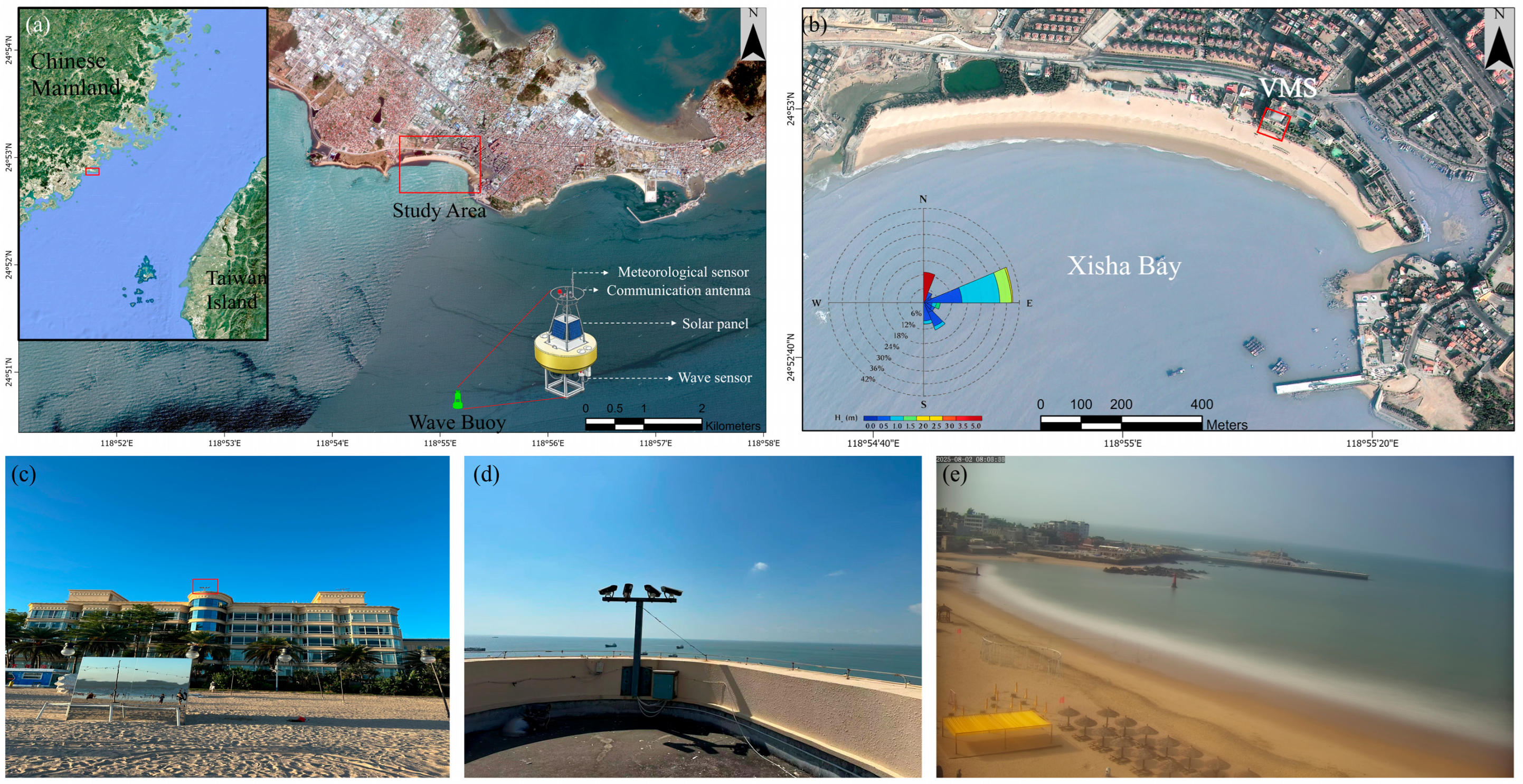
The study area is Xisha Bay Beach, which is located in Quanzhou, Fujian Province, southeastern China, on the eastern segment of the Chongwu–Tuxiu coastline and facing the Taiwan Strait to the south (Figure 1a,b). The beach is a typical east–west-oriented crescentic headland–bay system, with a concave sandy shoreline approximately 1.3 km long and an intertidal width of approximately 200 m from the berm to the low-tide zone. Xisha Bay underwent beach nourishment and rehabilitation from November 2013 to June 2014, substantially modifying its morphology and making it a representative site for studying postnourishment beach evolution and intertidal morphodynamics response [40]. The beach is characterized by a low-tide terrace profile, with a steeper upper–middle beach face and a much gentler lower intertidal zone. The beach-face slope generally ranges from 0.06 to 0.12 in the high- to mid-tide zones but is typically less than 0.04 in the low-tide terrace. This gentle lower profile makes the waterline position highly sensitive to small vertical changes in elevation.
Xisha Bay is influenced by a regular semidiurnal tide, with a long-term mean tidal range of approximately 4.27 m, indicating macrotidal conditions [41,42]. The nearshore wave climate is moderate, and dominated by waves from the east and southeast, with significant wave heights of 0.10–1.25 m and wave periods of 3.30–4.50 s. Incoming wave energy is partly attenuated by nearby islands, reefs, and coastal structures, and previous simulations have shown strong wave-energy dissipation on the eastern side of the bay, while relatively high wave energy occurs on the western side. A shore-based video monitoring station was installed on a building behind the beach to continuously observe the beach face, swash zone, and nearshore area (Figure 1b–d). The system provides fixed-view Timex images for waterline detection and profile reconstruction, supported by offshore wave buoy measurements and auxiliary meteorological observations.

3. Data Foundation

3.1. Video Imagery

As part of this study, a shore-based video monitoring system (VMS) was installed in July 2021 on the rooftop of the Xisha Bay Resort Hotel at the eastern end of the beach. The system comprises four cameras (C1–C4; 8-megapixel sensors) mounted at ~30 m in elevation and ~150 m landward of the shoreline. It operates continuously, acquiring imagery for the first 10 min of every hour at 2 Hz, from which instantaneous, time-averaged (Timex), and variance images are produced; a maximum intensity composite is also generated. Using measured intrinsic and extrinsic parameters, orthorectified mosaics with spatial resolutions better than 0.5 m and full georeferencing were created via coordinate transformation and multiview fusion, covering the entire beach. This work uses imagery from 2023 to 2025. Timex images were used to generate an orthorectified dataset for this period; to mitigate illumination-driven differences in brightness that could affect waterline breakpoint detection, mean normalization was applied during fusion.

3.2. Field-Measured Topographic Data

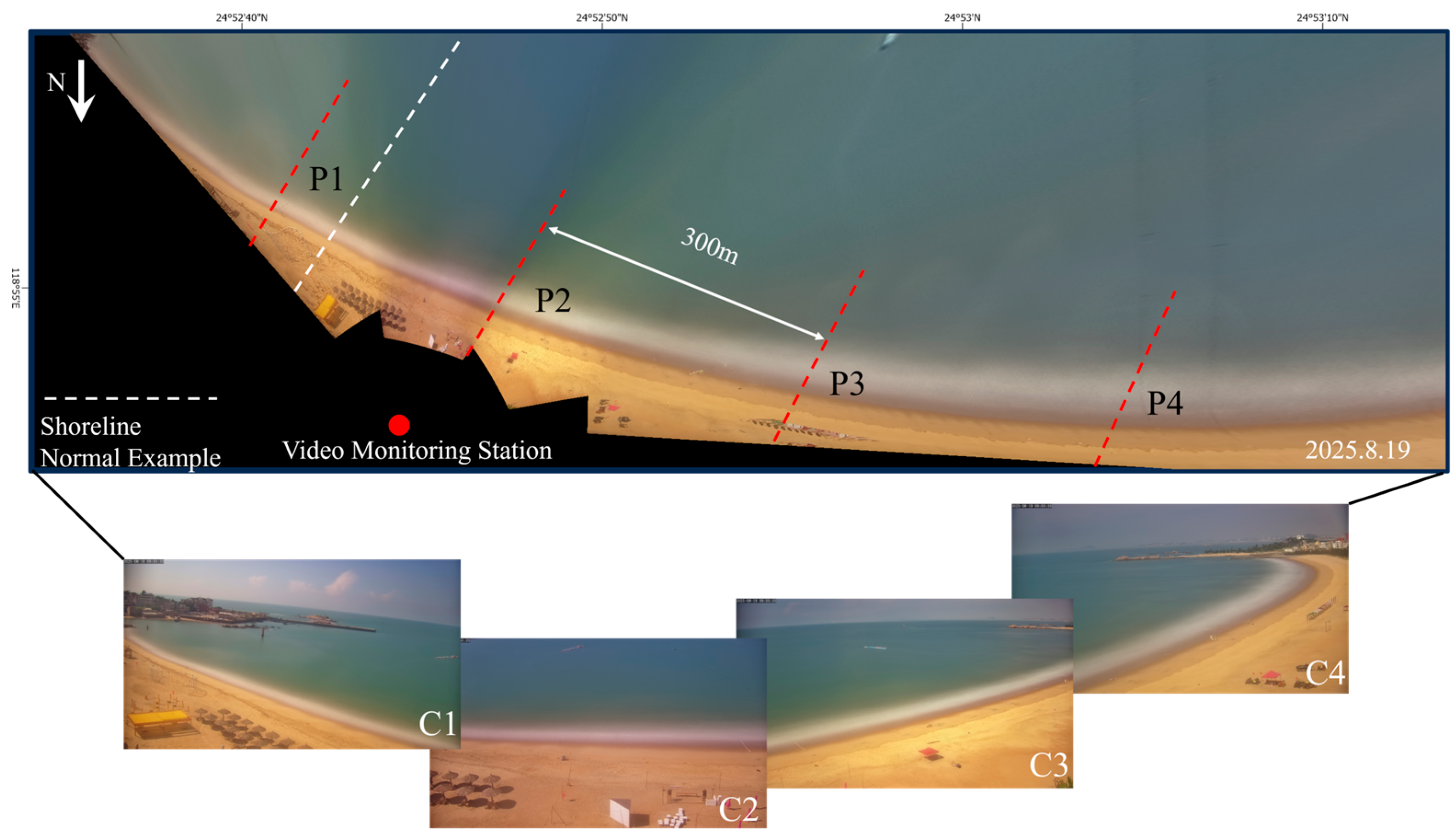
Beach profiles were surveyed at low tide using RTK system, with a stated horizontal control accuracy of ± (8 mm + 1 ppm) root mean square (RMS) and a vertical accuracy of ± (15 mm + 1 ppm) RMS. The reference frame is CGCS2000 with Gauss–Krüger projection (central meridian 117°E). Control elevations were converted relative to the local mean sea level. Guided by long term morphodynamical reconnaissance and the fields of view of the four cameras, four fixed profiles (P1–P4) were established at ~300 m spacing. The spatial layout of the video monitoring profiles at Xisha Bay and the correspondence between each profile and the fields of view of different cameras at the shore-based video monitoring station are shown in Figure 2.
Three field visits (2 August 2023; 27 January 2024; 24 July 2025) recorded profile elevations and slopes to construct the swash zone slope model and to validate subsequent profile reconstruction; Table 1 lists the starting point coordinates of each profile.

3.3. Hydrodynamic Data

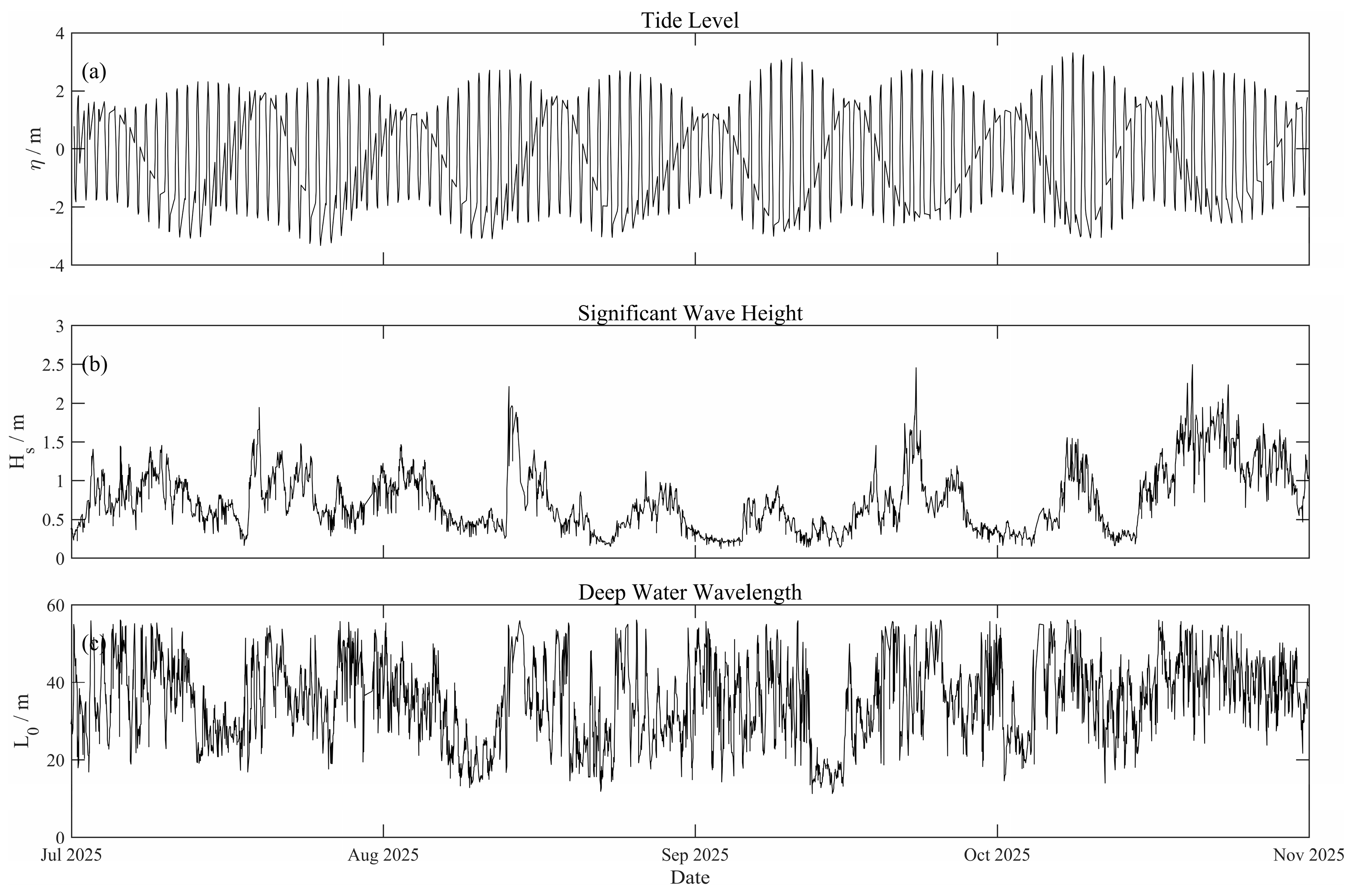
A wave buoy was deployed south of Xisha Bay in waters ~8 m deep, and the significant wave height, mean wave height, significant wave period, and mean wave period were recorded at 60 min intervals (Figure 3). In addition, tide levels were obtained from the Chongwu tide gauge located within the study area (the station’s vertical datum is 351 cm below mean sea level).

4. Methodology

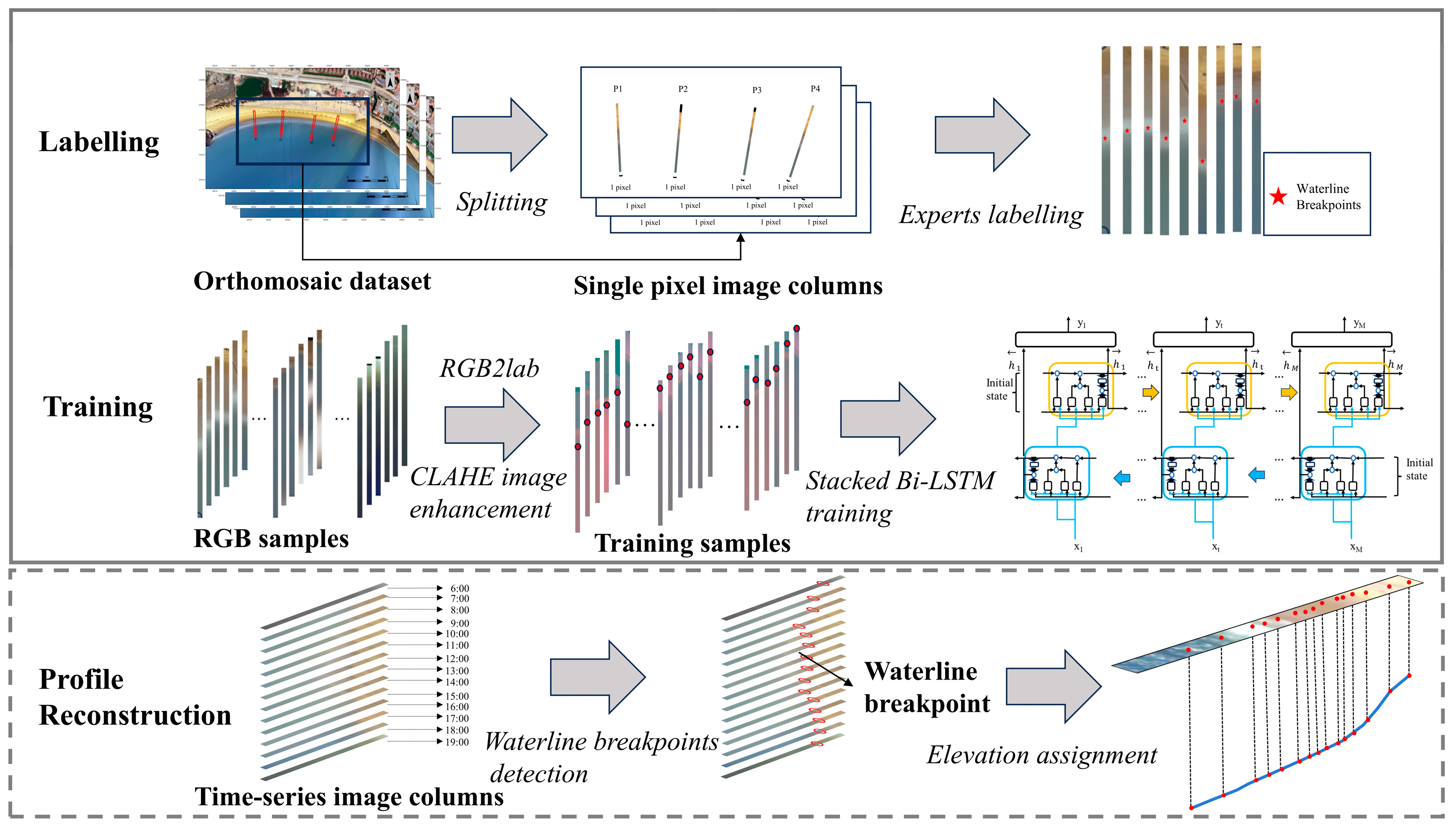
The workflow of the proposed method is shown in Figure 4. The following sections describe the image column sample construction and labelling, Bi-LSTM model training, waterline breakpoint detection, and elevation-constrained profile reconstruction.

4.1. Video Imagery Processing

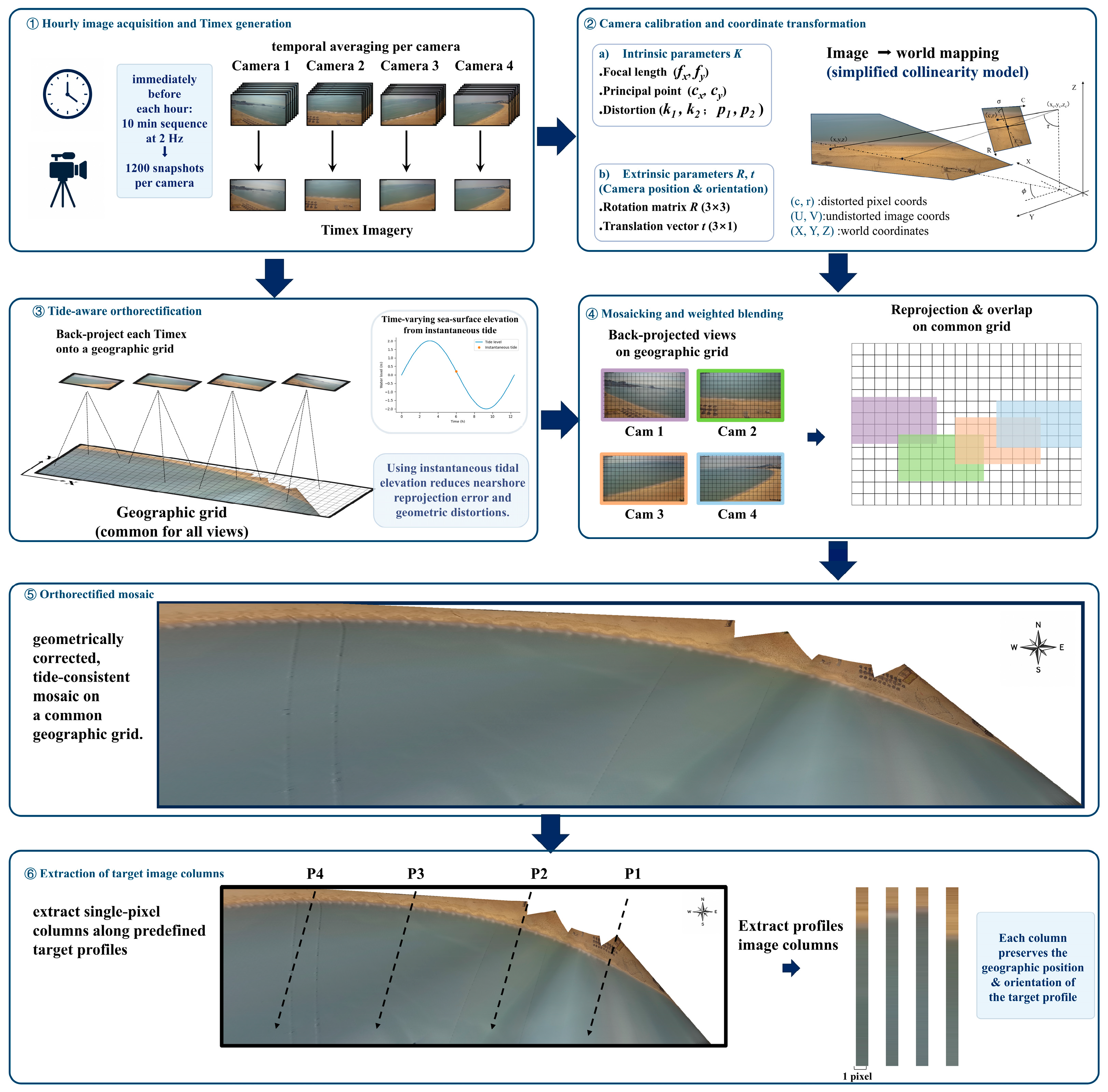
Video imagery processing aims to transform raw multicamera video records into georeferenced image column samples for profile-oriented waterline detection. As illustrated in Figure 5, the procedure consists of hourly Timex image generation, camera calibration and coordinate transformation, tide-aware orthorectification, multicamera mosaicking, and the extraction of single-pixel image columns along predefined beach profiles. For each hour, a 10 min sequence immediately before the hour was sampled at 2 Hz, producing 1200 snapshots per camera with a resolution of 3840 × 2160 pixels. The snapshots were averaged to generate Timex images, which were subsequently orthorectified, projected onto a common geographic grid, and mosaicked. Target image columns were then extracted from the orthorectified mosaic, providing geographically referenced profile samples for subsequent annotation and Bi-LSTM-based waterline breakpoint detection.
To quantitatively extract nearshore information from imagery, image coordinates u , v are mapped precisely to world coordinates X , Y , Z [43]. Camera calibration followed the Zhang method [44]. Considering that long-term operations can accumulate errors in the extrinsic parameters [45], we adopt the simplified collinearity model of Simarro et al., which reduces the number of free parameters from 14 to 8 to increase robustness [46]. The relationship between distorted pixel coordinates c , r and the ideal image plane coordinates u , v is given by the following equation:
c = u 1 + k d 2 s + o c , r = u 1 + k d 2 s + o r ,
where k is the radial distortion factor; s is the pixel size (assumed to be square); ( o c , o r ) are the coordinates of the principal imagery point (assumed to be the centre of the imagery); and d 2 = u 2 + v 2 and ( u , v ) are the undistorted coordinates;
u = x x c m 1 x x c m 3 , v = x x c m 2 x x c m 3 ,
where x c = ( x c , y c , z c ) are the positions of the camera in the world coordinate system, and M = ( m 1 , m 2 , m 3 ) are the parameters in the orientation matrix calculated through Euler angles ( α , τ , θ );
M = m 1 m 2 m 3 = cos α sin α 0 sin α cos α 0 0 0 1 1 0 0 0 cos τ sin τ 0 sin τ cos τ × cos θ sin θ 0 sin θ cos θ 0 0 0 1
where α is the camera’s azimuth, τ is the pitch, and θ is the lateral tilt.
To obtain single-pixel image column samples that are strictly projected to the target profile’s geographic position and orientation, we adopt the Coastal Imaging Research Network [47] image geometric rectification workflow in combination with GeoTIFF affine transformations [48]; see Figure 4 for the procedure.
First, the camera intrinsic and extrinsic are fed into the coordinate transformation model to establish a one-to-one mapping between ground coordinates ( X , Y , Z ) and image plane coordinates ( u , v ) . Pixels are then back-projected onto a unified geographic grid, and the four camera views are fused using a distance transform weighted blending strategy. Notably, because each image is captured at a different time, using a single reference plane can distort the shoreline; therefore, in this study, each view is projected to a time-varying sea surface elevation (based on the instantaneous tide) before mosaicking to reduce nearshore reprojection errors.
To ensure that the extracted image column inherits the source image’s geodetic reference and true orientation, we construct a 4 × 4 ModelTransformationTag so that the row index of the column (from 1 to T ) advances along the prescribed target profile direction. Let the geographic increment vector of the profile be:
d X , d Y = x 2 x 1 T 1 , y 2 y 1 T 1
where x 1 , y 1 , x 2 , y 2 are the start and end points of the target profile, respectively.
The affine matrix T of the single-pixel image column is constructed as follows:
T = 1 d X 0 x 1 0 d Y 0 y 1 0 0 1 0 0 0 0 1
The affine matrix embeds the profile direction vector into the spatial transform of the column: the image “row” axis advances along the target profile, so the world coordinates of the i row pixel are ( x 1 + i × d X ,   y 1 + i × d Y ) The azimuth θ is computed by:
θ = tan 1 ( d Y d X ) ,   d X > 0 tan 1 ( d Y d X ) + π ,   d X < 0 ,   d Y 0 tan 1 ( d Y d X ) π ,   d X < 0 ,   d Y < 0 + π 2 ,   d X = 0 ,   d Y > 0 π 2 ,   d X = 0 ,   d Y < 0 u n d e f i n e d ,   d X = 0 ,   d Y = 0
In addition to extracting image columns along profiles with known geographic endpoints, we enriched the sample diversity by allowing researchers to freely select the start and end points of profiles within the imagery.
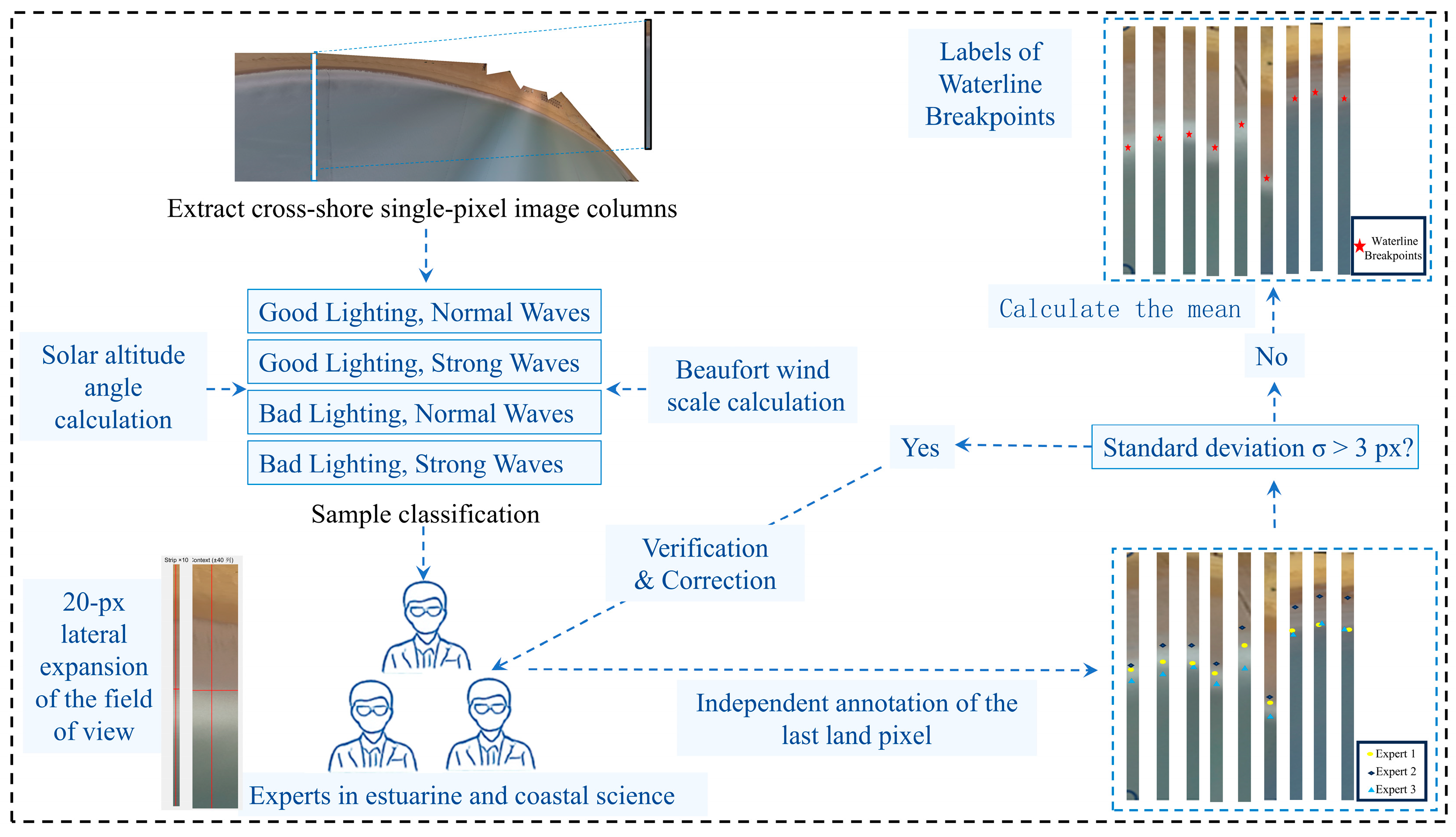
During labelling, to facilitate human interpretation, each sample was temporarily expanded by 20 pixels on both the left and right as the contextual field of view, while model training still used a single-pixel image column only. Three coastal experts independently labelled, for each image column, the position of the “last land pixel”; if the per-column labelling standard deviation exceeded σ > 3 px, a review procedure was triggered, and the corrected mean of the three labels was stored as the ground truth tag (Figure 6).
This procedure was repeated across seasons, illumination conditions, and wave conditions. Seasons were defined as spring (March–May), summer (June–August), autumn (September–November), and winter (December–February). Illumination was classified by the solar elevation angle h : h 0 denoted favourable illumination and h < 0 denoted unfavourable illumination.
sin h = sin φ sin δ + cos φ cos δ cos ω
where h is the solar elevation angle, φ is the latitude of the observation site, δ is the solar declination, and ω is the hour angle. The solar elevation angle can be calculated as follows:
h = arcsin sin φ sin δ + cos φ cos δ cos ω
When h 0 , the sun is above the horizon, and the illumination condition is classified as favourable. When h < 0 , the Sun is below the horizon, and the illumination condition is classified as unfavourable.
The wave conditions followed the Beaufort scale: a Beaufort score ≤ 3 was considered to indicate moderate waves and a value >3 was considered to indicate strong waves.
B = ( U / 0.836 ) 2 / 3
Cases with B < 6 were categorized as normal-wave conditions, whereas cases with B 6 were categorized as energetic-wave conditions.
Because pixel features are more complex under unfavourable illumination, we intentionally sampled more of such cases. Interannotator consistency was quantified using Cohen’s kappa [49], and labels were stored together with image indices.
Pairwise comparisons were performed among the annotation results of the three experts. Specifically, kappa values were calculated for the pairs of Expert 1–Expert 2, Expert 1–Expert 3, and Expert 2–Expert 3. The mean value of these three pairwise kappa coefficients was used to represent the overall interexpert agreement. The calculation is given as follows:
κ = P o P e 1 P e
where P o denotes the observed agreement proportion, and P e denotes the expected agreement proportion by chance. The annotation results with k classes, can be expressed as follows:
P o = i = 1 k n i i N
P e = i = 1 k n i + N · n + i N
where n i i denotes the number of samples for which the two annotators agree on class i , n i + and n + i denote the total number of samples in the i row and the i column of the confusion matrix, respectively, and N is the total number of samples.
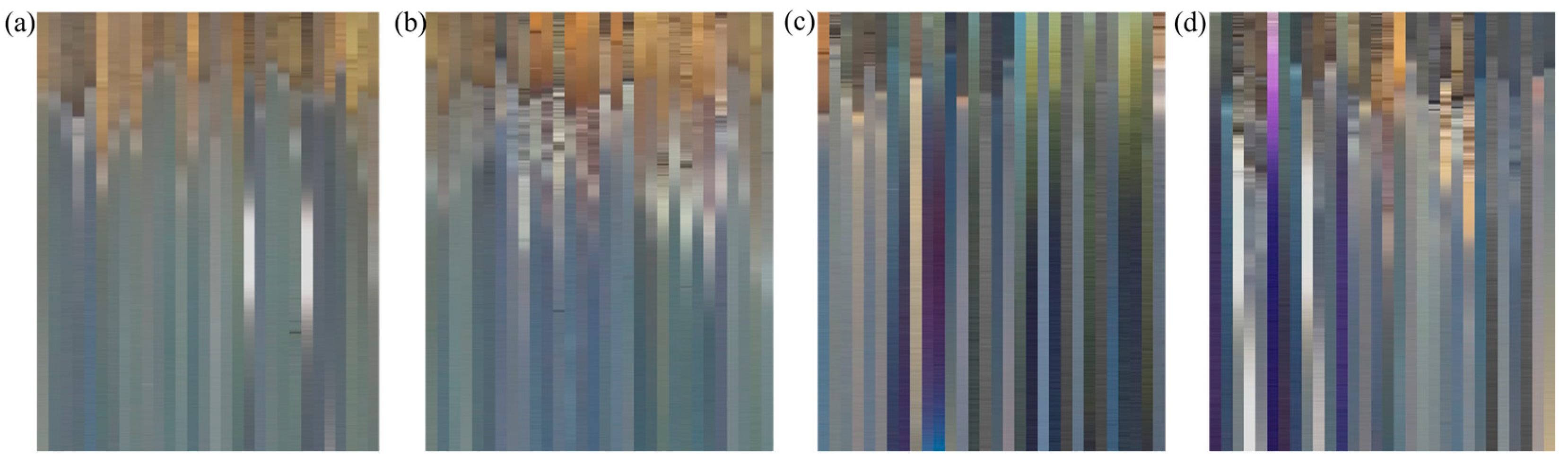
The final dataset comprises 1200 RGB image column samples (Figure 7) paired one to one with ground truth labels, with κ = 0.93 , indicating very high agreement and reliable ground truth for waterline breakpoint detection.
After comparing multiple colour spaces, Marti-Puig et al. [39] concluded that the LAB colour space performs best for shoreline extraction. Following these findings, we converted the RGB image columns into LAB-based samples and applied contrast-limited adaptive histogram equalization (CLAHE) for image enhancement, thereby emphasizing the grayscale gradient at the land–water boundary. The final feature-sampling sequences and their corresponding ground truth labels were subsequently obtained; examples of the labelled samples are shown in Table 2.

4.2. Training the Stacked Bi-LSTM Model for Waterline Breakpoint Localization

In deep learning, recurrent neural networks (RNNs) are effective tools for handling sequential data [50] and have long been a topic of active research. However, conventional RNNs are prone to gradient vanishing or exploding when processing long sequences, which makes learning long-range dependencies difficult. To address this challenge, Hochreiter and Schmidhuber [51] proposed the long short-term memory (LSTM) model. As shown in Figure 6, LSTM augments the classical RNN with gating mechanisms that selectively add or remove information from past time steps, namely the input, output, and forget gates, which control the inflow of new information into the cell, the exposure of the cell state, and the retention of information from the previous step, respectively. The LSTM equations are given as follows:
I t = σ W x i X t + W h i H t 1 + W c i C t 1 + b i
F t = σ W x f X t + W h f H t 1 + W c f C t 1 + b f
C t = F t C t 1 + I t tan h W x c X t + W h c H t 1 + b c
O t = σ W x o u t X t + W h o u t H t 1 + W c o u t C t 1 + b 0
where I , F , and O are the input, forget, and output gates, respectively; C and H are the cell state (information carried through the gated pathway) and the hidden state (the output at each time step). W are the weight matrices, X is the input data, b is the bias terms, σ is the logistic sigmoid function, and is the Walsh–Hadamard product. The subscript t indicates time t ; the subscripts i , f , and out refer to the weights and biases associated with the three gates, and the subscript c refers to those associated with the cell state C . The subscript x on W is the weight applied to the input X , and the subscript h denotes the weight applied to the hidden state H .
To overcome the limitation that a unidirectional LSTM can exploit only past context and cannot use future context, Schuster and Paliwal [52] proposed the bidirectional recurrent neural network (BRNN), which merges two LSTM hidden layers running in opposite temporal directions into a common output. In this way, the output layer can simultaneously leverage information from both the past and the future. In this study, one LSTM layer processes the input sequence forwards (land → sea), and the other processes it backwards (sea → land). The Bi-LSTM output is obtained by combining the outputs of these two LSTM layers and can be written as follows:
y t = σ W h y h t + W h y h t + b y
where h t are the outputs of the layer being processed in the forwards direction, and h t are those of the backwards network. σ is the activation function, W h y ; W h y are the weights of this layer, and b y are the biases.
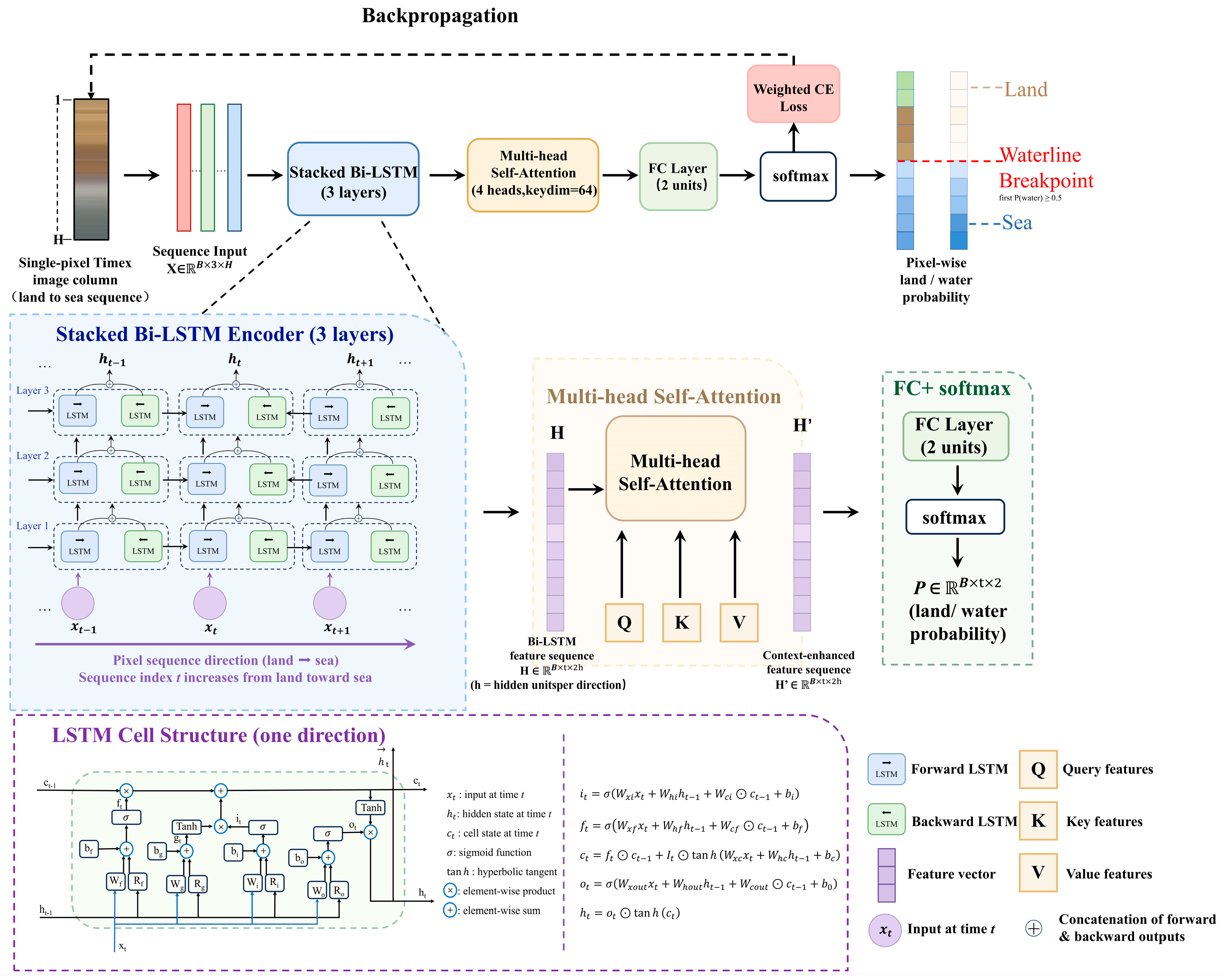
Prior studies have shown that stacking multiple Bi-LSTM layers in neural networks can further enhance classification or regression performance [53]. Moreover, deep, hierarchical models can represent certain functions more efficiently than shallow models can [54]. Accordingly, we define a stacked Bi-LSTM-based artificial neural network that processes single-pixel image columns sequentially to extract shoreline breakpoints, as illustrated in Figure 8:
The proposed network consists of three stacked Bi-LSTM layers, followed by a multi-head self-attention layer, a fully connected layer, a softmax layer, and a weighted cross-entropy loss layer. Each Bi-LSTM layer contains 256 hidden units and outputs a feature sequence. Layer normalization and dropout are applied after each Bi-LSTM layer to stabilize training and reduce overfitting. The first Bi-LSTM layer mainly captures localized colour and texture transitions along the image column, while the deeper layers integrate longer-range contextual information and enhance the representation of the complete land-to-sea transition.
To further strengthen the global dependency modelling of the sequence, a multi-head self-attention module was introduced after the stacked Bi-LSTM encoder. Given the Bi-LSTM feature sequence H , the attention module first generates query, key, and value matrices:
Q = H W Q , K = H W K , V = H W V
The scaled dot-product attention is then calculated as:
Attention Q , K , V = softmax Q K T d k V
where d k is the key dimension. In this study, four attention heads were used, with a key dimension of 64. The attention-enhanced features were passed to a fully connected layer with two output units and then to a softmax layer to obtain the land and water probabilities for each pixel
p t = p t , land , p t , water , p t , land + p t , water = 1
The waterline breakpoint was determined from the probability sequence. Specifically, the first position where p t , water 0.5 was regarded as the transition from land to water. To obtain a sub-pixel breakpoint position, linear interpolation was performed between the two adjacent pixels around the probability threshold. If p i 1 , water < 0.5 and p i , water 0.5 , the predicted breakpoint position was calculated as: r ^
r ^ = i 1 + 0.5 - p i 1 , water p i , water - p i 1 , water
This probability-crossing strategy avoids restricting the detected breakpoint to an integer pixel row and enables sub-pixel localization of the waterline breakpoint.
Because water pixels usually outnumber land pixels in the image column samples, direct use of standard cross-entropy may bias the network toward the dominant water class. This bias can reduce land-pixel recall and may shift the predicted breakpoint seaward. To alleviate this class imbalance, a weighted cross-entropy loss was used:
L = 1 B H b = 1 B t = 1 H c l a n d , w a t e r w c y b , t , c log p b , t , c
where B is the batch size, H is the sequence length, y b , t , c is the ground truth label of class c , p b , t , c is the predicted probability, and w c is the class weight. The weights were calculated using inverse class frequency:
w c = N 2 N c
where N is the total number of labelled pixels, and N c is the number of pixels belonging to class c By assigning a higher penalty to the minority land class, the network was encouraged to learn the land-to-water transition more effectively.
Before training, the main hyperparameters of the stacked Bi-LSTM model were optimized through controlled experiments. As summarized in Table 3, the model takes Timex image columns as inputs and outputs land/water probability sequences for waterline breakpoint localization. The dataset contained 1200 labelled samples and was manually divided into training, validation, and test sets at a ratio of 6:2:2, corresponding to 720, 240, and 240 samples, respectively. To prevent temporal leakage, samples from March to July were used for training, those from August to October were used for validation, and those from December were used for independent testing.

4.3. Assigning Elevations to Waterline Breakpoints

To obtain beach elevations, additional information is required to assign elevations to the shoreline extracted from video imagery. The “standardized” formulation for shoreline elevation given by Aarninkhof et al. [17] is:
Z s l = Z o + η s l + K o s c × η o s c 2
where Z s l is the shoreline elevation; Z o is the nearshore water level combining astronomical tide and meteorological effects; η s l is the elevation change due to wave setup; and K o s c × η o s c 2 represents the maximum elevation reached by swash motion, where K o s c is an empirical swash coefficient requiring field calibration. On the basis of field calibration in this study, K o s c = 1.10 was adopted for subsequent waterline elevation assignment.
Stockdon et al. [55] proposed empirical relations that directly parameterize η s l , η o s c , and the commonly used extreme runup metric R 2 % enabling a one-to-one correspondance and allowing Equation (24) to be rewritten as follows:
Z s l = Z o + K o s c 0.35 tan 2 β s H 0 L 0 + 1 2 H 0 L 0 0.563 tan 2 β s + 0.004
where β s is the mean slope of the swash zone; H 0 is the offshore significant wave height; and L 0 is the deep-water wavelength, which can be obtained from the dispersion relation L 0 = g T 2   / 2 π , where T is the significant wave period and g is gravitational acceleration.
Existing studies often compute wave runup using a single mean slope for the swash zone [56], which is operationally simple but ignores the space time drift of the swash band induced by tidal fluctuations. As a result, the local beach slope varies appreciably with the tide level, degrading the accuracy of extreme runup estimates. To improve runup estimation, we do not adopt a swash zone mean slope. Given the sensitivity of both the video-based inversion and empirical formulas to the slope parameter, we calibrate a site-specific model by fitting in situ profiles to the Bruun–Dean equilibrium profile [57]. The functional form is as follows:
h x = A x m
where x is the horizontal distance from the shoreline, h is the corresponding water depth, A is the profile scale parameter, and m is the exponent. The parameters A and m are obtained by fitting to the observational data.
Building on this, we further generalize by treating the tide level and the offshore distance as independent variables to define a functional relationship and by taking its first derivative to obtain the local slope β f at any offshore position:
h x = tan β f x = A m x m 1
Equation (27) allows the slope for any combination of tide level and offshore distance to be queried directly, thereby introducing a high-resolution, time-varying slope input into the piecewise computation of wave setup η s l and swash oscillation η o s c and providing a rigorous topographic constraint for refined runup extreme estimation.
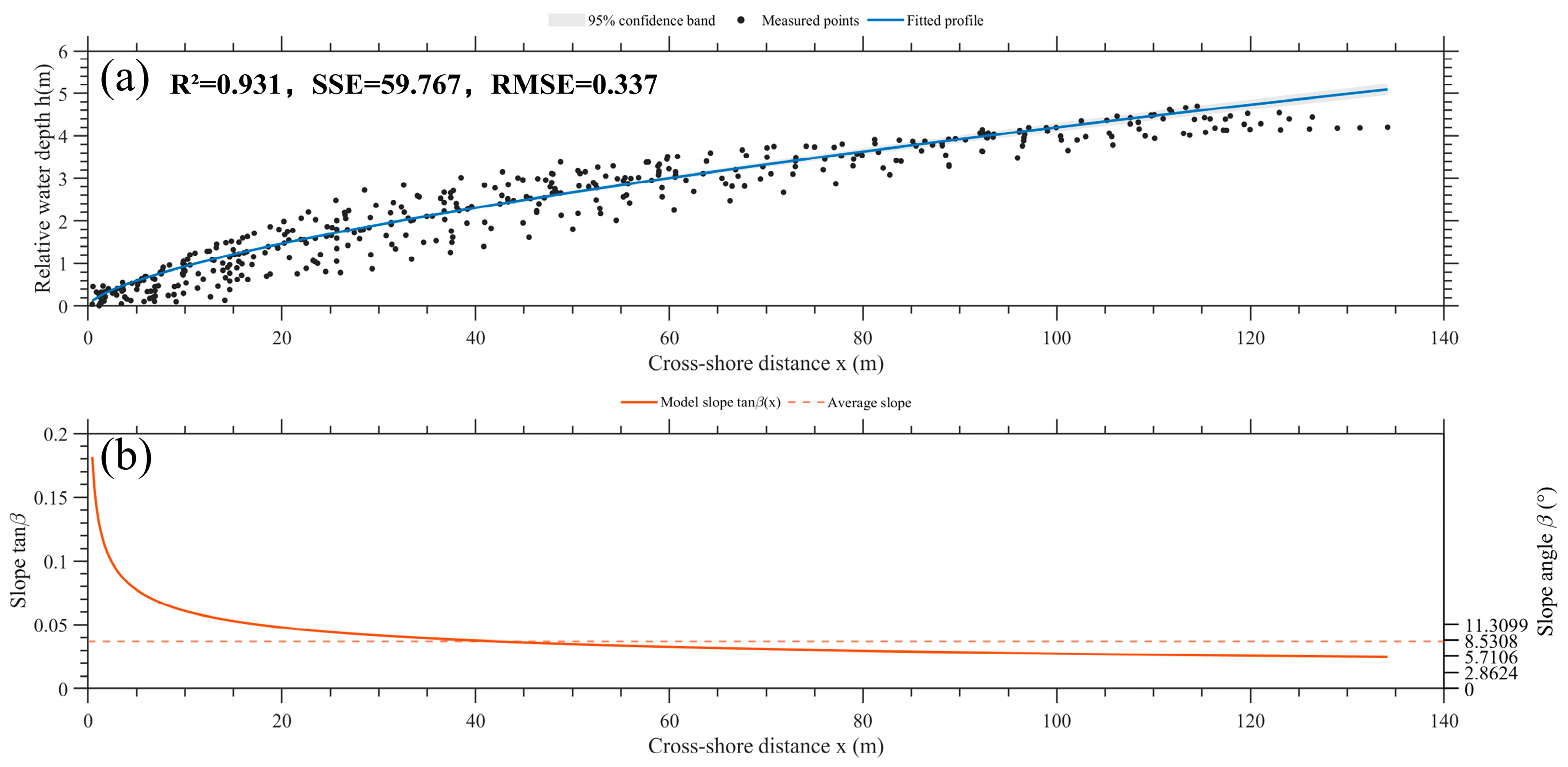
Using ten RTK GPS beach profiles from the study area, we calibrated the equilibrium profile model (Figure 9a). The fitted scale parameter A ranges from 0.1678 to 0.2022 with an expected value of 0.1892, and the exponent m ranges from 0.6517 to 0.7719 with an expected value of 0.6861—close to the Bruun–Dean canonical value m = 2/3. The goodness of fit is high, with R 2 = 0.931 .
On the basis of this fitted profile model, a swash zone slope model was constructed for Xisha Bay beach (Figure 9b). The slope β ranges from 1.09° to 10.78°, with a mean of 2.18°. The corresponding mean t a n β is 0.038, which is close to the measured average foreshore slope of 0.04, indicating the high credibility of the model.
For each timestamp, the waterline-breakpoint offshore distance is input to the slope model to obtain the local slope at that point. The local slope for each breakpoint, together with the nearshore tide level from the Chongwu gauge and the contemporaneous wave parameters from the buoy (e.g., significant wave height and period), is then substituted into Equation (25) to compute the waterline elevation. Using the resulting elevations and offshore distances of all the breakpoints, the corresponding intertidal beach profile can be plotted.

5. Results

The accuracy assessment was conducted at two levels: waterline breakpoint detection and beach profile reconstruction. For breakpoint detection, expert-labelled breakpoint positions were used as reference data, and precision, recall, accuracy, F1 score, and pixel-scale breakpoint error were calculated. For profile reconstruction, the reconstructed profiles were compared with synchronous field-measured topographic profiles after both datasets were transformed onto the same cross-shore distance coordinate. Elevation residuals were defined as the reconstructed elevation minus the measured elevation. The coefficient of determination (R2), mean error (ME), mean absolute error (MAE), root mean square error (RMSE), error standard deviation, confidence intervals, and limits of agreement were then used to evaluate the agreement, bias, error magnitude, residual dispersion, and uncertainty of the reconstructed profiles.

5.1. Accuracy Assessment of Waterline Breakpoint Detection

In this study, waterline breakpoint extraction is recast as a binary land–sea segmentation task: each pixel is classified as either sea or land, and the shoreline breakpoint is defined as the last land pixel immediately adjacent to the sea. This enables precise breakpoint localization, and on this basis, the confusion matrix [58] for waterline breakpoint detection is defined (Table 4).
On the basis of the confusion matrix, four classification metrics were calculated: precision (R), recall (R), accuracy (Acc), and F1 score (F1). Precision measures the proportion of correctly classified land pixels among all pixels predicted as land, recall measures the proportion of actual land pixels correctly identified by the model, accuracy measures the overall proportion of correctly classified pixels, and F1 score provides a balanced measure of precision and recall. These metrics are defined as follows:
P = T P T P + F P
R = T P T P + F N
A c c = T P + T N T P + T N + F P + F N
F 1 = 2 × P × R P + R
To validate the performance of the proposed neural network, several shoreline breakpoint extraction methods, including single-layer Bi-LSTM, support vector machine (SVM), and Otsu thresholding were compared. The results are summarized in Table 5. The proposed stacked Bi-LSTM achieved the best overall performance, with the highest precision, recall, accuracy, and F1 score. Compared with the single-layer Bi-LSTM, the stacked structure further improved the recognition of land–water transition features. The SVM and thresholding methods yielded lower recall and F1 scores, indicating that traditional feature-based or threshold-based approaches are less robust under complex illumination, wet-sand, and foam-covered conditions.
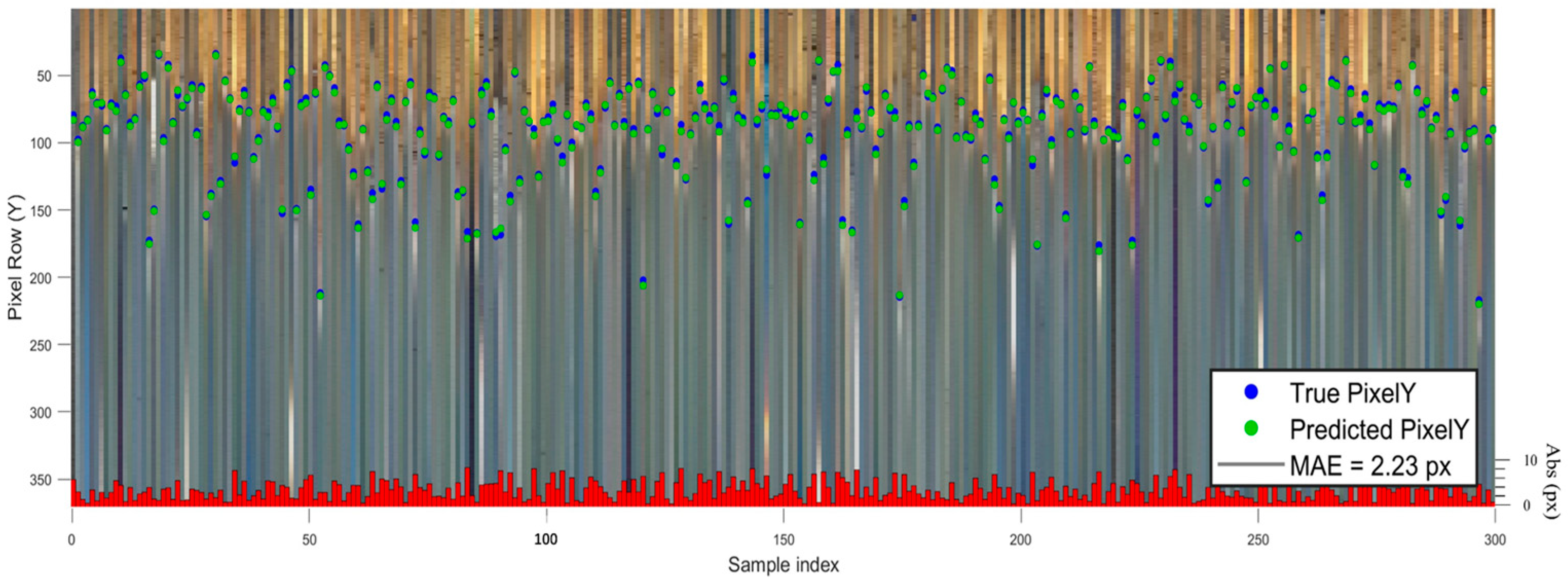
The validation results for waterline breakpoint detection are shown in Figure 10: blue markers denote true breakpoints, the green markers represent the model predictions, and the red bars represent the absolute error per sample. The predictions align closely with the true values for the vast majority of test samples, yielding a mean error of 2.23 pixels. The few larger errors occur primarily under poor illumination with reduced texture and brightness contrast. Overall, the stacked Bi-LSTM maintains stable generalizability to unseen data for single-pixel image columns; for profiles with column heights of several hundred pixels, this error magnitude has only a minor effect on subsequent georeferencing and profile reconstruction.
After obtaining the pixel coordinates of the waterline breakpoints from the model, we transformed them to projected planar coordinates via the affine transform, thereby recovering their geographic positions. Although preliminary experiments already showed excellent performance with single-column decomposition, we also tested two-pixel-wide and five-pixel-wide image columns. These wider columns offered no advantage for breakpoint extraction and, in fact, degraded the collinearity of the predicted breakpoints with the target profile as the width increased, which is unfavourable for profile reconstruction. We therefore conclude that single-pixel sampling remains the preferred strategy.

5.2. Reconstruction Results of Intertidal Beach Profiles

To evaluate the accuracy and stability of the proposed method for intertidal beach profile reconstruction, three field survey dates with synchronous measurements were selected for validation—2 August 2023, 27 January 2024, and 24 July 2025, hereafter referred to as T1, T2, and T3, respectively. For each validation period, single-pixel image columns were extracted from the corresponding Timex images along the four target profiles, P1–P4. The intertidal beach profiles were then reconstructed using the proposed method and compared with the synchronous RTK-GPS measurements. To ensure consistency in the error calculation, both the reconstructed and measured profiles were transformed onto the same cross-shore distance coordinate, and pointwise elevation residuals were calculated as the video-derived elevation minus the RTK-GPS elevation. These residuals were then used to quantify the accuracy, bias, dispersion, and uncertainty of the reconstructed profiles.
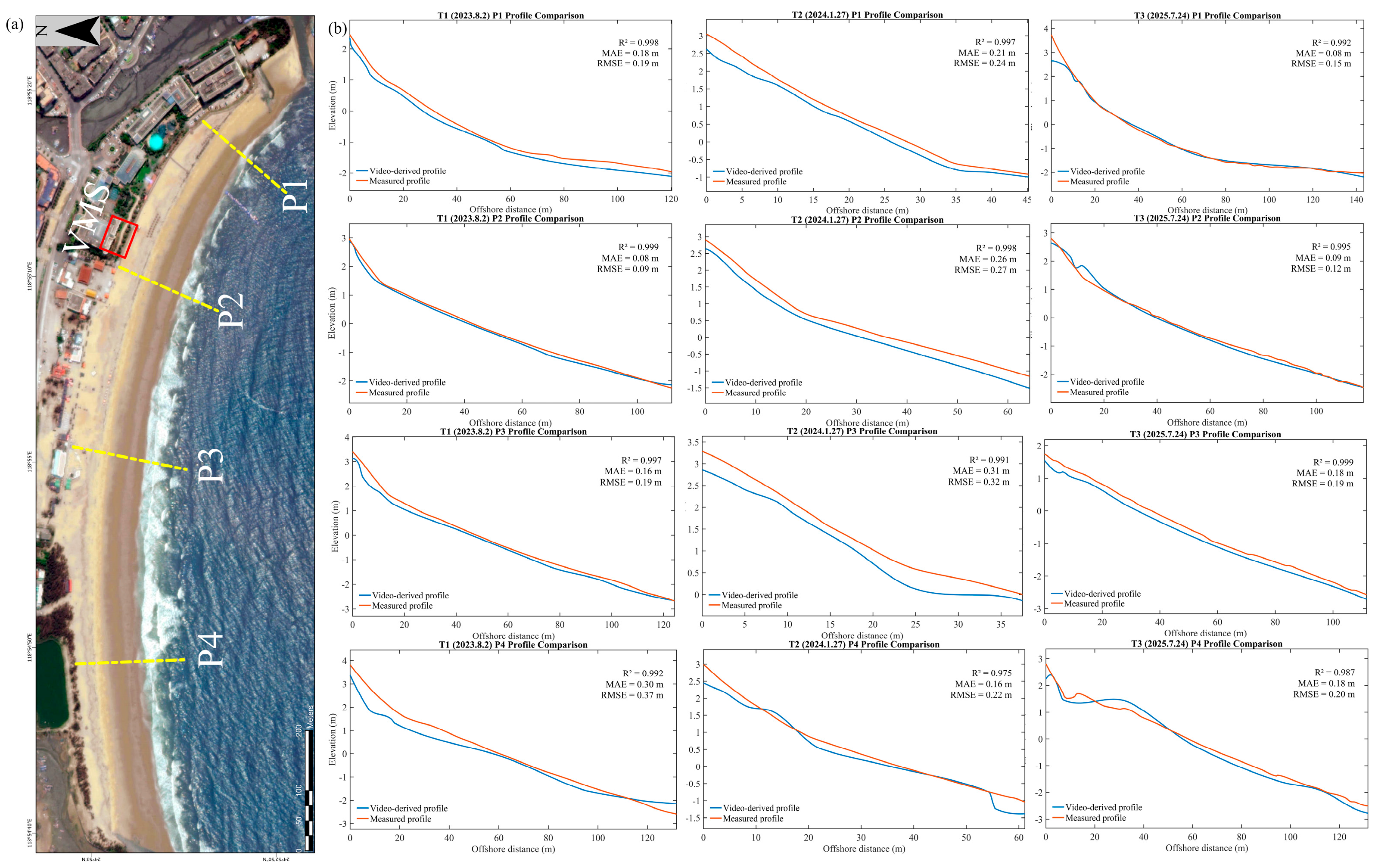
As shown in Figure 11, the reconstructed profiles generally follow the cross-shore variation in the measured profiles. The main beach-face slope, intertidal elevation change, and low-tide terrace morphology are reasonably reproduced. Local discrepancies mainly occur in the upper intertidal zone, the slope-break region, and the wet-sand to shallow-water transition zone. These areas are commonly affected by microtopography, wet-sand reflectance, residual foam, and blurred land–water boundaries, which may introduce uncertainty into waterline breakpoint localization and elevation assignment.
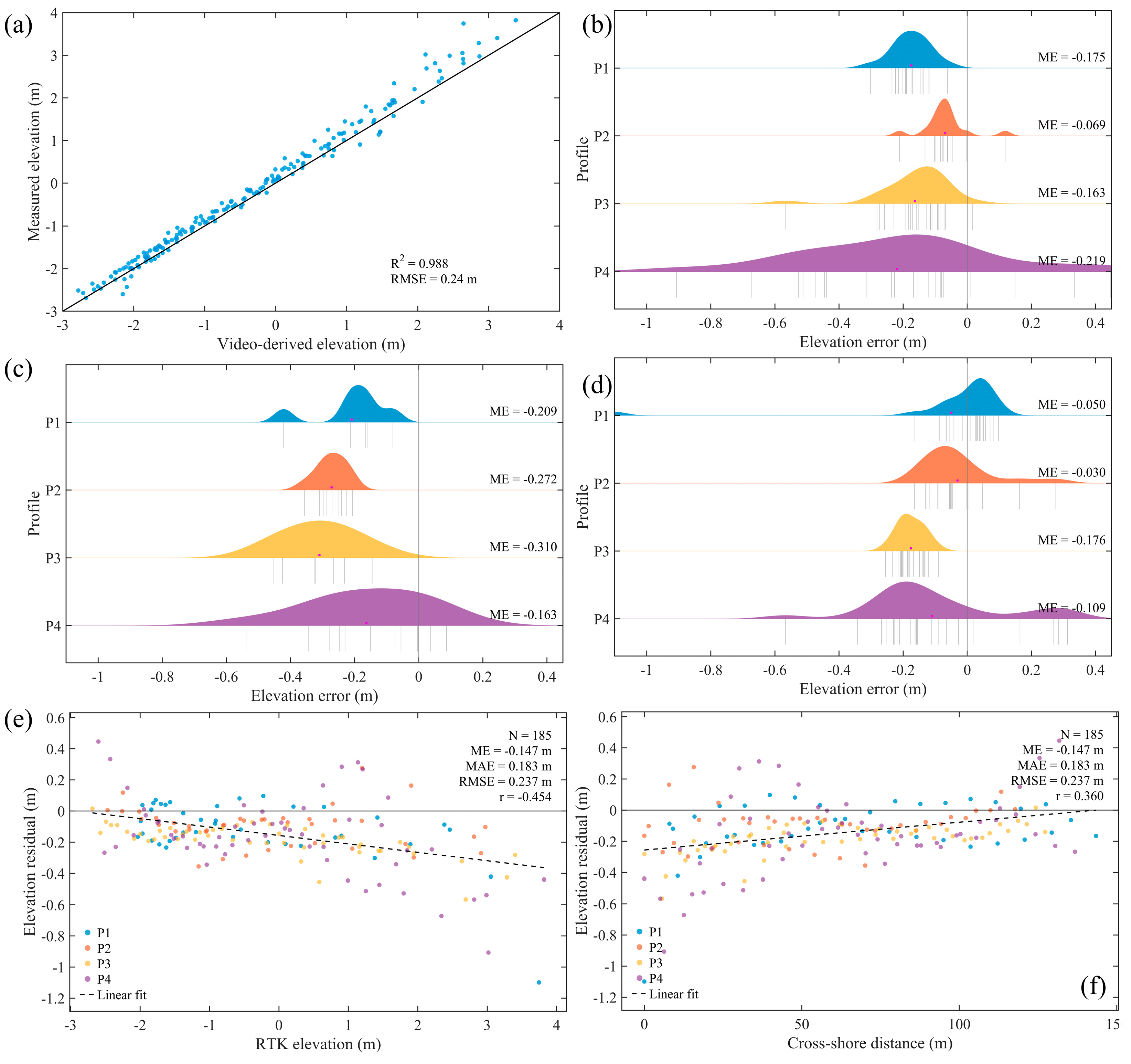
To further quantify the agreement between video-derived elevations and RTK-GPS measurements, all elevation points from the three validation periods were pooled and compared in Figure 12a. The results show a strong linear relationship, with most points distributed close to the 1:1 reference line. The coefficient of determination reaches R2 = 0.988, and RMSE is 0.24 m, indicating that the video-derived elevations explain the measured elevation variation well. Some scatter remains in local high- and low-elevation ranges, suggesting that local errors may still occur in areas with complex morphology or ambiguous image boundaries.
The period-based statistics indicate that the reconstruction results are generally stable (Table 6). Across all 12 profile-date combinations, ME, MAE, and RMSE are −0.155 ± 0.093 m, 0.183 ± 0.078 m, and 0.212 ± 0.080 m, respectively. Among the three periods, T3 performs best, followed by T1, whereas T2 shows relatively larger errors. The negative ME values for all periods indicate that the video-derived elevations are slightly lower than the measured elevations, which is also reflected in the residual density distributions in Figure 12b–d. The pointwise residual analysis further shows that the residuals are moderately negatively correlated with RTK elevation (Figure 12e), suggesting that underestimation is more evident in higher-elevation portions of the intertidal profile. In contrast, residuals increase slightly with cross-shore distance (Figure 12f), indicating that the negative bias is more pronounced in the upper intertidal zone and gradually weakens toward the middle-to-lower intertidal zone.
The residual distributions reveal evident differences among validation periods and profiles. During T1, residuals for P1–P3 are relatively concentrated, whereas P4 shows a wider distribution and stronger negative bias, with the largest MAE and RMSE of 0.299 m and 0.374 m, respectively. During T2, all profiles exhibit negative ME values, and P3 has the largest error, suggesting that weak winter illumination, ambiguous wet-sand boundaries, and local slope-break complexity increased reconstruction uncertainty. In contrast, the residuals become narrower during T3, especially for P1 and P2, indicating improved stability under more favorable summer imaging conditions. Profile-based statistics further show that P2 has the most stable performance, while P4 generally presents larger residual ranges, probably due to far-field viewing geometry, shadows, seepage textures, and wet-sand reflectance. Overall, the reconstruction uncertainty is jointly controlled by breakpoint localization, camera geometry, image quality, and local beach-surface characteristics.
These results indicate that the uncertainty of the reconstructed profiles is expressed mainly as slight systematic underestimation, temporal variability, and profile-dependent differences (Table 7). Among the three validation periods, T3 has the best performance, with the lowest MAE and RMSE, suggesting that favourable summer illumination and clearer land–water boundaries help improve the accuracy of waterline breakpoint localization. In contrast, T2 has the greatest uncertainty, indicating that weak winter illumination, reduced image contrast, and ambiguous wet-sand boundaries can increase elevation errors and profile-shape deviations. The differences among P1–P4 further demonstrate that camera-viewing geometry and local beach-surface characteristics influence reconstruction accuracy. P2 hass the most stable overall performance, whereas P4 has the greatestt uncertainty; particularly under far-field viewing conditions, small pixel-level deviations in the image can be amplified into larger ground position errors after orthorectification. P3 shows particularly large errors during T2, which may be related to the combined effects of degraded winter image quality and complex local slope-break morphology. These findings are also consistent with the conclusions of Arriaga et al. [59], who suggested that the accuracy of video monitoring results is jointly controlled by image quality, target-boundary clarity, camera-to-target distance, and water-level correction, and that the effects of image stability and geometric correction errors on spatial positioning accuracy become more pronounced as the target area is farther from the camera.

6. Discussion

6.1. Comparison of the Obtained Accuracy with Previous Studies

To discuss the accuracy level of the proposed method, the uncertainty of the expert-labelled waterline breakpoint should first be considered. Following the practices of previous model-evaluation studies, this study first quantified the difference between each expert-labelled waterline breakpoint and the expert-mean breakpoint. The mean breakpoint labelled by the three experts was taken as the “true” value, and the average distance between each expert-labelled breakpoint and the expert-mean breakpoint was used as the uncertainty of the waterline breakpoint reference. As shown in Table 8, the uncertainty of the waterline breakpoint reference at Xisha Bay was 1.50 px (0.75 m). The mean error of the model was 1.68 px (0.84 m) for the training dataset and 2.51 px (1.25 m) for the test dataset, indicating that the predicted breakpoints were generally close to the expert mean reference.
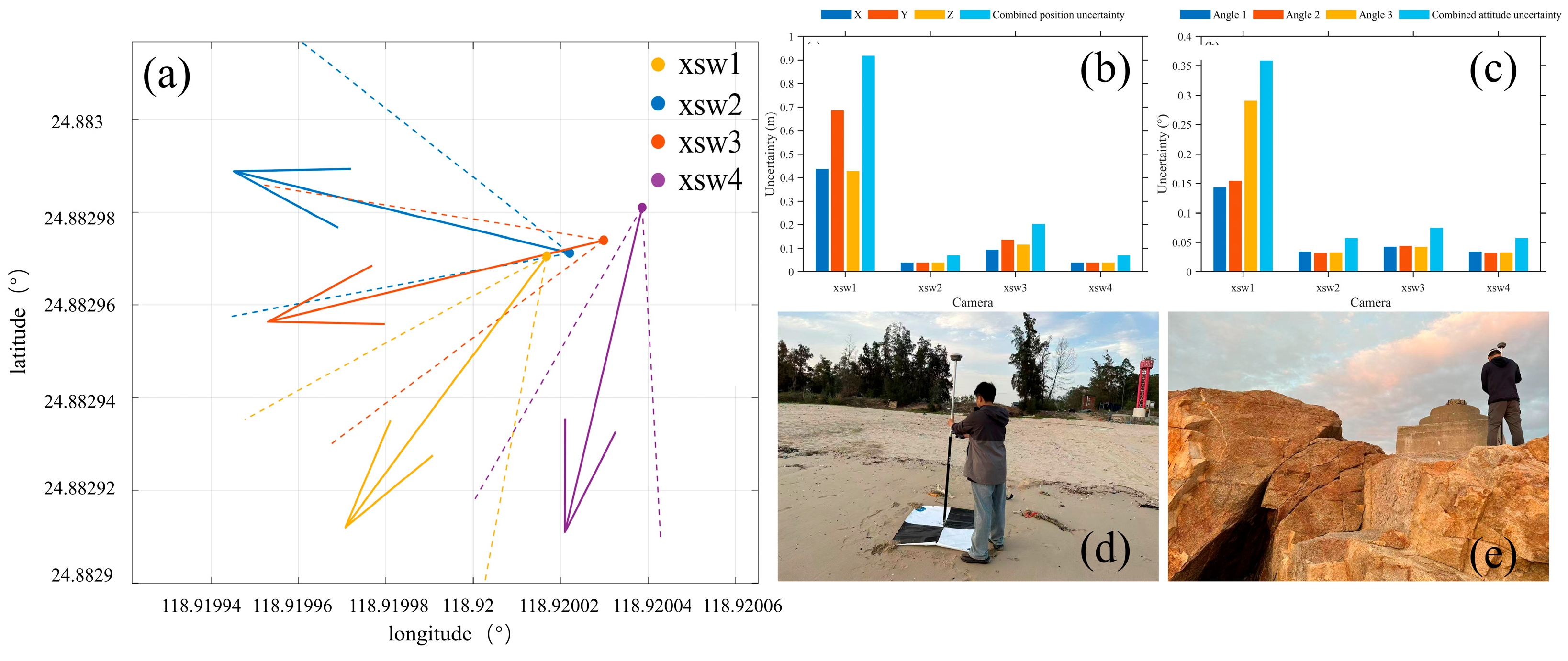
The above breakpoint-localization error first appears as a planimetric offset of the waterline breakpoint and is then propagated into the reconstructed profile through image to ground coordinate transformation, fixed-profile projection, local-slope querying, and tide–wave–slope-based elevation assignment. The camera geometric error further increases this uncertainty. As shown in Figure 13a, the four cameras were deployed alongshore and covered the study area from different viewing angles. Their exterior orientation angles were 165.83°, 82.14°, and 6.03° for xsw1; −165.85°, 72.11°, and −0.98° for xsw2; −125.50°, 78.27°, and −1.55° for xsw3; and −102.91°, 84.53°, and −3.24° for xsw4. Differences in viewing direction, depression angle, and field of view may cause the same image positioning error to be converted into different ground position offset magnitudes. According to the calibration results, the overall position uncertainties of xsw2, xsw3, and xsw4 were relatively small, approximately 0.07 m, 0.20 m, and 0.07 m, respectively, whereas that of xsw1 reached 0.92 m. xsw1 also had the largest overall attitude-angle uncertainty, approximately 0.36°. In addition, xsw1, xsw2, xsw3, and xsw4 were constrained by 14, nine, 23, and nine ground control points, respectively, indicating that calibration stability depends not only on the number of control points but also on their spatial distribution, image position, viewing geometry, and field measurement quality. As shown in Figure 13d,e, the control-point measurements based on control markers or distinct field landmarks may be affected by beach undulation, object obstruction, pole verticality, base stability, target interpretation, and manual sighting. These errors may enter the exterior-parameter solution and further affect reprojection residuals and orthorectified positioning accuracy. Therefore, the relatively large error of xsw1 is more likely related to insufficient control-point constraint quality, unfavourable viewing geometry, and unstable exterior-parameter estimation.
The mean errors obtained by other authors using different methods at different sites are listed below to contextualize the results obtained for Xisha Bay beaches and are recorded in Table 9. Although the hydro and morphodynamical conditions, the location of the cameras concerning the shoreline, and the typology of the sand and the beach can be very different, the mean errors of previous works are natural references.
The accuracy of the proposed method was compared with that of previous intertidal topographic reconstruction studies to place the Xisha Bay results in context. Because these studies differ in site conditions, data sources, validation methods, and reconstruction scales, the reported errors should be regarded as reference values rather than a strict ranking. As shown in Table 9, the present method achieved an MAE of 0.183 ± 0.078 m and an RMSE of 0.212 ± 0.080 m, which are comparable to or slightly better than those of many existing video-based approaches, such as the Argus-based method of Uunk et al. and the Mask R-CNN-based method of Soloy et al. Compared with satellite- and radar-based DEM methods, the obtained accuracy also falls within a reasonable range. More importantly, the proposed method is designed for high-frequency fixed-profile reconstruction, making it suitable for event-scale and seasonal beach morphodynamic analysis at Xisha Bay.

6.2. Advantages and Prospects of the New Methodology

An important limitation of many existing deep-learning-based waterline detection methods is their reliance on a large number of expert-labelled images before their applicationto a new beach, which makes labelling time-consuming and costly. Whole-image segmentation models are also often difficult to interpret. The proposed method addresses these issues by transforming waterline extraction from an entire Timex image into a sequence-based breakpoint localization problem along single-pixel image columns. A stacked Bi-LSTM model is used to identify the land–water transition position from CLAHE-enhanced LAB image column sequences, outputting pixel-wise land/water probabilities and defining the “last land pixel” as the waterline breakpoint. Because each image column can be treated as an independent sequence sample and approximately corresponds to the cross-shore direction, the model can learn physically meaningful transitions among land, wet sand, foam, and water.
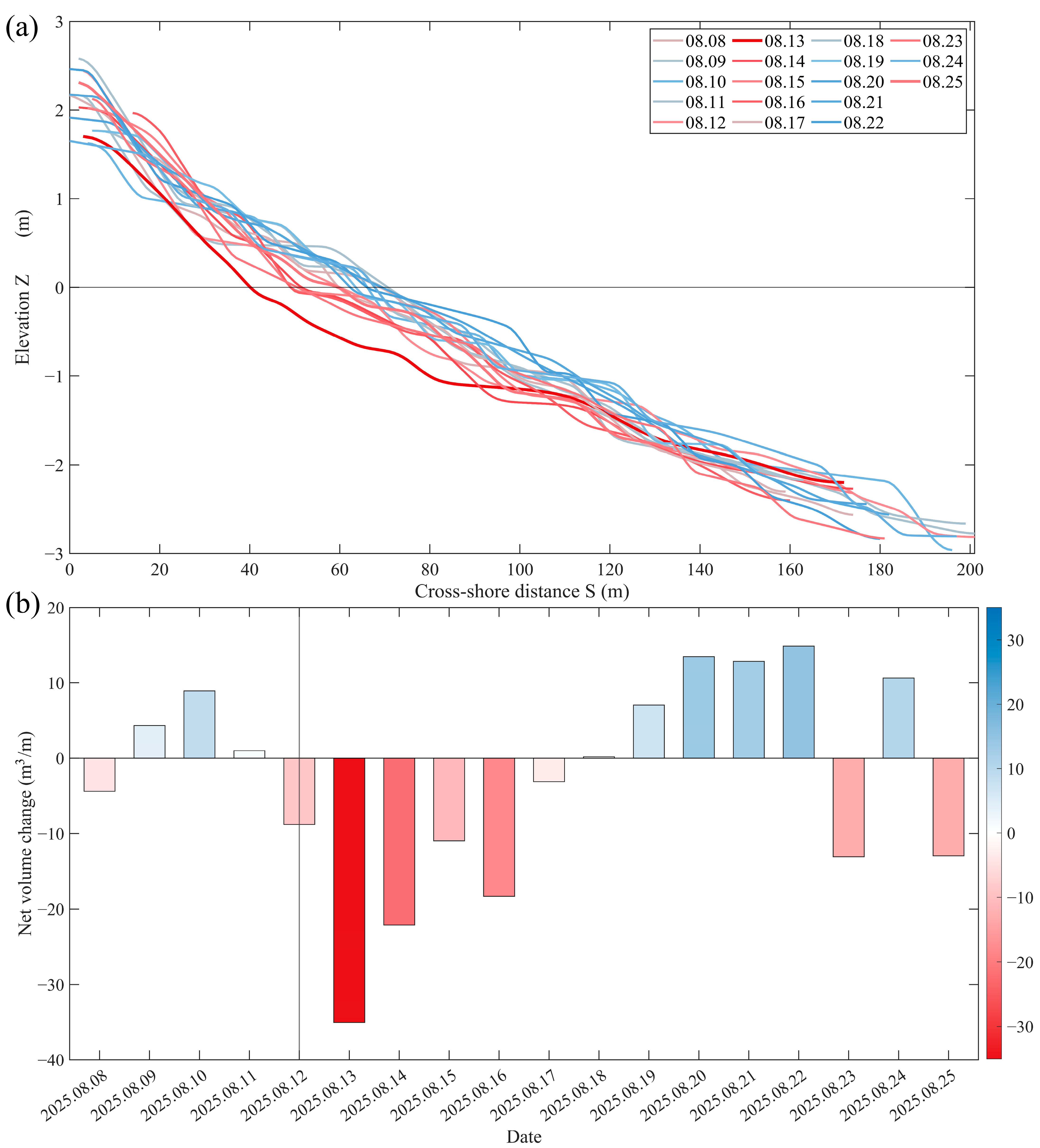
Another advantage of the proposed method is its substantially improved temporal resolution and continuity in beach profile monitoring. Traditional field surveys are typically limitedby spring low-tide windows, weather conditions, and fieldwork costs, making it difficult to obtain daily beach profiles before and after storm events. Satellite-based observations are also limited by revisit intervals, cloud and rainfall interference, and spatial resolution, and therefore generally cannot achieve daily elevation reconstruction along a fixed beach profile. In contrast, the proposed method assigns elevations to waterline breakpoints formed at different tidal stages, enabling daily reconstruction of intertidal beach profiles. Typhoon Podul affected the study area around 13 August 2025, and the reconstructed P2 profiles from 8 to 25 August 2025 clearly captured rapid profile lowering and erosion during the typhoon impact period, followed by poststorm adjustment and partial recovery (Figure 14). The net erosion–accretion volume change per unit width further reveals the transition from storm-induced erosion to subsequent accretion, demonstrating the potential of this method for high-frequency monitoring of event-scale beach morphological responses.
In future applications, waterline breakpoint-based profile reconstruction could support long-term and high-frequency monitoring of low-tide terrace beaches. Continuous Timex imagery may provide daily or hourly intertidal profile sequences for analyzing seasonal erosion–accretion, storm-induced erosion and recovery, localized sediment redistribution, and profile-scale responses of microgeomorphic features such as beach cusps. Future work should incorporate additional image features, improve outlier detection and profile-continuity constraints, and combine RTK-GPS, UAV, wave–tide observations, and multicamera orthorectified mosaics to enhance spatial coverage and uncertainty control.

7. Conclusions

This study presents a methodology for the automated reconstruction of intertidal beach profiles. Using continuous video Timex imagery over a tidal cycle, we extract single-pixel image columns along baseline cross-shore transects to constructa sample library spanning diverse tide levels, illumination conditions, and wave conditions; a stacked Bi-LSTM is then trained to precisely detect waterline breakpoints from these columns; finally, waterline elevations, corrected for wave runup via a local slope model, are assigned to breakpoints at their acquisition times and geographic positions, yielding high spatiotemporal resolution profile reconstructions. Validation against field measurements reveals strong performance in terms of both vertical accuracy and visualization quality.
Leveraging the high temporal resolution of the video system, the method explicitly accounts for tidal oscillations and swash-driven excursions of the waterline, enabling finer-scale characterization of topography and micromorphology; the stacked Bi-LSTM learns robust context features from the sequence, maintaining stable breakpoint localization even under low contrast, strong specular reflection, or shadowing. Compared with the RTK GPS profiles, the video-derived profiles achieve a mean vertical accuracy better than 0.22 m, which is sufficient for resolving intertidal erosion and accretion dynamics across spatial scales. This approach supports the high-frequency reconstruction of intertidal profiles and associated microforms, offering a pathway towards an automated, high-spatiotemporal-resolution monitoring system for beach evolution. Future work will (1) expand the dataset to include gravel and muddy beaches and extreme storm events to systematically assess generalization and (2) integrate additional observational constraints, such as GNSS IR and wave radar, to further improve elevation attribution.

Author Contributions

Conceptualization, K.L., H.Q. and H.Y.; methodology, K.L., H.Y. and G.L.; validation, K.L., H.Y., S.Z. and J.Z.; formal analysis, K.L. and F.C.; investigation, K.L., H.Y. and G.L.; resources, F.C.; data curation, K.L. and J.Z.; writing—original draft preparation, K.L.; writing—review and editing, H.Q., H.Y., G.L. and S.Z.; supervision, H.Q., H.Y., F.C., G.L., S.Z. and J.Z.; project administration, H.Q.; funding acquisition, H.Q. and F.C. All authors have read and agreed to the published version of the manuscript.

Funding

This work was funded by Research on Key Technologies for Integrated Assessment of Marine Ecological Protection and Restoration Effectiveness (Grant No. 2024ZRBSHZ109), in part by the Scientific Research Foundation of the Third Institute of Oceanography, Ministry of Natural Resources (No. 2020017), and in part by the National Natural Science Foundation of China (No. U22A20585).

Data Availability Statement

The data used in this study are available on request.

Conflicts of Interest

The authors declare no conflicts of interest.

References

  1. Cai, F.; Cao, H.; Su, X.; Xia, D. Analysis on Morphodynamics of Sandy Beaches in South China. J. Coast. Res. 2007, 231, 236–246. [Google Scholar] [CrossRef]
  2. Schlacher, T.A.; Schoeman, D.S.; Dugan, J.; Lastra, M.; Jones, A.; Scapini, F.; McLachlan, A. Sandy Beach Ecosystems: Key Features, Sampling Issues, Management Challenges and Climate Change Impacts. Mar. Ecol. 2008, 29, 70–90. [Google Scholar] [CrossRef]
  3. Masselink, G.; van Heteren, S. Response of Wave-Dominated and Mixed-Energy Barriers to Storms. Mar. Geol. 2014, 352, 321–347. [Google Scholar] [CrossRef]
  4. Coco, G.; Senechal, N.; Rejas, A.; Bryan, K.R.; Capo, S.; Parisot, J.P.; Brown, J.A.; MacMahan, J.H.M. Beach Response to a Sequence of Extreme Storms. Geomorphology 2014, 204, 493–501. [Google Scholar] [CrossRef]
  5. Salameh, E.; Frappart, F.; Almar, R.; Baptista, P.; Heygster, G.; Lubac, B.; Raucoules, D.; Almeida, L.P.; Bergsma, E.W.J.; Capo, S.; et al. Monitoring Beach Topography and Nearshore Bathymetry Using Spaceborne Remote Sensing: A Review. Remote Sens. 2019, 11, 2212. [Google Scholar] [CrossRef]
  6. Díaz-Cuevas, P.; Prieto-Campos, A.; Ojeda-Zújar, J. Developing a Beach Erosion Sensitivity Indicator Using Relational Spatial Databases and Analytic Hierarchy Process. Ocean Coast. Manag. 2020, 189, 105146. [Google Scholar] [CrossRef]
  7. Lee, J.-M.; Park, J.-Y.; Choi, J.-Y. Evaluation of Sub-Aerial Topographic Surveying Techniques Using Total Station and RTK-GPS for Applications in Macrotidal Sand Beach Environment. J. Coast. Res. 2013, 65, 535–540. [Google Scholar] [CrossRef]
  8. Cohn, N.; Ruggiero, P. The Influence of Seasonal to Interannual Nearshore Profile Variability on Extreme Water Levels: Modeling Wave Runup on Dissipative Beaches. Coast. Eng. 2016, 115, 79–92. [Google Scholar] [CrossRef]
  9. Gonçalves, J.A.; Henriques, R. UAV Photogrammetry for Topographic Monitoring of Coastal Areas. ISPRS J. Photogramm. Remote Sens. 2015, 104, 101–111. [Google Scholar] [CrossRef]
  10. Saye, S.E.; van der Wal, D.; Pye, K.; Blott, S.J. Beach–Dune Morphological Relationships and Erosion/Accretion: An Investigation at Five Sites in England and Wales Using LIDAR Data. Geomorphology 2005, 72, 128–155. [Google Scholar] [CrossRef]
  11. Vos, K.; Splinter, K.D.; Harley, M.D.; Simmons, J.A.; Turner, I.L. CoastSat: A Google Earth Engine-Enabled Python Toolkit to Extract Shorelines from Publicly Available Satellite Imagery. Environ. Model. Softw. 2019, 122, 104528. [Google Scholar] [CrossRef]
  12. Hagenaars, G.; de Vries, S.; Luijendijk, A.P.; de Boer, W.P.; Reniers, A.J.H.M. On the Accuracy of Automated Shoreline Detection Derived from Satellite Imagery: A Case Study of the Sand Motor Mega-Scale Nourishment. Coast. Eng. 2018, 133, 113–125. [Google Scholar] [CrossRef]
  13. Holman, R.A.; Stanley, J. The History and Technical Capabilities of Argus. Coast. Eng. 2007, 54, 477–491. [Google Scholar] [CrossRef]
  14. Lippmann, T.C.; Holman, R.A. Quantification of Sand Bar Morphology: A Video Technique Based on Wave Dissipation. J. Geophys. Res. Ocean. 1989, 94, 995–1011. [Google Scholar] [CrossRef]
  15. Plant, N.G.; Holman, R.A. Intertidal Beach Profile Estimation Using Video Images. Mar. Geol. 1997, 140, 1–24. [Google Scholar] [CrossRef]
  16. Aarninkhof, S.G.J.; Turner, I.L.; Dronkers, T.D.T.; Caljouw, M.; Nipius, L. A Video-Based Technique for Mapping Intertidal Beach Bathymetry. Coast. Eng. 2003, 49, 275–289. [Google Scholar] [CrossRef]
  17. Aarninkhof, S.G.J.; Ruessink, B.G.; Roelvink, J.A. Nearshore Subtidal Bathymetry from Time-exposure Video Images. J. Geophys. Res. Ocean. 2005, 110, C06011. [Google Scholar] [CrossRef]
  18. Turner, I.L.; Aarninkhof, S.G.J.; Dronkers, T.D.T.; McGrath, J. CZM Applications of Argus Coastal Imaging at the Gold Coast, Australia. J. Coast. Res. 2004, 20, 739–752. [Google Scholar] [CrossRef]
  19. Plant, N.G.; Aarninkhof, S.G.J.; Turner, I.L.; Kingston, K.S. The Performance of Shoreline Detection Models Applied to Video Imagery. J. Coast. Res. 2007, 23, 658–670. [Google Scholar] [CrossRef]
  20. Almar, R.; Blenkinsopp, C.; Almeida, L.P.; Bergsma, E.W.J.; Catalan, P.A.; Cienfuegos, R.; Viet, N.T. Intertidal Beach Profile Estimation from Reflected Wave Measurements. Coast. Eng. 2019, 151, 58–63. [Google Scholar] [CrossRef]
  21. Uunk, L.; Wijnberg, K.M.; Morelissen, R. Automated Mapping of the Intertidal Beach Bathymetry from Video Images. Coast. Eng. 2010, 57, 461–469. [Google Scholar] [CrossRef]
  22. Holman, R.; Plant, N.; Holland, T. cBathy: A Robust Algorithm for Estimating Nearshore Bathymetry. J. Geophys. Res. Ocean. 2013, 118, 2595–2609. [Google Scholar] [CrossRef]
  23. Mason, D.C.; Davenport, I.J.; Robinson, G.J.; Flather, R.A.; McCartney, B.S. Construction of an Inter-Tidal Digital Elevation Model by the ‘Water-Line’ Method. Geophys. Res. Lett. 1995, 22, 3187–3190. [Google Scholar] [CrossRef]
  24. Vousdoukas, M.I.; Ferreira, P.M.; Almeida, L.P.; Dodet, G.; Psaros, F.; Andriolo, U.; Taborda, R.; Silva, A.N.; Ruano, A.; Ferreira, Ó.M. Performance of Intertidal Topography Video Monitoring of a Meso-Tidal Reflective Beach in South Portugal. Ocean Dyn. 2011, 61, 1521–1540. [Google Scholar] [CrossRef]
  25. Polidori, L.; El Hage, M. Digital Elevation Model Quality Assessment Methods: A Critical Review. Remote Sens. 2020, 12, 3522. [Google Scholar] [CrossRef]
  26. Didier, D.; Bernatchez, P.; Augereau, E.; Caulet, C.; Dumont, D.; Bismuth, E.; Cormier, L.; Floc’h, F.; Delacourt, C. LiDAR Validation of a Video-Derived Beachface Topography on a Tidal Flat. Remote Sens. 2017, 9, 826. [Google Scholar] [CrossRef]
  27. Liu, H.; Sherman, D.; Gu, S. Automated Extraction of Shorelines from Airborne Light Detection and Ranging Data and Accuracy Assessment Based on Monte Carlo Simulation. J. Coast. Res. 2007, 23, 1359–1369. [Google Scholar] [CrossRef]
  28. Mingo, I.M.; Almar, R.; Lacaze, L. Surf and Swash Dynamics on Low Tide Terrace Beaches. Coasts 2021, 1, 73–89. [Google Scholar] [CrossRef]
  29. Qi, H.S.; Yin, H.; Cai, F.; Zhang, C.; Liu, G.; Cao, Z.B. Advances and Prospects of the a Shore-Based Video Monitoring Technology on Beach Research. Natl. Remote Sens. Bull. 2024, 28, 2761–2779. [Google Scholar]
  30. Hoonhout, B.M.; Radermacher, M.; Baart, F.; van der Maaten, L.J.P. An Automated Method for Semantic Classification of Regions in Coastal Images. Coast. Eng. 2015, 105, 1–12. [Google Scholar] [CrossRef]
  31. Kingston, K.S.; Ruessink, B.G.; Van Enckevort, I.M.J.; Davidson, M.A. Artificial Neural Network Correction of Remotely Sensed Sandbar Location. Mar. Geol. 2000, 169, 137–160. [Google Scholar] [CrossRef]
  32. Rigos, A.; Andreadis, O.P.; Andreas, M.; Vousdoukas, M.I.; Tsekouras, G.E.; Velegrakis, A. Shoreline Extraction from Coastal Images Using Chebyshev Polynomials and RBF Neural Networks. In Progress in Pattern Recognition, Image Analysis, Computer Vision, and Applications; Bayro-Corrochano, E., Hancock, E., Eds.; Lecture Notes in Computer Science; Springer International Publishing: Cham, Switzerland, 2014; Volume 8827, pp. 593–603. [Google Scholar]
  33. Erdem, F.; Bayram, B.; Bakirman, T.; Bayrak, O.C.; Akpinar, B. An Ensemble Deep Learning Based Shoreline Segmentation Approach (WaterNet) from Landsat 8 OLI Images. Adv. Space Res. 2021, 67, 964–974. [Google Scholar] [CrossRef]
  34. Aghdami-Nia, M.; Shah-Hosseini, R.; Rostami, A.; Homayouni, S. Automatic Coastline Extraction through Enhanced Sea-Land Segmentation by Modifying Standard U-Net. Int. J. Appl. Earth Obs. Geoinf. 2022, 109, 102785. [Google Scholar] [CrossRef]
  35. Yang, T.; Jiang, S.; Hong, Z.; Zhang, Y.; Han, Y.; Zhou, R.; Wang, J.; Yang, S.; Tong, X.; Kuc, T.; et al. Sea-Land Segmentation Using Deep Learning Techniques for Landsat-8 OLI Imagery. Mar. Geod. 2020, 43, 105–133. [Google Scholar] [CrossRef]
  36. Yang, F.; Feng, T.; Xu, G.; Chen, Y. Applied Method for Water-Body Segmentation Based on Mask R-CNN. J. Appl. Remote Sens. 2020, 14, 014502. [Google Scholar] [CrossRef]
  37. Chen, C.; Zhang, C.; Tian, B.; Wu, W.; Zhou, Y. Tide2Topo: A New Method for Mapping Intertidal Topography Accurately in Complex Estuaries and Bays with Time-Series Sentinel-2 Images. ISPRS J. Photogramm. Remote Sens. 2023, 200, 55–72. [Google Scholar] [CrossRef]
  38. Soloy, A.; Turki, I.; Lecoq, N.; Gutiérrez Barceló, Á.D.; Costa, S.; Laignel, B.; Bazin, B.; Soufflet, Y.; Le Louargant, L.; Maquaire, O. A Fully Automated Method for Monitoring the Intertidal Topography Using Video Monitoring Systems. Coast. Eng. 2021, 167, 103894. [Google Scholar] [CrossRef]
  39. Marti-Puig, P.; Serra-Serra, M.; Ribas, F.; Simarro, G.; Caballeria, M. Automatic Shoreline Detection by Processing Planview Timex Images Using Bi-LSTM Networks. Expert Syst. Appl. 2024, 240, 122566. [Google Scholar] [CrossRef]
  40. Yin, H.; Cai, F.; Qi, H.; Zheng, J.; Hui, B.; Wu, X.; Liu, K.; Chen, X. A Video Dataset for Nearshore Wave Breaking Type Classification. Sci. Data 2025, 12, 1722. [Google Scholar] [CrossRef]
  41. Yin, H.; Cai, F.; Qi, H.; Jiang, Y.; Liu, G.; Cao, Z.; Sun, Y.; Xiao, Z. Analysis of Tidal Cycle Wave Breaking Distribution Characteristics on a Low-Tide Terrace Beach Using Video Imagery Segmentation. Remote Sens. 2024, 16, 4616. [Google Scholar] [CrossRef]
  42. Cai, F.; Yin, H.; Qi, H.; Zheng, J.; Jiang, Y.; Cao, Z.; He, Y. Using Video Imagery to Reconstruct the 3D Intertidal Terrain along a Beach with Multiple Cusps. Acta Oceanol. Sin. 2023, 42, 1–9. [Google Scholar] [CrossRef]
  43. Holland, K.T.; Holman, R.A.; Lippmann, T.C.; Stanley, J.; Plant, N. Practical Use of Video Imagery in Nearshore Oceanographic Field Studies. IEEE J. Ocean. Eng. 1997, 22, 81–92. [Google Scholar] [CrossRef]
  44. Zhang, Z. Flexible Camera Calibration by Viewing a Plane from Unknown Orientations. In Proceedings of the Seventh IEEE International Conference on Computer Vision; IEEE: Kerkyra, Greece, 1999; Volume 1, pp. 666–673. [Google Scholar]
  45. Sánchez-García, E.; Balaguer-Beser, A.; Pardo-Pascual, J.E. C-Pro: A Coastal Projector Monitoring System Using Terrestrial Photogrammetry with a Geometric Horizon Constraint. ISPRS J. Photogramm. Remote Sens. 2017, 128, 255–273. [Google Scholar] [CrossRef]
  46. Simarro, G.; Calvete, D.; Souto, P.; Guillén, J. Camera Calibration for Coastal Monitoring Using Available Snapshot Images. Remote Sens. 2020, 12, 1840. [Google Scholar] [CrossRef]
  47. Palmsten, M.L.; Brodie, K.L. The Coastal Imaging Research Network (CIRN). Remote Sens. 2022, 14, 453. [Google Scholar] [CrossRef]
  48. Burrows, D. Using GeoTIFF Images to Create Flexible Radar Compositing Software. Phys. Chem. Earth Part B Hydrol. Ocean. Atmos. 2000, 25, 1137–1140. [Google Scholar] [CrossRef]
  49. Cohen, J. A Coefficient of Agreement for Nominal Scales. Educ. Psychol. Meas. 1960, 20, 37–46. [Google Scholar] [CrossRef]
  50. Jordan, M.I. Serial order: A parallel distributed processing approach. In Advances in Psychology; North-Holland: Amsterdam, The Netherlands, 1997. [Google Scholar]
  51. Hochreiter, S.; Schmidhuber, J. Long Short-Term Memory. Neural Comput. 1997, 9, 1735–1780. [Google Scholar] [CrossRef]
  52. Schuster, M.; Paliwal, K.K. Bidirectional Recurrent Neural Networks. IEEE Trans. Signal Process. 1997, 45, 2673–2681. [Google Scholar] [CrossRef]
  53. Liu, Z.; Yang, M.; Wang, X.; Chen, Q.; Tang, B.; Wang, Z.; Xu, H. Entity Recognition from Clinical Texts via Recurrent Neural Network. BMC Med. Inform. Decis. Mak. 2017, 17, 67. [Google Scholar] [CrossRef]
  54. Bengio, Y. Learning Deep Architectures for AI. Found. Trends® Mach. Learn. 2009, 2, 1–127. [Google Scholar] [CrossRef]
  55. Stockdon, H.F.; Holman, R.A.; Howd, P.A.; Sallenger, A.H. Empirical Parameterization of Setup, Swash, and Runup. Coast. Eng. 2006, 53, 573–588. [Google Scholar] [CrossRef]
  56. Atkinson, A.L.; Power, H.E.; Moura, T.; Hammond, T.; Callaghan, D.P.; Baldock, T.E. Assessment of Runup Predictions by Empirical Models on Non-Truncated Beaches on the South-East Australian Coast. Coast. Eng. 2017, 119, 15–31. [Google Scholar] [CrossRef]
  57. Dean, R.G. Equilibrium Beach Profiles: Characteristics and Applications. J. Coast. Res. 1991, 7, 53–84. [Google Scholar]
  58. Deng, X.; Liu, Q.; Deng, Y.; Mahadevan, S. An Improved Method to Construct Basic Probability Assignment Based on the Confusion Matrix for Classification Problem. Inf. Sci. 2016, 340–341, 250–261. [Google Scholar] [CrossRef]
  59. Arriaga, J.; Medellin, G.; Ojeda, E.; Salles, P. Shoreline Detection Accuracy from Video Monitoring Systems. J. Mar. Sci. Eng. 2022, 10, 95. [Google Scholar] [CrossRef]
  60. Bishop-Taylor, R.; Sagar, S.; Lymburner, L.; Beaman, R.J. Between the Tides: Modelling the Elevation of Australia’s Exposed Intertidal Zone at Continental Scale. Estuar. Coast. Shelf Sci. 2019, 223, 115–128. [Google Scholar] [CrossRef]
  61. Chen, C.; Zhang, C.; Tian, B.; Wu, W.; Zhou, Y. Mapping Intertidal Topographic Changes in a Highly Turbid Estuary Using Dense Sentinel-2 Time Series with Deep Learning. ISPRS J. Photogramm. Remote Sens. 2023, 205, 1–16. [Google Scholar] [CrossRef]
  62. Xu, N.; Wang, L.; Ma, Y.; Ma, X.; Wang, X.H. Constructing Intertidal Topography for Sandy Beaches by Combining Sentinel-2 Imagery and Water Level Data. Geo-Spat. Inf. Sci. 2025, 28, 2400–2414. [Google Scholar] [CrossRef]
  63. Pool, L.; Mascagni, M.L.; Klein, A.H.F.; Carvalho, J.L.B.; Lima, L.G.; Costa, W.L.L.; Gonçalves, R.Q.; Fiorini, L.P. Revealing Intertidal Topography with Public Satellite Imagery: Adaptations of the Waterline Method. Environ. Model. Softw. 2025, 193, 106600. [Google Scholar] [CrossRef]
  64. Ming, X.; Tian, Y.; Zhang, Q.; Zhang, Y.; Tao, J.; Lin, J. Coupling ICESat-2 and Sentinel-2 Data for Inversion of Mangrove Tidal Flat to Predict Future Distribution Pattern of Mangroves. Int. J. Appl. Earth Obs. Geoinf. 2025, 136, 104398. [Google Scholar] [CrossRef]
  65. Lee, S.-K.; Ryu, J.-H. High-Accuracy Tidal Flat Digital Elevation Model Construction Using TanDEM-X Science Phase Data. IEEE J. Sel. Top. Appl. Earth Obs. Remote Sens. 2017, 10, 2713–2724. [Google Scholar] [CrossRef]
Figure 1. Study area and shore-based video monitoring system at Xisha Bay: (a) regional location of the study area and deployment of the wave buoy and marine observation instruments; (b) shoreline morphology, video monitoring station location, and nearshore wave-direction distribution; (c,d) field deployment of the shore-based video monitoring station, with the red box in (c) indicating the station; and (e) time-exposure image generated by Camera 1 at 08:00 on 2 August 2025.
Remotesensing 18 01893 g001
Figure 2. Layout of the video monitoring profiles (P1–P4), shoreline-normal example, and multi-camera fields of view from cameras C1–C4 at Xisha Bay.
Remotesensing 18 01893 g002
Figure 3. Time series of the tide level, significant wave height, and deep-water wavelength at Xisha Bay from July to November 2025: (a) Tide level; (b) Significant wave height; (c) Deep-water wavelength.
Remotesensing 18 01893 g003
Figure 4. Automated intertidal beach profile reconstruction workflow based on single-pixel image columns and a stacked Bi-LSTM model.
Remotesensing 18 01893 g004
Figure 5. Workflow of tide-constrained orthorectified mosaicking and target single-pixel image column extraction from shore-based multicamera Timex imagery.
Remotesensing 18 01893 g005
Figure 6. Workflow of manual annotation, sample classification, and quality control for waterline breakpoint labels based on single-pixel image columns.
Remotesensing 18 01893 g006
Figure 7. Training samples: (a) favourable illumination, moderate waves; (b) favourable illumination, strong waves; (c) unfavourable illumination, moderate waves; (d) unfavourable illumination, strong waves.
Remotesensing 18 01893 g007
Figure 8. Architecture of the waterline breakpoint detection model based on single-pixel Timex image columns, stacked Bi-LSTM, and multi-head self-attention.
Remotesensing 18 01893 g008
Figure 9. Fitting profile results and slope model: (a) fitting profile model; (b) slope model.
Remotesensing 18 01893 g009
Figure 10. Validation results of waterline breakpoint detection: the blue and green markers indicate the true and predicted breakpoint positions, respectively, while the red bars represent the absolute pixel error of each test sample, with a mean absolute error of 2.23 pixels.
Remotesensing 18 01893 g010
Figure 11. Validation of video-derived beach profiles at Xisha Bay: (a) spatial layout of the shore-based video monitoring station and fixed monitoring profiles P1–P4, with yellow dashed lines indicating the profile locations, and (b) comparisons between video-derived and measured beach profiles at the fixed profiles on 2 August 2023, 27 January 2024, and 24 July 2025. The blue and red lines represent the video-derived and measured profiles, respectively, with R2, mean absolute error, and root mean square error shown for each comparison.
Remotesensing 18 01893 g011
Figure 12. Accuracy assessment and elevation error distributions of video-derived beach profiles at Xisha Bay: (a) comparison between video-derived and measured elevations for all validation samples; (b) elevation error distributions of profiles P1–P4 on 2 August 2023; (c) elevation error distributions of profiles P1–P4 on 27 January 2024; and (d) elevation error distributions of profiles P1–P4 on 24 July 2025; (e) relationship between elevation residuals and RTK-measured elevations; and (f) relationship between elevation residuals and cross-shore distance.
Remotesensing 18 01893 g012
Figure 13. Extrinsic calibration and uncertainty assessment of the multicamera video monitoring system at Xisha Bay: (a) spatial positions, viewing directions, and fields of view of Cameras xsw1–xsw4; (b) positional uncertainty of each camera; (c) angular uncertainty of each camera; and (d,e) field calibration and ground-control-point survey procedures.
Remotesensing 18 01893 g013
Figure 14. Morphological evolution of the P2 beach profile and net erosion–accretion volume change per unit width during Typhoon Podul. (a) Daily reconstructed cross-shore beach profiles from 8 August to 25 August 2025, showing profile adjustments before, during, and after the typhoon event. In the (a), a red–gray–blue gradient color scheme has been applied, corresponding to the erosion–accretion pattern shown in (b): red indicates erosion, blue indicates accretion, and gray indicates relatively stable. (b) Net erosion–accretion volume change per unit width, with negative and positive values indicating erosion and accretion, respectively.
Remotesensing 18 01893 g014
Table 1. Start and end coordinates of the four fixed monitoring profiles at Xisha Bay.
ProfileStart
Latitude (°N)
Start
Longitude (°E)
End
Latitude (°N)
End
Longitude (°E)
Distance
to VMS (m)
P124.881647118.92176424.880371118.920665228.2
P224.882907118.91958324.881356118.91889346.8
P324.883601118.91689424.881955118.916566327.6
P424.883535118.91364624.882001118.913705652.1
Table 2. Representative sample classification under different illumination and wave conditions.
Sample NameAcquisition TimeSolar Elevation Angle (°)Beaufort ScaleClassification Result
XSW_plan20250603060000_World_strip01.tif3 June 2025 06:008.423.2Favourable illumination;
normal-wave conditions
XSW_plan20250603060000_World_strip02.tif3 June 2025 06:008.423.2Favourable illumination;
normal-wave conditions
XSW_plan20250603120000_World_strip03.tif3 June 2025 12:0084.614.5Favourable illumination;
normal-wave conditions
XSW_plan20250603180000_World_strip04.tif3 June 2025 18:006.376.1Favourable illumination;
energetic-wave conditions
XSW_plan20251210170000_World_strip02.tif10 December 2025 17:00−0.687.2Unfavourable illumination; energetic-wave conditions
XSW_plan20250915070000_World_strip01.tif15 September 2025 07:0018.735.4Favourable illumination;
normal-wave conditions
XSW_plan20250915150000_World_strip02.tif15 September 2025 15:0043.266.7Favourable illumination;
energetic-wave conditions
XSW_plan20250915190000_World_strip03.tif15 September 2025 19:00−7.926.3Unfavourable illumination; energetic-wave conditions
XSW_plan20251210060000_World_strip04.tif10 December 2025 06:00−4.153.6Unfavourable illumination; normal-wave conditions
XSW_plan20251210120000_World_strip01.tif10 December 2025 12:0041.022.5Favourable illumination;
normal-wave conditions
Table 3. Training parameters of the stacked Bi-LSTM model for waterline breakpoint localization.
ParameterSetting
InputTimex image column
OutputLand/water probability sequence
Data split60%/20%/20%
Network3-layer Bi-LSTM + self-attention
LossWeighted cross-entropy
Class weightsLand = 1.85; water = 0.68
OptimizerAdam
Learning rate0.001
Batch size/epochs32/100
Dropout0.3/0.3/0.2/0.2
Table 4. Confusion matrix for waterline breakpoint detection classification.
Predicted Class
LandSea
LandTPFNP
Actual classSeaFPTNN
P′N′N + P
Note. Here we treat “land” as the positive class. TP is the number of pixels correctly classified as land; FP is the number of pixels incorrectly classified as land; TN is the number of pixels correctly classified as sea. FN is the number of pixels incorrectly classified as sea. P′ is the total number of pixels predicted as land, and N′ is the total number of pixels predicted as sea. P is the true number of land pixels, and N is the true number of sea pixels.
Table 5. Precision table of waterline breakpoint detection in the study area.
Research MethodPrecisionRecallAccuracyF1 Score
Stacked Bi-LSTM0.9510.8940.9780.903
Bi-LSTM0.9150.8460.9540.868
SVM0.8930.7510.9280.795
Thresholding0.8120.7050.8750.799
Table 6. Summary of elevation errors between the reconstructed profiles and RTK-GPS measurements for each validation period.
Validation
Period
DateProfiles
Number
ME
(m)
MAE (m)RMSE (m)Error SD (m)
T12 August 20234−0.162 ± 0.0660.181 ± 0.0900.212 ± 0.1180.127 ± 0.114
T227 January 20244−0.229 ± 0.0750.236 ± 0.0640.261 ± 0.0470.105 ± 0.051
T324 July 20254−0.075 ± 0.0760.132 ± 0.0560.164 ± 0.0380.124 ± 0.061
Overall/12−0.155 ± 0.0930.183 ± 0.0780.212 ± 0.0800.119 ± 0.073
Table 7. Elevation error statistics between reconstructed and RTK-GPS-measured profiles for each validation period and profile.
PeriodDateProfileR2ME (m)MAE, 95% CI (m)RMSE, 95% CI (m)LoA (m)
T12 August 2023P10.998−0.1820.182 (0.175–0.188)0.190 (0.183–0.195)−0.288 to −0.075
T12 August 2023P20.999−0.0730.080 (0.075–0.085)0.091 (0.084–0.098)−0.180 to 0.035
T12 August 2023P30.997−0.1620.163 (0.151–0.174)0.192 (0.174–0.208)−0.363 to 0.038
T12 August 2023P40.992−0.2300.299 (0.276–0.324)0.374 (0.345–0.401)−0.808 to 0.348
T227 January 2024P10.997−0.2100.210 (0.198–0.222)0.236 (0.220–0.250)−0.421 to 0.000
T227 January 2024P20.998−0.2640.264 (0.259–0.269)0.268 (0.263–0.273)−0.355 to −0.173
T227 January 2024P30.991−0.3080.308 (0.297–0.320)0.323 (0.312–0.335)−0.500 to −0.117
T227 January 2024P40.975−0.1330.162 (0.145–0.179)0.216 (0.196–0.235)−0.466 to 0.200
T324 July 2025P10.992−0.0150.078 (0.065–0.094)0.154 (0.109–0.198)−0.315 to 0.285
T324 July 2025P20.995−0.0270.090 (0.082–0.099)0.116 (0.103–0.130)−0.249 to 0.196
T324 July 2025P30.999−0.1810.181 (0.176–0.186)0.186 (0.181–0.191)−0.266 to −0.096
T324 July 2025P40.987−0.0790.179 (0.169–0.190)0.201 (0.191–0.211)−0.442 to 0.284
Table 8. Uncertainty of expert-labelled and model-predicted breakpoints.
UncertaintyError TrainingError Tests
Xisha Bay1.50 px (0.75 m)ME = 1.68 px (0.84 m)ME = 2.51 px (1.25 m)
Table 9. Comparison of vertical accuracy among intertidal topographic reconstruction methods.
ReferenceLocationImageryReconstruction
Technique
Reported
Vertical Error
Present workXisha Bay
(China)
Timex video
imagery
Bi-LSTM image column detection with tide–wave–slope elevation assignmentMAE = 0.183 ± 0.078 m; RMSE = 0.212 ± 0.080 m
Uunk et al. (2010) [21]Egmond
(Netherlands)
Argus video
imagery
Automated waterline mapping and tidal elevation interpolationRMS = 0.28 m;
automated RMS = 0.34 m
Soloy et al. (2021) [38]Villers-sur-Mer, Étretat,
and Hautot-sur-Mer
(France)
video
imagery
Mask R-CNN water segmentation and water-level assignmentRMSE = 0.22–0.33 m
Bishop-Taylor et al. (2019) [60]Entire Australian coastlineLandsat archiveTide-model-based waterline compositing for intertidal DEM generationRMSE = 0.39–0.41 m for tidal flats and sandy shores
Chen et al. (2023) [37]The Wash Bay and Thames Estuary
(United Kingdom),
east Chongming Island & Sansha Bay
(China)
Sentinel-2 time
series
Tidal inundation frequency-based topography reconstructionRMSE ≈ 0.16–0.38 m
Chen et al. (2023) [61]Yangtze Estuary
(China)
Sentinel-2 time
series
Deep-learning waterline extraction with elevation calibrationRMSE = 0.13 m
Xu et al. (2025) [62]Texas
(USA)
Sentinel-2 and
water-level data
Coastline extraction with water-level-based DEM constructionAccuracy ≈ 0.42 m
Pool et al. (2025) [63]Six sites in Brazil and New ZealandSentinel-2 imageryAdapted waterline method with kriging interpolationRMSE = 0.14–0.24 m
Ming et al. (2025) [64]Maowei Sea
(China)
ICESat-2 and
Sentinel-2
ICESat-2-calibrated inundation-frequency mappingRMSE ≤ 0.075 m
Lee et al. (2017) [65]Tidal flats on the west coast of South KoreaTanDEM-X SARInSAR-based tidal-flat DEM reconstructionRMSE ≈ 0.20 m
Disclaimer/Publisher’s Note: The statements, opinions and data contained in all publications are solely those of the individual author(s) and contributor(s) and not of MDPI and/or the editor(s). MDPI and/or the editor(s) disclaim responsibility for any injury to people or property resulting from any ideas, methods, instructions or products referred to in the content.