Article

Fringe-Enhanced Phase Unwrapping Method Based on an Iterative Bayes–Sard Quadrature Kalman Filter

Guangxi Key Laboratory of Precision Navigation Technology and Application, Guilin University of Electronic Technology, Guilin 541004, China
*
Author to whom correspondence should be addressed.
Remote Sens. 2026, 18(10), 1661; https://doi.org/10.3390/rs18101661
Submission received: 25 March 2026 / Revised: 8 May 2026 / Accepted: 19 May 2026 / Published: 21 May 2026

Highlights

What are the main findings?
  • A complete InSAR phase unwrapping framework, termed PFT-IBSQKF, is proposed. IBSQKF introduces the Bayes–Sard quadrature moment transform into two-dimensional phase unwrapping for the first time, enabling the quantification and correction of numerical integration errors, while an iterative strategy further improves unwrapping accuracy.
  • A multi-level and multi-scale feature fusion pre-filtering network, PFTNet, is designed to effectively enhance interferometric fringe clarity and improve the quality of the input phase.
What are the implications of the main findings?
  • The proposed method provides a new solution to the difficulty of compensating numerical integration errors in traditional Kalman-filter-based phase unwrapping.
  • It offers a reliable technical approach for high-accuracy phase unwrapping of interferograms under complex noise conditions.

Abstract

Phase unwrapping plays a vital role in interferometric synthetic aperture radar (InSAR) processing. However, the presence of noise can introduce inconsistencies in phase discontinuities, giving rise to residue points that may cause unwrapping errors. To address this challenge, this paper for the first time applies the Bayes–Sard quadrature transform to the phase unwrapping problem and proposes an iterative Bayes–Sard quadrature Kalman filter phase unwrapping method (IBSQKF). In contrast to the conventional unscented Kalman filter algorithm, the Bayes–Sard moment transform can quantify the additional uncertainty introduced by quadrature errors. Through integration with the proposed iterative strategy, it enables more accurate calibration of state estimation and effectively reduces the root mean square error. To further enhance unwrapping accuracy, a multi-level and multi-scale feature fusion neural network (PFTNet) is developed as a pre-filtering module to independently process the real and imaginary components of the complex interferometric phase representation, which can effectively enhance the clarity of the interferometric fringes. By integrating PFTNet with IBSQKF, a complete phase unwrapping framework (PFT-IBSQKF) is constructed to further improve unwrapping accuracy. Experiments on both simulated and real data demonstrate that IBSQKF can reliably restore phase continuity, while PFT-IBSQKF can further reduce unwrapping errors, especially in low signal-to-noise-ratio or fringe-blurred scenarios. Despite the introduction of the iterative strategy, the proposed framework still maintains an acceptable computational cost while achieving high unwrapping accuracy.

1. Introduction

Interferometric Synthetic Aperture Radar (InSAR) represents a groundbreaking advancement in remote sensing and constitutes a major innovation beyond conventional SAR technology. Analyzing the interferometric patterns of two highly coherent SAR images from the same region, InSAR generates interferograms that capture surface displacement and topography. However, SAR measurement technology can only acquire the principal value (modulo 2 π ) of the phase [1,2], which results in observed phase discontinuities manifested as periodic jumps in space. As a crucial step in the InSAR processing chain, two-dimensional phase unwrapping typically depends on the Itoh condition [3], which assumes that the absolute phase difference between neighboring pixels lies within the interval ( π , π ] . Under this assumption, the unwrapped phase can be retrieved from the wrapped (modulo) phase by compensating for integer multiples of 2 π offsets [4], providing a direct data foundation for the high-precision retrieval of physical information such as surface deformation and elevation [5]. However, in practice, factors such as phase noise and large terrain variations can violate this assumption. Therefore, it is crucial to develop phase unwrapping techniques capable of handling both phase noise and discontinuities.
At present, InSAR phase unwrapping techniques are generally classified into three major types: path-following algorithms, minimum-norm strategies, and approaches that combine denoising with unwrapping [6]. As the earliest applied and most widely used strategy, path-following methods are favored for their intuitiveness, ease of implementation, and online processing capability. Their core principle involves identifying positive and negative residues and constructing connecting pairs (residue balancing) to establish branch cuts. These cuts prevent integration paths from traversing phase discontinuity regions. Representative algorithms include the branch-cut technique [7], the quality-guided approach [8], and the region-growing algorithm [9]. While this approach performs remarkably well in highly coherent areas, it is prone to generating unwrapped “islands” or residual regions in low-coherence zones, often necessitating manual intervention for patching. In the minimum-norm methods, there are two main approaches: the least squares (LS) algorithm [10] and the minimum cost flow (MCF) algorithm [11]. The LS approach is a global method known for its high computational efficiency, but it tends to produce oversmoothing and loses fine detail. The MCF method constructs a network flow model to compute and adjust the flow of phase gradients for effective unwrapping, striking a favorable balance between unwrapping accuracy and computational efficiency. Methods that combine denoising with unwrapping significantly enhance unwrapping robustness by suppressing noise interference and restoring phase continuity. Within this category, the Bayesian estimation framework formulates the phase unwrapping problem as an optimal state estimation problem in dynamic systems. Representative methods under this framework include the extended Kalman-filter-based phase unwrapping method [12], the unscented Kalman-filter-based phase unwrapping method [13,14], and other related approaches. In recent years, research on the integration of neural networks with phase unwrapping has significantly advanced the field [15], such as UNet [16], demonstrating considerable potential for improving unwrapping performance. In 2020, Zhou et al. proposed PGNet [17], a network that learns phase gradient features from images with different noise levels and terrain characteristics, enabling accurate identification of phase gradient patterns without relying on the Itoh phase continuity assumption. Subsequently, Zhou et al. introduced BCNet [18], which transforms the two-dimensional phase unwrapping problem into a semantic segmentation task, achieving near-real-time unwrapping processing. Although phase unwrapping methods based on deep learning have achieved promising results, they still rely heavily on labeled samples, while reliable ground-truth phases are difficult to obtain from real InSAR data. This may lead to a domain gap between simulated and real data. Their generalization ability may also degrade when noise levels, terrain variations, or fringe blurring exceed the training data distribution. In addition, purely data-driven methods lack explicit physical interpretability in noise modeling and uncertainty propagation. To alleviate these limitations, hybrid methods combining deep learning with model-driven estimation frameworks have attracted increasing attention. In 2022, Gao et al. [19] first proposed combining deep learning with the unscented Kalman filter (UKF), using a Convolutional Neural Network (CNN) to extract phase gradients in two directions and embedding them into the UKF state estimation process to achieve phase unwrapping. Overall, phase unwrapping techniques for InSAR are continuously evolving. Researchers are exploring diverse algorithms and approaches to continually improve unwrapping accuracy, computational efficiency, and robustness to noise.
The cubature Kalman filter (CKF) [20], UKF, and related methods are generally referred to as sigma-point filters [21], which offer significant advantages for state estimation in nonlinear systems. However, in practical applications, their quadrature rules may introduce bias into the estimation moments, leading to suboptimal calibration of estimation and prediction. Conventional sigma-point filters lack mechanisms to correct this type of bias. In 2020, Prüher et al. [22] derived the Bayes–Sard quadrature approach. By constructing a moment transform framework based on Bayes–Sard quadrature (BSQ), they designed the Bayes–Sard quadrature Kalman filter (BSQKF). The additional uncertainty caused by quadrature errors is explicitly modeled within this filter, enabling the systematic correction of higher-order moment bias.
In addition to single-baseline phase unwrapping, multi-baseline InSAR phase unwrapping typically exploits an interferogram stack formed with different spatial baselines and improves unwrapping robustness by imposing cross-baseline redundancy constraints, which is especially advantageous in areas with strong topographic relief or where the phase-continuity assumption is likely to fail. Representative methods include the two-stage programming approach (TSPA) framework [23], cluster analysis (CA) algorithm [24], and WaveCluster-based clustering strategies [25]. However, multi-baseline methods often rely on acquiring multiple interferograms and require good co-registration and phase-reference consistency among the interferograms, which usually incurs higher data and computational costs. In contrast, our method targets the more common single-interferogram scenario: when only one interferogram is available or when it is difficult to construct a stable multi-baseline stack, our method has the advantages of lower data requirements and easier integration into conventional processing chains. Based on this application background, this paper presents the first application of the Bayes–Sard quadrature moment transform (BSQMT) to the phase unwrapping problem, aiming to correct the numerical integration errors of sigma-point filters in phase unwrapping and thereby improve state estimation quality and unwrapping accuracy. Within this framework, the local gradient estimator proposed in [26] is employed to obtain phase gradient estimates. Leveraging the robustness of the iterative unscented Kalman filter (IUKF) in nonlinear Bayesian estimation, an iterative Bayes–Sard quadrature Kalman filter phase unwrapping method (IBSQKF) is developed, which can effectively suppress phase-jump propagation errors through a residual feedback loop.
Building on this foundation, we further propose a complete phase unwrapping framework, termed PFT-IBSQKF, which integrates the IBSQKF phase unwrapping method with a neural-network-based pre-filtering module to improve the reliability of wrapped-phase observations under low-coherence and noisy conditions. In comparison with existing approaches, our method offers the following key innovations:
  • We propose PFTNet, a multi-level, multi-scale feature fusion pre-filtering network that processes the real and imaginary parts of the complex interferometric phase representation separately, effectively enhancing fringe clarity and improving the accuracy and reliability of the phase filtering task.
  • To address the inability of traditional Kalman filter phase unwrapping methods to correct quadrature errors, we apply the BSQMT to phase unwrapping for the first time and introduce an iterative optimization strategy that incrementally refines the unwrapping result through multiple iterations, thereby enhancing unwrapping accuracy.

2. Basic Principle and Related Algorithms

Phase unwrapping aims to reconstruct the true phase from the wrapped phase, which is limited to the interval ( π , π ] . The relationship between them can be expressed as [27]:
ϕ ( s ) = φ ( s ) + 2 k ( s ) π
where ϕ ( s ) is the true phase at pixel position s, φ ( s ) is the wrapped phase at the same location, and k ( s ) is an unknown integer. From Equation (1), it follows that the true phase can be obtained by adding an appropriate integer multiple of 2 π to each wrapped phase. However, since the set of all k ( s ) admits infinitely many combinations, it is necessary to identify a unique solution. When the phase difference between adjacent pixels meets the condition | φ ( s + 1 ) φ ( s ) | < π , the true phase can be reconstructed by accumulating the wrapped phase increments.

2.1. System Equations

The core technique of the BSQKF is Bayesian quadrature; in Bayesian quadrature, the integration error is corrected by formulating the numerical integration problem as a probabilistic inference problem with uncertainty modeling. This approach not only provides an estimated value of the integral but also quantifies the uncertainty of this estimate. To effectively recover the true phase, we model the phase unwrapping process as a dynamic system with noise. Consider the dynamic system and its state observation process modeled via the following state-space representation [28]:
x k = f x k 1 + q k 1
z k = h x k + r k
where the function f ( · ) : R d x R d x describes the system dynamic model of phase, while h ( · ) : R d x R d z describes the measurement model of phase, the state vector x k R d x represents the true phase, and the corresponding observation vector z k R d z represents the phase measurement information. The process noise q k 1 N ( 0 , Q ) and measurement noise r k N ( 0 , R ) are both zero-mean Gaussian white noise. They are mutually independent and also uncorrelated with the initial state x 0 N m 0 x , P 0 x .

2.2. Bayes–Sard Quadrature Moment Tranform

In the Bayes–Sard quadrature moment transform (BSQMT), we use a Gaussian process to model the noisy wrapped phase and estimate the true phase via Bayesian quadrature. The core of this process lies in integrating the wrapped phase to correct phase unwrapping errors caused by noise and measurement inaccuracies. Given the distribution of the state variable x as N ( m , P ) , the output y = g ( x ) describes the phase unwrapping process, where g ( x ) is the transformation in order to restore original phase from the wrapped phase, specifically,
y = g ( x ) , x N ( m , P )
where x is a Gaussian input variable with mean m and covariance P. For the integration of the function g ( x ) , we model the integrand using a Gaussian process to capture its uncertainty, thereby translating the uncertainty of the integrand into the uncertainty (error) of the integral estimate. The core objectives of the BSQMT are to evaluate the mean μ of y, its covariance Π and the cross-covariance C between x and y [22].
Step 1: Given the system Equations (2) and (3), the state vector x is assumed to follow a distribution with mean m and covariance P. For the D-dimensional input state variable, select N = 2 D + 1 unit sigma points ξ via the unscented transform. Leveraging the symmetry of the Gaussian distribution, the points can be generated for each dimension d = 1 , , D , as shown:
ξ i = 0 , i = 0 c e i , i = 1 , , d c e i , i = d + 1 , , 2 d
where e i R d denotes the d-th column of the identity matrix I d × d , c = D + λ , where
λ = a 2 ( d + κ ) d
a is a scaling factor, typically a small positive value greater than zero, with a typical range of 10 4 a 1 , κ is a adjustment factor, typically set to 0 or 3 d . These parameter settings originate from the unscented transform and are used to control the spread and weights of sigma points, thereby improving the accuracy of Gaussian moment approximation after nonlinear transformation. The sigma point weights are determined using the following expressions:
w i = λ c , i = 0 1 2 c , i = 1 , , 2 d
Step 2: State variable sigma point determination. Leveraging the moment matching property of sigma points with respect to the mean m and covariance P of the stochastic input vector, compute the sampling points according to (8):
χ i = m + L ξ i , i = 0 , , 2 d
L denotes the lower-triangular matrix resulting from the Cholesky factorization of P. The unscented transform method generates a set of points through symmetric selection in each dimension to approximate the nonlinear transformation of a Gaussian distribution. For phase unwrapping, these sigma points help capture the nonlinear characteristics of the wrapped phase variations.
Step 3: Choose an appropriate function space. By carefully designing Q N basis functions ϕ q ( x ) , various classical quadrature methods used in nonlinear filtering can be reproduced. When the function space π is spanned by a properly chosen set of polynomial basis functions, both the unscented transform and Gauss–Hermite quadrature emerge as special instances of the BSQ approach. To effectively recover the true phase, it is necessary to select an appropriate function space to represent the relationship between the wrapped phase and the true phase. Under the standard Gaussian assumption p ( x ) = N ( x 0 , I ) , one may choose 2 D + 1 sigma points from the unscented transform (5) and use them to define the associated function space as follows:
π = span 1 , x 1 , , x D , x 1 2 , , x D 2
Step 4: Compute quadrature weights. In the BSQMT, a hierarchical Gaussian process (GP) with nonzero mean is used as the prior model. The Bayes–Sard weights are fully determined by the selected sigma points and the chosen basis function space. The quadrature weights are computed as follows:
w = Φ T ϕ ¯ W = Φ T A Φ 1 W c = B Φ 1
where ϕ ¯ = E ξ [ ϕ ( ξ ) ] , Φ N = ϕ 1 ξ N ϕ N ξ N , A = E ξ ϕ ( ξ ) ϕ ( ξ ) T , B = E ξ ξ ϕ ( ξ ) T .
Step 5: Compute the output moment transform. The formulas are given in (11):
μ = Y T w Π = Y T W Y μ μ T + σ ¯ 2 I C = L W c Y
where Y = g χ i , denotes the transformed sigma points after passing through the nonlinear function. Through the BSQMT, we can compute the mean and covariance of the output. These values not only reflect the estimated true phase recovered from the wrapped phase but also quantify the uncertainty arising from measurement noise and estimation errors. Bayesian quadrature provides not only the expected value of the integral but also accurately characterizes the uncertainty of this estimate through the covariance matrix. The term σ ¯ 2 represents the expected model variance (EMV), which is largely influenced by the selection of the radial basis function (RBF) kernel and its hyperparameters; its computation can be expressed as
σ ¯ 2 = k ¯ tr H T Φ T + H Φ 1 W K
where k ¯ = E ξ [ k ( ξ , ξ ; θ ) ] , [ H ] n = E ξ k ξ , ξ ( n ) ; θ ϕ ( ξ ) T , [ K ] n m = k ξ ( n ) , ξ ( m ) ; θ , and k denotes the RBF, whose expression is given as follows [29]:
k x , x ; θ = α 2 d = 1 D exp x d x d 2 2 l d 2
The kernel’s parameter θ include a scale factor α > 0 and dimension-dependent length parameter l 1 , , l D > 0 , as θ = [ α , l ] .

3. Proposed Method

3.1. Convolutional Neural Network Filtering

3.1.1. Dataset Preparation

First, a large and diverse set of simulated true interferometric phase data is generated by applying random matrix transformations and inverting a real digital elevation model (DEM) [30]. Next, 128 × 128-pixel patches are randomly cropped and phase wrapped to produce noise-free interferometric phase images as network training labels. Finally, by adjusting the coherence parameter ρ and using the complex interferometric signal model [31] in Equation (14), noisy complex interferometric data are simulated. The corresponding noisy wrapped phase is then extracted from the simulated complex interferogram as the network input. The parameter ρ ranges from 0 to 1, such that the closer ρ is to 1, the less noise is present in the phase.
u 1 u 2 = A 1 0 A 2 ρ e j φ A 2 1 ρ 2 v 1 v 2
where u 1 and u 2 are the interferometric pair complex images, γ = u 1 u 2 is the complex interferogram, ∗ denotes conjugate multiplication, and v 1 and v 2 are two independent standard circularly symmetric complex Gaussian random variables, i.e., v 1 , v 2 CN ( 0 , 1 ) . A 1 and A 2 are the amplitudes of u 1 and u 2 , and φ is the interferometric phase before noise addition.
Ultimately, we constructed the PFTNet dataset consisting of 10,000 images of size 128 × 128 (8000 for training and 2000 for validation). Since the network architecture is designed to handle the real and imaginary components of the complex data separately, we used Euler’s Formula (15) to convert both the dataset and its labels into corresponding real part and imaginary part images, which are then used to train and validate two independent convolutional neural networks.

3.1.2. Network Introduction

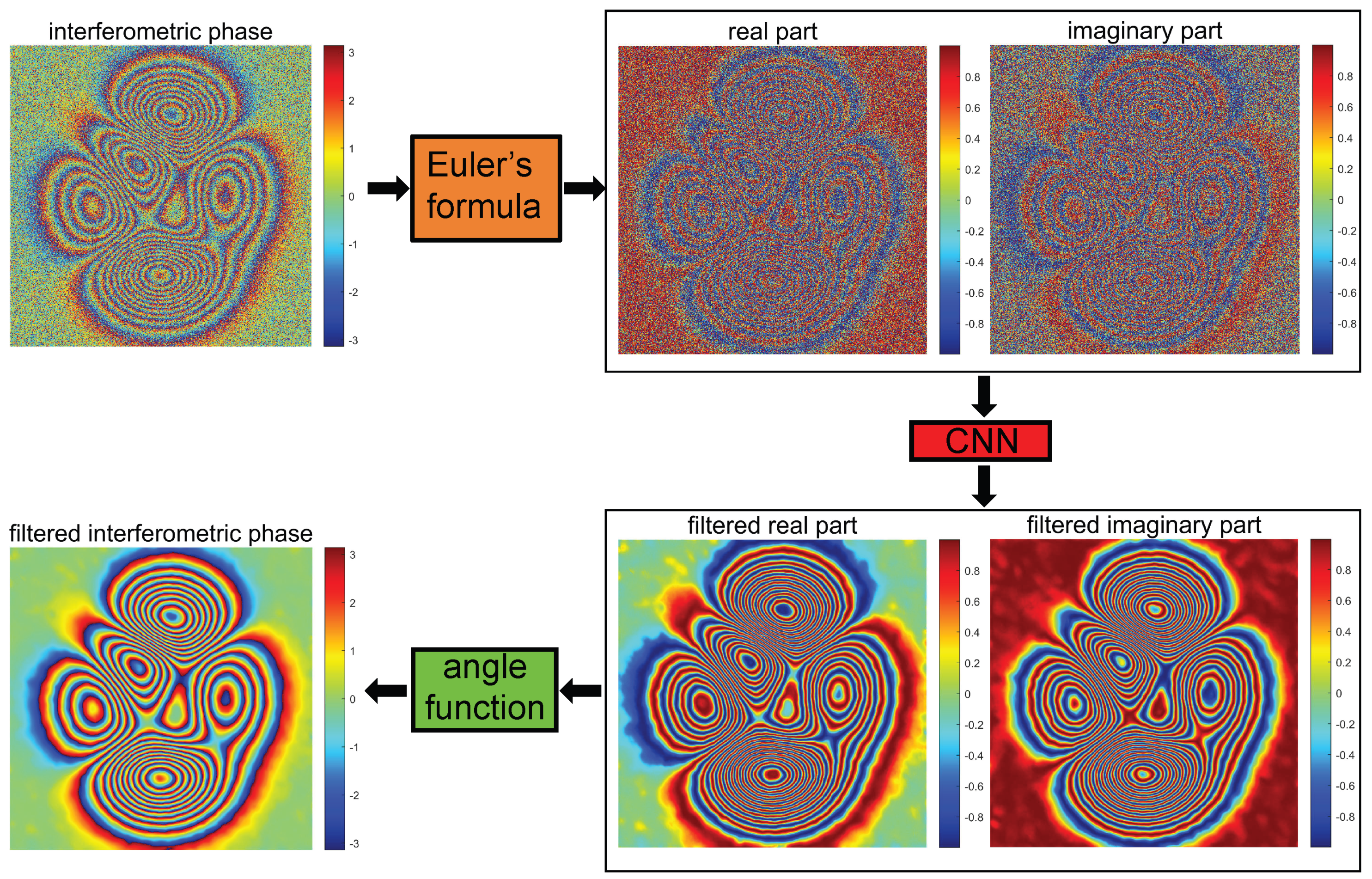
Due to the periodicity of trigonometric functions, interferometric phase maps often exhibit phase jumps from π to π , and these jumps are crucial to the accuracy of subsequent phase unwrapping. If filtering is performed directly in the real phase domain, the denoising process can easily destroy the phase-jump information. Therefore, this paper adopts complex-domain filtering and then converts the result back to the phase domain so as to better preserve phase-jump information while suppressing noise [32]. This paper employs a multi-level, multi-scale feature fusion network for phase filtering. As illustrated in Figure 1, the input interferometric phase is converted to a complex interferogram according to Equation (15). Then, two pre-trained network models are used to separately filter the real and imaginary parts of the complex interferometric phase representation. Finally, the filtered complex output is passed through the angle function to obtain the final interferometric phase.
e j φ = cos φ + j · sin φ
here, φ denotes the interferometric phase, j is the imaginary unit, and c o s φ and s i n φ denote the real and imaginary components of the complex interferometric phase representation separately.

3.1.3. Design of the Multi-Level, Multi-Scale Feature Fusion Module

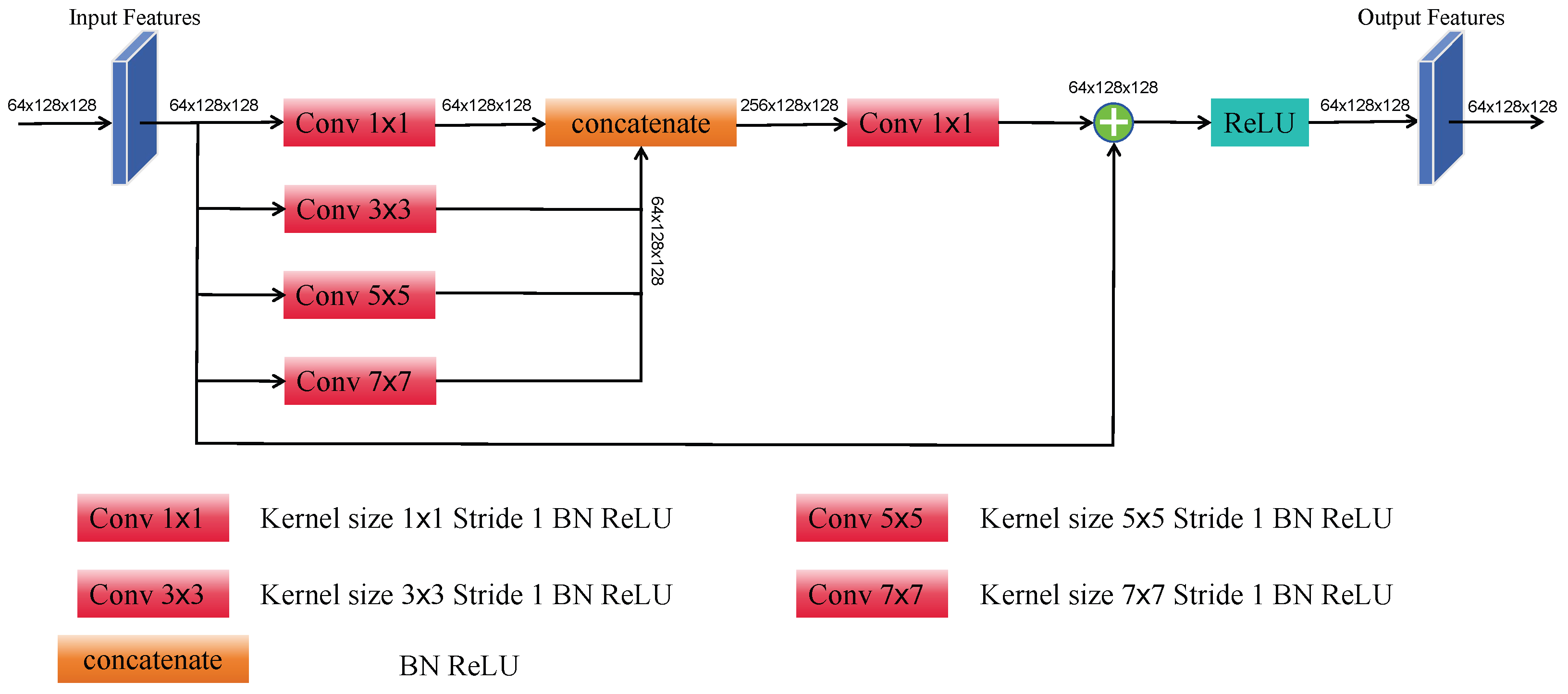
The core component of the PFTNet architecture is the multi-level and multi-scale feature fusion module (MLSFFM), which enhances the network’s robustness by integrating the unique characteristics of InSAR data. A detailed illustration of its structure is provided in Figure 2.
The MLSFFM begins by applying four parallel convolutional layers with different kernel sizes (1 × 1, 3 × 3, 5 × 5, and 7 × 7) to extract multi-scale features. These features are then fused by concatenation [33]. Then, a 1 × 1 convolutional layer further integrates the concatenated multi-scale features and reshapes the channel count to be consistent with the input of the module. A residual connection adds the module’s input back to this fused output, enabling feature-level integration. In the MLSFFM, each convolution is followed by Batch Normalization, which accelerates training convergence and reduces sensitivity to parameter initialization, and then by a ReLU activation to ensure the network can learn and adapt to nonlinear features.

3.1.4. PFTNet Network Architecture Design

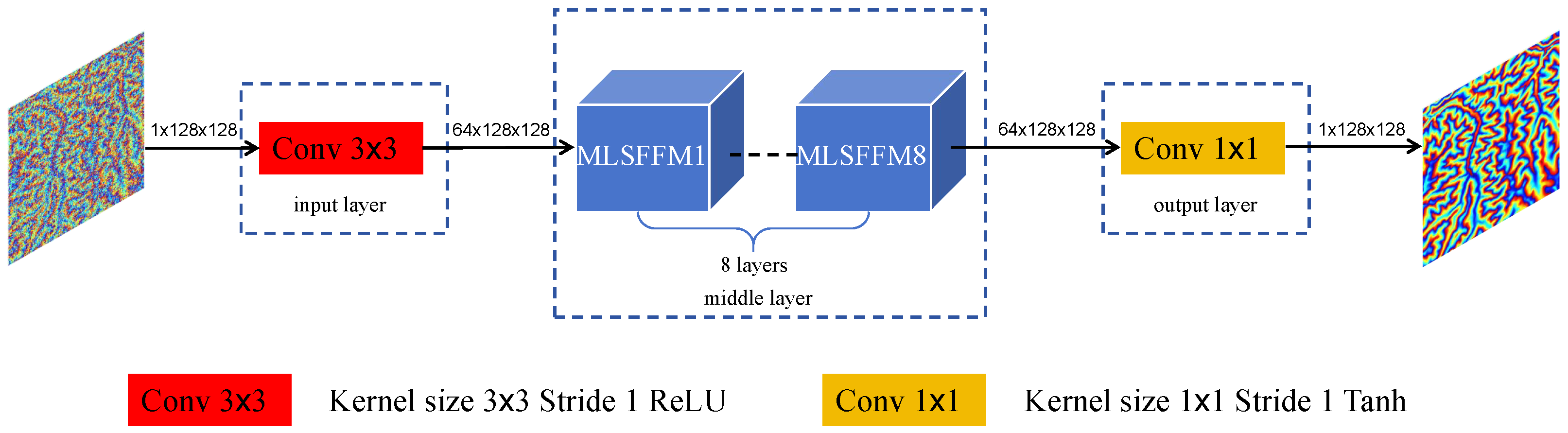
As shown in Figure 3, the architecture of PFTNet is composed of three main components: an input layer, a middle layer, and an output layer. The input layer includes a 3 × 3 convolutional layer that initially extracts 64 feature maps from the input interferometric phase image. The middle layer is formed by eight MLSFFM modules connected in series; these modules work cooperatively to extract richer and more robust features from the input. The output layer applies a 1 × 1 convolutional layer to compress the channel dimension to a single output, and subsequently employs a Tanh activation function. The Tanh serves to constrain the output to the range (−1, 1). While the real and imaginary components of the complex interferogram are theoretically confined to the range [−1, 1], in practice, the probability of being just at the endpoint is close to zero, so the minor discrepancy between the closed interval [−1, 1] and the open interval (−1, 1) of the Tanh function can be considered negligible.

3.1.5. Network Training

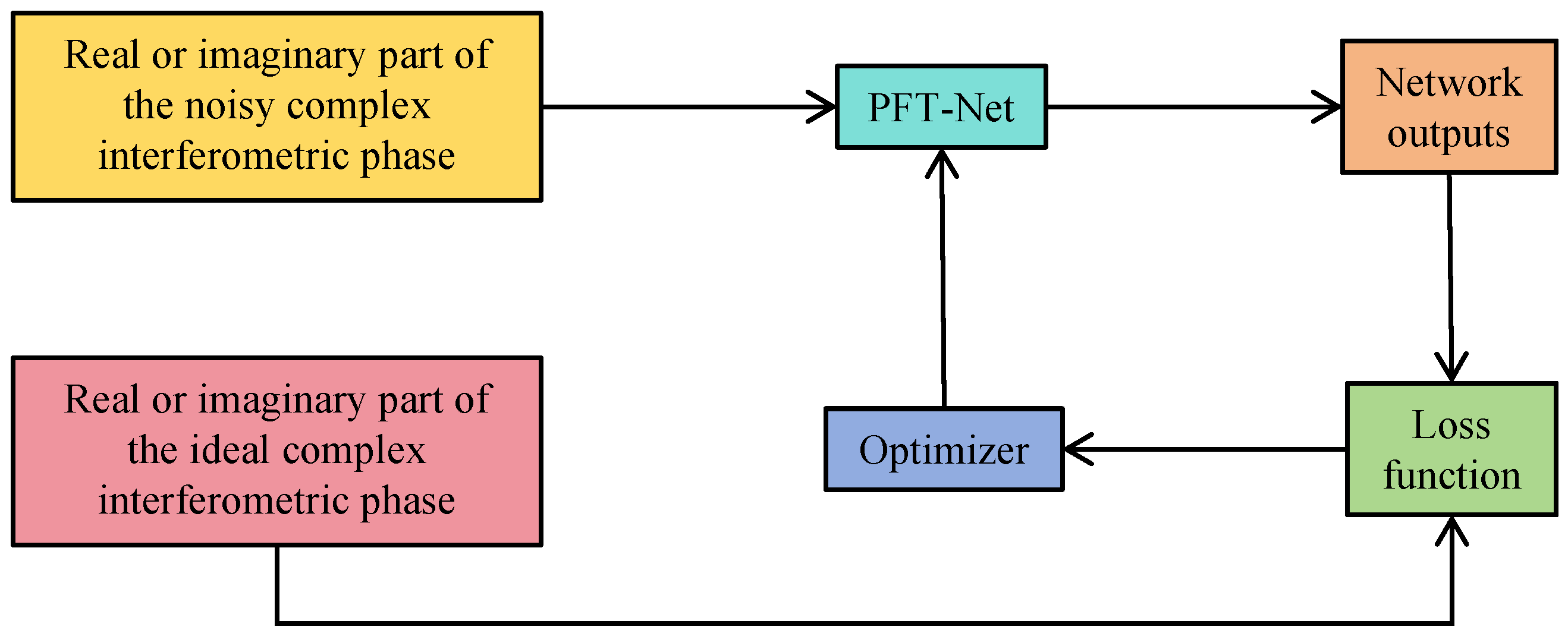
Based on the previously constructed dataset, two PFTNet models are trained separately for the real and imaginary components of the complex representation of interferometric phase. The training workflow (shown in Figure 4) is as follows: first, the noisy real or imaginary part of the interferogram is fed into its corresponding PFTNet, the network’s output is compared against the ground-truth label to compute the loss, and finally, this loss is back-propagated and passed to the optimizer, which updates the network parameters accordingly.
The PFTNet is trained using the Adam optimizer with a learning rate of 1 × 10 5 , the model is trained for 50 epochs with a batch size of 12, and the loss function adopted is the Mean Absolute Error (MAE), which is defined as follows:
M A E = 1 N i = 1 N y ^ i y i
where y i is the ground truth value, y ^ i is the network’s prediction, and N is the number of samples. A lower MAE value generally indicates closer agreement between the network’s predicted values and the ground truth.

3.2. BSQ Kalman Filter Phase Unwrapping Method

The BSQ Kalman filter phase unwrapping method formulates the state and observation equations of the unwrapping system and incorporates a gradient estimator to achieve an optimal estimate of the absolute phase from measurements contaminated by system noise and interference. The state transition and observation models are given as follows [34]:
x ( m , n ) = x ( a , s ) + g ¯ ( m , n ) ( a , s ) + ε ( m , n ) ( a , s ) = f x ( a , s ) + ε ( m , n ) ( a , s )
y ( m , n ) = sin x ( m , n ) cos x ( m , n ) + r 1 ( m , n ) r 2 ( m , n ) = h x ( m , n ) + r ( m , n )
where x ( a , s ) is the absolute phase at pixel ( a , s ) , ε ( m , n ) ( a , s ) is zero-mean real-valued Gaussian white noise, which denotes the phase-gradient estimation error between pixels ( a , s ) and ( m , n ) . Since the measurement model consists of the sine and cosine components of the phase, r ( m , n ) is modeled as zero-mean real-valued Gaussian noise, i.e., r ( m , n ) N ( 0 , R ) . g ¯ ( m , n ) ( a , s ) is the estimated phase gradient between pixels ( a , s ) and ( m , n ) , obtained from the phase gradient estimator [26], calculated as follows:
g ¯ ( m , n ) ( a , s ) = φ ¯ y ( a , s ) ( m a ) + φ ¯ x ( a , s ) ( n s )
where φ ¯ y ( a , s ) and φ ¯ x ( a , s ) describe the estimated unit local phase gradients in the column and row directions at pixel ( a , s ) , respectively. In the BSQ Kalman filter phase unwrapping algorithm, each target pixel is unwrapped by making predictions based on the set of already unwrapped pixels within its eight-neighbor vicinity, which leads to more accurate and robust unwrapping outcomes.
Assume the phase of the pixel ( a , s ) is represented by the state variable x k 1 , whose mean is m k 1 x and covariance is P k 1 x . A set of sigma points ξ is obtained via the unscented transform; kernel parameters θ f and θ h are then set based on the state transition function f ( · ) and the measurement model h ( · ) , respectively.
State prediction. First, take the previous time step’s state variable x k 1 with mean m k 1 x and covariance P k 1 x , the generated sigma points ξ , the state transition function f ( x k 1 ) and its corresponding kernel parameters θ f as inputs to the BSQMT. This is formally expressed by Equation (20):
m k k 1 x , P k k 1 x = BSQMT f x k 1 , m k 1 x , P k 1 x , θ f
BSQMT stands for the Bayes–Sard quadrature moment transform. Here, m k k 1 x denotes the a priori estimate of the state x k 1 , and P k k 1 x denotes the corresponding estimation error covariance. The process noise covariance Q ( k 1 ) is incorporated into P k k 1 x to obtain the predicted covariance, as expressed in Equation (21):
P k k 1 x = P k k 1 x + Q ( k 1 )
State update. The m k k 1 x and covariance P k k 1 x , together with the measurement model h ( x k ) , the sigma points ξ and their corresponding kernel parameters θ h , are used as inputs to the BSQMT. Specifically, this is given as follows:
m k k 1 z , P k k 1 z , P k k 1 x z = BSQMT h x k , m k k 1 x , P k k 1 x , θ h
where m k k 1 z denotes the predicted estimate of the measurement z k , P k k 1 z denotes its estimation error covariance, and P k k 1 x z denotes the cross-covariance between the state x k and the measurement z k . The measurement noise covariance R ( k ) is added to P k k 1 z to obtain the updated measurement covariance, as shown in Equation (23):
P k k 1 z = P k k 1 z + R ( k )
Then, the Kalman gain G k can be computed according to (24):
G k = P k k 1 x z P k k 1 z 1
Finally, the mean m k x and covariance P k x of the state variable x k are updated to produce the unwrapped phase estimate and its associated uncertainty at pixel location ( m , n ) . This process is described as follows:
m k k x = m k k 1 x + G k z k m k k 1 z P k k x = P k k 1 x G k P k k 1 z G k T
Repeat the computations in Equations (20)–(25) until all pixels in the interferogram have been unwrapped.

3.3. Iterative Strategy

The core idea of the iterative strategy is to use the state estimate obtained after the measurement update as the input to reapply the BSQMT, thereby updating the mean and covariance of the state [35]. Through multiple iterations, this approach can further improve the accuracy of the filtering estimation while significantly reducing the variance of the estimated results.
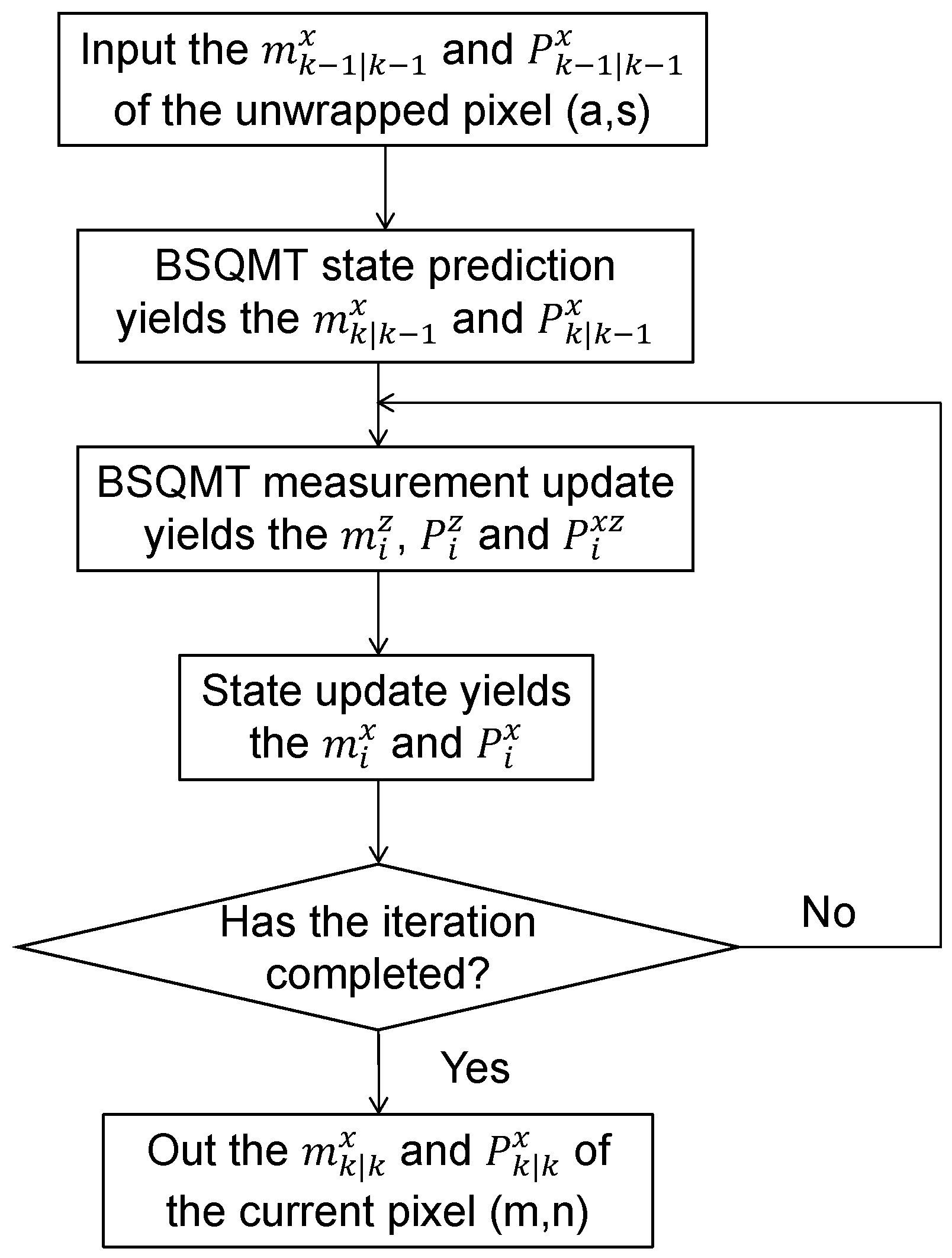
In the iterative strategy, the state prediction step remains the same as in the standard BSQ Kalman filter, but the state update step is modified. For simplicity, the subscripts for time steps k and k-1 are omitted in the following expressions. Assume that m i x and P i x denote the estimated state and its associated error covariance obtained through iterative computation at a given pixel ( m , n ) . As illustrated in Figure 5, the updated state estimate is first fed into the BSQMT to calculate the predicted measurement, the estimation error covariance, and the cross covariance between the state and the measurement at the current pixel in the i-th iteration. The detailed computations are as follows:
m i z , P i z , P i x z = BSQMT h , m i 1 x , P i 1 x , ξ , θ h
where m i 1 x = m k k x , P i 1 x = P k k x , denote the mean and covariance of the state variable before any iterative operations. Add the measurement noise covariance R to the transformed covariance P i z obtained from the moment transformation:
P i z = P i z + R
The Kalman gain matrix for the i-th iteration is computed as follows:
G i = P i x z P i z 1
Finally, according to the state update equation, compute the estimated unwrapped phase and its covariance at pixel ( m , n ) after the i-th iteration:
m i x = m i 1 x + G i z m i 1 z P i x = P i 1 x G i P i z G i T
If i < N iter , continue the iterative process until the number of iterations reaches the preset value N iter . Through this iterative procedure, the BSQ Kalman filter can significantly improve estimation accuracy under complex conditions.

4. Experiment Results

4.1. Data Selection

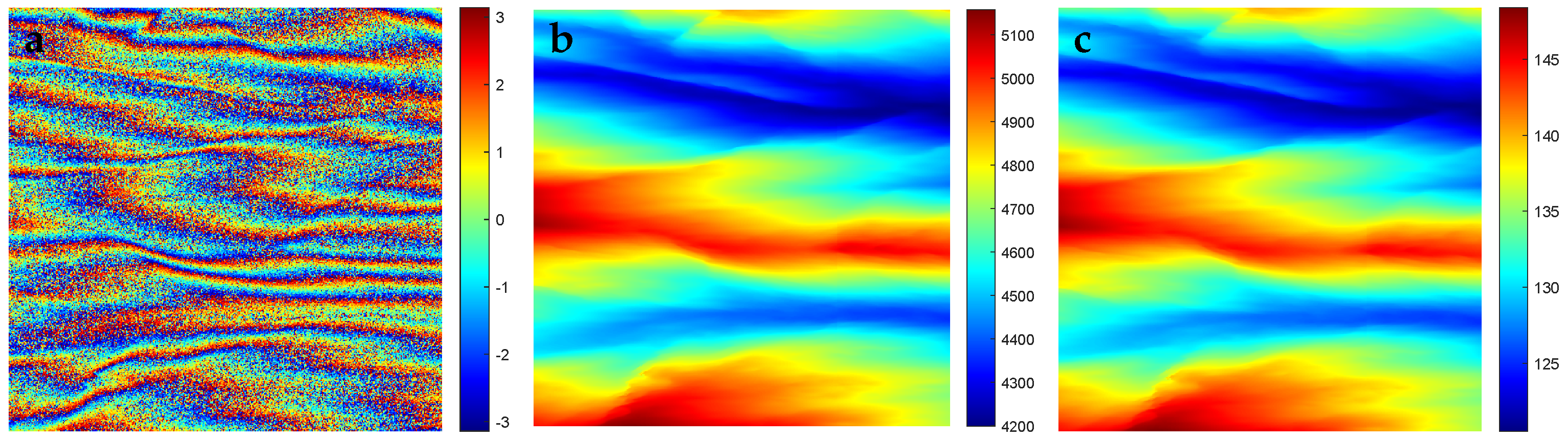
In this part of the experiment, four sets of data were selected for validation. Among them, two are simulated datasets: Dataset 1 (size of 512 × 512) is generated by inverting a DEM, and Dataset 2 (size of 512 × 512) is created using the “peaks” multi-mountain terrain function. In addition, two sets of real data were used: Dataset 3 (size of 512 × 512) is a Sentinel-1 real InSAR dataset from the Tibet region of China. An external DEM can be used to construct a reference phase, enabling quantitative evaluation such as root mean square error (RMSE), and the main interferometric geometric parameters are listed in Table 1. Dataset 4 (size of 400 × 400) is real interferometric data from Mount Etna in Italy and is used to verify the robustness of the proposed method in typical scenarios with complex terrain and strong phase variations. Considering that volcanic interferometric phases may include deformation and atmospheric components, an external DEM cannot provide a unified absolute reference phase. Therefore, we evaluate Dataset 4 using rewrapping consistency and residue statistics, which serves as a complement to the quantitative validation on Dataset 3. In the experiments, the kernel parameters of the state transition function and the observation function were set, respectively, as follows: θ f = [ 1 , 0.1 ] , θ h = [ 1 , 0.1 ] . This setting was selected based on comparative tests with different parameter combinations and was used consistently in the following experiments. Comparative analysis of different parameter combinations revealed that this configuration provides a good balance between noise suppression and fringe detail preservation, resulting in superior accuracy and stability in phase unwrapping performance.

4.2. Simulated Data

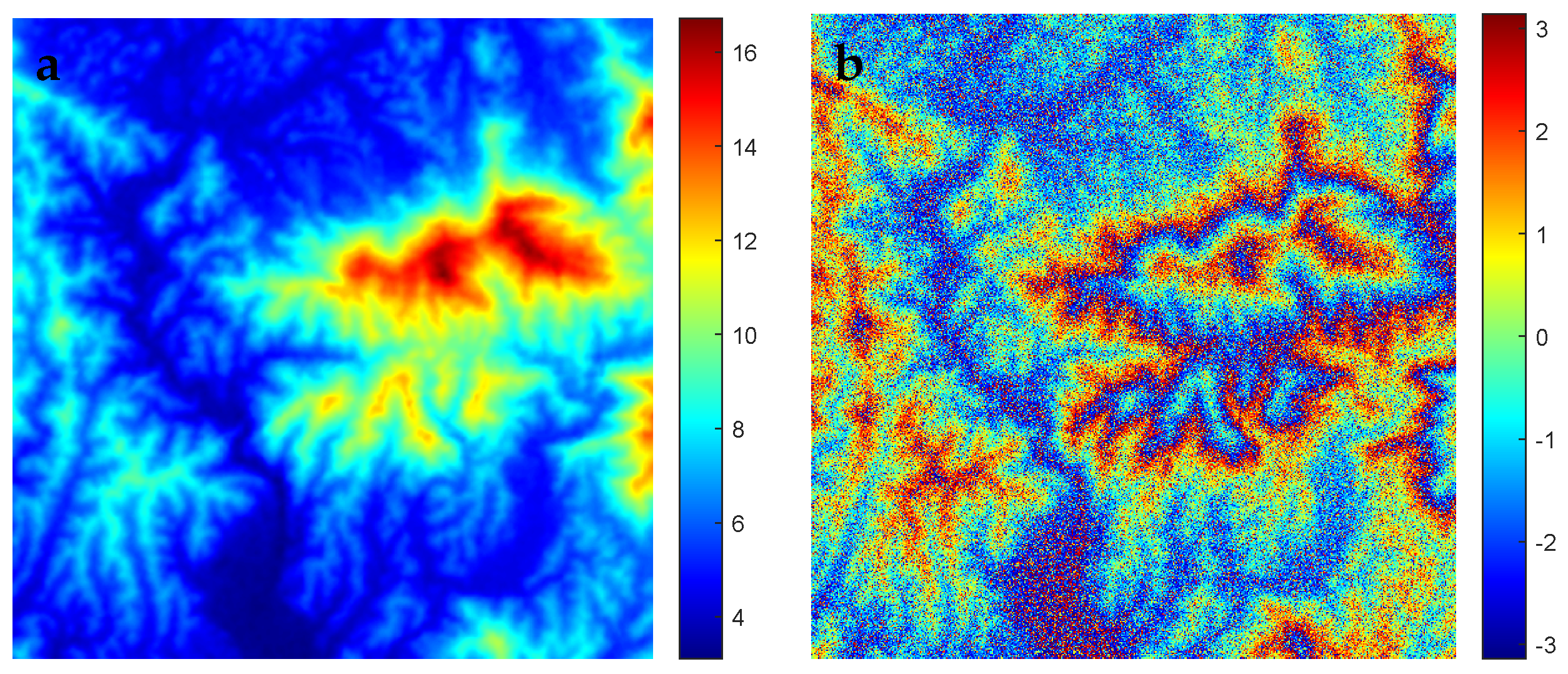
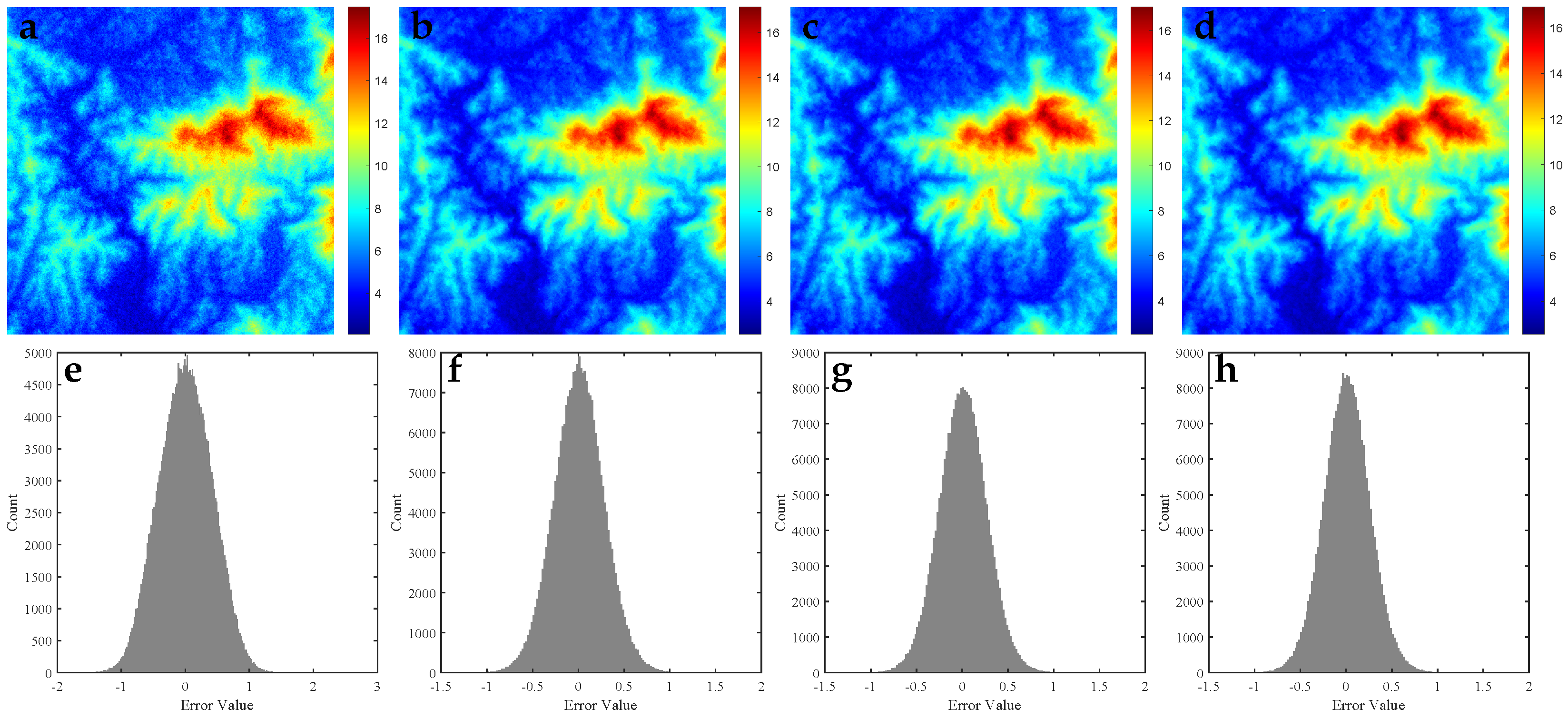
In order to examine the performance of the iterative strategy, we conducted tests using Dataset 1 without incorporating the PFTNet neural network for pre-filtering. Figure 6 shows the ground truth phase and the wrapped phase with noise from Dataset 1, while Figure 7 presents the unwrapping results and corresponding RMSE histograms under a coherence coefficient of 0.7 for different numbers of iterations. The results indicate that with an increasing number of iterations, the unwrapped phase images gradually converge toward the true phase, and the corresponding error distribution becomes narrower and the error points are more tightly clustered. The most significant improvement is observed during the first iteration. Table 2 reports unwrapping accuracy across various coherence coefficients and iteration counts. It can be seen that the RMSE improvement becomes marginal after three iterations, indicating that the iterative process has essentially converged. Therefore, subsequent experiments adopt an iteration count of three by default.
PFT-IBSQKF consists of the proposed PFTNet pre-filtering network and the IBSQKF unwrapping module. To separately evaluate the contributions of the pre-filtering stage and the unwrapping strategy and to verify the generality of PFTNet as a preprocessing module, two comparative settings are designed on the same noisy interferogram. In the first setting without pre-filtering, all methods directly take the original noisy wrapped phase as input, and IBSQKF is used to evaluate the intrinsic performance of the proposed unwrapping method. In the second setting with unified PFTNet pre-filtering, the wrapped phase is first preprocessed by PFTNet, and the resulting output is then used as a common input for all methods. Here, PFT-Method denotes the corresponding method equipped with the proposed PFTNet pre-filtering module.
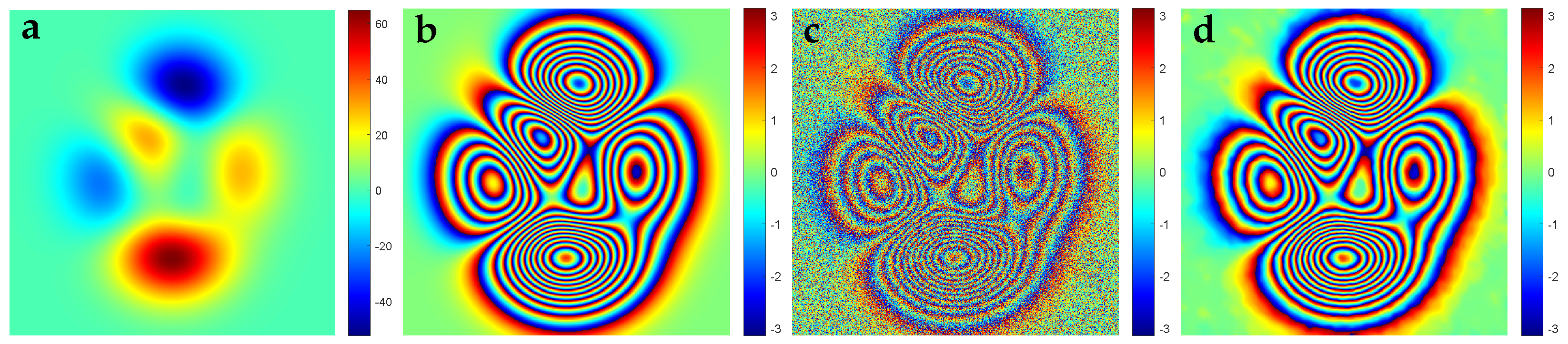
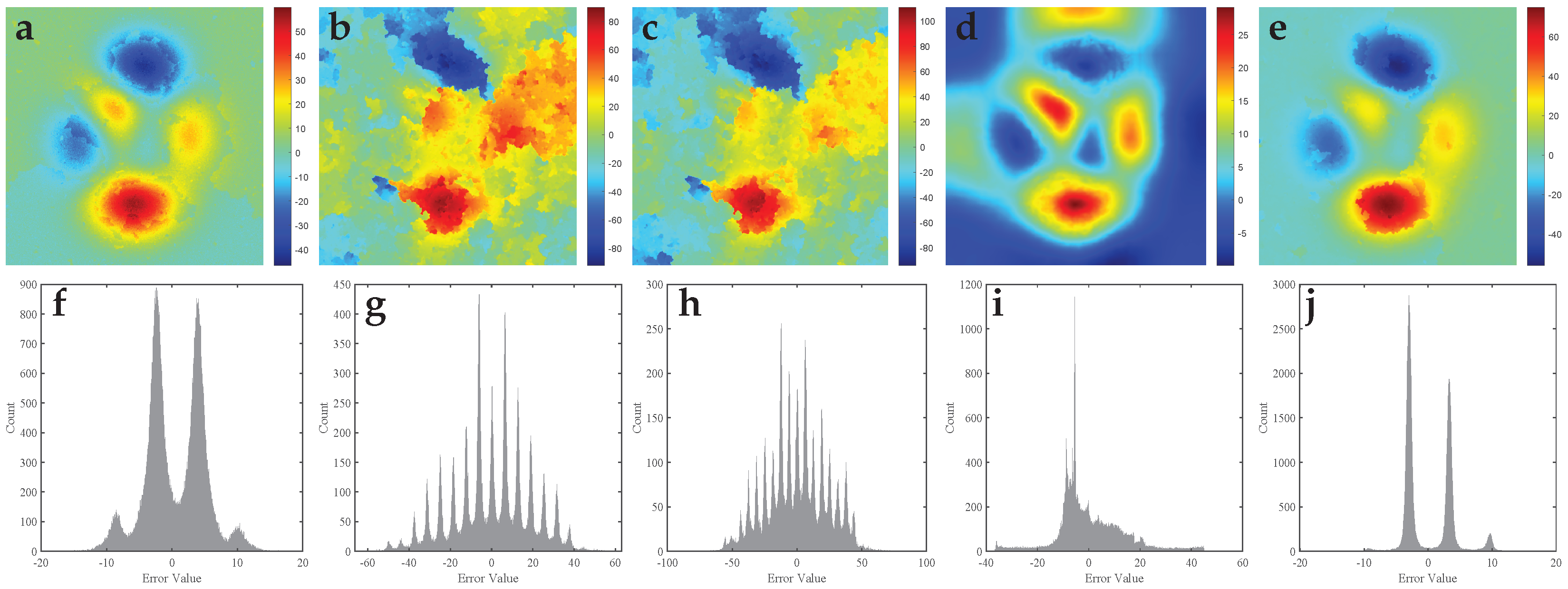
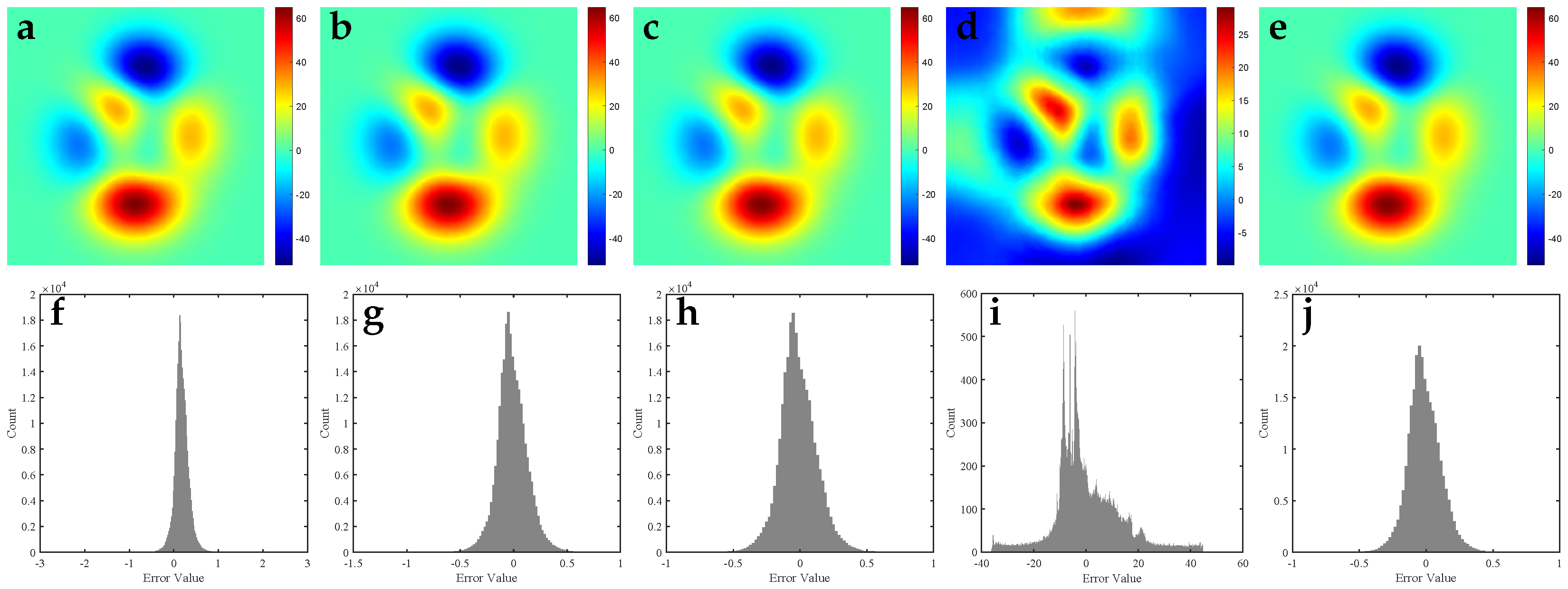
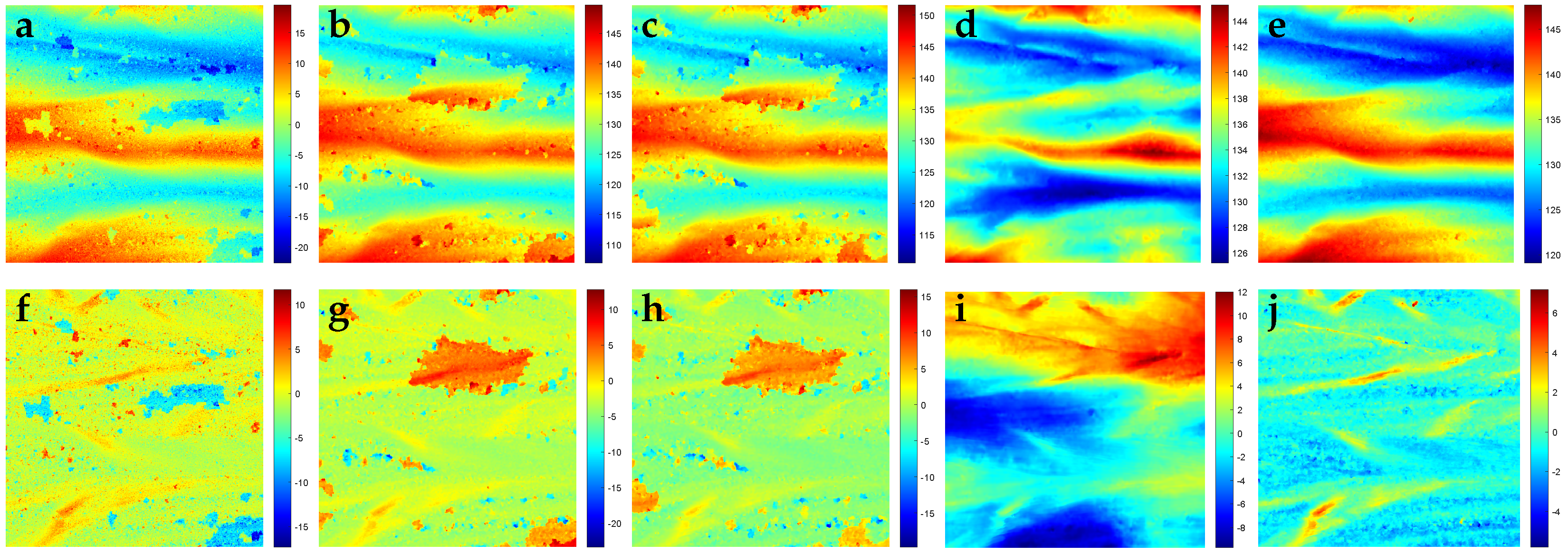
To more intuitively demonstrate the performance under low-coherence conditions, Figure 8 provides the “peaks” dataset with a lower coherence coefficient of 0.5: Figure 8a shows the true phase, Figure 8b the noise-free wrapped phase, and Figure 8c the noisy wrapped phase. Due to noise contamination, the fringe structures become blurred, whereas PFTNet processing improves fringe discernibility (Figure 8d). Figure 9 and Figure 10 further compare the unwrapping results of the “peaks” data under the two aforementioned settings. Table 3 reports the corresponding RMSE results under different coherence coefficients. According to Table 3, IBSQKF obtains the lowest RMSE values among the compared methods in the setting without pre-filtering. After introducing unified PFTNet pre-filtering, the RMSE values of most methods decrease, and PFT-IBSQKF achieves the lowest RMSE values under the same pre-filtering condition.

4.3. Real Data

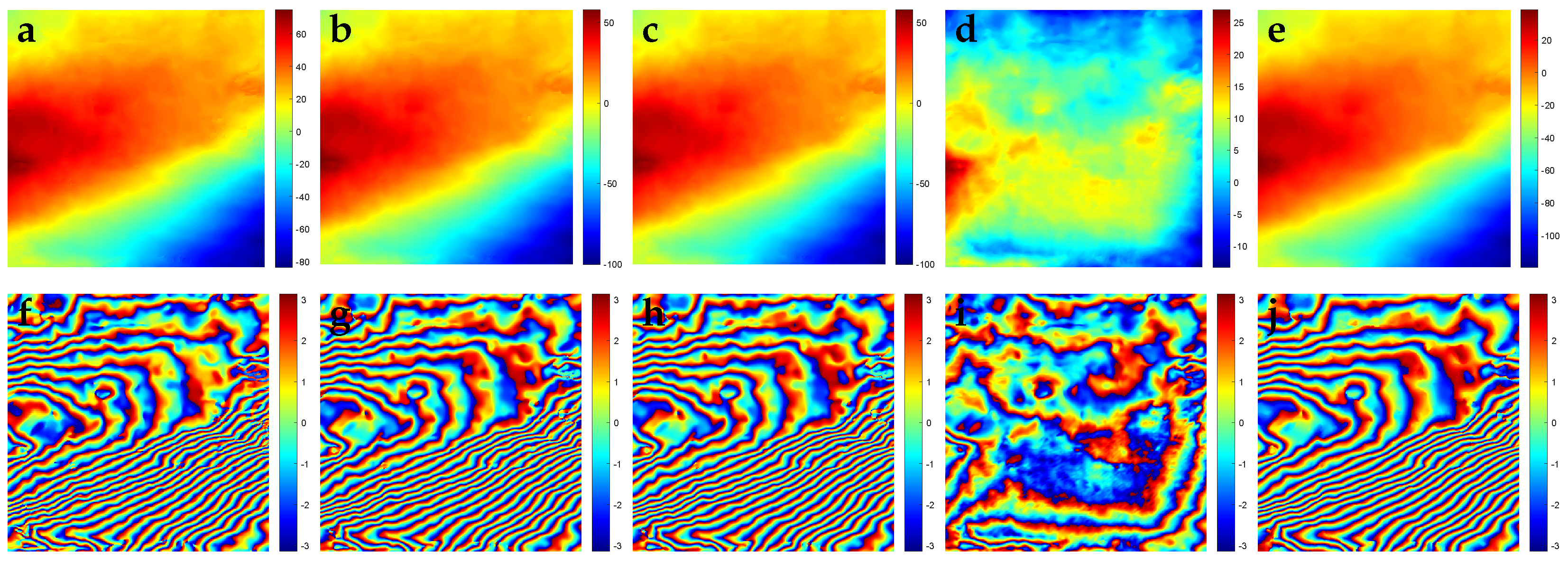
To highlight the standalone performance of the proposed unwrapping method, the quantitative evaluation on Dataset 3 (Tibet) is conducted under the setting without PFTNet pre-filtering, where only IBSQKF is compared with the competing methods. Figure 11 shows the wrapped phase of Dataset 3, the external DEM, and the reference absolute phase derived from the external DEM. Figure 12 presents the unwrapping results of different methods on Dataset 3 together with the corresponding error maps.
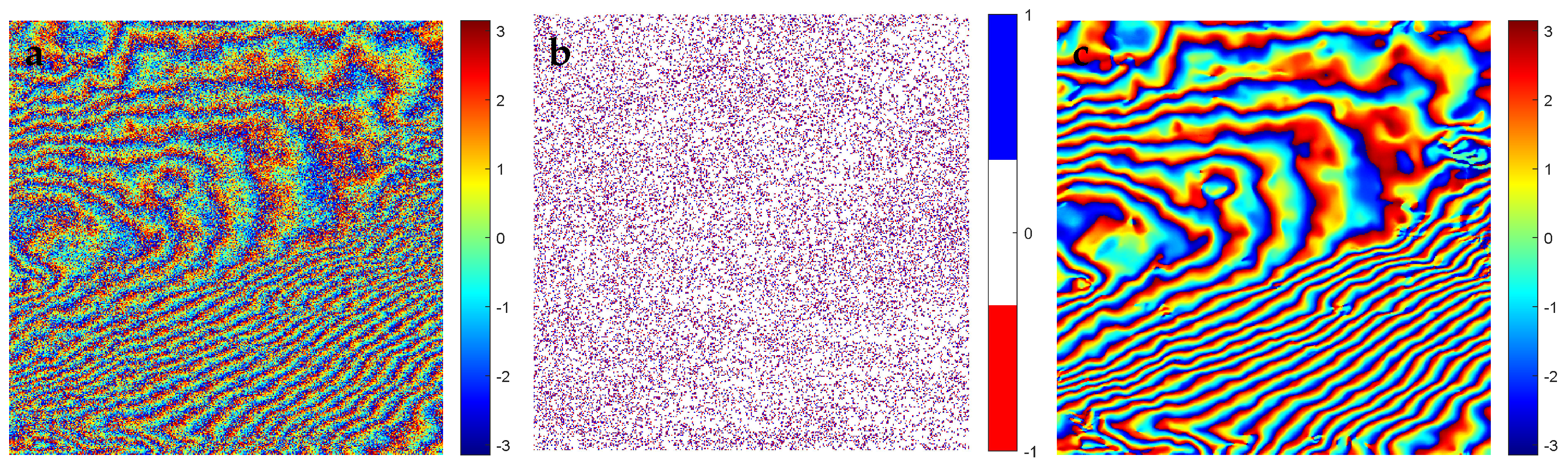
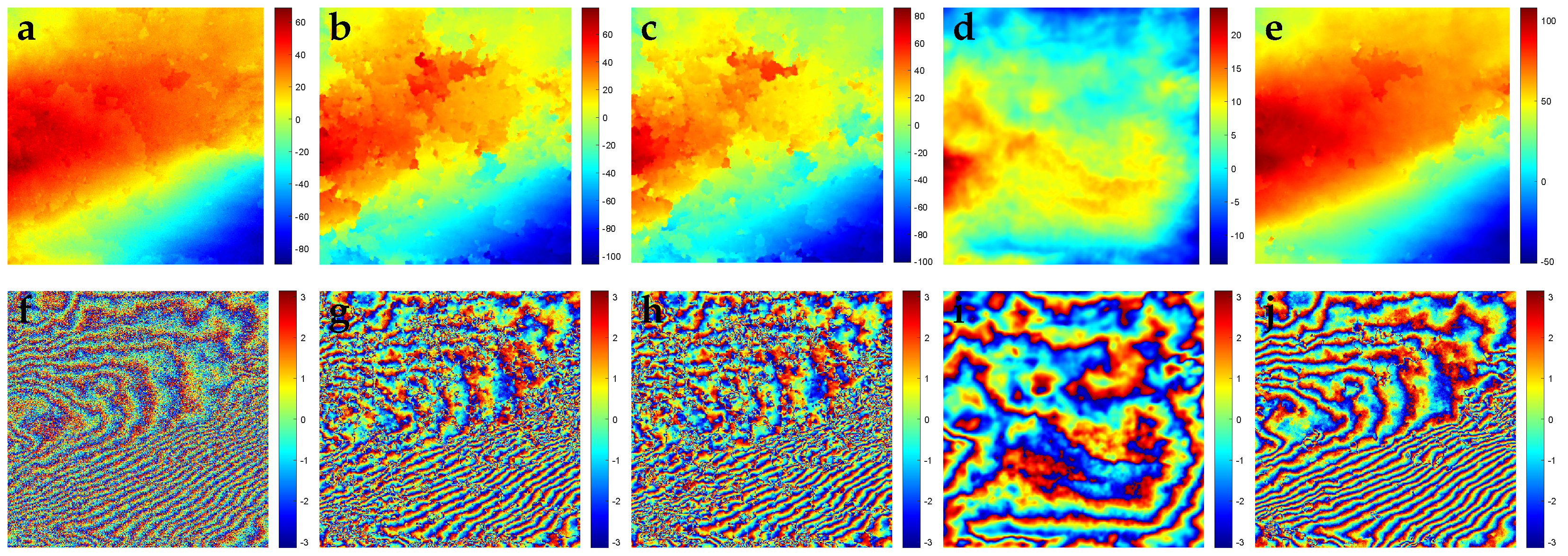
As shown in Figure 12f–j, IBSQKF exhibits lower-magnitude and more localized errors, with fewer large-area patch artifacts. The corresponding RMSE statistics are summarized in Table 4, where IBSQKF obtains the lowest RMSE among all compared methods. Figure 13 shows the wrapped phase of Dataset 4 (Mount Etna, Italy), the residue distribution, and the wrapped phase after PFTNet processing. It can be observed that, as a one-time pre-filtering step, PFTNet improves fringe discernibility and enhances local phase consistency, thereby providing a more stable input for subsequent unwrapping. Figure 14 and Figure 15 further compare the unwrapping results of different methods under the settings without pre-filtering and with PFTNet pre-filtering. Table 5 reports the residue statistics of Dataset 4 during the rewrapping stage (the actual residue count is 33,822). Without pre-filtering, the residue reduction achieved by MCF is almost negligible, while UKF and IUKF obtain reduction rates of 68.7% and 70.5%, respectively. By comparison, IBSQKF achieves a residue reduction rate of 95.1%, indicating a much stronger capability in suppressing residue accumulation. After introducing unified PFTNet pre-filtering, PFT-IBSQKF further improves the residue reduction rate to 99.9%.
Table 6 presents the computational time of different phase unwrapping methods. It can be seen that UKF requires the longest time, while UNet requires the shortest. Although the computational time of IBSQKF is slightly higher than that of MCF and IUKF, it remains within an acceptable range. At the same time, IBSQKF demonstrates superior unwrapping accuracy and robustness compared to the other methods, making its overall performance more advantageous. As shown in Table 7, the filtering process of PFT-Net is extremely fast and can be almost negligible. Therefore, the complete PFT-IBSQKF framework still maintains an acceptable overall computational cost while achieving better unwrapping performance.

5. Discussion

The experimental results show that the proposed PFT-IBSQKF framework achieves stable performance on both simulated and real InSAR datasets. Specifically, PFTNet enhances fringe structures and suppresses noise before phase unwrapping, providing improved wrapped phase observations for the subsequent filtering process. IBSQKF then performs recursive phase estimation within a Bayesian framework, where the Bayes–Sard quadrature moment transform helps model the additional uncertainty caused by quadrature errors.
Compared with MCF, UKF, IUKF, and UNet, the proposed method shows better robustness under noisy and blurred fringe conditions. MCF may be affected by low-coherence regions, while UKF and IUKF are still limited by sigma-point moment approximation errors. In contrast, IBSQKF improves the estimation of the predicted mean and covariance through the Bayes–Sard quadrature moment transform, thereby helping reduce error accumulation during recursive phase estimation. The iteration experiments further show that RMSE decreases in the first few iterations and changes only slightly after three iterations, indicating that three iterations provide a reasonable balance between accuracy and efficiency.
The comparison between the settings with and without PFTNet pre-filtering indicates the complementary effect between PFTNet and IBSQKF. PFTNet improves the quality of noisy wrapped phase inputs, while IBSQKF still maintains superior performance under the same pre-filtering condition. This suggests that the advantage of PFT-IBSQKF comes not only from fringe enhancement and noise suppression provided by pre-filtering but also from the ability of IBSQKF to quantify quadrature errors and state estimation uncertainty. PFTNet is not regarded as a perfect black-box filter in the proposed framework. Its output is used as the filtered wrapped phase observation input for IBSQKF, but it may still contain residual network prediction errors. In the Bayesian state-space framework of IBSQKF, such residual errors can be regarded as part of the effective measurement noise, which affects the observation likelihood and posterior state estimation through the measurement noise covariance R ( k ) . However, the current PFTNet only provides the filtered phase output and does not estimate the reliability of each pixel prediction. Therefore, dynamically adjusting the measurement noise covariance matrix R ( k ) in IBSQKF according to the local confidence of PFTNet outputs remains a promising direction for future research. In addition, although the UNet unwrapping method yields zero residues, the corresponding unwrapped images still exhibit relatively poor overall quality, possibly due to over-smoothing in the UNet output. This suggests that the performance of deep learning methods may be affected by the training data distribution and their adaptability to the current phase unwrapping task. It should also be noted that UNet is used only as a representative deep learning baseline in this study, rather than a recent specialized phase unwrapping network. In future work, more comprehensive comparisons with recent specialized phase unwrapping networks, such as PGNet and BCNet, will be conducted under unified experimental settings.
The proposed method is mainly suitable for single-interferogram phase unwrapping under moderate to low coherence, noisy observations, and blurred fringe conditions. Since it does not rely on multiple baselines or an interferogram stack, it can be conveniently integrated into conventional InSAR processing chains. However, several limitations remain. First, under extreme noise conditions, such as severe decorrelation or strong interference, the available fringe information may be insufficient, and the phase unwrapping performance may still degrade. Second, IBSQKF involves recursive Bayesian estimation, the Bayes–Sard quadrature moment transform, and iterative refinement, resulting in higher computational cost than some traditional methods. Therefore, the current implementation is more suitable for phase unwrapping tasks in medium-sized scenes, while its direct application to large-scale InSAR data or real-time processing may still be limited. Nevertheless, the main computational process of IBSQKF consists of repeated local estimation steps, which has potential for parallel acceleration. In addition, the kernel parameters are currently determined mainly through experimental tuning. Although this setting achieves stable results in the current experiments, its adaptability under different terrain and noise conditions still requires further investigation. Future work will focus on GPU-based parallel computing, adaptive parameter selection, and more efficient iterative strategies to improve the computational efficiency and scalability of the proposed framework for large-scale InSAR applications.


6. Conclusions

In this paper, we introduce PFTNet, a convolutional neural-network-based pre-filter that employs a multi-level and multi-scale feature-fusion strategy to separately denoise the real and imaginary components of the complex interferometric phase representation, thereby significantly enhancing fringe clarity. We also present the IBSQKF method, which is the first phase unwrapping algorithm to integrate the Bayes–Sard quadrature method with an improved iterative strategy, thereby addressing the challenge of correcting numerical integration errors in traditional Kalman-filter-based phase unwrapping. To evaluate the performance of the iterative strategy, experiments were conducted on DEM inversion simulated data. The results show that, with an increasing number of iterations, IBSQKF achieves significantly higher unwrapping accuracy. Experiments on both simulated and real data demonstrate that PFTNet effectively suppresses noise and extracts clear interferometric fringes from blurred interferograms. IBSQKF consistently outperforms the other compared methods under the setting without pre-filtering, while the complete PFT-IBSQKF framework achieves optimal unwrapping performance and enhanced robustness when combined with pre-filtering. In particular, the proposed framework shows clear advantages under high-noise conditions.

Author Contributions

Conceptualization, X.C.; methodology, M.L. and X.C.; validation, M.L., X.Z. and X.C.; formal analysis, M.L. and X.C.; data curation, M.L., X.Z. and X.C.; writing—original draft preparation, M.L. and X.C.; writing—review and editing, X.C.; project administration, X.C. All authors have read and agreed to the published version of the manuscript.

Funding

This work was supported in part by Guangxi Natural Science Foundation (2025GXNSFAA069512); Guangxi Science and Technology Major Program (No. Guike AA24206025, No. Guike AA23062038).

Data Availability Statement

Data will be made available on request.

Acknowledgments

The authors would like to gratefully acknowledge the Guangxi Key Laboratory of Precision Navigation Technology and Application for supporting the experimental work of this study. The authors also extend sincere appreciation to all colleagues who provided valuable insights and assistance throughout this research.

Conflicts of Interest

The authors declare no conflicts of interest.

References

  1. Zhang, Y.; Gao, Y.; Li, S.; Zhang, S. Phase Cost Indicator-Guided Central Difference Information Filter 2-D Phase Unwrapping Approach. IEEE J. Sel. Top. Appl. Earth Obs. Remote Sens. 2023, 16, 4096–4108. [Google Scholar] [CrossRef]
  2. Kelany, K.A.H.; Dimopoulos, N.; Adolphs, C.P.J.; Baniasadi, A. Quantum Annealing Methods and Experimental Evaluation to the Phase-Unwrapping Problem in Synthetic Aperture Radar Imaging. IEEE Trans. Quantum Eng. 2022, 3, 3101420. [Google Scholar] [CrossRef]
  3. Itoh, K. Analysis of the Phase Unwrapping Algorithm. Appl. Opt. 1982, 21, 2470. [Google Scholar] [CrossRef] [PubMed]
  4. Ghiglia, D.C.; Pritt, M.D. Two-Dimensional Phase Unwrapping: Theory, Algorithms, and Software; Wiley: New York, NY, USA, 1998. [Google Scholar]
  5. Mao, W.; Liu, G.; Wang, X.; Xie, Y.; He, X.; Zhang, B.; Xiang, W.; Wu, S.; Zhang, R.; Fu, Y.; et al. Using Range Split-Spectrum Interferometry to Reduce Phase Unwrapping Errors for InSAR-Derived DEM in Large Gradient Region. Remote Sens. 2022, 14, 2607. [Google Scholar] [CrossRef]
  6. Yu, H.; Lan, Y.; Yuan, Z.; Xu, J.; Lee, H. Phase Unwrapping in InSAR: A Review. IEEE Geosci. Remote Sens. Mag. 2019, 7, 40–58. [Google Scholar] [CrossRef]
  7. Goldstein, R.M.; Zebker, H.A.; Werner, C.L. Satellite Radar Interferometry: Two-Dimensional Phase Unwrapping. Radio Sci. 1988, 23, 713–720. [Google Scholar] [CrossRef]
  8. Asundi, A.; Zhou, W. Fast Phase-Unwrapping Algorithm Based on a Gray-Scale Mask and Flood Fill. Appl. Opt. 1998, 37, 5416–5420. [Google Scholar] [CrossRef]
  9. Xu, W.; Cumming, I. A Region-Growing Algorithm for InSAR Phase Unwrapping. IEEE Trans. Geosci. Remote Sens. 1999, 37, 124–134. [Google Scholar] [CrossRef]
  10. Ghiglia, D.C.; Romero, L.A. Robust Two-Dimensional Weighted and Unweighted Phase Unwrapping That Uses Fast Transforms and Iterative Methods. J. Opt. Soc. Am. A 1994, 11, 107–117. [Google Scholar] [CrossRef]
  11. Costantini, M. A Novel Phase Unwrapping Method Based on Network Programming. IEEE Trans. Geosci. Remote Sens. 1998, 36, 813–821. [Google Scholar] [CrossRef]
  12. Osmanoglu, B.; Wdowinski, S.; Dixon, T.H.; Biggs, J. InSAR Phase Unwrapping Based on Extended Kalman Filtering. In Proceedings of the 2009 IEEE Radar Conference, Pasadena, CA, USA, 4–8 May 2009; pp. 1–4. [Google Scholar]
  13. Zhang, Y.; Zhang, S.; Gao, Y.; Li, S.; Jia, Y.; Li, M. Adaptive Square-Root Unscented Kalman Filter Phase Unwrapping with Modified Phase Gradient Estimation. Remote Sens. 2022, 14, 1229. [Google Scholar] [CrossRef]
  14. Xie, X.M.; Zeng, Q.N. Efficient and Robust Phase Unwrapping Algorithm Based on Unscented Kalman Filter, the Strategy of Quantizing Paths-Guided Map, and Pixel Classification Strategy. Appl. Opt. 2015, 54, 9294–9307. [Google Scholar] [CrossRef]
  15. Wang, K.; Li, Y.; Qian, K.; Di, J.; Zhao, J. One-Step Robust Deep Learning Phase Unwrapping. Opt. Express 2019, 27, 15100–15115. [Google Scholar] [CrossRef]
  16. Sica, F.; Calvanese, F.; Scarpa, G.; Rizzoli, P. A CNN-Based Coherence-Driven Approach for InSAR Phase Unwrapping. IEEE Geosci. Remote Sens. Lett. 2020, 19, 4003705. [Google Scholar] [CrossRef]
  17. Zhou, L.; Yu, H.; Lan, Y. Deep Convolutional Neural Network-Based Robust Phase Gradient Estimation for Two-Dimensional Phase Unwrapping Using SAR Interferograms. IEEE Trans. Geosci. Remote Sens. 2020, 58, 4653–4665. [Google Scholar] [CrossRef]
  18. Zhou, L.; Yu, H.; Lan, Y.; Xing, M. Deep Learning-Based Branch-Cut Method for InSAR Two-Dimensional Phase Unwrapping. IEEE Trans. Geosci. Remote Sens. 2021, 60, 5209615. [Google Scholar] [CrossRef]
  19. Gao, Y.; Wang, G.; Wang, G.; Li, T.; Zhang, S.; Li, S.; Zhang, Y.; Zhang, T. Two-Dimensional Phase Unwrapping Method Using a Refined D-LinkNet-Based Unscented Kalman Filter. Opt. Lasers Eng. 2022, 152, 106948. [Google Scholar] [CrossRef]
  20. Arasaratnam, I.; Haykin, S. Cubature Kalman Filters. IEEE Trans. Autom. Control 2009, 54, 1254–1269. [Google Scholar] [CrossRef]
  21. Simon, D. Optimal State Estimation: Kalman, H Infinity, and Nonlinear Approaches; Wiley: Hoboken, NJ, USA, 2006. [Google Scholar]
  22. Prüher, J.; Karvonen, T.; Oates, C.J.; Straka, O.; Särkkä, S. Improved Calibration of Numerical Integration Error in Sigma-Point Filters. IEEE Trans. Autom. Control 2020, 66, 1286–1292. [Google Scholar] [CrossRef]
  23. Yu, H.; Lan, Y. Robust Two-Dimensional Phase Unwrapping for Multibaseline SAR Interferograms: A Two-Stage Programming Approach. IEEE Trans. Geosci. Remote Sens. 2016, 54, 5217–5225. [Google Scholar] [CrossRef]
  24. Yu, H.; Li, Z.; Bao, Z. A Cluster-Analysis-Based Efficient Multibaseline Phase-Unwrapping Algorithm. IEEE Trans. Geosci. Remote Sens. 2010, 49, 478–487. [Google Scholar] [CrossRef]
  25. Yuan, Z.; Wang, Z.; Yu, H.; Xing, X.; Zhou, L.; Chen, L.; Xu, J. A WaveCluster-Based Robust and Fast Multibaseline InSAR Phase Unwrapping Algorithm. IEEE Trans. Geosci. Remote Sens. 2025, 63, 5223417. [Google Scholar] [CrossRef]
  26. Gao, Y.; Dian, Z.; Zhang, S.; Zhang, Y.; Li, S. Adaptive Local Gradient Estimation Smoothing UKF Phase Unwrapping Algorithm. J. China Univ. Min. Technol. 2022, 51, 1007–1015. [Google Scholar]
  27. Chen, X.; Wen, Z.; Wu, Q. Residue Classification-Based Robust Phase Unwrapping in High-Noise Region. J. Sens. 2022, 2022, 5423881. [Google Scholar] [CrossRef]
  28. Prüher, J.; Šimandl, M. Bayesian Quadrature Variance in Sigma-Point Filtering. In Informatics in Control, Automation and Robotics: 12th International Conference, ICINCO 2015, Colmar, France, 21–23 July 2015; Revised Selected Papers; Springer: Cham, Switzerland, 2016; pp. 355–370. [Google Scholar]
  29. Kanagawa, M.; Sriperumbudur, B.K.; Fukumizu, K. Convergence Guarantees for Kernel-Based Quadrature Rules in Misspecified Settings. In Proceedings of the Advances in Neural Information Processing Systems 29, Barcelona, Spain, 5–10 December 2016. [Google Scholar]
  30. Krieger, G. TanDEM-X: A Satellite Formation for High-Resolution SAR Interferometry. IEEE Trans. Geosci. Remote Sens. 2007, 45, 3317–3341. [Google Scholar] [CrossRef]
  31. Sica, F.; Cozzolino, D.; Zhu, X.X.; Verdoliva, L.; Poggi, G. InSAR-BM3D: A Nonlocal Filter for SAR Interferometric Phase Restoration. IEEE Trans. Geosci. Remote Sens. 2018, 56, 3456–3467. [Google Scholar] [CrossRef]
  32. Pu, L.; Zhang, X.; Zhou, Z.; Shi, J.; Wei, S.; Zhou, Y. A Phase Filtering Method with Scale Recurrent Networks for InSAR. Remote Sens. 2020, 12, 3453. [Google Scholar] [CrossRef]
  33. Wu, Z.; Wang, T.; Wang, Y.; Wang, R.; Ge, D. Deep Learning for the Detection and Phase Unwrapping of Mining-Induced Deformation in Large-Scale Interferograms. IEEE Trans. Geosci. Remote Sens. 2021, 60, 5216318. [Google Scholar] [CrossRef]
  34. Luo, X.; Li, H.; Dong, Z.; Zhu, S. InSAR Phase Unwrapping Based on Square-Root Cubature Kalman Filter. IEEE J. Sel. Top. Appl. Earth Obs. Remote Sens. 2020, 13, 4627–4641. [Google Scholar] [CrossRef]
  35. Xie, X. Iterated Unscented Kalman Filter for Phase Unwrapping of Interferometric Fringes. Opt. Express 2016, 24, 18872–18897. [Google Scholar] [CrossRef]
Figure 1. Phase filtering process in Convolutional Neural Network.
Remotesensing 18 01661 g001
Figure 2. MLSFFM structure.
Remotesensing 18 01661 g002
Figure 3. PFTNet structure.
Remotesensing 18 01661 g003
Figure 4. Training process.
Remotesensing 18 01661 g004
Figure 5. Iterative strategy workflow.
Remotesensing 18 01661 g005
Figure 6. Dataset 1. (a) True phase (rad), (b) wrapped phase (rad).
Remotesensing 18 01661 g006
Figure 7. Phase unwrapping results for Dataset 1 under different numbers of iterations. (ad) show the unwrapped results with 0, 1, 2, and 3 iterations, respectively. (eh) show the error histograms between (ad) and the true phase, with error values in radians.
Remotesensing 18 01661 g007
Figure 8. Dataset 2. (a) True phase, (b) wrapped phase without noise, (c) wrapped phase with a coherence coefficient of 0.5, (d) filtered result of (c) (in radians).
Remotesensing 18 01661 g008
Figure 9. Phase unwrapping results for Dataset 2 without pre-filtering using different methods. (ae) show the unwrapped phases obtained by MCF, UKF, IUKF, UNet and IBSQKF, respectively. (fj) are the error histograms between (ae) and the true phase, with error values in radians.
Remotesensing 18 01661 g009
Figure 10. Phase unwrapping results for Dataset 2 with pre-filtering using different methods. (ae) show the unwrapped phases obtained by PFT-MCF, PFT-UKF, PFT-IUKF, PFT-UNet and PFT-IBSQKF, respectively. (fj) are the error histograms between (ae) and the true phase, with error values in radians.
Remotesensing 18 01661 g010
Figure 11. Dataset 3. (a) Wrapped phase (rad), (b) the external DEM, (c) reference absolute phase of (a) obtained from the external DEM (rad).
Remotesensing 18 01661 g011
Figure 12. Phase unwrapping results for Dataset 3 using different methods. (ae) show the unwrapped phases obtained by MCF, UKF, IUKF, UNet and IBSQKF, respectively. (fj) show the error maps between the unwrapped phases in (ae) and the reference phase; all phases are in radians.
Remotesensing 18 01661 g012
Figure 13. Dataset 4. (a) Wrapped phase (rad), (b) residues distribution, (c) filtered result of (a) (rad).
Remotesensing 18 01661 g013
Figure 14. Phase unwrapping results for Dataset 4 without pre-filtering using different methods. (ae) show the unwrapped phases obtained by MCF, UKF, IUKF, UNet and IBSQKF, respectively. (fj) are rewrapped results of the unwrapped phases (ae), all phases are in radians.
Remotesensing 18 01661 g014
Figure 15. Phase unwrapping results for Dataset 4 with pre-filtering using different methods. (ae) show the unwrapped phases obtained by PFT-MCF, PFT-UKF, PFT-IUKF, PFT-UNet and PFT-IBSQKF, respectively. (fj) are rewrapped results of the unwrapped phases (ae), and all phases are in radians.
Remotesensing 18 01661 g015
Table 1. Major Interferometric Parameters of Dataset 3 (Sentinel-1).
Orbit AltitudeIncidence AngleWavelengthNormal Baseline
694.5 km41.97°0.055 m76.68 m
Table 2. Comparison of Unwrapping Accuracy for Different Numbers of Iterations under Varying Coherence Coefficients (RMSE: rad).
CohNiter = 0Niter = 1Niter = 2Niter = 3Niter = 4Niter = 5
0.90.28640.18100.16950.16880.16850.1684
0.80.35750.22890.21590.21040.21050.2101
0.70.41170.27500.25970.25220.25190.2513
0.60.48850.36730.35430.35400.35390.3537
0.54.34424.22223.22832.91362.91182.9123
Table 3. Accuracy Comparison of Different Methods with and without PFTNet Pre-filtering under Different Coherence Coefficients (RMSE: rad).
CohWithout Pre-FilteringWith PFTNet Pre-Filtering
MCF UKF IUKF UNet IBSQKF PFT-MCF PFT-UKF PFT-IUKF PFT-UNet PFT-IBSQKF
0.90.81430.21410.142112.78240.12400.08540.06660.063612.68920.0431
0.81.09070.28960.219712.76560.17040.11000.08450.081712.65820.0685
0.71.39520.71760.847712.71020.22270.14120.10280.099612.62420.0741
0.63.348514.118010.468112.63360.37550.17450.12160.117812.59240.1034
0.54.484720.897421.726012.53923.77280.19200.14450.139912.57270.1087
Table 4. Accuracy Comparison of Different Methods on Dataset 3 (RMSE: rad).
MethodMCFUKFIUKFUNetIBSQKF
Dataset 32.52743.47022.58444.37931.0125
Table 5. Residue Counts of Rewrapped Results for Dataset 4 under Different Experimental Settings.
SettingMCFUKFIUKFUNetIBSQKF
Without pre-filtering3300510577998401668
With pre-filtering2057882010
Table 6. Average Running Time (s) of Different Unwrapping Methods on Dataset 3 and Dataset 4.
MethodMCFUKFIUKFUNetIBSQKF
Dataset 38.2302574.301923.84650.430881.9335
Dataset 46.6748206.513614.60180.192954.9013
Table 7. Average Running Time (s) of PFTNet for Filtering on Dataset 2, Dataset 3, and Dataset 4.
MethodDataset 2Dataset 3Dataset 4
PFT-Net0.01100.01290.0109
Disclaimer/Publisher’s Note: The statements, opinions and data contained in all publications are solely those of the individual author(s) and contributor(s) and not of MDPI and/or the editor(s). MDPI and/or the editor(s) disclaim responsibility for any injury to people or property resulting from any ideas, methods, instructions or products referred to in the content.