


Highlights
What are the main findings?
- A comparative SBAS-InSAR survey of 28 airports (verified by PS-InSAR with RMSE 1.60 mm/y) reveals that high-fill airports exhibit significantly higher subsidence velocities than non-high-fill sites, showing a positive correlation with fill thickness.
- Geological conditions exert a non-linear control on deformation: red-bed soft rocks accelerate subsidence due to water-induced slaking, while Karst geology causes extreme spatial heterogeneity.
What are the implications of the main findings?
- Current engineering measures cannot completely eliminate post-construction settlement in complex geological settings, highlighting that priority must be given to favorable site selection during the planning phase.
- Establishing a long-term InSAR-based early warning mechanism is essential for monitoring differential settlement and ensuring the operational safety of high-fill infrastructure.
Abstract
With the rapid expansion of airport construction projects in China, high-fill airports are frequently built under complex geological conditions, where the high risk of surface stability may significantly affect flight safety and operational costs. In this study, 17 high-fill airports and 11 non-high-fill airports across China, all characterized by high subsidence risks, were selected to investigate vertical ground deformation. Utilizing multi-temporal Sentinel-1A radar imagery spanning from 2017 to 2024, Small Baseline Subset InSAR (SBAS-InSAR) was employed to retrieve the annual average deformation velocities and time-series cumulative displacements. The results revealed that among the selected sites, only 25% were relatively stable, while the others exhibited significant deformation characteristics. Notably, high-fill airports demonstrated greater deformation magnitudes compared to those in plain areas, especially in the area of prevalent slope subsidence. In addition, significantly positive correlation was found between fill height and deformation magnitude, while differential settlement was widespread in runway zones. Furthermore, foundations involving special ground conditions manifested continuedly and distinct deformation patterns despite ground treatments. This study demonstrates the limitations of current engineering approaches in completely eliminating airport deformation, and offers valuable insights for the site selection, engineering design, and maintenance of high-fill airports.
1. Introduction
As vital hubs for efficient and safe transportation, airports play a pivotal role in modern socioeconomic and cultural development [1]. Ideally, airport sites are selected in regions characterized by flat terrain, minimal earthwork requirements, and stable geological conditions to ensure the operational stability of critical infrastructure, especially runways and taxiways. Since the 1990s, China has experienced rapid economic growth, driving a significant expansion of its air transport industry. By 2023, the number of domestic transport airports reached 259, an increase of 70 compared to 2013 [2]. However, due to the strict land management policies in China, many new airports are being increasingly constructed in remote areas characterized by significant terrain undulations or complex geological environments [3]. Although engineering codes provide specific regulations for special ground conditions (e.g., soft soil, collapsible loess, and expansive soil) and adverse geological processes (e.g., landslides and liquefaction), as well as specialized designs for high-fill and land reclamation projects, challenges still remain for the long-term operation of the high-fill airports. Despite addressing potential deformation during the design phase, widespread differential settlement frequently manifests in these airports shortly after operation commences, posing serious threats to flight safety [4].
Traditionally, ground deformation monitoring has primarily relied on precise leveling and trigonometric leveling [5]. In addition, techniques such as layerwise mark measurement can be employed to monitor deformation at various depths during the filling process [6]. Although these methods provide high accuracy for small-scale and short-term monitoring, they are labor-intensive, time-consuming, and susceptible to weather conditions, making it difficult to achieve large-scale monitoring with high spatiotemporal resolution. Spaceborne Interferometric Synthetic Aperture Radar (InSAR) characterised by all-weather capability, wide coverage, and high precision can achieve millimeter-level accuracy in vertical deformation monitoring [7]. It has been widely applied to high-precision deformation monitoring of both regional areas and individual targets, including land subsidence [8], landslides [9], glacier motion [10], airports [11], urban buildings [12], and dams [13]. Initially, InSAR was mainly used for Digital Elevation Model (DEM) generation by calculating the phase difference between two SAR images [14]. Subsequently, various deformation monitoring techniques were developed, such as D-InSAR (Differential InSAR), PS-InSAR (Persistent Scatterer InSAR), and SBAS-InSAR (Small Baseline Subset InSAR). Conventional D-InSAR calculates surface deformation based on the phase difference between two acquisition times, which is limited by the spatiotemporal decorrelation and atmospheric artifacts, rendering it unsuitable for long-term continuous monitoring [15]. To address these limitations, multi-temporal InSAR (MT-InSAR) techniques, such as PS-InSAR and SBAS-InSAR, were developed to retrieve high-precision time-series deformation by modeling multiple interferograms [16]. PS-InSAR calculates surface deformation by identifying persistent scatterers [17], while this method requires high stability of ground features; consequently, the density of PS points decreases in areas with rapid or severe deformation, thereby reducing the spatial resolution of deformation identification. SBAS-InSAR utilizes multiple SAR images to select interferometric pairs with short spatiotemporal baselines to generate multi-look interferograms to deriving the average deformation velocity [18]. The continuous deformation field time series by SBAS-InSAR that characterize multi-scale spatial surface deformation make it highly effective for monitoring airport deformation [19].
Airport construction in complex geological environments involves diverse engineering techniques, including land reclamation, high-fill embankments, and the treatment of special ground. The implementation of these techniques relies heavily on existing topographical and geological data; consequently, the accuracy and completeness of such data, along with the rationality of the technical methods employed, significantly influence the post-construction stability of the airport [20]. Furthermore, alterations to the geological environment induced by anthropogenic activities during airport operation can equally jeopardize operational stability [21]. As a representative major hub in China, Beijing Capital International Airport (BCIA) has suffered significantly from land subsidence, and a 10-year time-series InSAR investigation revealed a maximum subsidence rate of 66.2 mm/year, primarily attributed to changes in the engineering geological environment caused by excessive groundwater extraction [22]. Similarly, Hong Kong International Airport (HKIA), constructed atop marine sediments, also exhibited a maximum cumulative settlement of 40 cm over a 20-year monitoring period using time-series InSAR. This settlement was found to be mainly associated with the properties of the fill materials and the underlying alluvial deposits [23]. For high-fill airports, subsidence arises not only from complex topographical and geological conditions and construction materials but also from construction processes such as filling and compaction, which can lead to differential settlement and issues with site and slope stability. For instance, at Kunming Changshui International Airport, where the fill height exceeds 50 m, time-series InSAR monitoring results indicated a positive correlation between the subsidence rate and fill height [24,25]. Additionally, a one-year time-series InSAR study of Ankang Airport revealed that the shrinkage deformation of expansive soil was the primary cause of slope instability [26]. Although individual airport deformation monitoring can successfully identify deformation processes and their primary driving factors, the limited sample size makes it difficult to comprehensively evaluate the effectiveness of engineering approaches in controlling deformation. Consequently, a systematic review and monitoring of major deforming airports on a nationwide scale represent an effective approach to achieving such an evaluation.
In this study, based on primary deformation influencing factors such as high-fill embankments and complex engineering geological conditions, high-fill airports in China exhibiting high subsidence risks were selected for investigation. The SBAS-InSAR technique was employed to monitor vertical deformation. By deriving the average deformation velocity and cumulative deformation, the spatiotemporal characteristics of the deformation were characterized. Furthermore, the influencing factors were analyzed according to airport types and geotechnical properties to evaluate the effectiveness of planning and design in controlling deformation, particularly during the operational phase.
2. Study Area and Data
2.1. Study Area
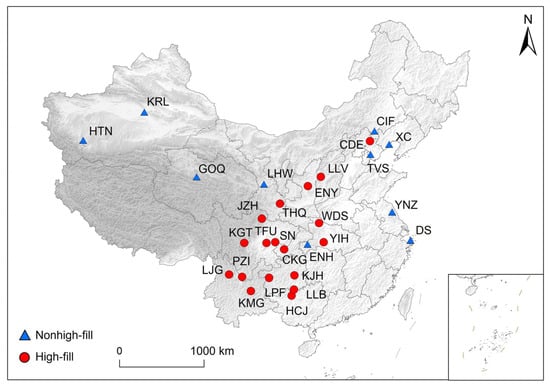
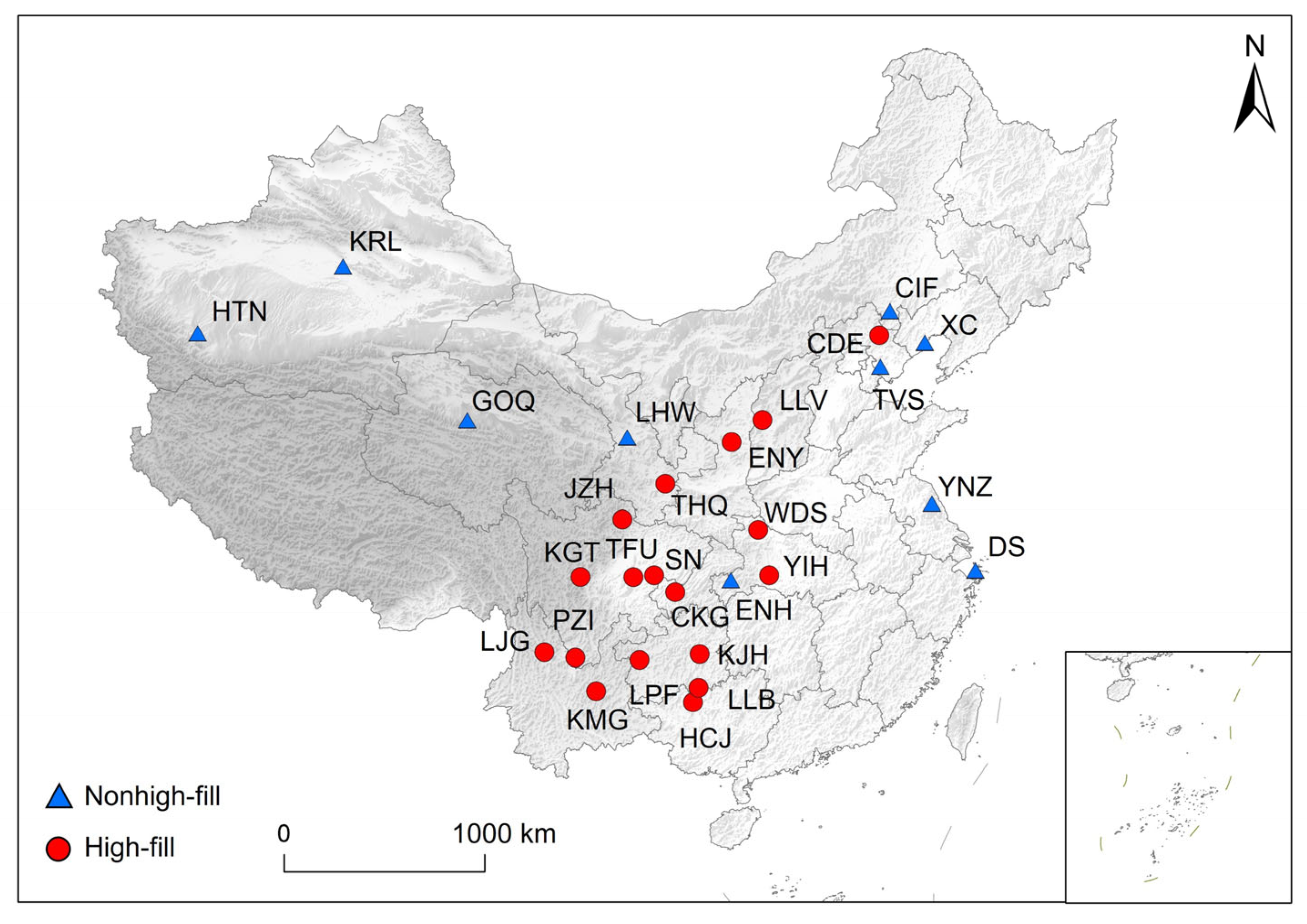
Through a comprehensive collection of national airport data [2] and a literature review [27], airports with high subsidence risks—predominantly high-fill airports—were screened and selected as research subjects. Specifically, according to the Technical Code for High-Fill Engineering of Civil Airports [28], airports with a maximum fill thickness exceeding 20 m were classified as high-fill airports in this study, whereas those located on flat terrain were categorized as non-high-fill. The selection criteria primarily focused on the complexity of the topography and engineering geological environment, incorporating available geological survey records and deformation characteristics reported in previous studies [20,26]. A total of 28 airports were selected for this study. Sentinel-1 data were utilized to retrieve their deformation evolution and analyze the influencing factors. Geographically, these airports are distributed as follows: 5 in North China, 6 in Northwest China, 11 in Southwest China, 3 in Central China, 2 in East China, and 1 each in Northeast and South China (Figure 1).
Figure 1.
Geographic distribution of the 28 monitored airports in China. Red circles indicate high-fill airports (), while blue triangles represent non-high-fill airports (). Labels correspond to airport IATA codes, with the exception of the Xingcheng and Daishan military airports (XC and DS), which use city abbreviations due to the absence of IATA designators.
2.2. Datasets
In this study, we utilized Single Look Complex (SLC) products acquired in Interferometric Wide (IW) swath mode from the Sentinel-1 satellite constellation. The dataset consists of C-band SAR images with VV polarization, covering both ascending and descending orbits to ensure optimal observation geometries for different airport orientations. All available images were collected based on the operational timelines (opening or reopening dates) of the respective airports, with a nominal temporal interval of 24 days (occasionally extending to 36 or 48 days due to data unavailability). Notably, for the Chifeng Airport area in Inner Mongolia, only descending orbit data were available, covering the period up to 2020. Precise Orbit Ephemerides (POD) were employed for orbit correction, and precise ground registration was performed during data import. The Shuttle Radar Topography Mission (SRTM) 1 arc-second Digital Elevation Model (DEM) with a spatial resolution of 30 m was selected for topographic phase removal.
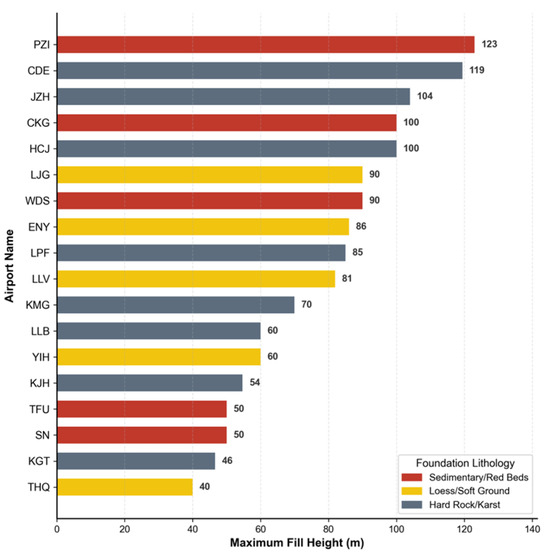
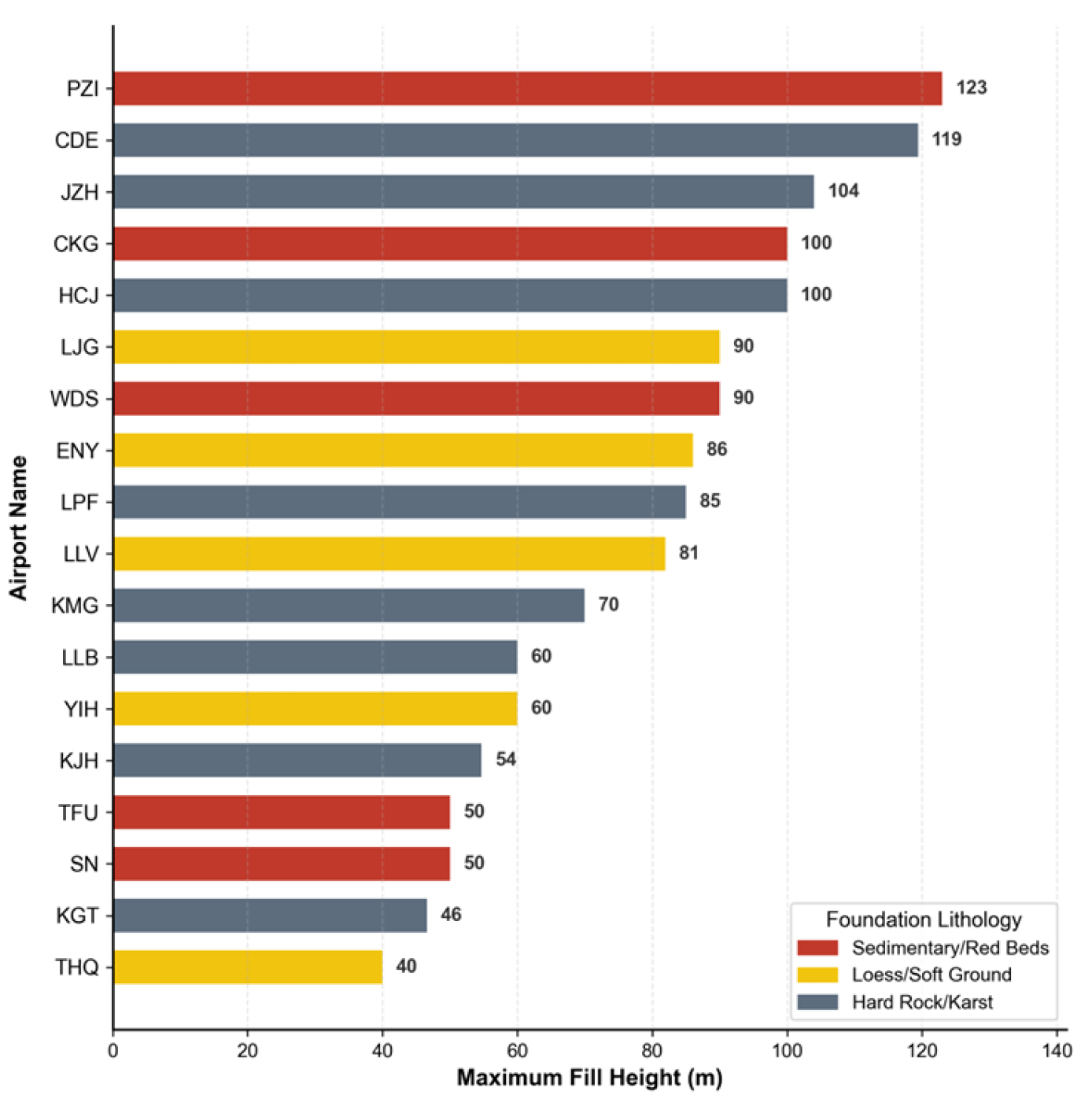
To further investigate the coupling mechanism between engineering loads and geological contexts, detailed construction parameters and geological background information for the 18 high-fill airports were collected from design documents and geotechnical survey reports [27]. As illustrated in Figure 2, the maximum fill heights of these airports exhibit a significant variation, ranging from 40 m (Tianshui Maijishan Airport) to a peak of 123 m (Panzhihua Baoanying Airport). Based on the dominant lithology and geological characteristics of the original foundation, these airports were classified into three categories: Sedimentary/Red Beds (represented by Panzhihua Airport and Chengde Airport), Loess/Soft Ground (e.g., Lvliang Airport and Yan’an Airport), and Hard Rock/Karst (e.g., Hechi Airport and Liupanshui Airport). These engineering and geological attributes provide the physical basis for interpreting the subsequent subsidence patterns.
Figure 2.
Engineering and geological characteristics of the 18 high-fill airports (defined as fill thickness > 20 m). The bar chart displays the maximum fill height for each airport, ranked from highest to lowest. Bar colors differentiate the foundation Lithology (Red: Sedimentary/Red Beds; Yellow: Loess/Soft Ground; Grey: Hard Rock/Karst).
3. Methods
3.1. SBAS-InSAR
The Small Baseline Subset InSAR (SBAS-InSAR) technique is a differential interferometry approach based on short baselines [18]. Its fundamental principle involves utilizing the deformation results derived from individual D-InSAR pairs as observations. Interferometric processing is performed by selecting SAR images characterized by short spatiotemporal baselines. Subsequently, the Singular Value Decomposition (SVD) method and the Least Squares (LS) solution are applied to jointly invert multiple small baseline subsets [29], thereby retrieving the time series of the deformation process. Assuming there are SAR images covering the study area, acquired at times , these images are freely combined and paired to generate interferometric pairs that satisfy the spatiotemporal baseline thresholds. The relationship between and is defined as:
Neglecting the effects of decorrelation and atmospheric delays, the differential interferometric phase at time relative to the reference time is denoted as . Consequently, the value of the pixel in the interferogram can be expressed as:
where and represent the differential interferometric phases at times and , respectively; denotes the radar wavelength; and and correspond to the cumulative deformation along the Line-of-Sight (LOS) direction at times and , respectively. Assuming that the deformation at the reference time is zero, i.e., , Equation (2) can be simplified as:
Differential interferometric processing is performed on a pixel-by-pixel basis. For pixels exhibiting coherence values exceeding 0.3 across all temporal SAR acquisitions, the phase vector is denoted as (the transpose of ), and the phase vector derived from the processed interferograms is denoted as . These are defined as:
The chronological indices corresponding to the master and slave images for the interferometric pairs are respectively defined as:
The master and slave images are chronologically ordered such that > , Consequently, the differential interferometric phase is expressed as:
which can be simplified into a matrix form:
where matrix represents an matrix. When the rank of matrix equals , the Least Squares (LS) method can be employed to solve Equation (7). However, in practical computation, the rank of matrix is typically less than (i.e., rank deficient), making a direct LS solution infeasible. Therefore, the Singular Value Decomposition (SVD) method is utilized to transform the problem into Equation (9):
where matrix is the generalized inverse matrix of with a rank of . The velocity vector v is calculated using the LS method, and the phase is subsequently retrieved based on Equation (8) [18].
3.2. Data Processing
In this study, the SBAS-InSAR processing was conducted using the SARscape module (sarmap SA, Caslano, Switzerland) within the ENVI 5.6 software environment (L3Harris Geospatial, Boulder, CO, USA). The workflow comprised five main steps: data cropping, connection graph generation, interferometric processing, deformation velocity inversion, and geocoding. The calculation process was identical for all airports.
- Data Cropping: The swath width of Sentinel-1A data is approximately 250 km, while the airport areas investigated in this study occupy only a small fraction of the scenes. Consequently, the original images required cropping. A master image was selected as the spatial reference to generate a vector file, which was then used to crop all images in the time series. Visual inspection was performed on the imported cropped images to ensure no geographic deviation occurred.
- Connection Graph Generation: Given the long temporal span of the analysis (predominantly 6 years or more), maximum temporal and spatial baseline thresholds were set to 120 days and approximately 200 m, respectively. Connection pairs with the shortest temporal baselines were retained to ensure coherence. For an input of scenes, the maximum number of paired combinations is defined as:
- Given the varying operational timelines of the airports (spanning 3 to 7 years), the number of SAR images () processed for each airport ranged from approximately 90 to 200. Consequently, based on the defined spatiotemporal thresholds, the number of interferometric pairs () generated for the SBAS network typically ranged from 300 to 800. This configuration ensured a highly redundant network with an average connectivity of 3–5 pairs per image, guaranteeing the robustness of the time-series inversion.
- Interferometric Processing: The generated pairs underwent interferometric processing. First, the SLC pairs were co-registered using an external DEM [30]. Differential interferometry was then performed to generate interferograms and coherence maps. Furthermore, the external DEM was utilized to remove the flat-earth and topographic phases. The Goldstein filter was applied to suppress phase noise, and phase unwrapping was conducted using the Minimum Cost Flow (MCF) method [31,32].
- Deformation Inversion: Ground Control Points (GCPs), selected from stable areas far from the deformation zones, were employed to perform orbital refinement and re-flattening, thereby removing residual phase ramps caused by orbital inaccuracies and atmospheric delays. The external DEM was re-imported to remove residual topographic phases. Subsequently, atmospheric phase components were estimated and removed using a combined filtering approach (time window: 365 days; spatial window: 1200 m). The deformation time series were then retrieved using the Least Squares (LS) method to obtain the cumulative deformation and mean velocity in the Line-of-Sight (LOS) direction [33].
- Geocoding: Since satellite SAR images are generated in the slant-range coordinate system, the results were geocoded into the geographic coordinate system (WGS-84). The actual vertical ground deformation was calculated as [34]:
- To ensure the reliability of the unwrapped phase and final deformation results, a strict coherence threshold of 0.7 was applied during the processing. Only pixels with a temporal coherence greater than 0.7 were retained for the subsequent time-series analysis and visualization.
3.3. Definition of Subsidence Risk Indicator and Thresholds
To quantitatively evaluate the potential safety hazards, we defined the risk indicator, as the average subsidence velocity of the pixels ranking in the top 1% of subsidence rates within the airport boundary. To ensure the robustness of this indicator and exclude the influence of phase noise or localized artifacts, a pre-statistical filtering process was implemented. Specifically, statistical outliers and isolated coherent pixels (pixels without a minimum of 5 neighbors within a 100-m radius) were removed. Consequently, represents the magnitude of the most significant spatially clustered subsidence funnels rather than random noise. The mathematical expression is:
where denotes the subset of pixels with subsidence rates falling into the top 1st percentile, and is the number of pixels in this subset.
We selected the 1% threshold based on a sensitivity analysis. By testing thresholds of 0.5%, 1%, and 2%, we found that while the absolute magnitude of varies, the relative risk ranking of the airports remains highly consistent (robustness). The 1% threshold was ultimately chosen as it effectively captures the “worst-case” deformation clusters consistent with engineering scales (e.g., runway segments) while mitigating single-pixel noise.
Furthermore, we established −5 mm/year as the critical threshold to identify airports with potential subsidence risk. This criterion is grounded in the measurement uncertainty of the SBAS-InSAR technique. Considering the typical vertical precision of InSAR in such environments is approximately ±2 to ±5 mm/year [35], vertical velocities with an absolute value greater than 5 mm/year are identified as statistically significant deformation, warranting engineering attention.
4. Results
4.1. General Deformation
4.1.1. Deformation Velocity Distribution
This study retrieved continuous deformation velocities for 28 major airports across China over a seven-year period using the SBAS-InSAR. The spatial distribution of subsidence varied among the airports; in some cases, subsidence was primarily concentrated in runway and taxiway zones, while in others, it occurred predominantly in slope areas. To accurately quantify potential structural hazards, the average velocity of the pixels representing the top 1% most severe subsidence rates within the airport boundary was calculated and denoted as . This index serves as a representative metric for the velocity of deformation in the most significantly subsiding zones within the airport.
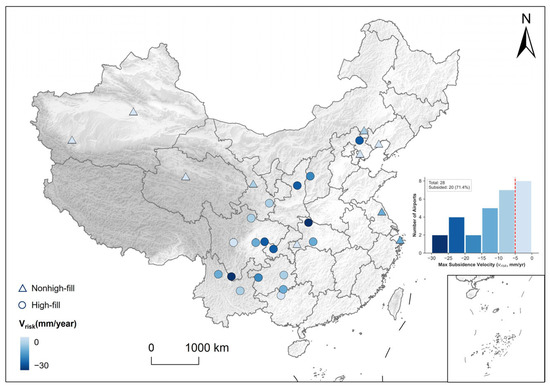
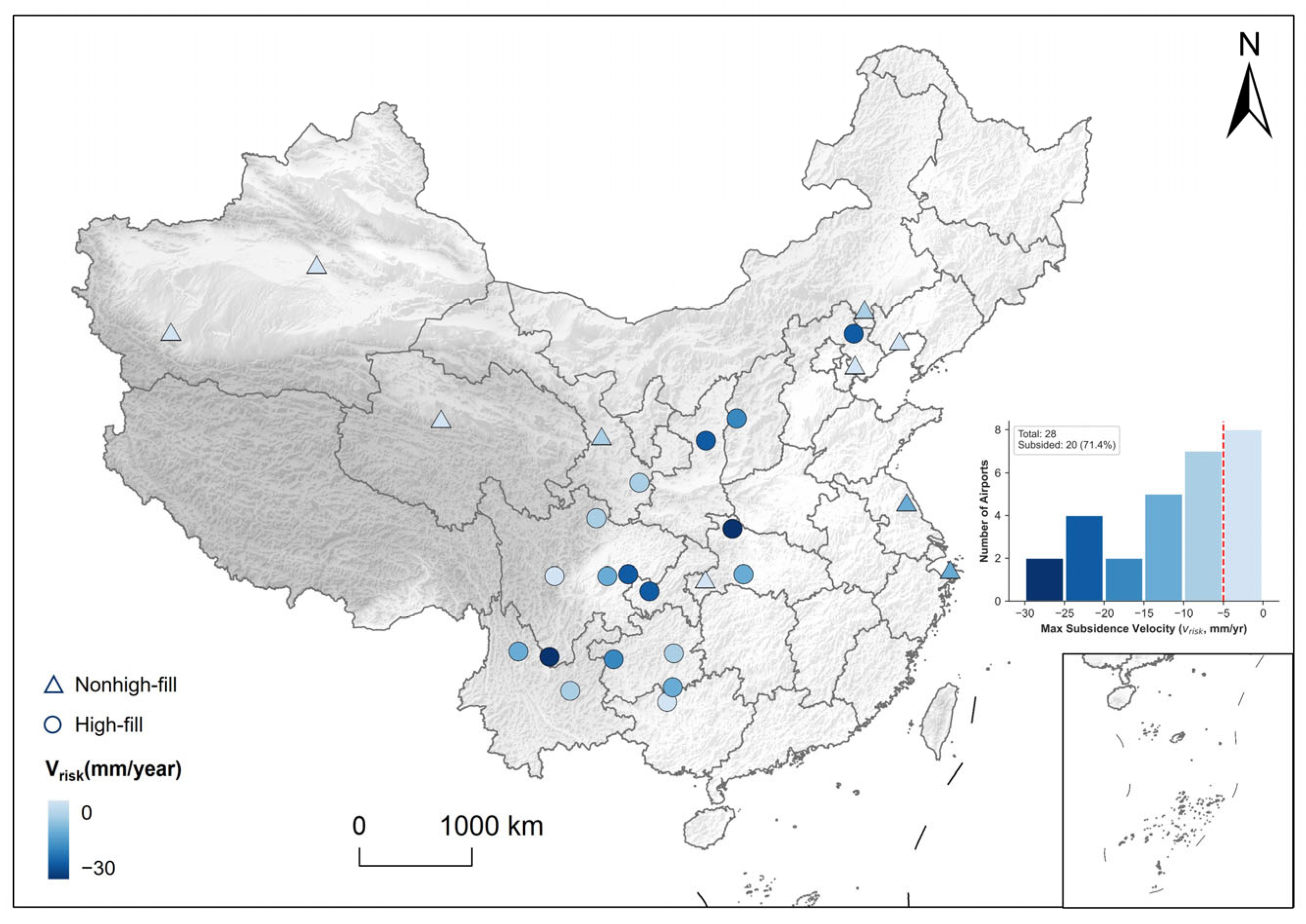
Statistical results revealed significant spatial heterogeneity across the airports (Figure 3). The values ranged from −30 mm/year to 0 mm/year. Shiyan Wudangshan Airport exhibited the highest subsidence velocity, with a reaching −29 mm/year. In contrast, Golmud Airport remained relatively stable, with a of only 1.3 mm/year. Geographically, airports exhibiting high values were primarily concentrated in the mountainous regions of Southwest and Northwest China, which are characterized by complex terrain. This distribution coincides highly with the locations of high-fill engineering projects. Conversely, airports in the eastern plain regions generally demonstrated lower . Considering the inherent error margin of InSAR measurements, airports with a lower than −5 mm/year were classified as airports with subsidence risks. A total of 20 airports were identified as having subsidence risks, accounting for 71.4% of the studied sites.
Figure 3.
Spatial distribution of the Risk-zone Subsidence Velocity () for the 28 monitored airports in China. The map symbols differentiate construction modes: circles denote high-fill airports and triangles denote non-high-fill airports. The color gradient represents the magnitude of , which is defined as the average velocity of the pixels representing the lowest 1% of vertical velocity values (i.e., maximum subsidence) within each airport area.
For the majority of airports, unstable zones constituted a negligible proportion of the total airport area (typically <1%). This finding suggests that post-construction settlement in Chinese airports does not manifest as large-scale uniform subsidence. Instead, it primarily presents as differential settlement concentrated in critical zones, such as high-fill embankments, cut-and-fill transition zones, or soft ground weak zones.
4.1.2. Temporal and Spatial Characteristics of Airport Deformation
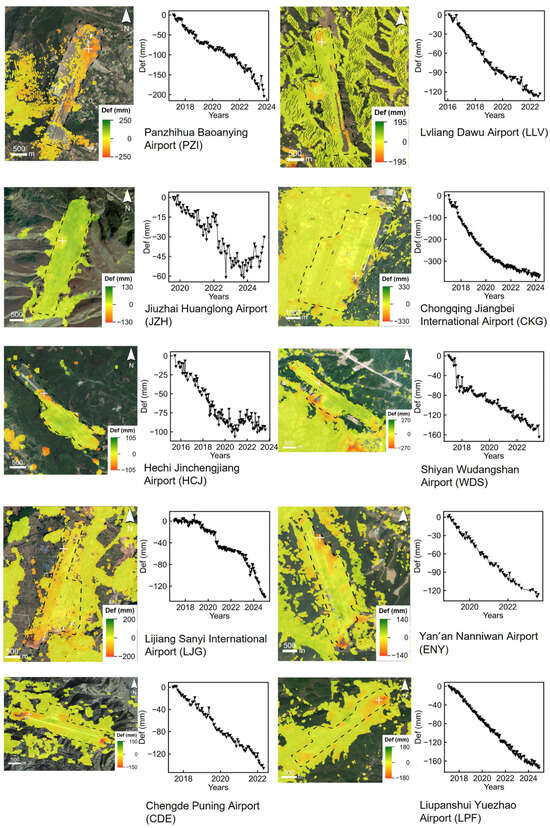
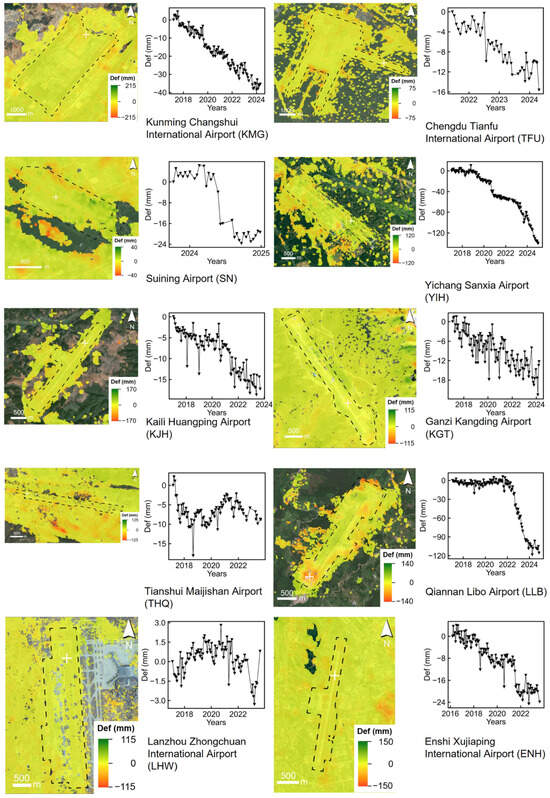
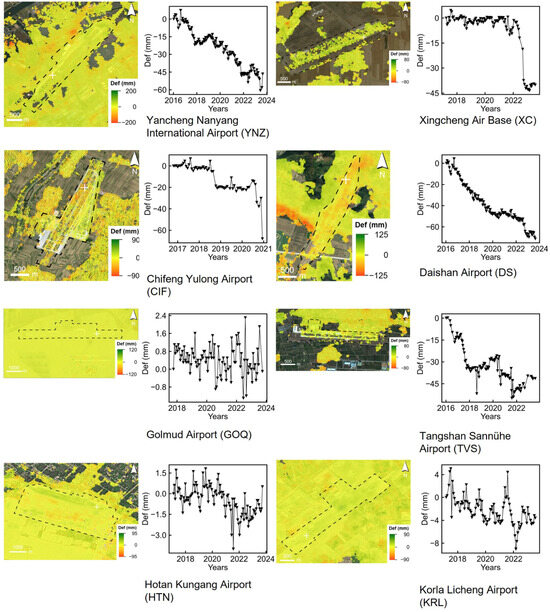
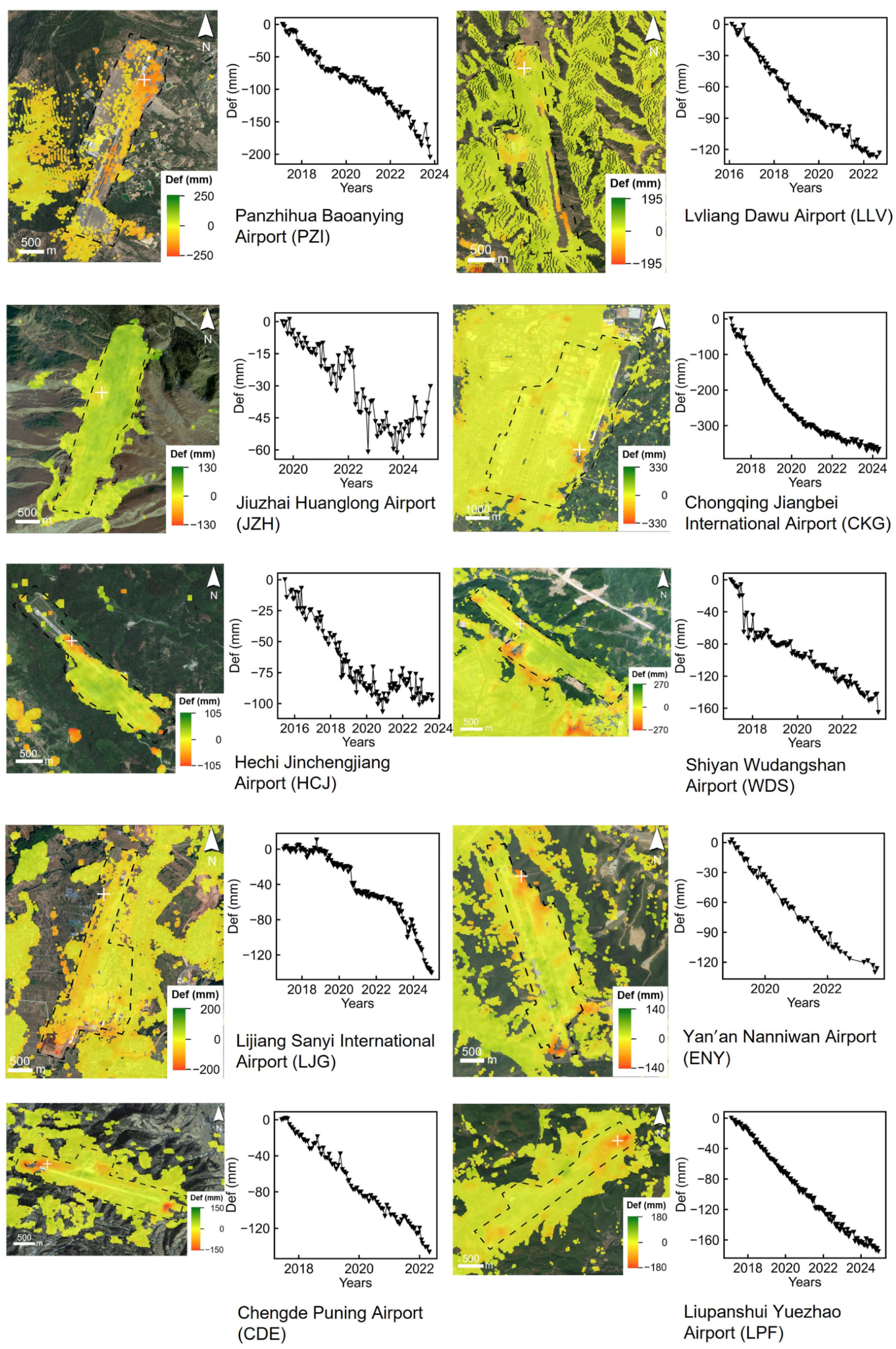
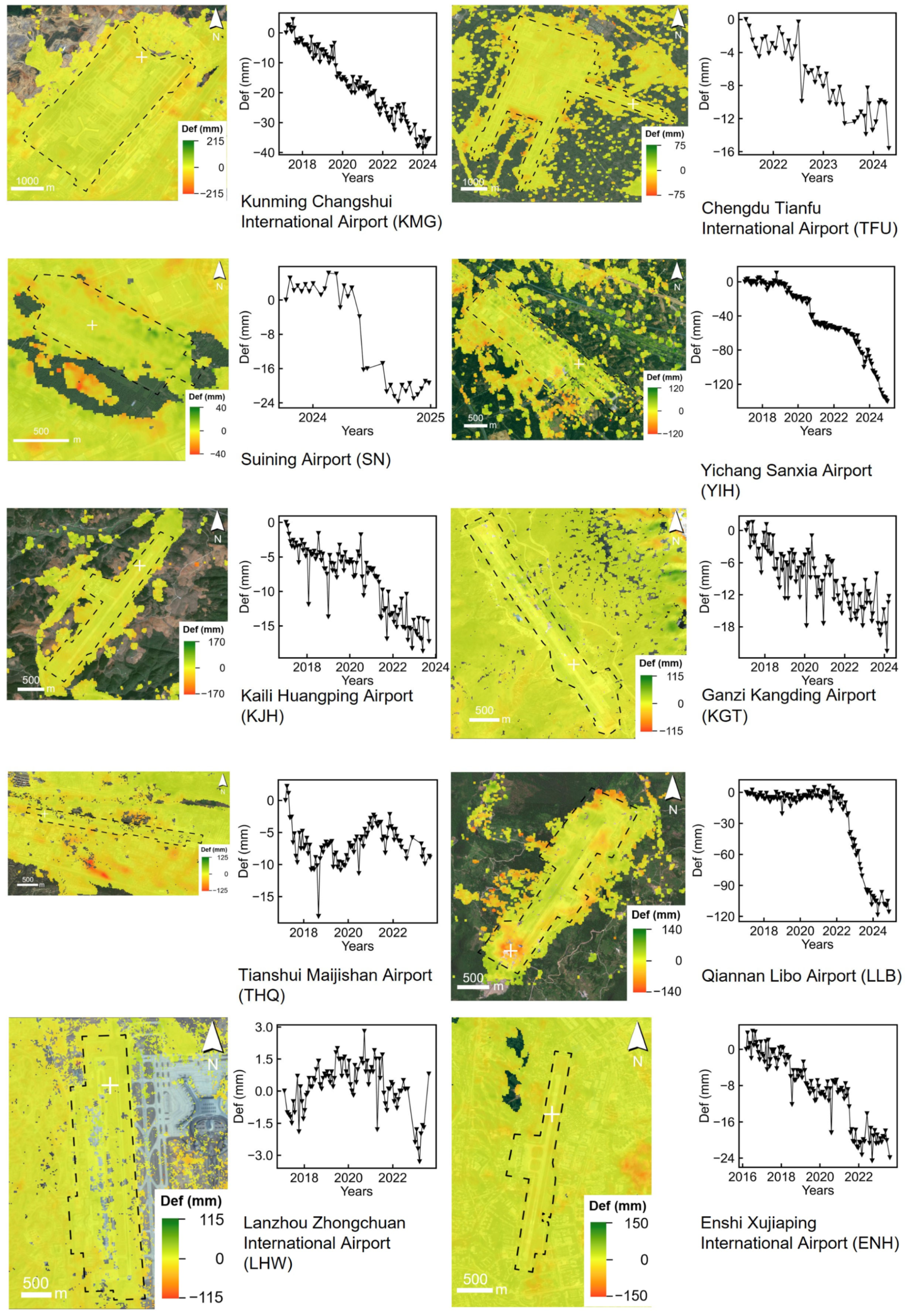
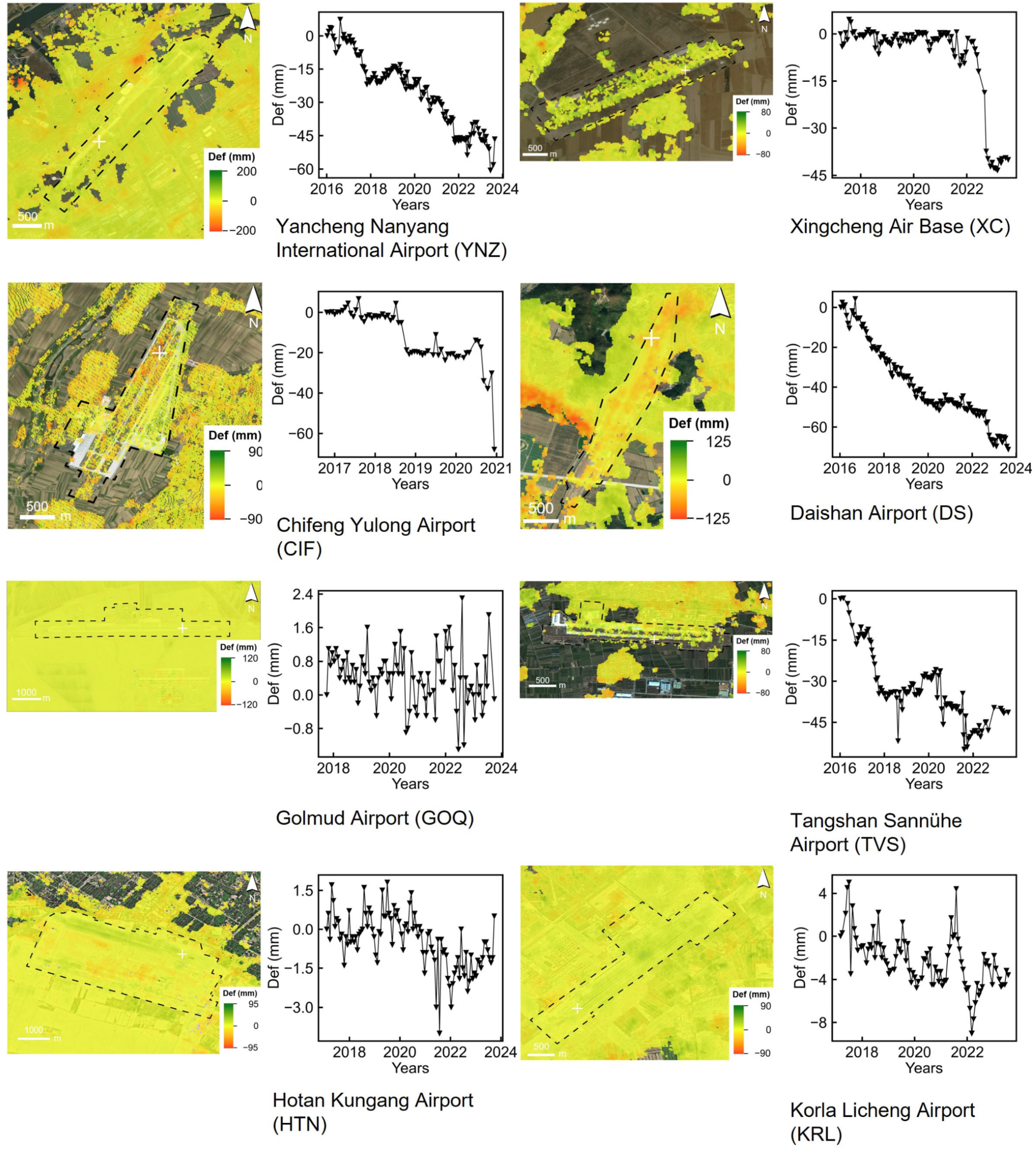
To comprehensively reveal the deformation evolution patterns under distinct construction modes and geological settings, the cumulative deformation (Def) values for all 28 monitored airports were extracted. Furthermore, time-series evolution curves were generated for characteristic points located within the typical deformation zones of each airport (Figure 4).
Figure 4.
Comprehensive spatiotemporal deformation characteristics of the 28 monitored airports. The figure is organized into panels for each airport, displaying: (Left) The cumulative vertical deformation map derived from SBAS-InSAR. The deformation maps are displayed using individual symmetric color scales centered on zero. Red represents subsidence, green tones indicate uplift, and yellow represents the stable reference (0 mm). Black dashed lines delineate the airport runway and flight zone boundaries. A white cross (+) marks the specific location of the pixel with the maximum cumulative subsidence. The background optical imagery is sourced from ESRI World Imagery. (Right) The displacement time-series plot corresponding to the location marked by the white cross, illustrating the temporal evolution of ground settlement throughout the monitoring period (2017–2024).
In terms of spatial distribution, significant disparities were observed between high-fill and non-high-fill airports. Among the 18 high-fill airports, the majority exhibited distinct regional subsidence funnels, with the spatial distribution of subsidence highly correlated with the fill areas. Moreover, pronounced slope subsidence was prevalent in most of these airports, with subsidence centers often extending into the runway zones, thereby posing potential safety hazards. In contrast, the 10 non-high-fill airports exhibited better overall stability, with cumulative deformation maps predominantly rendered in yellow or green hues indicative of stability. However, individual airports located in coastal regions (e.g., Zhejiang Daishan Airport) still exhibited localized subsidence. Although this airport has been established for a considerable period, the observed deformation is primarily attributed to the long-term secondary consolidation (creep) of the underlying deep marine clay layers, rather than the primary consolidation typically seen in newly constructed high-fill projects. Additionally, surrounding groundwater extraction may further contribute to the localized subsidence.
The time-series evolution patterns reflected distinct deformation characteristics resulting from different engineering and design approaches. Characteristic points in most high-fill airports exhibited a sustained linear or quasi-linear subsidence trend. This indicates that even years or decades post-construction, the deep fill bodies remain in the stages of secondary consolidation and rheology, having not yet reached a final stable state. In certain airports with longer service lives or zones that underwent rigorous foundation treatment, the subsidence rate presented a convergent trend (deceleration) over time. Conversely, in the stable zones of non-high-fill airports, the time-series curves mainly displayed seasonal fluctuations around zero. This reflects the influence of environmental factors such as atmospheric delays or thermal expansion and contraction, rather than long-term land subsidence. Notably, rapid settlement accelerations were observed at Libo Airport (LLB) and Xingcheng Air Base around the summer of 2022. These deformation anomalies temporally coincide with regional extreme precipitation events: specifically, the acceleration at LLB aligns with the historic ‘Dragon Boat Water’ rainfall that affected Guizhou in May–June 2022 [36], while the sudden settlement drop at Xingcheng corresponds to the severe torrential rains in Liaoning in July 2022 [37]. This synchronization suggests a rapid hydro-mechanical response of the fill foundations to intense water infiltration, likely triggering the slaking and softening of the fill materials.
Comparing all results, Chongqing Jiangbei International Airport exhibited the maximum cumulative subsidence, exceeding 400 mm, whereas the cumulative deformation of most non-high-fill airports was controlled within 60 mm. This stark disparity clearly delineates the deformation baselines of the two airport categories, further corroborating the significant impact of high-fill engineering in altering the stress state of the geological environment.
4.2. Statistical Disparities Between High-Fill and Non-High-Fill Airports
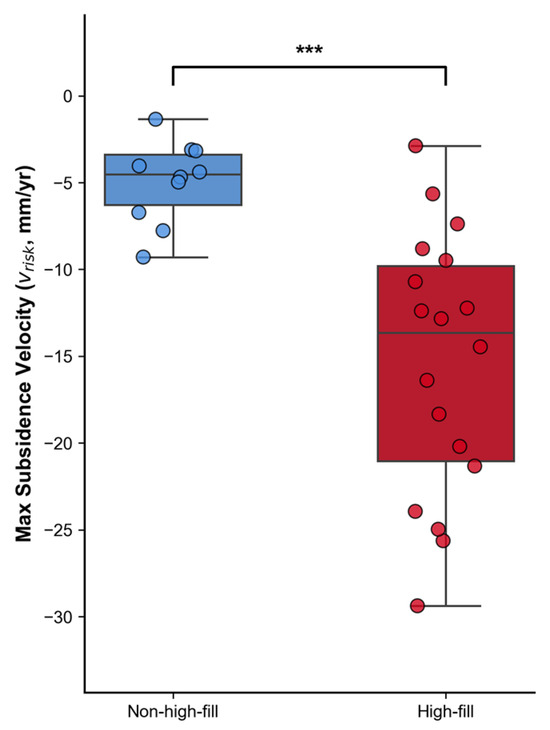
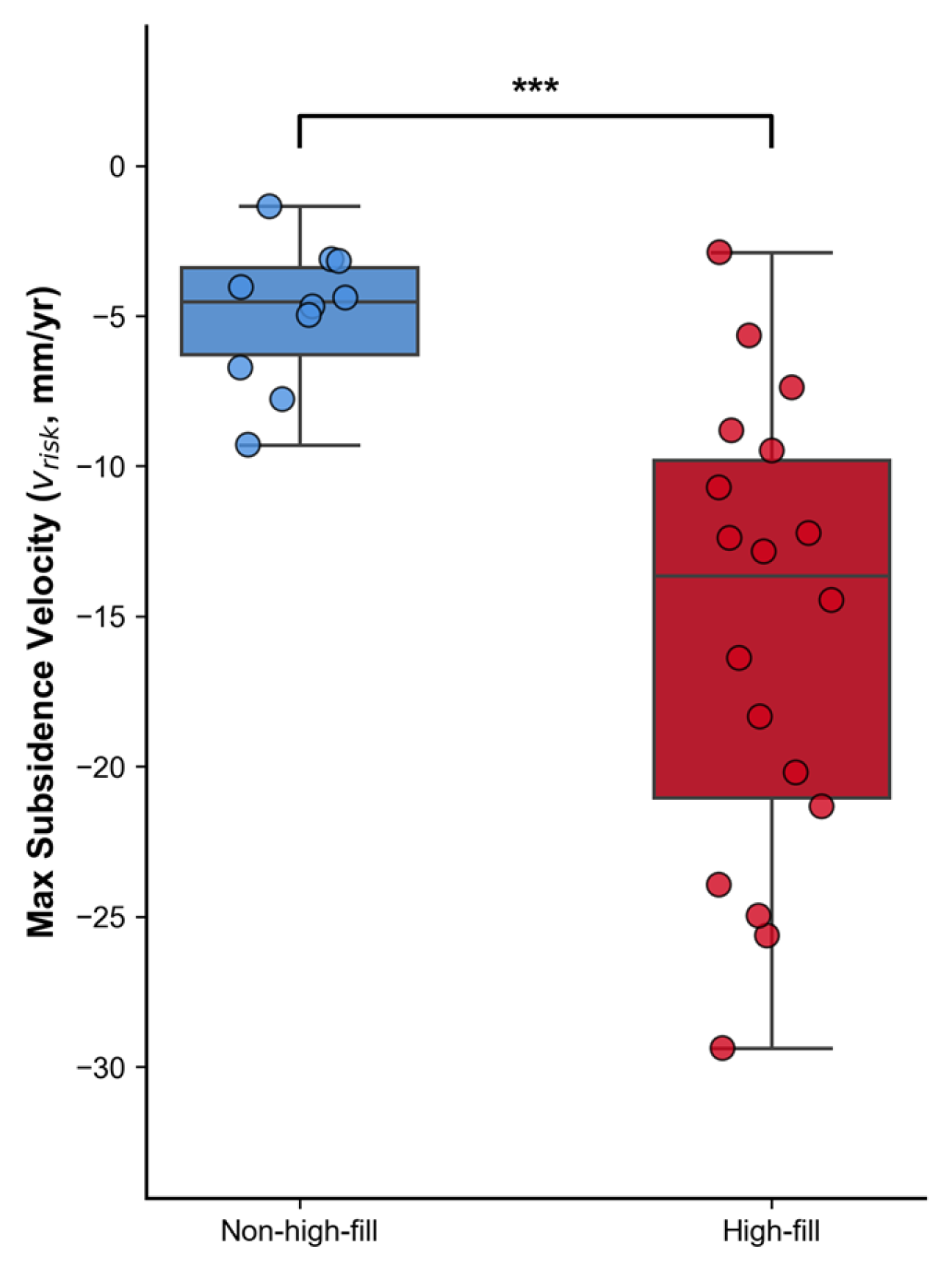
To assess the impact of construction methods on foundation stability, the 28 airports were classified into a high-fill group (, defined as fill thickness > 20 m) and a non-high-fill group (). Statistical comparison revealed a distinct divergence in deformation characteristics between these two categories (Figure 5).
Figure 5.
Statistical comparison of the Risk-zone Subsidence Velocity between non-high-fill () and high-fill () airports. The boxplots display the median (central line), interquartile range (box limits), and full data range (whiskers), with individual airport samples overlaid as jittered circles. The bracket with triple asterisks indicates a highly significant statistical difference between the two groups (, Mann-Whitney U test).
High-fill airports exhibited significantly greater subsidence magnitudes compared to non-high-fill airports. As shown in Figure 2, the median for the non-high-fill group was relatively mild (approximately −5 mm/year), whereas the median for the high-fill group was significantly lower (approximately −14 mm/year). The Mann–Whitney U test confirmed the high statistical significance of this difference (). As shown in the boxplots, the high-fill group exhibited not only a higher median subsidence rate but also a wider interquartile range (IQR) compared to the non-high-fill group. While the non-high-fill group showed a relatively clustered data distribution, distinct outliers were still observed in the lower whiskers.
5. Discussion
5.1. High-Precision Deformation Monitoring of Airports Using SBAS-InSAR
The SBAS-InSAR technique has proven effective for monitoring ground deformation. The 28 airports selected in this study encompass diverse geographical settings, including mountainous regions, plains, plateaus, depressions, and islands. The computational results achieved comprehensive coverage for the majority of these airports. However, in mountainous areas, data gaps occurred in limited sections due to loss of coherence (decorrelation). The results, measured at the millimeter scale, realized high-precision deformation monitoring across different airport zones, allowing for the visual distinction between subsidence and uplift areas to facilitate the analysis of influencing factors. With an average monitoring duration of 6 years, this method enables long-term time-series deformation analysis while significantly reducing monitoring costs compared to traditional surveying methods.
The accuracy of SBAS-InSAR results can be validated through comparison with leveling benchmarks. Previous studies have verified the reliability of SBAS-InSAR for airport deformation monitoring by comparing the retrieved deformation values at Yan’an Nanniwan Airport with ground leveling data [38], and the subsidence of the airports in this study can be assumed be highly reliable.
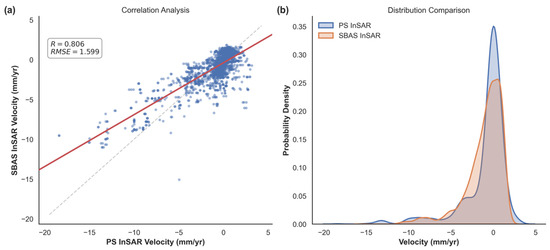
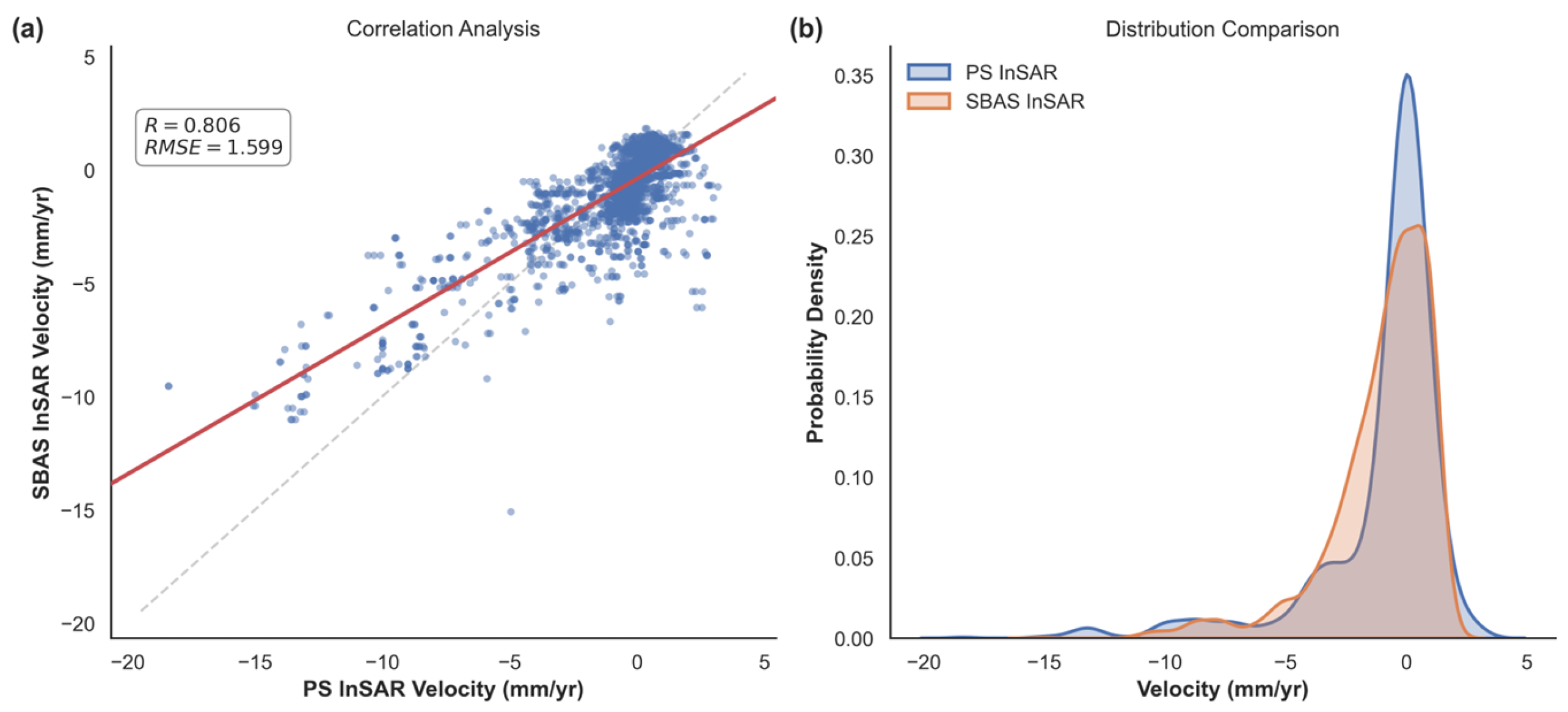
To further substantiate this reliability quantitatively, we conducted an internal cross-validation using independent Persistent Scatterer InSAR (PS-InSAR) on a representative airport (LLV). As illustrated in Figure 6, the deformation velocities derived from both methods exhibit a high degree of consistency. After correcting for the systematic reference frame error (mean bias), the analysis yields a Pearson correlation coefficient () of 0.81 and a Root Mean Square Error (RMSE) of only 1.60 mm/year. Additionally, the probability density distributions of the two datasets show remarkable alignment. This confirms that the random error of our monitoring results is strictly controlled within the millimeter range.
Figure 6.
Cross-validation of deformation velocities derived from SBAS-InSAR and PS-InSAR at LLV. (a) Scatter plot showing the correlation between the two methods. Note that the systematic reference frame offset has been removed to align the datasets, resulting in a calibrated RMSE of 1.60 mm/year and a correlation coefficient () of 0.81. The red line represents the linear regression fit. (b) Comparison of the probability density distributions, highlighting the statistical consistency of the deformation patterns detected by both algorithms.
5.2. Impact of Different Geological Conditions on Airport Deformation
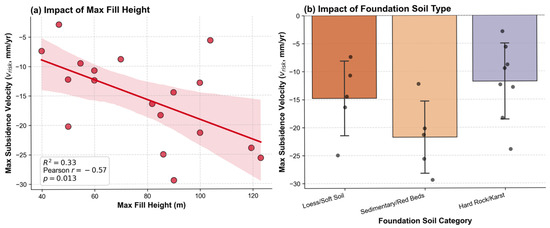
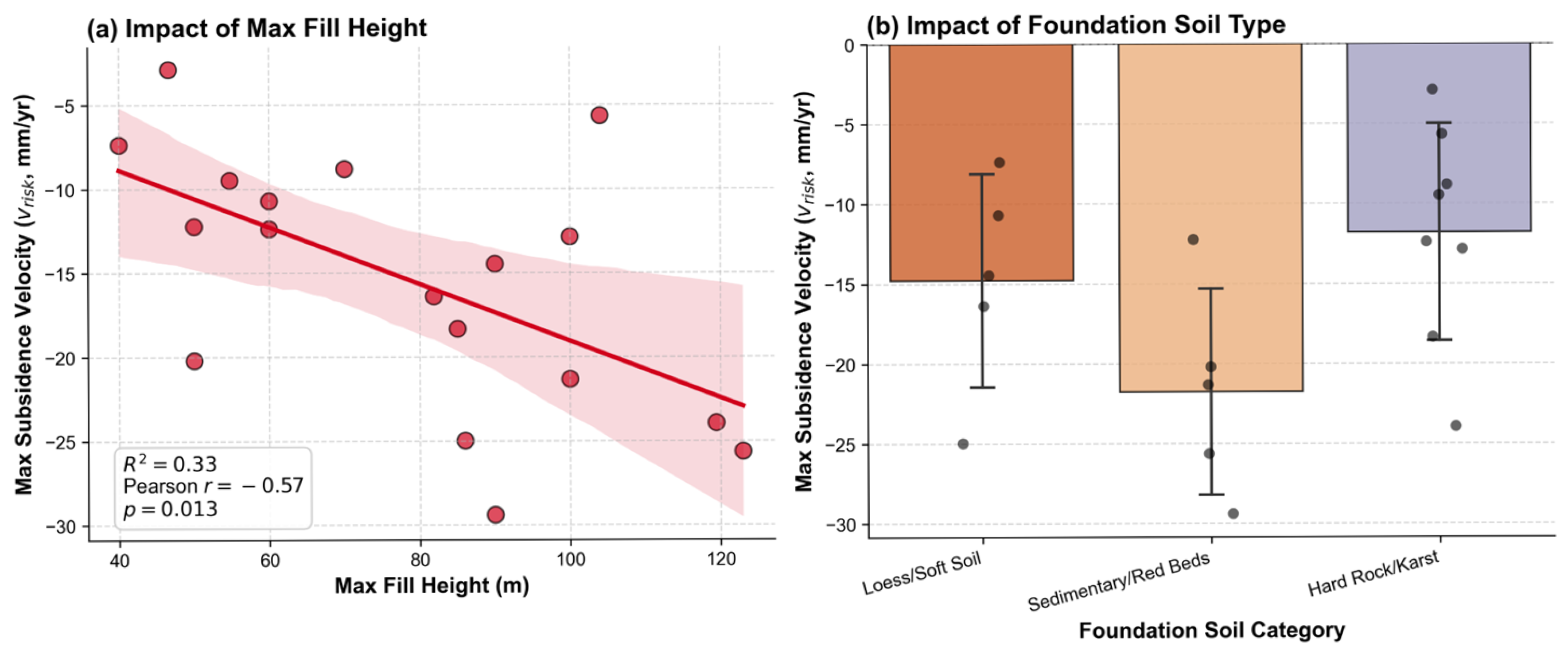
Beyond engineering design parameters, the geological environment acts as a critical determinant of surface deformation. To quantify this impact, geological conditions were categorized into three broad classes. By correlating the maximum subsidence velocity in risk zones () with maximum fill height and foundation lithology (Figure 7), we found that the control of geological conditions on airport stability exhibits significant non-linear characteristics.
Figure 7.
Coupling analysis of engineering load and geological context on airport stability. (a) Linear regression analysis between the maximum fill height and the risk-zone subsidence velocity (). The solid red line represents the linear fit (Pearson ), and the light red shaded band indicates the 95% confidence interval. The relationship is statistically significant (), confirming that higher fill loads drive greater subsidence rates. (b) Statistical comparison of categorized by foundation lithology. The bars represent the mean subsidence velocity for each geological group, while the error bars denote the standard deviation, highlighting the intra-group dispersion. Individual airport data points are overlaid as jittered dots. Note that the “Sedimentary/Red Beds” group exhibits the most severe average subsidence, whereas the “Hard Rock/Karst” group shows the highest variability.
Regression analysis (Figure 7a) statistically confirms the driving role of fill height on subsidence (). As the thickness of the fill body increases, the substantial overburden load induces intensified secondary consolidation and creep in the deep fill layers. However, the value of 0.33 implies that only 33% of the deformation variance is explained by fill height alone; the remaining variance is largely governed by the geological properties of the foundation.
Figure 7b reveals a phenomenon with distinct regional characteristics: the “Sedimentary/Red Beds” group exhibits the most pronounced average subsidence (mean ≈ −22 mm/year), surpassing even the “Loess/Soft Ground” group. This behavior is closely linked to the engineering properties of the Mesozoic red bed mudstones widely distributed in Southwest China. Although red bed soft rocks possess relatively high strength in their natural state, they are rich in hydrophilic clay minerals (e.g., montmorillonite and illite) and exhibit high water sensitivity [39]. High-fill engineering alters the original groundwater seepage field; once infiltrated, the red bed materials are prone to slaking and softening, leading to a sharp decay in shear strength [28]. The data indicate that this “water-rock interaction” amplifies the impact of engineering loads, constituting a significant risk source for high-fill airports.
In contrast, the “Hard Rock/Karst” group demonstrates substantial intra-group heterogeneity (e.g., Hechi and Liupanshui). While this group shows the lowest average subsidence velocity, reflecting the high bearing capacity of intact bedrock, it also includes extreme cases with subsidence rates exceeding −25 mm/year. This polarization highlights the concealment and stochastic nature of Karst geology. The localized anomalous subsidence captured by InSAR likely corresponds to the collapse of overburden layers above concealed Karst caves or the suffosion of fill materials into rock fissures. These findings suggest that in Karst regions, relying solely on the concept of a “bedrock foundation” is insufficient; the integrity of the foundation is often more critical than its stiffness. In summary, the geological environment does not merely passively bear loads but modulates engineering subsidence through non-linear mechanisms such as “red bed softening” or “Karst suffosion”.
5.3. Limitations of Design and Construction in Eliminating Airport Deformation
In China, stringent engineering standards have been established for airport construction to control ground deformation. According to the Technical Code for High-Fill Engineering of Civil Airports, the minimum degree of compaction for high-fill bodies is mandatorily required to be no less than 90%, and the use of qualified fill materials is verified through quality inspections. Stringent process controls and quality inspections are implemented during construction, particularly for critical areas such as flight zones and slopes. Specifically, the allowable elevation deviation for pavement is strictly restricted to the range of +10 mm (uplift) to −20 mm (subsidence), and flatness deviation must not exceed 20 mm [40]. Furthermore, according to the Technical Standards for Flight of Civil Airports, when measuring new runways with a 3-m straightedge, the maximum gap between the straightedge bottom and the pavement surface must not exceed 5 mm.
The statistical evidence presented in Section 4.1 indicates that the high-fill construction method inherently introduces a higher risk of instability. Even with the implementation of modern compaction techniques, the immense overburden stress generated by deep embankments may still drive long-term secondary consolidation and creep, resulting in settlement rates that are consistently higher than those of airports constructed on natural foundations. Furthermore, the high intra-group heterogeneity observed in the high-fill group suggests that while these projects are generally more prone to subsidence, their stability is highly sensitive to other variables—such as specific fill heights or underlying geological conditions. In contrast, for the non-high-fill group, the presence of outliers implies that even in the absence of surcharge loads, specific localized factors (most likely soft marine clay foundations) can still induce significant deformation.
Consequently, the cumulative subsidence of certain high-fill airports has significantly exceeded design expectations. For instance, Panzhihua Baoanying Airport exhibited cumulative subsidence exceeding 150 mm in the flight zone, while Hechi Jinchengjiang Airport also exceeded 100 mm. Extreme geological instability forced Panzhihua Airport to suspend operations for remediation due to landslide risks, and Hechi Airport faced similar governance challenges. Moreover, Lvliang Dawu Airport and Kaili Huangping Airport exhibited distinct differential settlement in slopes and fill areas, necessitating long-term engineering governance engineering measures. Under the combined effects of complex geology and ultra-high fills, even fully compliant engineering construction makes it difficult to completely curb the evolution of geohazards. Although the overall deformation of non-high-fill airports is smaller than that of high-fill airports, Chifeng Yulong Airport and Zhoushan Daishan Airport both exhibited cumulative subsidence exceeding 50 mm, primarily attributed to the consolidation characteristics of coastal soft deposits or specific foundations. The unique physicochemical properties of the foundation ground can similarly compromise the overall flatness of the pavement. This demonstrates that even in the absence of high-fill loads, adverse geological conditions alone are sufficient to induce non-negligible engineering deformation.
In summary, whether for high-fill airports situated in complex terrain or plain airports located in special geological zones, post-construction deformation is a pervasive physical phenomenon. This indicates that while current engineering techniques can mitigate deformation, they cannot completely eliminate the issue. Therefore, critical attention must be paid to geological and foundation conditions during the site selection phase to identify the optimal location for airport construction. Future site selection should prioritize identifying and actively avoiding geohazard-prone areas such as red beds, deep soft ground, or regions with strong Karst development.
6. Conclusions
In this study, the SBAS-InSAR technique was employed to conduct long-term time-series deformation monitoring of 28 airports, spanning an average period of 6 years. The annual average deformation velocities, cumulative displacements, and time-series plots were retrieved. By classifying the airports based on construction types and foundation lithology, the influencing factors of airport deformation were analyzed and discussed. The main conclusions are as follows:
- SBAS-InSAR proved capable of performing high-precision deformation monitoring for airports situated in diverse geographical settings. The results achieved comprehensive coverage of the airport areas with millimeter-scale accuracy. The derived cumulative subsidence maps and deformation velocity maps enabled a direct and visual analysis of the deformation characteristics. After verification through PS-InSAR, the RMSE reached 1.59 mm/y after eliminating systematic errors, further validating the accuracy of the calculation results.
- The subsidence velocity in risk zones () of high-fill airports was significantly higher than that of non-high-fill airports, and a positive correlation was observed between fill height and subsidence rate. The geological basement exhibited a non-linear control effect on deformation. In particular, red bed soft rocks, widely distributed in Southwest China, exhibited a more severe subsidence tendency than conventional soft ground due to their characteristics of slaking and softening upon water contact. Meanwhile, Karst geology caused extreme deformation dispersion due to its structural heterogeneity.
- Current engineering approaches measures cannot completely eliminate airport deformation; differential settlement is prevalent in high-fill projects. Therefore, during the planning phase, priority must be given to select sites with favorable geological and geographical conditions in strict accordance with regulatory requirements. During the operation and maintenance phase, an early warning mechanism should be established to ensure the long-term safety of the infrastructure.
Author Contributions
Conceptualization, M.L. and Q.W.; methodology, M.L.; software, M.L.; validation, M.L., L.G. and N.T.; formal analysis, M.L.; investigation, M.L.; resources, J.W.; data curation, M.L.; writing—original draft preparation, M.L.; writing—review and editing, J.W., Q.W. and K.W.; visualization, M.L.; supervision, J.W. and K.W.; project administration, J.W.; funding acquisition, J.W. All authors have read and agreed to the published version of the manuscript.
Funding
This research received no external funding.
Data Availability Statement
Publicly available datasets were analyzed in this study. The Sentinel-1A SAR data can be accessed via the Alaska Satellite Facility (ASF) at https://search.asf.alaska.edu (accessed on 10 December 2025). The Precision Orbit Ephemerides (POD) data are available at http://step.esa.int/auxdata/orbits/Sentinel-1/ (accessed on 10 December 2025). The SRTM DEM data (30 m) can be downloaded from https://earthexplorer.usgs.gov/ (accessed on 10 December 2025). The derived deformation data presented in this study are available on request from the corresponding author.
Acknowledgments
The authors would like to thank the European Space Agency (ESA) for providing the Sentinel-1 SAR data and Precision Orbit Ephemerides data free of charge. We also acknowledge the United States Geological Survey (USGS) for providing the SRTM DEM data. We are grateful to the anonymous reviewers for their constructive comments and suggestions that improved the quality of this manuscript.
Conflicts of Interest
The authors declare no conflicts of interest.
References
- Lenaerts, B.; Allroggen, F.; Malina, R. The Economic Impact of Aviation: A Review on the Role of Market Access. J. Air Transp. Manag. 2021, 91, 102000. [Google Scholar] [CrossRef] [Scilit]
- Ministry of Transport of the People’s Republic of China. Statistical Communiqué on the Development of the Civil Aviation Industry in 2023. Available online: https://www.mot.gov.cn/tongjishuju/minhang/ (accessed on 17 December 2025).
- Cong, Y. Research on Airport Runway Deformation Monitoring and Early Warning. Ph.D. Thesis, Beihang University, Beijing, China, 2020. (In Chinese) [Google Scholar]
- Ding, D.L.; Cai, L.C.; Wang, X.L. Application of Comprehensive Evaluation of the Airport Site Selection. Appl. Mech. Mater. 2011, 97–98, 311–315. [Google Scholar] [CrossRef] [Scilit]
- Benoit, L.; Briole, P.; Martin, O.; Thom, C.; Malet, J.P.; Ulrich, P. Monitoring Landslide Displacements with the Geocube Wireless Network of Low-Cost GPS. Eng. Geol. 2015, 195, 111–121. [Google Scholar] [CrossRef] [Scilit]
- Stiros, S.C. Landslide Monitoring Based on Geodetically Derived Distance Changes. J. Surv. Eng. 2004, 130, 156–162. [Google Scholar] [CrossRef] [Scilit]
- Simons, M.; Rosen, P.A. Interferometric Synthetic Aperture Radar Geodesy. Treatise Geophys. 2007, 3, 339–385. [Google Scholar]
- Wang, R.; Yang, M.S.; Yang, T.L.; Lin, J.X.; Liao, M.S. Decomposing and Mapping Different Scales of Land Subsidence Over Shanghai with X- and C-Band SAR Data Stacks. Int. J. Digit. Earth 2022, 15, 478–502. [Google Scholar] [CrossRef] [Scilit]
- Rosi, A.; Tofani, V.; Tanteri, L.; Stefanelli, C.T.; Agostini, A.; Catani, F.; Casagli, N. The New Landslide Inventory of Tuscany (Italy) Updated with PS-InSAR: Geomorphological Features and Landslide Distribution. Landslides 2018, 15, 5–19. [Google Scholar] [CrossRef] [Scilit]
- Luckman, A.; Padman, L.; Jansen, D. Persistent Iceberg Groundings in the Western Weddell Sea, Antarctica. Remote Sens. Environ. 2010, 114, 385–391. [Google Scholar] [CrossRef] [Scilit]
- Chu, H.; Bo, S.; Houjun, J. A Combined Multi-Polarimetric InSAR Phase Unwrapping Algorithm Based on Conditional Random Fields. Acta Geod. Cartogr. Sin. 2013, 42, 838–845. [Google Scholar]
- Zhang, Y.; Wang, P.; Luo, X. Monitoring Land Subsidence in Xi’an Using Sentinel-1 Data and SBAS-InSAR Technology. Bull. Surv. Mapp. 2017, 4, 93–97. (In Chinese) [Google Scholar]
- Ruya, X.; Xiufeng, H. Deformation Monitoring of Reservoirs and Dams Using Time Series InSAR. Geomat. Inf. Sci. Wuhan Univ. 2019, 44, 1334–1341. [Google Scholar]
- Zebker, H.A.; Goldstein, R.M. Topographic Mapping from Interferometric Synthetic Aperture Radar Observations. J. Geophys. Res. Solid Earth 1986, 91, 4993–4999. [Google Scholar] [CrossRef] [Scilit]
- Hanssen, R.F. Radar Interferometry: Data Interpretation and Error Analysis; Kluwer Academic Publishers: Dordrecht, The Netherlands, 2001. [Google Scholar]
- Li, S.; Xu, W.; Li, Z. Review of the SBAS InSAR Time-series algorithms, applications, and challenges. Geod. Geodyn. 2022, 13, 114–126. [Google Scholar] [CrossRef] [Scilit]
- Ferretti, A.; Prati, C.; Rocca, F. Nonlinear Subsidence Rate Estimation Using Permanent Scatterers in Differential SAR Interferometry. IEEE Trans. Geosci. Remote Sens. 2000, 38, 2202–2212. [Google Scholar] [CrossRef] [Scilit]
- Berardino, P.; Fornaro, G.; Lanari, R.; Sansosti, E. A New Algorithm for Surface Deformation Monitoring Based on Small Baseline Differential SAR Interferograms. IEEE Trans. Geosci. Remote Sens. 2002, 40, 2375–2383. [Google Scholar] [CrossRef] [Scilit]
- An, B.; Jiang, Y.; Wang, C.; Shen, P.; Song, T.; Hu, C.; Liu, K. Ground Infrastructure Monitoring in Coastal Areas Using Time-Series InSAR Technology: The Case Study of Pudong International Airport, Shanghai. Int. J. Digit. Earth 2023, 16, 355–374. [Google Scholar] [CrossRef] [Scilit]
- Douglas, I.; Lawson, N. Airport Construction: Materials Use and Geomorphic Change. J. Air Transp. Manag. 2003, 9, 177–185. [Google Scholar] [CrossRef] [Scilit]
- Jiang, Y.; Liao, M.; Wang, H.; Zhang, L.; Balz, T. Deformation Monitoring and Analysis of the Geological Environment of Pudong International Airport with Persistent Scatterer SAR Interferometry. Remote Sens. 2016, 8, 1021. [Google Scholar] [CrossRef] [Scilit]
- Gao, M.; Gong, H.; Chen, B. InSAR Time-Series Investigation of Long-Term Ground Displacement at Beijing Capital International Airport, China. Tectonophysics 2016, 691, 271–281. [Google Scholar] [CrossRef] [Scilit]
- Wu, S.; Yang, Z.; Ding, X. Two Decades of Settlement of Hong Kong International Airport Measured with Multi-Temporal InSAR. Remote Sens. Environ. 2020, 248, 111976. [Google Scholar] [CrossRef] [Scilit]
- Wen, M.; Yang, M.; Zhao, X.; Zhao, Z. Postconstruction Deformation Characteristics of High-Fill Foundations of Kunming Changshui International Airport Using Time-Series InSAR Technology. IEEE J. Sel. Top. Appl. Earth Obs. Remote Sens. 2024, 17, 206–218. [Google Scholar] [CrossRef] [Scilit]
- Ma, Y.; Zuo, X.; Ma, W. Study on Settlement Monitoring of High Slope at Kunming Airport Based on SBAS-InSAR Technology. Geotech. Investig. Surv. 2018, 46, 22–27. [Google Scholar]
- Zhang, S.; Si, J.; Niu, Y.; Zhu, W.; Fan, Q.; Hu, X.; Zhang, C.; An, P.; Ren, Z.; Li, Z. Surface Deformation of Expansive Soil at Ankang Airport, China, Revealed by InSAR Observations. Remote Sens. 2022, 14, 2217. [Google Scholar] [CrossRef] [Scilit]
- Cao, G. Research on Post-Construction Settlement Deformation of High Fill in Mountainous Airports. Ph.D. Thesis, Tsinghua University, Beijing, China, 2012. [Google Scholar]
- Zhang, Z.; Zhang, R.; Wu, S.; Zhang, H. The Critical Indicator of Red-Bed Soft Rocks in Deterioration Process Induced by Water Basing on Renormalization Group Theory. Appl. Sci. 2021, 11, 7968. [Google Scholar] [CrossRef] [Scilit]
- He, X.; He, M. InSAR Earth Observation Data Processing Methods and Integrated Measurement; Science Press: Beijing, China, 2012. [Google Scholar]
- Sansosti, E.; Berardino, P.; Manunta, M.; Serafino, F.; Fornaro, G. Geometrical SAR image registration. IEEE Trans. Geosci. Remote Sens. 2006, 44, 2861–2870. [Google Scholar] [CrossRef] [Scilit]
- Goldstein, R.M.; Werner, C.L. Radar interferogram filtering for geophysical applications. Geophys. Res. Lett. 1998, 25, 4035–4038. [Google Scholar] [CrossRef] [Scilit]
- Costantini, M. A novel phase unwrapping method based on network programming. IEEE Trans. Geosci. Remote Sens. 1998, 36, 813–821. [Google Scholar] [CrossRef] [Scilit]
- Pepe, A.; Berardino, P.; Bonano, M.; Euillades, L.D.; Lanari, R.; Sansosti, E. SBAS-Based Satellite Orbit Correction for the Generation of DInSAR Time-Series: Application to RADARSAT-1 Data. IEEE Trans. Geosci. Remote Sens. 2011, 49, 5150–5165. [Google Scholar] [CrossRef] [Scilit]
- Yastika, P.E.; Shimizu, N.; Abidin, H.Z. Monitoring of long-term land subsidence from 2003 to 2017 in coastal area of Semarang, Indonesia by SBAS DInSAR combined with continuous GPS. Int. J. Appl. Earth Obs. Geoinf. 2019, 78, 2–15. [Google Scholar]
- Casu, F.; Manzo, M.; Lanari, R. A quantitative assessment of the SBAS algorithm performance for surface deformation retrieval from DInSAR data. Remote Sens. Environ. 2006, 102, 195–210. [Google Scholar] [CrossRef] [Scilit]
- Liu, N.; Li, Y.; Zhang, Y.; Cheng, J.; Zhao, Y.; Zhi, R.; Feng, G. Meridional circulation dominates the record-breaking “Dragon Boat Water” rainfall over south China in 2022. Front. Earth Sci. 2023, 10, 1032313. [Google Scholar] [CrossRef] [Scilit]
- Li, Z.; Wang, Y. Analysis of Heavy Precipitation Process in Eastern China from July 26 to 29, 2022. J. Geosci. Environ. Prot. 2024, 12, 198–208. [Google Scholar]
- Wu, Q.; Jia, C.; Chen, S.; Li, H. SBAS-InSAR Based Deformation Detection of Urban Land, Created from Mega-Scale Mountain Excavating and Valley Filling in the Loess Plateau: The Case Study of Yan’an City. Remote Sens. 2019, 11, 1673. [Google Scholar] [CrossRef] [Scilit]
- Liu, C.; Liu, X.; Sun, H.; Wang, M.; Xu, C. Experimental study on mechanical properties of red-bed mudstone under the action of water–rock hydro-mechanical coupling. Mater. Des. 2025, 260, 115064. [Google Scholar] [CrossRef] [Scilit]
- Civil Aviation Administration of China (CAAC). Technical Code for High-Fill Engineering of Civil Airports (MH/T 5035-2016); China Civil Aviation Publishing House: Beijing, China, 2016.
Disclaimer/Publisher’s Note: The statements, opinions and data contained in all publications are solely those of the individual author(s) and contributor(s) and not of MDPI and/or the editor(s). MDPI and/or the editor(s) disclaim responsibility for any injury to people or property resulting from any ideas, methods, instructions or products referred to in the content. |
© 2026 by the authors. Licensee MDPI, Basel, Switzerland. This article is an open access article distributed under the terms and conditions of the Creative Commons Attribution (CC BY) license.