Article

Maize LAI Retrieval Using PointNet++ and Transfer Learning with Integrated 3D Radiative Transfer Modeling and LiDAR Point Clouds


1
College of Geo-Exploration Science and Technology, Jilin University, Changchun 130026, China
2
School of Geomatics and Prospecting Engineering, Jilin Jianzhu University, Changchun 130118, China
*
Author to whom correspondence should be addressed.
Remote Sens. 2026, 18(10), 1660; https://doi.org/10.3390/rs18101660 (registering DOI)
Submission received: 7 April 2026 / Revised: 11 May 2026 / Accepted: 16 May 2026 / Published: 21 May 2026

Highlights

What are the main findings?
  • Effective RTM-Simulated Dataset and Transfer Learning Strategy: The integration of 3D RTM-simulated LiDAR point clouds and transfer learning effectively alleviated the limitation of insufficient measured samples and improved the adaptability of the model to real canopy conditions.
  • Improved LAI Retrieval Performance: The proposed “RTM simulation + PointNet++ + transfer learning” framework significantly improved maize LAI retrieval accuracy. Comparative experiments further demonstrated that TLS observations, moderate scan angles, and medium stem diameter conditions produced relatively higher retrieval accuracy.
What are the implications of the main findings?
  • The proposed framework provides a promising LiDAR-based strategy for crop structural parameter retrieval under limited measured data conditions and complex canopy structures.
  • The integration of RTM-simulated datasets, deep learning, and transfer learning demonstrates potential applicability for crop phenotyping, precision agriculture, and future UAV-/ALS-based LiDAR monitoring applications.

Abstract

Accurately estimating leaf area index (LAI) is vital for evaluating crop growth and predicting yields. Conventional approaches, however, often struggle due to the limited representativeness of available data and the complex structure of plant canopies, which reduce their reliability across diverse canopy architectures and observation conditions. To overcome these challenges, this work introduces an LAI retrieval framework that combines a three-dimensional radiative transfer model (3D RTM) with deep learning techniques. Representative 3D maize canopy scenarios were generated using the LESS model, producing synthetic LiDAR point clouds constrained by realistic structural parameters. A deep learning model based on PointNet++ was trained, and transfer learning (TL) was employed to facilitate knowledge transfer from simulated to actual measured data. The TL-enhanced model demonstrated significant improvement, with R2 rising from 0.537 to 0.842 and RMSE dropping from 0.541 to 0.288 m2·m−2. Moreover, retrieval performance was notably affected by scanning mode, angle, and stem diameter, achieving optimal results under TLS acquisition, moderate scanning angles, and intermediate stem widths. These findings suggest that integrating 3D RTM-generated synthetic point clouds with transfer learning is an effective strategy for enhancing the robustness and generalization of LiDAR-based LAI retrieval.

1. Introduction

Leaf area index (LAI) is a fundamental biophysical parameter that describes canopy structure, light interception capacity, and vegetation productivity, and plays a critical role in agricultural monitoring and crop modeling [1]. Accurate estimation of LAI is essential for understanding crop growth status and physiological processes, including biomass accumulation and yield formation [2]. In maize systems, LAI exhibits strong temporal variability throughout the growth cycle, reflecting dynamic changes in canopy development and photosynthetic activity [3]. Compared with effective LAI, true LAI provides a more comprehensive representation of leaf distribution and canopy architecture, making it particularly important for crop phenotyping and precision agriculture applications [4]. However, traditional field-based LAI measurements are often destructive, labor-intensive, and limited in spatial coverage, which restricts their applicability for large-scale monitoring [5]. Therefore, developing efficient and robust remote sensing approaches for LAI retrieval remains an important research challenge [6].
With the advancement of remote sensing technologies, optical methods based on multispectral and hyperspectral data have been widely used for LAI estimation [7]. UAV platforms have further enabled high-resolution monitoring of crop dynamics at fine spatial and temporal scales [8]. Various vegetation indices have been developed to simplify the relationship between spectral reflectance and LAI, providing computationally efficient solutions under controlled conditions [9]. In addition, machine learning approaches have been introduced to improve the non-linear modeling capability of LAI inversion [10]. Despite these developments, optical-based methods are sensitive to environmental factors such as illumination conditions, soil background, and atmospheric variability, which often reduces their robustness [11]. Furthermore, spectral saturation in dense canopies limits the ability of these approaches to accurately represent high-LAI conditions [12]. As a result, models trained under specific conditions often show limited transferability across different years and environments [13].
Compared with passive optical approaches, LiDAR provides active measurements of vegetation structure, offering unique advantages for LAI retrieval [14]. LiDAR point clouds can directly capture three-dimensional canopy characteristics, including height, density, and vertical distribution [15]. This structural information enables more accurate representation of complex crop architectures [16]. Previous studies have shown that LiDAR-based methods can alleviate spectral saturation effects and improve estimation performance under dense canopy conditions [17]. With the rapid development of deep learning, point cloud-based neural networks such as PointNet have been proposed to directly process irregular 3D data [18]. Subsequently, PointNet++ introduced hierarchical feature learning to capture local geometric structures at multiple scales [19]. These advances have significantly improved the capability of modeling complex vegetation structures [20]. In particular, PointNet++ is well suited for representing spatial heterogeneity in maize canopies, where occlusion and layering effects are prominent [21].
Although deep learning models are powerful, their performance strongly depends on the availability of large labeled datasets, which are often difficult to obtain in agricultural applications [22]. To address this issue, radiative transfer models (RTMs) have been widely used to generate synthetic datasets for training purposes [23]. RTMs simulate the interaction between vegetation and radiation under controlled structural and environmental conditions [24,25]. Traditional one-dimensional RTMs, such as PROSAIL, assume homogeneous canopy structures and have been extensively used in vegetation parameter inversion [26,27]. However, such simplifications are insufficient to represent the structural complexity of crops like maize [28]. Compared with homogeneous vegetation assumptions, maize canopies exhibit significant spatial heterogeneity and complex geometric distributions that are difficult to characterize using simplified one-dimensional canopy representations. In contrast, three-dimensional RTMs, including DART, explicitly model canopy geometry and spatial distribution [29,30,31]. More recently, the LESS model has been developed to simulate large-scale remote sensing data over heterogeneous 3D scenes [32]. These models allow the generation of structurally diverse datasets, which are essential for training data-driven models [33]. In addition, advanced radiative transfer simulation frameworks have played an important role in improving the physical realism and consistency of synthetic remote sensing datasets under complex observation conditions [34].
To further improve model generalization, transfer learning (TL) has been introduced as an effective strategy for bridging the gap between simulated and real data [35]. TL enables knowledge learned from a source domain to be transferred to a target domain with limited labeled samples [36]. By pretraining models on synthetic datasets and fine-tuning them using measured data, it is possible to significantly improve model robustness [37]. Previous studies have demonstrated that combining RTM-based simulation with TL can enhance inversion performance and stability [38]. Nevertheless, most existing research focuses on spectral data and convolutional neural networks, while studies integrating 3D RTM-simulated point clouds with point cloud deep learning models remain limited [39].
Therefore, this study proposes an integrated framework for maize LAI retrieval by combining 3D RTM-simulated LiDAR point cloud data, the PointNet++ model, and transfer learning. Specifically, synthetic point cloud datasets are generated using the LESS model with diverse structural parameter combinations. These datasets are used to pretrain the PointNet++ network, which is subsequently fine-tuned using measured LiDAR point cloud data. The proposed framework aims to improve LAI retrieval performance under limited sample conditions while enhancing model generalization across different canopy structures. This study provides a new perspective for integrating physical modeling and deep learning in vegetation parameter inversion.

2. Materials and Methods

2.1. Data

This work utilized two distinct datasets—synthetic maize canopy scenes and field-measured maize canopy data—to evaluate the performance of the proposed LAI retrieval approach under varying conditions. The synthetic maize canopies were generated using the DLAmaize [40] structural model, and corresponding 3D point clouds were produced with the LESS LiDAR simulator. These synthetic datasets provided training samples spanning a broad range of Leaf Area Index (LAI) values. Field-measured datasets, on the other hand, were collected from intensive vegetation structure monitoring at the Yingke Oasis and Huazhaizi Desert experimental sites and were employed to test the applicability of the model under real-world conditions.
The two datasets served complementary validation purposes. The simulated maize canopies were primarily used to explore the relationship between LiDAR point cloud structural features and LAI across different canopy configurations, to train the LAI retrieval model, and to evaluate how variations in canopy structure at two representative vegetative stages (V7 and V13) affected retrieval accuracy. The field-observed data were employed to examine the generalization of the model under actual observation scenarios and to validate predictions against measured vegetation structure parameters and LAI values.

2.1.1. Synthetic Dataset

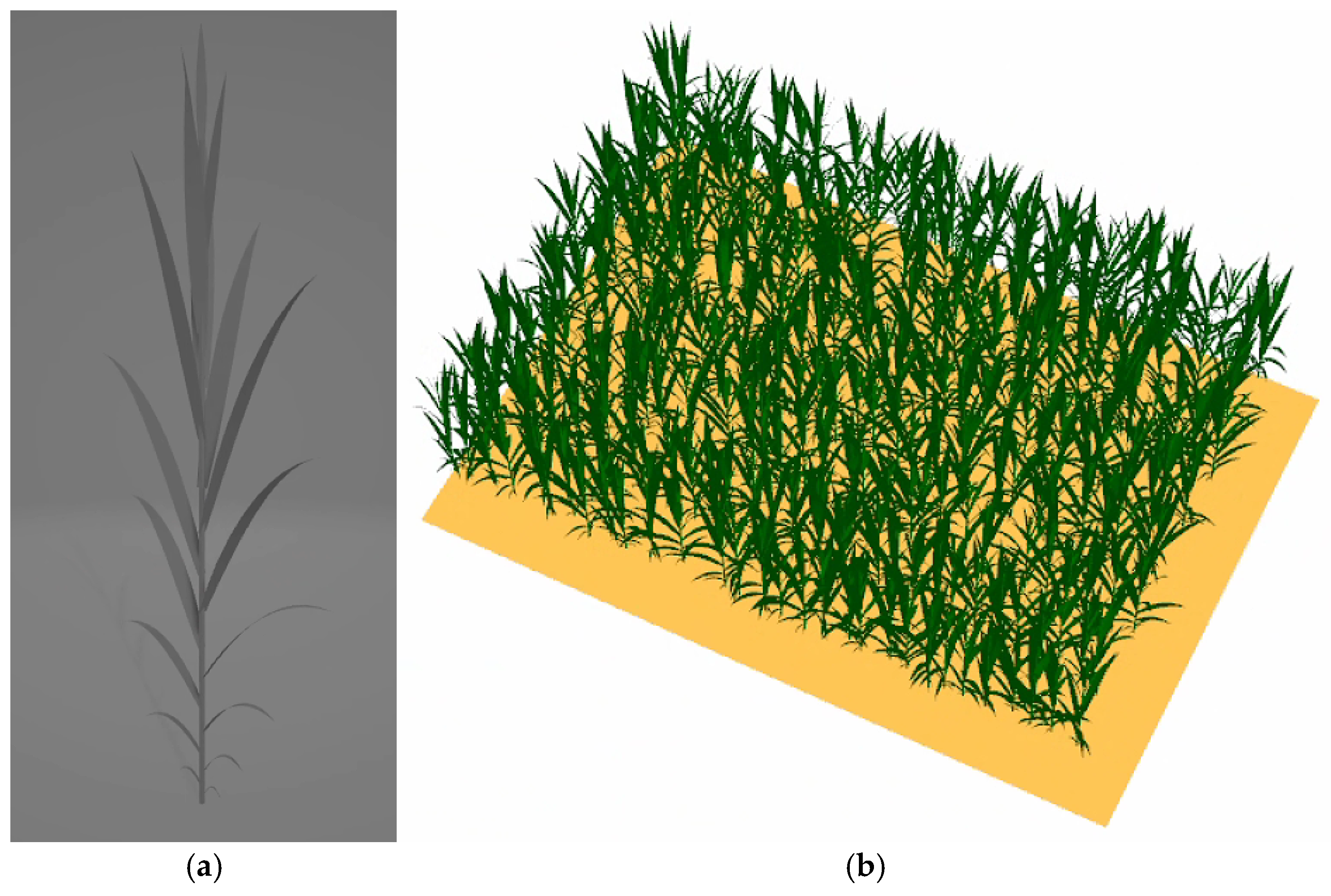
The synthetic dataset was constructed using three-dimensional maize canopy scenes generated by the DLAmaize model. The generated scenes were designed to represent maize canopy structures under varying growth and structural conditions. The scene dimensions were set to 8.5 m × 6 m, with a row spacing of 0.65 m and a plant spacing of 0.3 m, corresponding to typical maize planting conditions (Figure 1).
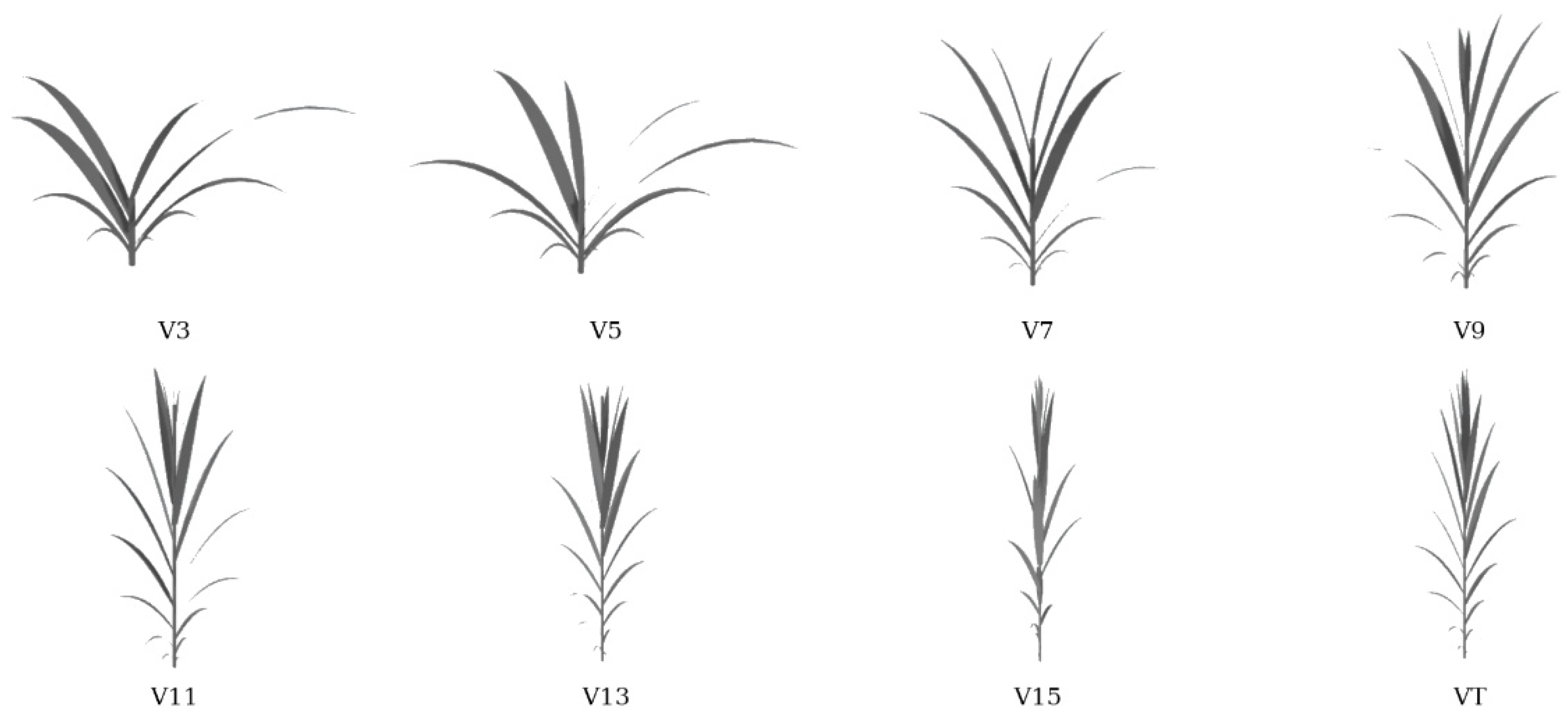
To capture representative variations in canopy structure, parametric 3D maize plant models were generated across multiple growth stages, including V3, V5, V7, V9, V11, V13, V15, and VT. Among these, the V7 and V13 stages were selected as representative vegetative phases for building the synthetic datasets and conducting model experiments. During model construction, measured canopy structural parameters—such as plant height, leaf count, leaf length and width, leaf inclination, stem diameter, and canopy height—were applied as constraints. These parameter ranges were obtained from field observations at the Yingke Oasis and Huazhaizi Desert sites to ensure both structural realism and biological plausibility of the generated canopy models. Figure 2 illustrates representative maize plant models at different growth stages. As the plants developed from V3 to VT, canopy height, leaf number, and structural complexity increased noticeably, leading to stage-specific three-dimensional canopy features that directly affected laser beam propagation and the distribution of points within the LiDAR-generated point clouds.
Using the defined parameter ranges, structural attributes were sampled and combined within biologically plausible limits derived from field observations and growth-stage-specific canopy features. The DLAmaize model maintained realistic maize architectural relationships through rule-based constraints, resulting in plants with diverse structural traits and varying Leaf Area Index (LAI) values. Individual plants were spatially organized according to standard row planting patterns to create complete 3D canopy scenes. In the modeling process, the main stem was first constructed based on plant height and stem diameter, followed by sequential leaf generation according to node distribution and leaf count. Leaf geometry—including length, width, curvature, inclination, and azimuth—was controlled to produce realistic spatial arrangements, while random perturbations were applied to increase natural variability and prevent overly regularized canopies. The final 3D models were exported in Wavefront OBJ format for subsequent LiDAR simulations. To further enhance dataset diversity, multiple randomized combinations of structural parameters were used to produce canopy scenes with varying densities and spatial distributions. In total, 2000 3D maize canopy scenes were generated, evenly split between the V7 and V13 growth stages. LAI values were calculated directly from the geometric information of each 3D model and served as ground-truth labels for supervised learning.
Following the generation of the 3D canopy scenes, LiDAR simulations were conducted using the LESS simulator, producing the corresponding point cloud datasets. LESS is a 3D radiative transfer model based on ray-tracing algorithms and is capable of simulating interactions between laser pulses and complex vegetation structures, generating both LiDAR waveforms and discrete point clouds. In this study, the LiDAR sensor was primarily configured in terrestrial laser scanning (TLS) mode to acquire high-density point clouds that accurately captured detailed canopy structures. Key TLS simulation parameters are listed in Table 1. Additionally, an airborne laser scanning (ALS) scenario was simulated to examine the effect of observation geometry on LAI retrieval performance, with detailed ALS parameters presented in Table 2. By performing LiDAR simulations for all generated scenes, a complete set of point cloud data paired with corresponding LAI labels was obtained, forming the synthetic dataset used for model pretraining, transfer learning, and validation.

2.1.2. Field-Observed Maize Canopy

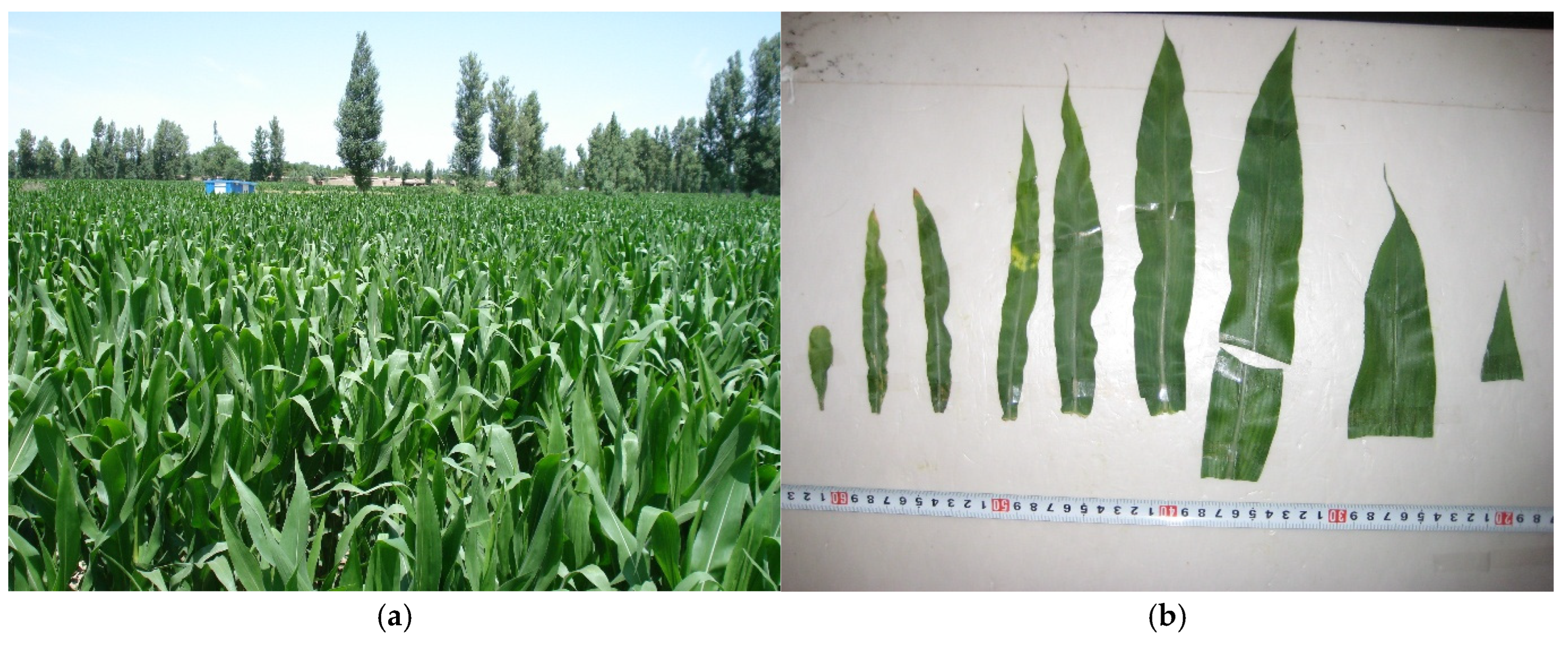
The field-observed maize canopy scenes were collected from the Yingke Oasis and Huazhaizi Desert experimental sites located in the Heihe River Basin, China [41,42,43,44]. These sites are part of the Heihe eco-hydrological observation network established for monitoring vegetation structure and land surface processes in arid and semi-arid regions. Field campaigns were conducted multiple times between 20 May and 9 July 2008. During these campaigns, vegetation structural parameters of maize and wheat were systematically measured using the LI-COR LAI-2000 plant canopy analyzer (LI-COR Biosciences, Lincoln, NE, USA), TRAC, fisheye photography, protractors, rulers, and manual sampling methods. The measurements included leaf length, leaf width, leaf inclination angle, plant height, leaf base height, row spacing, plant spacing, canopy height, and stem geometric parameters. Representative field observations and leaf structural measurements are shown in Figure 3. To ensure consistency between field-measured LAI and the geometrically derived canopy LAI used in the 3D simulation framework, a canopy clumping correction was applied to convert effective LAI derived from optical measurements into true LAI using the conversion method proposed by Chen and Cihlar [45,46]. The corresponding clumping correction factor was adopted according to the LAI data processing method reported for the Heihe experimental region. In this study, the field dataset was mainly used to constrain the structural parameter ranges of the 3D maize canopy model and to support transfer learning validation.
Field observations were conducted primarily to collect canopy structural parameters relevant to Leaf Area Index (LAI). For each plant, the maximum length and width of each leaf were measured with a ruler. Leaves were divided into three segments to capture inclination angles at multiple positions, with the length and width of each segment recorded. Additionally, plant height and the base height of each leaf were measured. Average plant spacing was determined by measuring distances among multiple plants (e.g., 20 plants) within the same row. Canopy height was measured at several points within each plot, and the mean value was taken as the final canopy height. Planting arrangement parameters, including row spacing and inter-row spacing, were also documented.
To obtain more detailed structural information, two representative plants were selected from each plot and brought back to the laboratory for further measurements, including stem length, stem width, and stem circumference. Leaf morphological traits, such as maximum leaf length, maximum leaf width, and leaf area, were also measured using the LI-COR LAI-2000 plant canopy analyzer. All measurement data were organized and stored in Excel format and were used as reference data for subsequent validation of LAI retrieval results.

2.2. Method

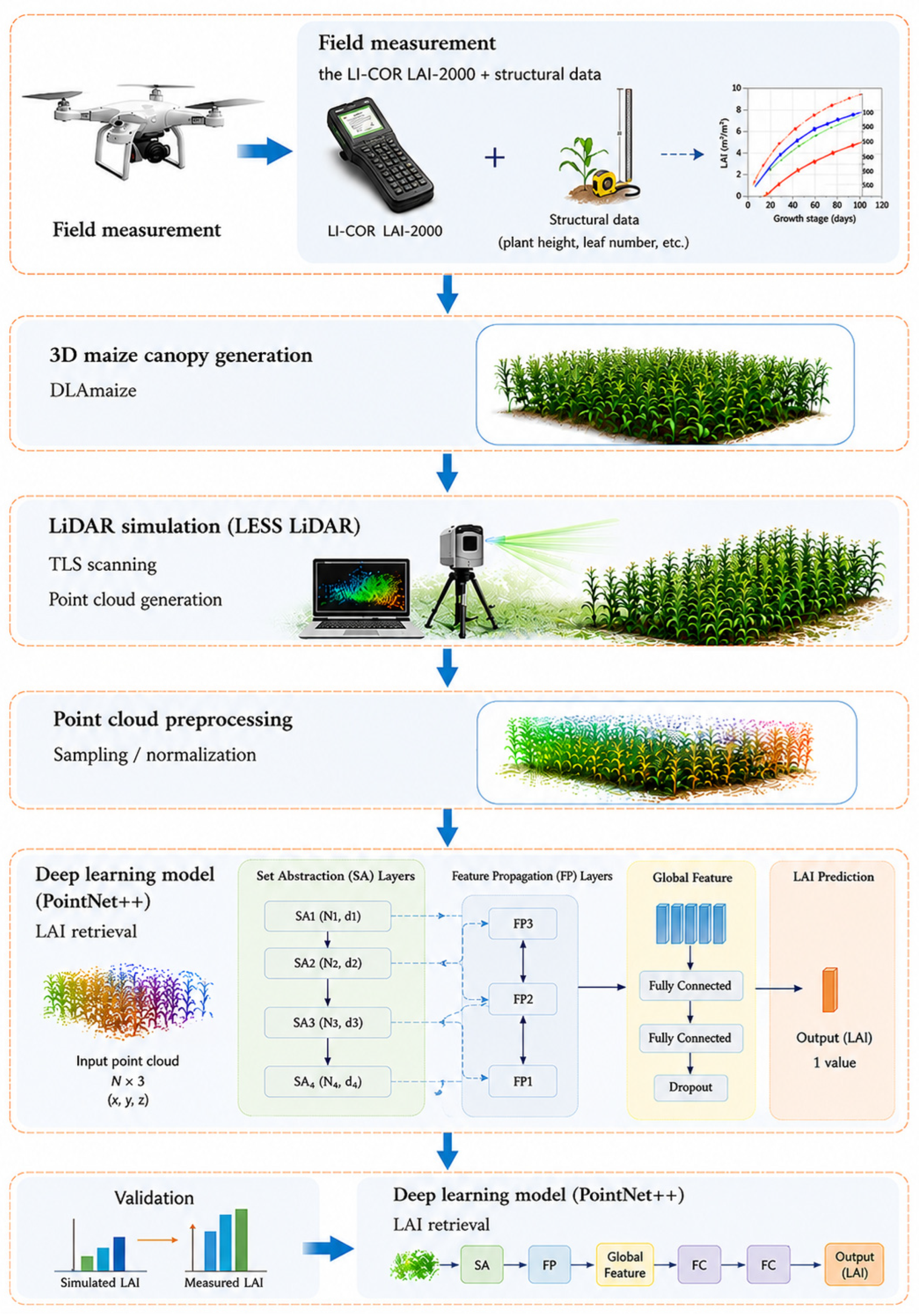
Figure 4 presents the overall workflow of the study. Initially, canopy structural parameters of maize—including leaf length, leaf width, leaf inclination, plant height, and canopy height—were collected from datasets obtained at the Yingke Oasis and Huazhaizi Desert observation sites. These measurements were used to constrain the DLAmaize model, enabling the generation of three-dimensional maize canopy structures.
Using the generated 3D canopy models, LiDAR simulations were performed with the LESS simulator in terrestrial laser scanning (TLS) mode to produce synthetic point cloud datasets. A deep learning model based on PointNet++ was then developed to extract structural features from the LiDAR point clouds and to map these features to Leaf Area Index (LAI) values. The model was trained on the synthetic dataset and subsequently employed for LAI retrieval. Finally, the performance of the model was assessed and validated against LAI measurements from the field datasets.

2.2.1. LAI Retrieval Method Based on PointNet++

In this work, a deep learning approach based on the PointNet++ architecture was utilized to estimate maize leaf area index (LAI) from simulated LiDAR point clouds. PointNet++ is capable of directly learning from 3D point cloud data and hierarchically capturing both local and global geometric features, allowing it to effectively characterize the spatial structure of vegetation canopies.
  • Point Cloud Preprocessing
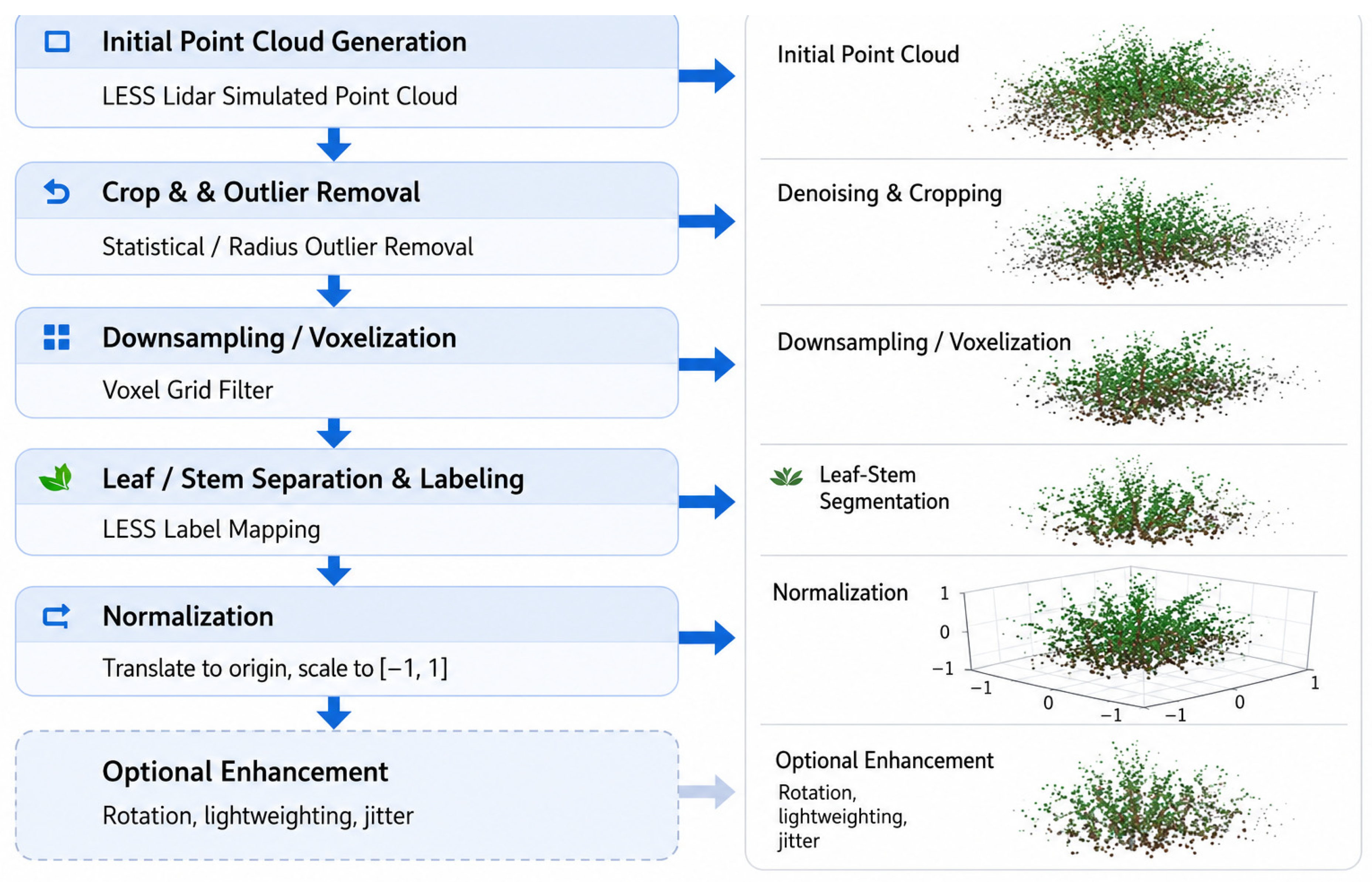
Prior to training, the simulated LiDAR point clouds were preprocessed to ensure a consistent and stable input format for the network. The overall preprocessing workflow is illustrated in Figure 5. The process consists primarily of two steps: coordinate normalization and point sampling. First, the 3D coordinates of the raw point clouds were normalized and scaled to a common spatial range, reducing the effects of scene-to-scene scale variations on model training. Next, random sampling was applied to generate point cloud samples with a fixed number of points, ensuring a uniform input size for the deep learning model. Each resulting point cloud sample is composed of discrete points, with their three-dimensional coordinates (x, y, z) serving as the primary input features for the network.
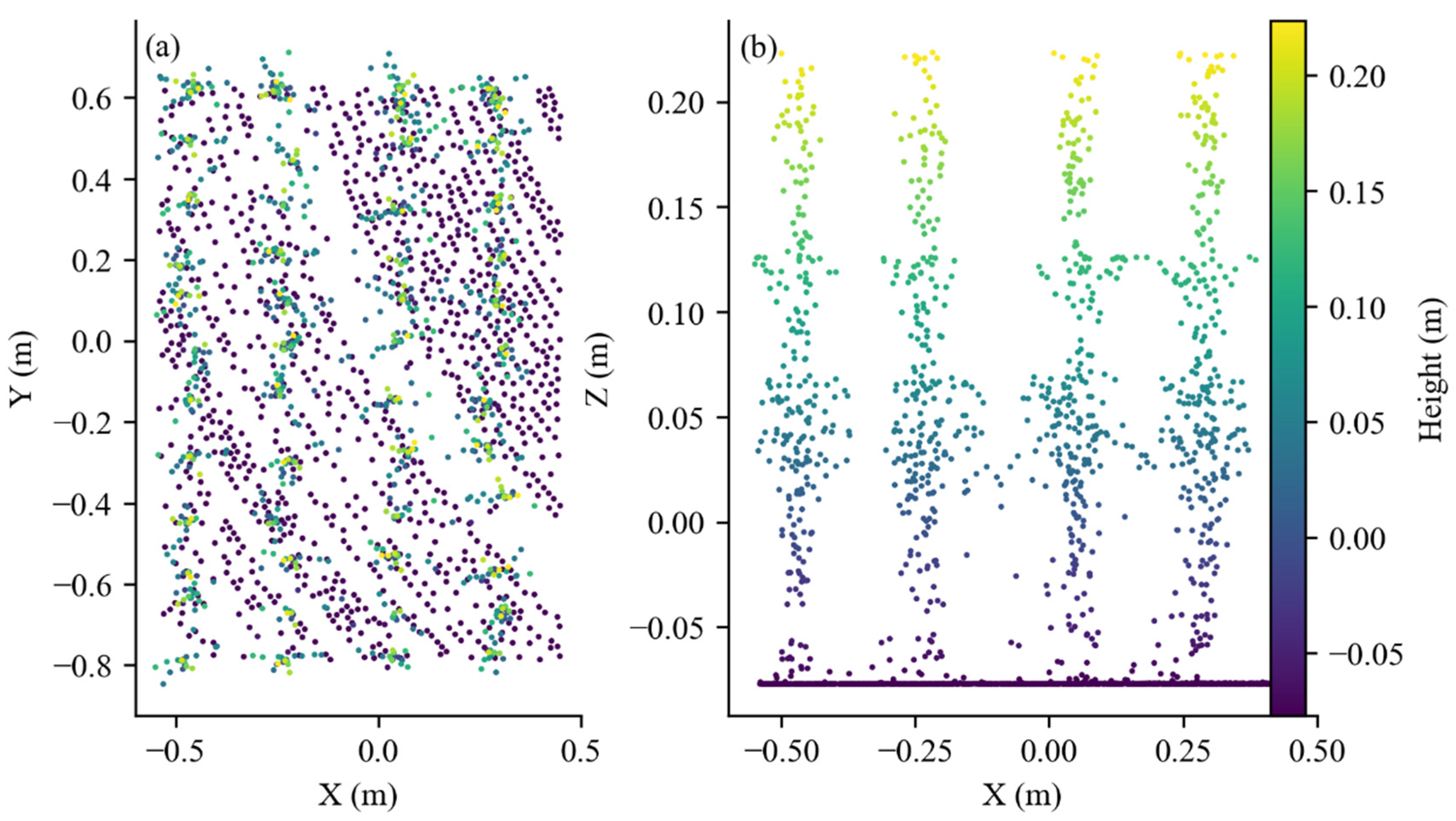
To visually assess the spatial arrangement and structural features of the preprocessed point clouds, the LiDAR data were visualized and analyzed, as illustrated in Figure 6. Figure 6a depicts the horizontal (X–Y) distribution of the point clouds, where a clear row–column pattern reflects the planting layout and spatial organization of the maize canopy. Figure 6b presents the vertical profile (X–Z), with height information represented by color. The point clouds show a distinct stratification from the ground to the canopy top, indicating that preprocessing successfully removed outliers and noise while preserving canopy structural information.
Furthermore, the height-based color coding highlights the internal canopy structure, with different height layers corresponding to varying point densities. This provides a solid foundation for the subsequent extraction of three-dimensional structural features. Overall, the preprocessed point clouds exhibit continuity and consistency in both spatial distribution and structural representation, satisfying the data quality and structural requirements necessary for deep learning model training.
2.
Network Architecture
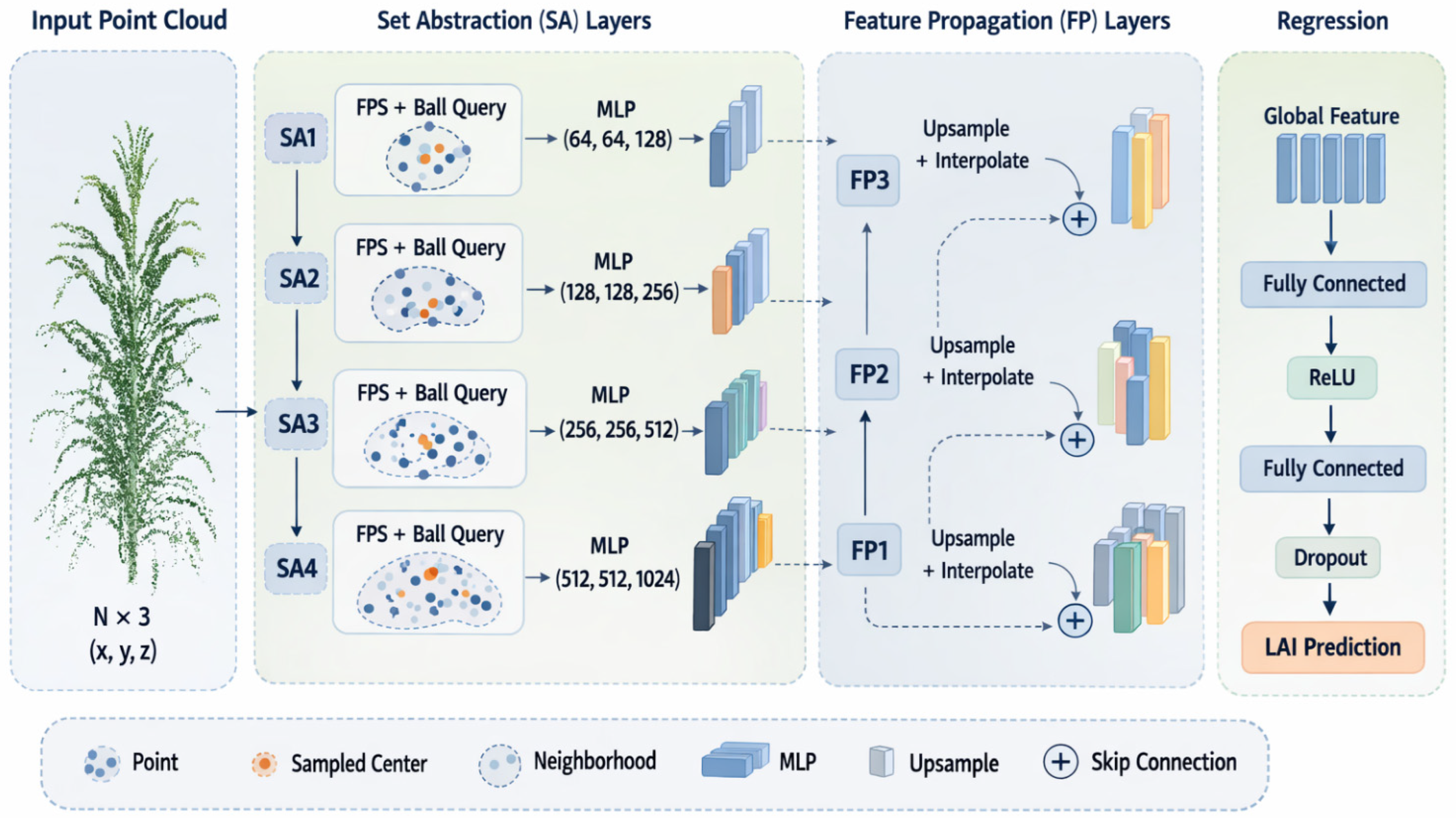
This study utilizes the PointNet++ architecture to extract features from LiDAR point cloud data, with the overall network structure illustrated in Figure 7. Unlike the original PointNet, which primarily captures global features, PointNet++ incorporates a hierarchical feature learning strategy that progressively integrates local and global information, thereby improving its ability to represent complex 3D structures. The network comprises Set Abstraction (SA) layers, Feature Propagation (FP) layers, and fully connected layers.
Within the SA layers, farthest point sampling (FPS) is applied to downsample the input point cloud and select representative centroid points. Local neighborhoods are then constructed using a ball query with a specified radius, and shared multi-layer perceptrons (MLPs) extract features from these neighborhoods. By stacking multiple SA modules, the network’s receptive field expands hierarchically, allowing it to capture both local geometric details and the overall canopy structure, thereby effectively modeling the multi-scale spatial features of the maize canopy.
In the FP layers, distance-weighted interpolation is used to propagate features from low-resolution point sets to higher-resolution point sets. Skip connections are employed to merge shallow, detailed features with deep semantic features, enabling the network to preserve fine spatial details while maintaining global structural information. The aggregated high-dimensional features are subsequently fed into fully connected layers for regression, producing LAI predictions. Through this design, PointNet++ effectively leverages the three-dimensional structural information in LiDAR point clouds to establish a nonlinear mapping between point cloud features and maize leaf area index.
3.
Transfer Learning Strategy
To overcome the limited availability of measured LiDAR samples, a transfer learning (TL) strategy was implemented. The PointNet++ model was initially pretrained on the RTM-simulated LiDAR point cloud dataset generated using the LESS model. Following pretraining, the model was fine-tuned with field-measured LiDAR point clouds to enhance its adaptability to real canopy conditions. The measured dataset comprised 64 samples with corresponding LAI labels. A five-fold cross-validation scheme was adopted for model evaluation, with approximately 20% of the samples in each fold reserved for testing and the remaining samples used for fine-tuning and validation. Within the training set, 20% was further separated as a validation subset for model selection and early stopping.
During pretraining on synthetic data, the Adam optimizer was used with an initial learning rate of 1 × 10⁻³, and mean squared error (MSE) was employed as the loss function. For fine-tuning, the pretrained weights of PointNet++ were retained for all feature extraction layers, including the set abstraction (SA) and feature propagation (FP) modules, which were frozen. Only the final fully connected regression layers (fc1–fc3) were updated using the measured training samples. This last-layer fine-tuning approach preserves structural feature representations learned from the large synthetic dataset while mitigating overfitting risks associated with the limited measured data. The Adam optimizer was applied with a learning rate of 5 × 10⁻⁵ and a batch size of 4. Training was limited to 30 epochs, with early stopping patience set to 6 epochs.
For comparison, the baseline PointNet++ model was trained solely on the measured training samples without synthetic pretraining or transfer learning. To prevent data leakage, the testing subset was entirely excluded from training and validation in each fold, and samples from the same plot and growth stage were assigned to a single subset whenever feasible.

2.2.2. Model Performance Comparison

In addition to the proposed PointNet++-based LAI retrieval framework, comparative experiments were performed using the Beer–Lambert gap fraction method, a Random Forest (RF) model built on hand-crafted point cloud structural features, and the original PointNet network to quantitatively assess the performance of different approaches for maize LAI estimation. The Beer–Lambert Law is a widely applied physical model for vegetation parameter inversion, estimating LAI based on the attenuation of laser or optical signals as they pass through the canopy. In contrast, the RF and PointNet approaches rely on structural features extracted from point clouds, representing traditional machine learning- and deep learning-based strategies, respectively.
To ensure a fair evaluation, all methods were tested on the same LiDAR point cloud datasets and identical testing samples. For the deep learning approaches, identical data partitioning strategies were applied. Both PointNet++ and PointNet learned the mapping between canopy structural characteristics and LAI directly from the point cloud data, whereas the Beer–Lambert method estimated LAI using canopy transmittance derived from LiDAR penetration measurements.

2.2.3. Model Accuracy Evaluation

To assess the performance of the LAI retrieval model, the coefficient of determination (R2) and root mean square error (RMSE) were chosen as the primary evaluation metrics. Using both the simulated and measured datasets, quantitative analyses were conducted to examine model predictions under various experimental conditions. The R2 metric evaluates the goodness of fit between predicted and observed values, indicating the model’s ability to capture trends in LAI variation. In contrast, RMSE measures the average deviation between predicted and observed values, reflecting the accuracy and stability of the model. Together, these two metrics provide a comprehensive assessment of model performance in terms of both predictive fit and error magnitude. The formulas for R2 and RMSE are defined as follows:
R M S E = 1 n i = 1 n y i y i ^ 2
R 2 = 1 i = 1 n y i y i ^ 2 i = 1 n y i y ¯ 2
where y i denotes the observed LAI for the i -th sample, y i ^ represents the predicted LAI for that sample, y ¯ is the mean of all observed LAI values, and n is the total number of samples. A larger R 2 value, approaching 1, indicates stronger model fitting, whereas a smaller RMSE value corresponds to greater predictive accuracy.

3. Results

3.1. Availability of Synthetic Datasets

To verify the feasibility of training deep learning models using synthetic datasets, this study analyzed the distribution characteristics of LAI in the generated synthetic dataset and compared them with the measured LAI data provided in the dataset. The synthetic dataset exhibits a broader distribution in terms of LAI range and canopy structural characteristics. In contrast, field observations are often constrained by factors such as observation time, meteorological conditions, and crop growth stages, making it difficult for limited measured data to cover the full range of canopy structural variability.
In comparison, this study generated three-dimensional maize canopy structures with diverse combinations of structural parameters using the DLAmaize model, and corresponding LiDAR point cloud data were produced using the LESS LiDAR simulator. This approach enabled the construction of a synthetic dataset containing a wide variety of canopy structural characteristics. By randomly combining parameters within the range of measured structural data, the synthetic dataset covers a more comprehensive range of LAI values and canopy configurations, providing more diverse training samples for deep learning models. This approach helps improve the model’s capability to retrieve maize LAI under varying canopy structural conditions.

3.2. Correlation Between Point Cloud Structural Features and LAI

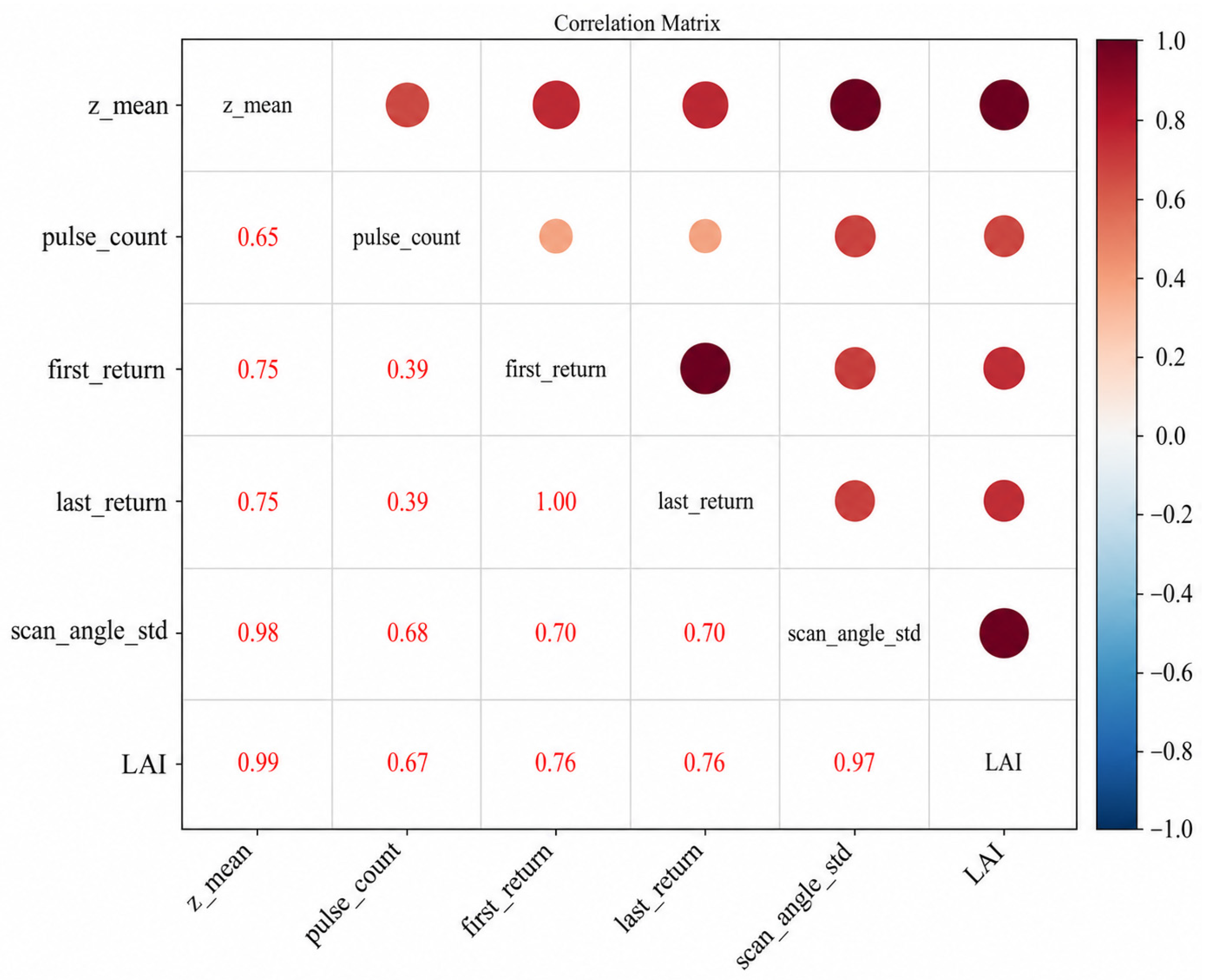
The relationship between LiDAR point cloud structural features and LAI was analyzed through statistical correlation analysis based on the synthetic dataset, as shown in Figure 8. Overall, the selected point cloud features exhibit significant positive correlations with LAI. Among them, the height-related feature z_mean shows the strongest correlation with LAI (R = 0.99), indicating that canopy vertical structural variation is the dominant factor influencing LAI retrieval. Return-related features, including first_return and last_return, also demonstrate relatively high correlations with LAI (R = 0.76), suggesting that canopy penetration characteristics provide important structural information for LAI estimation. In addition, pulse_count and scan_angle_std show moderate to strong correlations with LAI (R = 0.67 and 0.97, respectively), reflecting the influence of point cloud density and observation geometry on canopy structural representation. Overall, these features effectively characterize maize canopy structural properties and provide a reliable basis for establishing the nonlinear relationship between LiDAR point clouds and LAI.

3.3. Comparison of Different Training Strategies for LAI Retrieval

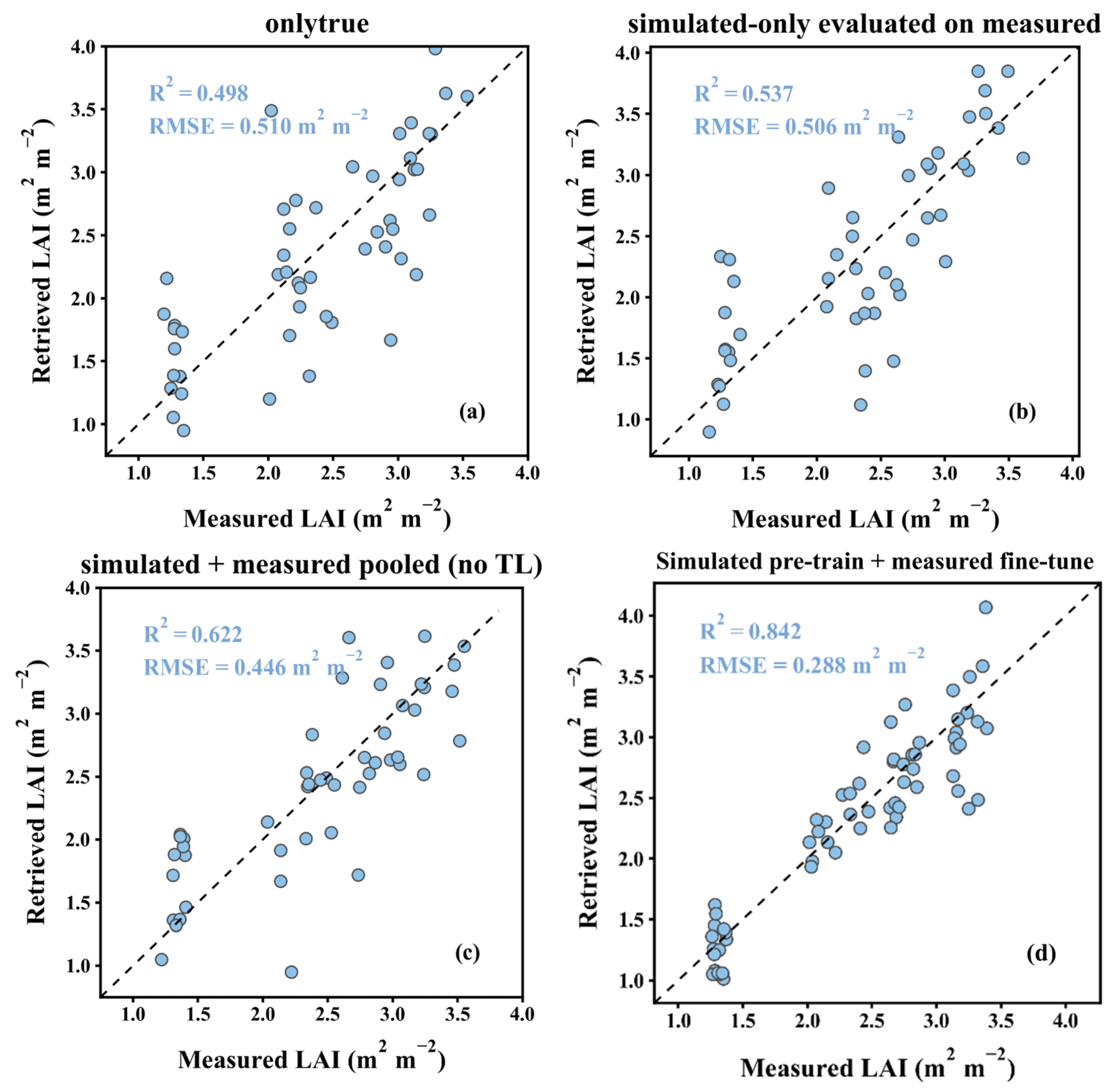
To assess the impact of different training strategies on LAI retrieval, comparative experiments were performed using four approaches: training solely on measured data, training solely on simulated data, combined simulated and measured training without transfer learning (TL), and simulated-data pretraining followed by fine-tuning with measured data, as illustrated in Figure 9. While all models captured the overall trend of LAI variation, notable differences in prediction accuracy were observed. The measured-only model exhibited the lowest performance (R2 = 0.498, RMSE = 0.510 m2·m−2), primarily due to the limited number of measured samples, which restricted the network’s ability to learn stable and representative canopy structural features. The simulated-only model achieved an R2 of 0.537 and RMSE of 0.506 m2·m−2, demonstrating that synthetic data can provide useful structural information, although the predictions were still influenced by the domain gap between simulated and measured point clouds. The pooled training approach without TL further improved performance, yielding an R2 of 0.622 and RMSE of 0.446 m2·m−2.
Among the four strategies, the PointNet++ model combined with transfer learning attained the highest performance, with an average R2 of 0.842 ± 0.021 and an average RMSE of 0.288 ± 0.024 m2·m−2 across five-fold cross-validation. Predictions were more closely aligned with the 1:1 reference line, particularly for medium-to-high-LAI values. These results suggest that the 3D RTM-generated synthetic dataset provided valuable prior structural knowledge for the deep learning model, while transfer learning allowed effective adaptation of this knowledge to the limited measured LiDAR data. Overall, the proposed framework mitigated the constraints of scarce measured training data and enhanced the robustness and accuracy of LAI retrieval.

3.4. Comparison of LAI Retrieval Between Deep Learning and Traditional Methods

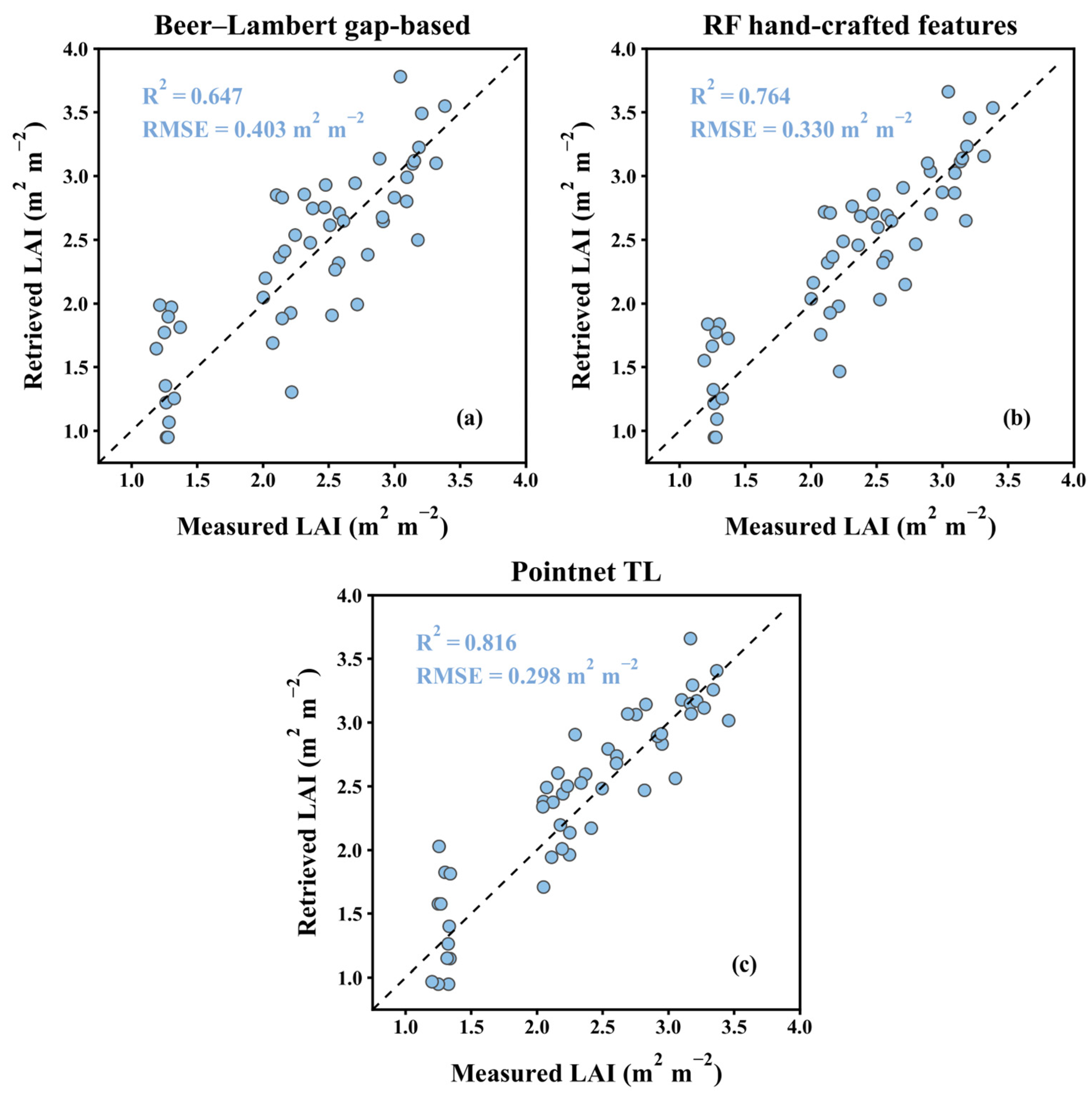
To further evaluate the performance of different LAI retrieval methods, comparative experiments were conducted using the Beer–Lambert gap-based method, the Random Forest (RF) model based on hand-crafted point cloud structural features, and the PointNet model, as shown in Figure 10. Overall, the Beer–Lambert method exhibited relatively large fluctuations and noticeable overestimation or underestimation in some samples, indicating limited stability under complex canopy structural conditions. The RF model improved the retrieval accuracy to some extent by incorporating multiple structural features; however, prediction dispersion was still observed, particularly in the medium-to-high-LAI range.
In comparison, the PointNet model produced predictions that were generally closer to the measured LAI values and more concentrated around the 1:1 reference line, demonstrating the benefits of deep learning approaches for point cloud feature extraction for canopy structural characterization. Compared with traditional physical and machine learning methods, the deep learning framework showed better robustness and stability for LAI retrieval. Furthermore, the PointNet++ model with transfer learning presented in Section 3.3 achieved the highest retrieval accuracy among all compared methods.

3.5. Analysis of the Effects of Observation Conditions and Structural Parameters on LAI Retrieval Accuracy

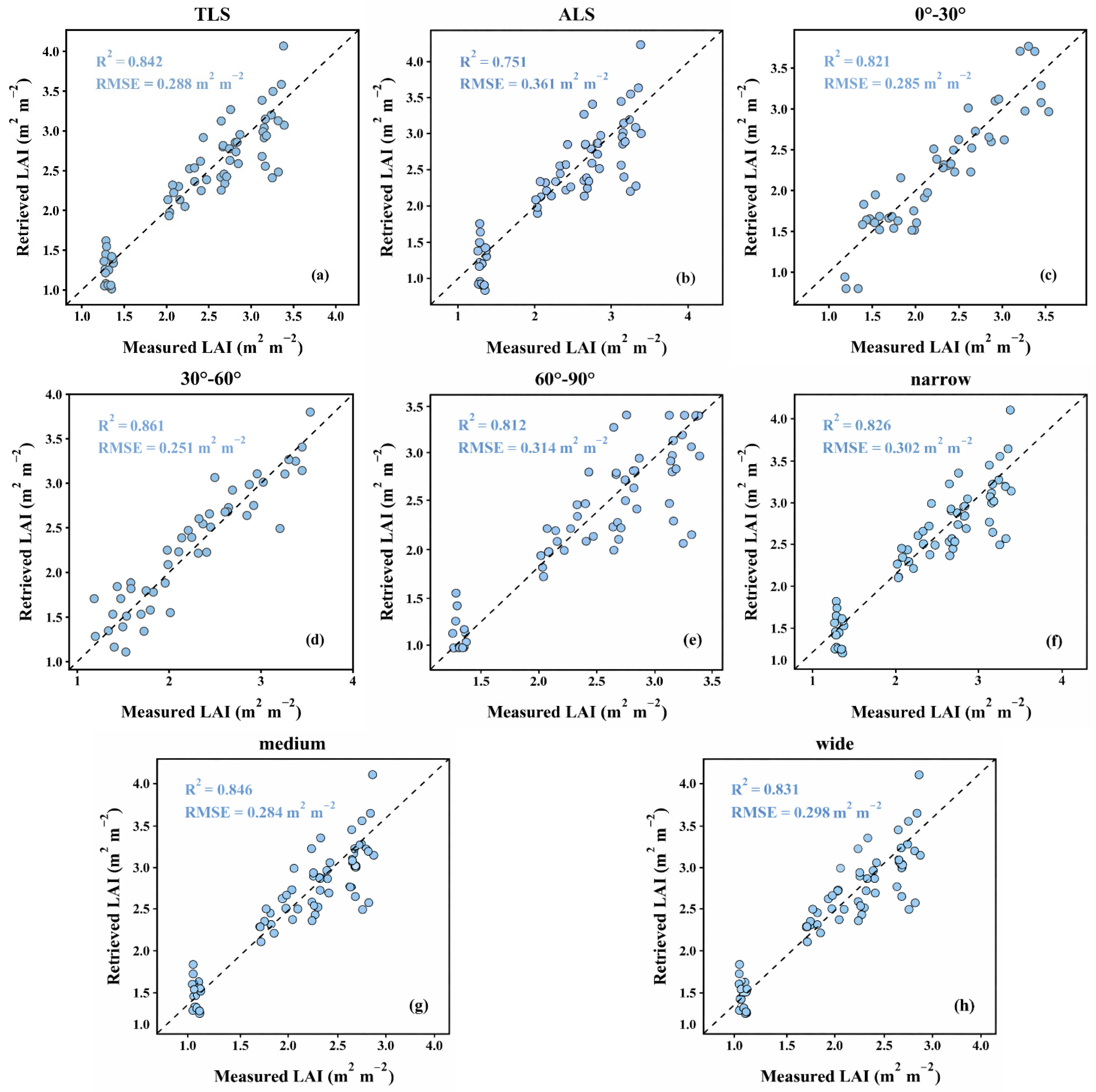
To analyze the impact of observation conditions on LAI retrieval accuracy, model performance under different observation modes and scanning angle conditions was compared, as shown in Figure 11. In terms of observation mode, the model performed significantly better under TLS than ALS, with an R2 of 0.842 and an RMSE of 0.288 m2·m−2, whereas under ALS conditions, the R2 was 0.751 and the RMSE was 0.361 m2·m−2. The predictions under ALS showed greater dispersion, particularly in the medium-to-high-LAI range. Under different scanning angle conditions, the model exhibited a clear performance pattern. The best performance was achieved within the 30–60° range (R2 = 0.842, RMSE = 0.288 m2·m−2), while lower accuracy was observed at 0–30° (R2 = 0.751, RMSE = 0.361 m2·m−2), and a slight decline occurred at 60–90° (R2 = 0.812, RMSE = 0.314 m2·m−2), indicating that moderate scanning angles are more favorable for capturing effective canopy structural information.
In terms of canopy structural parameters, model performance also varies under different stem diameter conditions. The stem-diameter categories were defined according to the stem-width parameter used during 3D maize canopy scene generation and corresponding LiDAR simulation, including narrow (<2.5 cm), medium (2.5–4.0 cm), and wide (>4.0 cm) stem-diameter groups. Analysis of the results indicates that the model achieved the highest accuracy under medium stem diameter conditions (R2 = 0.846, RMSE = 0.284 m2·m−2), while slightly lower accuracy is observed under narrow and wide stem diameter conditions (R2 = 0.826 and 0.831; RMSE = 0.302 and 0.298 m2·m−2, respectively). Overall, LAI retrieval accuracy was jointly influenced by observation conditions and canopy structural parameters. The best performance was achieved under TLS observation, moderate scanning angles, and medium stem diameter conditions, indicating that appropriate observation configurations and structural parameter settings can effectively improve LiDAR-based LAI retrieval performance.

4. Discussion

4.1. The Importance of Synthetic Datasets from 3D RTM

Compared with traditional optical remote sensing approaches, such as vegetation-index-based and PROSAIL model-based LAI retrieval methods, the proposed framework provides several advantages for structurally complex maize canopies. Optical remote sensing methods mainly rely on canopy spectral reflectance information and are widely used for large-scale LAI retrieval because of their mature theoretical foundation and compatibility with multispectral and hyperspectral observations. However, under medium-to-high-LAI conditions, spectral indices may become susceptible to saturation effects, reducing sensitivity to canopy structural variation. In contrast, LiDAR point clouds can directly characterize three-dimensional canopy geometry and vertical structural distribution, enabling improved representation of complex canopy architecture and structural heterogeneity.
Compared with the Beer–Lambert gap-based method [47] and the Random Forest (RF) model [48], the proposed PointNet++ framework achieved higher retrieval accuracy and more stable prediction performance. The Beer–Lambert method exhibited relatively large prediction fluctuations because canopy transmittance measurements were highly sensitive to canopy occlusion and vertical structural heterogeneity. Although the RF model improved retrieval performance by incorporating multiple handcrafted structural features, its ability to represent complex nonlinear canopy geometry remained limited.
LiDAR-based LAI retrieval may still encounter uncertainties under dense-canopy and high-LAI conditions, particularly during middle and late growth stages. Increasing canopy occlusion may reduce laser penetration into lower canopy layers, leading to incomplete characterization of vertical canopy structures and potential underestimation of LAI retrieval results.

4.2. Uncertainty and Limitations of LiDAR-Based LAI Retrieval

Although the proposed framework achieved promising LAI retrieval performance, LiDAR-based LAI retrieval may still encounter uncertainties under dense-canopy and high-LAI conditions, particularly during middle and late growth stages. As canopy density increases, laser penetration into lower canopy layers may decrease due to occlusion effects, potentially leading to incomplete characterization of vertical canopy structures and underestimation of LAI. These effects become more pronounced during reproductive and senescent growth stages with increased leaf overlap and canopy closure.
In addition, LiDAR point clouds often contain mixed structural information from leaves, stems, and other canopy components. The difficulty of accurately separating leaf and stem structures may influence canopy structural feature extraction and introduce additional uncertainty into LAI retrieval results. As shown in the stem-diameter experiments, changes in stem proportion can influence canopy spatial distribution and laser penetration characteristics, further affecting structural representation within point clouds. These findings indicate that LiDAR-based LAI retrieval remains sensitive to canopy structural complexity and observation geometry under different growth conditions.

4.3. Simulation–Reality Gap and Model Generalization

The simulation–reality gap between RTM-generated point clouds and measured LiDAR observations also remains an important limitation of the present study. The synthetic canopy scenes were generated under simplified assumptions regarding leaf optical properties, where leaves within the same scene were assumed to share similar reflectance characteristics. Although this simplification improves simulation efficiency and structural consistency, it may not fully represent the spectral and structural variability observed under real agricultural conditions.
Furthermore, the current synthetic scenes mainly focused on canopy structural representation and did not explicitly include environmental background components such as weeds, soil roughness, crop residues, or other non-canopy clutter, which may influence laser scattering characteristics and point cloud distribution in practical agricultural environments. Although representative maize growth stages were considered, the generated canopy scenes mainly focused on vegetative stages (V7 and V13) and did not explicitly model late-stage canopy senescence, leaf wilting, or lodging effects. In addition, the simulated scenes were generated under a fixed planting geometry with a row spacing of 0.65 m and a plant spacing of 0.30 m, which may limit the adaptability of the trained model under substantially different planting densities and canopy configurations.
Nevertheless, the transfer learning strategy partially alleviated the domain discrepancy between simulated and measured point clouds by fine-tuning the pretrained model using measured field samples. The results suggest that RTM-generated synthetic datasets can still provide useful structural prior knowledge for deep learning-based LAI retrieval under limited measured data conditions.

4.4. Future Perspectives

The present study mainly focused on the PointNet++ framework because its hierarchical Set Abstraction (SA) mechanism is effective for capturing multi-scale structural information from maize canopy point clouds. However, other advanced point cloud learning frameworks, including DGCNN, KPConv, and transformer-based point cloud models, may further improve the representation of complex canopy geometry and long-range spatial relationships. Due to the limited size of the measured LiDAR dataset and the primary focus of this study on integrating 3D radiative transfer simulation with transfer learning, a comprehensive benchmark comparison among various deep learning architectures was beyond the scope of the current work.
Future research will aim to improve the biological realism and environmental complexity of the synthetic canopy scenes by incorporating dynamic leaf optical properties, senescence processes, heterogeneous background components, and more diverse planting geometries to further reduce the simulation–reality gap and improve model transferability under complex agricultural conditions. In addition, future studies will further investigate advanced point cloud learning frameworks and explore the applicability of the proposed framework for larger-scale crop phenotyping and UAV-/ALS-based LiDAR applications in precision agriculture.

5. Conclusions

In this study, an integrated framework combining a three-dimensional radiative transfer model (3D RTM), LiDAR point cloud simulation, PointNet++, and transfer learning (TL) was proposed for maize LAI retrieval. Three-dimensional maize canopy scenes with diverse structural characteristics were generated using the DLAmaize model, and corresponding LiDAR point clouds were simulated using the LESS LiDAR simulator to construct a large-scale synthetic dataset. The synthetic point cloud dataset was subsequently used for PointNet++ pre-training, while measured LiDAR samples were employed for fine-tuning and validation.
The results demonstrated that the proposed framework effectively improved LAI retrieval performance under limited measured sample conditions. Compared with the original PointNet++ model trained only on measured data, the incorporation of transfer learning significantly enhanced prediction accuracy, with R2 increasing from 0.537 to 0.842 and RMSE decreasing from 0.541 to 0.288 m2·m−2. In addition, the experiments showed that observation mode, scanning angle, and stem diameter substantially influenced retrieval performance, with the best results achieved under TLS conditions, moderate scanning angles, and medium stem diameter configurations.
Overall, the proposed framework demonstrates the potential of integrating physics-based LiDAR simulation and point cloud deep learning for crop structural parameter retrieval. The RTM-driven synthetic data generation strategy provides an effective solution to the scarcity of labeled LiDAR datasets and improves the transferability of deep learning models under varying canopy structural conditions. Future work will focus on incorporating more realistic canopy physiological characteristics, heterogeneous background components, and advanced point cloud learning architectures to further improve the generalization capability of LiDAR-based crop phenotyping models.

Author Contributions

Conceptualization, Q.L.; methodology, Q.L. and L.C.; software, H.C. and Y.Z.; validation, L.C., J.Z. and M.W.; investigation, A.Z. and J.Y.; writing—original draft preparation, Q.L.; writing—review and editing, S.C. and L.C.; supervision, S.C. project administration, S.C.; funding acquisition, S.C. All authors have read and agreed to the published version of the manuscript.

Funding

This research was funded by the National Key Research and Development Program of China under Grant 2020YFA0714103, and in part by the Key Scientific and Technological Initiative for the Satellite and Application of Changchun under Grant 2024WX06.

Data Availability Statement

The dataset used in this study was obtained from the National Tibetan Plateau Data Center (TPDC, https://www.tpdc.ac.cn/ (accessed on 6 September 2025)), a publicly accessible scientific data platform providing multi-source geoscientific datasets. The specific dataset can be accessed via: https://www.tpdc.ac.cn/zh-hans/data/4d60d570-0aa9-417b-8a9d-c32b73b564 (accessed on 6 September 2025). The TPDC database integrates long-term observational and remote sensing data with standardized quality control, ensuring the reliability and consistency of the datasets for scientific research.

Acknowledgments

The authors would like to acknowledge the National Tibetan Plateau Data Center (TPDC) for providing the open-access datasets that supported this study. The availability of high-quality and well-curated data from TPDC has greatly facilitated the implementation and validation of this research.

Conflicts of Interest

The authors declare no conflicts of interest.

References

  1. Jonckheere, I.; Fleck, S.; Nackaerts, K.; Muys, B.; Coppin, P.; Weiss, M.; Baret, F. Review of methods for in situ leaf area index determination: Part I. Theories, sensors and hemispherical photography. Agric. For. Meteorol. 2004, 121, 19–35. [Google Scholar] [CrossRef]
  2. Weiss, M.; Baret, F.; Smith, G.J.; Jonckheere, I.; Coppin, P. Review of methods for in situ leaf area index (LAI) determination: Part II. Estimation of LAI, errors and sampling. Agric. For. Meteorol. 2004, 121, 37–53. [Google Scholar] [CrossRef]
  3. Asner, G.P.; Scurlock, J.M.O.; Hicke, J.A. Global synthesis of leaf area index observations: Implications for ecological and remote sensing studies. Glob. Ecol. Biogeogr. 2003, 12, 191–205. [Google Scholar] [CrossRef]
  4. Chen, J.M.; Black, T.A. Defining leaf area index for non-flat leaves. Plant Cell Environ. 1992, 15, 421–429. [Google Scholar] [CrossRef]
  5. Bréda, N.J.J. Ground-based measurements of leaf area index: A review of methods, instruments and current controversies. J. Exp. Bot. 2003, 54, 2403–2417. [Google Scholar] [CrossRef]
  6. Zheng, G.; Moskal, L.M. Retrieving Leaf Area Index (LAI) Using Remote Sensing: Theories, Methods and Sensors. Sensors 2009, 9, 2719–2745. [Google Scholar] [CrossRef]
  7. González-Sanpedro, M.C.; Le Toan, T.; Moreno, J.; Kergoat, L.; Rubio, E. Seasonal variations of leaf area index of agricultural fields retrieved from Landsat data. Remote Sens. Environ. 2008, 112, 810–824. [Google Scholar] [CrossRef]
  8. Dandois, J.P.; Ellis, E.C. Remote Sensing of Vegetation Structure Using Computer Vision. Remote Sens. 2010, 2, 1157–1176. [Google Scholar] [CrossRef]
  9. Xue, J.; Su, B. Significant Remote Sensing Vegetation Indices: A Review of Developments and Applications. J. Sens. 2017, 2017, 1353691. [Google Scholar] [CrossRef]
  10. Wulder, M. Optical remote-sensing techniques for the assessment of forest inventory and biophysical parameters. Prog. Phys. Geogr. Earth Environ. 1998, 22, 449–476. [Google Scholar] [CrossRef]
  11. Deng, L.; Mao, Z.; Li, X.; Hu, Z.; Duan, F.; Yan, Y. UAV-based multispectral remote sensing for precision agriculture: A comparison between different cameras. ISPRS J. Photogramm. Remote Sens. 2018, 146, 124–136. [Google Scholar] [CrossRef]
  12. Qiao, L.; Zhao, R.; Tang, W.; An, L.; Sun, H.; Li, M.; Wang, N.; Liu, Y.; Liu, G. Estimating maize LAI by exploring deep features of vegetation index map from UAV multispectral images. Field Crops Res. 2022, 289, 108739. [Google Scholar] [CrossRef]
  13. Thenkabail, P.S.; Smith, R.B.; De Pauw, E. Hyperspectral Vegetation Indices and Their Relationships with Agricultural Crop Characteristics. Remote Sens. Environ. 2000, 71, 158–182. [Google Scholar] [CrossRef]
  14. Viña, A.; Gitelson, A.A.; Nguy-Robertson, A.L.; Peng, Y. Comparison of different vegetation indices for the remote assessment of green leaf area index of crops. Remote Sens. Environ. 2011, 115, 3468–3478. [Google Scholar] [CrossRef]
  15. Zhao, Q.; Yu, S.; Zhao, F.; Tian, L.; Zhao, Z. Comparison of machine learning algorithms for forest parameter estimations and application for forest quality assessments. For. Ecol. Manag. 2019, 434, 224–234. [Google Scholar] [CrossRef]
  16. Houborg, R.; Fisher, J.B.; Skidmore, A.K. Advances in remote sensing of vegetation function and traits. Int. J. Appl. Earth Obs. Geoinf. 2015, 43, 1–6. [Google Scholar] [CrossRef]
  17. Im, J.; Jensen, J.R. Hyperspectral Remote Sensing of Vegetation. Geogr. Compass 2008, 2, 1943–1961. [Google Scholar] [CrossRef]
  18. Okin, G.S.; Roberts, D.A.; Murray, B.; Okin, W.J. Practical limits on hyperspectral vegetation discrimination in arid and semiarid environments. Remote Sens. Environ. 2001, 77, 212–225. [Google Scholar] [CrossRef]
  19. Wang, Y.; Fang, H. Estimation of LAI with the LiDAR Technology: A Review. Remote Sens. 2020, 12, 3457. [Google Scholar] [CrossRef]
  20. Lefsky, M.A.; Cohen, W.B.; Parker, G.G.; Harding, D.J. Lidar Remote Sensing for Ecosystem Studies: Lidar, an emerging remote sensing technology that directly measures the three-dimensional distribution of plant canopies, can accurately estimate vegetation structural attributes and should be of particular interest to forest, landscape, and global ecologists. BioScience 2002, 52, 19–30. [Google Scholar] [CrossRef]
  21. Tang, Z.; Jiang, T.; Wang, Y.; Sun, X. LiDAR: A new player in analyzing plant phenotypes. Trends Plant Sci. 2024, 29, 1383–1384. [Google Scholar] [CrossRef] [PubMed]
  22. Hütt, C.; Bolten, A.; Hüging, H.; Bareth, G. UAV LiDAR Metrics for Monitoring Crop Height, Biomass and Nitrogen Uptake: A Case Study on a Winter Wheat Field Trial. PFG—J. Photogramm. Remote Sens. Geoinf. Sci. 2023, 91, 65–76. [Google Scholar] [CrossRef]
  23. Szostak, M.; Pająk, M. LiDAR Point Clouds Usage for Mapping the Vegetation Cover of the “Fryderyk” Mine Repository. Remote Sens. 2023, 15, 201. [Google Scholar] [CrossRef]
  24. Yang, H.; Chen, W.; Qian, T.; Shen, D.; Wang, J. The Extraction of Vegetation Points from LiDAR Using 3D Fractal Dimension Analyses. Remote Sens. 2015, 7, 10815–10831. [Google Scholar] [CrossRef]
  25. Jacquemoud, S.; Verhoef, W.; Baret, F.; Bacour, C.; Zarco-Tejada, P.J.; Asner, G.P.; François, C.; Ustin, S.L. PROSPECT+SAIL models: A review of use for vegetation characterization. Remote Sens. Environ. 2009, 113, S56–S66. [Google Scholar] [CrossRef]
  26. Vetter, M.; Höfle, B.; Hollaus, M.; Gschöpf, C.; Mandlburger, G.; Pfeifer, N.; Wagner, W. Vertical Vegetation Structure Analysis and Hydraulic Roughness Determination Using Dense Als Point Cloud Data—A Voxel Based Approach. Int. Arch. Photogramm. Remote Sens. Spat. Inf. Sci. 2012, 38, 265–270. [Google Scholar] [CrossRef]
  27. Liu, W.; Mõttus, M.; Malenovský, Z.; Shi, S.; Alonso, L.; Atherton, J.; Porcar-Castell, A. An in situ approach for validation of canopy chlorophyll fluorescence radiative transfer models using the full emission spectrum. Remote Sens. Environ. 2025, 316, 114490. [Google Scholar] [CrossRef]
  28. Zhang, Z.; Cao, L.; She, G. Estimating Forest Structural Parameters Using Canopy Metrics Derived from Airborne LiDAR Data in Subtropical Forests. Remote Sens. 2017, 9, 940. [Google Scholar] [CrossRef]
  29. Debnath, S.; Paul, M.; Debnath, T. Applications of LiDAR in Agriculture and Future Research Directions. J. Imaging 2023, 9, 57. [Google Scholar] [CrossRef]
  30. Zhen, Z.; Benromdhane, N.; Kallel, A.; Wang, Y.; Regaieg, O.; Boitard, P.; Landier, L.; Chavanon, E.; Lauret, N.; Guilleux, J.; et al. DART: A 3D radiative transfer model for urban studies. In Proceedings of the 2023 Joint Urban Remote Sensing Event (JURSE), Heraklion, Greece, 17–19 May 2023; IEEE: New York, NY, USA, 2023; Volume 2023, pp. 1–4. [Google Scholar]
  31. Gastellu-Etchegorry, J.P.; Demarez, V.; Pinel, V.; Zagolski, F. Modeling radiative transfer in heterogeneous 3-D vegetation canopies. Remote Sens. Environ. 1996, 58, 131–156. [Google Scholar] [CrossRef]
  32. Farhan, S.M.; Yin, J.; Chen, Z.; Memon, M.S. A Comprehensive Review of LiDAR Applications in Crop Management for Precision Agriculture. Sensors 2024, 24, 5409. [Google Scholar] [CrossRef] [PubMed]
  33. Qi, C.R.; Su, H.; Mo, K.; Guibas, L.J. Pointnet: Deep learning on point sets for 3d classification and segmentation. In Proceedings of the IEEE Conference on Computer Vision and Pattern Recognition; IEEE: New York, NY, USA, 2017; Volume 2017, pp. 652–660. [Google Scholar]
  34. Cahalan, R.F.; Oreopoulos, L.; Marshak, A.; Evans, K.F.; Davis, A.B.; Pincus, R.; Yetzer, K.H.; Mayer, B.; Davies, R.; Ackerman, T.P.; et al. THE I3RC: Bringing Together the Most Advanced Radiative Transfer Tools for Cloudy Atmospheres. Bull. Am. Meteorol. Soc. 2005, 86, 1275–1294. [Google Scholar] [CrossRef]
  35. Qi, C.R.; Yi, L.; Su, H.; Guibas, L.J. Pointnet++: Deep hierarchical feature learning on point sets in a metric space. Adv. Neural Inf. Process. Syst. 2017, 30, 5099–5108. [Google Scholar] [CrossRef]
  36. Guo, Y.; Wang, H.; Hu, Q.; Liu, H.; Liu, L.; Bennamoun, M. Deep Learning for 3D Point Clouds: A Survey. IEEE Trans. Pattern Anal. Mach. Intell. 2021, 43, 4338–4364. [Google Scholar] [CrossRef]
  37. Wang, Y.; Sun, Y.; Liu, Z.; Sarma, S.E.; Bronstein, M.M.; Solomon, J.M. Dynamic Graph CNN for Learning on Point Clouds. ACM Trans. Graph. 2019, 38, 146. [Google Scholar] [CrossRef]
  38. Li, Y.; Bu, R.; Sun, M.; Wu, W.; Di, X.; Chen, B. Pointcnn: Convolution on x-transformed points. Adv. Neural Inf. Process. Syst. 2018, 31, 820–830. [Google Scholar] [CrossRef]
  39. Thomas, H.; Qi, C.R.; Deschaud, J.-E.; Marcotegui, B.; Goulette, F.; Guibas, L.J. Kpconv: Flexible and deformable convolution for point clouds. In Proceedings of the IEEE/CVF International Conference on Computer Vision; IEEE: New York, NY, USA, 2019; Volume 2019, pp. 6411–6420. [Google Scholar]
  40. Zhen, Z.; Chen, S.; Yin, T.; Han, C.; Chavanon, E.; Lauret, N.; Guilleux, J.; Gastellu, J.P. A Dynamic L-System-Based Architectural Maize Model for 3-D Radiative Transfer Simulation. IEEE Trans. Geosci. Remote Sens. 2024, 62, 4401620. [Google Scholar] [CrossRef]
  41. Fan, W.; Yan, B.; Xu, X. Crop Area and Leaf Area Index Simultaneous Retrieval Based on Spatial Scaling Transformation. Sci. China Earth Sci. 2010, 40, 1709–1716. [Google Scholar] [CrossRef]
  42. Fan, W.J.; Xu, X.R.; Liu, X.C.; Yan, B.Y.; Cui, Y.K. Accurate LAI retrieval method based on PROBA/CHRIS data. Hydrol. Earth Syst. Sci. 2010, 14, 1499–1507. [Google Scholar] [CrossRef]
  43. Liu, Y.; Wang, J.; Zhou, H.; Xue, H. LAI Measuring Data Processing, Analysis and Spatial Scaling in the Middle Reaches of Heihe Experimental Research Region. Remote Sens. Technol. Appl. 2010, 25, 805–813. [Google Scholar]
  44. Yao, Y.; Fan, W.; Liu, Q.; Li, L.; Tao, X.; Xin, X.; Liu, Q. Improved Harvesting Method for Corn LAI Measurement in Corn Whole Growth Stages. Trans. CSAE 2010, 26, 189–194. [Google Scholar] [CrossRef]
  45. Chen, J.M.; Cihlar, J. Plant canopy gap-size analysis theory for improving optical measurements of leaf-area index. Appl. Opt. 1995, 34, 6211–6222. [Google Scholar] [CrossRef] [PubMed]
  46. Chen, J.M.; Cihlar, J. Quantifying the effect of canopy architecture on optical measurements of leaf area index using two gap size analysis methods. IEEE Trans. Geosci. Remote Sens. 1995, 33, 777–787. [Google Scholar] [CrossRef]
  47. Luo, T.; Wang, X.; Li, Z.; Zhang, Y. Estimation of Forest Leaf Area Index Using Discrete Airborne LiDAR: A Review. Remote Sens. 2021, 13, 2408. [Google Scholar] [CrossRef]
  48. Yan, H.; Li, X.; Zhang, L.; Zhao, B. Estimating Grassland Leaf Area Index Using the Random Forest Approach and Landsat Imagery in the Meadow Steppe of Hulunber, China. Remote Sens. 2016, 8, 345. [Google Scholar] [CrossRef]
Figure 1. Illustration of the simulated maize canopy scene. (a) Schematic diagram of the maize plant model; (b) three-dimensional model of the canopy scene.
Remotesensing 18 01660 g001
Figure 2. Three-dimensional models of individual maize plants at different growth stages.
Remotesensing 18 01660 g002
Figure 3. Field observations of the maize canopy and leaf structural measurements. (a) Field photograph of the maize canopy at the Yingke Oasis experimental site; (b) maize leaf samples and schematic illustration of leaf length and width measurements. https://www.tpdc.ac.cn (accessed on 6 September 2025).
Remotesensing 18 01660 g003
Figure 4. Flowchart of the experimental workflow. Structural parameters from the Yingke Oasis and Huazhaizi dataset were used to generate 3D maize canopy scenes using the DLAmaize model. LiDAR point clouds were then simulated using the LESS LiDAR simulator and used to train the PointNet++ model for LAI retrieval.
Remotesensing 18 01660 g004
Figure 5. LiDAR Point Cloud Preprocessing Workflow.
Remotesensing 18 01660 g005
Figure 6. Spatial distribution of preprocessed LiDAR point clouds: (a) horizontal distribution (X–Y); (b) vertical distribution (X–Z), where color represents height information.
Remotesensing 18 01660 g006
Figure 7. Architecture of the PointNet++ network used for maize LAI retrieval from LiDAR point clouds. The network extracts hierarchical features through Set Abstraction (SA) and Feature Propagation (FP) layers and outputs the predicted LAI through fully connected layers.
Remotesensing 18 01660 g007
Figure 8. Correlation matrix between LiDAR point cloud structural features and leaf area index (LAI).
Remotesensing 18 01660 g008
Figure 9. Comparison of LAI retrieval performance under different training strategies. (a) Measured-only training. (b) Simulated-only training evaluated on measured data. (c) Pooled simulated and measured training without transfer learning (TL). (d) PointNet++ with simulated-data pre-training and measured data fine-tuning using transfer learning. The dashed lines represent the 1:1 reference lines.
Remotesensing 18 01660 g009
Figure 10. Comparison of LAI retrieval performance using different baseline methods. (a) Scatter plot of retrieved LAI versus measured LAI using the Beer–Lambert gap-based method. (b) Scatter plot of retrieved LAI versus measured LAI using the Random Forest (RF) model based on hand-crafted point cloud structural features. (c) Scatter plot of retrieved LAI versus measured LAI using the PointNet model. The dashed lines represent the 1:1 reference lines.
Remotesensing 18 01660 g010
Figure 11. Comparison of LAI retrieval results under different observation conditions and canopy structural parameters: (a) TLS-based retrieval results; (b) ALS-based retrieval results; (c) retrieval results under scan angles of 0°–30°; (d) retrieval results under scan angles of 30°–60°; (e) retrieval results under scan angles of 60°–90°; (f) retrieval results under narrow stem diameter conditions; (g) retrieval results under medium stem diameter conditions; and (h) retrieval results under wide stem diameter conditions.
Remotesensing 18 01660 g011
Table 1. TLS simulation parameters used in the LESS LiDAR simulator.
ParameterValueUnit
Sensor typeTLS——
Sensor height1.7m
Zenith scan range180°
Azimuth scan range360°
Zenith angular resolution0.5°
Maximum range15m
Table 2. ALS simulation parameters used in the LESS LiDAR simulator.
ParameterValueUnit
Sensor typeALS——
Sensor receiving area0.1m2
Beam divergence half-angle1.25 × 10−4rad
Field-of-view half-angle2.0 × 10−4rad
Sampling interval0.1333ns
Flying height80.0m
Point density~1000pts/m2
Disclaimer/Publisher’s Note: The statements, opinions and data contained in all publications are solely those of the individual author(s) and contributor(s) and not of MDPI and/or the editor(s). MDPI and/or the editor(s) disclaim responsibility for any injury to people or property resulting from any ideas, methods, instructions or products referred to in the content.