


Atmospheric Weighted Average Temperature Enhancement Model for the European Region Considering Daily Variations and Residual Changes in Surface Temperature


Highlights
- The EurTm model markedly enhances the accuracy of Tm estimation across the European region, demonstrating superior performance compared to the Bevis, ETmPoly, and HGPT2 models at both modeling and non-modeling stations.
- For PWV retrieval, the EurTm model achieves optimal Tm estimation accuracy, demonstrating reduced theoretical and relative errors compared to the Bevis, ETmPoly, and HGPT2 models.
- This study proposes a regionally enhanced modeling framework for global Tm models (e.g., HGPT2), and the method greatly improves the precision of PWV obtained from GNSS, independent of sophisticated infrastructure.
- The methodology offers a scalable solution for atmospheric water vapor monitoring in areas with limited data availability and can be extended to other geographically complex areas.
Abstract
1. Introduction
2. Data and Methods
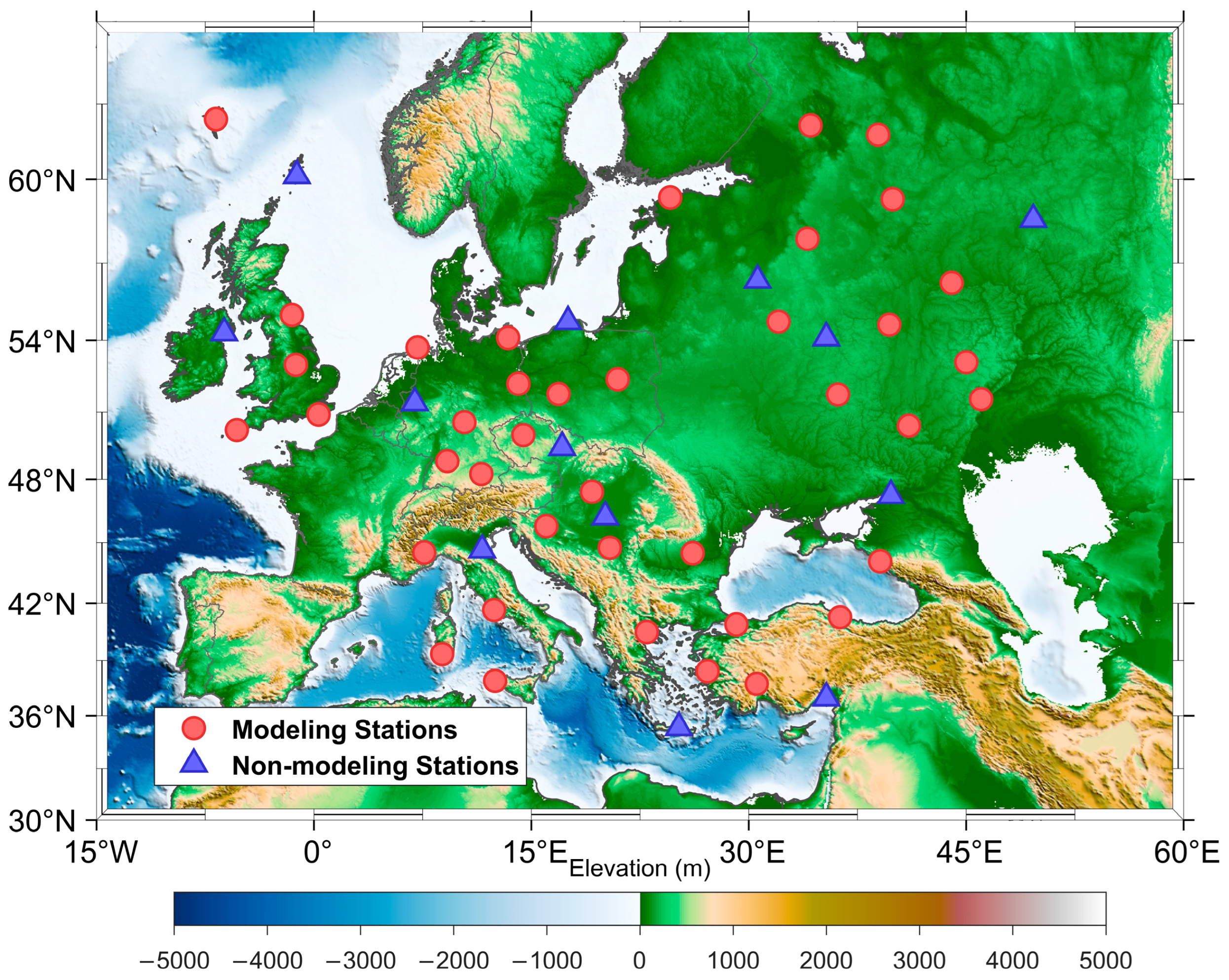
2.1. Study Area
2.2. Calculation of Tm Using Numerical Integration Method
2.3. Selection of Tm Comparative Models and Their Theoretical Basis
- (1)
- The Tm estimated by the Bevis model
- (2)
- The Tm estimated by the ETmPloy model
- (3)
- The Tm estimated by the HGPT2 model
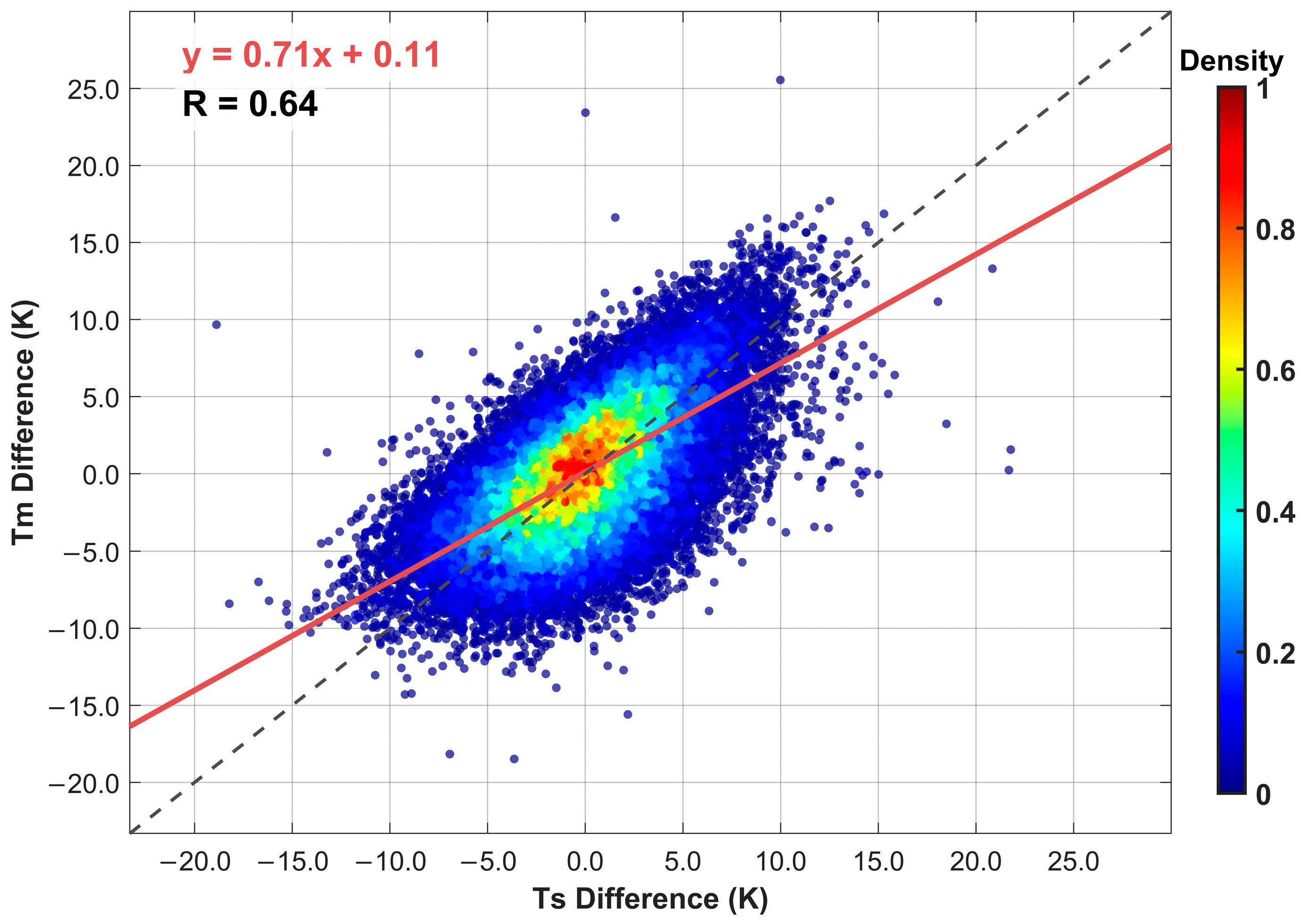
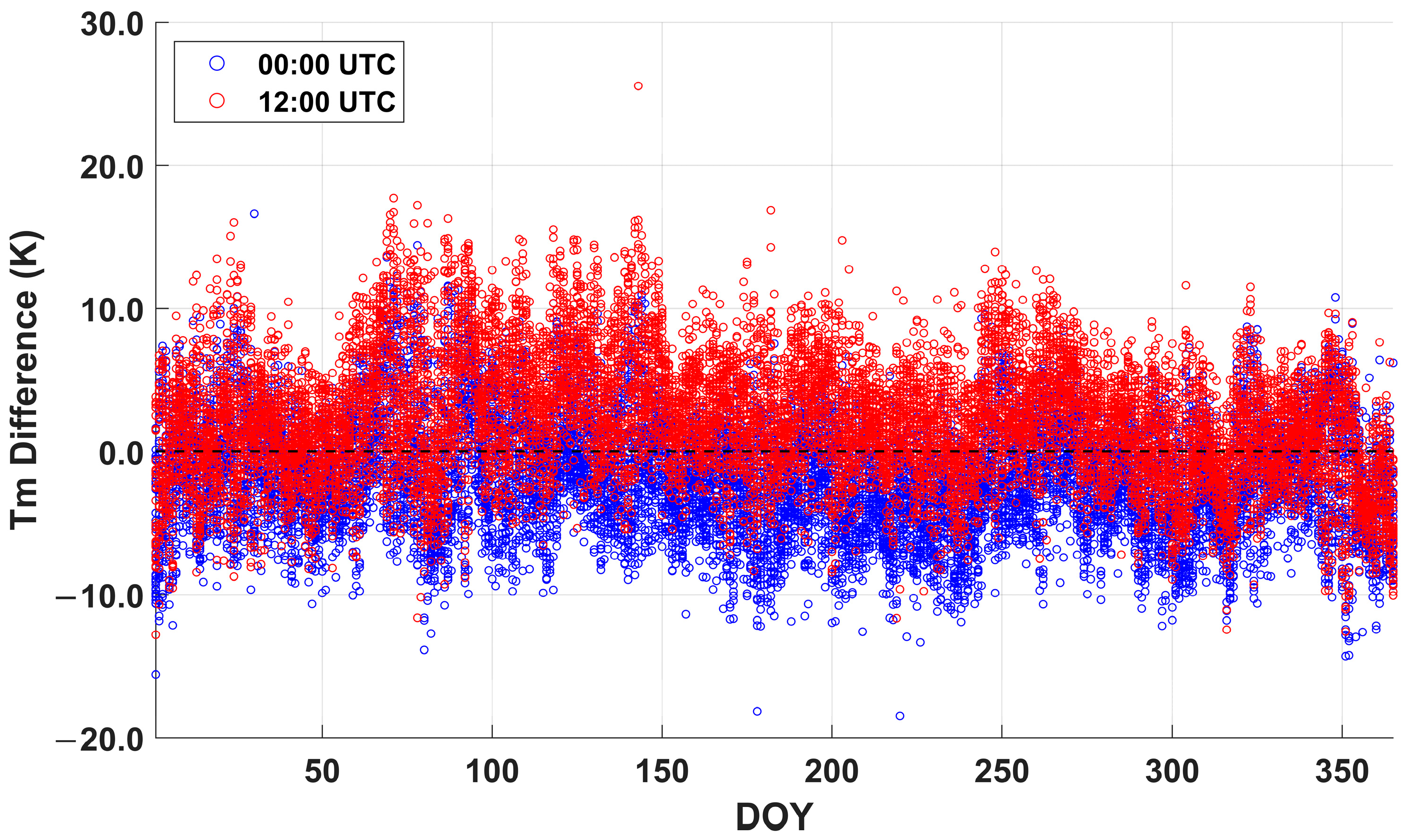
2.4. Development of an Empirically Enhanced Tm Model for the European Region
2.5. Statistical Metrics
3. Accuracy Assessment of Tm Models
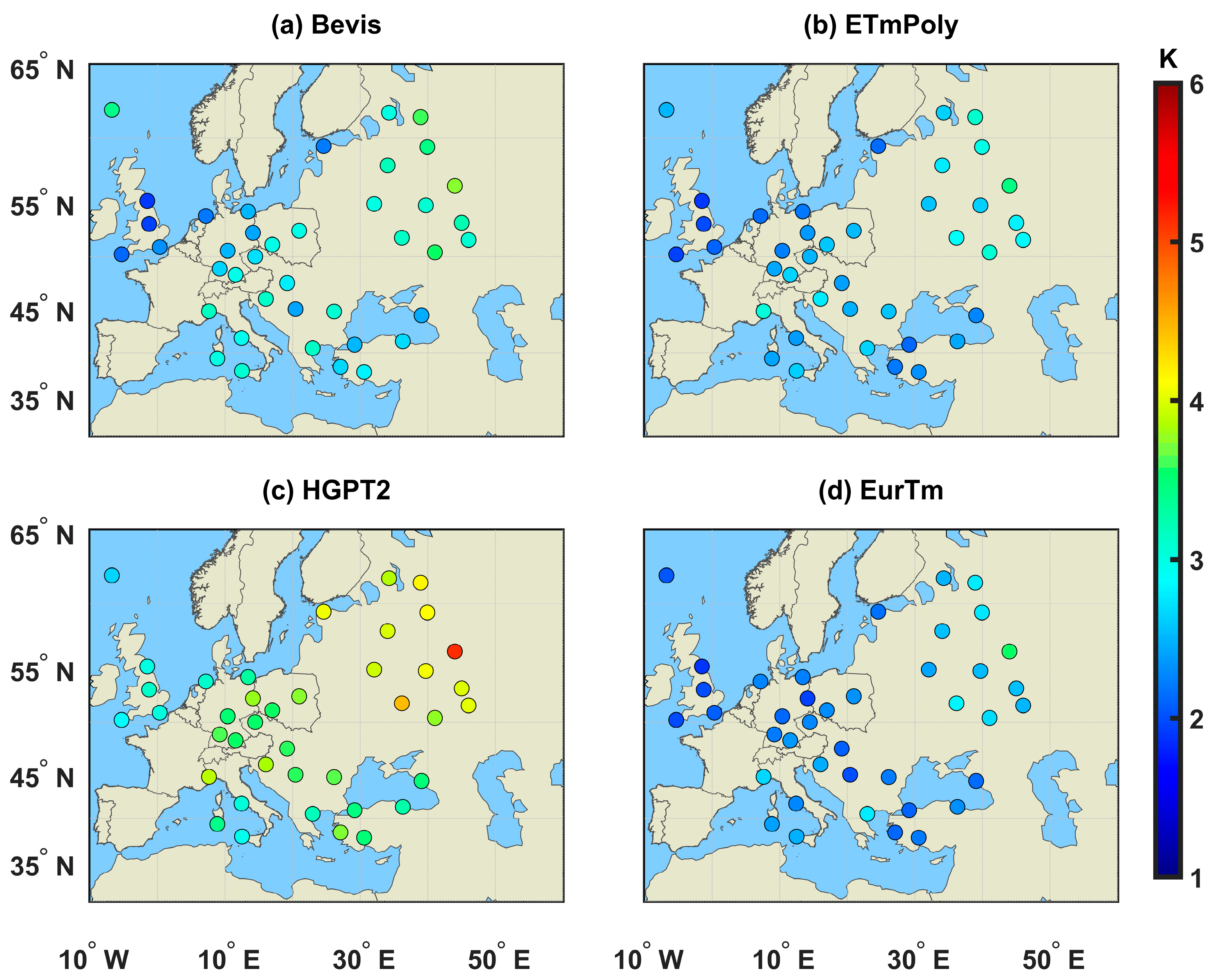
3.1. Accuracy Analysis of Tm Models at Modeling Stations in 2024
3.2. Accuracy Analysis of Tm Models at Non-Modeling Stations in 2024
4. Impact of Tm on GNSS PWV Calculation Accuracy
5. Discussion
6. Conclusions
- (1)
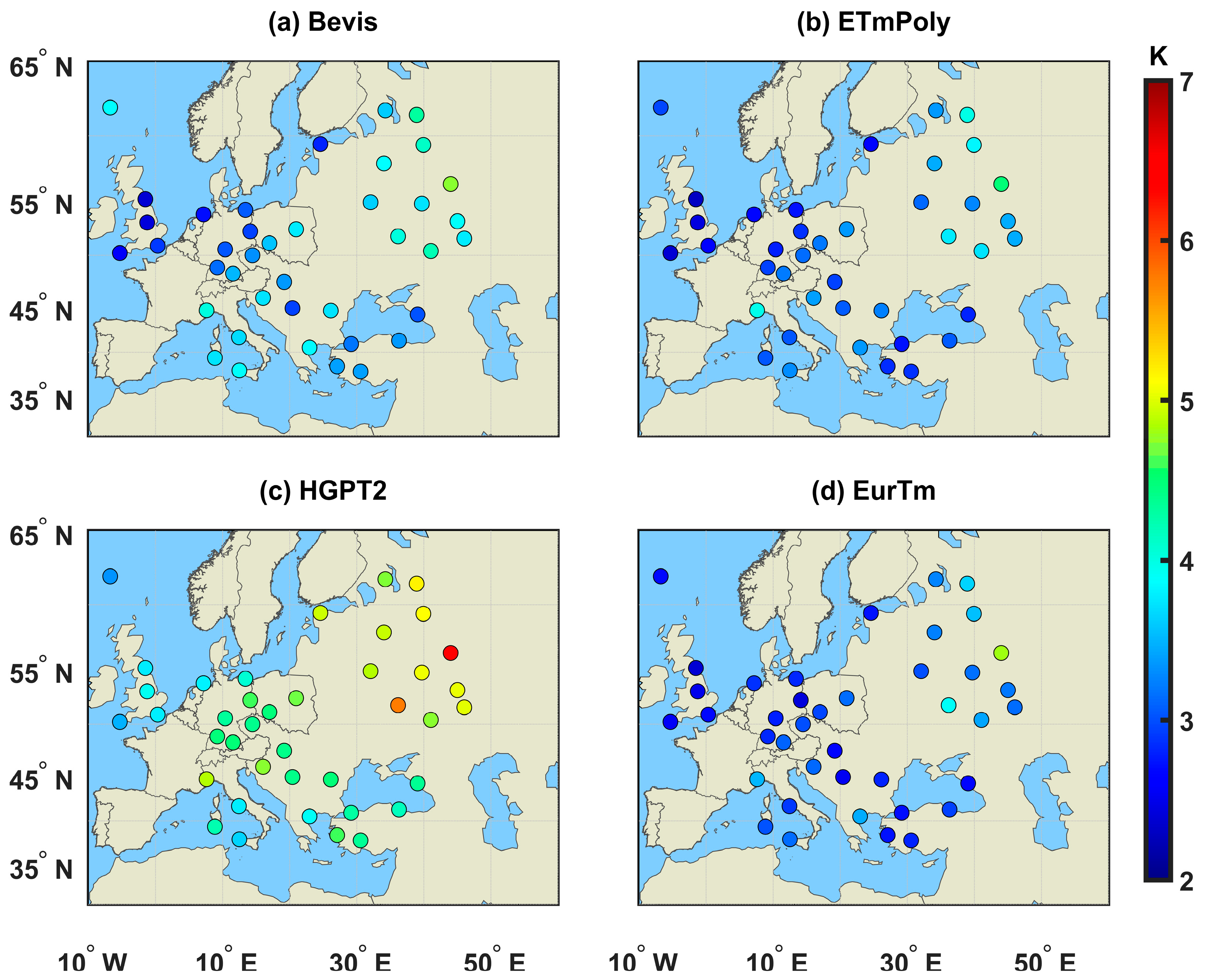
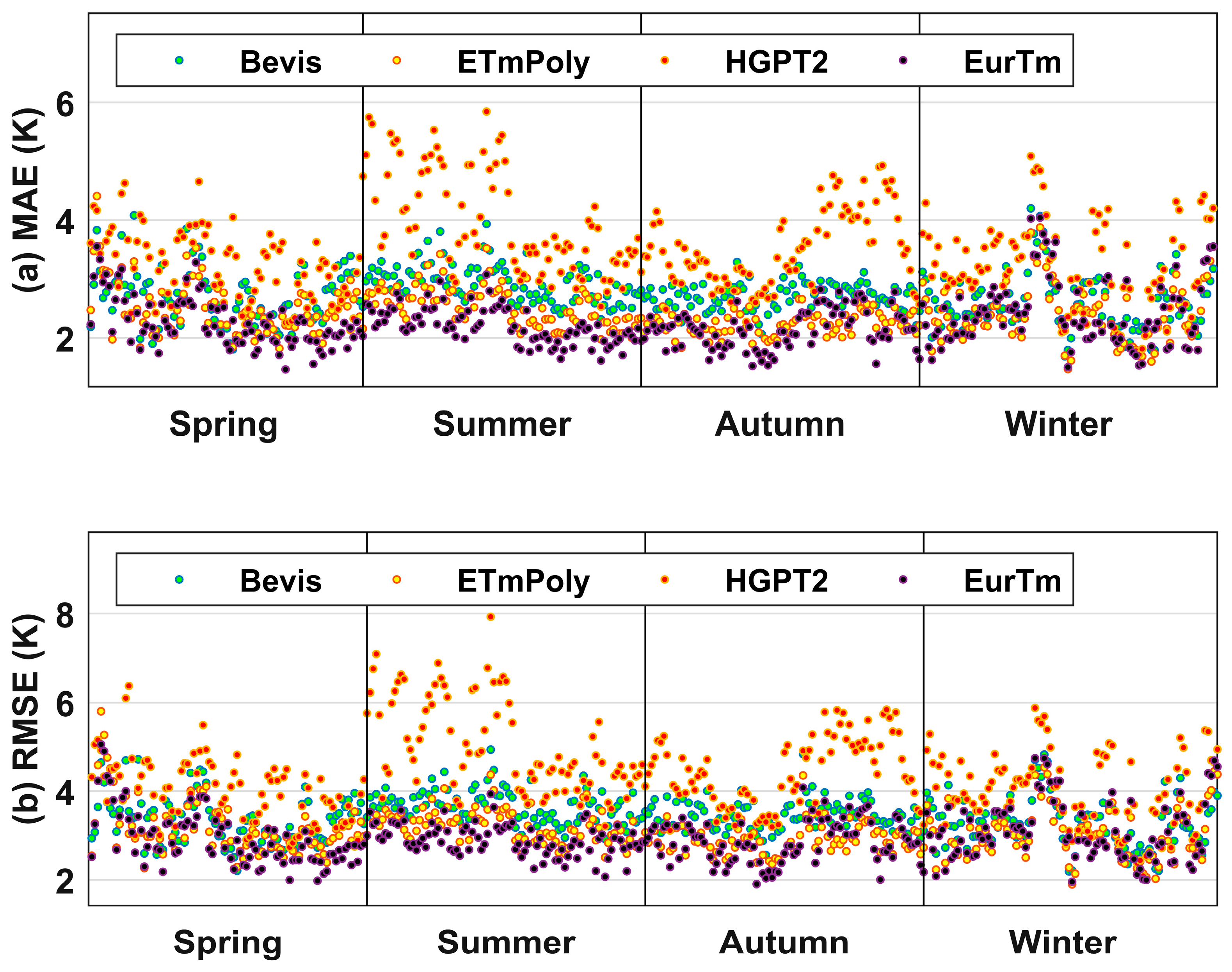
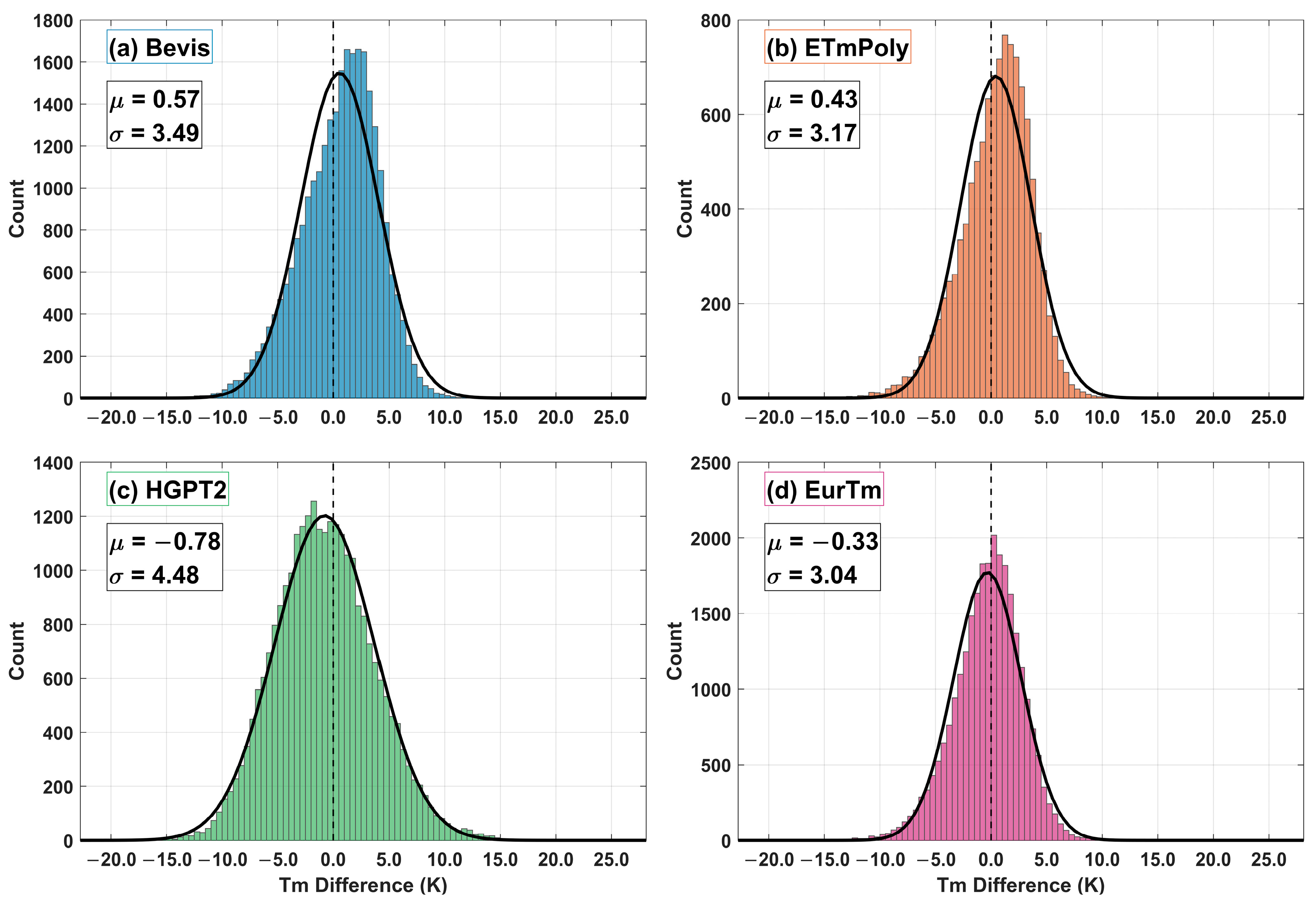
- At the modeling stations, the EurTm model achieved average MAE and RMSE values of 2.35 K and 3.02 K, respectively. Compared to the Bevis, ETmPoly, and HGPT2 models, its accuracy improved by 13.2%, 4.1%, and 32.7%, respectively. In terms of seasonal performance, the EurTm model demonstrated the most stable behavior with the smallest daily error values. Regarding residual distribution, this model exhibited the smallest mean and standard deviation of residuals, indicating significant advantages in both minimal error and highest stability.
- (2)
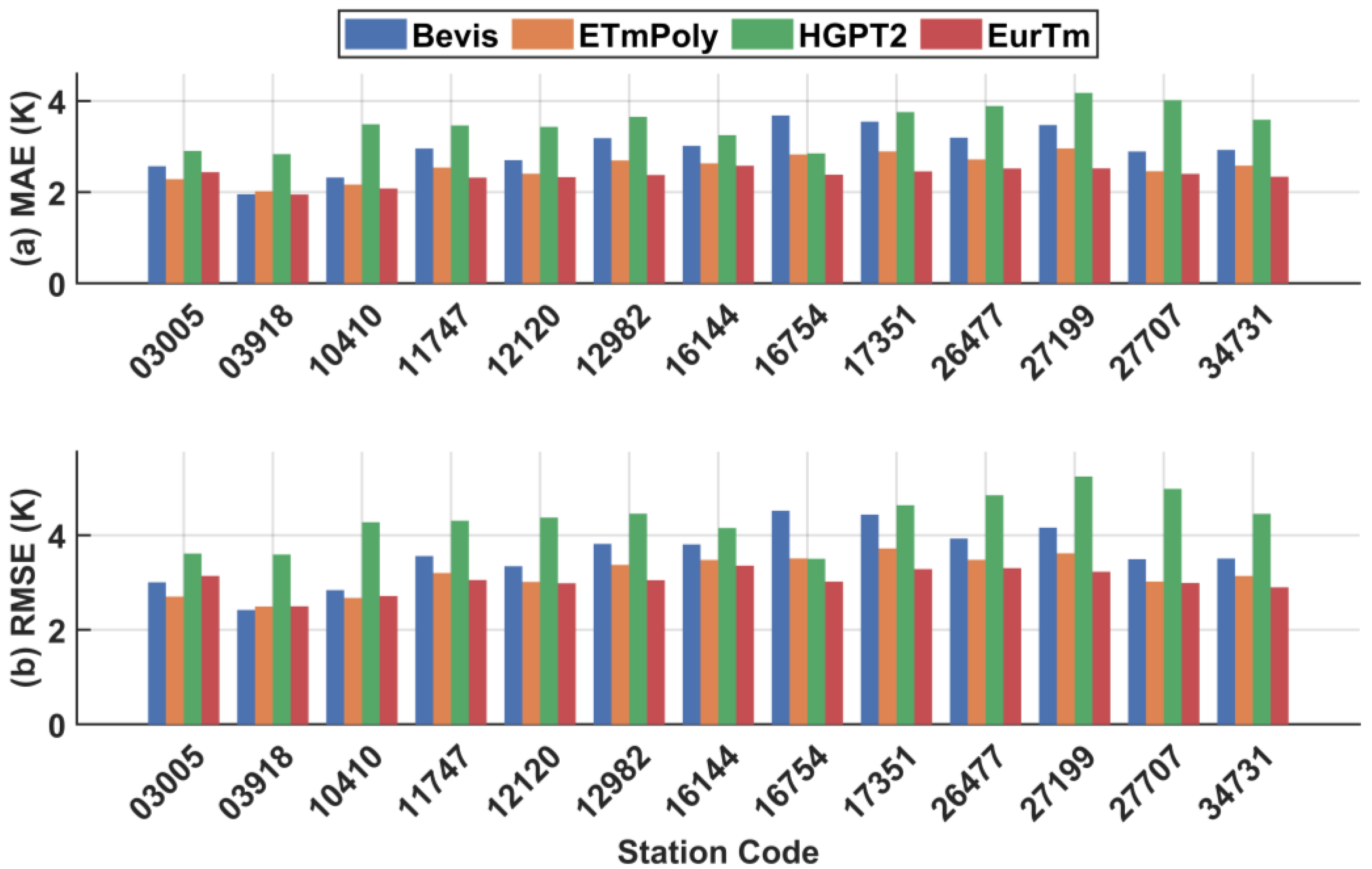
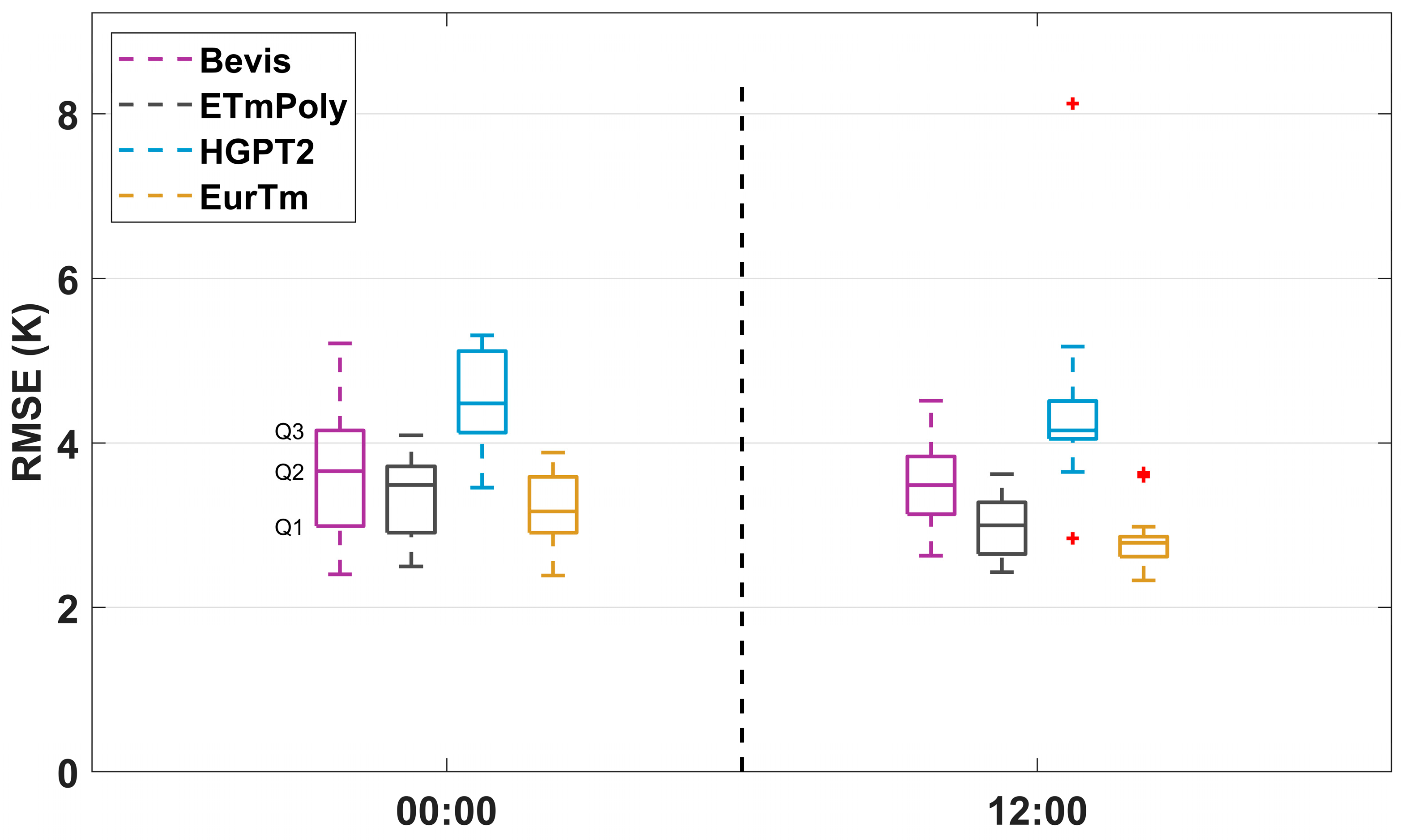
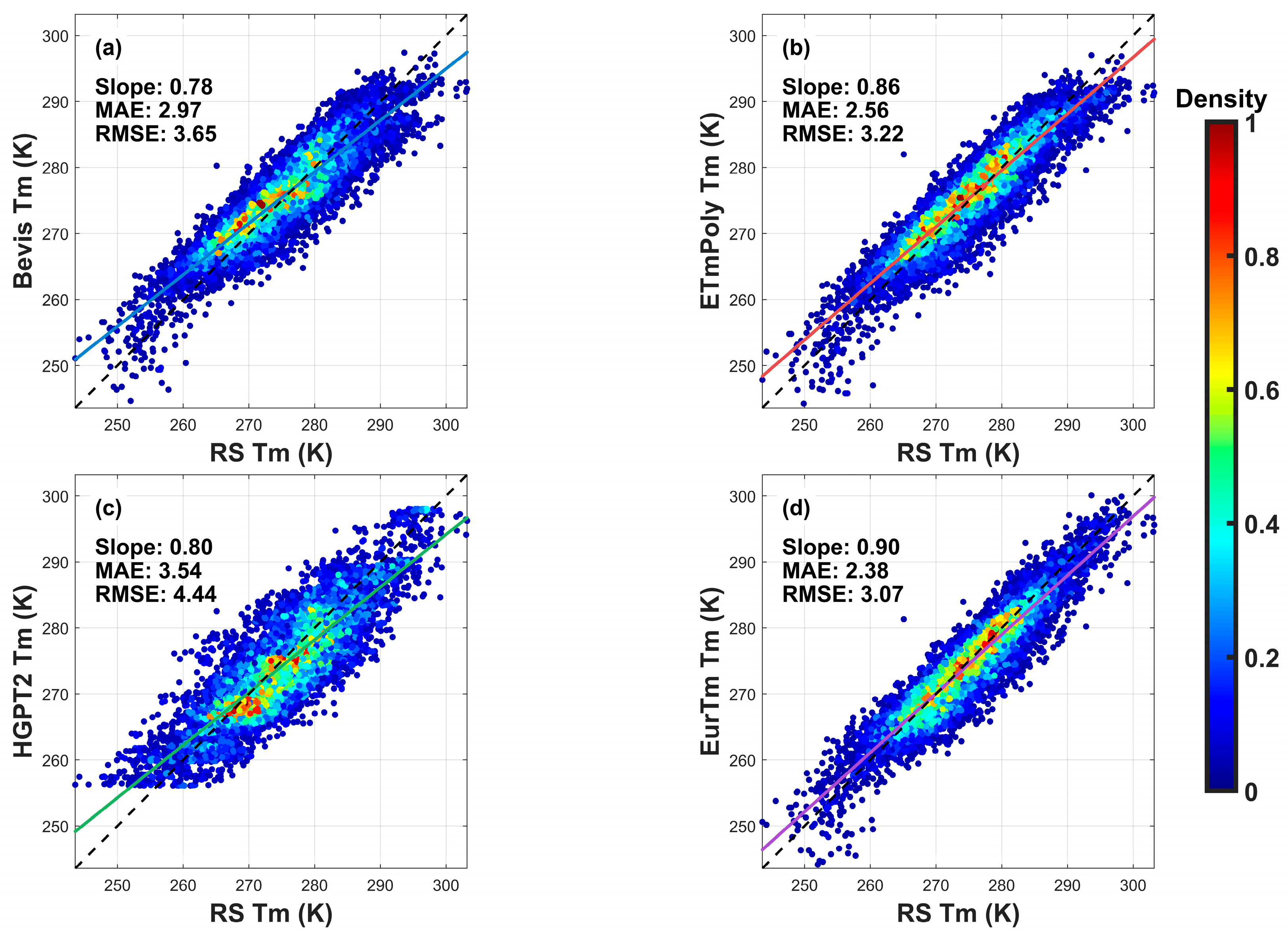
- At the non-modeling stations, the EurTm model achieved average MAE and RMSE values of 2.36 K and 3.04 K, respectively. Compared to the Bevis, ETmPoly, and HGPT2 models, it improved accuracy by 16.1%, 4.7%, and 30.0%. In evaluations across different time periods, the EurTm model demonstrated the best responsiveness to instantaneous variations in Tm. In linear regression with radiosonde-derived Tm values, the model not only exhibited a stronger linear relationship but also successfully overcame the value range limitation observed in the HGPT2 model for Tm estimation.
- (3)
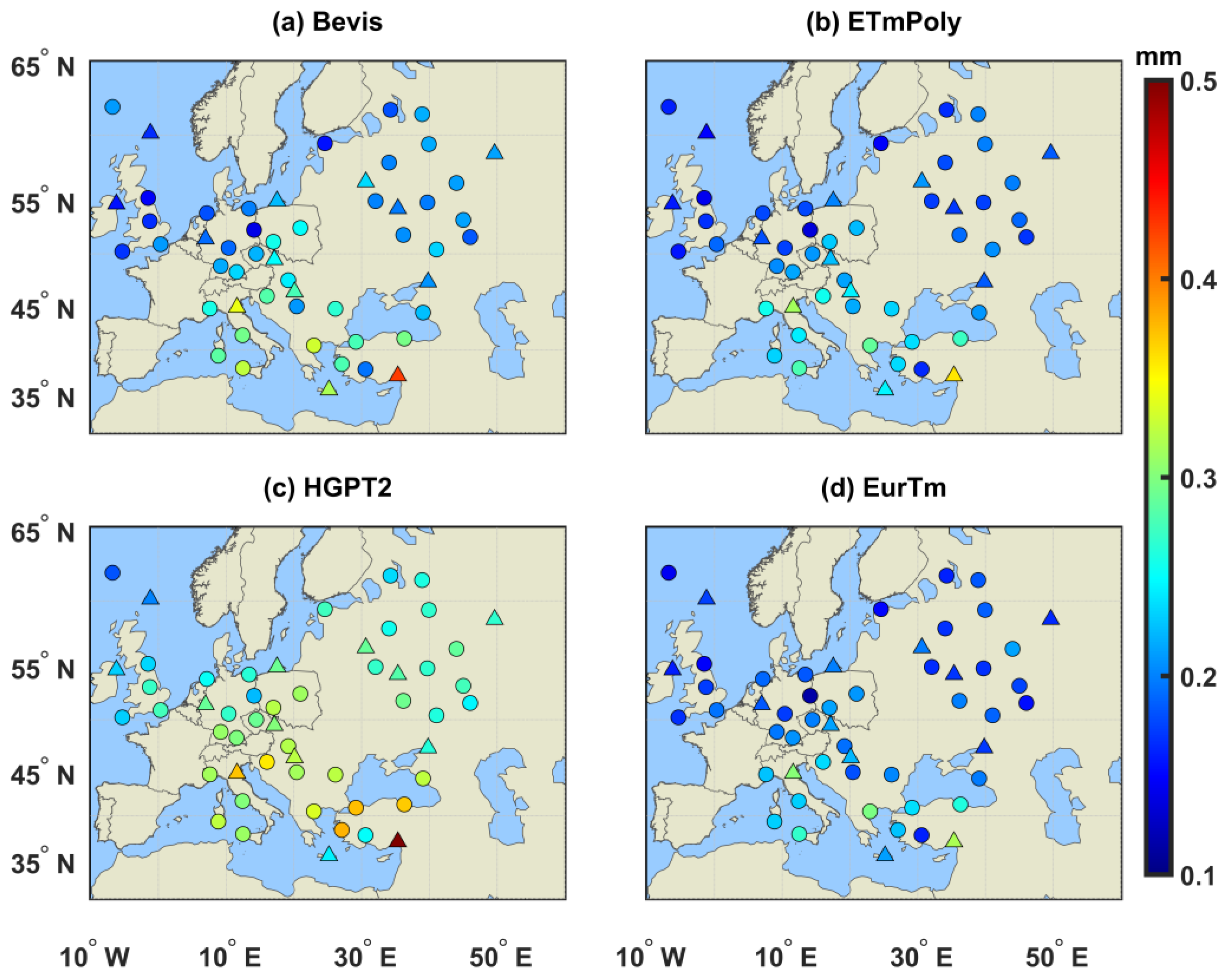
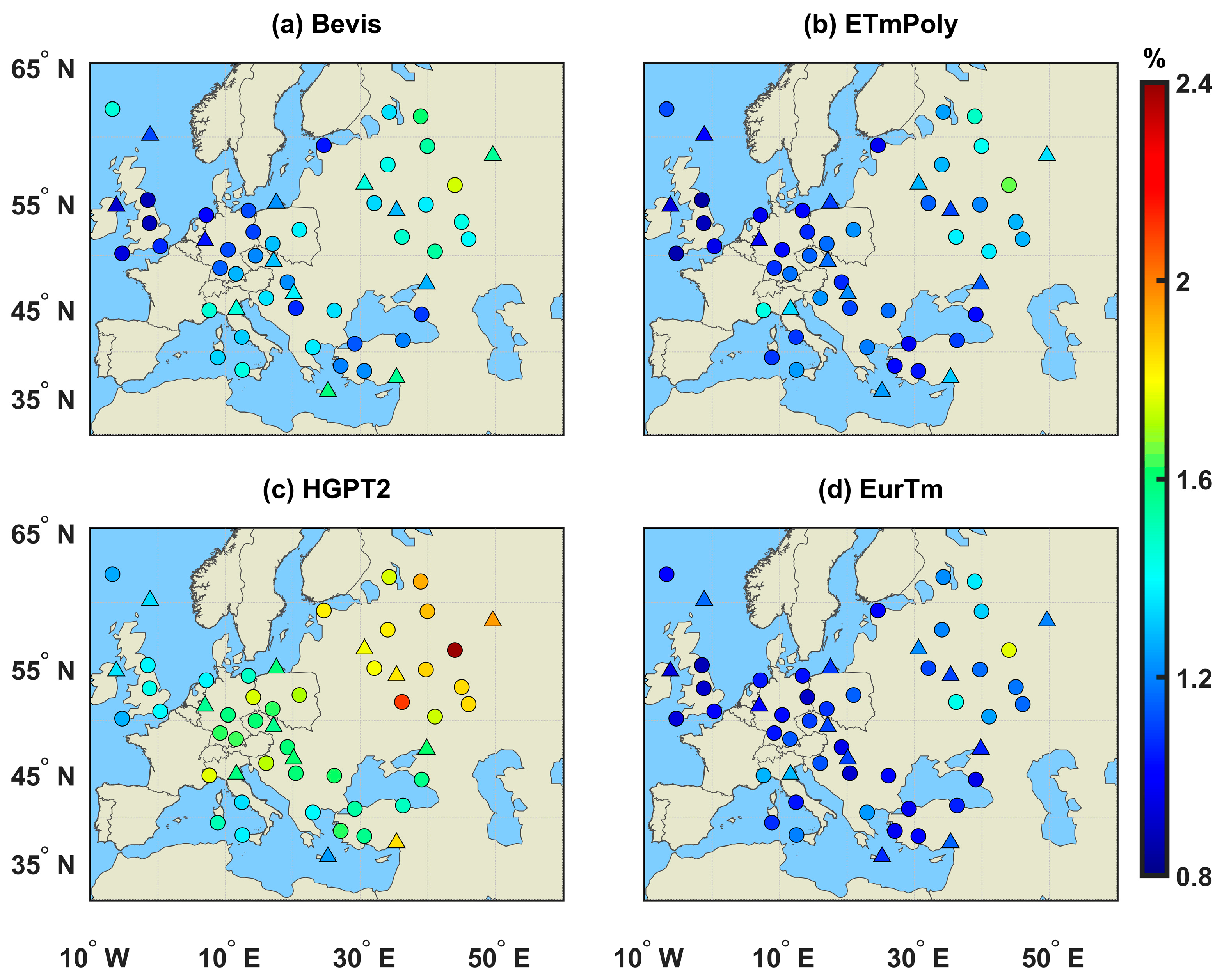
- Analysis of the PWV retrieval accuracy across different models indicates that the EurTm model achieved average RMSEPWV and RMSEPWV/PWV values of 0.20 mm and 1.11%, respectively. These results outperform the other three comparative models, further confirming the superior Tm accuracy of the EurTm model.
Author Contributions
Funding
Data Availability Statement
Acknowledgments
Conflicts of Interest
References
- Huang, L.; Wang, Y.; Bi, H.; Zhu, G.; Liu, L.; Jiang, W. Initial results of atmospheric weighted mean temperature estimation with Pangu-Weather in real-time GNSS PWV retrieval for China. GPS Solut. 2025, 29, 48. [Google Scholar] [CrossRef]
- Zhao, Q.; Liu, Y.; Yao, W.; Yao, Y. Hourly rainfall forecast model using supervised learning algorithm. IEEE Trans. Geosci. Remote Sens. 2021, 60, 4100509. [Google Scholar] [CrossRef]
- Sun, Y.; Yang, F.; Liu, M.; Li, Z.; Gong, X.; Wang, Y. Evaluation of weighted mean temperature derived from multiple reanalysis data over China using radiosonde observations. Atmos. Res. 2023, 284, 106247. [Google Scholar]
- Zhao, Q.; Liu, Y.; Ma, X.; Yao, W.; Yao, Y.; Li, X. An improved rainfall forecasting model based on GNSS observations. IEEE Trans. Geosci. Remote Sens. 2020, 58, 4891–4900. [Google Scholar] [CrossRef]
- Sapucci, L.F. Evaluation of modeling water-vapour-weighted mean tropospheric temperature for GNSS-integrated water vapour estimates in Brazil. J. Appl. Meteorol. Climatol. 2014, 53, 715–730. [Google Scholar] [CrossRef]
- Zhu, D.; Sun, P.; Hu, Q.; Zhang, K.; Wu, S.; He, P.; Yu, A.; Yin, W.; Liu, W. A fusion framework for producing an accurate PWV map with spatiotemporal continuity based on GNSS, ERA5 and MODIS data. IEEE Trans. Geosci. Remote Sens. 2024, 62, 5802214. [Google Scholar] [CrossRef]
- Zhu, D.; Zhang, K.; Sun, P.; Wu, S.; Wan, M. Homogenization of daily precipitable water vapor time series derived from GNSS observations over China. Adv. Space Res. 2023, 72, 1751–1763. [Google Scholar] [CrossRef]
- Bevis, M.; Businger, S.; Herring, A.T.; Rocken, C.; Anthes, R.A.; Ware, R.H. GPS meteorology: Remote sensing of atmospheric water vapor using the global positioning system. J. Geophys. Res. Atmos. 1992, 97, 15787–15801. [Google Scholar] [CrossRef]
- Zhang, B.; Guo, Z.; Liu, X.; Shen, Y.; Yan, J.; Xu, F.; Cui, Y. Bevis Refined Model of Weighted Average Temperature in Hong Kong Considering Multi-Factors. J. Xinyang Norm. Univ. (Nat. Sci. Ed.) 2023, 36, 269–273. [Google Scholar]
- Suresh Raju, C.; Saha, K.; Thampi, B.V.; Parameswaran, K. Empirical model for mean temperature for Indian zone and estimation of precipitable water vapour from ground based GPS measurements. Ann. Geophys. 2007, 25, 1935–1948. [Google Scholar] [CrossRef]
- Mekik, C.; Deniz, I. Modelling and validation of the weighted mean temperature for Turkey. Meteorol. Appl. 2017, 24, 92–100. [Google Scholar] [CrossRef]
- Emardson, T.R.; Derks, H. On the relation between the wet delay and the integrated precipitable water vapour in the european atmosphere. Meteorol. Appl. 2010, 7, 61–68. [Google Scholar] [CrossRef]
- Liu, J.; Yao, Y.; Sang, J. A new weighted mean temperature model in China. Adv. Space Res. 2018, 61, 402–412. [Google Scholar] [CrossRef]
- Zhang, F.; Barriot, J.-P.; Xu, G.; Yeh, T.-K. Metrology Assessment of the Accuracy of Precipitable Water Vapor Estimates from GPS Data Acquisition in Tropical Areas: The Tahiti Case. Remote Sens. 2018, 10, 758. [Google Scholar] [CrossRef]
- Yao, Y.; Zhu, S.; Yue, S. A globally applicable, season-specific model for estimating the weighted mean temperature of the atmosphere. J. Geod. 2012, 86, 1125–1135. [Google Scholar] [CrossRef]
- Lan, Z.; Zhang, B.; Geng, Y. Establishment and analysis of global gridded Tm–Ts relationship model. Geod. Geodyn. 2016, 7, 101–107. [Google Scholar] [CrossRef]
- Yao, Y.; Zhang, B.; Xu, C.; Chen, J. Analysis of the global Tm–Ts correlation and establishment of the latitude-related linear model. Chin. Sci. Bull. 2014, 59, 2340–2347. [Google Scholar] [CrossRef]
- Baldysz, Z.; Nykiel, G. Improved Empirical Coefficients for Estimating Water Vapor Weighted Mean Temperature over Europe for GNSS Applications. Remote Sens. 2019, 11, 1995. [Google Scholar] [CrossRef]
- Li, L.; Li, Y.; He, Q.; Wang, X. Weighted Mean Temperature Modelling Using Regional Radiosonde Observations for the Yangtze River Delta Region in China. Remote Sens. 2022, 14, 1909. [Google Scholar] [CrossRef]
- Bhm, J.; Mller, G.; Schindelegger, M.; Pain, G.; Weber, R. Development of an improved empirical model for slant delays in the troposphere (GPT2w). GPS Solut. 2015, 19, 433–441. [Google Scholar] [CrossRef]
- Landskron, D.; Boehm, J. VMF3/GPT3: Refined discrete and empirical troposphere mapping functions. J. Geod. 2018, 92, 349–360. [Google Scholar] [CrossRef] [PubMed]
- Yao, Y.; Zhang, B.; Yue, S.; Xu, C.; Peng, W. Global empirical model for mapping zenith wet delays onto precipitable water. J. Geod. 2013, 87, 439–448. 21. [Google Scholar] [CrossRef]
- Yao, Y.; Xu, C.; Zhang, B.; Cao, N. GTm-III: A new global empirical model for mapping zenith wet delays onto precipitable water vapour. Geophys. J. Int. 2018, 197, 202–212. [Google Scholar] [CrossRef]
- Sun, Z.; Zhang, B.; Yao, Y. A Global Model for Estimating Tropospheric Delay and Weighted Mean Temperature Developed with Atmospheric Reanalysis Data from 1979 to 2017. Remote Sens. 2019, 11, 1893. [Google Scholar] [CrossRef]
- Huang, L.; Jiang, W.; Liu, L.; Chen, H.; Ye, S. A new global grid model for the determination of atmospheric weighted mean temperature in GPS precipitable water vapor. J. Geod. 2019, 93, 159–176. [Google Scholar] [CrossRef]
- Huang, L.; Liu, L.; Chen, H.; Jiang, W. An improved atmospheric weighted mean temperature model and its impact on GNSS precipitable water vapor estimates for China. GPS Solut. 2019, 23, 51. [Google Scholar] [CrossRef]
- Mateus, P.; Catalão, J.; Mendes, V.B.; Nico, G. An ERA5-Based Hourly Global Pressure and Temperature (HGPT) Model. Remote Sens. 2020, 12, 1098. [Google Scholar] [CrossRef]
- Mateus, P.; Mendes, V.B.; Plecha, S.M. HGPT2: An ERA5-Based Global Model to Estimate Relative Humidity. Remote Sens. 2021, 13, 2179. [Google Scholar] [CrossRef]
- Li, H.; Liu, X.; Zhou, P.; Liu, Z.; Li, M.; Cao, Z. Machine Learning–Based Multiscale Quantification of Long-Term Emission Contributions to PM2.5 Variability in China. Atmos. Pollut. Res. 2025, 102786. [Google Scholar] [CrossRef]
- Benevides, P.; Catalao, J.; Nico, G. Neural Network Approach to Forecast Hourly Intense Rainfall Using GNSS Precipitable Water Vapor and Meteorological Sensors. Remote Sens. 2019, 11, 966. [Google Scholar] [CrossRef]
- Zhang, Q.; Ye, J.; Zhang, S.; Han, F. Precipitable Water Vapor Retrieval and Analysis by Multiple Data Sources: Ground-Based GNSS, Radio Occultation, Radiosonde, Microwave Satellite, and NWP Reanalysis Data. J. Sens. 2018, 2018, 3428303. [Google Scholar] [CrossRef]
- Wang, X.; Zhang, K.; Wu, S.; Fan, S.; Cheng, Y. Water vapor-weighted mean temperature and its impact on the determination of precipitable water vapor and its linear trend. J. Geophys. Res. Atmos. 2016, 121, 833–852. [Google Scholar] [CrossRef]
- Li, H.; Wang, X.; Wu, S.; Zhang, K.; Chen, X.; Qiu, C.; Zhang, S.; Zhang, J.; Xie, M.; Li, L. Development of an Improved Model for Prediction of Short-Term Heavy Precipitation Based on GNSS-Derived PWV. Remote Sens. 2020, 12, 4101. [Google Scholar] [CrossRef]
- Guerova, G.; Jones, J.; Douša, J.; Dick, G.; de Haan, S.; Pottiaux, E.; Bock, O.; Pacione, R.; Elgered, G.; Vedel, H.; et al. Review of the state of the art and future prospects of the ground-based GNSS meteorology in Europe. Atmos. Meas. Tech. 2016, 9, 5385–5406. [Google Scholar] [CrossRef]
- Shen, Y.; Li, P.; Zhang, B.; Wu, T.; Zhu, J.; Li, Q.; Li, W. An Empirical Atmospheric Weighted Average Temperature Enhancement Model in the Yunnan–Guizhou Plateau Considering Surface Temperature. Remote Sens. 2024, 16, 4366. [Google Scholar] [CrossRef]
- Levenberg, K. A method for the solution of certain problems in least squares. Q. Appl. Math. 1944, 2, 164–168. [Google Scholar] [CrossRef]
- Marquardt, W. An algorithm for least-squares estimation of nonlinear parameters. J. Soc. Ind. Appl. Math. 1963, 11, 431–441. [Google Scholar] [CrossRef]
- Zhang, B.; Wang, Z.; Li, W.; Jiang, W.; Shen, Y.; Zhang, Y.; Zhang, S.; Tian, K. An Improved Spatiotemporal Weighted Mean Temperature Model over Europe Based on the Nonlinear Least Squares Estimation Method. Remote Sens. 2022, 14, 3609. [Google Scholar] [CrossRef]

| Model | MAE/K | RMSE/K | ||||
|---|---|---|---|---|---|---|
| Min | Max | Mean | Min | Max | Mean | |
| Bevis | 1.91 | 3.74 | 2.84 | 2.37 | 4.75 | 3.48 |
| ETmPloy | 1.91 | 3.45 | 2.52 | 2.30 | 4.50 | 3.15 |
| HGPT2 | 2.64 | 5.13 | 3.61 | 3.34 | 6.50 | 4.49 |
| EurTm | 1.88 | 3.56 | 2.35 | 2.38 | 4.80 | 3.02 |
| Model | MAE/K | RMSE/K | ||||
|---|---|---|---|---|---|---|
| Min | Max | Mean | Min | Max | Mean | |
| Bevis | 1.95 | 3.68 | 2.96 | 2.42 | 4.52 | 3.60 |
| ETmPloy | 2.02 | 2.96 | 2.55 | 2.49 | 3.72 | 3.19 |
| HGPT2 | 2.84 | 4.18 | 3.49 | 3.50 | 5.24 | 4.34 |
| EurTm | 1.95 | 2.58 | 2.36 | 2.50 | 3.36 | 3.04 |
| Model | RMSEpwv (mm) | RMSEpwv/PWV (%) | ||||
|---|---|---|---|---|---|---|
| Min | Max | Mean | Min | Max | Mean | |
| Bevis | 0.14 | 0.43 | 0.23 | 0.88 | 1.75 | 1.28 |
| ETmPloy | 0.14 | 0.36 | 0.21 | 0.85 | 1.66 | 1.15 |
| HGPT2 | 0.18 | 0.51 | 0.29 | 1.24 | 2.39 | 1.63 |
| EurTm | 0.11 | 0.32 | 0.20 | 0.88 | 1.77 | 1.11 |
Disclaimer/Publisher’s Note: The statements, opinions and data contained in all publications are solely those of the individual author(s) and contributor(s) and not of MDPI and/or the editor(s). MDPI and/or the editor(s) disclaim responsibility for any injury to people or property resulting from any ideas, methods, instructions or products referred to in the content. |
© 2025 by the authors. Licensee MDPI, Basel, Switzerland. This article is an open access article distributed under the terms and conditions of the Creative Commons Attribution (CC BY) license.
Share and Cite
Zhang, B.; Wu, T.; Shen, Y. Atmospheric Weighted Average Temperature Enhancement Model for the European Region Considering Daily Variations and Residual Changes in Surface Temperature. Remote Sens. 2026, 18, 36. https://doi.org/10.3390/rs18010036
Zhang B, Wu T, Shen Y. Atmospheric Weighted Average Temperature Enhancement Model for the European Region Considering Daily Variations and Residual Changes in Surface Temperature. Remote Sensing. 2026; 18(1):36. https://doi.org/10.3390/rs18010036
Chicago/Turabian StyleZhang, Bingbing, Tong Wu, and Yi Shen. 2026. "Atmospheric Weighted Average Temperature Enhancement Model for the European Region Considering Daily Variations and Residual Changes in Surface Temperature" Remote Sensing 18, no. 1: 36. https://doi.org/10.3390/rs18010036
APA StyleZhang, B., Wu, T., & Shen, Y. (2026). Atmospheric Weighted Average Temperature Enhancement Model for the European Region Considering Daily Variations and Residual Changes in Surface Temperature. Remote Sensing, 18(1), 36. https://doi.org/10.3390/rs18010036

