Validation of Downscaled SoilMERGE with NDVI and Storm-Event Analysis in Oklahoma and Kansas


 and
and
Highlights
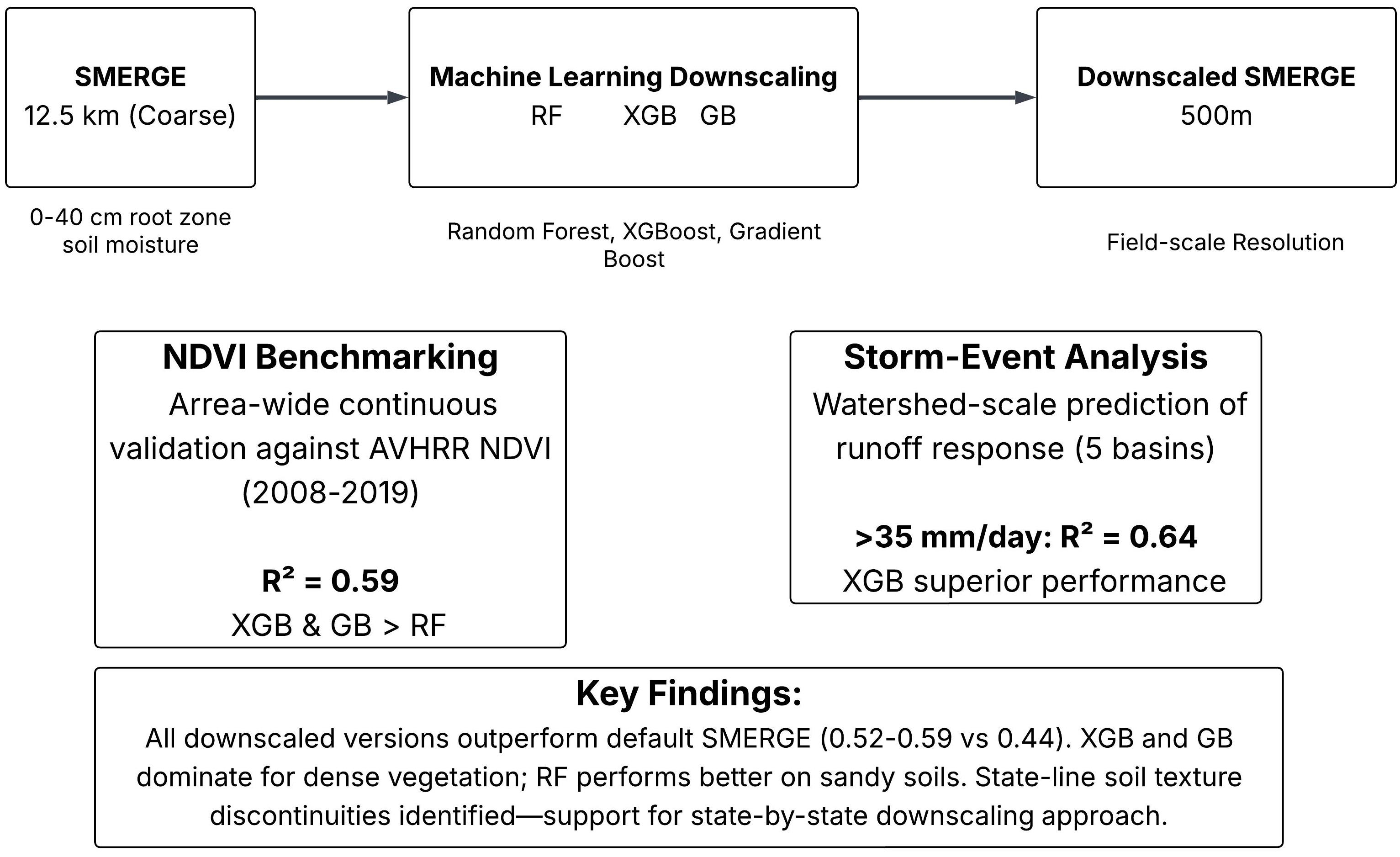
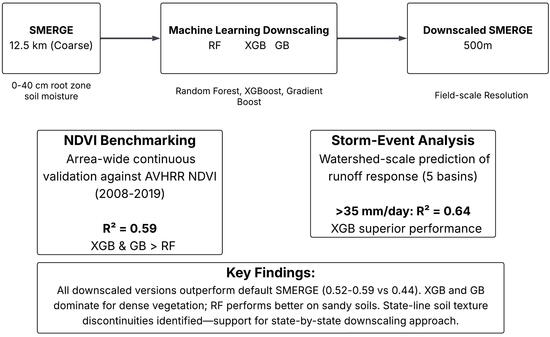
- SoilMERGE (SMERGE) can be successfully downscaled to 500 m via machine learning.
- Extreme Gradient Boosting generally outperforms Gradient Boosting and Random Forest.
- SMERGE can support historical analysis for diverse applications at a field scale.
- This study provides a proof of concept for state-based SMERGE products to be developed across the US Great Plains
Abstract
1. Introduction
2. Materials and Methods
2.1. Data Sets
2.2. Study Area
2.3. Methodology
2.3.1. Date and Precipitation Event Selection
2.3.2. Machine Learning Downscaling
2.3.3. Ranked Correlation Comparisons Between NDVI and SMERGE
2.3.4. Watershed Streamflow Comparison Against Antecedent Soil Moisture
3. Results
4. Discussion
4.1. NDVI Benchmarking Performance Based on Geography
4.2. NDVI Benchmarking Performance Compared Against Previous Studies
4.3. Temporal Analysis of SMERGE NDVI Performance over Time
4.4. Model Comparison and Sensitivity Discussion
4.5. Implications for the Development of State-Wide Versions of SMERGE
5. Conclusions
- (1)
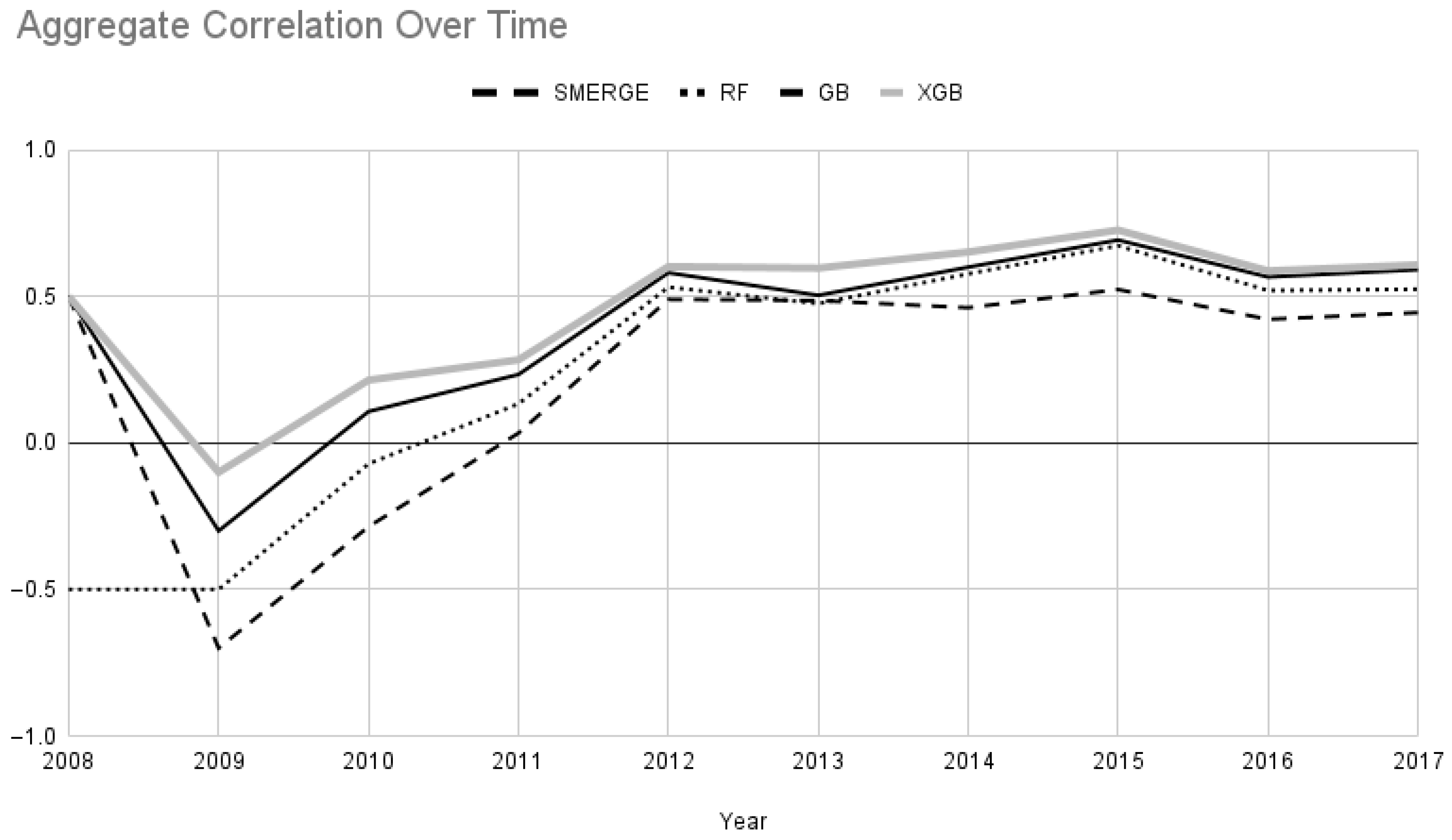
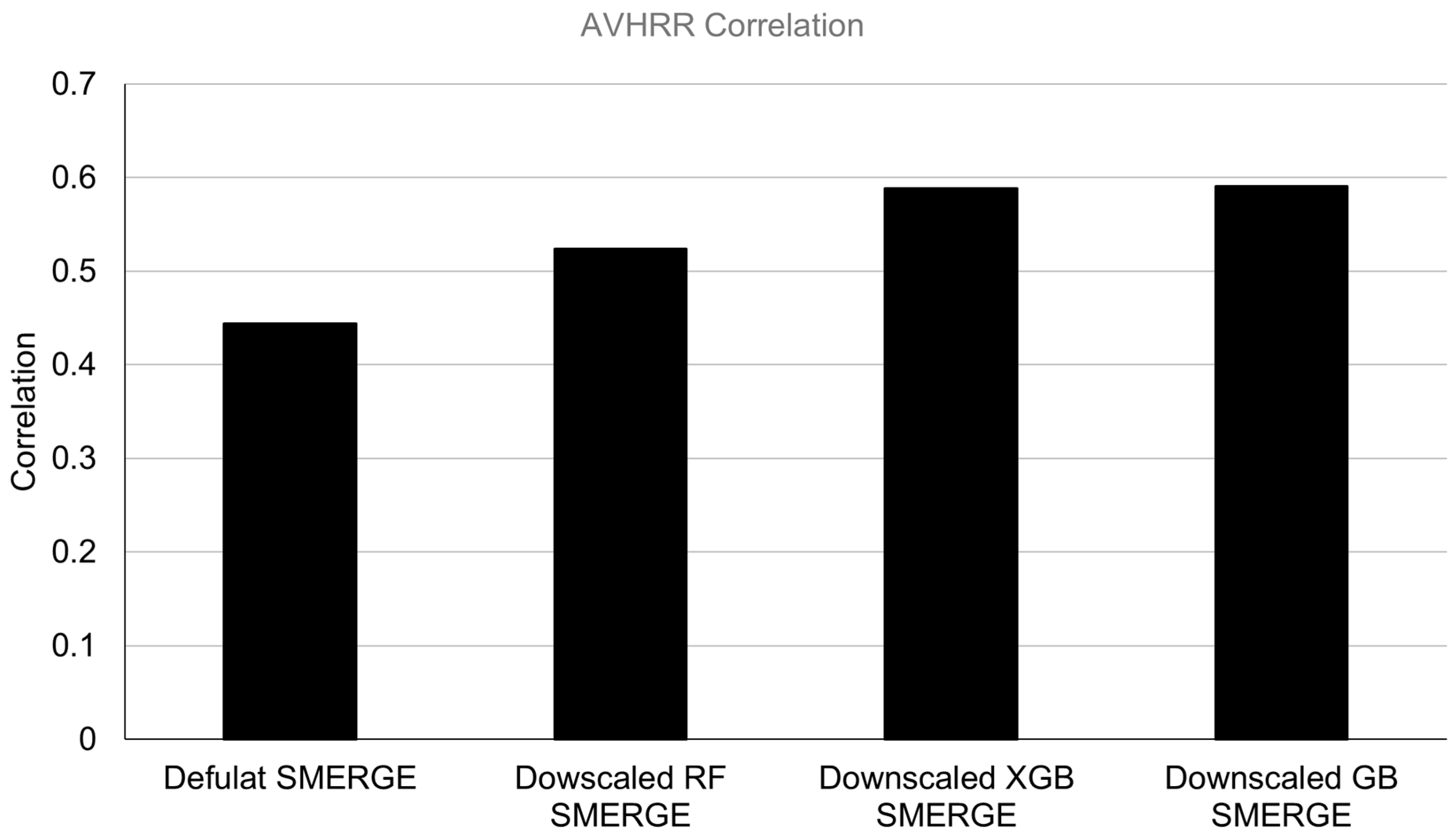
- NDVI benchmarking facilitated performance evaluation over the entire study and was not confined to just in situ sites. Overall, all downscaled versions of SMERGE outperformed the default version of SMERGE. XGB and GB generally, and had higher-ranked correlations than RF.
- (2)
- Improvements in downscaled performance based on NDVI benchmarking are comparable to those observed in previous studies based on in situ comparisons.
- (3)
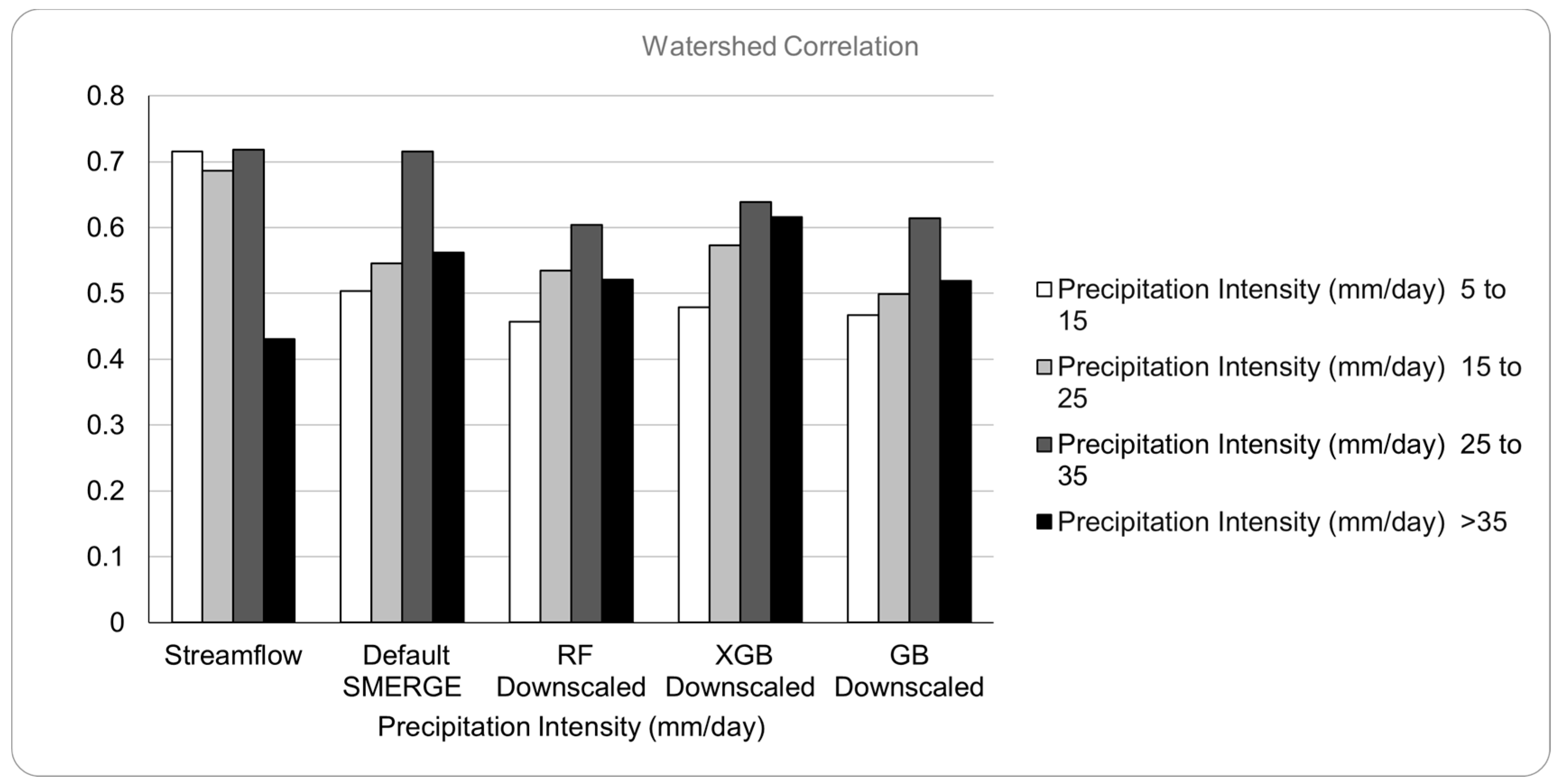
- XGB downscaled SMERGE was a superior predictor of storm event response at a watershed scale for the most intense storm events examined, >35 mm/day. Antecedent XGB downscaled SMERGE outperformed other downscaled versions of SMERGE, default SMERGE, and USGS streamflow for the most intense storm events.
- (4)
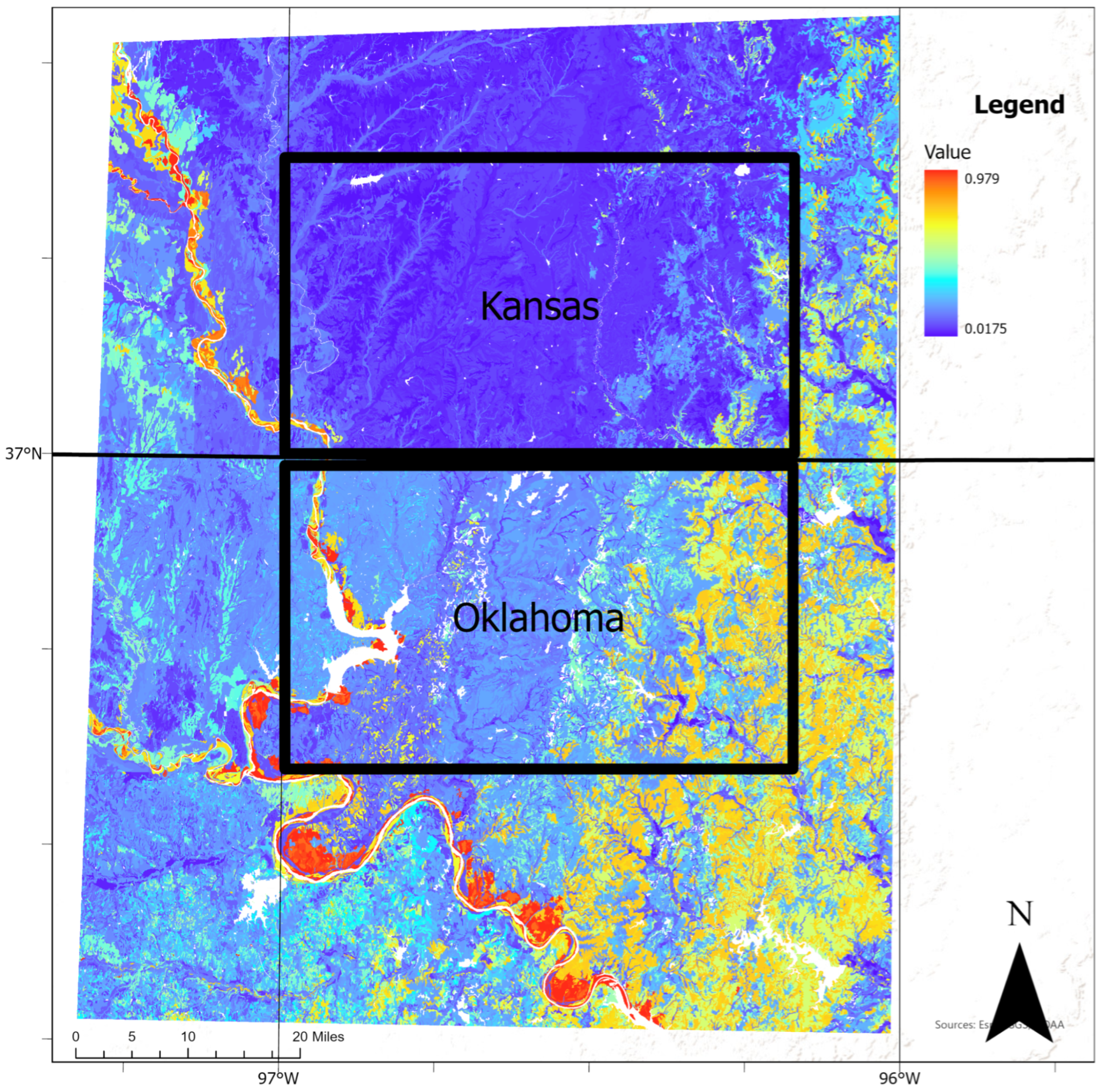
- State line discrepancies in soil texture characterization between Kansas and Oklahoma were propagated into the downscaled version of SMERGE. Based on this finding, the SMERGE team will focus on the development of state versions of SMERGE where soil properties were uniformly characterized.
Author Contributions
Funding
Data Availability Statement
Acknowledgments
Conflicts of Interest
Abbreviations
| SMERGE | SoilMERGE |
| RZSM | Root zone soil moisture |
| NDVI | Normalized Difference Vegetation Index |
| XGB | Extreme Gradient Boosting |
| SMOS | Soil Moisture Ocean Salinity |
| SMAP | Soil Moisture Active Passive |
| ESA | European Space Agency |
| CCI | Climate Change Initiative |
| RF | Random Forest |
| GB | Gradient Boosting |
| LAI | Leaf Area Index |
| MODIS | Moderate Resolution Spectroradiometer Imagining |
| AVHRR | Advanced Very-High-Resolution Radiometer |
| PRISM | Parameter-elevation Regressions on Independent Slopes Model |
| NLCD | National Land Cover Database |
| AIRMOSS | Airborne Microwave Observatory of Subcanopy and Surface |
| DMLC | Distributed (Deep) Machine Learning Community |
| TACC | Texas Advanced Computing Center |
| IMMD | Inverse Mean Minimum Depth |
| SHAP | SHapley Additive exPlanations |
| UTC | Coordinated Universal Time |
| USGS | United States Geological Survey |
| MOISST | Marena Oklahoma Soil Moisture Active Passive In Situ Testbed |
References
- Lawrence, D.M.; Fisher, R.A.; Koven, C.D.; Oleson, K.W.; Swenson, S.C.; Bonan, G.; Collier, N.; Ghimire, B.; van Kampenhout, L.; Kennedy, D.; et al. The Community Land Model version Description of new features, benchmarking, and impact of forcing uncertainty. J. Adv. Model. Earth Syst. 2019, 11, 4245–4287. [Google Scholar] [CrossRef]
- Mahfouf, J.-F.; Noilhan, J. Inclusion of gravitational drainage in a land surface scheme based on the force-restore method. J. Appl. Meteorol. Clim. 1996, 35, 987–992. [Google Scholar] [CrossRef][Green Version]
- Mitchell, K.E.; Lohmann, D.; Houser, P.R.; Wood, E.F.; Schaake, J.C.; Robock, A.; Cosgrove, B.A.; Sheffield, J.; Duan, Q.; Luo, L.; et al. The multi-institution North American Land Data Assimilation System (NLDAS): Utilizing multiple GCIP products and partners in a continental distributed hydrological modeling system. J. Geophys. Res. Atmos. 2004, 109, D07S90. [Google Scholar] [CrossRef]
- Kerr, Y.; Al-Yaari, A.; Rodriguez-Fernandez, N.; Parrens, M.; Molero, B.; Leroux, D.; Bircher, S.; Mahmoodi, A.; Mialon, A.; Richaume, P.; et al. Overview of SMOS performance in terms of global soil moisture monitoring after six years in operation. Remote Sens. Environ. 2016, 180, 40–63. [Google Scholar] [CrossRef]
- Reichle, R.H.; De Lannoy, G.J.M.; Liu, Q.; Ardizzone, J.V.; Colliander, A.; Conaty, A.; Crow, W.; Jackson, T.J.; Jones, L.A.; Kimball, J.S.; et al. Assessment of the SMAP Level-4 surface and root-zone soil moisture product using in situ measurements. J. Hydrometeorol. 2017, 18, 2621–2645. [Google Scholar] [CrossRef]
- Dorigo, W.; Wagner, W.; Albergel, C.; Albrecht, F.; Balsamo, G.; Brocca, L.; Chung, D.; Ertl, M.; Forkel, M.; Gruber, A.; et al. ESA CCI Soil Moisture for improved Earth system understanding: State-of-the art and future directions. Remote Sens. Environ. 2017, 203, 185–215. [Google Scholar] [CrossRef]
- Reichle, R.H.; Crow, W.T.; Koster, R.D.; Sharif, H.O.; Mahanama, S.P.P. Contribution of soil moisture retrievals to land data assimilation products. Geophys. Res. Lett. 2008, 35, L01404. [Google Scholar] [CrossRef]
- Albergel, C.; Ruediger, C.; Pellarin, T.; Calvet, J.-C.; Fritz, N.; Froissard, F.; Suquia, D.; Petitpa, A.; Piguet, B.; Martin, E. From near-surface to root-zone soil moisture using an exponential filter: An assessment of the method based on in-situ observations and model simulations. Hydrol. Earth Syst. Sci. 2008, 12, 1323–1337. [Google Scholar] [CrossRef]
- Wagner, W.; Lemoine, G.; Rott, H. A method for estimating soil moisture from ERS scatterometer and soil data. Remote Sens. Environ. 1999, 70, 191–207. [Google Scholar] [CrossRef]
- Tobin, K.; Sanchez, A.; Esparza, D.; Garcia, M.; Ganta, D.; Bennett, M. Machine Learning Downscaling of SoilMERGE in the United States Southern Great Plains. Remote Sens. 2023, 15, 5120. [Google Scholar] [CrossRef]
- Crow, W.T.; Berg, A.A.; Cosh, M.H.; Loew, A.; Mohanty, B.P.; Panciera, R.; de Rosnay, P.; Ryu, D.; Walker, J.P. Upscaling sparse ground-based soil moisture observations for the validation of coarse-resolution satellite soil moisture products. Rev. Geophys. 2012, 50, RG2002. [Google Scholar] [CrossRef]
- Dangol, S.; Zhang, X.; Liang, X.; Blanc-Betes, E. Advancing the SWAT model to simulate perennial bioenergy crops: A case study on switchgrass growth. Environ. Model. Softw. 2023, 170, 105834. [Google Scholar] [CrossRef]
- Wang, M.; Wyatt, B.M.; Ochsner, T.E. Accurate statistical seasonal streamflow forecasts developed by incorporating remote sensing soil moisture and terrestrial water storage anomaly information. J. Hydrol. 2023, 626, 130154. [Google Scholar] [CrossRef]
- Tobin, K.J.; Crow, W.T.; Dong, J.; Bennett, M.E. Validation of a new soil moisture product Soil MERGE. IEEE J. Sel. Top. Appl. Earth Obs. Remote Sens. 2019, 12, 3351–3365. [Google Scholar] [CrossRef]
- Bolten, J.D.; Crow, W.T. Improved prediction of quasi-global vegetation conditions using remotely-sensed surface soil mois ture. Geophys. Res. Lett. 2012, 39, L19406. [Google Scholar] [CrossRef]
- Crow, W.T.; Chen, F.; Reichle, R.H.; Liu, Q. L band microwave remote sensing and land data assimilation improve the representation of prestorm soil moisture conditions for hydrologic forecasting. Geophys. Res. Lett. 2017, 44, 5495–5503. [Google Scholar] [CrossRef]
- Zhao, W.; Sánchez, N.; Lu, H.; Li, A. A spatial downscaling approach for the SMAP passive surface soil moisture product using random forest regression. J. Hydrol. 2018, 563, 1009–1024. [Google Scholar] [CrossRef]
- Abowarda, A.S.; Bai, L.; Zhang, C.; Long, D.; Li, X.; Huang, Q.; Sun, Z. Generating surface soil moisture at 30 m spatial resolution using both data fusion and machine learning toward better water resources management at the field scale. Remote Sens. Environ. 2021, 255, 112301. [Google Scholar] [CrossRef]
- Xu, J.; Su, Q.; Li, X.; Ma, J.; Song, W.; Zhang, L.; Su, X. A Spatial Downscaling Framework for SMAP Soil Moisture Based on Stacking Strategy. Remote Sens. 2024, 16, 200. [Google Scholar] [CrossRef]
- Mahmood, T.; Löw, J.; Pöhlitz, J.; Wenzel, J.L.; Conrad, C. Estimation of 100 m root zone soil moisture by downscaling 1 km soil water index with machine learning and multiple geodata. Environ. Monit. Assess. 2024, 196, 823. [Google Scholar] [CrossRef] [PubMed] [PubMed Central]
- Sahaar, S.A.; Niemann, J.D. Estimating Rootzone Soil Moisture by Fusing Multiple Remote Sensing Products with Machine Learning. Remote Sens. 2024, 16, 3699. [Google Scholar] [CrossRef]
- Francis, D.M.; Bryson, L.S. Proposed methodology for site-specific soil moisture obtainment utilizing coarse satellite-based data. Environ. Earth Sci. 2023, 82, 377. [Google Scholar] [CrossRef]
- Kovačević, J.; Cvijetinović, Z.; Stančić, N.; Brodić, N.; Mihajlović, D. New Downscaling Approach Using ESA CCI SM Products for Obtaining High Resolution Surface Soil Moisture. Remote Sens. 2020, 12, 1119. [Google Scholar] [CrossRef]
- Zappa, L.; Forkel, M.; Xaver, A.; Dorigo, W. Deriving field scale soil moisture from satellite observations and ground measurements in a hilly agricultural region. Remote Sens. 2019, 11, 2596. [Google Scholar] [CrossRef]
- Liu, Y.; Xia, X.; Yao, L.; Jing, W.; Zhou, C.; Huang, W.; Li, Y.; Yang, J. Downscaling satellite retrieved soil moisture using Regression tree-based machine learning algorithms over Southwest France. Earth Space Sci. 2020, 7, e2020EA001267. [Google Scholar] [CrossRef]





| Data Sets | Description | Download URL | Spatial Resolution |
|---|---|---|---|
| ML Static | |||
| Elevation | USGS Elevation Products (3DEP), 1/3 arc-sec DEM | TNM Download v2 (https://www.nationalmap.gov) | 10 m |
| Soil Texture | Gridded National Soil Survey Geographic Database (gNATOSGO) from which sand, silt, and clay values were derived | https://www.nrcs.usda.gov/resources/data-and-reports/gridded-national-soil-survey-geographic-database-gnatsgo | 30 m |
| ML Dynamic | |||
| RZSM | SMERGE-Noah-CCI root zone soil moisture 0–40 cm L4 daily V2.0 (SMERGE_ RZSM0_40CM): | https://www.tamiu.edu/cees/smerge/data.shtml | 12.5 km |
| Albedo | MCD15A3H v061 MODIS/Terra + Aqua MCD43A3 v061 MODIS/Terra + Aqua BRDF/Albedo Albedo Daily L3 Global 500 m | https://www.earthdata.nasa.gov/data/catalog/lpcloud-mcd43a3-061 | 500 m |
| LAI | MCD15A3H v061 MODIS/Terra + Aqua Leaf Area Index/FPAR 4-Day L4 Global 500 m SIN | https://www.earthdata.nasa.gov/data/catalog/lpcloud-mcd15a3h-061 | 500 m |
| NDVI-1 | Temporally Smoothed Weekly AQUA Collect 6 (C6) Moderate Resolution Imaging Spectroradiometer (MODIS) Normalized Difference Vegetation Index (NDVI) | Remote Sensing Phenology CONUS 250 m Smoothed NDVI (https://phenology.cr.usgs.gov/get_data_smNDVI.php) | 250 m |
| Daily mean temperature | PRISM daily mean temperature, calculated as (tmax + tmin)/2 | https://data.prism.oregonstate.edu/time_series/us/an/4km/tmean/daily/ | 4 km |
| Other Data | |||
| Daily mean precipitation | PRISM daily mean precipitation | https://data.prism.oregonstate.edu/time_series/us/an/4km/ppt/daily/ | 4 km |
| Land Cover | National Land Cover Database | https://www.usgs.gov/centers/eros/science/national-land-cover-database | 30 m |
| NDVI-2 | NOAA Climate Data Record (CDR) of AVHRR Normalized Difference Vegetation Index (NDVI) Version 5 | https://www.ncei.noaa.gov/products/climate-data-records/normalized-difference-vegetation-index | 5 km |
| USGS Outlet Number | Sand | Silt | Clay | |
|---|---|---|---|---|
| Watershed—Bird Creek | 7,177,500 | 38.8% | 39.1% | 22.2% |
| Watershed—Chikaskia River | 7,152,000 | 35.5% | 42.9% | 21.7% |
| Watershed—Little Arkansas River | 7,144,200 | 21.7% | 48.8% | 29.5% |
| Watershed—North Folk Ninnescah | 7,144,750 | 65.9% | 20.5% | 13.6% |
| Watershed—Walnut River | 7,147,800 | 7.8% | 55.2% | 37.0% |
| Overall Study Area | - | 33.9% | 42.2% | 23.9% |
| USGS Outlet Number | A | B | C | |
|---|---|---|---|---|
| Watershed—Bird Creek | 7,177,500 | 65.9% | 1.5% | 32.6% |
| Watershed—Chikaskia River | 7,152,000 | 97.1% | 0.2% | 2.9% |
| Watershed—Little Arkansas River | 7,144,200 | 96.2% | 0.6% | 3.8% |
| Watershed—North Folk Ninnescah | 7,144,750 | 96.4% | 0.4% | 3.5% |
| Watershed—Walnut River | 7,147,800 | 93.6% | 0.6% | 6.3% |
| Overall Study Area | - | 91.8% | 0.2% | 8.0% |
| Basin Name | USGS Outlet Number | Basin Size (km2) | Annual Avg. P (mm) | Avg. Storm Event Q Ratio |
|---|---|---|---|---|
| Bird Creek near Sperry, OK, USA | 7,177,500 | 2349 | 953 | 0.0789 |
| Chikaskia River near Blackwell, OK, USA | 7,152,000 | 4851 | 847 | 0.0105 |
| Little Arkansas River at Valley Center | 7,144,200 | 3237 | 827 | 0.0167 |
| North Folk Ninnescah River AB Cheney RE, USA | 7,144,750 | 1424 | 752 | 0.0112 |
| Walnut River at Winfield, KS, USA | 7,147,800 | 4869 | 976 | 0.0309 |
| Year | Dates |
|---|---|
| 2008 | 24 April, 8 May, 27 May, 9 June, 27 June, 13 July, 18 July, 19 July, 29 July, 30 July, 10 August, 25 August, 12 September, 7 October, 15 October, 23 October |
| 2009 | 19 April, 27 April, 8 May, 16 May, 27 May, 3 June, 13 June, 21 June, 9 July, 21 July, 1 August, 18 August, 9 September, 26 September, 9 October, 22 October, 29 October, 30 October |
| 2010 | 23 April, 30 April, 13 May, 20 May, 25 May, 31 May, 13 June, 14 June, 5 July, 15 July, 16 July, 25 July, 17 August, 18 August, 24 August, 1 September, 16 September, 24 September |
| 2011 | 25 April, 12 May, 31 May, 17 June, 13 July, 4 August, 10 August, 13 August, 18 September, 22 September, 10 October |
| 2012 | 20 March, 14 April, 15 April, 1 May, 31 May, 3 June, 4 June, 15 June, 21 June, 15 August, 25 August, 26 August, 14 September, 27 September, 13 October, 14 October |
| 2013 | 2 May, 8 May, 9 May, 20 May, 30 May, 17 June, 28 June, 14 July, 30 July, 16 August, 30 August, 20 September, 28 September, 5 October, 29 October |
| 2014 | 12 May, 24 May, 26 May, 10 June, 15 June, 29 June, 1 July, 10 July, 11 July, 17 July, 18 July, 31 July, 10 August, 29 August, 1 September, 2 September, 6 September, 24 September, 25 September, 13 October, 4 November |
| 2015 | 26 March, 17 April, 27 April, 24 May, 27 May, 29 May, 12 June, 15 June, 18 June, 7 July, 10 July, 21 July, 31 July, 5 August, 10 August, 18 August, 23 August, 29 August, 9 September, 11 September, 26 September, 9 October, 31 October |
| 2016 | 11 April, 27 April, 30 April, 17 May, 31 May, 1 June, 24 June, 3 July, 6 July, 15 July, 29 July, 12 August, 26 August, 1 September, 9 September, 10 September, 17 September, 25 September, 7 October, 26 October |
| 2017 | 29 March, 5 April, 20 April, 22 April, 3 May, 11 May, 20 May, 18 June, 30 June, 9 July, 14 July, 23 July, 6 August, 10 August, 17 August, 18 September, 26 September, 27 September, 5 October, 7 October, 15 October |
| 2018 | 22 April, 26 April, 3 May, 10 May, 19 May, 20 May, 30 May, 31 May, 12 June, 25 June, 1 July, 14 July, 18 July, 29 July, 7 August, 3 September, 21 September, 22 September |
| 2019 | 14 April, 18 April, 24 April |
| Random Forest (Version 0.13.0) |
| Num_trees = 500 Max_depth = 20 Min_examples = 5 Split_axis = “SPARSE_OBLIQUE” Sparse_oblique_projection_density_factor = 1.0 Sparse_oblique_normalization = “MIN_MAX“ Sparse_oblique_weights = “CONTINUOUS” Categorical_algorithm = “RANDOM” Winner_take_all = True Num_threads = 50 |
| XGBoost (Version 1.6.2) |
| Colsample_bytree = 1.0 Device = “gpu” Learning_rate = 0.005 Max_depth = 13 N_estimators = 1500 Subsample = 0.8 Tree_method = “hist” |
| Gradient Boost (Version 1.0.2) |
| N_estimators = 1000 Subsample = 0.817 Min_samples_split = 9 Min_samples_leaf = 4 Max_features = 4 Max_depth = 7 Learning_rate = 0.092 |
| Variable | RF Downscaled SMERGE | XGB Downscaled SMERGE | GB Downscaled SMERGE |
|---|---|---|---|
| Year | 0.002703 | 0.01158 | 0.010724 |
| Month | 0.002316 | 0.010745 | 0.010632 |
| Sand | 0.013603 | 0.015659 | 0.011035 |
| Silt | 0.004526 | 0.008927 | 0.009021 |
| Clay | 0.00807 | 0.006518 | 0.004605 |
| Elevation | 0.005095 | 0.011947 | 0.009767 |
| Aspect | 0.000472 | 0.002215 | 0.001136 |
| Slope | 0.001254 | 0.003808 | 0.002615 |
| LAI | 0.001639 | 0.001195 | 0.001408 |
| Temperature | 0.003359 | 0.00959 | 0.009289 |
| Albedo | 0.004283 | 0.004545 | 0.005548 |
| NDVI | 0.001283 | 0.001067 | 0.00128 |
| Watershed | 5–15 mm/Day | 15–25 mm/Day | 25–35 mm/Day | <35 mm/Day |
|---|---|---|---|---|
| Bird Creek | 31 | 33 | 10 | 22 |
| Chikaskia River | 38 | 17 | 10 | 17 |
| Little Arkansas River | 39 | 24 | 9 | 15 |
| North Folk Ninnescah | 35 | 26 | 11 | 20 |
| Walnut River | 25 | 35 | 12 | 15 |
| Product | Metric | Overall | Landcover A | Landcover B | Landcover C |
|---|---|---|---|---|---|
| Default SMERGE | Correlation | 0.444 | 0.433 | 0.620 | 0.318 |
| Default SMERGE | p-value | 0.021 | 0.024 | 0.001 | 0.106 |
| Downscaled RF SMERGE | Correlation | 0.524 | 0.541 | 0.683 | 0.490 |
| Downscaled RF SMERGE | p-value | 0.005 | 0.004 | <0.001 | 0.009 |
| Downscaled RF SMERGE | RMSE | - | 0.035 | 0.036 | 0.035 |
| Downscaled XGB SMERGE | Correlation | 0.588 | 0.596 | 0.701 | 0.486 |
| Downscaled XGB SMERGE | p-value | 0.001 | 0.001 | <0.001 | 0.011 |
| Downscaled XGB SMERGE | RMSE | - | 0.032 | 0.031 | 0.032 |
| Downscaled GB SMERGE | Correlation | 0.591 | 0.587 | 0.698 | 0.504 |
| Downscaled GB SMERGE | p-value | 0.001 | 0.001 | <0.001 | 0.007 |
| Downscaled GB SMERGE | RMSE | - | 0.033 | 0.035 | 0.034 |
| Precipitation Intensity (mm/Day) | Streamflow | Default SMERGE | RF Downscaled | XGB Downscaled | GB Downscaled |
|---|---|---|---|---|---|
| 5 to 15 | 0.716 | 0.504 | 0.457 | 0.479 | 0.467 |
| 15 to 25 | 0.686 | 0.546 | 0.535 | 0.573 | 0.499 |
| 25 to 35 | 0.718 | 0.716 | 0.604 | 0.639 | 0.614 |
| >35 | 0.431 | 0.562 | 0.521 | 0.616 | 0.519 |
| Basin | Streamflow | Default SMERGE | RF Downscaled | XGB Downscaled | GB Downscaled |
|---|---|---|---|---|---|
| Bird Creek | 0.442 | 0.844 | 0.840 | 0.880 | 0.863 |
| Chikaskia River | 0.422 | 0.471 | 0.581 | 0.699 | 0.530 |
| Little Arkansas River | 0.226 | 0.209 | 0.190 | 0.232 | 0.190 |
| North Folk Ninnescah | 0.333 | 0.545 | 0.412 | 0.476 | 0.317 |
| Walnut River | 0.735 | 0.741 | 0.584 | 0.791 | 0.698 |
| Comparison | Default SMERGE | RF Downscaled | XGB Downscaled | GB Downscaled |
|---|---|---|---|---|
| East–West Performance | ||||
| Eastern Grid | 0.2418 | 0.4768 | 0.4664 | 0.4860 |
| Western Grid | 0.5092 | 0.6624 | 0.6782 | 0.6716 |
| State-Line Performance | ||||
| Kansas Grid | 0.3199 | 0.5183 | 0.6313 | 0.5403 |
| Oklahoma Grid | 0.2259 | 0.4951 | 0.5463 | 0.5305 |
| Overall State Performance | ||||
| Kansas Overall | 0.4637 | 0.5042 | 0.6136 | 0.5598 |
| Oklahoma Overall | 0.4463 | 0.5995 | 0.5952 | 0.5958 |
| Variable | Oklahoma Median | Kansas Median | U-Statistic | p-Value | Effect Size (r) | Interpretation |
|---|---|---|---|---|---|---|
| Sand (%) | 19.8 | 7.8 | 1.04 × 10¹³ | <0.0001 | −0.808 | Large |
| Clay (%) | 29.5 | 39.3 | 1.84 × 10¹² | <0.0001 | 0.679 | Large |
| Silt (%) | 47.9 | 53.2 | 3.20 × 10¹² | <0.0001 | 0.442 | Medium |
| Comparison | Sand | Silt | Clay | Landcover A | Landcover B | Landcover C |
|---|---|---|---|---|---|---|
| East–West Performance | ||||||
| Eastern Grid | 23.4% | 50.0% | 26.6% | 75.3% | 1.5% | 23.2% |
| Western Grid | 59.3% | 26.0% | 14.7% | 93.5% | 2.9% | 3.7% |
| State-Line Performance | ||||||
| Kansas Grid | 10.3% | 53.2% | 36.5% | 89.5% | 0.4% | 10.1% |
| Oklahoma Grid | 29.2% | 45.3% | 25.6% | 82.3% | 1.0% | 16.4% |
| Overall State Performance | ||||||
| Kansas Overall | 27.5% | 45.4% | 27.0% | 80.7% | 2.2% | 17.1% |
| Oklahoma Overall | 39.6% | 39.2% | 21.2% | 83.5% | 0.7% | 15.8% |
Disclaimer/Publisher’s Note: The statements, opinions and data contained in all publications are solely those of the individual author(s) and contributor(s) and not of MDPI and/or the editor(s). MDPI and/or the editor(s) disclaim responsibility for any injury to people or property resulting from any ideas, methods, instructions or products referred to in the content. |
© 2025 by the authors. Licensee MDPI, Basel, Switzerland. This article is an open access article distributed under the terms and conditions of the Creative Commons Attribution (CC BY) license (https://creativecommons.org/licenses/by/4.0/).
Share and Cite
Tobin, K.; Sanchez, A.; Alaniz, A.X.; Hernandez, S.; Perez, A.; Ganta, D.; Bennett, M. Validation of Downscaled SoilMERGE with NDVI and Storm-Event Analysis in Oklahoma and Kansas. Remote Sens. 2025, 17, 4058. https://doi.org/10.3390/rs17244058
Tobin K, Sanchez A, Alaniz AX, Hernandez S, Perez A, Ganta D, Bennett M. Validation of Downscaled SoilMERGE with NDVI and Storm-Event Analysis in Oklahoma and Kansas. Remote Sensing. 2025; 17(24):4058. https://doi.org/10.3390/rs17244058
Chicago/Turabian StyleTobin, Kenneth, Aaron Sanchez, Alejandro X. Alaniz, Stephanie Hernandez, Adriana Perez, Deepak Ganta, and Marvin Bennett. 2025. "Validation of Downscaled SoilMERGE with NDVI and Storm-Event Analysis in Oklahoma and Kansas" Remote Sensing 17, no. 24: 4058. https://doi.org/10.3390/rs17244058
APA StyleTobin, K., Sanchez, A., Alaniz, A. X., Hernandez, S., Perez, A., Ganta, D., & Bennett, M. (2025). Validation of Downscaled SoilMERGE with NDVI and Storm-Event Analysis in Oklahoma and Kansas. Remote Sensing, 17(24), 4058. https://doi.org/10.3390/rs17244058