


Evaluating Remotely Sensed Spectral Indices to Quantify Seagrass in Support of Ecosystem-Based Fisheries Management in a Marine Protected Area of Western Australia

Highlights
- Four spectral indices were identified as important for the quantification of seagrass within and adjacent to the MSC-certified Western Australia Enhanced Greenlip Abalone Fishery. The Normalised Difference Aquatic Vegetation Index (NDAVI) and Depth Invariant Index of the blue and green bands were the most important indices.
- Similar seagrass cover and distribution were observed inside and outside of the fishery area of operation.
- The use of indices from free satellite products via Google Earth Engine workflows and automatic image annotation provides a rapidly repeatable method to support ecosystem-based fisheries management for this fishery.
- These findings may have broader applications for ecosystem monitoring across moderately deep (<20 m) fisheries and marine management areas.
Abstract
1. Introduction
1.1. EBFM and Habitat Assessment
1.2. Cost-Effective Habitat Assessment Tools
1.3. Remote Sensing Indices
1.4. Fishery Background and Habitat Association
1.5. Study Objectives
2. Materials and Methods
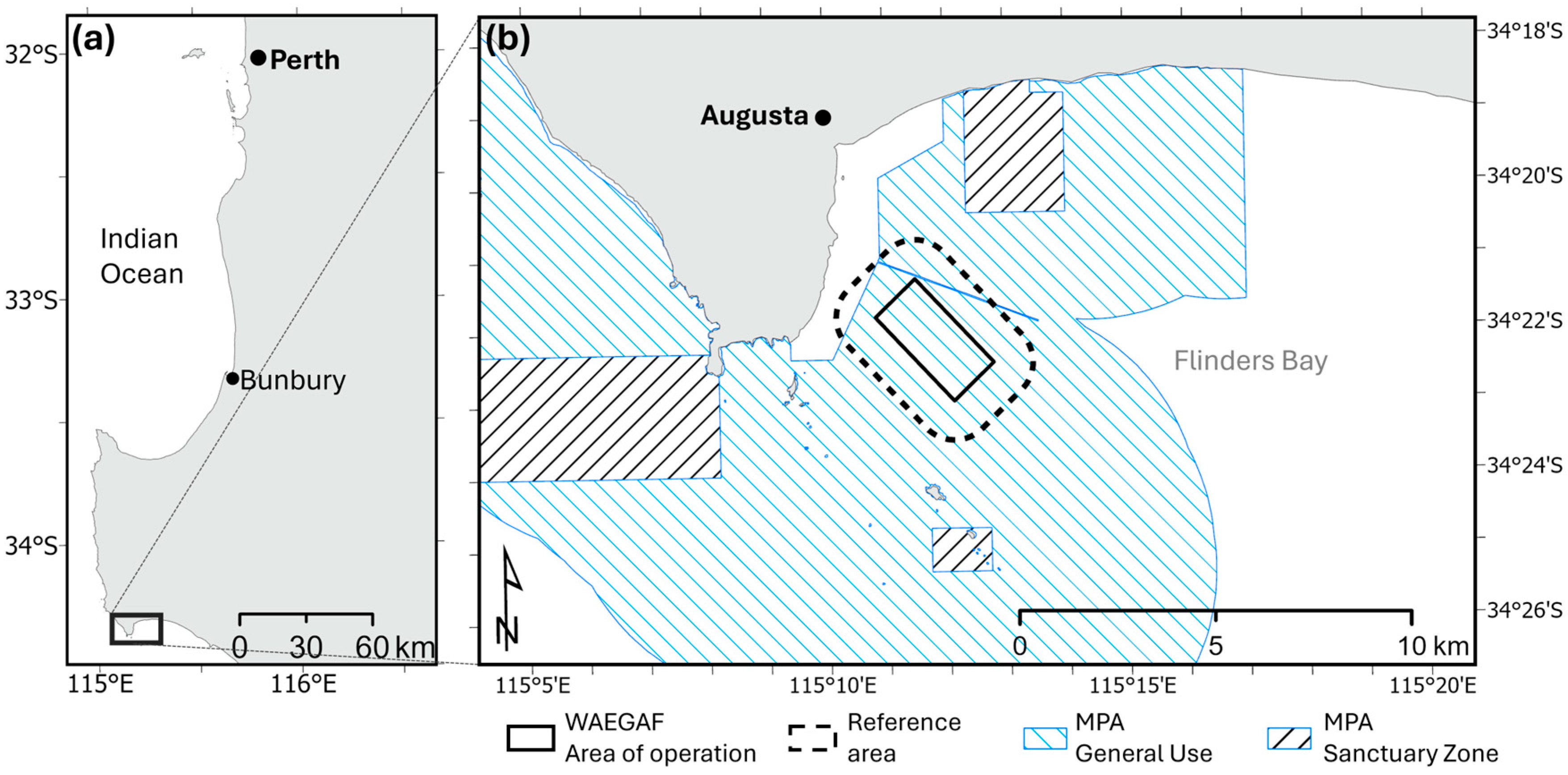
2.1. Study Area
2.2. Unsupervised Classification and Ground Truth Sampling
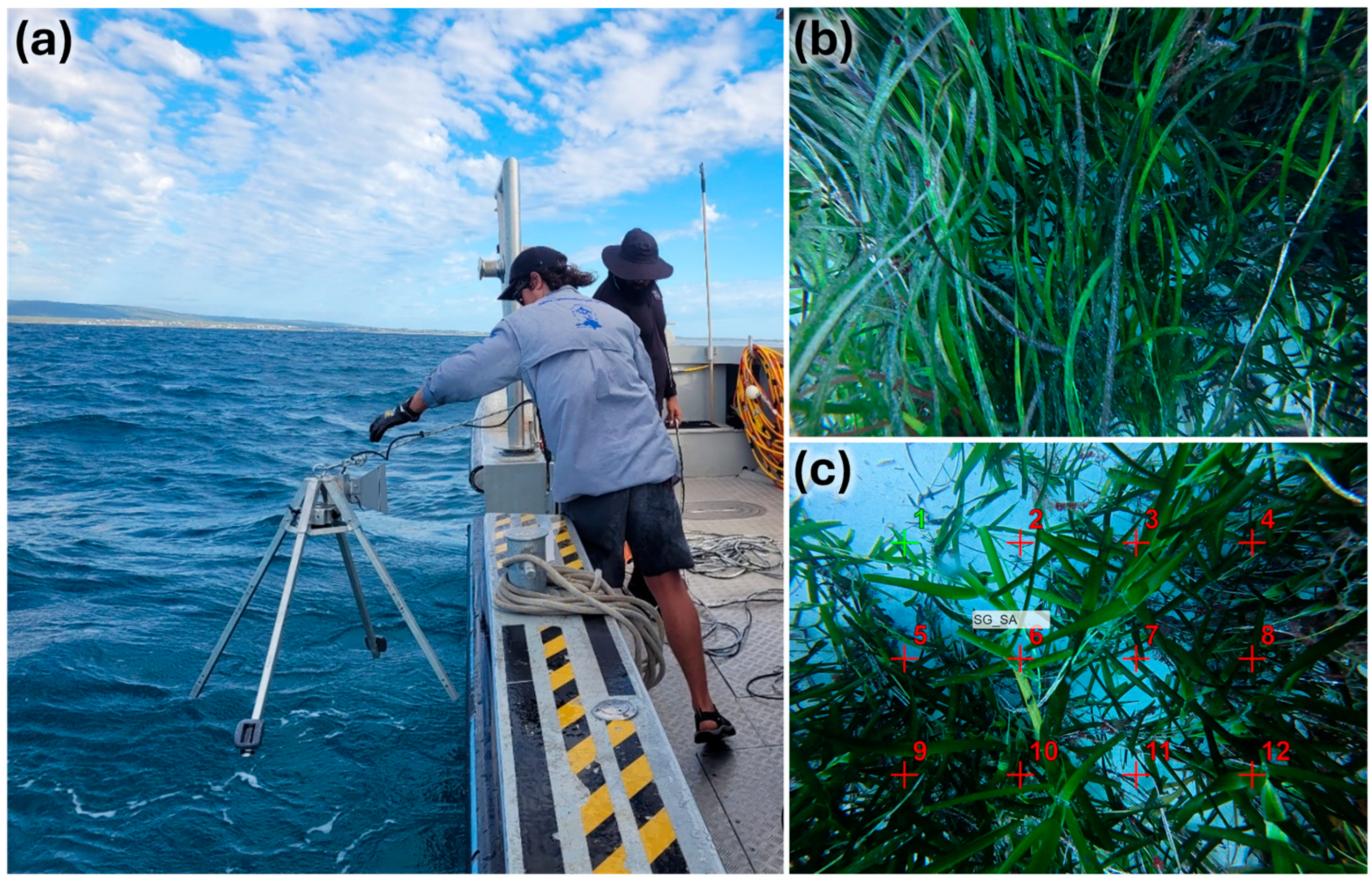
2.3. Ground Truth Image Annotation and Trained Classifier
2.4. Satellite Image Pre-Processing and Index Calculation
2.5. Remote Sensing Indices Evaluation
2.6. Supervised Classification
3. Results
3.1. Annotation and Ground Truth Image Classifier Performance
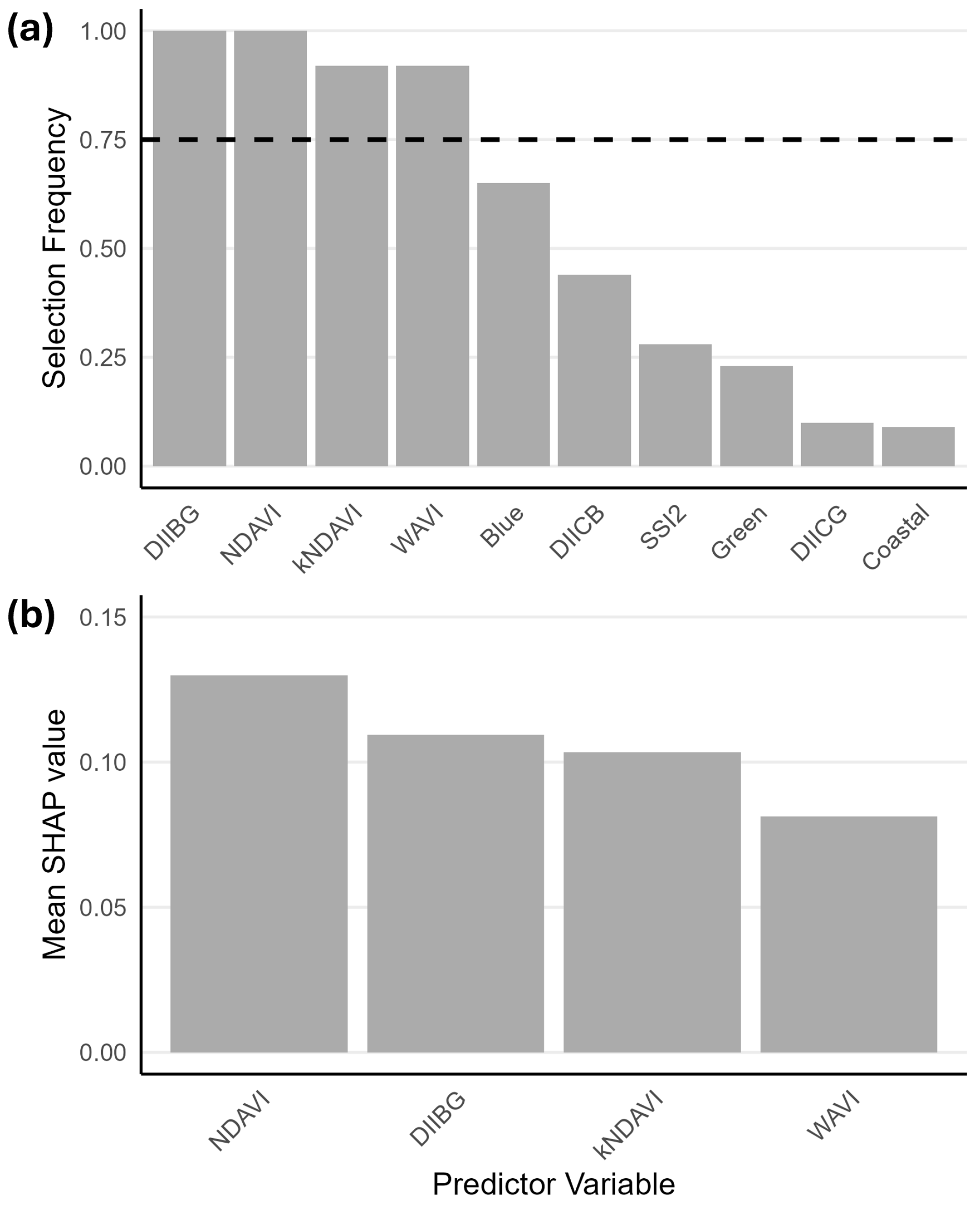
3.2. Index Evaluation
3.3. Random Forest Model Performance
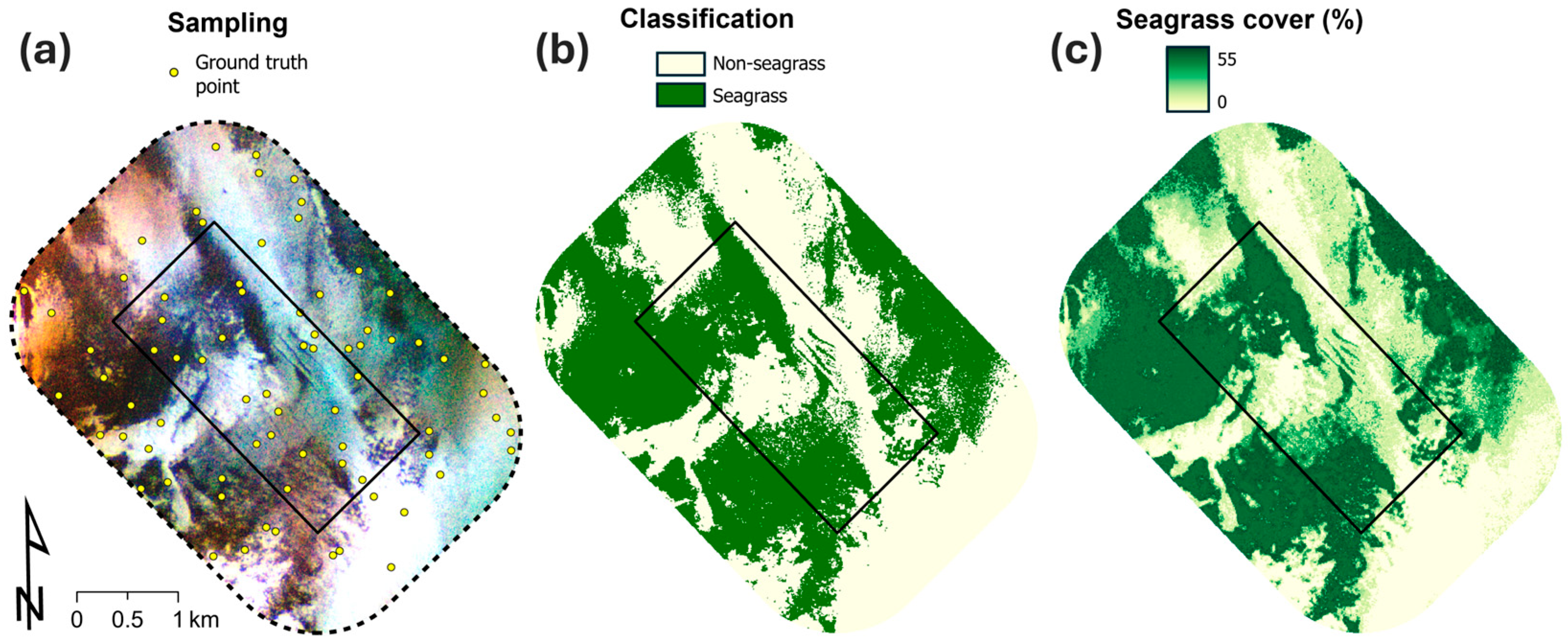
3.4. Seagrass Distribution and Cover
4. Discussion
5. Conclusions
Supplementary Materials
Author Contributions
Funding
Data Availability Statement
Acknowledgments
Conflicts of Interest
Abbreviations
| AIA | Automatic Image Annotation |
| AVI | Aquatic Vegetation Index |
| CATAMI | Collaborative and Automated Tools for Analysis of Marine Imagery |
| CDOM | Colour Dissolved Organic Matter |
| DEM | Digital Elevation Model |
| DII | Depth Invariant Index |
| EBFM | Ecosystem-Based Fisheries Management |
| GEE | Google Earth Engine |
| kNDAVI | Kernelised Normalised Difference Aquatic Vegetation Index |
| L2A | Sentinel-2 Level 2A |
| LiDAR | Light Detection and Ranging |
| MAE | Mean Absolute Error |
| MODIS | Moderate Resolution Imaging Spectroradiometer |
| MSI | Multispectral Instrument |
| NDAVI | Normalised Difference Aquatic Vegetation Index |
| NIR | Near-Infrared |
| RF | Random Forest |
| RF-RFE | Random Forest Recursive Feature Elimination |
| RMSE | Root Mean Squared Error |
| SAV | Submerged Aquatic Vegetation |
| SSI-2 | Seagrass Index II |
| SWIR | Shortwave Infrared |
| VIIRS | Visible Infrared Imaging Radiometer Suite |
| WAEGAF | Western Australia Enhanced Greenlip Abalone Fishery |
| WAVI | Water-Adjusted Vegetation Index |
| WCSS | Within-Cluster Sum of Squares |
References
- Townsend, H.; Harvey, C.J.; deReynier, Y.; Davis, D.; Zador, S.G.; Gaichas, S.; Weijerman, M.; Hazen, E.L.; Kaplan, I.C. Progress on Implementing Ecosystem-Based Fisheries Management in the United States Through the Use of Ecosystem Models and Analysis. Front. Mar. Sci. 2019, 6, 641. [Google Scholar] [CrossRef]
- Fletcher, W.J.; Shaw, J.; Metcalf, S.J.; Gaughan, D.J. An Ecosystem Based Fisheries Management Framework: The Efficient, Regional-Level Planning Tool for Management Agencies. Mar. Policy 2010, 34, 1226–1238. [Google Scholar] [CrossRef]
- Overly, K.E.; Lecours, V. Mapping Queen Snapper (Etelis oculatus) Suitable Habitat in Puerto Rico Using Ensemble Species Distribution Modeling. PLoS ONE 2024, 19, e0298755. [Google Scholar] [CrossRef]
- Nordlund, L.M.; Unsworth, R.K.F.; Gullström, M.; Cullen-Unsworth, L.C. Global Significance of Seagrass Fishery Activity. Fish Fish. 2018, 19, 399–412. [Google Scholar] [CrossRef]
- Menandro, P.S.; Lavagnino, A.C.; Vieira, F.V.; Boni, G.C.; Franco, T.; Bastos, A.C. The Role of Benthic Habitat Mapping for Science and Managers: A Multi-Design Approach in the Southeast Brazilian Shelf after a Major Man-Induced Disaster. Front. Mar. Sci. 2022, 9, 1004083. [Google Scholar] [CrossRef]
- Evans, S.N.; Konzewitsch, N.; Hovey, R.K.; Kendrick, G.A.; Bellchambers, L.M. Selecting the Best Habitat Mapping Technique: A Comparative Assessment for Fisheries Management in Exmouth Gulf. Front. Mar. Sci. 2025, 12, 1570277. [Google Scholar] [CrossRef]
- Davies, S.C.; Thompson, P.L.; Gomez, C.; Nephin, J.; Knudby, A.; Park, A.E.; Friesen, S.K.; Pollock, L.J.; Rubidge, E.M.; Anderson, S.C.; et al. Addressing Uncertainty When Projecting Marine Species’ Distributions under Climate Change. Ecography 2023, 2023, e06731. [Google Scholar] [CrossRef]
- Briguglio, M.; Ramírez-Monsalve, P.; Abela, G.; Armelloni, E.N. What Do People Make of “Ecosystem Based Fisheries Management”? Front. Mar. Sci. 2025, 12, 1553838. [Google Scholar] [CrossRef]
- Kachelriess, D.; Wegmann, M.; Gollock, M.; Pettorelli, N. The Application of Remote Sensing for Marine Protected Area Management. Ecol. Indic. 2014, 36, 169–177. [Google Scholar] [CrossRef]
- Li, J.; Roy, D.P. A Global Analysis of Sentinel-2a, Sentinel-2b and Landsat-8 Data Revisit Intervals and Implications for Terrestrial Monitoring. Remote Sens. 2017, 9, 902. [Google Scholar] [CrossRef]
- Copernicus Data Space Ecosystem. Sentinel-2 Level-2A. Available online: https://browser.stac.dataspace.copernicus.eu/collections/sentinel-2-l2a?.language=en (accessed on 30 September 2025).
- Phinn, S.; Roelfsema, C.; Dekker, A.; Brando, V.; Anstee, J. Mapping Seagrass Species, Cover and Biomass in Shallow Waters: An Assessment of Satellite Multi-Spectral and Airborne Hyper-Spectral Imaging Systems in Moreton Bay (Australia). Remote Sens. Environ. 2008, 112, 3413–3425. [Google Scholar] [CrossRef]
- Hossain, M.S.; Bujang, J.S.; Zakaria, M.H.; Hashim, M. The Application of Remote Sensing to Seagrass Ecosystems: An Overview and Future Research Prospects. Int. J. Remote Sens. 2015, 36, 61–114. [Google Scholar] [CrossRef]
- Traganos, D.; Reinartz, P. Mapping Mediterranean Seagrasses with Sentinel-2 Imagery. Mar. Pollut. Bull. 2018, 134, 197–209. [Google Scholar] [CrossRef]
- Gorelick, N.; Hancher, M.; Dixon, M.; Ilyushchenko, S.; Thau, D.; Moore, R. Google Earth Engine: Planetary-Scale Geospatial Analysis for Everyone. Remote Sens. Environ. 2017, 202, 18–27. [Google Scholar] [CrossRef]
- Chen, Q.; Beijbom, O.; Chan, S.; Bouwmeester, J.; Kriegman, D. A New Deep Learning Engine for CoralNet 2021. In Proceedings of the IEEE/CVF International Conference on Computer Vision, Virtual, 11–17 October 2021. [Google Scholar]
- ReefCloud. Available online: https://reefcloud.ai/ (accessed on 30 September 2025).
- Wyatt, M.; Radford, B.; Callow, N.; Bennamoun, M.; Hickey, S. Using Ensemble Methods to Improve the Robustness of Deep Learning for Image Classification in Marine Environments. Methods Ecol. Evol. 2022, 13, 1317–1328. [Google Scholar] [CrossRef]
- Evans, S.N.; Philippa, B.; Mattone, C.; Konzewitsch, N.; Hovey, R.K.; Sheaves, M.; Kendrick, G.A.; Bellchambers, L.M. Advancing Fishery Dependent and Independent Habitat Assessments Using Automated Image Analysis: A Fisheries Management Agency Case Study. PLoS ONE 2025, 20, e0329409. [Google Scholar] [CrossRef] [PubMed]
- Bannari, A.; Ali, T.S.; Abahussain, A. The Capabilities of Sentinel-MSI (2A/2B) and Landsat-OLI (8/9) in Seagrass and Algae Species Differentiation Using Spectral Reflectance. Ocean Sci. 2022, 18, 361–388. [Google Scholar] [CrossRef]
- Villa, P.; Mousivand, A.; Bresciani, M. Aquatic Vegetation Indices Assessment through Radiative Transfer Modeling and Linear Mixture Simulation. Int. J. Appl. Earth Obs. Geoinf. 2014, 30, 113–127. [Google Scholar] [CrossRef]
- Alkhatlan, A.; Bannari, A.; El-Battay, A.; Al-Dawood, T.; Abahussain, A. Potential of Landsat-OLI for Seagrass and Algae Species Detection and Discrimination in Bahrain National Water Using Spectral Reflectance. In Proceedings of the International Geoscience and Remote Sensing Symposium (IGARSS), Valencia, Spain, 22–27 July 2018; Institute of Electrical and Electronics Engineers Inc.: Piscataway, NJ, USA; pp. 4043–4046. [Google Scholar]
- Moeen, M.; Babin, D.; Tentoglou, T.; Waite, T.; Young, K. NASA Technical Reports Server (NTRS). In Louisiana Water Resources: Using NASA Earth Observations to Monitor Historical Changes in the Extension of Seagrass Meadows in the Breton National Wildlife Refuge in Louisiana; NASA Develop National Program; National Aeronautics and Space Administration: Washington, DC, USA, 2021. [Google Scholar]
- Deeks, E.; Magalhães, K.; Traganos, D.; Ward, R.; Normande, I.; Dawson, T.P.; Kratina, P. Seagrass Mapping of North-Eastern Brazil Using Google Earth Engine and Sentinel-2 Imagery. Environ. Sustain. Indic. 2024, 24, 100489. [Google Scholar] [CrossRef]
- Mastrantonis, S.; Radford, B.; Langlois, T.; Spencer, C.; de Lestang, S.; Hickey, S. A Novel Method for Robust Marine Habitat Mapping Using a Kernelised Aquatic Vegetation Index. ISPRS J. Photogramm. Remote Sens. 2024, 209, 472–480. [Google Scholar] [CrossRef]
- Wang, Q.; Moreno-Martínez, Á.; Muñoz-Marí, J.; Campos-Taberner, M.; Camps-Valls, G. Estimation of Vegetation Traits with Kernel NDVI. ISPRS J. Photogramm. Remote Sens. 2023, 195, 408–417. [Google Scholar] [CrossRef]
- Li, Y.; Bai, J.; Chen, S.; Chen, B.; Zhang, L. Mapping Seagrasses on the Basis of Sentinel-2 Images under Tidal Change. Mar. Environ. Res. 2023, 185, 105880. [Google Scholar] [CrossRef]
- Liang, H.; Wang, L.; Wang, S.; Sun, D.; Li, J.; Xu, Y.; Zhang, H. Remote Sensing Detection of Seagrass Distribution in a Marine Lagoon (Swan Lake), China. Opt. Express 2023, 31, 27677. [Google Scholar] [CrossRef]
- Bai, J.; Li, Y.; Chen, S.; Du, J.; Wang, D. Long-Time Monitoring of Seagrass Beds on the East Coast of Hainan Island Based on Remote Sensing Images. Ecol. Indic. 2023, 157, 111272. [Google Scholar] [CrossRef]
- Lobell, D.B.; Asner, G.P. Hyperion Studies of Crop Stress in Mexico. In Proceedings of the 12th JPL Airborne Earth Science Workshop, Pasadena, CA, USA, 31 March 2004. [Google Scholar]
- Komatsu, T.; Hashim, M.; Nurdin, N.; Noiraksar, T.; Prathep, A.; Stankovic, M.; Phuoc, T.; Son, H.; Thu, M.; Van Luong, C.; et al. Practical Mapping Methods of Seagrass Beds by Satellite Remote Sensing and Ground Truthing. Coast. Mar. Sci. 2020, 43, 1–25. [Google Scholar]
- Green, E.P.; Mumby, P.J.; Edwards, A.J.; Clark, C.D. Remote Sensing Handbook for Tropical Coastal Management; Edwards, A.J., Ed.; UNESCO: Paris, France, 2000. [Google Scholar]
- Mumby, P.J.; Green, E.P.; Edwards, A.J.; Clark, C.D. Measurement of Seagrass Standing Crop Using Satellite and Digital Airborne Remote Sensing. Mar. Ecol. Prog. Ser. 1997, 159, 51–60. [Google Scholar] [CrossRef]
- Lyzenga, D.R. Passive Remote Sensing Techniques for Mapping Water Depth and Bottom Features. Appl. Opt. 1978, 17, 379. [Google Scholar] [CrossRef] [PubMed]
- Rowan, G.S.L.; Kalacska, M. A Review of Remote Sensing of Submerged Aquatic Vegetation for Non-Specialists. Remote Sens. 2021, 13, 623. [Google Scholar] [CrossRef]
- Chin, A.; Conci, M.; Treptow, A.; Markell, G. Assessing Recreational Fish Habitats in Florida Using Earth Observations; Develop Technical Report; Coastal Florida Ecological Conservation. In Proceedings of the 8th International Science Symposium, Fort Lauderdale, FL, USA, 7–8 November 2025. [Google Scholar]
- Andskog, M.A.; Layman, C.; Allgeier, J.E. Seagrass Production around Artificial Reefs Is Resistant to Human Stressors. Proc. R. Soc. B Biol. Sci. 2023, 290, 20230803. [Google Scholar] [CrossRef] [PubMed]
- Ocean Grown Abalone Pty. Ltd. Aquaculture Management and Environmental Monitoring Plan (MEMP); Ocean Grown Abalone Ltd.: Augusta, Australia, 2020. [Google Scholar]
- Waycott, M.; Duarte, C.M.; Carruthers, T.J.B.; Orth, R.J.; Dennison, W.C.; Olyarnik, S.; Calladine, A.; Fourqurean, J.W.; Heck, K.L.; Hughes, A.R.; et al. Accelerating Loss of Seagrasses across the Globe Threatens Coastal Ecosystems. Proc. Natl. Acad. Sci. USA 2009, 106, 12377–12381. [Google Scholar] [CrossRef]
- WA Department of Transport. Donnelly_20230410_Cape_Leeuwin_Augusta_LiDAR. Available online: https://www.arcgis.com/apps/webappviewer/index.html?id=d58dd77d85654783b5fc8c775953c69b (accessed on 2 September 2025).
- Hedley, J.D.; Harborne, A.R.; Mumby, P.J. Simple and Robust Removal of Sun Glint for Mapping Shallow-Water Benthos. Int. J. Remote Sens. 2005, 26, 2107–2112. [Google Scholar] [CrossRef]
- Wickham, H.; Averick, M.; Bryan, J.; Chang, W.; McGowan, L.; François, R.; Grolemund, G.; Hayes, A.; Henry, L.; Hester, J.; et al. Welcome to the Tidyverse. J. Open Source Softw. 2019, 4, 1686. [Google Scholar] [CrossRef]
- Pebesma, E. Simple Features for R: Standardized Support for Spatial Vector Data. 2018. [Google Scholar]
- Robert, M.; Hijmans, J. Package “terra” Type Package Title Spatial Data Analysis; R Foundation for Statistical Computing: Vienna, Austria, 2025. [Google Scholar]
- Althaus, F.; Hill, N.; Ferrari, R.; Edwards, L.; Przeslawski, R.; Schönberg, C.H.L.; Stuart-Smith, R.; Barrett, N.; Edgar, G.; Colquhoun, J.; et al. A Standardised Vocabulary for Identifying Benthic Biota and Substrata from Underwater Imagery: The CATAMI Classification Scheme. PLoS ONE 2015, 10, e0141039. [Google Scholar] [CrossRef]
- Zhou, Q.; Ke, Y.; Wang, X.; Bai, J.; Zhou, D.; Li, X. Developing seagrass index for long term monitoring of Zostera japonica seagrass bed: A case study in Yellow River Delta, China. ISPRS J. Photogramm. Remote Sens. 2022, 194, 286–301. [Google Scholar] [CrossRef]
- Poursanidis, D.; Katsanevakis, S. Mapping Subtidal Marine Forests in the Mediterranean Sea Using Copernicus Contributing Mission. Remote Sens. 2025, 17, 2398. [Google Scholar] [CrossRef]
- Hu, W.; Zhang, D.; Chen, B.; Liu, X.; Ye, X.; Jiang, Q.; Zheng, X.; Du, J.; Chen, S. Mapping the Seagrass Conservation and Restoration Priorities: Coupling Habitat Suitability and Anthropogenic Pressures. Ecol. Indic. 2021, 129, 107960. [Google Scholar] [CrossRef]
- Meinshausen, N.; Bühlmann, P. Stability Selection. J. R. Stat. Soc. Ser. B Stat. Methodol. 2010, 72, 417–473. [Google Scholar] [CrossRef]
- Kuhn, M. Building Predictive Models in R Using the Caret Package. J. Stat. Softw. 2008, 28, 1–26. [Google Scholar] [CrossRef]
- Wickham, H. Ggplot2. WIREs Comput. Stat. 2011, 3, 180–185. [Google Scholar] [CrossRef]
- Liaw, A.; Weiner, M. Classification and Regression by RandomForest. R News 2002, 2, 18–22. [Google Scholar]
- R Core Team. R: A Language and Environment for Statistical Computing; R Foundation for Statistical Computing: Vienna, Austria, 2025. [Google Scholar]
- Valavi, R.; Elith, J.; Lahoz-Monfort, J.J.; Guillera-Arroita, G. blockCV: An r package for generating spatially or environmentally separated folds for k-fold cross-validation of species distribution models. Methods Ecol. Evol. 2019, 10, 225–232. [Google Scholar] [CrossRef]
- Jethani, N.; Sudarshan, M.; Covert, I.; Lee, S.I.; Ranganath, R. Fastshap: Real-time shapley value estimation. ICLR 2022, 2022. [Google Scholar] [CrossRef]
- Google Earth Engine. Ee.Classifier.SmileRandomForest. Available online: https://developers.google.com/earth-engine/apidocs/ee-classifier-smilerandomforest (accessed on 25 September 2025).
- Kilminster, K.; McMahon, K.; Waycott, M.; Kendrick, G.A.; Scanes, P.; McKenzie, L.; O’Brien, K.R.; Lyons, M.; Ferguson, A.; Maxwell, P.; et al. Unravelling Complexity in Seagrass Systems for Management: Australia as a Microcosm. Sci. Total Environ. 2015, 534, 97–109. [Google Scholar] [CrossRef]
- Bancroft, K.P. A Standardised Classification Scheme for the Mapping of Shallow-Water Marine Habitats in Western Australia. Report MCB-05/2003. Unpublished work. 2002. [Google Scholar]
- Department of Parks and Wildlife, Western Australian Government, Marine Habitats of Western Australia. Available online: https://researchdata.edu.au/marine-habitats-western-australia/967012 (accessed on 10 October 2025).
- Ware, S.; Downie, A.L. Challenges of Habitat Mapping to Inform Marine Protected Area (MPA) Designation and Monitoring: An Operational Perspective. Mar. Policy 2020, 111, 103717. [Google Scholar] [CrossRef]
- Strong, J.A. An Error Analysis of Marine Habitat Mapping Methods and Prioritised Work Packages Required to Reduce Errors and Improve Consistency. Estuar. Coast. Shelf Sci. 2020, 240, 106684. [Google Scholar] [CrossRef]
- Kendrick, G.A.; Nowicki, R.; Olsen, Y.S.; Strydom, S.; Fraser, M.W.; Sinclair, E.A.; Statton, J.; Hovey, R.K.; Thomson, J.A.; Burkholder, D.; et al. A Systematic Review of How Multiple Stressors from an Extreme Event Drove Ecosystem-Wide Loss of Resilience in an Iconic Seagrass Community. Front. Mar. Sci. 2019, 6, 455. [Google Scholar] [CrossRef]
- Strydom, S.; Murray, K.; Wilson, S.; Huntley, B.; Rule, M.; Heithaus, M.; Bessey, C.; Kendrick, G.A.; Burkholder, D.; Fraser, M.W.; et al. Too Hot to Handle: Unprecedented Seagrass Death Driven by Marine Heatwave in a World Heritage Area. Glob. Chang. Biol. 2020, 26, 3525–3538. [Google Scholar] [CrossRef]
- Cambridge, M.L.; Mccomb, A.J. The loss of seagrasses in Cockburn Sound, Western Australia. I. The time course and magnitude of seagrass decline in relation to industrial development. Aquat. Bot. 1984, 20, 229–243. [Google Scholar]
- Kendrick, G.A.; Aylward, M.J.; Hegge, B.J.; Cambridge, M.L.; Hillman, K.; Wyllie, A.; Lord, D.A. Changes in Seagrass Coverage in Cockburn Sound, Western Australia between 1967 and 1999. Aquat. Bot. 2002, 1, 75–87. [Google Scholar] [CrossRef]
- Buckee, J.; Hetzel, Y.; Nyegaard, M.; Evans, S.; Whiting, S.; Scott, S.; Ayvazian, S.; van Keulen, M.; Verduin, J. Catastrophic Loss of Tropical Seagrass Habitats at the Cocos (Keeling) Islands Due to Multiple Stressors. Mar. Pollut. Bull. 2021, 170, 112602. [Google Scholar] [CrossRef]
- Walker, D.I.; Mccomb, A.J. Seagrass Degradation in Australian Coastal Waters. Mar. Poll. Bull. 1992, 25, 191–195. [Google Scholar] [CrossRef]
- Konzewitsch, N.; Evans, S.N. Time-Series Satellite Image Classification Reveals Comprehensive Canopy Loss of Dense Thalassodendron Ciliatum Seagrass Meadows at Cocos (Keeling) Islands. Mar. Biol. 2024, 171, 45. [Google Scholar] [CrossRef]
- Sinclair, E.A.; Statton, J.; Austin, R.; Breed, M.F.; Cross, R.; Dodd, A.; Kendrick, A.; Krauss, S.L.; McNeair, B.; McNeair, N.; et al. Healing Country Together: A Seagrass Restoration Case Study from Gathaagudu (Shark Bay). Ocean Coast. Manag. 2024, 256, 107274. [Google Scholar] [CrossRef]
- Kendrick, G.A.; Austin, R.; Ferretto, G.; van Keulen, M.; Verduin, J.J. Lessons Learnt from Revisiting Decades of Seagrass Restoration Projects in Cockburn Sound, Southwestern Australia. Restor. Ecol. 2025, 33, e70040. [Google Scholar] [CrossRef]
- Sinclair, E.A.; Sherman, C.D.; Statton, J.; Copeland, C.; Matthews, A.; Waycott, M.; van Dijk, K.J.; Vergés, A.; Kajlich, L.; McLeod, I.M.; et al. Advances in Approaches to Seagrass Restoration in Australia. Ecol. Manag. Restor. 2021, 22, 10–21. [Google Scholar] [CrossRef]

| Index | Reference | Equation | Included? | Rationale |
|---|---|---|---|---|
| NDAVI | [21] | Yes | Widely used | |
| WAVI | [21] | Yes | Widely used | |
| kNDAVI | [25] | Yes | Successfully used in similar environment | |
| SSI-2 | [28] | Yes | Seagrass specific | |
| SGI (Sum Green Index) | [30] | No | Not applicable to Sentinel-2; requires hyperspectral imagery | |
| SSI-1 | [28] | No | Insufficient penetration | |
| SSII | [27] | No | Insufficient penetration | |
| SGI (Seagrass Index) | [46] | No | Insufficient penetration Requires time series |
| Target | |||
|---|---|---|---|
| Output | Seagrass | Non-Seagrass | Sum |
| Seagrass | 127 | 7 | 134 |
| Non-seagrass | 13 | 416 | 429 |
| Sum | 140 | 423 | 543/563 (0.965) |
| Model | Metric | Score |
|---|---|---|
| Binary classification | Overall accuracy | 0.87 |
| Kappa coefficient | 0.73 | |
| Producer accuracy | Seagrass: 0.79 | |
| Non-seagrass: 0.94 | ||
| User accuracy | Seagrass: 0.94 | |
| Non-seagrass: 0.81 | ||
| Regression | R2 | 0.59 |
| RMSE | 15.1 | |
| MAE | 11.8 |
| RF Model | Area | Habitat | Area (km2) | Percentage (%) |
|---|---|---|---|---|
| Binary classification | WAEGAF | Seagrass | 2.31 | 55.8 |
| Non-seagrass | 1.83 | 44.2 | ||
| Reference | Seagrass | 6.27 | 53.1 | |
| Non-seagrass | 5.54 | 46.9 | ||
| Regression | WAEGAF | Low seagrass (0–20%) | 1.65 | 39.9 |
| Moderate seagrass (20–40%) | 0.81 | 19.5 | ||
| Dense seagrass (>40%) | 1.68 | 40.6 | ||
| Reference | Low seagrass (0–20%) | 5.46 | 46.2 | |
| Moderate seagrass (20–40%) | 1.81 | 15.3 | ||
| Dense seagrass (>40%) | 4.55 | 38.4 |
Disclaimer/Publisher’s Note: The statements, opinions and data contained in all publications are solely those of the individual author(s) and contributor(s) and not of MDPI and/or the editor(s). MDPI and/or the editor(s) disclaim responsibility for any injury to people or property resulting from any ideas, methods, instructions or products referred to in the content. |
© 2025 by the authors. Licensee MDPI, Basel, Switzerland. This article is an open access article distributed under the terms and conditions of the Creative Commons Attribution (CC BY) license (https://creativecommons.org/licenses/by/4.0/).
Share and Cite
Konzewitsch, N.; Mist, L.; Evans, S.N. Evaluating Remotely Sensed Spectral Indices to Quantify Seagrass in Support of Ecosystem-Based Fisheries Management in a Marine Protected Area of Western Australia. Remote Sens. 2025, 17, 3932. https://doi.org/10.3390/rs17243932
Konzewitsch N, Mist L, Evans SN. Evaluating Remotely Sensed Spectral Indices to Quantify Seagrass in Support of Ecosystem-Based Fisheries Management in a Marine Protected Area of Western Australia. Remote Sensing. 2025; 17(24):3932. https://doi.org/10.3390/rs17243932
Chicago/Turabian StyleKonzewitsch, Nick, Lara Mist, and Scott N. Evans. 2025. "Evaluating Remotely Sensed Spectral Indices to Quantify Seagrass in Support of Ecosystem-Based Fisheries Management in a Marine Protected Area of Western Australia" Remote Sensing 17, no. 24: 3932. https://doi.org/10.3390/rs17243932
APA StyleKonzewitsch, N., Mist, L., & Evans, S. N. (2025). Evaluating Remotely Sensed Spectral Indices to Quantify Seagrass in Support of Ecosystem-Based Fisheries Management in a Marine Protected Area of Western Australia. Remote Sensing, 17(24), 3932. https://doi.org/10.3390/rs17243932

