Article

Evaluating the Performance of the STEMMUS-SCOPE Model to Simulate SIF and GPP Under Drought Stress Using Tower-Based Observations of Maize


1
Key Laboratory of Digital Earth Science, Aerospace Information Research Institute, Chinese Academy of Sciences, Beijing 100094, China
2
International Research Center of Big Data for Sustainable Development Goals, Beijing 100094, China
3
College of Resources and Environment, University of Chinese Academy of Sciences, Beijing 100049, China
*
Author to whom correspondence should be addressed.
Remote Sens. 2025, 17(24), 3931; https://doi.org/10.3390/rs17243931 (registering DOI)
Submission received: 24 October 2025 / Revised: 29 November 2025 / Accepted: 2 December 2025 / Published: 5 December 2025

Highlights

What are the main findings?
  • The STEMMUS-SCOPE model demonstrates higher accuracy than the SCOPE model in simulating SIF and GPP under drought stress.
What is the implication of the main finding?
  • The simulation performance of STEMMUS-SCOPE under drought stress is validated;
  • The potential of the STEMMUS-SCOPE model to investigate the SIF-GPP relationship under drought stress is demonstrated.

Abstract

With advancements in solar-induced fluorescence (SIF) observation technology and the evolution of vegetation radiative transfer models, SIF signals can now be more effectively interpreted and leveraged from a mechanistic perspective. This, in turn, facilitates a deeper understanding of the mechanistic link between SIF and photosynthesis. Considering the impact of water stress on terrestrial ecosystems, this paper simulated SIF and gross primary productivity (GPP) values using the STEMMUS-SCOPE model at half-hour scales from 2017 to 2023 at the Daman site. The simulation results were compared and validated against flux tower observations and SCOPE model outputs. Taking advantage of irrigation events in the semi-arid irrigated farmland, we assessed the accuracy of STEMMUS-SCOPE in simulating SIF and GPP under drought stress, as well as its capability to quantitatively analyze the impacts of water stress on SIF and GPP. The results show that the accuracy of the SIF and GPP values simulated by the STEMMUS-SCOPE model is higher than that of the SCOPE model. The averaged R2 and RMSE between the SIF simulated by STEMMUS-SCOPE model and the observed SIF values are 0.66 and 0.29 mW m−2 nm−1, and the averaged R2 and RMSE between the GPP simulated by the STEMMUS-SCOPE model and the observed GPP values from 2017 to 2023 are 0.88 and 4.93 µmol CO2 m−2 s−1, respectively. Especially under relatively drought conditions, the R2 between the SIF simulated values and observed values is 0.84, and the R2 between the GPP simulated values and observed values is 0.96. By further combining soil moisture content (SMC) and canopy conductance (Gs) analyses, we found that the response of the STEMMUS-SCOPE simulations under water stress was consistent with previous findings on the impacts of water deficits, thereby confirming the model’s reliability for drought conditions. Under drought stress, the decline in fluorescence emission efficiency (ΦF) with decreasing Gs and SMC was smaller than that of the light use efficiency (LUE). Therefore, the STEMMUS-SCOPE model is promising for investigating the SIF–GPP relationship under drought stress.

1. Introduction

In the photosynthesis of vegetation, chlorophyll molecules absorb photosynthetically active radiation (PAR) and release it through three energy dissipation pathways: photosynthetic carbon fixation, heat dissipation, and chlorophyll fluorescence, which is the most important biochemical process in terrestrial ecosystems [1]. Numerous studies have demonstrated that solar-induced chlorophyll fluorescence (SIF) and gross primary productivity (GPP) showed a good correlation at various spatial scales of leaves, individuals, canopies, and regions [2,3]. The light use efficiency (LUE) model proposed by Monteith (1972) simplifies the photosynthetic process by expressing GPP as the product of absorbed photosynthetically active radiation (APAR) and the LUE for CO2 fixation [4]. Chlorophyll fluorescence originates from photochemical reactions and is simultaneously driven by APAR. Fluorescence emission efficiency (ΦF) is the fluorescence quantum efficiency at the photosystem level, and fesc is the SIF escape probability from the photosystem to the canopy level (the ratio of canopy SIF in a certain direction to the total SIF emitted by the photosystem); the relationship between SIF and GPP can be linked through the ratio between LUE and ΦF.
In recent years, numerous studies have demonstrated that SIF is a novel approach for detecting vegetation photosynthesis and tracking photosynthetic dynamics owing to the physiological information it contains [5,6]. Especially under stress conditions or in evergreen ecosystems with little variation in vegetation structure, SIF can exhibit a stronger correlation between GPP and APAR [7,8,9].
In the observation and simulation of terrestrial ecosystems, substantial uncertainty still exists in the coupling relationship between SIF and photosynthesis. This uncertainty mainly arises from the influences of vegetation types and environmental factors, such as light stress, temperature stress, and drought stress, thereby posing challenges to the accurate estimation of photosynthesis [3,10,11,12,13,14]. The vertical heterogeneity of light distribution within plant canopies affects both the energy source for photosynthesis and spectral fluorescence responses. Previous studies have employed various modeling approaches to elucidate the effects of light conditions on leaf physiological processes [15,16]. Under temperature stress, low temperatures impair plant photosynthesis by altering key biochemical processes [17]. Numerous studies have demonstrated that the photosynthetic rate of high-latitude evergreen coniferous forests decreases significantly due to low winter temperatures [13,18]. By incorporating the maximum photochemical efficiency of photosystem II, Chen et al. developed a model based on the light-response mechanism (MLR) model that improves the accuracy of GPP estimation [19]. Numerous studies have demonstrated that drought exerts a significant influence on both ecosystem stability and productivity [20,21,22]. In response to drought stress, plant mechanisms are generally classified into stomatal regulation and non-stomatal regulation. When water stress occurs, plants reduce the rate of photosynthesis by adjusting the opening and closing of the stomata and maintain high leaf water potential or high relative water content of the leaves by controlling the opening and closing of the stomata to avoid tissue dehydration [23,24,25]. As drought stress intensifies, plant regulatory mechanisms shift from stomatal to non-stomatal regulation, leading to decreases in chlorophyll content, reductions in SIF, and leaf damage. It has been suggested that the decline in GPP-to-SIF ratios with reduced water availability may be associated with stomatal responses [26]. Therefore, investigating the effects of drought stress on photosynthetic products and their interrelationships is of great importance.
Under drought stress, the observed relationship between SIF and GPP exhibited a nonlinear pattern, with increasing drought stress, the ratio of GPP to SIF declined. Compared with normalized difference vegetation index (NDVI) and enhanced vegetation index (EVI), SIF is more sensitive to drought and better captures vegetation dynamics driven by water and thermal variations. In addition, compared with LUE-based estimates, SIF-based GPP estimations exhibited a stronger correlation with observed GPP [27,28,29,30]. SIF exhibited more consistent declines with GPP losses induced by drought than APAR estimations during the drought period in space and time, where APAR had obvious lagged responses compared with SIF, especially in evergreen broadleaf forest land [31]. However, the emission mechanism of SIF is complex, and considerable uncertainties remain in its interpretation and analysis. Therefore, a mechanistic understanding of the interactions between SIF and vegetation structure, along with an examination of the main factors influencing SIF emission, will help to elucidate the relationships between SIF, photosynthesis, and biomass.
The SCOPE (Soil Canopy Observation of Photosynthesis and Energy) model is one of the most widely used models for the simulation of SIF [32]. Based on the energy balance, the model integrates the radiative transfer model and the photosynthesis model, which is a virtual laboratory for studies on surface energy balance, and SIF–photosynthesis. However, the SCOPE model does not track the moisture changes in soil and vegetation, nor does it parameterize the effects of soil moisture changes on photosynthesis or stomatal parameters, so the effects of soil moisture are only apparent when soil moisture affects the optical and thermal signals of vegetation [33]. Therefore, under drought and extreme heat conditions, the simulation performance of the SCOPE model is constrained. In 2019, Bayat et al. [33] incorporated the soil–plant–atmosphere continuum (SPAC) model into SCOPE, developing the SCOPE_SM model, which limited the maximum carboxylation rate by calculating the water stress coefficient of soil moisture, and its feasibility was evaluated through simulations at a grassland site. The results demonstrated that the model responds well to water stress; however, it neglects the dynamic distribution of vegetation roots. In 2021, Wang et al. developed STEMMUS-SCOPE by integrating the processes of photosynthesis, SIF, and soil water–heat transfer into the SPAC system [34]. This integration was achieved through the incorporation of a one-dimensional root growth model and an impedance scheme connecting the soil, roots, leaves, and atmosphere. Experimental results from maize and grassland sites demonstrated that, compared with the SCOPE and SCOPE_SM models, STEMMUS-SCOPE achieved higher simulation accuracy for water, heat, and carbon fluxes. These findings indicate that by coupling soil water–heat transport with dynamic root growth, the model can more accurately simulate ecosystem functions [34,35]. The advantage of the STEMMUS-SCOPE model lies in its coupling of a leaf-level photosynthesis model, a canopy radiative transfer model, and the soil–plant–atmosphere continuum (SPAC) model. This integration enables a quantitative analysis of the sensitivity of simulated SIF and GPP to different input parameters. By accounting for and separating the influences of physiological and non-physiological factors on SIF and GPP, the model provides a clearer understanding of the relationship between SIF and GPP, thereby filling the current research gap in quantitatively assessing how water stress affects this relationship. However, validation using long-term observational data is still lacking.
ChinaSpec is a continuous SIF ground observation network based on flux stations in the Chinese mainland [36]. Among them, the long-time flux and SIF observation data of the Daman site in recent years provide a good basis for the validation of the STEMMUS-SCOPE model in irrigated farmland within semi-arid areas. Based on this dataset, we employed flux, meteorological data, and vegetation parameters from the Daman site during 2017–2023, together with measured soil water content to evaluate the performance of STEMMUS-SCOPE model in simulating SIF and GPP under drought stress and further evaluated the impact of crop drought stress on SIF, GPP at the Daman site. This study emphasizes the validation and evaluation of the STEMMUS-SCOPE model based on multi-year continuous observational data, along with mechanistic interpretations of its responses to SIF and GPP under drought stress, highlighting its important role in quantitatively assessing the effects of drought stress on SIF and GPP.

2. Materials and Methods

2.1. Study Area

The Daman site is located on flat terrain about 8 km southeast of Zhangye City, Gansu Province (38°51′20″N, 100°22′20″E). It belongs to the temperate continental climate, with an average annual temperature of 8 °C, an annual sunshine of 3000–3600 h, and an annual precipitation of about 300 mm. The observed feature type of this flux station belongs to crops, the type of which is maize, and there is no special irrigation and fertilization control [37]. The station is equipped with flux, meteorological, hydrological, and SIF observation systems, and the Daman site Vegetation Fluorescence Automatic Observation System has been observing and accumulating canopy spectral data for 7 consecutive years since 2017. In this article, the Daman site from June to September of each year from 2017 to 2023 was used for analysis. The CO2 exchange between vegetation and the atmosphere was measured by a CO2 flux observation system based on the eddy covariance (EC) technique [38]. The flux measurement system is located on a 5 m high platform on the flux tower in the crop area of the Daman site. The flux observation system consists of a high-frequency open-circuit infrared gas analyzer (IRGA) (Li-7500, Li-Cor, Lincoln, NE, USA) and a three dimensional sonic anemometer that measures the high-frequency instantaneous wind speed component and sound temperature. Turbulent flux data were sampled at a frequency of 10 Hz. The raw flux data collected by the flux measurement system (CR5000 at YK and GT, Campbell Scientific Inc., Logan, UT, USA; 27) is stored through a data logger and processed to obtain a net ecosystem exchange (NEE) of CO2. GPP is estimated from the NEE and ecological respiration (Re) measured by the equation GPP = Re − NEE.
The automatic weather station (AWS) system consists of a meteorological gradient observation device capable of observing environmental and meteorological variables, including PAR, air temperature (Ta), air pressure (Press), and air humidity (RH). The system is located on an EC flux observation tower [37]. All observations were processed to a 30 min resolution after removing outliers (more than 3 standard deviations) and then integrated into a daily mean [39].
An automatic fluorescence observation system of vegetation (Bergsun Inc., Beijing, China) is also erected on the flux tower, and the automatic fluorescence observation system adopts a QE65Pro spectrometer (QE65pro; Ocean Optics, Dunedin, FL, USA), with a spectral resolution of 0.31 nm, a sampling interval of 0.155 nm, and a spectral range of 650~815 nm. The upward and downward radiation observation uses a bifurcated optical fiber to connect to the spectrometer in a dual-field angle measurement method, a bare optical fiber observes the reflected radiation of ground objects at an inclination angle of 25°, and the other cosine probe measures the incident solar radiation vertically towards the zenith direction, and the “sandwich” sampling method is used to observe the downward solar radiation and upward canopy radiation through the electronic shutter and control software.
This study used the solar-induced chlorophyll fluorescence calculated by the fluorescence automatic observation system through the 3FLD algorithm. The 3FLD algorithm assumes a linear variation in fluorescence and reflectance within the absorption line, and this method has been shown to be more robust and accurate than the FLD and iFLD methods [15]. Therefore, in this study, the 3FLD algorithm was used to retrieve the SIF at the O2-A band for the accuracy evaluation of the STEMMUS-SCOPE model.
In this study, half-hour-scale meteorological data observed at the tower base were used as inputs for the STEMMUS-SCOPE model to obtain half-hour-scale outputs of SIF and GPP. The half-hour-scale tower-based observations of SIF and GPP were used to compare with the corresponding outputs simulated by the STEMMUS-SCOPE model.
In this article, the fPAR was estimated based on the vegetation index. Several research results have shown that the NDVI is a good proxy for fPAR from a fixed perspective [40,41]. We use the wide dynamic range vegetation index (WDRVI), which has been shown to show a good linear correlation with fPAR [42]. WDRVI is defined as:
W D R V I = α Re f 800 Re f 680 α Re f 800 + Re f 680
where Ref800 and Ref680 are the reflectance at 800 nm and 680 nm, respectively. α is the weight coefficient, which is set to a fixed value of 0.1, and the existing linear model is used to estimate the fPAR based on WDRVI:
f P A R = 0.516 W D R V I + 0.726

2.2. STEMMUS-SCOPE Model

The STEMMUS-SCOPE model is an integrated soil–plant model that integrates the SCOPE model and STEMMUS model. The SCOPE model can predict leaf-to-canopy reflectance and SIF spectra, photosynthesis, and evapotranspiration, while the STEMMUS model can simulate root dynamic growth and root water uptake (RWU), addressing the limitation of the SCOPE model that does not account for root water uptake and the compensation mechanism among roots. By coupling the two, the model is able to link soil water and nutrient dynamics with photosynthetic and stomatal behaviors, allowing water stress to be considered before it manifests in vegetation optical or thermal signals [33]. This coupling enhances the model’s capability to predict vegetation status under drought conditions without being hindered. The integrated model links below-ground ecophysiological and hydrological processes with leaf- and canopy-level photosynthesis and SIF. Consequently, it can serve as a forward simulator of SIF and VNIR–SWIR–TIR spectra while also constraining the coupled processes of water, energy, and carbon fluxes [43].
The STEMMUS-SCOPE model uses the STEMMUS module to simulate the initial soil moisture profile based on soil initial conditions. From this, a water stress factor is calculated, which is used in the Biochemical module of SCOPE to constrain the maximum carboxylation rate (Vcmax) and to compute the ΦF as well as the net photosynthetic rates (An) at the leaf and canopy levels. The GPP is subsequently derived from the net photosynthetic rate. Through the Fluspect (leaf fluorescence), RTMo (canopy optical radiative transfer), Ebal (energy balance), RTMt (canopy thermal radiative transfer), and RTMf (canopy fluorescence radiative transfer) modules of SCOPE, the model simulates various fluxes and variables, including energy fluxes (net radiation, Rn; latent heat flux, LE; sensible heat flux, H; and soil heat flux, G), transpiration (T), soil surface temperature (Ts), and SIF. The STEMMUS module then uses the outputs and boundary conditions from SCOPE to compute RWU and other hydrological variables. Through iterative coupling, the STEMMUS-SCOPE model is able to calculate the leaf water potential (LWP), which reflects the plant’s water status, based on soil moisture and soil hydraulic resistance. In this study, a time step of 30 min was adopted.
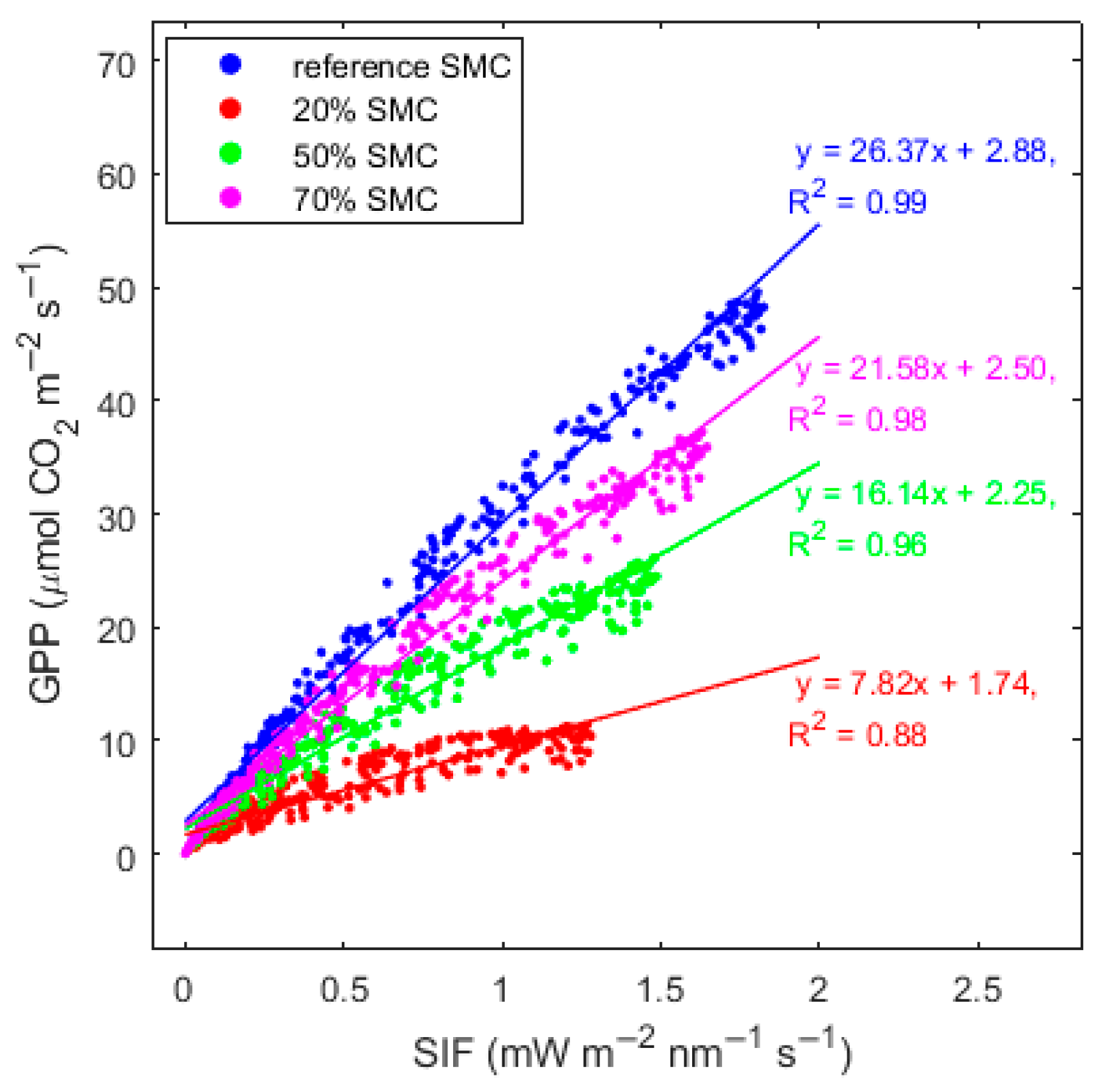
An example scatter plot of SIF and GPP simulated by the STEMMUS-SCOPE model is shown below (see Figure 1), which is during the DOY of 180–190 (no irrigation, no drought) in 2020 and with setting the cab to 50, the LAI to 3, and the Vcmax to 80. According to the original average soil moisture content of each layer, the input measured soil moisture content is changed, and the lower the soil moisture content is, the lower the slope of the SIF-GPP linear regression line, which gradually presents a nonlinear state.
In this study, the input parameters of the STEMMUS-SCOPE model were obtained through field measurement, reference to the literature, and inversion, and the key input parameters are listed in the Table 1. Among them, the meteorology parameters are obtained by actual measurement. The MERIS Terrestrial Chlorophyll Index (MTCI) was used to retrieve Cab. MTCI exhibits high accuracy in estimating Cab (R2 = 0.73, RMSE = 11.16) and maintains good sensitivity even during the high-chlorophyll-concentration stage in maize [44,45]. The multi-angular NDVI (MAVI) was used to retrieve LAI, with the aim of reducing the effects of soil background and saturation on LAI estimation. The MAVI achieves high accuracy in LAI retrieval (R2 = 0.945, RMSE = 0.345) [46]. The leaf inclination was spherical, which has been shown to be a good approximation in crops such as maize [47,48].

2.3. Calculation of Canopy Conductance

Canopy conductance is the degree of stomatal opening at the canopy scale, is the main factor affecting the photosynthesis and respiration of plants, and can also be used as a comprehensive basis for determining the overall impact of drought; we use the daily mean canopy conductance (Gs) as a comprehensive parameter reflecting the drought stress experienced by plants. Gs can be calculated using the vorticity flux data to extrapolate the Penman–Monteith equation [4,49]:
G s = γ g a L E Δ R n G + ρ c p g a V P D a Δ + γ L E
Among them, γ is the humidity constant (kPa K−1), which is related to atmospheric pressure; ga is the aerodynamic conductivity (ms−1); ∆ is the slope of the saturated water vapor pressure difference curve (kPa K−1); LE is the latent heat flux (W m−2); Rn is the net radiation (W m−2); and G is the soil heat flux below the canopy (Wm−2). In addition, ρ is the density of the air (kg m−3), which depends on temperature, pressure, and humidity; cp is the specific heat capacity of air (kJ kg−1K−1); and VPDa is the atmospheric vapor pressure difference, defined as the difference between the atmospheric vapor pressure at ambient temperature and the actual vapor pressure [50]. In this equation, the unit of Gs is m s−1, and these units can be converted to mol m−2s−1 using ideal gas quantification [51]. ga can be calculated by the following formula:
g a = k 2 u ln z d + z H z H + ψ H ln z d + z M z M + ψ M
where z is the anemometer wind speed (m); d is the zero plane displacement (m); and zH and zM represent the roughness length (m) of the sensible thermal momentum, respectively. ψH and ψM represent the stability correction factors for heat and momentum, respectively. k is the von Karman constant; and u is the wind speed at altitude z. Both d and zM can be estimated as a function of canopy height, with h and zH as a function of zM (usually d = 0.67 h, zM = 0.67 h, zH = 0.2 zM).

2.4. Irrigation and Changes in Soil Moisture in 2023

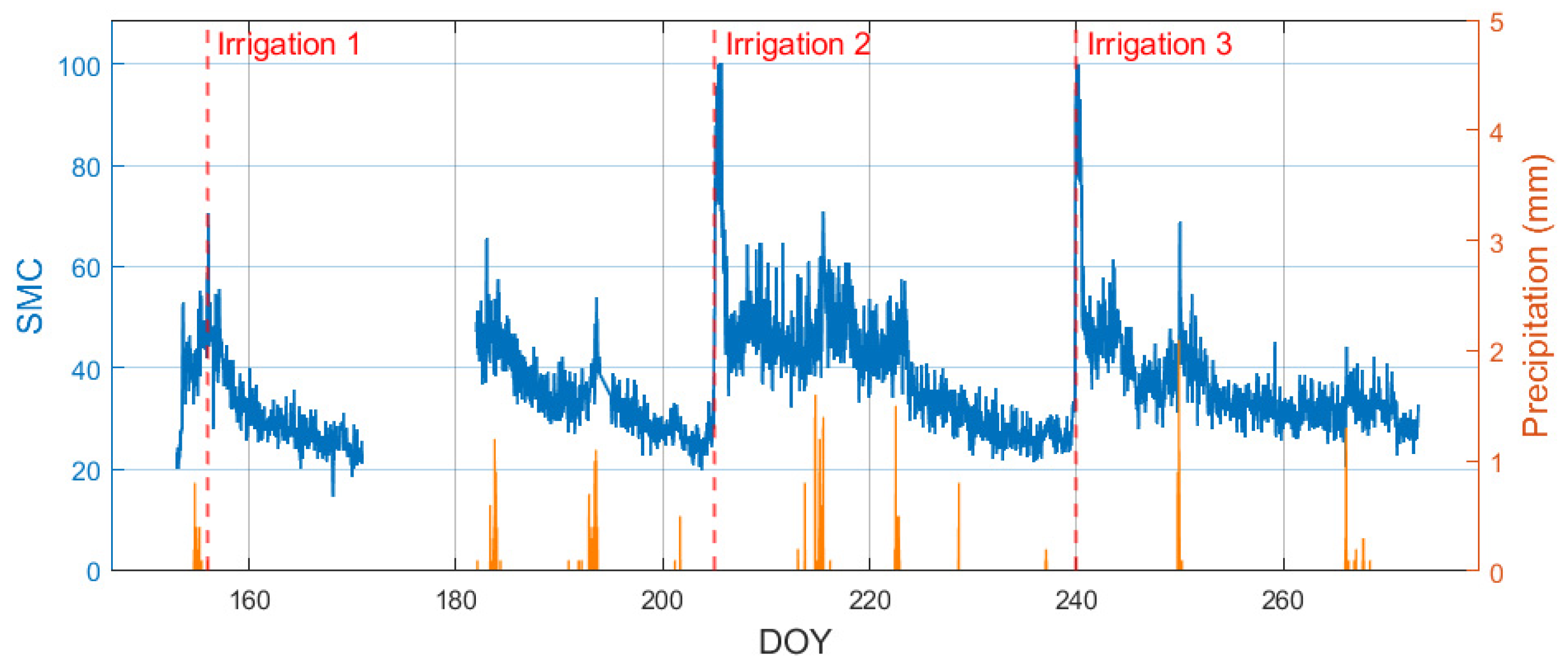
The irrigation management at the Daman site provides an opportunity to quantify the performance of the STEMMUS-SCOPE model in SIF and GPP under drought stress. According to the irrigation and precipitation data at the Daman site, we can select the period of drastic change in soil water content, compare the differences between the SCOPE model and the STEMMUS-SCOPE model before and after the drastic change in soil water content, and evaluate the simulated value caused by the STEMMUS-SCOPE model for tracking the change in soil water content. Due to the obvious irrigation events in 2023, the period between the second and third irrigation, which is the mid-growth stage of maize, was chosen as the representative period for evaluating the performance of the STEMMUS-SCOPE model in different soil moisture conditions. According to the half-hour-scale changes in soil water content and precipitation in 2023 (see Figure 2), it can be inferred that the irrigation events in 2023 occurred at the time points of 156, 205, and 240 DOY.
Previous studies have shown that crops in the study area experience significant drought stress when soil moisture falls below 20% [52,53]. However, the study area is located in a typical irrigated farmland in a semi-arid region of China, where a well-developed irrigation infrastructure and advanced agricultural management practices ensure that soil moisture is carefully regulated within an optimal range for crop growth. As a result, soil moisture rarely drops below 20%. When soil moisture approaches the stress threshold, irrigation is usually applied promptly to prevent severe water deficits. Therefore, soil moisture exhibits pronounced fluctuations before and after irrigation. Based on this pattern, we selected the soil moisture conditions during the three days before irrigation as the standard for defining drought. Periods with soil moisture below 30% or canopy conductance below 0.3 were classified as relatively dry conditions, whereas periods after irrigation characterized by a rapid increase in soil moisture were defined as relatively non-drought conditions.

3. Results

3.1. Comparison of the Accuracy of the STEMMUS-SCOPE and SCOPE Models for GPP and SIF Simulation

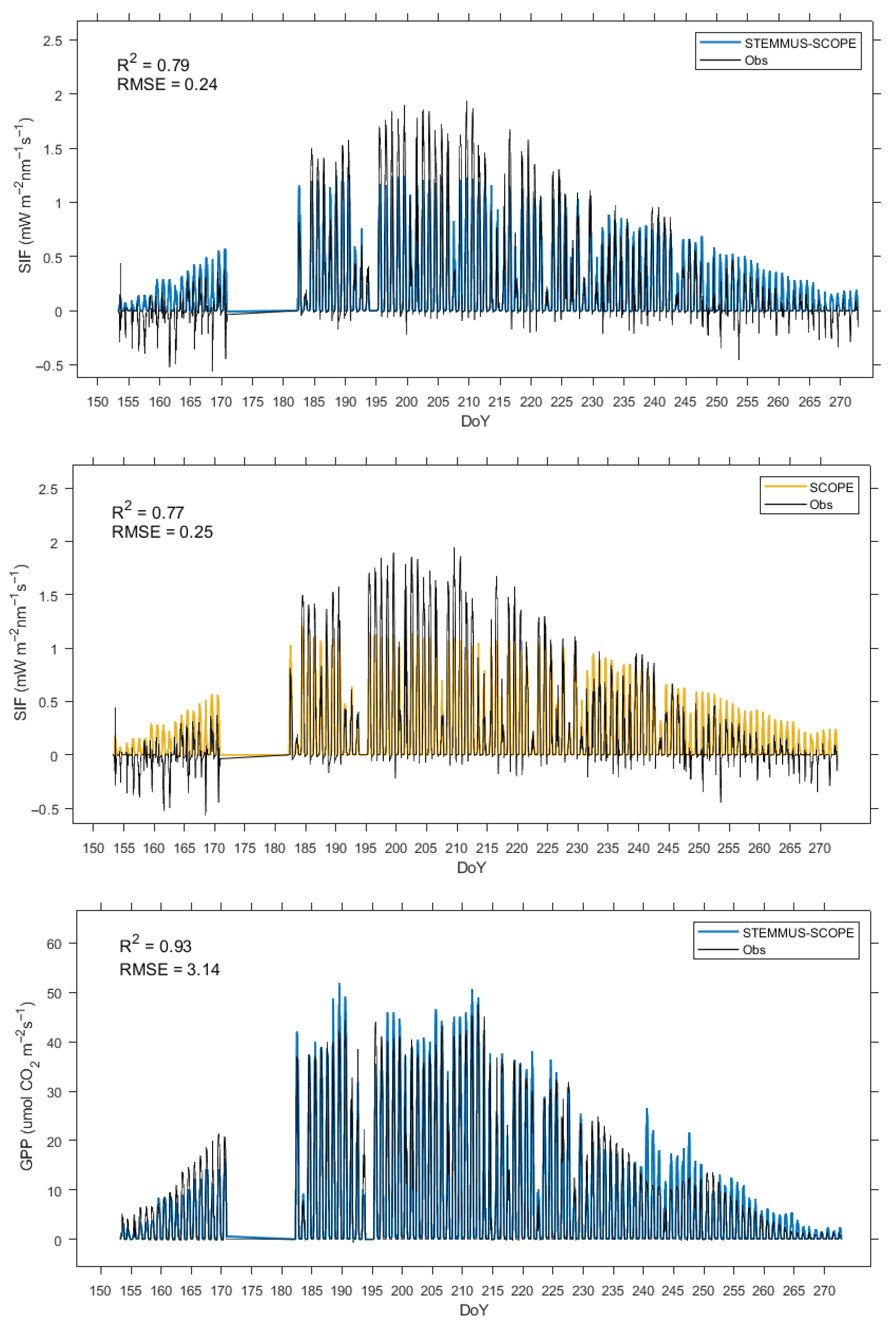
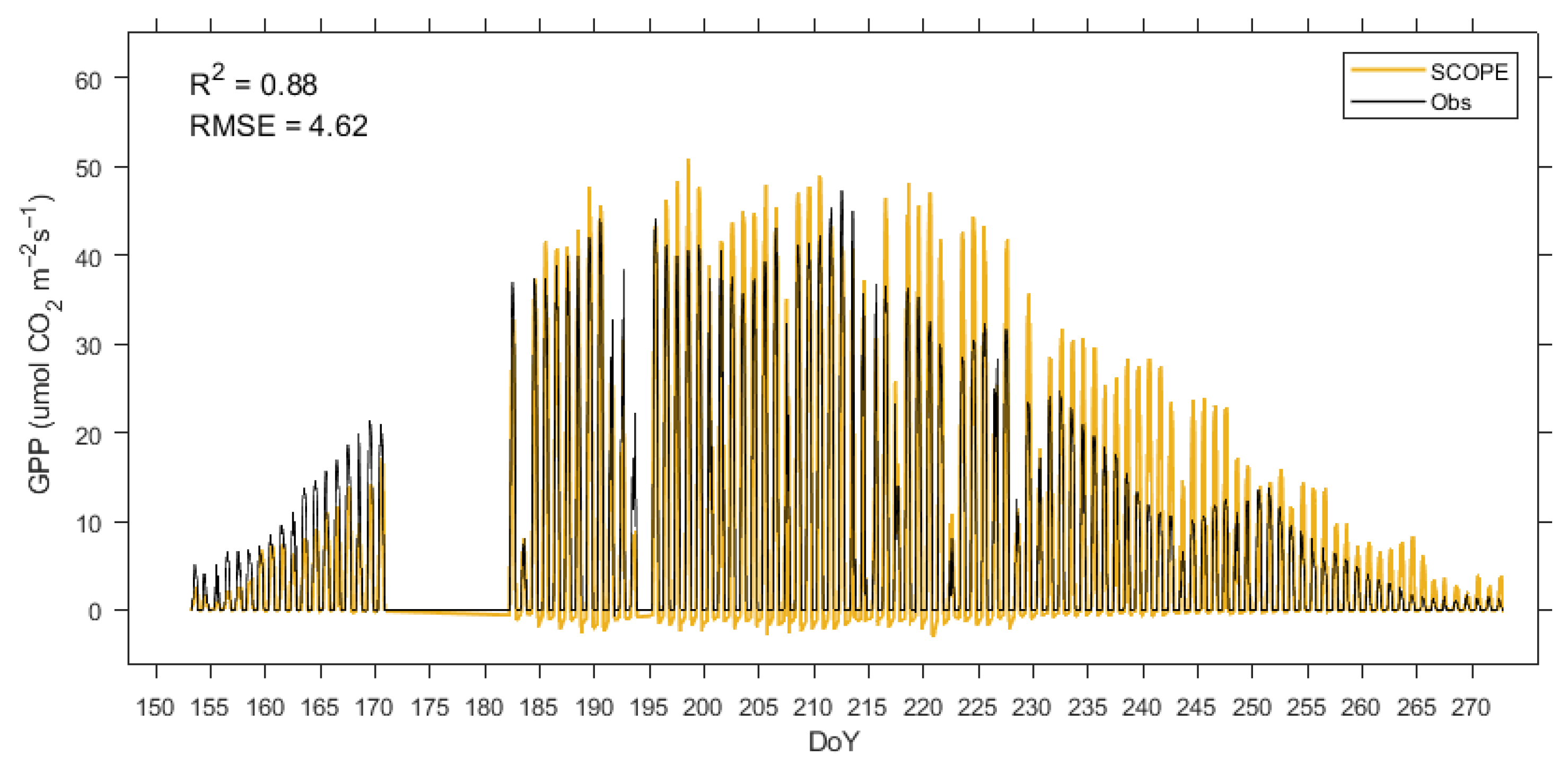
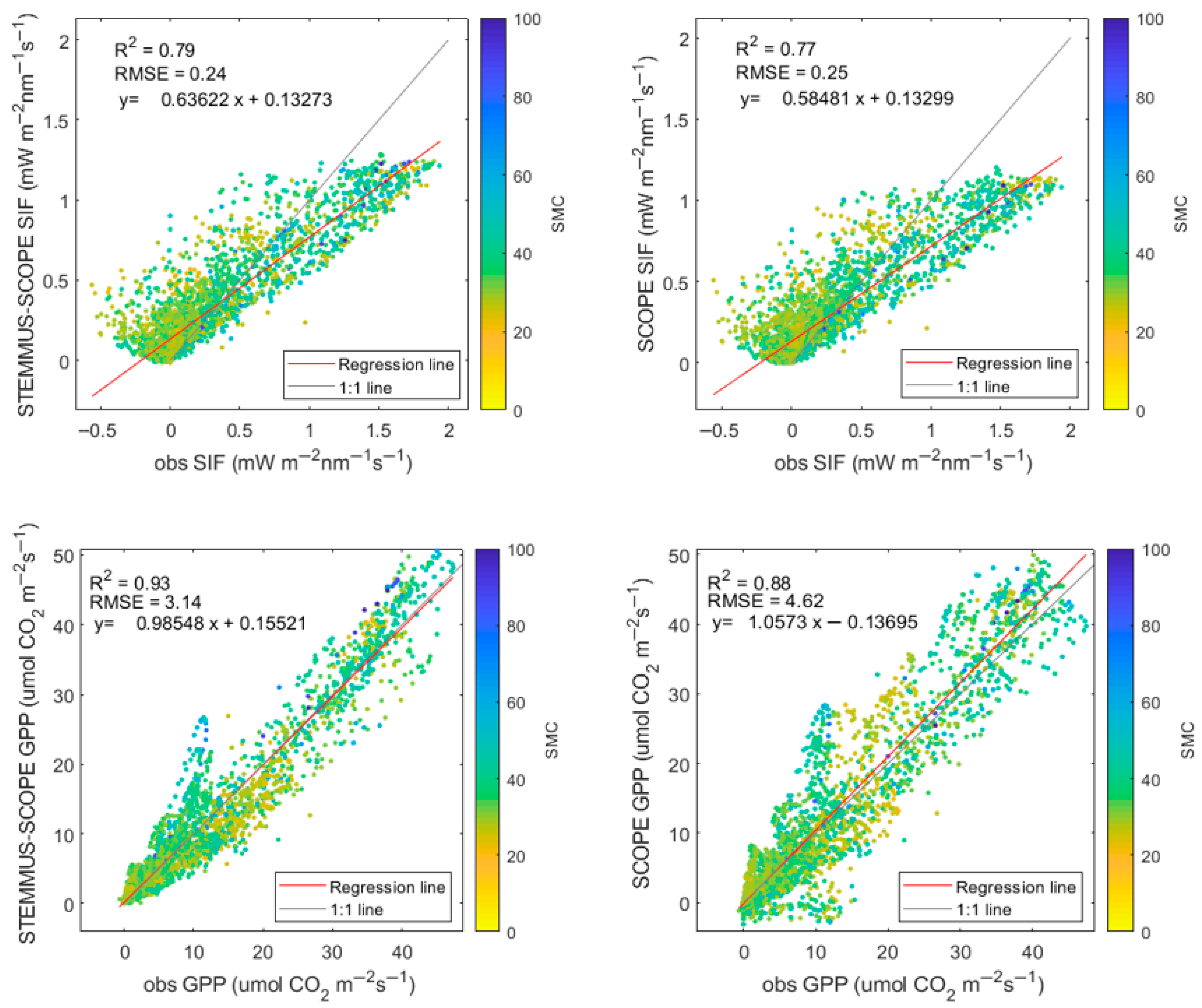
Based on the half-hour-scale SIF and GPP data of simulations and observations, we analyzed the accuracy of the simulated SIF and GPP values of the STEMMUS-SCOPE model from 2017 to 2023 (see Table 2). Across all years, both models showed reasonable agreement with tower-based observations, but the STEMMUS-SCOPE model consistently achieved slightly higher accuracy. For SIF, the R2 of the STEMMUS-SCOPE model ranged from 0.46 to 0.83, and the RMSE ranged from 0.21 to 0.35 mW·m−2·nm−1, comparable to or slightly better than those of the SCOPE model. For GPP, the STEMMUS-SCOPE model exhibited clear improvements, with R2 values ranging from 0.80 to 0.93 and RMSE values from 3.14 to 5.93 μmol CO2·m−2·s−1, outperforming the SCOPE model (R2 = 0.71–0.88, RMSE = 4.62–7.64 μmol CO2·m−2·s−1). The results indicate that the STEMMUS-SCOPE model provides more accurate and stable simulations of both SIF and GPP, particularly for GPP, reflecting the benefit of incorporating soil moisture dynamics and root water uptake processes. Take 2023 as an example, for the STEMMUS-SCOPE model, the R2 between the observed SIF and the simulated SIF was 0.79, with an RMSE of 0.19 mW·m−2·nm−1, and the R2 between the observed GPP and the simulated GPP was 0.93, with an RMSE of 3.14 µmol CO2 m−2 s−1. For the SCOPE model, the R2 between the observed SIF and simulated SIF was 0.77, with an RMSE of 0.20 mW·m−2·nm−1, and the R2 between the observed GPP and simulated GPP was 0.88, with an RMSE of 4.62 µmol CO2 m−2 s−1 (see Figure 3 and Figure 4). The results show that, throughout the entire growth period of summer maize at the Daman site in 2023, the STEMMUS-SCOPE model achieved a higher accuracy of SIF and GPP than the SCOPE model, and the simulation results in the middle of the crop growth period were better than those in the early and late stages of crop growth period in 2023. During DOY 215–240, the SCOPE model significantly overestimated GPP, whereas the STEMMUS-SCOPE model did not exhibit such overestimation. On DOY 241, the simulated GPP from the STEMMUS-SCOPE model showed a sudden increase, which was likely caused by an irrigation event that led to a rise in simulated values.

3.2. Performance of the STEMMUS-SCOPE Model in Tracking the Effects of Drought Stress

The performance of the STEMMUS-SCOPE model in simulating SIF and GPP under changing soil water conditions was evaluated based on the variations in soil water content between the second and third irrigation events at the Daman site.
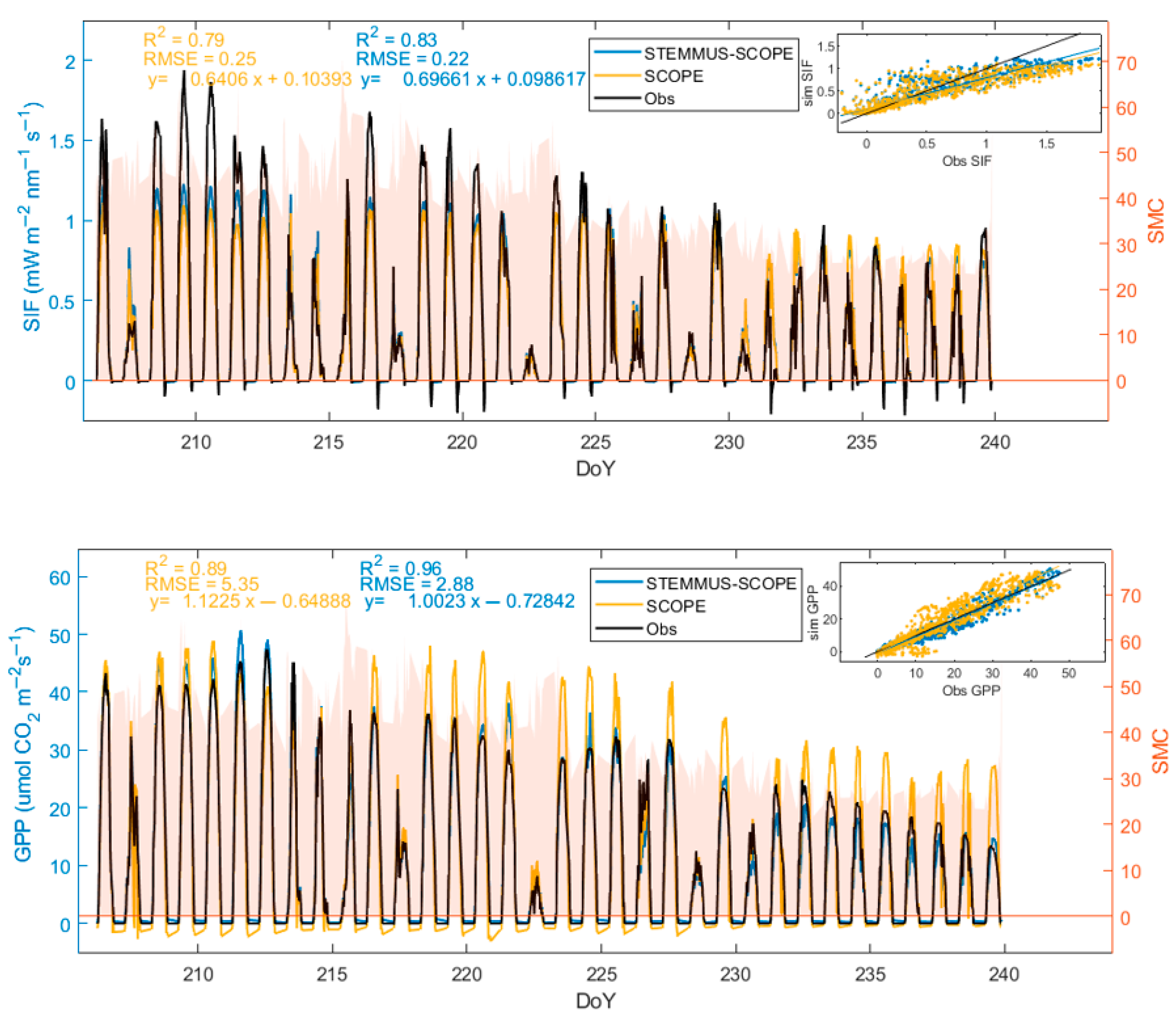
As shown in Figure 5, during the period between the second and third irrigation, the R2 between the observed SIF and the SIF simulated by the STEMMUS-SCOPE model was 0.83, and the RMSE was 0.22 mW m−2 nm−1. For SCOPE model, the R2 between the observed SIF and simulated SIF was 0.79, and the RMSE was 0.25 mW m−2 nm−1. During DOY 206–221, when soil moisture was relatively high after the second irrigation, the SIF simulated by the STEMMUS-SCOPE model was higher than that simulated by the SCOPE model. In contrast, during DOY 231–239, when soil moisture was relatively low before the third irrigation, the SIF simulated by the STEMMUS-SCOPE model was slightly lower than that of the SCOPE model. During the period between the second and third irrigation, the R2 between the observed GPP and the GPP simulated by the STEMMUS-SCOPE model was 0.96, and the RMSE was 2.88 µmol CO2 m−2 s−1. For the SCOPE model, the R2 between the observed SIF and simulated SIF was 0.79, and the RMSE was 5.35 µmol CO2 m−2 s−1. During this period, the SCOPE model tended to overestimate GPP, with the overestimation particularly pronounced before the third irrigation. In contrast, the STEMMUS-SCOPE model effectively addressed this issue, showing improved simulation performance not only before the third irrigation but also during other periods when the SCOPE model exhibited overestimation. Specifically, the linear regression slope of the GPP simulated by the STEMMUS-SCOPE model between the second and third irrigation events was 1.0023, indicating that the STEMMUS-SCOPE model achieved better GPP simulation performance than the SCOPE model under varying soil moisture conditions, especially when soil moisture was relatively low.
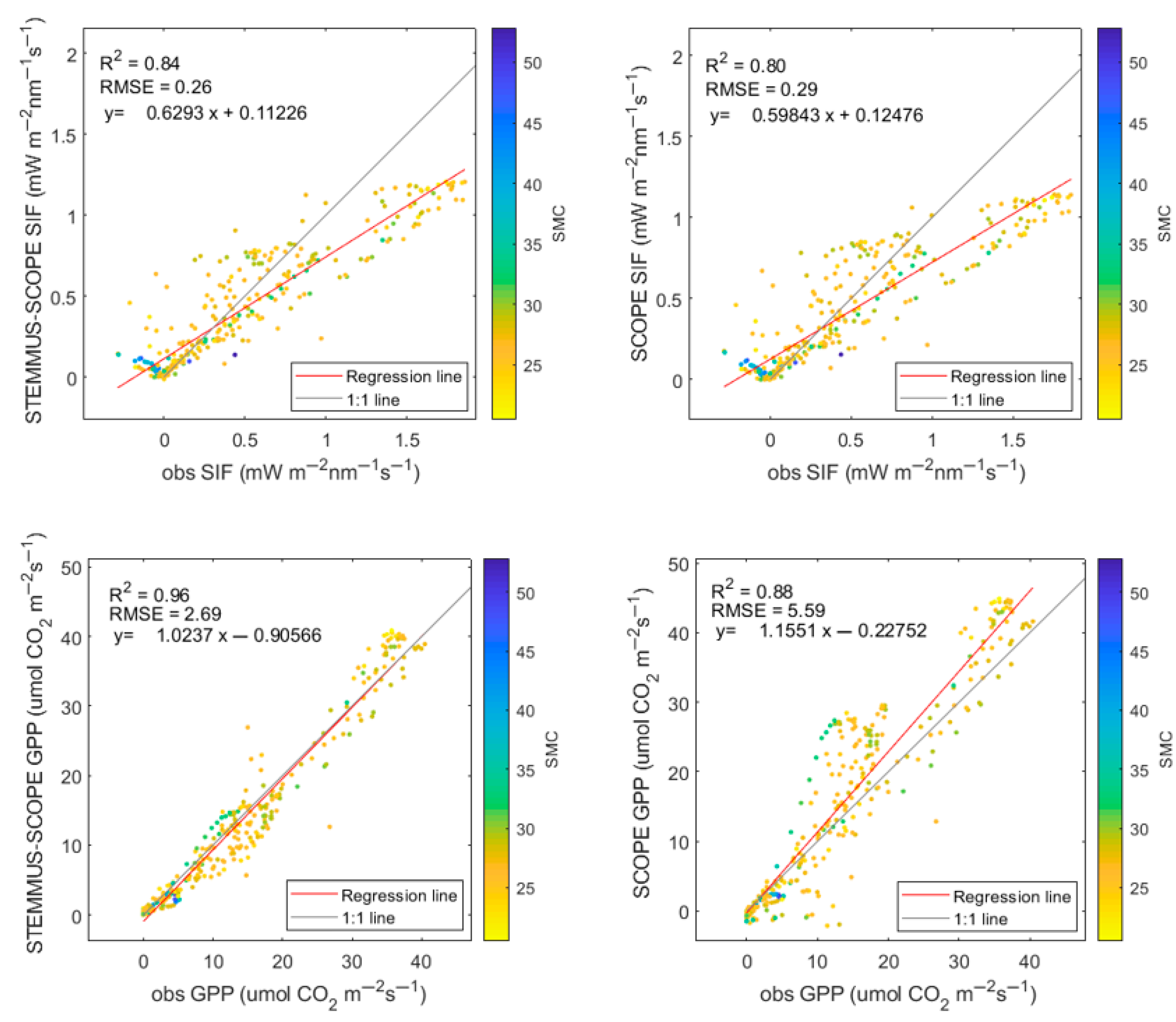
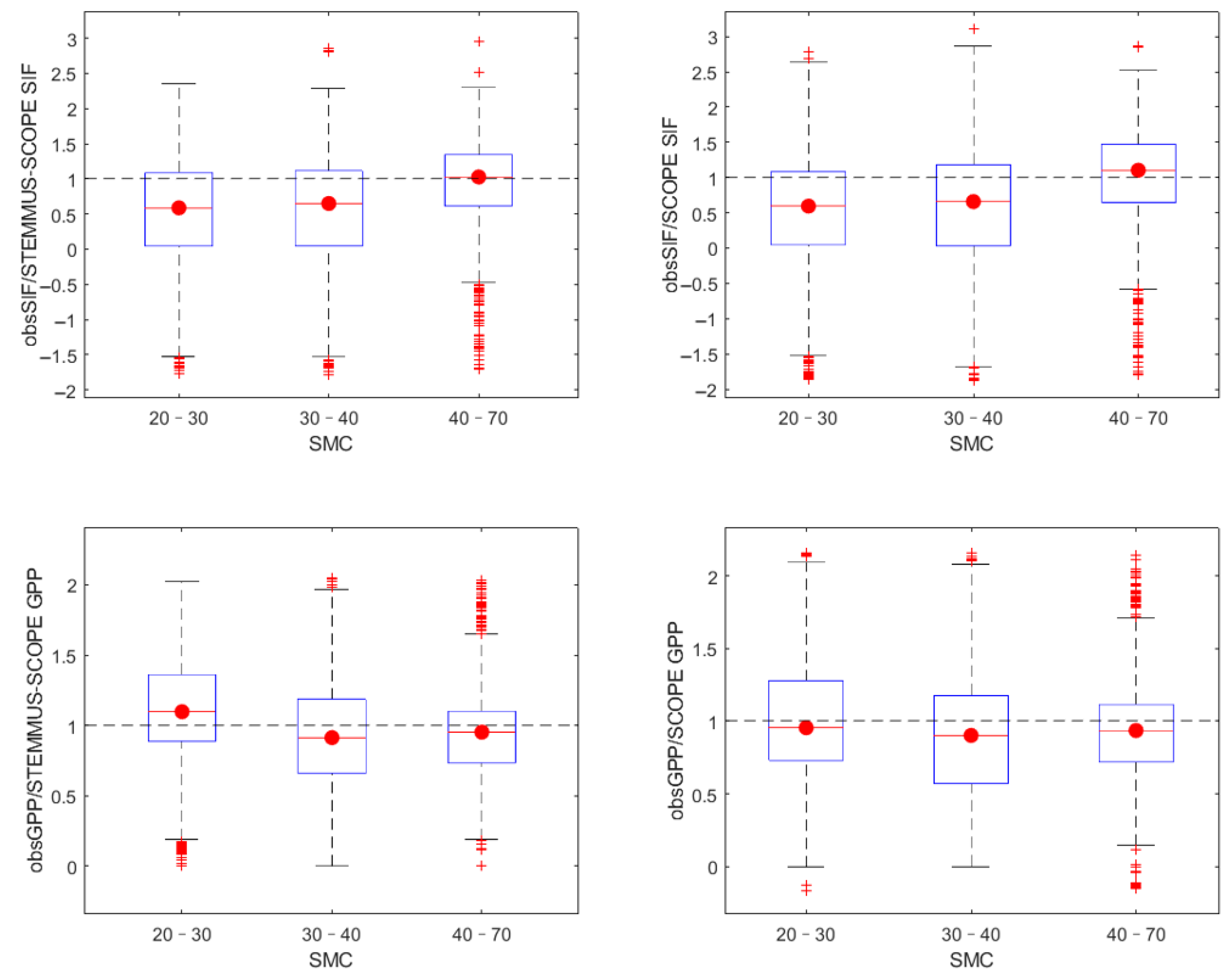
As shown in Figure 6, in periods before all irrigations in 2023, the accuracy of SIF simulated by the STEMMUS-SCOPE model was slightly better than the simulations by the SCOPE model, with an R2 of 0.84 and an RMSE of 0.26 mW m−2 nm−1, and its regression line was closer to the 1:1 line. The accuracy of GPP simulated by the STEMMUS-SCOPE model was significantly higher than that of the SCOPE model, with an R2 of 0.96, an RMSE of 2.69 µmol CO2 m−2 s−1, and a regression slope of 1.0237. The observation-to-simulation ratios under different soil moisture conditions indicated that, under lower soil moisture, the variability in these ratios for the STEMMUS-SCOPE model was smaller than that for the SCOPE model, demonstrating its superior simulation accuracy during drought periods (see Figure 7).

3.3. Responses of STEMMUS-SCOPE-Simulated ΦF and LUE to Varying SMC

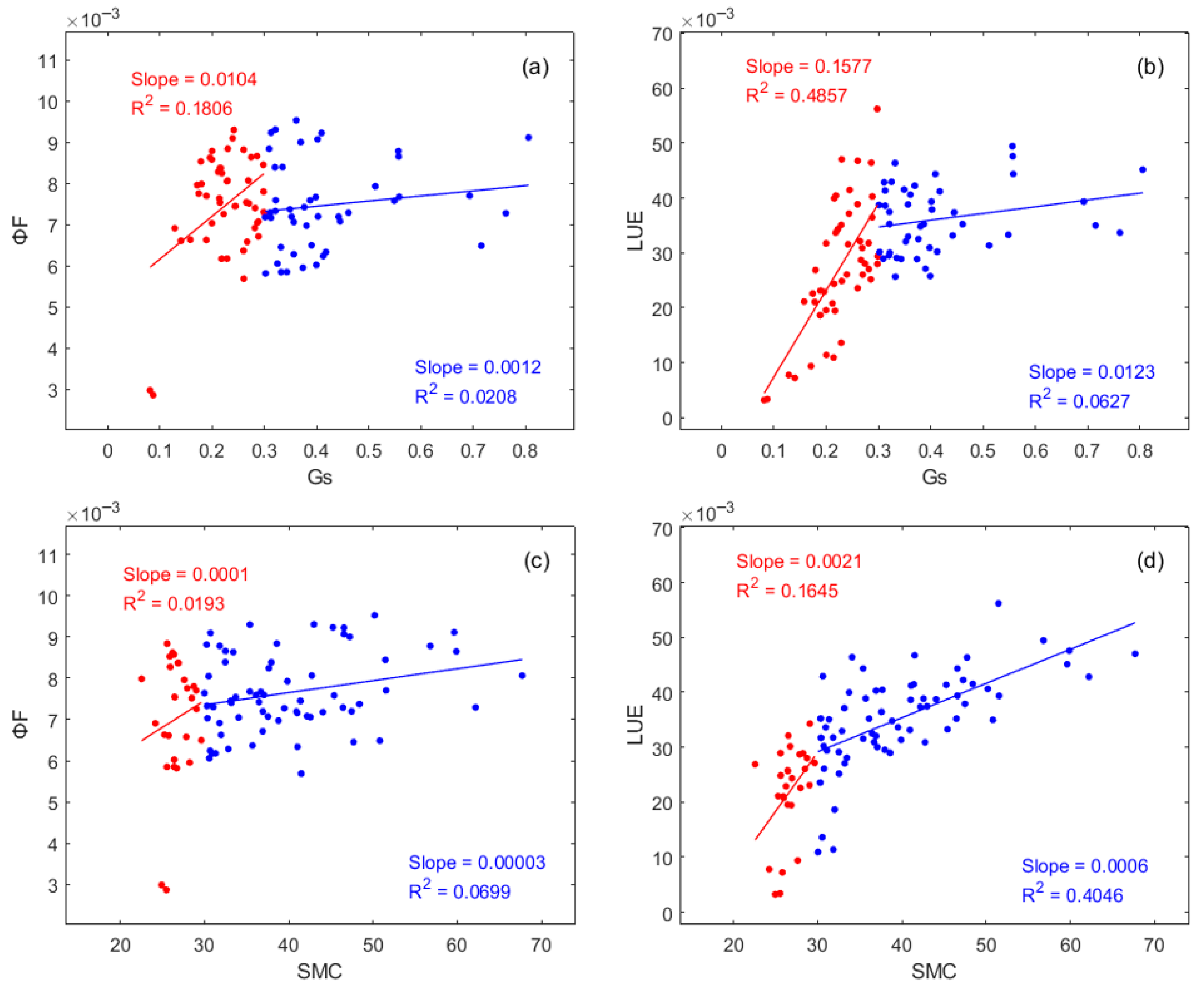
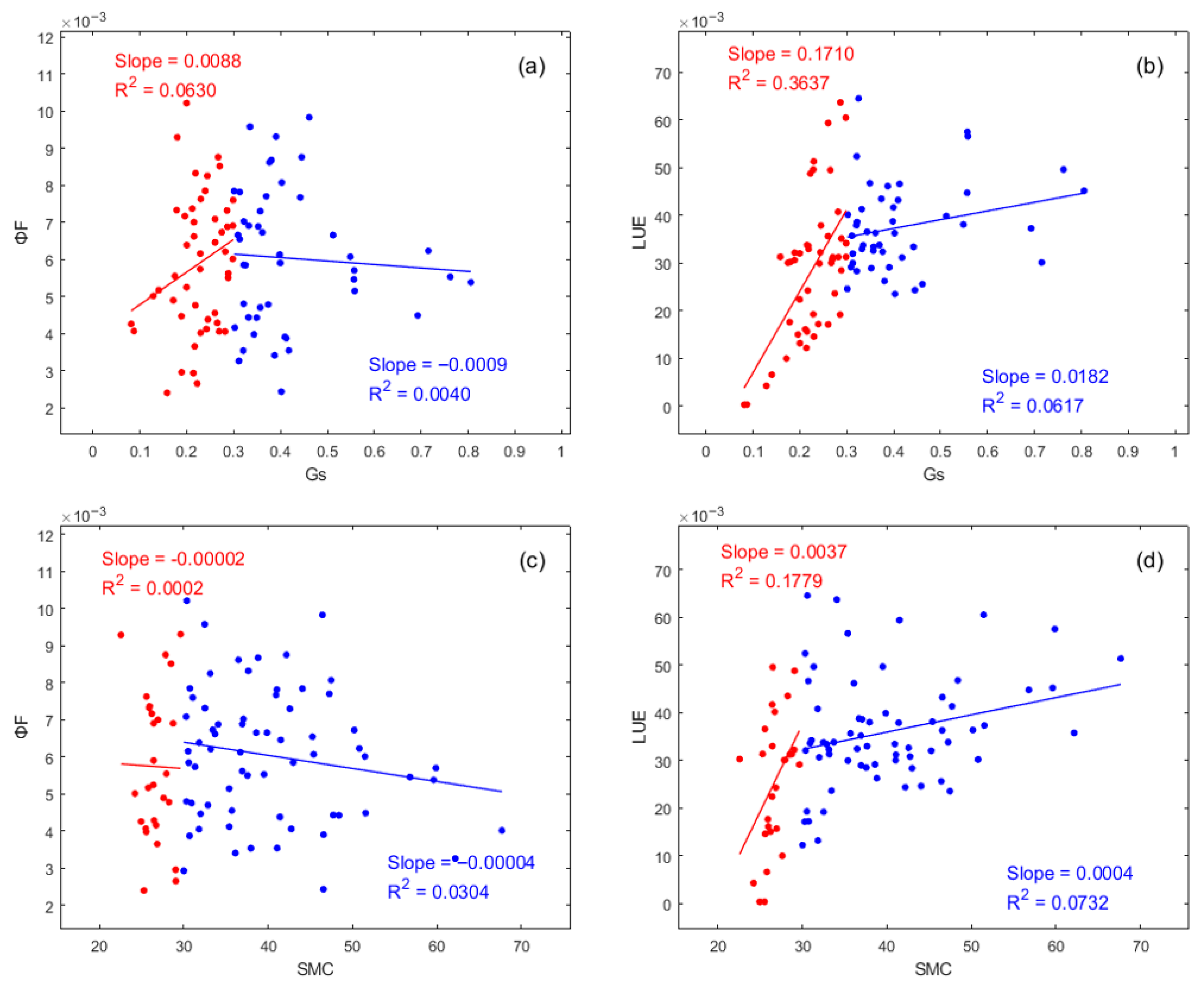
Based on the daily-scale ΦF and LUE values obtained from tower observations as well as those simulated by the STEMMUS-SCOPE model, we discuss their relationships with varying soil moisture content and canopy conductance in 2022 (see Figure 8 and Figure 9).
Under relatively non-drought conditions, the model simulations showed that the correlation between ΦF and SMC (R2 = 0.0699) was slightly stronger than that between ΦF and Gs (R2 = 0.0208), while the correlation between LUE and SMC (R2 = 0.4046) was significantly stronger than that between LUE and Gs (R2 = 0.0627). Under relatively drought conditions, the correlation between ΦF and Gs (R2 = 0.1806) was stronger than that between ΦF and SMC (R2 = 0.0193), and the correlation between LUE and Gs (R2 = 0.4857) was significantly stronger than that between LUE and SMC (R2 = 0.1645). These results indicate that under relatively drought conditions, Gs carries more physiological information about the crop, whereas under relatively non-drought conditions, SMC performs better. This pattern is consistent with the results observed from the flux tower measurements. It is noteworthy that the correlation between LUE and SMC simulated by the STEMMUS-SCOPE model under non-drought conditions was significantly higher than that between LUE and SMC observed from the tower measurements (R2 = 0.0732).
Moreover, both the tower observations and STEMMUS-SCOPE simulations show that ΦF and LUE decreased with a declining water availability index; however, their response patterns differ. As drought severity increases, the observed decline in ΦF is smaller than that in LUE, whereas this asynchronous decline is partially constrained in the STEMMUS-SCOPE simulations.

4. Discussion

4.1. Performance of the STEMMUS-SCOPE Model for SIF and GPP Under Drought Stress

In this article, we evaluated the performance of the STEMMUS-SCOPE model at the Daman site, with a particular focus on drought periods and times of soil moisture variation. As shown in Table 2 and Figure 3 and Figure 4, the simulation performance of the STEMMUS-SCOPE model has been validated, and its accuracy of SIF and GPP simulation can match or even exceed that of the SCOPE model. Wang et al. [34] compared and analyzed the simulation performance of the SCOPE, STEMMUS, and STEMMUS-SCOPE models in maize fields and grasslands by verifying the simulation capabilities of different terrestrial ecological types, indicating that the STEMMUS-SCOPE model has better simulation capabilities in different terrestrial ecological types, especially when the canopy experienced moderate water stress. Tang et al. [54] used the STEMMUS-SCOPE model in the desert grassland of northwest China to simulate the energy flux under shrub and grassland scenarios. Different from these studies, this study takes advantage of the pronounced soil moisture fluctuations in semi-arid irrigated farmland to focus on evaluating the STEMMUS-SCOPE model’s performance in simulating SIF and GPP, particularly under relatively dry conditions and during periods of soil moisture variation. As shown in Figure 5, during the relatively dry period before the third irrigation, unlike the SCOPE model, the GPP simulated by the STEMMUS-SCOPE model was clearly constrained by water stress, resulting in a significant improvement in simulation accuracy. Figure 6 and Figure 7 further demonstrate that STEMMUS-SCOPE outperforms SCOPE under drought conditions.
To evaluate the capability of STEMMUS-SCOPE to quantitatively assess the effects of drought stress on SIF and GPP, we also took into account the impact of stomatal response on SIF and GPP under relatively drought conditions. We calculated Gs on a daily scale based on Equations (3) and (4), and FPAR was calculated according to Equations (1) and (2). The determination of water stress is complex, involving multiple factors such as reduced soil moisture content as well as atmospheric and water demand. At present, vegetation indices and the CWSI are used as indicators for monitoring crop drought [55,56,57]. At the leaf scale, leaf water potential is a good parameter for determining water stress, but no measured leaf water potential data are available in this study area. Souza et al. [25] found that under drought stress, the declines in canopy conductance, respiration rate, and transpiration rate were consistent. Since stomatal responses directly affect plant photosynthesis, respiration, and transpiration, this may explain the change in the relationship between SIF and GPP. Previous studies have also suggested that Gs is associated with certain fluorescence parameters related to photosynthesis [58,59]. Therefore, in this article, Gs is also used as an index to determine drought status, and the simulation performance of the STEMMUS-SCOPE model for SIF and GPP is analyzed in combination with SMC. The variations in ΦF and LUE simulated by the STEMMUS-SCOPE model under different drought indicators were generally consistent with those observed at the tower. Chen et al. [27] pointed out that the decrease in ΦF under drought stress was less than the decrease in LUE, and this phenomenon was found in both observations at the tower base and model simulations. This may be because, although the light response of plant photosynthesis is weakened in relatively drought conditions, plants compensate for the decline in photochemical processes through stomatal reactions, thereby mitigating the effects of drought. In this article, the inconsistency between the declines in ΦF and LUE with decreasing water availability was constrained (see Figure 8). This suggests that the SIF and GPP values simulated by STEMMUS-SCOPE exhibit strong correlations across different water conditions, which can be attributed to the model’s consideration of the dynamic effects of water availability on the simulation. In addition, we found that the ΦF and LUE values simulated by the STEMMUS-SCOPE model are more strongly correlated with Gs, indicating that Gs can also serve as a comprehensive evaluation index, and it performs better than SMC as an indicator under drought conditions.

4.2. Advantages of STEMMUS-SCOPE in Quantifying Drought Effects on SIF and GPP

In this article, we demonstrated that the STEMMUS-SCOPE model can track the effect of water stress on the simulated values under drought conditions, whereas the SCOPE model lacks this capability. Although the input parameters of the SCOPE model also include a water stress factor, these parameters are not calculated based on measured soil moisture content or simulated soil moisture content, so they cannot accurately and specifically reflect the impact of drought stress on the simulation experiment. Especially under relatively drought conditions and the late growth stage of maize, the simulated GPP value of the SCOPE model tends to be higher, because water stress is one of the main factors restricting vegetation function [33,60]. Therefore, it is particularly important to combine hydraulic models. Bayat et al. [33] achieved better performance in estimating GPP and ET by integrating SPAC models into SCOPE. The STEMMUS-SCOPE model further incorporates the SPAC system and a root growth module to calculate the water stress factor. Compared with the SCOPE-SM model, the STEMMUS-SCOPE model introduces a one-dimensional root growth model, which can simulate the flux change under drought stress well [34]. By integrating a one-dimensional root growth model and an impedance scheme that links soil, roots, leaves, and the atmosphere, the STEMMUS-SCOPE model is able to simulate SIF and GPP under drought conditions or during rapid soil moisture changes more accurately than the SCOPE model.
One major reason for the uncertainty in the SIF–GPP relationship under drought conditions is that stomatal responses can occur more rapidly than changes in electron transport [61]. Under drought stress, rapid stomatal closure limits the entry of CO2 into the leaf and chloroplasts, reducing the internal CO2/O2 ratio. This shift promotes higher rates of photorespiration and the Mehler reaction. Because these two processes consume only a small fraction of ATP compared with carbon fixation, the thylakoid proton gradient (ΔpH) increases substantially [62]. As ΔpH rises, the xanthophyll cycle is activated, enhancing non-photochemical quenching (NPQ). Consequently, thermal dissipation becomes increasingly important in the drought response, while SIF is reduced. In addition to stomatal limitation, severe drought can also trigger non-stomatal regulation, further suppressing photosynthesis. Intense water stress can impair the activity and activation state of Rubisco and chloroplasts, leading to declines in both photosynthesis and fluorescence. Helm et al. [63] noted that drought-induced reductions in CO2 assimilation may result from restricted CO2 diffusion due to stomatal closure or from downregulation of leaf biochemical processes caused by non-stomatal factors. However, the observed decrease in fluorescence was generally smaller than the reduction in CO2 assimilation. This mismatch between the light reactions and carbon reactions may be a key contributor to the complex SIF–GPP relationship, as SIF is directly linked to the light reactions of photosynthesis.
The STEMMUS-SCOPE model calculates the water stress factor based on the soil moisture content and root length density of each soil layer. The obtained water stress factor is directly applied to the photosynthetic biochemical processes to constrain Vcmax. When soil moisture decreases, the stress factor significantly reduces Vcmax, leading to a decline in photochemical efficiency, an increase in thermal dissipation, enhanced NPQ, and reduced fluorescence. As a result, SIF exhibits a decreasing trend that corresponds to the severity of drought (see Figure 5, Figure 6, Figure 7, Figure 8 and Figure 9). The decline in Vcmax in the model directly limits carbon fixation capacity, leading to a reduction in simulated GPP. Especially under drought conditions, the water stress factor can effectively constrain the model outputs, thereby avoiding the overestimation commonly observed in the SCOPE model (see Figure 5 and Figure 6).
For the uncertainty in the SIF–GPP relationship under drought conditions, a mechanistic explanation can be obtained through the different pathways by which the water stress factor in the STEMMUS-SCOPE model affects SIF and GPP. As soil moisture decreases, the slope between simulated SIF and GPP gradually declines (see Figure 1), highlighting the model’s potential for assessing the influence of drought stress on the SIF–GPP relationship.

4.3. The Limitations of This Article

In this study, we conducted a long-term evaluation of the STEMMUS-SCOPE model using continuously monitored maize data, confirming that the model performs well in simulating processes within this agricultural ecosystem. However, several limitations remain that warrant improvement in future research. Maize is a typical C4 plant, and this study did not include long-term validation for other plant functional types. Since the photosynthetic processes of C3 and C4 plants differ, their responses to environmental stresses may involve distinct mechanisms [61,64]. Secondly, although the STEMMUS-SCOPE model provides a process-based description of the interactions among water, carbon, and energy, its performance still depends on the accuracy of key physiological parameterization such as Cab and LAI. Uncertainties in these parameters can introduce potential variability into the model outputs. Moreover, the soil profile in the study area is not vertically homogeneous, whereas this study assumes vertical uniformity, which may introduce certain biases when simulating the SPAC processes within the STEMMUS-SCOPE framework.

5. Conclusions

In this study, we used meteorological and flux data from the Daman site during 2017–2023, along with measured or retrieved vegetation parameters, to simulate half-hourly SIF and GPP using the STEMMUS-SCOPE model. Leveraging the irrigation events characteristic of semi-arid irrigated farmland, we evaluated and validated the model from two perspectives: accuracy in simulating SIF and GPP under drought stress and capability to quantitatively assess the impacts of water stress on SIF and GPP. The STEMMUS-SCOPE model exhibited strong simulation performance during the maize growing season. Taking 2023 as an example, the model achieved an R2 of 0.79 for SIF and 0.93 for GPP. Compared with the SCOPE model, STEMMUS-SCOPE more effectively reduces the overestimation under water deficit conditions, indicating its improved ability to track the effects of soil moisture variability—an advantage particularly evident under low soil moisture. This article, thus, verified the simulation performance of the STEMMUS-SCOPE model and examined the model’s ability to track the effects of soil moisture variability on simulated values under different water conditions.

Author Contributions

Conceptualization, M.L., X.L. and L.L.; validation, M.L.; formal analysis, M.L.; investigation, M.L.; resources, L.L.; writing—original draft, M.L.; writing—review and editing, X.L. and L.L.; visualization, M.L.; supervision, X.L. and L.L.; project administration, L.L.; funding acquisition, L.L. All authors have read and agreed to the published version of the manuscript.

Funding

This research received no external funding or This research was funded by National Natural Science Foundation of China grant number 42425001.

Data Availability Statement

Data will be made available upon request to the authors.

Conflicts of Interest

The authors declare no conflict of interest.

References

  1. Van Der Tol, C.; Berry, J.A.; Campbell, P.K.E.; Rascher, U. Models of Fluorescence and Photosynthesis for Interpreting Measurements of Solar-Induced Chlorophyll Fluorescence. J. Geophys. Res. Biogeosci. 2014, 119, 2312–2327. [Google Scholar] [CrossRef]
  2. Köhler, P.; Guanter, L.; Kobayashi, H.; Walther, S.; Yang, W. Assessing the Potential of Sun-Induced Fluorescence and the Canopy Scattering Coefficient to Track Large-Scale Vegetation Dynamics in Amazon Forests. Remote Sens. Environ. 2018, 204, 769–785. [Google Scholar] [CrossRef]
  3. Liu, L.; Guan, L.; Liu, X. Directly Estimating Diurnal Changes in GPP for C3 and C4 Crops Using Far-Red Sun-Induced Chlorophyll Fluorescence. Agric. For. Meteorol. 2017, 232, 1–9. [Google Scholar] [CrossRef]
  4. Monteith, J.L. Solar Radiation and Productivity in Tropical Ecosystems. J. Appl. Ecol. 1972, 9, 747–766. [Google Scholar] [CrossRef]
  5. Guanter, L.; Frankenberg, C.; Dudhia, A.; Lewis, P.E.; Gómez-Dans, J.; Kuze, A.; Suto, H.; Grainger, R.G. Retrieval and Global Assessment of Terrestrial Chlorophyll Fluorescence from GOSAT Space Measurements. Remote Sens. Environ. 2012, 121, 236–251. [Google Scholar] [CrossRef]
  6. Porcar-Castell, A.; Malenovský, Z.; Magney, T.; Van Wittenberghe, S.; Fernández-Marín, B.; Maignan, F.; Zhang, Y.; Maseyk, K.; Atherton, J.; Albert, L.P.; et al. Chlorophyll a Fluorescence Illuminates a Path Connecting Plant Molecular Biology to Earth-System Science. Nat. Plants 2021, 7, 998–1009. [Google Scholar] [CrossRef] [PubMed]
  7. Song, L.; Guanter, L.; Guan, K.; You, L.; Huete, A.; Ju, W.; Zhang, Y. Satellite Sun-Induced Chlorophyll Fluorescence Detects Early Response of Winter Wheat to Heat Stress in the Indian Indo-Gangetic Plains. Glob. Change Biol. 2018, 24, 4023–4037. [Google Scholar] [CrossRef]
  8. Chen, R.; Liu, L.; Liu, X.; Rascher, U. CMLR: A Mechanistic Global GPP Dataset Derived from TROPOMIS SIF Observations. J. Remote Sens. 2024, 4, 0127. [Google Scholar] [CrossRef]
  9. Pierrat, Z.; Magney, T.; Parazoo, N.C.; Grossmann, K.; Bowling, D.R.; Seibt, U.; Johnson, B.; Helgason, W.; Barr, A.; Bortnik, J. Diurnal and Seasonal Dynamics of Solar-Induced Chlorophyll Fluorescence, Vegetation Indices, and Gross Primary Productivity in the Boreal Forest. J. Geophys. Res. Biogeosci. 2022, 127, e2021JG006588. [Google Scholar] [CrossRef]
  10. Frankenberg, C.; Fisher, J.B.; Worden, J.; Badgley, G.; Saatchi, S.S.; Lee, J.-E.; Toon, G.C.; Butz, A.; Jung, M.; Kuze, A.; et al. New Global Observations of the Terrestrial Carbon Cycle from GOSAT: Patterns of Plant Fluorescence with Gross Primary Productivity. Geophys. Res. Lett. 2011, 38, L17706. [Google Scholar] [CrossRef]
  11. Dechant, B.; Ryu, Y.; Badgley, G.; Köhler, P.; Rascher, U.; Migliavacca, M.; Zhang, Y.; Tagliabue, G.; Guan, K.; Rossini, M.; et al. NIRVP: A Robust Structural Proxy for Sun-Induced Chlorophyll Fluorescence and Photosynthesis across Scales. Remote Sens. Environ. 2022, 268, 112763. [Google Scholar] [CrossRef]
  12. Kim, J.; Ryu, Y.; Dechant, B.; Lee, H.; Kim, H.S.; Kornfeld, A.; Berry, J.A. Solar-Induced Chlorophyll Fluorescence Is Non-Linearly Related to Canopy Photosynthesis in a Temperate Evergreen Needleleaf Forest during the Fall Transition. Remote Sens. Environ. 2021, 258, 112362. [Google Scholar] [CrossRef]
  13. Li, Y.; Hou, R.; Tao, F. Interactive Effects of Different Warming Levels and Tillage Managements on Winter Wheat Growth, Physiological Processes, Grain Yield and Quality in the North China Plain. Agric. Ecosyst. Environ. 2020, 295, 106923. [Google Scholar] [CrossRef]
  14. Chen, A.; Mao, J.; Ricciuto, D.; Lu, D.; Xiao, J.; Li, X.; Thornton, P.E.; Knapp, A.K. Seasonal Changes in GPP/SIF Ratios and Their Climatic Determinants across the Northern Hemisphere. Glob. Change Biol. 2021, 27, 5186–5197. [Google Scholar] [CrossRef]
  15. Chen, R.; Liu, L.; Liu, X.; Liu, Z.; Gu, L.; Rascher, U. Improving Estimates of Sub-Daily Gross Primary Production from Solar-Induced Chlorophyll Fluorescence by Accounting for Light Distribution within Canopy. Remote Sens. Environ. 2024, 300, 113919. [Google Scholar] [CrossRef]
  16. Rajewicz, P.A.; Zhang, C.; Atherton, J.; Van Wittenberghe, S.; Riikonen, A.; Magney, T.; Fernandez-Marin, B.; Plazaola, J.I.G.; Porcar-Castell, A. The Photosynthetic Response of Spectral Chlorophyll Fluorescence Differs across Species and Light Environments in a Boreal Forest Ecosystem. Agric. For. Meteorol. 2023, 334, 109434. [Google Scholar] [CrossRef]
  17. Porcar-Castell, A.; Tyystjarvi, E.; Atherton, J.; van der Tol, C.; Flexas, J.; Pfuendel, E.E.; Moreno, J.; Frankenberg, C.; Berry, J.A. Linking Chlorophyll a Fluorescence to Photosynthesis for Remote Sensing Applications: Mechanisms and Challenges. J. Exp. Bot. 2014, 65, 4065–4095. [Google Scholar] [CrossRef] [PubMed]
  18. Magney, T.S.; Bowling, D.R.; Logan, B.A.; Grossmann, K.; Stutz, J.; Blanken, P.D.; Burns, S.P.; Cheng, R.; Garcia, M.A.; Köhler, P.; et al. Mechanistic Evidence for Tracking the Seasonality of Photosynthesis with Solar-Induced Fluorescence. Proc. Natl. Acad. Sci. USA 2019, 116, 11640–11645. [Google Scholar] [CrossRef]
  19. Chen, R.; Liu, L.; Liu, Z.; Liu, X.; Kim, J.; Kim, H.S.; Lee, H.; Wu, G.; Guo, C.; Gu, L. SIF-Based GPP Modeling for Evergreen Forests Considering the Seasonal Variation in Maximum Photochemical Efficiency. Agric. For. Meteorol. 2024, 344, 109814. [Google Scholar] [CrossRef]
  20. Deng, Z.; Chen, J.; Wang, S.; Li, T.; Huang, K.; Gu, P.; Peng, H.; Chen, Z. Response of Vegetation Photosynthesis to the 2022 Drought in Yangtze River Basin by Diurnal Orbiting Carbon Observatory-2/3 Satellite Observations. J. Remote Sens. 2025, 5, 0445. [Google Scholar] [CrossRef]
  21. Kandhol, N.; Pandey, S.; Singh, V.P.; Herrera-Estrella, L.; Tran, L.-S.P.; Tripathi, D.K. Link between Plant Phosphate and Drought Stress Responses. Research 2024, 7, 0405. [Google Scholar] [CrossRef]
  22. Zhang, T.; Ji, X.; Xu, M.; Zhao, G.; Zheng, Z.; Tang, Y.; Chen, N.; Zhu, J.; He, Y.; Zhang, Y. Influences of Drought on the Stability of an Alpine Meadow Ecosystem. Ecosyst. Health Sustain. 2022, 8, 2110523. [Google Scholar] [CrossRef]
  23. Chaves, M.M.; Flexas, J.; Pinheiro, C. Photosynthesis under Drought and Salt Stress: Regulation Mechanisms from Whole Plant to Cell. Ann. Bot. 2009, 103, 551–560. [Google Scholar] [CrossRef] [PubMed]
  24. Galmés, J.; Medrano, H.; Flexas, J. Photosynthetic Limitations in Response to Water Stress and Recovery in Mediterranean Plants with Different Growth Forms. New Phytol. 2007, 175, 81–93. [Google Scholar] [CrossRef]
  25. Souza, R.P.; Machado, E.C.; Silva, J.A.B.; Lagôa, A.M.M.A.; Silveira, J.A.G. Photosynthetic Gas Exchange, Chlorophyll Fluorescence and Some Associated Metabolic Changes in Cowpea (Vigna unguiculata) during Water Stress and Recovery. Environ. Exp. Bot. 2004, 51, 45–56. [Google Scholar] [CrossRef]
  26. Chen, A.; Mao, J.; Ricciuto, D.; Xiao, J.; Frankenberg, C.; Li, X.; Thornton, P.E.; Gu, L.; Knapp, A.K. Moisture Availability Mediates the Relationship between Terrestrial Gross Primary Production and Solar-Induced Chlorophyll Fluorescence: Insights from Global-Scale Variations. Glob. Change Biol. 2021, 27, 1144–1156. [Google Scholar] [CrossRef] [PubMed]
  27. Chen, J.; Liu, X.; Du, S.; Ma, Y.; Liu, L. Effects of Drought on the Relationship Between Photosynthesis and Chlorophyll Fluorescence for Maize. IEEE J. Sel. Top. Appl. Earth Obs. Remote Sens. 2021, 14, 11148–11161. [Google Scholar] [CrossRef]
  28. Li, C.; Peng, L.; Zhou, M.; Wei, Y.; Liu, L.; Li, L.; Liu, Y.; Dou, T.; Chen, J.; Wu, X. SIF-Based GPP Is a Useful Index for Assessing Impacts of Drought on Vegetation: An Example of a Mega-Drought in Yunnan Province, China. Remote Sens. 2022, 14, 1509. [Google Scholar] [CrossRef]
  29. Hou, X.; Zhang, B.; Chen, J.; Zhou, J.; He, Q.-Q.; Yu, H. Response of Vegetation Productivity to Greening and Drought in the Loess Plateau Based on VIs and SIF. Forests 2024, 15, 339. [Google Scholar] [CrossRef]
  30. Chen, S.; Huang, Y.; Wang, G. Detecting Drought-Induced GPP Spatiotemporal Variabilities with Sun-Induced Chlorophyll Fluorescence during the 2009/2010 Droughts in China. Ecol. Indic. 2021, 121, 107092. [Google Scholar] [CrossRef]
  31. Zhang, L.; Qiao, N.; Huang, C.; Wang, S. Monitoring Drought Effects on Vegetation Productivity Using Satellite Solar-Induced Chlorophyll Fluorescence. Remote Sens. 2019, 11, 378. [Google Scholar] [CrossRef]
  32. Van Der Tol, C.; Verhoef, W.; Timmermans, J.; Verhoef, A.; Su, Z. An Integrated Model of Soil-Canopy Spectral Radiances, Photosynthesis, Fluorescence, Temperature and Energy Balance. Biogeosciences 2009, 6, 3109–3129. [Google Scholar] [CrossRef]
  33. Bayat, B.; van der Tol, C.; Yang, P.; Verhoef, W. Extending the SCOPE Model to Combine Optical Reflectance and Soil Moisture Observations for Remote Sensing of Ecosystem Functioning under Water Stress Conditions. Remote Sens. Environ. 2019, 221, 286–301. [Google Scholar] [CrossRef]
  34. Wang, Y.; Zeng, Y.; Yu, L.; Yang, P.; Van Der Tol, C.; Yu, Q.; Lü, X.; Cai, H.; Su, Z. Integrated Modeling of Canopy Photosynthesis, Fluorescence, and the Transfer of Energy, Mass, and Momentum in the Soil–Plant–Atmosphere Continuum (STEMMUS–SCOPE v1.0.0). Geosci. Model Dev. 2021, 14, 1379–1407. [Google Scholar] [CrossRef]
  35. Zeng, Y.; Su, Z.; Wan, L.; Wen, J. A Simulation Analysis of the Advective Effect on Evaporation Using a Two-Phase Heat and Mass Flow Model. Water Resour. Res. 2011, 47, 010701. [Google Scholar] [CrossRef]
  36. Zhang, Y.; Zhang, Q.; Liu, L.; Zhang, Y.; Wang, S.; Ju, W.; Zhou, G.; Zhou, L.; Tang, J.; Zhu, X.; et al. ChinaSpec: A Network for Long-Term Ground-Based Measurements of Solar-Induced Fluorescence in China. J. Geophys. Res. Biogeosci. 2021, 126, e2020JG006042. [Google Scholar] [CrossRef]
  37. Liu, S.; Li, X.; Xu, Z.; Che, T.; Xiao, Q.; Ma, M.; Liu, Q.; Jin, R.; Guo, J.; Wang, L.; et al. The Heihe Integrated Observatory Network: A Basin-Scale Land Surface Processes Observatory in China. Vadose Zone J. 2018, 17, 1–21. [Google Scholar] [CrossRef]
  38. Baldocchi, D.D.; Hincks, B.B.; Meyers, T.P. Measuring Biosphere-Atmosphere Exchanges of Biologically Related Gases with Micrometeorological Methods. Ecology 1988, 69, 1331–1340. [Google Scholar] [CrossRef]
  39. Hu, J.; Liu, L.; Guo, J.; Du, S.; Liu, X. Upscaling Solar-Induced Chlorophyll Fluorescence from an Instantaneous to Daily Scale Gives an Improved Estimation of the Gross Primary Productivity. Remote Sens. 2018, 10, 1663. [Google Scholar] [CrossRef]
  40. Liu, X.; Guanter, L.; Liu, L.; Damm, A.; Malenovský, Z.; Rascher, U.; Peng, D.; Du, S.; Gastellu-Etchegorry, J.-P. Downscaling of Solar-Induced Chlorophyll Fluorescence from Canopy Level to Photosystem Level Using a Random Forest Model. Remote Sens. Environ. 2019, 231, 110772. [Google Scholar] [CrossRef]
  41. Rahman, M.M.; Lamb, D.W.; Stanley, J.N. The Impact of Solar Illumination Angle When Using Active Optical Sensing of NDVI to Infer fAPAR in a Pasture Canopy. Agric. For. Meteorol. 2015, 202, 39–43. [Google Scholar] [CrossRef]
  42. Gitelson, A.A.; Peng, Y.; Huemmrich, K.F. Relationship between Fraction of Radiation Absorbed by Photosynthesizing Maize and Soybean Canopies and NDVI from Remotely Sensed Data Taken at Close Range and from MODIS 250 m Resolution Data. Remote Sens. Environ. 2014, 147, 108–120. [Google Scholar] [CrossRef]
  43. Zeng, Y.; Verhoef, A.; Vereecken, H.; Ben-Dor, E.; Veldkamp, T.; Shaw, L.; Ploeg, M.V.D.; Wang, Y.; Su, Z. Monitoring and Modeling the Soil-Plant System Toward Understanding Soil Health. Rev. Geophys. 2025, 63, e2024RG000836. [Google Scholar] [CrossRef]
  44. Zhang, H.; Li, J.; Liu, Q.; Lin, S.; Huete, A.; Liu, L.; Croft, H.; Clevers, J.G.P.W.; Zeng, Y.; Wang, X.; et al. A Novel Red-Edge Spectral Index for Retrieving the Leaf Chlorophyll Content. Methods Ecol. Evol. 2022, 13, 2771–2787. [Google Scholar] [CrossRef]
  45. Dash, J.; Curran, P.J. The MERIS Terrestrial Chlorophyll Index. Int. J. Remote Sens. 2004, 25, 5403–5413. [Google Scholar] [CrossRef]
  46. Yan, L.; Liu, X.; Jing, X.; Geng, L.; Che, T.; Liu, L. Enhancing Leaf Area Index Estimation for Maize with Tower-Based Multi-Angular Spectral Observations. Sensors 2023, 23, 9121. [Google Scholar] [CrossRef]
  47. Verhoef, W.; Bach, H. Coupled Soil-Leaf-Canopy and Atmosphere Radiative Transfer Modeling to Simulate Hyperspectral Multi-Angular Surface Reflectance and TOA Radiance Data. Remote Sens. Environ. 2007, 109, 166–182. [Google Scholar] [CrossRef]
  48. Lemeur, R.; Blad, B.L. A Critical Review of Light Models for Estimating the Shortwave Radiation Regime of Plant Canopies. In Developments in Agricultural and Managed Forest Ecology; Stone, J.F., Ed.; Plant Modification for More Efficient Water Use; Elsevier: Amsterdam, The Netherlands, 1975; Volume 1, pp. 255–286. [Google Scholar]
  49. Penman, H.L. Natural Evaporation from Open Water, Bare Soil and Grass. Proc. R. Soc. Lond. Ser. A Math. Phys. Sci. 1948, 193, 120–145. [Google Scholar]
  50. Li, X.; Gentine, P.; Lin, C.; Zhou, S.; Sun, Z.; Zheng, Y.; Liu, J.; Zheng, C. A Simple and Objective Method to Partition Evapotranspiration into Transpiration and Evaporation at Eddy-Covariance Sites. Agric. For. Meteorol. 2019, 265, 171–182. [Google Scholar] [CrossRef]
  51. Lin, C.; Gentine, P.; Huang, Y.; Guan, K.; Kimm, H.; Zhou, S. Diel Ecosystem Conductance Response to Vapor Pressure Deficit Is Suboptimal and Independent of Soil Moisture. Agric. For. Meteorol. 2018, 250–251, 24–34. [Google Scholar] [CrossRef]
  52. Liu, Y.; Li, S.; Chen, F.; Yang, S.; Chen, X. Soil Water Dynamics and Water Use Efficiency in Spring Maize (Zea mays L.) Fields Subjected to Different Water Management Practices on the Loess Plateau, China. Agric. Water Manag. 2010, 97, 769–775. [Google Scholar] [CrossRef]
  53. Cheng, M.; Wang, H.; Fan, J.; Zhang, F.; Wang, X. Effects of Soil Water Deficit at Different Growth Stages on Maize Growth, Yield, and Water Use Efficiency under Alternate Partial Root-Zone Irrigation. Water 2021, 13, 148. [Google Scholar] [CrossRef]
  54. Tang, E.; Zeng, Y.; Wang, Y.; Song, Z.; Yu, D.; Wu, H.; Qiao, C.; Van Der Tol, C.; Du, L.; Su, Z. Understanding the Effects of Revegetated Shrubs on Fluxes of Energy, Water, and Gross Primary Productivity in a Desert Steppe Ecosystem Using the STEMMUS–SCOPE Model. Biogeosciences 2024, 21, 893–909. [Google Scholar] [CrossRef]
  55. Durigon, A.; de Jong van Lier, Q. Canopy Temperature versus Soil Water Pressure Head for the Prediction of Crop Water Stress. Agric. Water Manag. 2013, 127, 1–6. [Google Scholar] [CrossRef]
  56. Lu, X.; Liu, Z.; Zhou, Y.; Liu, Y.; An, S.; Tang, J. Comparison of Phenology Estimated from Reflectance-Based Indices and Solar-Induced Chlorophyll Fluorescence (SIF) Observations in a Temperate Forest Using GPP-Based Phenology as the Standard. Remote Sens. 2018, 10, 932. [Google Scholar] [CrossRef]
  57. Idso, S.B. Non-Water-Stressed Baselines: A Key to Measuring and Interpreting Plant Water Stress. Agric. Meteorol. 1982, 27, 59–70. [Google Scholar] [CrossRef]
  58. Ounis, A.; Evain, S.; Flexas, J.; Tosti, S.; Moya, I. Adaptation of a PAM-Fluorometer for Remote Sensing of Chlorophyll Fluorescence. Photosynth. Res. 2001, 68, 113–120. [Google Scholar] [CrossRef]
  59. Flexas, J.; Medrano, H. Drought-Inhibition of Photosynthesis in C3 Plants: Stomatal and Non-Stomatal Limitations Revisited. Ann. Bot. 2002, 89, 183–189. [Google Scholar] [CrossRef]
  60. Zhou, S.; Duursma, R.A.; Medlyn, B.E.; Kelly, J.W.G.; Prentice, I.C. How Should We Model Plant Responses to Drought? An Analysis of Stomatal and Non-Stomatal Responses to Water Stress. Agric. For. Meteorol. 2013, 182–183, 204–214. [Google Scholar] [CrossRef]
  61. Gu, L.; Han, J.; Wood, J.D.; Chang, C.Y.-Y.; Sun, Y. Sun-Induced Chl Fluorescence and Its Importance for Biophysical Modeling of Photosynthesis Based on Light Reactions. New Phytol. 2019, 223, 1179–1191. [Google Scholar] [CrossRef]
  62. Osmond, B.; Badger, M.; Maxwell, K.; Björkman, O.; Leegood, R. Too Many Photons: Photorespiration, Photoinhibition and Photooxidation. Trends Plant Sci. 1997, 2, 119–121. [Google Scholar] [CrossRef]
  63. Helm, L.T.; Shi, H.; Lerdau, M.T.; Yang, X. Solar-Induced Chlorophyll Fluorescence and Short-Term Photosynthetic Response to Drought. Ecol. Appl. 2020, 30, e02101. [Google Scholar] [CrossRef] [PubMed]
  64. Farquhar, G.D.; von Caemmerer, S.; Berry, J.A. Models of Photosynthesis. Plant Physiol. 2001, 125, 42–45. [Google Scholar] [CrossRef] [PubMed]
Figure 1. The relationship between SIF and GPP under different soil moisture contents.
Remotesensing 17 03931 g001
Figure 2. Soil volume moisture content and rainfall during the growth period of maize in 2023.
Remotesensing 17 03931 g002
Figure 3. Comparison of simulated and observed values of the STEMMUS-SCOPE model and the SCOPE model in 2023.
Remotesensing 17 03931 g003aRemotesensing 17 03931 g003b
Figure 4. Scatter plots of the 2023 STEMMUS-SCOPE model and SCOPE model simulations and observations.
Remotesensing 17 03931 g004
Figure 5. Comparison of half-hour-scale simulation performance of SCOPE and STEMMUS-SCOPE models during the period between the second and third irrigation events.
Remotesensing 17 03931 g005
Figure 6. Comparison of half-hour-scale GPP and SIF simulated by the STEMMUS-SCOPE model and the SCOPE model during the 2023 drought.
Remotesensing 17 03931 g006
Figure 7. Half-hour-scale SIF and GPP box plots simulated by the STEMMUS-SCOPE model and the SCOPE model for different soil moisture contents in 2023.
Remotesensing 17 03931 g007
Figure 8. The relationship between (a) ΦF and (b) LUE simulated by the STEMMUS-SCOPE model and Gs; the relationship between (c) ΦF and (d) LUE simulated by the STEMMUS-SCOPE model and SMC. The red areas represent relatively drought conditions, while the blue areas represent relatively non-drought conditions.
Remotesensing 17 03931 g008
Figure 9. The relationship between (a) ΦF and (b) LUE observed at the tower base and Gs; the relationship between (c) ΦF and (d) LUE observed at the tower base and SMC. The red areas represent relatively drought conditions, while the blue areas represent relatively non-drought conditions.
Remotesensing 17 03931 g009
Table 1. List of parameters and values used in this study.
ParameterDescriptionSymbolUnitValue/Source
LeafLeaf chlorophyll contentCabµg cm−2Inversion
Leaf carotenoid contentCcaµg cm−20.25 Cab
Leaf dry matter contentCdmg cm−10.012
Senescent material contentCs/0
Ball–Berry stomatal conductance parameterm/6.8, 10
CanopyLeaf area indexLAIm2 m−2Inversion
Leaf inclination distribution functionLIDFa/−0.35
Leaf inclination distribution functionLIDFb/−0.15
Maximum carboxylation rateVcmax 60–80
MeteorologyIncoming shortwave radiationRinW m−2Measurement
Air temperatureTa°CMeasurement
Wind speedum s−1Measurement
Air vapor pressureeahPaMeasurement
CO2 concentrationCaµmol m−3Measurement
Incoming longwave radiationRliW m−2Measurement
Relative humidityRH%Measurement
Relative humidityVPDhPaMeasurement
Air pressurePhPaMeasurement
Soil moisture contentSMC%Measurement
precipitationRainmmMeasurement
Table 2. Half-hour-scale simulation accuracy of the STEMMUS-SCOPE model and SCOPE model from 2017 to 2023.
YearSIFGPP
STEMMUS-SCOPESCOPESTEMMUS-SCOPESCOPE
R2RMSER2RMSER2RMSER2RMSE
20170.460.330.460.300.805.930.717.64
20180.620.350.610.270.905.750.886.82
20190.610.330.620.290.894.960.866.85
20200.560.330.550.300.865.180.835.77
20210.830.240.830.320.904.770.865.60
20220.740.210.730.200.894.780.866.17
20230.790.240.770.250.933.140.884.62
Disclaimer/Publisher’s Note: The statements, opinions and data contained in all publications are solely those of the individual author(s) and contributor(s) and not of MDPI and/or the editor(s). MDPI and/or the editor(s) disclaim responsibility for any injury to people or property resulting from any ideas, methods, instructions or products referred to in the content.