Article

Enhancing Aboveground Biomass Estimation in Rubber Plantations Using UAV Multispectral Data for Satellite Upscaling

1
College of Big Data and Intelligent Engineering, Southwest Forestry University, Kunming 650223, China
2
College of Landscape Architecture and Horticulture, Southwest Forestry University, Kunming 650223, China
*
Author to whom correspondence should be addressed.
Remote Sens. 2025, 17(17), 2955; https://doi.org/10.3390/rs17172955
Submission received: 24 June 2025 / Revised: 20 August 2025 / Accepted: 23 August 2025 / Published: 26 August 2025

Abstract

The estimation of rubber plantation aboveground biomass (AGB) is crucial for carbon sequestration assessment and management optimization. Unmanned Aerial Vehicles (UAVs) fitted with multispectral sensors present an economical approach for local-scale AGB monitoring. However, the prevailing studies primarily concentrate on spectral characteristics and algorithmic enhancements, failing to incorporate key ecological parameters such as stand age. Moreover, the current approaches remain constrained to local-scale assessments due to the absence of reliable upscaling methodologies from UAV to satellite platforms, limiting their applicability for regional monitoring. Thus, this study aims to establish an improved estimation model for rubber plantation AGB based on UAV multispectral imagery and stand age, develop an upscaling algorithm to bridge the gap between UAV and satellite scales, and ultimately achieve accurate regional-scale monitoring of rubber forest AGB. Combining optimized multispectral features, Landsat-derived stand age, and machine learning techniques yields the most accurate UAV-scale AGB estimates in this study, with performance metrics of R2 = 0.90, an RMSE = 13.24 t/ha, and an MAE = 11.09 t/ha. Notably, the novel ‘UAV-satellite’ upscaling approach proposed in this study enables regional-scale AGB estimation using Sentinel-2 imagery, with remarkable consistency (correlation coefficient of 0.93). The developed framework synergistically combines Landsat-derived stand age data with spectral features, effectively improving rubber plantation AGB estimation accuracy through machine learning and enabling UAVs to replace manual measurements. This cross-scale upscaling framework demonstrates applicability beyond rubber plantation AGB monitoring, while providing novel insights for estimating critical parameters, including regional-scale stock volume and leaf area index, across diverse tree species.

1. Introduction

The rubber tree (Hevea brasiliensis) is a perennial, evergreen, broad-leaved species of significant economic and ecological value. As the leading commercial source of natural rubber worldwide, its plantations serve dual functions of agroforestry production and carbon storage in tropical regions [1]. In this context, accurate quantification of rubber plantation aboveground biomass (AGB) is crucial for assessing regional carbon sequestration potential, optimizing resource management strategies, and supporting sustainable land use decisions.
The conventional AGB measurement methods rely on destructive sampling, which involves felling trees and directly obtaining biomass. Alternatively, allometric models based on parameters such as diameter at breast height (DBH), tree height (H), and crown diameter (CD) are used to estimate biomass. Specifically, tree height is typically measured using a hypsometer or laser rangefinder, crown diameter is determined by measuring the east–west and north–south diameters, and stand age is obtained from plantation records or through analysis of tree trunk rings [2,3,4]. Although these methods can achieve relatively high data accuracy, they suffer from limitations, such as low efficiency, high costs, and limited spatial coverage, making them unsuitable for obtaining AGB in large-scale rubber plantations [5]. In contrast, geomatics methodologies, encompassing remote sensing (RS), geographic information systems (GISs), and global navigation satellite systems (GNSSs), have emerged as powerful tools for forest inventory, offering scalable, efficient, and non-destructive alternatives to traditional field surveys [6]. The applicability and efficacy of these techniques, however, are highly contingent upon specific forest characteristics—including forest type, stand density, and age structure—as well as practical considerations like data availability and cost [7]. This underscores a critical paradigm in forestry: there is no singular “best” method, but rather a spectrum of tools whose optimal deployment is dictated by the specific ecological context and management objectives.
Currently, Unmanned Aerial Vehicle (UAV) remote sensing has emerged as an effective approach for forest AGB estimation, owing to its operational flexibility, cost-effectiveness, and non-destructive nature [8]. In a previous study, Navarro et al. [9] utilized UAV-SfM (Unmanned Aerial Vehicle-Structure from Motion) data to estimate the height, canopy diameter, and AGB of both natural and restored mangroves in two regions along the southeastern coast of Australia. Their analysis revealed a systematic bias in the UAV-SfM-derived AGB estimates relative to the ground measurements: underestimates averaging 15% in natural areas contrasted with overestimates of approximately 10% in restored areas. Despite this bias, a near-perfect linear alignment (approaching the 1:1 ideal) was observed. This study provides a new perspective on using UAVs as an alternative to manual sampling for AGB assessment. Moreover, Zhai et al. [10] achieved spatially continuous estimation of urban forest AGB using airborne LiDAR and multispectral data. Their results demonstrated that combining forest structural diversity (FSD) metrics through allometric scaling relationships improved the AGB estimation accuracy to 80%. Current research on UAV-based AGB estimation has made significant progress through the optimization of spectral feature variables—such as vegetation indices and texture metrics—and the refinement of machine learning algorithms. However, a more pressing challenge has emerged in regions like Xishuangbanna, where intensively planted rubber trees lead to high canopy closure, causing estimation methods relying solely on spectral variables to perform poorly in such high-density plantations [11]. As demonstrated by Chen et al. [12], stand age—a critical factor strongly correlated with rubber tree growth patterns and biomass accumulation dynamics—can substantially enhance the accuracy of AGB estimation in rubber plantations when integrated as an additional predictor in machine learning models. Stand age can be derived from time-series Landsat data, as has been confirmed in previous studies. Kou et al. [13] developed a simplified methodology by capitalizing on the characteristic negative Land Surface Water Index (LSWI) values observed in both cleared lands and newly established rubber plantations. Their approach integrated PALSAR 50 m resolution mosaic imagery with multi-temporal Landsat TM/ETM+ data. Through phenological analysis of rubber plantations across different age classes, they generated the 2009 rubber plantation age-class distribution map (classified into ≤5 years, 6–10 years, and >10 years) based on multi-temporal Landsat imagery. Building on this work, Beckschäfer [14] enhanced the methodology to produce a rubber plantation age map for Xishuangbanna. This map leveraged reflectance data from a substantial collection of Landsat imagery (270 scenes encompassing both TM and ETM+ sensors). Validation confirmed its accuracy, yielding a root mean square error (RMSE) of 2.5 years. However, although these studies have indicated that stand age can play a significant role in estimating AGB in rubber plantations at the satellite scale, it remains unclear whether integrating satellite-derived stand age with optimized spectral and texture features can improve the accuracy of aboveground biomass estimation at the UAV scale.
UAV remote sensing currently allows for reliable, high-accuracy AGB estimation at local scales, though its spatial coverage remains constrained. Effective resource management, carbon sequestration verification, and policy formulation all require reliable aboveground biomass estimates across entire regions or watersheds, scales that can only be feasibly and efficiently achieved using satellite remote sensing [15]. Satellite remote sensing data, particularly from the Landsat and Sentinel series, have been extensively validated for rubber plantation AGB estimation. The spectral derivatives calculated from these optical bands, including vegetation indices (VIs) and texture features (TFs), demonstrate strong correlations with field-measured AGB values, establishing them as reliable predictive indicators for large-scale biomass assessment [16]. Fu et al. [17] demonstrated the effectiveness of VIs and TFs derived from Sentinel-2 imagery combined with random forest regression (RFR) for rubber plantation AGB modeling. However, current research indicates that for rubber plantation biomass estimation, we are often faced with a fundamental dilemma: either highly accurate, but spatially limited UAV maps, or broad-coverage, but inaccurate satellite maps [18]. This highlights the significant value of establishing UAV-derived AGB models as an alternative to labor-intensive field sampling, combined with a robust scaling methodology for extrapolation at the satellite level, in order to improve large-scale rubber plantation AGB estimation.
Significant progress has been made in upscaling high-precision UAV-scale AGB models toward satellite observations. For example, Lu et al. [19] developed an innovative methodological framework that first established a coverage-biomass estimation model using submerged aquatic vegetation (SAV) biomass and coverage data, achieving a robust predictive performance (R2 = 0.93, RMSE = 0.8 kg/m2). At the satellite scale, they developed a separate model incorporating satellite-derived metrics (including VIs, backscatter coefficients, and TFs) with localized SAV coverage samples. The large-scale SAV biomass was ultimately estimated by synergistically combining the coverage-biomass model with satellite-retrieved coverage data. However, due to the high-density planting practices in Xishuangbanna, this method of using canopy coverage as an auxiliary variable to achieve drone-to-satellite upscaling has fundamental limitations when applied to rubber plantations in the region. Under such planting systems, the canopy coverage of mature rubber plantations often reaches saturation, leading to a loss of significant correlation between coverage and AGB [20]. Therefore, for closed-canopy plantations, there is significant potential to explore remote sensing parameters (such as vegetation indices and texture features) and forest parameters (canopy height and stand age) that are more sensitive to biomass. This approach aims to mitigate the issue of excessively high canopy closure in rubber plantations and enable large-scale estimation of their AGB [21].
A nonlinear relationship has been demonstrated between remote sensing data and AGB, while machine learning models can effectively capture these complex correlative patterns through their powerful nonlinear fitting capabilities and feature learning mechanisms, enabling accurate AGB estimation [22]. For instance, Liang et al. [11] performed a systematic assessment of how GLCM parameters (gray-level co-occurrence matrix) used in texture extraction influence AGB modeling within rubber stands. Their study showed that SVR (support vector regression) integrating spectral data with texture features yielded the best accuracy (R2 = 0.752, RMSE = 28.72 t/ha). In a separate study, Li et al. [23] observed that random forest models incorporating conventional remote sensing indicators (RSIs) and environmental-climatic indicators (ECIs) yielded relatively poor estimation accuracy with substantial bias (R2 = 0.24, RMSE = 38.36 mg/ha), they demonstrated that the inclusion of stand age could dramatically enhance model performance, improving accuracy to R2 = 0.77 with an RMSE of approximately 21.12 mg/ha. However, incorporating excessive redundant features or low-contribution features into machine learning models may introduce noise interference, leading to model overfitting and reduced generalization capability [24]. Therefore, identifying and selecting key features that substantially contribute to AGB estimation is of paramount importance for ensuring model robustness and predictive accuracy. VSURF (Variable Selection Using Random Forests) and SHAP (SHapley Additive exPlanations) have both been shown to be effective feature selection methods in prior research. The VSURF algorithm employs a two-stage screening mechanism (variable importance ranking and iterative feature optimization) to identify optimal feature subsets from high-dimensional feature spaces [25]. In contrast, the SHAP method enhances model interpretability by quantifying the marginal contributions of features, with comparative research by Marcílio and Eler [26] showing its superior AUC (Area Under the Curve) performance over Mutual Information, RFE (Recursive Feature Elimination), and ANOVA (Analysis of Variance) methods across most datasets [27]. Although these feature selection techniques have been individually validated for estimating AGB in rubber plantations using either UAV [28] or satellite [12] remote sensing, few studies have attempted to integrate data from both platforms to further improve estimation accuracy.
Nevertheless, the estimation of AGB in rubber plantations in Xishuangbanna remains constrained by several key challenges: excessively high-level canopy closure, difficulties in manual collection of large quantities of field samples, and limited accuracy of AGB estimation at the satellite scale. Furthermore, whether stand age can enhance the accuracy of UAV-based AGB estimation in rubber plantations remains unclear. Therefore, to achieve more accurate large-scale estimation of AGB in rubber plantations by improving the UAV-scale AGB estimation methods and upscaling them at the satellite level, this study aims to (1) develop a UAV-scale AGB estimation model using feature-selected remote sensing variables and Landsat-derived stand age as a spectral response modulator, providing a practical alternative to manual field sampling; (2) establish a methodological framework that combines stand age and spectral features to upscale improved UAV-derived AGB estimation models to the satellite scale, achieving precise cross-scale AGB assessment in rubber plantations especially under closed-canopy conditions.

2. Materials and Methods

2.1. Study Area

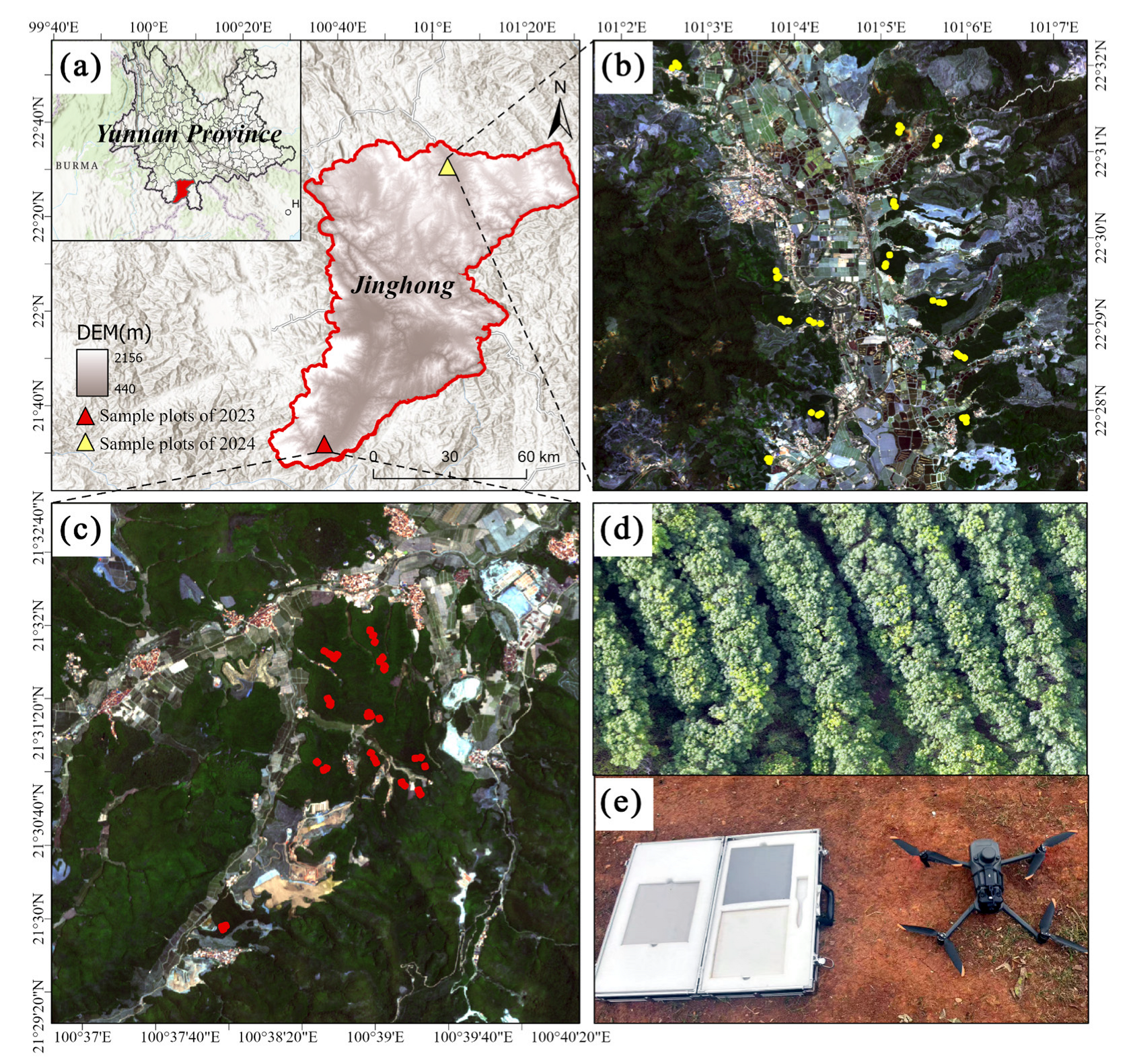
Jinghong City (21°27′–22°36′ N, 100°25′–101°31′ E), situated within the Xishuangbanna Dai Autonomous Prefecture in Yunnan Province, China, constitutes the study area (Figure 1). Rubber cultivation forms a vital economic pillar for local farmers in this region, recognized as one of China’s key rubber-producing zones. Characterized by a tropical monsoon climate, Jinghong receives between 1200 and 1700 mm of annual precipitation. This climate regime exhibits high temperatures, marked seasonal rainfall variation, and well-defined wet and dry seasons, creating favorable agronomic conditions for rubber tree growth.
During two critical sampling periods in May 2023 and May 2024, the systematic selection of 80 sample plots representing diverse rubber varieties was conducted for field surveys. Each plot was established with standardized dimensions of 20 m × 25 m to ensure sampling consistency.

2.2. Data Acquisition and Preprocessing

2.2.1. Field AGB Measurements

Given that our study area is precisely in Jinghong City, Xishuangbanna, we utilized the species- and site-specific allometric equations developed by Tang et al. [20] explicitly for estimating AGB of rubber tree plantations within Jinghong City. This non-destructive approach supports the preservation of ecosystem stability and sustainable plantation productivity. The biomass calculation employs the following formulas:
W T = 0.136 D B H 2.437
W R = 0.108 D B H 1.948
where W T and W R denote the total biomass and belowground biomass per rubber tree, respectively. DBH represents the diameter at breast height (measured at 1.3 m above ground; units: cm). Combining (Equations (1) and (2)), the AGB formula for Xishuangbanna rubber trees was derived as follows:
W A G B = 0.136 D B H 2.437 0.108 D B H 1.948
where W A G B represents the AGB of an individual rubber tree. These equations and their empirical coefficients were derived and validated using the field-measured data collected from rubber plantations in Jinghong City. Although this model uses DBH as the sole predictor variable, it inherently accounts for the effects of both tree age and cultivar variation, demonstrating high predictive accuracy for estimating AGB in Xishuangbanna rubber plantations (R2 > 0.97).
The ZHD V200 RTK system (Hi-Target Navigation Tech., Guangzhou, China) was utilized for plot boundary delineation and geospatial coordinate recording of individual rubber trees. Within each plot, all trees underwent DBH measurement at 1.3 m height using standard tapes. The mean AGB per plot was derived by summing the individual tree AGB values and normalizing by plot area. Descriptive statistics of AGB and stand age for the 80 rubber plantation sample plots utilized in this study are provided in our previously published research [28].

2.2.2. UAV Imagery Acquisition and Processing

A standardized UAV platform, the DJI Mavic 3 M (SZ DJI Technology Co., Shenzhen, China), was employed for aerial image acquisition across all 80 rubber plantation sample plots. This UAV model integrates a high-resolution 20-megapixel RGB sensor and a multispectral imaging system comprising four 5-megapixel cameras capturing green, red, red-edge, and near-infrared bands. Equipped with an integrated RTK module, the system guaranteed centimeter-level positional accuracy, facilitating high-precision aerial surveys. To secure optimal image quality, flights were scheduled during the midday hours (from 10:30 AM to 2:30 PM local time) under favorable meteorological conditions characterized by clear skies, absence of cloud cover, and minimal wind speeds. Operating at a consistent altitude of 100 m yielded an approximate ground sampling distance (spatial resolution) of 3 cm.
Utilizing DJI Terra software (version 3.2.0; DJI; accessed 5 August 2024 at https://enterprise.dji.com/cn/dji-terra), reflectance correction, image stitching, and automatic georeferencing of UAV imagery were performed per sample plot, adhering to Jarahizadeh and Salehi [29]. All outputs were exported as GeoTIFF files to preserve the geospatial metadata for downstream applications.

2.2.3. Satellite Imagery Acquisition and Processing

The Sentinel-2 Level-2A imagery (10 m bands; May 2023, 2024) and Landsat TM/ETM+ surface reflectance bands (NIR, SWIR) were sourced from the Google Earth Engine platform (https://developers.google.com/earth-engine (accessed on 25 August 2024)) to characterize rubber plantation sample plots (Table 1). Stand age estimation utilized the Landsat NIR and SWIR bands. These datasets have undergone standardized processing by the European Space Agency (ESA), including radiometric calibration, atmospheric correction, topographic correction, and cloud mask optimization [30,31]. These preprocessing steps effectively mitigate the impacts of atmospheric scattering, topographic shadows, and cloud contamination, providing a high-quality remote sensing data foundation for AGB estimation.
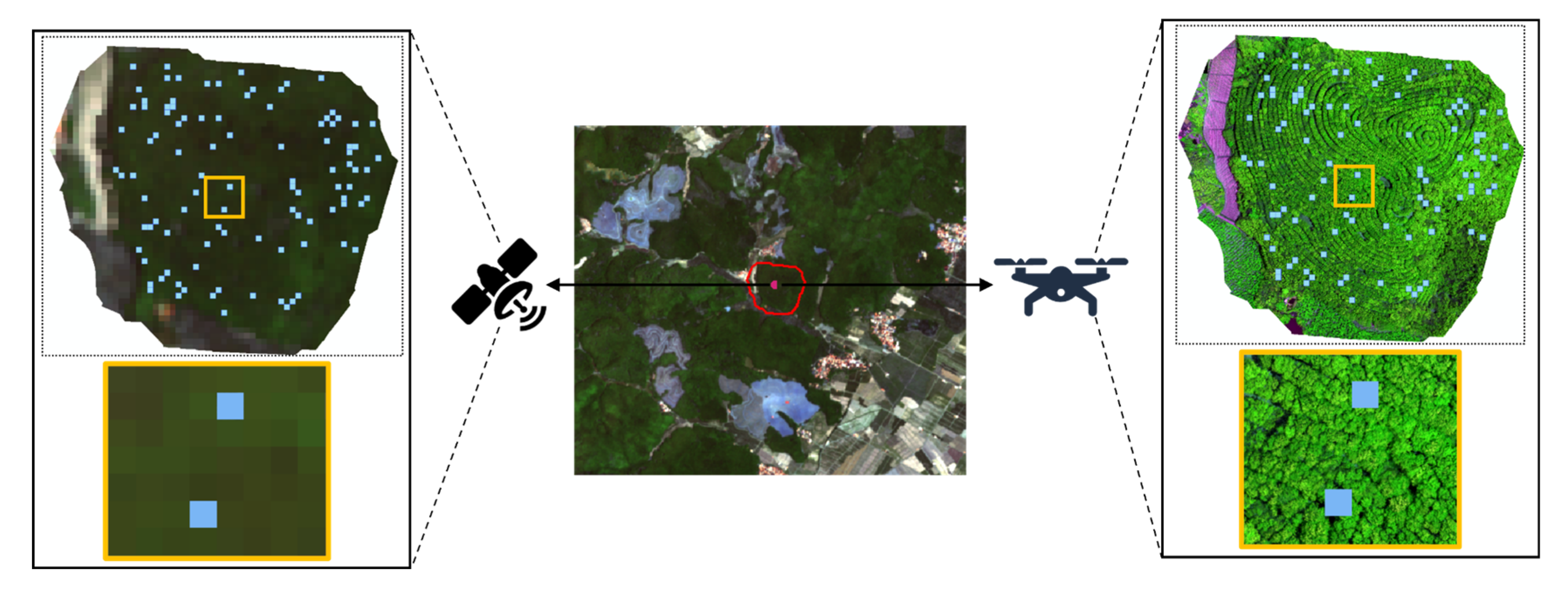
Compared to the UAV scale, large-scale rubber plantation AGB estimation at the satellite scale generally requires more plot data to construct the AGB estimation model. Therefore, we randomly established 1200 ROIs (Regions of Interest) in the satellite imagery of the study area’s rubber plantations. Additionally, to ensure precise spatial alignment between these ROIs at both the satellite and UAV scales, each ROI corresponds to a single pixel in the satellite-scale imagery and covers an area of 10 × 10 m2 at the UAV scale (Figure 2).

2.3. Feature Extraction

2.3.1. VIs Calculation

Based on our prior research [28], 15 vegetation indices (VIs) commonly used for AGB estimation were selected: Normalized Difference Vegetation Index (NDVI), Modified Soil-Adjusted Vegetation Index (MSAVI), Soil-Adjusted Vegetation Index (SAVI), Modified Simple Ratio (MSR), Nonlinear Index (NLI), Difference Vegetation Index (DVI), Optimized Soil-Adjusted Vegetation Index (OSAVI), Modified Chlorophyll Absorption Ratio Index (MCARI), Transformed Chlorophyll Absorption in Reflectance Index (TCARI), Green Chlorophyll Vegetation Index (GCVI), Red-Edge Normalized Difference Vegetation Index (RNDVI), Green Normalized Difference Vegetation Index (GNDVI), Red-Edge Ratio Index (RRI), and Triangular Vegetation Index (TVI).

2.3.2. Textural Metrics Calculation

Characterizing the spatial distribution of vegetation canopy structures relies effectively on the texture features. Adopting the approach of Liang et al. [11], this research derived eight gray-level co-occurrence matrix (GLCM) texture metrics from the UAV imagery’s red band: mean (Mea), Variance (Var), Homogeneity (Hom), contrast (Con), Dissimilarity (Dis), Entropy (Ent), Second Moment (Sec), and correlation (Cor). The parameter settings included an orientation of 135°, a 7 × 7 pixel moving window, and a displacement of 2 pixels.

2.3.3. Stand Age Acquisition

The stand age data for each rubber plantation plot were acquired following the approach of Beckschäfer [14]. This method derives stand age by subtracting the plantation establishment year from the target years (2023 and 2024). Specifically, annual Normalized Difference Moisture Index (NDMI) composites spanning 1988–2020 were generated within the Google Earth Engine platform using Landsat TM/ETM+ surface reflectance data.
Vegetation status for each annual NDMI composite was determined by thresholding; pixels with NDMI > 0 were categorized as vegetated, while NDMI ≤ 0 indicated non-vegetated areas. For every pixel within the sample plots, the most recent year classified as non-vegetated was identified and designated as the rubber planting year. Pixel-level stand age was subsequently computed as the difference between the target year (2023 or 2024) and the planting year. Given that rubber plantations in Jinghong predominantly form large contiguous stands with less fragmentation and exhibit consistent planting patterns across scales, stand establishment years derived from Landsat imagery (30 m resolution) can be directly correlated with 20 m × 25 m ground plots. This approach was necessitated by the requirement for historical archives beyond Sentinel-2’s operational inception in 2015, particularly crucial for rubber stands often exceeding 30 years of age [21]. Consequently, Landsat pixels fully encompass plantation boundaries, minimizing issues from resolution discrepancies when comparing with Sentinel-2 (10 m) features.

2.4. Regression Techniques

2.4.1. Random Forest Regression

Random forest regression (RFR) is an ensemble learning method based on decision trees, which makes predictions by constructing multiple decorrelated regression trees and aggregating their outputs through mean averaging [32]. Its core lies in two randomization mechanisms: bootstrap sampling to create training subsets and random feature selection during node splitting, which collectively enhance generalization capability. Compared to the conventional methods, RFR exhibits three key advantages: (1) automatic modeling of nonlinear relationships; (2) quantification of feature importance; and (3) unbiased estimation using out-of-bag (OOB) samples. In remote sensing inversion, RFR effectively processes spectral-texture fused data and effectively mitigates saturation effects in AGB estimation [28].

2.4.2. Gradient Boosting Regression

Gradient Boosting Regression (GBR) is a sequential optimization algorithm based on additive models that minimizes loss functions through gradient descent [33]. The algorithm builds weak predictors (typically shallow regression trees) stage-wise to approximate negative gradients, while optimizing the step sizes. GBR ensembles weak learners via weighted summation, offering three key advantages: (1) support for diverse loss functions, (2) automatic feature selection, and (3) strong outlier resistance [34]. Compared to the conventional methods, GBR exhibits feature scale invariance and can directly process multi-source heterogeneous remote sensing data without preprocessing.

2.4.3. Categorical Boosting Regression

Categorical Boosting (CatBoost) Regression is a gradient boosting-based machine learning algorithm, with its key advantage being native support for categorical features [35]. It employs an ordered boosting mechanism to prevent target leakage and automatically encodes categorical features via target statistics, eliminating the need for one-hot encoding. The algorithm utilizes symmetric decision trees (oblivious trees) as base learners, improving the inference speed by 30%, while enhancing feature interaction capabilities [22]. Its built-in regularization system automatically selects feature combinations and adjusts learning rates, demonstrating strong performance in handling high-dimensional remote sensing data. Additionally, CatBoost supports GPU acceleration, enabling efficient processing of large-scale geospatial datasets.

2.5. Feature Selection and Model Assessment

2.5.1. Feature Selection Method Based on SHAP

Lundberg and Lee [36] introduced Shapley Additive exPlanation (SHAP) as a technique for elucidating predictions generated by machine learning models. Rooted in the game theory, SHAP quantifies each feature’s marginal contribution to a prediction, yielding intuitive model interpretations. Its mathematical robustness is guaranteed by strict compliance with four foundational axioms: efficiency, symmetry, linearity, and dummy. Furthermore, SHAP employs an additive feature attribution framework, wherein the model’s output is decomposed into the sum of individual Shapley values for each feature. This framework facilitates interpretability at both the local (single prediction) and global (entire model) levels.
For feature selection purposes, SHAP values are computed for every instance once regression models (e.g., RFR, GBR, and CatBoost in this work) are trained. The mean absolute SHAP value per feature is subsequently obtained by aggregating these values across the complete dataset. This aggregated metric serves as an indicator of feature importance. The features are then ranked based on descending mean absolute SHAP values, revealing those exerting the strongest influence on the model’s predictions.

2.5.2. Feature Selection Method Based on VSURF

Variable Selection Using Random Forests (VSURF), proposed by Genuer et al. [25], is a robust method for feature selection in high-dimensional datasets. Based on the ensemble learning theory, VSURF identifies informative features through a three-stage hierarchical process that sequentially eliminates redundant and noisy predictors, while preserving the statistically significant variables. A key advantage of VSURF lies in its rigorous three-phase architecture—initial threshold screening, iterative redundancy elimination, and predictive validation—ensuring both computational efficiency and mathematical reliability in feature subset selection. Additionally, VSURF employs a stability-driven approach, evaluating features through consensus importance across bootstrap iterations, supporting both granular (individual feature contribution) and holistic (optimal subset performance) interpretability.
During feature selection, VSURF trains a random forest model to compute feature importance scores, and then applies a data-driven threshold to discard the low-importance features. The retained variables then undergo an iterative backward elimination procedure, where features with the least impact on out-of-bag error are progressively removed. Finally, the refined feature subset is validated through permutation importance testing, retaining only the variables demonstrating stable significance across multiple resampling iterations. Unlike the conventional feature ranking methods, this process directly yields a minimal optimal feature subset, enabling the construction of parsimonious, yet accurate predictive models.

2.5.3. Accuracy Assessment

This study constructed three machine learning regression models. The dataset was partitioned into training and test sets using a stratified random sampling method at a ratio of 70%:30%. A 5-fold cross-validation strategy was employed during model training to assess generalization ability and mitigate randomness. Model hyperparameters were optimized via grid search [37]. For both the RFR and GBR models, 150 decision trees were specified with a maximum depth of 16 layers. The CatBoost model was configured with 300 iterations and a learning rate of 0.01, while the other parameters were left at their default values (Table 2). All the models were implemented and trained in the Python 3.8 environment. The RFR and GBR models were primarily built using the scikit-learn library (v1.6.0), while the CatBoost model was built using the catboost library (v1.2.7). Model performance was comprehensively evaluated on the independent test set using three complementary metrics: Mean Absolute Error (MAE), Root Mean Squared Error (RMSE), and the Coefficient of Determination (R2). The formulas for these metrics are as follows:
R 2 = 1   i = 1 n y i y i ^ 2 i = 1 n y i y i ¯ 2
R M S E = i = 1 n y i y i ^ 2 n 1
M A E = 1 n i = 1 n y ^ i y i
where y i denotes the measured value, y ^ i represents the estimated value, y i ¯ stands for the sample average, and n indicates the total number of samples. The subscript i is the sample index, ranging from 1 to n ( i =   1 ,   2 ,   ,   n ).
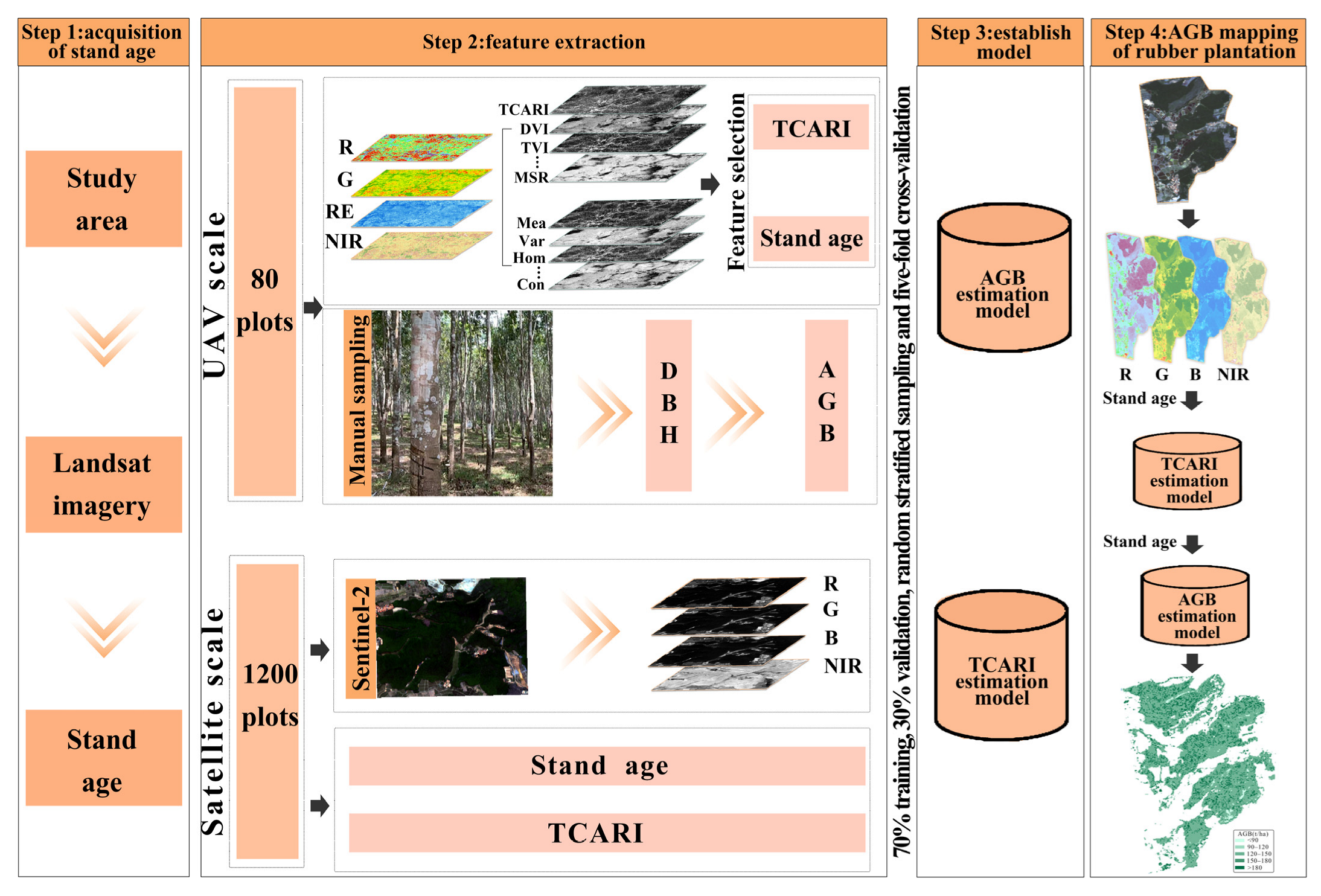
The technical workflow for estimating rubber plantation AGB by integrating UAV and satellite data is illustrated in Figure 3. The entire process consists of four steps. In Step 1, following the study of Beckschäfer [14], comprehensive processing of the Landsat imagery acquired by satellites was conducted to obtain the stand age of rubber plantations in the study area. In Step 2, the data collected at the ground, UAV, and satellite scales were processed. At the ground scale, the field survey data and the allometric growth equations were used to derive AGB for 80 sample plots. At the UAV scale, the orthophotos captured by the UAV were utilized to calculate VIs and TFs for the 80 sample plots, with the optimal features (TCARI and stand age) selected for constructing the AGB estimation model. At the satellite scale, the TCARI and stand age data for 1200 plots were acquired, and reflectance values for the R, G, B, and NIR bands were extracted from the Sentinel-2 imagery. In Step 3, at the UAV scale, the AGB estimation model was developed using the obtained AGB, TCARI, and stand age data from the 80 samples. At the satellite scale, the TCARI estimation model was constructed using the TCARI and stand age data, along with the reflectance values of the R, G, B, and NIR bands from the 1200 plots. In Step 4, the established TCARI and AGB estimation models were applied to generate rubber plantation AGB maps.

3. Results

3.1. AGB Estimation of Rubber Plantations Using UAV Imagery Data

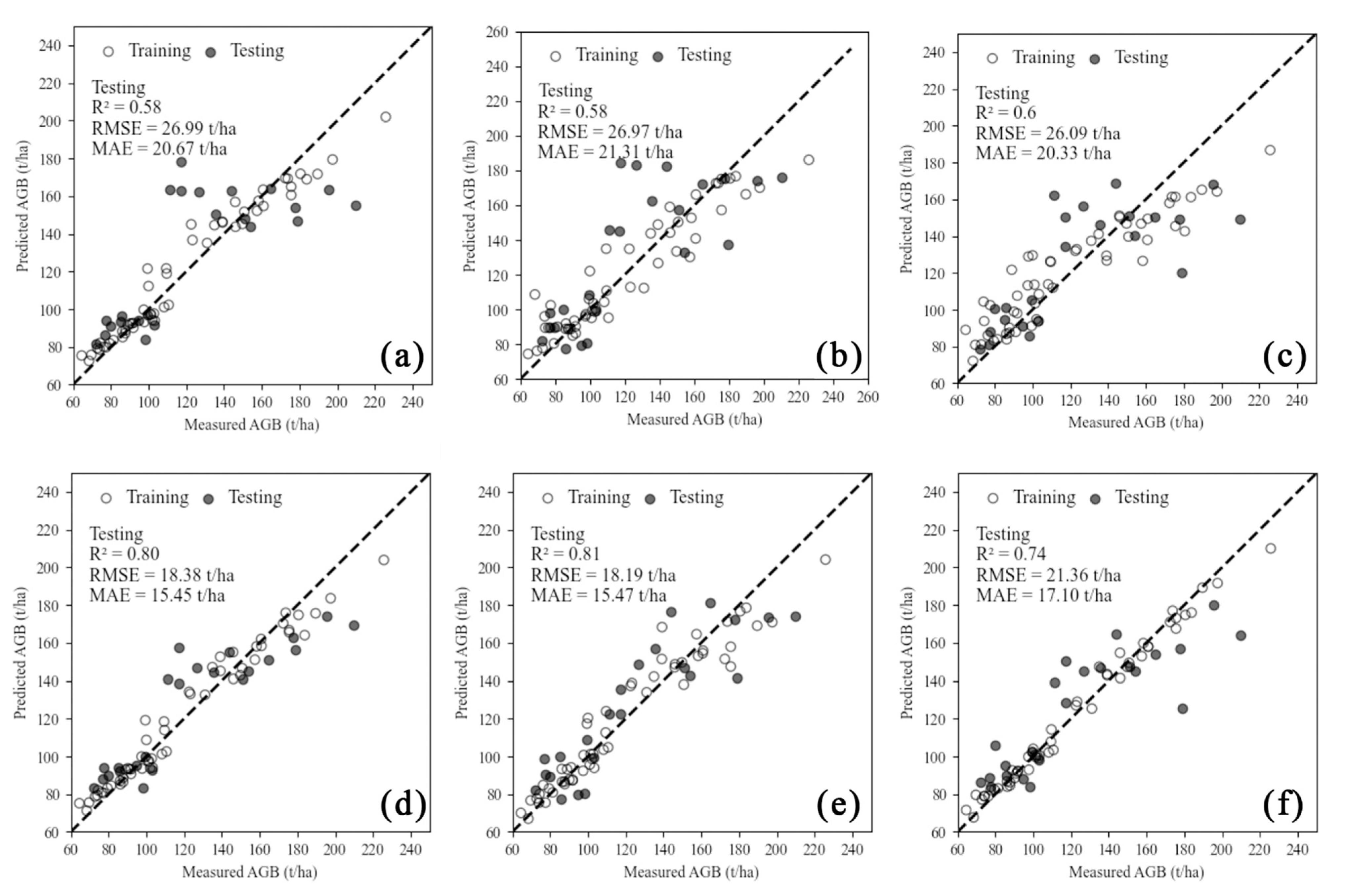
To improve the accuracy of AGB estimation for rubber plantations at the UAV scale, we integrated 15 VIs and 8 TFs extracted from UAV-based multispectral imagery, referred to as VIs_TFs. Additionally, we incorporated rubber plantation stand age derived from the satellite imagery into VIs_TFs, forming a new variable set termed VIs_TFs_SA. These two sets of variables were then used as inputs for three machine learning regression models (RFR, GBR, and CatBoost) to estimate the AGB of rubber plantations.
As shown in Figure 4, we evaluated the estimation accuracy of these two variable combinations across the three machine learning regression models. The highest accuracy was achieved using the GBR model, with R2 = 0.81, an RMSE = 18.19 t/ha, and an MAE = 15.47 t/ha. Compared to the models based on VIs_TFs, incorporating VIs_TFs_SA into machine learning models substantially improved the accuracy of AGB estimation.

3.2. Feature Selection of Remote Sensing Variables

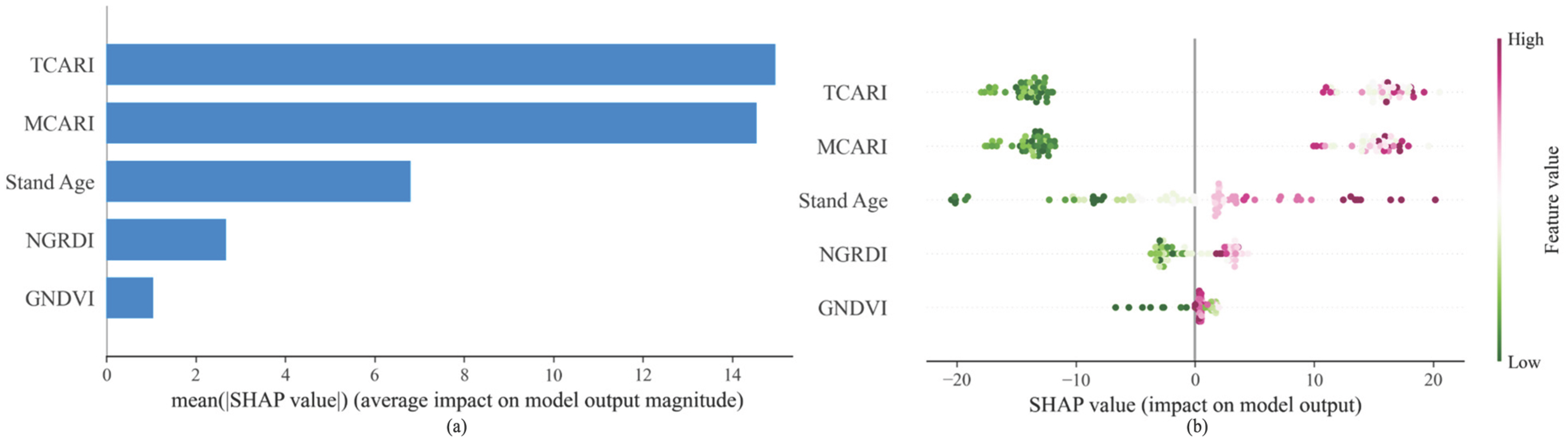
We performed SHAP analysis on the established AGB estimation model (the GBR model based on VIs_TFs_SA) with the highest accuracy. Based on the mean absolute SHAP values, the top five most important features were selected to form a new feature combination, designated as SHAP_Features. Figure 5 presents the SHAP analysis results based on SHAP_Features, where Figure 5a illustrates the ranking of feature importance according to the average SHAP value. A higher SHAP value indicates a greater contribution of the feature to the effectiveness and efficiency of AGB estimation. Meanwhile, Figure 5b displays the SHAP summary plot of the features used for estimating rubber plantation AGB. In this figure, the y-axis represents the names of the features, and the x-axis represents the SHAP values of the features. Additionally, feature values are depicted using two colors: red for high feature values and green for low feature values.
As shown in Figure 5, the TCARI and the MCARI have a similar impact on the AGB estimation model, with their SHAP values being from two to ten times higher than those of other features. Additionally, a higher value of stand age is beneficial for the model’s estimation performance.
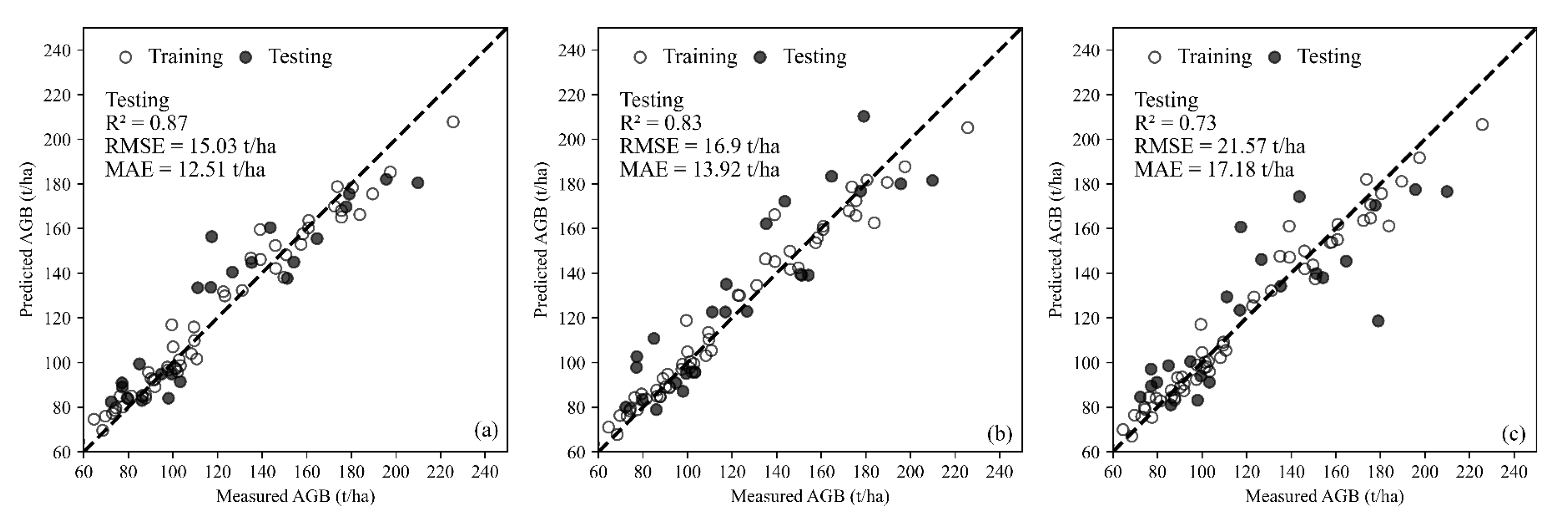
To investigate whether the features selected using SHAP can enhance the AGB estimation capability of machine learning regression models, we reconstructed three AGB estimation models based on RFR, GBR, and CatBoost using SHAP_Features and evaluated their estimation accuracy (Figure 6). Compared to the models using unfiltered features (Figure 4), the RFR model built with SHAP_Features exhibited a significant improvement in estimation accuracy, achieving R2 = 0.87, an RMSE = 15.03 t/ha, and an MAE = 12.51 t/ha. However, the estimation accuracy of the other two models remained largely unchanged.
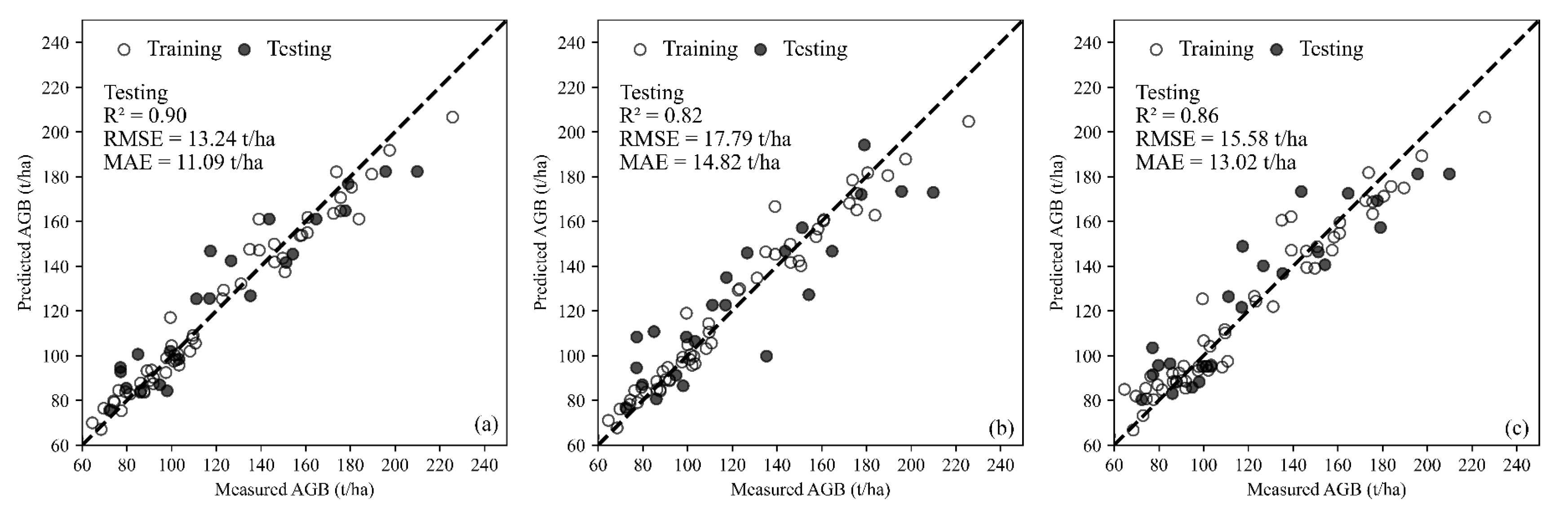
To evaluate the performances of the different variable selection methods, we applied the VSURF algorithm to select variables from VIs_TFs_SA. After the three-stage selection process, VSURF produced a refined subset containing only two variables: TCARI and stand age. Using these two variables, we constructed three rubber plantation AGB estimation models based on RFR, GBR, and CatBoost. The accuracy of these models was evaluated, and the results are presented in Figure 7. Compared to the AGB estimation models built with the original unfiltered features (VIs_TFs_SA), the RFR model constructed using the TCARI and stand age achieved the highest estimation accuracy (Figure 7a), with R2 = 0.90, an RMSE = 13.24 t/ha, and an MAE = 11.09 t/ha. However, the other two models (Figure 7b,c) did not show notable improvements in AGB estimation accuracy for rubber plantations.

3.3. Integrated UAV and Satellite Imagery for AGB Estimation in Rubber Plantations

3.3.1. Utilizing UAVs to Replace Manual Measurement for Rubber Plantation AGB

To develop a large-scale satellite-based AGB estimation model for rubber plantations, this study employed an established RFR model incorporating the TCARI and stand age as feature variables to estimate AGB across the 1200 rubber plantation plots. The AGB data from these plots will be used for the accuracy validation of the satellite-based AGB estimation model. Specifically, we extracted the TCARI and stand age of the 1200 rubber plantation plots using the UAV imagery data and input these two features into the TSRFR model, which was developed based on the TCARI and stand age. The model then generated the AGB estimation results for these plots. Statistical information of the estimated AGB for these 1200 rubber plantation plots is presented in Table 3.

3.3.2. TCARI Estimation Model Development and Validation

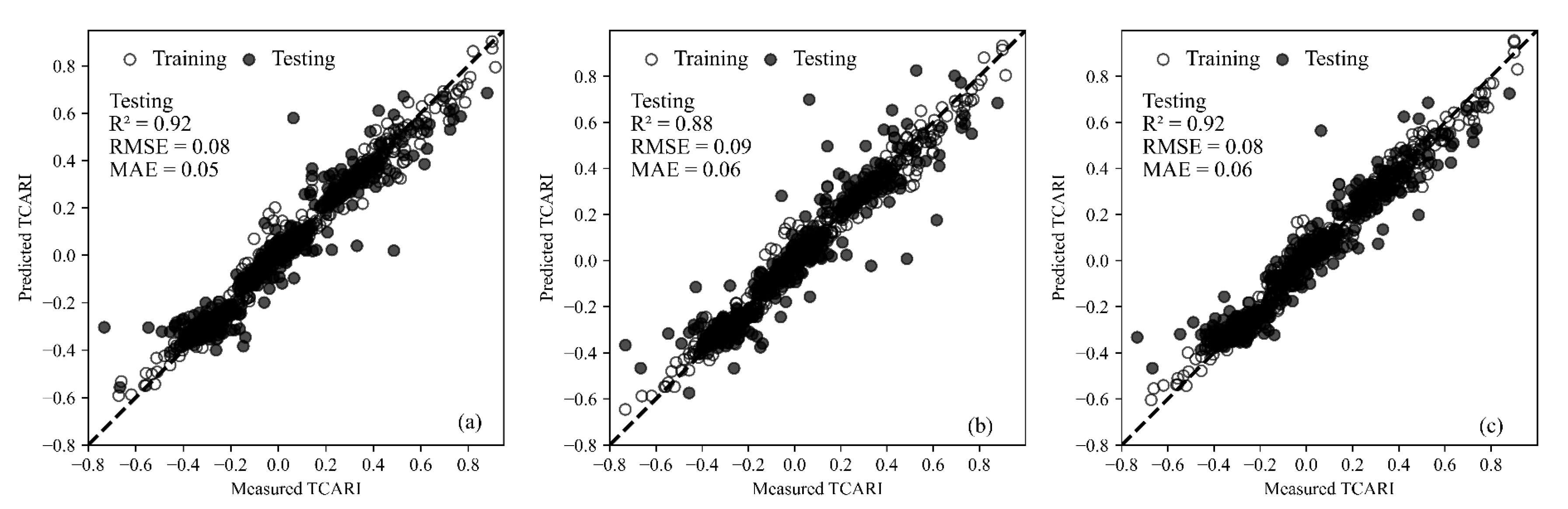
To apply the TSRFR model for rubber plantation AGB estimation at the satellite scale, we developed a TCARI estimation model based on the satellite imagery data. Specifically, we extracted the reflectance values of the R, G, B, and NIR bands from the 1200 rubber plantation plots. These four bands, along with the existing stand age values, were used to construct three TCARI estimation models. Additionally, the 1200 TCARI values obtained from the UAV data were also utilized for model training (840 samples) and validation (360 samples). The accuracy validation results of these three estimation models are presented in Figure 8. All three models achieved high estimation accuracy, with the RFR-based TCARI estimation model performing the best, attaining an R2 = 0.92, an RMSE = 0.08 and an MAE = 0.05.
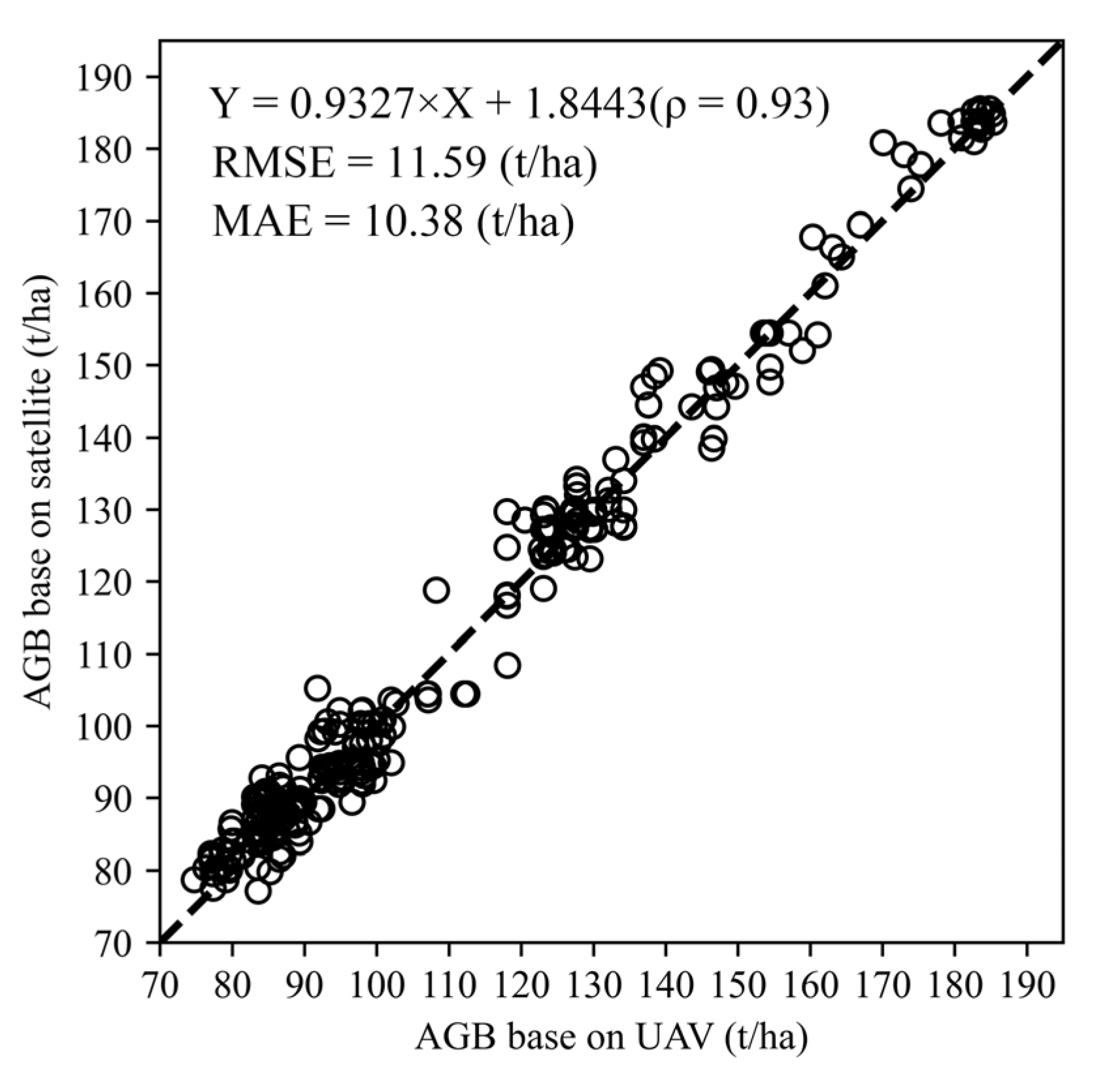
Despite the high accuracy of the RFR-based TCARI estimation model (Figure 7a), we conducted additional validation by feeding the 360 TCARI predictions (from model validation) and the existing stand age data into the TSRFR model, resulting in 360 estimated AGB values. Finally, an analysis was performed between the satellite-scale and UAV-scale AGB estimates (Figure 9), demonstrating strong agreement between the two datasets, with a Spearman’s correlation coefficient (ρ) of 0.93.

3.3.3. AGB Mapping of Rubber Plantations Using Satellite Data

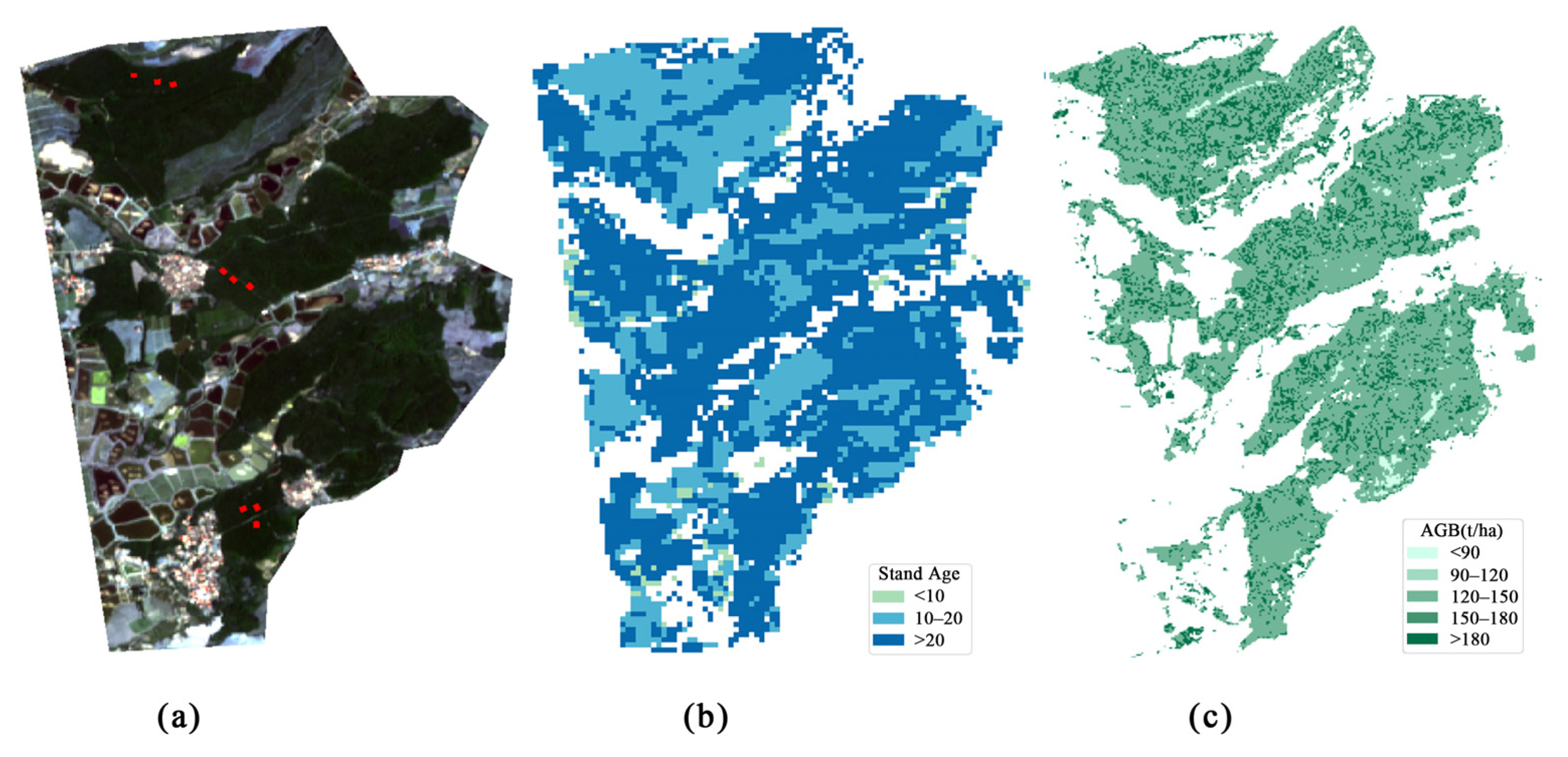
A Sentinel-2 image covering part of the study area (Figure 10a) was used for mapping the AGB of the rubber plantations. We estimated the TCARI of this image using the RFR-based TCARI estimation model. The obtained TCARI, along with the existing stand age data (Figure 10b), were then input into a TSRFR model to estimate the AGB of rubber plantations within the image area, resulting in the generation of an AGB map (Figure 10c).

4. Discussion

4.1. The Advantages of Integrating Stand Age and UAV Remote Sensing Data in AGB Estimation of Rubber Plantations

Establishing an improved AGB estimation model necessitates the foundation of effective feature variables [38]. In this study, stand age consistently obtained high importance scores and was retained in the selected variable subsets through both the variable selection methods. Furthermore, at the UAV scale, stand age and the TCARI selected by VSURF achieved the highest estimation accuracy (R2 = 0.90, RMSE = 13.24 t/ha, and MAE = 11.09 t/ha). Additionally, in the Xishuangbanna region, models constructed using stand age and spectral features achieved higher accuracy for rubber plantation AGB estimation compared to the model developed by Fu et al. [17] using spectral and textural features (R2 = 0.86 and RMSE = 15.77 t/ha). The TCARI, calculated using red-edge (700 nm) and red (670 nm) bands, exhibits high sensitivity to the chlorophyll content [39]. In rubber trees, the chlorophyll levels may reflect both tree health status and foliar biomass, thereby indirectly correlating with the overall biomass. Although the TCARI primarily captures canopy surface conditions without vertical structural information, the incorporation of stand age effectively compensates for this limitation. These findings align with Chen et al. [12], where adding stand age as a predictor improved model accuracy from R2 = 0.38 (RMSE = 24.34 Mg/ha) to R2 = 0.81 (RMSE = 10.59 Mg/ha) for rubber plantation biomass estimation. As demonstrated by Wauters et al. [40], this correlation stems from the relatively short economic cycle of rubber plantations (typically 25–30 years), during which biomass accumulation undergoes significant deceleration after approximately 20 years. Specifically, the AGB growth pattern in rubber plantations follows a sigmoidal Gompertz curve in relation to stand age, characterized by rapid accumulation during the juvenile phase followed by progressively slower growth rates that eventually stabilize at maturity. These results collectively demonstrate the strong association between rubber plantation biomass and stand age [14].
The stand age information extracted from the Landsat time-series imagery was integrated into the Sentinel-2-based feature sets. This integration leverages Sentinel-2’s critical advantages over Landsat; its enhanced 10 m spatial resolution enables detection of fine-scale structural heterogeneity, effectively reducing mixed-pixel effects in dense plantations, while its superior spectral capability through unique red-edge bands (B5, B6, and B7) captures chlorophyll- and nitrogen-driven physiological variations across age classes [41].

4.2. Bridging UAV and Satellite Remote Sensing for Rubber Plantations AGB

Accurate estimation of rubber plantation AGB at large spatial scales remains challenging. Despite technological advances, the current methods struggle to achieve both high estimation accuracy and cost-effectiveness at regional scales [42]. The existing studies have demonstrated that UAV can replace manual sampling [8]. However, the high canopy density of rubber plantations limits the effectiveness of the current drone-based estimation methods [21]. Research has been conducted using vegetation indices and texture indices to estimate AGB in rubber plantations, yet the estimation accuracy remains limited [11]. Therefore, this study proposes incorporating stand attributes (specifically stand age) as a key parameter, combined with feature selection methods, to enhance the accuracy of UAV-scale AGB estimation and replace manual sampling. Furthermore, this UAV-based approach addresses the need for large sample sizes in satellite-scale AGB estimation models. By extrapolating the improved drone-scale model at the satellite scale, large-scale and annual AGB estimation for rubber plantations becomes feasible.
Specifically, we developed an improved AGB estimation model at the UAV scale using stand age and the TCARI, identified through rigorous variable selection. Given that stand age can already be derived from Landsat imagery [14], the critical challenge shifts to accurately obtaining the TCARI at the satellite scale. However, a significant limitation arises from Sentinel-2’s 10 m resolution imagery (R, G, B and NIR bands), which cannot directly calculate the TCARI due to the lack of red-edge spectral bands [39]. To overcome this, we constructed a improved TCARI estimation model (R2 = 0.92, RMSE = 0.08, and MAE = 0.05) using Sentinel-2-derived reflectance data combined with the existing stand age data. This method follows a similar approach to that of Lu et al. [19], who first established a small-scale coverage-biomass model and subsequently developed a robust large-scale coverage estimation model. By using horizontal coverage—a relatively simple parameter—the team successfully achieved large-scale estimation of submerged aquatic vegetation biomass. This outcome provides strong evidence for the scalability of the AGB mapping framework proposed in this study.

4.3. Limitations and Potential Applications

The uncertainties in AGB estimation originate principally from three methodological aspects: sampling approaches, variable selection for modeling, and algorithm architecture [43]. Although UAVs can estimate tree AGB by acquiring structural parameters, such as crown width and height [44], this approach exhibits significant limitations in rubber plantations—excessive canopy closure resulting from high planting density invalidates such methods, aligning with Liang et al. [11] conclusion that traditional forestry survey techniques are unsuitable for densely planted rubber forests with high canopy coverage. In this study, we employed a systematic sampling methodology across rubber plantations in Xishuangbanna during the 2023–2024 growing seasons. The sample plots were established using a stratified design based on stand age, cultivars, and elevation gradients, yielding 80 georeferenced plots with field-measured AGB data. These datasets were subsequently utilized to develop a drone-based AGB estimation model. To develop a regional-scale AGB estimation model for rubber plantations, we further utilized this UAV-based model to replace the conventional manual sampling methods. This approach efficiently acquired AGB data covering the 1200 rubber plantation plots. The method effectively reduced the labor and time costs, while substantially improving data collection efficiency.
It should be noted that the accuracy of satellite-scale AGB estimation models is typically highly dependent on the number of training samples. While Ma et al. [45] demonstrated that 50 samples suffice for modeling purposes, increasing the sample size beyond the current study’s scope may further improve model robustness in future work. Furthermore, the allometric equation used for estimating rubber plantation AGB in the ground-based experiments of this study was developed and rigorously validated by Tang et al. [20] (involving destructive tree sampling, oven-drying, and weighing procedures). However, due to different geographical conditions in Xishuangbanna compared to the rubber cultivation regions in Hainan Province, China, the spatial applicability of this equation is currently restricted to the Xishuangbanna region. Notably, since rubber cultivation involves pre-plantation clear-cutting, stand age can be reliably derived from time-series remote sensing data. This study capitalizes on the capability to incorporate Landsat-derived stand age into UAV-based AGB estimation models, thereby improving the accuracy of AGB predictions for rubber plantation. However, this method is not suitable for other tree species lacking easily obtainable stand age data. Future research will focus on expanding the sample size to enhance model robustness, and developing novel stand age-analogous features (e.g., phenological dynamics and canopy structural metrics) for integration into the framework to further refine AGB estimation accuracy in rubber plantations [18,46]. This advancement will overcome the current limitation of single-species applicability in the proposed methodology, ultimately providing a generalized solution for carbon stock assessment across diverse forest ecosystems.

5. Conclusions

This study developed a large-scale estimation method for rubber plantation AGB by upscaling a UAV-based AGB estimation model at the satellite scale. The results demonstrate that at the UAV scale, incorporating stand age as a new variable into the AGB estimation model substantially improves accuracy across the three machine learning algorithms (RFR, GBR, and CatBoost), achieving high precision (R2 = 0.90, RMSE = 13.24 t/ha, and MAE = 11.09 t/ha). At the satellite scale, the TCARI index, selected based on UAV-scale analysis, enables accurate inversion using satellite imagery, successfully achieving precise AGB estimation from small to large scales (R2 = 0.92, RMSE = 0.08, and MAE = 0.05). This study demonstrated that: (1) Consumer-grade multispectral UAVs synergized with stand age data enable precise AGB estimation for rubber plantations, presenting a viable alternative to manual field-based AGB quantification, while mitigating the data-intensive requirements of satellite-scale AGB estimation models. (2) The improved UAV-derived AGB estimation model can be successfully extrapolated to satellite-scale applications through the integration of the TCARI and stand age parameters, enabling reliable regional biomass assessments. The methodology proposed in this study establishes a new transferable paradigm for multi-source remote sensing (UAV + satellite) and auxiliary data (e.g., stand structure parameters) integration, pioneering an innovative approach to upscale small-scale precision forest parameter inversion models to regional scales. This framework enables accurate cross-scale AGB mapping applicable to plantations, providing a cost-effective alternative to labor-intensive field surveys. This methodology offers a novel approach and potential pathway for enhancing the efficiency and coverage of future forest carbon stock monitoring efforts. The resulting regional AGB maps directly support carbon accounting and sustainable management by serving as essential data inputs for refining ecosystem models, verifying carbon sequestration projects, and informing land use policies.

Author Contributions

Conceptualization, W.K., L.W. and N.L.; data curation, H.T.; investigation, H.T.; methodology, W.K.; software, H.W.; supervision, W.X.; validation, H.W.; writing—original draft, H.T.; writing—review and editing, N.L. All authors have read and agreed to the published version of the manuscript.

Funding

This work was supported by the National Natural Science Foundation of China (32160368, 32360435, 32360387, and 32260391), the Yunnan Province Expert Workstation of Chen Yong (202505AF350005), the Yunnan Province Academician Li Wei Workstation (202505AF350082), the Joint Special Project for Agriculture of Yunnan Province (202301BD070001-160), the Yunnan International Joint Laboratory of Natural Rubber Intelligent Monitor and Digital Applications (202403AP140001), and the Xingdian Talent Support Program for Industrial Innovation Talents.

Data Availability Statement

The data presented in this study are available on request from the corresponding author.

Conflicts of Interest

The authors declare no conflicts of interest.

References

  1. Cornish, K. Similarities and differences in rubber biochemistry among plant species. Phytochemistry 2001, 57, 1123–1134. [Google Scholar] [CrossRef] [PubMed]
  2. De Petris, S.; Sarvia, F.; Borgogno-Mondino, E. About tree height measurement: Theoretical and practical issues for uncertainty quantification and mapping. Forests 2022, 13, 969. [Google Scholar] [CrossRef]
  3. Szewczyk, G.; Wąsik, R.; Leszczyński, K.; Podlaski, R. Age estimation of different tree species using a special kind of an electrically recording resistance drill. Urban For. Urban Green. 2018, 34, 249–253. [Google Scholar] [CrossRef]
  4. McNeil, B.E.; Fahey, R.T.; King, C.J.; Erazo, D.A.; Heimerl, T.Z.; Elmore, A.J. Tree crown economics. Front. Ecol. Environ. 2023, 21, 40–48. [Google Scholar] [CrossRef]
  5. Yang, X.; Blagodatsky, S.; Liu, F.; Beckschäfer, P.; Xu, J.; Cadisch, G. Rubber tree allometry, biomass partitioning and carbon stocks in mountainous landscapes of sub-tropical China. For. Ecol. Manag. 2017, 404, 84–99. [Google Scholar] [CrossRef]
  6. Balestra, M.; Tonelli, E.; Vitali, A.; Urbinati, C.; Frontoni, E.; Pierdicca, R. Geomatic data fusion for 3D tree modeling: The case study of monumental chestnut trees. Remote Sens. 2023, 15, 2197. [Google Scholar] [CrossRef]
  7. Tian, L.; Wu, X.; Tao, Y.; Li, M.; Qian, C.; Liao, L.; Fu, W. Review of remote sensing-based methods for forest aboveground biomass estimation: Progress, challenges, and prospects. Forests 2023, 14, 1086. [Google Scholar] [CrossRef]
  8. González-Jaramillo, V.; Fries, A.; Bendix, J. AGB Estimation in a Tropical Mountain Forest (TMF) by Means of RGB and Multispectral Images Using an Unmanned Aerial Vehicle (UAV). Remote Sens. 2019, 11, 1413. [Google Scholar] [CrossRef]
  9. Navarro, A.; Young, M.; Allan, B.; Carnell, P.; Macreadie, P.; Ierodiaconou, D. The application of Unmanned Aerial Vehicles (UAVs) to estimate above-ground biomass of mangrove ecosystems. Remote Sens. Environ. 2020, 242, 111747. [Google Scholar] [CrossRef]
  10. Zhai, Y.; Wang, L.; Yao, Y.; Jia, J.; Li, R.; Ren, Z.; He, X.; Ye, Z.; Zhang, X.; Chen, Y. Spatially continuous estimation of urban forest aboveground biomass with UAV-LiDAR and multispectral scanning: An allometric model of forest structural diversity. Agric. For. Meteorol. 2025, 360, 110301. [Google Scholar] [CrossRef]
  11. Liang, Y.; Kou, W.; Lai, H.; Wang, J.; Wang, Q.; Xu, W.; Wang, H.; Lu, N. Improved estimation of aboveground biomass in rubber plantations by fusing spectral and textural information from UAV-based RGB imagery. Ecol. Indic. 2022, 142, 109286. [Google Scholar] [CrossRef]
  12. Chen, B.; Yun, T.; Ma, J.; Kou, W.; Li, H.; Yang, C.; Xiao, X.; Zhang, X.; Sun, R.; Xie, G. High-precision stand age data facilitate the estimation of rubber plantation biomass: A case study of Hainan Island, China. Remote Sens. 2020, 12, 3853. [Google Scholar] [CrossRef]
  13. Kou, W.; Xiao, X.; Dong, J.; Gan, S.; Zhai, D.; Zhang, G.; Qin, Y.; Li, L. Mapping deciduous rubber plantation areas and stand ages with PALSAR and Landsat images. Remote Sens. 2015, 7, 1048–1073. [Google Scholar] [CrossRef]
  14. Beckschäfer, P. Obtaining rubber plantation age information from very dense Landsat TM & ETM+ time series data and pixel-based image compositing. Remote Sens. Environ. 2017, 196, 89–100. [Google Scholar] [CrossRef]
  15. Yang, G.; Liu, J.; Zhao, C.; Li, Z.; Huang, Y.; Yu, H.; Xu, B.; Yang, X.; Zhu, D.; Zhang, X. Unmanned aerial vehicle remote sensing for field-based crop phenotyping: Current status and perspectives. Front. Plant Sci. 2017, 8, 1111. [Google Scholar] [CrossRef]
  16. Lu, D.; Chen, Q.; Wang, G.; Liu, L.; Li, G.; Moran, E. A survey of remote sensing-based aboveground biomass estimation methods in forest ecosystems. Int. J. Digit. Earth 2016, 9, 63–105. [Google Scholar] [CrossRef]
  17. Fu, Y.; Tan, H.; Kou, W.; Xu, W.; Wang, H.; Lu, N. Estimation of Rubber Plantation Biomass Based on Variable Optimization from Sentinel-2 Remote Sensing Imagery. Forests 2024, 15, 900. [Google Scholar] [CrossRef]
  18. Zhang, X.; Jia, M.; Yan, F.; Zhang, Y.; Man, W.; Li, F.; Liu, M.; Wu, F.; Yin, X.; Duan, J. Advancing coastal wetland management: A combined UAV-satellite approach for Spartina alterniflora aboveground biomass estimation using interpretable machine learning. Int. J. Digit. Earth 2025, 18, 2525383. [Google Scholar] [CrossRef]
  19. Lu, L.; Luo, J.; Xin, Y.; Xu, Y.; Sun, Z.; Duan, H.; Xiao, Q.; Qiu, Y.; Huang, L.; Zhao, J. A novel strategy for estimating biomass of submerged aquatic vegetation in lake integrating UAV and Sentinel data. Sci. Total Environ. 2024, 912, 169404. [Google Scholar] [CrossRef] [PubMed]
  20. Tang, J.; LONG, J.; CHEN, M.; GUO, X.; CENG, R. Biomass and its estimation model of rubber plantations in Xishuangbanna, Southwest China. Chin. J. Ecol. 2009, 28, 1942. [Google Scholar]
  21. Chen, B.; Li, X.; Xiao, X.; Zhao, B.; Dong, J.; Kou, W.; Qin, Y.; Yang, C.; Wu, Z.; Sun, R. Mapping tropical forests and deciduous rubber plantations in Hainan Island, China by integrating PALSAR 25-m and multi-temporal Landsat images. Int. J. Appl. Earth Obs. Geoinf. 2016, 50, 117–130. [Google Scholar] [CrossRef]
  22. Zhang, Y.; Ma, J.; Liang, S.; Li, X.; Li, M. An Evaluation of Eight Machine Learning Regression Algorithms for Forest Aboveground Biomass Estimation from Multiple Satellite Data Products. Remote Sens. 2020, 12, 4015. [Google Scholar] [CrossRef]
  23. Li, X.; Wang, X.; Gao, Y.; Wu, J.; Cheng, R.; Ren, D.; Bao, Q.; Yun, T.; Wu, Z.; Xie, G.; et al. Comparison of Different Important Predictors and Models for Estimating Large-Scale Biomass of Rubber Plantations in Hainan Island, China. Remote Sens. 2023, 15, 3447. [Google Scholar] [CrossRef]
  24. Cai, J.; Luo, J.; Wang, S.; Yang, S. Feature selection in machine learning: A new perspective. Neurocomputing 2018, 300, 70–79. [Google Scholar] [CrossRef]
  25. Genuer, R.; Poggi, J.-M.; Tuleau-Malot, C. VSURF: An R package for variable selection using random forests. R J. 2015, 7, 19–33. [Google Scholar] [CrossRef]
  26. Marcílio, W.E.; Eler, D.M. From explanations to feature selection: Assessing SHAP values as feature selection mechanism. In Proceedings of the 2020 33rd SIBGRAPI Conference on Graphics, Patterns and Images (SIBGRAPI), Virtual, 7–10 November 2020; pp. 340–347. [Google Scholar]
  27. Li, Z. Extracting spatial effects from machine learning model using local interpretation method: An example of SHAP and XGBoost. Comput. Environ. Urban Syst. 2022, 96, 101845. [Google Scholar] [CrossRef]
  28. Tan, H.; Kou, W.; Xu, W.; Wang, L.; Wang, H.; Lu, N. Improved estimation of aboveground biomass in rubber plantations using deep learning on UAV multispectral imagery. Drones 2025, 9, 32. [Google Scholar] [CrossRef]
  29. Jarahizadeh, S.; Salehi, B. A comparative analysis of UAV photogrammetric software performance for forest 3D modeling: A case study using AgiSoft photoscan, PIX4DMapper, and DJI Terra. Sensors 2024, 24, 286. [Google Scholar] [CrossRef]
  30. Claverie, M.; Vermote, E.F.; Franch, B.; Masek, J.G. Evaluation of the Landsat-5 TM and Landsat-7 ETM+ surface reflectance products. Remote Sens. Environ. 2015, 169, 390–403. [Google Scholar] [CrossRef]
  31. Gorroño, J.; Guanter, L.; Graf, L.V.; Gascon, F. A Framework for the Estimation of Uncertainties and Spectral Error Correlation in Sentinel-2 Level-2A Data Products. IEEE Trans. Geosci. Remote Sens. 2024, 62, 1–13. [Google Scholar] [CrossRef]
  32. Erwan, S.; Gérard, B.; Jean-Philippe, V. Consistency of random forests. Ann. Stat. 2015, 43, 1716–1741. [Google Scholar] [CrossRef]
  33. Friedman, J.H. Greedy function approximation: A gradient boosting machine. Ann. Stat. 2001, 29, 1189–1232. [Google Scholar] [CrossRef]
  34. Wei, Z.; Meng, Y.; Zhang, W.; Peng, J.; Meng, L. Downscaling SMAP soil moisture estimation with gradient boosting decision tree regression over the Tibetan Plateau. Remote Sens. Environ. 2019, 225, 30–44. [Google Scholar] [CrossRef]
  35. Prokhorenkova, L.; Gusev, G.; Vorobev, A.; Dorogush, A.V.; Gulin, A. CatBoost: Unbiased boosting with categorical features. Adv. Neural Inf. Process. Syst. 2018, 31, 6639–6649. [Google Scholar]
  36. Lundberg, S.M.; Lee, S.-I. A unified approach to interpreting model predictions. Adv. Neural Inf. Process. Syst. 2017, 30, 4768–4777. [Google Scholar]
  37. Stuke, A.; Rinke, P.; Todorović, M. Efficient hyperparameter tuning for kernel ridge regression with Bayesian optimization. Mach. Learn. Sci. Technol. 2021, 2, 035022. [Google Scholar] [CrossRef]
  38. Luo, M.; Wang, Y.; Xie, Y.; Zhou, L.; Qiao, J.; Qiu, S.; Sun, Y. Combination of feature selection and catboost for prediction: The first application to the estimation of aboveground biomass. Forests 2021, 12, 216. [Google Scholar] [CrossRef]
  39. Haboudane, D.; Miller, J.R.; Tremblay, N.; Zarco-Tejada, P.J.; Dextraze, L. Integrated narrow-band vegetation indices for prediction of crop chlorophyll content for application to precision agriculture. Remote Sens. Environ. 2002, 81, 416–426. [Google Scholar] [CrossRef]
  40. Wauters, J.B.; Coudert, S.; Grallien, E.; Jonard, M.; Ponette, Q. Carbon stock in rubber tree plantations in Western Ghana and Mato Grosso (Brazil). For. Ecol. Manag. 2008, 255, 2347–2361. [Google Scholar] [CrossRef]
  41. Misra, G.; Cawkwell, F.; Wingler, A. Status of phenological research using Sentinel-2 data: A review. Remote Sens. 2020, 12, 2760. [Google Scholar] [CrossRef]
  42. Botrel, M.; Hudon, C.; Biron, P.M.; Maranger, R. Combining quadrat, rake, and echosounding to estimate submerged aquatic vegetation biomass at the ecosystem scale. Limnol. Oceanogr. Methods 2023, 21, 192–208. [Google Scholar] [CrossRef]
  43. Neuenschwander, A.L.; Magruder, L.A. The Potential Impact of Vertical Sampling Uncertainty on ICESat-2/ATLAS Terrain and Canopy Height Retrievals for Multiple Ecosystems. Remote Sens. 2016, 8, 1039. [Google Scholar] [CrossRef]
  44. Puletti, N.; Innocenti, S.; Guasti, M.; Alvites, C.; Ferrara, C. Improving Aboveground Biomass Estimation in Beech Forests with 3D Tree Crown Parameters Derived from UAV-LS. Remote Sens. 2025, 17, 1497. [Google Scholar] [CrossRef]
  45. Ma, Y.; Im, J.; Zhen, Z.; Zhao, Y. A framework for upscaling aboveground biomass from an individual tree to landscape level and qualifying the multiscale spatial uncertainties for secondary forests. Geo-Spat. Inf. Sci. 2025, 28, 97–116. [Google Scholar] [CrossRef]
  46. Qin, S.; Wang, H.; Rogers, C.; Bermúdez, J.; Lourenço, R.B.; Zhang, J.; Li, X.; Chau, J.; Tompalski, P.; Gonsamo, A. Aboveground biomass mapping of Canada with SAR and optical satellite observations aided by active learning. ISPRS J. Photogramm. Remote Sens. 2025, 226, 204–220. [Google Scholar] [CrossRef]
Figure 1. Study area overview. (a) Geographic location of sampling sites (Digital Elevation Model data courtesy of NASA EarthData, accessed 18 October 2024). (b) Yellow points represent the spatial distribution of sampling points in 2023. (c) Red points represent the spatial distribution of sampling points in 2024. (d) UAV-captured canopy imagery depicting rubber plantations. (e) UAV platform deployed for data acquisition.
Remotesensing 17 02955 g001
Figure 2. Spatial correspondence schematic between UAV-scale and satellite-scale ROIs.
Remotesensing 17 02955 g002
Figure 3. Workflow diagram illustrating computational steps for modeling rubber plantation AGB.
Remotesensing 17 02955 g003
Figure 4. Machine learning regression (RFR, GBR, and CatBoost) performance in AGB estimation visualized through predicted vs. measured 1:1 plots. Variable sets: Row 1 (ac): VIs and TFs; Row 2 (df): VIs, TFs, and stand age. Model subplot mapping: (a,d) RFR; (b,e) GBR; and (c,f) CatBoost.
Remotesensing 17 02955 g004
Figure 5. Results of feature selection based on SHAP values. (a) SHAP feature importance plot. (b) SHAP summary plot.
Remotesensing 17 02955 g005
Figure 6. Machine learning regression performance in AGB estimation visualized through predicted vs. measured 1:1 plots. Feature selection: SHAP_Features. Regression models: (a) RFR, (b) GBR, and (c) CatBoost.
Remotesensing 17 02955 g006
Figure 7. Machine learning regression performance in AGB estimation visualized through predicted vs. measured 1:1 plots. Feature selection: TCARI and stand age. Regression models: (a) RFR, (b) GBR, and (c) CatBoost.
Remotesensing 17 02955 g007
Figure 8. Machine learning regression performance in TCARI estimation visualized through predicted vs. measured 1:1 plots. Feature inputs: reflectance (R, G, B, and NIR) and stand age. Regression models: (a) RFR, (b) GBR, and (c) CatBoost.
Remotesensing 17 02955 g008
Figure 9. The 1:1 relationship plot between the satellite-scale and UAV-scale estimated AGBs.
Remotesensing 17 02955 g009
Figure 10. Distribution map of rubber plantation AGB in the study area. (a) Sentinel 2 satellite image, (b) stand age distribution map of rubber plantation, and (c) AGB distribution map of rubber plantation.
Remotesensing 17 02955 g010
Table 1. Spectral band information of satellite imagery used in this study.
SensorNameDescriptionResolutionWavelength
Sentinel-2 Level-2AB2Blue10 m496.6 nm/492.1 nm
B3Green10 m560 nm/559 nm
B4Red10 m664.5 nm/665 nm
B8Near Infrared10 m835.1 nm/833 nm
Landsat TMB4Near Infrared30 m760 nm/900 nm
B5Shortwave Infrared30 m1550 nm/1750 nm
Landsat ETM+B4Near Infrared30 m775 nm/900 nm
B5Shortwave Infrared30 m1550 nm/1750 nm
Table 2. Parameter specifications of machine learning models.
ParameterRFRGBRCatBoost
Number of Trees150150-
Iterations--300
Max Tree Depth16 layers16 layers-
Learning Rate--0.01
Table 3. Summary statistics of AGB (t/ha) derived from TSRFR modeling in rubber plantation plots.
Stand Age (Year)AGB (t/ha)
MinMaxMeanSDCountCV (%)
14–1886.28125.48120.678.002006.63
19–2280.06165.74109.9926.2430023.86
23–2677.43158.96112.6928.2040025.02
27–3069.72195.16119.9249.2030041.02
Disclaimer/Publisher’s Note: The statements, opinions and data contained in all publications are solely those of the individual author(s) and contributor(s) and not of MDPI and/or the editor(s). MDPI and/or the editor(s) disclaim responsibility for any injury to people or property resulting from any ideas, methods, instructions or products referred to in the content.