Article

Coupling Coordination Spatial Pattern of Habitat Quality and Human Disturbance and Its Driving Factors in Southeast China


1
Institute of Geology and Geophysics, Chinese Academy of Sciences, Beijing 100029, China
2
University of Chinese Academy of Sciences, Beijing 100049, China
3
Key Laboratory of Environmental Change and Natural Disaster, Ministry of Education, Beijing Normal University, Beijing 100875, China
4
CAS Key Laboratory of Tropical Forest Ecology, Xishuangbanna Tropical Botanical Garden, Chinese Academy of Sciences, Mengla 666303, China
5
School of Geography and Environmental Engineering, Gannan Normal University, Ganzhou 341000, China
*
Author to whom correspondence should be addressed.
Remote Sens. 2025, 17(17), 2956; https://doi.org/10.3390/rs17172956
Submission received: 30 June 2025 / Revised: 12 August 2025 / Accepted: 21 August 2025 / Published: 26 August 2025

Abstract

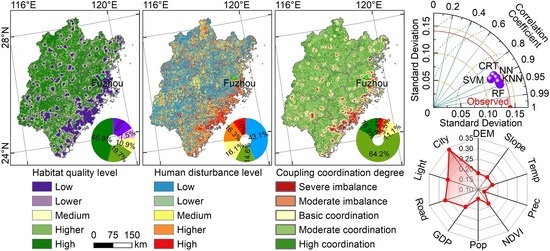
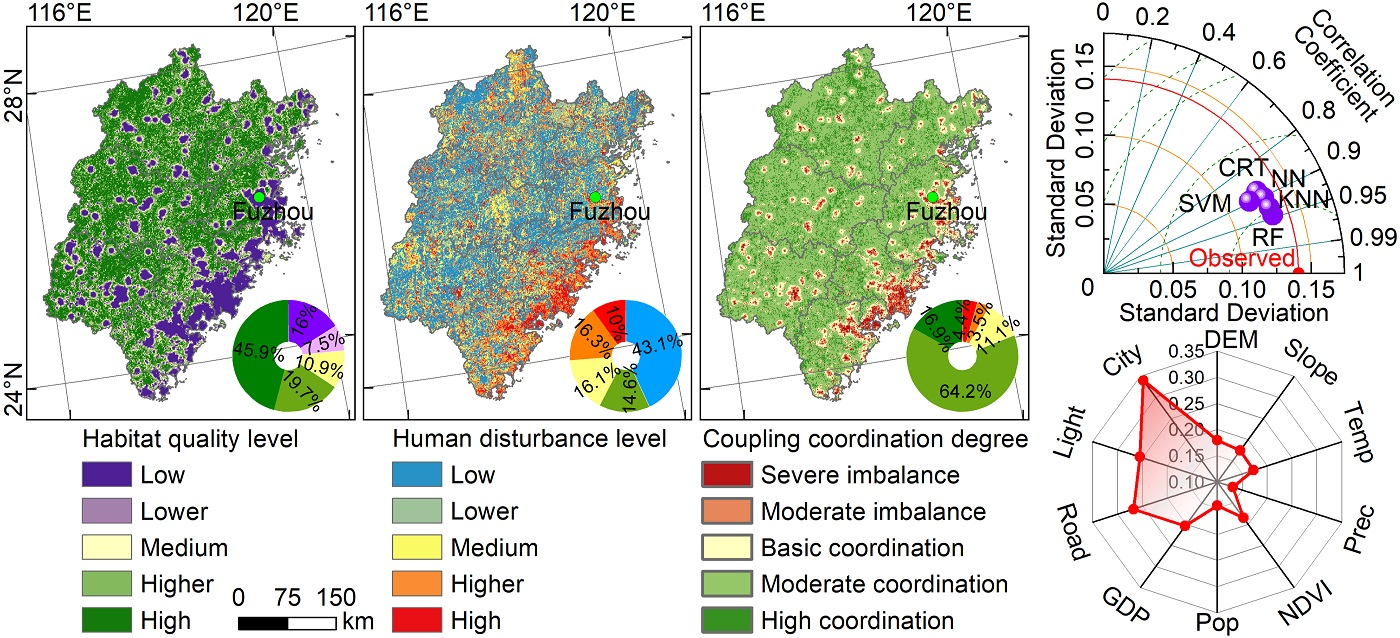
Assessing habitat quality and quantifying human disturbance are fundamental prerequisites for ecological conservation. However, existing studies predominantly focus on single dimensions. There is an urgent need to integrate habitat quality and human disturbance, and quantify their spatially coupled coordination relationships to address the disconnect between them in current research. As a critical ecological reserve in southeastern China, Fujian Province faces threats of ecological degradation. This study employed the InVEST model to evaluate habitat quality in Fujian from 1980 to 2020, utilized a human disturbance index to quantify spatiotemporal patterns of anthropogenic activities, analyzed their changes using landscape indices, and applied coupling coordination analysis to examine their interrelationships. Machine learning and geographically weighted regression were further integrated to identify driving factors of coupling coordination patterns. The results showed that: (1) Habitat quality remained relatively high while human disturbance levels stayed low throughout 1980–2020, though both showed gradual deterioration over time, particularly during 2010–2020, with riverine and coastal eastern regions exhibiting the lowest habitat quality and highest disturbance levels. (2) Coupling coordination relationships predominantly exhibited synergy, with moderate imbalance zones concentrated in the eastern coastal areas. Temporally, regions with lower imbalance expanded significantly during 2010–2020. (3) Landscape metric analysis revealed declining dominance of high-quality habitat/low-disturbance/synergistic zones, contrasted by increased fragmentation of low-quality habitat/high-disturbance/imbalanced zones. (4) Socioeconomic factors exerted stronger influence on coupling coordination patterns than natural environmental variables, proximity to urban areas, road density, and nighttime light indices. Each driver displayed spatially variable positive/negative effects. The results enhance our understanding of human–nature sustainable development dynamics, urban expansion–ecological conservation trade-offs, and provide methodological insights for regional ecological management and achieving sustainable development goals.

Graphical Abstract

1. Introduction

The 15th Sustainable Development Goal (SDG15) explicitly calls for the protection, restoration, and promotion of the sustainable use of terrestrial ecosystems, and halting biodiversity loss. Habitat quality, a cornerstone metric for assessing ecosystem integrity and resilience, underpins the preservation of biodiversity, the mediation of ecological functions, and the sustained provisioning of critical ecosystem services—including carbon sequestration, water purification, and pollination [1,2,3]. Escalating global environmental perturbations have intensified habitat degradation through urbanization, agricultural expansion, and climate shifts, posing existential threats to wildlife habitats and human socioecological stability [4,5,6,7,8]. Accurately quantifying habitat quality dynamics is therefore indispensable for identifying priority conservation areas, evaluating policy efficacy, and guiding sustainable land-use planning [9,10]. Such quantification will help optimize ecological protection and restoration strategies, enhance biodiversity resilience, and provide scientific support for the realization of SDG15, thereby coordinating ecological protection and human activities at the regional to global scale, and promoting the sustainable development vision of “harmonious coexistence between humans and nature”.
Traditional habitat quality assessment methods often rely on coarse-resolution satellite data or static indices, or expert inquiry. Conversely, emerging technologies such as high-resolution sUAS imagery and advanced modeling frameworks (e.g., InVEST, PLUS) enable precise mapping of habitat fragmentation and scenario-based simulations, thereby bridging the gap between theoretical research and practical conservation [11,12,13]. However, challenges persist in integrating multi-scale environmental variables, addressing data uncertainties, and disentangling the complex interactions between anthropogenic pressures that shape habitat quality patterns [14,15]. This underscores the urgent need for interdisciplinary approaches that combine cutting-edge remote sensing, model analysis, machine learning, and ecological theory to advance habitat quality research and inform evidence-based environmental governance [16,17,18].
Habitat quality assessment models range from statistical approaches (e.g., MaxEnt for species distribution modeling) to process-based frameworks (e.g., Habitat Suitability Index and Habitat Risk Assessment) that quantify ecological processes and cumulative pressures [19,20,21]. Historically, many methods often rely on vegetation cover as a proxy for habitat quality, frequently neglecting critical factors like fragmentation and anthropogenic disturbances [22]. In contrast, spatially explicit models like InVEST integrate land-use data, threat proximity, and policy-protected zones to quantify habitat degradation and prioritize conservation areas [23,24]. For instance, InVEST’s habitat quality module evaluates habitat sensitivity to threats (e.g., urbanization, agriculture) using weighted decay functions and sensitivity tables, enabling scenario-based evaluations of land-use changes [25,26,27]. While machine learning models frequently enhanced predictive accuracy, InVEST’s multi-module integration and open-source flexibility make it a cornerstone for balancing ecological integrity and human activities in conservation planning [28].
The intensification of urbanization and anthropogenic activities over recent decades has driven widespread deterioration of habitat quality, with global ecosystems exhibiting persistent degradation trends. For instance, the Omo-Gibe Basin in southwestern Ethiopia experienced continuous habitat quality decline from 1988 to 2018, attributed to expanding agricultural encroachment and infrastructure development [29]. This pattern is not isolated. In China’s Nansi Lake Basin, habitat quality deteriorated significantly between 1980 and 2015 despite the implementation of protected area policies, underscoring the limited efficacy of conventional conservation strategies in mitigating anthropogenic pressures [30]. Over the past 40 years, high-quality habitats in China have consistently degraded and contracted, while low-quality habitats expanded, with projections indicating accelerated deterioration due to ongoing land-use intensification [31]. Urban agglomerations and their peripheries exhibit particularly acute habitat degradation, with China’s three major urban clusters—the Guangdong–Hong Kong–Macao Greater Bay Area, the Yangtze River Delta, and the Beijing–Tianjin–Hebei region—dominated by medium-to-low habitat quality [32]. Land-use transitions, notably the conversion of ecological land (e.g., forests) to urban areas, further exacerbate these trends [33]. Recognizing this situation, there is a growing awareness of the critical role of ecological restoration policies in improving habitat quality [34]. While ecological restoration initiatives have been prioritized to counteract habitat loss, their efficacy remains limited. Current restoration efforts, such as reforestation programs and wetland rehabilitation, have yielded only partial success in decelerating degradation, often failing to offset anthropogenic disturbances [35]. Moreover, restored ecosystems exhibit high vulnerability to secondary degradation, especially under prolonged environmental stressors [36]. Spatial heterogeneity further complicates these dynamics: habitat recovery predominantly occurs in policy-mandated protected areas, whereas non-designated or weakly regulated regions continue to deteriorate [37]. Therefore, it is necessary to adopt a holistic perspective, and not limit ecological restoration merely to nature reserves.
The premise of ecological restoration lies in the precise quantification of human activities and their spatiotemporal impacts on ecosystems, as unsustainable land-use changes, pollution, and resource extraction have become dominant drivers of global environmental degradation [38,39]. Over the past two decades, rapid urbanization and industrialization have altered approximately 78% of global land surface, with anthropogenic pressures now exceeding planetary boundaries in critical regions such as urban agglomerations [40,41]. Altered natural landscapes are typically quantified using landscape indices, including fragmentation and connectivity metrics. For instance, indices such as the Largest Patch Index (LPI), Mean Patch Size (MPS), and Landscape Percentage (PLAND) have been identified as key factors influencing spatiotemporal variations in habitat quality within the Ethiopian Highlands Basin [42]. In the Wadla River Basin of central India, declining LPI trends, coupled with increasing Patch Density (NP) and Area-Weighted Mean Shape Index (AWMSI), reveal deteriorating ecological connectivity and habitat quality [43]. In China, habitat fragmentation has garnered significant attention. In Changchun City (Northeast China), urban expansion elevated Patch Density (PD), Edge Density (ED), and Shannon Diversity Index (SHDI) within built-up areas, yet reduced Aggregation Index (AI) levels, leading to pronounced habitat quality degradation [44]. Similarly, in Chengdu (Southwest China), habitat fragmentation metrics, edge shapes, and connectivity were employed to evaluate habitat quality in newly developed urban zones, offering insights for urban planning and ecological restoration [45]. While these studies explore habitat quality responses to landscape indices, they fundamentally analyze land-use change impacts rather than the direct distributions of human activities. Furthermore, existing indices, though depicting fragmentation, lack quantification of anthropogenic activity intensity gradients—a gap addressed by metrics like nighttime light intensity or Human Activity Intensity Index [14,46]. Previous research has not fully explored the bidirectional coupling between habitat quality and human activities, despite their mutual influences. This study addresses this limitation by integrating landscape indices as spatiotemporal analytical tools to separately investigate habitat quality dynamics, human activity patterns, and their interdependent relationships.
Fujian Province, a crucial ecological barrier in southeastern coastal China, holds a pivotal position in regional ecological security due to its unique mountainous–coastal landscape and rich biodiversity. However, in recent years, alongside rapid urbanization and economic growth, specifically the high concentration of human activities along the coast, the region faces severe challenges of habitat degradation and human–land imbalance [47,48]. While prior studies have addressed ecosystem service assessments, trade-offs and synergies, and ecological security across spatiotemporal scales in Fujian [49,50,51,52], they predominantly overlook the bidirectional interactions between human activities and ecosystems.
To address these gaps and contribute to sustainable regional development, this study aims to achieve the following aims: (1) To quantitatively assess the spatiotemporal evolution of habitat quality and human disturbance in Fujian Province from 1980 to 2020, leveraging InVEST model outputs and comprehensive landscape pattern metrics. (2) To analyze the spatiotemporal coupling coordination patterns between habitat quality and human disturbance in Fujian Province using a novel spatially explicit coupling coordination model. (3) To identify and quantify the multi-scale driving factors influencing the coupling coordination between habitat quality and human disturbance. (4) To propose targeted policy recommendations for regional ecological conservation and sustainable development in Fujian Province based on the research findings, contributing to the realization of SDG15.

2. Materials and Methods

2.1. Study Area

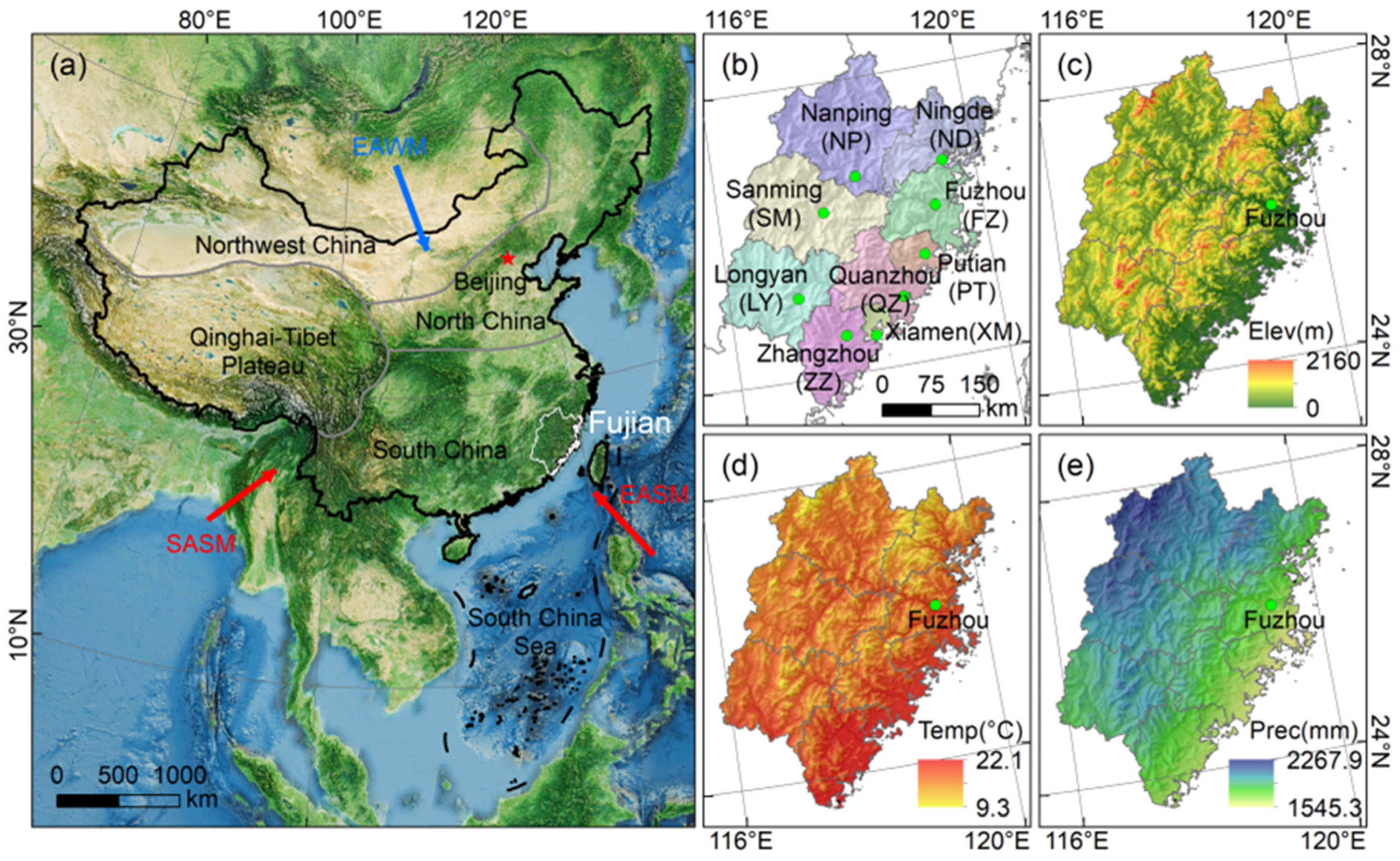
Fujian Province, located along the southeastern coast of China (Figure 1a,b), is a pivotal region for ecological security, uniquely characterized by its complex mountainous–coastal landscape and abundant biodiversity (Figure 1c) [53]. The province experiences a subtropical monsoon climate [54,55], which fosters evergreen broad-leaved forests as the zonal vegetation. However, significant human activities have led to altered natural forest ecosystems, with secondary forest formations (58.7% of forest cover) and coniferous plantations (19.2%) now dominating current vegetation patterns [56]. A notable ecological contrast exists between the densely developed eastern coastal plains and the relatively more natural inland regions, where urbanization pressures in metropolitan areas (e.g., Fuzhou, Xiamen, and Quanzhou) result in significantly reduced canopy cover compared to the higher vegetation coverage of the hinterlands [53].
Socioeconomic development in Fujian is markedly concentrated in eastern coastal corridor. Between 2000 and 2020, the province’s GDP grew exponentially (1058.4%), far outpacing population growth (22.02%) and driving intensive land-use conversion in these economically advanced coastal zones [57]. This pronounced spatial decoupling between rapid economic development and critical ecological conservation creates significant and urgent challenges for sustainable development, especially with respect to exacerbated habitat fragmentation and growing resource allocation disparities, making Fujian an exemplary case for studying human-land coupling dynamics.

2.2. Research Framework and Data

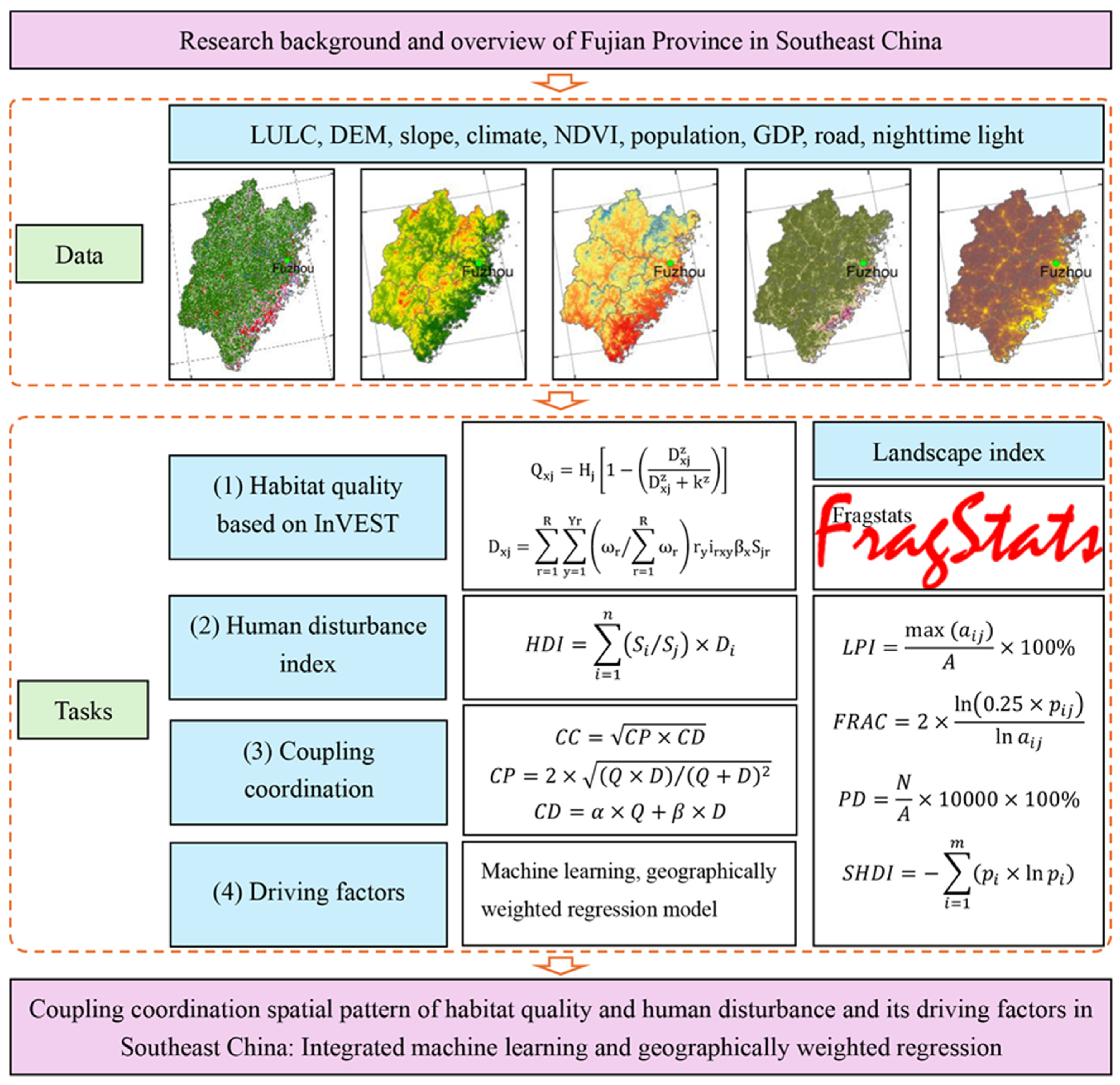
We adopted a comprehensive research framework to achieve the objectives, as illustrated in Figure 2. The workflow commenced with the collection and preprocessing of multi-source spatiotemporal data. These data, encompassing land use and land cover [58,59], elevation, climate, vegetation, socioeconomic variables, and transportation networks, were rigorously processed and validated to reliable support the analysis of the coupling coordination relationship between habitat quality and human activities, as well as their driving mechanisms. Data sources and specifications are detailed in Table 1.
Subsequently, habitat quality was assessed using the InVEST model, while human disturbance was quantified through a composite index integrating various socioeconomic and infrastructure data. The core of the analysis involved a novel spatiotemporal coupling coordination model to evaluate the interaction patterns between habitat quality and human disturbance across different periods. Finally, a geographically weighted regression (GWR) model was employed to identify and quantify the driving factors influencing these coupling coordination patterns, leading to the formulation of targeted policy recommendations for sustainable regional development.

2.3. Habitat Quality Evaluation Based on InVEST Model

2.3.1. Evaluation Principles of Habitat Quality

The InVEST model (Integrated Valuation of Ecosystem Services and Trade-offs, https://naturalcapitalproject.stanford.edu/software/invest, accessed on 5 October 2024) has become a cornerstone in ecosystem service evaluation, specifically for its capacity to quantify spatially explicit trade-offs between provisioning, regulating, and cultural services [51,60,61]. The habitat quality (HQ) evaluation in the InVEST model characterizes the habitat suitability and degree of habitat degradation of regional LULC types by calculating the habitat quality index, which is calculated by the following equations [62,63]:
Q x j = H j 1 D x j z D x j z + k z
D x j = r = 1 R y = 1 Y r ω r / r = 1 R ω r r y i r x y β x S j r
In the Equation (1), Qxj is the habitat quality index of the j-th LULC type x grid unit, which is divided into low (0–0.2), lower (0.2–0.4), medium (0.4–0.6), higher (0.6–0.8), and high (0.8–1) in this study. This five-level classification was adopted based on an equal interval categorization, a common practice for facilitating spatial visualization and interpretation of continuous ecological variables. Hj is the habitat suitability score for the j-th LULC type, with a range of values from 0 to 1. Z is the scale constant, usually taken as 2.5; k is a half-saturation constant, generally half of the maximum degradation degree. Dxj is the habitat degradation index, which represents the degree of degradation exhibited by the habitat under stress. In the Equation (2), r is the stress factor; R is the number of stress factors; y is a single grid in the stress factor r grid layer; Y is the total number of grid units of the stress factor r; wr is the relative weight of the stress factor r to all habitats; irxy represents the impact of stress factor r on each grid of the habitat (linear or exponential); βx represents the level of habitat anti-interference; Sjr represents the relative sensitivity of each habitat to different stress factors.

2.3.2. Input Data for Habitat Quality Evaluation

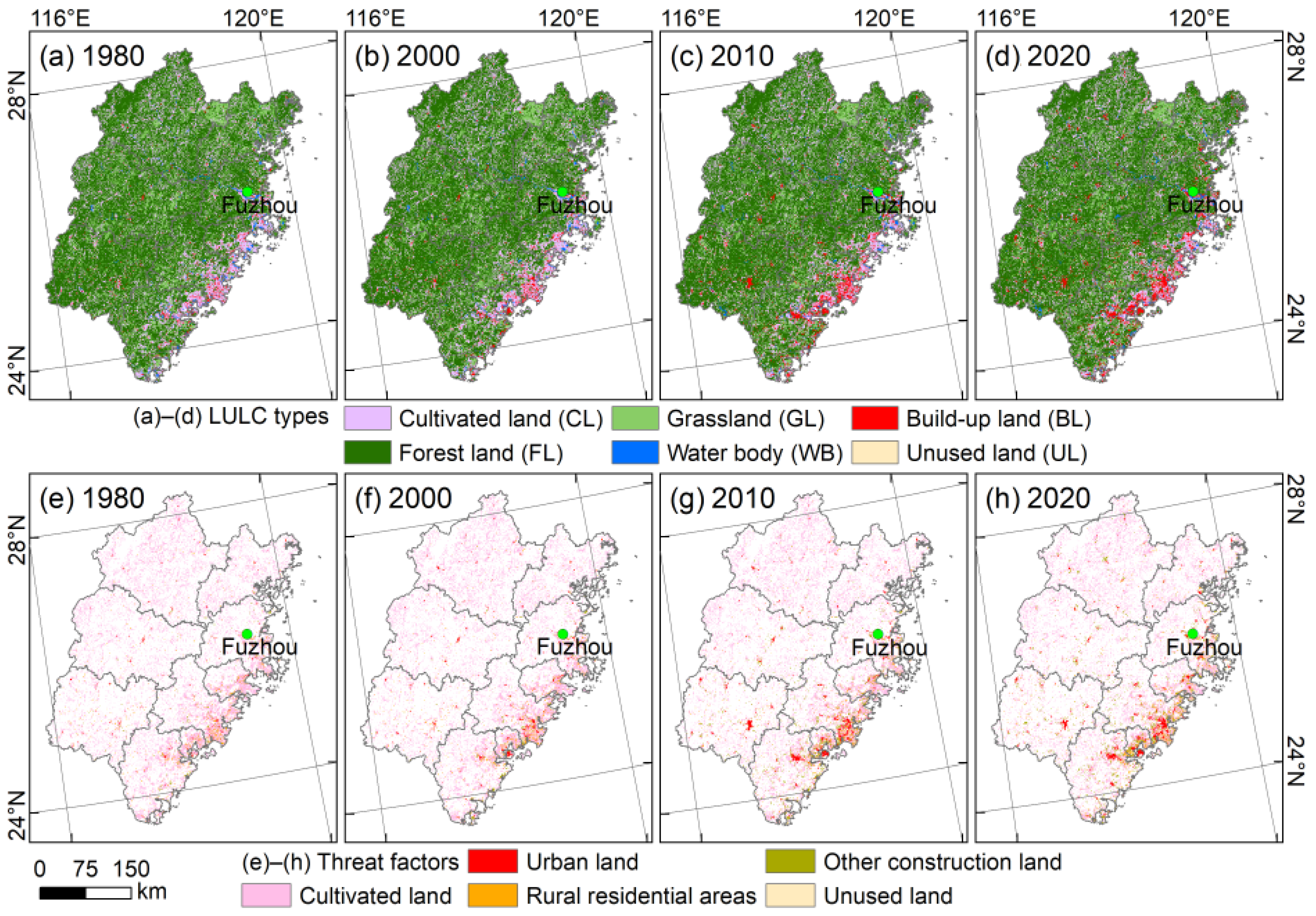
According to the habitat quality (HQ) module of the InVEST model, 4 parameters are required. (1) LULC: this study provides primary and secondary category data for the years 1980, 2000, 2010, and 2020 (Figure 3a–d). (2) Threats factor and table: mapping each threat of interest to its properties and distribution maps (Figure 3e–h, Table 2). (3) Sensitivity table: mapping each LULC class to data about the species’ habitat preference and threat sensitivity in areas with that LULC (Table 3). (4) Half-saturation constant: used in the degradation equation. The default value is 0.05, and calibrated to 0.5 after running.

2.4. Human Disturbance Index

Human activities intentionally or unintentionally affect the ecological environment, transform the environmental conditions, and significantly reflect in LULC. Different LULC types reflect the differences in human disturbance strength on land, and assigning values to different LULC types can attempt to quantify the intensity of human activities in the region [38,64,65]. The equation is as follows:
H D I = i = 1 n S i / S j × D i
In Equation (3), HDI is human disturbance index; n is the number of LULC types with different disturbance levels, and the maximum value of n in this study was 24; Si is the area of the i-th LULC type in the sampling grid (km2); Sj is the total area of the sampling grid (km2); and Di is the disturbance intensity coefficient reflected by the i-th LULCtype (Table 4).

2.5. Coupling Coordination Degree Model

The coupling coordination model can reflect the mutual influence relationship between habitat quality and human disturbance. The coupling degree reflects the interaction strength between habitat quality and human disturbance, and the coordination degree reflects whether the mutual influence between the two develops towards mutual promotion or destruction. The formula is as follows [66,67,68,69]:
C C = C P × C D
C P = 2 × Q × D / Q + D 2
C D = α × Q + β × D
In Equations (4)–(6), CC, CP, and CD are the coupling coordination degree, coupling degree, and coordination degree between habitat quality and human disturbance, respectively, with a value range of [0, 1]; Q and D are the habitat quality index and human disturbance index, respectively; α and β are all undetermined coefficients and set α + β= 1, this article α and β take 0.5 due to both important of habitat quality and human disturbance. The coupling coordination degree was divided into five categories: 0 ≤ CC < 0.2 (severe imbalance), 0.2 ≤ CC < 0.4 (moderate imbalance), 0.4 ≤ CC < 0.6 (basic coordination), 0.6 ≤ CC < 0.8 (moderate coordination), and 0.8 ≤ CC < 1 (high coordination).

2.6. Fragstats and Landscape Indices

Fragstats (v 4.3.833b, https://www.fragstats.org, accessed on 15 October 2024), developed by McGarigal et al. [70], is a widely utilized software for calculating landscape indices [71,72,73]. To comprehensively characterize the landscape pattern features and dynamic changes of habitat quality and human disturbance, we selected 12 representative landscape pattern indices at the patch, class, and landscape levels, calculated with Fragstats.
The selection of these 12 metrics was primarily based on their ability to effectively capture critical aspects of landscape patterns relevant to habitat quality and human disturbance within the study area [70,71,72,73]:
(1)
Ability to effectively reflect landscape fragmentation: Indices such as Patch Density (PD) and Edge Density (ED). This is crucial for assessing habitat integrity in Fujian Province’s context of rapid urbanization, where fragmented landscapes can impede ecological processes.
(2)
Capacity to reveal landscape connectivity and aggregation: The Largest Patch Index (LPI) and Aggregation Index (AI). This provides vital guidance for identifying important ecological corridors and conservation zones within Fujian’s diverse terrain.
(3)
Capability to embody landscape diversity and heterogeneity: Shannon Diversity Index (SHDI) and Shannon Evenness Index (SHEI). These indices aid in assessing the impact of human activities on natural landscape diversity across different administrative and ecological units.
(4)
Reflection of patch shape complexity: Area-weighted Mean Patch Fractal Dimension (AWMPFD) and Landscape Shape Index (LSI). The two indices quantify the complexity of patch shapes, indirectly indicating human-induced alterations to natural boundaries and the intensity of anthropogenic influence on landscape structure.
(5)
Basic Compositional Metrics: Total Class Area (CA) and Percentage of Landscape (PLAND). They provide fundamental measures of landscape composition, quantifying the proportional abundance of specific patch types (e.g., habitat areas or human-dominated land uses).
(6)
Patch Count and Cohesion: Number of Patches (NP) offers a simple measure of subdivision, while the Patch Cohesion Index (COHESION) quantifies the physical connectedness of patches within a specific type, which is important for understanding habitat connectivity for species movement.

2.7. Driving Factors and Their Contributions

2.7.1. Driver Factor Selection

The coupling and coordination between habitat quality and human disturbance need to be analyzed from different perspectives; therefore, 10 indicators were selected from natural environmental factors and socio-economic factors to explore driving factors. Five natural environmental factors were selected, including elevation (X11), slope (X12), temperature (X13), precipitation (X14), and NDVI (X15), taking into account factors such as topography, climate, and vegetation. Five socio-economic factors include population density (X21), GDP density (X22), road density (X23), nighttime light index (X24), and distance to cities and counties (X25), which comprehensively reflect various factors such as population, economy, and city. To explore driving factors, especially geographically weighted regression analysis, a 5 km × 5 km fishing net was created on the ArcGIS 10.8 platform, and the driving factors and coupling coordination results were statistically analyzed.

2.7.2. Machine Learning Models

The application of machine learning in ecosystem service assessment has been proven to have good results [74,75,76]. Random forest (RF), classification and regression tree (CRT), neural network (NN), support vector machine (SVM), and k-nearest neighbor (KNN) were used in this study to evaluate the relative importance of driving factors. RF leveraged ensemble learning to aggregate predictions from multiple decision trees, mitigating overfitting, and providing feature importance scores via Gini impurity reduction. CRT constructed binary recursive partitions, offering interpretable rules but limited to axis-aligned splits. NN modeled complex nonlinear relationships through layered transformations, requiring extensive data but excelling in high-dimensional spaces. SVM identified optimal hyperplanes with kernel tricks to handle nonlinear separability, yet struggled with large datasets due to quadratic scaling. KNN predicted outcomes based on local neighborhood similarities, prioritizing spatial proximity but suffering from the “curse of dimensionality”. This multimethod approach balanced interpretability (CRT, KNN) with predictive power (RF, NN, SVM), enabling robust identification of critical drivers in heterogeneous environmental systems. These methods each have their own advantages and disadvantages, and it is necessary to evaluate the applicability of different models.
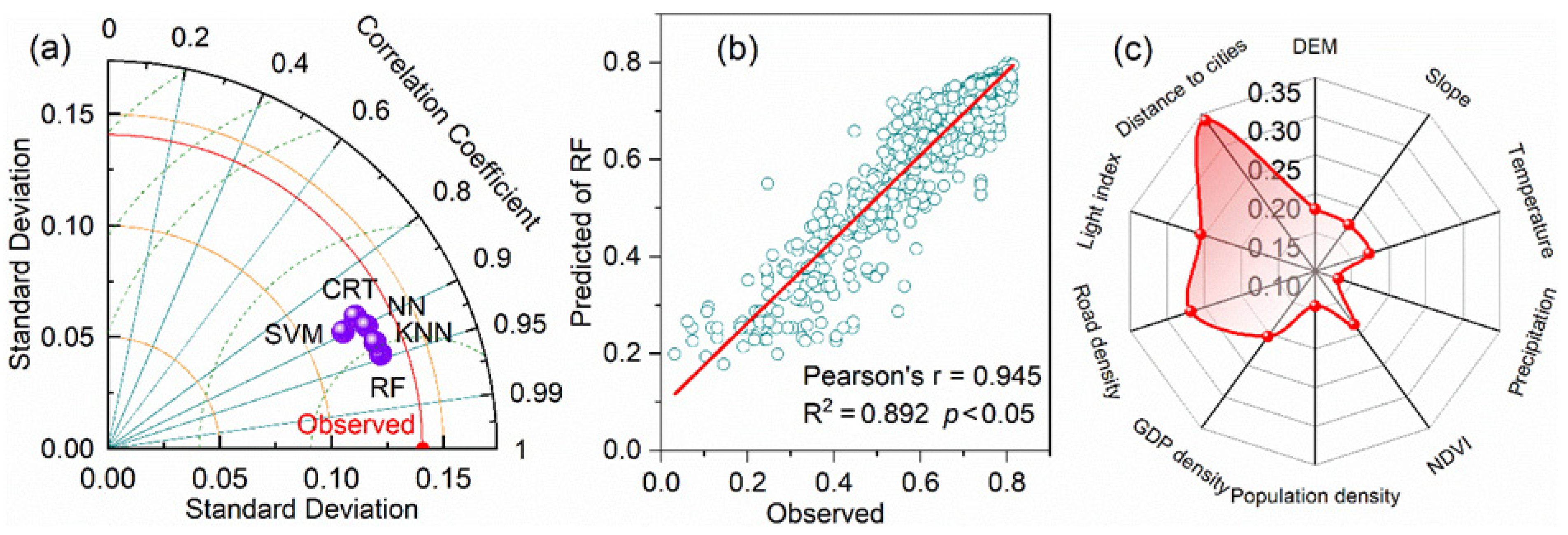
In addition, a Taylor diagram was used to evaluate the performance of machine learning models. It was employed to quantitatively compare model performance through three key statistical metrics: correlation coefficient, standard deviation ratio, and root mean square error. Each model is represented as a point in polar coordinates where: Radial distance from the origin reflects prediction variability relative to observations; angular position (0–90°) corresponds to R values, showing agreement strength between predicted and observed patterns; contour lines of constant root mean square error enable visual comparison of prediction accuracy across models. This method synthesizes multiple performance metrics into a single visualization, facilitating intuitive identification of optimal models (e.g., RF proximity to the reference line suggests superior performance).

2.7.3. Geographically Weighted Regression Model

The geographically weighted regression (GWR) model is a powerful tool used to explore spatial relationships, which can be used to display the spatial distribution of driving factor contributions. This model operates by estimating local regression coefficients at each spatial location, where weights are assigned to neighboring observations based on distance decay functions to quantify spatial heterogeneity in driving factor contributions. This approach allows visualization of how factor importance varies spatially, enabling identification of localized relationships. The calculation method is as follows [18,77,78,79]:
y i = β 0 μ i , v i + j = 1 k β j x i j + ε i
where yi and xij are the results of the dependent variable, y, and the explanatory variable (driving factor), x, at position (ui, vi); the coefficients, βj(ui, vi) (j = 1, 2, …, k), are k functions on the spatial location; and εi (i = 1, 2, …, k) is an error with a mean variance of σ2. The model parameters, βj(ui, vi) (j = 1, 2, …, k), are location dependent and are typically estimated locally using a weighted least squares approach.

3. Results

3.1. Habitat Quality Characteristics

3.1.1. Spatial–Temporal Characteristics of Habitat Quality

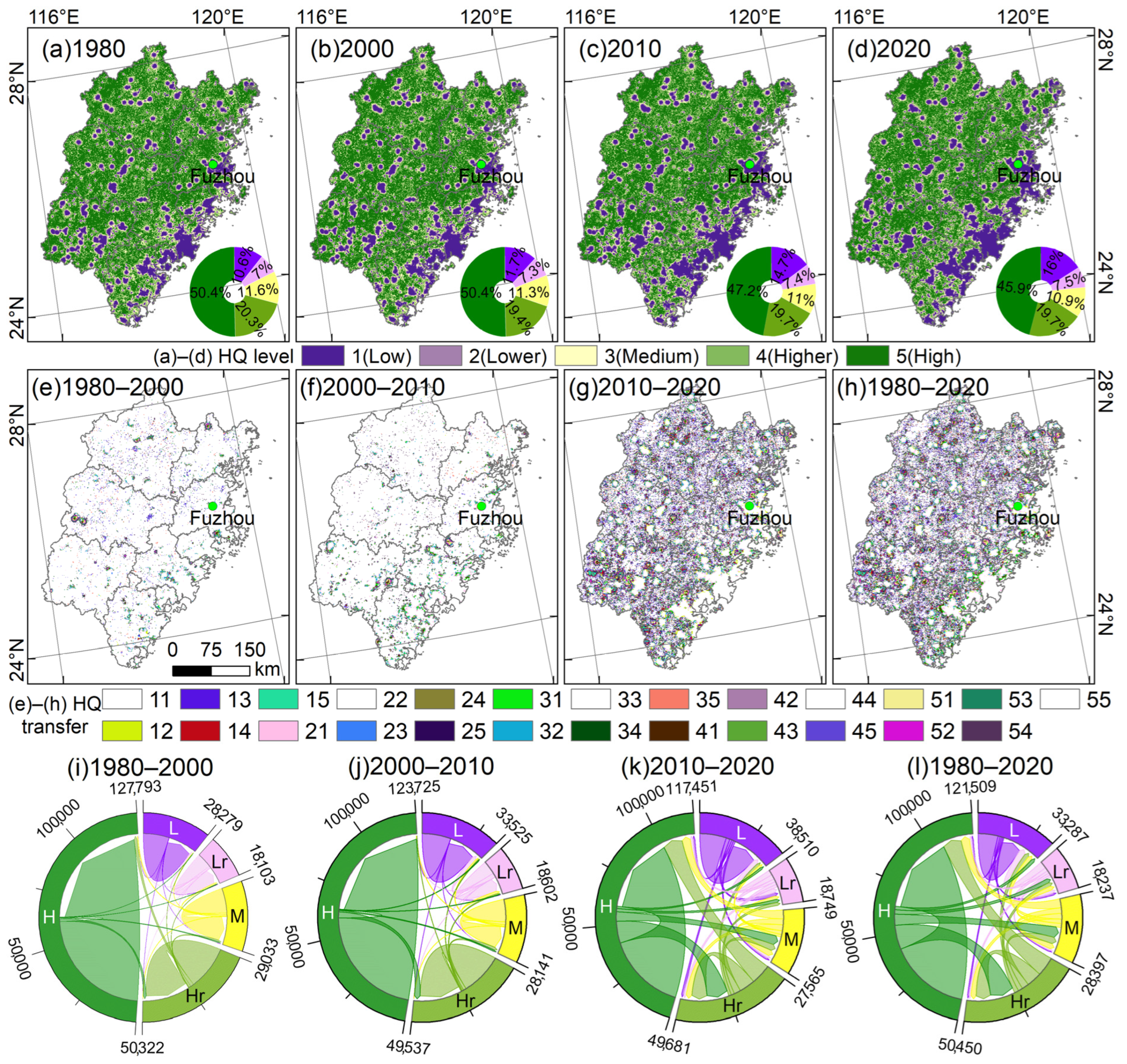
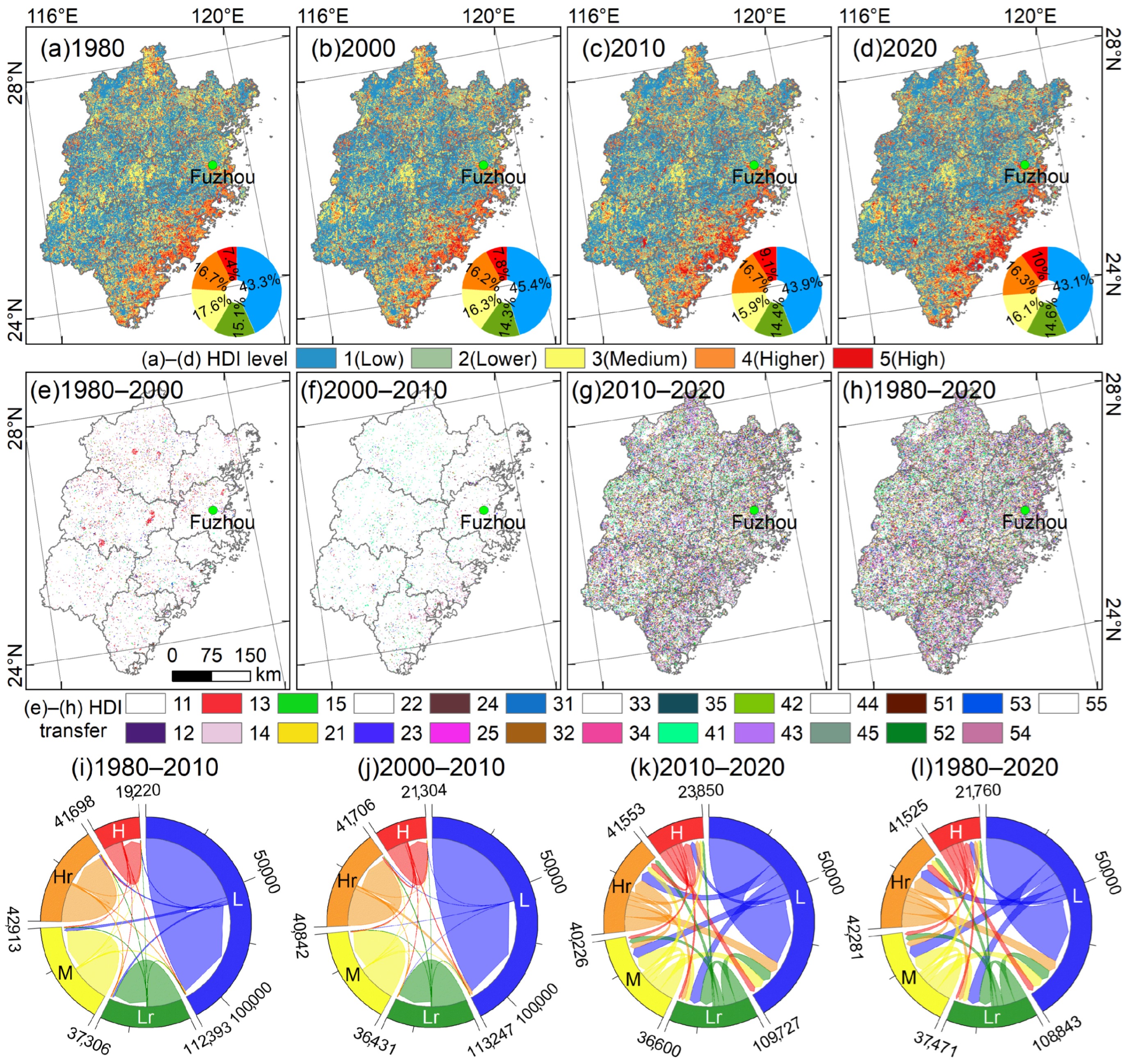
The overall habitat quality in Fujian Province was relatively high, with higher levels regions being dominant and widely distributed throughout the province, while lower levels regions were relatively rare and distributed in a dotted pattern inland and in striped pattern along the southeast coast (Figure 4a–d). From 1980 to 2020, the areas proportion of above higher levels gradually decreased (70.73% to 65.61%), while the areas proportion of below lower levels gradually increased (17.62% to 23.49%) (Figure 4a–d). The habitat quality change was mainly constant, but with the passage of time, the transfer at different levels has gradually become more frequent, especially from 2010 to 2020 (Figure 4e–h). From 1980 to 2010, there were relatively less transfer between different levels, while from 2010 to 2020, there was more transfer between different levels and a larger area, especially mutual transfer between higher and high types (Figure 4i–l).
The spatial–temporal characteristics and changes showed that lower levels regions and more significant change regions of habitat quality were both dotted or strip-shaped, mainly distributed in flat terrain regions such as river valleys or coastal areas, where significant interference on habitat quality due to relatively dense of population, transportation, and urban construction. The temporal change characteristics showed that the habitat quality in Fujian Province was gradually deteriorating, especially at a faster rate after 2010, which was related to the socio-economic development characteristics of Fujian Province.

3.1.2. Class Metrics Characteristics of Habitat Quality

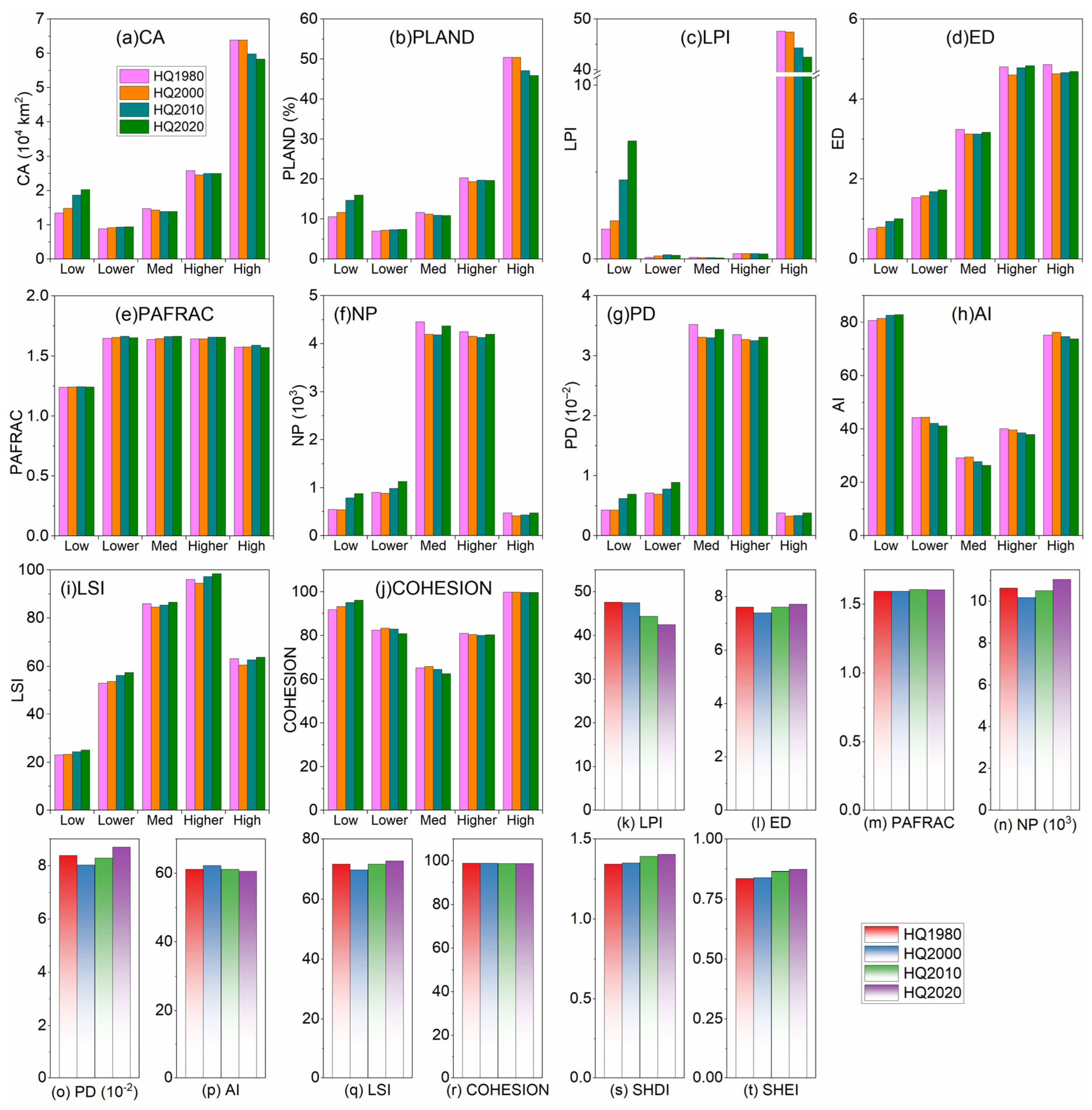
Analysis of habitat quality indicators in Fujian Province revealed significant temporal variations from 1980 to 2020, with distinct annual fluctuations observed across different metric levels (Figure 5a–j). CA, PLAND, and LPI demonstrated consistent dominance of high-quality habitats, whereas lower-to-moderate quality habitats exhibited contrasting trends, evident in LPI values (Figure 5a–c). Quantitative analysis indicated a 8.68% reduction in CA, 8.83% decline in PLAND, and 10.83% decrease in LPI for high-quality habitats, signifying reduced dominance. Conversely, low-quality habitats showed substantial expansion with a 51.3% CA increase, 51.05% PLAND growth, and 290.32% LPI elevation. ED analysis revealed contrasting patterns: high-quality habitats maintained stable ED with moderate fragmentation levels, while low-quality regions exhibited a 30.97% ED increment (Figure 5d), indicating increased boundary fragmentation. PAFRAC values across all quality levels remained close to 1.5 (within 1–2 range), demonstrating moderate spatial regularity and human impact (Figure 5e). Notably, low-quality habitats displayed reduced PAFRAC (1.24), suggesting heightened anthropogenic influence compared to other categories.
Both NP and PD exhibited significant dominance by moderate and high habitat quality, indicating higher heterogeneity and fragmentation in these areas (Figure 5f–g). Conversely, low habitat quality showed rapid increases in NP (59.27%) and PD (60.47%), suggesting an increasing fragmentation trend. The AI demonstrated contrary trends, with relative dominance of low and high habitat quality accompanied by higher aggregation levels, while minimal differences were observed across other categories (Figure 5h). Changes indicated slight increases in low habitat quality and aggregation, concurrent with declines across other levels and increased dispersion. LSI values revealed relative dominance of high and moderate habitat quality, reflecting better spatial structure and higher complexity (Figure 5i). Minimal differences among other categories, coupled with increasing trends, indicated overall landscape complexity enhancement. COHESION values maintained generally high levels with minimal variation, except for relatively lower values in moderate habitat quality, demonstrating overall high landscape connectivity (Figure 5j).

3.1.3. Landscape Metrics Characteristics of Habitat Quality

The landscape metrics of habitat quality in Fujian Province exhibited moderate annual variations with inconsistent temporal trends (Figure 5k–t). The LPI value decreased from 47.62 to 42.46 (10.83% reduction) from 1980 to 2020 (Figure 5k), indicating relatively high but declining dominance of the largest habitat patches, consistent with the class-level metric for high-quality habitats (Figure 5c). The ED value initially declined slightly (7.61 to 7.39) followed by a minor increase (7.39 to 7.72) from 1980 to 2020 (Figure 5l), reflecting elevated boundary fragmentation compared to class-level metrics, though with minimal temporal variability. The PAFRAC value remained consistently around 1.6 throughout the study period (Figure 5m), suggesting moderate levels of spatial regularity and complexity in habitat quality.
The NP value exhibited a slight decrease (10,632 to 10,185) followed by a minor increase (10,185 to 11,054) from 1980 to 2020 (Figure 5n), indicating a fluctuating upward trend in regional habitat fragmentation. Similarly, the PD value showed an initial slight decline (0.084 to 0.08) followed by a minor rise (0.08 to 0.087) during the same period (Figure 5o), confirming consistent fragmentation patterns between NP and PD metrics. The AI value demonstrated an initial modest increase (61.17 to 62.27) followed by a subsequent decrease (62.27 to 60.61) from 1980 to 2020 (Figure 5p), presenting a contrary pattern to NP and PD while indicating relatively dispersed habitat distribution compared to class-level metrics. The LSI value displayed a minor reduction (71.67 to 69.71) followed by a slight increase (69.71 to 72.76) from 1980 to 2020 (Figure 5q), suggesting generally moderate-to-complex spatial distribution of habitat quality. COHESION values remained consistently high (>98.7) across all years (Figure 5r), demonstrating strong landscape connectivity.
The SHDI value of habitat quality progressively increased from 1.344 to 1.406 (1980–2020) (Figure 5s), reflecting gradual landscape diversity enhancement. The SHEI value gradually rose from 0.835 to 0.874 during the same period (Figure 5t), approaching 1 and indicating increasingly uniform spatial distribution and growing diversity.

3.2. Human Disturbance Characteristics

3.2.1. Spatial–Temporal Characteristics of Human Disturbance

The overall human disturbance in Fujian Province was relatively low, with regions of below lower levels dominating and widely distributed throughout the province, while regions of above higher levels accounted for a relatively small proportion, mainly along the southeast coast (Figure 6a–d). The area proportion at different levels remained relatively stable from 1980 to 2020, with a slight decrease in the area proportion below lower levels (58.39% to 57.68%), while the area proportion above higher levels slightly increased (24.05% to 26.26%) (Figure 6a–d). The human disturbance changes were mainly constant, but with the passage of time, the transfer at different levels has gradually become more frequent, especially from 2010 to 2020 (Figure 6e–h). From 1980 to 2010, there were very little transfer between different levels, while from 2010 to 2020, there was relatively more transfer between different levels and relatively large area, especially in the low levels transfer to levels (Figure 6i–l).
The spatial–temporal characteristics and changes indicate that above higher levels regions of human disturbance were mainly located along the southeast coast and river valleys, which were conducive to settlement, transportation, and urban construction. Human disturbance changes did not show obvious characteristics in space and were distributed throughout the province. The temporal change characteristics showed that human disturbance in Fujian Province was gradually increasing, especially at a faster rate after 2010, which reflects the social and economic development and increased intensity of human activities in Fujian Province.

3.2.2. Class Metrics Characteristics of Human Disturbance

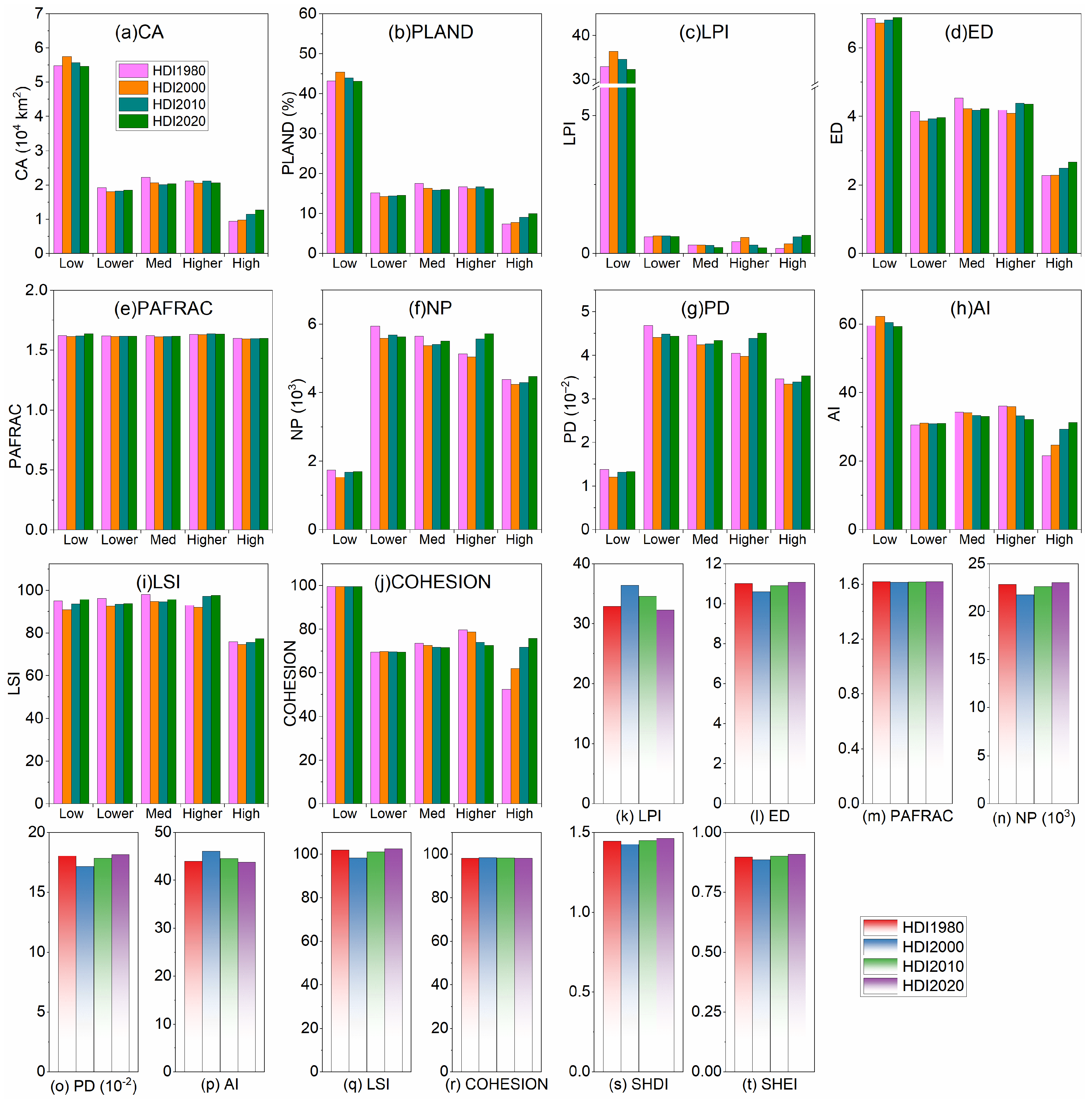
The class-level metrics of human disturbance in Fujian Province exhibited significant annual variations from 1980 to 2020, with distinct disparities among different disturbance levels (Figure 7a–j). CA, PLAND, and LPI consistently demonstrated dominant advantages for low human disturbance categories, while other levels showed contrasting trends, in LPI (Figure 7a–c). Changes indicated increases in CA (35.35%), PLAND (35.13%), and LPI (258.9%) for high-disturbance areas, reflecting expanded high-disturbance regions. Conversely, CA, PLAND, and LPI values decreased across low, moderate-low, moderate, and moderate-high disturbance levels, with the largest decline in moderate-high disturbance LPI (−52.72%), indicating reduced dominance. ED values revealed low-disturbance areas maintained higher edge density and boundary fragmentation (Figure 7d), whereas high-disturbance regions showed lower ED but a notable increase (17.65%), suggesting heightened fragmentation. PAFRAC values across all disturbance levels remained close to and above 1.5 (within 1–2 range) with minimal fluctuations, indicating moderate and stable spatial regularity and complexity of patch shapes under human disturbance (Figure 7e).
The NP and PD values demonstrated low proportions of low human disturbance, while other levels exhibited dominant advantages with minimal disparities, indicating elevated overall heterogeneity and fragmentation (Figure 7f–g). Notably, NP and PD values increased under moderate-high and high human disturbance levels, signaling a growing fragmentation trend. The AI metric exhibited contrary trends, with relatively higher dominance of low human disturbance and greater aggregation levels, while other categories showed limited differentiation (Figure 7h). Changes revealed a significant 45.01% increase in AI values under high human disturbance, reflecting enhanced aggregation. LSI values displayed minimal variation across disturbance levels, suggesting generally favorable landscape spatial structure and higher complexity (Figure 7i). COHESION values maintained high overall levels with reduced temporal disparities, demonstrating strong landscape connectivity (Figure 7j). Temporal analysis further indicated a 44.61% increase in COHESION values under high human disturbance, signifying progressively improved landscape connectivity despite persistent relative lower connectivity compared to other categories.

3.2.3. Landscape Metrics Characteristics of Human Disturbance

The landscape metrics of human disturbance in Fujian Province exhibited moderate annual variations with inconsistent temporal trends from 1980 to 2020, showing distinct disparities across disturbance levels (Figure 7k–t). LPI values initially increased (32.89 to 36.41) followed by a decline (36.41 to 32.29) during the study period (Figure 7k), indicating relatively high dominance of the largest patches but an overall decreasing trend, consistent with class-level metrics for low-disturbance areas (Figure 7c). ED values first slightly decreased (11.01 to 10.61) then marginally increased (10.61 to 11.07) from 1980 to 2020 (Figure 7l), reflecting elevated boundary fragmentation compared to class-level metrics with minimal temporal variability. PAFRAC values remained stable near 1.62 throughout the period (Figure 7m), suggesting moderate and consistent spatial regularity and complexity of patch shapes under human disturbance.
NP values displayed an initial minor decline (22,864 to 21,777) followed by a slight increase (21,777 to 23,046) from 1980 to 2020 (Figure 7n), indicating fluctuating but rising fragmentation. Similarly, PD values showed comparable trends (0.18 to 0.171 then 0.171 to 0.182) (Figure 7o), confirming consistent fragmentation patterns between NP and PD. AI values exhibited an initial modest rise (44.04 to 46.08) followed by a decline (46.08 to 43.77) (Figure 7p), contrasting with NP/PD trends while indicating increased aggregation under human disturbance. LSI values first slightly decreased (101.96 to 98.33) then marginally increased (98.33 to 102.6) (Figure 7q), suggesting generally moderate-to-complex spatial distribution of disturbance patterns. COHESION values remained consistently high (>98.1) across all years (Figure 7r), demonstrating strong landscape connectivity.
The SHDI value of human disturbance first slightly decreased (1.44 to 1.43) then increased (1.43 to 1.46) (Figure 7s), reflecting fluctuating landscape diversity. SHEI values initially declined (0.89 to 0.88) then rose (0.88 to 0.91) (Figure 7t), approaching 1 and indicating progressively more uniform spatial distribution and increasing diversity.

3.3. Coupling Coordination Spatial Patterns

3.3.1. Correlation Between Habitat Quality and Human Disturbance

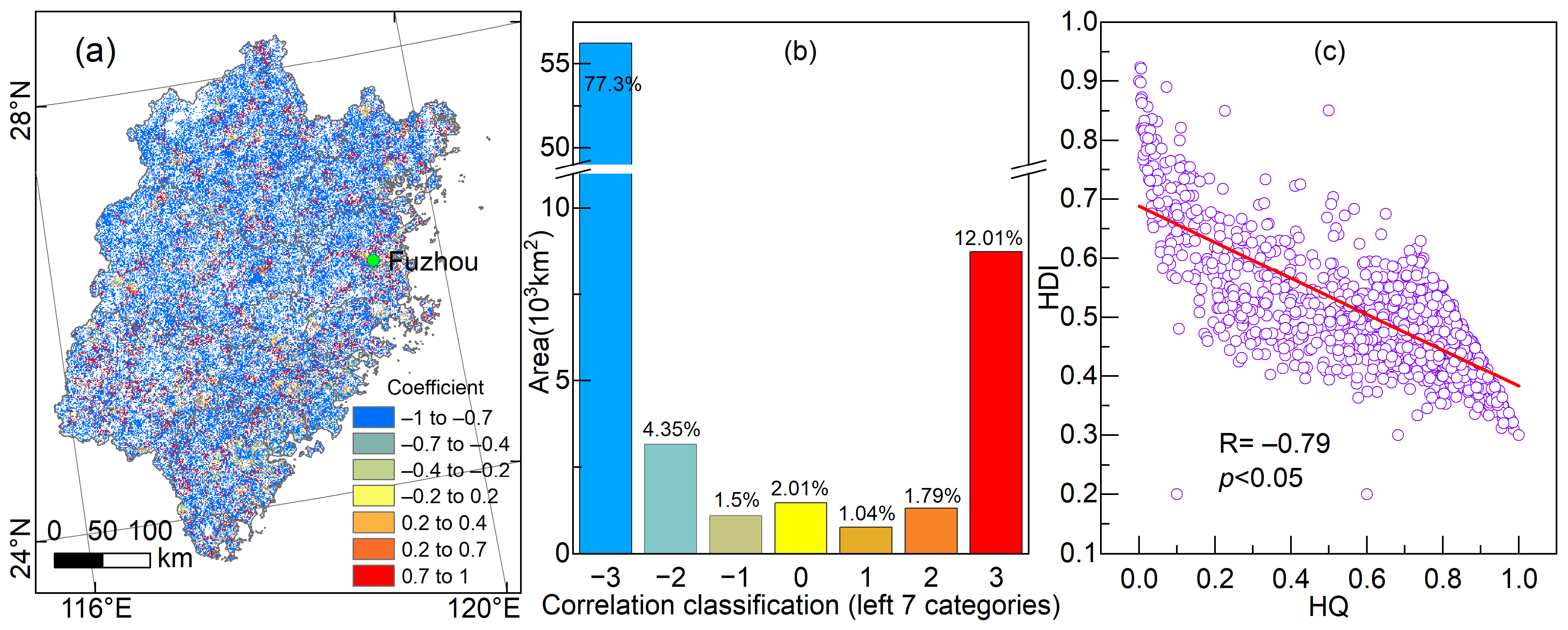
Correlation analysis showed that there was a significant correlation between habitat quality and human disturbance (p < 0.05), with strongly correlated regions distributed throughout the province and a large area (accounting for 89.31%) (Figure 8). Among them, strong negative correlation dominates (77.3%), followed by strong positive correlation (12.01%), and only a few regions were not correlated (2.01%) (Figure 8b). Taking 2020 as an example, there is a significant negative correlation between habitat quality and human disturbance (R = −0.79, p < 0.05) (Figure 8c). The results indicate that there was a mutual influence between habitat quality and human disturbance, and there was a negative effect, when human activities increase, habitat quality decreases and human disturbance increases. Therefore, it was necessary to further explore the coupled and coordinated spatial–temporal patterns of habitat quality and human disturbance from 1980 to 2020.

3.3.2. Spatial–Temporal Characteristics of Coupling Coordination Patterns

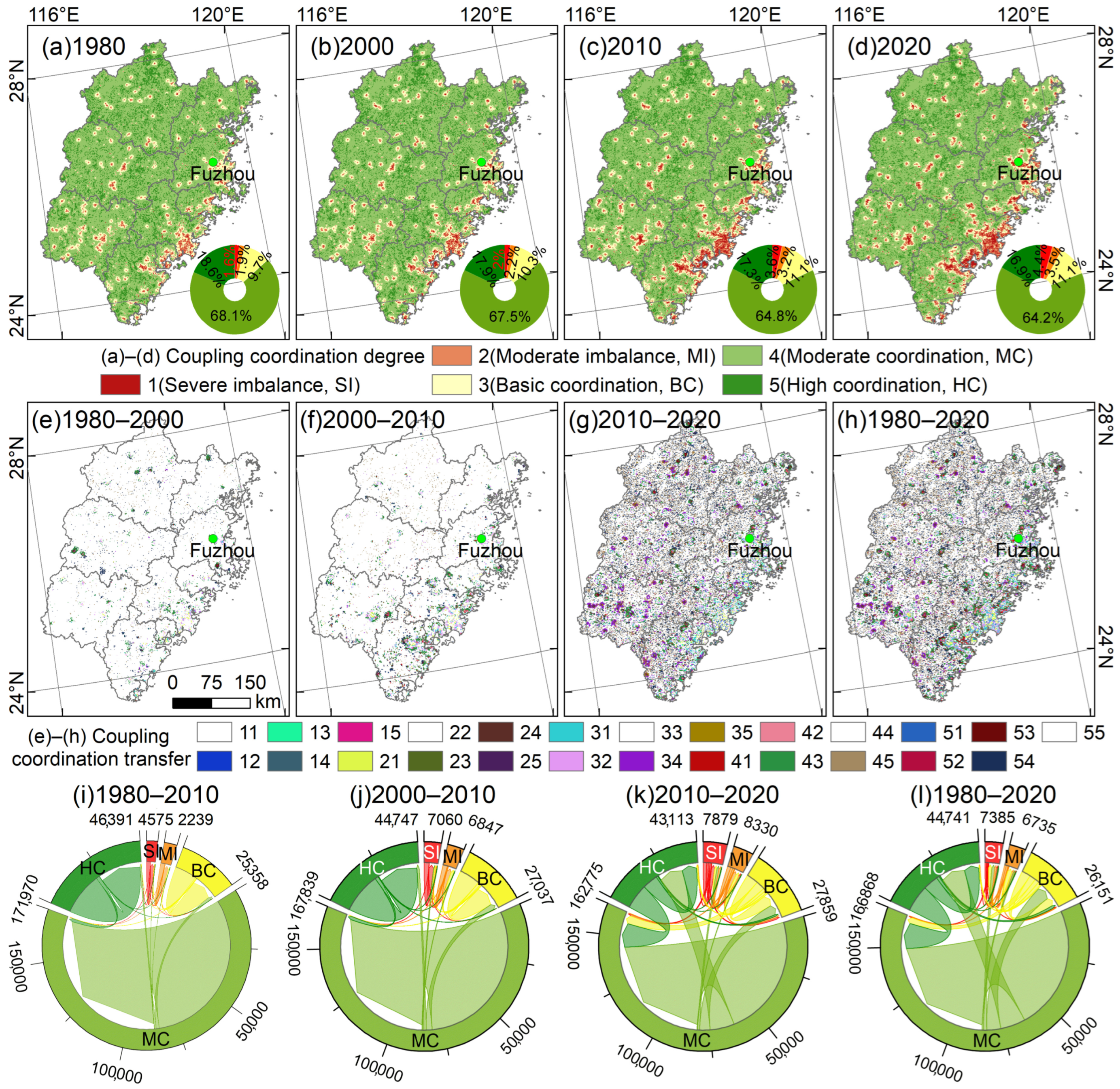
The coupling coordination spatial patterns distribution between habitat quality and human disturbance in Fujian Province was overall coordination, with regions above moderate coordination level dominating and widely distributed throughout the province, while regions below moderate imbalance level account for a relatively small proportion, mainly distributed in the southeastern coastal and inland point distribution (Figure 9a–d). From 1980 to 2020, the areas proportion of different levels gradually changed. The areas proportion of above the moderate coordination level decreased (86.77% to 81.03%), while the areas proportion of below the moderate imbalance level increased (3.48% to 7.87%) (Figure 9a–d). There were spatial–temporal differences in the changes of the coupled coordination spatial pattern, with small transfers at different levels from 1980 to 2010, while frequent transfers occur from 2010 to 2020 (Figure 9e–h). From 1980 to 2010, the transfer area between different levels was relatively small, while from 2010 to 2020, there was relatively more and larger mutual transfer between different levels, especially moderate and highly coordinated transfers (Figure 9i–l).
The spatial–temporal characteristics and changes indicate that the imbalance between habitat quality and human disturbance were mainly distributed along the southeast coast, and the inland regions were dotted, where are human settlements. The coupling coordination patterns changes did not show obvious spatial characteristics and were distributed throughout the province. The temporal change characteristics indicate that although high coordination regions cover the entire province, imbalanced regions gradually expand, there has been a significant shift in different coupling and coordination levels after 2010, reflecting an increasing trend of human activity intensity on habitat quality in Fujian Province.

3.3.3. Class Metrics Characteristics of Coupling Coordination Patterns

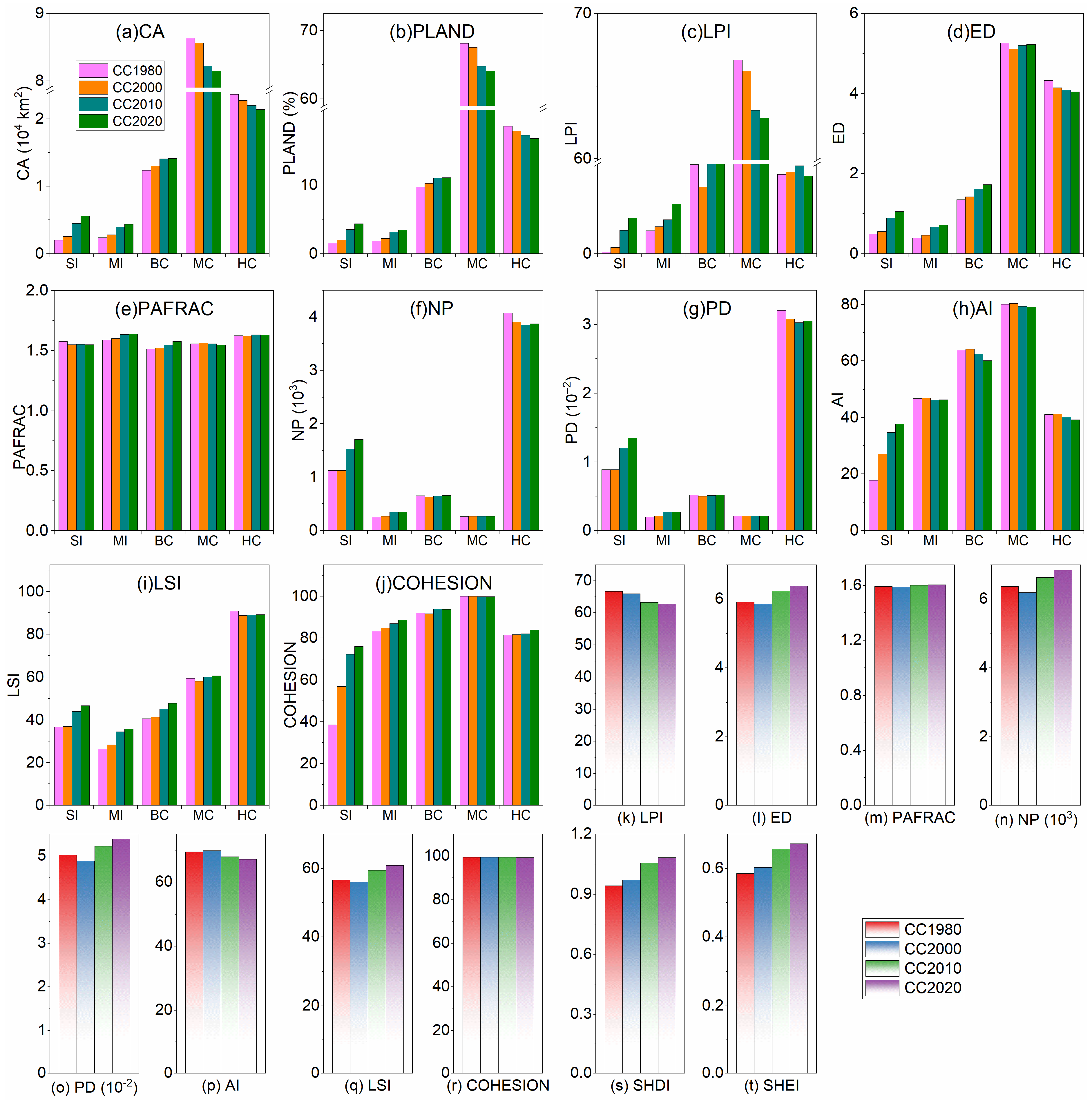
The coupling coordination patterns of habitat quality and human disturbance in Fujian Province exhibited significant annual variations in class-level metrics from 1980 to 2020, with distinct disparities across coordination levels (Figure 10a–j). CA, PLAND, and LPI consistently demonstrated moderate coordination as the dominant pattern, while severe imbalance showed opposing trends (Figure 10a–c). Changes indicated decreases in CA (−5.66%), PLAND (−5.82%), and LPI (−5.96%) for moderate coordination categories, reflecting reduced dominance. Conversely, severe imbalance metrics increased sharply (CA 178.9%, PLAND 178.44%, LPI 1906.6%), indicating expanded high-imbalance regions. ED values maintained dominance by moderate (decline −0.59%) and high coordination (decline −6.53%), with elevated edge density and boundary fragmentation stability, while severe imbalance ED surged by 110% (Figure 10d). PAFRAC values remained stable near 1.5 (within 1–2 range) with minimal fluctuations, suggesting moderate and human-activity-influenced spatial regularity in coupling patterns (Figure 10e).
NP and PD both showed high coordination dominance but declining trends (−4.98% each), indicating persistent heterogeneity and fragmentation (Figure 10f–g). Severe imbalance NP and PD values increased rapidly (51.37% and 51.66%), signaling amplified fragmentation. AI exhibited relative dominance of moderate coordination with higher aggregation, while severe imbalance showed a 112.04% increase in aggregation with elevated dispersion across other categories (Figure 10h). LSI values highlighted high coordination’s spatial complexity advantage (Figure 10i), with increasing trends across other levels indicating overall landscape complexity growth. COHESION maintained high overall levels for moderate coordination (highest connectivity) (Figure 10j). Temporal analysis revealed narrowing disparities between coordination levels, accompanied by a 97.01% surge in severe imbalance COHESION, demonstrating progressively improving landscape connectivity.

3.3.4. Landscape Metrics Characteristics of Coupling Coordination Patterns

The landscape metrics of coupling coordination patterns between habitat quality and human disturbance in Fujian Province exhibited moderate annual variations with inconsistent temporal trends from 1980 to 2020, showing distinct disparities across coordination levels (Figure 10k–t). The LPI value demonstrated a gradual decline (66.79 to 62.81) during 1980–2020 (Figure 10k), indicating relatively high dominance of the largest patches but a decreasing trend, consistent with class-level metrics for low habitat quality and human disturbance coupling patterns (Figure 10c). The ED value first slightly decreased (5.92 to 5.86) followed by a minor increase (5.86 to 6.39) from 1980 to 2020 (Figure 10l), reflecting elevated boundary fragmentation compared to class-level metrics with minimal temporal variability. PAFRAC values remained stable near 1.6 throughout the period (Figure 10m), suggesting moderate spatial regularity and complexity in coupling coordination patterns.
NP values displayed an initial minor decline (6372 to 6199) followed by a slight increase (6199 to 6849) (Figure 10n), indicating fluctuating but rising fragmentation. Similarly, PD values showed comparable trends (0.05 to 0.049 then 0.049 to 0.054) (Figure 10o), confirming consistent fragmentation patterns between NP and PD. The AI metric exhibited an initial modest rise (66.57 to 69.89) followed by a decline (69.89 to 67.24) (Figure 10p), contrasting with NP/PD trends while indicating increased dispersion in coupling patterns. LSI values first slightly decreased (56.68 to 56.12) then marginally increased (56.12 to 60.93) (Figure 10q), suggesting generally moderate-to-complex spatial distribution of coupling patterns. COHESION values maintained high overall levels (>99.4) across all years (Figure 10r), demonstrating strong landscape connectivity.
The SHDI value of coupling coordination patterns progressively increased from 0.94 to 1.08 (1980–2020) (Figure 10s), reflecting continuous landscape diversity enhancement. The SHEI value also gradually rose (0.58 to 0.67) (Figure 10t), approaching 1 and indicating increasingly uniform spatial distribution and growing diversity in coupling coordination patterns.

3.4. Driving Factors Contribution of Coupling Coordination Spatial Pattern

3.4.1. Driving Factors Importance Based on Machine Learning Models

The Taylor diagram is used to compare the reliability of prediction results from different models. The results show that the R coefficient of the RF model was the highest, and the difference between simulation results and observation values is the smallest (RMSE value was the lowest), indicating that the simulation prediction results of the RF model were better than other models (such as CRT, NN, SVM, KNN) (Figure 11a). The 10-fold cross-validation of observed and predicted values for the RF model also showed a high R-squared (R2 = 0.892) (Figure 11b), indicating. that the RF model is the most reliable in evaluating the coupling coordination pattern.
In this study, 10 natural environmental and socio-economic factors were used to explain the coupling coordination spatial pattern. The relative importance coefficient of the RF model output showed that socio-economic factors have a higher importance on the coupling coordination spatial pattern than natural environmental factors, especially in distance to cities and counties, road density, and nighttime light index (Figure 11c). Although the scope and depth of human activities are generally considered limited to the natural environment, the impact of human disturbance, represented by socio-economic activities, on the ecological environment is gradually deepening. This study suggests that attention should be paid to the coordination between social development and environmental protection.

3.4.2. Spatial Characteristics of Driving Factors Contribution Based on GWR Model

The global spatial autocorrelation of the coupling coordination spatial patterns distribution between habitat quality and human disturbance showed the Moran I value of 0.75, Z score of 332.37 (>2.58), and p < 0.0001, indicating a possibility of spatial autocorrelation higher than 99.99%. Local spatial autocorrelation analysis showed that the spatial differentiation of the coupling coordination spatial patterns distribution was significant, especially in low-low aggregation (Figure S1). The ordinary least squares (OLS) model showed that p-values of slope, population density and GDP density were not significant (p > 0.05), and variance inflation factor of population density and GDP density had data redundancy (VIF > 7.5) (Table S1). The p-values of the GWR model were less than 0.05, indicating significant results. The adjusted R2 was 0.503, the AICc was −1909.71, the local goodness of fit R2 was 0, and the maximum standardized residual value was 0.275 (less than 2.5), indicating that GWR model was suitable for analyzing the driving factors of the coupling coordination spatial patterns distribution between habitat quality and human disturbance in Fujian Province.
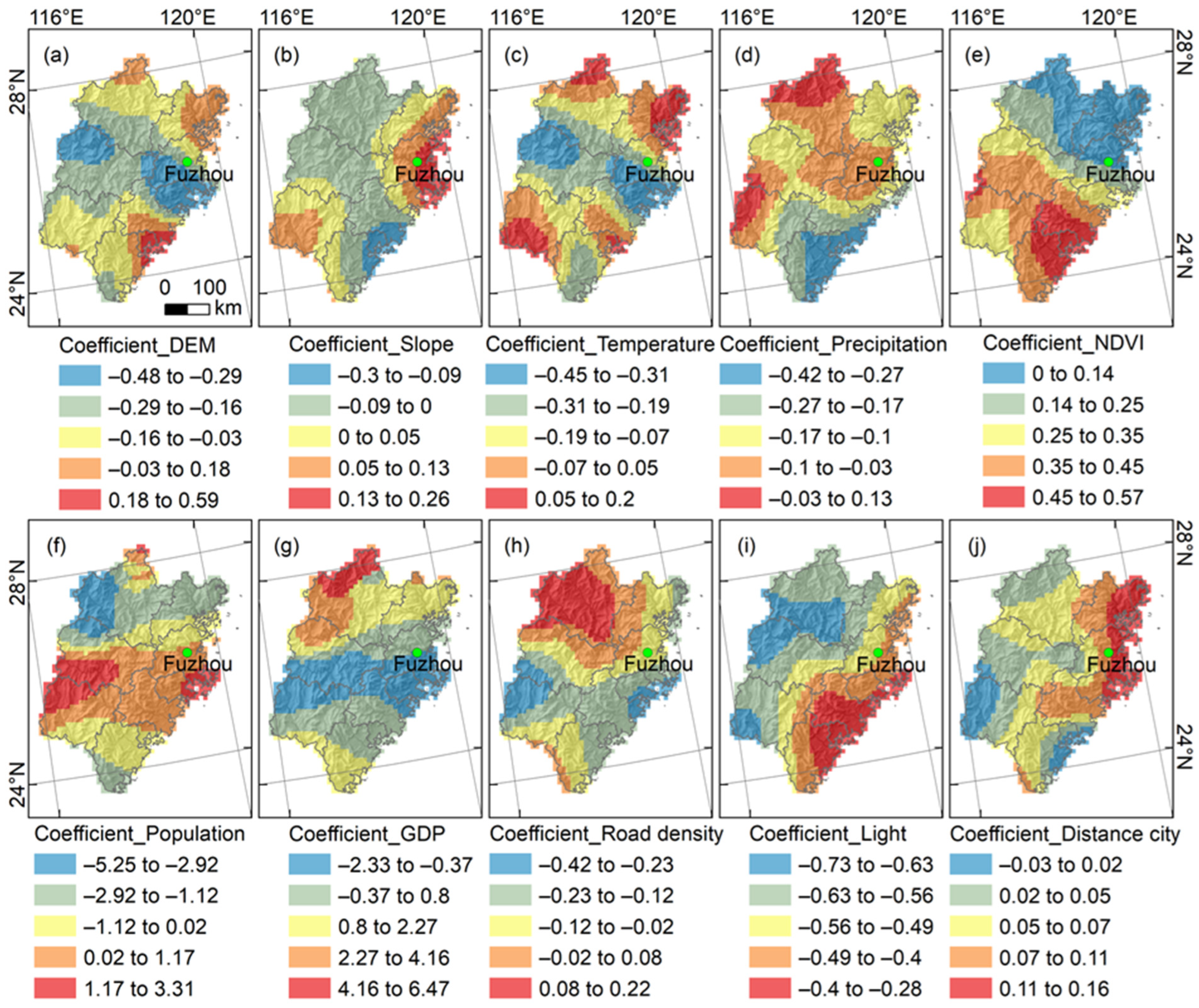
The regression coefficients of DEM (X11) ranged from −0.48 to 0.59 (mean −0.146), with lower values running from west to east in the central region and higher values in the north and south, especially in Xiamen in the southeast (Table 5, Figure 12a). The higher the elevation, the better the habitat quality, but it was not conducive to human activities; On the contrary, the lower the elevation, the more favorable it was for human activities to expand and the worse the habitat quality. Therefore, the overall mismatch between habitat quality and human activities was observed at high and low altitudes. The high values of the regression coefficient were mainly in the southeastern coastal areas, where the habitat quality were average but human activities were relatively strong, resulting in a negative effect of elevation on the coupled coordination pattern. The low value of the regression coefficient was in the valley of the Minjiang River, where the habitat quality were better and human activities were relatively weaker compared to coastal areas. Therefore, it showed a positive effect of elevation on the coupled coordination pattern. The regression coefficients for slope (X12) ranged from −0.296 to 0.258 (mean 0.01), with higher values in the northeast and lower values in the southeast (Table 5, Figure 12b). Although it did not pass the significance test, it still showed a differential effect between the northeast and southeast regions, which were also coastal plains. Perhaps due to the slightly better habitat quality and lower intensity of human activities in the northeast, the coupling coordination degree were relatively high, resulting in a positive slope effect. The coupling coordination degree in the southeast was very low, so the slope had a negative effect. The regression coefficient of temperature(X13) ranged from −0.453 to 0.199 (mean −0.138), with higher values in the southwestern and northern mountainous regions and lower values in the central region running from west to east (Table 5, Figure 12c). This was not consistent with the spatial distribution of temperature, as it was generally higher in the south and lower in the north. The regions with low regression coefficients were generally river valley regions, with accumulated temperatures higher than those in mountainous regions, which may contribute to increased agricultural activities and lead to relatively poor coupling coordination patterns, resulting in a negative temperature effect. The regression coefficient of precipitation (X14) ranged from −0.423 to 0.13 (mean −0.125), with higher values in the western and northern mountainous regions and lower values in the southern regions (Table 5, Figure 12d). More precipitation contributed to the restoration and prosperity of ecosystems, improves habitat quality, and provided water resources for human production and life; On the contrary, less precipitation was not conducive to habitat quality and human production and life. Monsoon precipitation from the ocean flows from southeast to northwest, with abundant precipitation when encountering mountain uplift. The habitat quality here was good and human activities were relatively weak, resulting in a positive effect of precipitation on the coupled coordination pattern. However, the southern coastal flat regions had relatively less precipitation, significant urban expansion, and poor habitats, resulting in a negative effect of precipitation. The regression coefficients of NDVI (X15) ranged from −0.001 to 0.57 (mean 0.283), with lower values in the north and higher values in the south, especially in the southeast (Table 5, Figure 12e). The overall NDVI in Fujian Province was relatively high, only lower in the southeast. Coincidentally, the habitat quality here was poor, with frequent urban construction, industrial and agricultural activities, and very poor coupling coordination, resulting in a positive effect of NDVI. The coupling coordination in the north was good, so the better NDVI exhibited a negative effect.
The regression coefficients of population density (X21) and GDP (X22) density ranged from −5.253 to 3.304 (mean −0.449) and −2.334 to 6.467 (mean 0.762), respectively (Table 5, Figure 12f,g). However, they cannot effectively explain the coupling coordination pattern, possibly due to insufficient spatialization of statistical data, resulting in obvious collinearity and failure to pass the significance test. The regression coefficients of road density (X23) ranged from −0.419 to 0.222 (mean −0.068), with lower values in the west and east and higher values in the northwest (Table 5, Figure 12h). The lower road density in the north reflected weaker human activities, better habitat quality, and better coupling coordination, resulting in a positive effect. The low value region of the regression coefficient reflected a relatively poor coupling coordination degree. The regression coefficients of the night light index (X24) ranged from −0.726 to −0.28 (mean −0.534), all of which had a negative effect, with higher values in the southeast coastal regions and lower values in the western mountainous regions (Table 5, Figure 12i). The night light index showed the distribution of urban construction, which were less in the west and more in the southeast coast. The habitat quality in coastal regions were poor, human activities were strong, and the coupling coordination pattern were not coordinated, so the negative effect of nighttime light index was relatively weak. The regression coefficient of distance to cities and counties (X25) ranged from −0.028 to 0.161 (mean 0.064), indicating a positive effect overall, with higher along the northeast coast and lower in the southwest and southeast (Table 5, Figure 12j). The shorter the distance, the more and densely populated of the residential regions. Overall, this distance was far in the west and close in the east. However, the coupling coordination pattern in the eastern region were not coordinated, resulting in a more obvious positive effect of the distance to cities and counties.

4. Discussion

4.1. Spatial–Temporal Changes of Habitat Quality

The overall habitat quality in Fujian Province remained relatively high from 1980 to 2020, a trend consistent with the region’s naturally favorable environmental conditions and its designation as a crucial ecological barrier [53]. Spatially, lower habitat quality was concentrated in inland river basins and the eastern coastal areas, reflecting the impact of intensive agricultural, industrial activities, and rapid urban development in these economically vital zones [47,80]. Temporally, the spatial expansion of low habitat quality indicated a progressive deterioration trend, particularly accelerating during 2010–2020. The spatial distribution patterns of habitat quality in this study aligned broadly with results from a Remote Sensing Ecological Index (RSEI)-based assessment, though our observed temporal degradation rate was more pronounced [56], likely due to differences in data sources and study periods (2000–2021). This aligns with broader trends of ecological degradation observed in major coastal cities globally and within China, where intensive human activities concentrated in urban centers and coastal zones lead to significant habitat loss [80]. For instance, our findings regarding habitat quality decline in Pingtan Island and Putian City (2000–2020) are consistent with previously reported trends in these rapidly developing areas [49,81]. Without enhanced environmental protection, habitat quality is projected to continue deteriorating, highlighting the urgent need for proactive conservation measures in line with sustainable development goals [82].
Landscape metrics further corroborate habitat quality degradation. It is evidenced by declines in metrics indicative of high-quality habitat dominance (reduced CA, PLAND, and LPI values), expansion of low-quality habitats (increased CA, PLAND, and LPI values), and heightened fragmentation of low-quality habitats (rapid increases in NP and PD values). These patterns are typical of regions undergoing significant land-use change, where natural landscapes are converted and fragmented by urban expansion and agricultural intensification [43,44]. However, the declines are moderated by the region’s robust natural environmental foundation moderates these declines, reflected in moderate spatial regularity and complexity (PAFRAC values close to 1.5 overall), relatively high landscape connectivity (elevated COHESION values), and increasing diversity (gradual rises in SHDI and SHEI values). This suggests that while human pressures are increasing, the province’s inherent ecological resilience and existing protected areas may partially mitigate the most severe impacts, though continuous monitoring and targeted interventions are still critical [37].
The trends observed in Fujian Province are not isolated; they mirror broader patterns of habitat degradation and fragmentation driven by urbanization and land-use change seen across the globe and in other parts of China. Global case studies demonstrate similar trends, with significant habitat quality decline has been observed in regions such as the Omo-Gibe Basin in Southwest Ethiopia [29], the Nanfei Lake Basin in Eastern China [30], China’s major cities [32,33], and diverse regions across China [30]. This widespread degradation is often accompanied by habitat fragmentation and land degradation [83,84]. These consistent global and national patterns underscore the universal importance of ecological security [85], and highlight the urgent need for integrating effective environmental policies and ecological restoration measures into urban planning and land development, ensuring long-term sustainability to prevent further degradation and limited recovery [35,36,37]. Fujian’s experience, therefore, serves as a valuable case study, providing localized insights into global challenges.

4.2. Spatial–Temporal Changes of Human Disturbance

The overall level of human disturbance in Fujian Province was relatively low from 1980 to 2020, a finding that generally corresponds with the observed high habitat quality during this period. Spatially, high-intensity disturbance areas were small and concentrated along the eastern coast, which is consistent with the region’s historical and ongoing concentration of population density, urbanization, and transportation infrastructure [47,48]. Low-disturbance areas dominated, particularly in inland hilly and mountainous regions, reflecting their lower population density and limited development activities. Temporally, the shrinkage of low-disturbance areas alongside the expansion of high-disturbance areas indicated a persistent increase in human interference over time, accelerating post-2010.
Landscape metrics further confirmed this trend: increased dominance of high-disturbance areas (rising CA, PLAND, and LPI values), reduced dominance of low-disturbance areas despite their persistence (declining CA, PLAND, and LPI values), and elevated fragmentation in high-disturbance zones (increased NP and PD values). These patterns are characteristic of rapid socioeconomic development, where urban and industrial expansion lead to the fragmentation of natural landscapes and the intensification of human footprint [44,57]. Nevertheless, current disturbance levels in Fujian remain, to some extent, manageable, with moderate spatial regularity (PAFRAC values near 1.5) and high landscape connectivity (elevated COHESION values), alongside increasing diversity (rising SHDI and SHEI values).
These findings in Fujian Province align with and contribute to a broader understanding of escalating anthropogenic pressures observed across diverse ecosystems globally and within China. For instance, in Guangxi Province (Southwest China), human disturbance indices have continued to rise, showing high disturbance levels in urban centers and radiating outward to lower levels in peripheral areas [86]. Comparable spatial patterns—high disturbance in city cores and lower levels in outskirts—were observed in the Chengdu–Chongqing urban agglomeration (Southwest China) and Ürümqi (Xinjiang) [46,87]. Temporal increases in human disturbance were also documented in Henan (Central China) and Shanxi (Northwest China) [14,65]. Collectively, these comparable studies underscore the pervasive nature of increasing human disturbance, driven by similar socioeconomic development patterns across different geographical contexts, highlighting the universal challenge of balancing development with ecological integrity.

4.3. Driving Factors and Suggestions of Coupling Coordination Between Habitat Quality and Human Disturbance

The overall inverse correlation between habitat quality and human disturbance in Fujian Province, particularly dominated by strong negative correlations, also indicates that increased human pressure generally leads to decreased habitat quality. Their coupling coordination relationship was predominantly characterized by coordination, with moderate coordination levels widely distributed spatially. Over time, areas below moderate imbalance levels expanded, especially during 2010–2020, with increased scope and intensity of inter-level transfers, notably mutual shifts between moderate and high coordination levels. Landscape metrics further revealed a declining trend towards imbalance in coupling coordination patterns. This was characterized by reduced dominance of moderate coordination (decreased CA, PLAND, and LPI values), expansion of severely imbalanced regions (elevated CA, PLAND, and LPI values), and accelerated fragmentation of low-quality habitats (rapid increases in NP and PD values). These dynamics suggest that while coordination still prevails in many areas, the intensifying human footprint is increasingly challenging the balance in rapidly developing zones. However, current patterns still retain some resilience, as indicated by moderate spatial regularity (PAFRAC values close to 1.6 overall), high landscape connectivity (elevated COHESION values), and gradually increasing diversity (rising SHDI and SHEI values), suggesting opportunities for targeted management.
Among the influencing factors of coupling coordination patterns, our findings indicate that socioeconomic drivers outweighed natural environmental factors. Specifically, distance to urban areas, road density, and nighttime light index. Spatial heterogeneity was observed, with each factor exhibiting both positive and negative effects across different sub-regions of Fujian. This confirms that the drivers of human–land coupling coordination are complex and context-dependent, necessitating spatially differentiated policy responses.
These findings resonate with and extend previous research on the drivers of habitat quality and land-use change. For instance, studies have identified elevation and land-use type were identified as the most critical drivers of habitat quality changes in the Northern Tianshan Urban Agglomeration [88]. Built-up area index was recognized as the primary factor in Hubei Province [89]. NDVI, temperature, precipitation, elevation, and population density were identified as key drivers of habitat quality changes in national parks [90]. Additionally, human activities, urban expansion, and climate change were found to drive habitat quality decline in Ürümqi [31]. This collective evidence, alongside our study, consistently demonstrates that changes in habitat quality and human–land coupling coordination result from the combined effects of multiple, often interacting, natural and anthropogenic drivers.
Addressing the conflicts between urban development, ecological conservation, economic growth, and sustainable development necessitates the establishment of integrated governance frameworks by governments and the public. Based on our findings, specifically the identified spatiotemporal patterns of habitat degradation and human disturbance, and the dominance of socioeconomic drivers in Fujian Province, we propose the following targeted strategies:
(1)
Optimizing spatial planning and land-use governance. Implement and strictly enforce a differentiated “three-line” control system—ecological conservation redlines, permanent basic farmland boundaries, and urban development limits—informed by our habitat quality assessments and identified human disturbance patterns [91]. Prioritize stringent protection for high-quality habitat zones (e.g., critical water conservation areas, biodiversity hotspots), restricting high-impact activities like mining and large-scale industrial projects. Adopt “reverse planning” strategies to proactively delineate and preserve ecological corridors and buffer zones, directly mitigating urban sprawl and safeguarding ecological connectivity in Fujian Province.
(2)
Innovating ecological compensation and market-based mechanisms. Introduce Gross Ecosystem Product (GEP) accounting to quantify ecological service values, integrating these metrics into local government performance evaluations to incentivize ecological protection [92]. Utilize market-based tools, such as carbon sequestration trading and dedicated ecological compensation funds, to financially support conservation efforts. For transboundary environmental issues (e.g., watershed pollution), establish ecological loss-gain accounting systems and horizontal compensation mechanisms to foster shared responsibility and equitable benefit distribution.
(3)
Enhancing public participation and collaborative governance. Ensure transparent disclosure of ecological compensation mechanisms and establish accessible public oversight platforms (e.g., pollution reporting incentives) to build trust and encourage active public involvement [93]. Promote low-carbon transportation and comprehensive waste sorting programs to reduce indirect anthropogenic pressures on habitats, such as vehicular emissions and landfill leachate, fostering a culture of human–nature harmonious coexistence.

4.4. Limitations and Prospects

This study provides critical insights into the interplay between habitat quality assessment and human activities in economically developed and mountainous-hilly composite regions. However, several limitations should be acknowledged, which also present avenues for future research.
Firstly, while conventional habitat quality evaluations incorporate factors such as urban construction, population density, GDP distribution, and nighttime light intensity, data limitations prevented the use of high-quality, long-term socioeconomic spatial datasets spanning over four decades. Consequently, we primarily relied on LULC data-derived variables—including cultivated land, residential areas, and built-up lands—to represent limiting factors. Future studies should integrate alternative indicators (e.g., agricultural intensity indices, infrastructure accessibility metrics) to enhance the diversity and representativeness of constraining factors.
Secondly, the current assessment framework adopts a single-method approach (InVEST model), which may overlook complementary perspectives. While InVEST-based ecosystem service evaluations are widely implemented globally, integrating alternative methodologies—such as the Remote Sensing Ecological Index [56]—would enable cross-validation and robustness enhancement of habitat quality quantification. Comparative analyses of methodological strengths and biases (e.g., spatial resolution dependencies, parameter sensitivity) are essential for optimizing habitat quality assessment paradigms in heterogeneous landscapes.
Thirdly, there is a lack of in-depth comparison in driver factor analysis methods. Although this study initially integrated machine learning and geographically weighted regression, existing research has significantly enhanced the reliability of driving mechanism interpretation through multi-model synergy (e.g., geographically weighted XGBoost, spatial matrix-enhanced neural networks) or cross-method validation [94]. Future studies need to systematically compare the performance differences of different algorithms (e.g., geographically weighted regression vs. random forest) in characterizing spatial heterogeneity and establish a unified evaluation framework to optimize the identification accuracy of driving factors.

5. Conclusions

The present study employed the InVEST model to evaluate habitat quality in Fujian Province (1980–2020), quantify spatial patterns of human disturbance, analyze coupling coordination relationships, and explore driving factors. The key findings are summarized as follows:
(1)
Habitat quality in Fujian Province remained relatively high overall during 1980–2020. Spatially, low-quality regions were concentrated along inland rivers and the eastern coast, whereas high-quality areas dominated inland hilly and mountainous zones. Temporally, high-quality habitat areas gradually contracted, while low-quality regions expanded, accelerating during 2010–2020. Landscape metrics corroborated these trends: reduced dominance of high-quality habitats (declining CA, PLAND, and LPI values), expansion of low-quality regions (increased CA, PLAND, and LPI values), and elevated fragmentation in low-quality zones (rapid increases in NP and PD values).
(2)
Human disturbance levels in Fujian Province were predominantly low during 1980–2020. Spatially, high-intensity disturbance areas were confined to the eastern coast, while low-disturbance regions predominated, especially in inland hilly and mountainous terrain. Temporally, low-disturbance areas shrank concurrently with high-disturbance zone expansion, intensifying from 2010–2020. Landscape metrics reflected these shifts: increased dominance of high-disturbance areas (rising CA, PLAND, and LPI values), gradual contraction of low-disturbance zones (declining CA, PLAND, and LPI values), and heightened fragmentation in high-disturbance regions (increased NP and PD values).
(3)
Habitat quality and human disturbance exhibited an overall negative correlation, predominantly characterized by coordinated relationships. Spatially, moderate coordination levels dominated, while significant imbalance zones were concentrated along the eastern coast. Temporally, imbalance zones below moderate levels expanded markedly post-2010. Landscape metrics further revealed: declining moderate coordination dominance (reduced CA, PLAND, and LPI values), expansion of severe imbalance zones (elevated CA, PLAND, and LPI values), and accelerated fragmentation in low-quality habitats (rapid increases in NP and PD values).
(4)
The random forest model identified socioeconomic factors as more influential than natural drivers in shaping coupling coordination patterns, particularly distance to urban areas, road density, and nighttime light index. Geographically weighted regression highlighted spatial heterogeneity in driver effects: elevation, NDVI, and nighttime light exhibited positive impacts in southeastern regions, while slope, temperature, population density, and urban proximity showed positive correlations in northeastern areas.

Supplementary Materials

The following supporting information can be downloaded at: https://www.mdpi.com/article/10.3390/rs17172956/s1, Figure S1. Cold and hot spot analysis results of the coupling coordination spatial patterns distribution between habitat quality and human disturbance in Fujian in 2020. Table S1. Test of the selected factors using the ordinary least squares (OLS) method.

Author Contributions

X.W.: resources, data curation, conceptualization, methodology, writing—original draft preparation, writing—review and editing; S.X. and H.J.: conceptualization, methodology, writing—original draft preparation; G.L.: conceptualization, methodology, writing—original draft preparation, writing—review and editing. All authors have read and agreed to the published version of the manuscript.

Funding

This work was supported by the National Natural Science Foundation of China (Grant 42361011), the Climbing Program Special Funds for Science and Technology Innovation Strategy of Guangdong Province (No. pdjh2020b0169), and the Challenge Cup Gold Seed Project of South China Normal University (No. 20DKKA01).

Data Availability Statement

All data supporting the findings of this study are included within the article.

Acknowledgments

We thank the editor and anonymous reviewers for their valuable and constructive comments and suggestions.

Conflicts of Interest

The authors declare that they have no known competing financial interests or personal relationships that could have appeared to influence the work reported in this paper.

Abbreviations

InVESTIntegrated Valuation of Ecosystem Services and Trade-offs
LULCLand use and land cover
DEMDigital Elevation Model
NDVINormalized Difference Vegetation Index
GDPGross Domestic Product
CATotal class area
PLANDPercentage of landscape
LPILargest patch index
EDEdge density
NPNumber of patches
PDPatch density
AIAggregation index
LSILandscape shape index
COHESIONPatch cohesion index
SHDIShannon’s diversity index
SHEIShannon’s evenness index
RFRandom Forest
CRTClassification and Regression Tree
NNNeural Network
SVMSupport Vector Machine
KNNK-Nearest Neighbor
GWRGeographically Weighted Regression

References

  1. Li, X.; Zhang, X.; Feng, H.; Li, Y.; Yu, J.; Liu, Y.; Du, H. Dynamic evolution and simulation of habitat quality in arid regions: A case study of the Hexi region, China. Ecol. Model. 2024, 493, 110726. [Google Scholar] [CrossRef]
  2. Mi, Y.; Li, S.; Wang, Z. Spatial distribution and topographic gradient effects of habitat quality in the Chang-Zhu-Tan Urban Agglomeration, China. Sci. Rep. 2024, 14, 22563. [Google Scholar] [CrossRef]
  3. Chen, H.; Liu, F.; Yang, B.; Luo, Q. Spatial-Temporal Evolution and Driving Factors of Habitat Quality Based on Different Topographic Gradients in Zhaotong City, Yunnan Province. J. Resour. Ecol. 2025, 16, 306–325. [Google Scholar] [CrossRef]
  4. Zhu, C.; Zhang, X.; Zhou, M.; He, S.; Gan, M.; Yang, L.; Wang, K. Impacts of urbanization and landscape pattern on habitat quality using OLS and GWR models in Hangzhou, China. Ecol. Indic. 2020, 117, 106654. [Google Scholar] [CrossRef]
  5. Wu, L.; Sun, C.; Fan, F. Estimating the characteristic spatiotemporal variation in habitat quality using the invest model—A case study from Guangdong–Hong Kong–Macao Greater Bay Area. Remote Sens. 2021, 13, 1008. [Google Scholar] [CrossRef]
  6. Tang, F.; Wang, L.; Guo, Y.; Fu, M.; Huang, N.; Duan, W.; Luo, M.; Zhang, J.; Li, W.; Song, W. Spatio-temporal variation and coupling coordination relationship between urbanisation and habitat quality in the Grand Canal, China. Land Use Policy 2022, 117, 106119. [Google Scholar] [CrossRef]
  7. Chen, S.; Liu, X. Spatio-temporal variations of habitat quality and its driving factors in the Yangtze River Delta region of China. Glob. Ecol. Conserv. 2024, 52, e02978. [Google Scholar] [CrossRef]
  8. Chen, S.; Halik, Ü.; Shi, L.; Fu, W.; Gan, L.; Welp, M. Habitat Quality Dynamics in Urumqi over the Last Two Decades: Evidence of Land Use and Land Cover Changes. Land 2025, 14, 84. [Google Scholar] [CrossRef]
  9. Moreira, M.; Fonseca, C.; Vergílio, M.; Calado, H.; Gil, A. Spatial assessment of habitat conservation status in a Macaronesian island based on the InVEST model: A case study of Pico Island (Azores, Portugal). Land Use Policy 2018, 78, 637–649. [Google Scholar] [CrossRef]
  10. Mengist, W.; Soromessa, T.; Feyisa, G.L. Landscape change effects on habitat quality in a forest biosphere reserve: Implications for the conservation of native habitats. J. Clean. Prod. 2021, 329, 129778. [Google Scholar] [CrossRef]
  11. Sallustio, L.; De Toni, A.; Strollo, A.; Di Febbraro, M.; Gissi, E.; Casella, L.; Geneletti, D.; Munafò, M.; Vizzarri, M.; Marchetti, M. Assessing habitat quality in relation to the spatial distribution of protected areas in Italy. J. Environ. Manag. 2017, 201, 129–137. [Google Scholar] [CrossRef]
  12. Wei, Q.; Abudureheman, M.; Halike, A.; Yao, K.; Yao, L.; Tang, H.; Tuheti, B. Temporal and spatial variation analysis of habitat quality on the PLUS-InVEST model for Ebinur Lake Basin, China. Ecol. Indic. 2022, 145, 109632. [Google Scholar] [CrossRef]
  13. Xu, M.; Zhu, Y.; Zhang, L.; Li, P.; Gong, Q.; Zuo, A.; Hu, K.; Jiang, X.; Lu, N.; Guan, Z. sUAS-Based High-Resolution Mapping for the Habitat Quality Assessment of the Endangered Hoolock tianxing Gibbon. Forests 2025, 16, 285. [Google Scholar] [CrossRef]
  14. Zhao, Y.; Qu, Z.; Zhang, Y.; Ao, Y.; Han, L.; Kang, S.; Sun, Y. Effects of human activity intensity on habitat quality based on nighttime light remote sensing: A case study of Northern Shaanxi, China. Sci. Total Environ. 2022, 851, 158037. [Google Scholar] [CrossRef] [PubMed]
  15. Liu, S.; Sun, T.; Ciais, P.; Zhang, H.; Fang, J.; Fang, J.; Gemechu, T.M.; Chen, B. Assessing Habitat Quality on Synergetic Land-Cover Dataset Across the Greater Mekong Subregion over the Last Four Decades. Remote Sens. 2025, 17, 1467. [Google Scholar] [CrossRef]
  16. Zlinszky, A.; Heilmeier, H.; Balzter, H.; Czúcz, B.; Pfeifer, N. Remote sensing and GIS for habitat quality monitoring: New approaches and future research. Remote Sens. 2015, 7, 7987–7994. [Google Scholar] [CrossRef]
  17. Wu, J.; Luo, J.; Zhang, H.; Qin, S.; Yu, M. Projections of land use change and habitat quality assessment by coupling climate change and development patterns. Sci. Total Environ. 2022, 847, 157491. [Google Scholar] [CrossRef]
  18. Hu, B.; Zhou, S.; Luo, P.; Chen, H. Assessment of Habitat Services and Gradient Zoning Optimization in Coal Mining Subsidence Areas from a Social–Ecological Coupling Perspective. Sustainability 2025, 17, 17. [Google Scholar] [CrossRef]
  19. Jeong, A.; Kim, M.; Lee, S. Analysis of priority conservation areas using habitat quality models and MaxEnt models. Animals 2024, 14, 1680. [Google Scholar] [CrossRef] [PubMed]
  20. Johnson, M.D. Measuring habitat quality: A review. Condor 2007, 109, 489–504. [Google Scholar] [CrossRef]
  21. Tan, C.; Xu, B.; Hong, G.; Wu, X. Integrating habitat risk and landscape resilience in forest protection and restoration planning for biodiversity conservation. Landsc. Urban Plan. 2024, 248, 105111. [Google Scholar] [CrossRef]
  22. Wang, Y.; Quan, D.; Zhu, W.; Lin, Z.; Jin, R. Habitat quality assessment under the change of vegetation coverage in the Tumen River Cross-Border Basin. Sustainability 2023, 15, 9269. [Google Scholar] [CrossRef]
  23. Yang, Y. Evolution of habitat quality and association with land-use changes in mountainous areas: A case study of the Taihang Mountains in Hebei Province, China. Ecol. Indic. 2021, 129, 107967. [Google Scholar] [CrossRef]
  24. Qin, X.; Yang, Q.; Wang, L. The evolution of habitat quality and its response to land use change in the coastal China 1985–2020. Sci. Total Environ. 2024, 952, 175930. [Google Scholar] [CrossRef]
  25. Tang, F.; Fu, M.; Wang, L.; Zhang, P. Land-use change in Changli County, China: Predicting its spatio-temporal evolution in habitat quality. Ecol. Indic. 2020, 117, 106719. [Google Scholar] [CrossRef]
  26. Gomes, E.; Inácio, M.; Bogdzevič, K.; Kalinauskas, M.; Karnauskaitė, D.; Pereira, P. Future scenarios impact on land use change and habitat quality in Lithuania. Environ. Res. 2021, 197, 111101. [Google Scholar] [CrossRef]
  27. Shi, G.; Chen, C.; Cao, Q.; Zhang, J.; Xu, J.; Chen, Y.; Wang, Y.; Liu, J. Spatiotemporal Dynamics and Prediction of Habitat Quality Based on Land Use and Cover Change in Jiangsu, China. Remote Sens. 2024, 16, 4158. [Google Scholar] [CrossRef]
  28. Manley, K.; Nyelele, C.; Egoh, B.N. A review of machine learning and big data applications in addressing ecosystem service research gaps. Ecosyst. Serv. 2022, 57, 101478. [Google Scholar] [CrossRef]
  29. Berta Aneseyee, A.; Noszczyk, T.; Soromessa, T.; Elias, E. The InVEST habitat quality model associated with land use/cover changes: A qualitative case study of the Winike Watershed in the Omo-Gibe Basin, Southwest Ethiopia. Remote Sens. 2020, 12, 1103. [Google Scholar] [CrossRef]
  30. Sun, X.; Jiang, Z.; Liu, F.; Zhang, D. Monitoring spatio-temporal dynamics of habitat quality in Nansihu Lake basin, eastern China, from 1980 to 2015. Ecol. Indic. 2019, 102, 716–723. [Google Scholar] [CrossRef]
  31. Chen, Y.; Zhang, F.; Lin, J. Projecting Future Land Use Evolution and Its Effect on Spatiotemporal Patterns of Habitat Quality in China. Appl. Sci. 2025, 15, 1042. [Google Scholar] [CrossRef]
  32. Liu, F.; Murayama, Y.; Masago, Y. Spatial influence of multifaceted environmental states on habitat quality: A case study of the three largest Chinese urban agglomerations. Remote Sens. 2023, 15, 921. [Google Scholar] [CrossRef]
  33. Liu, Y.; Zhou, J.; Liu, C.; Liu, N.; Fei, B.; Wang, Q.; Zou, J.; Wu, Q. Spatiotemporal Evolution Characteristics and Prediction of Habitat Quality Changes in the Poyang Lake Region, China. Sustainability 2025, 17, 3708. [Google Scholar] [CrossRef]
  34. Wang, B.; Cheng, W. Effects of land use/cover on regional habitat quality under different geomorphic types based on InVEST model. Remote Sens. 2022, 14, 1279. [Google Scholar] [CrossRef]
  35. Pan, C.; Wen, J.; Ma, J. Temporal and Spatial Variation in Habitat Quality in Guangxi Based on PLUS-InVEST Model. Land 2024, 13, 2250. [Google Scholar] [CrossRef]
  36. Zhang, W.; Lu, X.; Xie, Z.; Ma, J.; Zang, J. Study on the Spatiotemporal Evolution of Habitat Quality in Highly Urbanized Areas Based on Bayesian Networks: A Case Study from Shenzhen, China. Sustainability 2024, 16, 10993. [Google Scholar] [CrossRef]
  37. Lei, J.; Chen, Y.; Li, L.; Chen, Z.; Chen, X.; Wu, T.; Li, Y. Spatiotemporal change of habitat quality in Hainan Island of China based on changes in land use. Ecol. Indic. 2022, 145, 109707. [Google Scholar] [CrossRef]
  38. Wang, X.; Liu, G.; Xiang, A.; Qureshi, S.; Li, T.; Song, D.; Zhang, C. Quantifying the human disturbance intensity of ecosystems and its natural and socioeconomic driving factors in urban agglomeration in South China. Environ. Sci. Pollut. Res. 2022, 29, 11493–11509. [Google Scholar] [CrossRef]
  39. Wang, X.; Zhong, W.; Wang, B.; Quan, M.; Li, T.; Lin, D.; Shang, S.; Zhu, C.; Zhang, C.; Liao, Y. Spatial–temporal variations and pollution risks of mercury in water and sediments of urban lakes in Guangzhou City, South China. Environ. Sci. Pollut. Res. 2022, 29, 80817–80830. [Google Scholar] [CrossRef]
  40. Qin, G.; Wang, N.; Wu, Y.; Zhang, Z.; Meng, Z.; Zhang, Y. Spatiotemporal variations in eco-environmental quality and responses to drought and human activities in the middle reaches of the Yellow River basin, China from 1990 to 2022. Ecol. Inform. 2024, 81, 102641. [Google Scholar] [CrossRef]
  41. Ouyang, X.; Chen, J.; Cao, L. Threshold effect of ecosystem services in response to human activity in China’s urban agglomeration: A perspective on quantifying ecological resilience. Environ. Sci. Pollut. Res. 2024, 31, 9671–9684. [Google Scholar] [CrossRef]
  42. Yohannes, H.; Soromessa, T.; Argaw, M.; Dewan, A. Spatio-temporal changes in habitat quality and linkage with landscape characteristics in the Beressa watershed, Blue Nile basin of Ethiopian highlands. J. Environ. Manag. 2021, 281, 111885. [Google Scholar] [CrossRef]
  43. Nasim, N.K.; Sharma, A.; Poonia, M.; Rai, A.; Kadaverugu, R.; Hinkelmann, R. Assessment of Temporal Dynamics of Land Use and Landscape Fragmentation in the Wardha River Sub-Basin and their Potential Implications for Ecological Connectivity and Habitat Quality. J. Indian Soc. Remote Sens. 2025, 53, 2465–2480. [Google Scholar] [CrossRef]
  44. Bai, L.; Xiu, C.; Feng, X.; Liu, D. Influence of urbanization on regional habitat quality: A case study of Changchun City. Habitat Int. 2019, 93, 102042. [Google Scholar] [CrossRef]
  45. Lin, R.; Zevenbergen, C.; Wang, J.; Li, Y.; Qian, L. Integration of In-VEST Habitat Quality Model with Landscape Pattern Indices to Assess Habitat Fragmentation Under the Dynamic Development of Park City: Southwest China Case. Land 2024, 13, 2073. [Google Scholar] [CrossRef]
  46. Zhang, S.; Lei, J.; Zhang, X.; Fan, L.; Duan, Z. Urban human settlement quality refined assessment and its spatial relationship with human activity intensity in arid area: A case study of Urumqi, China. Habitat Int. 2025, 161, 103422. [Google Scholar] [CrossRef]
  47. Chen, S.; Zha, X. Evaluation of soil erosion vulnerability in the Zhuxi watershed, Fujian Province, China. Nat. Hazards 2016, 82, 1589–1607. [Google Scholar] [CrossRef]
  48. Liu, Y.; Huang, X.; Li, J.; Wang, Z.; Xu, C.; Xu, Y. Ecological connectivity analysis of typical coastal areas in China: The case of Zhangzhou City, Fujian Province. Urban Clim. 2024, 53, 101826. [Google Scholar] [CrossRef]
  49. Xu, J.; Jiang, X.; Liu, H.; Yin, F.; Xu, Y.; Gao, C. Monitoring of spatiotemporal changes in ecosystem service functions and analysis of influencing factors in Pingtan Island. Ecol. Indic. 2024, 158, 111590. [Google Scholar] [CrossRef]
  50. Li, M.; Zheng, P.; Pan, W. Spatial-temporal variation and tradeoffs/synergies analysis on multiple ecosystem services: A case study in Fujian. Sustainability 2022, 14, 3086. [Google Scholar] [CrossRef]
  51. Li, T.; Wang, X.; Jia, H. Evaluate Water Yield and Soil Conservation and Their Environmental Gradient Effects in Fujian Province in South China Based on InVEST and Geodetector Models. Water 2025, 17, 230. [Google Scholar] [CrossRef]
  52. Bai, J.; Sun, R.; Liu, Y.; Chen, J.; Li, X. Integrating ecological and recreational functions to optimize ecological security pattern in Fuzhou City. Sci. Rep. 2025, 15, 778. [Google Scholar] [CrossRef] [PubMed]
  53. He, Z.; Lin, Z.; Xu, Q.; Ding, S.; Bao, X.; Li, X.; Hu, X.; Li, J. Multi-Dimensional Landscape Connectivity Index for Prioritizing Forest Cover Change Scenarios: A Case Study of Southeast China. Forests 2024, 15, 1490. [Google Scholar] [CrossRef]
  54. Wang, X.; Xiao, S.; Liu, G.; Quan, M.; Zhang, C. MaxEnt model reveals northward and elevational expansion of climate suitability for Camellia oleifera growth in China. Geocarto Int. 2025, 40, 2536842. [Google Scholar] [CrossRef]
  55. Wang, X.; Zhong, W.; Quan, M.; Li, T.; Lin, D.; Zhang, C. Asynchronous variations of mercury accumulation since the last deglaciation in the eastern and western Nanling mountains in South China. Quat. Sci. Rev. 2024, 325, 108490. [Google Scholar] [CrossRef]
  56. Zheng, P.; Jin, L.; Huang, Y.; Pan, W. Spatial and Temporal Dynamic Evolution and Correlation of Ecological Quality and Ecosystem Service Value in Fujian Province. Sustainability 2024, 16, 5063. [Google Scholar] [CrossRef]
  57. Shen, J.; Lin, L. State-sponsored and spontaneous urbanization in Fujian province of China 1982–2010. Cities 2017, 60, 420–427. [Google Scholar] [CrossRef]
  58. Xu, X.; Liu, J.; Zhang, S.; Li, R.; Yan, C.; Wu, S. China Multi Period Land Use/Land Cover Remote Sensing Monitoring Dataset (CNLUCC); Data Registration and Publishing System of the Resource and Environmental Science Data Center of the Chinese Academy of Sciences: Beijing, China, 2018; (In Chinese). [Google Scholar] [CrossRef]
  59. Wang, X.; Liu, G.; Xiang, A.; Xiao, S.; Lin, D.; Lin, Y.; Lu, Y. Terrain gradient response of landscape ecological environment to land use and land cover change in the hilly watershed in South China. Ecol. Indic. 2023, 146, 109797. [Google Scholar] [CrossRef]
  60. Wang, X.; Liu, G.; Lin, D.; Lin, Y.; Lu, Y.; Xiang, A.; Xiao, S. Water yield service influence by climate and land use change based on InVEST model in the monsoon hilly watershed in South China. Geomat. Nat. Hazards Risk 2022, 13, 2024–2048. [Google Scholar] [CrossRef]
  61. Tu, G.; Lu, Q.; Zhang, F.; Xia, Y.; Yan, B. The spatio-temporal interactions between rapid urbanization and multiple ecosystem services at the county scale in the Poyang Lake Basin. Geomat. Nat. Hazards Risk 2025, 16, 2480252. [Google Scholar] [CrossRef]
  62. Natural Capital Project. InVEST 3.14.3. Stanford University, University of Minnesota, Chinese Academy of Sciences, The Nature Conservancy, World Wildlife Fund, Stockholm Resilience Centre and the Royal Swedish Academy of Sciences 2025. Available online: https://naturalcapitalproject.stanford.edu/software/invest (accessed on 5 October 2024).
  63. Fida, G.T.; Baatuuwie, B.N.; Issifu, H. Potential impact of future land use/cover dynamics on the habitat quality of the Yayo Coffee Forest Biosphere Reserve, southwestern Ethiopia. Geocarto Int. 2024, 39, 2278327. [Google Scholar] [CrossRef]
  64. Han, Y.; Zhang, K.; Lin, Q.; Huang, S.; Yang, X. Assessing lake ecosystem health from disturbed anthropogenic landscapes: Spatial patterns and driving mechanisms. Ecol. Indic. 2023, 147, 110007. [Google Scholar] [CrossRef]
  65. Wang, H.; Wang, K.; Zhou, Y.; Bai, X. Effects of human disturbance on the landscape pattern in the mountainous area of western Henan, China. J. Environ. Manag. 2025, 380, 124959. [Google Scholar] [CrossRef]
  66. Zhu, S.; Huang, J.; Zhao, Y. Coupling coordination analysis of ecosystem services and urban development of resource-based cities: A case study of Tangshan city. Ecol. Indic. 2022, 136, 108706. [Google Scholar] [CrossRef]
  67. Yan, M.; Zhao, J.; Yan, S.; Zhu, M. Coupling coordination of new urbanization in Chinese urban agglomeration—Characteristics and driving factors. Environ. Sci. Pollut. Res. 2023, 30, 117082–117095. [Google Scholar] [CrossRef]
  68. Wang, X.; Xiong, Y.; Liu, G.; Lai, S.; Xiang, A.; Meng, L. Coupling coordination spatial pattern between natural attractions and tourism potential with study travel implications: China case. Geocarto Int. 2024, 39, 2297554. [Google Scholar] [CrossRef]
  69. Xu, Y.; Liu, X.; Zhao, L.; Li, H.; Zhu, P.; Liu, R.; Wang, C.; Wang, B. Spatial and Temporal Analysis of Habitat Quality in the Yellow River Basin Based on Land-Use Transition and Its Driving Forces. Land 2025, 14, 759. [Google Scholar] [CrossRef]
  70. McGarigal, K.; Cushman, S.A.; Ene, E. FRAGSTATS v4: Spatial Pattern Analysis Program for Categorical Maps. Computer Software Program Produced by the Authors 2023. Available online: https://www.fragstats.org (accessed on 15 October 2024).
  71. Liu, G.; Xiang, A.; Huang, Y.; Zha, W.; Chen, Y.; Mao, B. Landscape changes and optimization in an ecological red line area: A case study in the Upper Reaches of the Ganjiang River. Int. J. Environ. Res. Public Health 2022, 19, 11530. [Google Scholar] [CrossRef]
  72. Liu, G.; Liu, H.; Liu, Y.; Lv, Z. Exploring the drivers and dynamics of urban waters: A case study of Wuhan from 1980 to 2060. Ecol. Indic. 2024, 167, 112625. [Google Scholar] [CrossRef]
  73. Dai, E.; Lu, R.; Yin, J. Identifying the effects of landscape pattern on soil conservation services on the Qinghai-Tibet Plateau. Glob. Ecol. Conserv. 2024, 50, e02850. [Google Scholar] [CrossRef]
  74. Li, A.; Yin, S.; Li, N.; Shi, C. Comprehensive Analysis of the Driving Forces Behind NDVI Variability in China Under Climate Change Conditions and Future Scenario Projections. Atmosphere 2025, 16, 738. [Google Scholar] [CrossRef]
  75. Liu, Q.; Qiao, J.; Li, M.; Huang, M. Spatiotemporal heterogeneity of ecosystem service interactions and their drivers at different spatial scales in the Yellow River Basin. Sci. Total Environ. 2024, 908, 168486. [Google Scholar] [CrossRef]
  76. Roy, S.K.; Alam, M.T.; Mojumder, P.; Mondal, I.; Kafy, A.A.; Dutta, M.; Ferdous, M.N.; Al Mamun, M.A.; Mahtab, S.B. Dynamic assessment and prediction of land use alterations influence on ecosystem service value: A pathway to environmental sustainability. Environ. Sustain. Indic. 2024, 21, 100319. [Google Scholar] [CrossRef]
  77. Li, M.; Abuduwaili, J.; Liu, W.; Feng, S.; Saparov, G.; Ma, L. Application of geographical detector and geographically weighted regression for assessing landscape ecological risk in the Irtysh River Basin, Central Asia. Ecol. Indic. 2024, 158, 111540. [Google Scholar] [CrossRef]
  78. Song, S.; Kong, M.; Su, M.; Ma, Y. Study on carbon sink of cropland and influencing factors: A multiscale analysis based on geographical weighted regression model. J. Clean. Prod. 2024, 447, 141455. [Google Scholar] [CrossRef]
  79. Giuffrida, L.; Cerro, M.; Cucuzza, G.; Signorello, G.; De Salvo, M. Spatiotemporal Assessment of Habitat Quality in Sicily, Italy. Land 2025, 14, 243. [Google Scholar] [CrossRef]
  80. Wu, Z.; Zhang, S.; Liu, M.; Wu, Z.; Hu, X.; Lin, S. Impact of Forest Landscape Patterns on Ecological Quality in Coastal Cities of Fujian, China, from 2000 to 2020. Forests 2024, 15, 1925. [Google Scholar] [CrossRef]
  81. Wen, L.; Li, B.; Peng, Y.; Zhou, Y.; Weng, A.; Jin, Y.; Cai, G.; Lin, Y.; Chen, B. Exploring the evolution of coupled natural-cultural ecosystem services and their geographically scaled driven modeling in a coastal city of Southeast China. J. Environ. Manag. 2024, 361, 121265. [Google Scholar] [CrossRef]
  82. Weng, A.; Liu, Q.; Lin, Y.; Nizamani, M.M.; Wen, L.; Zhou, Y.; Wang, H.; Li, B. Dynamic conservation strategies for protected areas of Fujian Province: From integrated perspective of the adaptability of habitat and carbon storage to climate. Ecol. Indic. 2024, 168, 112773. [Google Scholar] [CrossRef]
  83. Pu, J.; Shen, A.; Liu, C.; Wen, B. Impacts of ecological land fragmentation on habitat quality in the Taihu Lake basin in Jiangsu Province, China. Ecol. Indic. 2024, 158, 111611. [Google Scholar] [CrossRef]
  84. Hui, C.; Liu, X.; Zhang, X. Exploring the Spatial and Temporal Correlation Between Habitat Quality and Habitat Fragmentation in the West Qinling Mountains, China. Sustainability 2025, 17, 3256. [Google Scholar] [CrossRef]
  85. Wang, X.; Liu, G.; Zhang, C.; Liao, Y. Spatial-temporal pattern and urban-rural gradient of comprehensive ecological security in urban agglomeration in South China from 2000 to 2020. Environ. Sci. Pollut. Res. 2023, 30, 102474–102489. [Google Scholar] [CrossRef]
  86. Zhou, L.; Song, C.; You, C.; Liu, L. Evaluating the influence of human disturbance on the ecosystem service scarcity value: An insightful exploration in Guangxi region. Sci. Rep. 2024, 14, 27439. [Google Scholar] [CrossRef]
  87. Ai, M.; Chen, X.; Yu, Q. Spatial correlation analysis between human disturbance intensity (HDI) and ecosystem services value (ESV) in the Chengdu-Chongqing urban agglomeration. Ecol. Indic. 2024, 158, 111555. [Google Scholar] [CrossRef]
  88. Wang, R.; Zhuang, H.; Cheng, M.; Yang, H.; Wang, W.; Ci, H.; Yan, Z. Spatial and Temporal Variations of Habitat Quality and Influencing Factors in Urban Agglomerations on the North Slope of Tianshan Mountains, China. Land 2025, 14, 539. [Google Scholar] [CrossRef]
  89. Miao, J.; Xia, H.; Li, F.; Yang, J. Analysis of the Spatio-Temporal Evolution Characteristics and Influencing Factors of Habitat Quality in Hubei Province over the Past Three Decades. ISPRS Int. J. Geo-Inf. 2025, 14, 98. [Google Scholar] [CrossRef]
  90. Dai, P.; Wang, Y.; Ye, J.; Chen, J.; Li, R.; Cheng, X. Evolution and Attribution Analysis of Habitat Quality in China’s First Batch of National Parks. Land 2024, 14, 33. [Google Scholar] [CrossRef]
  91. Cheng, Q.; Jiang, P.; Cai, L.; Shan, J.; Zhang, Y.; Wang, L.; Li, M.; Li, F.; Zhu, C.; Dong, C. Delineation of a permanent basic farmland protection area around a city centre: Case study of Changzhou City, China. Land Use Policy 2017, 60, 73–89. [Google Scholar] [CrossRef]
  92. Ouyang, Z.; Song, C.; Zheng, H.; Polasky, S.; Xiao, Y.; Bateman, I.J.; Liu, J.; Ruckelshaus, M.; Shi, F.; Xiao, Y.; et al. Using gross ecosystem product (GEP) to value nature in decision making. Proc. Natl. Acad. Sci. USA 2020, 117, 14593–14601. [Google Scholar] [CrossRef] [PubMed]
  93. Cao, Z.; Chen, X. Study of Multi-Stakeholder Mechanism in Inter-Provincial River Basin Eco-Compensation: Case of the Inland Rivers of Eastern China. Sustainability 2025, 17, 7057. [Google Scholar] [CrossRef]
  94. Liu, G.; Wan, Z.; Liu, H.; Li, B.; Meng, L.; Hu, Z.; Liu, Y. Factors’ feature optimization and flood susceptibility mapping in hilly regions: An Artificial Intelligence approach. Nat. Hazards 2025. [Google Scholar] [CrossRef]
Figure 1. Study area. (a) Location of Fujian Province in China, where SASM, EASM, and EAWM represent South Asian Summer Monsoon, East Asian Summer Monsoon, and East Asian Winter Monsoon, respectively [54,55]; (be) City distribution, elevation, annual average temperature, and annual precipitation of Fujian Province.
Remotesensing 17 02956 g001
Figure 2. Research framework.
Remotesensing 17 02956 g002
Figure 3. Input data for habitat quality evaluation in Fujian Province. (ad) LULC from 1980 to 2020. CL, FL, GL, WB, BL, and UL represent cultivated land, forest land, grassland, water body, build-up land, and unused land, respectively. (eh) Threats factor from 1980 to 2020. CL, Urban, Rural, Other, and UL represent cultivated land, urban land, rural residential areas, other construction land, and unused land, respectively. The secondary category of LULC data is used to evaluate habitat quality.
Remotesensing 17 02956 g003
Figure 4. Habitat quality distribution and transfers in Fujian Province from 1980 to 2020. (ad) Habitat quality level distribution; (eh) Habitat quality transfers distribution (the two-digit code represents the HQ level at the beginning and end of the year, indicating the transfer type); (il) Habitat quality transfers chord diagram.
Remotesensing 17 02956 g004
Figure 5. Landscape indices statistics of habitat quality in Fujian Province from 2000 to 2020. (aj) Class metrics; (kt) Landscape metrics.
Remotesensing 17 02956 g005
Figure 6. Human disturbance distribution and transfers in Fujian Province from 1980 to 2020. (ad) Human disturbance level distribution; (eh) Human disturbance transfers distribution (the two-digit code represents the HD level at the beginning and end of the year, indicating the transfer type); (il) Human disturbance transfers chord diagram.
Remotesensing 17 02956 g006
Figure 7. Landscape indices statistics of human disturbance in Fujian Province from 2000 to 2020. (aj) Class metrics; (kt) Landscape metrics.
Remotesensing 17 02956 g007
Figure 8. Spatial pattern correlation between habitat quality and human disturbance in Fujian Province. (a) Correlation distribution from 2000 to 2020; (b) Area and proportion of correlation classification; (c) Scatter plot and correlation coefficient in 2020 (other years are similar), the red line represents the linear fitting result.
Remotesensing 17 02956 g008
Figure 9. Coupling coordination spatial patterns distribution between habitat quality and human disturbance in Fujian Province from 1980 to 2020. (ad) Coupling coordination degree distribution from 1980 to 2020 (the two-digit code represents the Coupling coordination degree at the beginning and end of the year, indicating the transfer type); (eh) Coupling coordination degree transfers distribution from 1980 to 2020; (il) Coupling coordination degree transfers chord diagram.
Remotesensing 17 02956 g009
Figure 10. Landscape indices statistics of coupling coordination patterns of habitat quality and human disturbance in Fujian Province from 2000 to 2020. (aj) Class metrics; (kt) Landscape metrics.
Remotesensing 17 02956 g010
Figure 11. Evaluation of models and driving factors. (a) Taylor diagram showing the evaluation of the model performance; (b) 10-Fold cross-validation for the RF model prediction; (c) relative importance of driving factors by RF model. In the Taylor diagram, the horizontal and vertical axes represent the standard deviation, radial distance reflects σ_ratio (closer to 1 indicates better predictive variability); angular position (0–90°) denotes correlation R (higher angles imply stronger correlation); and contour lines (blue dashed line) of root mean square error allow rapid identification of optimal models (closest to the observed).
Remotesensing 17 02956 g011
Figure 12. Regression coefficients between coupling coordination patterns and driving factors. (ae) Environmental factors, including elevation (X11), slope (X12), temperature (X13), precipitation (X14), and NDVI (X15), respectively; (fj) Socio-economic factors, including population density (X21), GDP density (X22), road density (X23), night light index (X24), and distance to cities and counties (X25), respectively.
Remotesensing 17 02956 g012
Table 1. Data sources and specifications.
Data NameData TypeTime PeriodSpatial ResolutionSource/URL
China Multi-Period Land Use and Land Cover Remote Sensing Monitoring Dataset (CNLUCC)Land Use/Cover (LULC)1980, 2000, 2010, 20201 kmNational Earth System Science Data Center (http://www.geodata.cn/, accessed on 15 January 2023)
Shuttle Radar Topography Mission (SRTM) DataElevation (DEM)-30 mNational Aeronautics and Space Administration (NASA, https://earthdata.nasa.gov/, accessed on 20 June 2020)
Annual Temperature and Precipitation DataClimate Data1980–20201 kmChina Meteorological Data Service Center (https://data.cma.cn/, accessed on 10 May 2022)
Normalized Difference Vegetation Index (NDVI)Vegetation Index2000–20201 kmNational Earth System Science Data Center (http://www.geodata.cn/, accessed on 10 May 2022)
Population densitySocioeconomic Data2010, 20201 kmResource and Environmental Science Data Center of the Chinese Academy of Sciences (RESDC-CAS, https://www.resdc.cn/, accessed on 10 August 2024)
GDP densitySocioeconomic Data2010, 20201 kmResource and Environmental Science Data Center of the Chinese Academy of Sciences (RESDC-CAS, https://www.resdc.cn/, accessed on 10 August 2024)
Nighttime light index (DMSP/OLS)Socioeconomic Data2000–20201 kmResource and Environmental Science Data Center of the Chinese Academy of Sciences (RESDC-CAS, https://www.resdc.cn/, accessed on 10 August 2024)
Road Line Feature DataTransportation Data2020 1 km (after density calculation)Open Street Maps (https://openstreetmap.com/, accessed on 25 July 2023)
Table 2. Threats factor weight and influence distance.
LULCMaximum Impact Distance (km)WeightDistance Decrease Rate
Cultivated land10.6Exponential
Urban land100.8Exponential
Rural residential areas50.6Exponential
Other construction land20.7Exponential
Unused land10.5Exponential
Table 3. Habitat suitability of different land use types and sensitivity to stress factors.
LULCHabitat SuitabilityThreats Factor
Cultivated LandUrban LandRural Residential AreasOther Construction LandUnused Land
Paddy field0.700.90.70.80.4
Dry land0.500.80.60.70.3
Closed forest land10.70.90.80.80.5
Shrubs forest land0.90.60.80.60.70.4
Sparse forest land0.80.70.80.70.80.5
Other forest land0.70.70.80.70.80.4
High coverage grassland0.80.60.70.70.70.7
Medium coverage grassland0.70.60.70.70.70.7
Low coverage grassland0.50.60.70.70.70.7
Rivers and canals0.70.40.70.60.70.4
Lake0.80.40.80.60.70.4
Reservoir pits and ponds0.70.40.80.60.70.4
Mudflat0.60.40.60.50.60.3
Beach land0.60.40.60.50.60.3
Urban land000000
Rural residential areas000000
Other construction land000000
Bare land0.20.30.50.40.50
Bare rocky land0.10.30.50.40.50
Table 4. Human disturbance index based on the LULC.
Level 1HDILevel 2HDILevel 1HDILevel 2HDI
CL0.8Paddy field0.75BL0.99Urban land0.99
Dry land0.85 Rural residential areas0.9
FL0.4Closed forest land0.3 Other construction land0.95
Shrubs forest land0.45UL0.3Sand0.45
Sparse forest land0.55 Gobi0.25
Other forest land0.65 Saline alkali land0.45
GL0.6High coverage grassland0.4 Marsh land0.5
Medium coverage grassland0.55 Bare land0.3
Low coverage grassland0.7 Bare rocky land0.2
WB0.5Rivers and canals0.5 Other0.15
Lake0.3
Reservoir pits and ponds0.35
Mudflat0.2
Beach land0.25
Table 5. Statistical description of parameters of the GWR model.
VariableMeanMinimumMaximumStandard Deviation
Intercept0.6790.2641.0060.168
Elevation (X11)−0.146−0.4780.590.157
Slope (X12)0.01−0.2960.2580.073
Temperature (X13)−0.138−0.4530.1990.162
Precipitation (X14)−0.125−0.4230.130.093
NDVI (X15)0.283−0.0010.570.148
Population density (X21)−0.449−5.2533.3041.624
GDP density (X22)0.762−2.3346.4671.682
Road density (X23)−0.068−0.4190.2220.134
Night light index (X24)−0.534−0.726−0.280.105
Distance to cities and counties (X25)0.064−0.0280.1610.035
Disclaimer/Publisher’s Note: The statements, opinions and data contained in all publications are solely those of the individual author(s) and contributor(s) and not of MDPI and/or the editor(s). MDPI and/or the editor(s) disclaim responsibility for any injury to people or property resulting from any ideas, methods, instructions or products referred to in the content.