Article

Study on the Design of Broadcast Ephemeris Parameters for Low Earth Orbit Satellites

1
College of Geodesy and Geomatics, Shandong University of Science and Technology, Qingdao 266590, China
2
Key Laboratory of Smart Earth, Beijing 100094, China
3
GNSS Research Center, Wuhan University, Wuhan 430079, China
*
Author to whom correspondence should be addressed.
Remote Sens. 2025, 17(16), 2894; https://doi.org/10.3390/rs17162894
Submission received: 15 July 2025 / Revised: 14 August 2025 / Accepted: 18 August 2025 / Published: 20 August 2025

Abstract

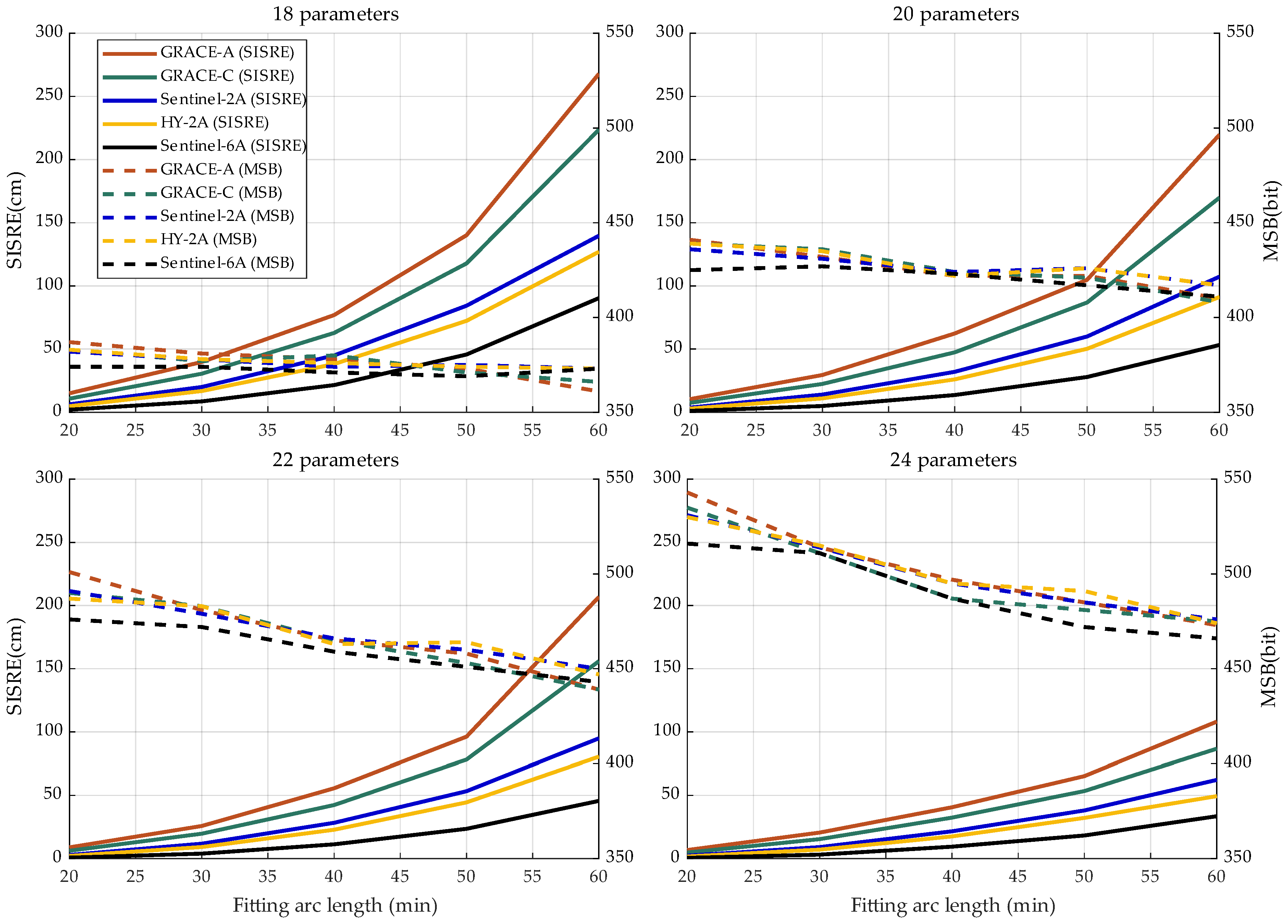
The integration of low Earth orbit (LEO) satellite constellations into the Global Navigation Satellite System (GNSS) has emerged as a prominent research focus, as LEO satellites can significantly enhance the precision of GNSS positioning, navigation, and timing (PNT) services. In the design of LEO navigation constellations, the development of an efficient broadcast ephemeris model is critical for delivering high-accuracy navigation solutions. This study extends the conventional 16-parameter Keplerian broadcast ephemeris model by proposing enhanced 18-, 20-, 22-, and 24-parameter models, ensuring compatibility with existing GNSS ephemeris standards. The performance of these models was evaluated using precise science orbit from five satellites at varying altitudes, ranging from 320 km to 1336 km. By analyzing fitting errors, Signal-in-Space Range Error (SISRE), and Message Size Bits (MSB) across different fitting arc durations and parameter counts, the optimal model configuration was identified. The results demonstrate that the 22-parameter model, which was constructed by augmenting the standard 16-parameter ephemeris with (a˙, n˙, Crs3, Crc3, Crs1, Crc1) delivers the best balance of accuracy and efficiency. With a fitting arc length of 20 min, the SISRE for the GRACE-A (320 km), GRACE-C (475 km), Sentinel-2A (786 km), HY-2A (966 km), and Sentinel-6A (1336 km) satellites were measured at 8.88 cm, 6.21 cm, 2.87 cm, 2.11 cm, and 0.75 cm, respectively. Meanwhile, the corresponding MSB remained compact at 501, 490, 491, 487, and 476 bits. These findings confirm that the proposed 22-parameter broadcast ephemeris model meets the stringent accuracy requirements for next-generation LEO-augmented GNSSs, paving the way for enhanced global navigation services.
Keywords: LEO satellite navigation; broadcast ephemeris; Kepler ephemeris model; least squares estimation; ephemeris message size; GNSS LEO satellite navigation; broadcast ephemeris; Kepler ephemeris model; least squares estimation; ephemeris message size; GNSS