Article

Global and Local Graph-Based Difference Image Enhancement for Change Detection

High-Tech Institute of Xi’an, Xi’an 710025, China
*
Author to whom correspondence should be addressed.
Remote Sens. 2023, 15(5), 1194; https://doi.org/10.3390/rs15051194
Submission received: 20 December 2022 / Revised: 18 January 2023 / Accepted: 23 January 2023 / Published: 21 February 2023

Abstract

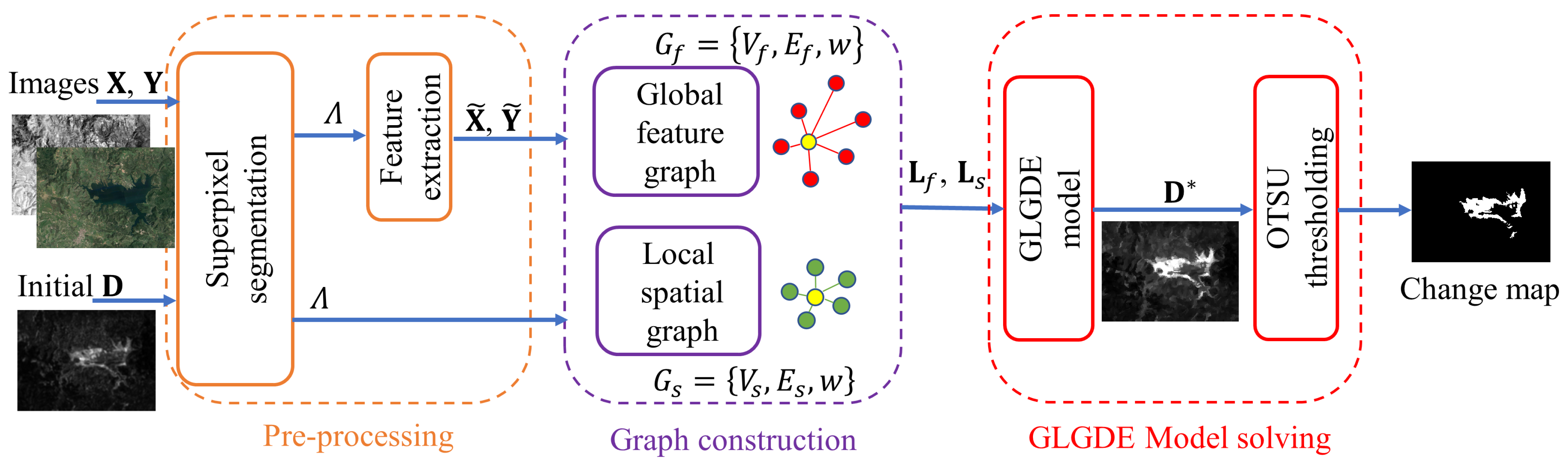
Change detection (CD) is an important research topic in remote sensing, which has been applied in many fields. In the paper, we focus on the post-processing of difference images (DIs), i.e., how to further improve the quality of a DI after the initial DI is obtained. The importance of DIs for CD problems cannot be overstated, however few methods have been investigated so far for re-processing DIs after their acquisition. In order to improve the DI quality, we propose a global and local graph-based DI-enhancement method (GLGDE) specifically for CD problems; this is a plug-and-play method that can be applied to both homogeneous and heterogeneous CD. GLGDE first segments the multi-temporal images and DIs into superpixels with the same boundaries and then constructs two graphs for the DI with superpixels as vertices: one is the global feature graph that characterizes the association between the similarity relationships of connected vertices in the multi-temporal images and their changing states in a DI, the other is the local spatial graph that exploits the change information and contextual information of the DI. Based on these two graphs, a DI-enhancement model is built, which constrains the enhanced DI to be smooth on both graphs. Therefore, the proposed GLGDE can not only smooth the DI but also correct the it. By solving the minimization model, we can obtain an improved DI. The experimental results and comparisons on different CD tasks with six real datasets demonstrate the effectiveness of the proposed method.
Keywords: change detection; difference image; smoothness; graph; heterogeneous data change detection; difference image; smoothness; graph; heterogeneous data