Article

Estimation of Handheld Ground-Penetrating Radar Antenna Position with Pendulum-Model-Based Extended Kalman Filter


Faculty of Electronics, Military University of Technology, ul. Gen. S. Kaliskiego 2, 00-908 Warsaw, Poland
*
Author to whom correspondence should be addressed.
Remote Sens. 2023, 15(3), 741; https://doi.org/10.3390/rs15030741
Submission received: 14 November 2022 / Revised: 23 January 2023 / Accepted: 25 January 2023 / Published: 27 January 2023
(This article belongs to the Special Issue Multi-Sensor Systems and Data Fusion in Remote Sensing II)

Abstract

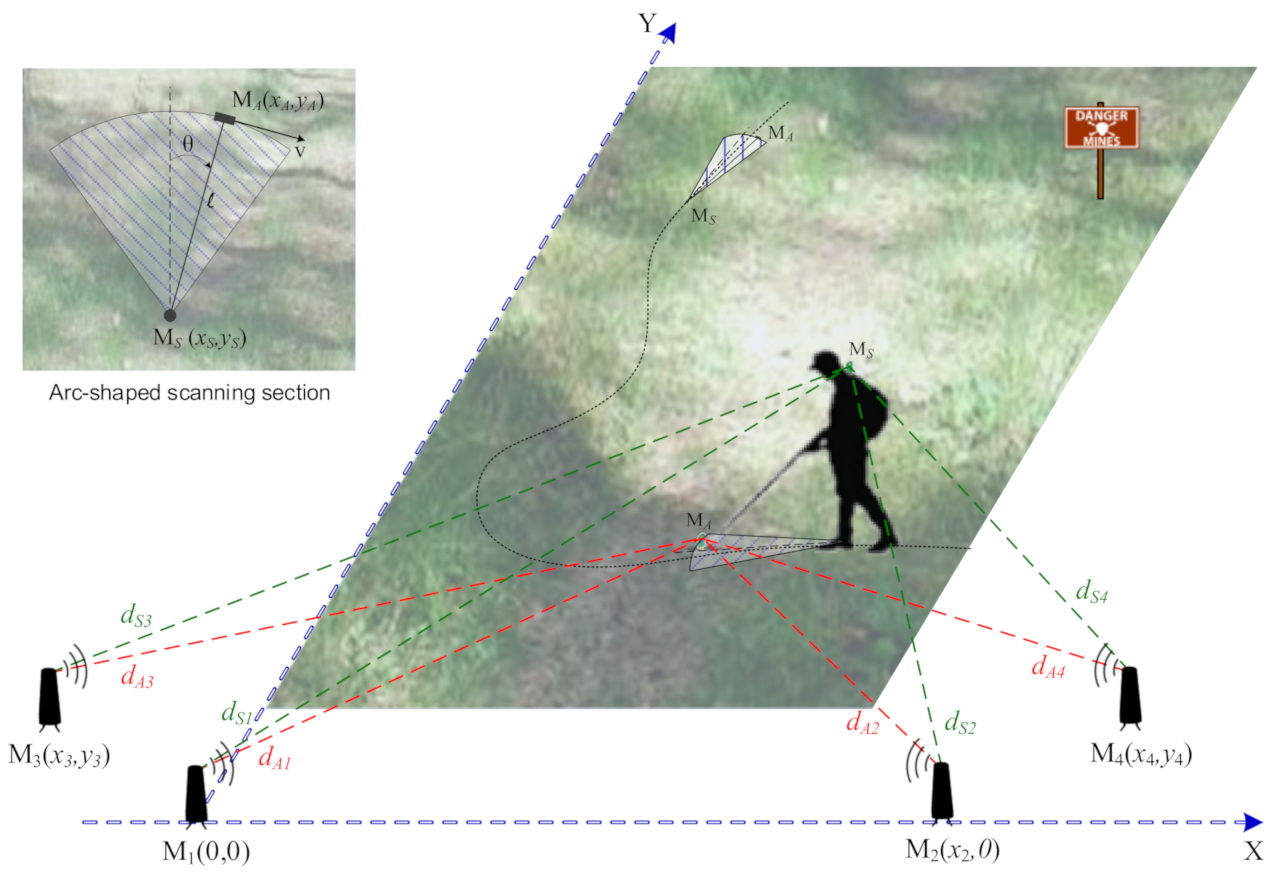
Landmines and explosive remnants of war are a significant threat in tens of countries and other territories, causing the deaths or injuries of thousands of people every year, even long after military conflicts. Effective technical means of remote detecting, localizing, imaging, and identifying mines and other buried explosives are still sought and have a great potential utility. This paper considers a positioning system used as a supporting tool for a handheld ground penetrating radar. Accurate knowledge of the radar antenna position during terrain scanning is necessary to properly localize and visualize the shape of buried objects, which helps in their remote classification and makes demining safer. The positioning system proposed in this paper uses ultrawideband radios to measure the distances between stationary beacons and mobile units. The measurements are processed with an extended Kalman filter based on an innovative dynamics model, derived from the model of a pendulum motion. The results of simulations included in the paper prove that using the proposed pendulum dynamics model ensures a better accuracy than the accuracy obtainable with other typically used dynamics models. It is also demonstrated that our positioning system can estimate the radar antenna position with the accuracy of single centimeters which is required for appropriate imaging of buried objects with the ground penetrating radars.
Keywords: ground-penetrating radar; GPR; position estimation; extended Kalman filter; EKF; ultrawideband radio modules; UWB; landmines detection; imaging ground-penetrating radar; GPR; position estimation; extended Kalman filter; EKF; ultrawideband radio modules; UWB; landmines detection; imaging