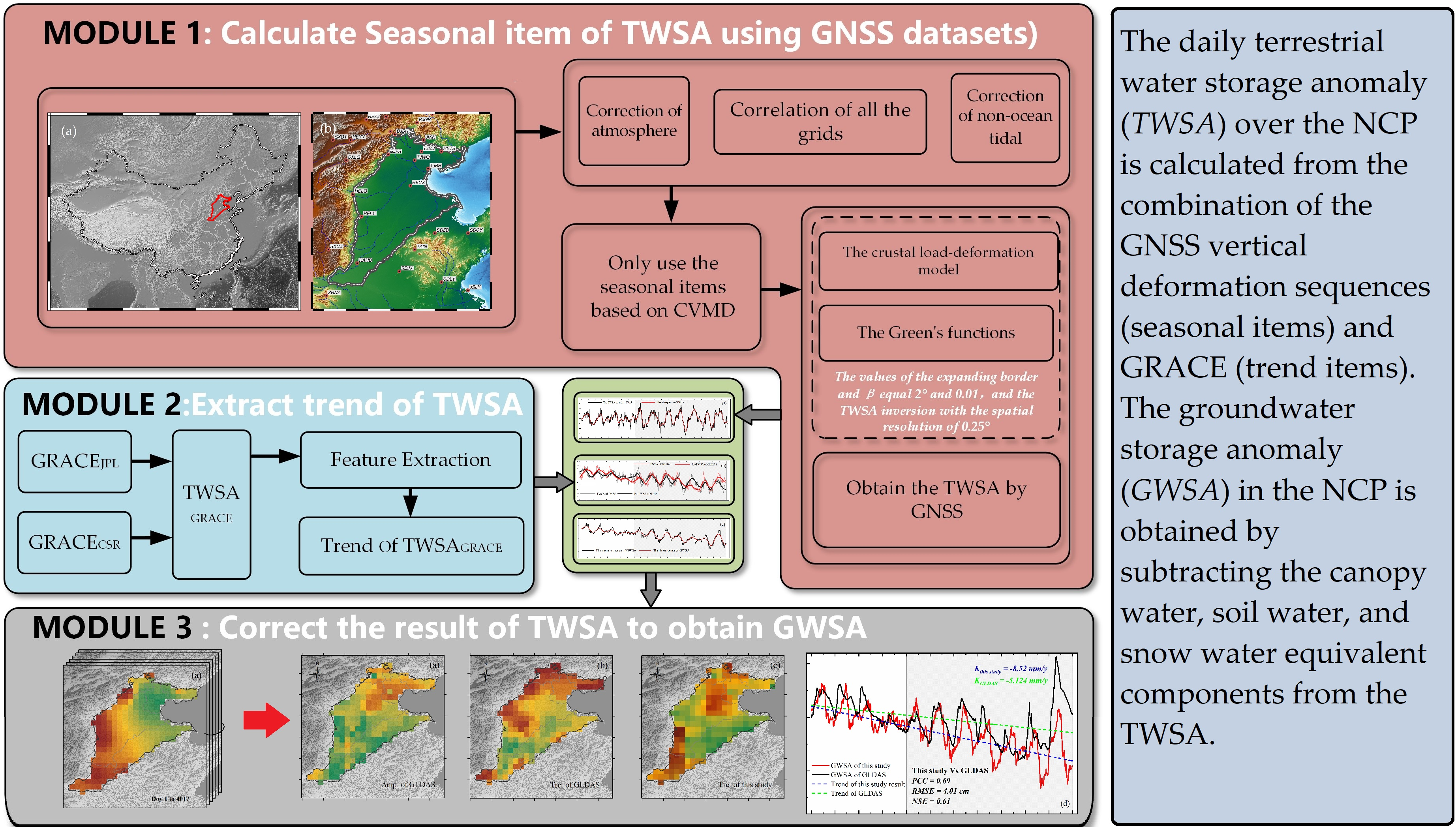
Inverted Algorithm of Groundwater Storage Anomalies by Combining the GNSS, GRACE/GRACE-FO, and GLDAS: A Case Study in the North China Plain
 ,
, Abstract
Share and Cite
Shen, Y.; Zheng, W.; Zhu, H.; Yin, W.; Xu, A.; Pan, F.; Wang, Q.; Zhao, Y. Inverted Algorithm of Groundwater Storage Anomalies by Combining the GNSS, GRACE/GRACE-FO, and GLDAS: A Case Study in the North China Plain. Remote Sens. 2022, 14, 5683. https://doi.org/10.3390/rs14225683
Shen Y, Zheng W, Zhu H, Yin W, Xu A, Pan F, Wang Q, Zhao Y. Inverted Algorithm of Groundwater Storage Anomalies by Combining the GNSS, GRACE/GRACE-FO, and GLDAS: A Case Study in the North China Plain. Remote Sensing. 2022; 14(22):5683. https://doi.org/10.3390/rs14225683
Chicago/Turabian StyleShen, Yifan, Wei Zheng, Huizhong Zhu, Wenjie Yin, Aigong Xu, Fei Pan, Qiang Wang, and Yelong Zhao. 2022. "Inverted Algorithm of Groundwater Storage Anomalies by Combining the GNSS, GRACE/GRACE-FO, and GLDAS: A Case Study in the North China Plain" Remote Sensing 14, no. 22: 5683. https://doi.org/10.3390/rs14225683
APA StyleShen, Y., Zheng, W., Zhu, H., Yin, W., Xu, A., Pan, F., Wang, Q., & Zhao, Y. (2022). Inverted Algorithm of Groundwater Storage Anomalies by Combining the GNSS, GRACE/GRACE-FO, and GLDAS: A Case Study in the North China Plain. Remote Sensing, 14(22), 5683. https://doi.org/10.3390/rs14225683